
Judge, 1920-10-23 · page 12 of 32
Judge — October 23, 1920 — page 12: what you’re looking at
What you’re looking at
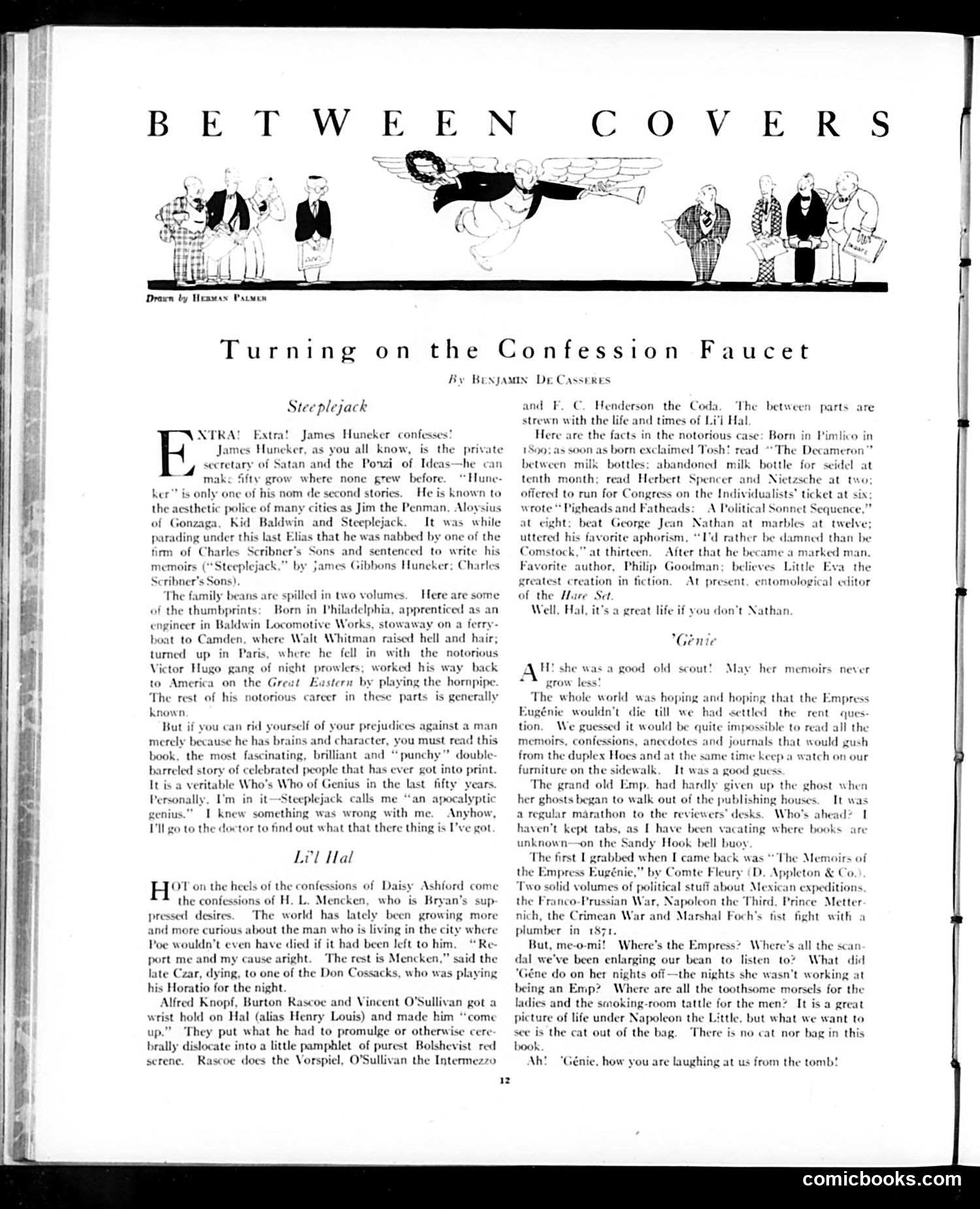
This page satirizes celebrity memoir-writing trends in the 1920s, featuring three prominent cultural figures and their published confessions: **James Huneker** (top section): A real music and drama critic whose memoirs are mocked as sensationalized. The satire exaggerates his colorful past—Paris bohemian circles, associations with Walt Whitman—suggesting his self-promotion as a "man of genius" is inflated. The author De Casseres plays along ironically, calling himself an "apocalyptic genius" in Huneker's book. **H.L. Mencken** ("Li'l Hal"): Described as Bryan's "suppressed desires" (referencing William Jennings Bryan, whom Mencken opposed), his memoir is presented as extracted by publishers Knopf, Rascoe, and O'Sullivan. The satire mocks both Mencken's pretensions and the publishing industry's hunger for celebrity revelations. The cartoon's point: American culture was obsessed with famous people's confessions and autobiographies, treated as entertainment rather than genuine insight. The satire ridicules both the subjects' vanity and readers' appetite for celebrity gossip dressed as literature.
📄 Transcribed text from this page (OCR, searchable)
Machine-transcribed from the original scan — historical spelling and the odd misread are preserved.
— Drawn by Heastax Patwnn Turning on the Confession Faucet By Bexjaatx De Casseres Steeplejack XTRA! Extra! James Huneker confesses! James Huneker, as you all know, is the private secretary of Satan and the Ponzi of Ideas—he can make fifty grow where none grew before.“ Hune- ker” is only one of his nom de second stories. He is known to the aesthetic po! of many cities as Jim the Penman. Aloysius of Gonzaga, Kid Baldwin and Steeplejack. It was while parading under this last Elias that he was nabbed by one of the firm of Charles Scribner's Sons and sentenced to write his ames Gibbons Huneker; Charles memoirs Scribner’s Sons) The family beans are spilled in two volumes. Here are some of the thumbprints: Born in Philadelphia, apprenticed as an engineer in Baldwin Locomotive Works, stowaway on a ferry- boat to Camden, where Walt Whitman raised hell and hair; turned up in Paris, where he fell in with the notorious Victor Hugo gang of night prowlers; worked his way back to America on the Great tern by playing the hornpipe. The rest of his notorious career in these parts is generally teeplejack.” by known But if you can rid yourself of your prejudices against a man merely because he has brains and character, you must read this book, the most fascinating, brilliant and “ punchy” double. barreled story of celebrated people that has ever got into print. It is a veritable Who's Who of Genius in the last fifty years. Personally, I'm in it—Steeplejack calls me “an apocalyptic genius.” I knew something was wrong with me. Anyhow, I'll go to the doctor to find out what that there thing is I’ve got Li'l Hal OT on the heels of the confessions of Daisy Ashford come the confessions of H. L. Mencken, who is Bryan’s sup pressed desires. The world has lately been growing more and more curious about the man who is living in the city where Poe wouldn’t even have died if it had been left to him, “ Re- port me and my cause aright. ‘The rest is Mencken,” said the late Czar, dying, to one of the Don Cossacks, who was playing his Horatio for the night Alfred Knopf, Burton Rascoe and Vincent O'Sullivan got a wrist hold on Hal (alias Henry Louis) and made him “come up.” They put what he had to promulge or otherwise cere brally dislocate into a little pamphlet of purest Bolshevist red serene. Rascoe does the Vorspiel, O'Sullivan the Intermezzo and F.C. Henderson the Coda. The between parts are strewn with the life and times of Li'l Hal Here are the facts in the notorious case: Born in Pimlico 1800; as s¢ s born exclaimed Tosh! read “The Decamer between milk bottles: abandoned milk bottle for seidel at tenth month; read Herbert Spencer and Nietzsche at two; red to run for Congress on the Individualists’ ticket at six wrote “ Pigheads and Fatheads: A Political Sonnet Sequence,” at eight; beat George Jean Nathan at marbles at twelve; uttered his favorite aphorism, “I'd rather be damned than be Comstock,” at thirteen. After that he became a marked man, Favorite author, Philip Goodman; believes Little Eva the greatest creation in fiction. At pre of the Hare Set. Well, Hal, it’s a great life if you don’t Nathan. ent. entomological editor "Génie Hi! she wa May her memoirs never grow less! The whole world was hoping and hoping that the Empress Eugénie wouldn't die till we had settled the rent ques tion. We guessed it would be quite impossible to read all the memoirs, confessions, anecdotes and journals that would h from the duplex Hoes and at the same time keep a watch on our furniture on the sidewalk. It was a good guess The grand old Emp, had hardly given up the ghost when her ghosts began to walk out of the publishing houses. It was a regular marathon to the reviewers’ desks. Who's haven't kept tabs, as [ have been vacating where be unknown—on the Sandy Hook bell buoy The first I grabbed when I came back was “The Memoirs of the Empress Eugénie,”” by Comte Fleury (D. Appleton & Co. ‘Two solid volumes of political stuff about Mexican expeditions the Franco-Prussian War, Napoleon the Third, Prince Metter nich, the Crimean War and Marshal Foch’s fist fight with a plumber in) 1871. But, me-o-mi! Where's the Empress? Where's all the scan dal we've been enlarging our bean to listen to? What did "Géne do on her nights off—the nights she wasn’t working at being an Emp? Where are all the toothsome morsels for the ladies and the smoking-room tattle for the men? It is a great picture of life under Napoleon the Little, but what we want to see is the cat out of the bag. There is no cat nor bag in this good old sc book Ah! ‘Génie, how you are laughing at us from the tomb! —=re comicbooks.com