
Judge, 1920-10-23 · page 20 of 32
Judge — October 23, 1920 — page 20: what you’re looking at
What you’re looking at
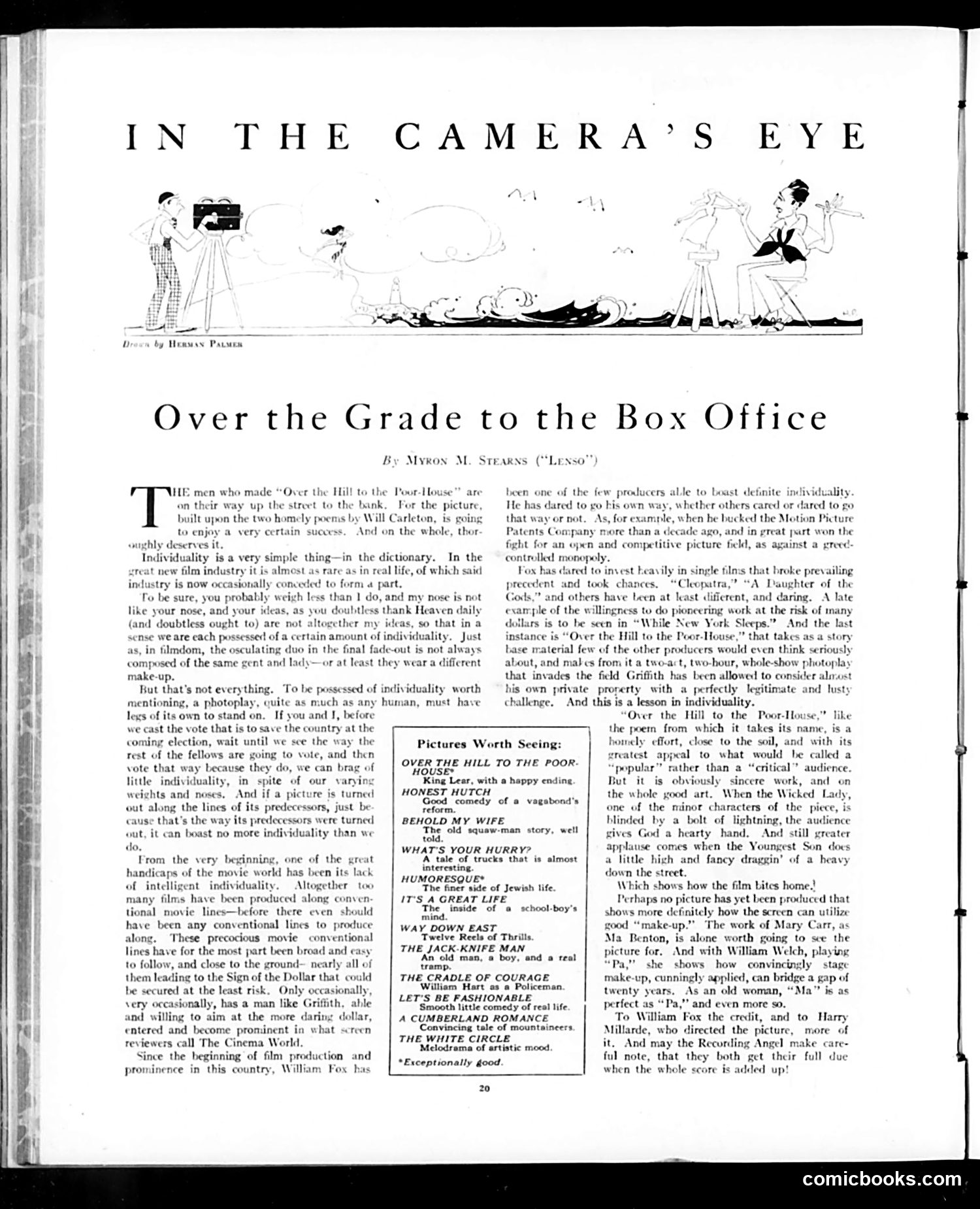
This is not a political cartoon but rather an article by Myron M. Stearns praising William Fox's film production company for demonstrating "individuality" in an industry that typically copies successful formulas. The accompanying illustration (by Herman Palmer) shows a film production in progress—a cameraman, director, and actors on set. **The argument**: Stearns criticizes Hollywood for producing interchangeable films that follow predecessors slavishly, lacking genuine creative courage. He contrasts this with Fox, who has invested in daring, original projects like *Cleopatra* and *While New York Sleeps*, and most recently *Over the Hill to the Poor-House*—adapted from Will Carleton's homely poems rather than conventional material. **The satire**: The piece implicitly mocks the film industry's creative cowardice and profit-driven conformity, using political voting as an analogy: just as voters mindlessly follow others' choices, studios mindlessly copy competitors' successes. Fox is positioned as the rare exception willing to risk money on genuine artistic merit and unconventional stories for working-class audiences.
📄 Transcribed text from this page (OCR, searchable)
Machine-transcribed from the original scan — historical spelling and the odd misread are preserved.
‘ bs ae — yr Drown by Henwas Patsren Over the Grade to the Box Office picture built upon the two homely poems by Will Carleton, is going to enjoy a very certain success. And on the whole, thor cnnghly deserves it, Individuality is a very simple thing—in the dictionary. In the great new film industry it is almost as rare as in real life, of which said is now occasionally conceded to form a part. you probably weigh less than 1 do, and my nose is not like your nose, and your ideas, as you doubtless thank Heaven daily (and doubtless ought to) are not altogether my ideas, so that in a sense we are each possessed of a certain amount of individuality. Just as, in filmdom, the osculating duo in the final fade-out is not always composed of the same gent and lady—or at least they wear a different make-up. But that’s not everything. To be possessed of individuality worth mentioning, a photoplay, quite as much as any human, must have legs of its own to stand on. If you and J, before we cast the vote that is to save the country at the ning election, wait until we sce the way the rest of the fellows are going to vote, and then vote that way because they do, we can brag of little individuality, in spite of our vary weights and noses. And if a picture is tured out along the lines of its predecessors, just be reform. cause that’s the way its predecessors were turned IIE men who made “Over the Hill to the Poor-Ile on their way up the street to the bank, For t indust To be sure, % HOUSE* Pictures Worth Seeing: OVER THE HILL TO THE POOR. King Lear, with a happy ending. HONEST HUTCH Good comedy of a vagebond's BEHOLD MY WIFE Myron M. Stearns (“Lexso”™ lity. whether others cared or dared to way or not. As, for example, when he bucked the Motion Picture tents Company more than a decade ago, and in great part won the ht for an open and competitive picture field, as against a greed- controlled monopoly. has dared to invest heavily in single films that broke prevailing ent and took chances. “Cleopatra,” “A Daughter of the * and others have Leen at least different, and daring. A late example of the willingness to do pioneering work at the risk of many dollars is to be seen in “While New York Sleeps.” And the last instance is “Over the Hill to the Poor-House,” that takes as a story base material few of the other producers would even think seriously about, and mab cs from it a two-act, two-hour, whole-show photoplay that invades the field Griffith has been allowed to consider almost his own private prorerty with a perfectly legitimate and lusty challenge. And this is a lesson in individuality. Over the Hill to the Poor-House,” like } the poem from which it takes its name, is a homely effort, close to the soil, and with its test appeal to what would be called a “popular” rather than a “critical” audience. But it is obviously sincere work, and on the whole good art. When the Wicked Lad one of the minor characters of the piece, i blinded by a bolt of lightning, the been one of the few producers able to boast definite indivi He has dared to go kis own w lience out, it can boast no more individuality than we Bo} old squaw-man story, well gives da hearty hand. And still greater do, WHAT'S YOUR HURRY? applause comes when the Youngest Son docs From the very beginning, one of the great handicaps of the movie world has been its lack of intelligent individuality. Altogether too many films have been produced along conven onal movie lines—before there even should have been any conventional lines to produce along. ‘These precocious movie conventional lines have for the most part been broad and easy to follow, and close to the ground~ nearly all of tramp. them leading to the Sign of the Dollar that c be secured at the least risk. Only occasionally, very occasionally, has a man like Griffith, able and willing to aim at the more di entered and become prominent in what screen reviewers call The Cinema W Since the beginning of film production and prominence in this country, William Fox has interesting. mind. ring dollar, A tale of trucks that is almost HUMORESQUE* The finer side of Jewish life. IT’S_A GREAT LIFE The inside of a school-boy’s WAY DOWN EAST. Twelve Reels of Thrills. THE JACK-KNIFE MAN ‘An old man, a boy, and a real ald THE CRADLE OF COURAGE William Hart as a Policeman. LET'S BE FASHIONABLE Smooth little comedy of real life. A CUMBERLAND ROMANCE Convincing tale of mountaineers. ld THE WHITE CIRCLE zs Melodrama of artistic mood. *Exceptionally good. a little high and fancy draggin’ of a heavy down the street. Which shows how the film bitcs home.! Perhaps no picture has yet been produced that shows more definitely how the screen can utilize good “make-up.” The work of Mary Carr, as Ma Renton, is alone worth going to sce the picture for, And with William Welch, playing ”" she shows how convincingly stage make-up, cunningly applied, can bridge a gap of twenty years, As an old woman, “Ma” is as perfect as “Pa,” and even more so. To William Fox the credit, and to Harry Millarde, who directed the picture, more of it. And may the Recording Angel ke care ful note, that they both get their full due when the whole seo added up! comicbooks.com