
A complete issue · 34 pages · 1920
Judge — September 25, 1920
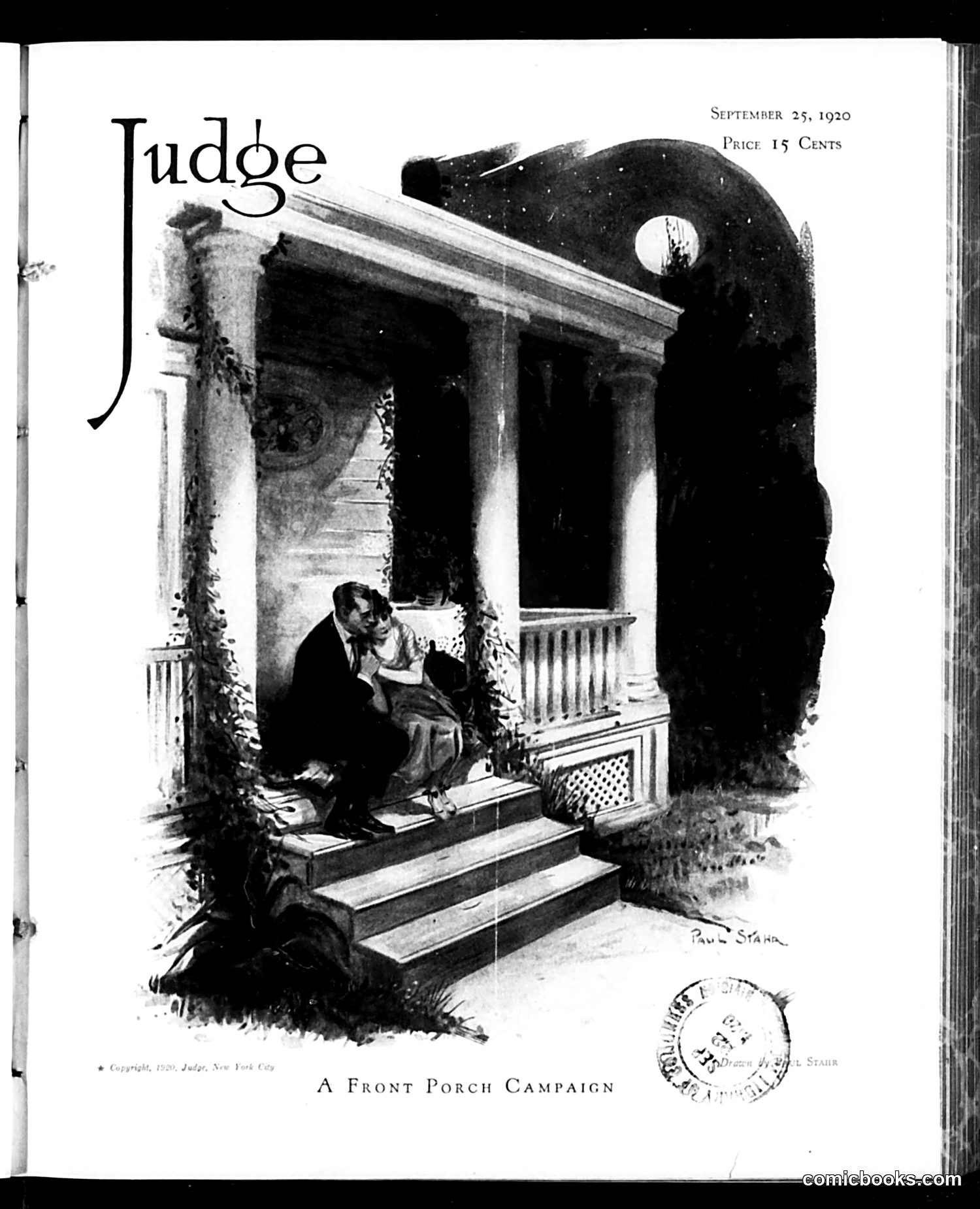
This Judge magazine cover from September 25, 1920 satirizes political campaigning through a domestic scene. Two figures embrace on a house's front porch, watched by a large, shadowy moon figure looming overhead. The title "A Front Porch Campaign" likely references the 1920 presidential election strategy, where candidates campaigned from their homes rather than traveling extensively. The intimate porch setting—traditionally associated with courting or private moments—suggests the satire mocks the domesticity or passivity of this campaign style. The looming moon figure appears ominous or intrusive, possibly representing public scrutiny or fate watching over the proceedings. The work critiques the election season's theatricality or the artificial staging of political messaging through the homey "front porch" approach popularized in that era's campaigns.
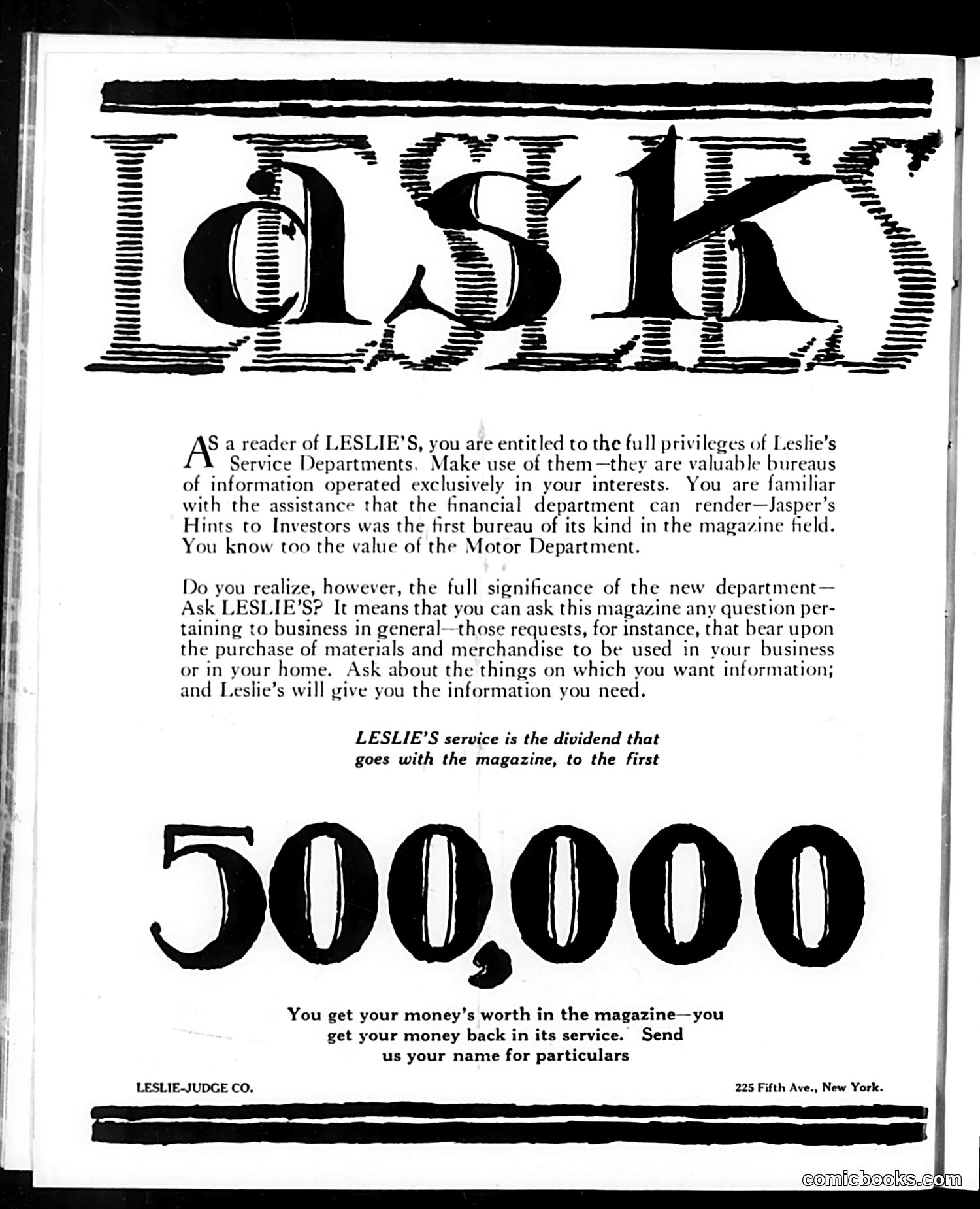
This page is primarily **advertising, not editorial content or satire**. It's a promotional piece for *Leslie's* magazine, placed within *Judge* magazine. The ad announces the launch of Leslie's "Ask Leslie's" service department—a reader advisory service answering questions about business, purchases, and household matters. The large number "500,000" emphasizes the scale of this initiative. The text uses the phrase "dividend that goes with the magazine," positioning reader services as added value. The final tagline—"You get your money's worth in the magazine—you get your money back in its service"—is a straightforward marketing claim. No political satire or cartoon caricatures appear here. This is a straightforward trade advertisement typical of early-to-mid 20th century magazine cross-promotion.
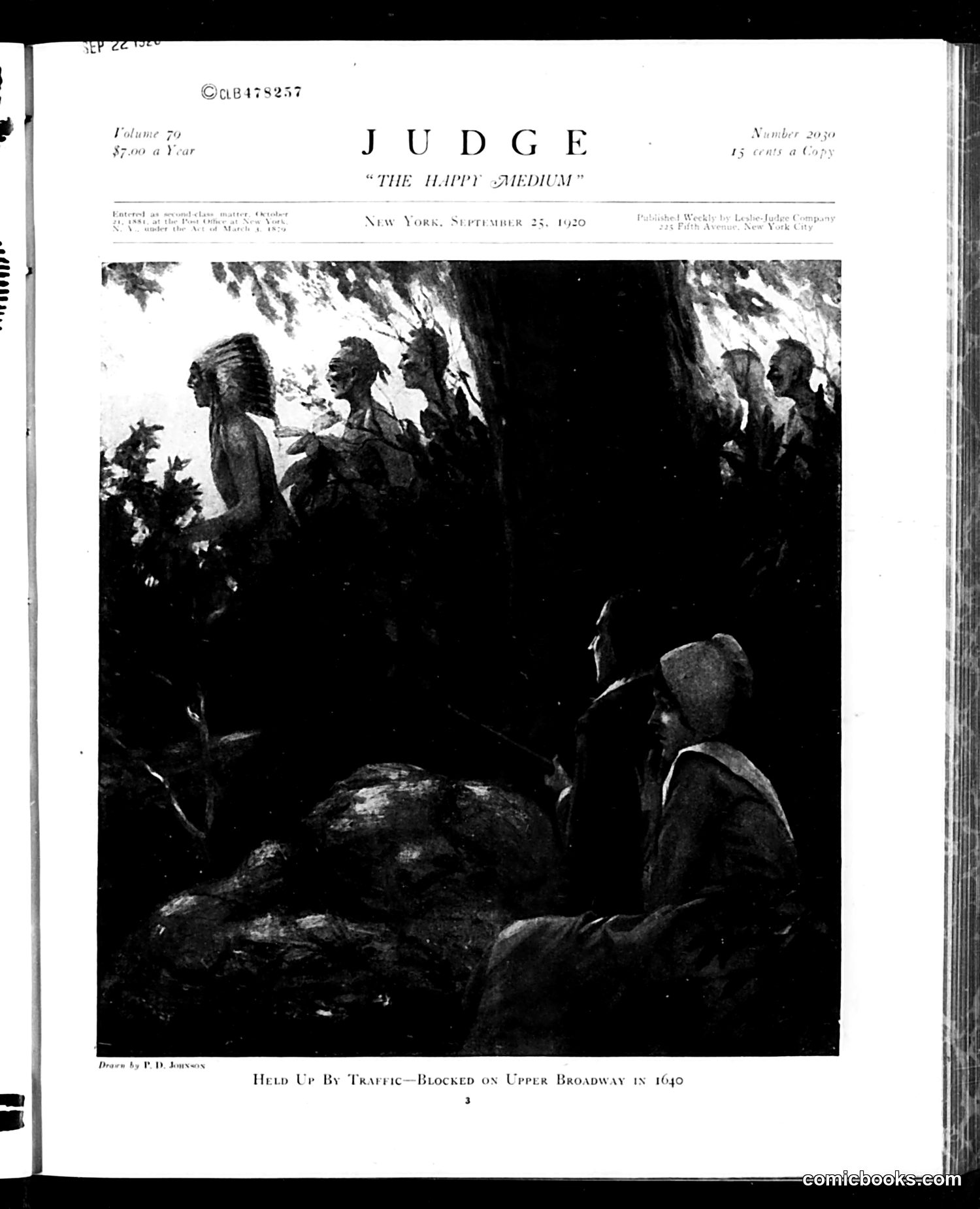
This is a Judge magazine cover from September 25, 1920. The illustration, drawn by F.D. Johnson, depicts a scene titled "Held Up By Traffic—Blocked on Upper Broadway in 1640." The satire appears to be a **historical anachronism joke**: it shows Native Americans (identifiable by headdresses) seemingly causing traffic congestion on Upper Broadway as if they still occupied Manhattan in 1640—which was historically accurate for that era. The humor lies in the absurdist premise of modern 1920s traffic problems being "blocked" by Indigenous people, inverting the actual history where European settlement displaced Native populations. This represents the type of casual, crude racial humor typical of early-20th-century American satire magazines, using Indigenous peoples as comic subjects without meaningful commentary.
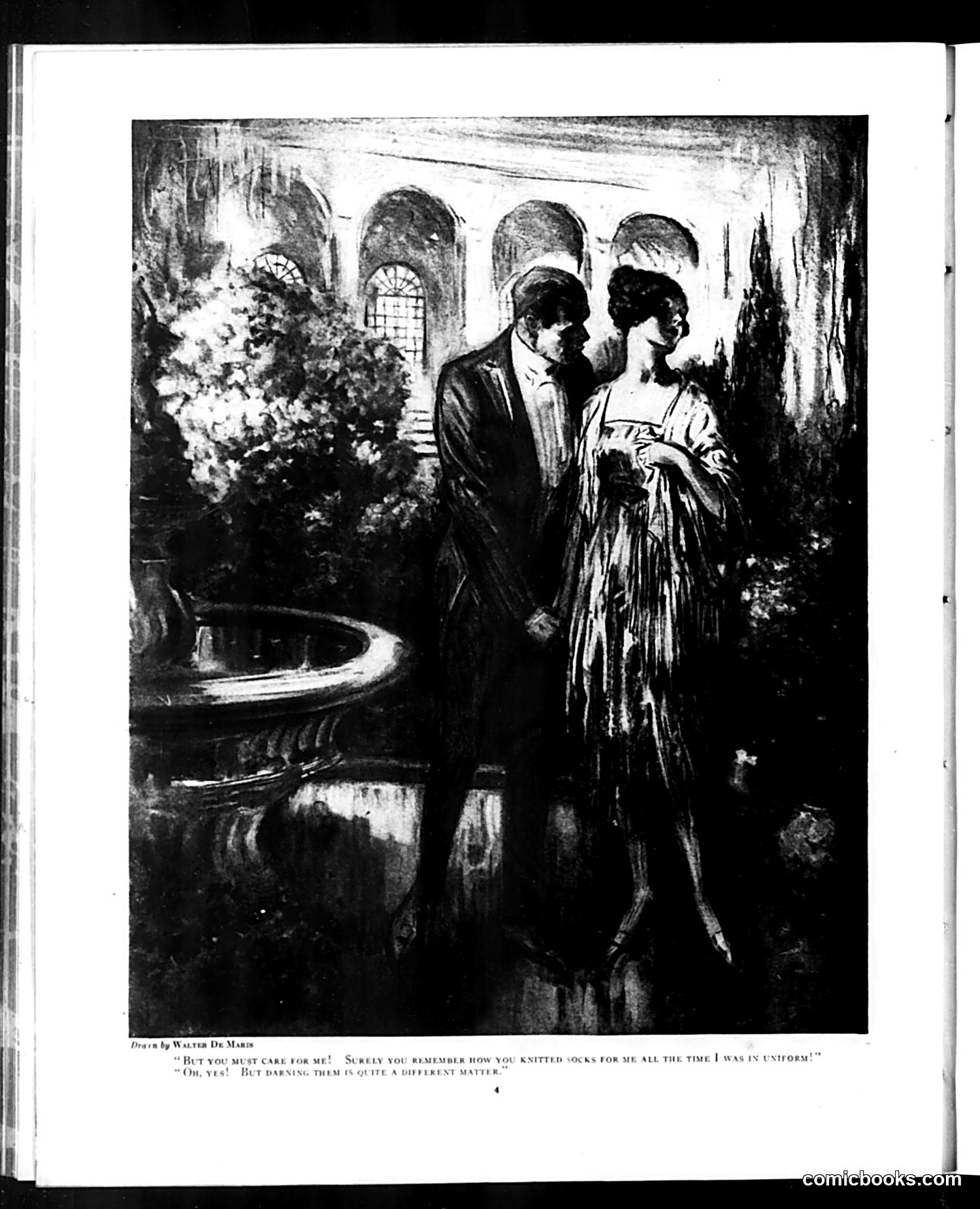
This drawing by Waiter De Maris depicts an interior scene with architectural elements (arches, a fountain) and three figures in formal dress. The dialogue references someone in uniform and knitted socks, suggesting a military or wartime context. The caption dialogue—"But you must care for me! Surely you remember how you knitted socks for me all the time I was in uniform?" and "Oh, yes! But darning them is quite a different matter"—appears to be romantic or domestic satire, likely commenting on post-war relationships or the shift from wartime domestic support to peacetime obligations. Without additional context about the specific issue date, the exact identities of the figures remain unclear, though the uniform reference suggests this relates to a wartime period in American history.
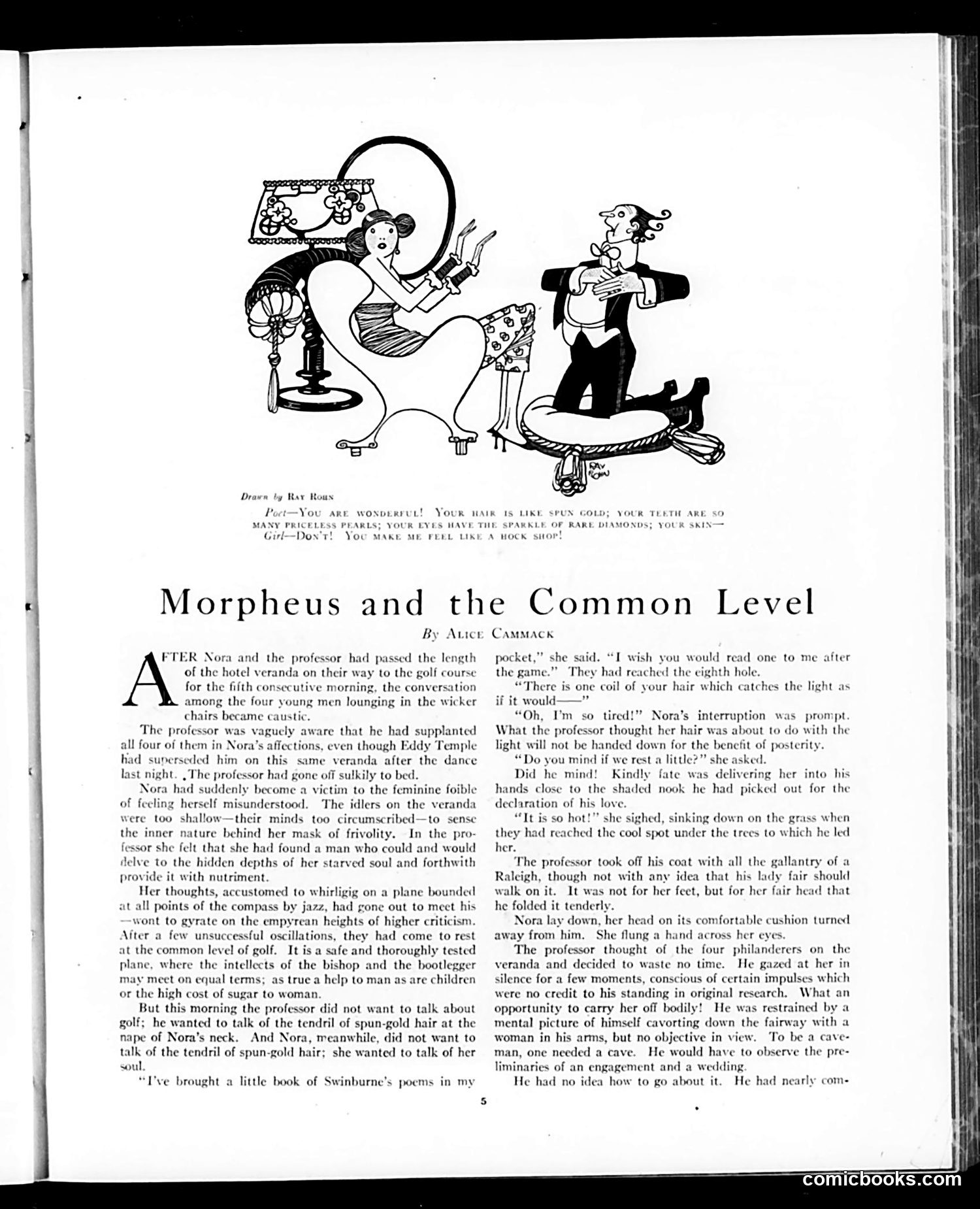
The top cartoon by Ray Rohn depicts a flapper-era couple: a woman with bobbed hair and fashionable dress receiving compliments from an admiring man. His dialogue praises her appearance ("spun gold" hair, pearl-like teeth, diamond-bright eyes), but she dismisses him—"You make me feel like a hock shop!" This satirizes 1920s dating culture and the objectification of women. The "hock shop" retort suggests she feels reduced to merchandise being appraised and pawned off, not genuinely appreciated as a person. It's social commentary on superficial courtship amid the Jazz Age's transformation of gender relations. The accompanying story "Morpheus and the Common Level" by Alice Cammack (below) appears unrelated—a literary piece about a professor and romance.
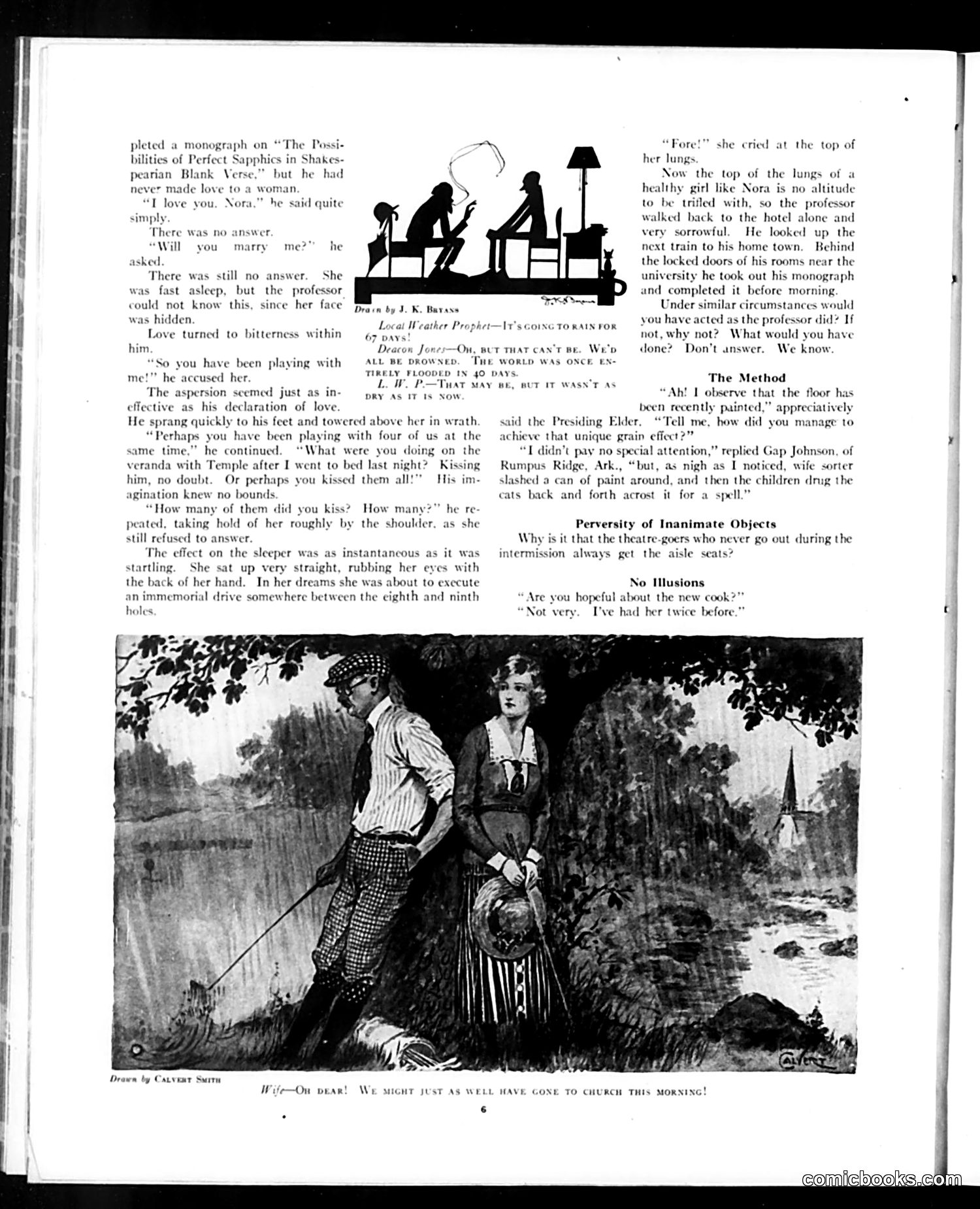
This page contains two illustrated stories with satirical commentary: **Top illustration** (by J.K. Barrass): Shows a professor confronting a female student about her affair, titled "Love in Wartime Prophecy." The satire mocks academic pretension—the professor lectures the sleepy student about rain predictions while claiming moral authority, then becomes enraged upon discovering she's been romantically involved. The joke critiques professorial hypocrisy and outdated courtship standards. **Bottom illustration** (by Calvert Smith): Depicts three figures by a river with the caption about nearly going to church. This appears to be generic domestic humor about avoiding religious obligation. The page's section headings—"The Method," "Perversity of Inanimate Objects," "No Illusions"—suggest this is a humor miscellany targeting educated readers with observations about human nature and social behavior rather than specific political events.
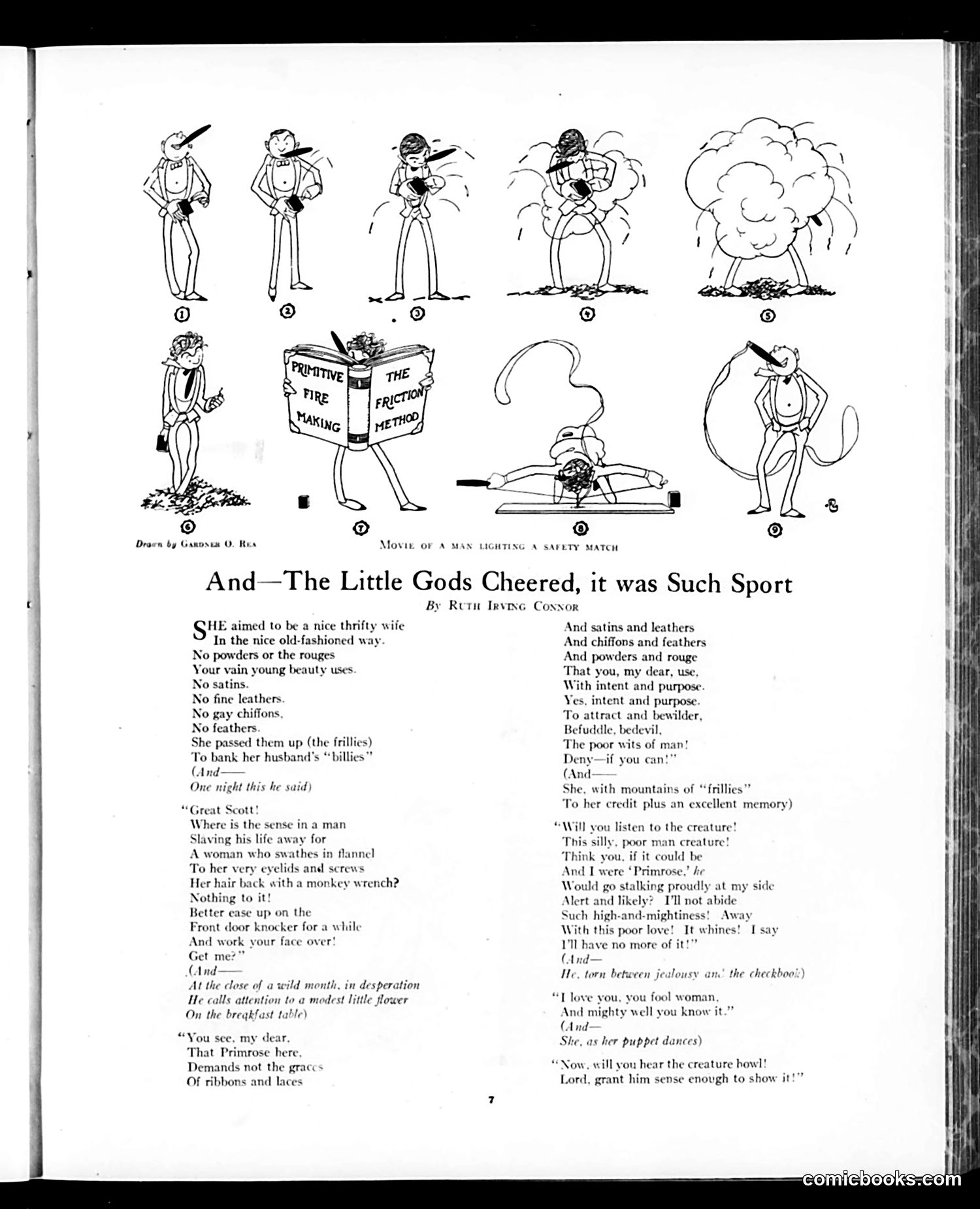
This satirical piece mocks early 20th-century marriage dynamics and changing gender expectations. The cartoon depicts a husband's frustration with his wife's rejection of traditional feminine adornment (ribbons, laces, powders, rouge) in favor of austere, practical clothing—a likely reference to the "New Woman" movement and suffragist ideals gaining traction at the time. The husband attempts to manipulate her by romanticizing natural simplicity (the primrose flower), but she sees through his manipulation, rejecting his "poor love" as insincere whining. The poem's title and closing suggest the "gods" (observers) find entertainment in this domestic power struggle. The satire cuts both ways: mocking both the husband's failed manipulation tactics and the wife's fierce independence. The underlying tension reflects anxieties about women rejecting prescribed femininity and asserting autonomy in marriage—radical ideas for the era.
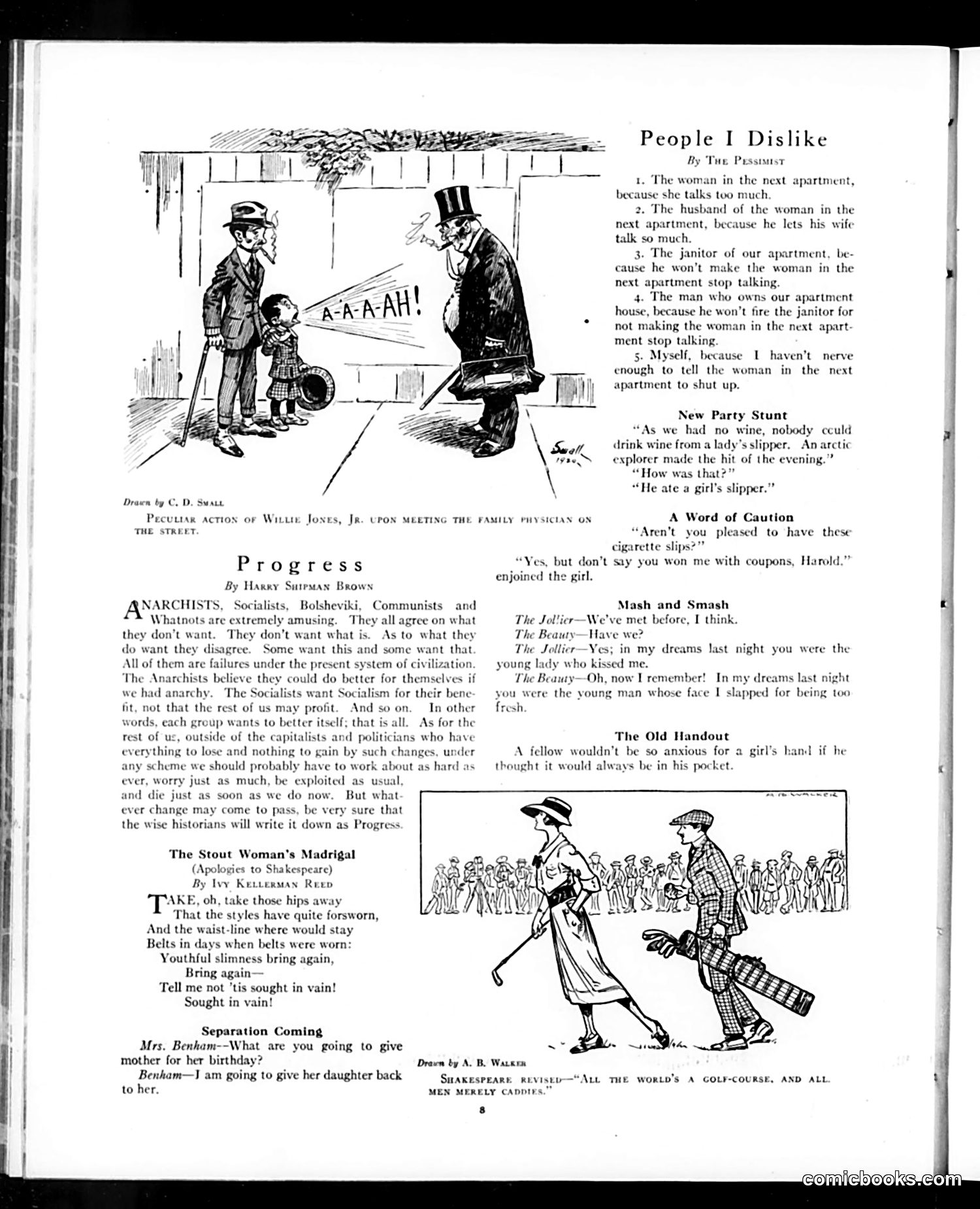
**Top Cartoon**: A well-dressed man encounters a doctor on the street while holding a small child. The child sneezes ("A-AAH!"), and the man appears to be introducing his child to the physician. The joke references "Willie Jones, Jr."—this satirizes upper-class etiquette where social introductions were formal and elaborate. The humor lies in the absurdity of formally introducing one's child to a stranger simply because that stranger happens to be a doctor, treating a chance encounter as a social obligation. **Text Content**: The page contains light satirical humor columns typical of early 20th-century magazines—complaints about noisy neighbors, party anecdotes, romantic banter, and golf jokes. These are domestic humor pieces reflecting middle-class anxieties and social customs of the era, not political commentary. The "Progress" essay critiques radical political movements (anarchists, socialists, Bolsheviks) as self-interested, arguing that regardless of which system wins, ordinary people will suffer equally under any regime.
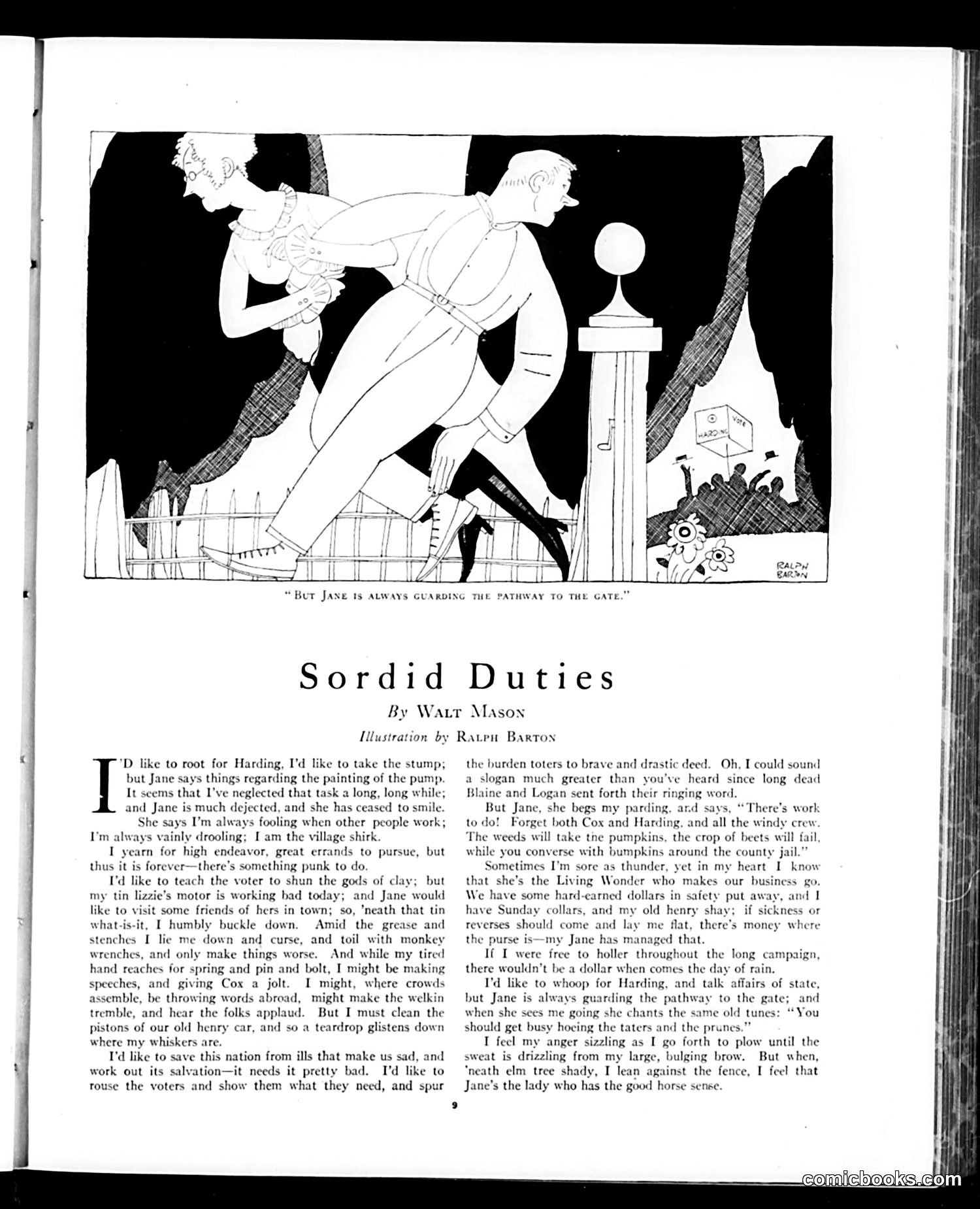
This poem by Walt Mason, illustrated by Ralph Barton, satirizes the tension between political ambition and domestic obligation during the 1920 election cycle. The unnamed narrator wants to campaign for Warren Harding (and against James Cox, the Democratic candidate) but is repeatedly prevented by his wife Jane, who insists he attend to practical household tasks—fixing their automobile ("tin lizzie"), painting pumps, hoeing vegetables. The satire targets male voters' grandiose political aspirations versus their actual, mundane responsibilities. The "Living Wonder" Jane represents practical domestic management that keeps the family solvent, while the husband dreams of making speeches and political impact. The cartoon's caption—"Jane is always guarding the pathway to the gate"—suggests she controls access to any larger ambitions. The joke: American men fantasize about political engagement while their wives maintain financial stability through unglamorous household work.
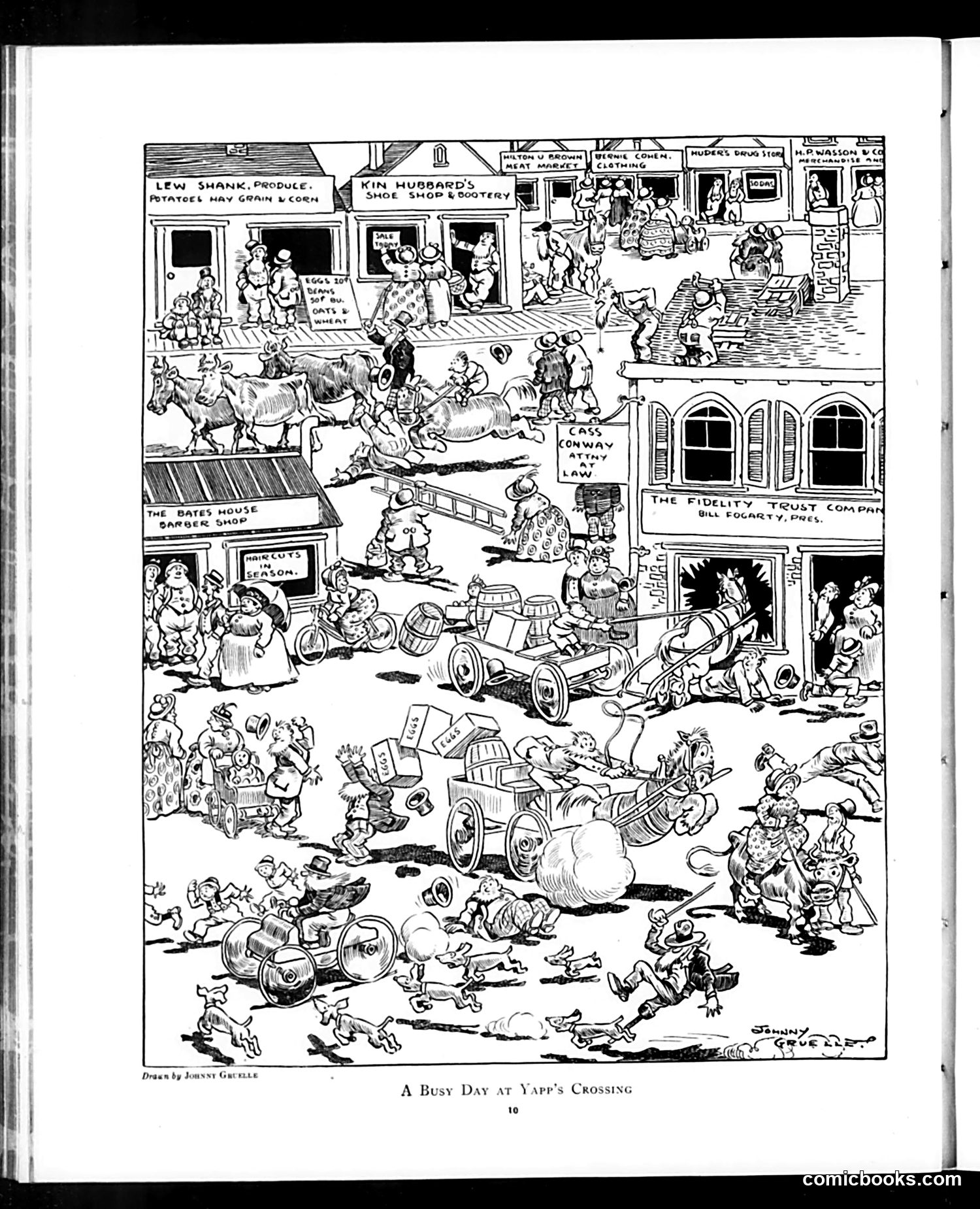
This is a densely-packed satirical street scene depicting commercial chaos and accident-prone activity at a town intersection. The cartoon identifies several businesses by name (Lew Shank's produce, Kin Hubbard's shoe shop, The Fidelity Trust Company, The Bates House Barber Shop) suggesting this represents a typical American small-town commercial district. The humor derives from depicting simultaneous mishaps—overturned carts, colliding vehicles, people falling, scattered goods—creating deliberate visual pandemonium. The exaggerated chaos satirizes either: the increasing mechanization/automobile traffic disrupting traditional commerce, or general small-town incompetence and disorder. The presence of multiple horse-drawn vehicles alongside early automobiles suggests this cartoon comments on the friction between old and new transportation methods. Without a clear date visible, the specific historical reference remains unclear, though the artistic style suggests early 20th century.
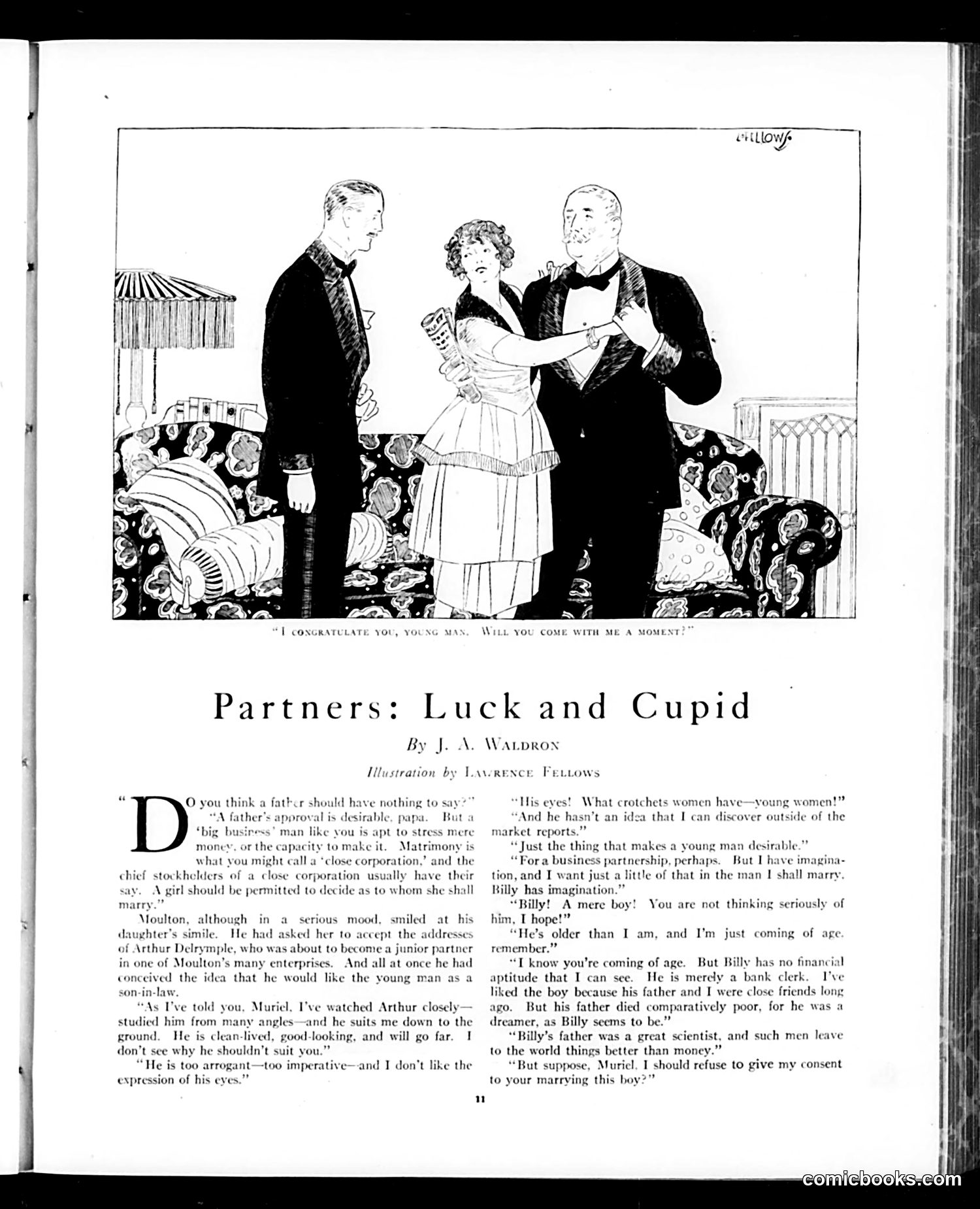
This is a short story (not a political cartoon) illustrating a common early-20th-century social conflict: a father's pragmatic view of marriage versus his daughter's romantic ideals. **The Setup:** Mr. Moulton, a wealthy businessman, wants his daughter Muriel to marry Arthur Delrymple, a junior partner in his company—a financially sensible match. Muriel refuses, preferring Billy, a bank clerk and son of a deceased scientist, whom she finds imaginative and kind-hearted. **The Satire's Point:** The story mocks the tension between two worldviews: the father's mercenary approach (marriage as "business partnership") and the daughter's romantic values (imagination, character, love). The title "Luck and Cupid" suggests fate and emotion will ultimately prevail over paternal financial logic. **Social Context:** This reflects Progressive-era anxieties about women's increasing independence in mate selection and the clash between old patriarchal control and emerging romantic autonomy for young women. The illustration shows the tense domestic scene where these arguments occur.
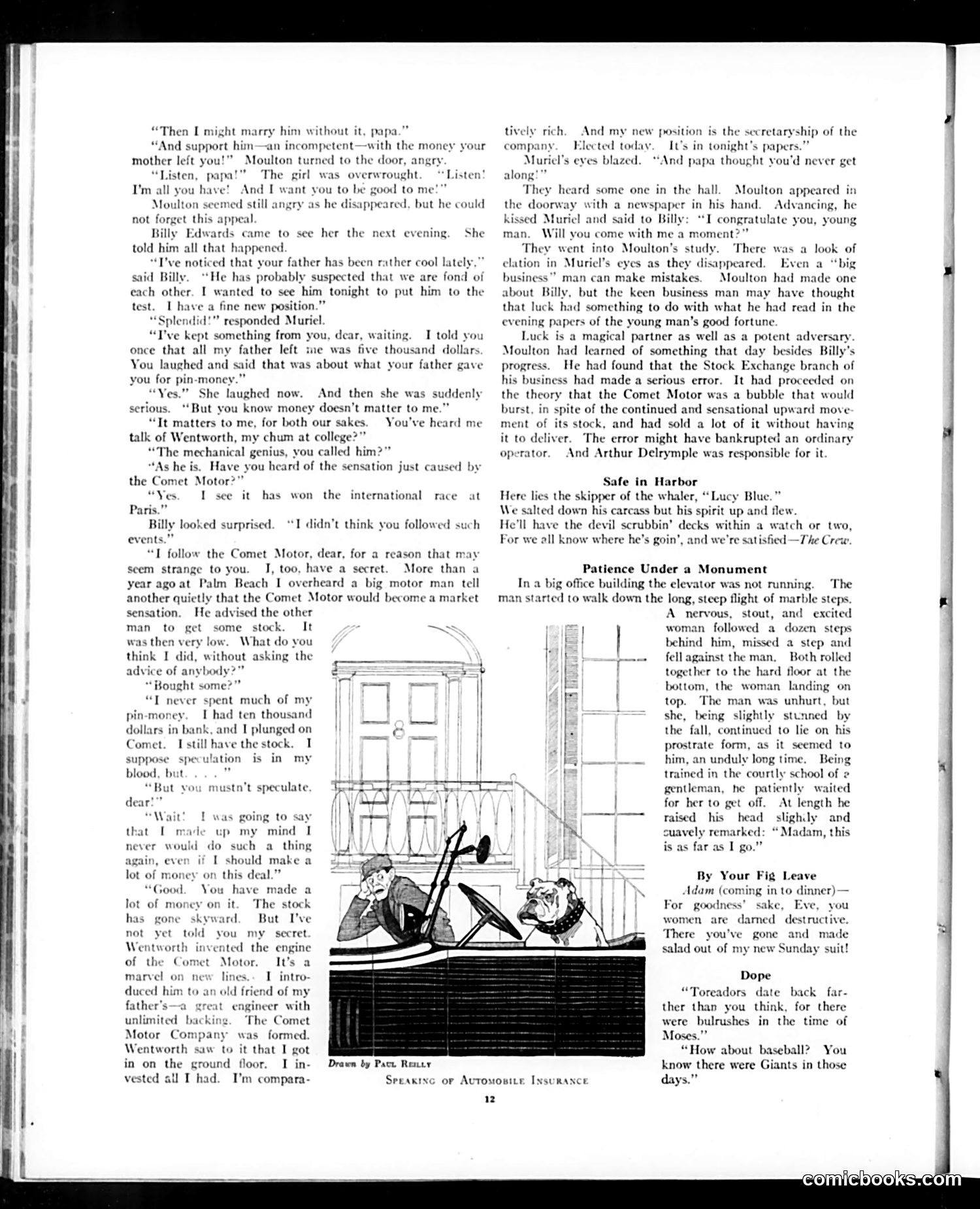
This page contains a serialized romance story (not a political cartoon) about a young man named Billy Edwards courting Muriel Moulton despite her father's disapproval based on Billy's perceived financial incompetence. **The Plot:** Billy's wealthy father-in-law initially rejected him for lacking money, but Billy reveals he secretly invested in the Comet Motor—an early automobile that won an international race and became hugely profitable. Billy now holds a prestigious position as secretary of the Comet Motor Company, vindicating his character and business sense. **The Satire:** The story satirizes late-19th/early-20th-century upper-class assumptions about masculine worth being measured purely by wealth and financial success. It mocks the snobbish father who initially judged Billy as incompetent, only to be humbled when Billy's shrewd speculation makes him rich. The tale celebrates entrepreneurial luck and industrial innovation (automobiles) as paths to respectability and marriage eligibility. **Historical Context:** This reflects the Gilded Age obsession with stock speculation and the emerging automobile industry as markers of modern success.
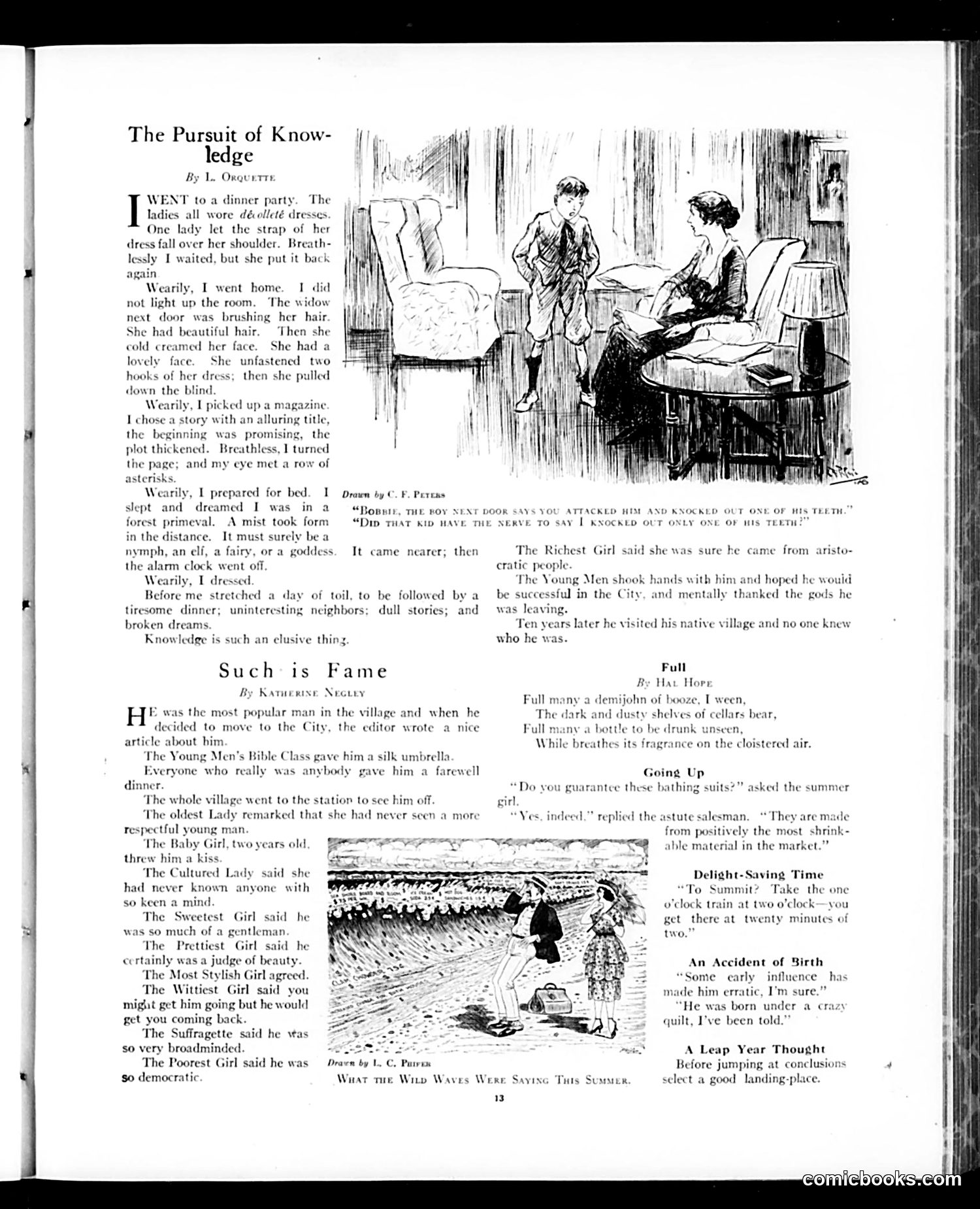
This page from *Judge* contains three satirical pieces mocking social pretense and human nature: **"The Pursuit of Knowledge"** (top left): A man attends a dinner party hoping for romantic/scandalous encounters—a woman's exposed shoulder, a widow undressing—but is repeatedly disappointed. He seeks titillation in a magazine only to find censored passages (asterisks), representing Victorian-era prudishness. The satire mocks both male voyeurism and society's hypocritical censorship of adult content. **"Such is Fame"** (center): A village's most popular man moves to the city; everyone celebrates him effusively. Ten years later, he returns—now forgotten and unrecognized. The satire skewers small-town social climbing and the hollowness of local celebrity. **Minor jokes** (right column): Brief satirical quips on topics like deceptive clothing labels, train schedules, and family dysfunction. These target consumer fraud, bureaucratic absurdity, and Victorian explanations for mental illness ("born under a crazy quilt"). The cartoons employ heavy irony to expose social hypocrisy, shallow values, and human foolishness typical of early 20th-century *Judge* humor.
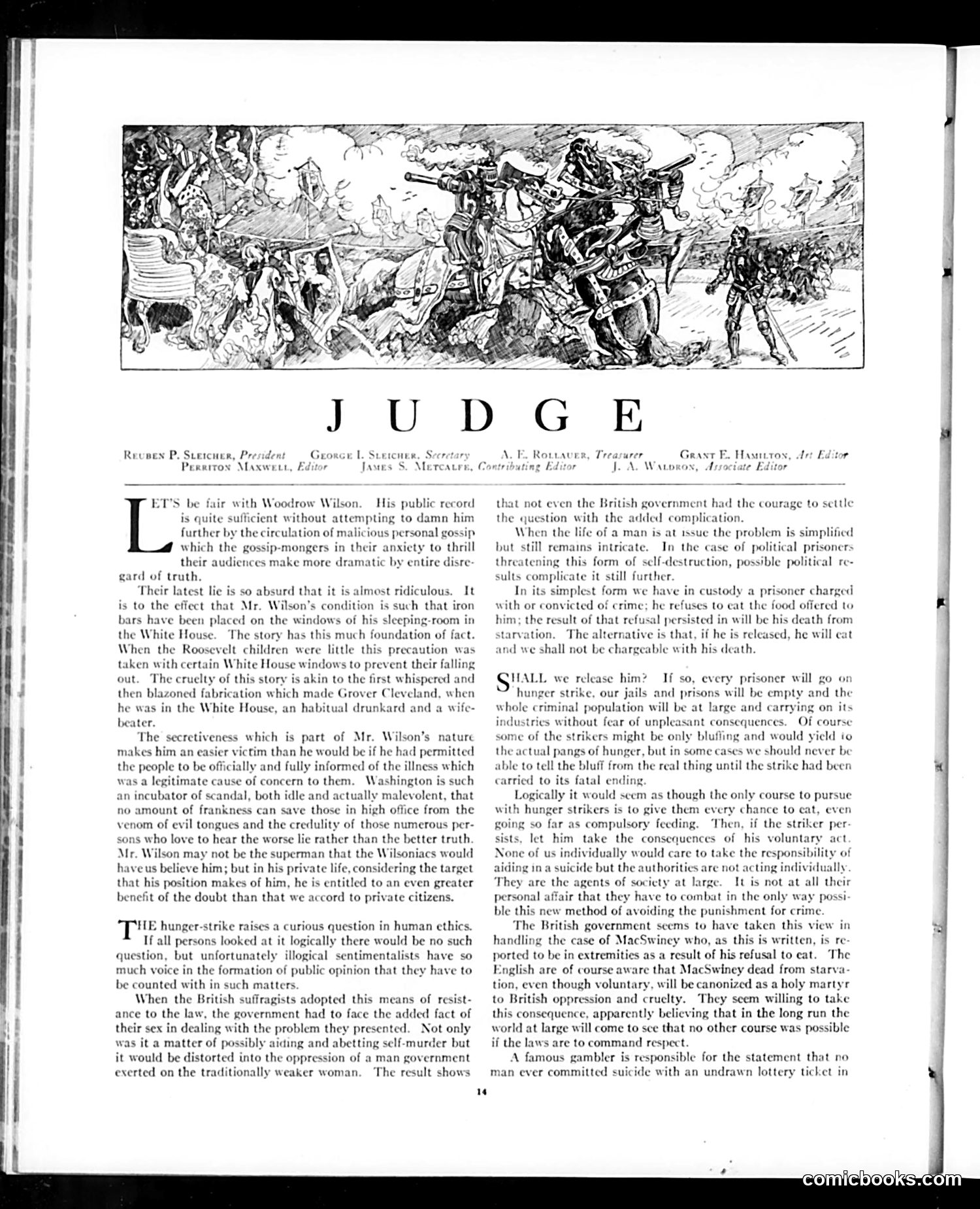
This editorial defends President Woodrow Wilson against malicious rumors circulating about his health—specifically the false claim that iron bars were placed on his White House bedroom windows, suggesting mental instability. The piece argues Wilson deserves privacy protection despite his secretive nature making him an "easier victim" for scandal-mongers. The second section addresses the British suffragists' hunger-strike protests. Judge acknowledges the government's logical dilemma: releasing hunger-striking prisoners rewards the tactic and empties prisons, but force-feeding generates accusations of oppressing women. The editorial suggests authorities face an impossible choice between appearing cruel or appearing weak. The cartoon's top panel (not fully visible) likely illustrates these tensions, though specific figures are unclear from this reproduction.
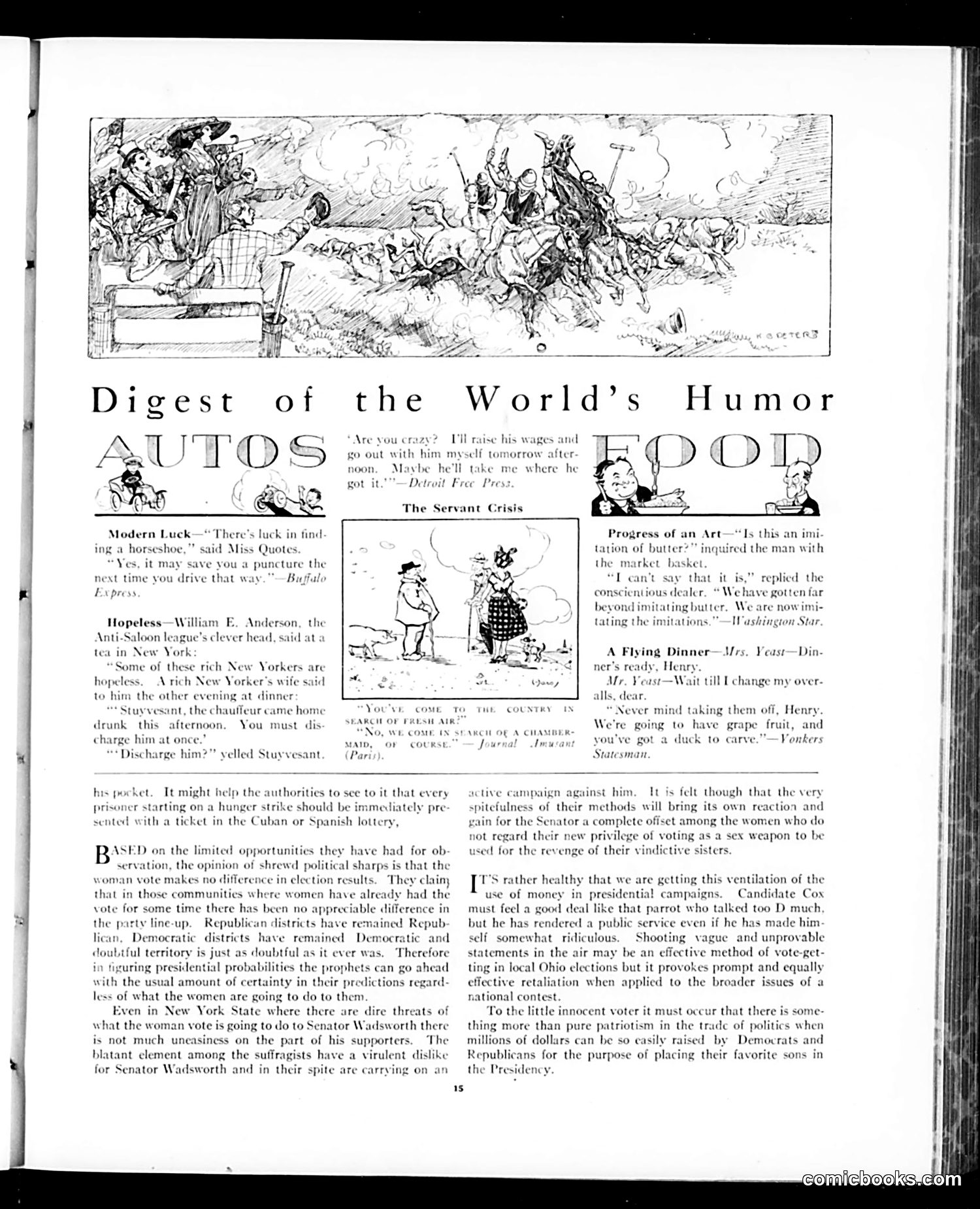
This page contains a "Digest of the World's Humor"—a collection of brief satirical jokes from various sources, not a single unified cartoon. **The jokes target:** - **"Modern Luck"**: Middle-class concerns about car maintenance - **"Hopeless"**: Anti-Saloon League hypocrisy (the temperance advocate's wife wants to leave her husband for a wealthier man) - **"The Servant Crisis"**: Post-WWI labor shortages; wealthy employers struggling to retain household staff - **"Progress of an Art"**: Food adulteration—manufacturers now imitate their own imitations rather than real butter - **"A Flying Dinner"**: Working-class husband's exhaustion **The longer editorial passages** discuss women's suffrage (recently granted nationally in 1920) and campaign finance corruption, arguing that female voters won't dramatically reshape politics and that money in presidential campaigns reveals politics as self-interested rather than patriotic. The overall tone is cynical about class relations, labor, food safety, and political corruption—typical of Judge's satirical stance.
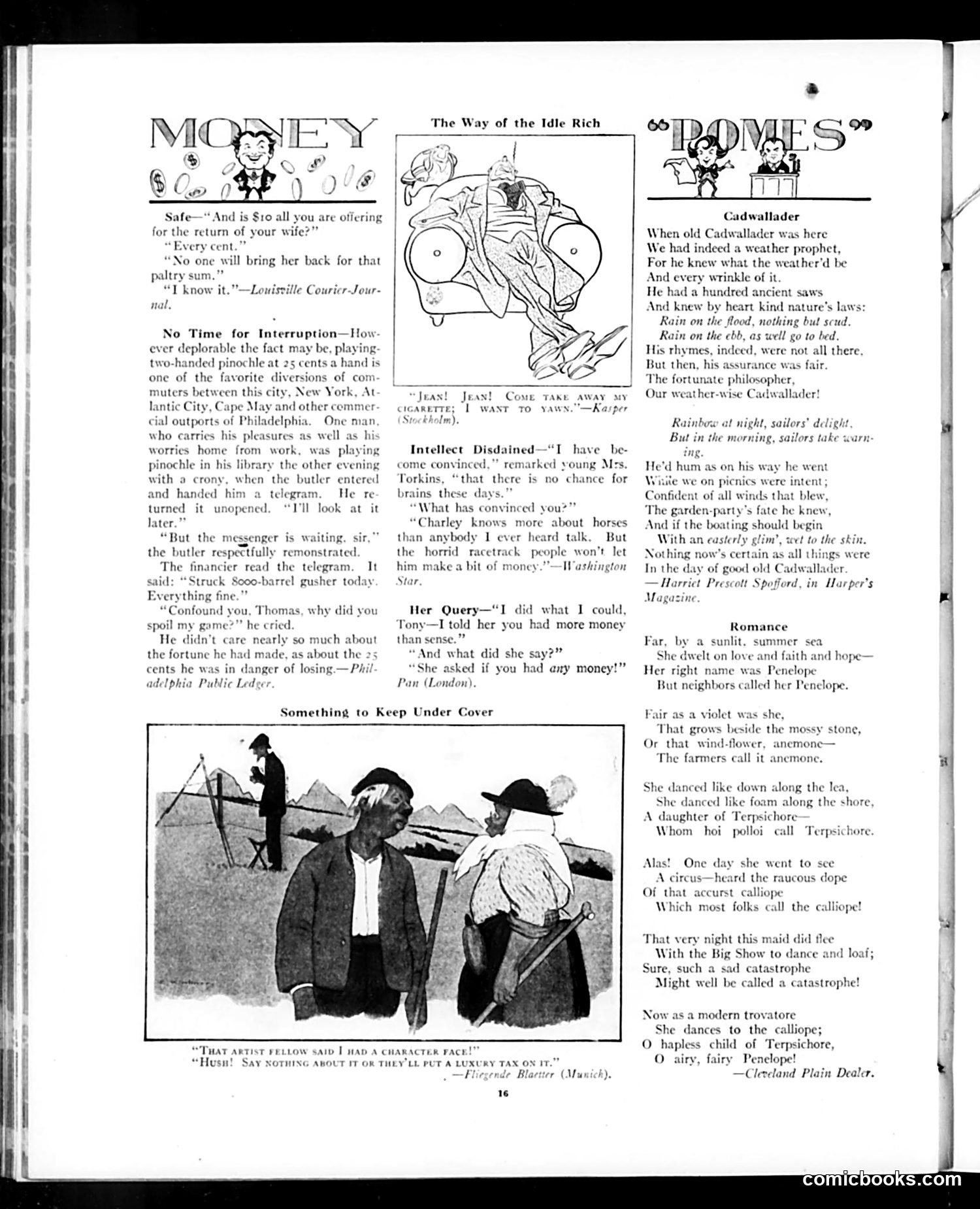
This page contains several distinct satirical pieces typical of early 20th-century American humor: **"Safe"** and related anecdotes mock wealthy men's misplaced priorities. One story depicts a financier receiving news of striking oil but refusing to interrupt his card game—valuing 25 cents of pinochle winnings over a fortune. The "Safe" joke suggests a husband wouldn't pay to recover his wife, satirizing marriages as financial burdens. **"Intellect Disdained"** ridicules the observation that intelligence doesn't guarantee wealth; a man knowledgeable about horses can't profit because "racetrack people won't let him." **"Something to Keep Under Cover"** (cartoon) warns that even character or talent risks government taxation—a jab at expanding tax policy under modern governance. The right column contains poetry and lighter fare: **"Cadwallader"** nostalgically celebrates a weather-wise figure; **"Romance"** humorously traces a young woman's descent from romantic heroine to circus performer. The humor targets wealth obsession, class attitudes, and government overreach through gentle satire rather than sharp political commentary.
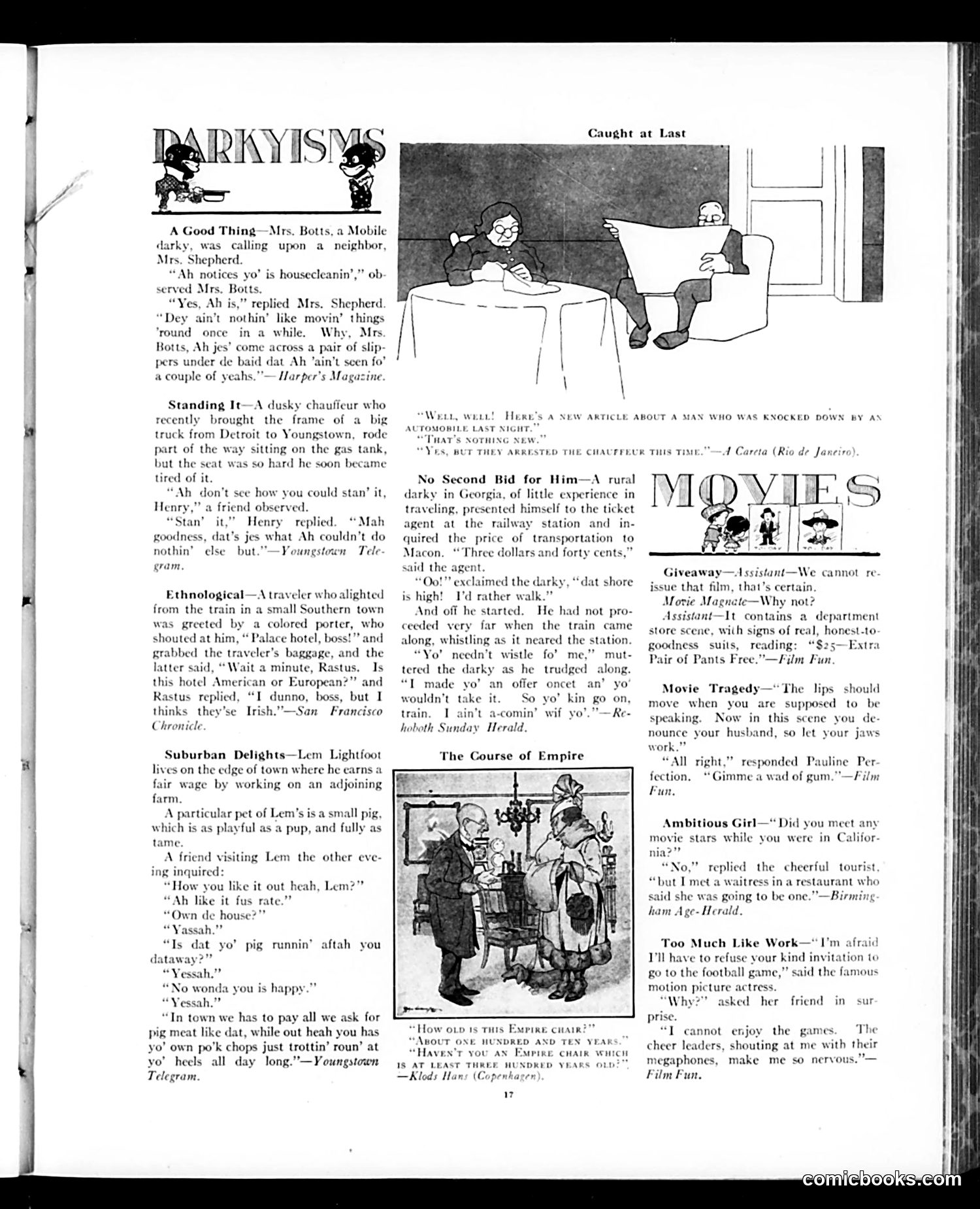
This page contains racist humor typical of early 20th-century American magazines, using caricatured African American dialect and stereotypes. Several brief anecdotes mock Black Southern speech patterns and portrayals: **Main content**: Multiple short jokes featuring African Americans in servile or rural roles—a maid discovering old slippers, a chauffeur enduring an uncomfortable ride, a porter, and a rural man negotiating train fare. Each relies on exaggerated dialect ("Ah," "yo'," "dat") for comedic effect. **"The Course of Empire" cartoon**: Depicts someone questioning whether an "Empire chair" is old enough, with the punchline implying confusion about historical timescales—unrelated to the racial humor elsewhere. **Right column**: Film industry anecdotes about movie production mishaps and actors. The page's humor depends entirely on racist caricature and stereotyping common to the era. Modern readers should understand this reflects deeply offensive editorial standards now recognized as harmful.
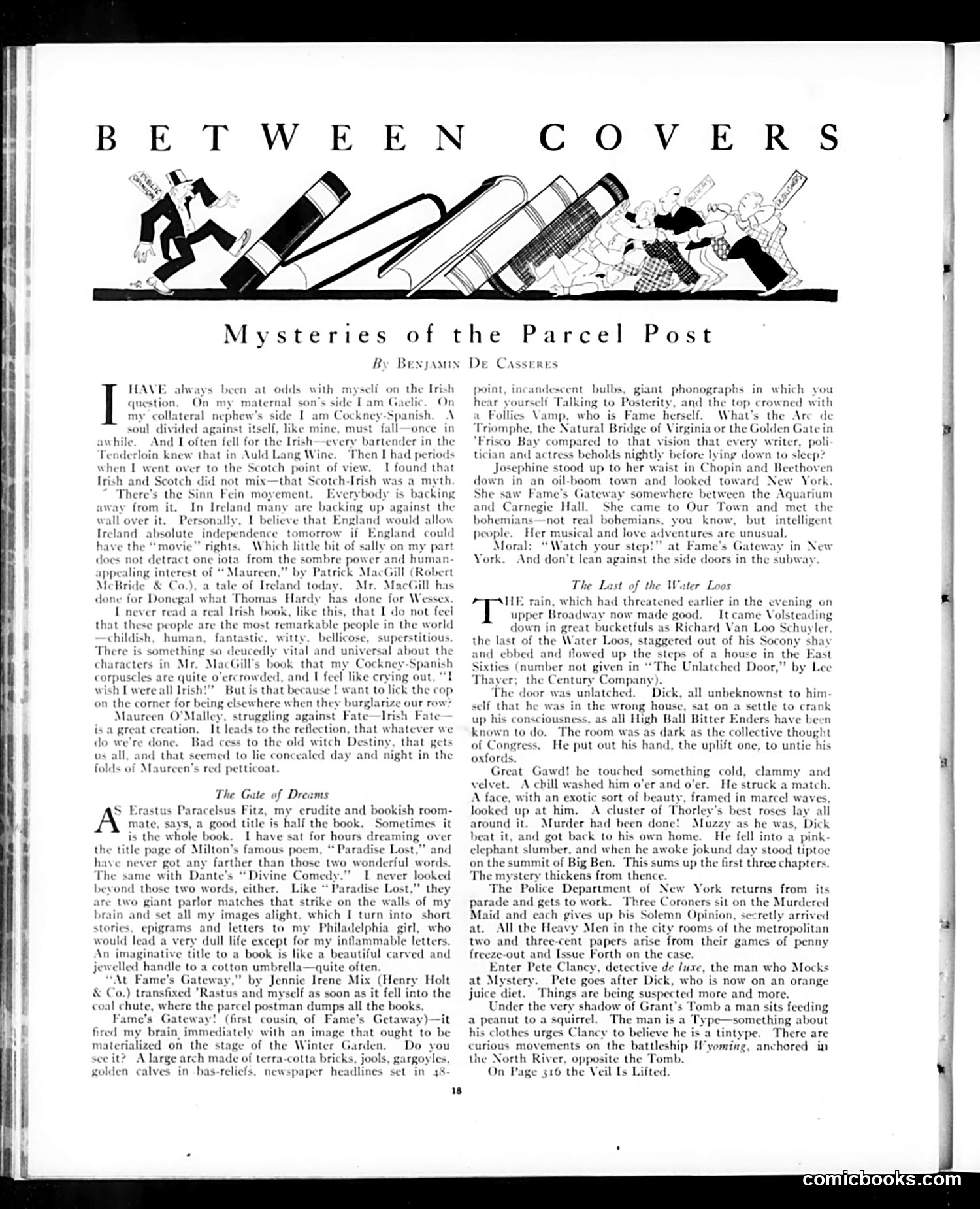
This page contains book reviews by Benjamin De Casseres from Judge magazine. The decorative header shows books and papers tumbling chaotically, illustrating the "mysteries" of mail delivery. De Casseres reviews three works: Patrick MacGill's *Maureen* (praising its portrayal of Irish characters as "remarkable" and "vital"), Milton's *Paradise Lost* and Dante's *Divine Comedy* (musing on how powerful titles alone can inspire imagination), and Jennie Irene Mix's *At Fame's Gateway* (describing how the title conjures vivid theatrical imagery—an elaborate arch with "Follies Vamp" personifying Fame itself). The satire is gentle: De Casseres mocks his own literary pretensions and the sometimes misleading nature of book titles. References to the "parcel postman" and coal chute humorously acknowledge how books arrive via the Parcel Post system (established 1913), treating literary delivery as casually as coal delivery.
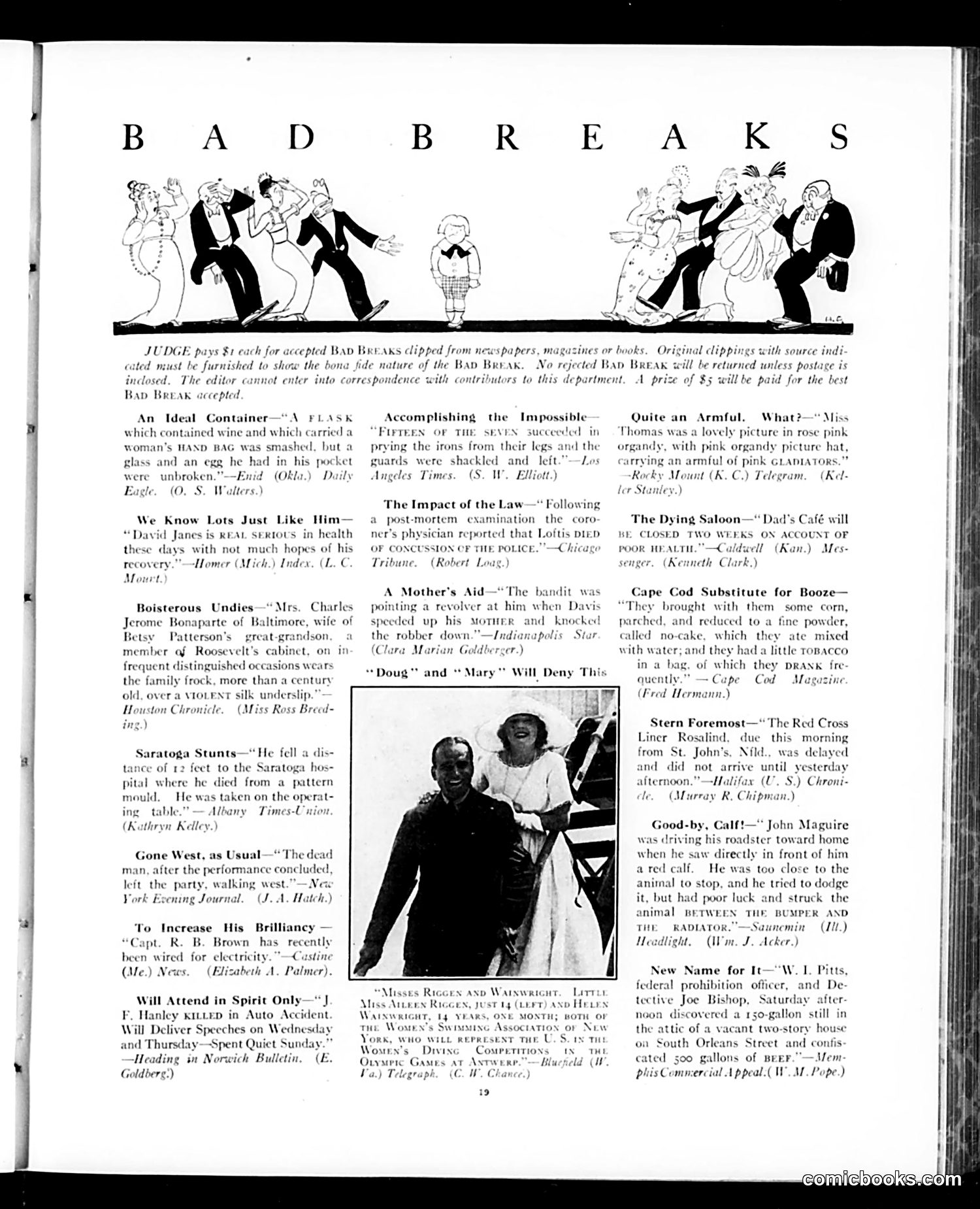
This is a "Bad Breaks" section—Judge's humor column featuring absurd news clippings revealing unintentional comedy in newspaper reporting. The text header explains Judge pays contributors $1 for such oddities. The cartoons at top and center satirize carelessness and mishaps. Examples include a woman whose handbag flask breaks but an egg survives intact; a coroner's examination where a dead man is described as having "walked west" after death; and a bandit robbery report that somehow involves someone's mother. The final item mocks Prohibition-era reporting: federal officers discovered a "150-gallon still" and confiscated "500 gallons of BEEF"—clearly the newspaper's absurd euphemism (or error) for alcohol. The joke lies in the ridiculous phrasing and newspapers' awkward attempts to discuss illegal liquor under Prohibition laws. These "breaks" expose how careless or evasive journalism produces laughable contradictions.
This is not a cartoon but rather a film criticism article by Myron M. Stearks analyzing plot absurdities in contemporary silent films. The piece mocks the melodramatic and morally contradictory storylines prevalent in 1920s cinema. The author catalogs three ridiculous plot scenarios: a wife enduring infidelity while a gangster uses her apartment; a paralyzed factory worker's convoluted revenge arc; and repeated trap-door murders. The satire targets Hollywood's simultaneous prudishness and sensationalism—films depicting "the Nude is Art" or that "only Evil is Truth." Stearks sardonically questions why such "filth" circulates while serious literature faces censorship. He advocates for taking cinema seriously as a medium worthy of moral oversight, rather than dismissing it as entertainment beneath notice. The article's tone suggests frustration that millions consume these narratives uncritically while the nation hasn't begun systematic film regulation. The accompanying film recommendation box provides context: Judge acknowledged quality cinema existed alongside the dreck being criticized.

This page features a photograph of actress **Helene Chadwick** surrounded by an ornamental geometric border, accompanied by promotional text from page 21 of *Judge* magazine. The text references her recent Goldwyn film releases, specifically "Scratch My Back" and "Cupid, the Cowpuncher." The accompanying quote praises Chadwick's broad smile and charisma, describing her as "a bright particular star" whose charm enhances her visibility. This appears to be **entertainment promotion rather than satire**—a glamour portrait with laudatory text typical of 1920s film industry publicity in satirical magazines. *Judge* regularly featured such celebrity promotions alongside its political and social commentary. The page celebrates Chadwick's success in early silent cinema during Hollywood's expansion era.
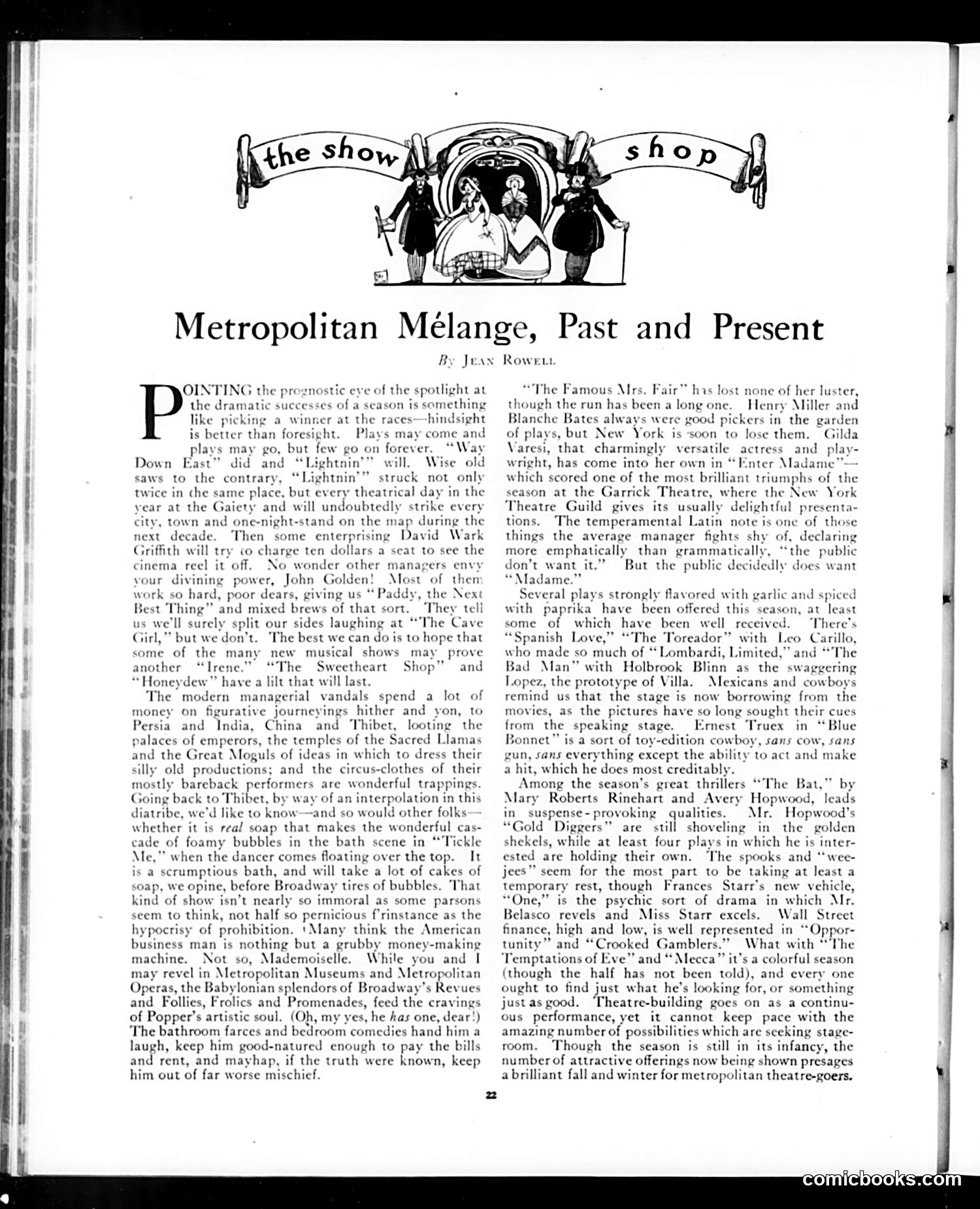
This is a theater column by Jean Rowell reviewing Broadway's current season. The decorative header "The Show Shop" frames the content. Rowell discusses recent theatrical successes and failures, praising long-running hits like "Way Down East" and "Lightnin'" while criticizing producers who spend lavishly on exotic set designs and "circus-clothes" borrowed from foreign locales (Persia, India, China, Tibet) to dress up mediocre productions. The piece celebrates specific plays and performers—praising "The Famous Mrs. Fair" with Henry Miller and Blanche Bates, and Gilda Varesi's "Enter Madame." It notes the season's trend toward Latin-flavored comedies (garlic and paprika plays), including "Spanish Love," "The Toreador," and "The Bad Man" featuring Leo Carillo as a Mexican bandit prototype. Rowell defends theatrical entertainment's moral value against prohibitionist critics, arguing bathroom farces and bedroom comedies serve legitimate purposes for hardworking businessmen seeking relaxation.
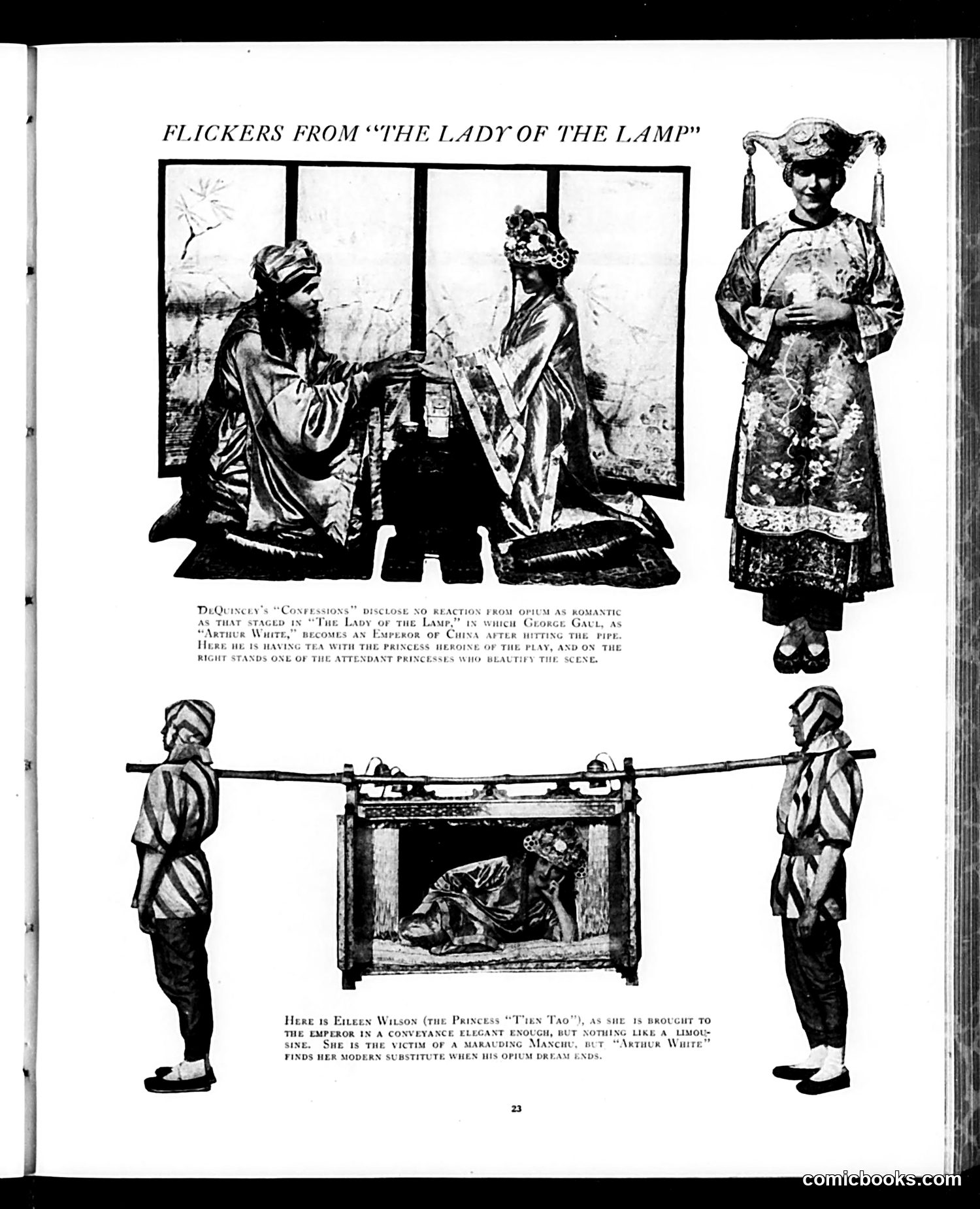
This page reviews a film adaptation of "The Lady of the Lamp," featuring George Gaul as "Arthur White," an Emperor of China who smokes opium. The satire references Thomas De Quincey's famous *Confessions of an English Opium-Eater*, comparing the drug's effects in that literary work to those depicted in the film. The top scenes show Arthur White in the Emperor's court with Chinese princesses during his opium-induced fantasy. The bottom scene depicts actress Eileen Wilson as Princess "Tien Tao," a character victimized by a marauding Manchu warlord. The joke appears to be that White's opium dream conjures an elaborate Oriental fantasy scenario, only to have reality intrude when his hallucination ends and he discovers a "modern substitute" for the fantasy princess. The satire mocks both the film's melodramatic orientalism and the fantastical logic of opium-fueled narratives.
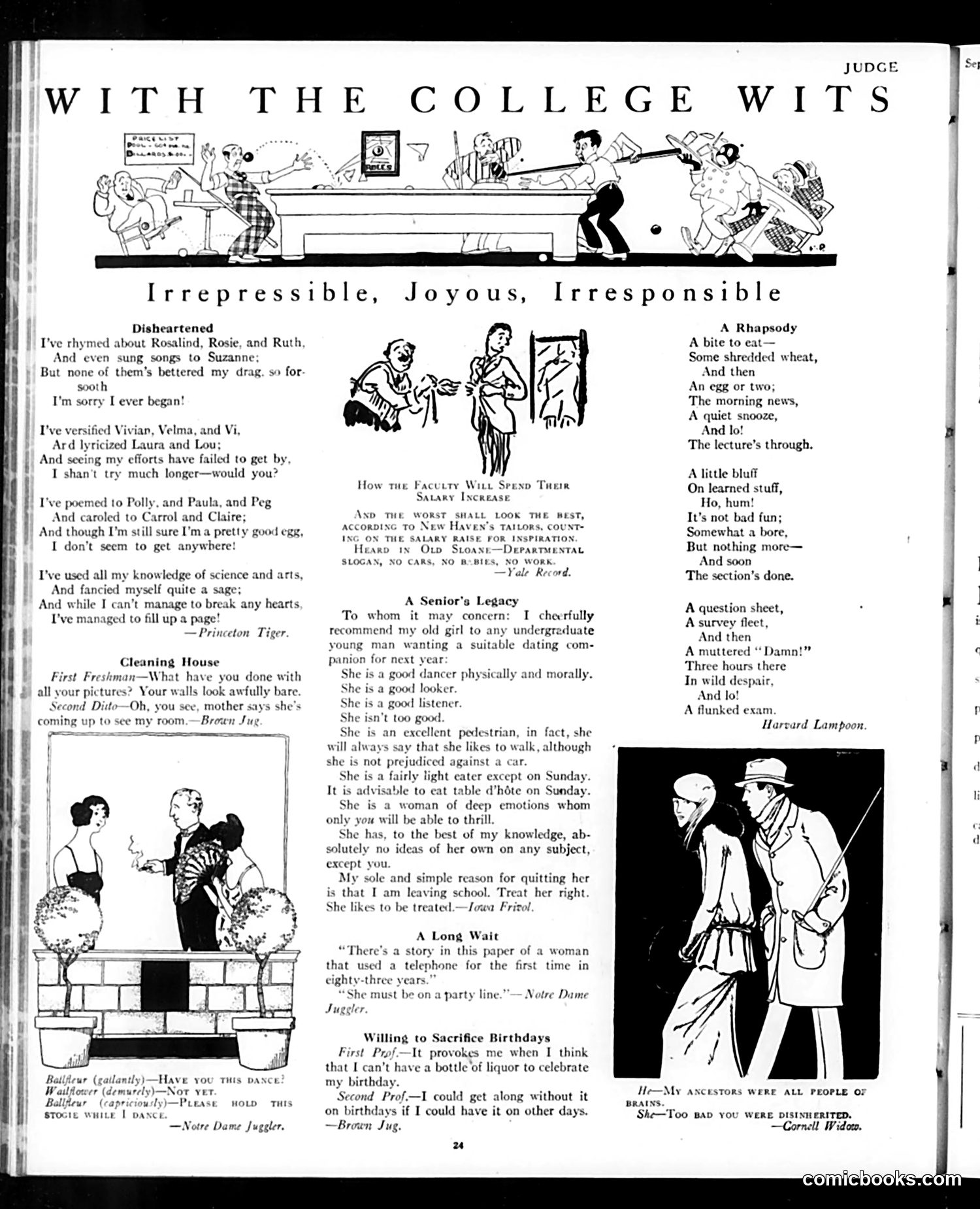
This page from *Judge* magazine features college humor from the early 20th century. The content mocks undergraduate life and romantic pursuit: **"Disheartened"** satirizes a male student who has exhausted poetic attempts at courting multiple women (Rosalind, Vivian, Polly, etc.) without success—lamenting his wasted effort. **"Cleaning House"** jokes about a freshman removing pictures because his mother is visiting, with a punchline about a dance partner lying to avoid commitment. **"A Senior's Legacy"** humorously "recommends" a departing senior's girlfriend to other men, listing her desirable traits (good dancer, good listener, walks willingly) while emphasizing her lack of independent opinions—reflecting period attitudes toward women as decorative companions. **Other items** mock Prohibition (professors wishing for alcohol), telephone technology, and academic shortcuts (bluffing through lectures). The underlying theme: college men pursuing women superficially, avoiding genuine study, and viewing female companionship as transactional rather than meaningful. The satire reflects 1920s campus culture's casual attitudes toward both romance and education.
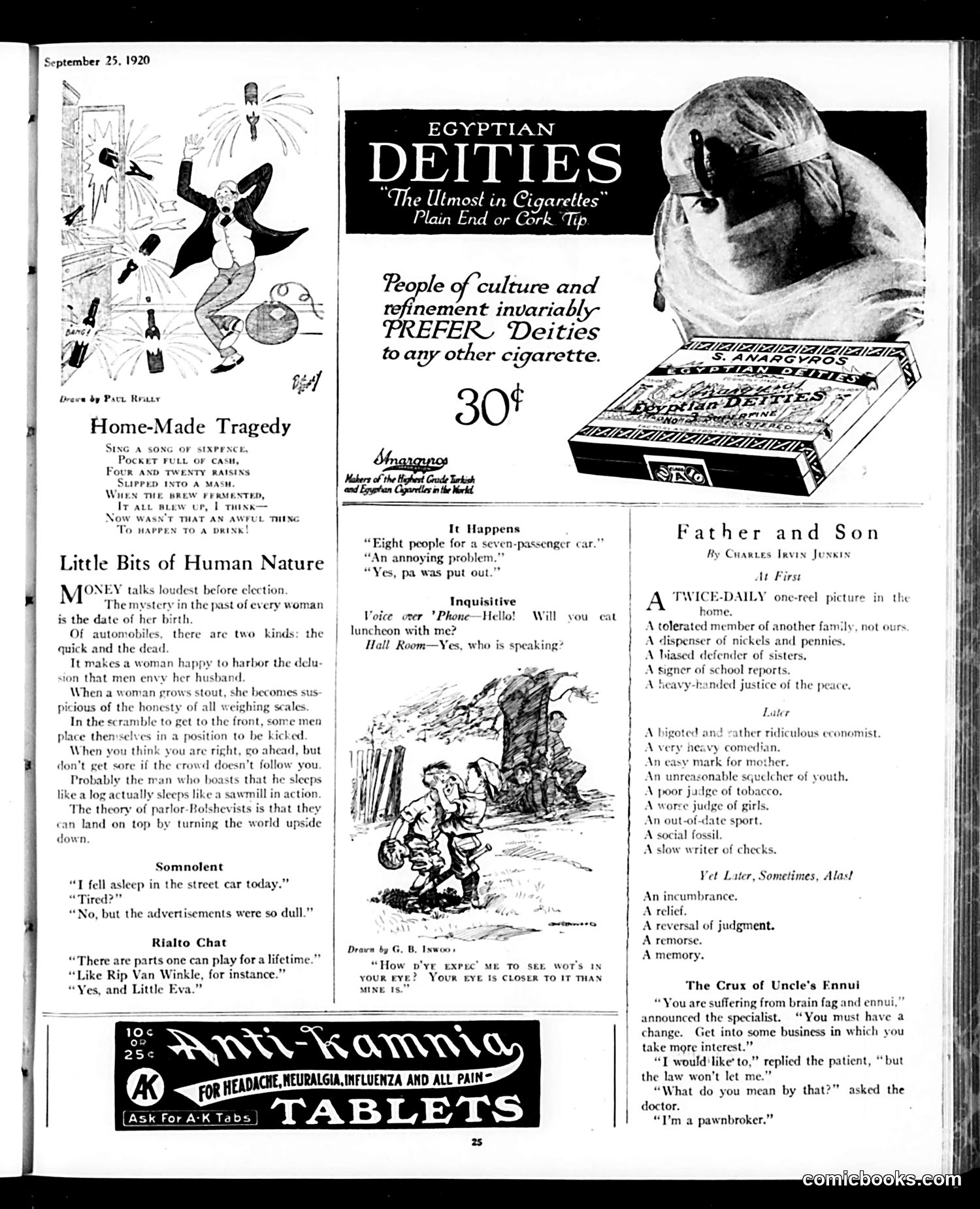
This page is primarily **advertising and light humor** rather than political satire. The main content features: **Egyptian Deities cigarette ad**: A product advertisement claiming that "people of culture and refinement" prefer this brand—typical early 20th-century marketing using snobbish appeals. **Comic sections** include: - "Home-Made Tragedy": A poem satirizing Prohibition-era home alcohol production ("raisins" into "mash") - "Little Bits of Human Nature": Observational humor about everyday life—money talk before elections, automobiles, women and vanity, Bolshevists - Brief comic vignettes with puns and wordplay - "Father and Son": A series contrasting a father's roles across life stages (defender, economist, fossil, pawnbroker) **The satire** is mild and social rather than political: poking fun at domestic life, human vanity, and changing social roles. The pawnbroker joke plays on financial hardship and legal restrictions—likely referencing post-WWI economic conditions or Prohibition's effects on ordinary citizens. This is a typical Judge page: mostly light entertainment with period advertising.
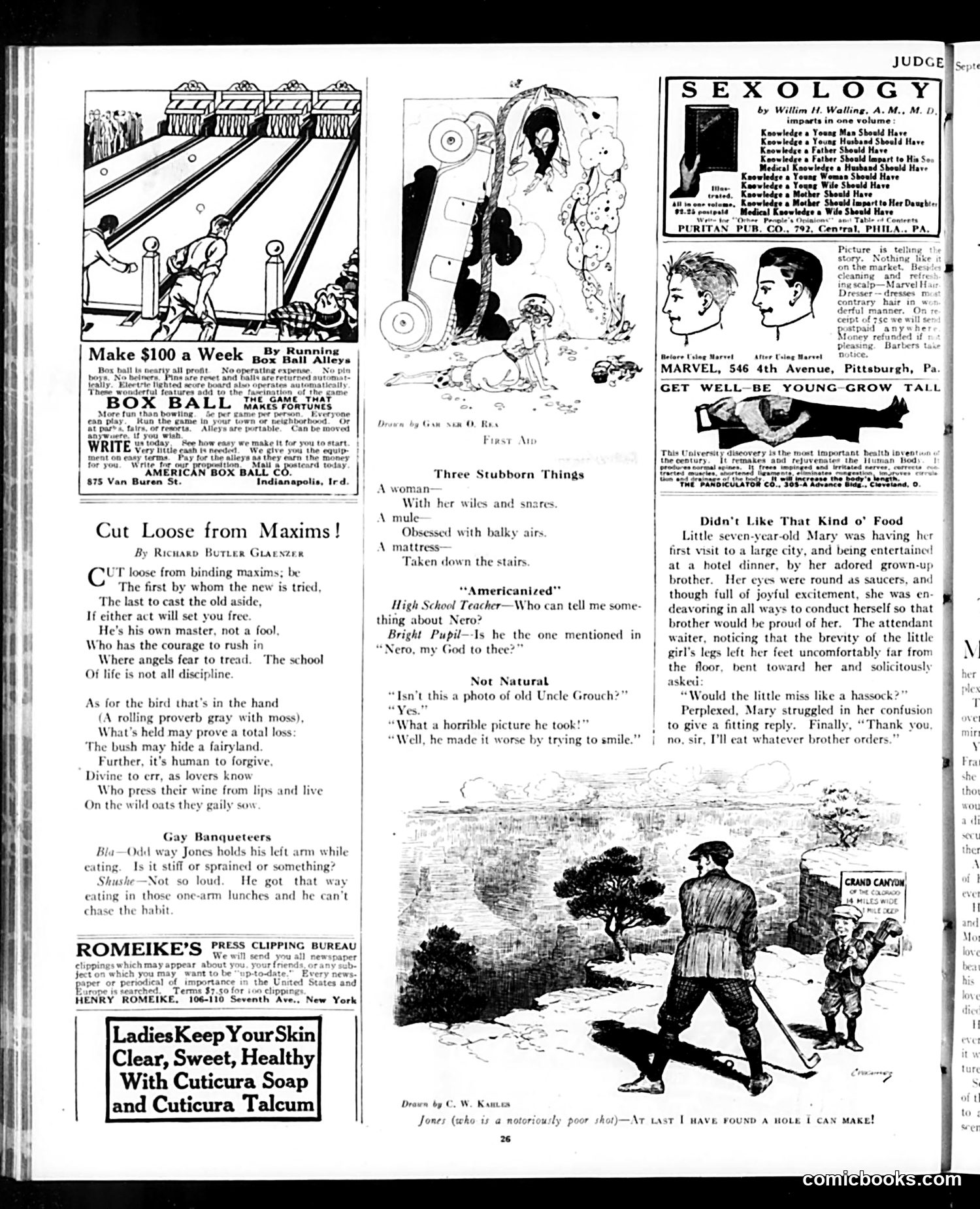
This page contains several distinct items typical of early 20th-century Judge magazine: **Main Cartoons:** - "Cut Loose from Maxims" is a satirical poem mocking Victorian rigid morality, suggesting old rules should be abandoned - "Three Stubborn Things" humorously lists a woman, mule, and mattress as equally obstinate - "Didn't Like That Kind o' Food" is a humorous anecdote about a child who misunderstands "hassock" (a footstool) as food, fearing to refuse it to please her brother—poking fun at childhood innocence and social anxiety **Advertisements:** The page is heavily populated with period ads: a "Box Ball" game promoting easy wealth, Cuticura soap/talcum, and a "Sexology" book claiming health benefits. **Context:** The humor reflects early 1900s attitudes—gentle mockery of social conventions, childhood misunderstandings, and advertising promising quick solutions to life's problems. The overall tone is lighthearted rather than politically pointed.
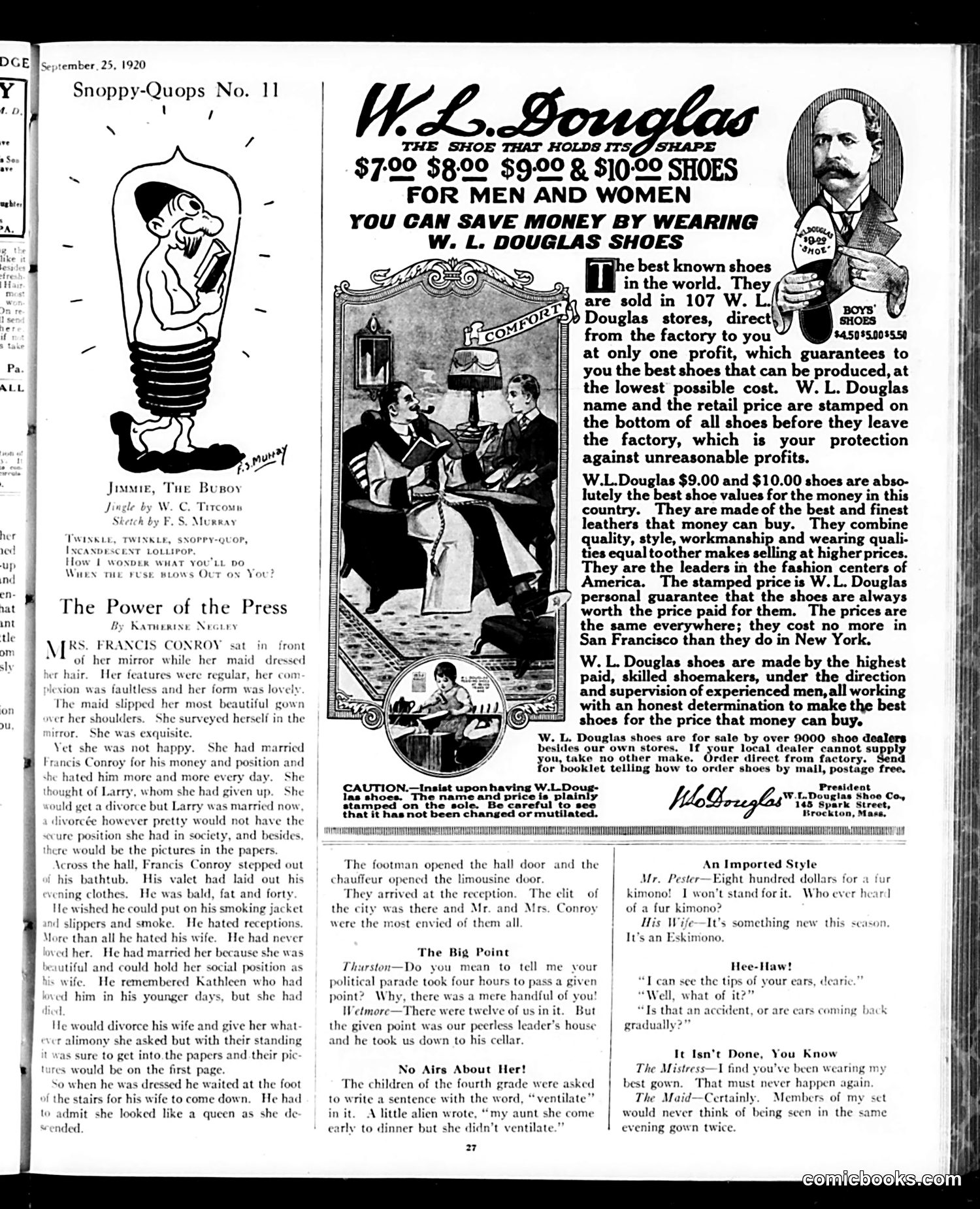
This page is primarily **advertising rather than editorial content**. The dominant feature is a large W.L. Douglas shoe advertisement emphasizing direct factory-to-consumer sales and price transparency—the company stamps its retail price on shoe bottoms to prevent "unreasonable profits." This was a contemporary marketing strategy highlighting affordability and anti-monopoly sentiment. The left side contains minor comic content: "Snoppy-Quops No. 11" (a light verse feature) and "The Power of the Press," a serialized story about Francis and Francis Conroy's unhappy marriage, focusing on how newspaper coverage affects social standing. The story reflects early 20th-century anxieties about divorce's social stigma. Small humorous snippets appear at bottom ("An Imported Style," "Hee-Haw," "It Isn't Done, You Know"), offering brief satirical observations on fashion and social etiquette. The page lacks significant political satire—it's predominantly commercial with light domestic humor.
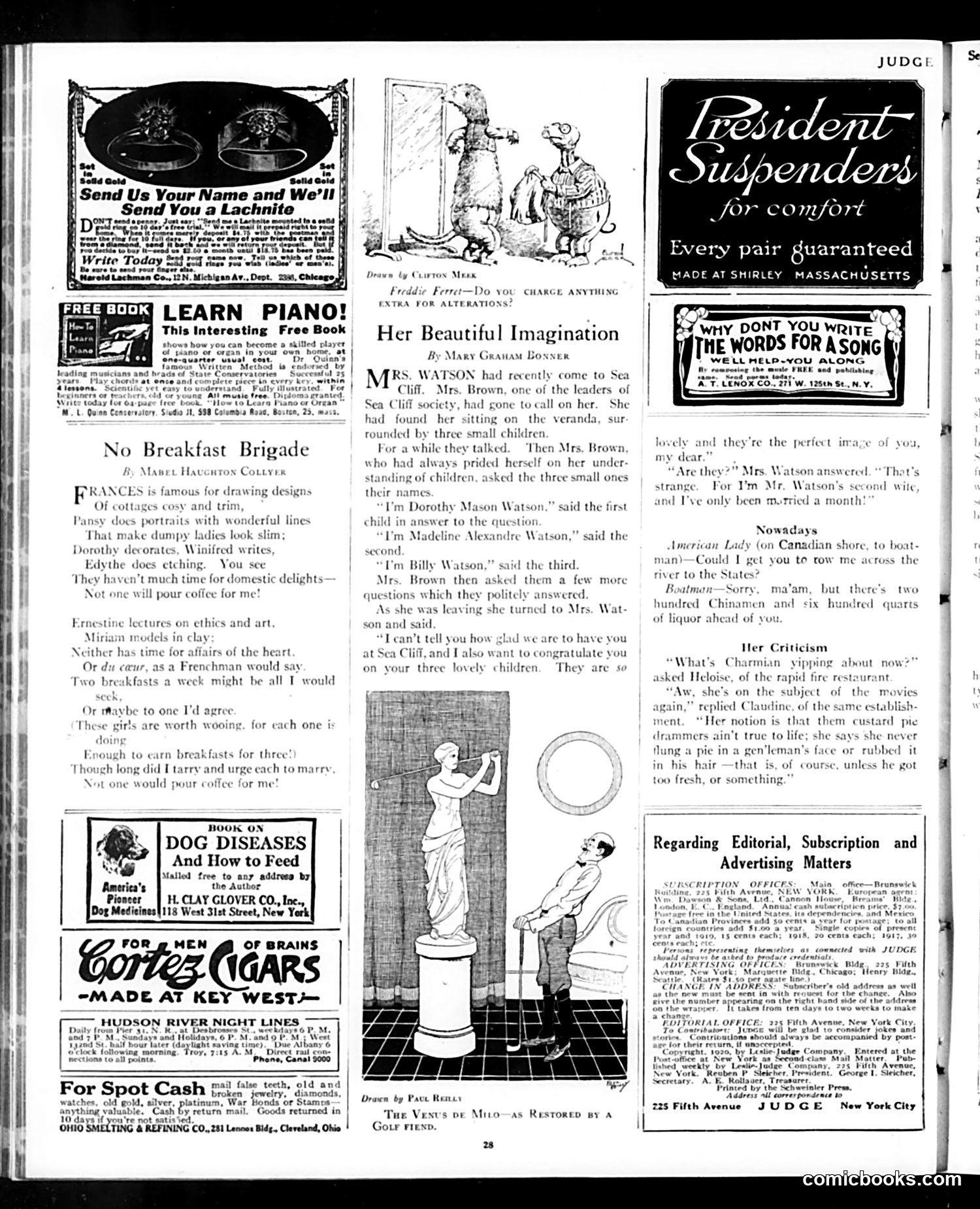
This page contains **primarily advertisements and short humor pieces**, typical of Judge's format mixing commercial content with satirical commentary. The main cartoon narrative is **"Her Beautiful Imagination"** by Mary Graham Bonner, a gentle domestic humor piece about Mrs. Watson, a new wife of one month, whose three children are introduced to Mrs. Brown. The joke relies on a social misunderstanding: Mrs. Brown assumes the children are Mrs. Watson's from a previous relationship, but they're actually stepchildren from Mr. Watson's prior marriage—hence Mrs. Watson's puzzled response that she's "only been married a month!" This plays on 1920s-era attitudes about remarriage and blended families. A secondary humor piece, **"Nowaday"** and **"Her Criticism,"** mock modern entertainment attitudes—specifically about movies and custard pie comedy routines losing authenticity. The **"No Breakfast Brigade"** poem satirizes modern women's independence, suggesting ladies prioritize careers (lecturing on ethics, modeling, etching) over domestic duties like making breakfast. The rest of the page is vintage **advertising**: piano lessons, cigars, dog medicine, and other period products—representing Judge's revenue model rather than editorial content.
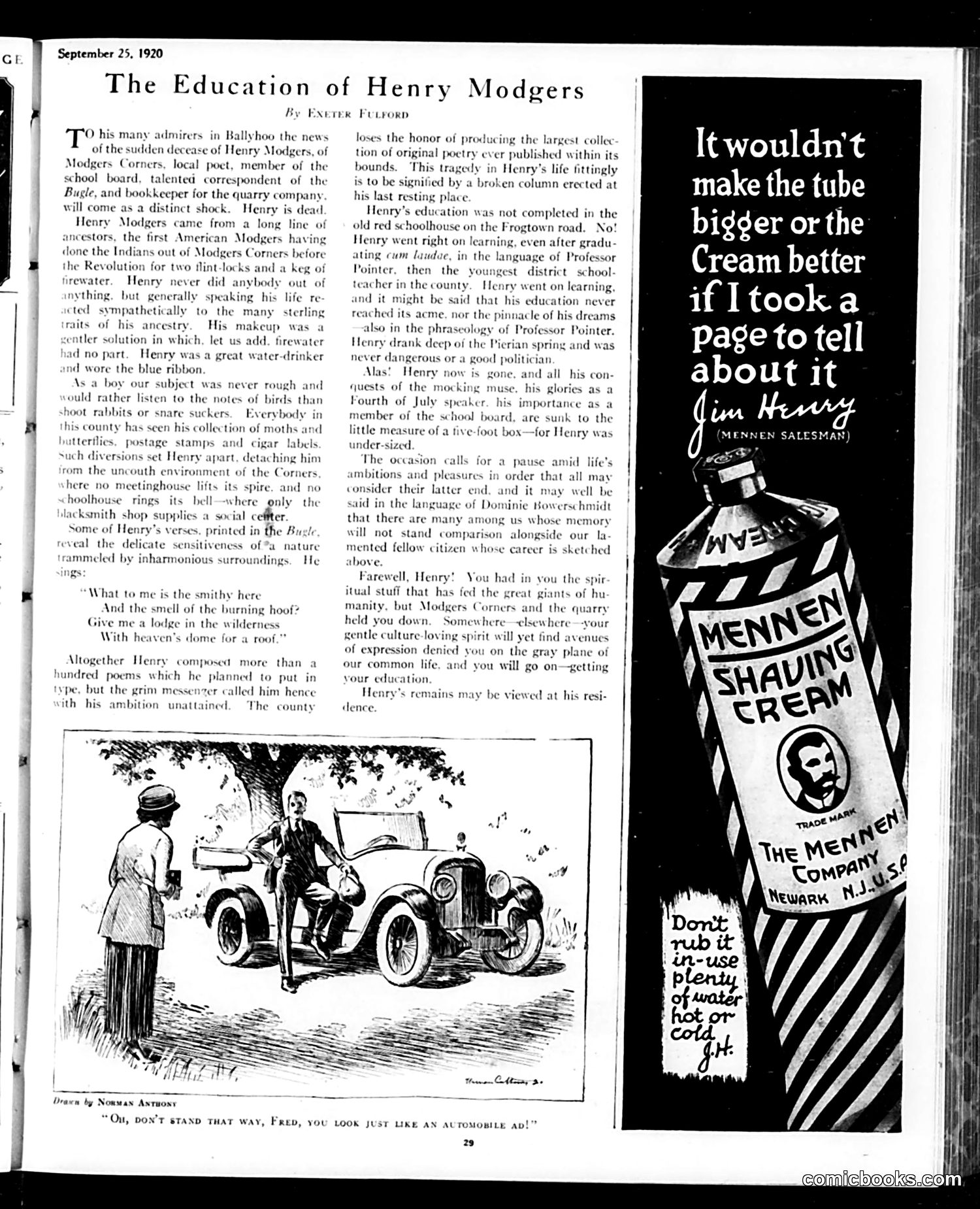
This is a satirical obituary of a small-town poet named Henry Modgers from "Modgers Corners." The piece mocks rural American life and unfulfilled ambition. Modgers composed over a hundred poems but died before publishing them, his dreams confined by his provincial environment (a quarry job, small-town school board). The satire suggests that despite his gentle, cultured nature and poetic sensibility, he remained trapped and "under-sized" in achievement—buried literally in a "five-foot box." The text implies he needed to escape his backwards rural setting to achieve greatness, yet was held down by local mediocrity. The accompanying cartoon shows a man posed awkwardly near an automobile, with the caption mocking his appearance as automobile-like—likely satirizing rural unfamiliarity with modern technology. The Mennen Shaving Cream advertisement is unrelated commercial content typical of magazine pages from this era.
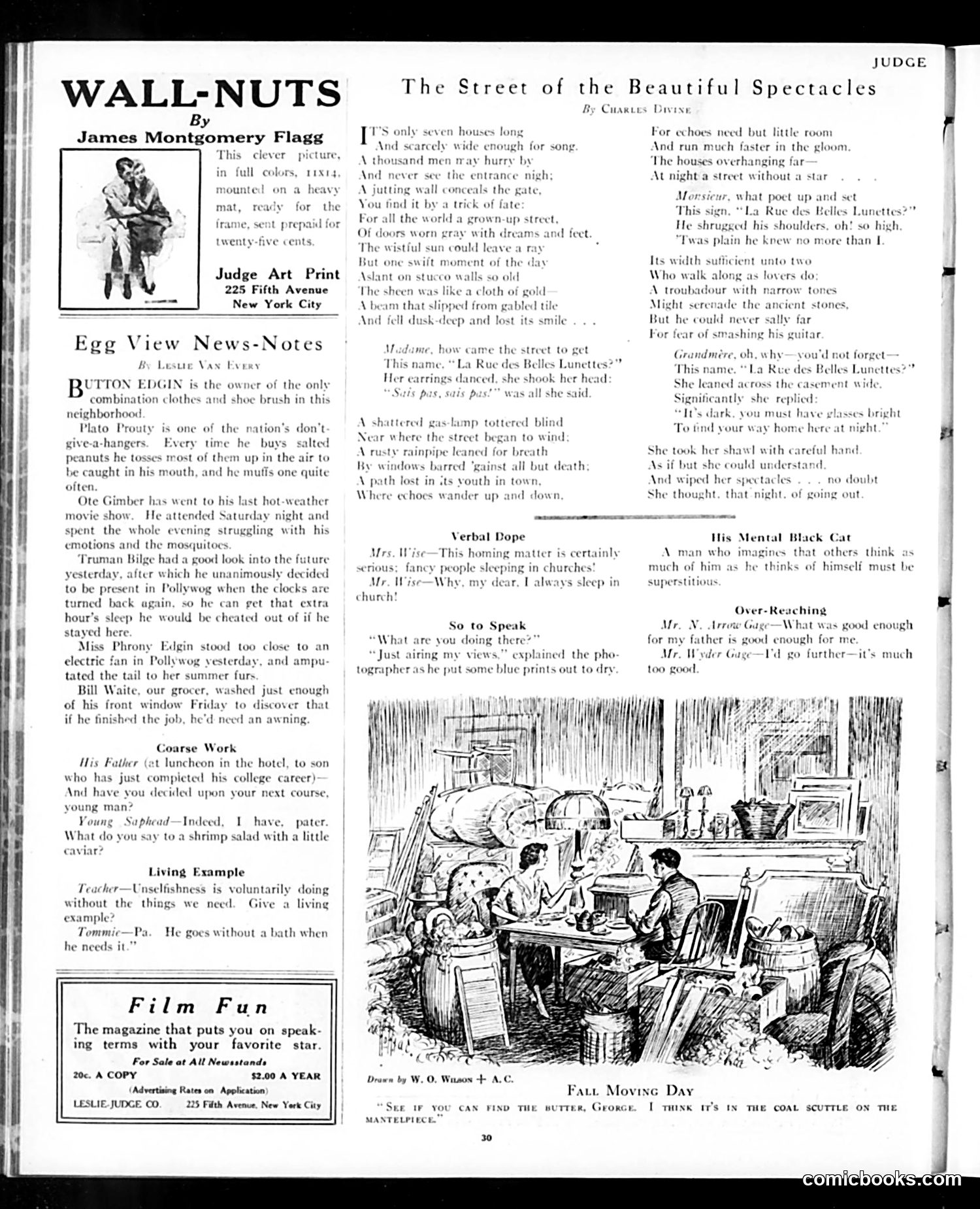
This page from *Judge* magazine contains mostly **humorous short fiction and poetry**, not political satire. **"Wall-Nuts"** by James Montgomery Flagg advertises an art print available for purchase. **"Egg View News-Notes"** is a humor column featuring absurdist, small-town anecdotes (e.g., a man with a combination clothes-and-shoe brush, someone who attended a movie and "struggled with his emotions"). **"The Street of the Beautiful Spectacles"** by Charles Divine is a romantic poem about a narrow Parisian street ("La Rue des Belles Lunettes"—Street of Beautiful Eyeglasses), told through dialogue between characters discovering its name and history. The remaining items are brief jokes ("Verbal Dope," "So to Speak," "Over-Reaching") and an advertisement for *Film Fun* magazine. There is **no significant political content or social satire** on this page—it's primarily entertainment and advertising typical of early 20th-century periodicals.
This is primarily **advertising copy**, not a political cartoon. It's a promotional piece for *Film Fun* magazine, a publication featuring content about silent-film celebrities. The page describes "Funday"—a monthly celebration when *Film Fun* is released—and depicts how an idealized American family enjoys it together. Each family member finds different appeals: Mother escapes housework drudgery, Sister admires fashion worn by silent-film stars Constance Talmadge and Doris May, Brother wants to see Harold Lloyd's comic stunts, and even stern Father chuckles at the cover. The satire is gentle, poking fun at family dynamics and gender roles (Mother's domestic monotony, Sister's fashion obsession) while presenting the magazine as a wholesome, unifying form of entertainment across generations. Priced at 20 cents, this appears designed to sell subscriptions by emphasizing the magazine's broad appeal during the height of silent cinema's popularity.
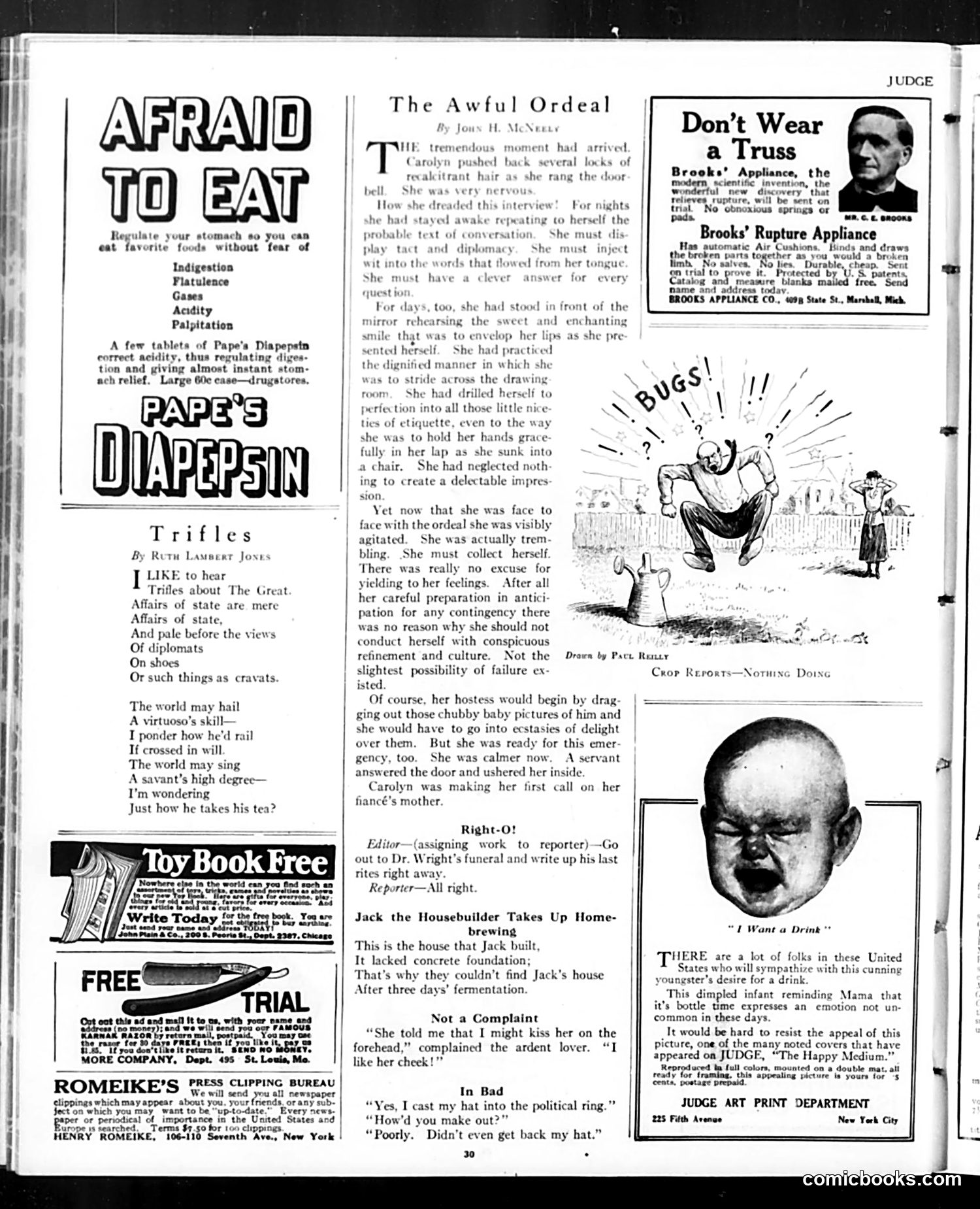
This page contains mostly **advertisements and light humor pieces** rather than political cartoons requiring historical context. The main content includes: **"The Awful Ordeal"** – a humorous short story about a woman (Carolyn) nervously preparing for her first visit to her fiancé's mother. The satire targets the rigid social etiquette and anxieties of upper-class courtship rituals of the era. **"Trifles" poem** – mocks diplomats and intellectuals, suggesting the author cares more about trivial matters (how someone takes tea) than their grand accomplishments. **Brief jokes** including one about homebrewing (likely referencing Prohibition-era illegal alcohol production) and a man literally throwing his hat into politics and losing it. **Advertisements dominate**: Pape's Diapepsin (digestive aid), Brooks' Rupture Appliance (medical device), a "Toy Book Free" offer, and Romeike's Press Clipping Bureau. The satire is genteel and domestic rather than politically pointed—typical of Judge's lighter content alongside its more serious political commentary.
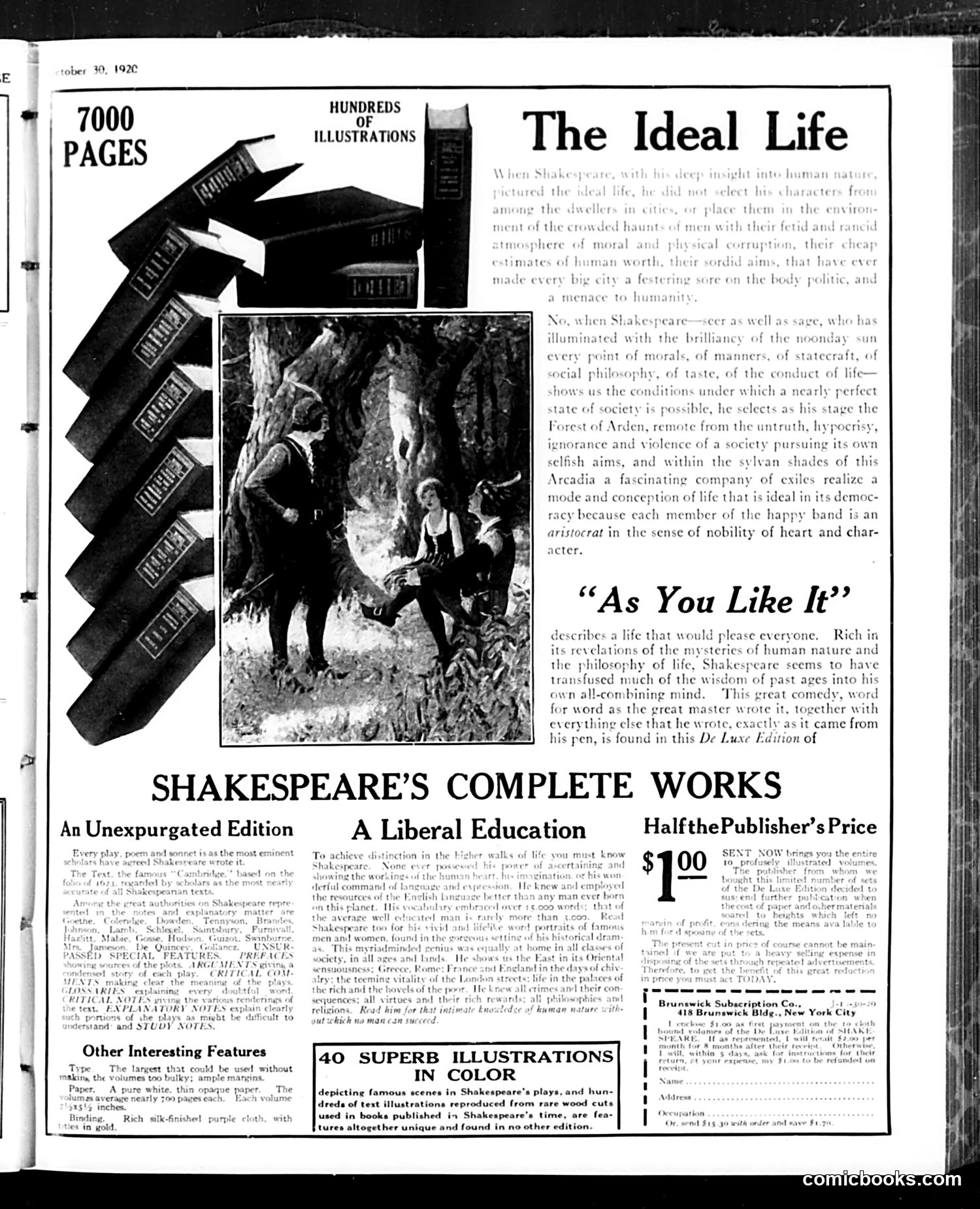
This is **not a political cartoon or satirical content** — it's a **full-page advertisement** for Shakespeare's Complete Works, published by the Brunswick Subscription Company (dated October 30, 1926). The page promotes a "De Luxe Edition" of Shakespeare at $1.00, emphasizing its features: 7,000 pages, hundreds of illustrations, 40 superb color illustrations, and study notes. The central image depicts a scene from "As You Like It," showing characters in a forest setting — the play's idealized pastoral world where exiled characters find refuge and nobility of character. The marketing copy connects Shakespeare's portrayal of "the ideal life" to the book's value as a "liberal education." This reflects early 20th-century reverence for Shakespeare as culturally elevating literature, promoting mass-market access to classic works during a period of expanding print culture and subscription-based book sales.
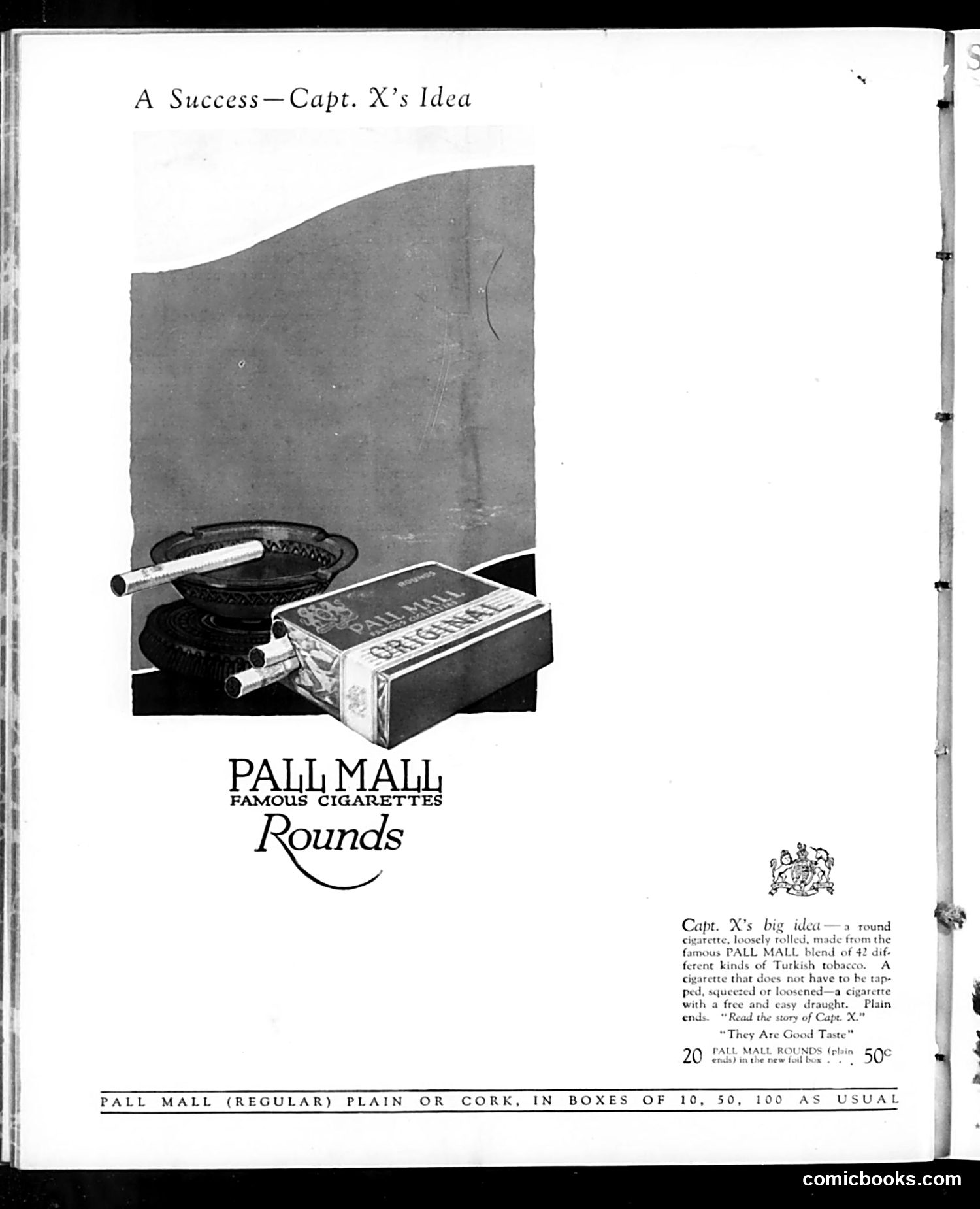
This is primarily a **cigarette advertisement**, not political satire. It promotes Pall Mall's new "Rounds"—circular cigarettes loosely rolled from Turkish tobacco blend. The page references "Capt. X's Idea" as a marketing hook, suggesting there's a story about this captain elsewhere in Judge magazine (readers are directed to "Read the story of Capt. X"). The image shows the product alongside a pipe and tobacco pouch, emphasizing quality. The advertisement's tagline—"They Are Good Taste"—plays on both literal smoking and social status. This reflects early 20th-century marketing that linked cigarette consumption to sophistication and modernity. The "big idea" is that these round cigarettes don't require tapping or squeezing before smoking—a practical innovation presented as novel. The product sold for 50¢ per box of 20.