
Judge, 1920-09-25 · page 22 of 34
Judge — September 25, 1920 — page 22: what you’re looking at
What you’re looking at
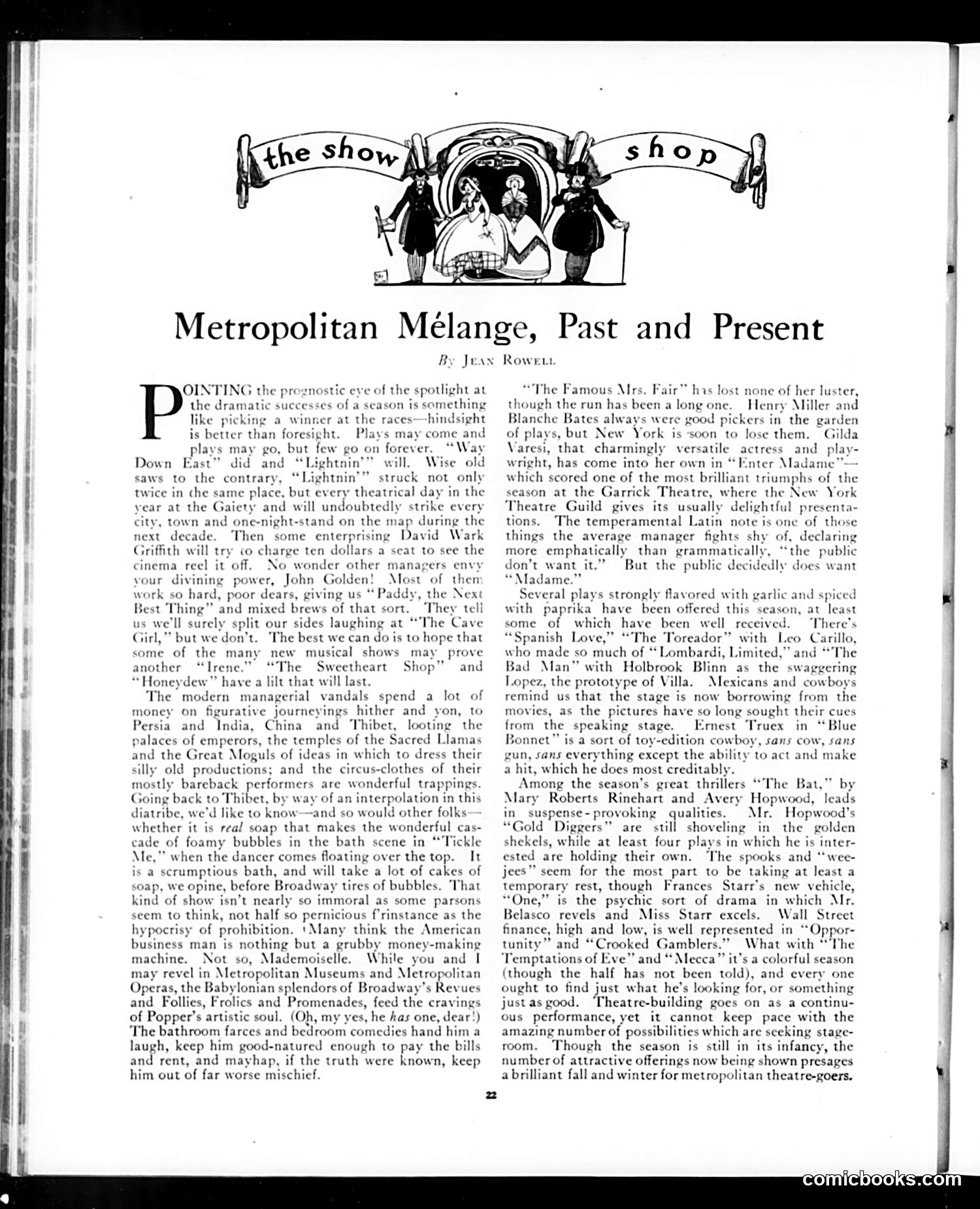
This is a theater column by Jean Rowell reviewing Broadway's current season. The decorative header "The Show Shop" frames the content. Rowell discusses recent theatrical successes and failures, praising long-running hits like "Way Down East" and "Lightnin'" while criticizing producers who spend lavishly on exotic set designs and "circus-clothes" borrowed from foreign locales (Persia, India, China, Tibet) to dress up mediocre productions. The piece celebrates specific plays and performers—praising "The Famous Mrs. Fair" with Henry Miller and Blanche Bates, and Gilda Varesi's "Enter Madame." It notes the season's trend toward Latin-flavored comedies (garlic and paprika plays), including "Spanish Love," "The Toreador," and "The Bad Man" featuring Leo Carillo as a Mexican bandit prototype. Rowell defends theatrical entertainment's moral value against prohibitionist critics, arguing bathroom farces and bedroom comedies serve legitimate purposes for hardworking businessmen seeking relaxation.
📄 Transcribed text from this page (OCR, searchable)
Machine-transcribed from the original scan — historical spelling and the odd misread are preserved.
Metropolitan Mélange, Past and Present By Jeax Rowen rostic eye of the spotlight at son is something OINTING the pro the dramatic successes of a se; like picking a winner at the races—hindsight is better than foresight. Plays may come and plays may go, but few go on forever. “Way Down East” did and “Lightnin will, Wise old saws to the contrary, “Lightnin’” struck not only twice in che same place, but every theatrical day in the year at the Gaiety and will undoubtedly strike every city, town and one-night-stand on the map during the next decade. Then some enterprising David Wark Griffith will try co charge ten dollars a seat to see the cinema reel it off. No wonder other managers envy your divining power, John Golden! Most of then work so hard, poor dears, giving us “Paddy, the Nex Best Thing” and mixed brews of that sort. They tell us we'll surely split our sides laughing at ‘The Cave rl,” but we don’t. The best we can do is to hope that some of the many new musical shows may prove another “Irene.” “The Sweetheart She and *Honeydew” have a lilt that will last. The modern managerial vandals spend a lot of money on figurative journeyings hither and yon, to Persia and India, China and Thibet, looting the palaces of emperors, the temples of the Sacred Llamas and the Great Moguls of ideas in which to dress their silly old productions; and the circus-clothes of their mostly bareback performers are wonderful trappings. Going back to Thibet, by way of an interpolation in this diatribe, we'd like to know—and so would other folks whether it is real soap that makes the wonderful cas- cade of foamy bubbles in the bath scene in ‘Tickle Me,” when the dancer comes floating over the top. It scrumptious bath, and will take a lot of cakes of p, we opine, before Broadway tires of bubbles. That kind of show isn’t nearly so immoral as some parsons seem to think, not half so pernicious frinstance as the hypocrisy of prohibition. ‘Many think the American business man is nothing but a grubby money-making machine. Not so, Mademoiselle. While you and | may revel in Metropolitan Museums and Metropolitan Operas, the Babylonian splendors of Broadway's Revues and Follies, Frolics and Promenades, feed the cravings of Popper’s artistic soul. (Oh, my ye: he has one, dear!) The bathroom farces and bedroom comedies hand him a laugh, keep him good-natured enough to pay the bills and rent, and mayhap, if the truth were known, keep him out of far worse mischief. “The Famous Mrs. Fair” has lost none of her luster, though the run has been a long one. Henry Miller and Blanche Bates always were good pickers in the garden of plays, but New York is soon to lose them. Gilda Vareit that charmingly versatile actress and pl. wright, has come into her own in “Enter Madame which scored one of the most brilliant triumphs of the on at the Garrick Theatre, where the New York Theatre Guild gives its usually delightful presenta- tions. The temperamental Latin note is one of those things the average manager fights shy of, declaring more emphatically than grammatically, “the public don’t want it.” But the public decidedly does want “Madame.” Several plays strongly flavored with garlic and spiced with paprika have been offered this season, at least some of which have been well received. There's “Spanish Love,” “The Toreador” with Leo Carillo, who made so much of “Lombardi, Limited,” a The Bad Man” with Holbrook Blinn as the swaggering Lopez, the prototype of Villa. Mexicans and cowboys remind us that the stage is now borrowing from the movies, as the pictures have so long sought their cues from the speaking stage. Ernest Truex in “Blue Bonnet” is a sort of toy-edition cowboy, sans cow, sans gun, sans everything except the ability to act and make a hit, which he does most creditably. Among the season’s great thrillers The Bat,” by Mary Roberts Rinehart and Avery Hopwood, leads in_ suspense-provoking qualities. Mr. Hopwood’s “Gold Diggers” are still shoveling in the golden shekels, while at least four plays in which he is inter- ested are holding their own. The spooks and “wee- jees” seem for the most part to be taking at least a temporary rest, though Frances Starr's new vehicle, “One,” is the psychic sort of drama in which Mr. Belasco revels and Miss Starr excels. Wall Street finance, high and low, is well represented in ‘Oppor- unity” and “Crooked Gambler: What with “The nptations of Eve” and “ Mecca” it’s a colorful season (though the half has not been told), and every one ought to find just what he’s looking for, or something justas good. Theatre-building goes on as a continu- ous performance, yet it cannot keep pace with the amazing number of possibilities which are sceking stage- room. Though the season is still in its infancy, the number of attractive offerings now being shown presages a brilliant fall and winter for metropolitan theatre-goers. y-