
Judge, 1920-09-25 · page 14 of 34
Judge — September 25, 1920 — page 14: what you’re looking at
What you’re looking at
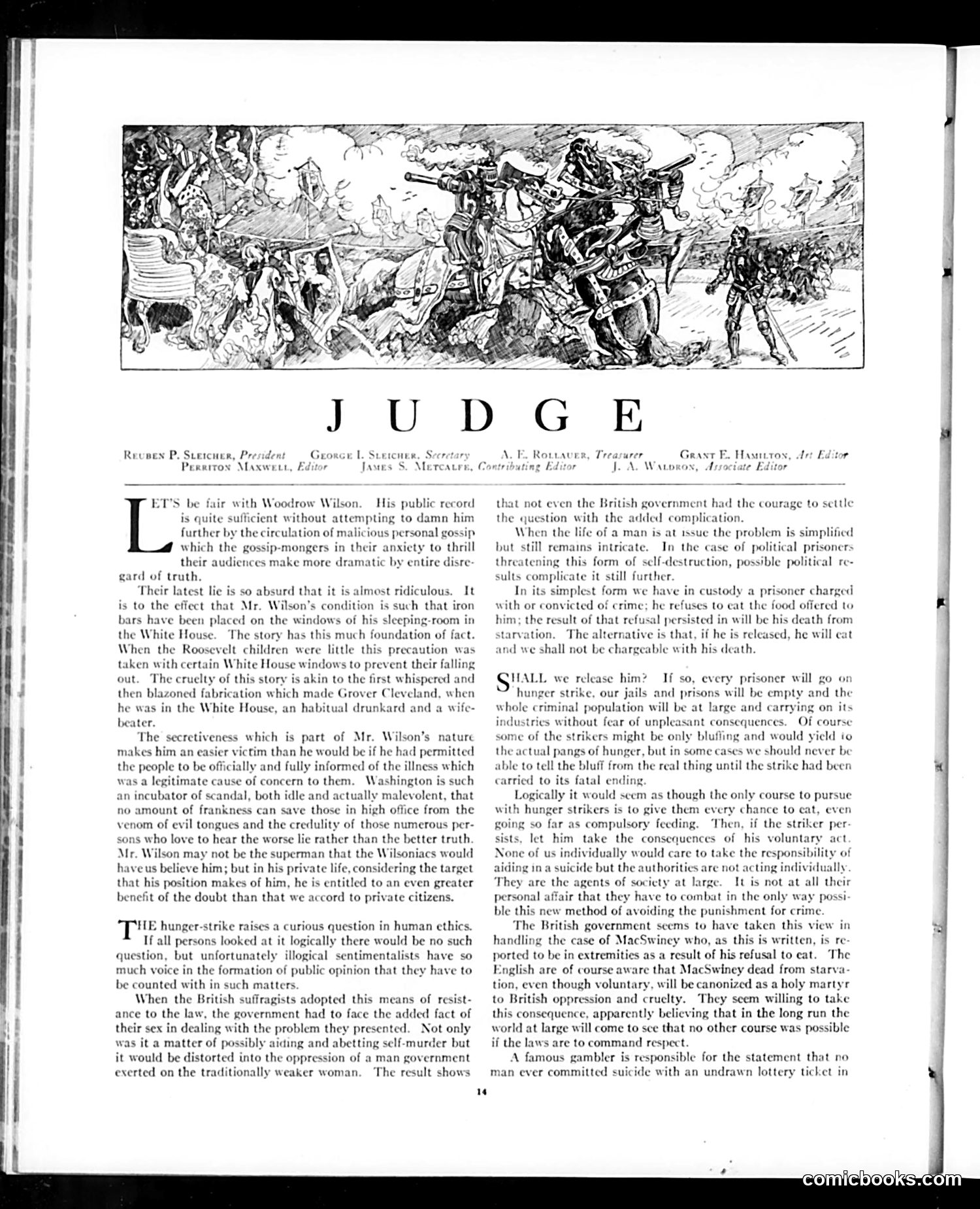
This editorial defends President Woodrow Wilson against malicious rumors circulating about his health—specifically the false claim that iron bars were placed on his White House bedroom windows, suggesting mental instability. The piece argues Wilson deserves privacy protection despite his secretive nature making him an "easier victim" for scandal-mongers. The second section addresses the British suffragists' hunger-strike protests. Judge acknowledges the government's logical dilemma: releasing hunger-striking prisoners rewards the tactic and empties prisons, but force-feeding generates accusations of oppressing women. The editorial suggests authorities face an impossible choice between appearing cruel or appearing weak. The cartoon's top panel (not fully visible) likely illustrates these tensions, though specific figures are unclear from this reproduction.
📄 Transcribed text from this page (OCR, searchable)
Machine-transcribed from the original scan — historical spelling and the odd misread are preserved.
Revpen P. Sretcuer, Pre. t nGe L. Srescnenr. Secretar Pererrox Maxweut, Edit Jawes S. Mercatre, ET’S be fair with Woodrow Wilson. His public record is quite sufficient without attempting to damn him further by the circulation of malicious personal gossip which the gossip-mongers in their anxiety to thrill their audiences make more dramatic by entire disre- gard of truth, Their latest lie is so absurd that it is almost ridiculous. It is to the effect that Mr. Wilson’s condition is such that iron bars have been placed on the windows of his sleeping-room in the White House. The story has this much foundation of fact. When the Roosevelt children were little this precaution was taken with certain White House windows to prevent their falling out. The cruelty of this story is akin to the first whispered and then blazoned fabrication which made Grover Cleveland, when he was in the White House, an habitual drunkard and a wife- beater. The secretiveness which is part of Mr. Wilson’s nature makes him an easier victim than he would be if he had permitted the people to be officially and fully informed of the illness which was a legitimate cause of concern to them. Washington is such an incubator of scandal, both idle and actually malevolent, that no amount of frankness can save those in high office from the venom of evil tongues and the credulity of those numerous per- sons who love to hear the worse lie rather than the better truth Mr. Wilson may not be the superman that the Wilsoniacs would haveus believe him; but in his private life, considering the target that his position makes of him, he is entitled to an even greater benefit of the doubt than that we accord to private citizens. Tie hunger-strike raises a curious question in human ethics. If all persons looked at it logically there would be no such question, but unfortunately illogical sentimentalists have so much voice in the formation of public opinion that they have to be counted with in such matters, When the British suffragists adopted this means of resist- ance to the law, the government had to face the added fact of their sex in dealing with the problem they presented. Not only was it a matter of possibly aiding and abetting self-murder but it would be distorted into the oppression of a man government exerted on the traditionally weaker woman. The result shows 14 A. FE. Rouraver, Treasurer Grast FE. Hasutros, drt Editor uting J. A. Warne that not even the British government had the courage to settle the question with the added complication. When the life of a man is at issue the problem is simplified but still remains intricate. In the case of political prisoners threatening this form of self-destruction, possible political re- sults complicate it still further. In its simplest form we have in custody a prisoner charged with or convicted of crime; he refuses to cat the food offered to him; the result of that re 1 persisted in will be his death from rvation. The alternative is that, if he is released, he will eat nd we shall not be chargeable with his death. HALL we release him? If so, every prisoner will go ot SD hunger strike, our jails and prisons will be empty and tht whole criminal population will be at large and carrying on its tries without fear of unpleasant consequences. Of course of the strikers might be only blui and would yield to the actual pangs of hunger, but in some cases we should never be able to tell the bluff from the real thing until the strike had been carried to its fatal ending. Logically it would seem as though the only course to pursue with hunger strikers is to give them every chance to cat, even ng so far as compulsory feeding. ‘Then, if the striker per- ists, Iet him take the consequences of his voluntar, 1 None of us individually would care to take the responsibility of aiding in a suicide but the authorities are not acting individually They are the agents of socicty at large. It is not at all their personal affair that they have to combat in the only way possi ble this new method of avoiding the punishment for crime. The British government seems to have taken this view in handling the case of MacSwiney who, as this is written, is re. ported to be in extremities as a result of his refusal to eat. The English are of course aware that MacSwiney dead from starva- tion, even though voluntary, will be canonized as a holy martyr to British oppression and cruelty. ‘They scem willing to take this consequence, apparently believing that in the long run the world at large will come to sce that no other course was possible if the laws are to command respect. A famous gambler is responsible for the statement that no man ever committed suicide with an undrawn lottery ticket in