
Judge, 1920-09-25 · page 18 of 34
Judge — September 25, 1920 — page 18: what you’re looking at
What you’re looking at
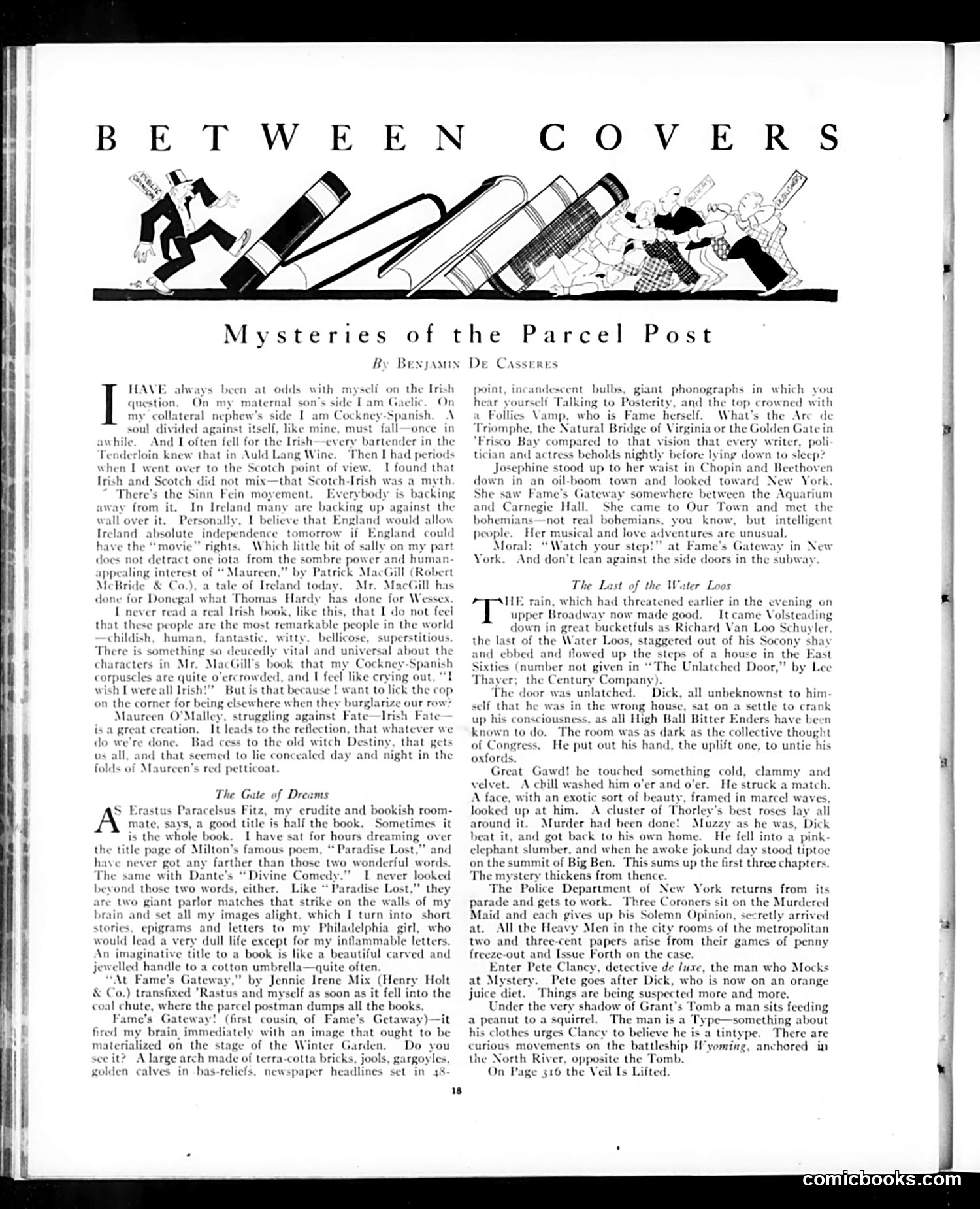
This page contains book reviews by Benjamin De Casseres from Judge magazine. The decorative header shows books and papers tumbling chaotically, illustrating the "mysteries" of mail delivery. De Casseres reviews three works: Patrick MacGill's *Maureen* (praising its portrayal of Irish characters as "remarkable" and "vital"), Milton's *Paradise Lost* and Dante's *Divine Comedy* (musing on how powerful titles alone can inspire imagination), and Jennie Irene Mix's *At Fame's Gateway* (describing how the title conjures vivid theatrical imagery—an elaborate arch with "Follies Vamp" personifying Fame itself). The satire is gentle: De Casseres mocks his own literary pretensions and the sometimes misleading nature of book titles. References to the "parcel postman" and coal chute humorously acknowledge how books arrive via the Parcel Post system (established 1913), treating literary delivery as casually as coal delivery.
📄 Transcribed text from this page (OCR, searchable)
Machine-transcribed from the original scan — historical spelling and the odd misread are preserved.
BETWEEN ysteries of the Parcel Post By Bexyamtxy De Casseres HAVE always been at odds with myseli on the Irish question. On my maternal son’s side Lam Gaelic. 0} my collateral nephew's side I t ey-Spanish. soul divided against itself, like mine, must fall—once in awhile. And I often fell for the Irish—every bartender in the Fenderloin knew that in Auld Lang Wine. Then I had periods when I went over to the Scotch point of view. IT found that Irish and Scotch did not mix—that Scotch-Irish was a myth There's the Sinn Fein moyement. Everybody is backing away from it. In Ireland many are backing up against the wall over it. Personally, I believe that England would allow Ireland absolute independence tomorrow if England could have the “movie” rights. Which little bit of sally on my part does not detract one iota from the sombre power and human appealing interest of Maureen,” by Patrick MacGill (Robert McBride & Co.), a tale of Ireland today. Mr. MacGill has done for Donegal what Thomas Hardy has done for Wessex I never read a real Irish book, like this, that I do not feel that these people are the most remarkable people in the world childish, human, fantastic, witty, bellicose, superstitious There is something so deucedly vital and universal about the characters in Mr. MacGill’s book that my Cockney-Spanish corpuscles are quite o’ercrowded, and I feel like crying out. “L wish I were all Irish!” But is that because ! want to lick the cop on the corner for being elsewhere when they burglarize our row? Maureen O'Malley, struggling against Fate—Irish Fate— is a great creation. It leads to the reflection, that whatever we «lo we're done. Bad cess to the old witch Destiny, that gets us all, and that seemed to lie concealed day and night in the folds of Maurcen’s red petticoat The Gate of Dreams S Era Paracelsus Fitz, my erudite and bookish room- mate, says, a good title is half the book. Sometimes it is the whole book. I have sat for hours dreaming over the title page of Milton’s famous poem, “ Paradise Lost,”” and have never got any farther than those two wonderful words. The same with Dante's “Divine Comedy.” [ never looked beyond those two words, cither. Like “ Paradise Lost,” the are two giant parlor matches that strike on the walls of my brain and set all my images alight, which I turn into. short stories, epigrams and letters to my Philadelphia girl, who lead a very dull life except for my inflammable letters. An imaginative title to a book is like a beautiful carved and jewelled handle to a cotton umbrella—quite often. “At Fame’s Gateway,” by Jennie Irene Mix (Henry Holt & Co.) transfixed 'Rastus and myself as soon as it fell into the coal chute, where the parcel postman dumps all the books. Fame’s Gateway! (first cousin, of Fame’s Getaway)—it ed my brain, immediately with an image that ought to be materialized on the stage of the Winter Garden. Do you sec it? A large arch made of terra-cotta bricks, jools, gargoyles, siden calves in bas-reliefs, newspaper headlines set in 48 point, incandescent bulbs, giant phonographs in which you hear yourself Talking to Posterity, and the top crowned with 1 Follies Vamp, who is Fame herself. What's the Are de Triomphe, the Natural Bridge of Virginia or the Golden Gate in ‘Frisco Bay compared to that vision that every writer, poli tician and actress beholds nightly before lying down to sleep? Josephine stood up to her waist in Chopin and Beethoven down in an oil-boom town and looked toward New York. She saw Fame’s Gateway somewhere between the Aquarium and Carnegie Hall. She came to Our Town and met the bohemians—not real bohemians, you know, but intelligent people. Her musical and love adventures are unusual. Moral: “Watch your step!” at Fame’s Gateway in New York. And don’t lean against the side doors in the subway. The Last of the Water Loos PRUE rain, which had threatened earlier in the evening on T upper Broadway now made good. It came Volsteading down in great bucketfuls as Richard Van Loo Schuyler the last of the Water Loos, staggered out of his Socony shay and ebbed and tlowed up the steps of a house in the East Sixties (number not given in “The Unlatched Door,” by Lee Thayer; the Century Company). The door was unlatched. Dick, all unbeknownst to him self that he was in the wrong house, sat on a settle to crank up his consciousness, as all High Ball Bitter Enders have been known to do. The room was as dark as the collective thought of Congress, He put out his hand, the uplift one, to unt oxfords. ireat Gawd! he touched something cold, clammy and velvet. A chill washed him o’er and o'er. He struck a match. A face, with an exotic sort of beauty, framed in marcel 1 looked up at him. A cluster of Thorley’s best roses lay all around it. Murder had been done! Muzzy as he was, Dick heat it, and got back to his own home. He fell into a pink- elephant slumber, and when he awoke jokund day stood tiptoe on the summit of Big Ben. This sums up the first three chapters. The mystery thickens from thence. The Police Department of New York returns from its parade and gets to work. Three Coroners sit on the Murdered Maid and each gives up bis Solemn Opinion, secretly arrived at. All the Heavy Men in the city rooms of the metropolitan two and three-cent papers arise from their games of penny freeze-out and Issue Forth on the case. Enter Pete Clancy, detective de /uxe, the man who Mocks at Mystery. Pete goes after Dick, who is now on an orange juice diet. Things are being suspected more and more. Under the very shadow of Grant's Tomb a man sits feeding a peanut to a squirrel. The man is a Type—something about his clothes urges Clancy to believe he is a tintype. There are curious movements on the battleship Wyoming, anchored in the North River, opposite the Tomb. On Page 316 the Veil Is Lifted ves. COVER S