
A complete issue · 36 pages · 1920
Judge — July 10, 1920
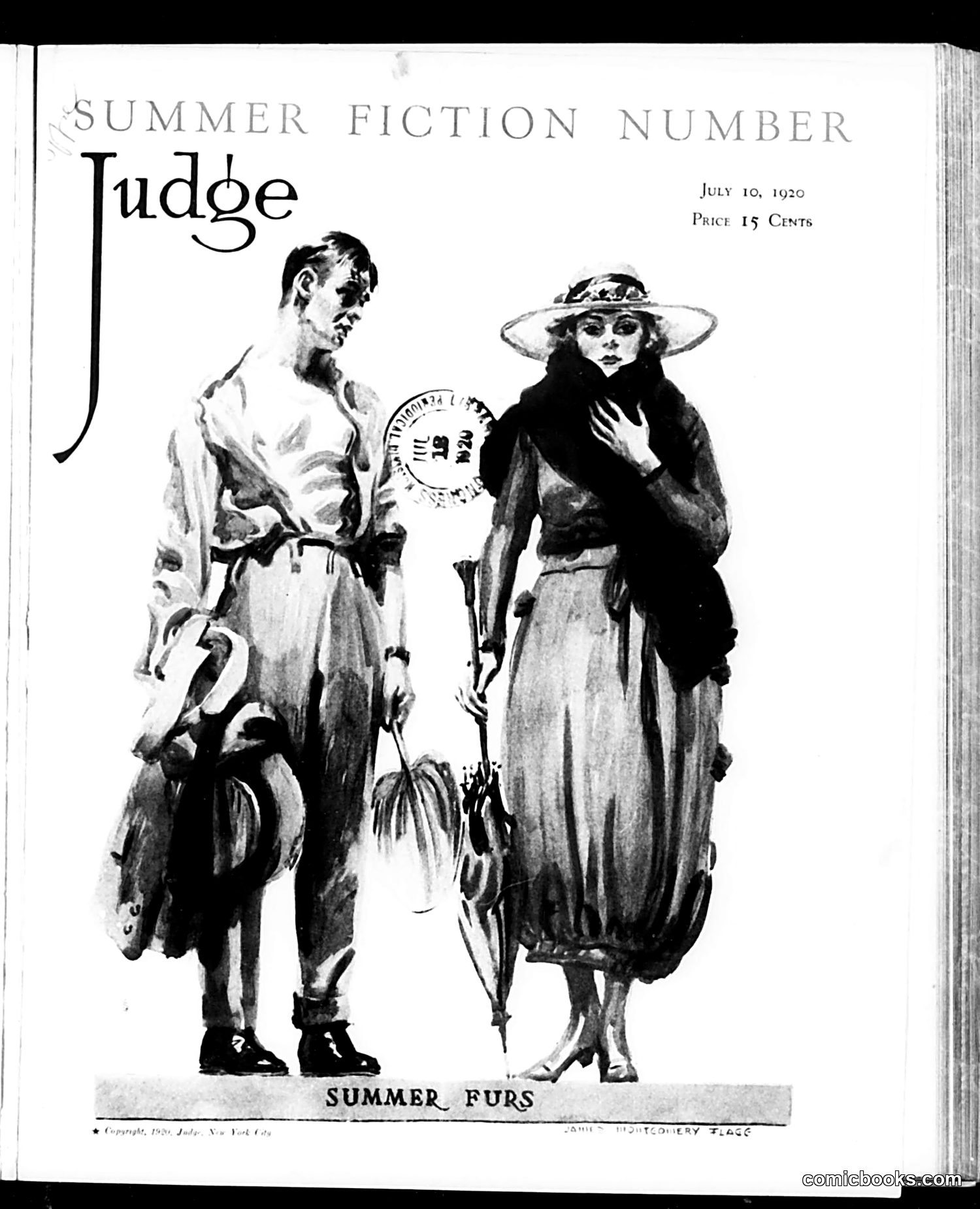
This cover illustration satirizes the absurdity of wearing fur coats during summer. The cartoon depicts a fashionable couple dressed in heavy fur stoles and wraps during what should be warm weather—the man carries a parasol for sun protection while draped in fur, and the woman wears a wide-brimmed hat along with a fur shawl. The satire targets the pretentiousness of wealthy fashion-followers who prioritized status symbols (expensive furs) over practical comfort and sense. By the 1920s, fur coats were marks of affluence, and this joke mocks those willing to suffer heat and discomfort merely to display their wealth and fashion-consciousness during inappropriate seasons.
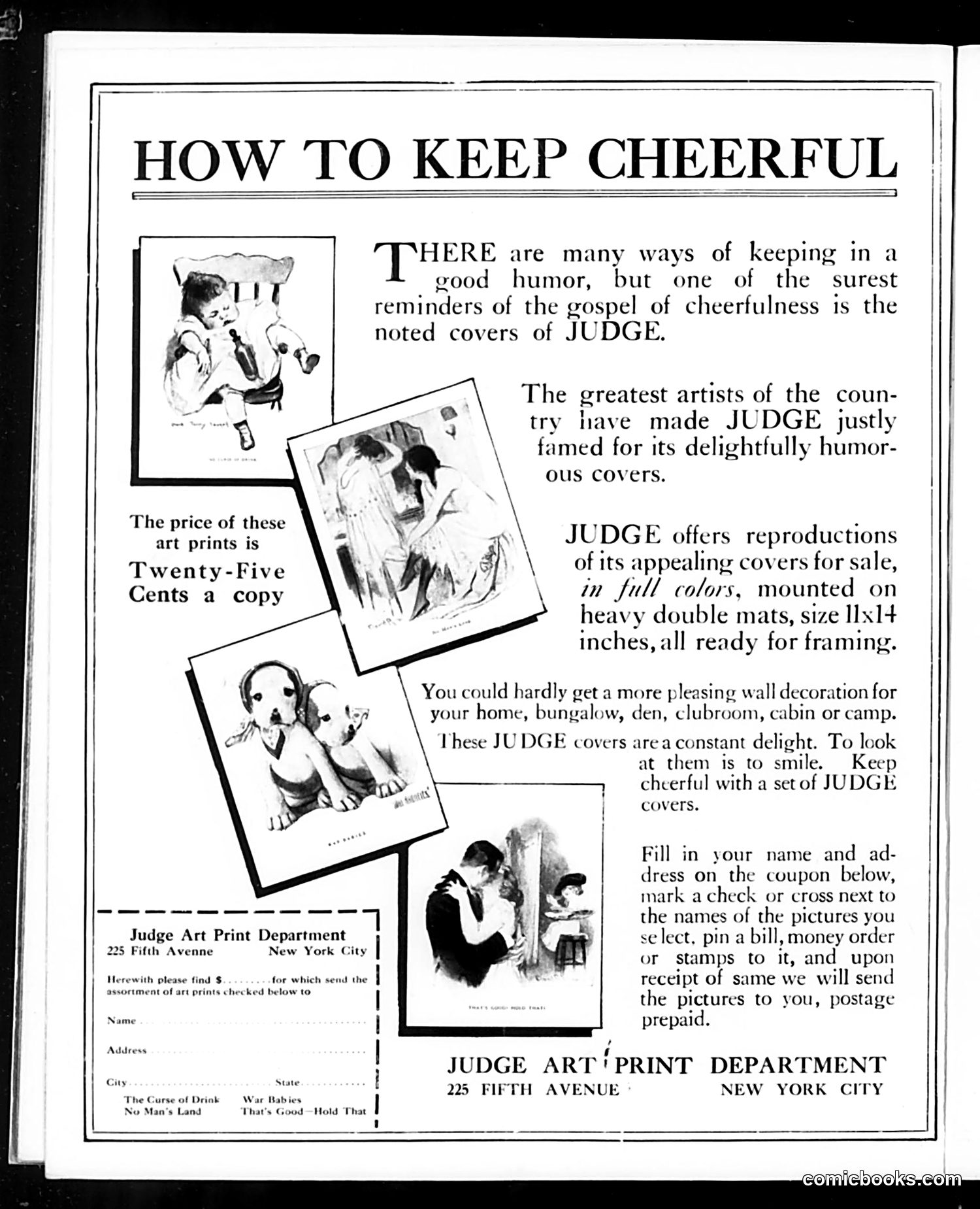
This page is primarily **advertising**, not political satire. Judge magazine is promoting art print reproductions of its famous humorous magazine covers at twenty-five cents each. The visible cover illustrations show **domestic comedy scenes**: a person at a desk, a dog in clothing, and what appears to be a family moment. These exemplify Judge's brand of genteel humor targeting middle-class readers. The ad emphasizes that Judge's covers were created by "greatest artists of the country" and promises these reproductions would brighten homes, dens, and clubrooms. The coupon allows readers to order assorted prints by mail. **Historical context**: This reflects Judge's peak era as a mainstream humor magazine before declining in relevance mid-twentieth century. The advertising strategy itself is the content here—selling cheerfulness as a purchasable commodity.
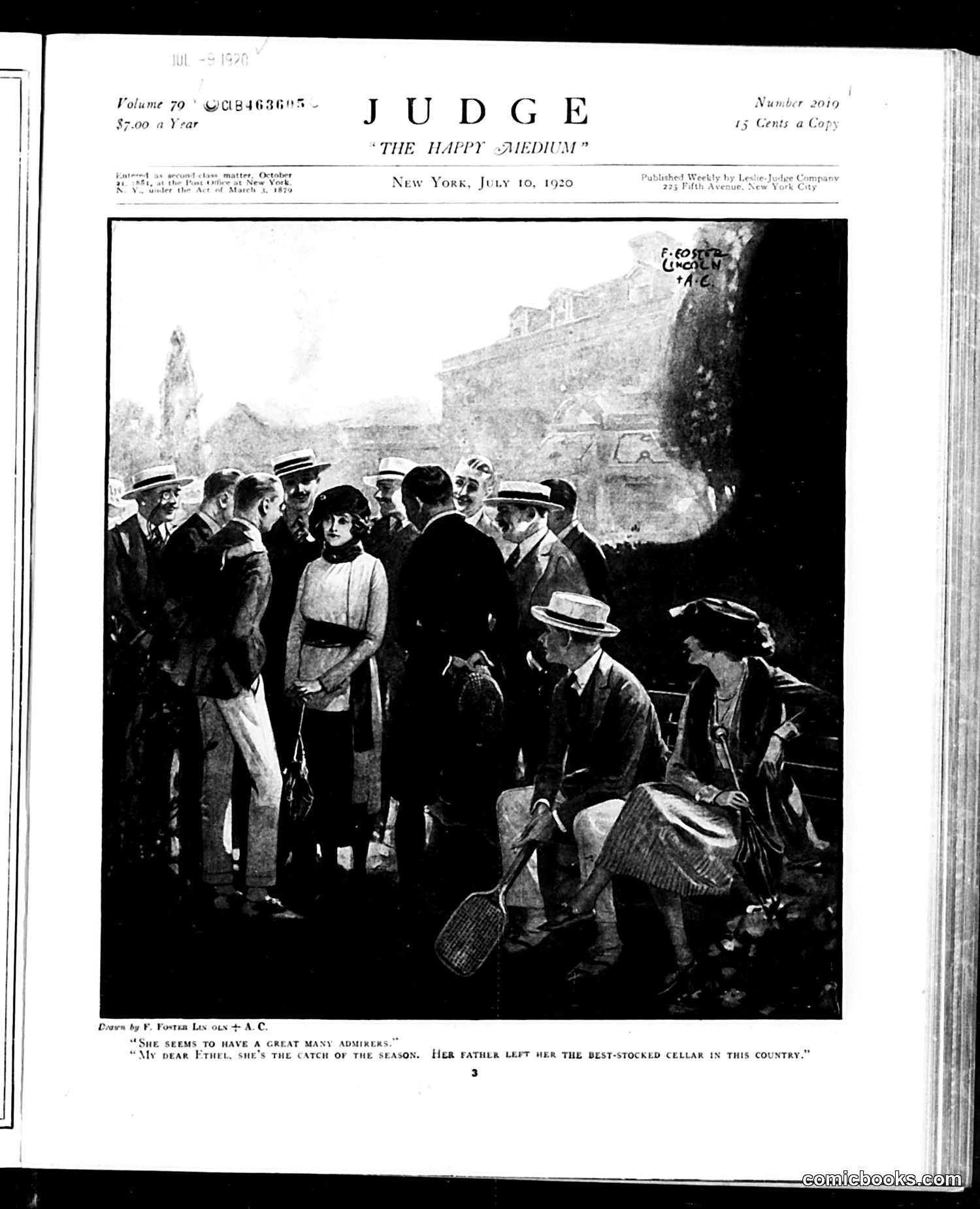
This illustration depicts a social scene at what appears to be a European location (note the classical architecture in background). The cartoon's caption reads: "She seems to have a great many admirers" and "My dear Ethel, she's the catch of the season. Her father left her the best-stocked cellar in this country." The satire targets Prohibition-era America (ratified January 1920). The "catch of the season" isn't a debutante praised for her accomplishments or family status, but rather a woman whose appeal derives from her father's illegal alcohol collection. The joke mocks how Prohibition created perverse incentives—wealth in contraband liquor became a marriageable asset, and wealthy families' wine cellars transformed into objects of desire and social currency.
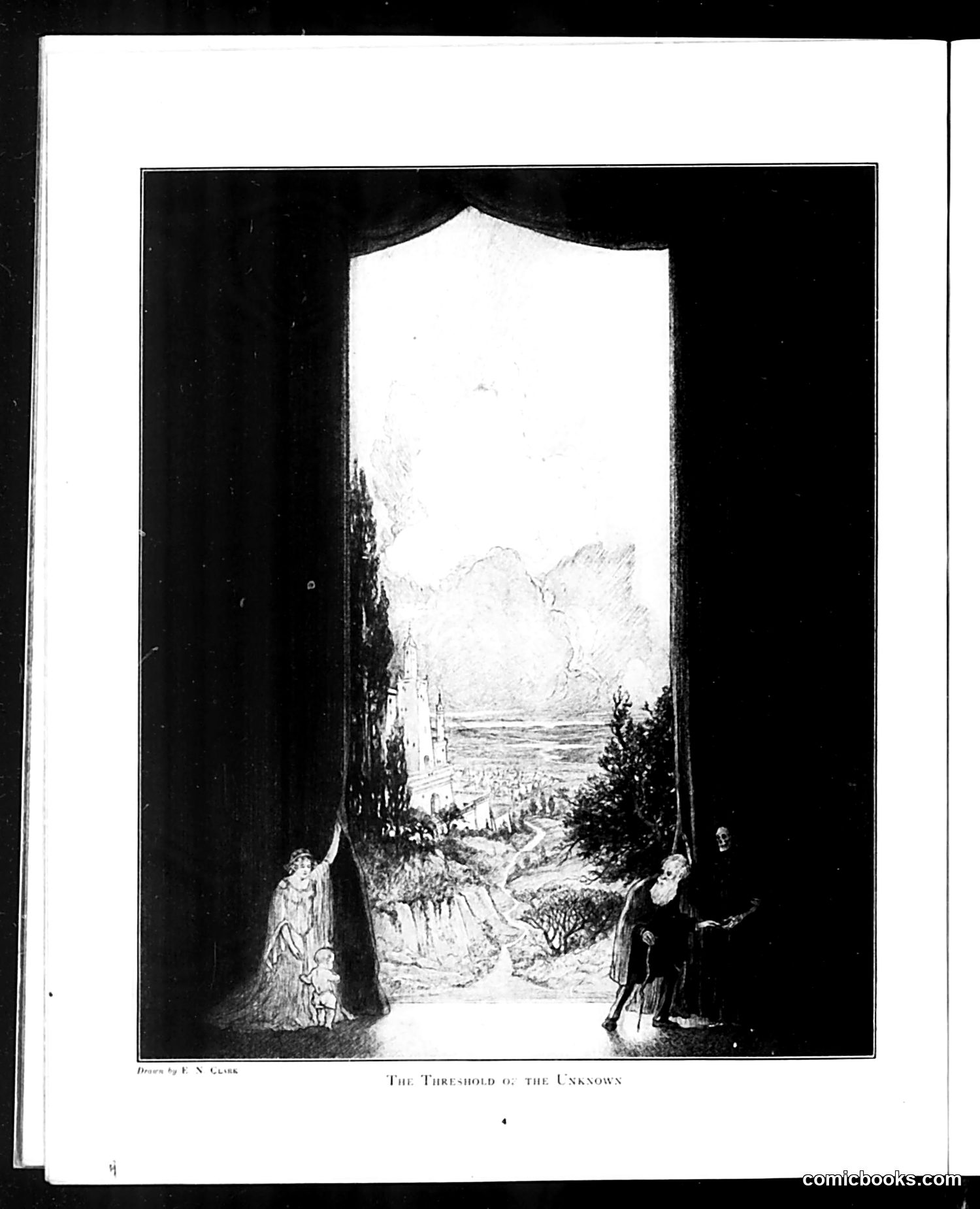
This illustration by F.N. Clark depicts two figures standing at a massive stone gateway or archway, gazing out toward a distant landscape with mountains and water. The composition creates a metaphorical "threshold"—a symbolic boundary between darkness (the enclosed stone structure) and light (the bright world beyond). The title and imagery suggest this is allegorical commentary about confronting the unknown or entering a new era. Without additional context or text identifying the figures, I cannot definitively state who they represent or what specific political/social event this references. The dramatic chiaroscuro technique emphasizes the psychological weight of crossing into uncertainty, a common satirical device in *Judge* magazine for commenting on contemporary anxieties or transitional moments in American society.
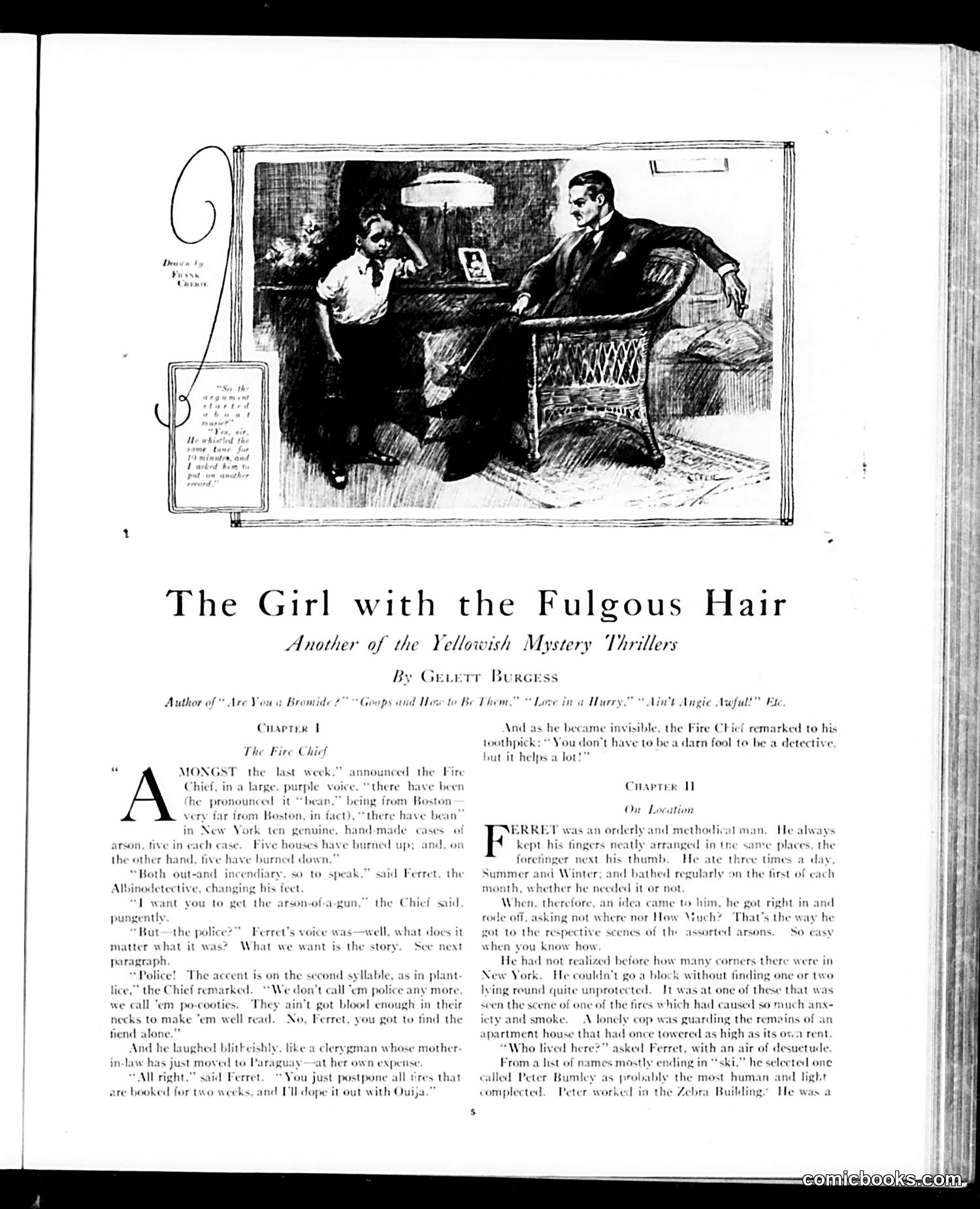
This page introduces a mystery thriller story by Gelett Burgess, a popular humorist of the early 1900s. The illustration depicts a man and woman in an office setting, apparently discussing a case involving arsons in Boston and New York. The story itself—not a political cartoon—appears to be a serialized detective fiction. The narrative references a "Fire Chief" discussing multiple house fires and mentioning "Ferret," an "orderly and methodical man" tasked with investigating. The text includes period-appropriate dialogue about police work and detective procedures. This represents Judge magazine's mixed content model: satire alongside commercial fiction serializations that entertained readers during the early twentieth century.
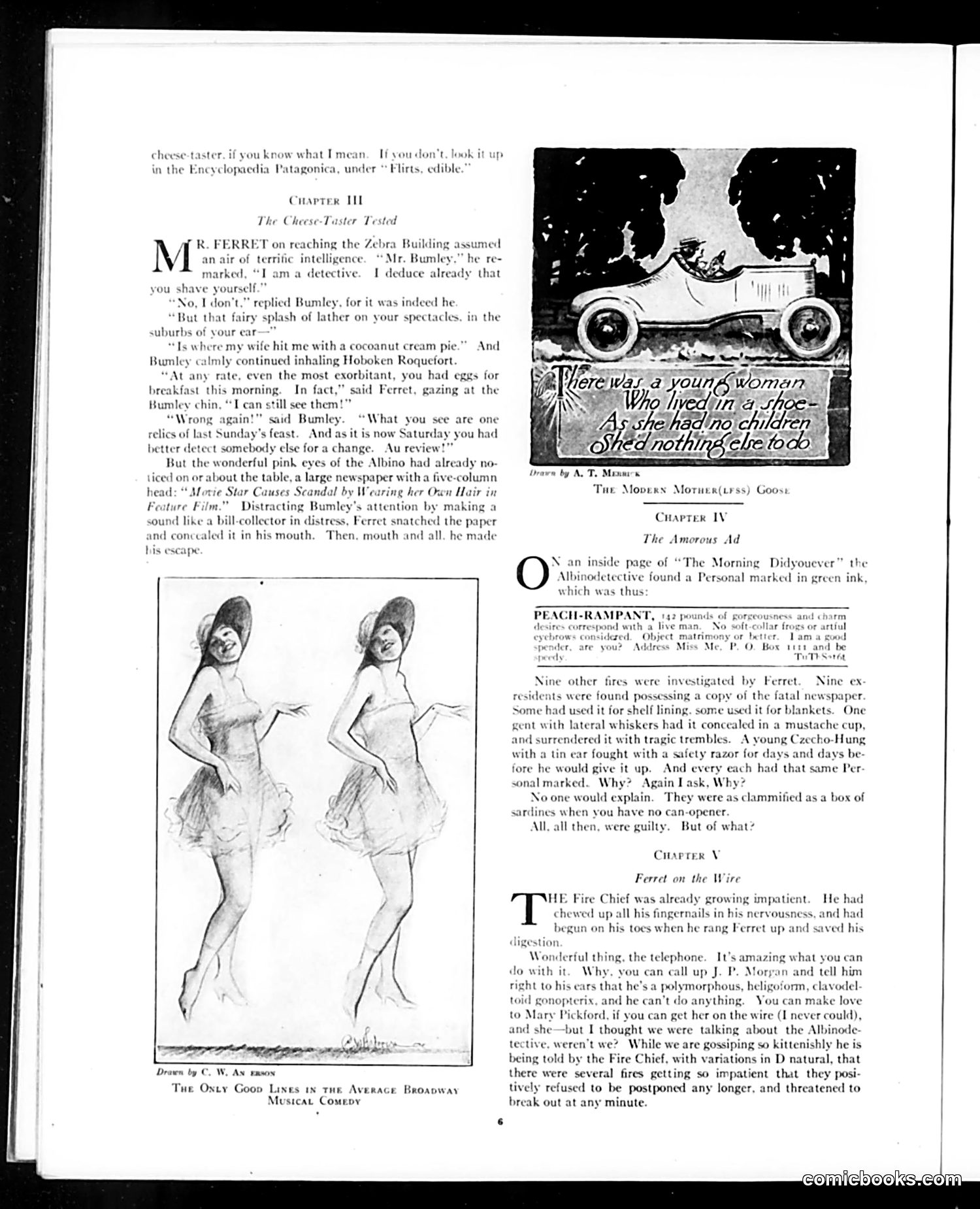
This page appears to be from a humorous fiction story rather than a political cartoon. The narrative in "Chapter III: The Cheese-Taster Tested" involves characters Mr. Ferret and Mr. Bumley discussing detective work and a wife hitting someone with a coconut cream pie. The illustrated content includes: - A drawing of a woman in a 1920s-style automobile with text referencing "a young woman who lived in a shoe" - A sketch labeled as "The Only Good Lines in an Average Broadway Musical Comedy" showing a woman in a dress The page appears to be entertainment/humor content typical of Judge magazine's satirical style, mocking contemporary theater and domestic situations, rather than containing political commentary. The magazine was known for mixing fictional stories with social satire.
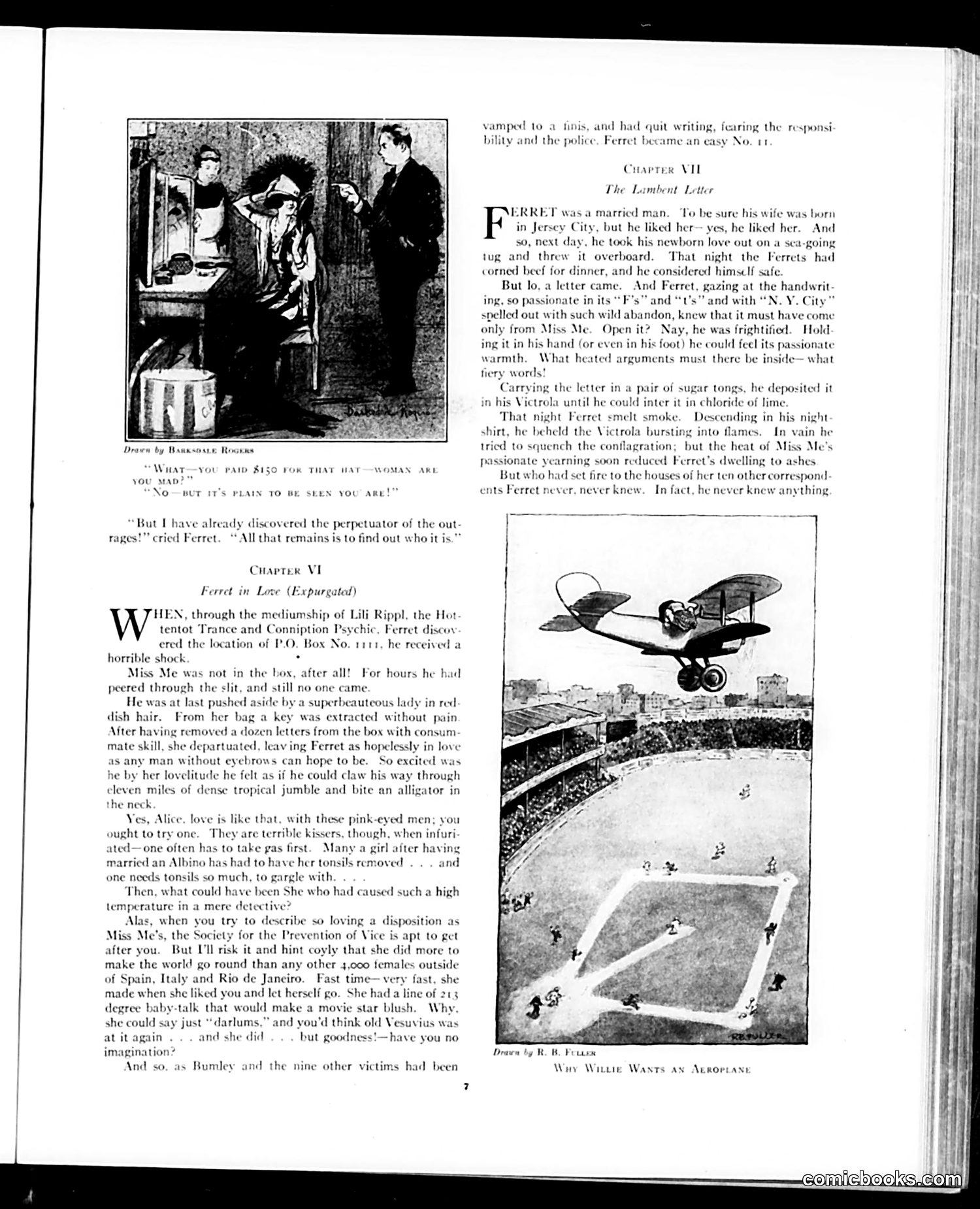
This page presents a serialized comic story called "Ferret" spanning multiple chapters. The narrative follows a detective named Ferret investigating mysterious crimes while becoming entangled with a woman called "Miss Me." **The satire targets:** The story parodies detective fiction and romance plots through absurdist humor. Chapter VI mocks sentimental love stories—Ferret falls instantly for a mysterious red-haired woman at a P.O. box, his infatuation described in exaggerated terms ("pink-eyed men," excessive melodrama). Chapter VII ridicules the extreme passion of love letters; the missive from Miss Me is so "passionate" it literally sets his house on fire. **The top cartoon** jokes about expensive women's fashion—a man criticizes his wife's $150 hat purchase, but she counters that at least her expensive taste is "plain to be seen" (unlike his cheap appearance). **The bottom illustration** shows Willie attempting aerial stunts in an early airplane, captioned "Why Willie Wants an Aeroplane"—likely satirizing aviation craze enthusiasm. The overall tone is lighthearted parody of contemporary obsessions: detective stories, romantic excess, fashion conspicuous consumption, and aviation fads.
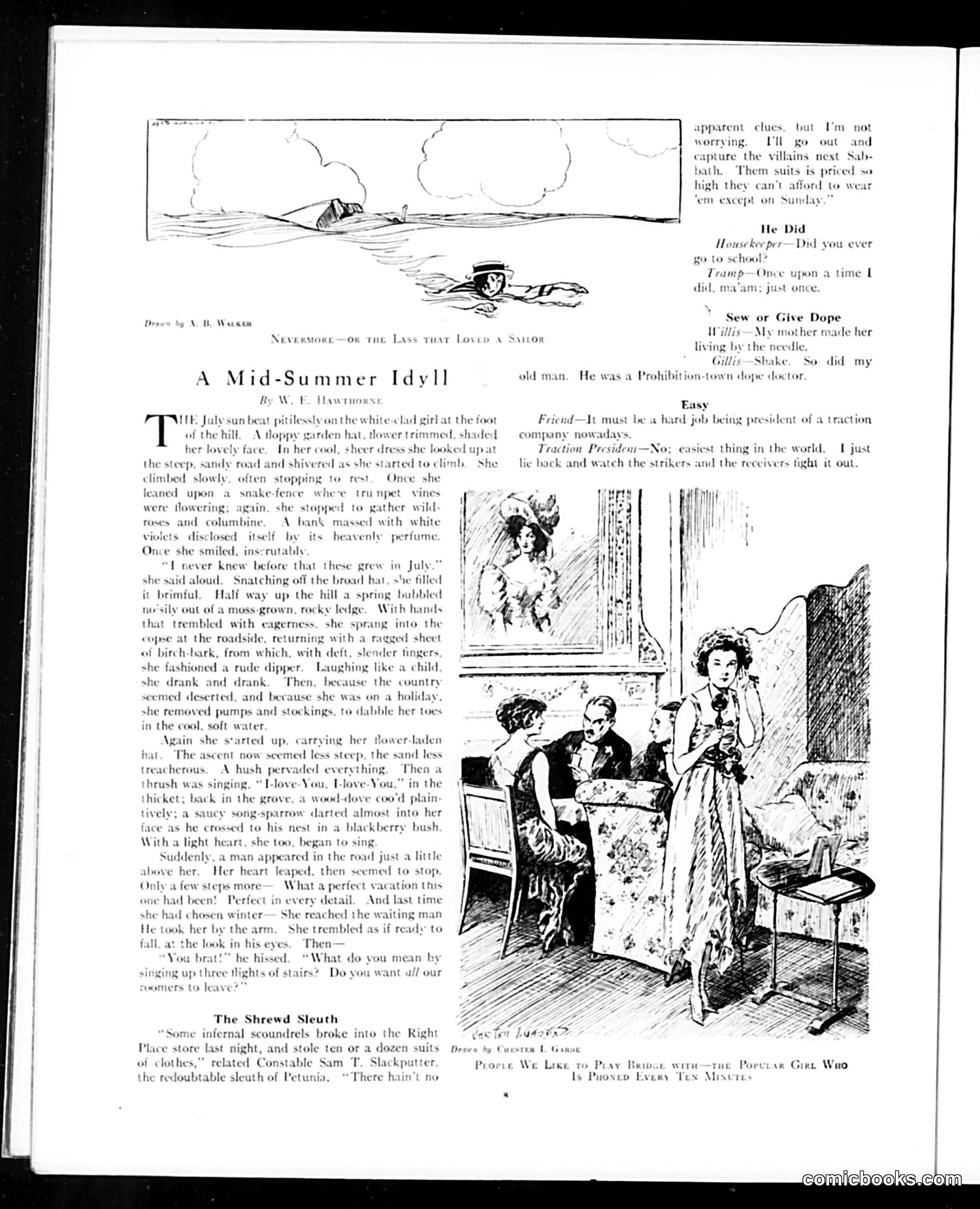
This page contains three distinct pieces: **"A Mid-Summer Idyll"** (center): A sentimental short story by W.F. Hawthorne about a young woman's romantic countryside walk, culminating in an encounter with a man. The illustration shows an interior domestic scene. This appears straightforward fiction, not satire. **"The Shrewd Sleuth"** (bottom): A brief crime anecdote about a store robbery, likely played for humorous effect through the constable's apparent confidence despite vague details. **Sidebar humor pieces** (right): Quick quips and jokes, including one about a "Traction President" watching strikers and receivers fight—**this is social satire** referencing labor disputes affecting streetcar/trolley companies in the early 1900s. The joke satirizes management's passivity during labor conflicts. Another references Prohibition-era "dope doctors." The page is primarily **entertainment and light fiction** rather than political cartooning, though the traction company joke reflects real contemporary labor tensions of the era.
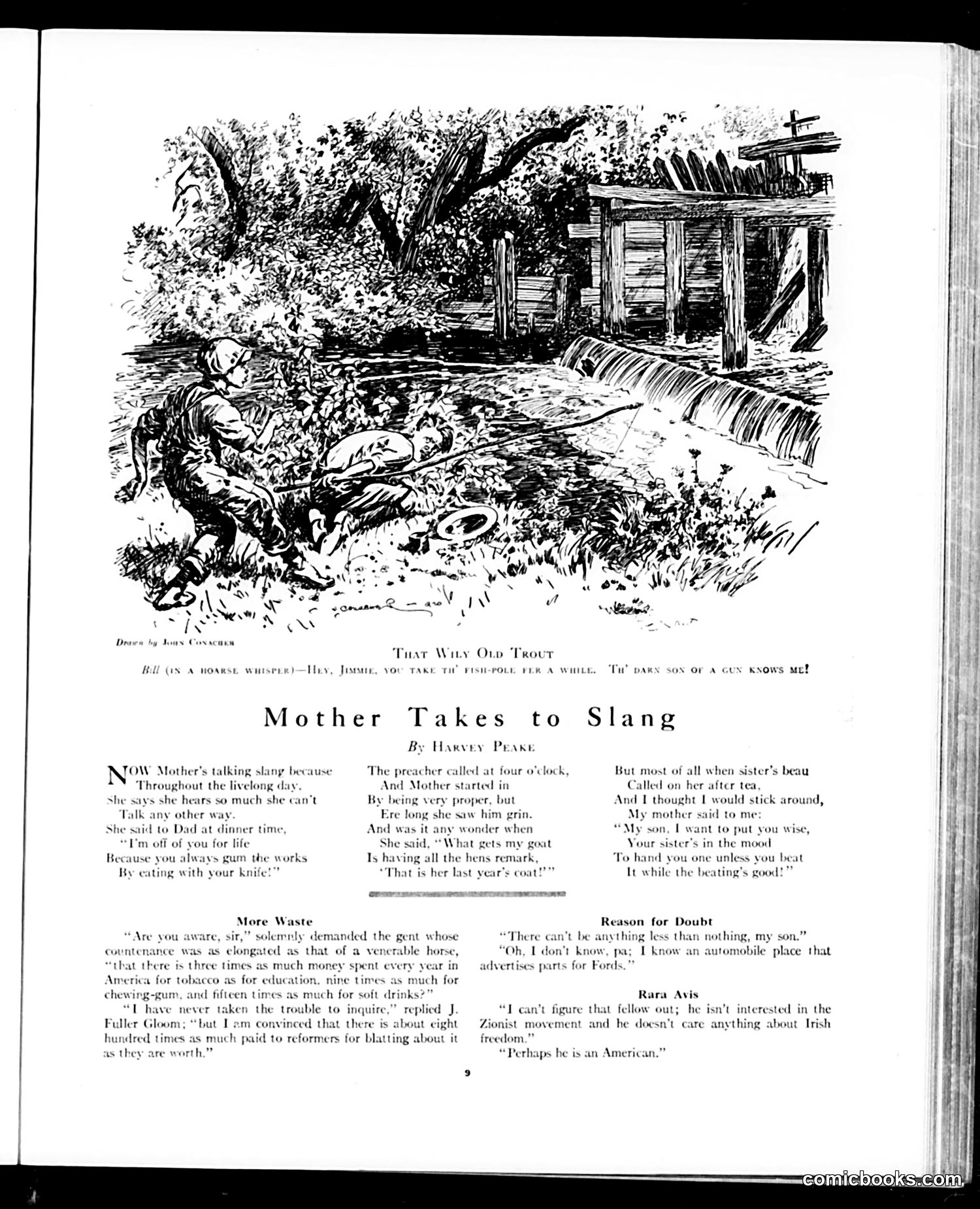
This page from *Judge* contains several short humor pieces satirizing American social manners and contemporary concerns circa early 20th century. **"Mother Takes to Slang"** mocks women adopting modern slang speech. The cartoon depicts a boy fishing while his mother uses crude language ("tu' darks son of a gun knows me!"), inverting expected propriety—mothers were stereotypically guardians of proper speech. **"More Waste"** critiques American consumer excess, with a gentleman complaining that the nation spends three times more on tobacco and chewing gum than education, and "eight hundred times" more on reformers complaining about it than actually fixing problems. **"That Wily Old Trout"** is a simple fishing anecdote playing on dialect humor. The bottom section includes brief satirical quips about automotive industry skepticism ("Fords") and a joke about finding an American man uninterested in both Zionism and Irish causes—treating patriotic activism as so universal that apathy itself seems exotic. The overall tone reflects Jazz Age anxieties about changing social standards, consumerism, and ethnic/political movements.
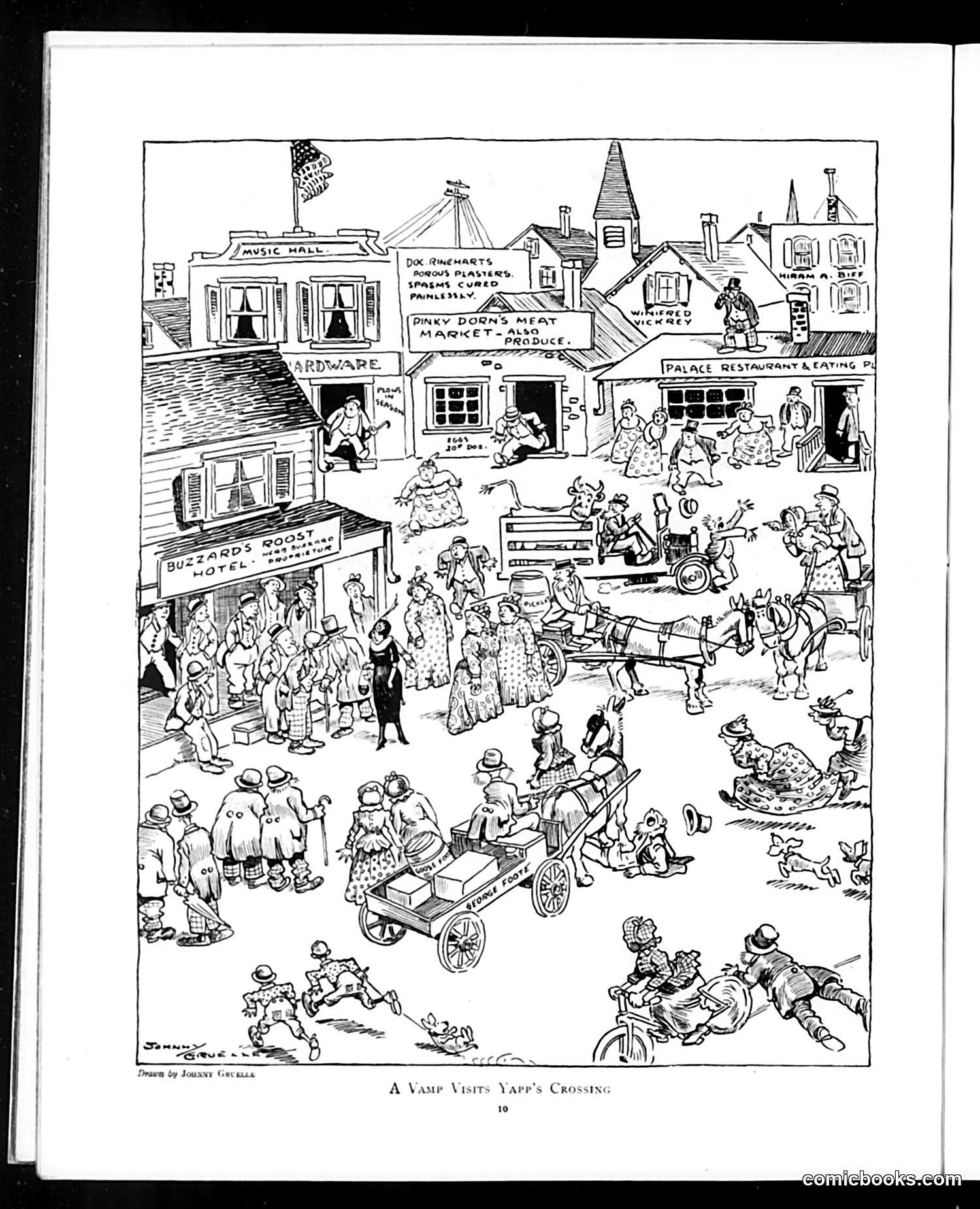
This satirical illustration depicts a chaotic small-town scene where a glamorous urban woman (the "vamp") has arrived, causing mayhem. The cartoon mocks both rural simplicity and urban sophistication through exaggerated contrasts. Visible establishments include "Buzzard's Roost Hotel," a "Music Hall," "Hardware" store, and "Palace Restaurant & Eating Place." The townspeople—depicted with caricatured rural features—react with visible excitement and confusion to the visitor's presence, creating slapstick disorder with vehicles, animals, and scattered townspeople. The satire critiques early 20th-century anxieties about cosmopolitan "vamps" (seductive city women) disrupting provincial American communities, while simultaneously mocking rural gullibility and unsophistication. The drawing style emphasizes physical comedy and social tension.
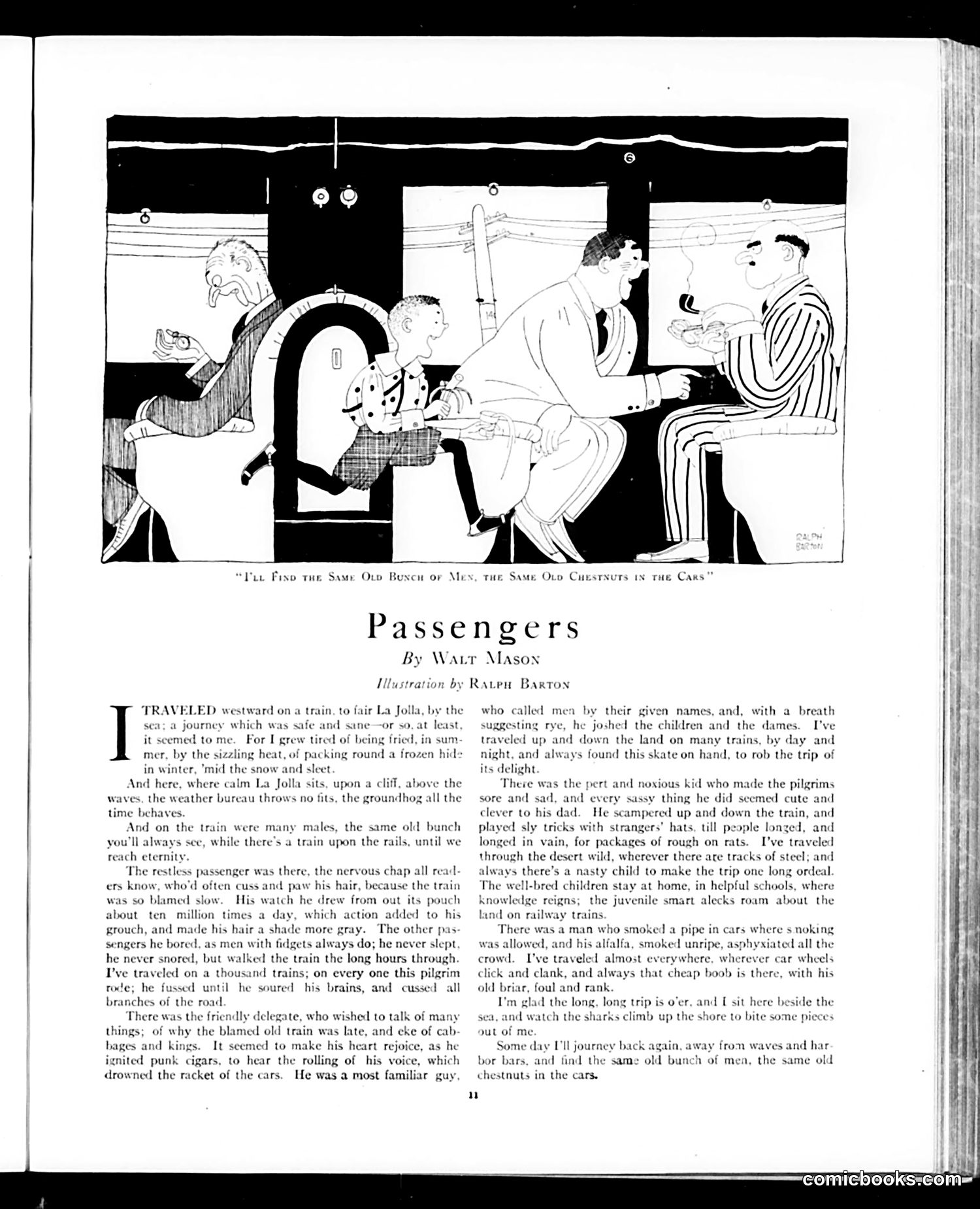
This is a humorous essay illustrated by Ralph Barton depicting stock characters encountered on train travel. The cartoon shows a cross-section of annoying fellow passengers in a railroad car. Mason catalogs the archetypal train nuisances: the restless, watch-checking businessman who frets constantly; the garrulous politician who won't stop talking; the obnoxious child running wild; the pipe smoker whose unpleasant tobacco asphyxiates nearby travelers. The subtitle's caption—"I'll Find the Same Old Bunch of Men, the Same Old Chestnuts in the Cars"—suggests these passenger types are universal and tiresome fixtures of American rail travel. The satire targets not specific individuals but rather the predictable annoyances of public transportation itself—the recurring personality types and behavioral transgressions that made train journeys tedious. For modern readers, it humorously documents early-20th-century travel complaints that remain relatable despite changing technology.
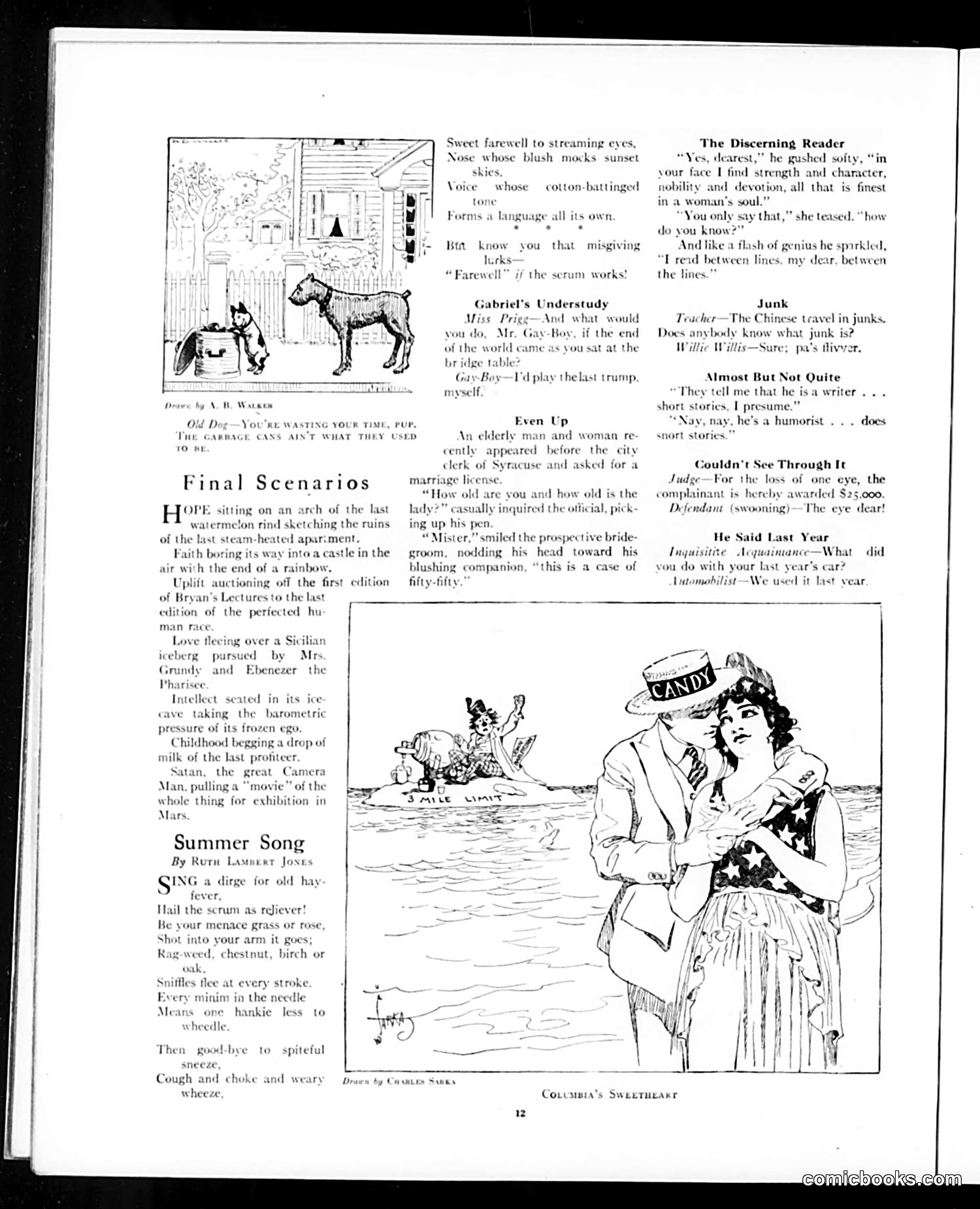
This page contains several brief humorous pieces typical of early 20th-century American satirical magazines: **"Final Scenarios"** presents whimsical apocalyptic vignettes—allegorical figures (Faith, Uplift, Love, Intellect, Childhood) depicted in surreal "end times" scenarios. The satire mocks Progressive Era idealism and abstract philosophizing. **"Summer Song"** is a comedic poem about hay fever, personifying the illness's symptoms with mock-solemnity. The short jokes scattered throughout mock everyday life: **"Gabriel's Understudy"** jokes about the end of the world; **"Even Up"** satirizes marriage equality (a couple of matching ages); **"The Discerning Reader"** ridicules flattery; **"Junk"** is a schoolroom joke; **"Almost But Not Quite"** distinguishes between writers and humorists. **"Columbia's Sweetheart"** (bottom illustration by Charles Saarks) shows a woman with a candy box, likely depicting romantic sentimentality or advertising. The overall tone is light domestic humor reflecting turn-of-the-century American sensibilities—no heavy political content is evident on this particular page.
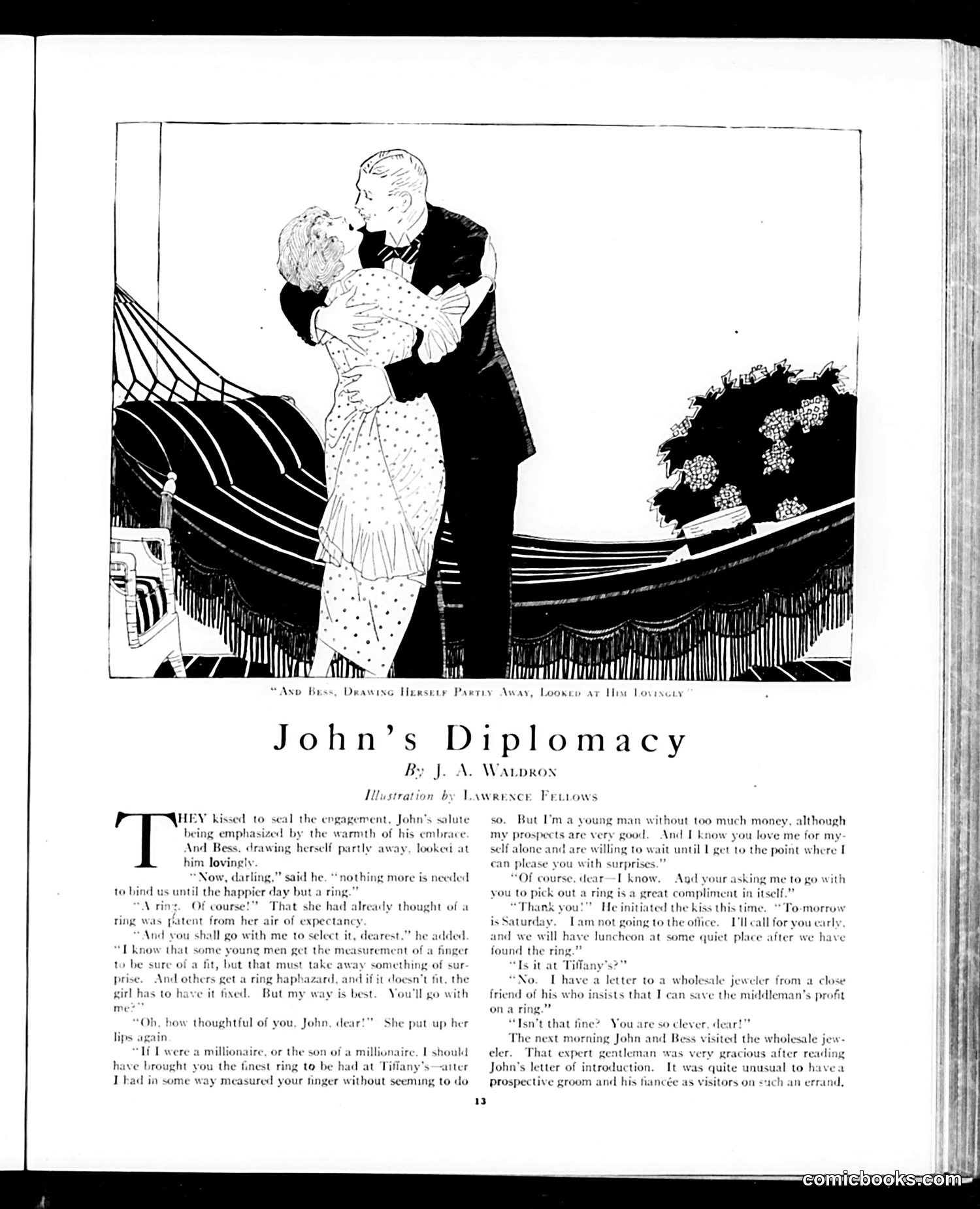
This is a romantic comedy story (not a political cartoon) from Judge magazine, illustrated by Lawrence Fellows. The narrative follows John, an engaged man of modest means, as he navigates buying an engagement ring with his fiancée Bess. The satire targets early 20th-century courtship conventions and male economic anxieties. John's "diplomacy" involves clever compromises: he can't afford Tiffany's finest rings, so he gets a letter of introduction to a wholesale jeweler to "save the middleman's profit." He also insists Bess accompany him to select the ring rather than guessing her size—framed as thoughtfulness but also practical necessity given his budget constraints. The humor lies in John presenting financial limitations as romantic consideration, while Bess graciously accepts his modest approach. It reflects period concerns about young men's ability to marry and provide, and the social performance required around engagement rituals.
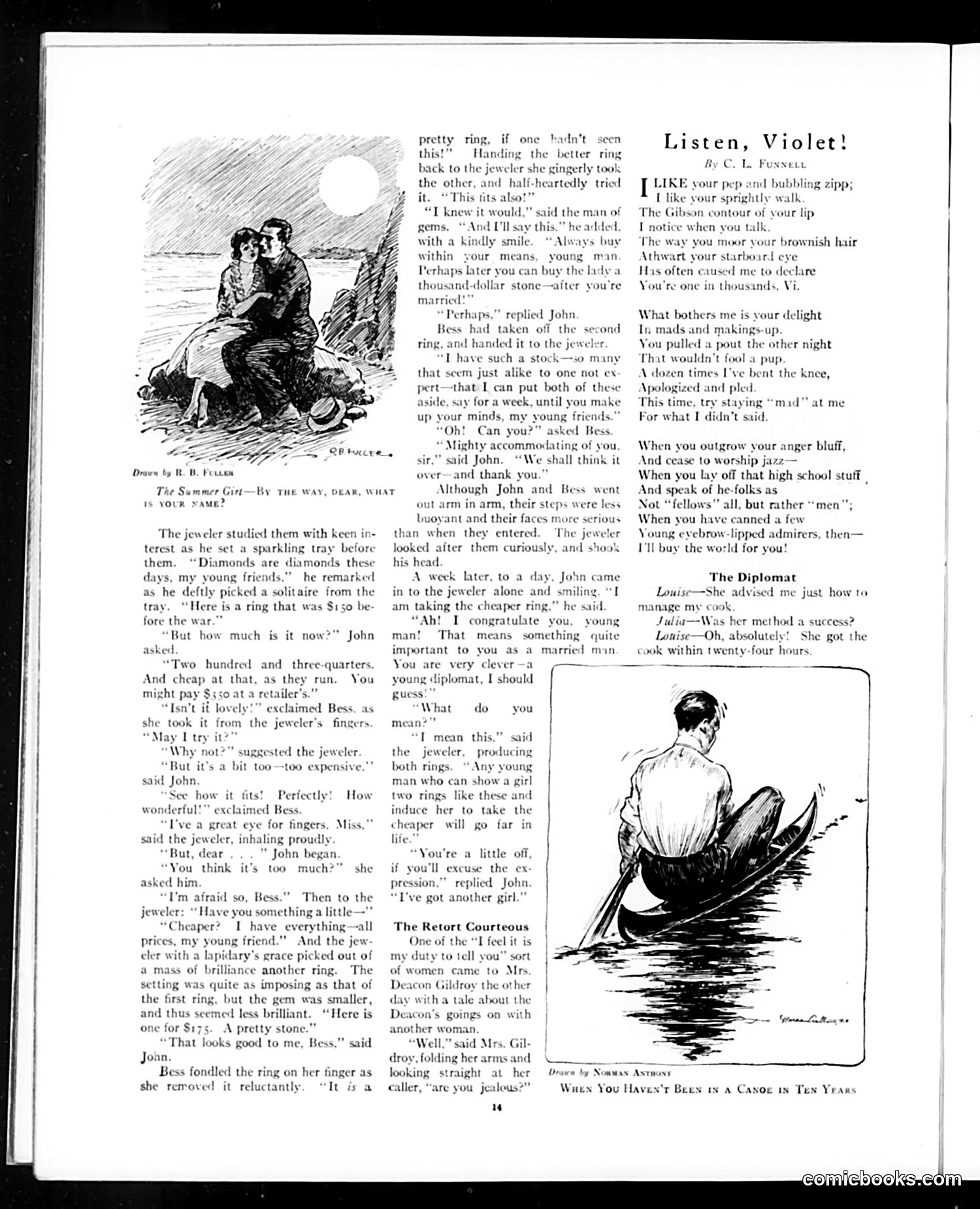
**The Main Cartoon ("The Summer Girl"):** A young couple, John and Bess, shop for an engagement ring during post-WWI inflation. A jeweler shows them a diamond that cost $150 before the war but now costs $275—over 80% more. Bess loves the expensive ring but John can't afford it. The jeweler offers a cheaper alternative. **The Satire's Point:** This mocks post-WWI economic hardship and inflation that made luxury goods unaffordable for young working-class couples. The jeweler's final advice—"buy within your means" and "perhaps later you can buy the lady a thousand-dollar stone—after you're married"—satirizes how inflation forced postponed dreams and financial anxiety even for life milestones. **Secondary Content:** The page also includes a poem "Listen, Violet!" (mocking flirtatious young women) and a brief "Diplomat" joke about managing servants. The cartoons reflect Judge's typical 1920s concerns: economic strain, generational attitudes, and social etiquette.
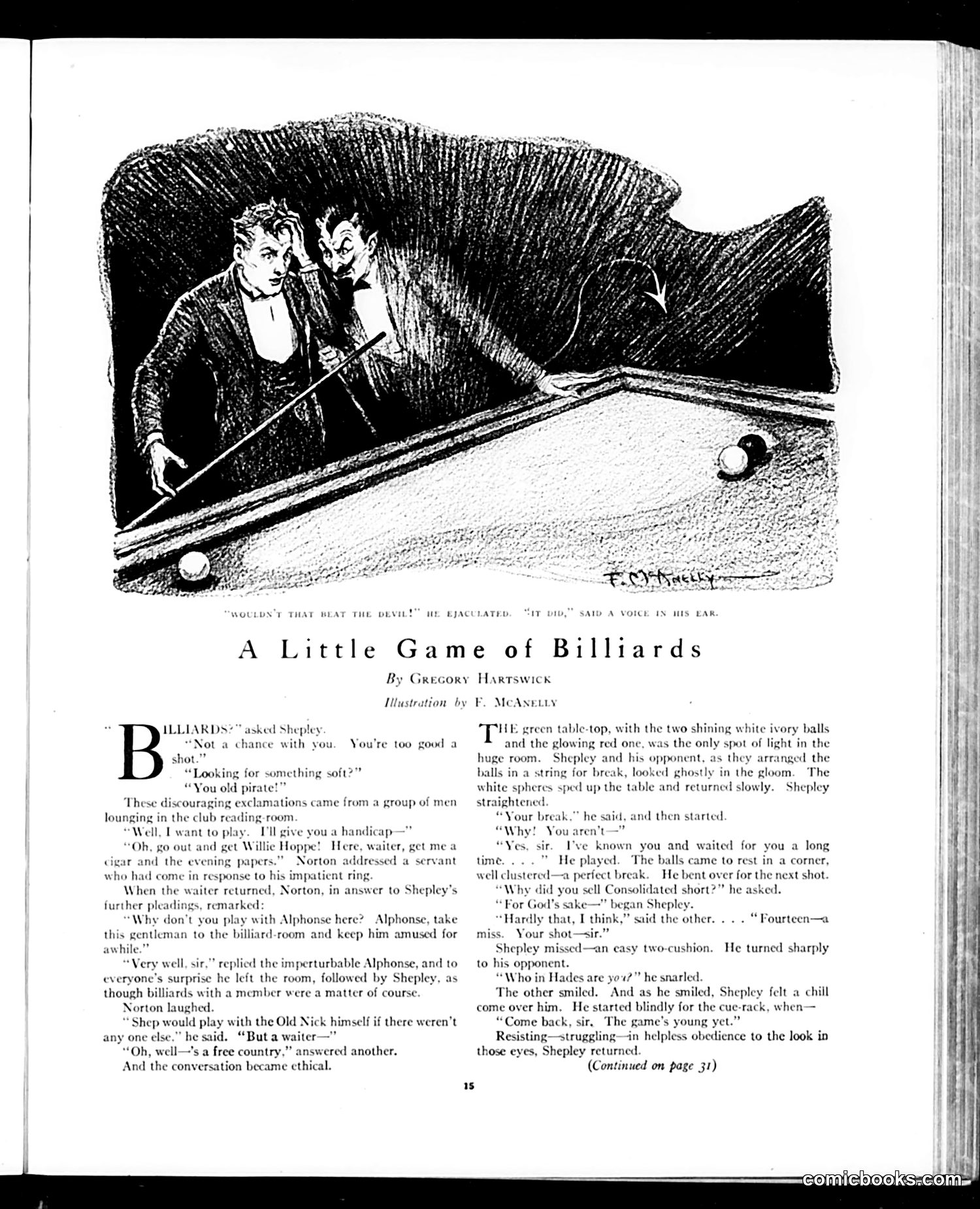
This is the opening of a serialized supernatural story (continued on page 31). The illustration depicts two men at a billiard table in a dark room—one appears demonic or otherworldly, the other is the protagonist Shepley, who has been tricked into playing. The narrative setup involves a clubman named Norton arranging for Shepley to play billiards with "Alphonse," supposedly a servant. However, "Alphonse" proves to be something sinister: he knows intimate details about Shepley's financial dealings (mentioning "Consolidated short"—a stock sale), demonstrates supernatural control over Shepley's will ("helpless obedience"), and appears increasingly inhuman as the scene progresses. The story appears to be a Faustian bargain narrative—a common Judge theme where a protagonist unknowingly enters into a supernatural wager, likely with the Devil himself (the caption's "Wouldn't that beat the Devil!" is ironic foreshadowing). The tale satirizes both gentlemen's club culture and financial speculation through this Gothic framework.
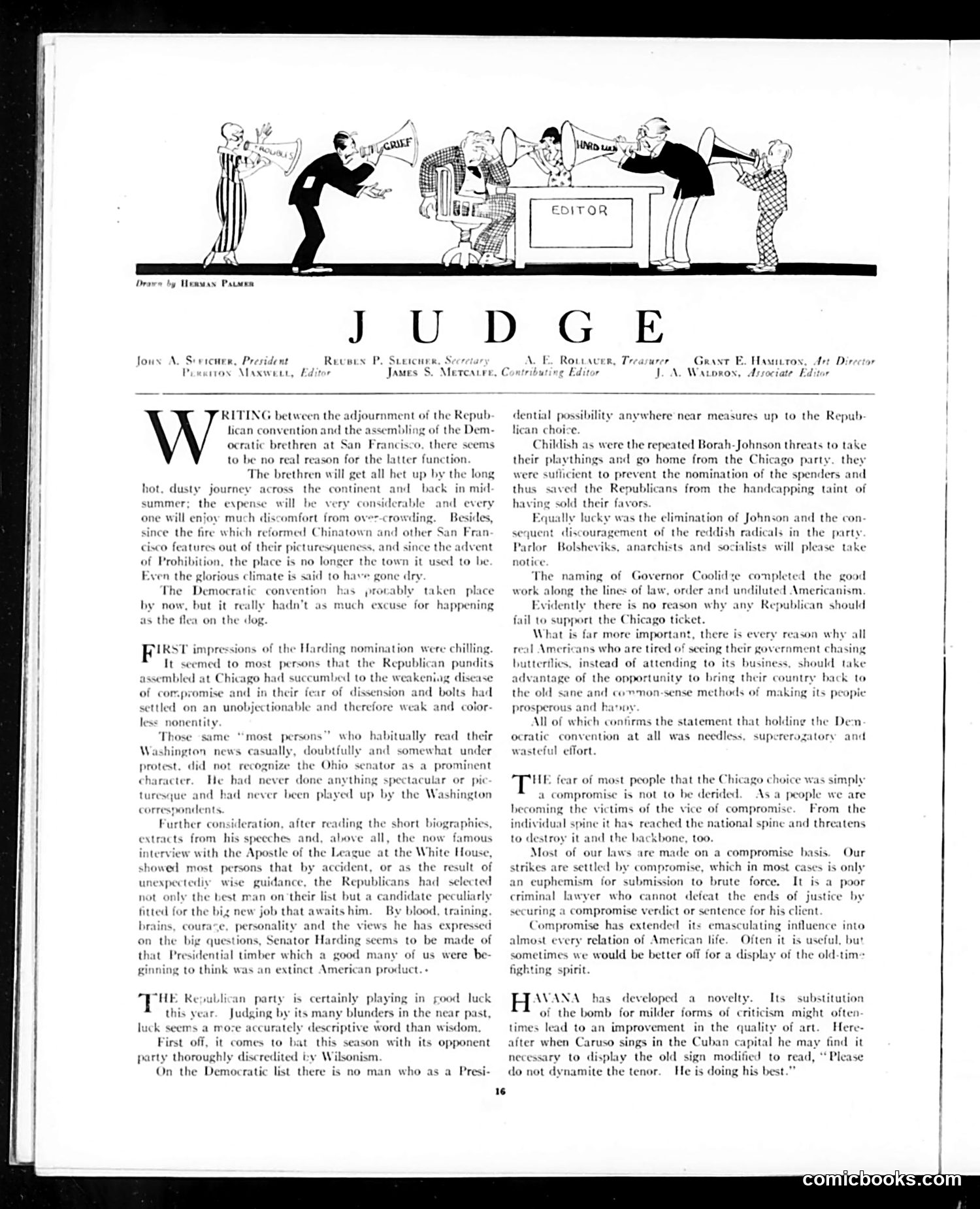
This page is primarily text—an editorial titled "JUDGE" discussing the 1920 Republican and Democratic national conventions. The small cartoon at the top shows figures around an "EDITOR" desk, likely satirizing the editorial process itself. The editorial argues that the Republican convention made wise choices: nominating Warren G. Harding (praised as capable and "made of Presidential timber") and Calvin Coolidge for VP. It mocks Democratic prospects, claiming no comparable candidate exists and that the party is "thoroughly discredited by Wilsonism" (Woodrow Wilson's unpopular presidency). Key political references include threats by Senator William Borah and Governor Frank Lowden to bolt the party (described as "childish"), and praise for eliminating radical elements. The piece advocates Republican victory as a return to "common-sense methods" after Wilson's idealistic but failed policies. The satire reflects 1920s Republican optimism about reclaiming power from Progressive Democrats.
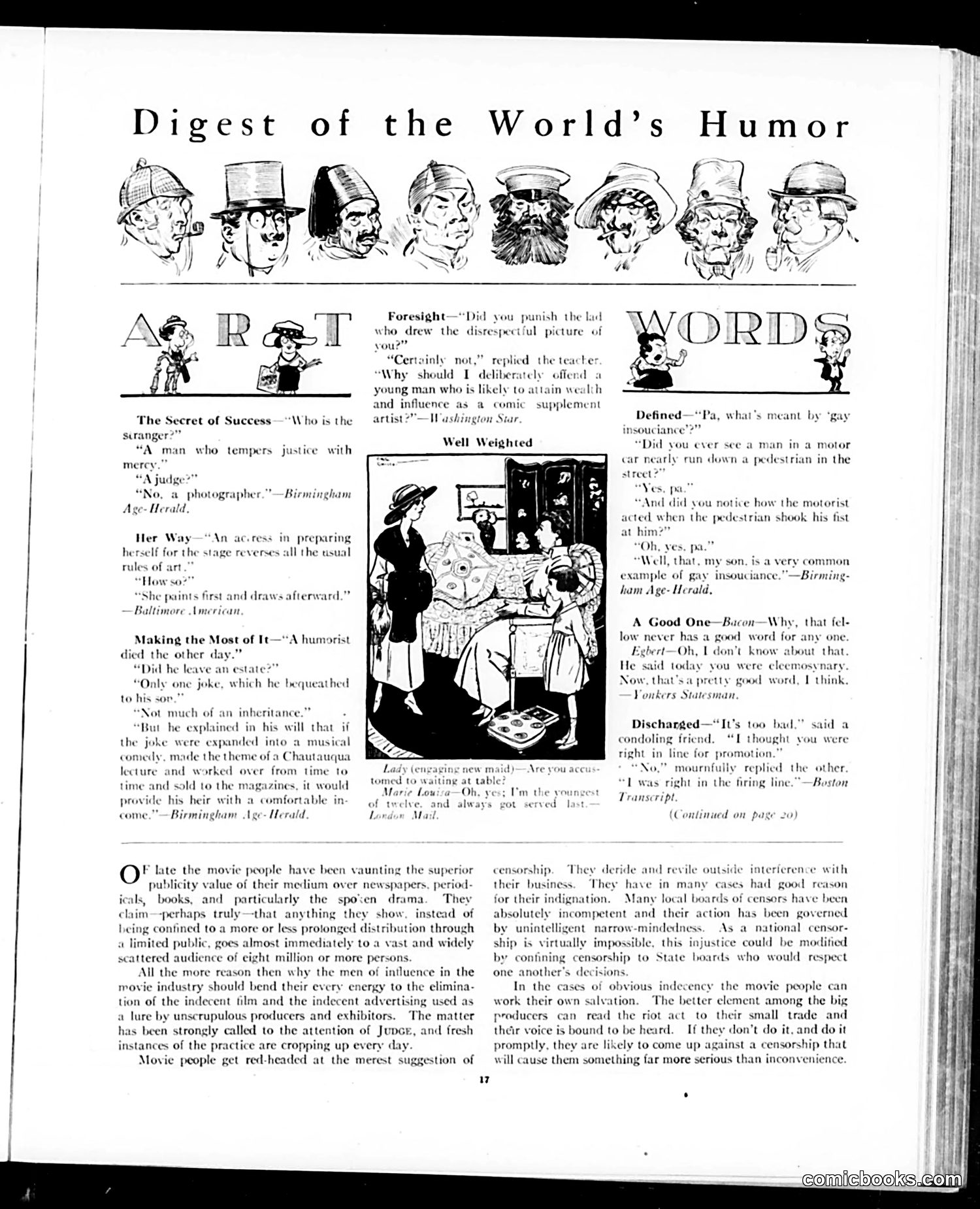
This page collects short humor jokes and a political editorial about film censorship. **The jokes** use visual and verbal puns common to early-20th-century American humor. "The Secret of Success" contrasts a judge (symbol of justice) with a photographer (who "tempers justice with mercy" by flattering subjects). "Her Way" jokes that actresses reverse normal painting technique. "Well Weighted" satirizes motorists' reckless indifference—a "gay insouciance"—to pedestrians they nearly kill. **The editorial** argues movie studios should self-regulate rather than resist censorship boards. It criticizes both incompetent local censors and the movie industry's defensive posturing about their cultural influence. The argument: studios claiming superiority to newspapers should voluntarily clean up indecent films and advertising, or face stricter outside censorship. The cartoon header shows caricatured ethnic/national stereotypes—standard visual vocabulary for Judge's satirical approach to humor.
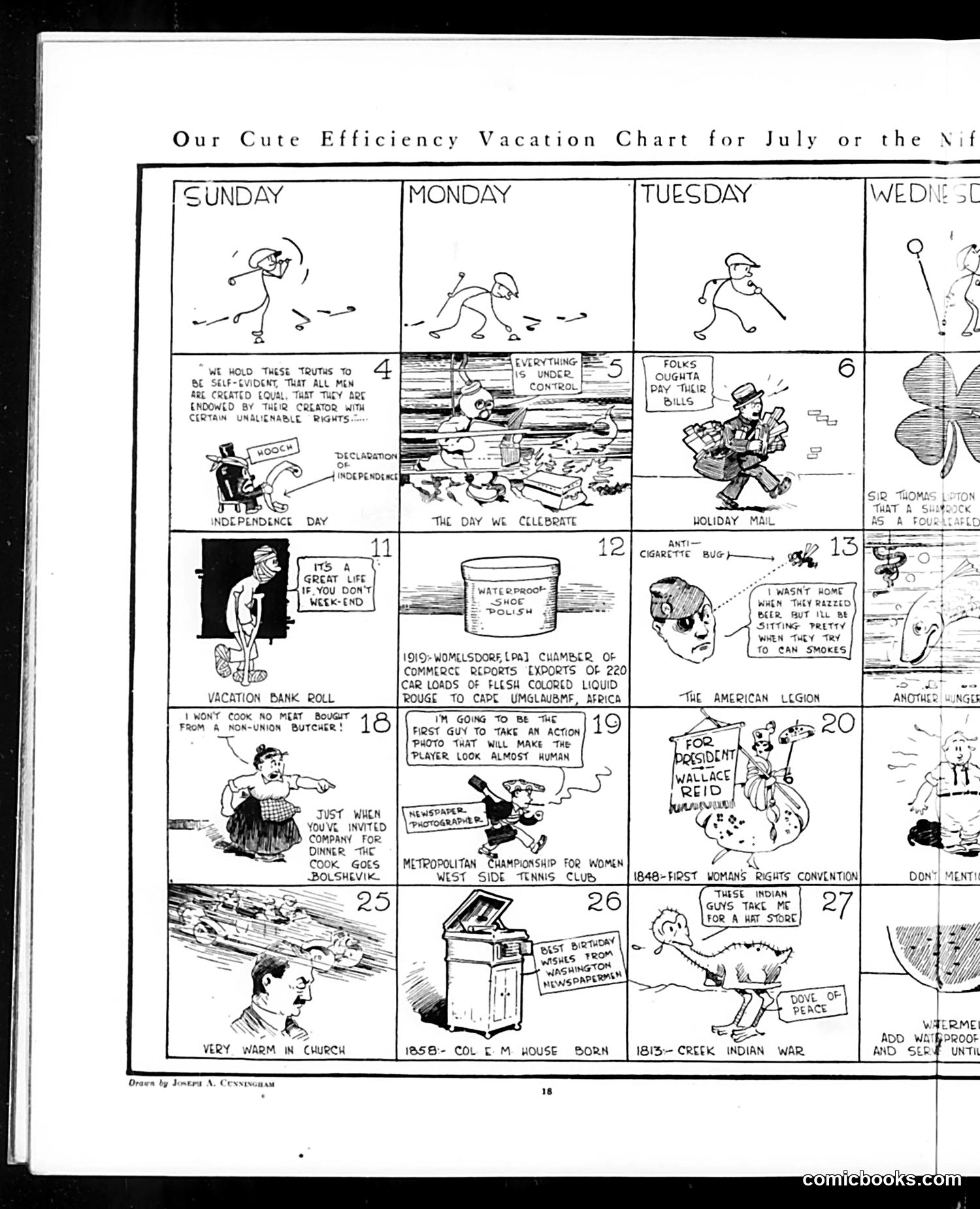
This is a satirical calendar comic mocking American social and political pretensions during the post-WWI era (circa 1920s). The chart presents daily vacation activities alongside historical or current-event commentary: **Key References:** - **July 4th**: Mocks the Declaration of Independence against actual inequality - **July 12th**: References a real 1919 export scandal—a chamber of commerce shipping "flesh-colored liquid rouge" to Africa, satirizing American commercialism - **July 18th**: Jokes about labor unions and non-union butchers (post-Red Scare anxieties) - **July 20th**: References the 1848 First Women's Rights Convention - **July 26th**: Appears to reference Cole M. House's 1856 birth - **July 27th**: References the 1813 Creek Indian War The cartoon's humor lies in juxtaposing lofty American ideals (independence, women's rights) with petty modern complaints (cooking, social embarrassment, shopping). It critiques both inefficiency and hypocrisy in American life.
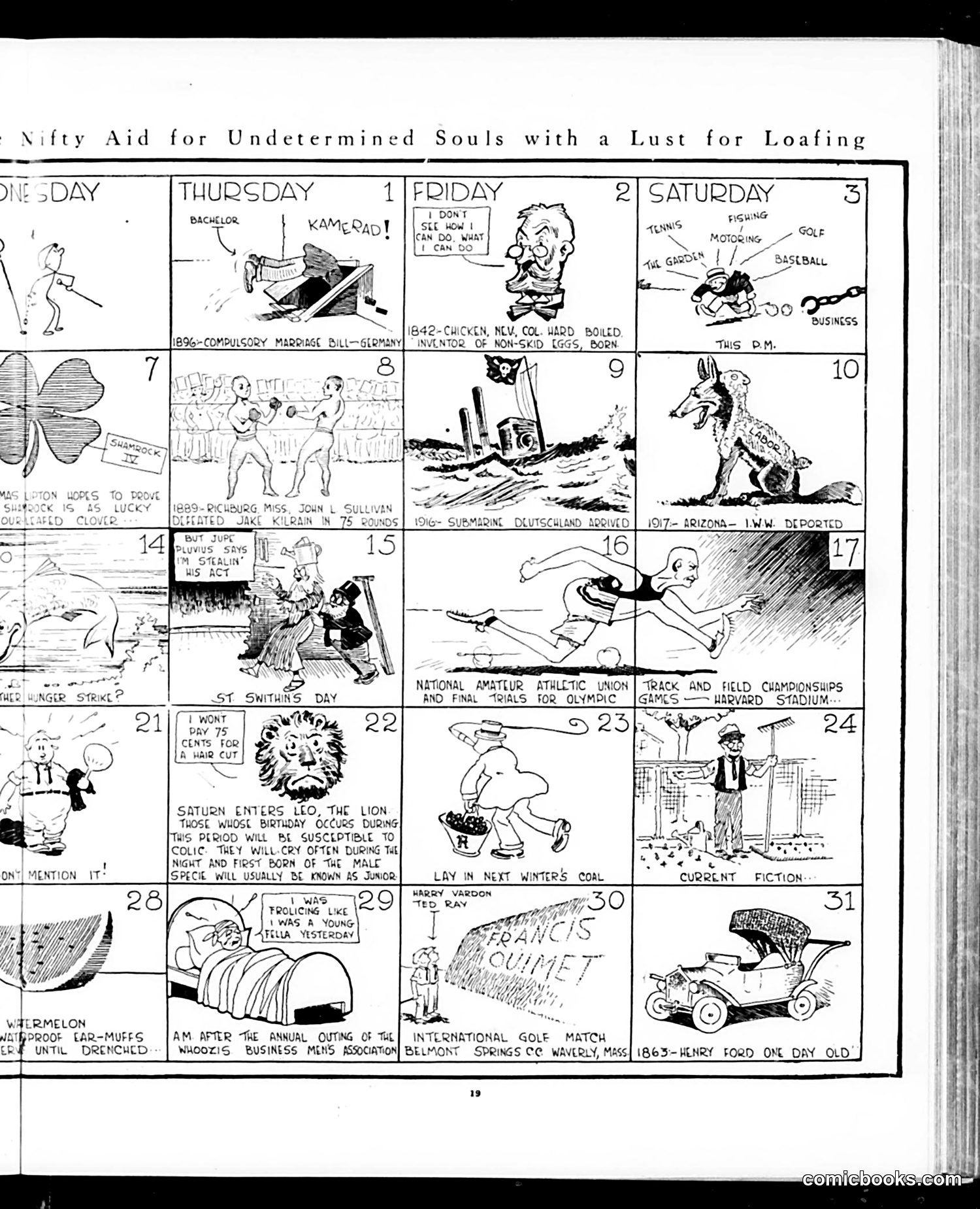
This is a humorous calendar page titled "Nifty Aid for Undetermined Souls with a Lust for Loafing"—essentially advice for lazy people on what to do each day. The cartoons satirize various contemporary events and trends circa 1912: - **Panel 2**: A man confused about his identity references a recent patent for non-skid eggs - **Panel 8**: Germany's U-boat (submarine) development during pre-WWI naval tensions - **Panel 22**: Saturn astrology entering Leo—mocking belief in horoscopes and superstitions - **Panel 24**: A baseball umpire, referencing current sporting events - **Panel 30-31**: References to Harry Vardon and Ted Ray (famous golfers) and Henry Ford's Model T automobile The overall humor relies on recognizing contemporary figures, inventions, and events. The page combines practical loafing suggestions with cultural commentary—poking fun at nascent technology, superstition, competitive sports, and leisure activities of the era.
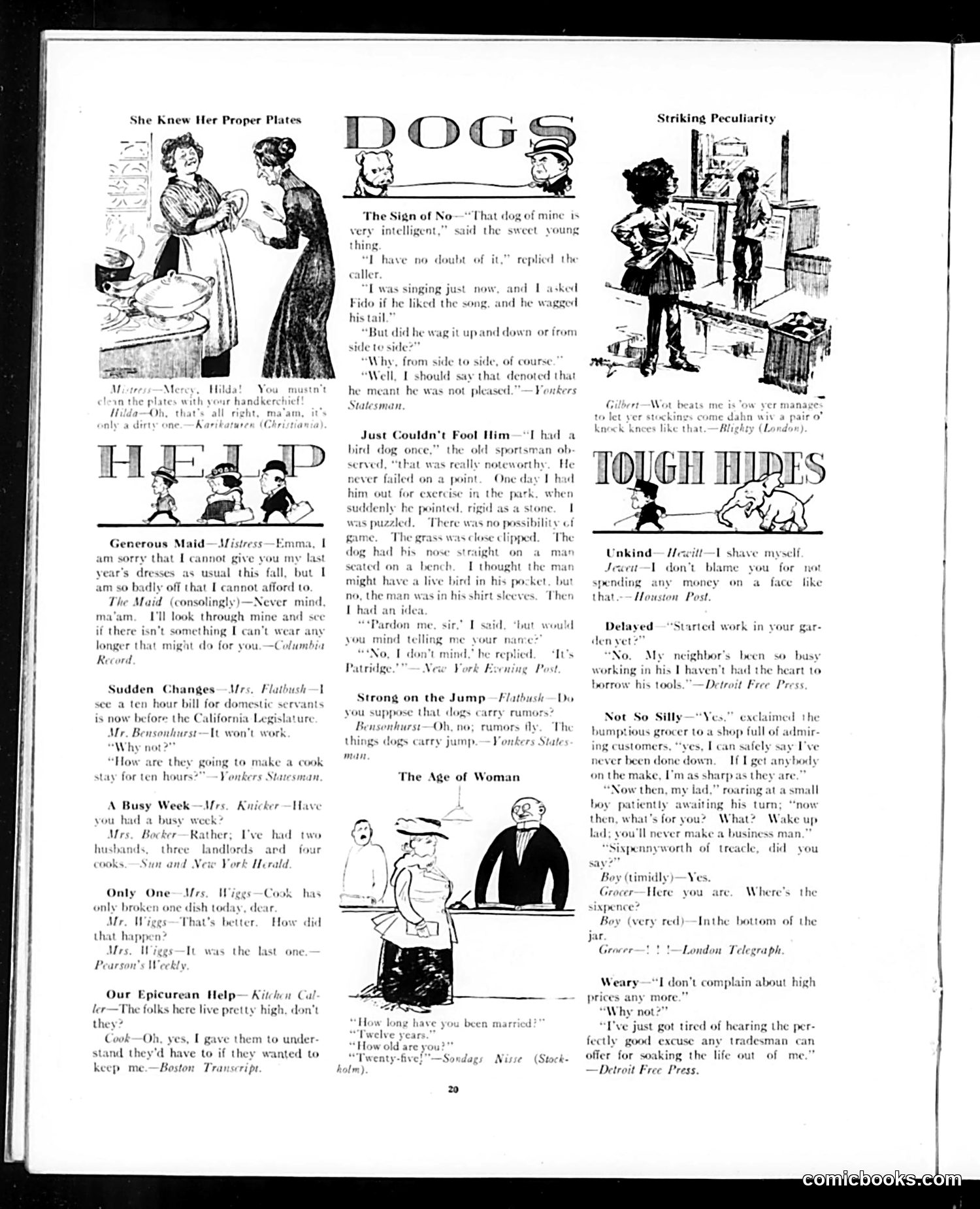
This page from *Judge* contains several brief humorous anecdotes satirizing domestic life and social class in early 20th-century America. **Main themes:** The sketches mock the pretensions and contradictions of middle-class households. "She Knew Her Proper Plates" ridicules a mistress's assumption that servants understand fine dining etiquette. "A Busy Week" exaggerates the demands placed on working women managing households. "Our Epicurean Help" satirizes a cook's manipulation of employers through false pretense of their sophistication. The dog anecdotes ("The Sign of No," "Just Couldn't Fool Him") use animal behavior to illustrate human absurdities—misinterpreting signals or being outsmarted by circumstances. **Social commentary:** These pieces reflect anxieties about servant hierarchies, women's domestic labor, and the gap between social aspiration and reality. The humor targets both employers (who misunderstand their servants) and servants (who manipulate or deceive their employers). The tone is gentle ridicule of everyday middle-class life rather than sharp political satire.
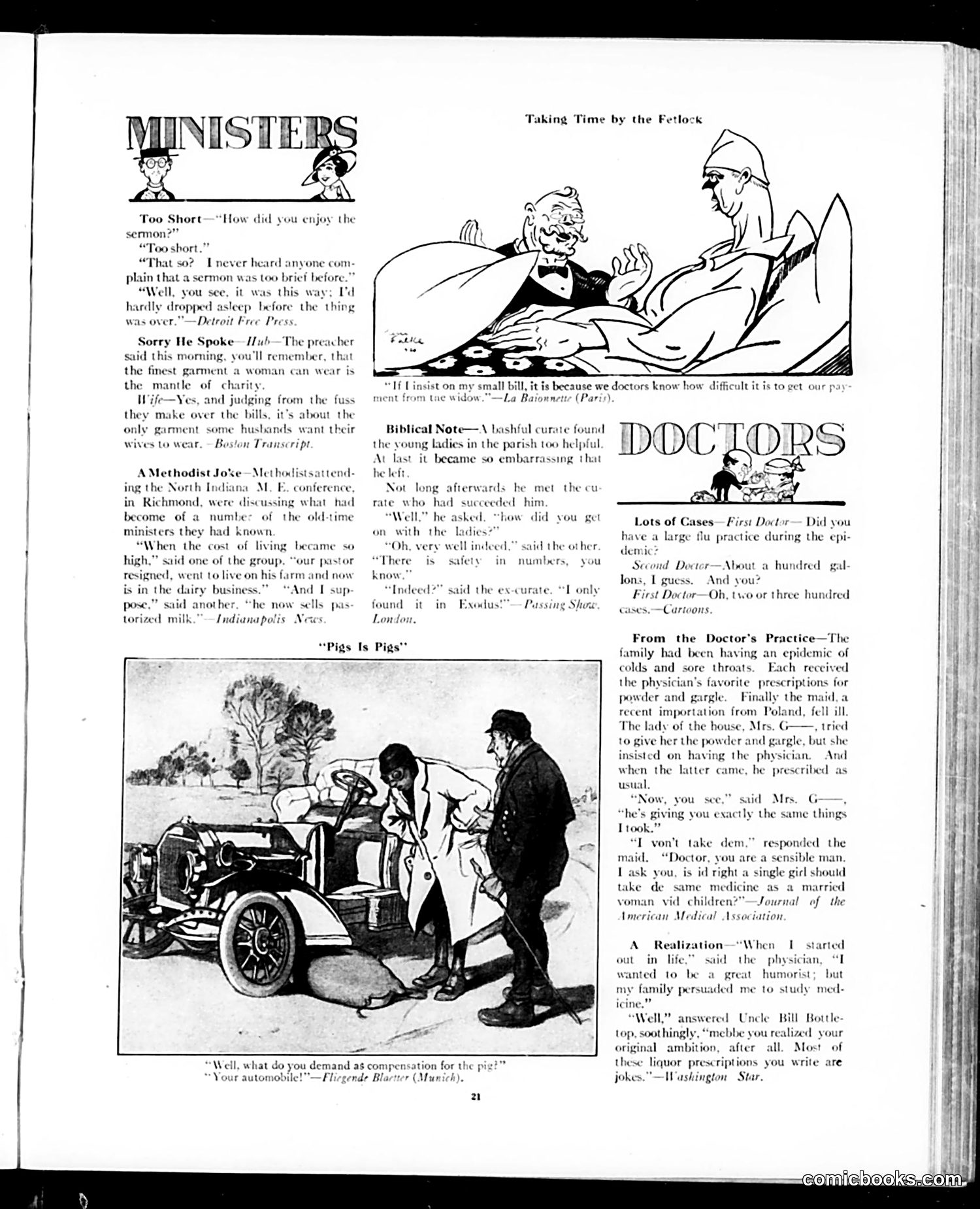
This page contains multiple brief humor pieces typical of early 20th-century American satire: **"Too Short"** and **"Sorry He Spoke"** are domestic comedy sketches mocking sermon length and marital disagreements about charity and spending. **"A Methodist Joke"** satirizes clergy who abandoned their vocations when living costs rose, retreating to dairy farming—a jab at ministers' practical compromises. **"Pigs Is Pigs"** (illustrated) shows a doctor demanding an automobile as compensation for treating a pig, mocking physicians' inflated self-importance and fee-setting. The **"Doctors"** section contains interconnected jokes about medical practice: doctors exaggerating patient numbers during epidemics, and a maid's confusion about whether identical prescriptions apply to unmarried versus married women—playing on period assumptions about women's different medical needs. **"A Realization"** concludes with Uncle Bill Bottle-top suggesting the physician became a humorist after all through absurd "liquor prescriptions"—likely referencing Prohibition-era alcohol sold as medicine, a common satirical target of the era.
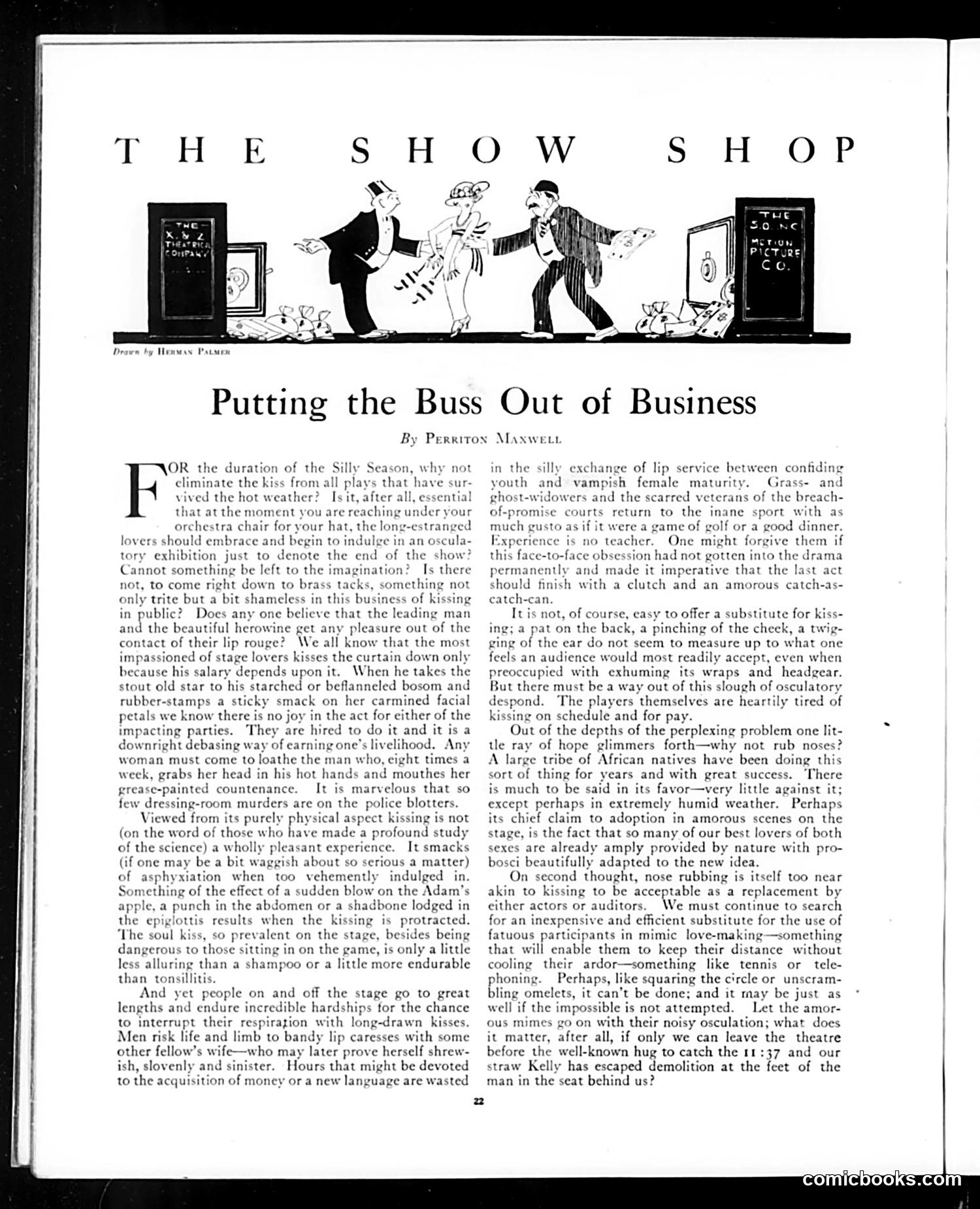
This satirical article by Perriton Maxwell attacks the convention of kissing in theatrical productions. The cartoon header shows theatrical figures with "picture companies" signs, suggesting the entertainment industry. Maxwell argues that stage kisses are: - **Physically unpleasant** (he compares them to asphyxiation and injury) - **Performed cynically** for salary, not genuine emotion - **Unhygienic** (grease paint, lip rouge, rubber-stamping) - **Tiresome** for actors who must repeat them nightly He mockingly proposes alternatives—patting backs, pinching cheeks, ear-tugging—before arriving at his punchline: **nose-rubbing**, practiced by "African natives" for years "with great success." The satire targets both theatrical artificiality and early-20th-century attitudes toward "exotic" practices. The "Silly Season" reference likely means summer theater programming. The piece is social commentary on theatrical conventions and audience expectations, wrapped in humor that reflects period attitudes toward race and hygiene.
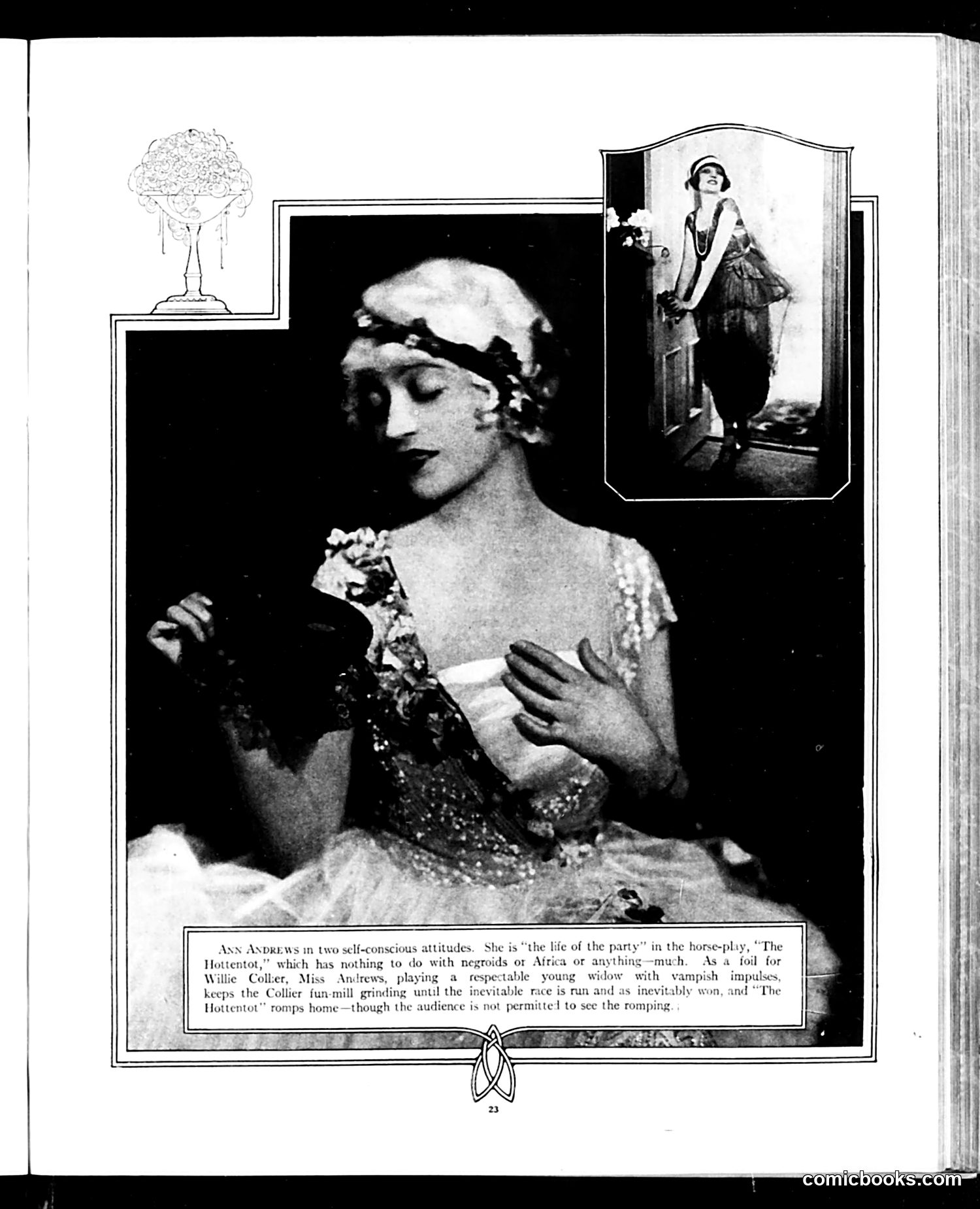
This page features actress **Ann Andrews** in two photographs from the theatrical production **"The Hottentot,"** a horse-play (farce comedy). The accompanying text sarcastically notes the show "has nothing to do with negroids or Africa or anything—much," an ironic acknowledgment that despite its title, the play apparently relies on racial stereotyping or themes. The production co-stars **Willie Collier** as a respectable young widower, while Andrews plays a woman with "vampish impulses" whose character drives the comedic plot. The satire suggests the show is a silly farce where inevitable plot mechanics grind forward predictably—the audience cannot see the "romping" (likely crude physical comedy) but experiences the contrived results. The commentary implies Judge's skepticism toward the play's racial pretensions and formulaic comedy structure.
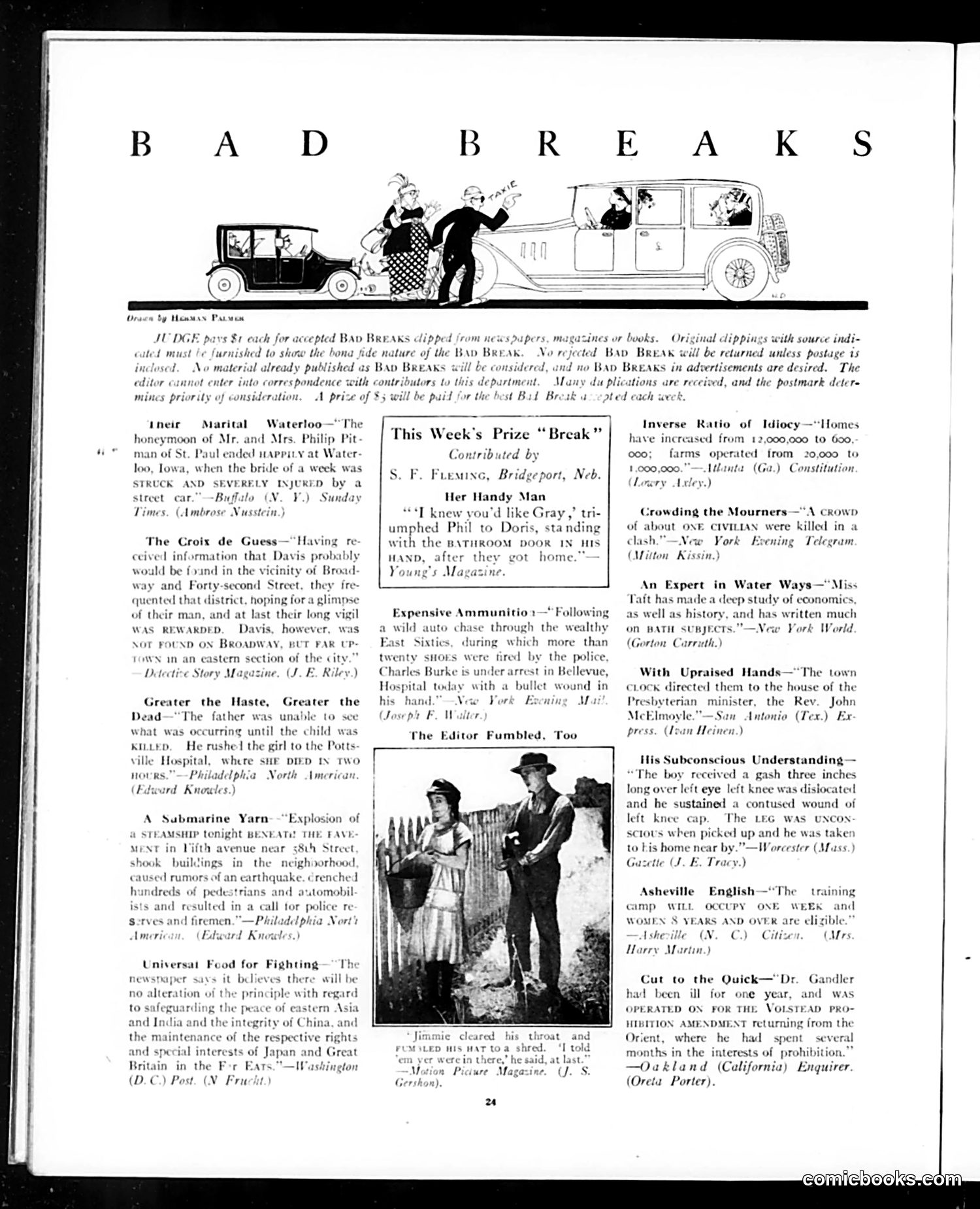
This is a "Bad Breaks" feature—Judge magazine's running collection of humorous editorial mistakes clipped from newspapers. The page satirizes unintentionally funny juxtapositions created by poor editing, unclear pronoun references, or accidental word placement. Examples visible include: "The girl was struck by a streetcar and died" placed awkwardly near unrelated text; "A bathroom door in his hand" creating absurd imagery; "An expert in water ways" about Miss Taft discussing "bath subjects" (apparently "bath" was misheard as "water ways"); and "Dr. Gandler operated on for the Volstead Prohibition Amendment"—likely meant to say he "returned from" the Orient but phrased to suggest he underwent surgery related to Prohibition. The cartoon at top shows vehicles and figures, illustrating editorial chaos. The joke relies on readers' recognition that newspaper carelessness creates unintentional comedy. This was popular satirical material targeting journalism's quality standards.
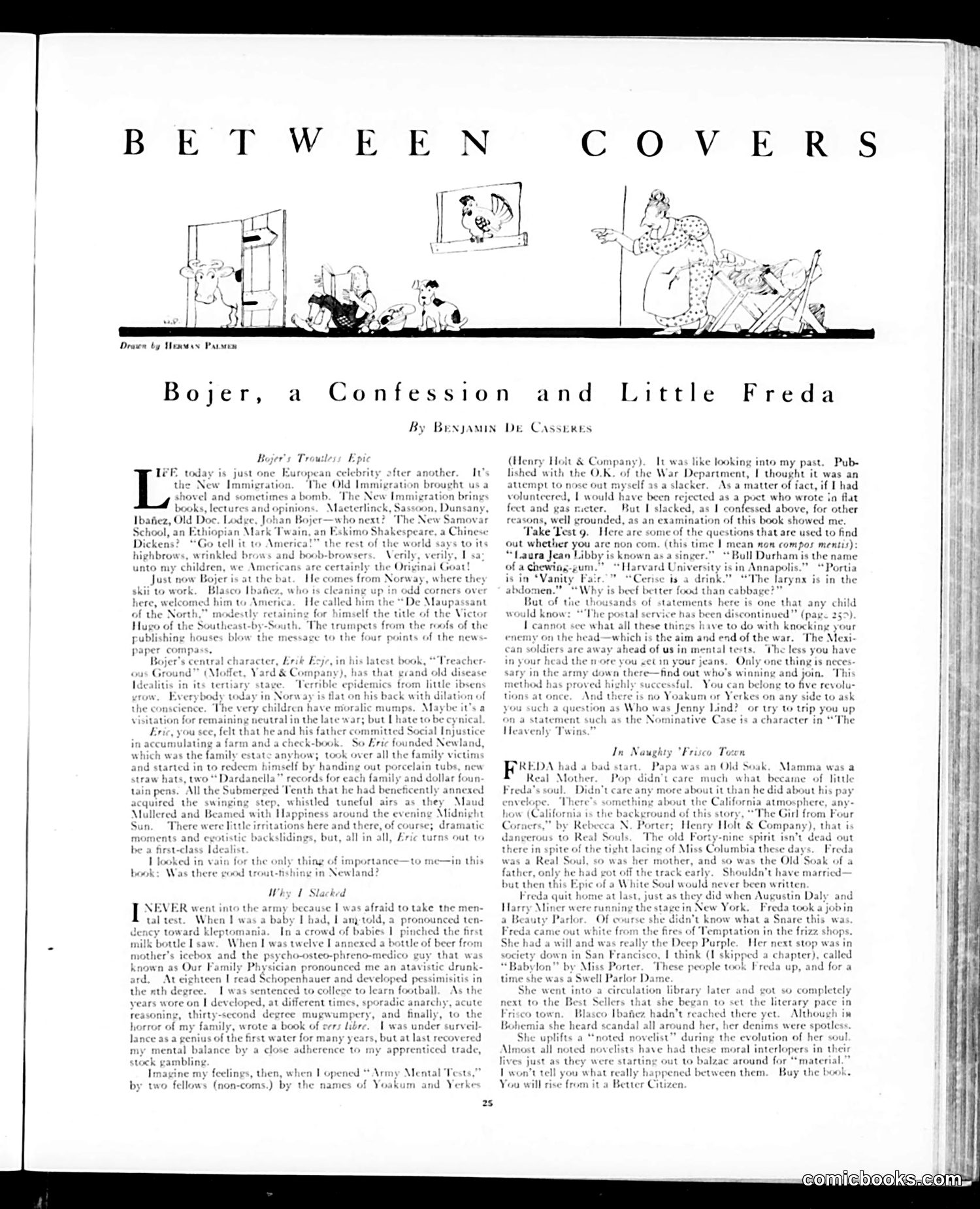
This appears to be a **literary/book review section** rather than political satire, despite Judge magazine's satirical reputation. The page features two serialized stories: "Bojer, a Confession" and "Little Freda" by Benjamin De Casseres. The illustrations at the top (drawn by Cesare Pellonini) show domestic and literary scenes rather than political caricature—they depict people in homes and what appears to be social situations related to the story content. The text discusses literary characters and plot points: Bojer's reflections on immigration, military service, and his past; Freda's background as a "Real Soul" with an absent father. References include Henry Holt & Company publishers and mentions of contemporary figures like Mark Twain and Laura Jean Libby (a popular novelist). This is primarily **serialized fiction for entertainment**, not political commentary—typical content for Judge's "Between Covers" literary section aimed at educated readers interested in character-driven narratives.
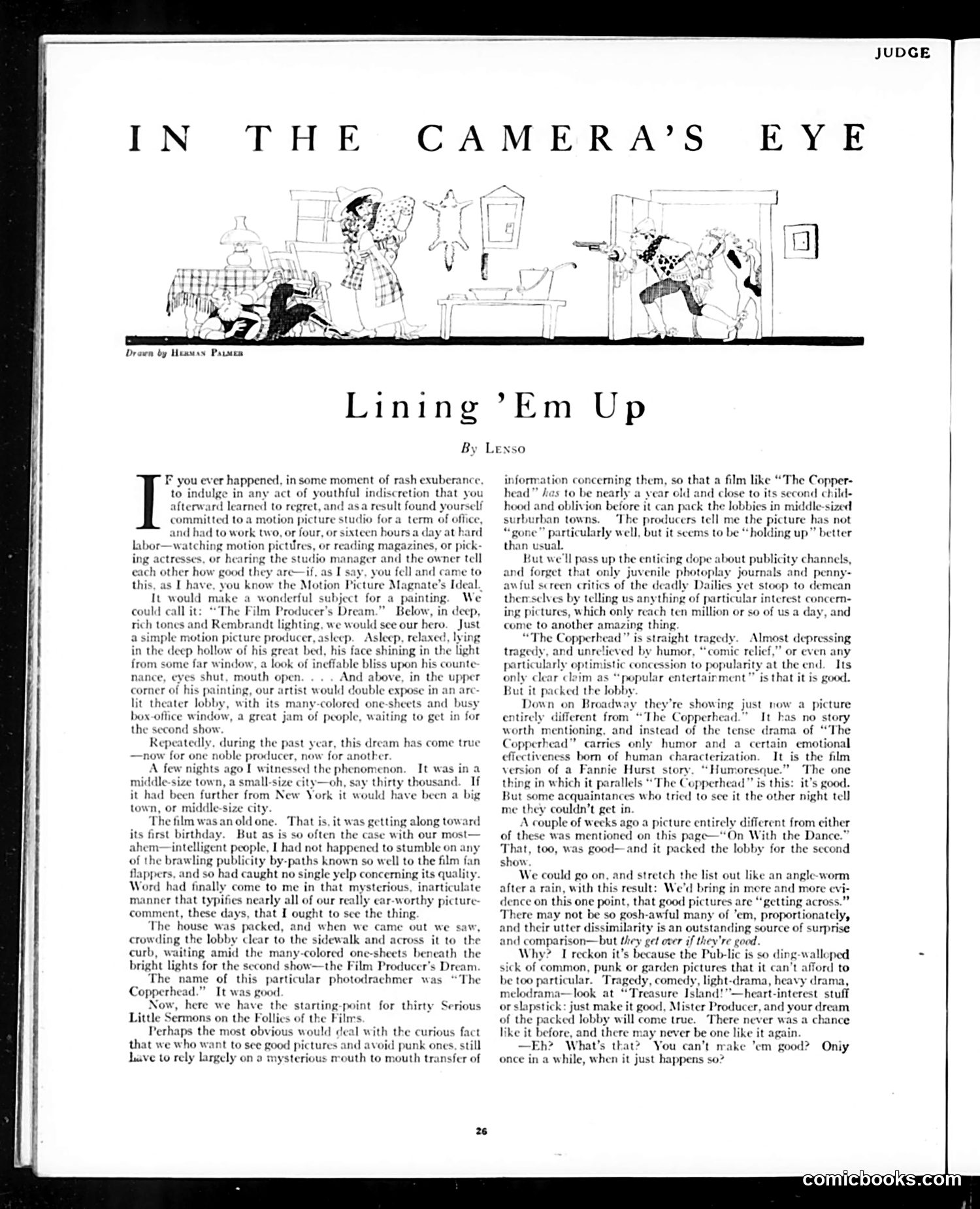
This page contains a lengthy essay rather than a political cartoon. The small illustration at the top shows a film studio scene. The article critiques the film industry's dysfunction, specifically how good movies fail to reach audiences while mediocre ones succeed through word-of-mouth. Lenso describes witnessing crowds at a theater waiting for a second showing of "The Copperhead"—a year-old film that "has not 'gone' particularly well" yet still packs lobbies in small towns. The satire targets: - **Film producers' obliviousness** to their own quality control - **The broken publicity system**: good pictures take nearly a year to reach audiences; critics and trade journals ignore films seen by millions daily - **Audience reliance on gossip** rather than reliable information - **Genre mismatch**: "The Copperhead" is straight tragedy with no comic relief, yet somehow succeeds as "popular entertainment" Lenso essentially argues the film industry works backwards—quality films struggle while successful ones defy explanation, revealing the absurdity of Hollywood's production and marketing systems.
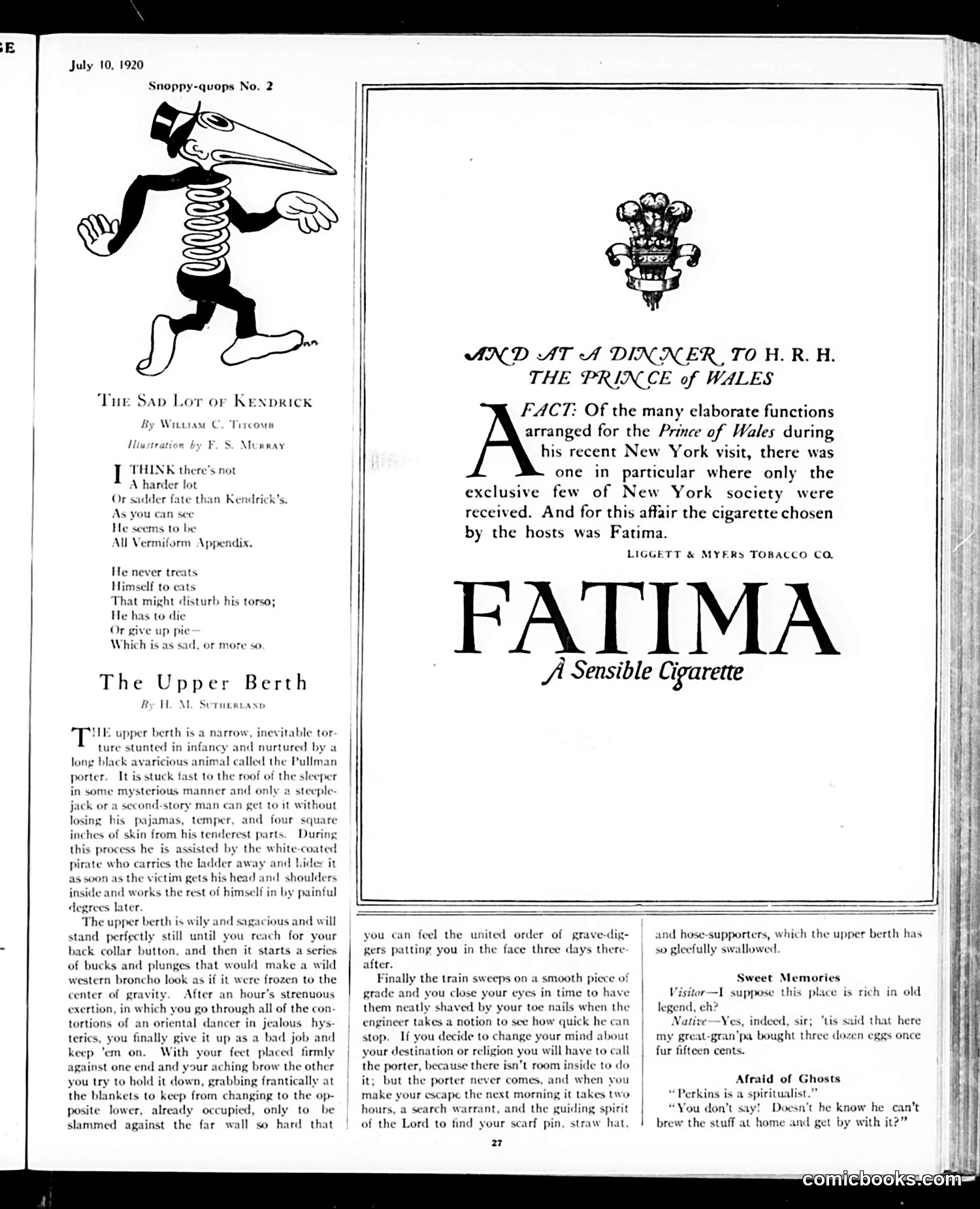
This page contains humorous short pieces typical of Judge's satirical style, plus a cigarette advertisement. **Left side content:** Three comedic sketches—"Snoopy-quops No. 2" (a cartoon of an emaciated figure), "The Sad Lot of Kendrick" (verse about a man whose appendix problems prevent him from eating), and "The Upper Berth" (prose satire mocking the nightmarish experience of sleeping in Pullman train berths, blaming the porter for its difficulties). **Right side:** A Fatima cigarette advertisement exploiting the recent visit of the Prince of Wales to New York. It claims that at an exclusive society dinner for the Prince, Fatima was the cigarette of choice—positioning the brand as elite and refined. The page reflects early 1920s American leisure class anxieties (train travel discomforts, digestive complaints) and shows how advertising appropriated celebrity endorsements indirectly through implied prestige associations.
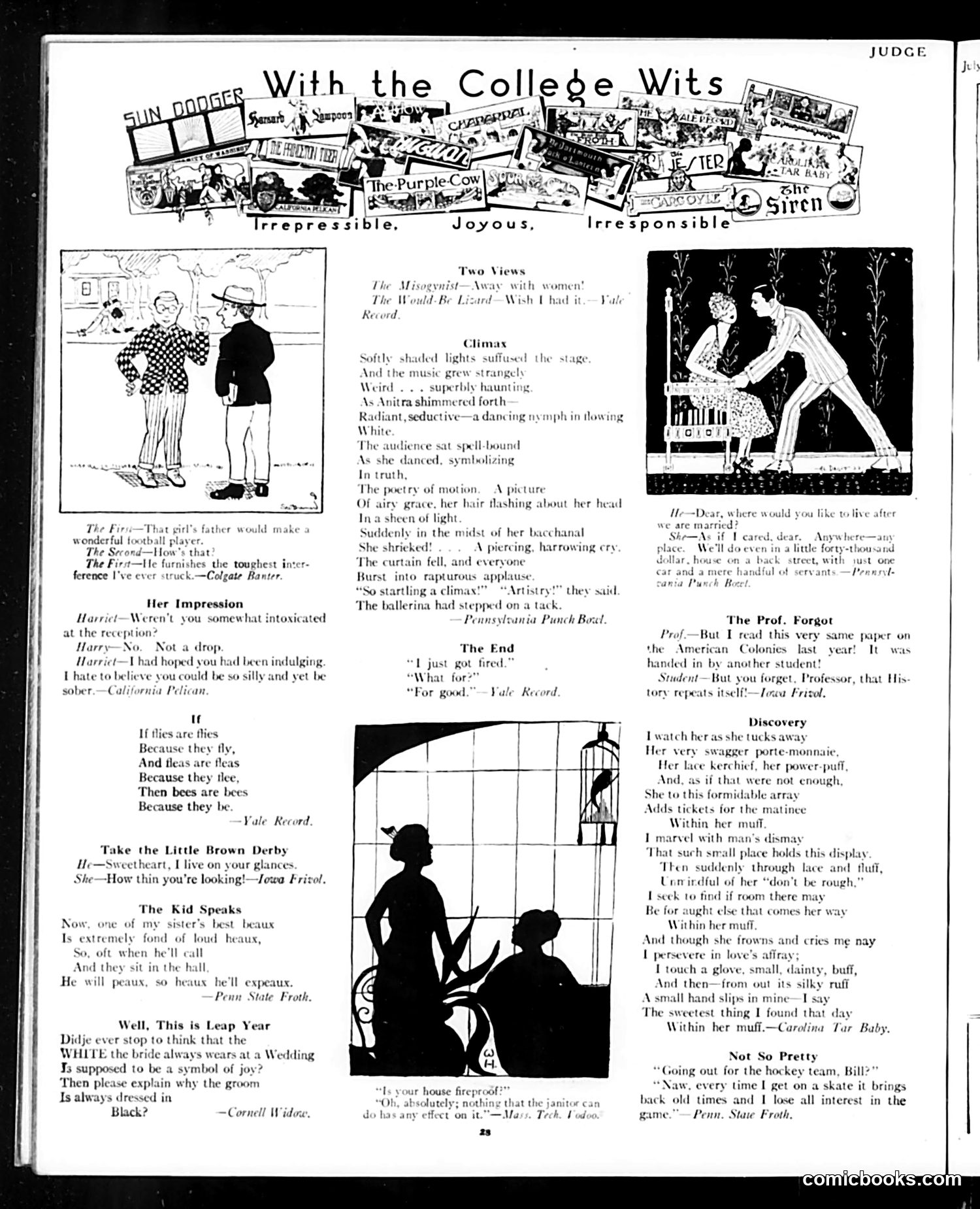
This page collects humor from college publications, presenting brief comedic pieces and cartoons typical of 1920s collegiate wit. **Key content includes:** - **"Climax"**: A satirical poem about a ballet performance where the dancer shrieked mid-performance—the punchline reveals she stepped on a tack, deflating the audience's pretentious admiration for her "artistry." - **"Discovery"**: A lengthy poem celebrating a woman's muff (a fur hand-warmer), playing on double entendre to describe the speaker's romantic interest in its contents. - **"Well, This is Leap Year"**: A joke contrasting the bride's white wedding dress (symbolizing joy) with the groom's black suit, questioning the logic of this tradition. - **Various short jokes** about intoxication, beaux, and romantic mishaps, sourced from college humor magazines (Yale Record, Penn State Froth, etc.). The page reflects early-20th-century college humor: lightweight, focused on romance, social pretension, and innocent innuendo rather than political satire.
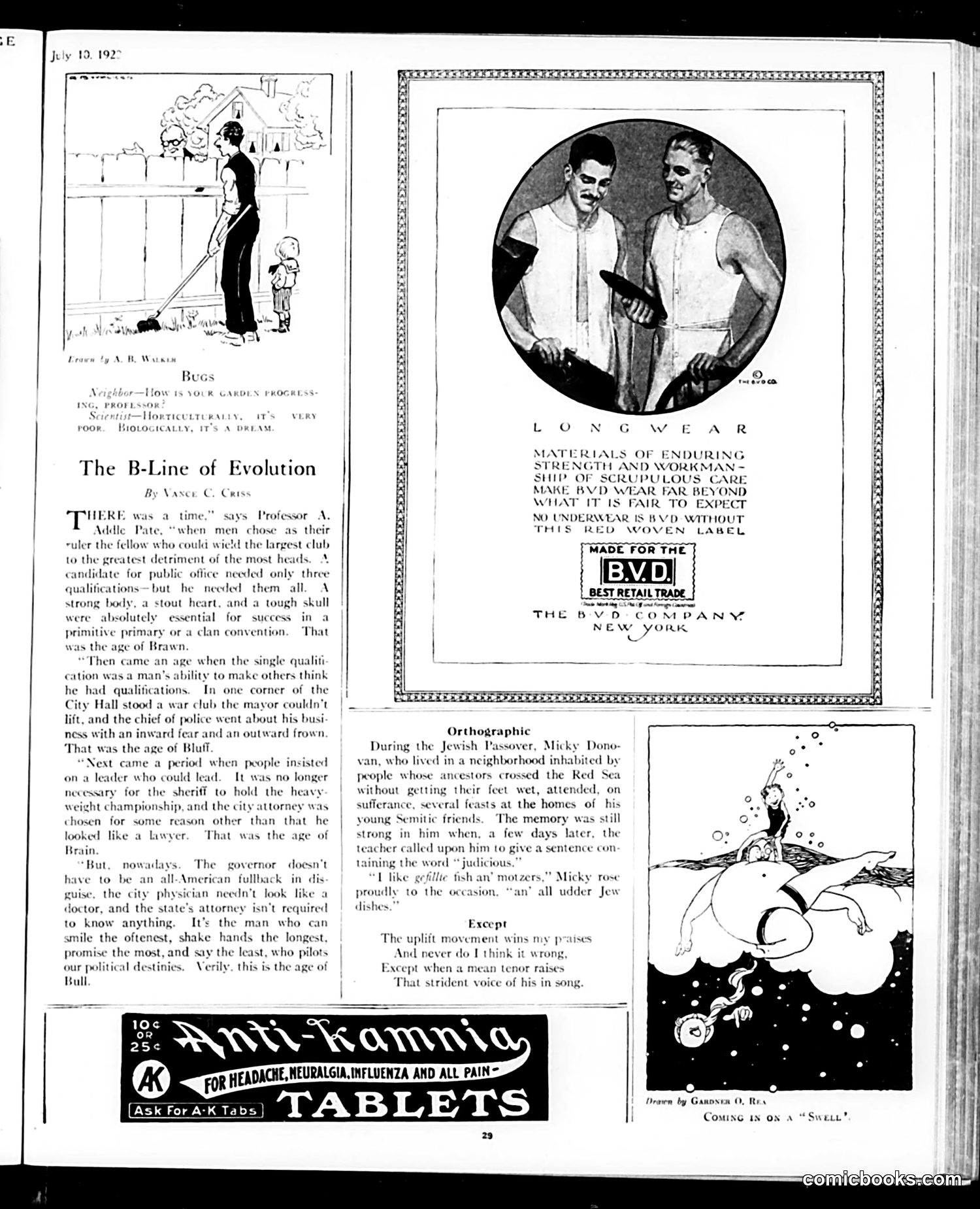
**"The B-Line of Evolution"** by Vance C. Criss satirizes political leadership decline. Professor Pate traces leadership qualifications through history: the "Age of Brawn" (physical strength), the "Age of Bluff" (charisma and deception), and the current "Age of Bull" (empty promises and charm). The satirist argues modern politicians succeed through superficial appeal—frequent smiling, handshaking, and dishonesty—rather than actual competence. This reflects post-WWI American skepticism toward political leadership. **"Orthographic"** is a brief ethnic humor piece: a non-Jewish boy named Micky, attending Passover feasts in a Jewish neighborhood, uses the word "judicious" in a sentence referencing gefilte fish and matzo, confusing Jewish dietary traditions with the word's meaning. The page also contains period advertisements (Ami-Kamnia tablets, BVD underwear).
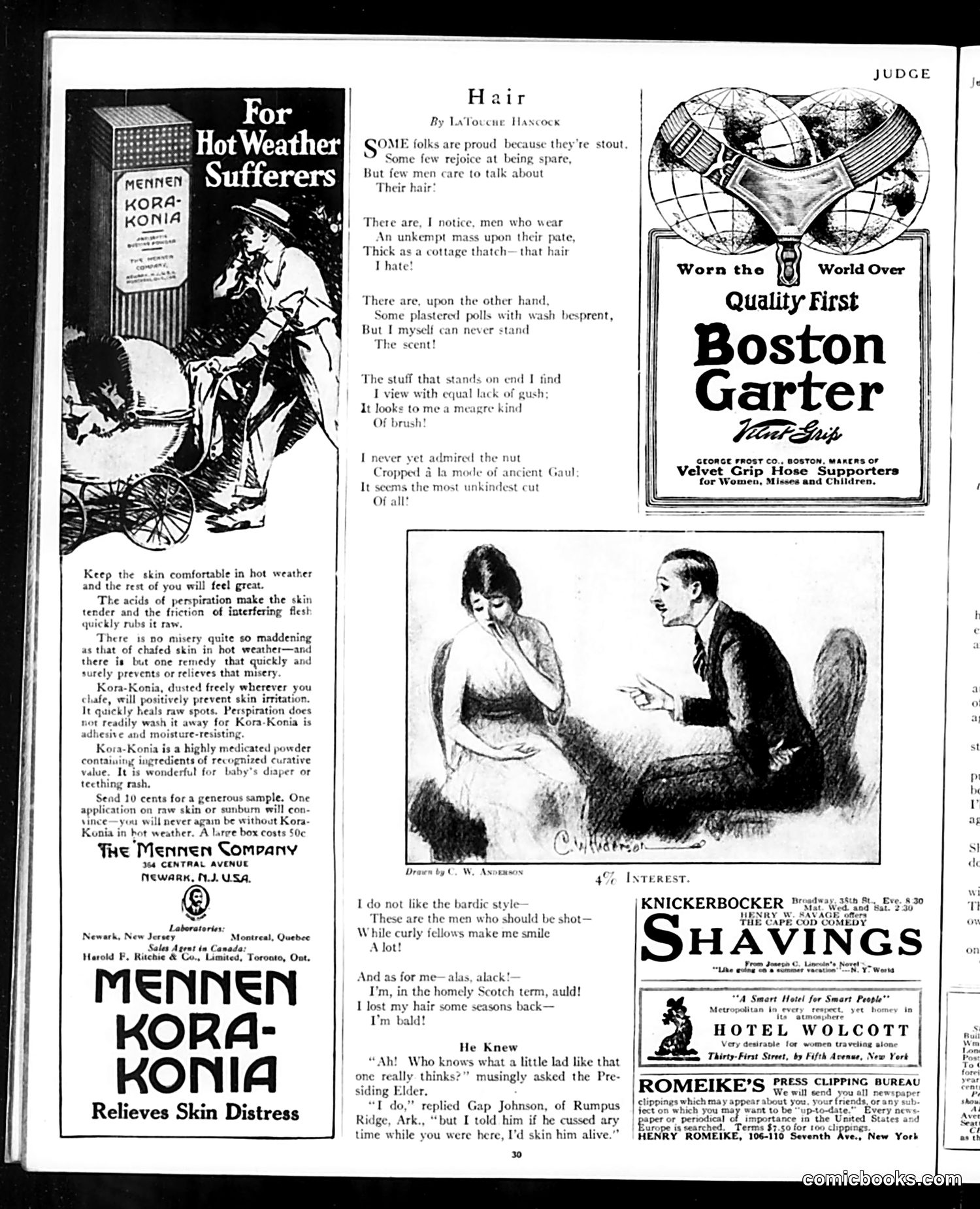
This page is primarily **advertisements and light humor** rather than political satire. The main content includes: **"Hair" by LaTouch Hancock** — a humorous poem satirizing men's various hairstyles. The author critiques excessive hair ("cottage thatch"), slicked-down greasy styles, stiff brushy hair, and fashionable curled styles—expressing preference for none of them while revealing he's bald himself. It's gentle social commentary on masculine grooming vanity and fashion trends. **The cartoon** (by C.W. Anderson) depicts a domestic scene where a man appears to be confessing something to a woman—likely related to the accompanying anecdote "He Knew," where a father threatens to "skin" his son if he swears in front of a visiting minister. The remainder consists of **period advertisements**: Mennen Kora-Konia powder (for heat rash), Boston Garter hosiery, Knickerbocker theatrical production, Hotel Wolcott, and Romeike's press clipping service. The overall tone is light, domestic humor aimed at early 20th-century readers concerned with grooming, fashion, and propriety.
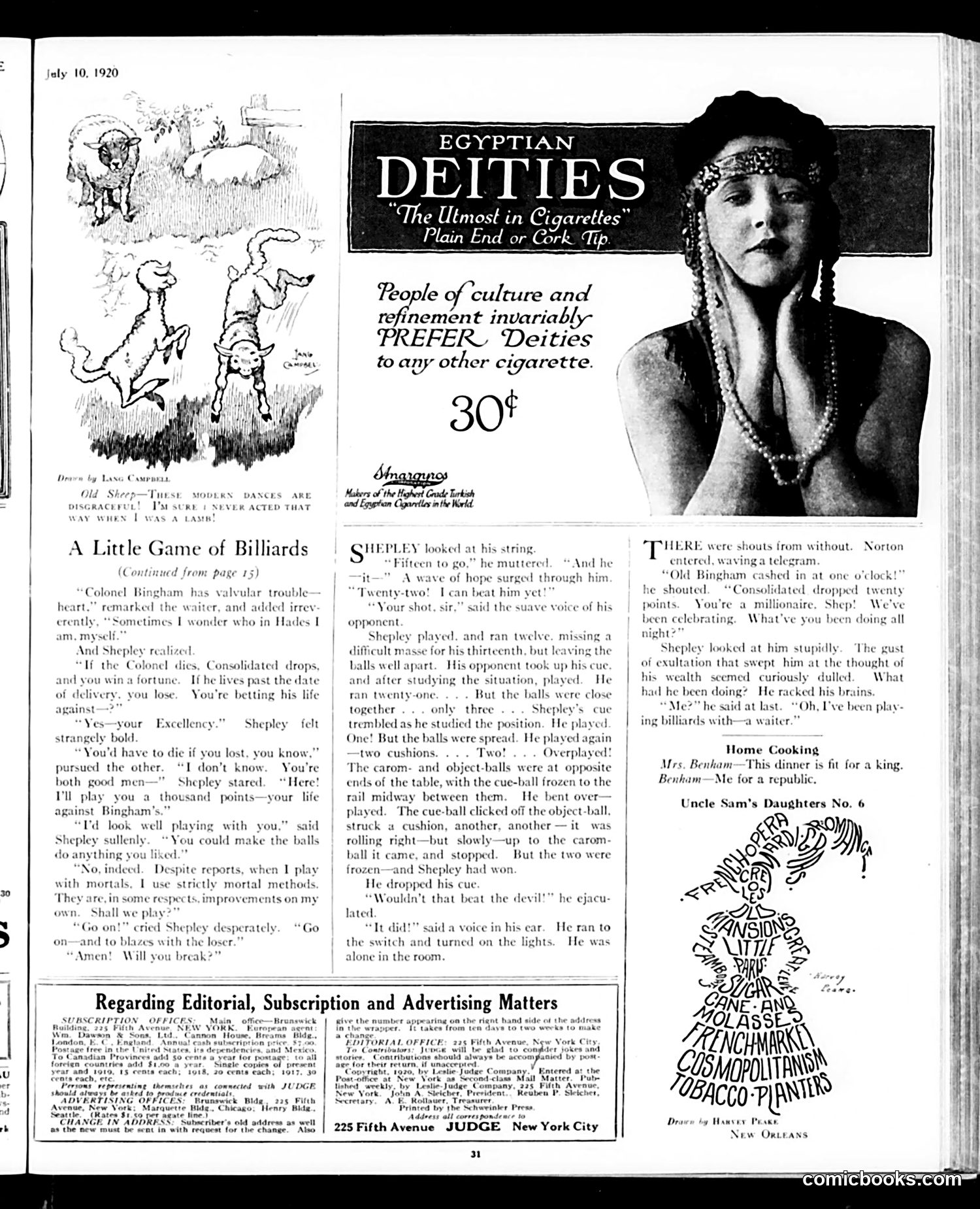
**Main Content:** This page is primarily **advertising and serialized fiction**, not political satire. **The Advertisement:** The prominent "Egyptian Deities" cigarette ad features an exotic woman in Egyptian costume, appealing to 1920s consumer culture. The tagline "People of culture and refinement invariably PREFER Deities" reflects period marketing that used pseudo-sophistication and orientalism to sell products at 30 cents. **The Story:** "A Little Game of Billiards" (continued from earlier) depicts a dramatic conclusion where protagonist Shepley wins a fortune at billiards through an impossible shot, then mysteriously finds himself alone—suggesting either a supernatural encounter or hallucination. The supernatural element is unclear from this excerpt. **The Cartoons:** Small sketches accompany text sections—including what appears to be a crude drawing of old-fashioned dances (mocking their awkwardness) and "Uncle Sam's Daughters No. 6," a humorous illustration related to home cooking. The page reflects typical 1920s Judge content: advertising, serialized melodrama, and light domestic humor rather than sharp political commentary.
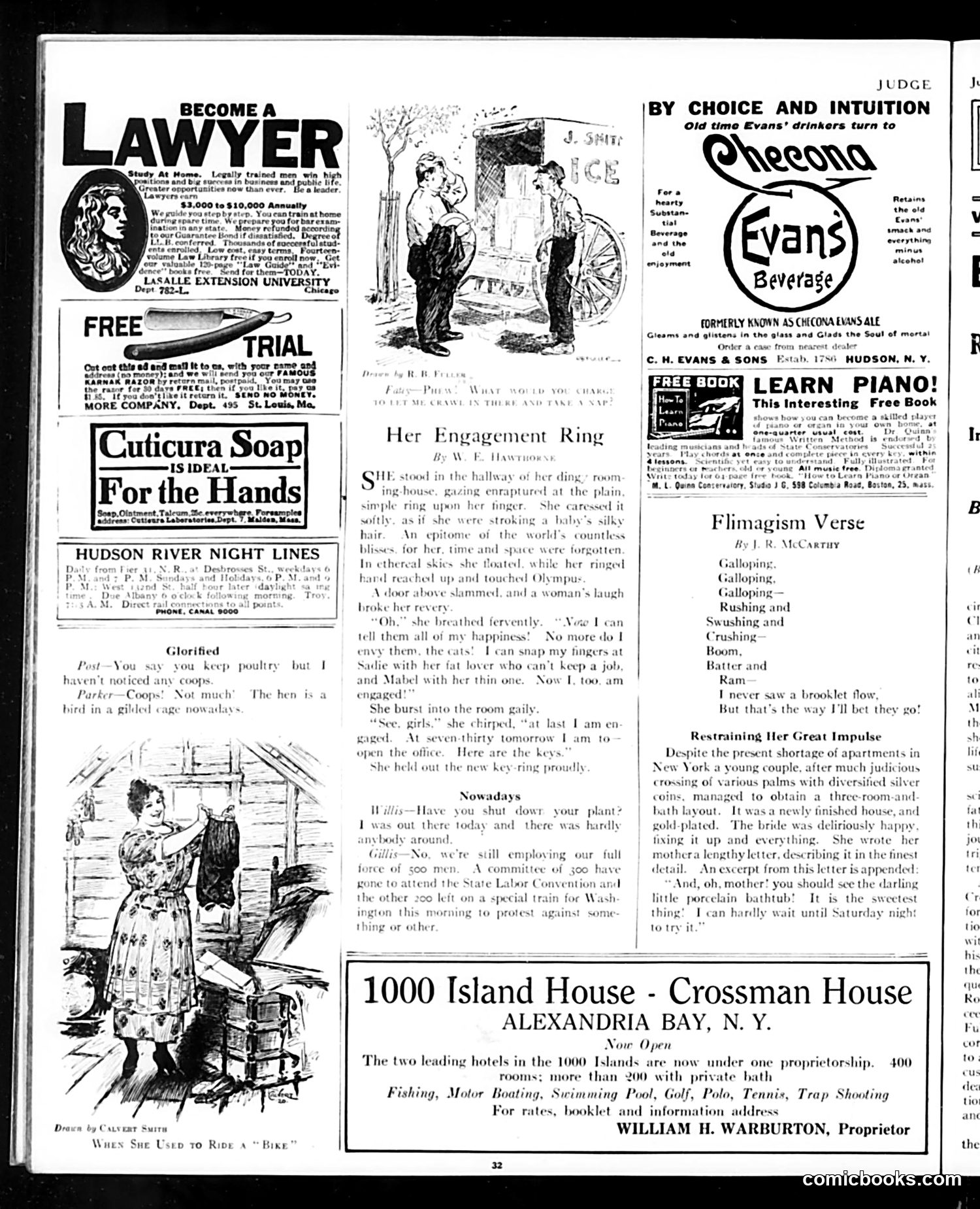
This page from Judge magazine contains primarily **advertisements and light fiction rather than political satire**. The main content includes: **"Her Engagement Ring"** — a romantic short story about a woman thrilled with her engagement ring, fantasizing about announcing it to friends, then abruptly returning to mundane household tasks when her roommate interrupts. **"Nowadays"** — a brief comedic dialogue mocking labor activism, where a character complains about a committee attending a "State Labor Convention" to protest "something or other," satirizing what the writer views as frivolous unionizing. **"Restraining Her Great Impulse"** — a humorous letter excerpt about a newlywed's enthusiasm for her new bathtub, playing on domestic humor. The page is dominated by **commercial advertisements** for soaps, beverages, hotels, correspondence law schools, and piano lessons—typical of Judge's business model. There is no identifiable political cartoon or specific historical reference requiring context beyond the ads' era-appropriate products and messaging.
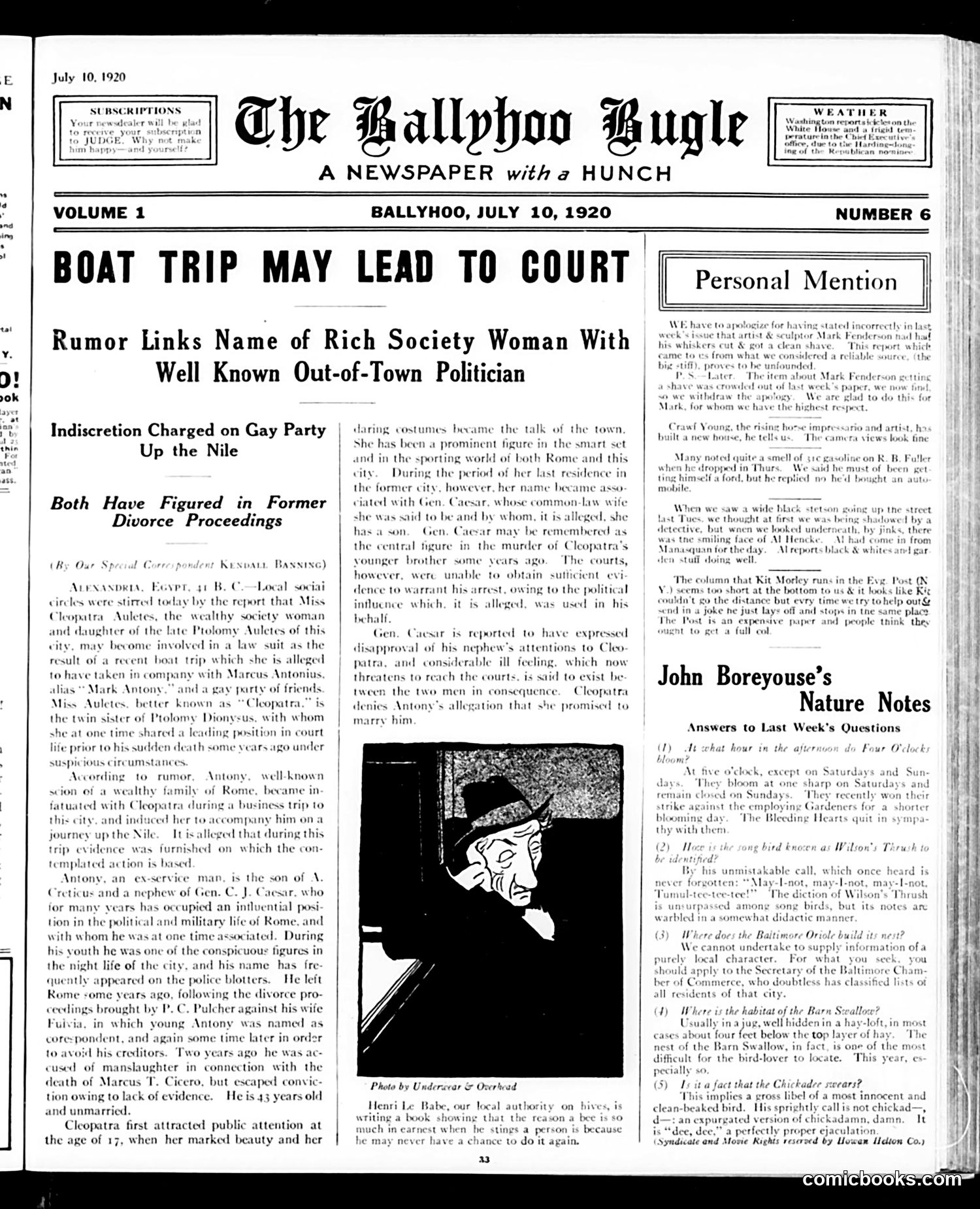
This satirical piece presents a faux newspaper article covering a scandal involving historical figures as contemporary society gossip. The main story applies the famous relationship between Cleopatra and Mark Antony to 1920s high-society scandal conventions—complete with divorce proceedings, boat trips, and wealthy indiscretions. The humor operates through anachronistic juxtaposition: ancient Egyptian history is reframed as modern tabloid gossip, with Cleopatra depicted as a wealthy American society woman and Antony as a Roman politician involved in dubious behavior. The piece mimics breathless gossip-column style while referencing real historical details (Caesar's murder, Antony's financial troubles) presented as contemporary scandal. The accompanying illustration shows a caricatured face, likely Cleopatra, using period exaggeration typical of Judge magazine's satirical portraiture. The overall effect mocks both celebrity scandal-mongering and the magazine's own sensationalist approach to news.
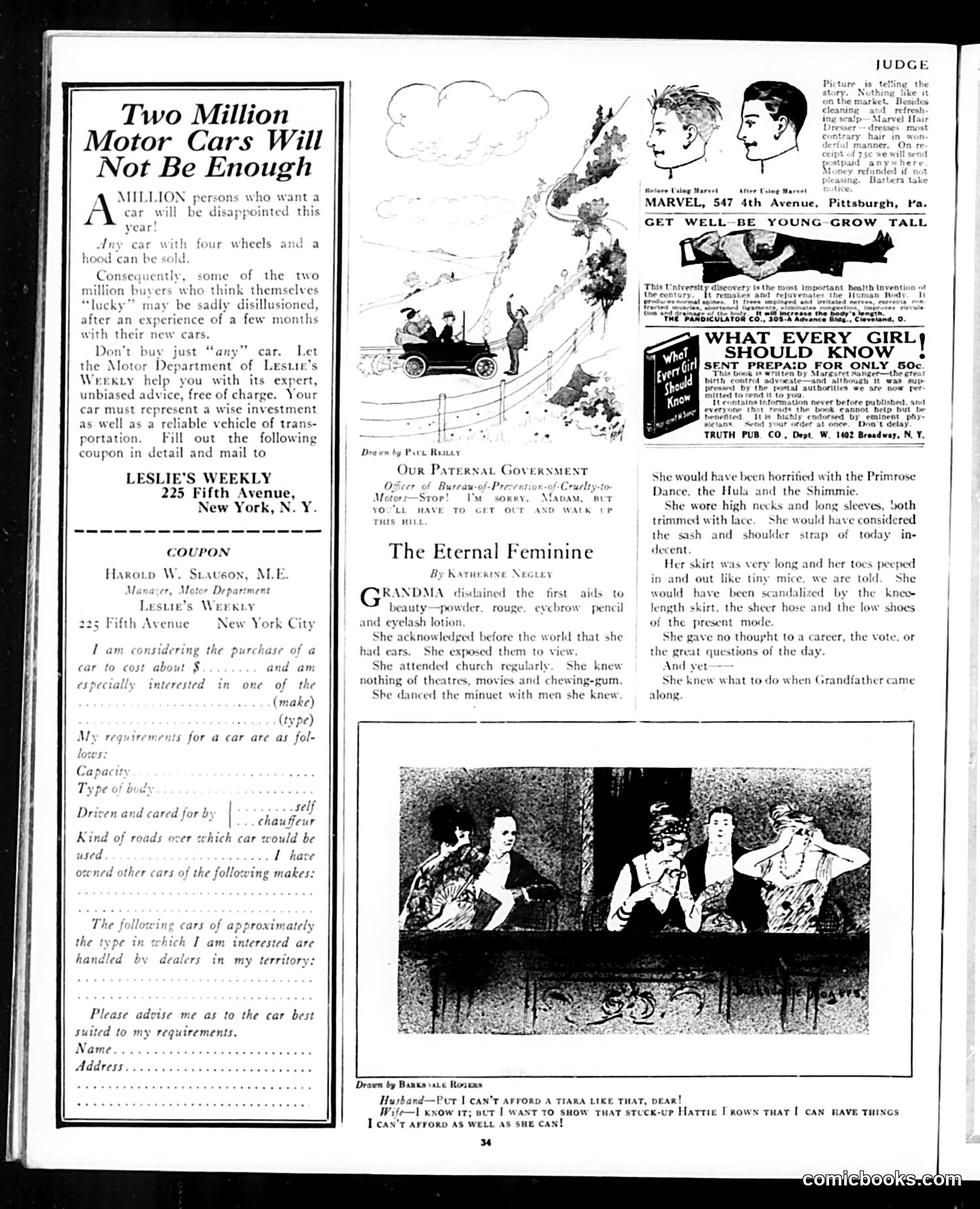
This Judge magazine page contains three distinct pieces: **Left: Motor Car Advertisement/Coupon** — Leslie's Weekly offers expert automotive advice to help readers make wise car-purchasing decisions, as two million Americans seek cars but most can't afford them. The magazine positions itself as a trusted guide against impulse buying. **Center: "Our Paternal Government" Cartoon** — A satirical drawing by Paul Revere showing a man on a hill waving frantically, captioned that he must "get out and walk up this hill." The joke likely mocks government intervention in auto regulation or road conditions. **Right: "The Eternal Feminine" Story** — Katherine Necley contrasts grandmother's modest Victorian era (high necklines, long skirts, no vote or career aspirations) with modern women's freedoms (short skirts, dancing, independence). The accompanying photo-drama illustration depicts fashionably dressed women. The bottom cartoon shows a husband complaining he can't afford his wife's tiara while she retorts she needs to show off her wealth to rival "stuck-up Hattie." The page satirizes changing gender roles, consumerism, and women's modern aspirations during the early 20th century.
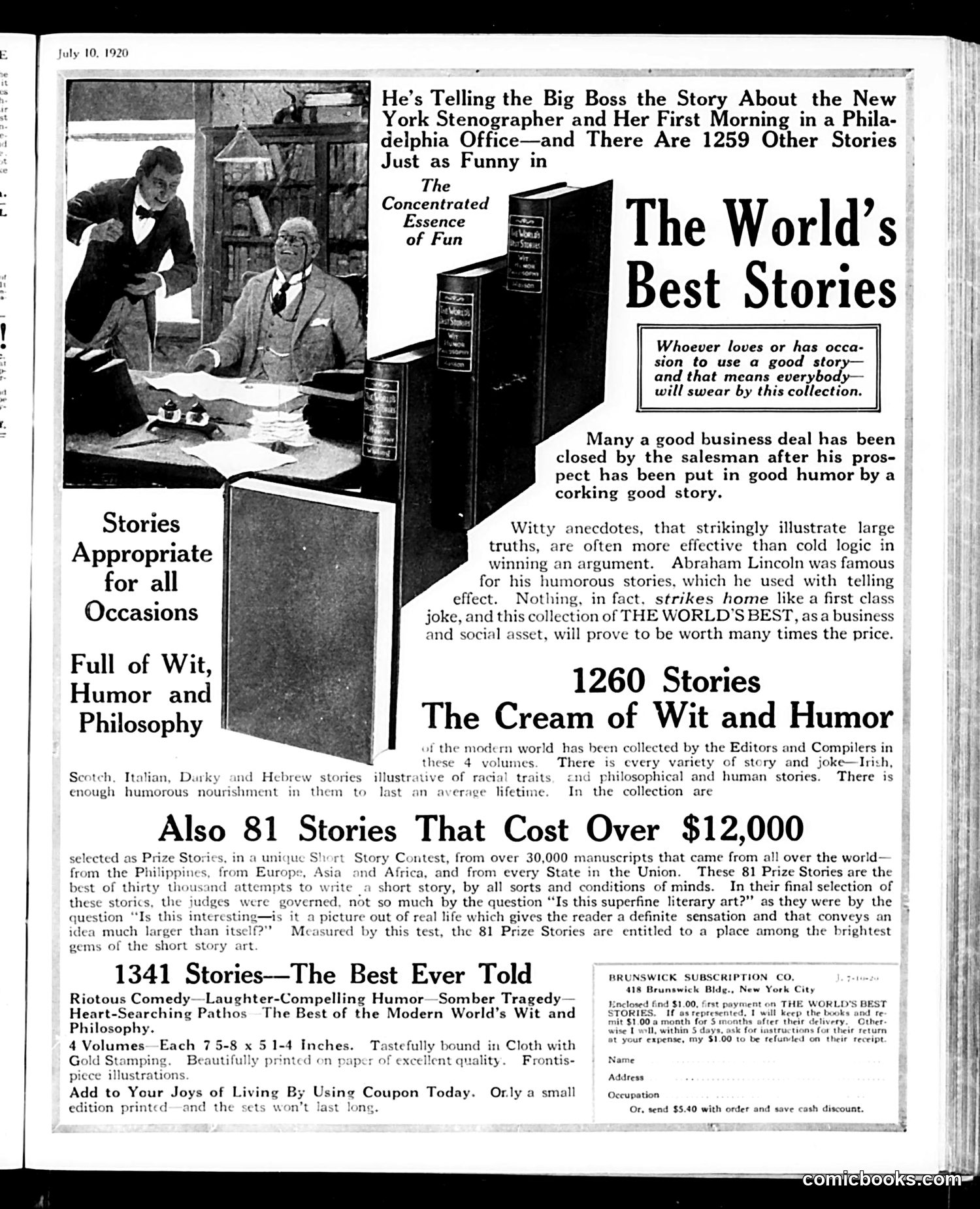
This is primarily a **full-page advertisement**, not a political cartoon. The small illustration at top left depicts a office scene: a standing man telling a story to a seated "big boss" at his desk—the scenario mentioned in the headline about a New York stenographer's first day in Philadelphia. The ad promotes "The World's Best Stories," a 4-volume collection containing 1,260 stories plus 81 prize-winning tales. The marketing pitch emphasizes that good storytelling is a **business tool**: humor closes deals, and anecdotes persuade better than logic (citing Abraham Lincoln as precedent). Notably, the text explicitly lists story categories including **"Darky and Hebrew stories"**—ethnic humor that was mainstream advertising in 1920 but reflects period prejudices modern readers would find offensive. The ad targets businessmen and social climbers seeking an inexpensive way to acquire joke collections for professional and social advantage.

This is a **Camel cigarettes advertisement**, not political satire. The page features an exotic Oriental design (pyramid, camels) to emphasize the brand's blend of "Turkish and Domestic" tobaccos—a major selling point in early 20th-century cigarette marketing. The ad's claims—that Camels won't tire your taste, leave no unpleasant aftertaste, or create odor—are typical period tobacco advertising rhetoric, now understood as misleading health claims. The phrase "Man alive—Listen!" uses colloquial language to grab attention. The "judge" publication context (a satirical magazine) is incidental; this is straightforward commercial advertising, not commentary. The exaggerated promises about smoking "till the cows come home" without fatigue reflect the era's uncritical tobacco promotion before health warnings existed.