
Judge, 1920-07-10 · page 26 of 36
Judge — July 10, 1920 — page 26: what you’re looking at
What you’re looking at
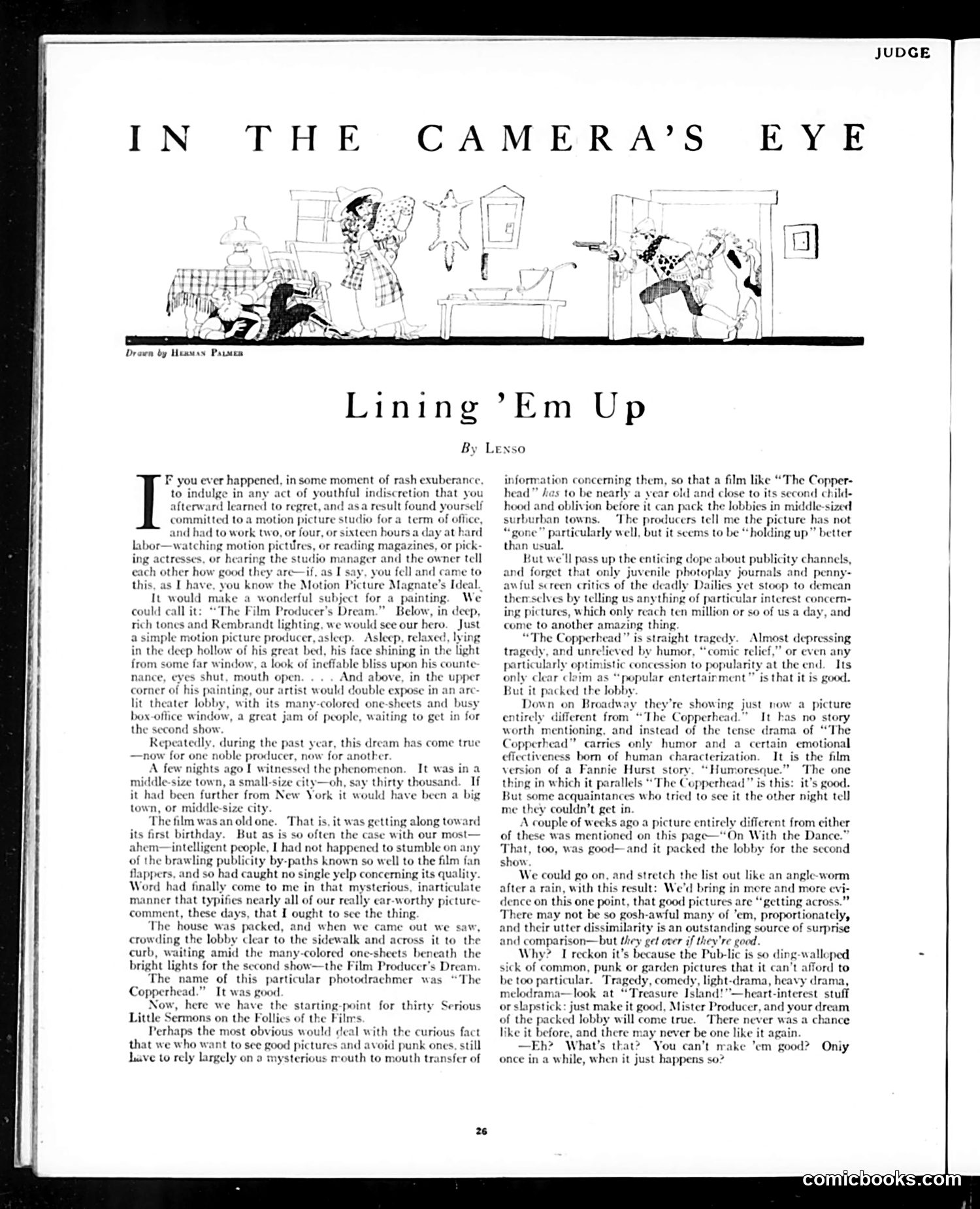
This page contains a lengthy essay rather than a political cartoon. The small illustration at the top shows a film studio scene. The article critiques the film industry's dysfunction, specifically how good movies fail to reach audiences while mediocre ones succeed through word-of-mouth. Lenso describes witnessing crowds at a theater waiting for a second showing of "The Copperhead"—a year-old film that "has not 'gone' particularly well" yet still packs lobbies in small towns. The satire targets: - **Film producers' obliviousness** to their own quality control - **The broken publicity system**: good pictures take nearly a year to reach audiences; critics and trade journals ignore films seen by millions daily - **Audience reliance on gossip** rather than reliable information - **Genre mismatch**: "The Copperhead" is straight tragedy with no comic relief, yet somehow succeeds as "popular entertainment" Lenso essentially argues the film industry works backwards—quality films struggle while successful ones defy explanation, revealing the absurdity of Hollywood's production and marketing systems.
📄 Transcribed text from this page (OCR, searchable)
Machine-transcribed from the original scan — historical spelling and the odd misread are preserved.
eos Drawn by Hiawss Parsee Lining ’Em Up By F you ever happened, in some moment of rash exuberance to indulge in any act of youthful indiscretion that you afterward learned to regret, and asa result found yourself committed to a motion picture studio fora term of office, and had to work two, or four, or sixteen hours a day at hard labor—watching motion pictires, or reading magazines, or pick- ing actresses, or hearing the studio manager and the owner tell each other how good they are—if, as I say, you fell and came to this, as I have, you know the Motion Picture Magnate’s Ideal It would make a wonderful subject for a painting. We could call it: The m Producer's Dream.” Below, in deep, rich tones and Rembrandt lighting, we would sce our hero. Just a simple motion picture producer, asleep. Asleep, relaxed, lying in the deep hollow of his great bed, his face shining in the light from some far window, a look of ineffable bliss upon his counte nance, eyes shut, mouth open. And above, in the upper corner of his painting, our artist would double expose in an arc- lit theater lobby, with its many-colored one-sheets and busy box-office window, a great jam of people, waiting to get in for the second show Repeatedly, during the past year, this dream has come tr ow for one »le producer, now for another. A few nights ago I witnessed the phenomenon. It was in a middle-size town, a small-size city—oh, thirty thousand. If it had been further from New York it would have been a L town, or middle-size city. The film wasanoldone. That is, it was getting along toward its first birthday. But as is so often the case with our most— ahem—intelligent people, I had not happened to stumble on any of the brawling publicity by-paths known so well to the film fan flappers, and so had caught no single yelp concerning its quality. Word had finally come to me in that mysterious, inarticulate manner that typifies nearly all of our really car-worthy picture comment, these days, that I ought to sce the thing. The house was packed, and when we came out we saw, crowding the lobby clear to the sidewalk and across it to the curb, waiting amid the many-colored one-sheets beneath the bright lights for the second show—the Film Producer's Dream The name of this particular photodrachmer was “The Copperhead.” Tt was good Now, here we have the starting-point for thirty Serious Little Sermons on the Follies of the Films. Perhaps the most obvious would deal with the curious fact that we who want to see good pictures and avoid punk oncs, still Lave to rely largely on 2 mysterious mouth to mouth transfer of Lexso information concerning them, so that a film like “The Copper- head” ‘as to be nearly a year old and close to its second child- hood and oblivion before it can pack the lobbies in middle-sized surburban towns. ‘The producers tell me the picture has not “gone” particularly well, but it seems to be “holding up” better than usual. But we'll pass up the enticing dope about publicity channels, and forget that only juvenile photoplay journals and penny- awful screen critics of the deadly Dailies yet stoop to demean themselves by telling us anything of particular interest concern- ing pictures, which only reach ten million or so of us a day, and come to another amazing thing “The Copperhead” is straight tragedy. Almost depressing dy, and unrelieved by humor, “comic relief,” or even any rticularly optimistic concession to popularity at the end. Its only clear cleim as “popular entertainment” is that it is good. But it packed the lobby Down on Broadway they're showing just now a picture entirely different from “The Copperhead.” It kas no story worth mentioni and instead of the tense drama of “The Copperhead” carries only humor and a. certain emotional efiectiveness bor of human characterization. It is the film version of a Fannie Hurst story. “Humoresque.” The one thing in which it parallels “The Copperhead” is this: it's good. But some acquaintances who tried to sce it the other night tel) me they couldn’t get in. \ couple of weeks ago a picture entirely different from cither of these was mentioned on this page—*On With the Dance. That, too, was good—and it packed the lobby for the second show We could go on, and stretch the list out like an angle-worm after a rain, with this result: We'd bring in mere and more evi- dence on this one point, that good pictures are “getting across.” There may not be so gosh-awful many of ‘em, proportionatcly, and their utter dissimilarity is an outstanding source of surprise and comparison—but they get over if they're good. Why? I reckon it’s because the Pub-lic is so ding-walloped sick of common, punk or garden pictures that it can’t afford to be too particular. Tragedy, comedy, light-drama, heavy drama, melodrama—look at “Treasure Island!"—heart-interest stuff or slapstick: just make it good, Mister Producer, and your dream of the packed lobby will come true. There never was a chance like it before, and there may never be one like it again. —Eh? What's that? You can’t make ’em good? Oniy once in a while, when it just happens so?