
A complete issue · 36 pages · 1920
Judge — February 7, 1920
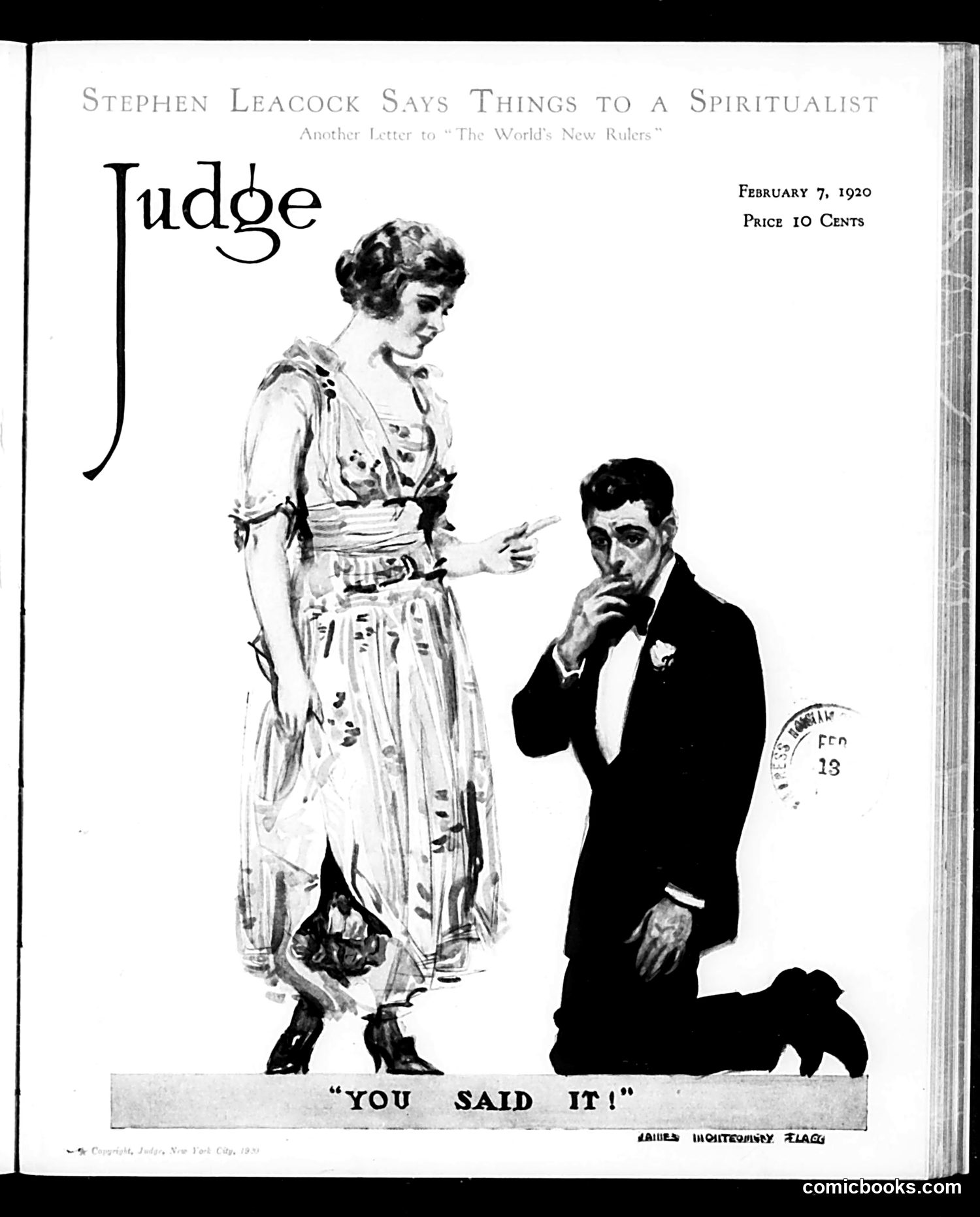
This satirical cartoon depicts a woman standing while a man kneels before her, with the caption "YOU SAID IT!" The headline references "Stephen Leacock Says Things to a Spiritualist" and describes it as "Another Letter to 'The World's New Rulers.'" The image appears to be social satire, likely mocking spiritualism—a popular but controversial movement in the 1920s involving séances and communication with the dead. The kneeling man's posture suggests supplication or gullibility, while the woman's elevated stance implies superiority or manipulation. The "YOU SAID IT!" caption suggests the woman has made a pronouncement the man accepts uncritically, satirizing how spiritualists supposedly influenced credulous followers. The reference to Leacock, a Canadian humorist, indicates this was satirical commentary on spiritualism's appeal and its critics.
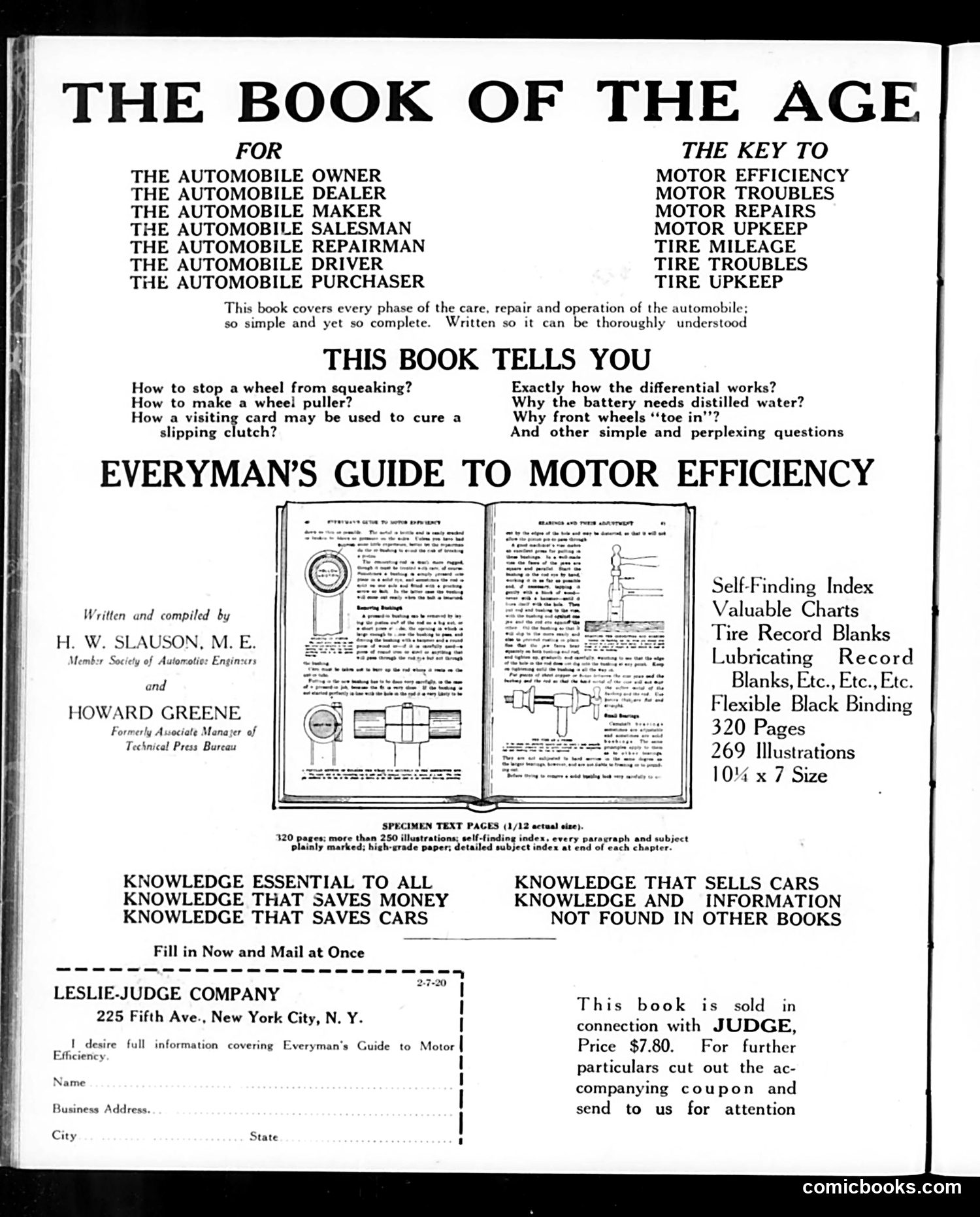
This page is **entirely an advertisement**, not satirical content or a cartoon. It promotes "The Book of the Age: Everyman's Guide to Motor Efficiency," published by Leslie-Judge Company in 1920. The ad targets automobile owners, dealers, makers, salesmen, repairmen, and drivers with a comprehensive 320-page manual covering motor maintenance, repairs, and operation. It emphasizes practical knowledge: "How to stop a wheel from squeaking," differential mechanics, battery care, tire maintenance, and other mechanical issues. The appeal is straightforward—this book provides essential, money-saving automotive knowledge "not found in other books." At $7.80, it positions itself as indispensable for anyone involved with automobiles during this early automotive era when mechanical literacy was genuinely valuable.
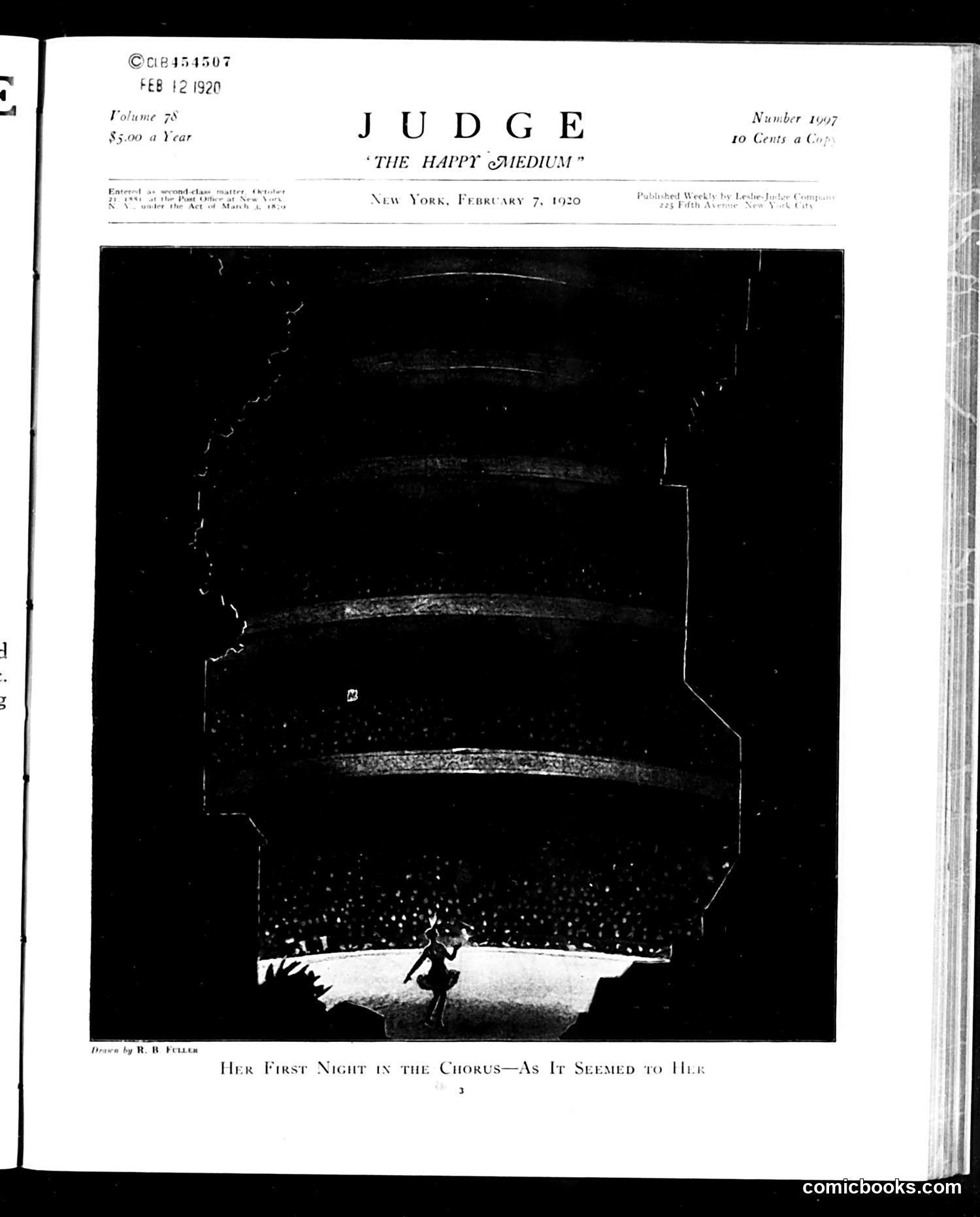
This is the cover of *Judge* magazine from February 7, 1920 (Volume 78, Number 1907). The illustration, drawn by R.B. Fuller, depicts a lone female performer on a theatrical stage before a massive, crowded auditorium. The title reads "Her First Night in the Chorus—As It Seemed to Her." The cartoon satirizes the subjective experience of stage fright or nervous anxiety. The cavernous, overwhelming theater space and sea of audience members create a visually distorted perspective meant to represent how an inexperienced performer perceives her debut—everything feels immense and intimidating. The humor lies in this contrast between objective reality (likely a standard-sized theater) and the performer's heightened emotional state, capturing the psychological experience of theatrical debut anxiety.
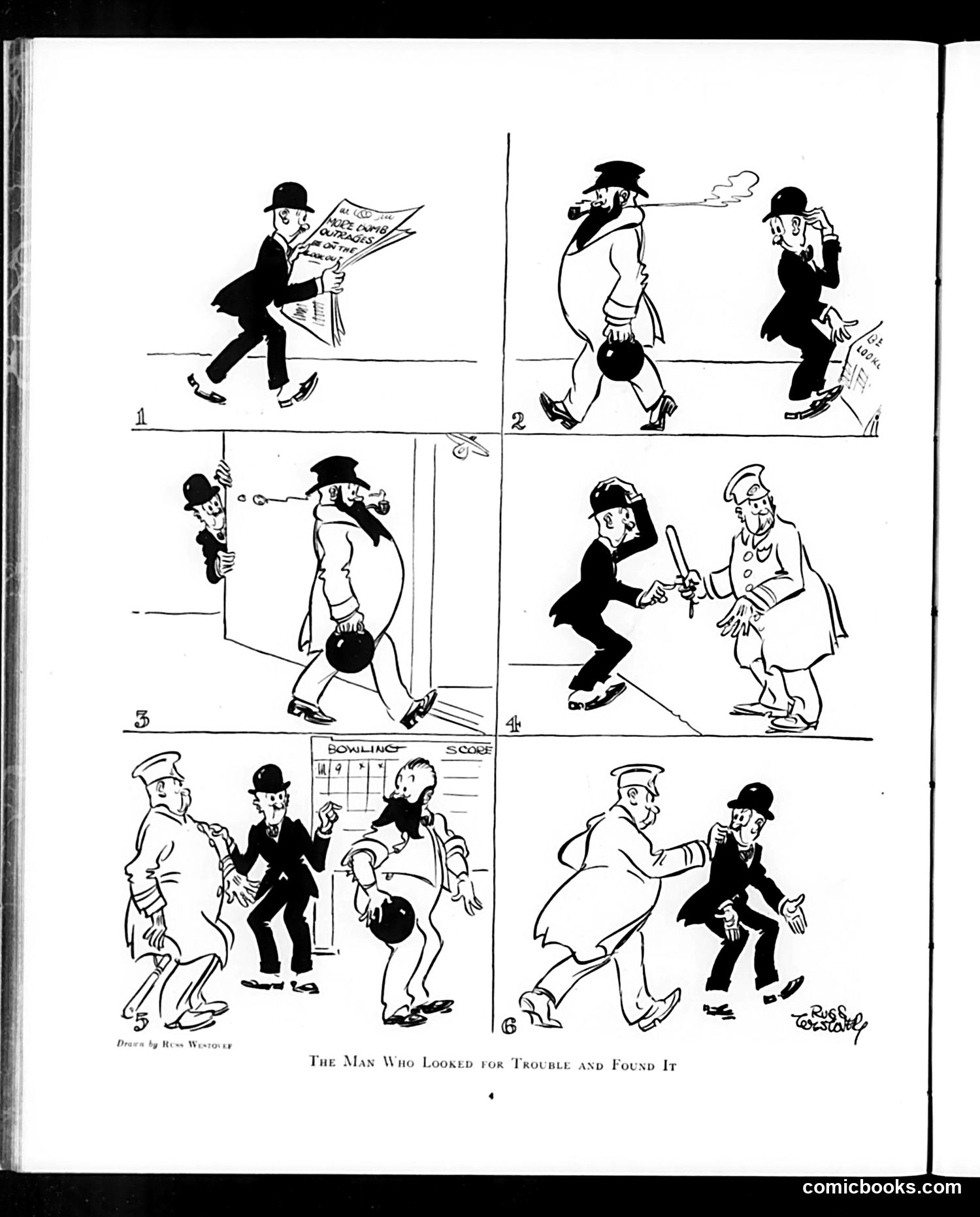
This six-panel comic strip depicts a man in formal attire systematically encountering various forms of trouble. He begins by reading a newspaper (panel 1), then confronts increasingly chaotic situations: a confrontation with a large man (panel 2), a boxing match (panels 3-4), and domestic/social conflicts (panels 5-6). The narrative appears to satirize a character who actively seeks out conflict or controversy, only to suffer predictable consequences. The progression from reading (information-gathering) to physical altercations suggests commentary on how pursuing sensational news or troublemaking behavior inevitably leads to personal harm. Without clearer identification of specific figures or dated context, the broader point seems to be a morality tale: trouble-seeking backfires.
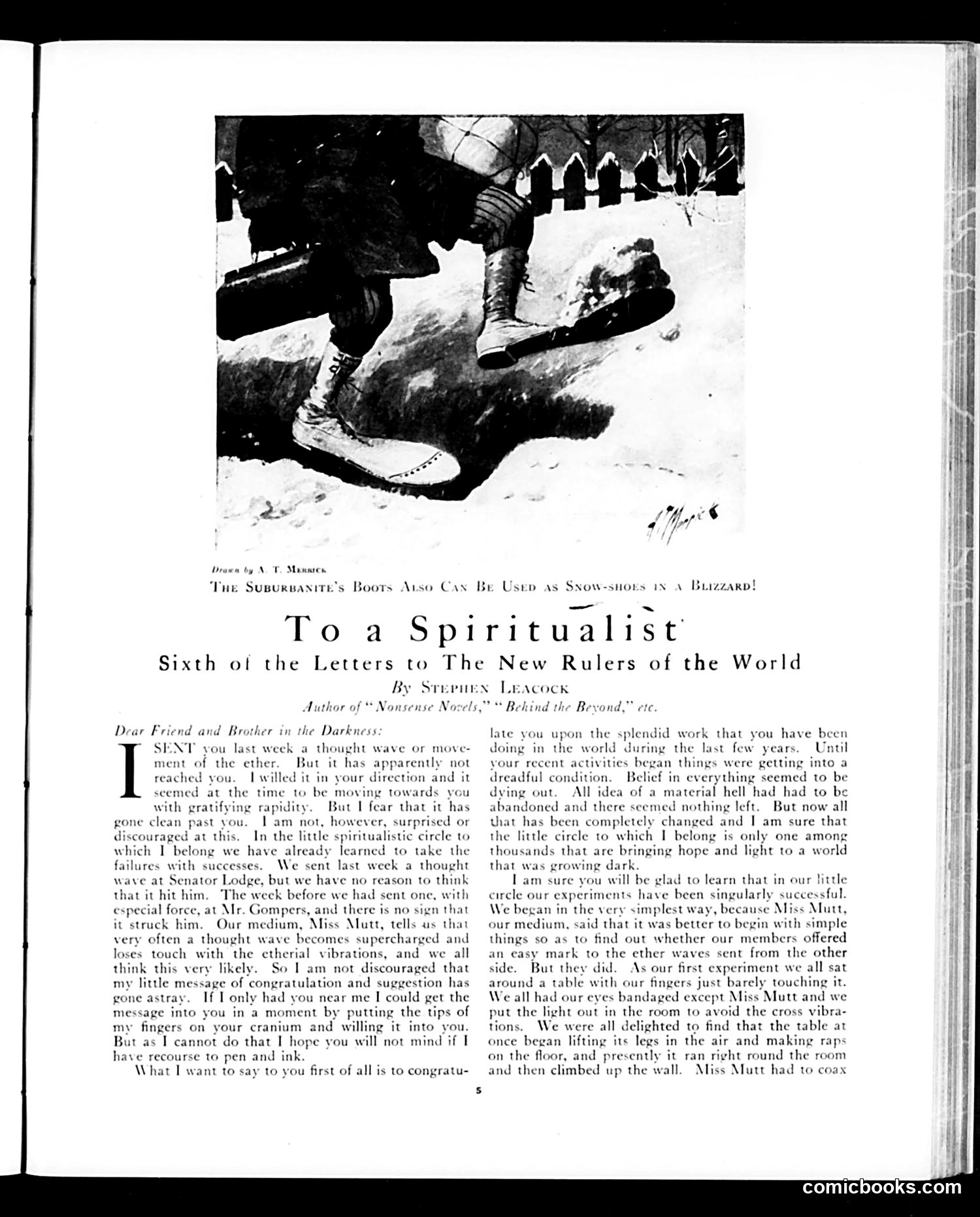
This page contains a letter titled "To a Spiritualist," part of a series called "Letters to The New Rulers of the World" by Stephen Leacock. The accompanying illustration, captioned "The Suburbanite's Boots Also Can Be Used as Snow-shoes in a Blizzard," shows someone's oversized boots being used in snow. The satire appears to target spiritualism—a popular early 20th-century movement claiming contact with the dead. Leacock's letter sarcastically congratulates spiritualists on their "splendid work" while describing séance experiments involving table-lifting and supernatural phenomena. The joke seems to mock both spiritualism's earnest believers and the ridiculous, easily-explained "supernatural" occurrences (tables moving, people climbing walls) that spiritualists attributed to otherworldly forces, suggesting they're gullible or deluded.
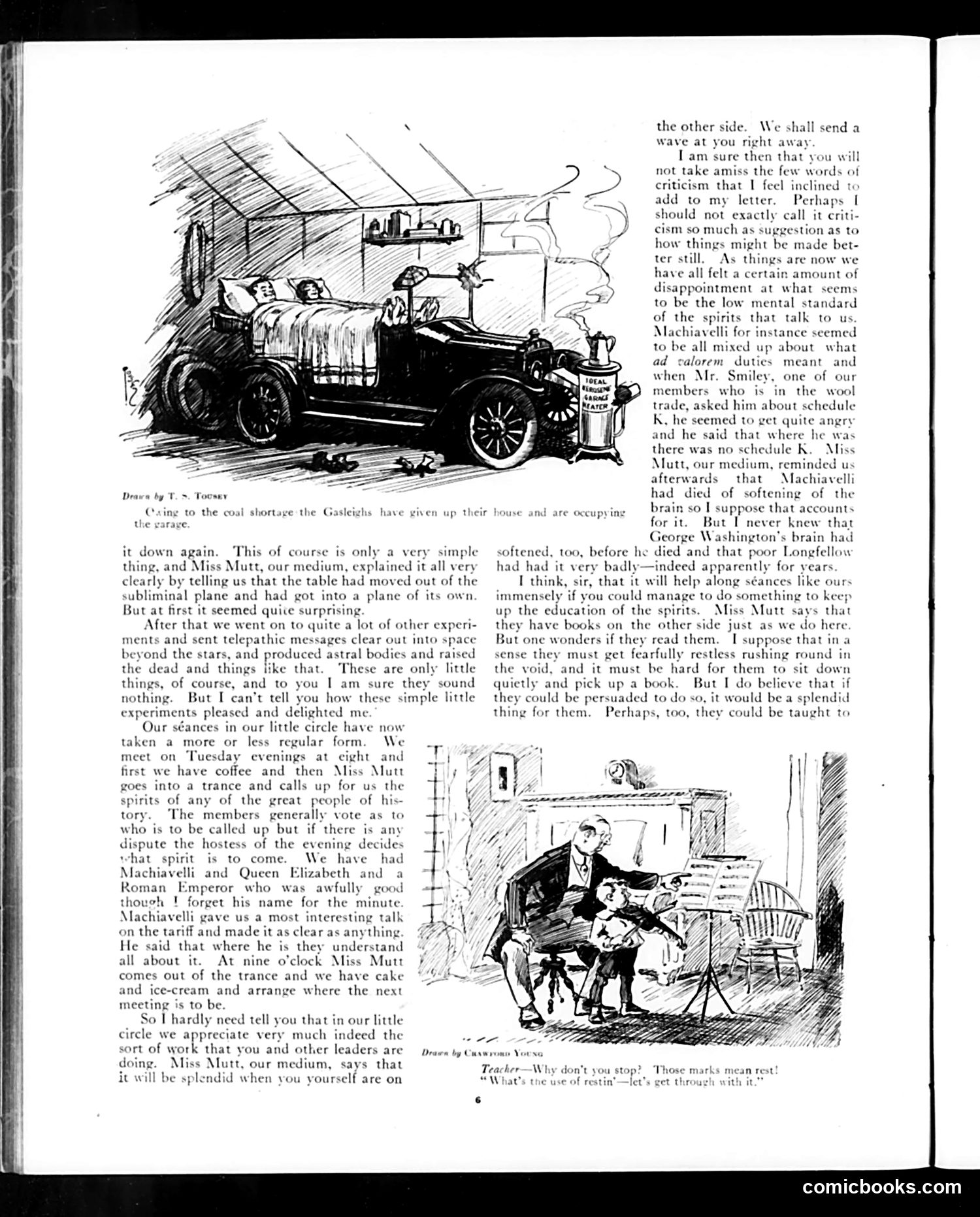
This page contains two editorial illustrations satirizing spiritualism, a popular early 20th-century phenomenon. The upper cartoon shows a wealthy family's automobile stored in their garage, implying they've abandoned their house to visit spiritualist séances instead—a commentary on how séances disrupted normal family life. The lower cartoon depicts a spiritualist séance or "trance" session where a medium (likely Miss Mutt, mentioned in text) conducts a reading. The illustration mocks the theatrical nature of séance performances. The accompanying text criticizes spiritualist mediums for their poor "education," referencing their confused claims about historical figures like Machiavelli and suggesting they promote gullible belief rather than genuine knowledge. The satire targets both the mediums' exploitation and the wealthy clients' credulity during this era's spiritualism craze.
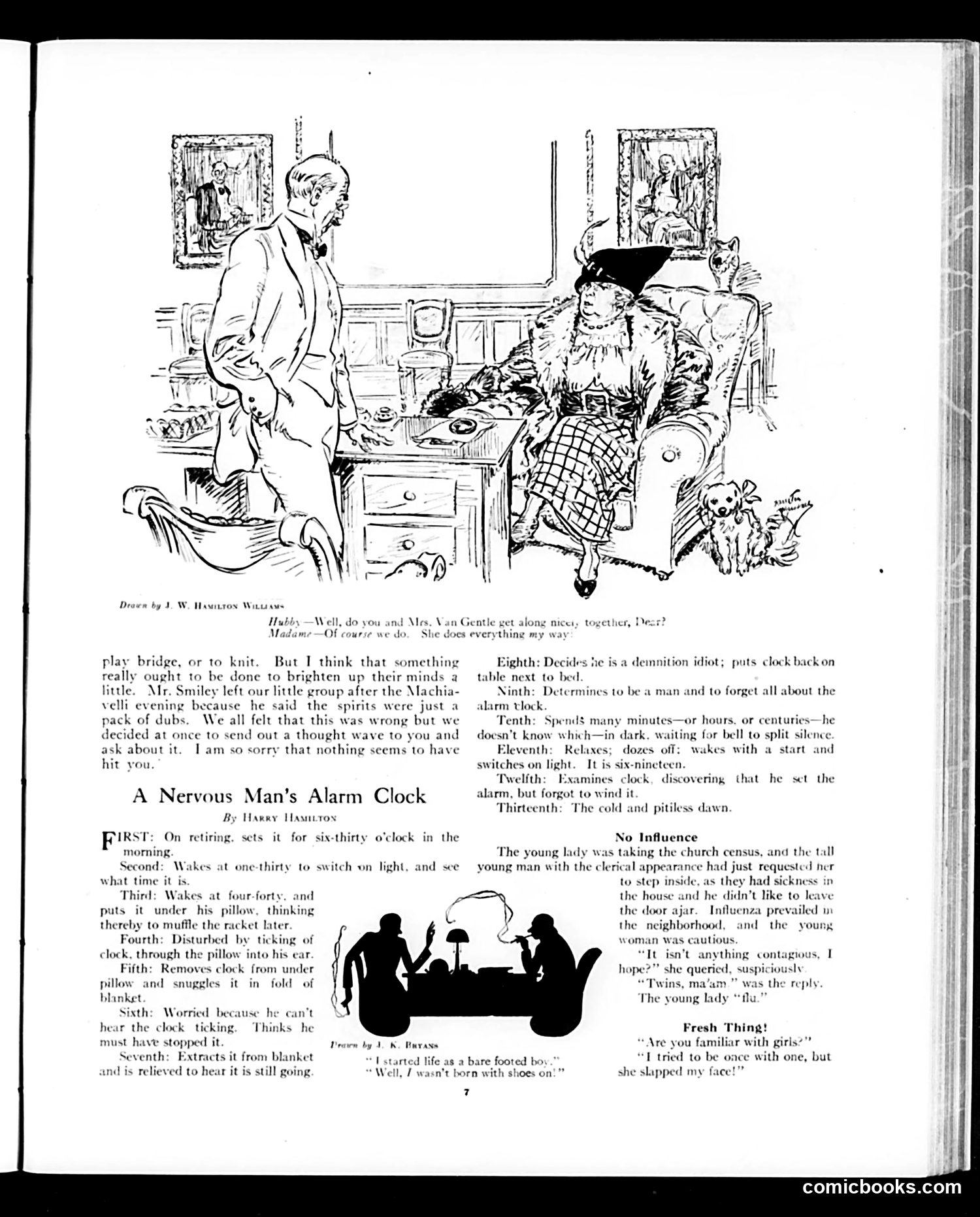
This page contains two main humorous pieces: **"A Nervous Man's Alarm Clock"** satirizes the anxious, overthinking modern man. The narrative follows thirteen steps of neurotic behavior: a man sets his alarm for 6:30 AM, then repeatedly wakes, moves the clock, worries whether it's working, second-guesses himself, and ultimately discovers he forgot to wind it. The humor targets the absurdity of self-sabotage and anxiety—the protagonist's own mental habits prevent the simple task of waking up. This reflects early-20th-century anxieties about modernity and nervousness. **The cartoon dialogue** mocks henpecked husbands and female dominance in marriage. The wife announces she "does everything my way," suggesting emasculation through domestic control. **"No Influence" and "Fresh Thing!"** are brief joke vignettes about romantic awkwardness and miscommunication—the young woman misinterprets "twins" as "influenza," and a young man gets slapped for presuming familiarity with a girl. The overall tone reflects Judge's typical satirical treatment of contemporary anxieties, gender dynamics, and social awkwardness in early-20th-century America.
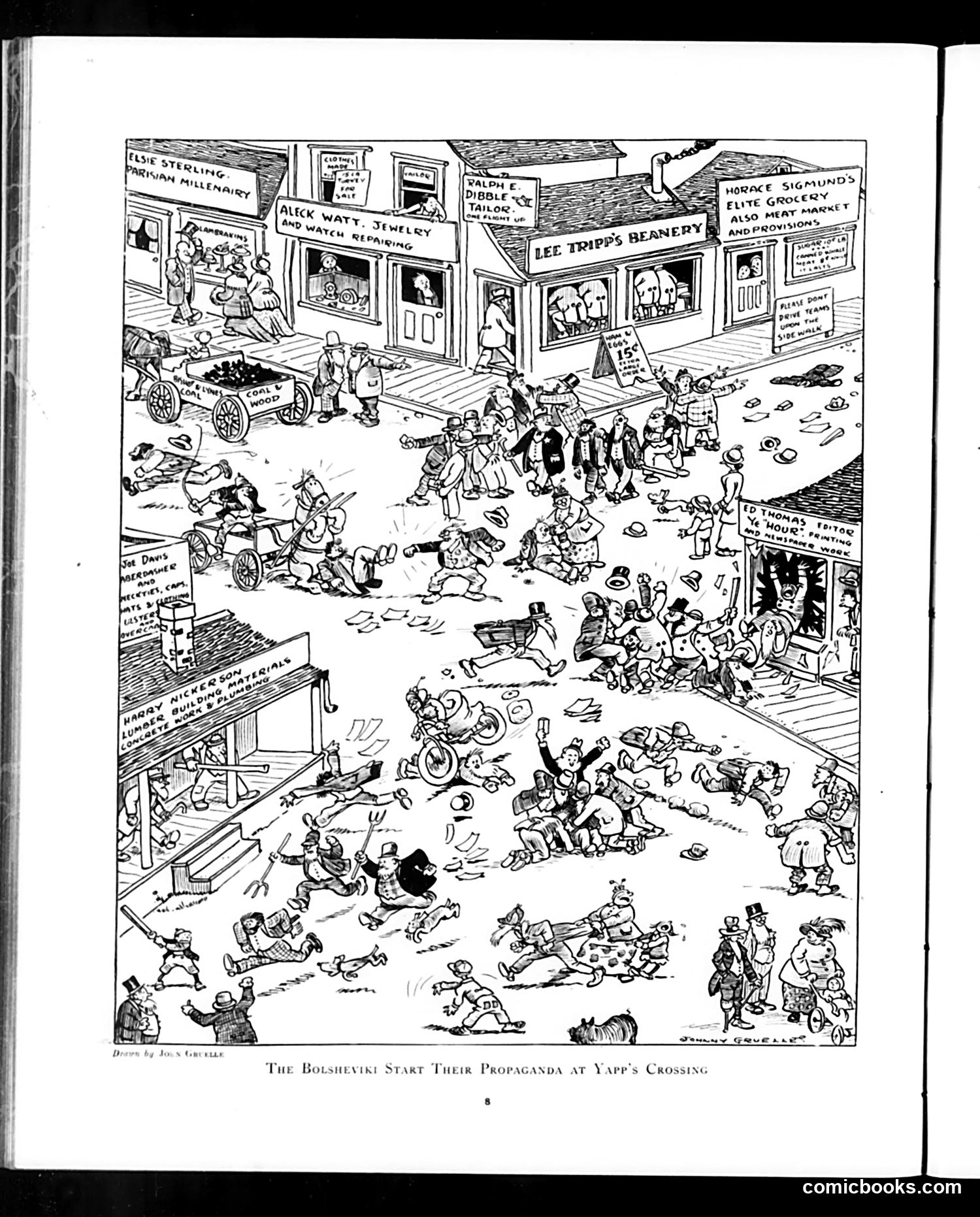
This is a satirical cartoon depicting "The Bolsheviki Start Their Propaganda at Yapp's Crossing" — a chaotic street scene with numerous figures engaged in various activities around storefronts. The cartoon appears to mock Bolshevik (Soviet communist) revolutionary agitation and propaganda efforts. The scene shows crowds of people, some fighting or scuffling, others gesturing dramatically, with visible shop signs including "Lee Tripps Beanery" and "Horace Sigmund's Elite Grocery." The composition suggests disorder and social disruption. This likely dates from the Red Scare period (1917-1920s) when American media frequently satirized communist/Bolshevik activities as dangerous foreign agitation threatening American stability and commerce. The cartoon ridicules Bolshevik "propaganda" by depicting it causing public mayhem and street violence in an ordinary American commercial district.
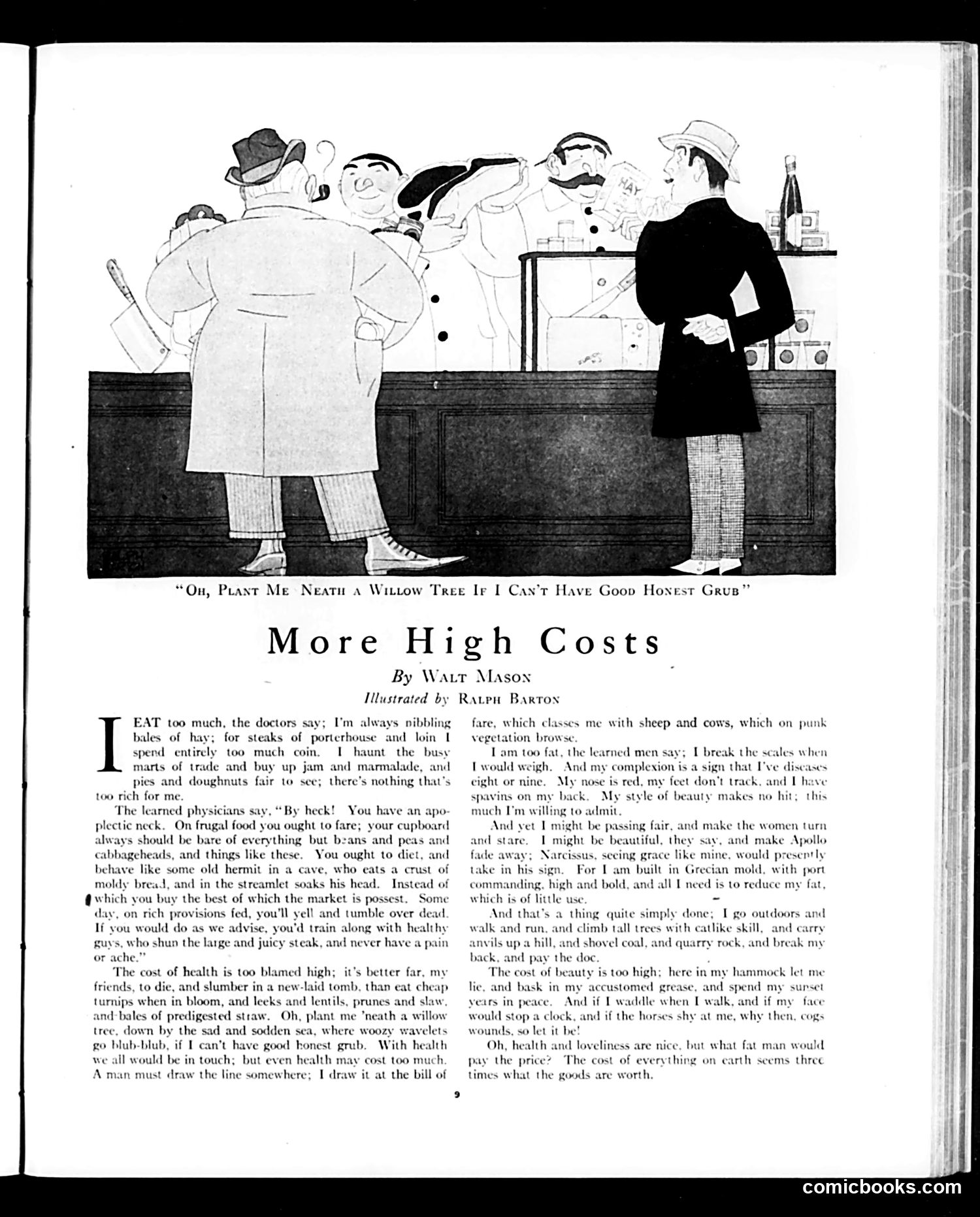
This is a humorous poem by Walt Mason (illustrated by Ralph Barton) satirizing the expense of maintaining health and beauty in early 20th-century America. The narrator is a fat man who doctors constantly nag to diet and exercise. He catalogs their demands—avoid rich foods, eat only beans and vegetables, exercise rigorously—then argues the cost (literal and lifestyle) is prohibitively high. He'd rather enjoy good food and die content than live miserably on cheap "turnips" and "predigested straw." The cartoon shows this portly gentleman at what appears to be a bar, surrounded by well-dressed onlookers. His declaration "Plant me 'neath a willow tree if I can't have good honest grub" captures the satire: better to be buried happy than live ascetically. The piece mocks both the expense of health-consciousness and the emerging medical establishment's prescriptive moralizing about diet and lifestyle—suggesting that for ordinary people, maintaining approved health standards is economically and socially unrealistic.
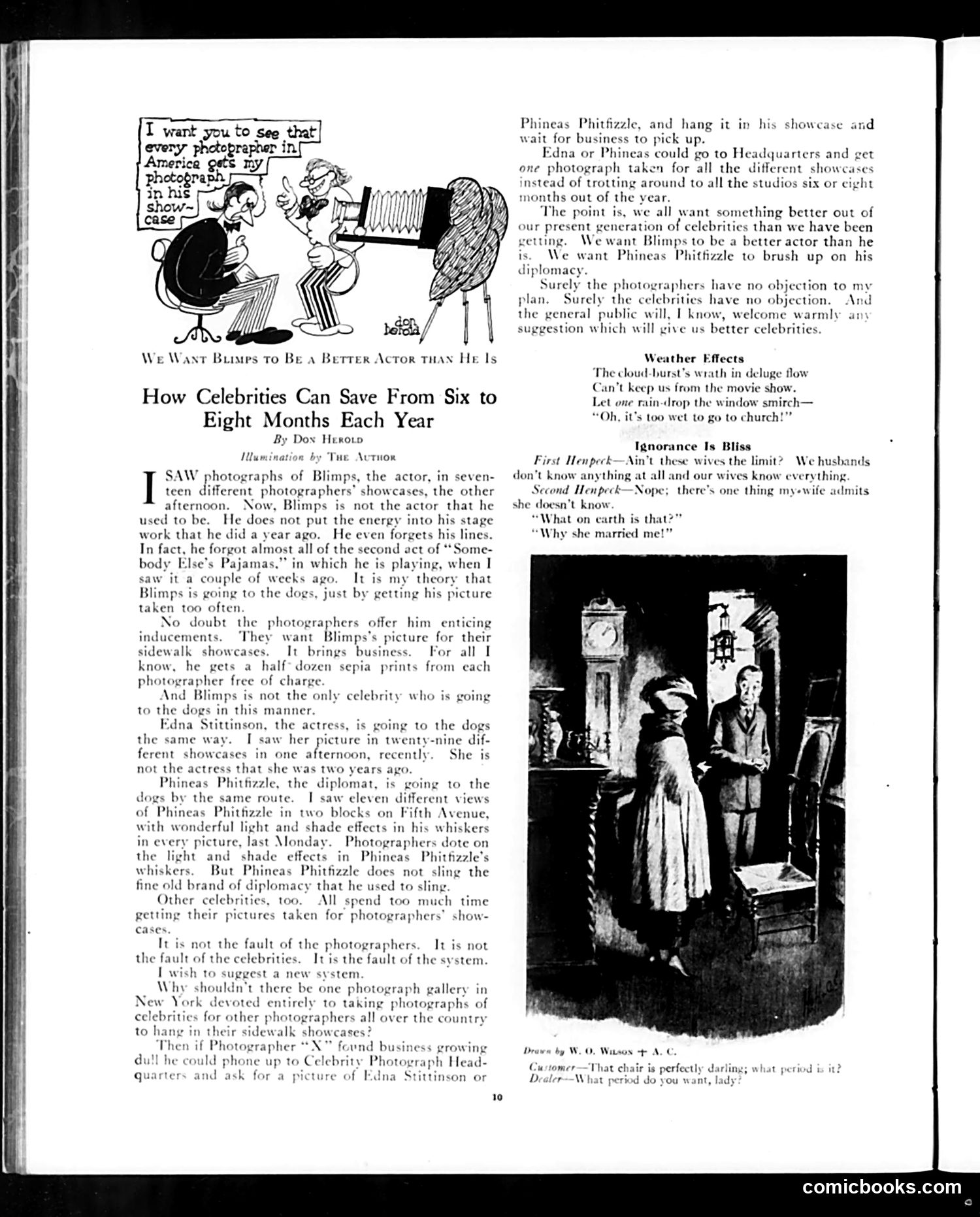
This 1920s *Judge* article satirizes celebrities' overexposure to photographers. The author "Dox Heroto" argues that actor "Blimps," actress "Edna Stittinson," and diplomat "Phineas Phitfizzle" are declining in their professions because they spend excessive time posing for sidewalk photographer showcases (storefronts displaying celebrity photos to attract customers). The satire critiques a wasteful system: celebrities visit dozens of different photographers' studios monthly for individual portraits. Heroto proposes a central "Celebrity Photograph Headquarters" where one photo session would supply all photographers citywide, freeing celebrities to actually work and improve their craft. The cartoon in the upper left shows a photographer hawking this concept to a skeptical figure. The accompanying jokes about weather, ignorance, and furniture are unrelated filler typical of *Judge*'s mixed-content format.
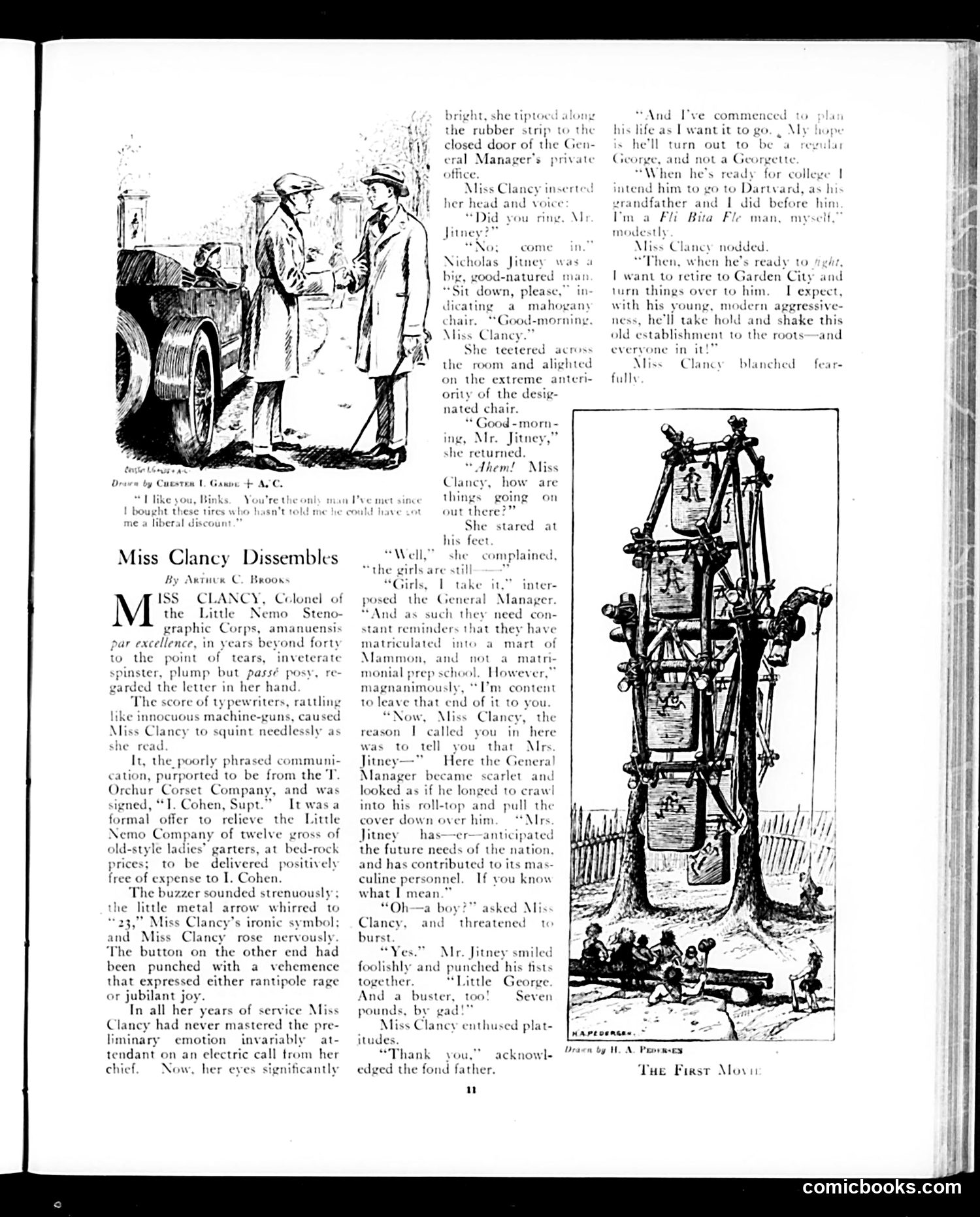
This story satirizes early 20th-century corporate culture and gender dynamics. Miss Clancy, an aging, unmarried stenographer for the "Little Nemo" company, is summoned by her boss, Mr. Jitney (a "big, good-natured" manager). The satire targets Jitney's hypocrisy: he lectures Miss Clancy that his female employees need "constant reminders" they're not attending "matrimonial prep school" — implying women should focus on work, not marriage. Yet moments later, he reveals his wife has just given birth to a son ("Little George"), which he celebrates despite his own moralizing about proper female behavior. The joke exposes the double standard: Jitney demands professional dedication from his female staff while simultaneously embracing traditional family life for himself. Miss Clancy's nervous reaction ("blanched") underscores the awkwardness of his self-contradiction. The accompanying illustration labeled "The First Move" appears to be a separate, unrelated cartoon about transportation or machinery.
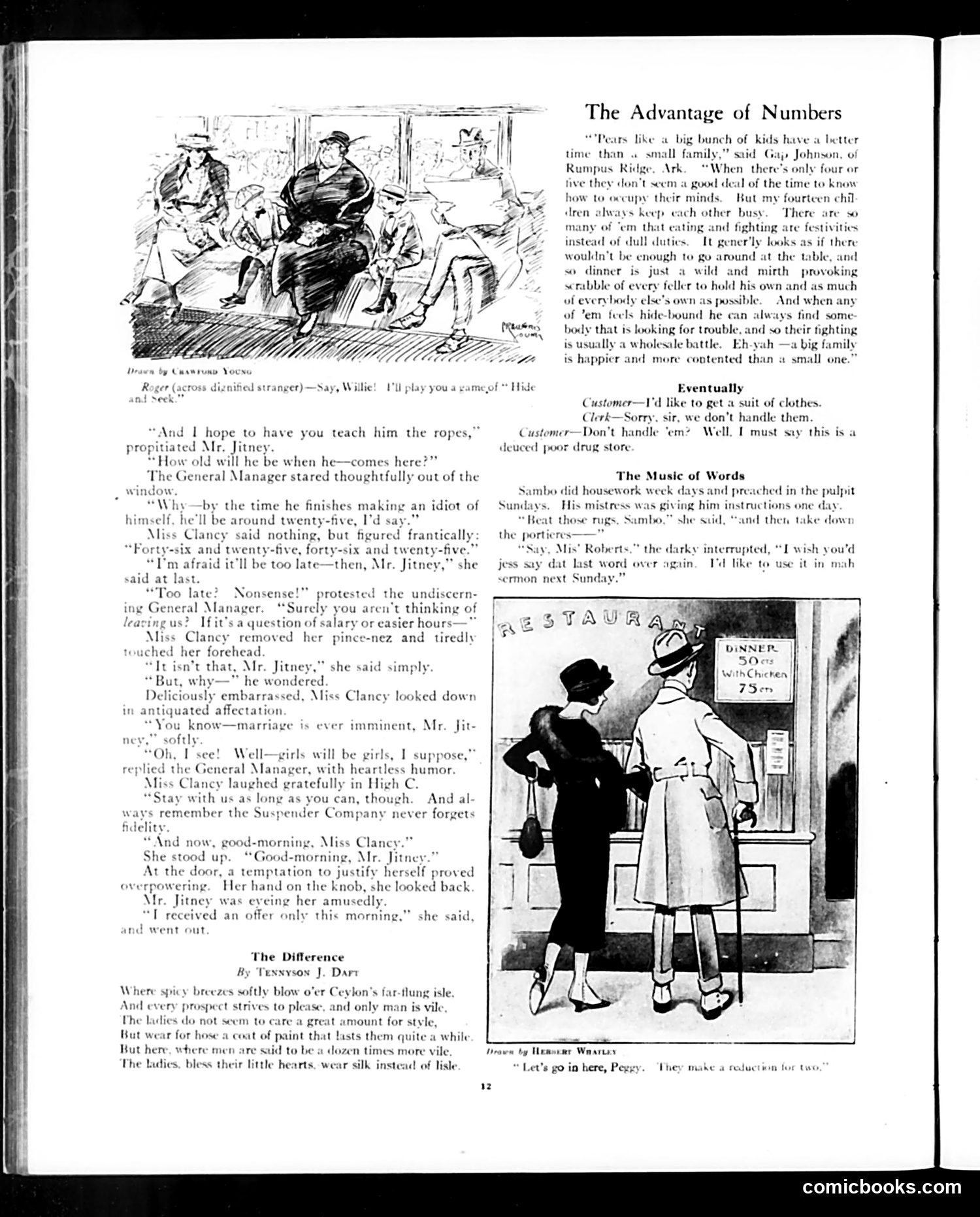
This page contains several short satirical pieces typical of early 20th-century Judge magazine: **"The Advantage of Numbers"** mocks rural attitudes through a farmer's boast that fourteen children are preferable to a small family because they keep themselves occupied—fighting and competing for food at dinner. The satire targets both large families and backwoods speech patterns. **"Eventually"** is a brief joke about a customer entering a drug store seeking clothes, highlighting the era's general stores that sold miscellaneous goods. **"The Music of Words"** uses racial stereotypes common to the period, depicting a Black domestic worker (Sambo) requesting to use the word "portieres" in a sermon because he likes how it sounds. The humor relies on the racist assumption that Black speakers would be unfamiliar with refined vocabulary. **"The Difference"** is a poem contrasting Ceylon (Sri Lanka) women's practical appearance with American women's fashion-consciousness and use of silk stockings, satirizing American materialism and vanity. The cartoon illustration shows two women at a restaurant, discussing a discount for two diners.
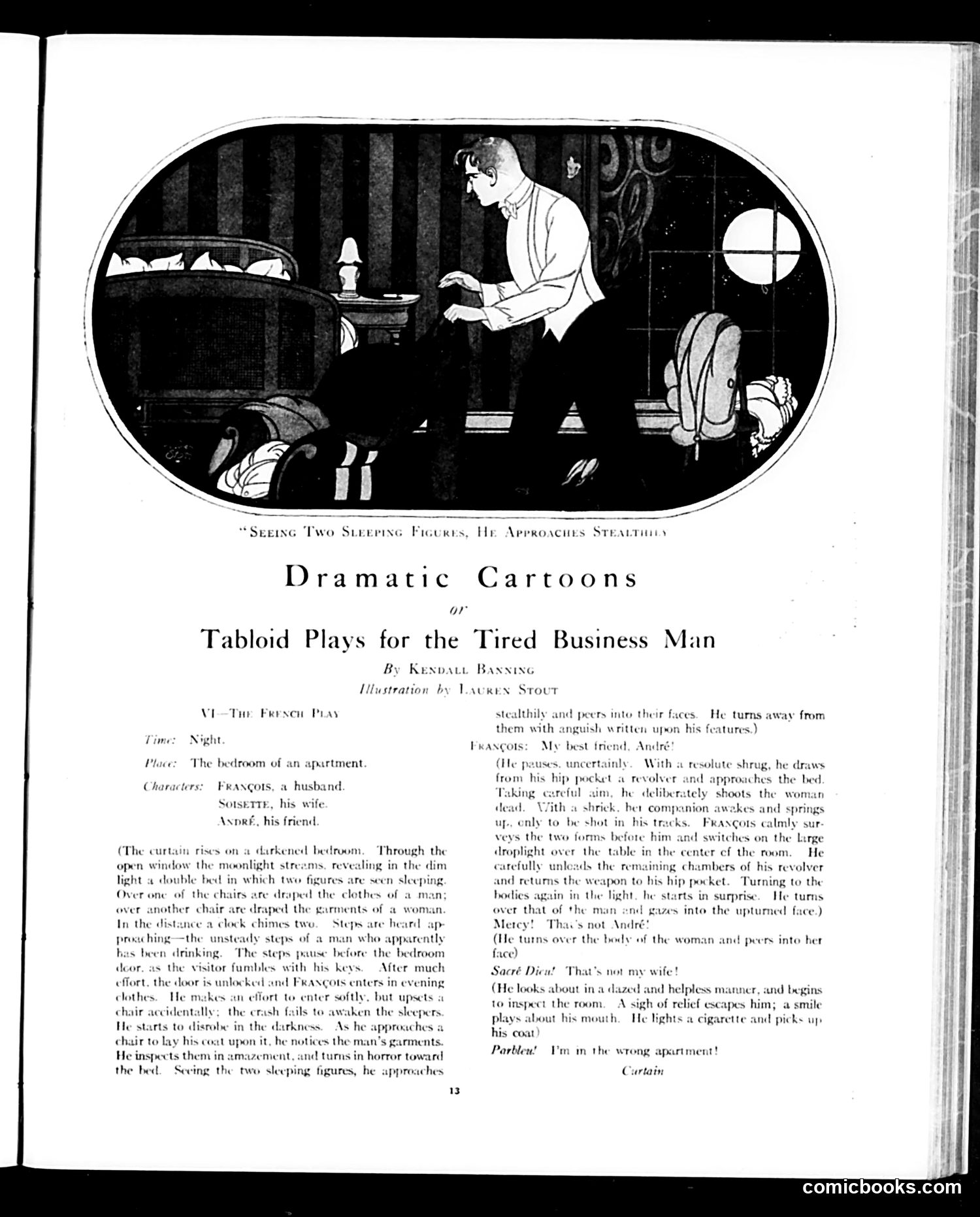
This is a comedic dramatic sketch titled "The French Play"—a satirical tabloid play meant for busy businessmen seeking brief entertainment. The humor relies on a classic farce setup popular in early 20th-century comedy. A man (François) stumbles home drunk at 2 a.m., enters what he believes is his apartment, and discovers two people in bed. He shoots both, believing he's caught his wife in infidelity. Upon inspection in the light, he realizes neither victim is his wife or his friend André. The punchline: he's simply in the wrong apartment, so he calmly lights a cigarette and leaves. The satire mocks both French theatrical melodrama (known for overwrought passion and murder) and the "tired businessman" audience seeking quick laughs. The absurdist resolution—casually accepting mass murder as merely an amusing mix-up—exaggerates the genre's emotional excess for comedic effect.
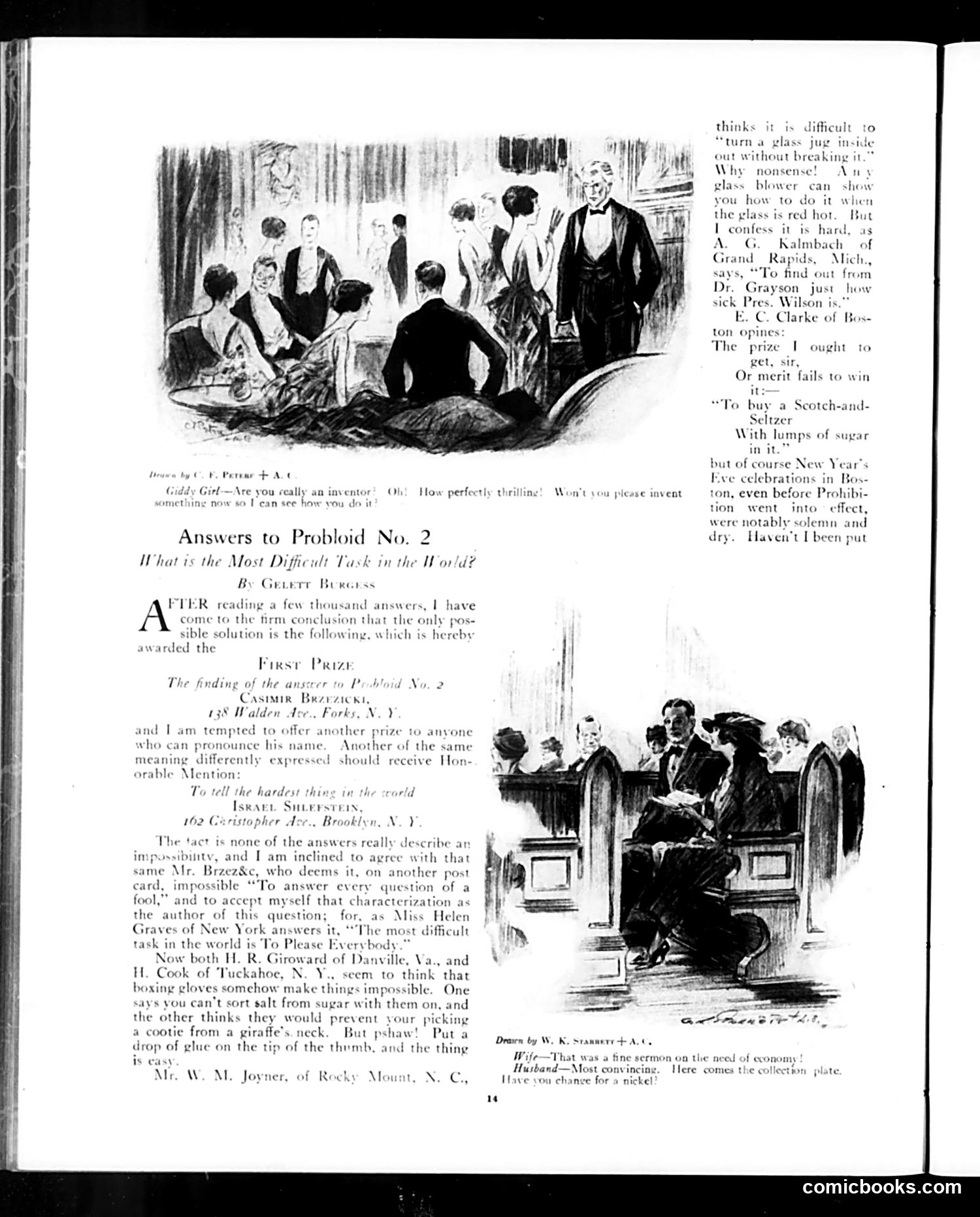
This page presents reader responses to a humor competition asking "What is the Most Difficult Task in the World?" Judge magazine awarded a First Prize to Casimir Brzezicki of New York for his answer. The page showcases several humorous submissions. One respondent suggests the hardest task is pronouncing Brzezicki's own name. Others offer practical impossibilities: sorting salt from sugar while wearing boxing gloves, or picking lice from a giraffe's neck with gloved hands. There's also a topical reference mocking President Wilson's health ("To find out from Dr. Grayson just how sick Pres. Wilson is"), and a joke about Prohibition's impact on New Year's Eve celebrations in Boston becoming "notably solemn and dry." The cartoons illustrate typical Judge style: genteel dinner party scenes and courtroom settings depicting the absurd scenarios described. This reflects the magazine's focus on middle-class humor and social satire popular in the early 20th century.
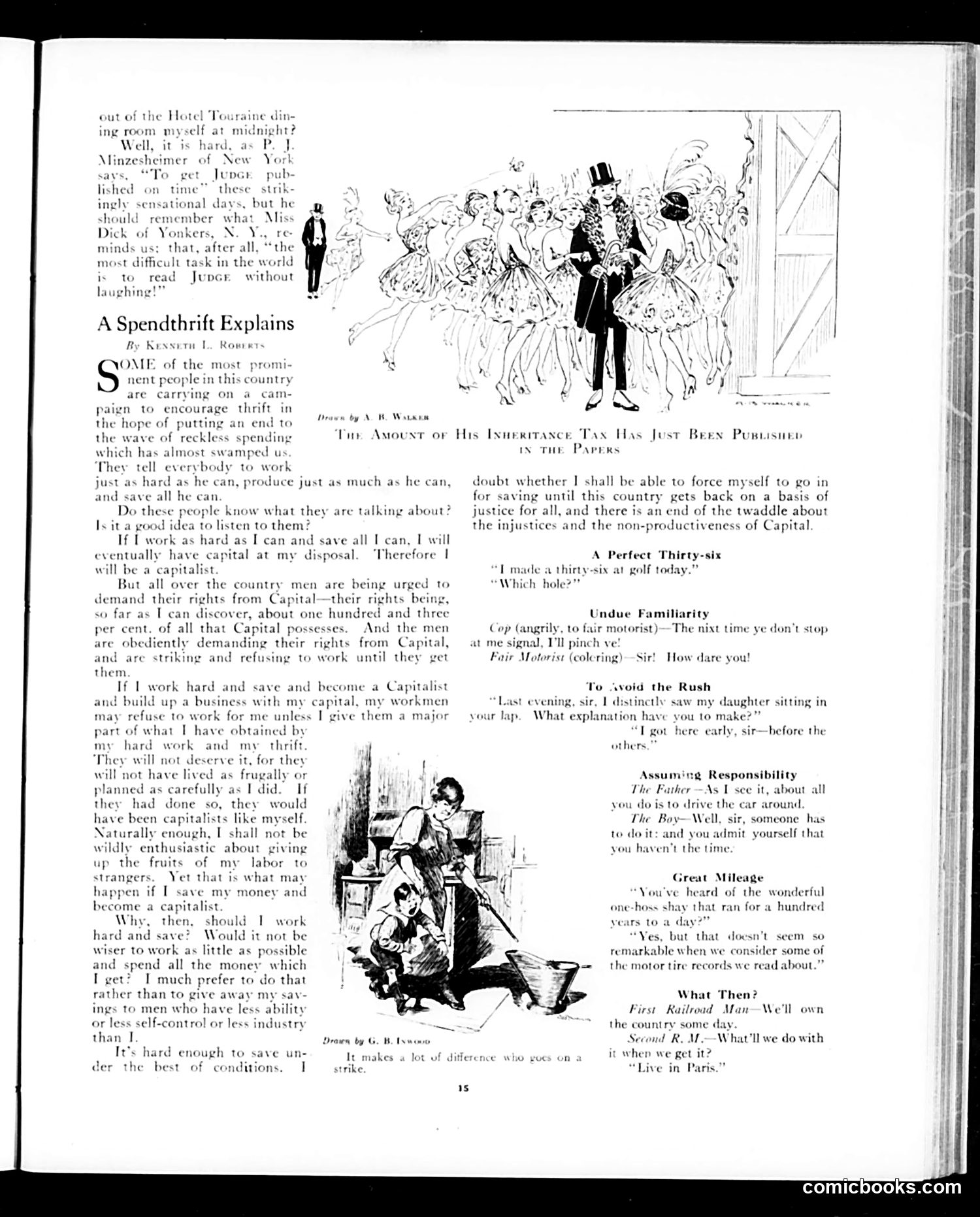
This page contains satirical commentary on labor disputes and capitalism during the early 20th century (appears to be 1910s-1920s based on style). **"A Spendthrift Explains"** is the main article. A wealthy businessman argues that he should *not* save money or build capital, because if he becomes successful, labor unions will demand his wealth anyway. He questions why he should work hard and accumulate savings only to have workers strike and demand his earnings. The satire mocks capitalist arguments against supporting labor rights—suggesting their logic leads to abandonment of thrift itself. **The cartoon** (upper right, by A.B. Walker) shows a well-dressed man surrounded by women at a social event, captioned about inheritance tax, likely satirizing wealthy heirs. **Bottom section** contains brief joke items about a traffic cop, a father discovering his daughter in a boy's lap, and railroad executives joking they'll own the country someday and live in Paris. The page satirizes both capitalist resistance to labor demands and the absurdity of their self-interested reasoning.
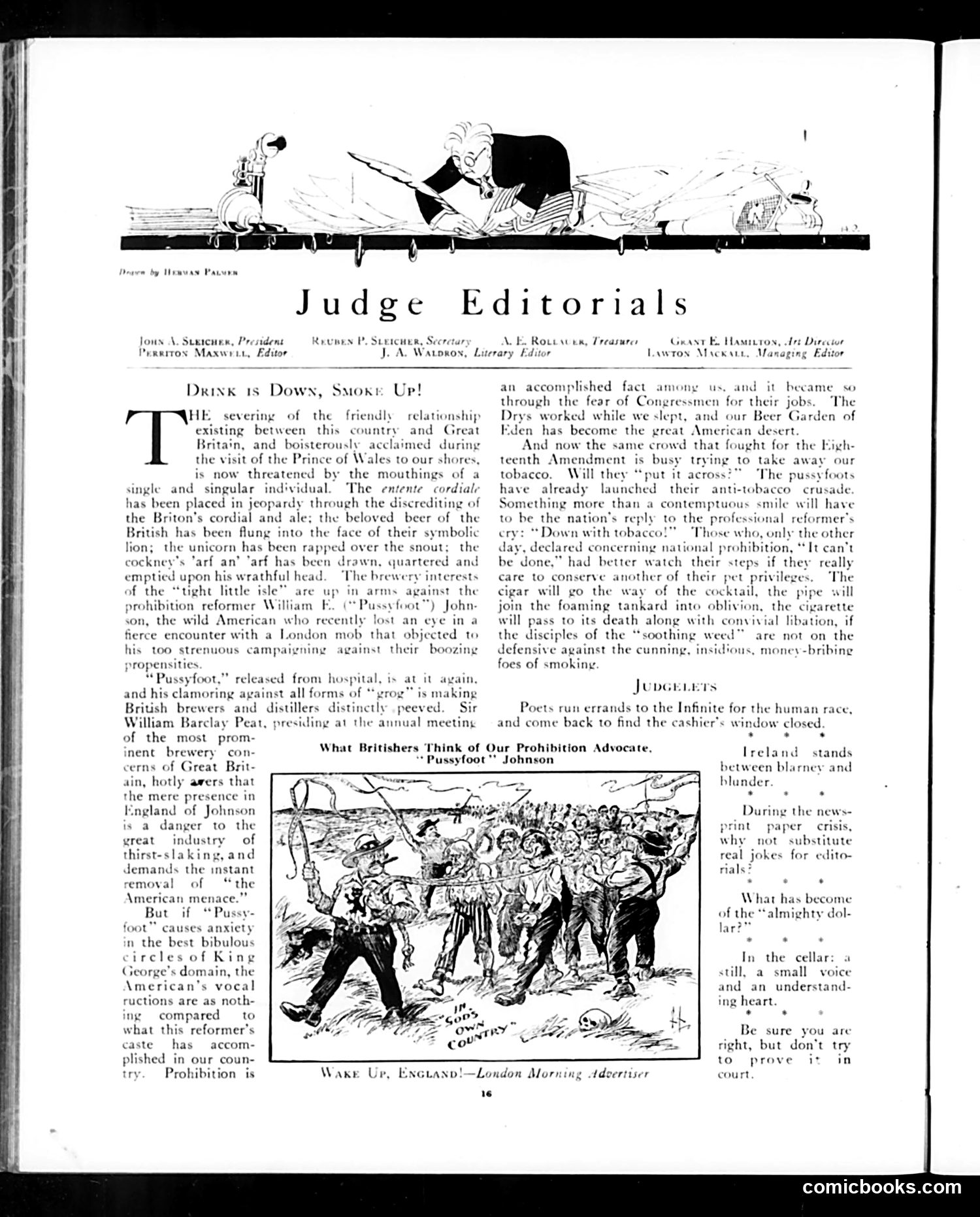
This page satirizes **William "Pussyfoot" Johnson**, an American prohibition advocate who visited Britain and was famously attacked by a London mob (losing an eye). The main editorial mocks the irony of his campaign: **The Satire:** Johnson fought successfully for American Prohibition, which has made the U.S. a "desert." Now he's in Britain promoting temperance and threatening the British brewing industry—the editorial sarcastically suggests Americans shouldn't lecture others about drinking restrictions when they've already destroyed their own alcohol culture at home. **Key Targets:** - Johnson's temperance crusade (framed as hypocritical American moralizing) - Fear that prohibitionists will next attack tobacco - The "soothing weed" disciples resisting smoking bans The cartoon (captioned "Wake Up, England!") depicts British brewers alarmed by Johnson's presence, with the editorial warning that Britain's cherished beer and ale industry faces American-style prohibition threats. The smaller "Judgelets" (joke section) are unrelated commentary on poets, journalism, and economics.
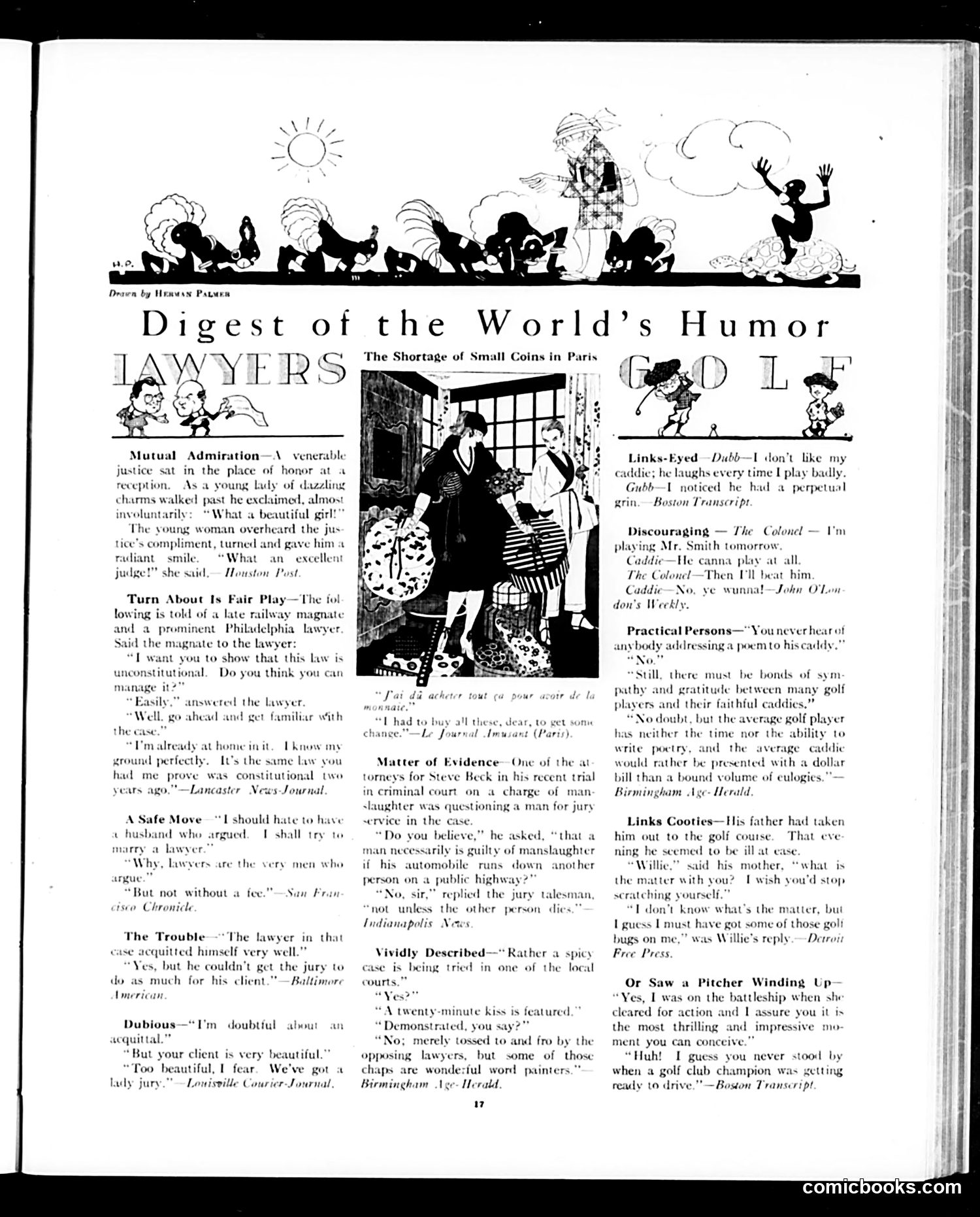
This page collects brief humorous anecdotes from various newspapers, reflecting early 20th-century American attitudes toward lawyers, golf, and social interactions. **Key jokes include:** - **Lawyers as mercenary**: Multiple anecdotes mock attorneys' willingness to argue any position for payment, regardless of consistency or ethics. One lawyer cheerfully argues a law is "unconstitutional" after previously proving it constitutional—same fee either way. - **Beauty influencing justice**: A female defendant's attractiveness biases both a judge and a jury, suggesting women exploited their appearance in court. - **Golf culture**: Several jokes reference caddies (golf assistants) as working-class figures, contrasting their practical concerns (getting paid a dollar) with romantic notions of poetry. - **Paris coin shortage**: A caption references actual economic conditions—a contemporary scarcity of small coins in Paris. The humor relies on cynicism about professional dishonesty, gender stereotypes, and class distinctions between gentlemen golfers and working-class caddies. The illustrations by Heawas Patwen provide visual gags supporting these themes.
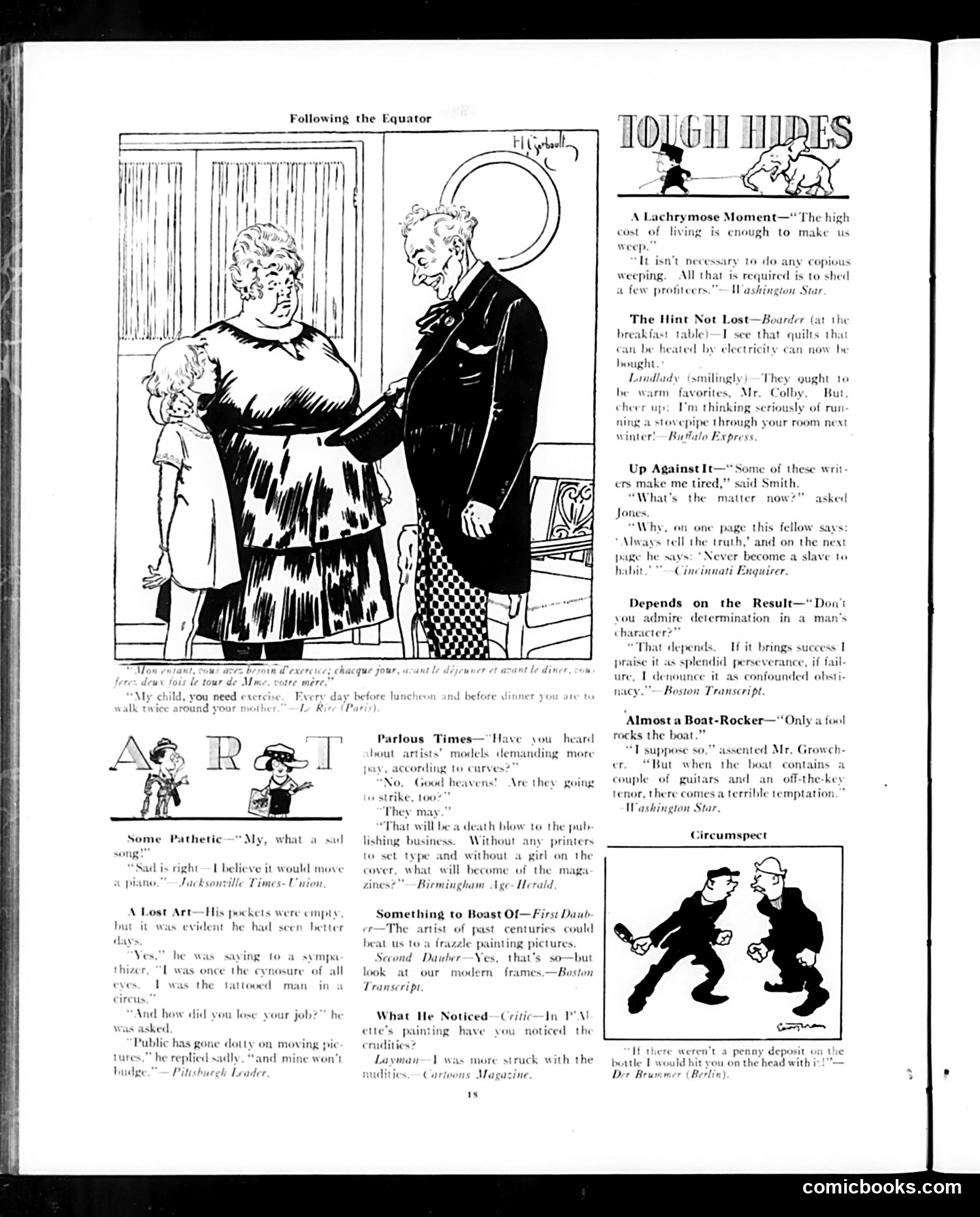
This page collects brief satirical jokes and observations typical of Judge's humor circa early 1900s. The main cartoon depicts a large woman and thin man in conversation—likely illustrating one of the accompanying witticisms about social observation or human nature. The surrounding vignettes mock contemporary concerns: the "high cost of living" (profiteers blamed for inflation), electric heating pads as luxury goods, artists demanding higher model fees, modern painting versus classical art, and workplace frustrations for writers. One joke contrasts a writer preaching honesty while behaving hypocritically—a common target of satire. The humor relies on class commentary (servants, boarders, artists), gender stereotypes (the large woman), and cynicism about human character. "Circumspect" shows two men in conspiratorial body language—unclear without context what specific situation is referenced. The title "Following the Equator" suggests travel narratives, possibly alluding to contemporary literature or current events, though the connection to individual jokes remains unclear.
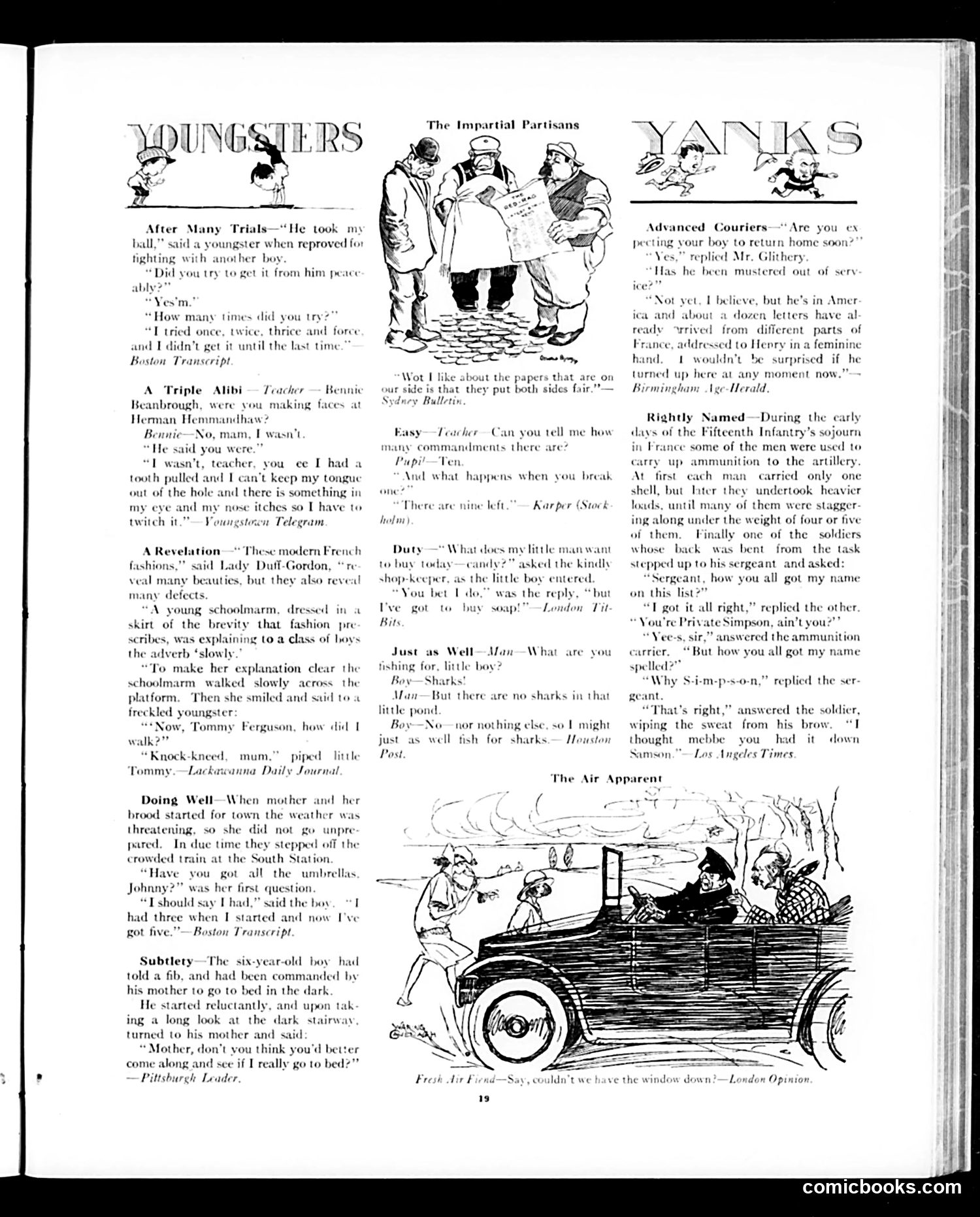
This is a humor page from *Judge* magazine featuring short jokes and comic vignettes about contemporary American life, likely from the WWI era (based on references to soldiers in France and the "Fifteenth Infantry"). The cartoons mock everyday situations: children's logic ("After Many Trials"), teacher-student exchanges ("A Triple Alibi"), and social observations. "The Impartial Partisans" satirizes how newspapers claim neutrality while favoring their own side. "The Air Apparent" shows a car with open windows, presumably making wind worse. The most historically specific piece is "Rightly Named," which jokes about an African American soldier (Private Simpson) being assigned heavy ammunition duty. The humor hinges on his sergeant spelling out "S-i-m-p-s-o-n" phonetically—a racist joke implying Black soldiers couldn't understand standard English. This reflects the discriminatory treatment of Black troops during WWI. The page represents period attitudes toward race, gender, and children that modern readers would find offensive rather than amusing.
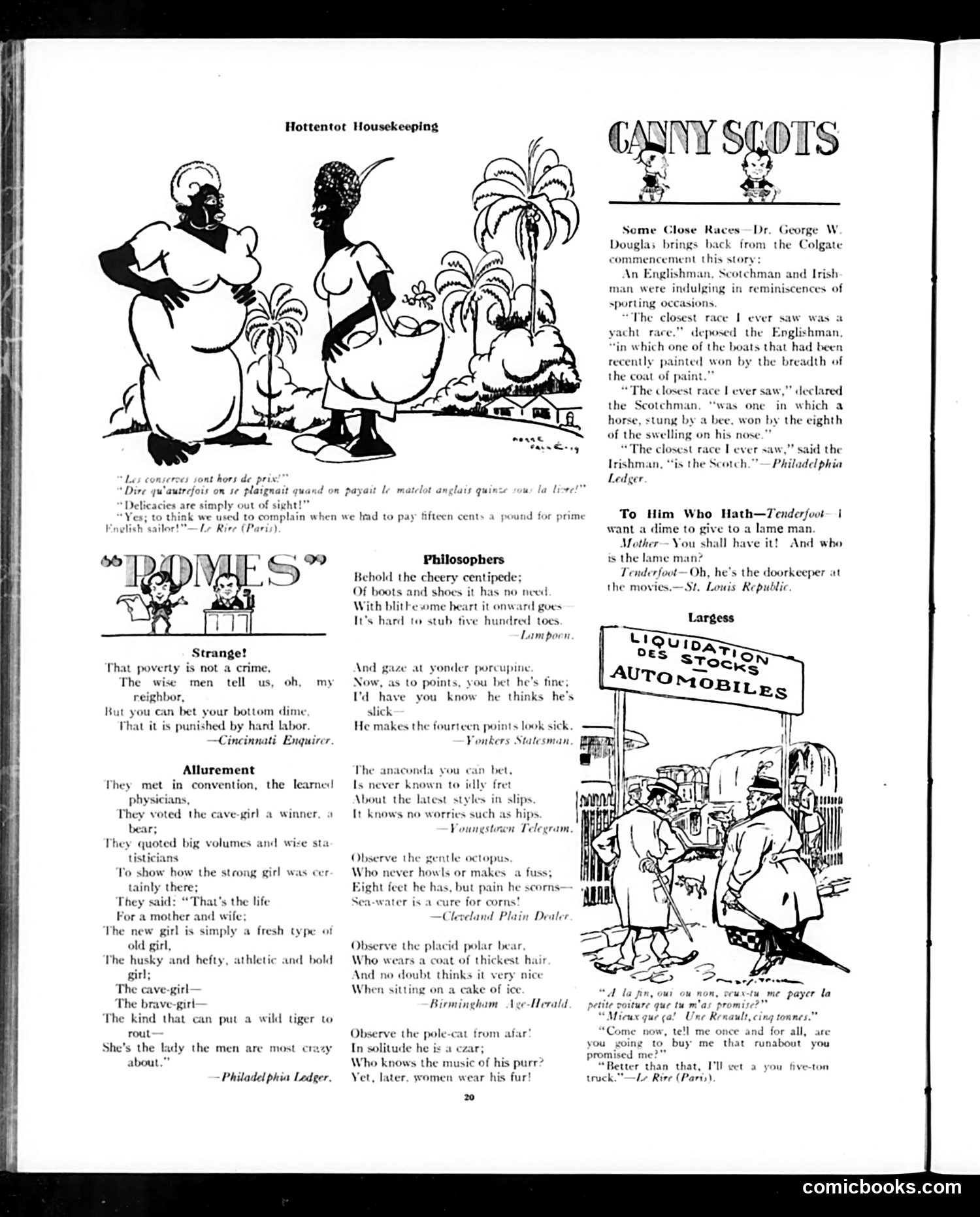
This Judge magazine page contains several layers of early 20th-century social commentary: **"Hottentot Housekeeping"** employs racist caricature (the "Hottentot" reference reflects period colonial attitudes toward African peoples) to mock European housewives' complaints about servant costs and living expenses—the joke being that even "primitive" people face economic pressures. **"Philosophers"** section uses animal observations as thinly-veiled social critique: the centipede needs no shoes (class commentary), the porcupine's "fourteen points" likely references Woodrow Wilson's post-WWI peace proposal, and the anaconda/octopus observations mock fashion anxieties and women's concerns about appearance. **"Some Close Races"** presents a joke structure mocking national stereotypes—English, Scottish, and Irish men competing in absurd race stories, with the Irishman's punchline that the "Scotch" itself is the closest race (a drinking joke). The advertising and other brief humor items reflect consumer culture preoccupations of the era.
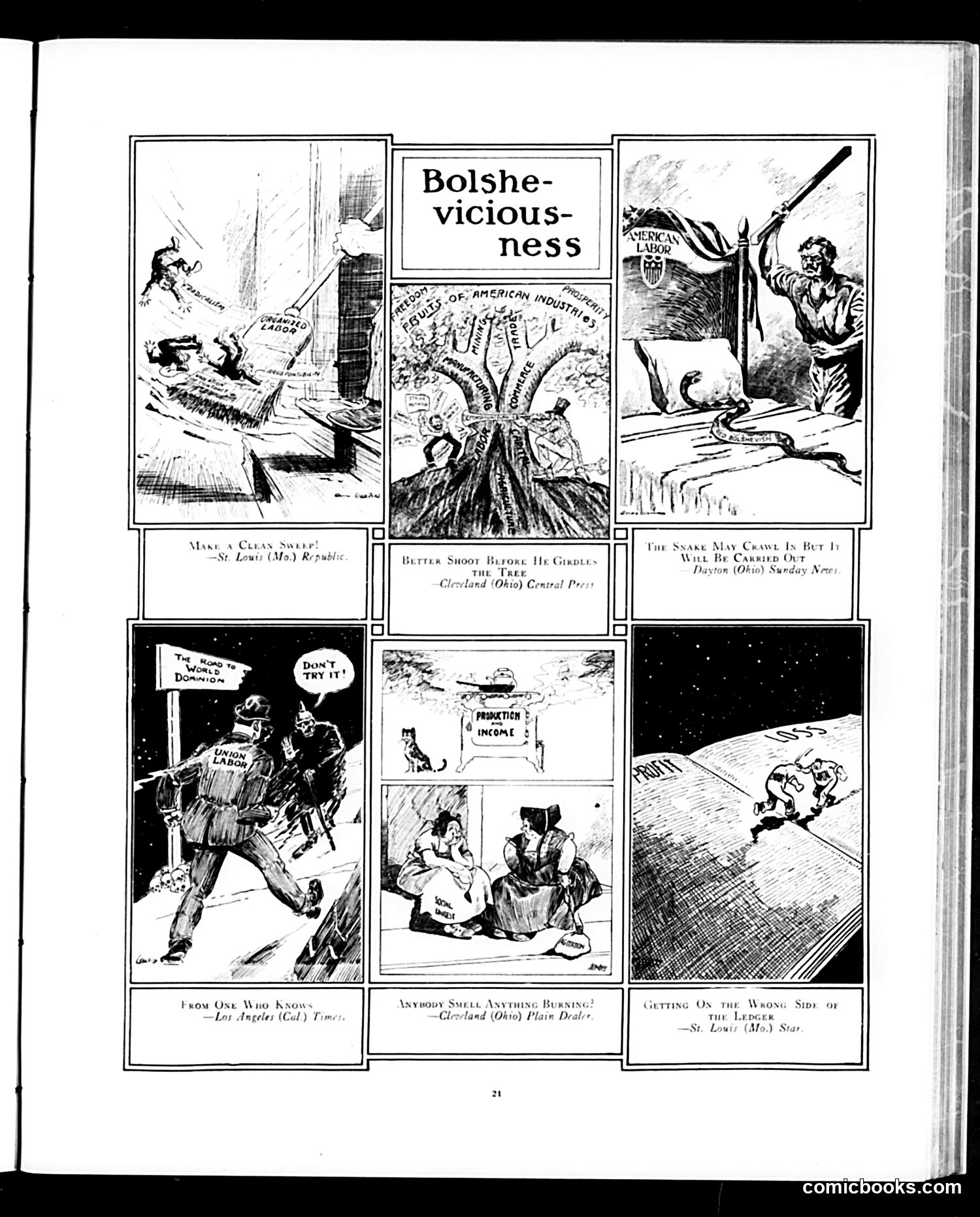
This Judge magazine page satirizes American anxieties about Bolshevism (Soviet communism) during the Red Scare era. The title panel depicts Bolsheviks as destructive forces—shown as a plant with tentacles spreading poison labeled "Pride of American Industries." The surrounding panels use newspaper headlines to illustrate perceived Bolshevik threats: labor agitation ("American Labor" figure), property destruction, and general societal chaos. One panel shows a figure labeled "Production & Income" being attacked. The satire mocks both actual communist activity and exaggerated American fears of it. References to specific newspapers (St. Louis, Cleveland, Los Angeles) suggest these were real contemporary concerns being reported. The overall message: Bolshevism threatens American industry, labor stability, and prosperity—a common propagandistic theme during the 1920s Red Scare period.
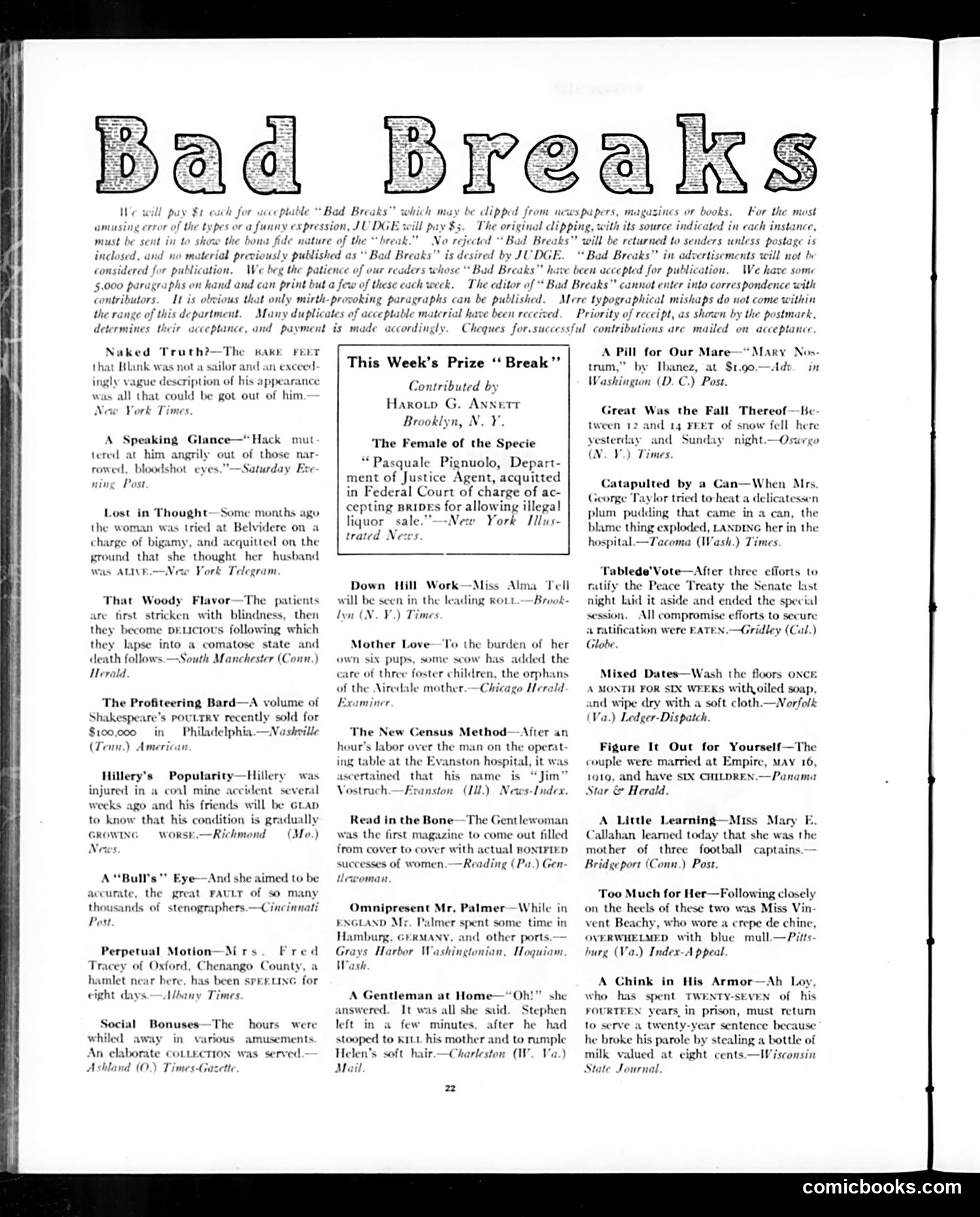
This page is the "Bad Breaks" section of Judge magazine, a humor feature that pays readers $1 for typographical errors or unintentionally funny phrases clipped from newspapers and magazines. The content consists entirely of short excerpts from real newspapers containing accidental humor—often from homonyms, misplaced capitalization, or awkward phrasing. Examples include a woman acquitted of bigamy because she "thought her husband was ALIVE," a coal miner whose condition is "gradually OWING—WORSE," and a magazine filled with "actual BOOTLEGGED successes of women." The humor relies on the reader recognizing the unintended meanings created by typos or editorial errors in the source publications. This was apparently a popular feature; Judge notes they receive many submissions and can only print a few weekly. The "prize break" this week comes from Harold G. Annett of Brooklyn. There is no political satire here—rather, it's gentle mockery of other newspapers' editorial incompetence.
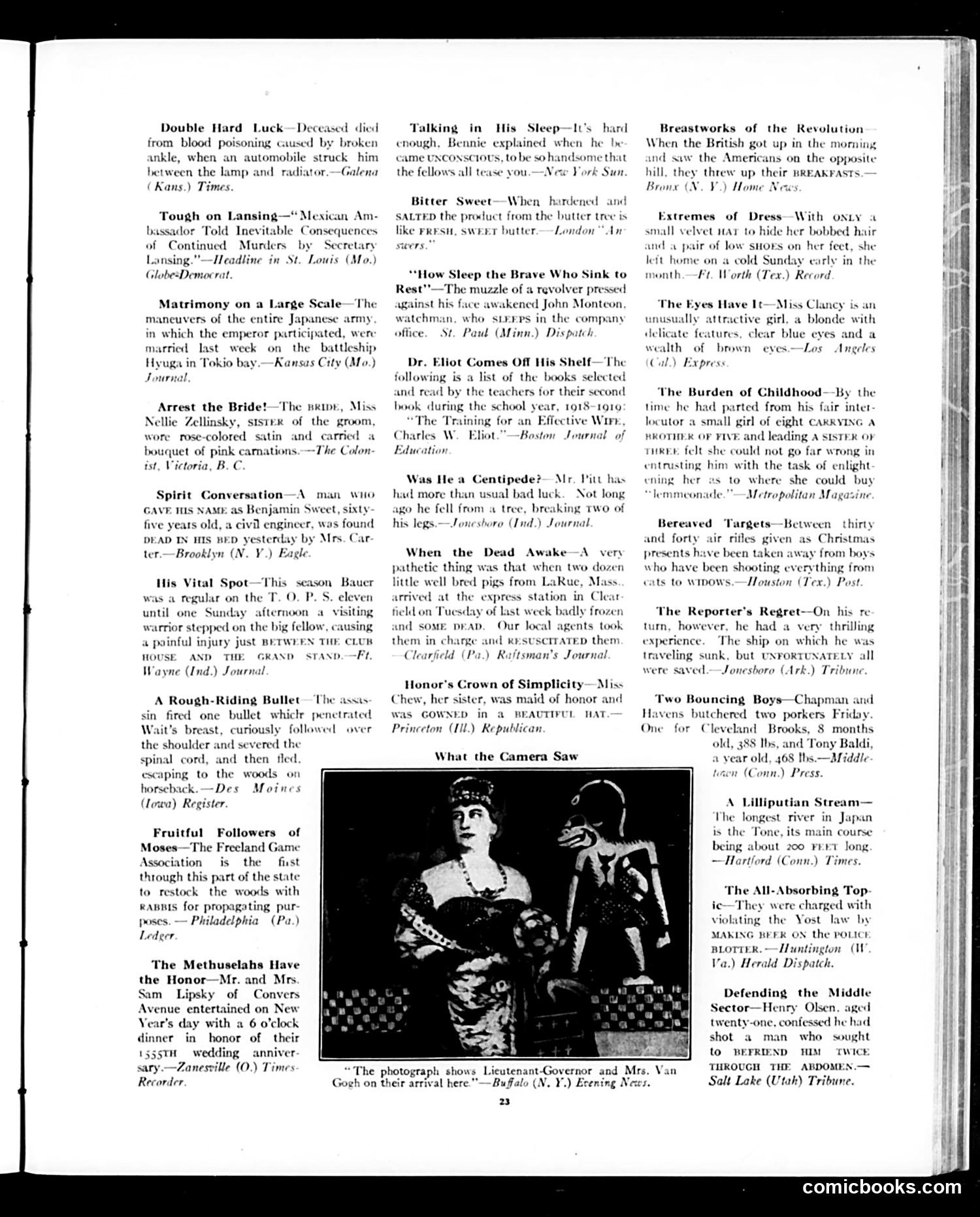
This page from Judge is a humor compilation featuring short, punchy satirical items—mostly absurdist "news briefs" mocking newspaper reporting styles. The central cartoon shows "Lieutenant-Governor and Mrs. Van Gogh on their arrival here" in formal dress at what appears to be a reception. The satire is straightforward: Judge is mocking pretentious society photography and reporting. By captioning an elegant formal photograph with the name "Van Gogh" (the famously struggling, now-deceased artist), the magazine creates ironic humor—contrasting the dignified bourgeois occasion with association with an artist known for poverty and madness. The joke undercuts both society photography's pomposity and suggests the absurdity of treating minor officials' arrivals as newsworthy spectacle. The surrounding brief items use similar deadpan humor: newspapers reporting bizarre accidents, ridiculous misstatements, and human oddities with deadpan earnestness. Judge's consistent target: gullible newspaper readers and overwrought journalistic conventions.
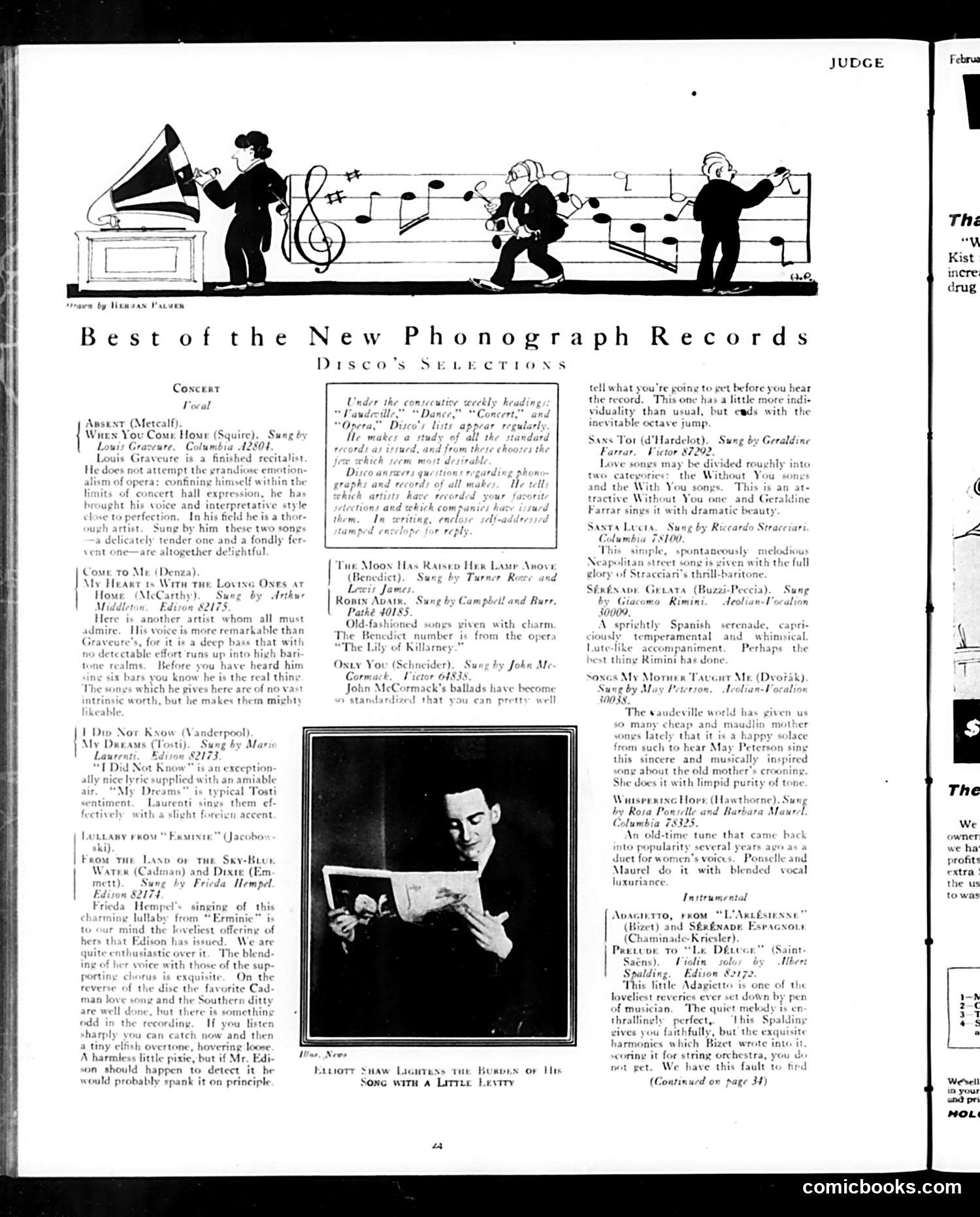
This page is **not a political cartoon**, but rather a **music review column** from Judge magazine's "Disco's Selections" section, evaluating newly released phonograph records. The illustration at the top is decorative—showing stylized figures with a gramophone and musical staff—but serves no satirical purpose. The content reviews vocal and instrumental recordings by classical and popular singers of the era (names like Frieda Hempel, Caruso, and others), offering critics' assessments of each record's quality, performance, and technical merits. A photograph shows what appears to be **Elliott Shaw**, identified as "lightless the burdens of his song with a little levity"—presumably a performer being reviewed. This is essentially **trade magazine content**: product recommendations for consumers interested in the latest Edison, Pathé, and Columbia phonograph releases. It reflects the commercial music industry of the early 20th century before radio dominated home entertainment.
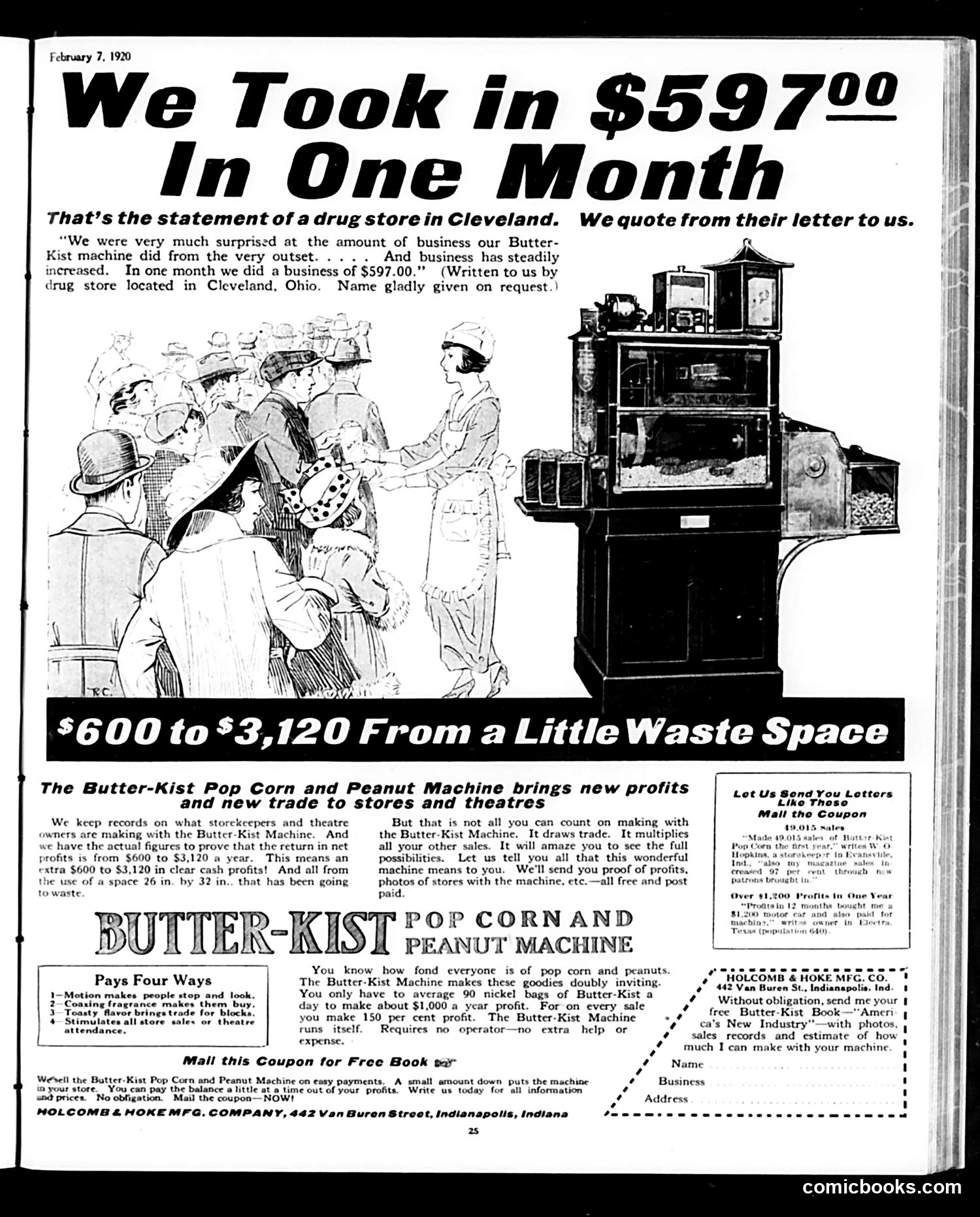
This page is primarily **advertising, not satire or political commentary**. It's a 1920 commercial for the Butter-Kist vending machine—an automated popcorn and peanut dispenser. The left illustration shows customers gathered around the machine, depicted as an attraction in stores or theaters. The appeal is straightforward entrepreneurship: business owners could generate $600-$3,120 yearly profit from minimal floor space by selling nickel bags of popcorn/peanuts to customers. The headline's dramatic "$597" claim appears exaggerated (likely a typo for the stated $597 monthly business), suggesting the ad uses hyperbole typical of early 20th-century product marketing. **Historical context:** This reflects the 1920s vending machine boom—an early form of automated retail. The appeal to store owners emphasizes passive income from a machine requiring "no operator—no extra help or expense." There is no cartoon satire here—merely product promotion using period illustration conventions.
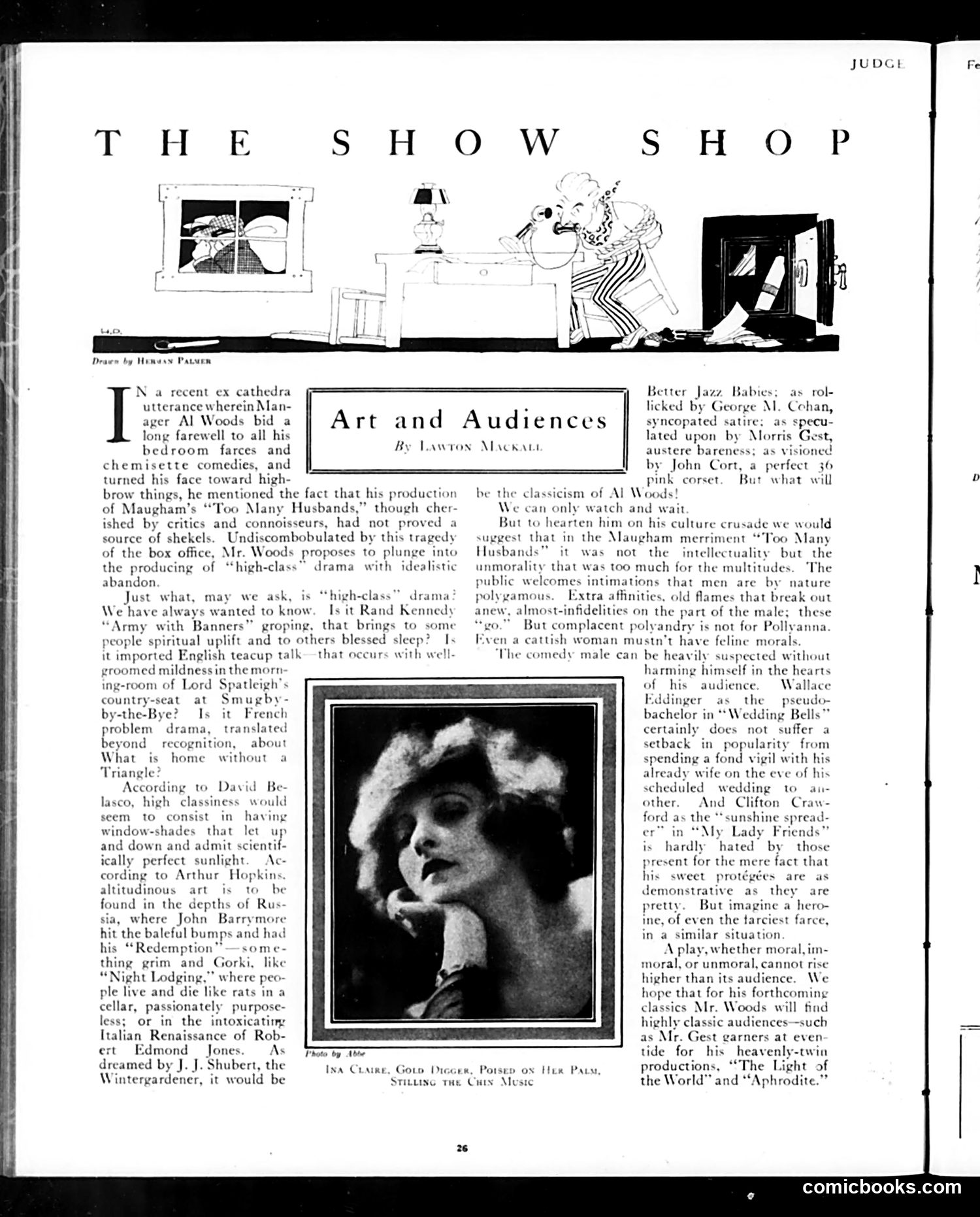
This is a satirical article about theater producer Al Woods's announced shift from comedies to "high-class" drama. The piece mocks the vagueness of what constitutes "highbrow" theater by listing various theatrical figures' definitions: David Belasco emphasizes lighting effects; Arthur Hopkins favors grim Russian plays; J.J. Shubert pursues Italian Renaissance aesthetics; and others champion different styles. The satire's core point: Woods's previous comedy "Too Many Husbands" failed financially not because it lacked sophistication, but because audiences found its plot (involving infidelity) too morally scandalous—yet those same audiences happily embrace similar themes in lighter farces. The article suggests Woods misunderstands his real problem and questions whether "high-class" drama can truly succeed with general audiences who prefer conventional morality. It's essentially mocking both pretentious artistic claims and the gap between public taste and critical standards.
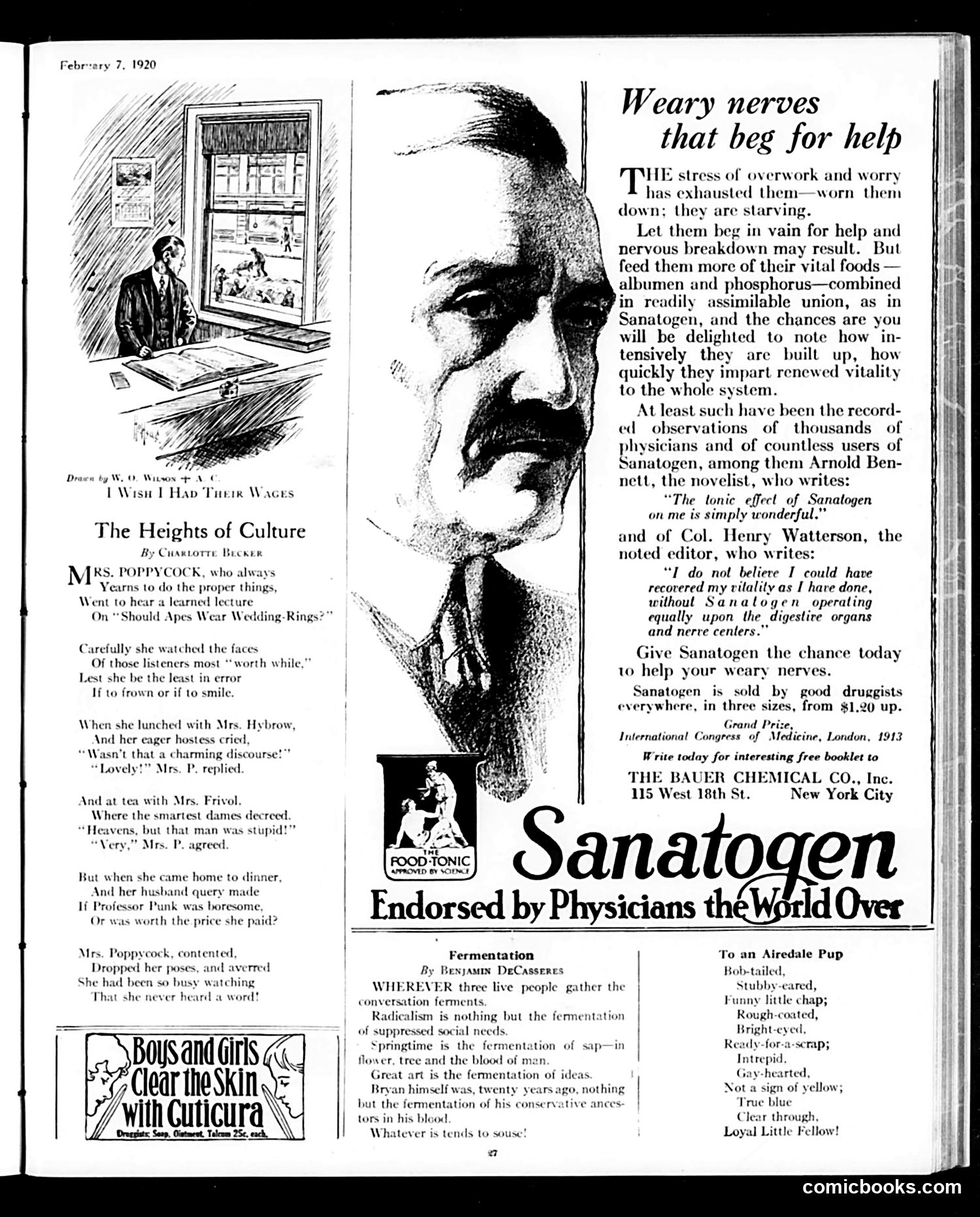
**The Cartoon:** This satirizes social pretension and performative culture. Mrs. Poppycock attends a lecture on "Should Apes Wear Wedding-Rings?" (absurdist topic suggesting intellectual emptiness). She carefully observes others' reactions to appear cultured, mimicking their opinions at lunch and tea—claiming the lecture was "charming" and "stupid" depending on her audience. Yet at home with her husband, she admits she never heard a word, revealing her social performance was entirely false. The joke: she's a vapid social climber masquerading as cultured. **The Advertisement:** The page's dominant content promotes Sanatogen, a patent medicine claiming to cure "weary nerves" and nervous exhaustion through added albumen and phosphorus. It cites endorsements from novelist Arnold Bennett and editor Henry Watterson. This reflects early-20th-century medical quackery—products marketed as cure-alls for vague conditions like "nerve exhaustion," targeting anxious middle-class consumers worried about overwork.
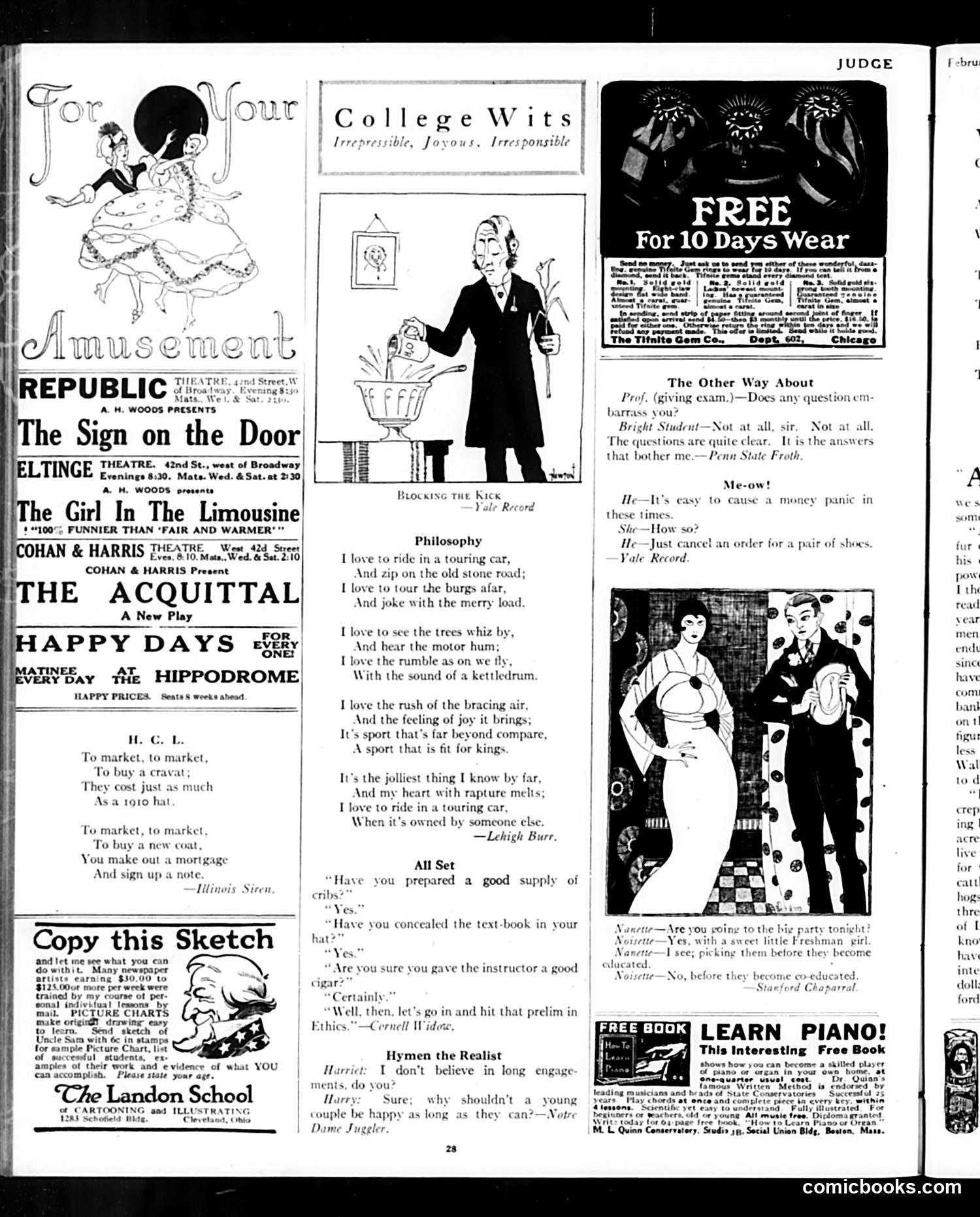
This page from *Judge* magazine contains primarily **advertisements and humorous filler content** rather than political cartoons. The main elements are: **Theater Advertisements**: Multiple Broadway theater listings (Republic, Eltinge) promoting plays like "The Sign on the Door" and "The Acquittal." **College Humor Sections**: Several brief joke items labeled "College Wits," including: - A poem about joy-riding in someone else's touring car (satirizing conspicuous consumption) - Exam-cheating jokes (students buying test answers/"cribs") - Light romantic humor about engagements and proposals **Educational Advertisement**: The Landon School solicits cartoon sketches from readers, offering instruction. **The humor reflects early 1920s concerns**: economic anxiety (the H.C.L. poem about rising costs for clothes), academic dishonesty, and leisurely automobile culture. The satire is gentle, aimed at college students and urban middle-class readers rather than political figures or movements. The page is characteristic of *Judge*'s light satirical approach to contemporary social life rather than hard political commentary.
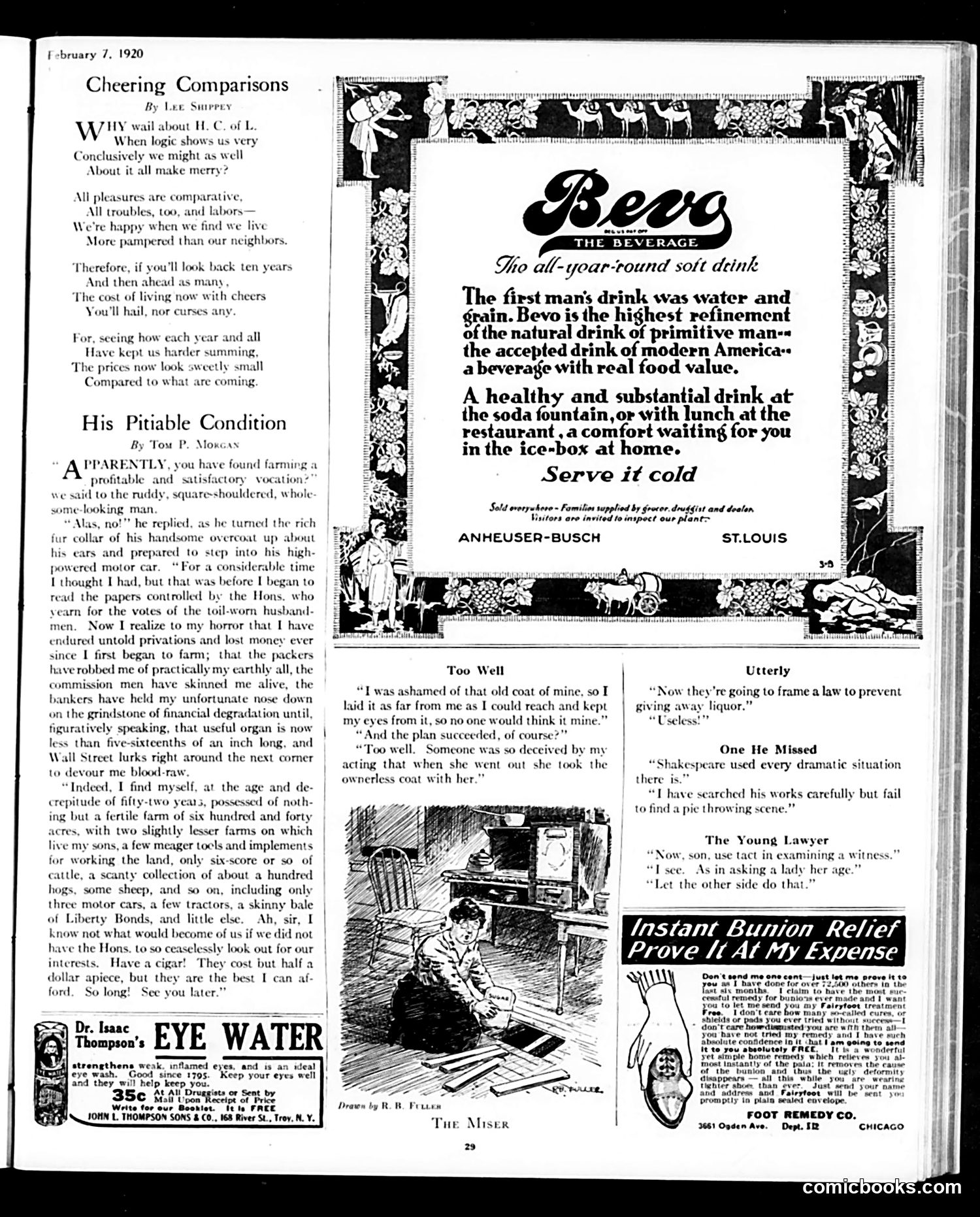
This Judge magazine page (February 7, 1920) contains satirical commentary on post-WWI American economic anxieties. **"His Pitiable Condition"** satirizes farmers' complaints about exploitation. A supposedly wealthy farmer—owning 640 acres, multiple farms, motor cars, tractors, and Liberty Bonds—claims poverty, blaming packers, commission men, bankers, and Wall Street for his "ruin." The joke targets Progressive Era rhetoric: the farmer appears objectively prosperous yet has internalized populist grievances, likely amplified by newspapers controlled by politicians seeking rural votes. The satire suggests farmers' complaints are exaggerated or self-delusional. **"Cheering Comparisons"** argues cost-of-living increases (a major 1920 concern) shouldn't distress people—prices will rise further anyway, making current costs seem cheap retrospectively. This darkly comic "silver lining" reflects post-war inflation anxiety. The page also includes advertisements for Bevo (Anheuser-Busch's non-alcoholic drink, sold during Prohibition) and Dr. Thompson's Eye Water, typical period ads.
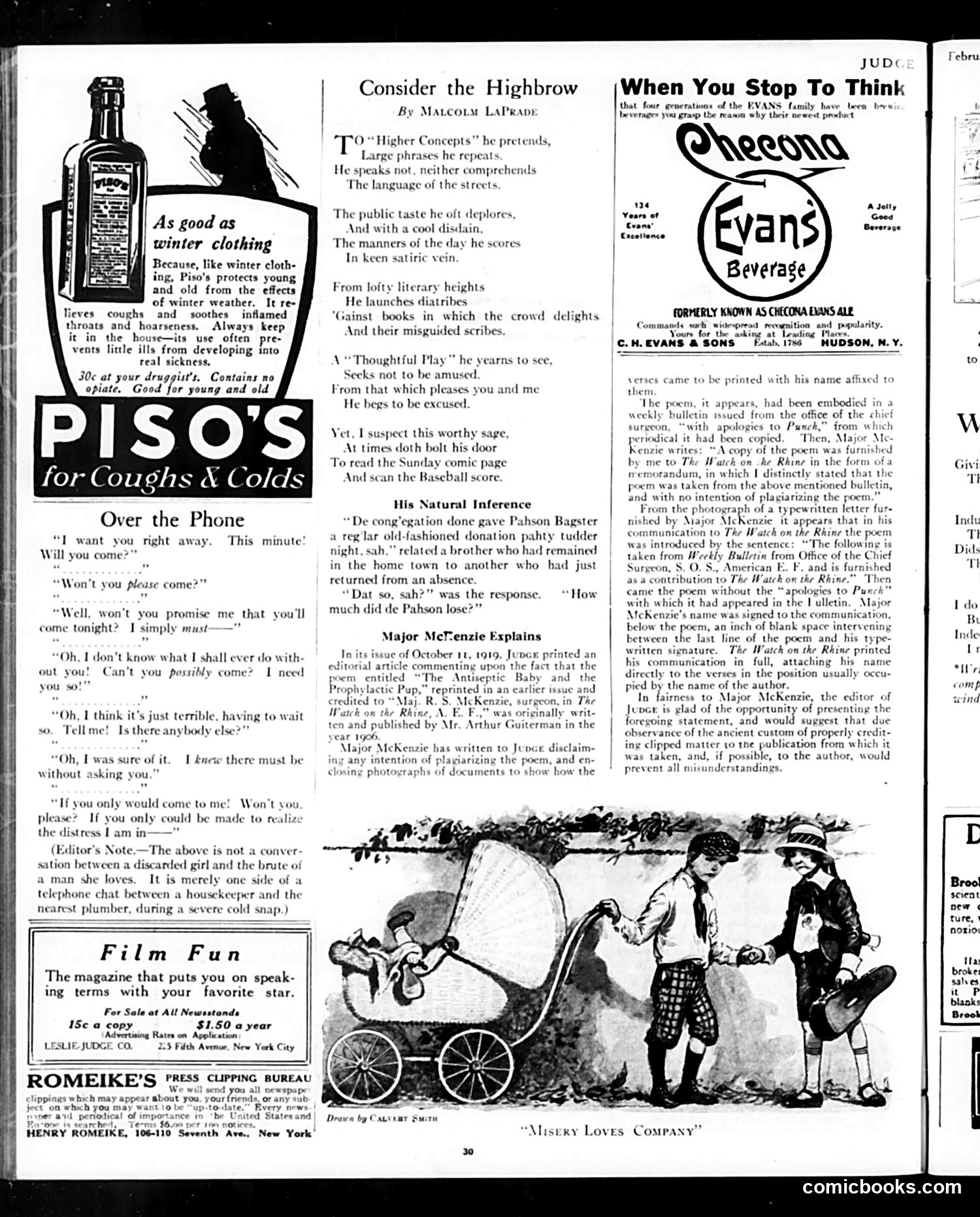
This page is primarily **advertisements and filler content** rather than political satire. The notable items: **"Consider the Highbrow"** (poem by Malcolm LaFrade): A satirical critique of pretentious intellectuals who affect superiority—scorning popular entertainment and public taste while using grandiose language. The joke's punchline: these snobs secretly read Sunday comic pages and baseball scores when alone. This reflects 1920s-era tensions between "highbrow" and "lowbrow" culture. **"Over the Phone"**: A humorous domestic scene where a housekeeper frantically pleads with a plumber during a cold snap, using desperate romantic language. The editor's note reveals the joke—readers might assume it's romantic drama, but it's merely about needing emergency plumbing repair. **Product Advertisements**: Piso's cough remedy and Cheroona Evans Beverage dominate the page visually. **Editorial Note**: Addresses a poetry attribution dispute from 1919, clarifying that "The Antiseptic Baby and the Prophylactic Pup" wasn't plagiarized but properly credited in its original source. The page lacks cohesive political commentary—it's typical Judge filler mixing ads with light humor.
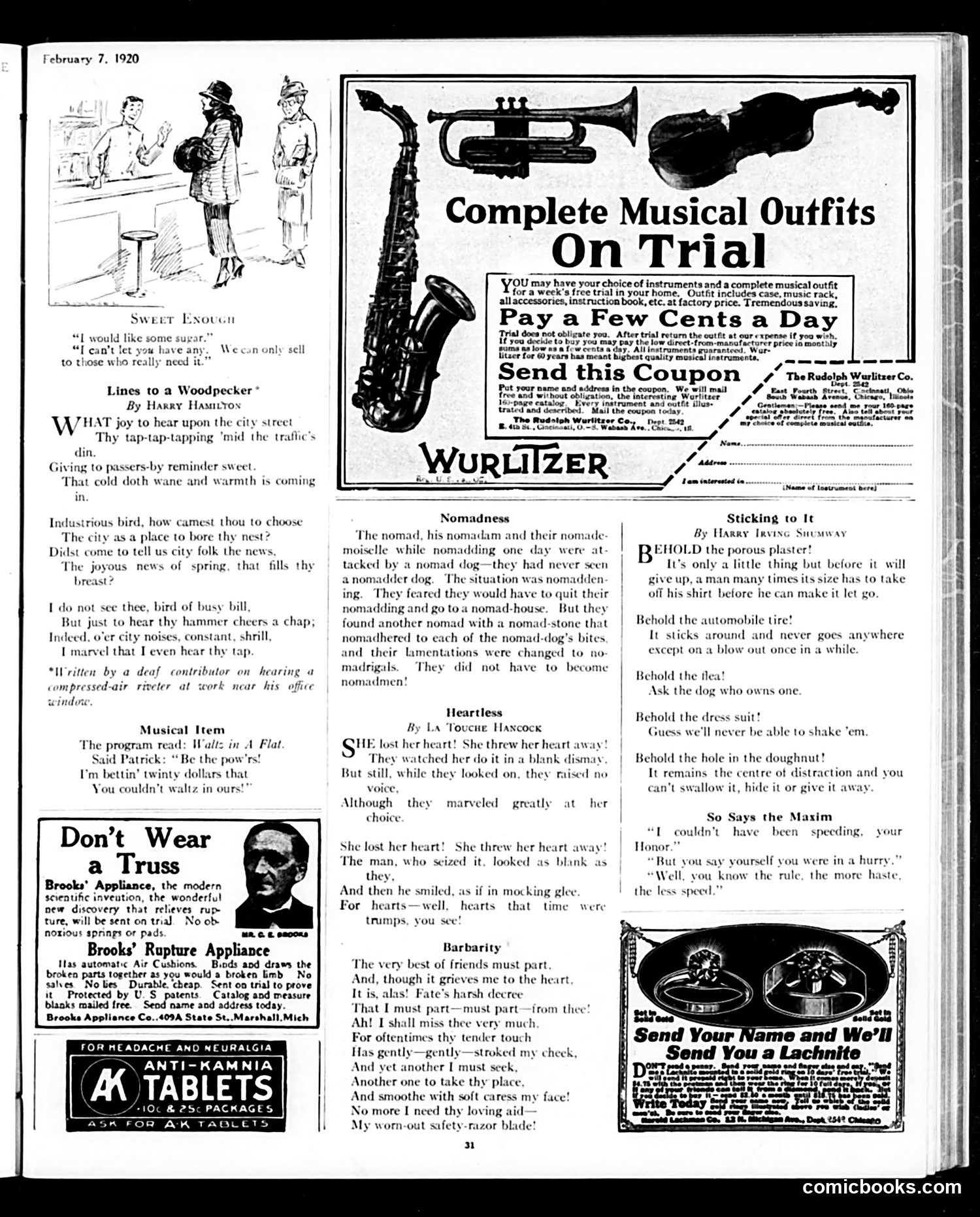
This page is primarily **advertising and light humor** rather than political satire. Key content: **The Main Cartoon ("Sweet Enough")**: A shopkeeper refuses sugar to a customer, claiming he can "only sell to those who really need it." This reflects **wartime rationing policies** (likely Prohibition-era sugar controls), satirizing bureaucratic restrictions on everyday goods. **"Lines to a Woodpecker"**: A humorous poem attributed to "a deaf contributor" jokes that he hears a woodpecker's pecking as a city sound—actually describing a riveter. The satire is gentle, poking fun at urban noise and ironic misidentification. **Other Content**: Mostly advertisements (musical instruments, rupture appliances, headache tablets) interspersed with lightweight poetry about lost love and friendship—typical Judge filler material. **No identifiable political figures or caricatures appear.** The page reflects 1920s consumer culture and wartime/immediate postwar concerns about rationing rather than partisan politics.
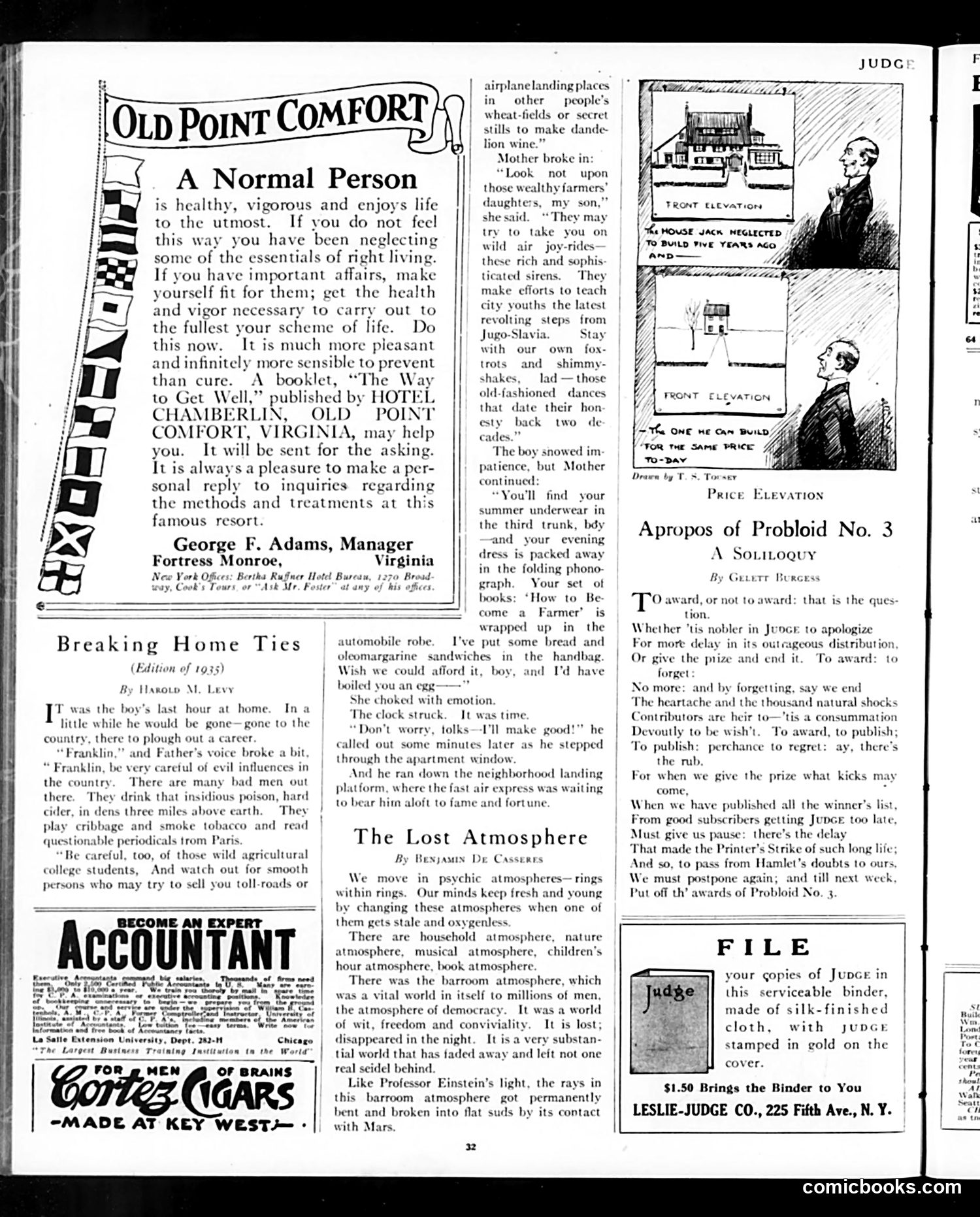
**Main Cartoon: "Breaking Home Ties"** This sentimental piece depicts a farm boy's last hour before leaving home to attend agricultural college. The humor is gentle—his anxious parents fret over city corruption (hard cider, evil influences, smooth con artists selling toll roads), while his mother reminds him to wear proper underwear and pack his formal clothes. He exits comically through the apartment window rather than the door, suggesting youthful impulsiveness. The cartoon satirizes both parental anxiety about sending sons to college and the clash between rural conservatism and urban sophistication in 1935 America. **"Price Elevation" Architectural Comic** A man displays house designs showing only the front elevation, claiming each can be built "for the same price to you." The satire targets contractor fraud—selling plans that look impressive from one angle while hiding poor construction elsewhere. **"The Lost Atmosphere"** This essay laments Prohibition's elimination of the barroom as a democratic social space, using pseudo-intellectual language comparing the atmosphere to Einstein's light bent by Mars. It's nostalgic commentary on 1920s alcohol ban consequences.
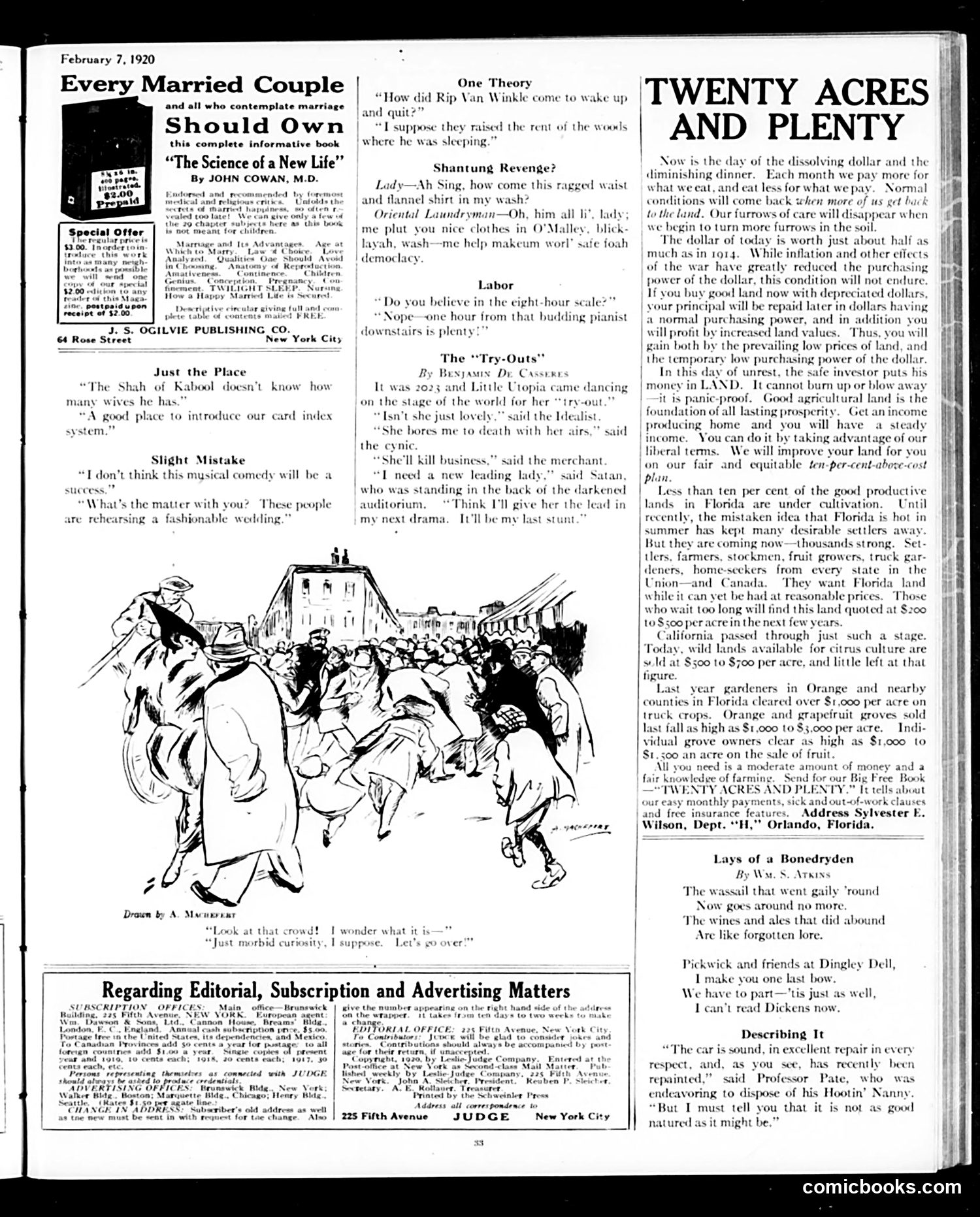
The main cartoon depicts a crowded street scene with people in chaotic motion around a building. The caption reads: "Look at that crowd! I wonder what it is—" / "Just morbid curiosity, I suppose. Let's go over." **Context:** This appears to satirize post-WWI American curiosity-seeking behavior, possibly referencing public gatherings around scandals, accidents, or sensational events that drew gawking crowds. The cartoon mocks the mindless mob mentality of people who stop to gape at disturbances without understanding what they're witnessing. The page also contains brief comedic vignettes poking fun at domestic life and entertainment, including a joke about a "budding pianist" disturbing neighbors and a theatrical producer seeking new actresses. The dominant content, however, is advertising for Florida real estate ("Twenty Acres and Plenty"), promoting agricultural investment during the 1920s land boom—a major economic phenomenon of that era.
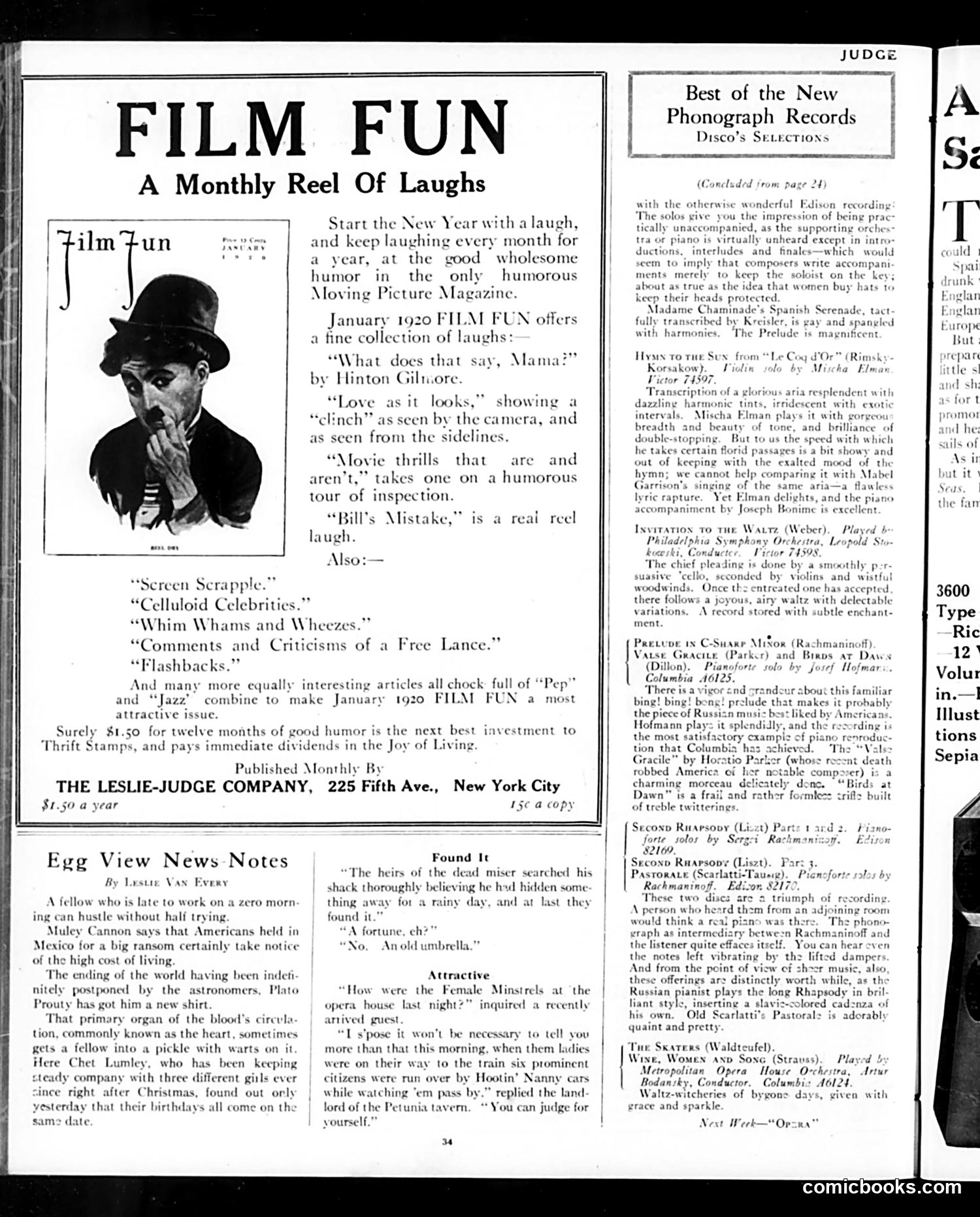
This page from Judge (January 1920) primarily advertises **Film Fun**, a new monthly humor magazine focused on silent movies. The main illustration shows a caricatured woman in a hat—likely representing the "average moviegoer" or perhaps a specific comedic character type common in 1920s cinema. The satire targets **early cinema itself**: the featured articles mock movie conventions ("Movie thrills that are and aren't," "Love as it looks") by documenting the gap between what appears dramatic on screen versus reality. This reflects 1920s skepticism about film's artificial nature. The page also includes "Egg View News Notes"—humorous short anecdotes about everyday life—and phonograph record reviews, typical Judge content of the era. **The broader point**: Positioning Film Fun as offering "wholesome humor" contrasts with Judge's own satirical approach, suggesting the magazine appeals to mass audiences seeking light entertainment rather than social commentary. The $1.50 annual subscription price was marketed as a smart investment in "the joy of living."
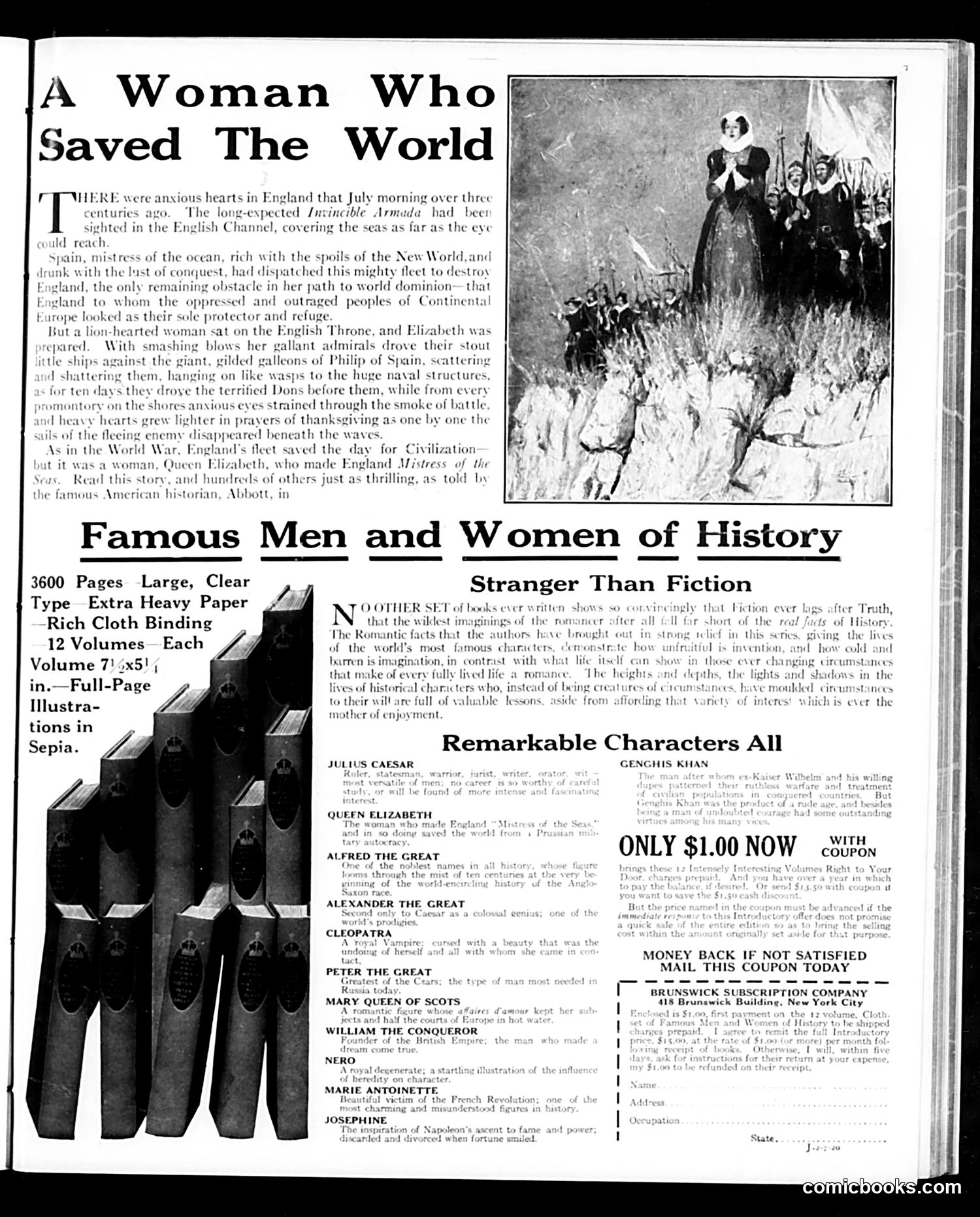
This page is primarily a book advertisement disguised as historical content. The main article celebrates **Queen Elizabeth I** defeating the Spanish Armada (1588), portraying her as England's savior during a crucial moment when Spain threatened English dominance. The text frames Elizabeth as a decisive leader whose "lion-hearted" qualities and naval strategy protected "Civilization" itself—a common historical narrative that inflates Elizabeth's personal role in a victory achieved largely by her admirals and favorable weather. The advertisement promotes a 12-volume encyclopedia titled *Famous Men and Women of History*, claiming it offers thrilling true stories "stranger than fiction." It lists historical figures (Julius Caesar, Cleopatra, Genghis Khan, etc.) to suggest comprehensive coverage. **Context for modern readers:** This appears designed for early 20th-century American audiences who valued both patriotic historical narratives and self-improvement through reading. The "only $1.00" coupon offer was a common direct-mail sales tactic of the era. The page conflates journalism with advertising—not unusual for Judge magazine, which relied on such hybrid content.

This is **a Murad cigarette advertisement**, not political satire. The page displays several large tobacco leaves grown near the Black Sea alongside a Murad cigarette package. The text emphasizes that these Turkish leaves are used to make Murad cigarettes, marketed as "high grade" and featuring "exceptional blending." The price shown is 20 cents. This represents early 20th-century tobacco advertising that highlighted product sourcing and ingredient quality—common marketing strategies before health concerns about cigarettes became widely publicized. The elaborate presentation of raw materials was meant to suggest premium craftsmanship and authenticity, appealing to consumers' desire for quality goods.