
Judge, 1920-02-07 · page 7 of 36
Judge — February 7, 1920 — page 7: what you’re looking at
What you’re looking at
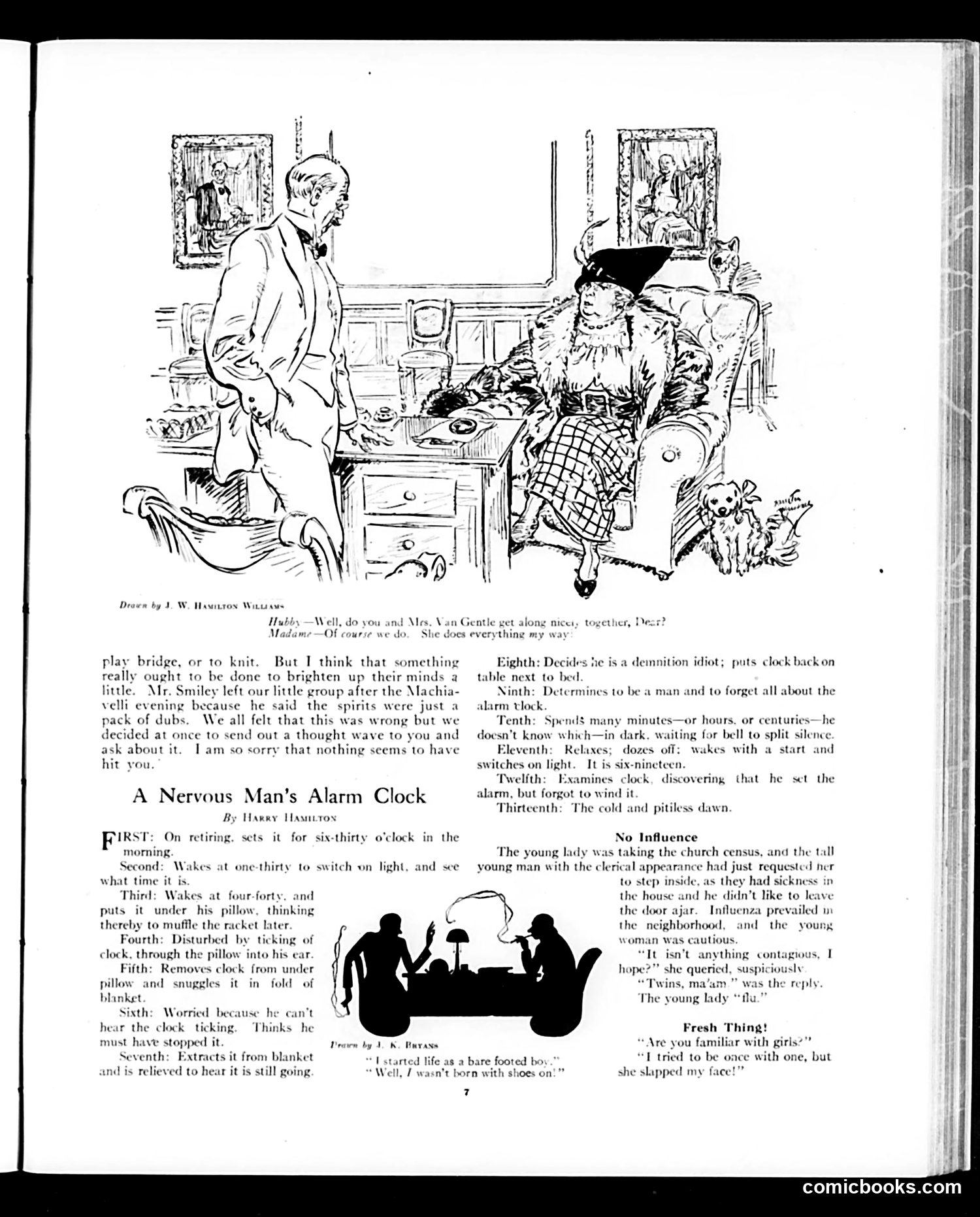
This page contains two main humorous pieces: **"A Nervous Man's Alarm Clock"** satirizes the anxious, overthinking modern man. The narrative follows thirteen steps of neurotic behavior: a man sets his alarm for 6:30 AM, then repeatedly wakes, moves the clock, worries whether it's working, second-guesses himself, and ultimately discovers he forgot to wind it. The humor targets the absurdity of self-sabotage and anxiety—the protagonist's own mental habits prevent the simple task of waking up. This reflects early-20th-century anxieties about modernity and nervousness. **The cartoon dialogue** mocks henpecked husbands and female dominance in marriage. The wife announces she "does everything my way," suggesting emasculation through domestic control. **"No Influence" and "Fresh Thing!"** are brief joke vignettes about romantic awkwardness and miscommunication—the young woman misinterprets "twins" as "influenza," and a young man gets slapped for presuming familiarity with a girl. The overall tone reflects Judge's typical satirical treatment of contemporary anxieties, gender dynamics, and social awkwardness in early-20th-century America.
📄 Transcribed text from this page (OCR, searchable)
Machine-transcribed from the original scan — historical spelling and the odd misread are preserved.
Well, do you and Mes. Van Gentle get alo: Cet, She does everything my way Of course we do play bridge, or to knit. But I think that something really ought to be done to brighten up their minds a little. Mr. Smiley left our little group after the Machia- velli evening because he said the spirits were just a pack of dubs. We all felt that this was wrong but we decided at once to send out a thought wave to you and ask about it. [am so sorry that nothing seems to have hit you. A Nervous Man’s Alarm Clock By Hawry Hasitrox IRST: morning. Second: Wakes at one-thirty to switch on light, and see what time it is. Third: Wakes at r-forty, and puts it under his pillow, thinking thereby to muffle the racket later. Fourth: Disturbed by ticking of clock, through the pillow into his ear Fifth: Removes clock from under pillow and snuggles it in fold of blanket Sixth: Worried because he can’t hear the clock ticking. Thinks he must have stopped it Seventh: Extracts it from blanket On retiring. sets it for six-thirty o'clock in the Penven by J. K. Brass rted life as a bare footed boy. together, Desr? Eighth: Dee he is a demnition idiot; puts clock back on table next to bed. Ninth: Determines to be a man and to forget all about the alarm vlock. Tenth: Spends many minutes—or hours. or centuries—he doesn’t know which—in dark. waiting for bell to split silence Eleventh: Relaxes; dozes off; wakes with a start and switches on light. It is six-nineteen Twelfth: Examines clock, discovering that he set the alarm, but forgot to wind it Thirteenth: The cold and pitiless dawn. No Influence The young lady was taking the church census, and the tall young man with the clerical appearance had just requested her to step inside, as they had sickness in the house and he didn’t like to leave the door ajar. Influenza prevailed the neighborhood, and the youny woman was cautious. “It isn’t anything contagious, 1 hope?” she que! suspiciously “Twins, ma’s was the reply. The young lady “flu.” Fresh Thing! “Are you familiar with girls?" “TL tried to be once with one, but and is relieved to hear it is still going. |, | wasn't born with shoes on!” 7 she slapped my face! comicbooks.com