
Judge, 1920-02-07 · page 30 of 36
Judge — February 7, 1920 — page 30: what you’re looking at
What you’re looking at
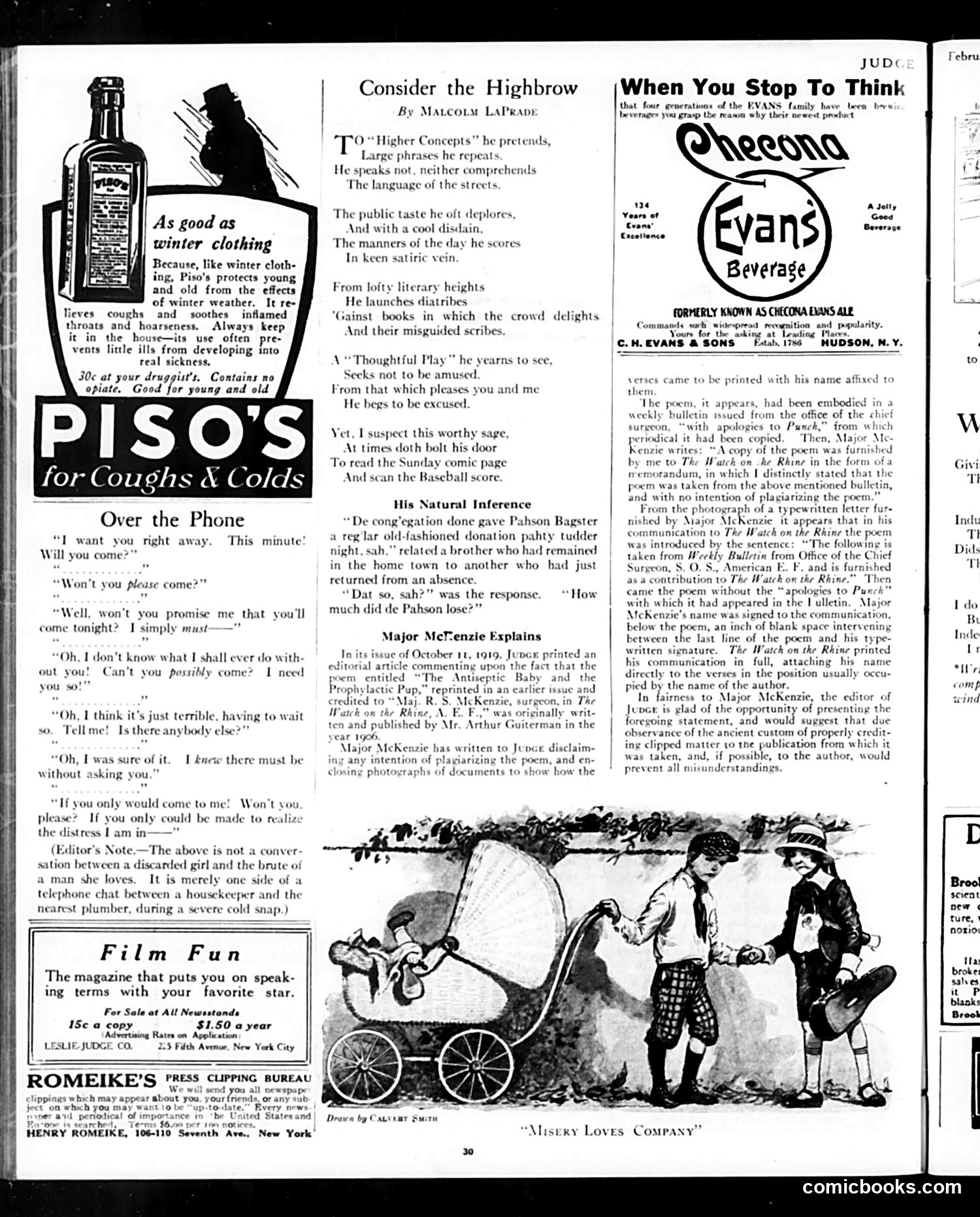
This page is primarily **advertisements and filler content** rather than political satire. The notable items: **"Consider the Highbrow"** (poem by Malcolm LaFrade): A satirical critique of pretentious intellectuals who affect superiority—scorning popular entertainment and public taste while using grandiose language. The joke's punchline: these snobs secretly read Sunday comic pages and baseball scores when alone. This reflects 1920s-era tensions between "highbrow" and "lowbrow" culture. **"Over the Phone"**: A humorous domestic scene where a housekeeper frantically pleads with a plumber during a cold snap, using desperate romantic language. The editor's note reveals the joke—readers might assume it's romantic drama, but it's merely about needing emergency plumbing repair. **Product Advertisements**: Piso's cough remedy and Cheroona Evans Beverage dominate the page visually. **Editorial Note**: Addresses a poetry attribution dispute from 1919, clarifying that "The Antiseptic Baby and the Prophylactic Pup" wasn't plagiarized but properly credited in its original source. The page lacks cohesive political commentary—it's typical Judge filler mixing ads with light humor.
📄 Transcribed text from this page (OCR, searchable)
Machine-transcribed from the original scan — historical spelling and the odd misread are preserved.
As good as winter clothing Because, like winter cloth- ing, Piso's protects young and old from the effects ; of winter weather, It re- lieves coughs and soothes inflamed throats and hoarseness. Always keep it in the house—its use often pre- vents little ills from developing into real sickness. 30¢ at your druggist’s, Contains no opiate. Good for young and old PISO’S for Coughs & Colds 7 Over the Phone “T want you right away. Will you come?” This minute! “Won't you please come?” Well, won't you promise me that you'll come tonight? I simply must——" “Oh, I don’t know what I shall ever do with- out you! Can't you possibly come? I need you so!" “Oh, I think it’s just terrible. having to wait so. Tellme! Is there anybody else?" “Oh, I was sure of it. I Anew there must be without asking you.” “If you only would come to me! Won't you please? If you only could be made to realiz the distress I am i - (Editor's Note.—The above is not a conver- sation between a discarded girl and the brute of a man she loves. It is merely one side of a telephone chat between a housekeeper and the hearest plumber, during a severe cold snap.) Film Fun The magazine that puts you on speak- ing terms with your favorite star. For Sale at All Newsstands 1Se a copy $1.50 a year wertising Rates on Application LESUE JUDGE" co. 2.5 Filth Avenue, New York City ROMEIKE'S PRESS CUPPING BUREAU 1 send you all car at out you. your frends o be “up-to-date.” By he U States and Consider the Highbrow By Marcoim LaPrave To: Higher Concepts” he pretends, Large phrases he repeats. He speaks not, neither comprehends The language of the streets. The public taste he oft deplores, And with a cool disdain, The manners of the day he scores In keen satiric vein. From lofty literary heights He launches diatribes ‘Gainst books in which the crowd delights And their misguided scribes. \ “Thoughtful Play’ he yearns to see, Seeks not to be amused. From that which pleases you and me He begs to be excused Yet, I suspect this worthy sage, At times doth bolt his door To read the Sunday comic page And scan the Baseball score. His Natural Inference “De cong’ n done gave Pahson Bagster a reg'lar old-fashioned donation pahty tudder night, sah,” related a brother who had remained in the home town to another who had just returned from an absence. “Dat so, sah?” was the response. “How much did de Pahson lose?"" Major McT-enzie Explains In its issue of October 11, 1919, Jupce printed an editorial article commenting upo fact that the poem entitled “The Antiseptic Baby and the | Prophylactic Pup,” reprinted in an earlier issue and credited to “Maj. R. S. McKenzie, surgeon, in The Rhine, \. E. F.,” was originally writ- an in the JUD¢ When You Stop To Think that four generations of the EVANS family have teen berw beverages you grasp the rasa why their newest product DHRENIA. Commas sok at Leading H.EVANS & SONS Hash, 1780 HUDSON, N. Y. and published by Mr. Arthur Guiter has written to Jupce disclaim- the poem, and en- how the Drawn by Causour Suu verses came to be printed with his name affixed to them. The poem, it appears, had been embodied in a weekly bulletin 1 from the office of the surgeon, “with apologies to Punch,” from which periodical it had been copied. Then, Major Me- Kenzie writes: “A copy of the poem was furnished by me to The Watch on -he Rhine in the form ofa wer dum, in which I distinctly stated that the poem was taken from the above mentioned bulletin, and with no intention of plagiarizing the poem.” From the p aph of a typewritten letter fur- nished by Major \ cKensie appears that in his nication to The Watch on the Rhine the poem was introduced by the sentence: “The following is taken from Weekly Bulletin from Office of the Chief Surgeon, S. O. : and is furnished as a contribution The We Rhine.” Then came the poem without th slogies to Punch” with which it had appeared in the L ulletin. Major Mckenzie’s name was signed to the communication, below the poem, an inch of blank space intervening between the last line of the poem and his type- written signature. The Watch on the Rhine printed his communication in full, attaching his name directly to the verses in the position usually occu- pied by the name of the author. In fairness to Major McKen: Juvce is glad of the opportunity of presenting th foregoing statement, and would suggest that due observance of the ancient custom of properly credit- ing clipped matter to the publication from which it was taken, and, if possible, to the author, would prevent all misunderstandings. Febru Ido Be Inde Ir “Wr. comt wind norio Mas broke: salves it comicbooks.com