
A complete issue · 36 pages · 1920
Judge — January 3, 1920
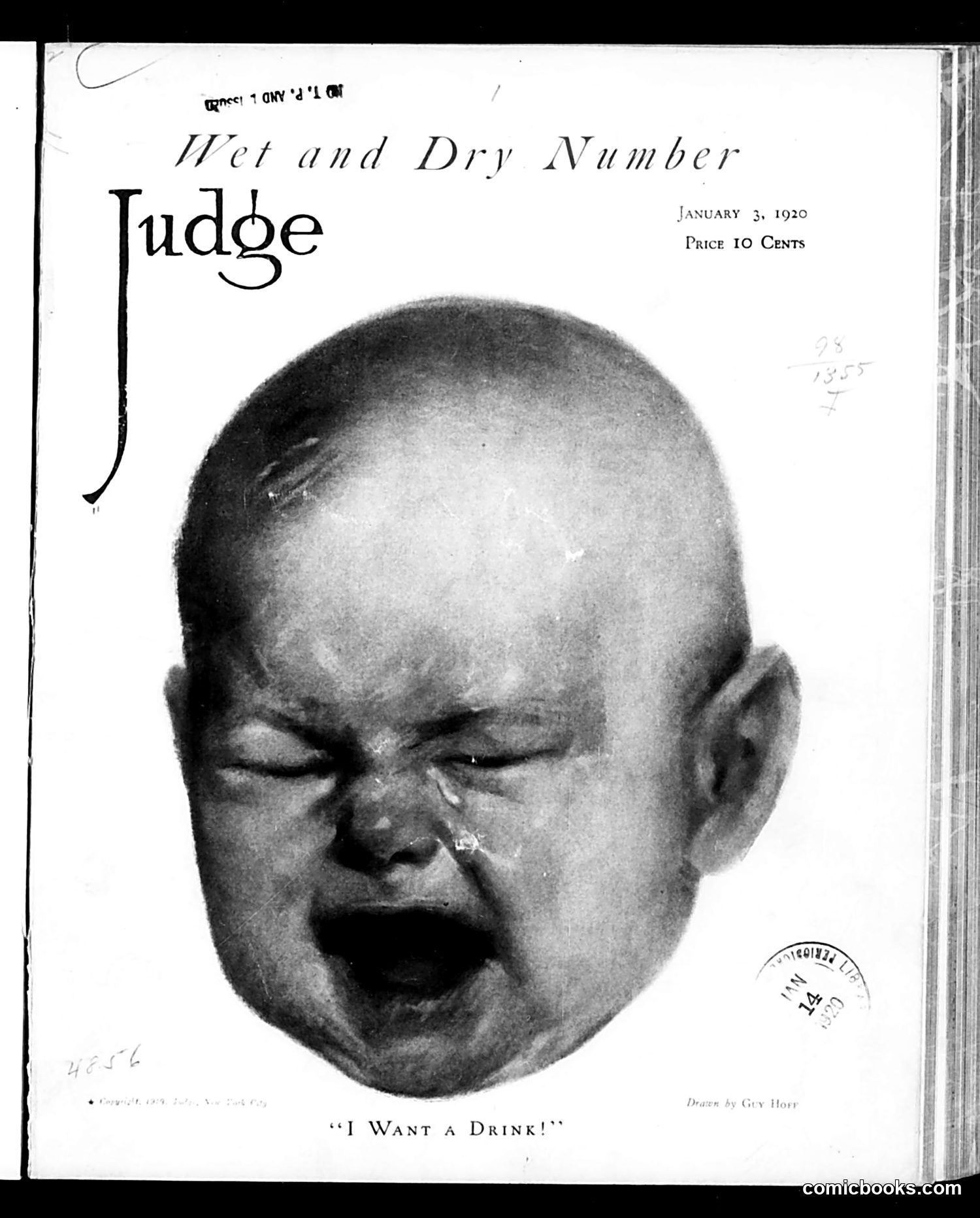
This cartoon comments on Prohibition, which took effect January 17, 1920—just two weeks after this issue's publication date. The distressed infant's expression and plea represent American consumers facing the imminent ban on alcohol sales. The baby symbolizes the nation's desire for alcoholic beverages, depicted as a helpless dependent suddenly denied access to what it wants. The satire mocks both the coming law and citizens' anticipated suffering under it. Judge magazine, known for its political satire, presented this as dark humor about Prohibition's unpopularity among segments of the American public. The "wet" perspective (opposing Prohibition) is evident in the sympathetic portrayal of the denied desire.
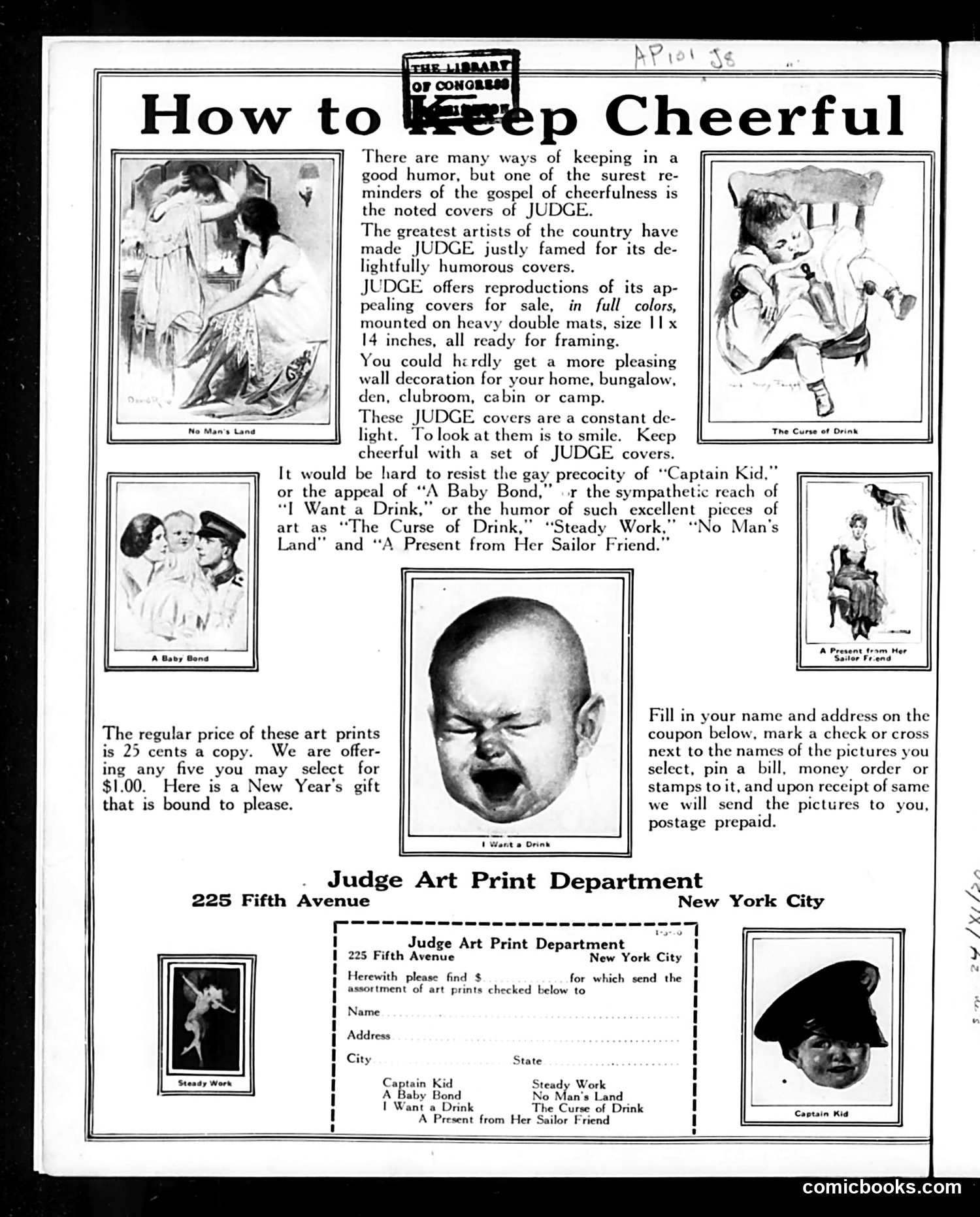
This page is primarily **advertising**, not political satire. It promotes Judge magazine's art prints through the "Judge Art Print Department." The advertisement emphasizes that Judge's covers—created by "the greatest artists of the country"—are available as affordable reproductions (five prints for $1.00). The images shown ("Captain Kid," "A Baby Bond," "No Man's Land," "Steady Work," "I Want a Drink," "The Curse of Drink," "A Present from Her Sailor Friend") appear to be humorous domestic and social scenes typical of Judge's satirical style, though their specific jokes are unclear without fuller context. The appeal targets middle-class readers seeking "pleasing wall decoration" for homes and gathering spaces. The coupon at bottom invites purchase orders from readers.
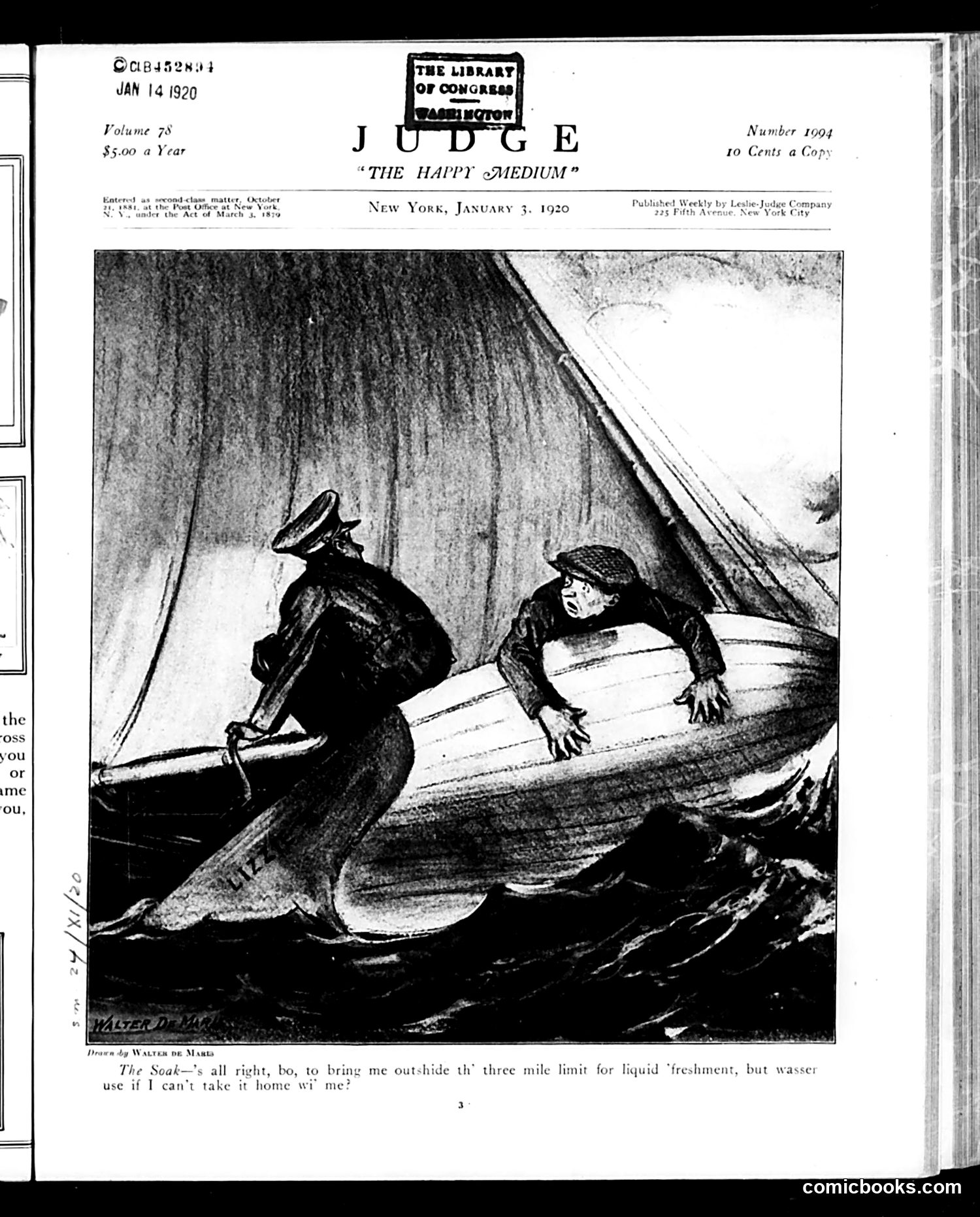
This cartoon by Walter de Maris depicts two men in a small boat. The figure on the left appears to be a sailor or boatman, while the one on the right seems to be a passenger or official. The caption references bringing someone "outside th' three mile limit for liquid 'freshment'" and whether "wasser" can be used as a substitute. This is clearly satirizing **Prohibition**, which became law on January 17, 1920—just two weeks after this publication date. The "three mile limit" refers to international waters where alcohol remained legal. The joke mocks the impending alcohol ban by suggesting seawater as a drinking alternative, ridiculing both the law's imminent implementation and those seeking workarounds to obtain liquor.
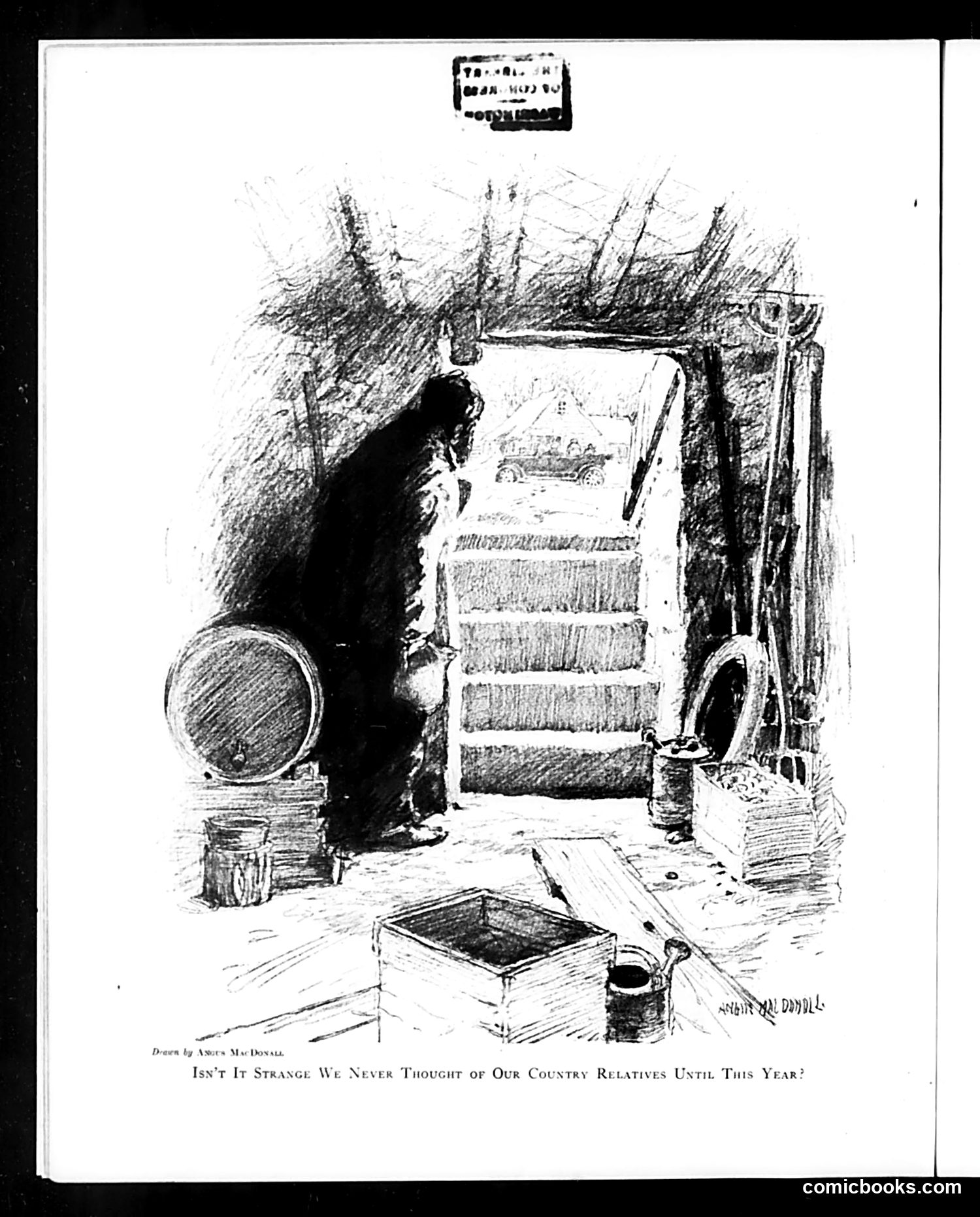
This political cartoon by Artist MacDowel depicts a rural farmer examining what appears to be a photograph or illustration of an automobile—a striking contrast between agricultural tradition and modern industrial technology. The caption reads: "Isn't It Strange We Never Thought of Our Country Relatives Until This Year?" The satire appears to address urban-rural disconnect during a specific historical moment (likely early 1900s based on the automobile reference). The joke suggests that city dwellers suddenly "discovered" their country relatives, possibly due to rural tourism becoming fashionable or a particular social trend making rural life newly interesting to urbanites. The crude barn setting emphasizes the satirical point about class and cultural differences between urban sophistication and rural simplicity.
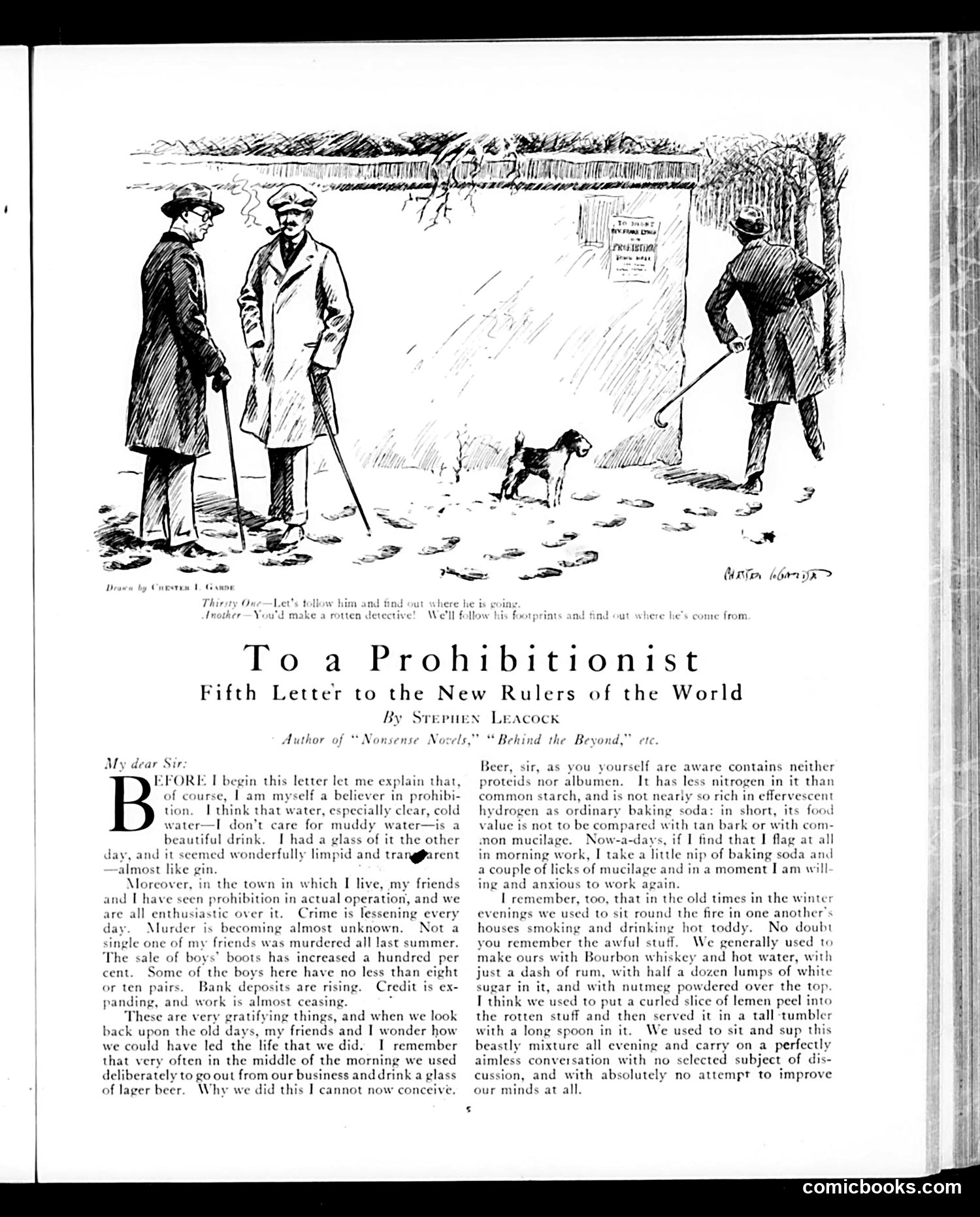
This is a satirical illustration paired with Stephen Leacock's essay "To a Prohibitionist." The cartoon depicts three well-dressed men and a small dog examining footprints in snow or ground, with one man saying they should "follow his footprints and find out where he is going." The satire targets **Prohibition enforcement**—the effort to track and arrest alcohol violators. The cartoon mocks the absurdity of prohibition detective work, suggesting the authorities' methods are comically inadequate. Leacock's accompanying essay argues **against Prohibition**, contrasting the social benefits of alcohol (beer, whisky, rum drinks) in pre-Prohibition times with Prohibition's effects: rising crime, increased arrests, and prohibition's failure to actually stop drinking. He portrays alcohol consumption as harmless compared to the social chaos Prohibition created.
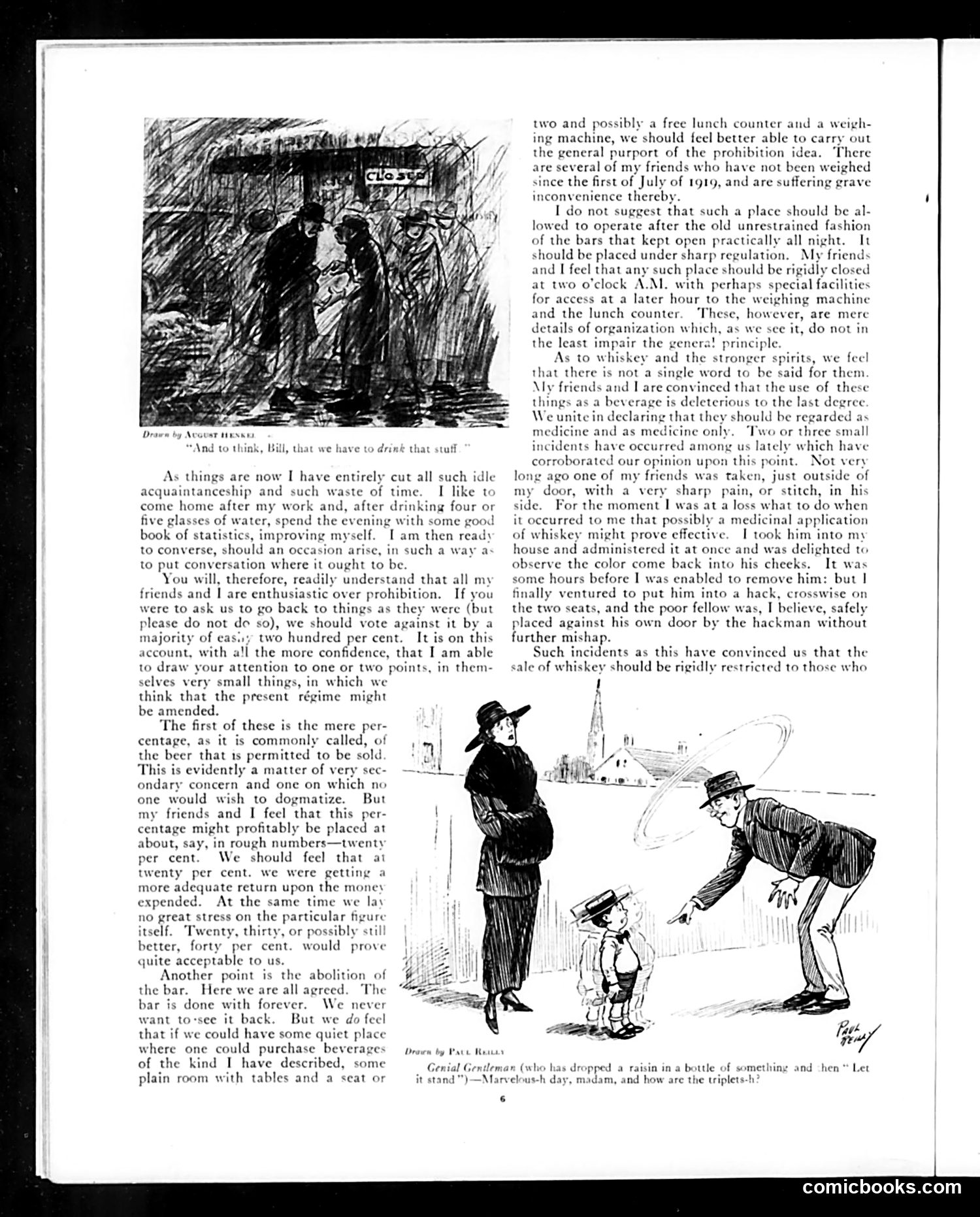
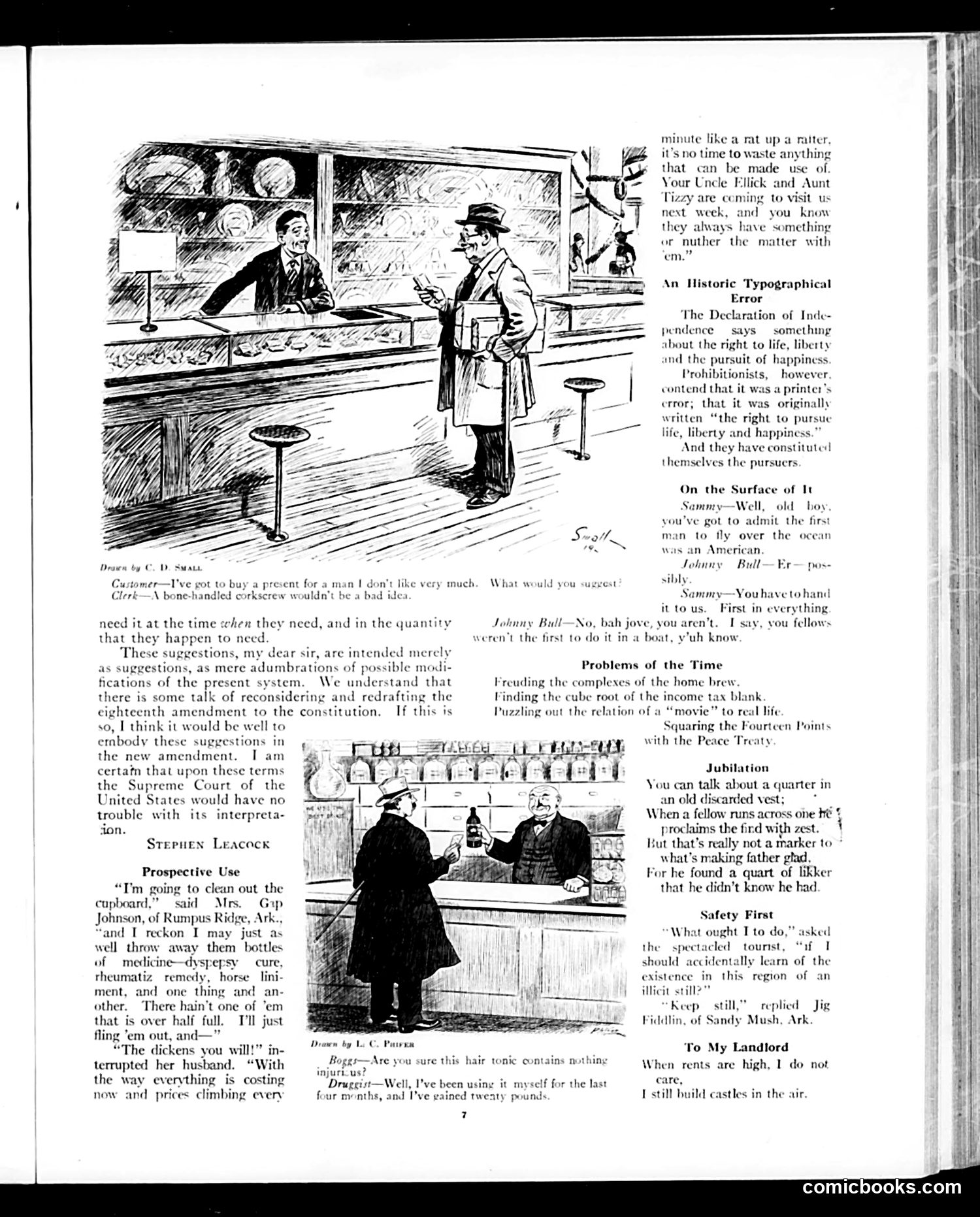
This page contains multiple satirical pieces reflecting 1920s America, primarily focused on **Prohibition** (the constitutional ban on alcohol, 1920-1933). **Top cartoon**: A clerk suggests a bone-handled corkscrew as a gift for an unlikeable man—satirizing how Prohibition made corkscrews suddenly "useful" since people still needed them for hidden alcohol stockpiles. **"Historic Typographical Error"**: Mocks Prohibitionists by claiming the Declaration of Independence originally said "pursue life, liberty and happiness" but was misprinted as "right to life, liberty and the pursuit of happiness"—suggesting Prohibitionists are now literally "pursuing" happiness through enforcement. **"Jubilation" and other sections**: Celebrate finding hidden alcohol ("a quart of likker"), humorously treating Prohibition violations as victories. **"Safety First"**: A tourist asks about illegal stills; locals advise silence—reflecting widespread public tolerance of bootlegging despite legal prohibition. The overall message: Judge satirizes how deeply Prohibition had failed, with ordinary Americans openly flouting the law while authorities largely looked the other way.
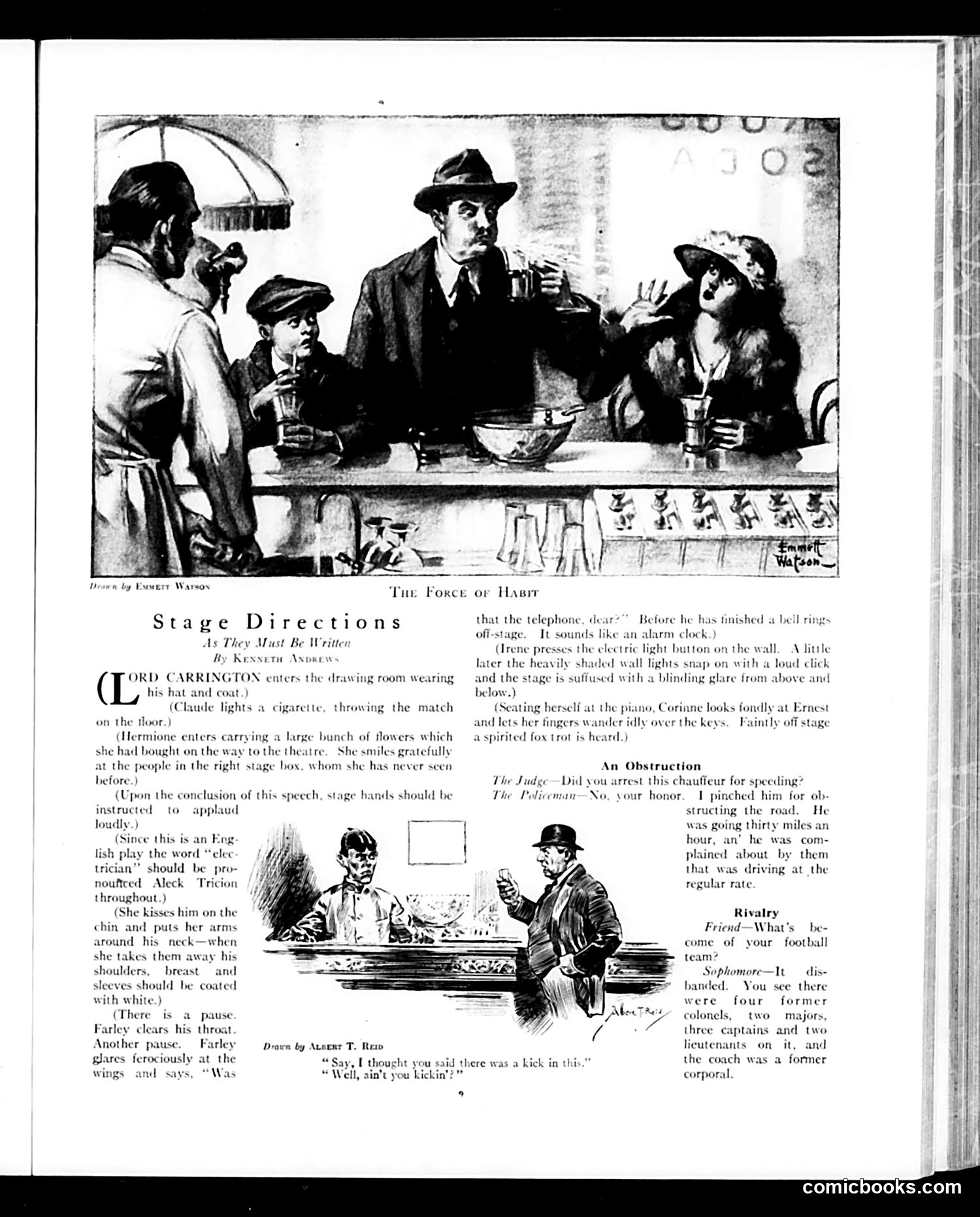
This page from *Judge* magazine contains theatrical satire and brief humor pieces. **"Stage Directions As They Must Be Written"** mocks overwrought, overly-detailed stage directions in contemporary plays. Kenneth Andrew parodies the absurd specificity playwrights demanded—from how actors should clear their throats to precise lighting cues to how white powder should coat an actor's shoulders after an embrace. The humor targets the pretension and impracticality of detailed theatrical instructions. **"An Obstruction"** is a brief joke about a policeman who arrests a speeding chauffeur not for speeding, but for "obstructing the road" because he was driving slower than the legal rate—inverting expectations about traffic enforcement. **"Rivalry"** jokes about a college football team disbanded because it was overstaffed with former military officers of various ranks, with only a former corporal as coach—satirizing the absurdity of military hierarchy interfering with athletics. All pieces use wordplay and situational humor typical of early 20th-century American comic magazines.
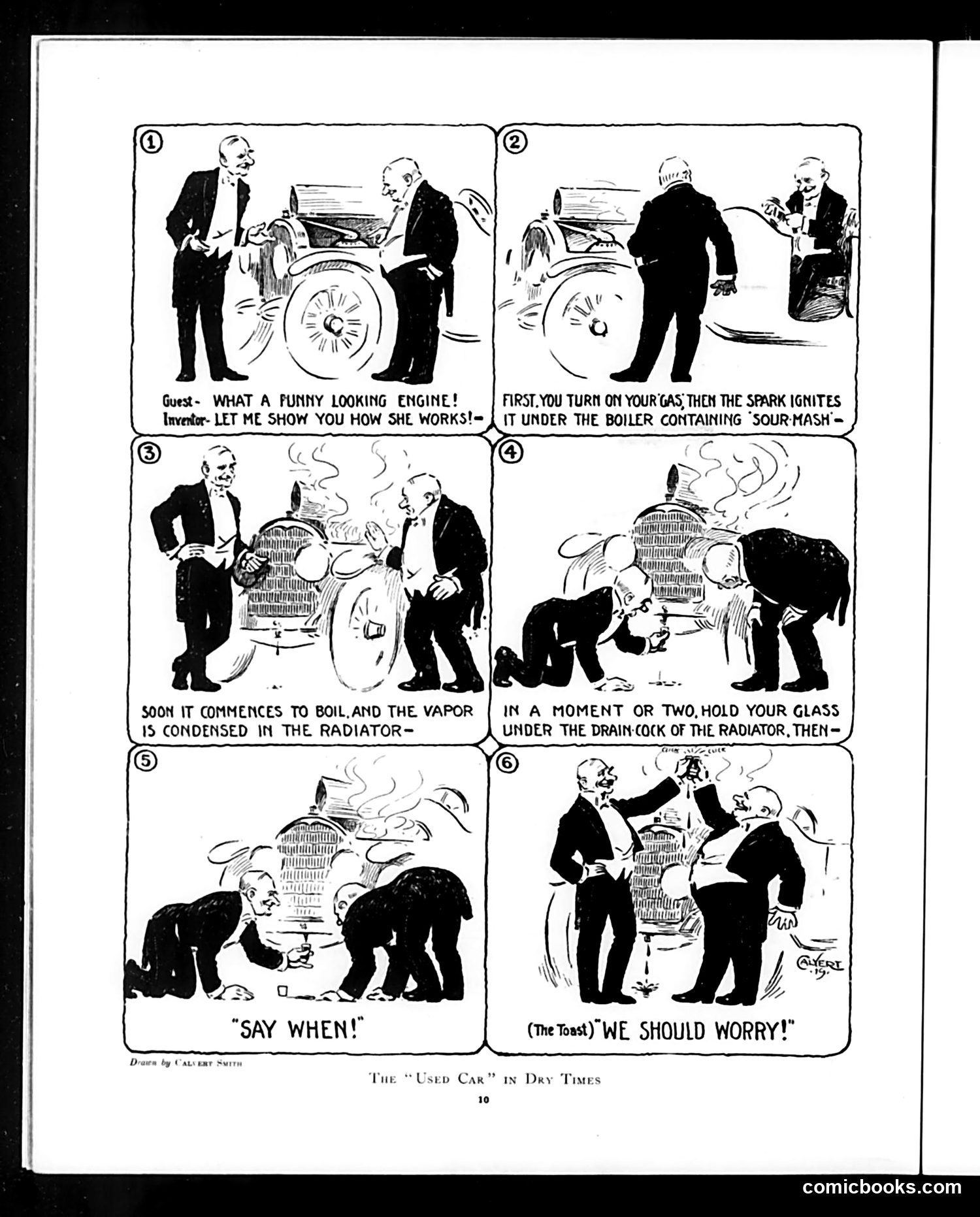
This satirical comic mocks Prohibition-era car sales tactics. An inventor "demonstrates" a used automobile to a guest by describing its mechanical operation, but the joke is that the radiator actually produces alcohol ("sour mash"—moonshine). The car becomes a cover for illegal liquor production and distribution. The six-panel sequence shows the con: gas ignites, the boiler heats, vapor condenses in the radiator, and finally liquid is collected in a glass from the drain cock. The punchline—"We should worry!"—suggests car dealers profited enormously during Prohibition (1920-1933) by selling vehicles ostensibly for transportation while actually marketing them as portable stills. The satire targets both Prohibition's absurdity and the widespread illegal alcohol manufacturing and sales that flourished during the "dry times."
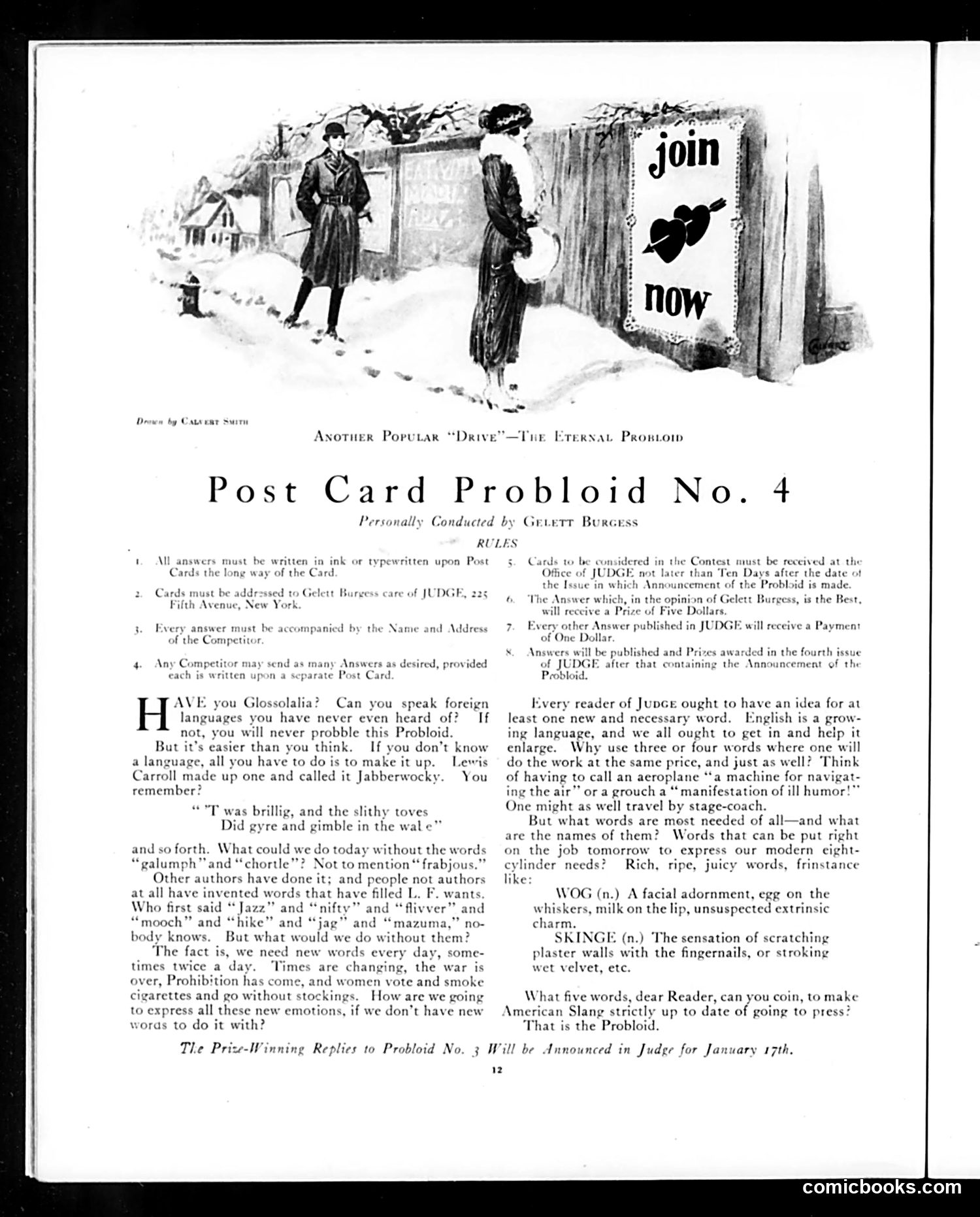
This page announces a reader-participation contest asking Americans to invent new slang words. The cartoon shows two women encountering a recruitment poster ("join now" with a heart symbol), satirizing how "drives" and recruitment campaigns had become ubiquitous—here absurdly applied to vocabulary creation. The contest premise: English needs fresh words to match modern life. The text references post-WWI changes (women voting, smoking, Prohibition) and invokes Lewis Carroll's "Jabberwocky" as precedent for neologisms. Readers are challenged to coin five new words, with examples provided: "WOG" (facial blemish) and "SKINGE" (scratching sensation). The satire gently mocks how Americans eagerly participate in "drives" for everything, here extended to linguistic innovation. Winners receive prize money, with results announced in Judge's January 17th issue.
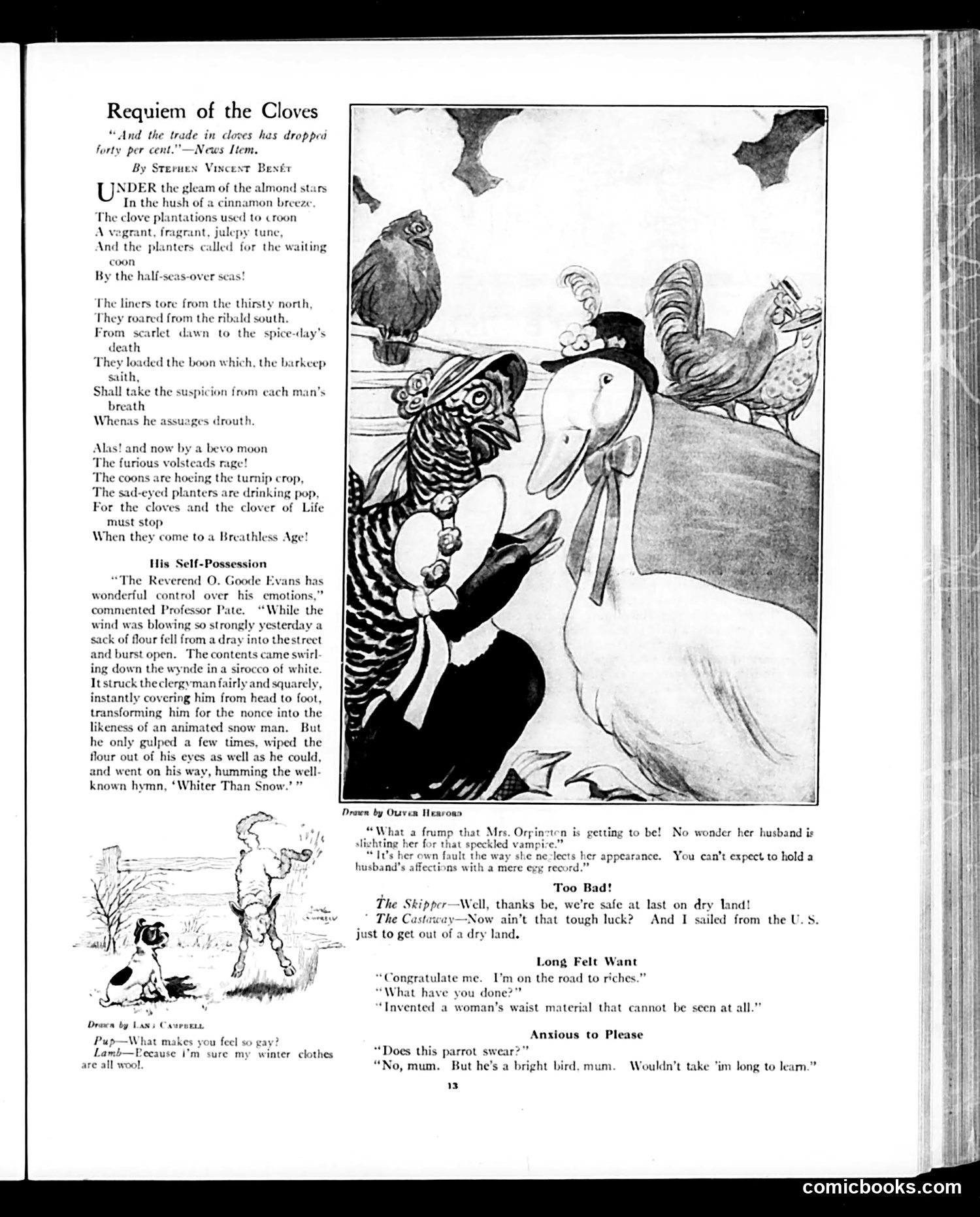
The main poem, "Requiem of the Cloves," satirizes **Prohibition** (the "Breathless Age" and "Volsteads" reference the Volstead Act). Cloves were traditionally used to mask alcohol on the breath—a key spice trade commodity. The poem mourns the economic collapse of the clove industry now that Prohibition has eliminated demand for this disguise. The language is deliberately grandiose and mournful, treating commercial ruin with mock-epic seriousness. The smaller comic vignettes employ standard early-20th-century humor: wordplay, Irish dialect, marital troubles, and class-based comedy. "His Self-Possession" celebrates composure under adversity. "Long Felt Want" jokes about invisible women's corsetry. "Too Bad!" plays on "dry land" (ironic given the castaway wanted to escape America's dryness under Prohibition). The illustrations are period cartoons with exaggerated caricatures typical of Judge magazine's satirical style.
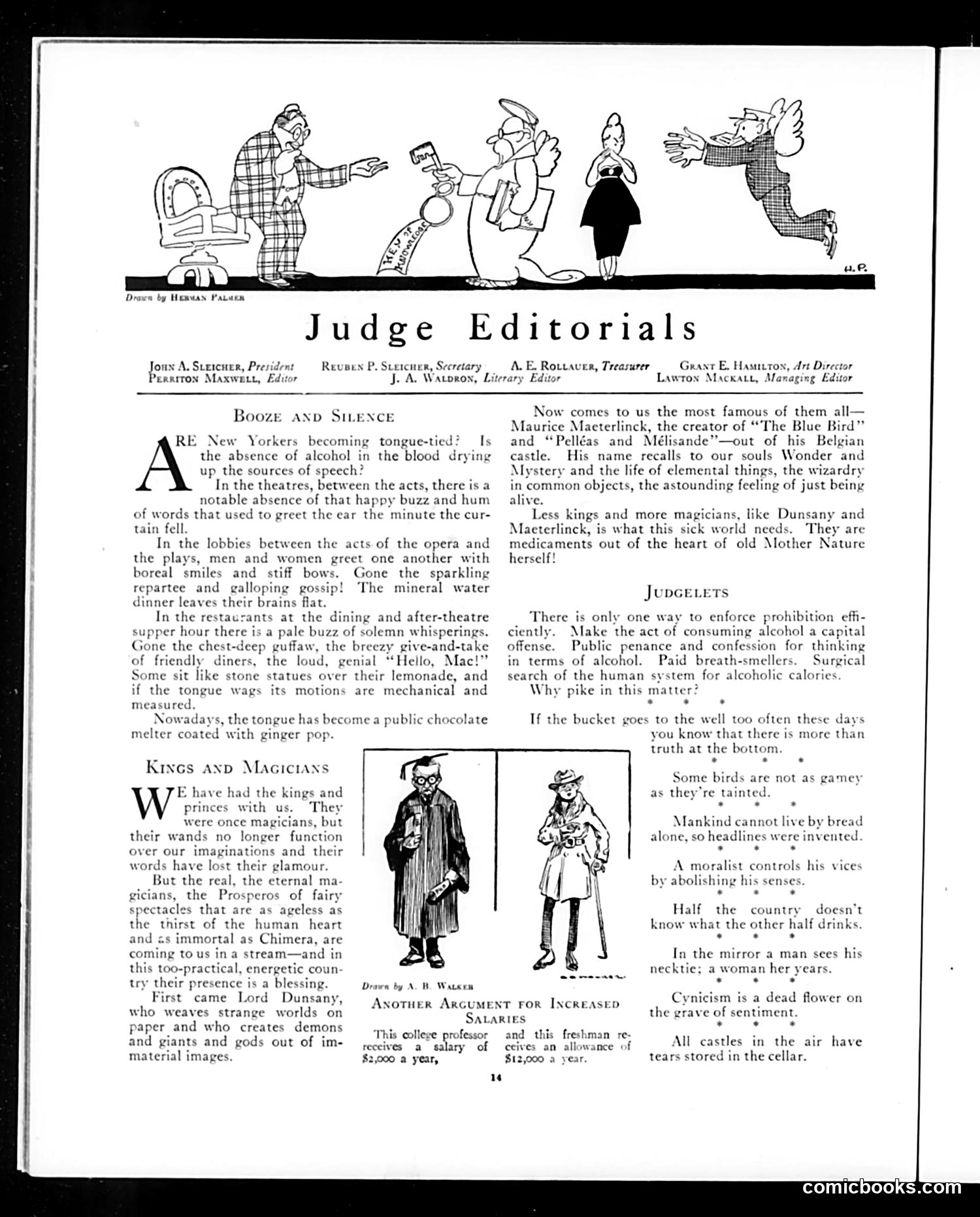
This page from **Judge** magazine satirizes **Prohibition** (the alcohol ban) and celebrates visiting literary figures. The main editorial, "Booze and Silence," mocks how New Yorkers have become dull and taciturn since alcohol was banned—theaters, restaurants, and social gatherings are now silent and awkward instead of lively. The satire suggests Prohibition has literally dried up conversation. The second piece praises visiting "magicians" like Irish playwright **Lord Dunsany** and Belgian symbolist **Maurice Maeterlinck** ("The Blue Bird"), arguing the world needs artists and dreamers more than practical materialism. An accompanying cartoon compares a college professor earning $2,000/year to a woman earning $12,000—likely satirizing wage inequality or arguing educators are underpaid. The "Judgelets" (aphorisms) continue mocking Prohibition's absurdity while offering general social commentary. The overall message: America needs imagination and conviviality, not joyless sobriety.
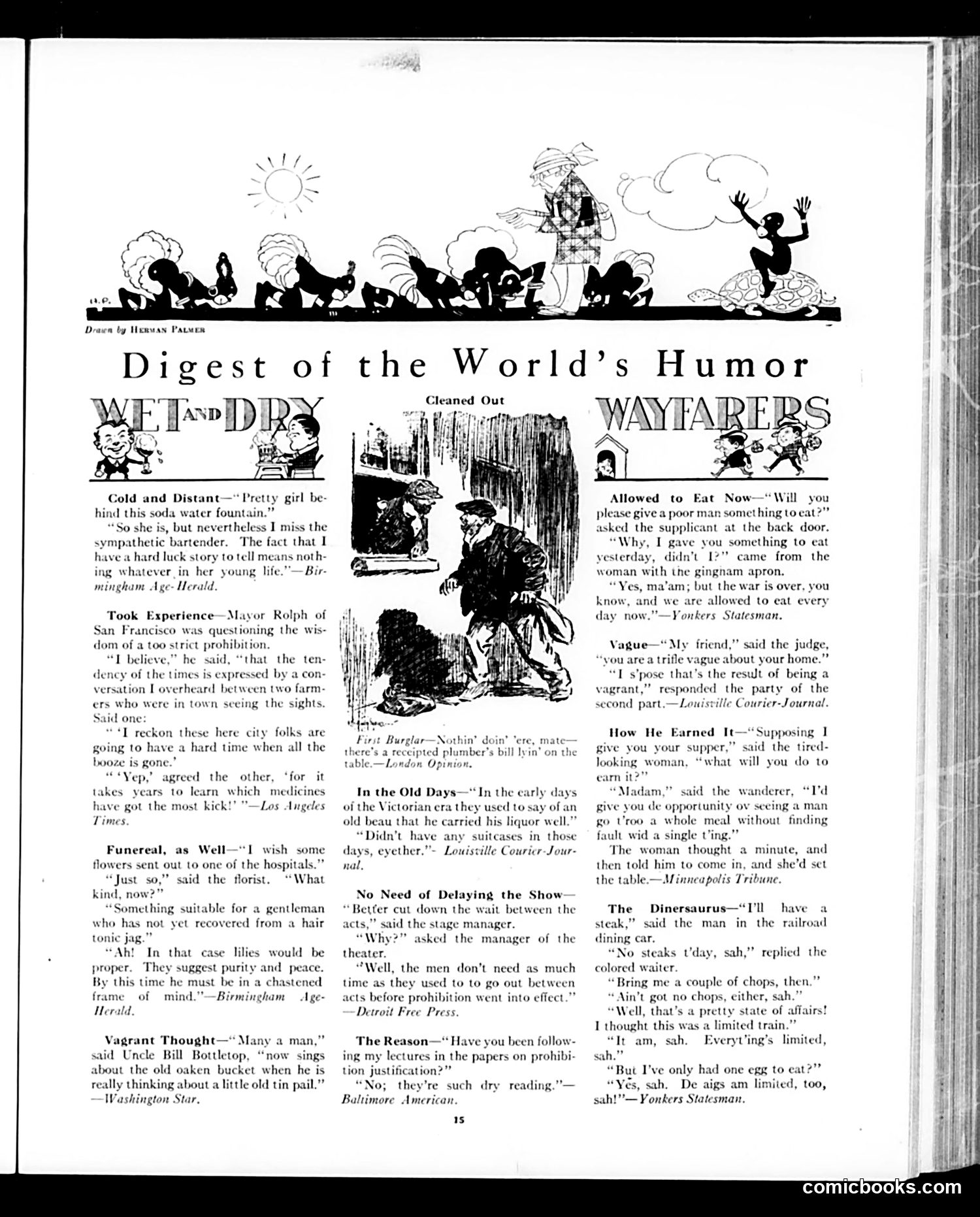
This is a humor compilation page from Judge magazine, likely from the **Prohibition era** (1920s-early 1930s), given repeated references to alcohol bans and their social effects. The cartoons and jokes satirize: 1. **Prohibition's impact**: Multiple jokes mock the law's effects—farmers joking that losing "booze" means losing access to "medicines" (liquor disguised as tonics), and references to prohibition "going into effect." 2. **Post-WWI adjustment**: One joke features a beggar claiming he's now "allowed to eat every day" since "the war is over," satirizing wartime rationing and changed charity attitudes. 3. **Economic hardship**: Several pieces feature vagrants, drifters, and poor people, suggesting Depression-era economic struggle. 4. **Class commentary**: The "soda water fountain" and "limited train" jokes mock social pretension and scarcity. The artwork by Herman Packer shows silhouetted figures in various comedic situations. These are satirical observations of contemporary American life during a period of major social and economic change.
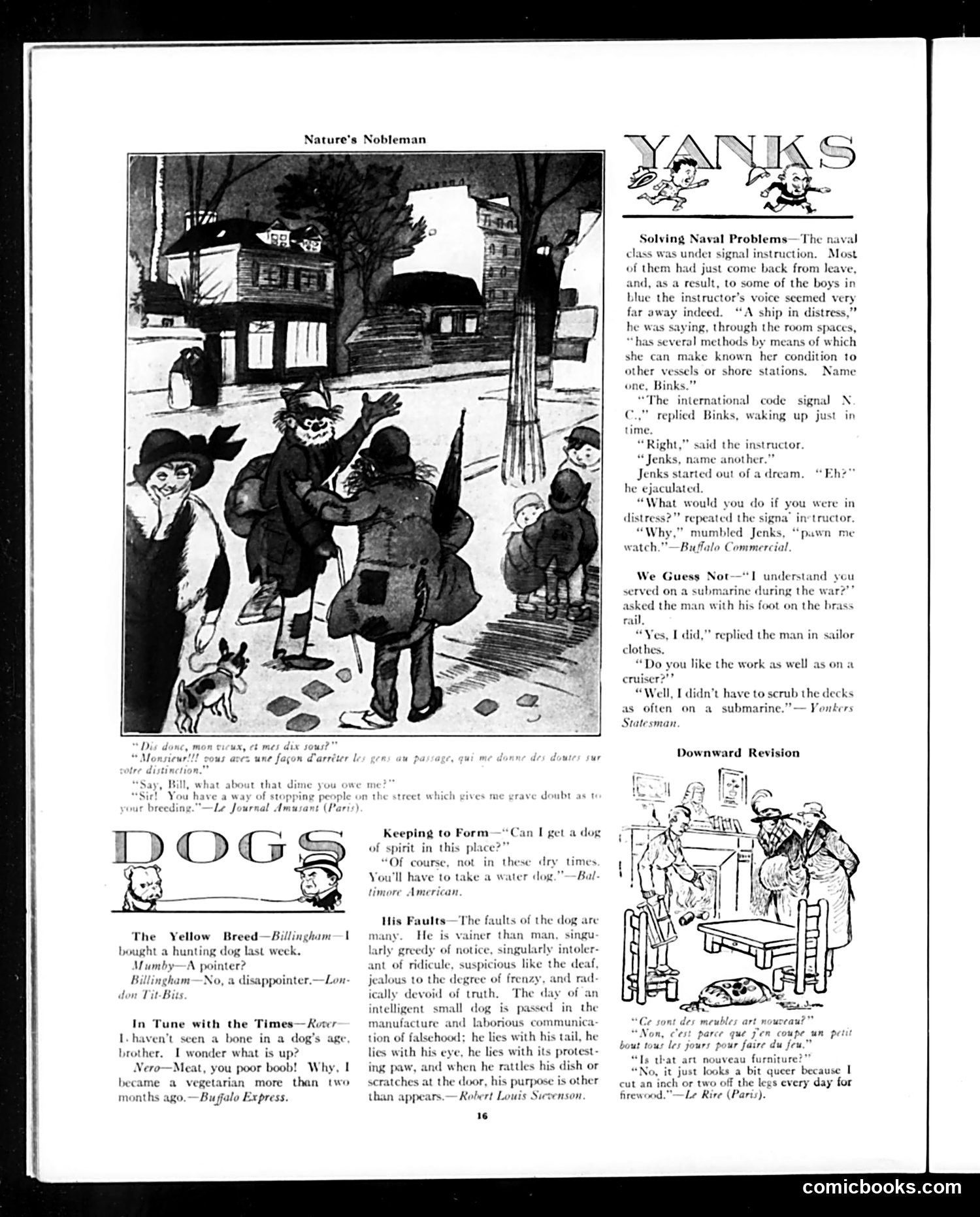
This Judge magazine page contains multiple brief humorous anecdotes about dogs and naval/military service, typical of early 20th-century American humor magazines. **"The Yellow Breed"** and related dog jokes mock fashionable pet ownership and wartime meat rationing (references to vegetarianism and bones disappearing suggest WWI-era food scarcity). **"Solving Naval Problems"** satirizes inattentive naval cadets returning from shore leave, unable to focus during signal instruction—a practical military skill. The joke is their half-asleep responses to the instructor's questions about maritime distress signals. **"We Guess Not"** contrasts submarine versus cruiser service: submarines required less deck-scrubbing, making former submariners reluctant to return to surface ship duties. **"Downward Revision"** (cartoon, right) appears to mock furniture or home goods, though details are unclear. The overall tone reflects American wartime attitudes toward military service, rationing, and social pretension—typical satirical fare for Judge's educated, middle-class readership.
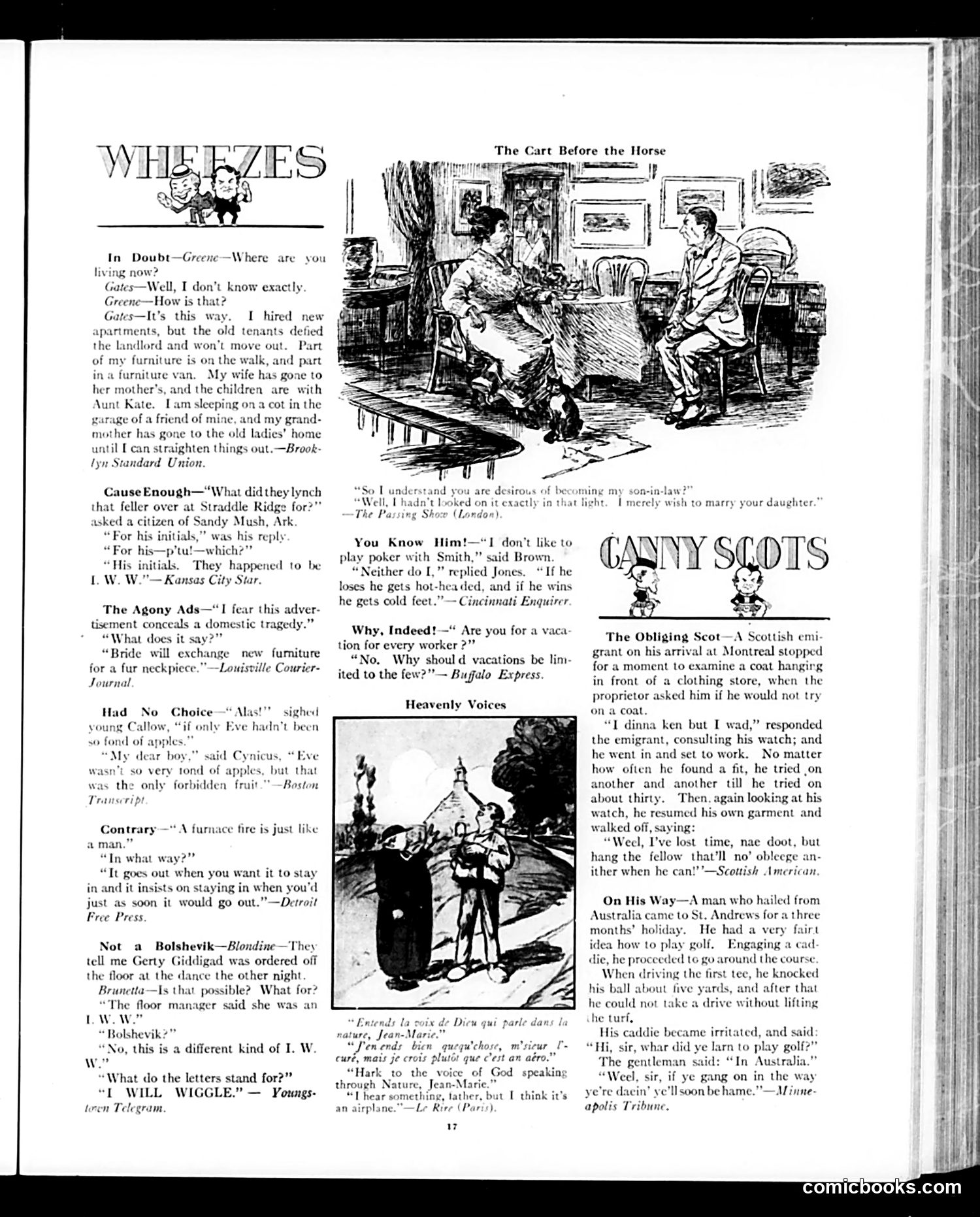
This page collects brief humorous anecdotes and satirical observations typical of early 20th-century American magazines. **Key content:** The main cartoon, "The Cart Before the Horse," depicts a domestic dispute where a man seeks to marry a woman, but she (or her family) appears skeptical of his intentions. **The jokes address:** - Housing instability and tenant disputes (a real social issue of the era) - Gender dynamics in courtship and marriage - Working-class struggles (references to "I.W.W."—the Industrial Workers of the World, a radical labor union, used here for wordplay rather than serious political critique) - Scottish immigrant stereotypes (the "Obliging Scot" and "On His Way" sections mock Scottish accents and supposed frugality) - Australian colonials portrayed as unsophisticated golfers The humor relies on class-based stereotypes, ethnic caricatures, and domestic/marital comedy—standard fare for Judge's readership. The IWW references suggest contemporary labor anxieties, though presented as lightweight wordplay rather than serious commentary.
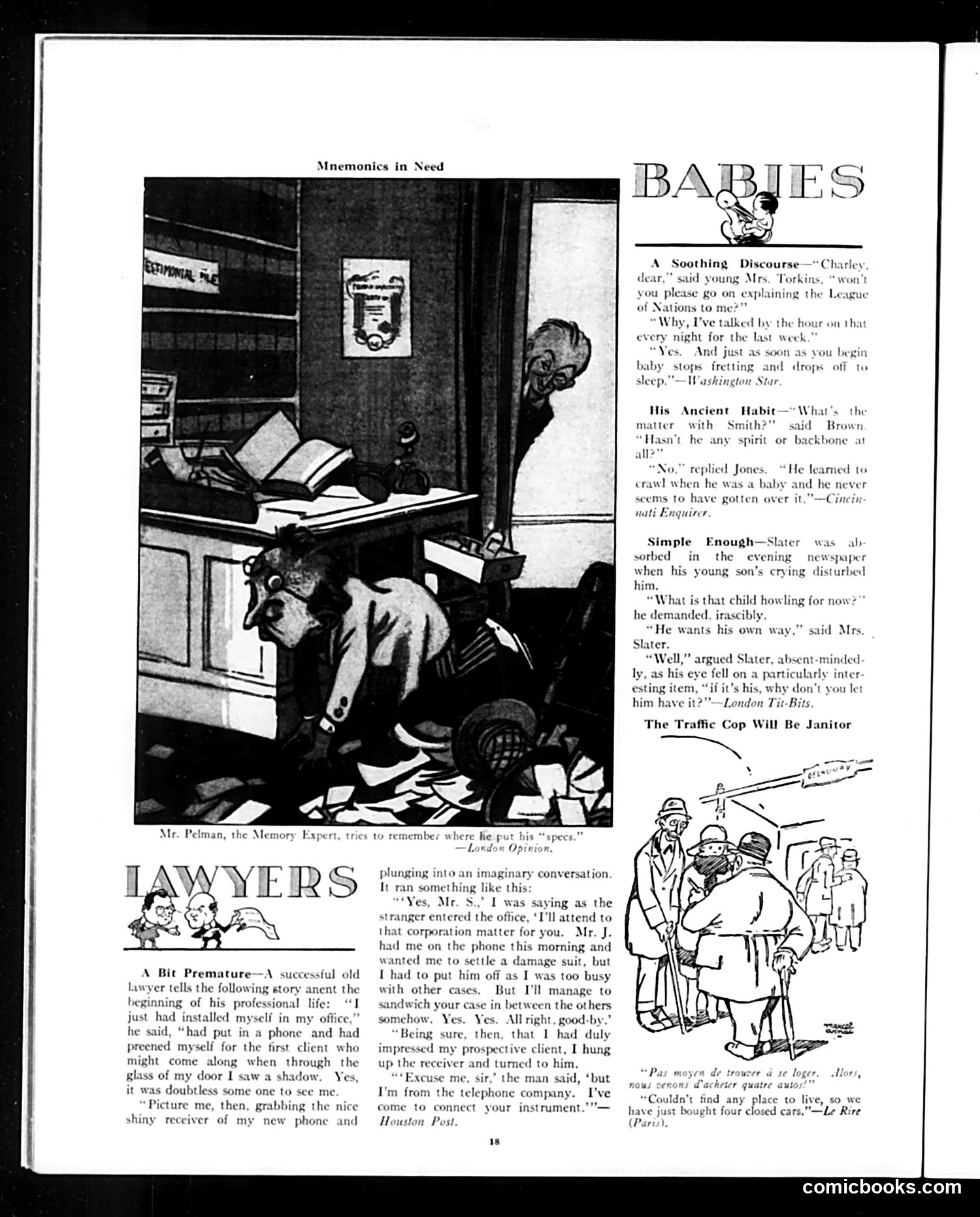
This page contains several short humorous anecdotes satirizing early 20th-century professional and domestic life. **Main cartoon**: Shows a young lawyer frantically performing an elaborate fake phone conversation to impress a potential client—only to discover the visitor is actually the telephone company installer. The joke mocks pretentious professionals who prioritize appearances over substance. **Other jokes** include: - A wife using League of Nations lectures to soothe her fretful baby - A man's lifelong inability to break the crawling habit learned as an infant - A father refusing his son's simple request while reading the newspaper - A final cartoon (French caption) about Parisians buying four closed cars as makeshift homes due to housing shortage The satirical point throughout: absurdity in modern life—whether professional desperation, male absent-mindedness, housing crises, or the gap between how people present themselves versus reality. The humor relies on recognizing common human foibles and social pretensions of the era.
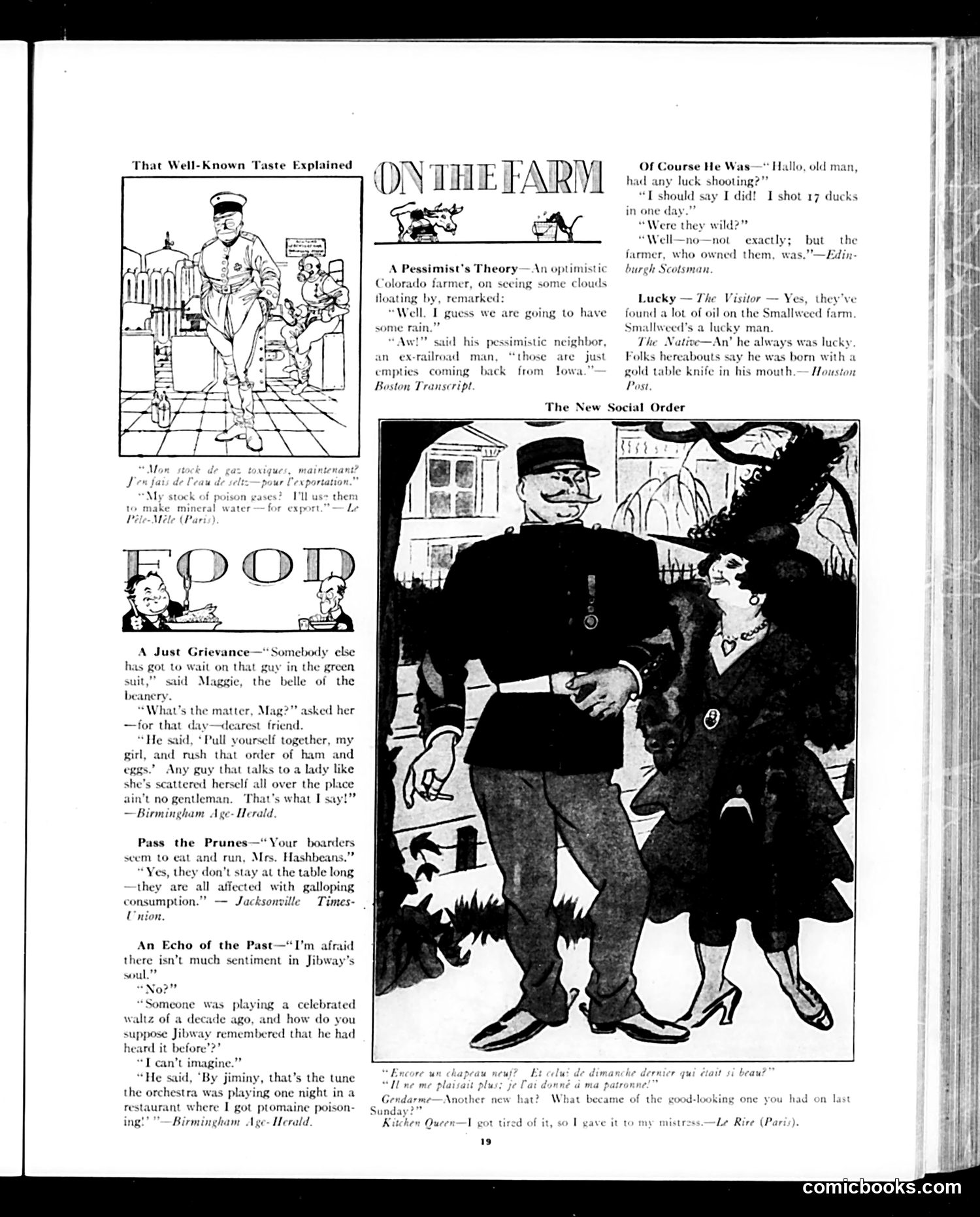
This cartoon satirizes changing social hierarchies and manners in early 20th-century America. It depicts a working-class man (identifiable by his cap and simple clothing) flanked by two fashionably dressed women who appear to be attending to him—a reversal of traditional class dynamics where servants deferred to the wealthy. The French caption translates roughly to commentary about losing a "good-looking hat" and giving another to one's mistress, reinforcing themes of social disorder and role reversal. The satire targets anxiety about class mobility and the "new social order"—likely reflecting concern among Judge's middle/upper-class readers about workers gaining economic power (possibly through labor organizing or industrial wealth), disrupting established social protocols. The cartoon mocks the idea that traditional deference and hierarchy are being upended, with working people now receiving service rather than providing it.
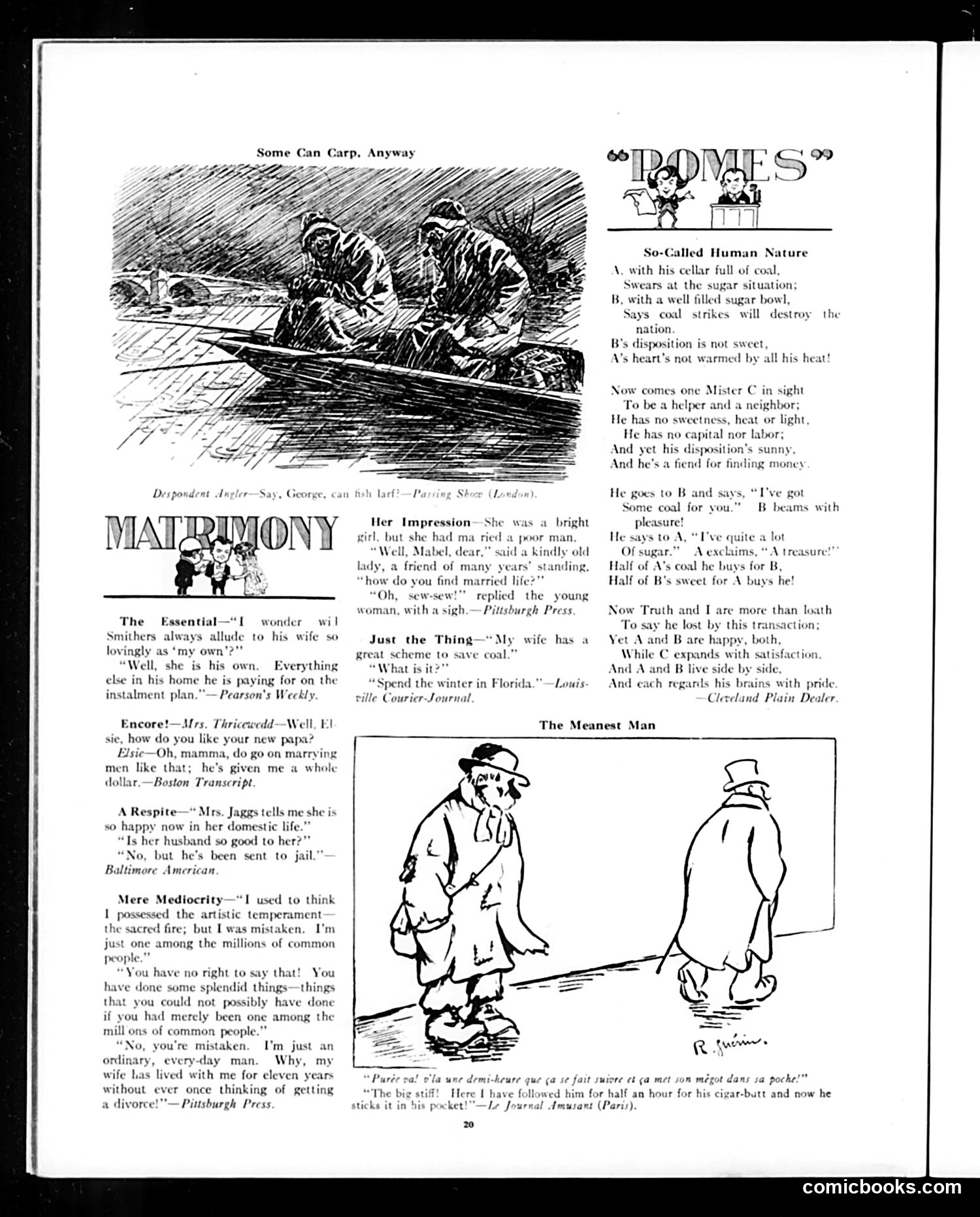
This Judge magazine page contains satirical humor pieces and a cartoon on everyday social issues: **Multiple short jokes** mock marital dissatisfaction and financial hypocrisy—wives as financial burdens ("paying for on the instalment plan"), remarriage for material gain, and escape through infidelity or incarceration. **"So-Called Human Nature"** (main prose piece) presents a moral lesson: three men—A (has coal, complains about sugar), B (has sugar, complains about coal), and C (has nothing but good humor)—engage in trade. C profits not through resources but through cheerful entrepreneurship and connecting others' needs. The satire critiques selfish materialism while praising enterprising optimism and human connection. **"The Meanest Man"** (cartoon, bottom) depicts a Parisian character so stingy he follows someone for half an hour to retrieve a discarded cigar butt from their pocket—extreme penny-pinching for absurdist comedic effect. The page reflects Progressive-era concerns: class mobility, marriage economics, and character versus wealth.
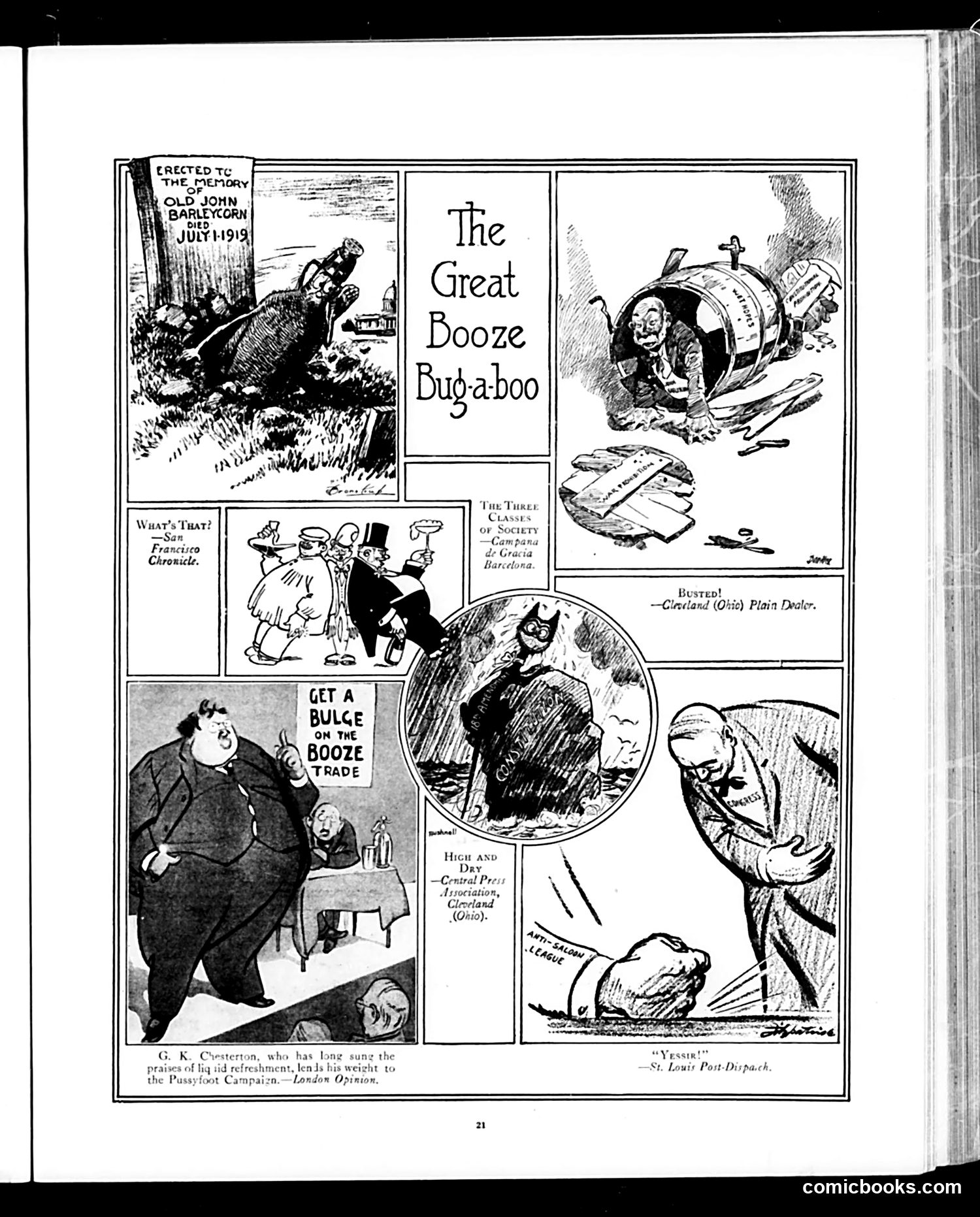
This page satirizes Prohibition-era temperance campaigns, particularly the "Pussyfoot" anti-alcohol movement. The top panels mock various newspaper takes on alcohol's dangers—depicted as a destroyed monument and a wrecked barrel. The central panel caricatures G.K. Chesterton (identifiable by caption), a prominent British writer whom temperance advocates had enlisted to support their cause. The satire suggests the irony of using a man known for enjoying life's pleasures to promote abstinence. Lower panels show typical Prohibition rhetoric—"Get a Bulge on the Booze Trade"—alongside cartoon vignettes depicting drinking's supposed consequences. The final panel ("Yessir!") appears to show obedient compliance with anti-alcohol messaging. Judge presents this as absurd moral panic, mocking both the temperance movement's exaggeration and the gullibility of newspapers amplifying these claims.
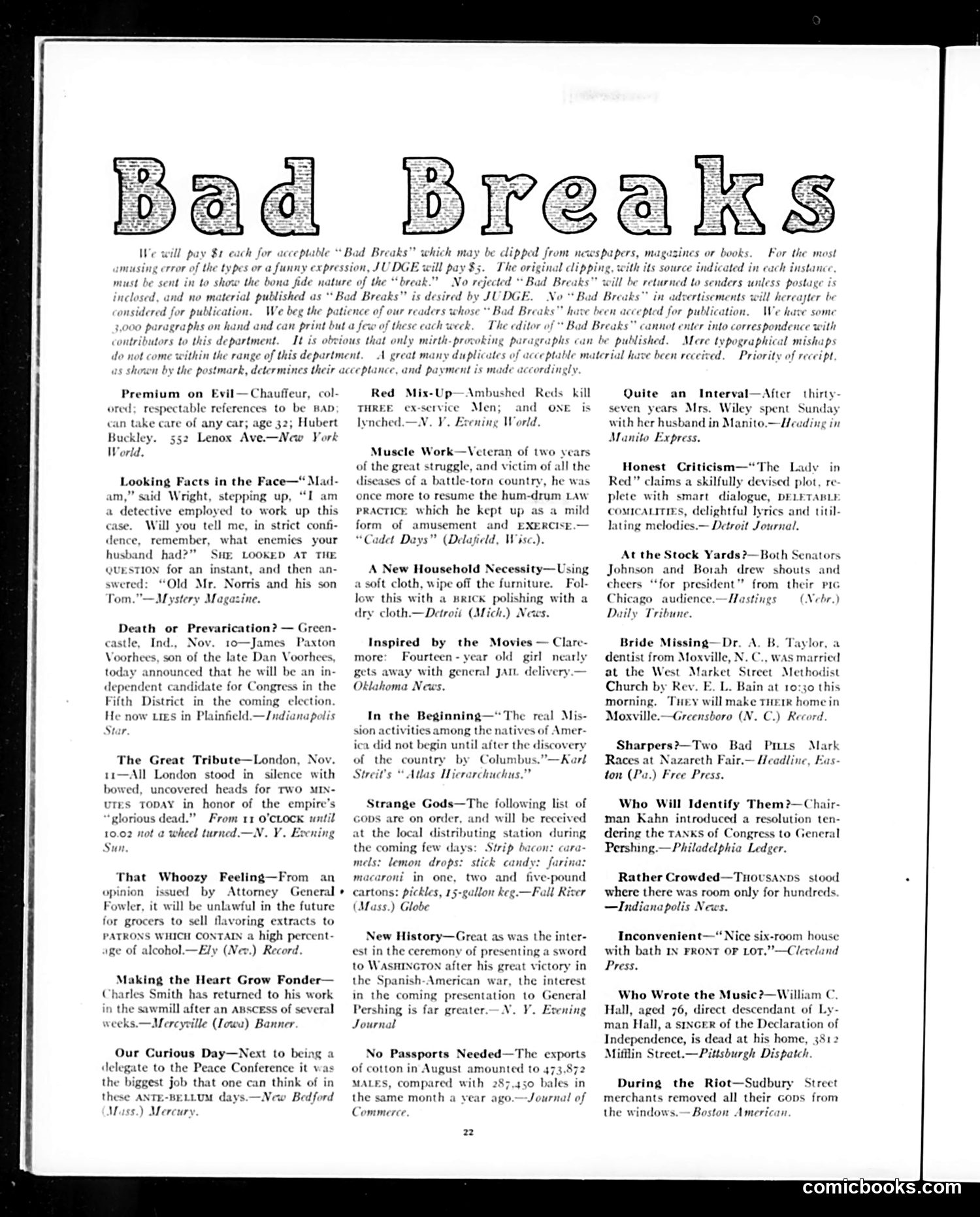
This page showcases **Judge magazine's "Bad Breaks" column**—a humor section featuring unintentionally funny newspaper clippings and typographical errors from across America. The satire works by republishing actual excerpts where printers' mistakes or awkward phrasing created unintended comedy. Examples include: - **"Red Mix-Up"**: A headline about Reds (communists) killing ex-servicemen reads as violent political content, likely humorous to 1920s readers amid Red Scare anxiety - **"Premium on Evil"**: A job listing seeking a chauffeur with "respectable references" becomes darkly comic - **"Death or Prevarication?"**: A politician's name triggers skepticism about his honesty - **"No Passports Needed"**: Cotton exports somehow become "MALES" (likely "bales")—absurdly suggesting human trafficking The column satirizes contemporary concerns (communism, Prohibition, post-WWI adjustment) while mocking small-town newspapers' editorial incompetence. For modern readers, it's essentially an early version of "funny headlines" compilations, revealing 1920s anxieties through accidental humor.
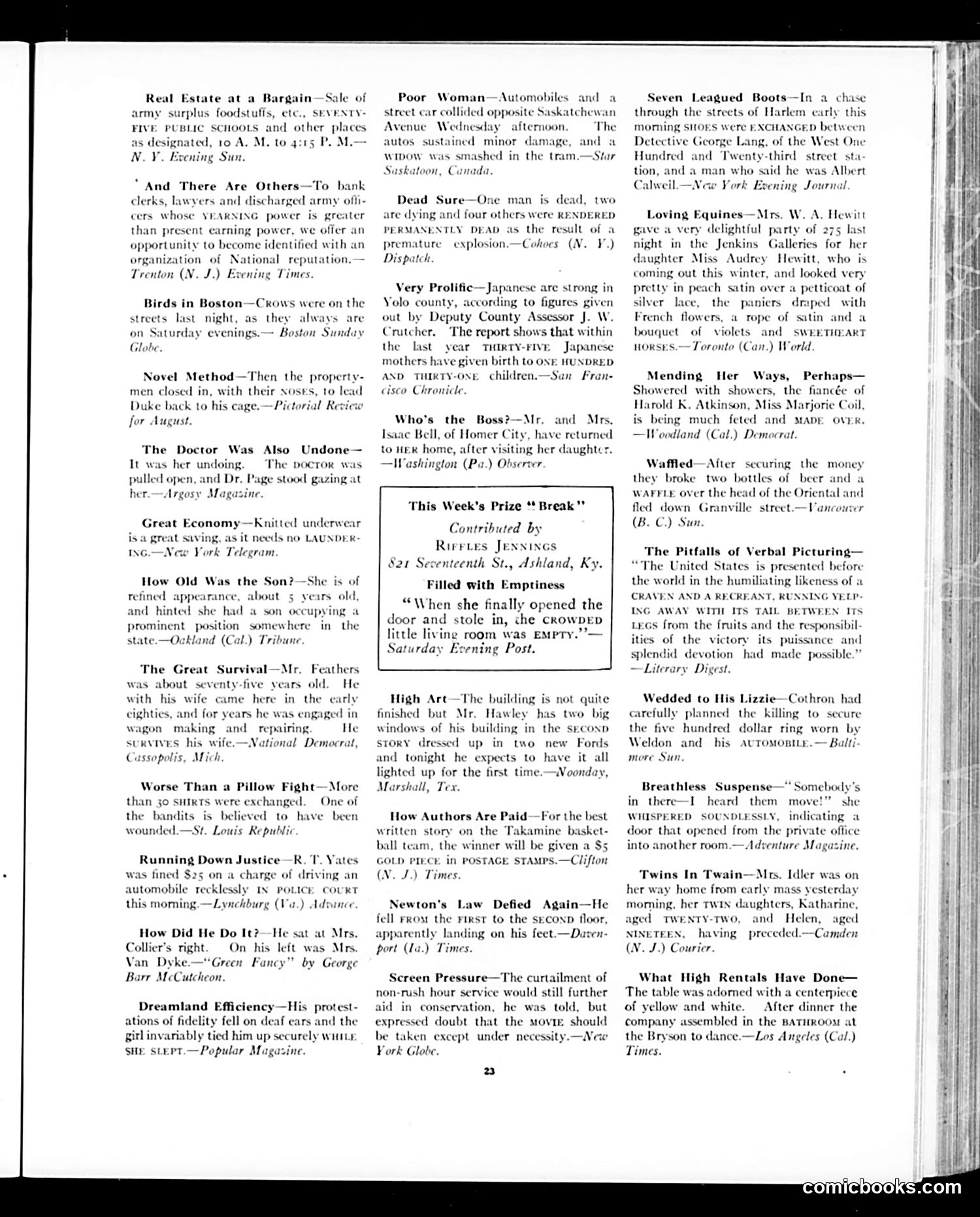
This page is primarily a humor column called "**Briefs**" — a collection of comedic short snippets clipped from newspapers across America. The magazine's satirical point is to highlight **unintentional absurdities and contradictions in everyday newspaper writing**. Examples of the humor: - **"Dead Sure"**: The dark joke that someone is "permanently dead" — as if death comes in degrees - **"Very Prolific"**: The mathematics don't work (35 mothers producing 131 children seems implausibly efficient) - **"Newton's Law Defied Again"**: Mockery of an implausibly lucky fall from second floor with no injury - **"High Art"**: Absurdity of displaying new Ford automobiles as window decoration/art The boxed "Prize Break" feature highlights the week's best unintentional contradiction: describing a "crowded little living room" that was completely "empty." This reflects Judge's core purpose: satirizing not politics or social issues directly, but rather the **ridiculous, contradictory, and illogical statements found in American newspapers** — offering readers sophisticated amusement at mass media's expense.
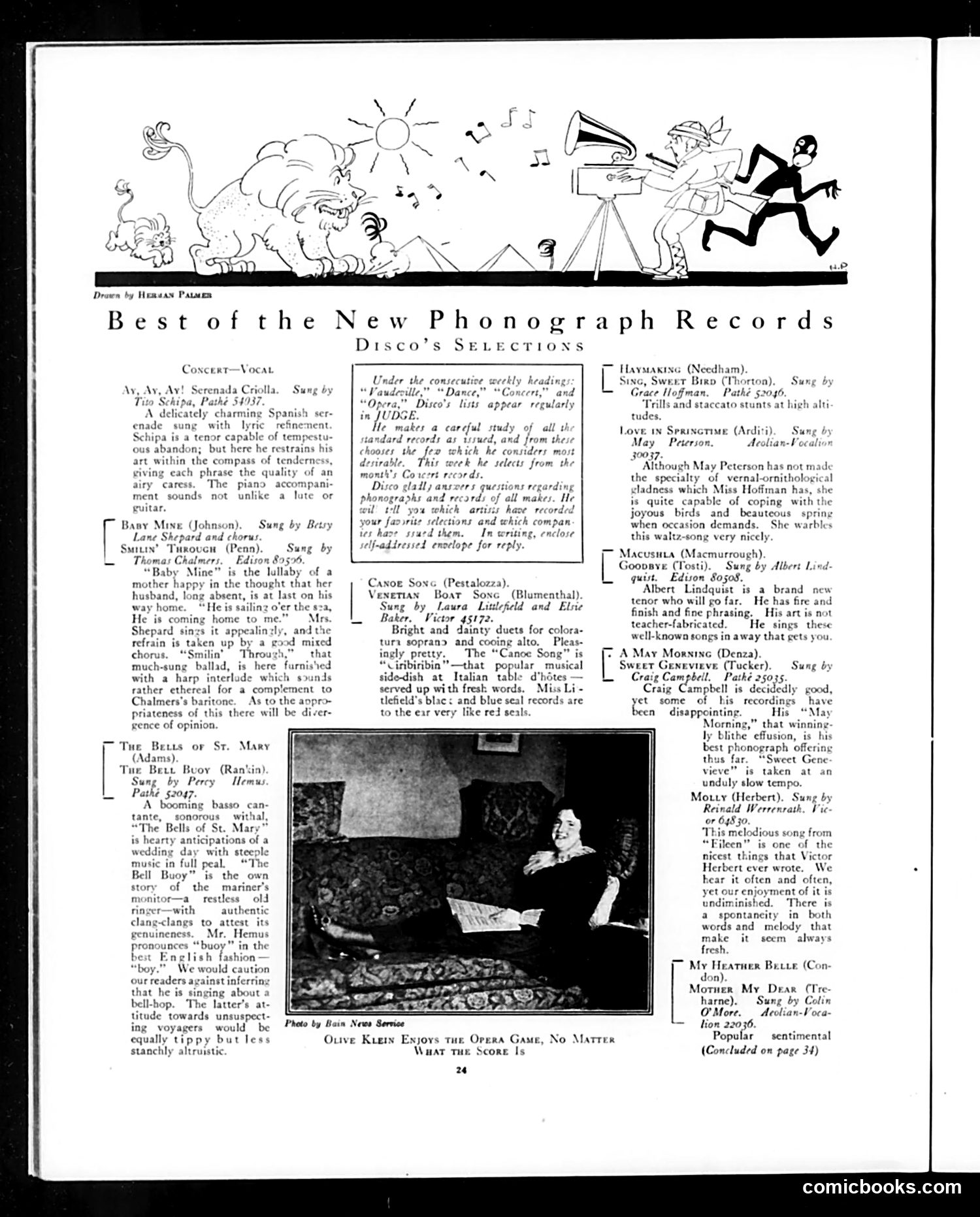
This page is **not a political cartoon**, but rather a **record review column** from Judge magazine titled "Best of the New Phonograph Records: Disco's Selections." The cartoon header (drawn by Hersan Palmer) is purely decorative—showing whimsical figures and a gramophone—not satirical commentary. The actual content evaluates recently released phonograph records, with detailed descriptions of vocal performances by artists like Betsy Lane Shepard, Percy Hemus, and Albert Lindquist. Critic "Disco" discusses technique, emotional delivery, and recording quality across various song genres (operatic pieces, sentimental ballads, folk songs). The central photograph shows **Olive Klein enjoying the opera game**, illustrating the leisure culture around recorded music consumption in this era. This represents early 20th-century popular entertainment journalism—essentially the equivalent of modern music or streaming service reviews—aimed at affluent readers who could afford phonographs and records.
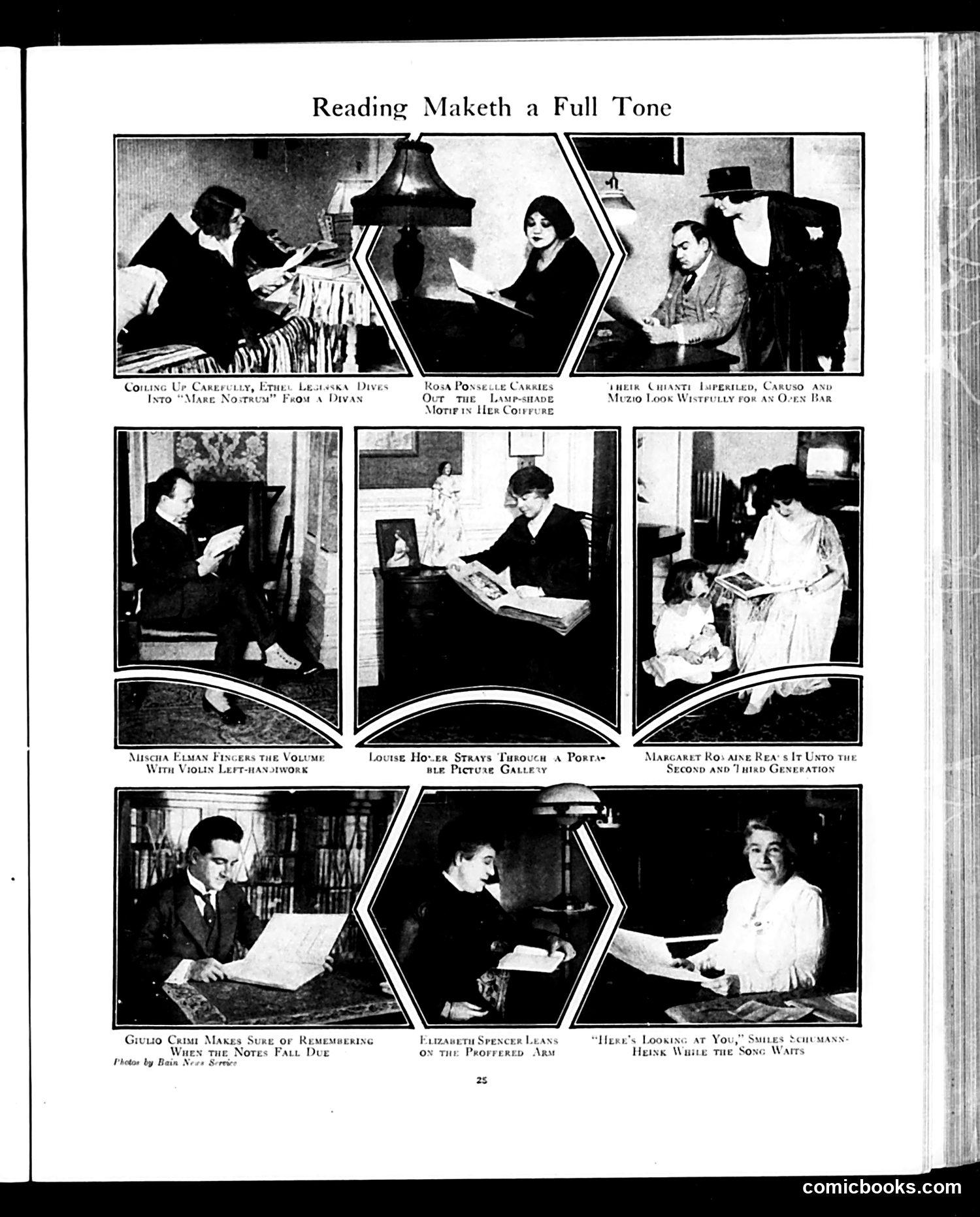
This page illustrates how reading cultivates refinement and cultural sophistication across generations. The top panels show opera singers and society figures engaged with literature—suggesting that serious reading elevates one's artistic sensibility and social standing. The bottom panels depict musicians (including names like Caruso, a famous tenor) and performers studying scores and texts, implying that intellectual engagement through reading produces better artistry. The final image shows a woman smiling while reading, captioned with a musical reference, connecting literary appreciation to happiness and cultural fulfillment. The overall message is a *genteel endorsement of reading* as a marker of civilization and taste—particularly among the wealthy and artistically accomplished. For a 1910s-era *Judge* audience, this was aspirational propaganda: reading signals you belong to the cultured classes. The satire, if present, is subtle—possibly mocking the pretension that mere book-holding confers sophistication.
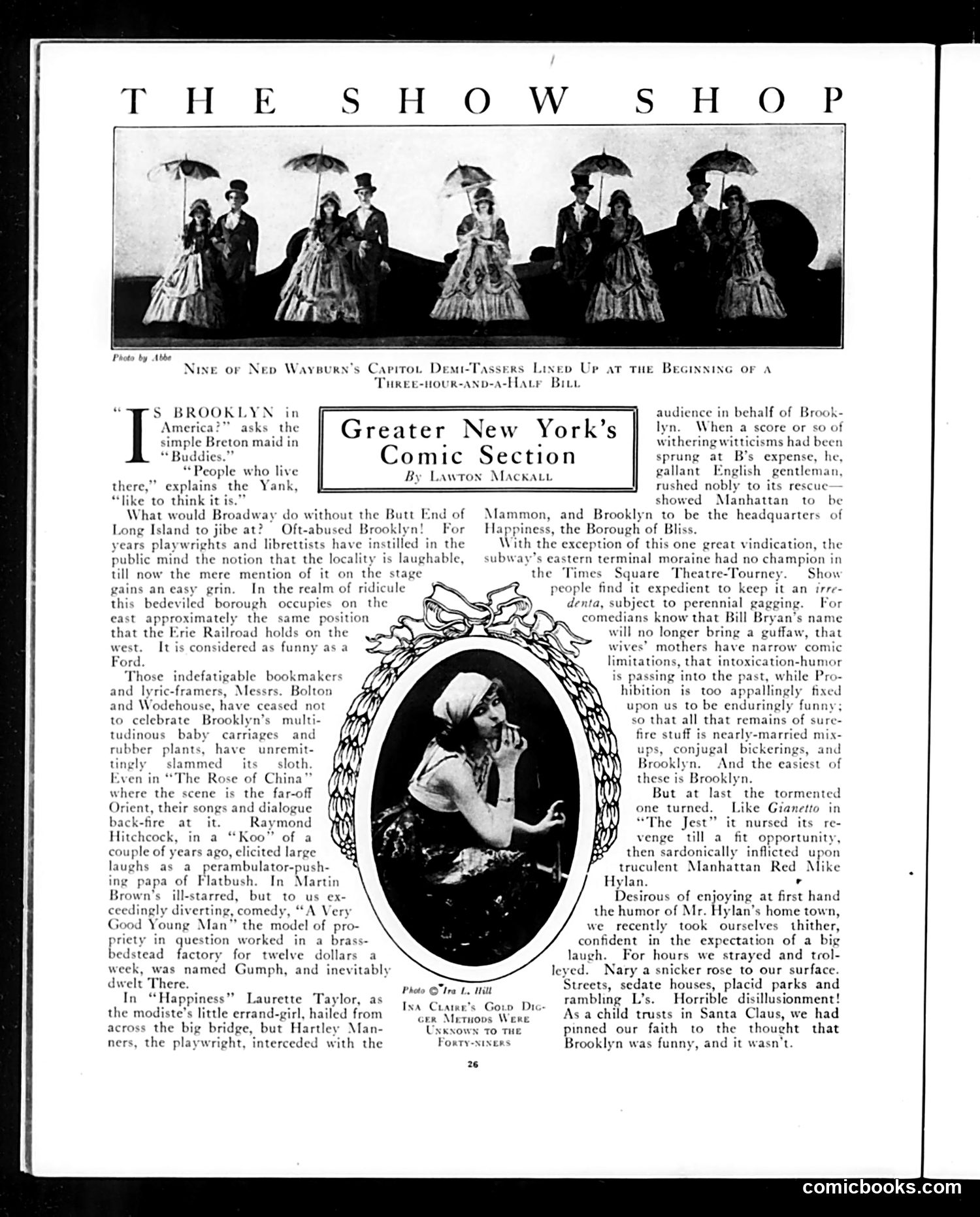
This *Judge* column satirizes how Broadway playwrights have made Brooklyn a stock comic target for decades. The author, Lawton Mackall, documents how writers like Bolton and Wodehouse, and plays featuring Raymond Hitchcock and Laurette Taylor, routinely mock Brooklyn as a laughable, unsophisticated borough—treating it as reliably funny as a Ford automobile is cheap. The piece notes Brooklyn's few defenders (like English playwright Hartley Manners in "Happiness") but argues the borough remains comedy's easiest target, alongside failed relationships and conjugal humor. The author's ironic conclusion: when he actually visited Brooklyn to experience its supposed humor firsthand, he found it disappointingly *normal*—sedate streets, quiet parks, ordinary life. The joke fails because reality doesn't match the caricature. The photo shows demi-tasse characters from a theatrical show.
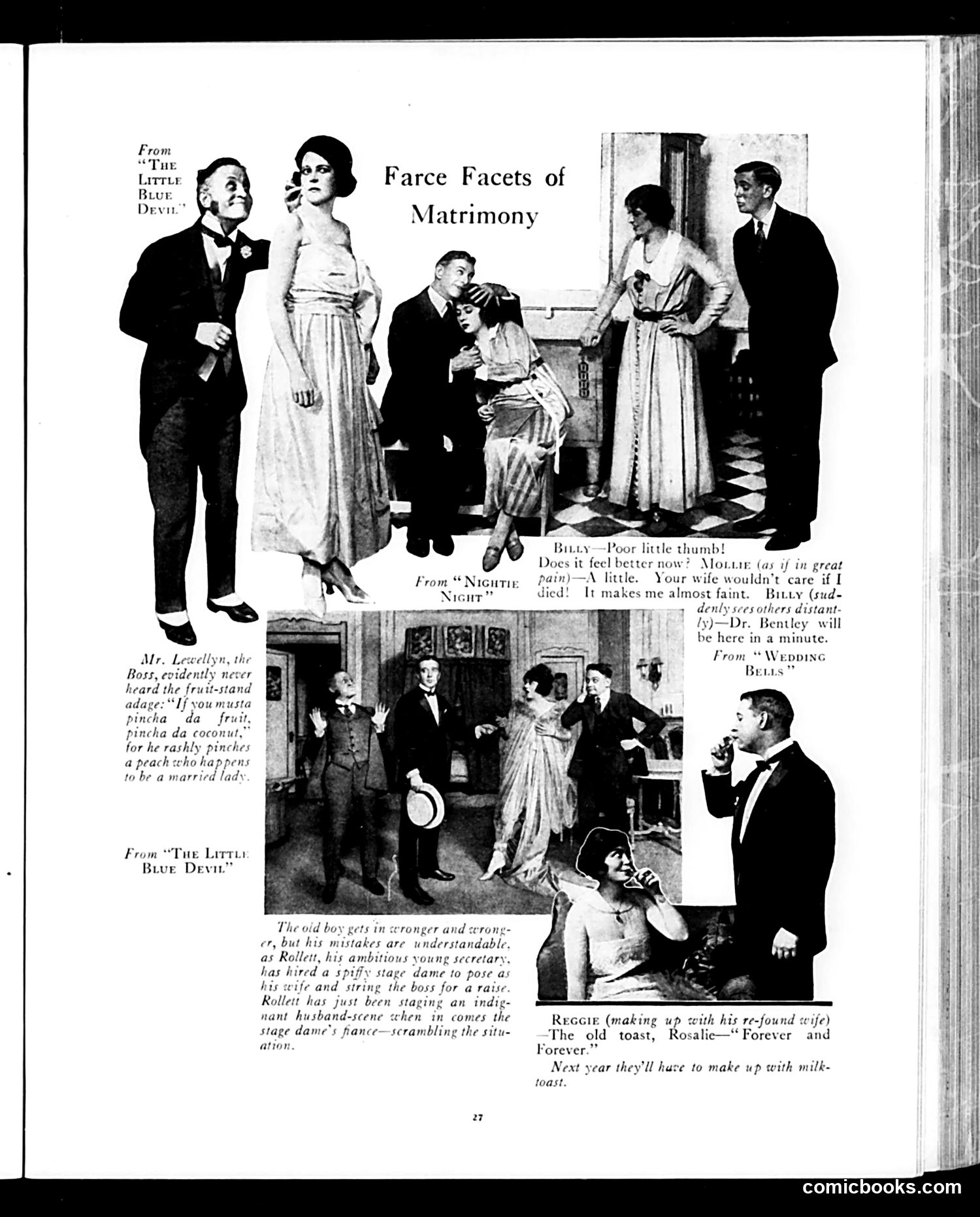
This page compiles comedic scenes from contemporary theatrical farces, each illustrating marital mishaps. The sketches mock domestic situations: a wife unconcerned about her husband's injury ("Your wife wouldn't care if I died"), a boy's injured thumb being treated while adults bicker, and a workplace scheme where an ambitious young secretary hires an actress to pose as his wife to manipulate his boss for a raise. The humor relies on early 20th-century theatrical tropes: marital indifference, scheming subordinates, and the chaos of deception unraveling. The final caption's "milk toast" joke suggests the couple will need bland reconciliation after their elaborate ruse fails. These vignettes satirize marriage as fundamentally farcical—a stage where people perform roles, deceive, and bungle rather than genuinely connect. The page showcases how Judge treated matrimony as inherently comedic material for its educated, urban readership.
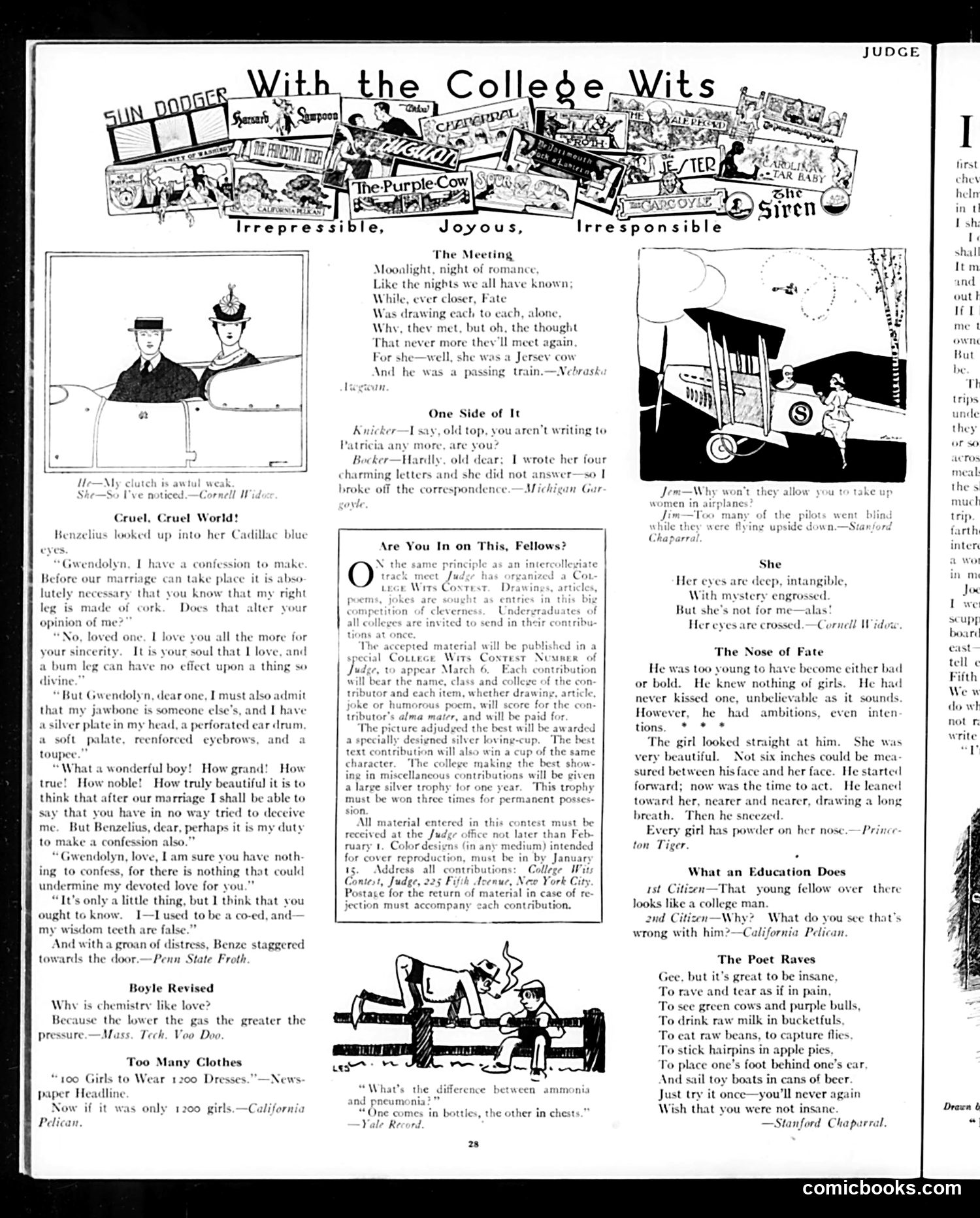
This page collects humorous short pieces and jokes aimed at college readers. The cartoons satirize college life and romantic ideals through absurdist humor: **"Cruel, Cruel World!"** mocks overly earnest romantic confessions. A man admits to increasingly ridiculous physical defects (cork leg, perforated eardrum, silver plate in head, toupee), and his fiancée matches his sincerity by revealing she's "used to be a co-ed" with false teeth—treating her college past as equivalent to his bodily failures. The joke undercuts melodramatic romance. **"The Nose of Fate"** presents a young man attempting his first kiss, only to sneeze when his nose nearly touches the girl's face because she's wearing powder. The anticlimax mocks romantic fantasy meeting physical reality. Other brief jokes satirize college pretension ("What an Education Does") and relationships ("One Side of It," where a man stops writing after rejection). The overall tone treats college romance, intellect, and identity as subjects for gentle ridicule—characteristic of 1920s college humor magazines.
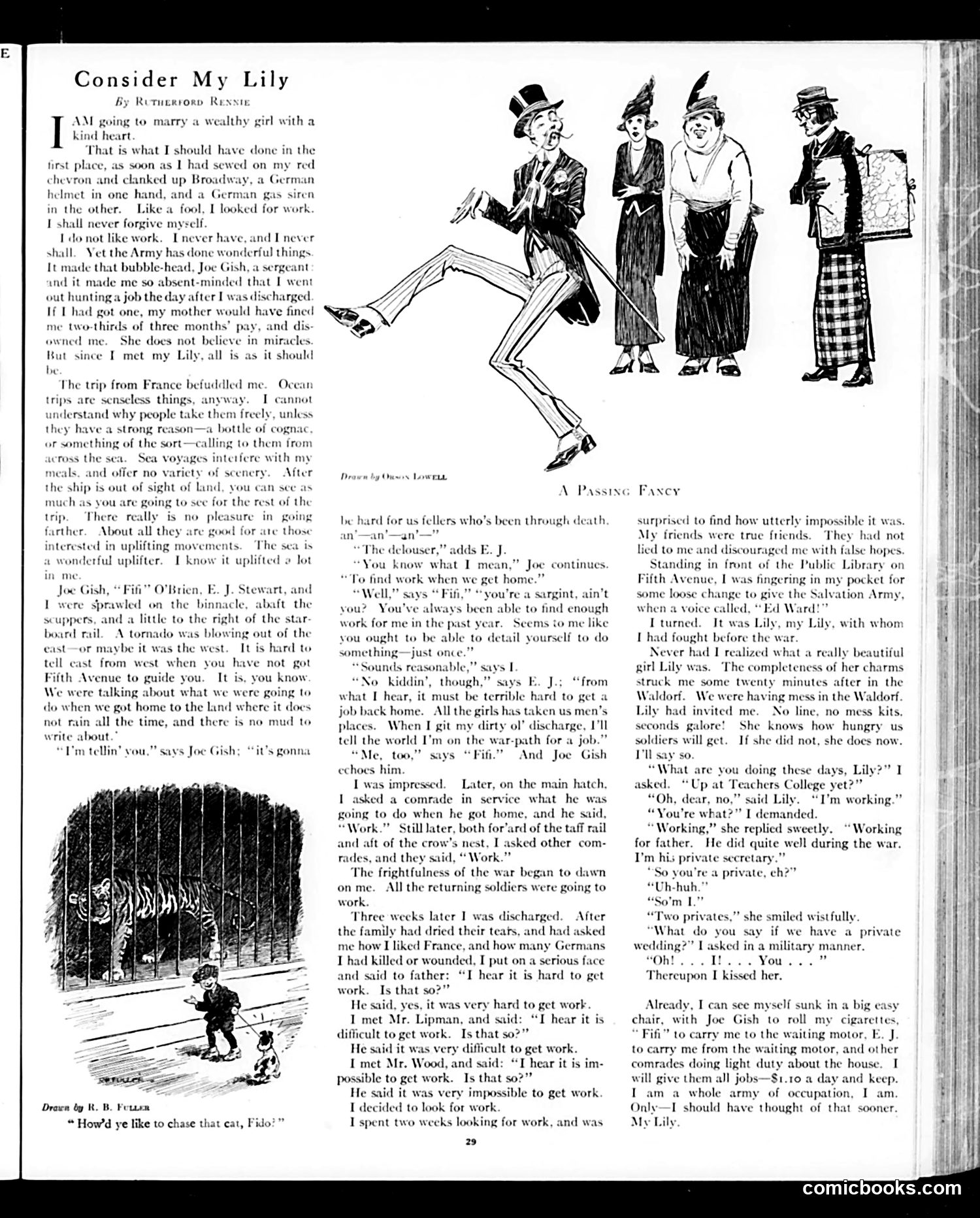
This is a post-WWI story satirizing a discharged soldier's laziness and opportunism. The narrator, a war veteran with a red chevron (indicating military service), admits he should have married a wealthy woman instead of seeking employment after returning from France. The satire mocks his attitude: despite complaining that finding work is "impossible," he spends weeks asking others about job prospects rather than actually looking. His friend Joe Gish, described as a "bubble-head," somehow became a sergeant—suggesting military advancement didn't require competence. **The cartoon "A Passing Fancy"** (right) illustrates the story's resolution: the narrator encounters his former sweetheart "Lily" at the Public Library and proposes marriage, apparently abandoning his job search entirely. The humor targets post-war veterans who preferred romantic escapades or financial dependence to honest employment—a common satirical theme in 1920s American magazines criticizing soldier readjustment.
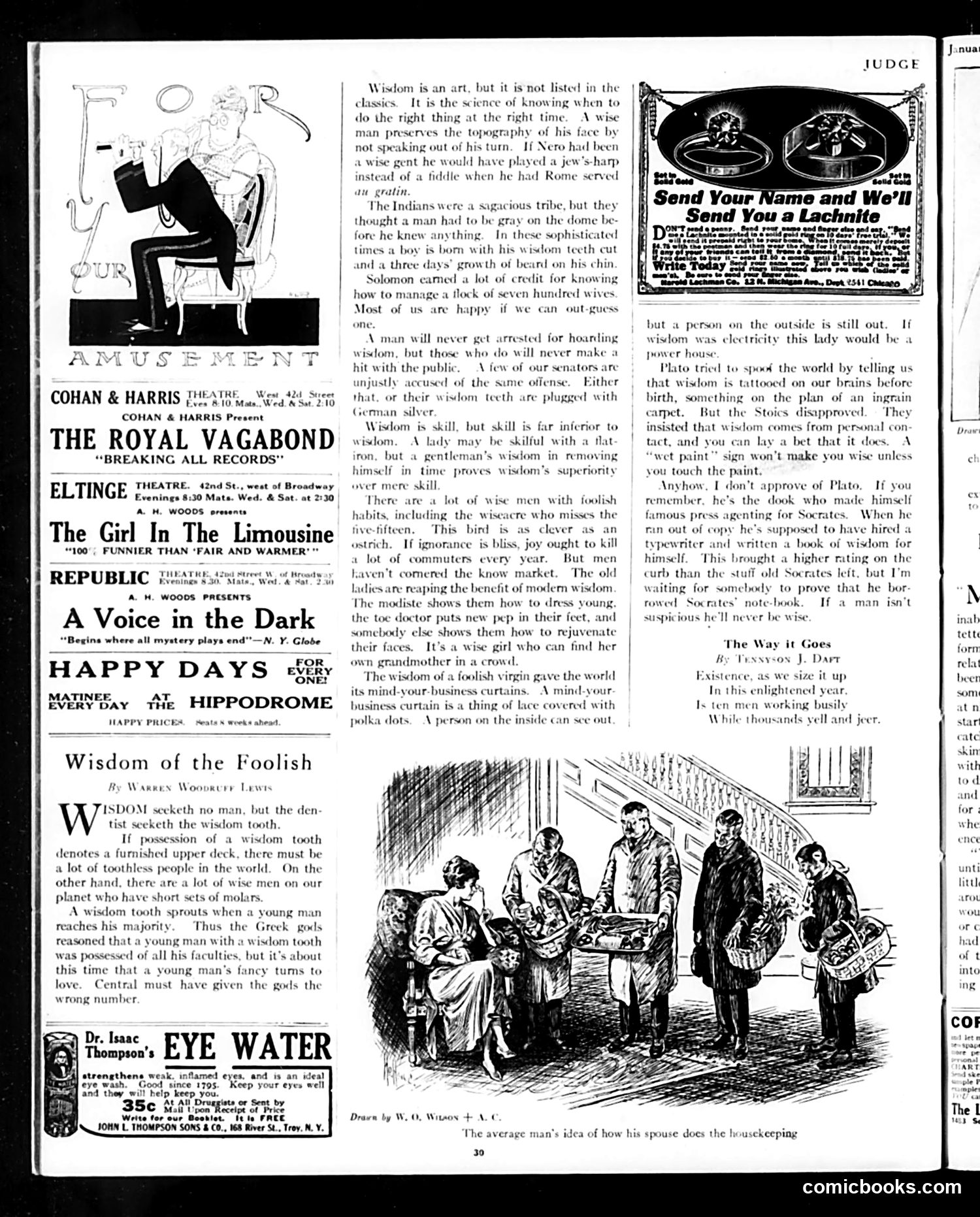
This page is primarily a humorous essay by Warren Woodworth Lewis titled "Wisdom of the Foolish," occupying most of the space. It's not political cartoon satire but rather social commentary using wit and aphorisms. The piece satirizes modern American pretensions to wisdom while actual foolishness flourishes. Lewis mocks various groups: senators accused of ignorance, commuters who miss trains despite supposed cleverness, and older ladies who dress young following fashion advice. He critiques false wisdom—Plato's claim that wisdom is innate, the notion that warning signs impart knowledge. The central joke: wisdom is claimed as universal virtue, yet manifests nowhere. A "wisdom tooth" denotes nothing about intelligence. The essay deflates grandiose philosophical claims (referencing Plato and Stoics) by contrasting them with everyday human absurdity—missing trains, bad fashion choices, failed marriages. The illustration shows people gathered indoors, supporting the theme of social interaction as wisdom's actual source, contra philosophical pretense. The page also advertises contemporary Broadway plays and Dr. Thompson's Eye Water patent medicine—typical Judge magazine content.
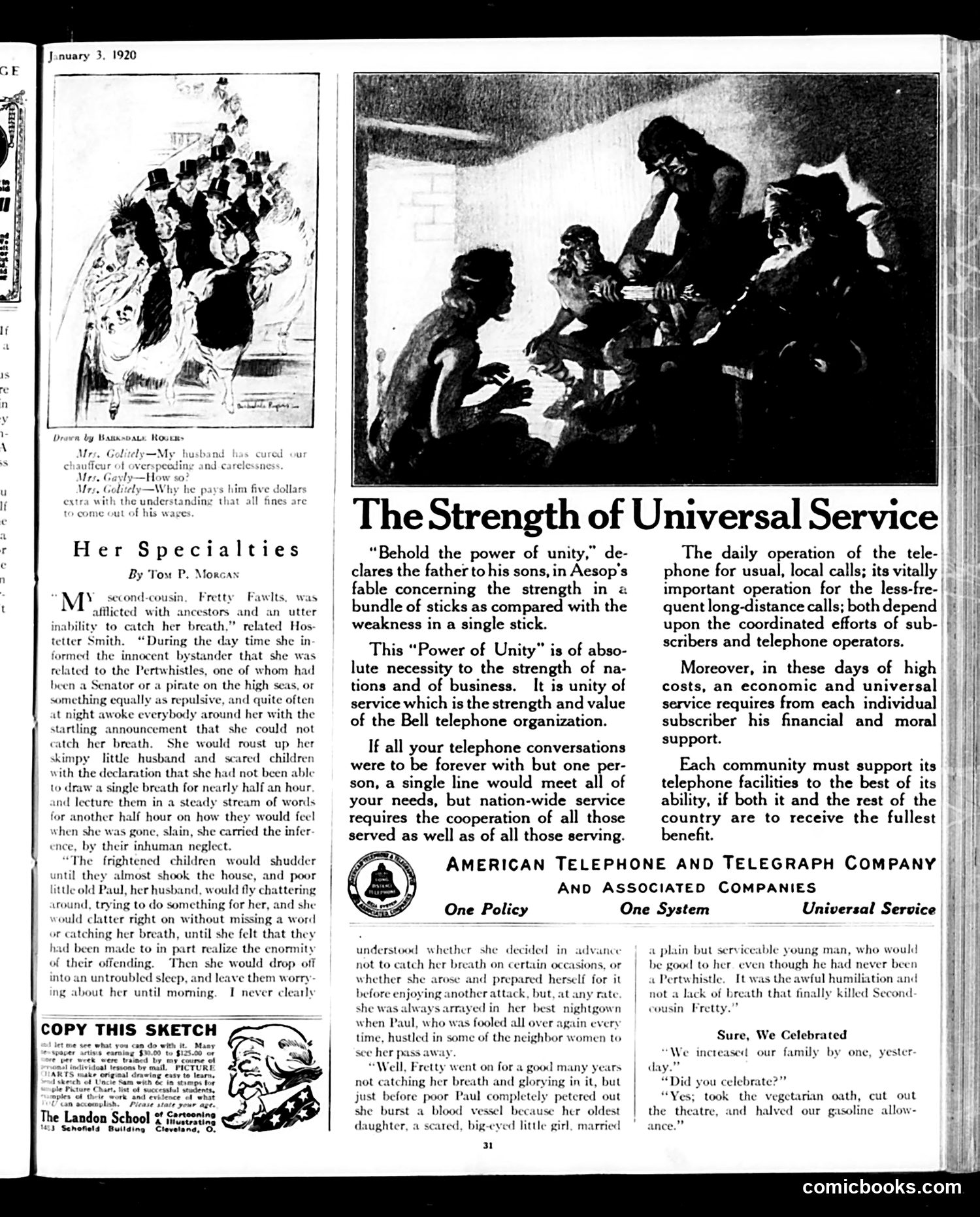
This page contains mixed content: a brief satirical cartoon about a chauffeur, a longer comedic story, and a substantial AT&T advertisement. **The Cartoon ("Drawn by Warnsdale Rogers"):** Shows a wealthy woman (Mrs. Golitely) discussing her chauffeur with another woman. The joke is that she pays him five dollars extra with the understanding he personally covers any traffic fines—shifting her legal liability onto an employee through financial coercion. It satirizes the casual exploitation of working-class servants by the wealthy. **"Her Specialties" Story:** A humorous piece mocking a hypochondriac woman (Fretty Faults) who repeatedly claims she cannot breathe, terrorizing her patient husband Paul with false medical emergencies for years. The satire targets her attention-seeking behavior and manipulation of her family's concern. **The AT&T Advertisement:** Frames telephone service as requiring national unity and cooperation—a corporate message wrapped in patriotic language about collective benefit, likely appealing to post-WWI American values.
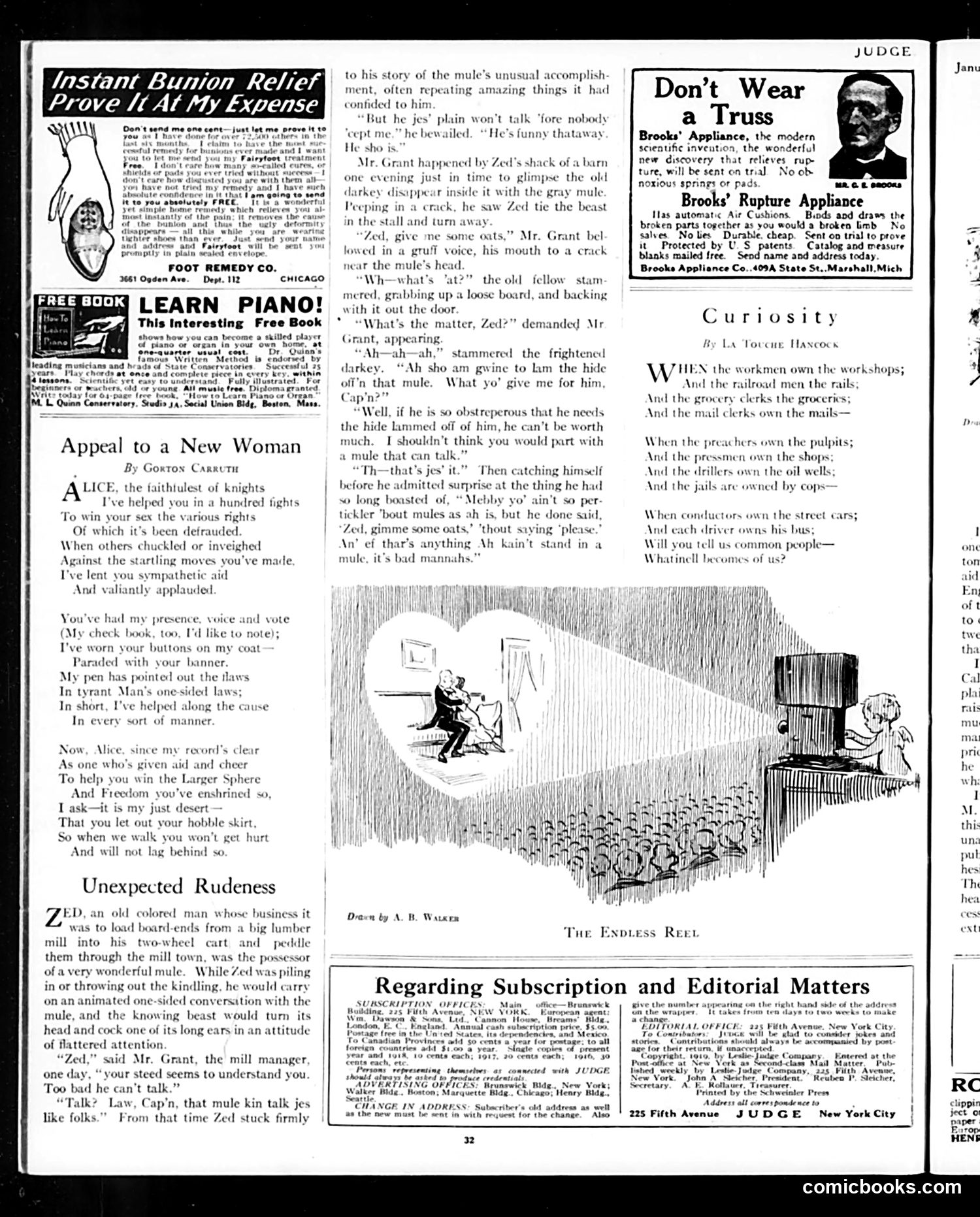
This page contains primarily **advertisements and light satirical fiction** rather than political cartoons. The main illustrated story, "Unexpected Rudeness," is a racial dialect comedy about an African American man named Zed who claims his mule can talk. When a mill manager investigates, he catches Zed about to beat the animal—Zed then fabricates an excuse that the mule was rude, saying "gimme some oats" without saying "please." The joke relies on racial stereotypes common to the era: the "credulous Black character" deceiving his white employer through implausible claims. The poem "Appeal to a New Woman" by Gordon Carruth addresses "Alice" (likely Alice Paul or the suffrage movement generally), sarcastically praising male support for women's rights while requesting women stop wearing restrictive "hobble skirts" so they won't slow down male companions. "Curiosity," a brief poem by La Touche Hancock, appears to be social commentary about worker ownership. The page is largely **filler content, advertisements** (bunion relief, piano lessons, rupture appliances), and subscription information.
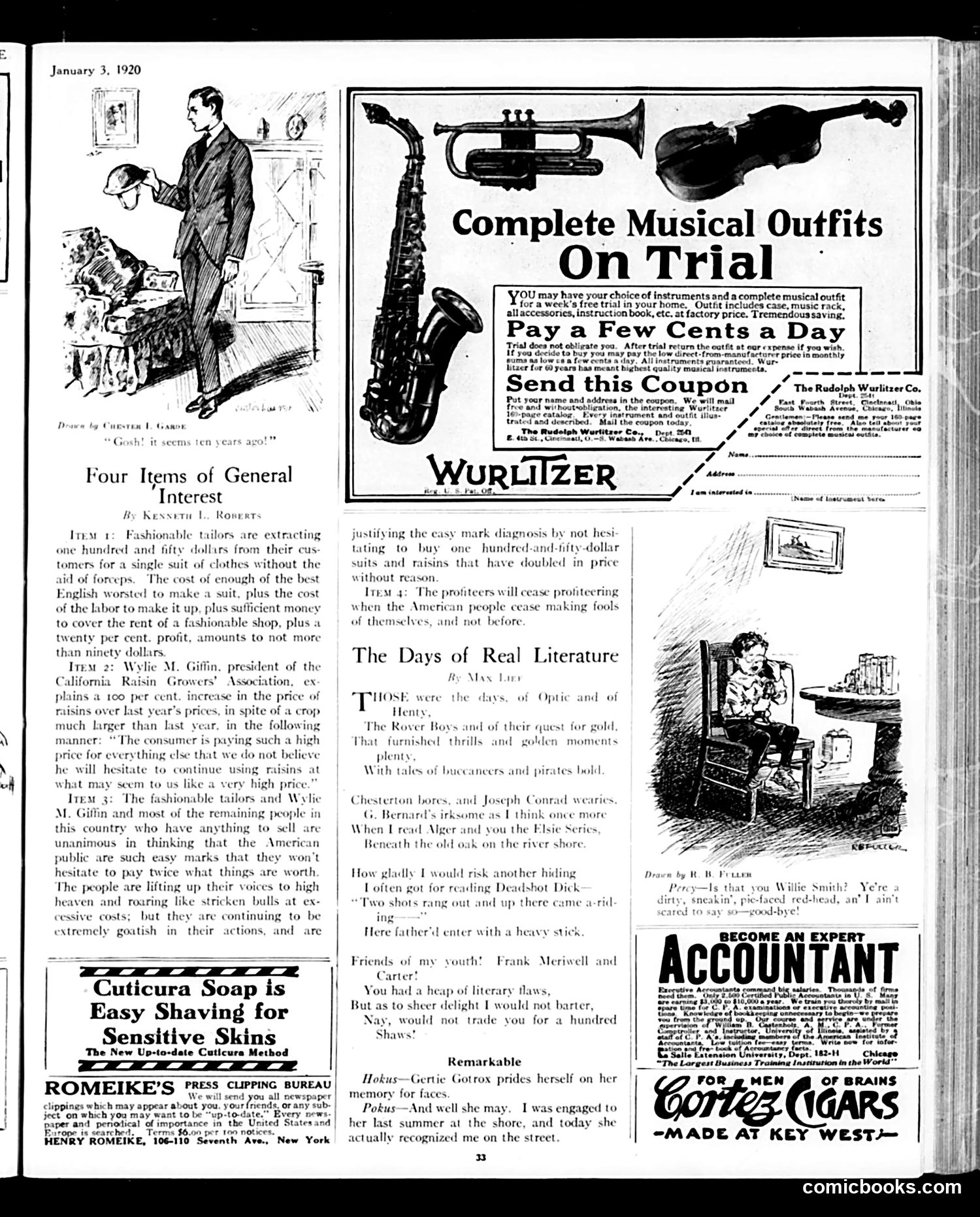
The main cartoon on this page satirizes post-World War I American consumer behavior and profiteering. Titled "Four Items of General Interest," it targets three groups exploiting public desperation: fashionable tailors charging $150 for suits costing $90 in materials and labor, raisin growers doubling prices despite larger crops, and profiteers generally. The satire's sharp point: Americans loudly complain about "excessive costs" yet paradoxically continue purchasing at inflated prices, making themselves "easy marks." The author (Kenneth L. Roberts) argues this irrational behavior—people "roaring like stricken bulls" while acting "extremely goatish"—enables continued profiteering. The cartoon exposes the gap between public complaint and consumer action, suggesting Americans deserve the exploitation they receive through their own market choices. This reflects genuine 1920 post-war inflation anxieties and criticism of wartime profiteers.
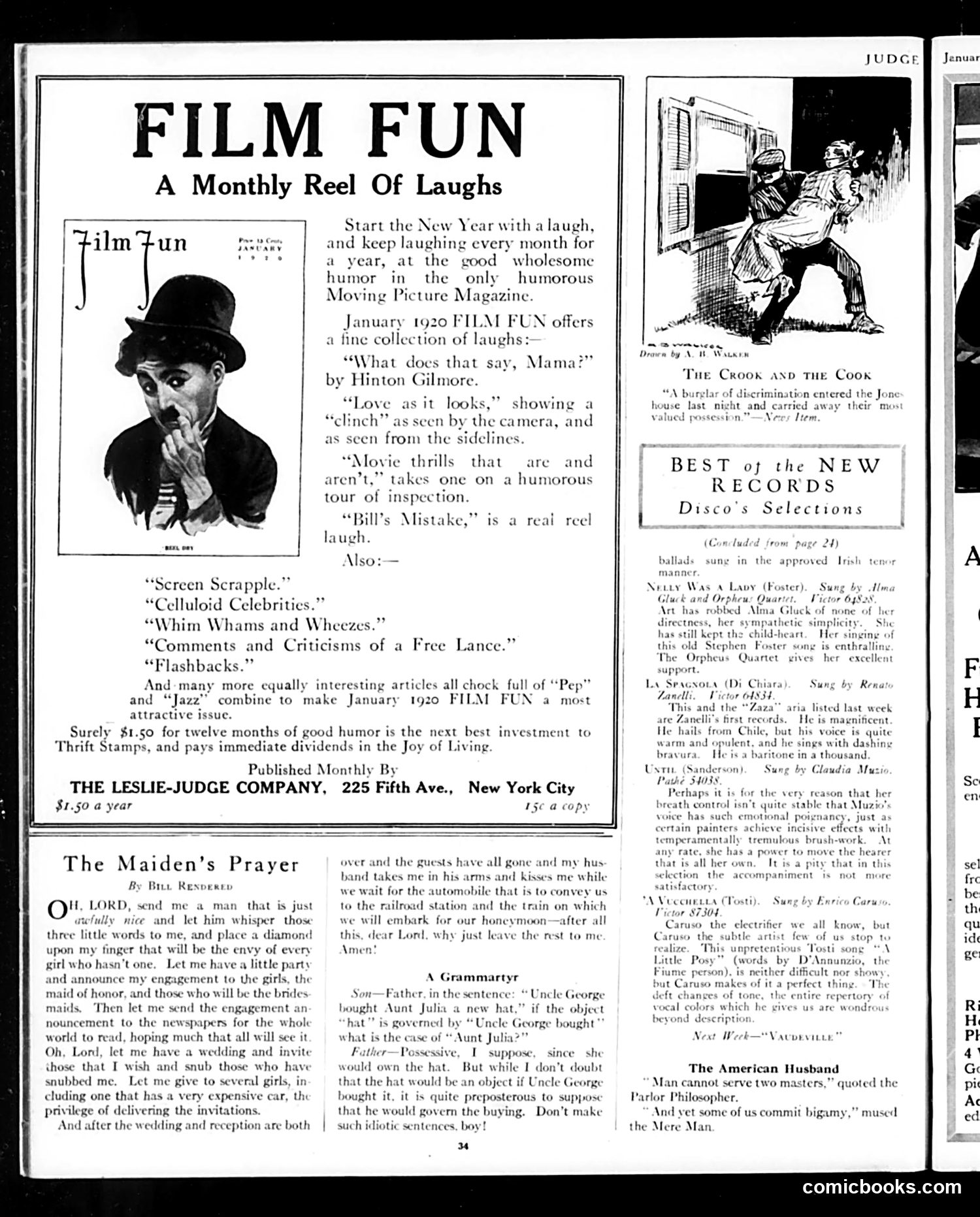
This is primarily an **advertisement page** for *Film Fun*, a 1920 humor magazine devoted to comedic film content. The main image shows a **Charlie Chaplin-like "Tramp" character**—the iconic bowler-hatted everyman figure popular in silent comedy. The page advertises *Film Fun*'s January 1920 issue, listing humorous short articles with titles like "Screen Scrapple" and "Celluloid Celebrities." References to "Pep" and "Jazz" reflect 1920s slang for energy and modernity. Below the advertisement are unrelated pieces: "The Maiden's Prayer" (a sentimental parody of feminine wedding fantasies) and "A Grammartyr" (a grammar lesson disguised as humor, mocking awkward sentence construction). The right column shows record reviews and film stills, including *The Crook and the Cook*. **Context**: This reflects Judge magazine's mixed content—advertisements, humor, and cultural commentary aimed at middle-class readers seeking affordable entertainment during the silent film era.
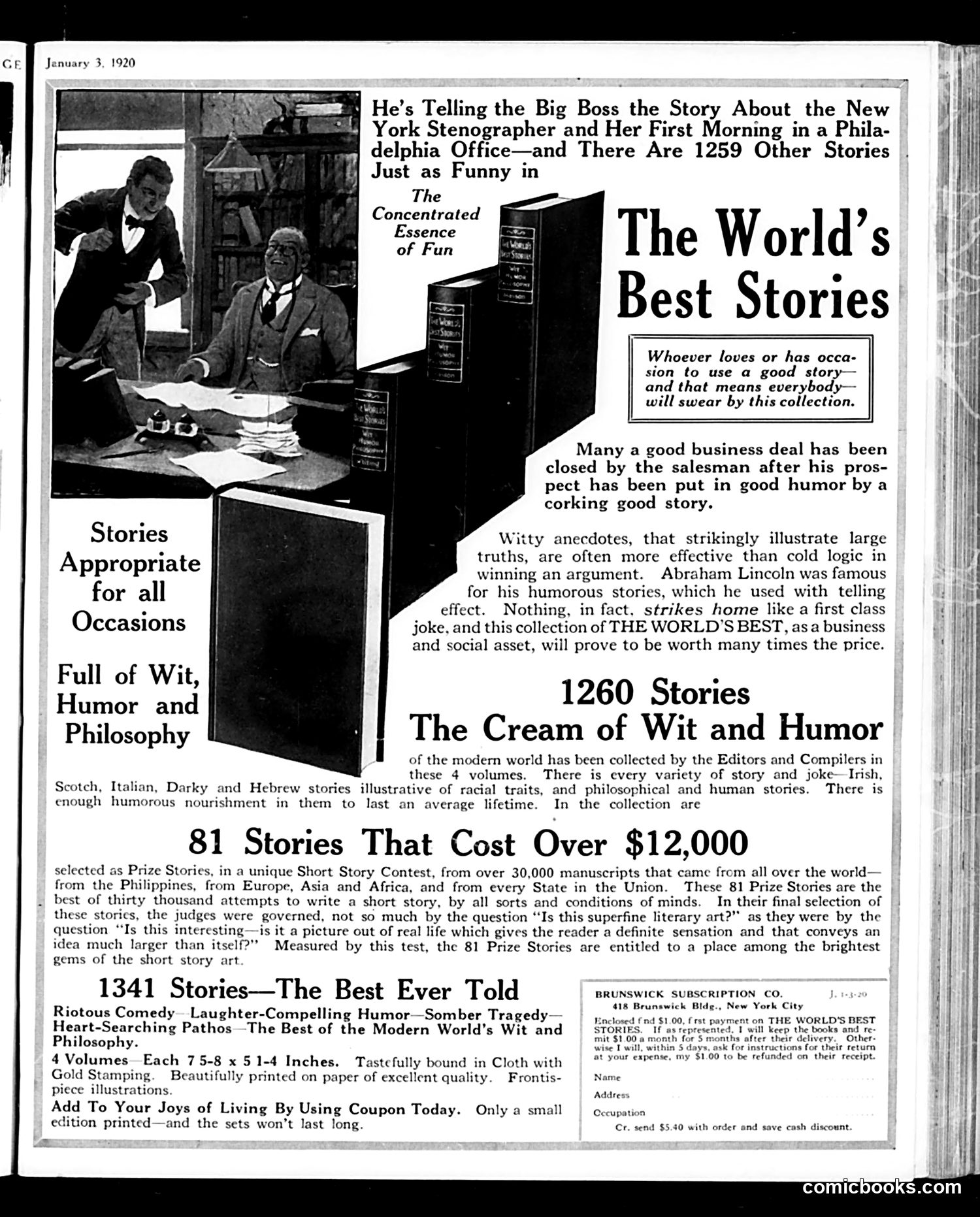
This page is primarily **advertising**, not political satire. It promotes "The World's Best Stories," a 4-volume collection of 1,260+ anecdotes and jokes. The illustration shows a typical office scene: a junior employee (likely a stenographer or clerk) telling stories to his boss at a desk—the ad's premise being that good storytelling closes business deals and wins arguments. The text references **period-specific ethnic humor**: the collection includes "Irish, Scotch, Italian, Darky and Hebrew stories illustrative of racial traits." This language reflects early-20th-century publishing conventions; such stereotyped ethnic jokes were marketed as family entertainment. The ad emphasizes practical value: comparing humor to Lincoln's rhetorical strategy, it positions witty anecdotes as business tools. The collection reportedly cost $12,000 in prize money—positioning it as prestigious. This is a **sales pitch dressed as editorial content**, exploiting the magazine's satirical credibility to market a humor compendium to middle-class readers.
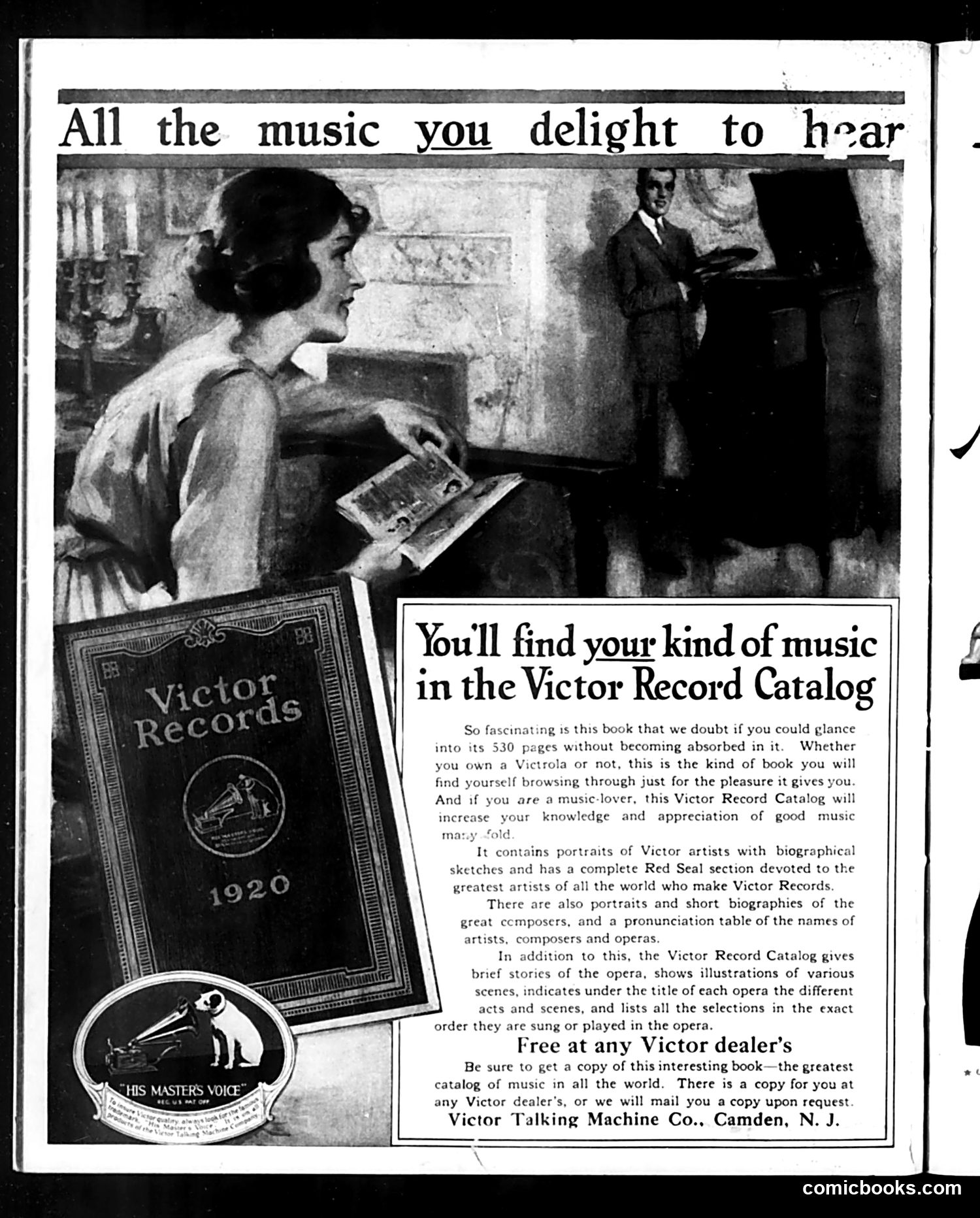
This is a full-page advertisement, not satire. It promotes Victor's 1920 Record Catalog to potential phonograph buyers. The image shows a woman browsing the 530-page catalog while a man operates a Victrola (Victor's phonograph brand) in the background. The ad emphasizes the catalog's comprehensiveness: it contains artist portraits, composer biographies, opera descriptions with scene illustrations, and a pronunciation guide. The "His Master's Voice" logo (the dog listening to a phonograph) appears prominently, Victor's famous trademark. The pitch targets "music-lovers" by positioning the catalog as both a practical shopping guide and an educational volume that increases "knowledge and appreciation of good music"—appealing to middle-class aspirations for cultural refinement through recorded music, a relatively new consumer technology in 1920.