
Judge, 1920-01-03 · page 5 of 36
Judge — January 3, 1920 — page 5: what you’re looking at
What you’re looking at
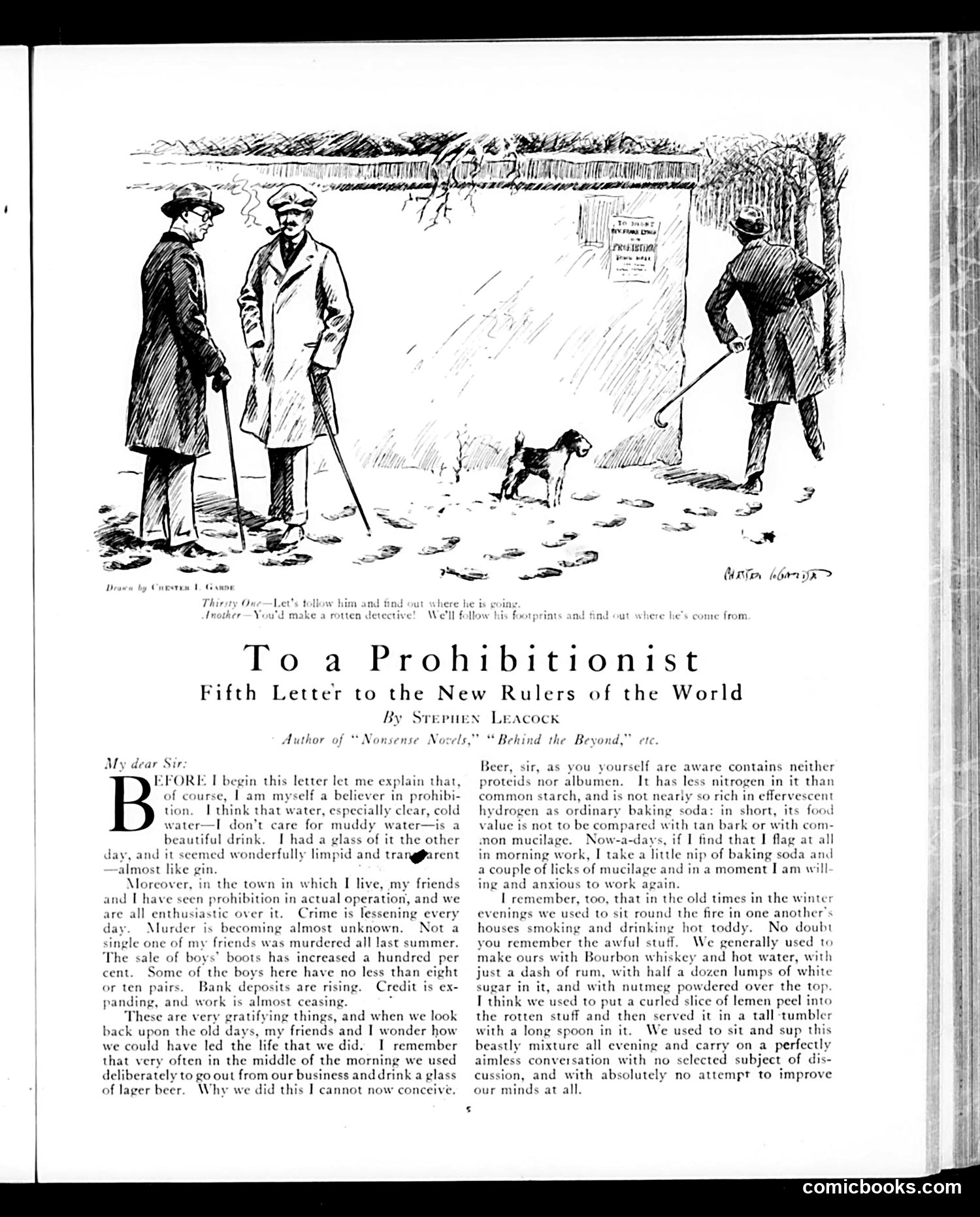
This is a satirical illustration paired with Stephen Leacock's essay "To a Prohibitionist." The cartoon depicts three well-dressed men and a small dog examining footprints in snow or ground, with one man saying they should "follow his footprints and find out where he is going." The satire targets **Prohibition enforcement**—the effort to track and arrest alcohol violators. The cartoon mocks the absurdity of prohibition detective work, suggesting the authorities' methods are comically inadequate. Leacock's accompanying essay argues **against Prohibition**, contrasting the social benefits of alcohol (beer, whisky, rum drinks) in pre-Prohibition times with Prohibition's effects: rising crime, increased arrests, and prohibition's failure to actually stop drinking. He portrays alcohol consumption as harmless compared to the social chaos Prohibition created.
📄 Transcribed text from this page (OCR, searchable)
Machine-transcribed from the original scan — historical spelling and the odd misread are preserved.
CY BEM es, or of * Nonsense My dear Sir: EFORE I begin this letter let me explain that, of course, | am myself a believer in prohibi- tion. I think that water, especially clear, cold | water—I don’t care for muddy water—is a beautiful drink. I had a glass of it the other day, and it seemed wonderfully limpid and trangfarent almost like gin. Moreover, in the town in which I live, my friends and [ have seen prohibition in actual operation, and we are all enthusiastic over it. Crime is lessening every day. Murder is becoming almost unknown. Not a single one of my friends was murdered all last summer. The sale of boys’ boots has increased a hundred per cent. Some of the boys here have no less than eight or ten pairs. Bank deposits are rising. Credit is ex- panding, and work is almost ceasing. ' These are very gratifying things, and when we look back upon the old days, my friends and I wonder how we could have led the life that we did. I remember that very often in the middle of the morning we used deliberately to go out from our business anddrink a glass | of lager beer. Why we did this I cannot now conceive. To a Prohi Fifth Letter to the New Novels,” CMON AA LP elles a ¥ i fev res ome } HUD ieee) 7 MERIT? oa Ww mon mucilage. Now-a-days, if I find that I flag at all in morning work, I take a little nip of baking soda and 7 a couple of licks of mucilage and in a moment I am will ing and anxious to work again. H i ii fi = e x Car Gar igR> qi [ e's conre from. i ] bitionist at i] Rulers of the World | By Srepunn Leacock | “Behind the Beyond,” ete. Beer, sir, as you yourself are aware contains neither proteids nor albumen. It has less nitrogen in it than f common starch, and is not nearly so rich in effervescent I hydrogen as ordinary baking soda: in short, its food i value is not to be compared with tan bark or with com- | | I remember, too, that in the old times in the winter ] evenings we used to sit round the fire in one another's a houses smoking and drinking hot toddy. No doubt + you remember the awful stuff. We generally used to | make ours with Bourbon whiskey and hot water, with i just a dash of rum, with half a dozen lumps of white sugar in it, and with nutmeg powdered over the top I think we used to put a curled slice of lemen peel into the rotten stuff and then served it in a tall tumbler with a long spoon in it. We used to sit and sup this 1 beastly mixture all evening and carry on a perfectly { aimless conversation with no selected subject of dis- 4 cussion, and with absolutely no attempt to improve our minds at all. comicbooks.com