
A complete issue · 36 pages · 1919
Judge — August 23, 1919
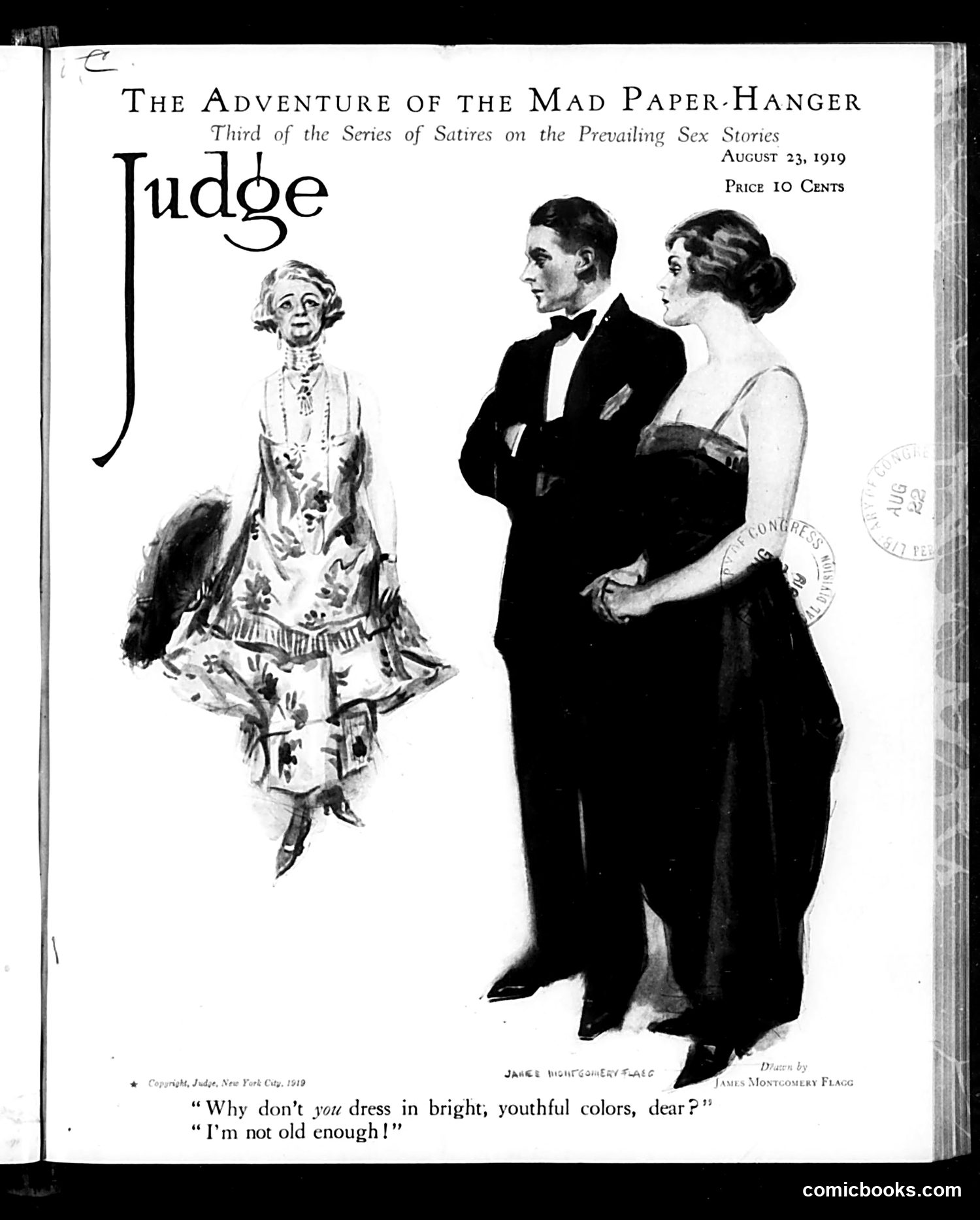
This satirical cartoon depicts a social critique about aging women and fashion. A well-dressed couple in formal evening wear (tuxedo and dark gown) are addressing an older woman in a floral, youthful-styled dress. The man asks why she doesn't "dress in bright, youthful colors, dear," to which she replies "I'm not old enough!" The satire targets contradictory social expectations: women are pressured to dress youthfully to remain attractive, yet the older woman's response suggests this pressure is absurd—she claims insufficient age to justify conservative dress, implying the standards themselves are ridiculous. This reflects early 20th-century anxieties about aging, femininity, and fashion conventions, mocking both the unrealistic expectations placed on women and women's internalization of these standards.
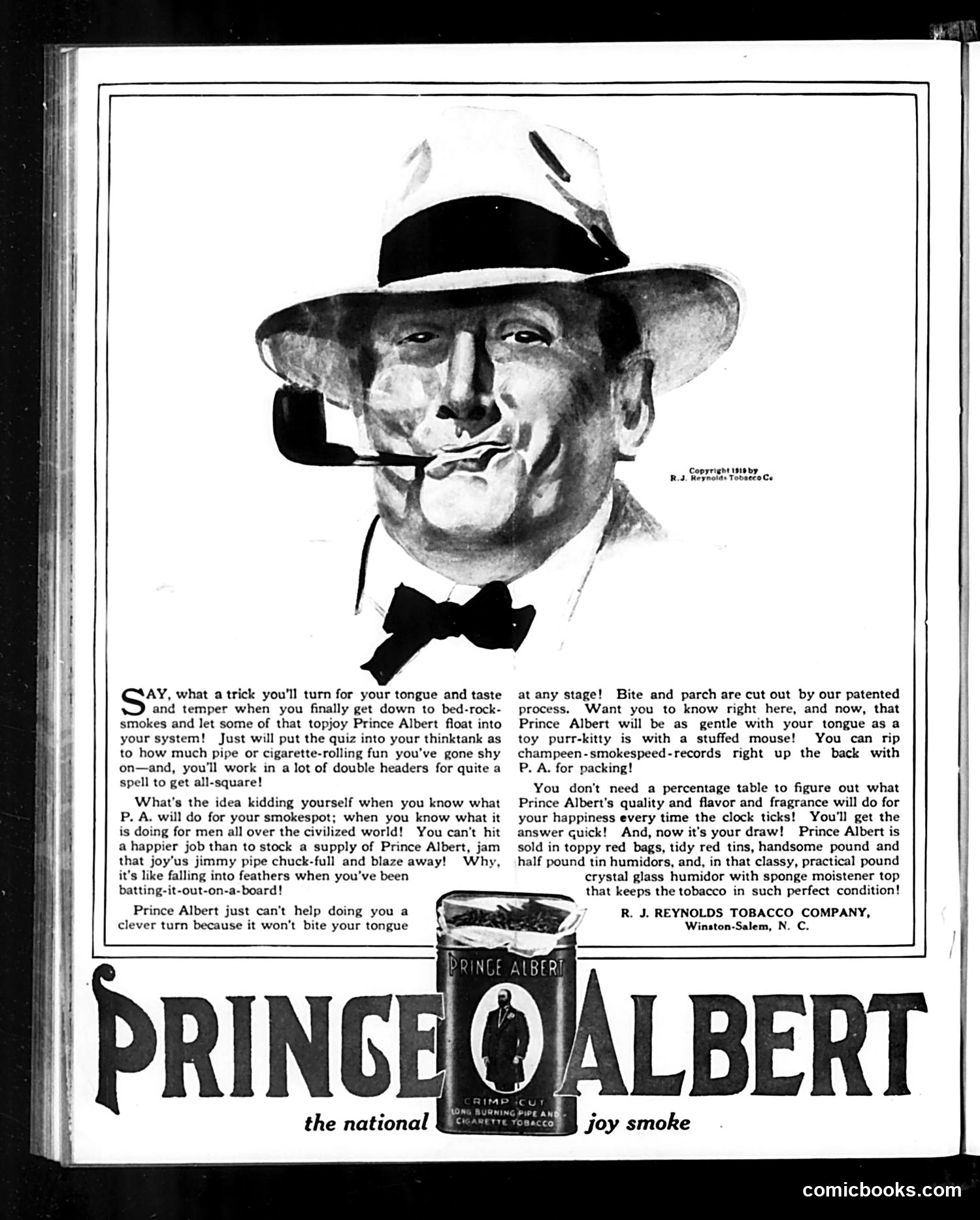
This page is **primarily a tobacco advertisement**, not satire or political commentary. It advertises Prince Albert pipe and cigarette tobacco, published by R.J. Reynolds Tobacco Company of Winston-Salem, North Carolina. The illustration depicts a man with an exaggerated nose wearing a wide-brimmed hat and smoking a pipe. The accompanying text uses playful language to market the product's qualities—claiming it won't bite the tongue, offers pleasant flavor, and comes in attractive packaging with a humidor. The "trick" referenced is simply the product's claimed advantage: Prince Albert tobacco allegedly provides superior smoking comfort compared to competitors. This represents standard early 20th-century advertising hyperbole rather than political satire or social commentary.
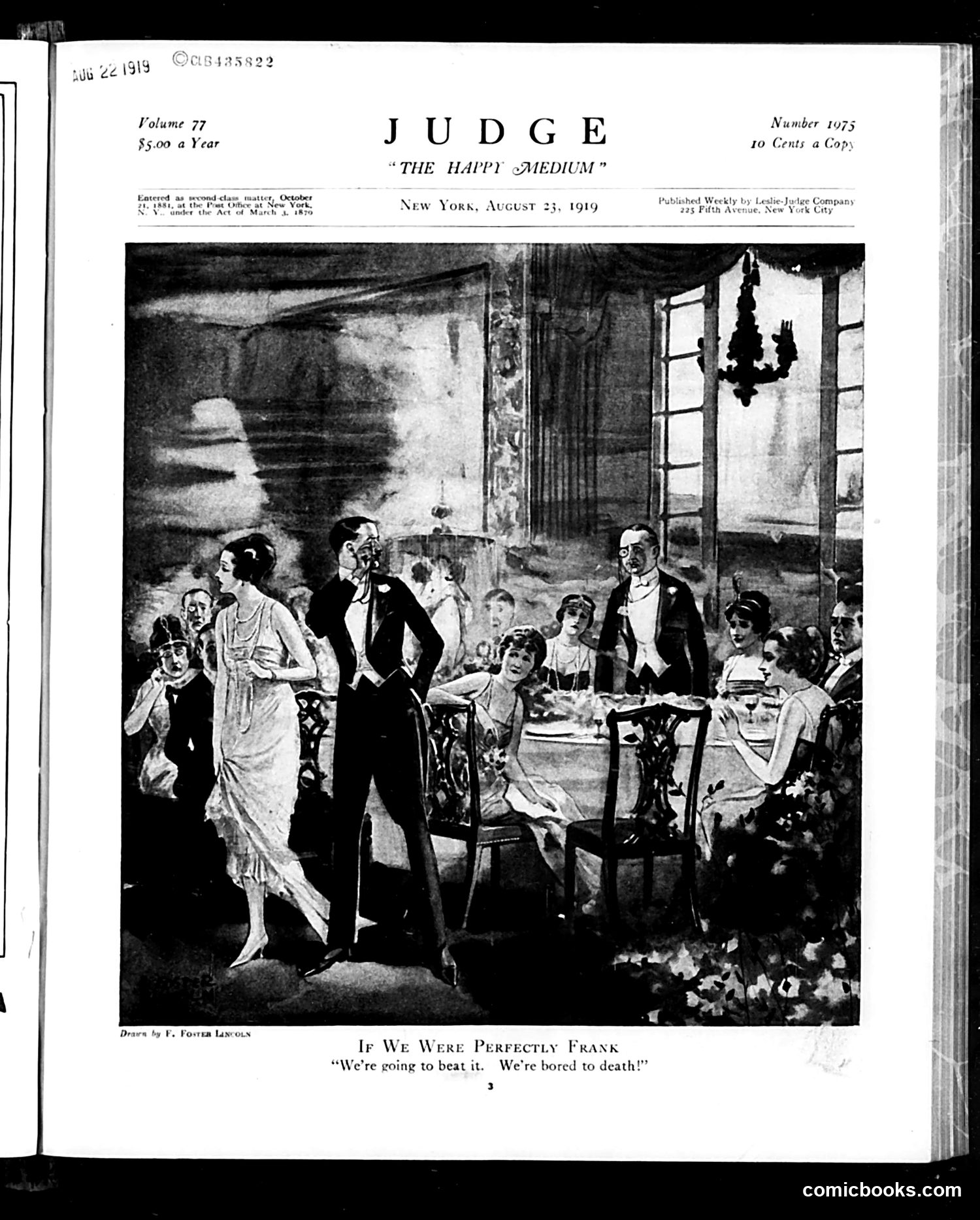
This Judge magazine page from August 23, 1919 presents a satirical drawing by F. Forain Lawson depicting a formal dinner party scene. The caption quotes partygoers saying "We're going to beat it. We're bored to death!"—a frank admission of the tedium underlying polite high-society gatherings. The satire targets the artificiality of upper-class social conventions in post-WWI America. Guests dressed formally sit around an elegant table in what appears to be a mansion, yet the humor lies in exposing the disconnect between outward propriety and inner ennui. The joke suggests that wealthy society events are obligatory but genuinely dull—a critique of superficial social rituals masking genuine disinterest and disconnection among attendees.
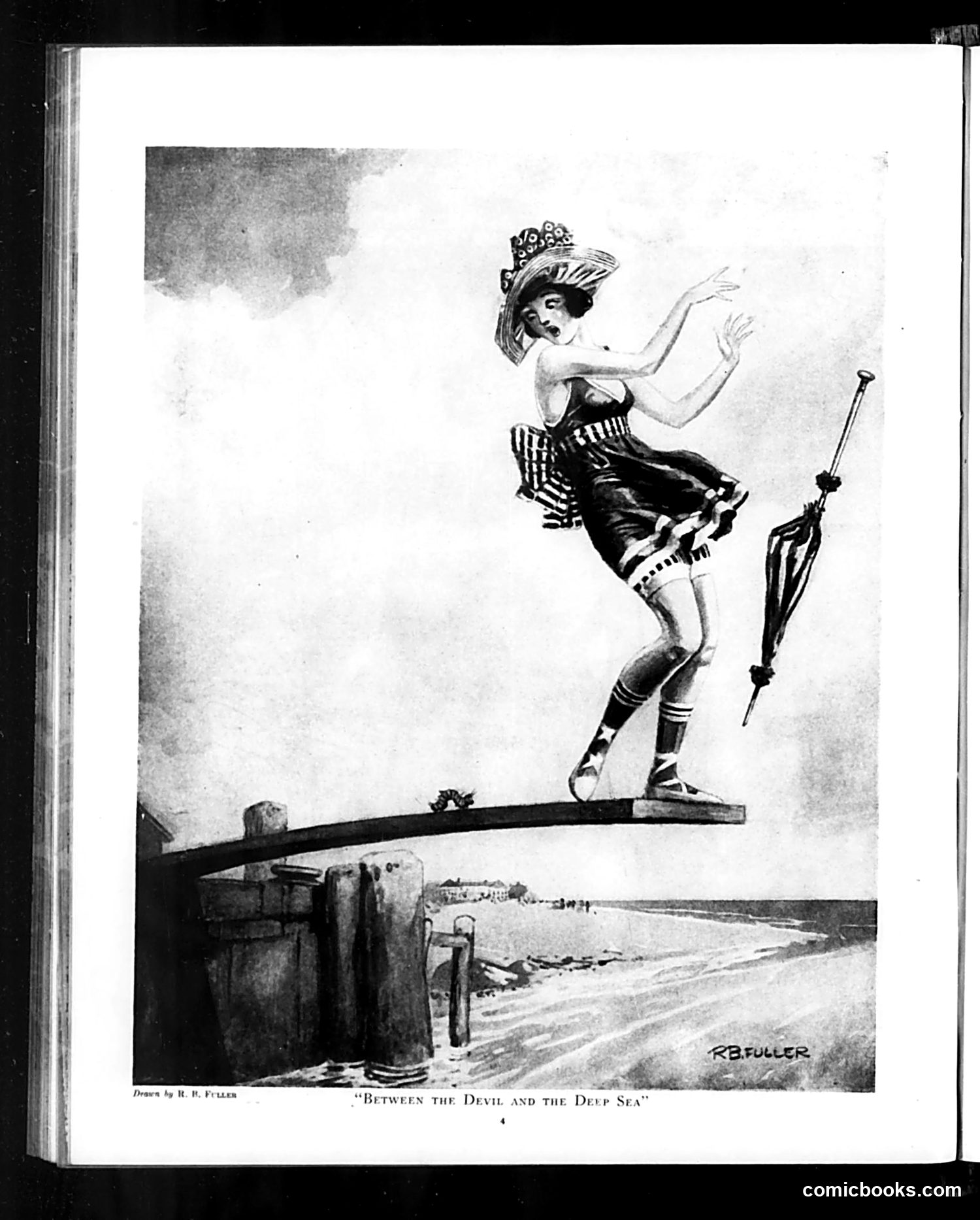
This illustration by R.B. Fuller depicts a woman in fashionable Edwardian dress performing a precarious balancing act on a seesaw or plank. She stands with arms raised, holding a parasol, positioned above what appears to be military fortifications and a coastal landscape. The title "Between the Devil and the Deep Sea" is a period idiom meaning caught between two dangerous alternatives with no good options. The cartoon likely satirizes a woman's constrained social position or difficult political circumstances of the era. The provocative costume and theatrical pose suggest commentary on female independence, sexuality, or social expectations. Without additional context, the specific political or social reference remains unclear, though the imagery implies precarious circumstances for women navigating societal constraints.
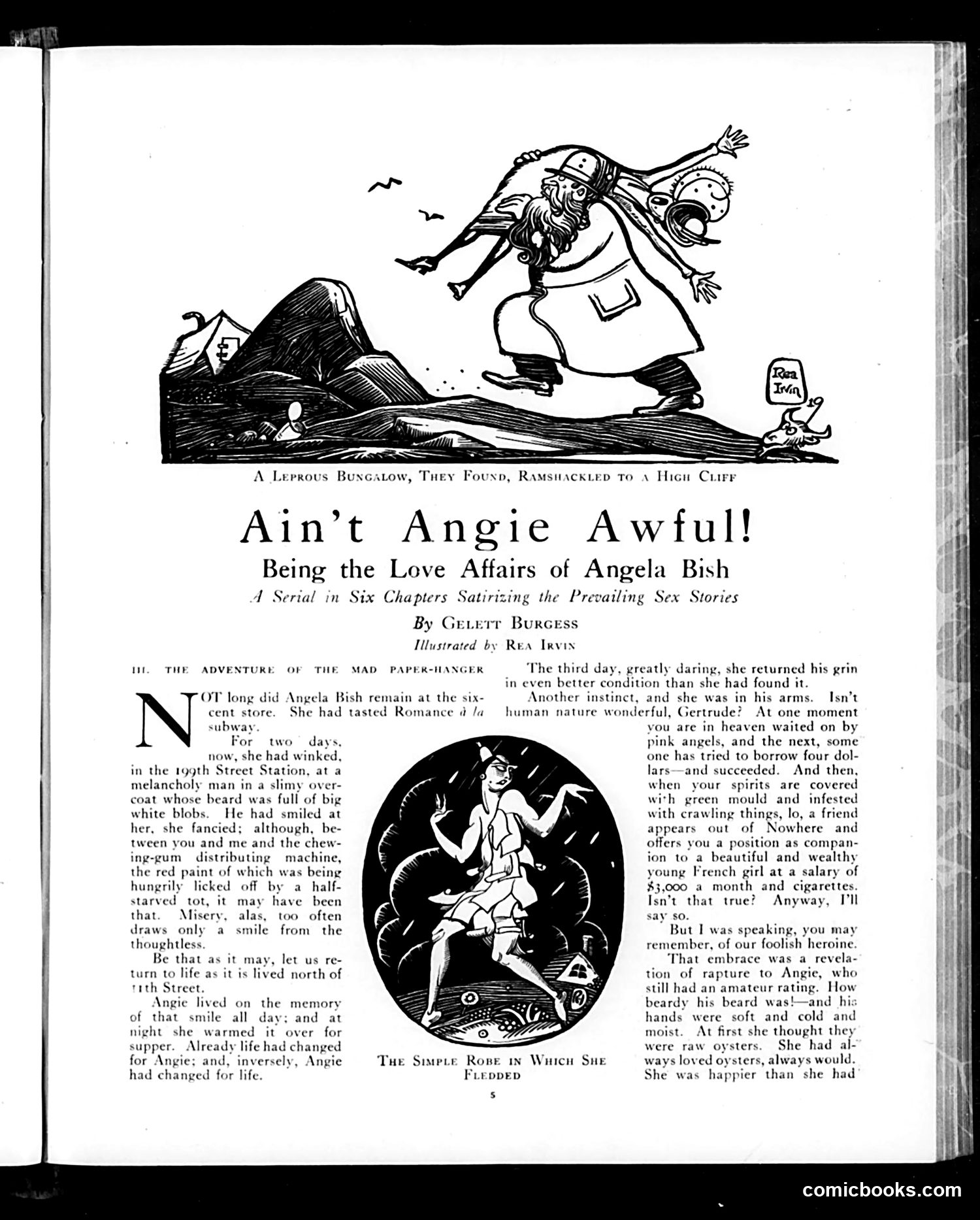
This page features a satirical serial called "Ain't Angie Awful!" about the romantic misadventures of a character named Angela Bish. The illustration shows a bearded man in old-fashioned dress carrying a woman, captioned "The Simple Robe in Which She Fludded." The satire targets prevailing sexual attitudes and romance fiction of the era. The text mocks Angela's romantic escapades—she's been living in a subway, briefly romanced by a slovenly man, then abandoned. The narrator sarcastically celebrates her "change" from the encounter, noting she's now willing to accept any offer, including a position as companion to a wealthy young Frenchwoman. The humor relies on mocking both the character's desperation and period romance tropes. Without identifying specific references, this appears to be general satire of contemporary romance narratives and women's precarious economic situations.
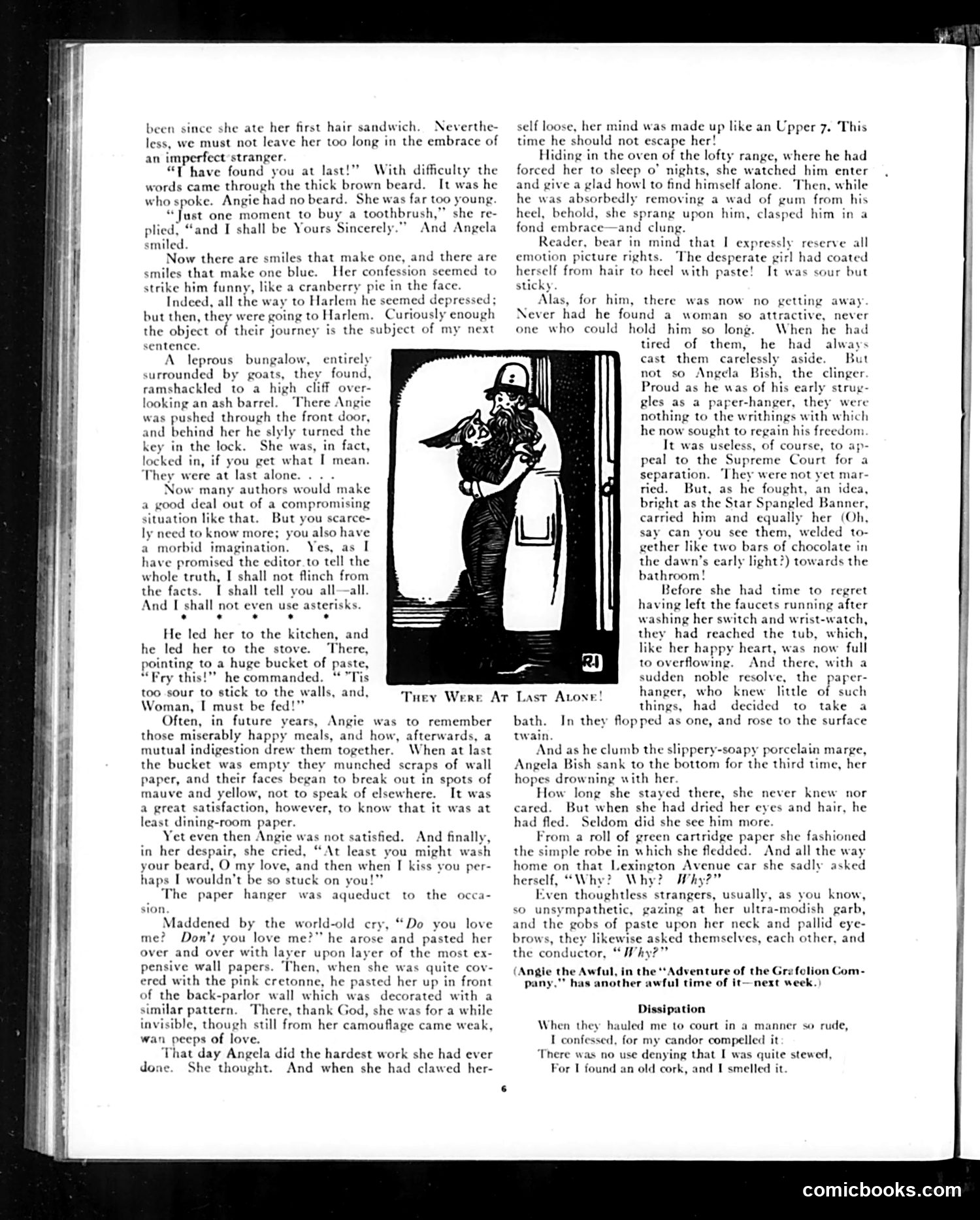
This page contains a serialized story titled "Angie the Awful, the Adventurer of the Gracious Company" (continuing next week). The main illustration shows a woman in what appears to be early 20th-century dress at a bathroom sink or tub, suggesting domestic comedy. The narrative describes a romantic relationship between two characters—a man and "Angela"—involving domestic struggles and reconciliation. The story emphasizes period-appropriate gender dynamics, with references to hairstyles, clothing, and courtship rituals typical of the era. At bottom, there's a short poem titled "Dissipation" about candor in court proceedings. **Note**: This appears to be primarily serialized fiction rather than political satire. The humor derives from domestic situations and character personality rather than social commentary.
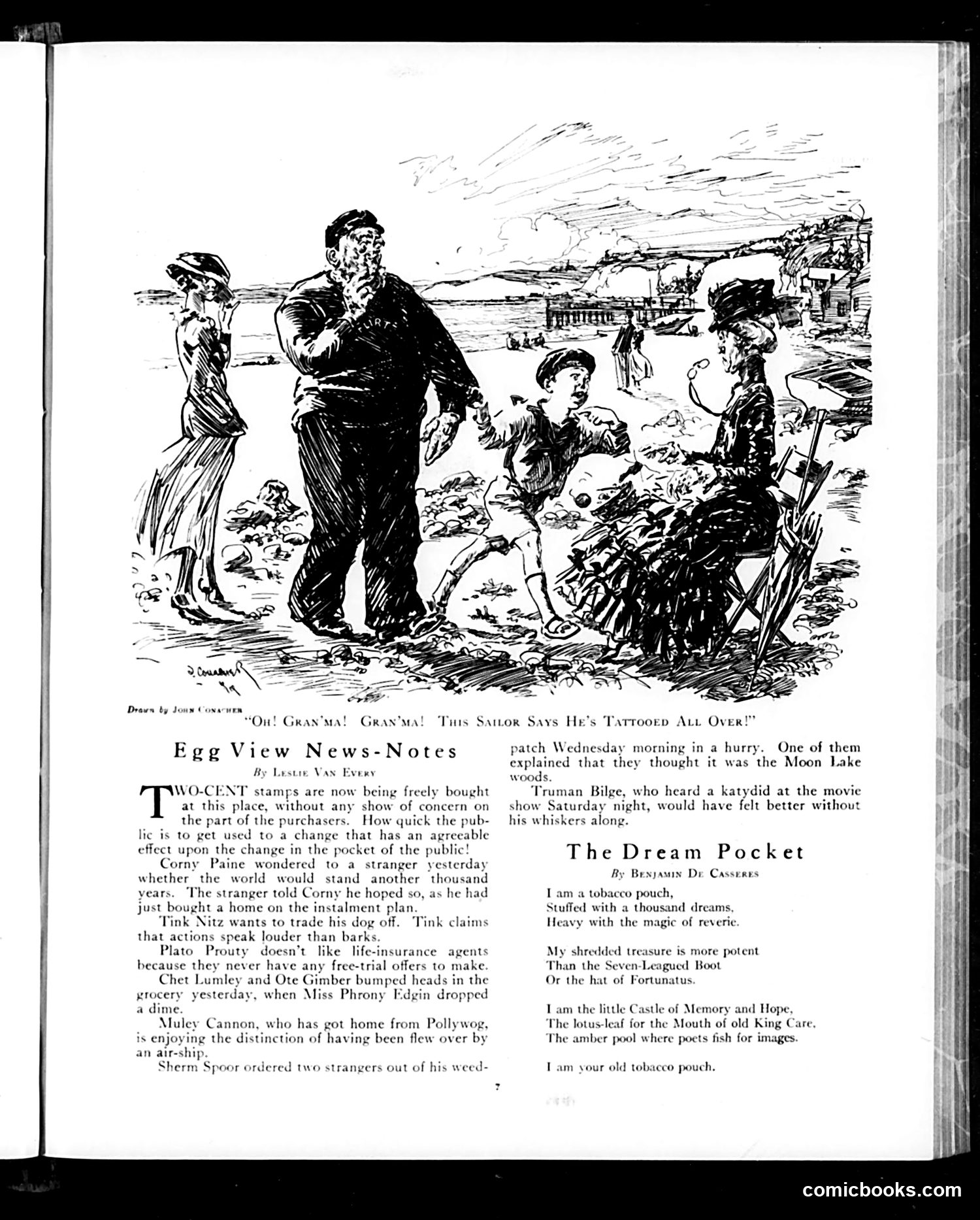
The cartoon depicts a humorous beach scene where a grandmother is being startled by her grandchild's excited report that "This Sailor Says He's Tattooed All Over!" The joke plays on the grandmother's assumed prudishness and shock at such a revelation—a common comedic trope of the era mocking older generations' sensibilities about tattoos and sailors' reputations. Below, the "Egg View News-Notes" section contains mild small-town gossip and humor: two-cent stamps being adopted without public concern, someone wanting to trade his dog, insurance agents being bothersome, and a man ordering strangers from his property thinking they'd wandered into different woods. The page also includes "The Dream Pocket," a sentimental poem personifying a tobacco pouch as a repository of memory and imagination—typical of Judge's literary content balancing satire with whimsy. Overall, this reflects early 20th-century middle-class American humor: mild social commentary, small-town eccentricity, and nostalgic sentimentality.
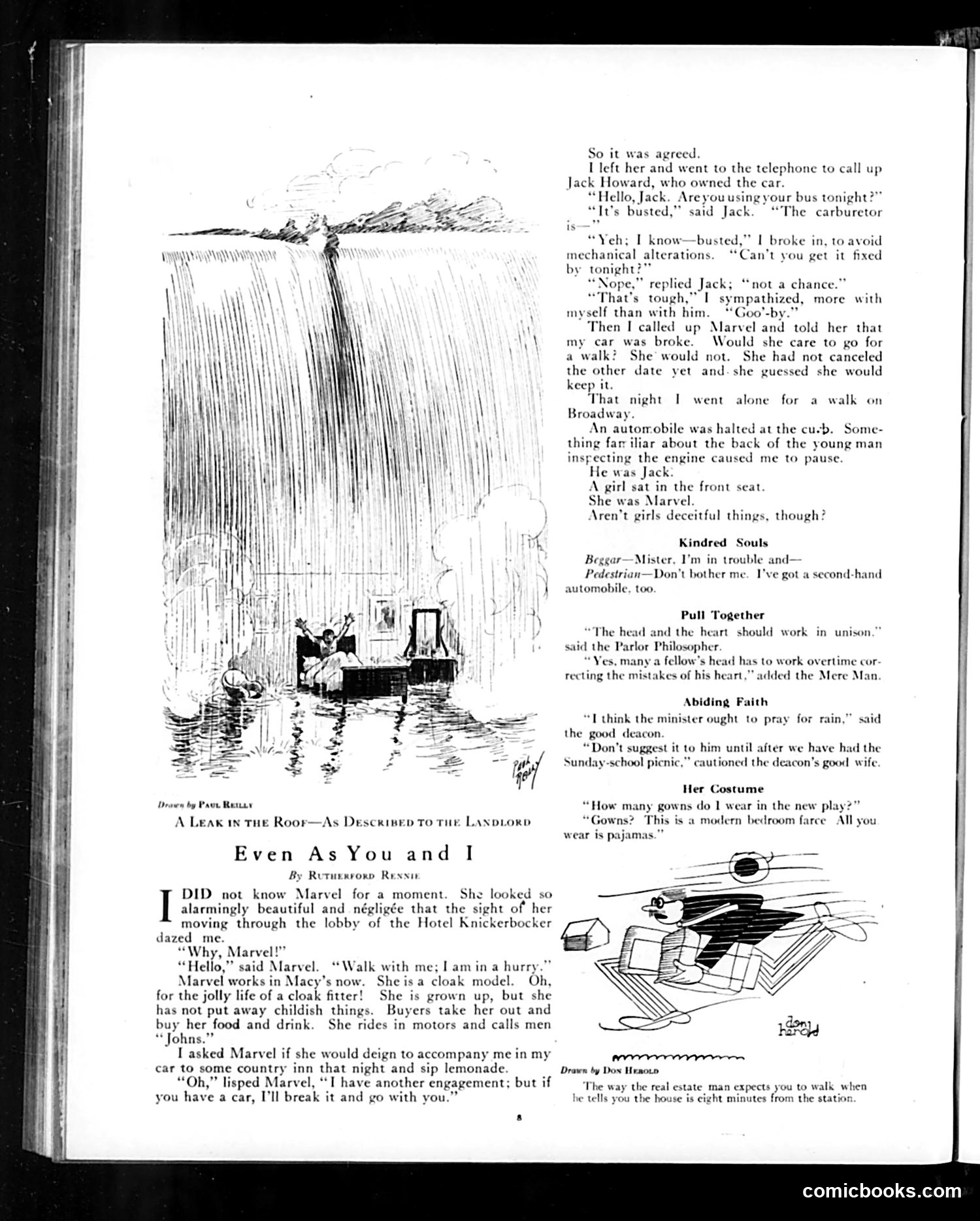
This story-with-illustrations satirizes the romantic deceptions of modern urban dating in the early 20th century. The narrator asks a beautiful young woman named Marvel—who works as a cloak model at Macy's—to accompany him to a country inn. She declines, claiming another engagement, but offers to break her plans if he has a car. When his car proves broken, she refuses the walk. The joke: the narrator later spots Marvel riding in *that very car* with another man (Jack Howard, the car's owner). The satire mocks women's duplicity and mercenary nature—Marvel's interest shifts instantly based on material advantage (the automobile), exposing her "childish" superficiality despite her grown appearance. The accompanying comic panels reinforce themes of deception and self-interest in modern relationships and social interactions. The overall tone is gently cynical about contemporary courtship and female opportunism.
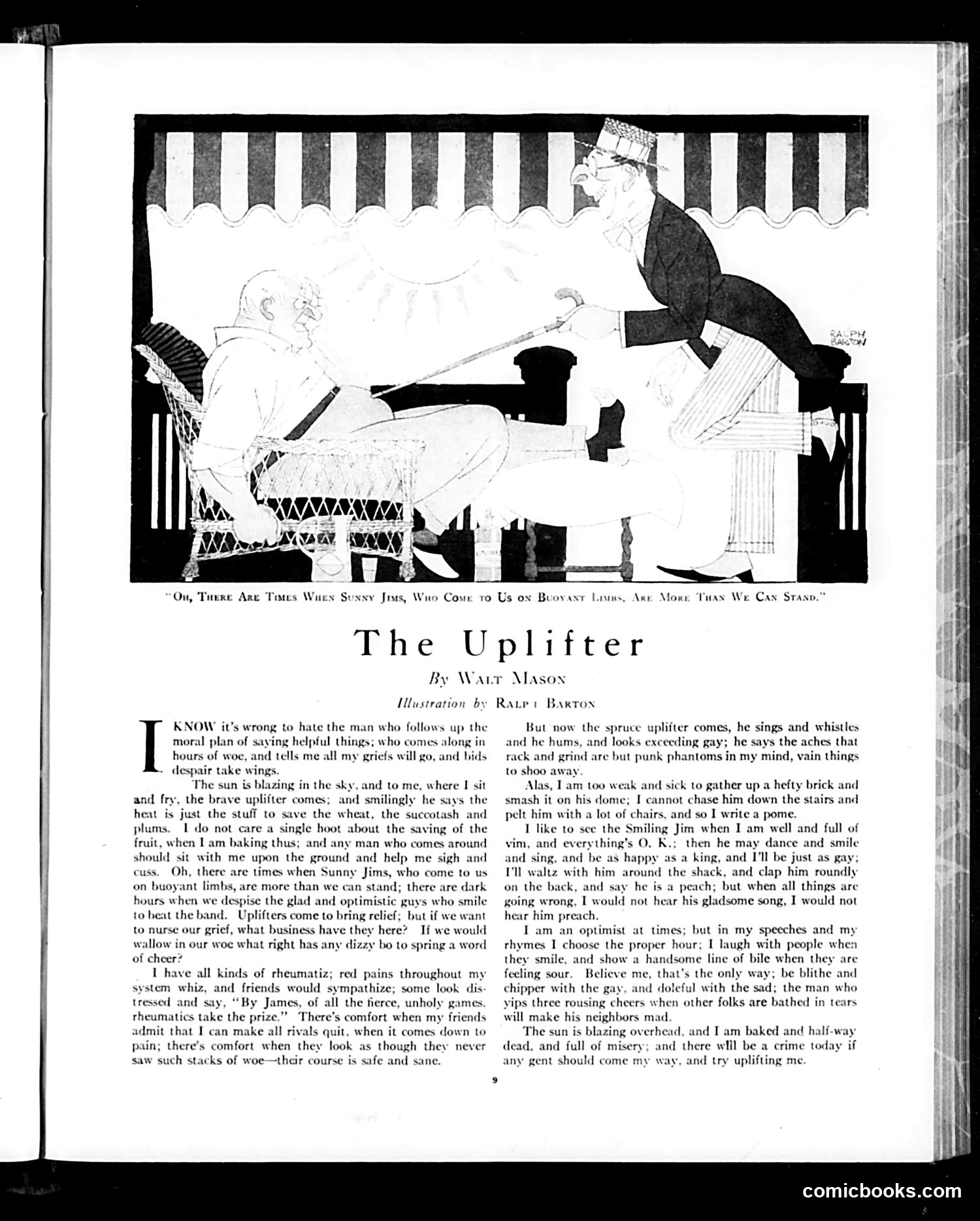
This is a humorous poem by Walt Mason, illustrated by Ralph Barton, satirizing the "Pollyanna" personality type—what the text calls "Sunny Jims." The cartoon depicts a cheerful, relentlessly optimistic man visiting someone suffering in the heat, insisting their misery has a silver lining. The satire targets forced positivity and toxic cheerfulness. Mason argues that constant optimism is inappropriate and unwelcome during genuine hardship. He distinguishes between *appropriate* optimism (sharing joy with the happy) and *inappropriate* optimism (lecturing the suffering). The "uplifter" who arrives with unsolicited encouragement ("the aches that rack and grind are but punk phantoms") exemplifies social rudeness masquerading as helpfulness. The joke: sometimes people simply need sympathy and permission to suffer, not motivational speeches. The exasperated narrator threatens violence, suggesting how intensely annoying such relentless cheerfulness becomes during real pain.
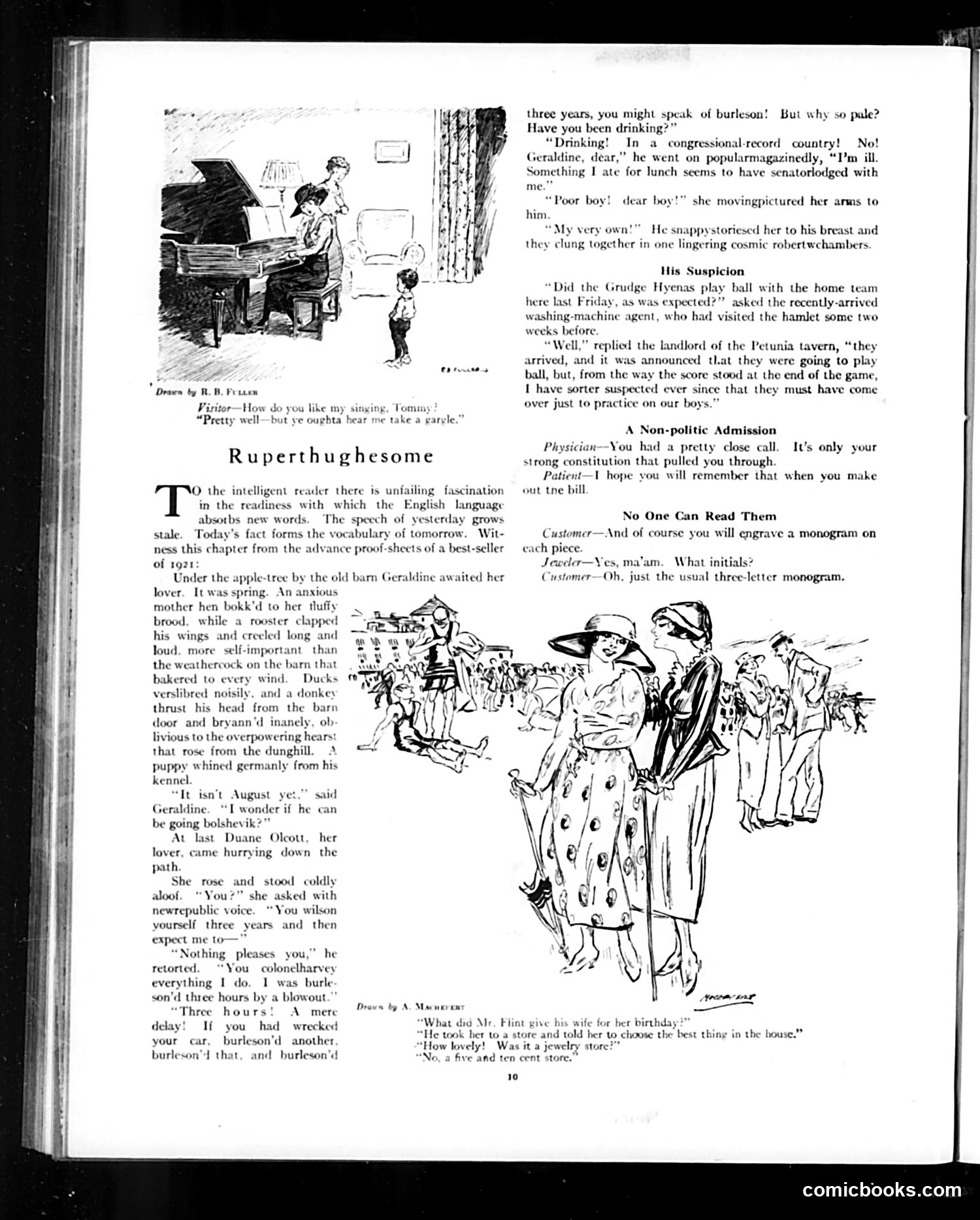
This page from *Judge* satirizes how rapidly new words enter English vocabulary. The main piece, "Ruperthuggesome," parodies overwrought literary fiction by inserting contemporary political/cultural figures' names as verbs—a humorous critique of how modern language corrupts traditional prose. Examples visible include "senatorlodged," "burleson'd," "bolshevik," and "colonelharvey"—converting names into verbs to create absurd neologisms. Albert Burleson was Postmaster General under Wilson; the reference to "congressional-record country" suggests Prohibition-era government scrutiny. The surrounding short humor pieces mock contemporary social anxieties: a "Non-politic Admission" about doctor's bills, and a joke about incomprehensible three-letter monograms. The satire targets both rapid linguistic change and the pretentiousness of contemporary magazine fiction, suggesting that modern literature and politics have made even plain English incomprehensible.
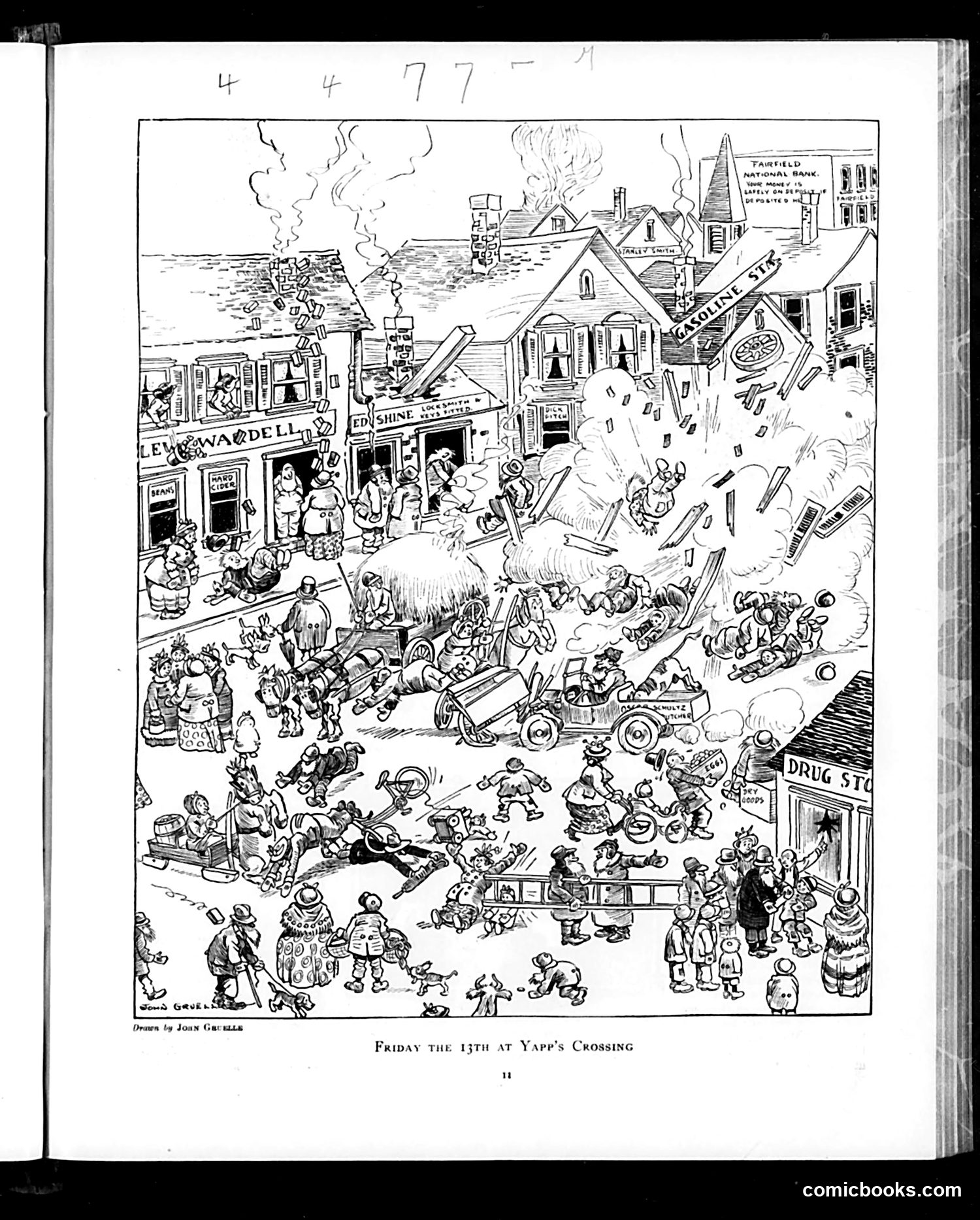
This is a crowded comic scene drawn by John Gruelle depicting chaos and mishaps in a small town street. The illustration shows numerous characters—children, adults, animals, and vehicles—engaged in various comedic disasters: collisions, people falling, items breaking, and general pandemonium. The satire plays on the superstition surrounding Friday the 13th. The cartoonist uses this date as a framework to humorously depict Murphy's Law in action—everything that can go wrong does go wrong simultaneously in this town. Visible storefronts include a drug store and what appears to be a Lewandell business, suggesting this is meant to represent a typical American small town where bad luck strikes indiscriminately across the community. The humor derives from the sheer density of mishaps and the visual gag of universal misfortune on this "unlucky" date.
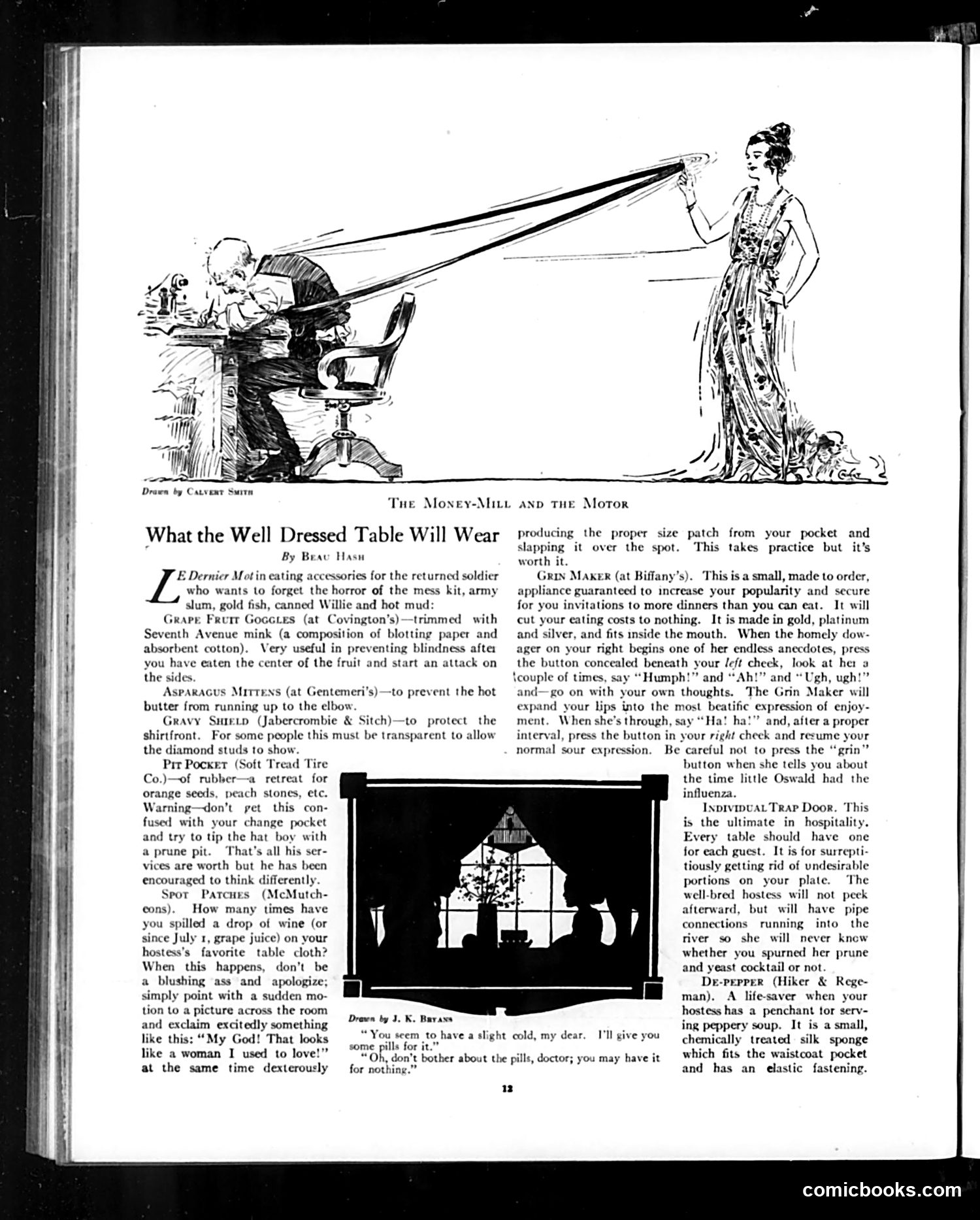
This is a humorous advice column from *Judge* magazine satirizing post-WWI etiquette for soldiers returning to civilian dining. The headline cartoon (drawn by Calvert Smith) shows a woman controlling a man at a dining table with strings—"The Money-Mill and the Motor"—suggesting women manipulate wealthy men through dining situations. The column itself mocks elaborate dining accessories invented to help awkward diners hide social mishaps: fake fur-trimmed goggles to prevent seeing unappetizing food, asparagus mittens to avoid butter burns, a mechanical "grin maker" device that forces smiles during boring conversation, and a trap door to secretly discard unwanted food. The satire targets both newly wealthy soldiers unfamiliar with refined dining customs and the absurdity of upper-class etiquette itself. It suggests that proper dining isn't about genuine courtesy but theatrical deception—you needn't actually listen to your hostess; just fake attention with a mechanical device. The humor mocks the gap between pretended sophistication and reality.
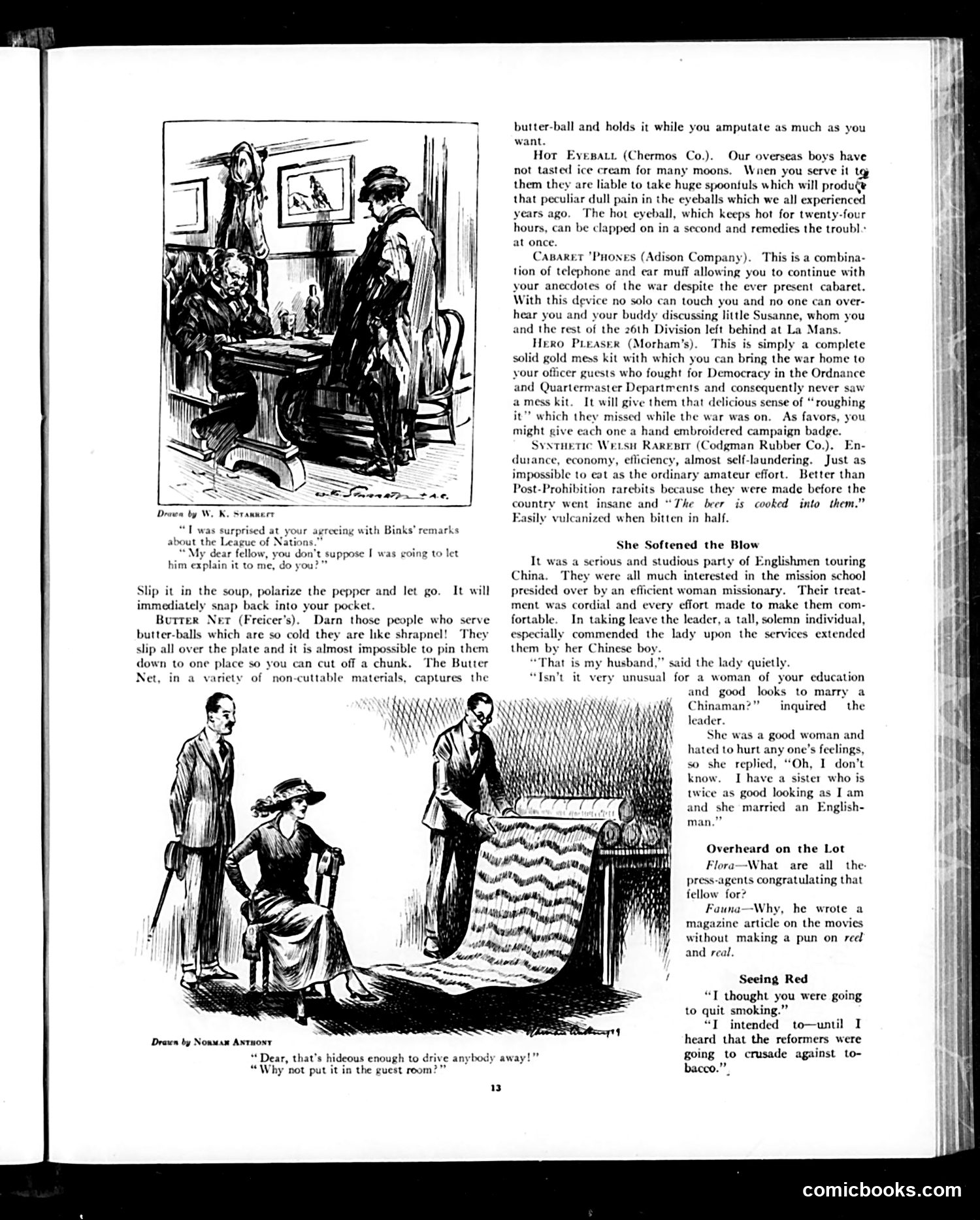
This page contains satirical product advertisements and humorous anecdotes typical of post-WWI American humor. **Top cartoon** (by W.K. Stanmeer): Mocks the League of Nations as incomprehensibly complex. Two men discuss agreeing with someone's remarks about it, with the punchline that one wouldn't let the other "explain it"—suggesting the League's purposes were genuinely baffling to ordinary people. **Middle cartoon** (by Norman Anthony): Shows a couple discussing an ugly decorative object, with the wife suggesting putting it in the guest room—a joke about intentionally displaying eyesores to discourage visitors. **Mock product advertisements**: Parody post-war novelty items (butter nets, hot eyeballs for ice cream headaches, cabaret phones). These satirize both consumer excess and soldiers' recent return from WWI. **Anecdotes**: Include a mild satire on British attitudes toward interracial marriage in China, and a joke about contrarian smoking—someone continuing smoking *because* reformers oppose it. The overall tone reflects 1920s American attitudes: irreverent toward international institutions, mildly xenophobic, and focused on domestic consumer culture and returning soldiers.
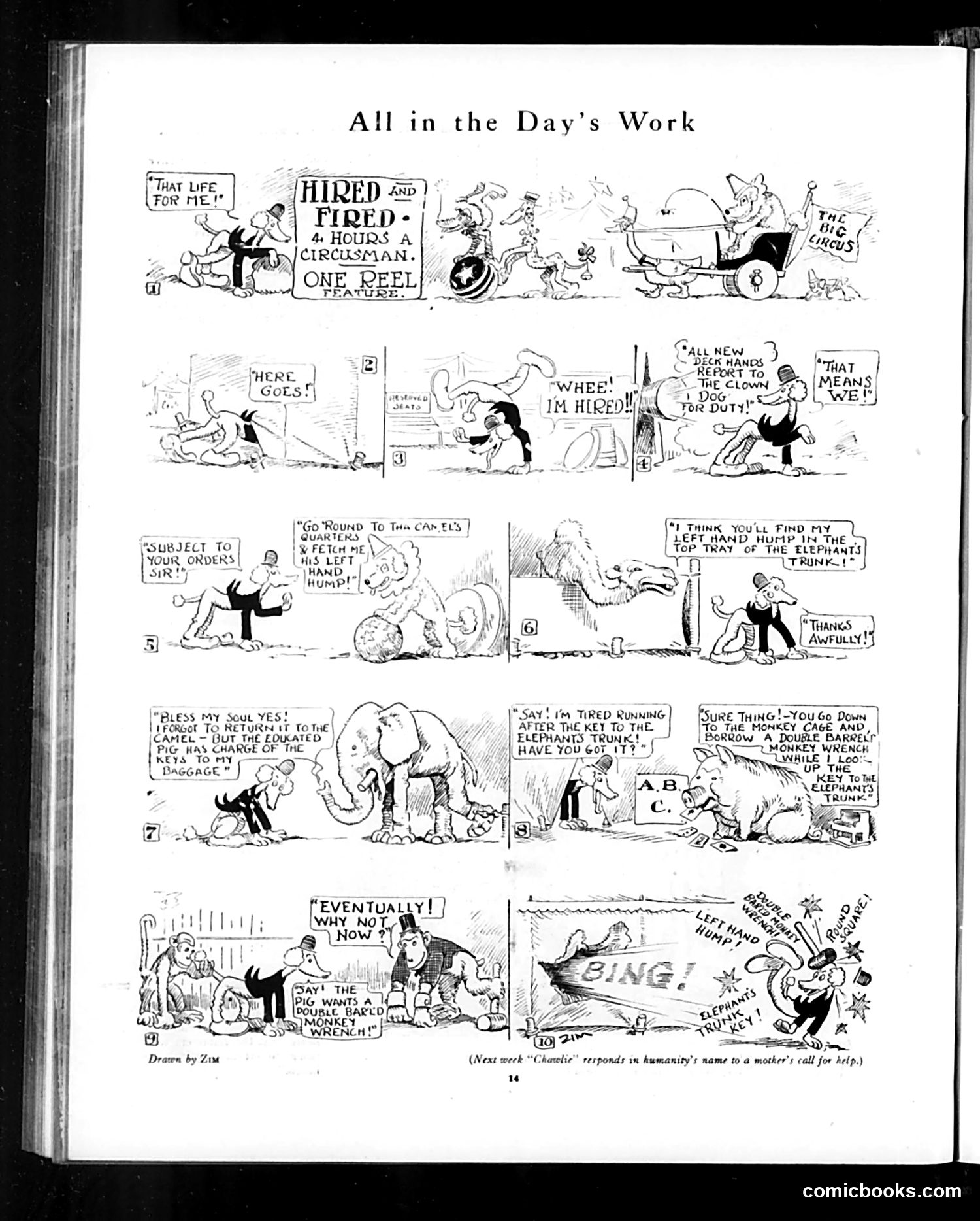
This is a slapstick comic strip about a circus performer (likely a clown or laborer) being hired and immediately fired, then sent on a humiliating series of errands by circus officials. The humor relies on: 1. **Circus hierarchy absurdity**: A lowly worker receives contradictory, increasingly ridiculous orders from authority figures—fetching items from a camel, an elephant's trunk, a monkey cage, borrowing impossible tools from other animals. 2. **Physical comedy**: The worker runs frantically between locations while circus animals cause chaos, playing on slapstick conventions popular in early silent film (referenced in panel 1: "One Reel Feature"). 3. **Social satire**: The joke targets workplace exploitation and the powerlessness of workers taking orders "subject to your orders, sir!" despite absurd treatment. The final note indicates next week's installment will feature "Charlie" (likely Chaplin) responding to a mother's plea—suggesting these were topical entertainment references for Judge's readers circa 1910s-1920s.
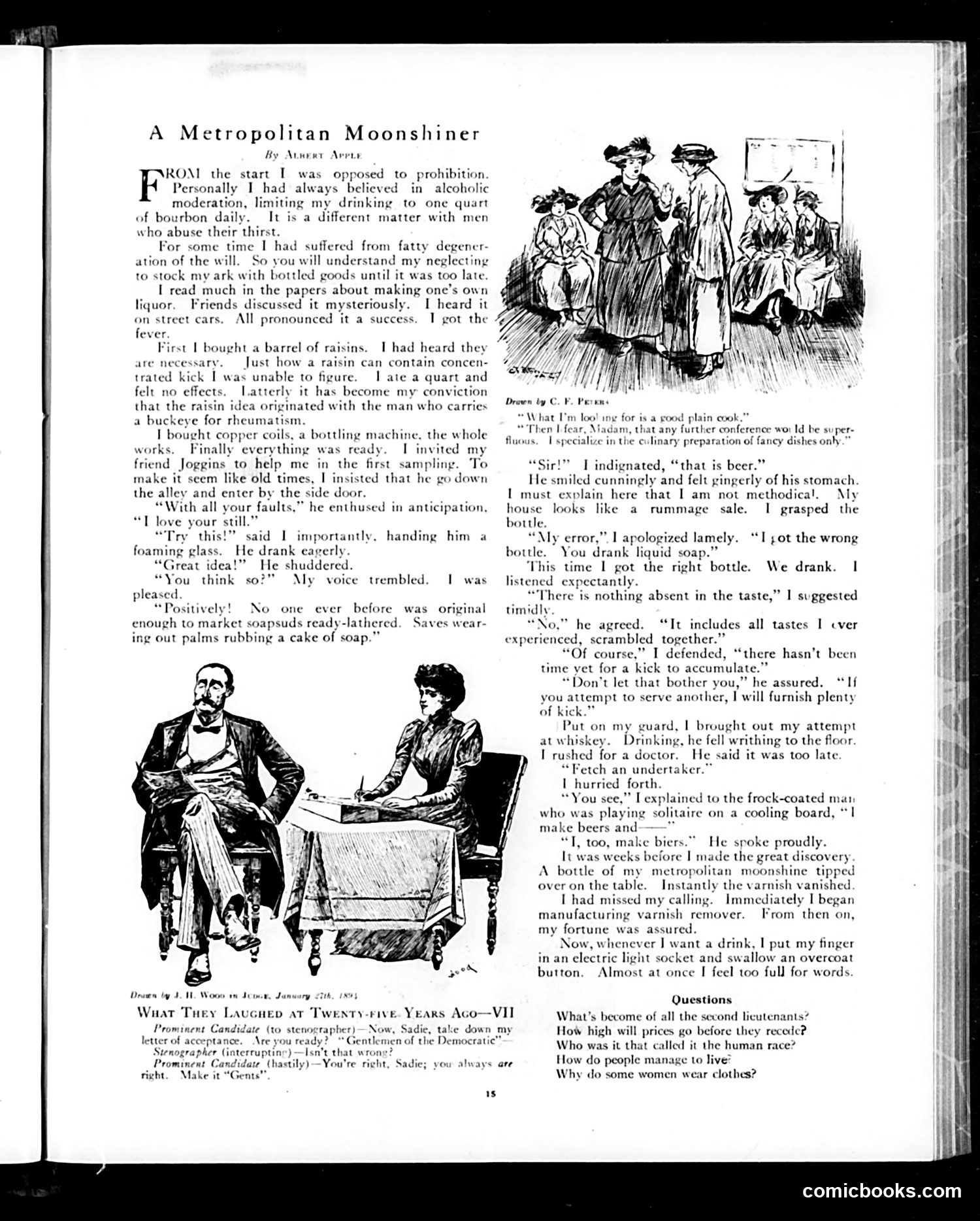
This satirical story mocks Prohibition-era home liquor production. The narrator, opposing alcohol prohibition, attempts to make his own booze using raisins and copper coils—common DIY methods during the 1920s-30s when commercial alcohol was banned. The humor lies in his spectacular failure: his homemade concoctions are dangerously inedible. When served to a friend, the "beer" tastes like liquid soap; his "whiskey" kills the guest. Eventually, he discovers his moonshine works only as varnish remover—accidentally achieving commercial success in that market instead. The accompanying cartoons mock related absurdities: a stenographer questioning a politician's language, and a cook refusing to prepare "fancy dishes." The satire targets both Prohibition's enforcement (forcing citizens to dangerous DIY alcohol production) and amateur moonshiners' incompetence. The irony—that his toxic brew's only real use was industrial—underscores the page's critique of Prohibition as creating more problems than it solved.
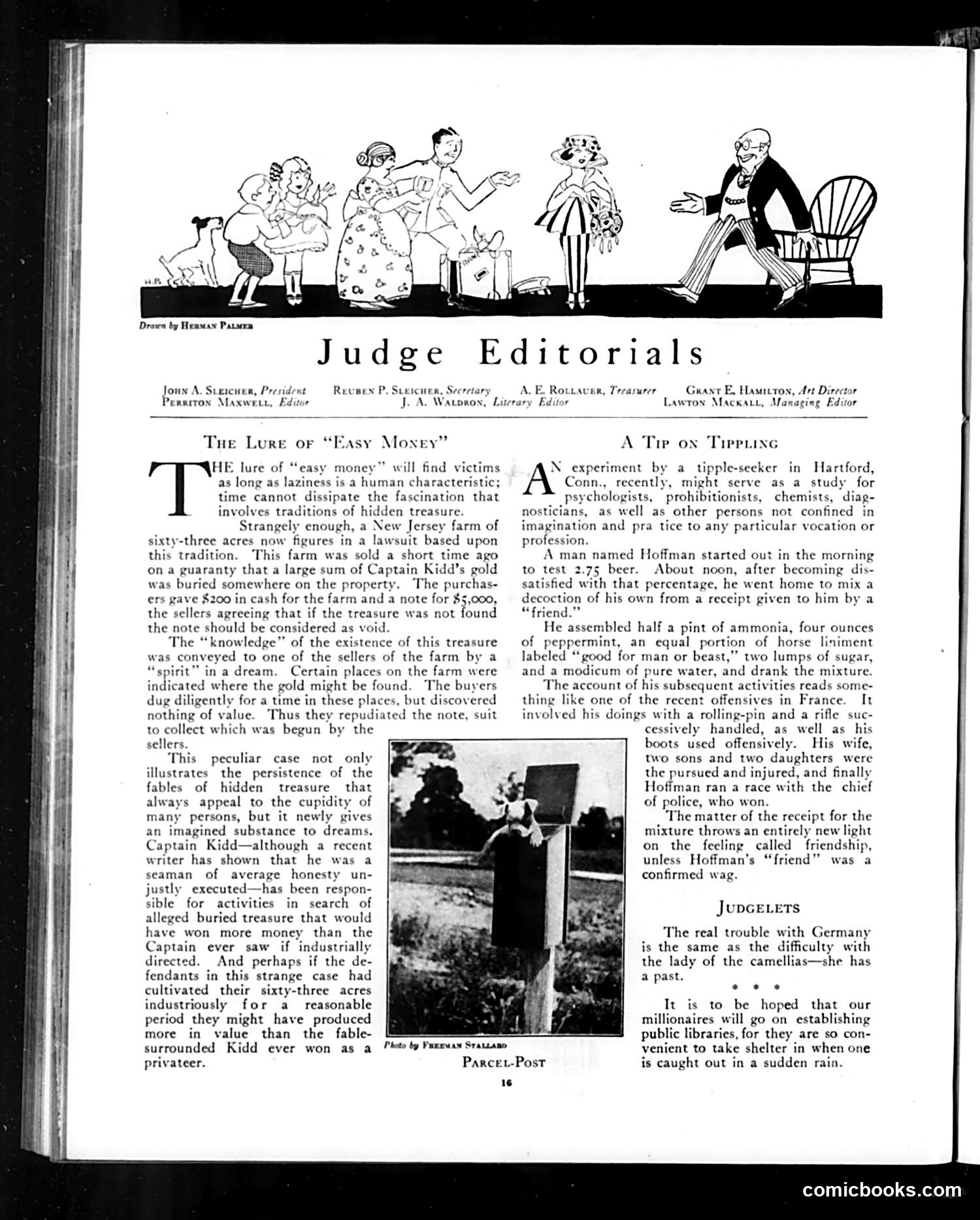
This page from Judge magazine contains three satirical pieces mocking human folly: **"The Lure of Easy Money"** ridicules treasure-hunting obsession, specifically a New Jersey farm sale based on claims of buried Captain Kidd gold. The editorial argues that the buyers' fruitless digging demonstrates how dreams of easy wealth persist despite logic—they could have earned more through actual farming. **"A Tip on Tipping"** (likely "Tippling") satirizes Prohibition-era drinking and desperation. A man named Hoffman, unsatisfied with 2.75% beer, created a homemade concoction from ammonia, peppermint, horse liniment, and sugar. The results were chaotic—he violently attacked his family and police with a rolling pin and rifle, parodying WWI combat descriptions. **"Judgelets"** provides brief satirical quips: one mocking Germany's wartime reputation, another suggesting millionaires build libraries primarily as rain shelters. The page's tone reflects post-WWI American attitudes: skepticism toward get-rich-quick schemes, dark humor about Prohibition enforcement, and continued mockery of Germany.
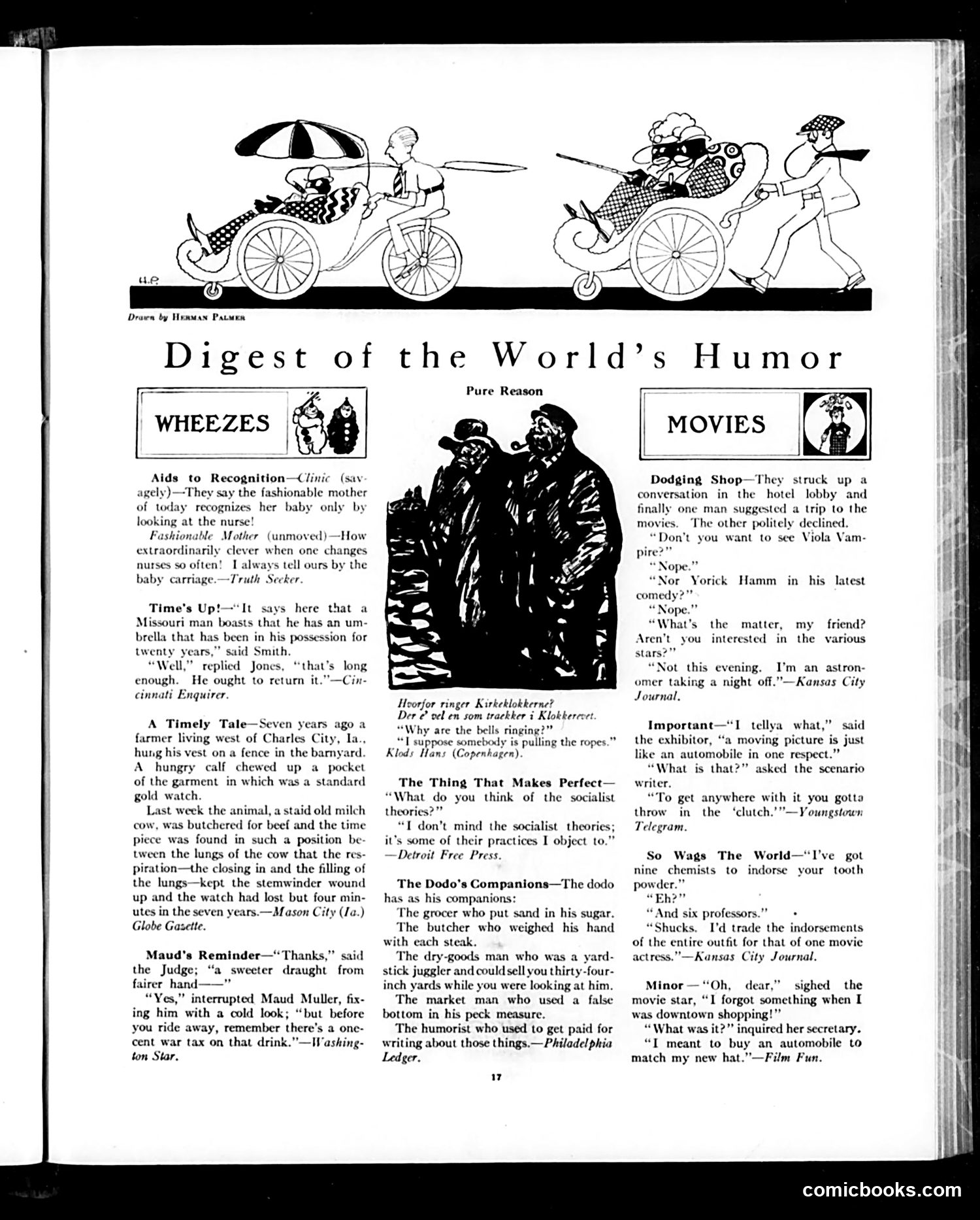
This is a humor compilation page from *Judge* magazine featuring short jokes and anecdotes organized by topic ("Wheezes," "Pure Reason," "Movies"). **Key Content:** The "Wheezes" section mocks fashionable society: a wealthy mother recognizes her baby only by the nurse's appearance (suggesting she's detached from childcare), and jokes about an umbrella borrowed twenty years prior and a cow that swallowed a watch that kept perfect time for seven years. **Social Satire:** The "Movies" section satirizes early cinema audiences' escapism and the absurdity of movie stardom—one joke features an astronomer refusing to see films, another mocks a movie star's materialism (buying a car to match her hat). **Historical Context:** These jokes reflect 1920s anxieties about modern life: class pretension, consumerism, and the cultural dominance of cinema. The humor targets both the wealthy and their frivolous pursuits, as well as Hollywood's shallow culture. The cartoons above illustrate similar slapstick themes with period costumes and exaggerated situations typical of the era's visual comedy style.
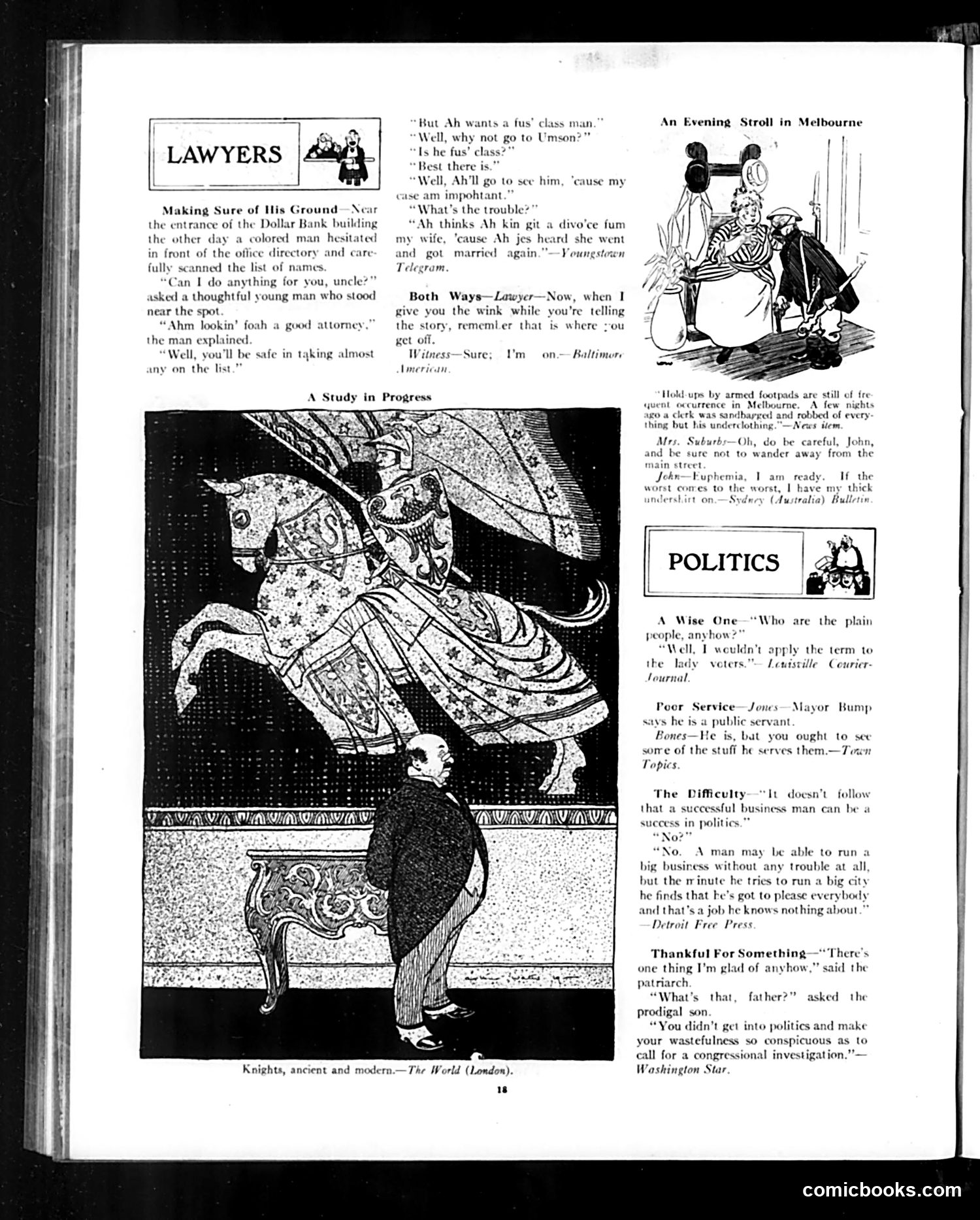
This page contains three satirical sections: **"Making Sure of His Ground"** (Lawyers section): A racist dialogue where a Black man seeks a divorce attorney. The humor relies on dialect stereotyping and the absurd premise that the man's wife divorced him and remarried without his knowledge—yet he wants a divorce from *her*. The satire targets both the man's confusion and, implicitly, lawyers' willingness to take any case. **"A Study in Progress"** (center): An illustration captioned "Knights, ancient and modern" shows a medieval knight beside a modern man viewing artwork—likely satirizing how modern society mirrors historical excess or folly, though the specific reference is unclear. **Politics section**: Four brief jokes mocking politicians and governance—suggesting politicians cannot manage public affairs like businessmen manage companies because they must please everyone; questioning who "plain people" are now that women vote; and joking about a patriarch grateful his wasteful son didn't enter politics (avoiding congressional investigation). The overall tone targets political incompetence, gender politics (new women voters), and racial stereotypes typical of early 20th-century American satire.
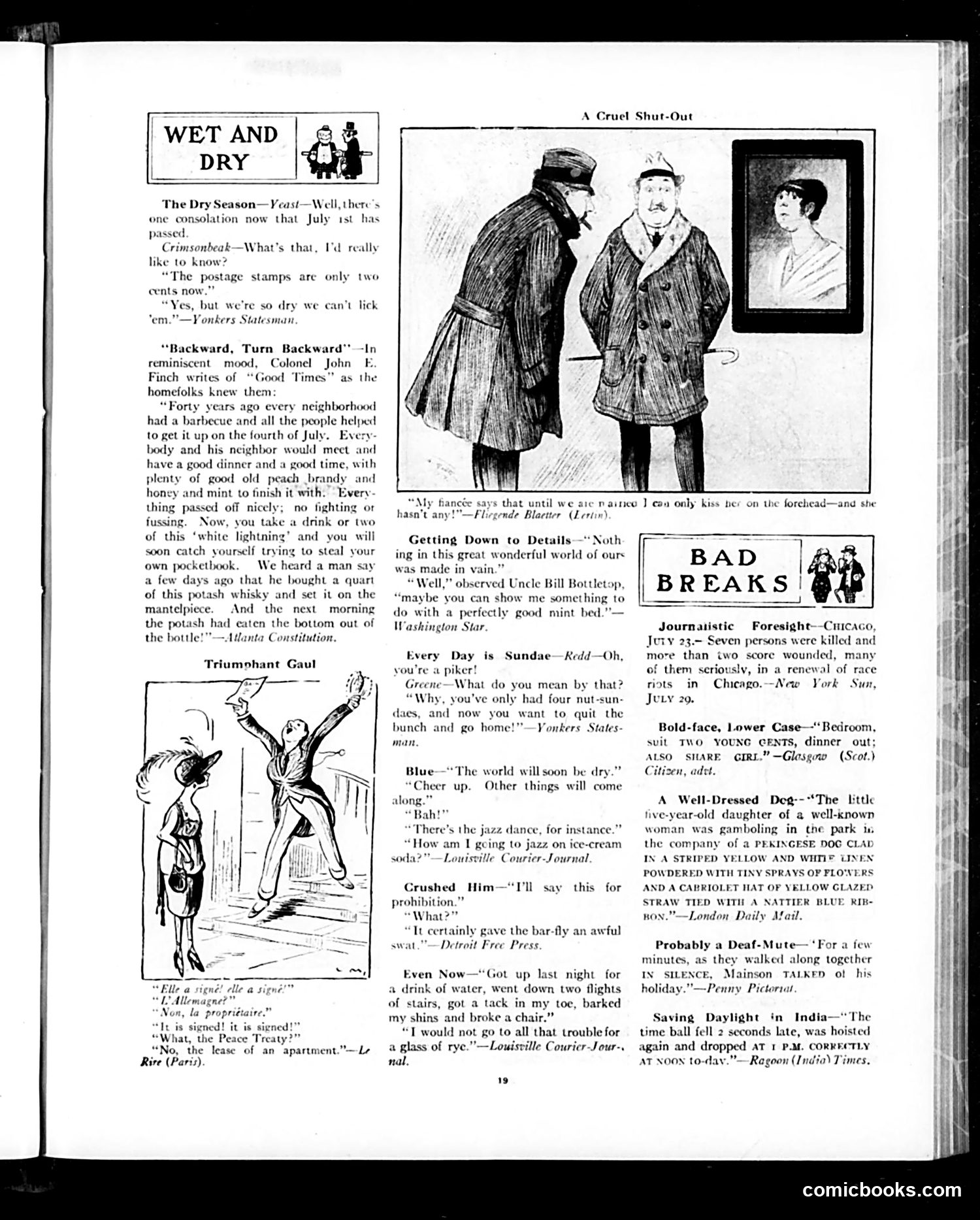
This page collects satirical humor about **Prohibition**, which had recently begun in America (the 18th Amendment passed in 1919). The jokes mock both the dry law itself and life under it. **Main cartoons and jokes:** The opening exchange jokes that postage stamps now cost only 2 cents, but Americans are "so dry we can't lick 'em"—a pun on the difficulty of obtaining alcohol. "Backward, Turn Backward" nostalgically recalls pre-Prohibition barbecues with "good old peach brandy," contrasting them with dangerous bootleg "potash whisky" that reportedly eats through bottles. Other jokes ridicule substitutes for alcohol (mint beds, ice-cream sodas, water) and mock both excessive drinking ("bar-flies") and the supposed moral failures of drinkers under Prohibition. The "Bad Breaks" section contains unrelated social humor about fashion, dogs, and a Chicago race riot. **Context:** These pieces reflect the public's mixed feelings about Prohibition—nostalgia for pre-ban drinking, humor about enforcement difficulties, and anxiety about dangerous substitute beverages.
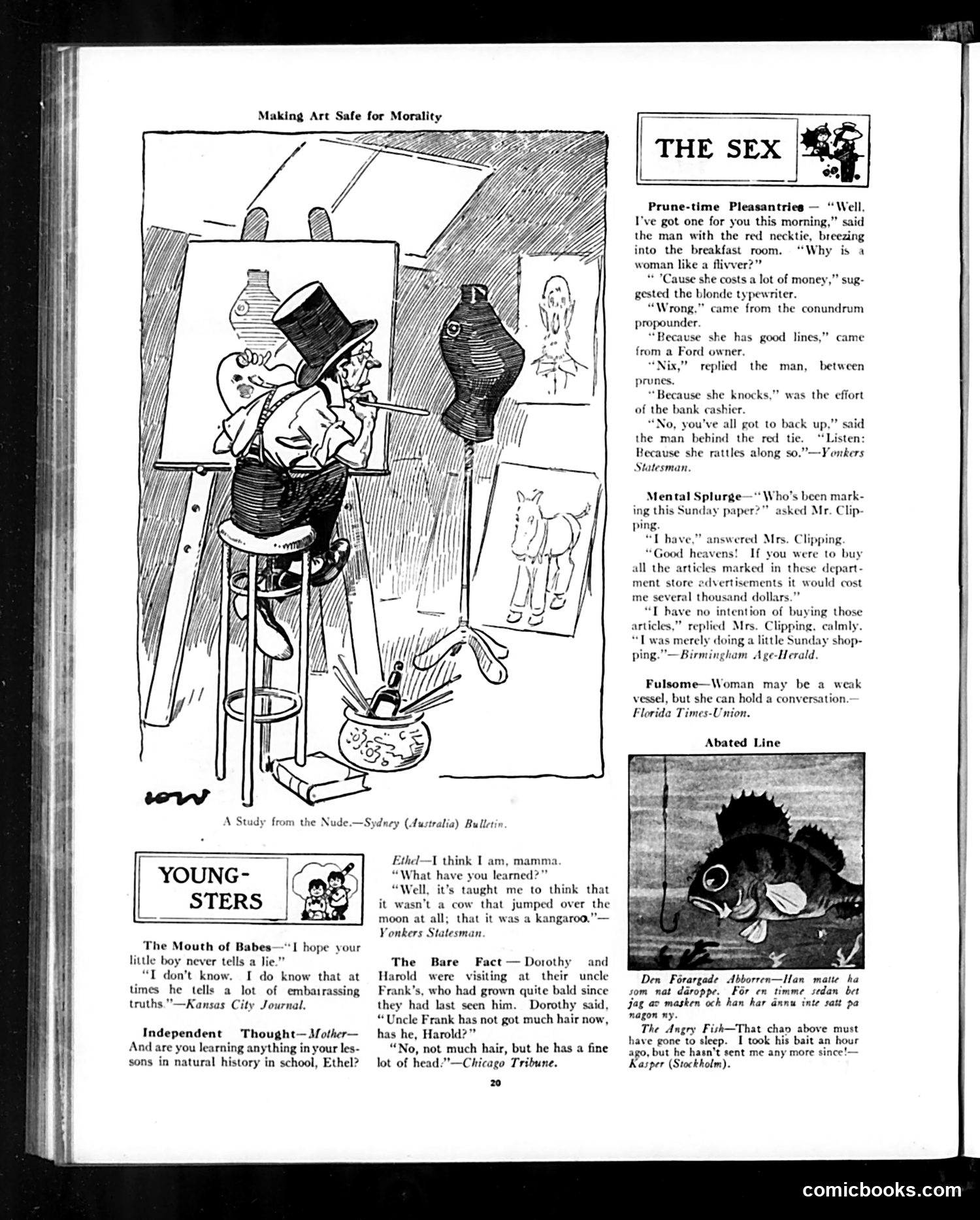
This Judge magazine page satirizes early 20th-century social attitudes through humorous anecdotes. **"Making Art Safe for Morality"** (left): A caricatured artist paints female nudes while holding a palette labeled "art," surrounded by sketches. The satire mocks efforts to justify nude artistic study as "moral" by framing it as educational rather than prurient. **The humor sections** feature children's innocent but embarrassing truths ("Uncle Frank has not got much hair"), playing on the era's anxiety that children revealed uncomfortable facts adults preferred hidden. **"The Sex"** section contains period jokes comparing women to cars (Fords/"flivvers"), treating women as commodities. The "prune-time" joke relies on gendered stereotypes about women being costly and temperamental. **Overall context**: These pieces reflect 1920s attitudes—discomfort with nudity in art, paternalism toward women, and amusement at children's bluntness. The cartoons would seem crude and sexist to modern audiences, but represent typical satirical humor of Judge's era targeting moral hypocrisy and social pretension.
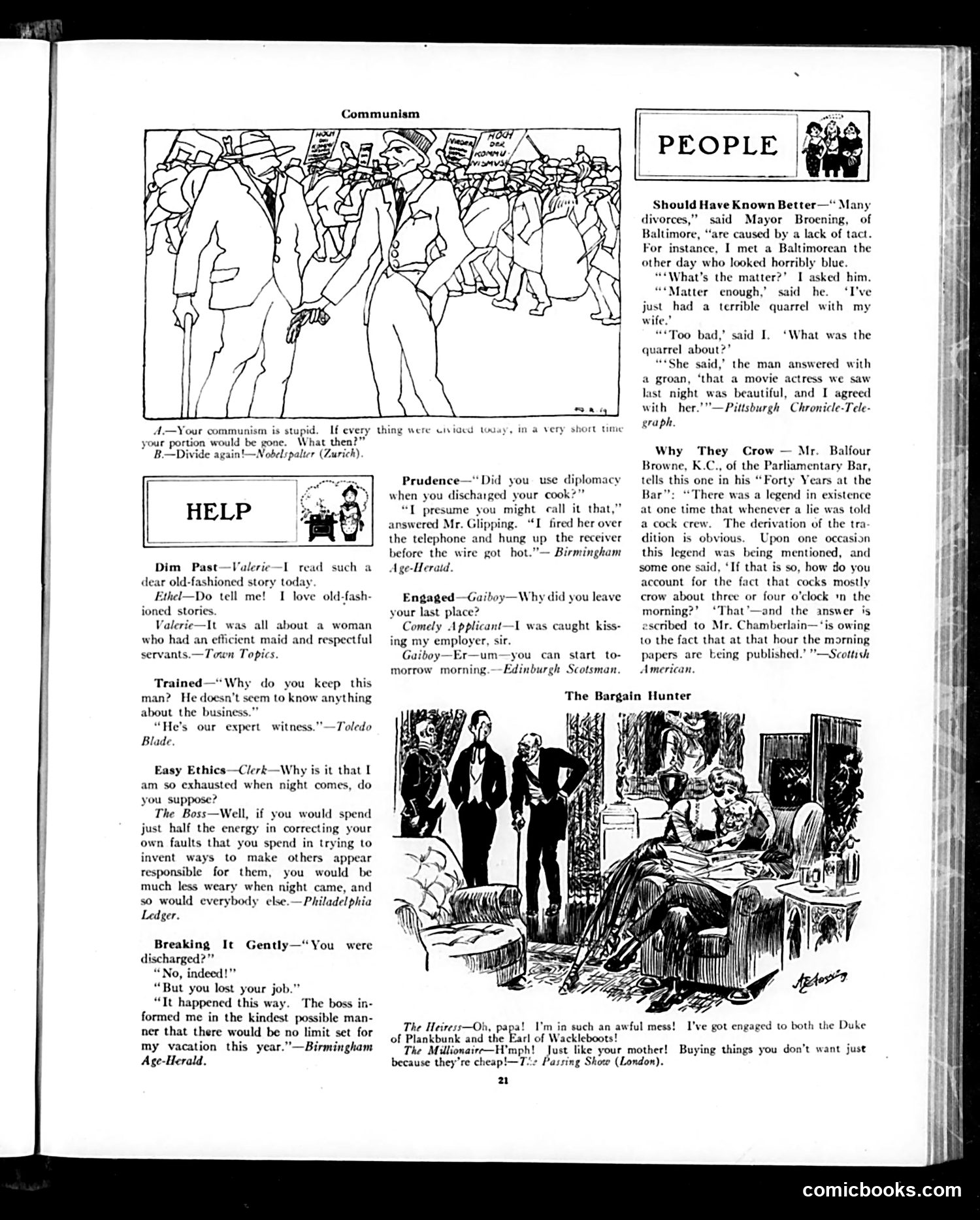
This page from *Judge* (a satirical American magazine) contains multiple short humorous anecdotes and one political cartoon mocking communism. **The Communism Cartoon** (top left): Two figures debate dividing resources. One argues communism is "stupid" because shared portions would quickly disappear. The other simply responds "Divide again!"—satirizing communism as a naive, circular ideology with no practical solution to resource scarcity. **The Remaining Content**: The page consists of brief joke segments—labeled "Dim Past," "Trained," "Easy Ethics," "Breaking It Gently," etc.—poking fun at domestic life, employment, and social etiquette. These include jokes about old-fashioned servants (implying modernity has lost certain standards), boss-employee dynamics, and marital mishaps. **"The Bargain Hunter" cartoon** (bottom): A wealthy heiress announces engagements to two aristocrats; her millionaire father dismisses this as her buying things cheaply—treating suitors like commodities. The page reflects early 20th-century American middle-class anxieties: communism, changing social hierarchies, and materialism.
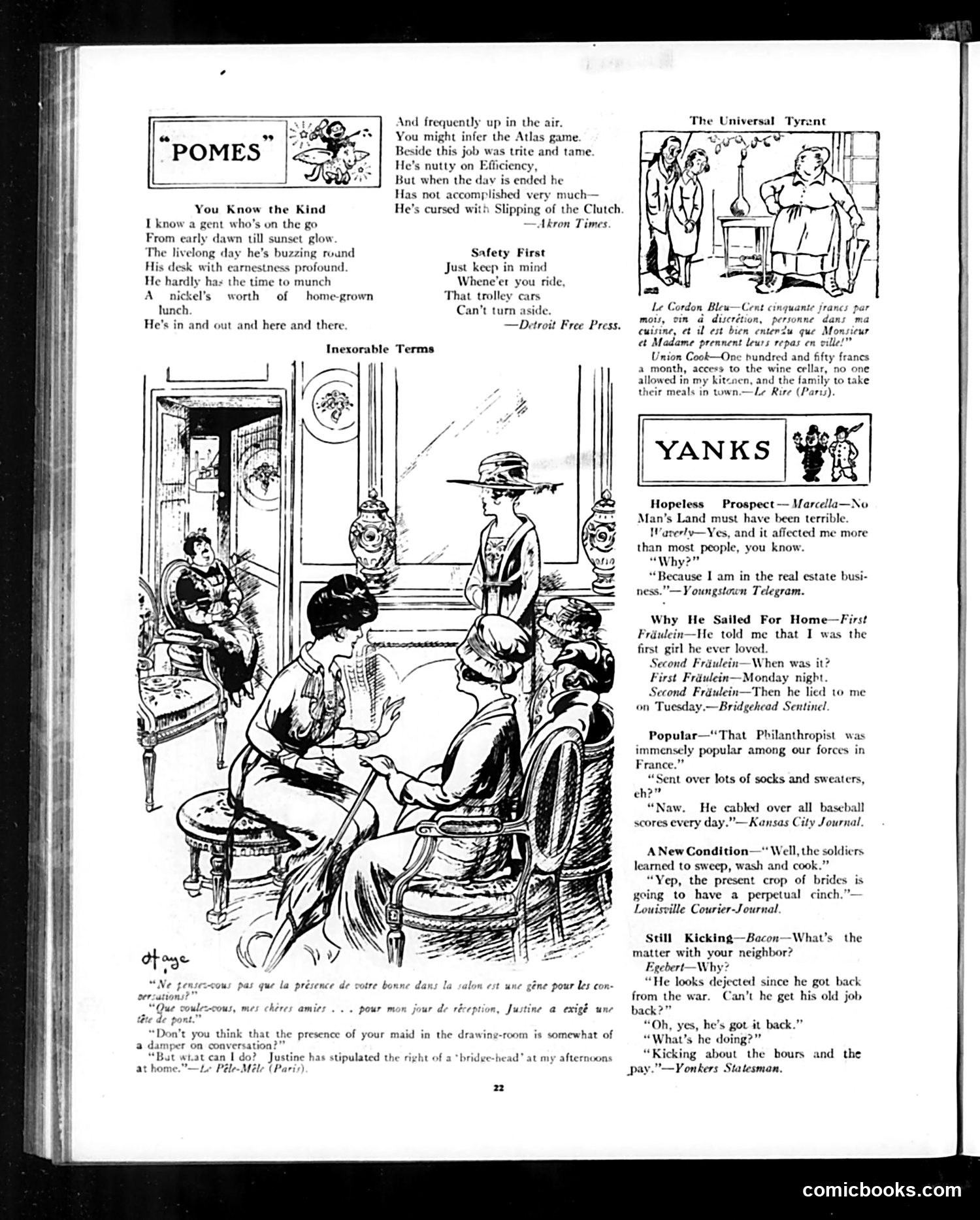
This page contains multiple short humor pieces reflecting post-WWI American society (likely early 1920s). **"Pomes"** satirizes the perpetually busy businessman—always rushing, never eating properly, constantly in motion yet accomplishing little. The satire targets American work culture's obsession with appearing industrious. **"Inexorable Terms"** depicts domestic servant negotiations, comparing American and French maids' contracts. The humor lies in servants' increasingly strict demands about kitchen access, wine privileges, and whether employers must eat at home—a commentary on labor's growing assertiveness post-war. **"The Universal Tyrant"** reinforces this theme through servant power dynamics. **Other vignettes** mock returning soldiers adjusting to civilian life—one complains about work hours after fighting in France, another mentions "Man's Land" affecting his real estate business prospects, and jokes reference soldiers learning domestic skills, suggesting their wartime experiences made them unsuitable for normal employment. The overall tone reflects American anxiety about post-war social disruption and changing labor relations.
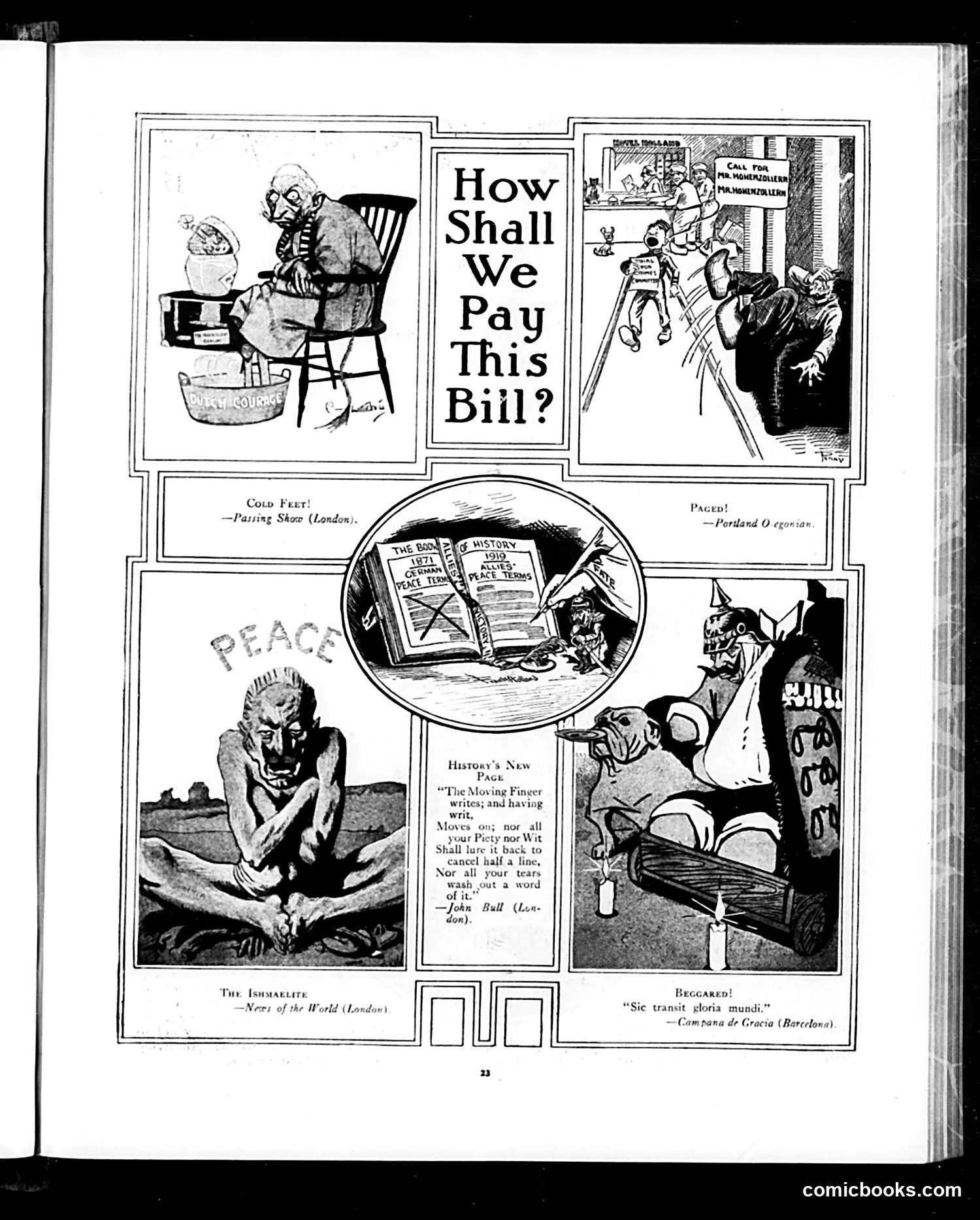
This page satirizes the financial and moral aftermath of World War I. The central question addresses the astronomical costs of the war and who bears responsibility. The four corner panels use personified nations commenting on the situation: - **"Cold Feet"** (London): Britain hesitates over war expenses - **"Paced!"** (Portland): America demands payment/accountability - **"The Ismaelite"** (London): Depicts suffering/displacement from conflict - **"Beggared!"** (Barcelona): Shows European devastation and poverty The central circular panel shows "History's New Page"—books recording Allied war losses, suggesting the permanent mark left by the conflict. The overall message: Nations must reckon with massive debts, human suffering, and moral consequences of the war. The magazine questions how societies will recover and who will ultimately "pay the bill."
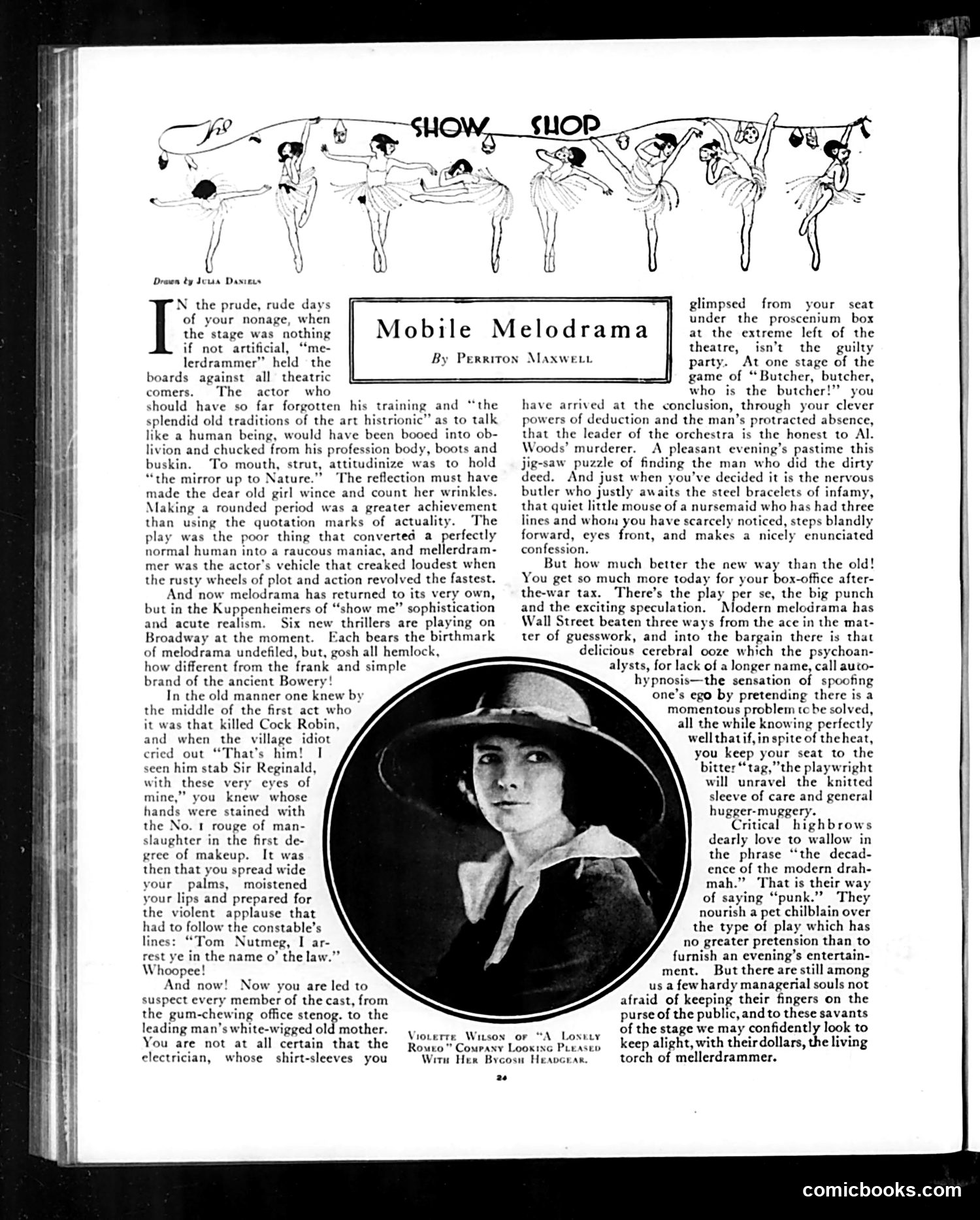
This page critiques the evolution of theatrical melodrama on Broadway. The **text by Perriton Maxwell** contrasts old-fashioned melodrama—where villains were obvious, plots transparent, and emotional reactions predictable—with modern 1920s versions that employ psychological complexity and misdirection. The **cartoon at top** (drawn by Julia Danfels) shows chorus girls in a "Show Shop," likely satirizing the commercialized, formulaic production of theatrical entertainment. The **circular photograph** features **Violette Wilson** in "A Lovely Rogue," exemplifying contemporary theatrical offerings. Maxwell's argument: modern melodrama disguises itself with sophistication and "realism," but audiences still pay (despite post-war taxation) for essentially the same escapist entertainment—now enhanced by pseudo-psychological intrigue. The satire targets both Broadway's pretensions to "artistic" evolution and audiences' willingness to believe they're solving complex mysteries when playwrights will inevitably "unravel the knitted sleeve" with conventional resolutions.
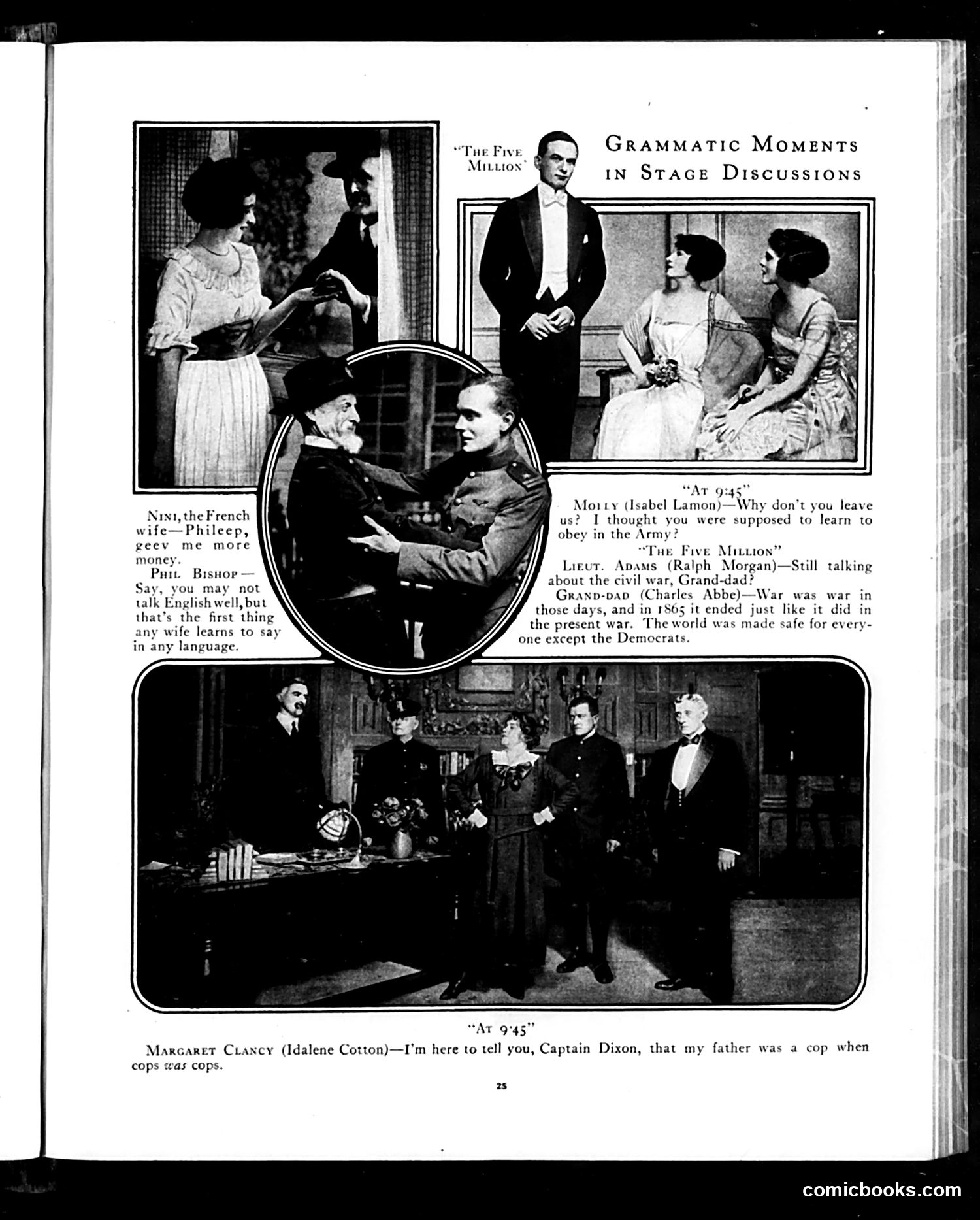
This page satirizes dialogue from "The Five Million," a stage play. The sketches mock common expressions and clichés spoken by characters: 1. **Top left**: A French wife's demand for money—the joke is that "give me more money" is supposedly the first phrase any wife learns in any language, regardless of linguistic ability. 2. **Center**: Civil War nostalgia—Grand-dad insists wars were "better" in his day, ending with a partisan jab that the world was made safe "for everyone except the Democrats," likely referencing post-WWI political divisions. 3. **Bottom**: Margaret Clancy boasts her father "was a cop when cops was cops"—nostalgia for a supposed golden age of police work, implying modern cops are inferior. The satire targets sentimental, repetitive stage dialogue and characters who romanticize the past while making grandiose claims.
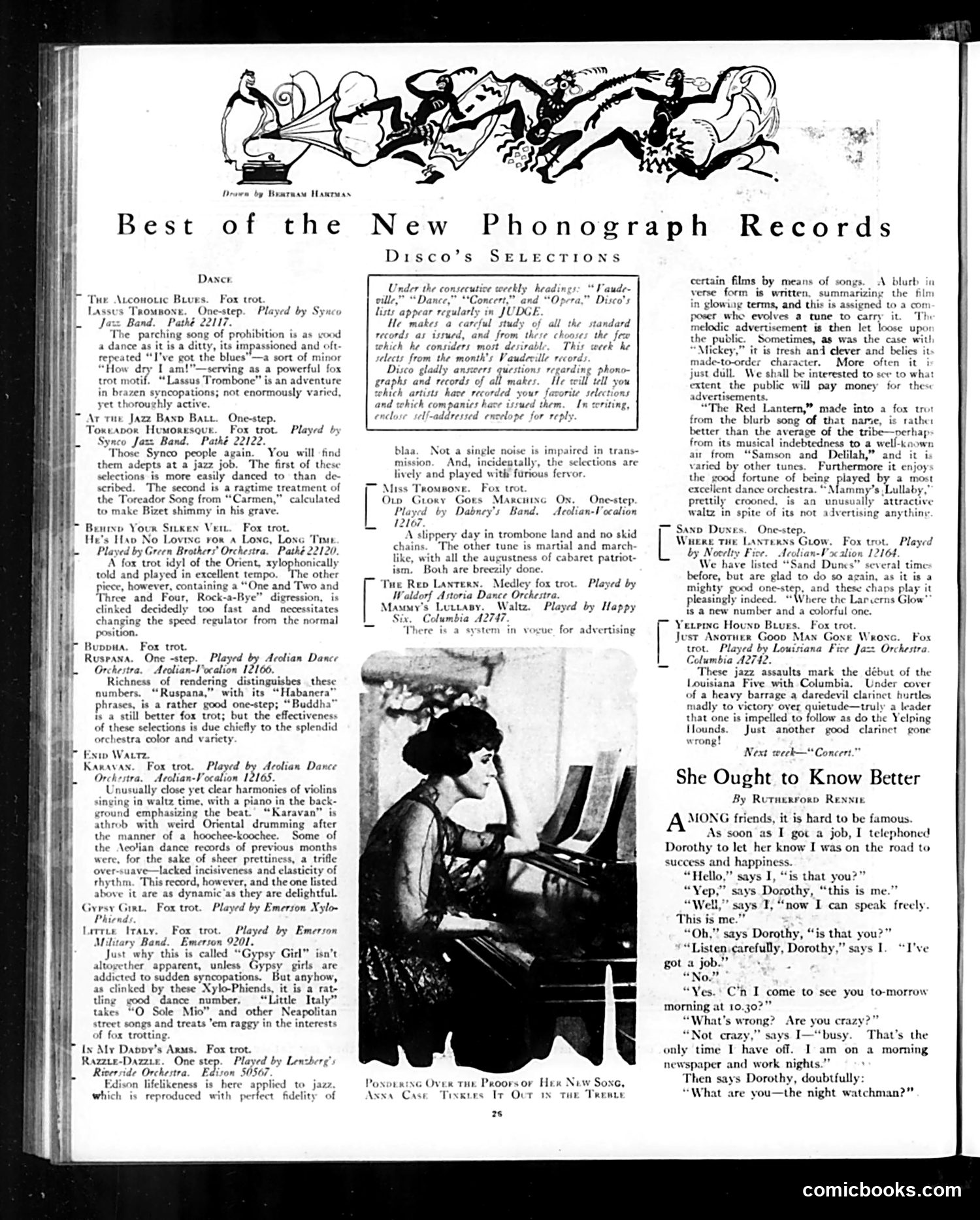
This page from Judge magazine presents record reviews alongside a short story titled "She Ought to Know Better" by Rutherfold Rennie. **The Main Content:** The left column reviews phonograph records—fox trots, one-steps, and waltzes—reflecting the popular dance music of the Jazz Age. The reviews discuss recordings by various orchestras (Synco Jazz Band, Waldorf Astoria Dance Orchestra, Louisiana Five Jazz). **The Cartoon/Illustration:** The page features a photograph of actress Anna Cane Inskeep, captioned "Pondering Over the Proofs of Her New Song." This appears to be promotional material rather than political satire. The illustration at the page's top shows decorative dancing figures. **The Story:** "She Ought to Know Better" depicts a conversational exchange between a narrator and a woman named Dorothy who has become famous. The dialogue is lighthearted domestic comedy about Dorothy's newfound success. **Context for Modern Readers:** This page blends entertainment industry coverage (records, songs, theatrical promotions) typical of Judge's 1920s content—the magazine wasn't primarily political satire at this point but rather general humor and entertainment coverage aimed at middle-class readers.
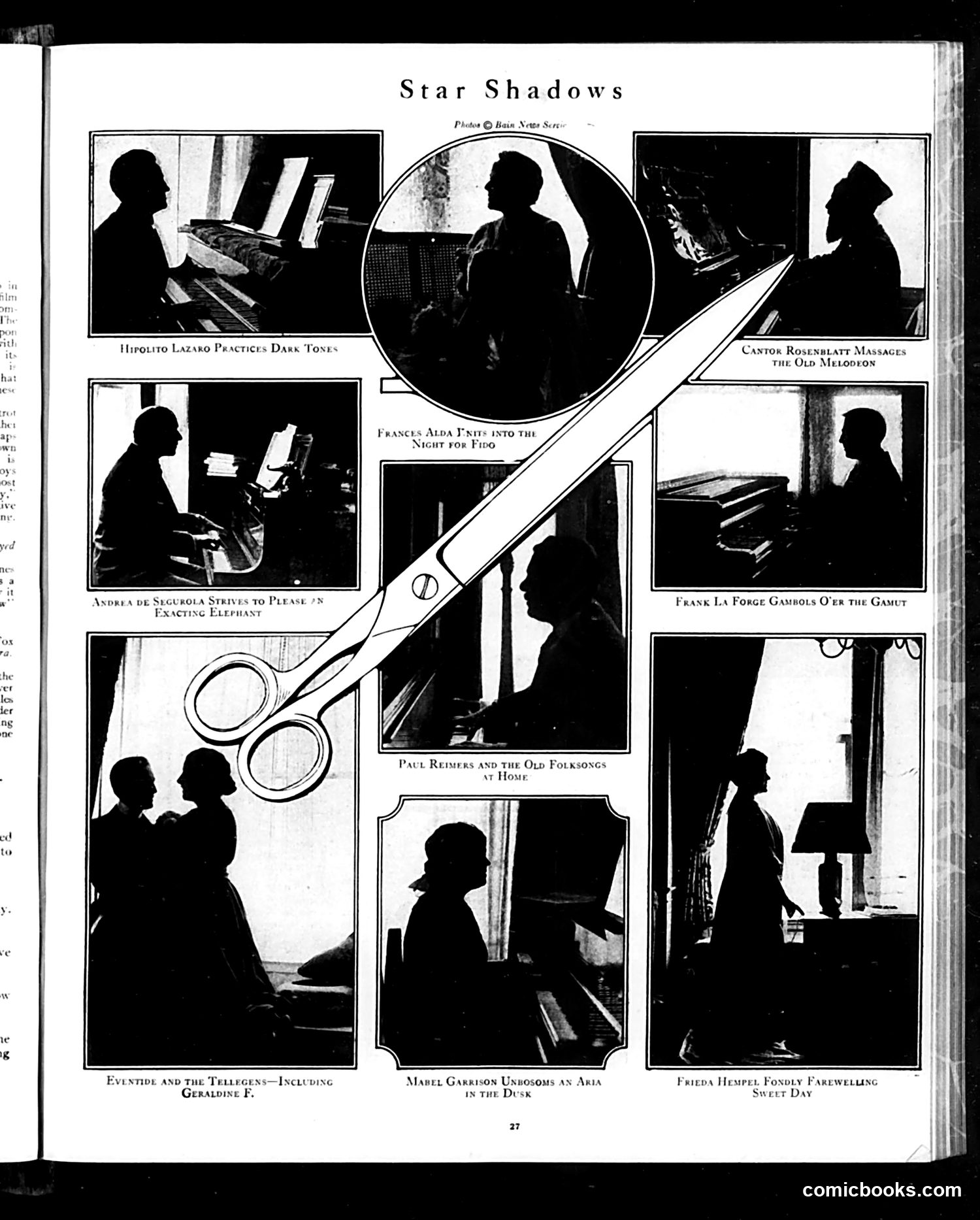
This page presents silhouette portraits of opera and early film performers from the silent era, arranged around a pair of large scissors. The captions identify figures like Frances Alda (opera singer), Cantor Rosenblatt, and others performing with musical instruments or in dramatic poses. The "Star Shadows" title and silhouette format appears to be a whimsical feature celebrating theatrical and musical celebrities of the day through their distinctive profiles. The large decorative scissors suggest this may be a theatrical or arts-focused publication section. This is not political satire but rather entertainment journalism—*Judge* magazine's coverage of performing arts celebrities. The captions reference operas, songs, and theatrical pieces ("Faust," "The Old Folks Songs"), indicating these are accomplished performers of the 1920s era whose names and work would have been recognizable to contemporary readers.
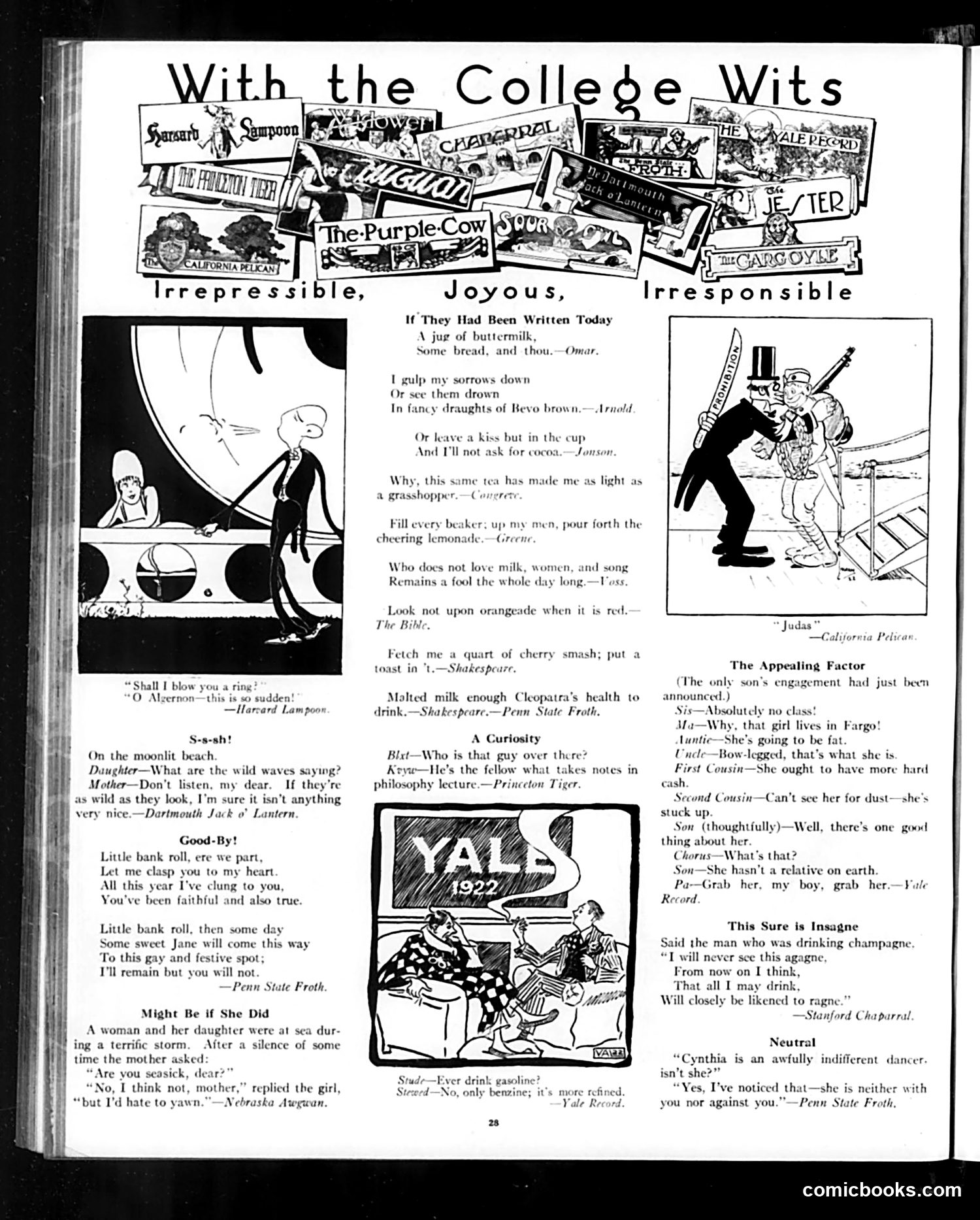
This page collects humorous verses and cartoons from college humor magazines (circa 1922, based on the visible date). The content satirizes **Prohibition-era drinking culture** among young Americans. The central joke is titled **"If They Had Been Written Today,"** which parodies famous literary quotes by substituting Prohibition-compliant beverages. Classic lines from Shakespeare, Omar Khayyam, and the Bible are rewritten replacing wine/alcohol with buttermilk, Bevo (non-alcoholic beer), "cherry smash," "fancy draughts," lemonade, milk, orangeade, and "benezine" (gasoline). The cartoons depict **college-aged characters** in romantic and social situations. One cartoon ("Judas") shows a man escaping with a woman while another watches. The satire mocks Prohibition's enforcement: young people were adapting famous romantic and celebratory verses to newly legal beverages, highlighting the absurdity of the ban. The magazine captures how Prohibition forced creative substitutions into even literary culture, making the law seem ridiculous to college-age readers who expected alcohol in social contexts.
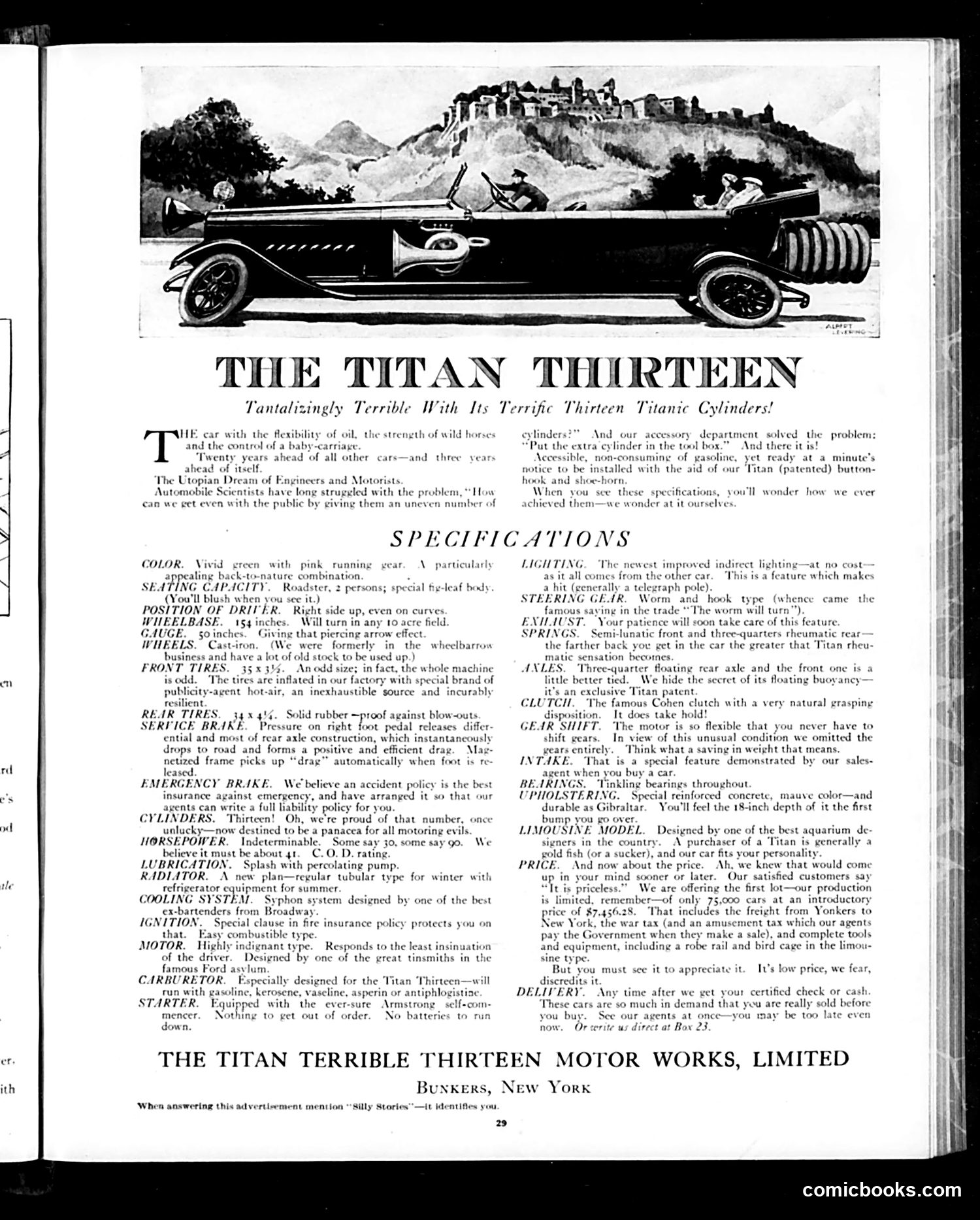
This page is **entirely an automobile advertisement**, not political satire. It's a humorous 1920s-era car ad for the fictional "Titan Terrible Thirteen" motor vehicle, published in *Judge* magazine (which mixed satire with advertising). The humor lies in exaggerated, absurdist claims typical of early automotive advertising: the car has thirteen cylinders, a 154-inch wheelbase, tires inflated with "special brand of hot-air," and features like a "Cohen clutch" (possibly an ethnic joke). The specifications section mocks both car engineering jargon and the hyperbolic advertising language of the era—claiming the car is "twenty years ahead of all other cars—and three years ahead of itself." The satirical angle targets **automobile manufacturers' increasingly outlandish marketing claims** during the 1920s auto boom. By presenting absurd specifications as serious features, the ad parodies how car companies competed through technical one-upmanship and pseudo-scientific language to appeal to consumers. There's no identifiable political figure or reference—just period automotive humor.
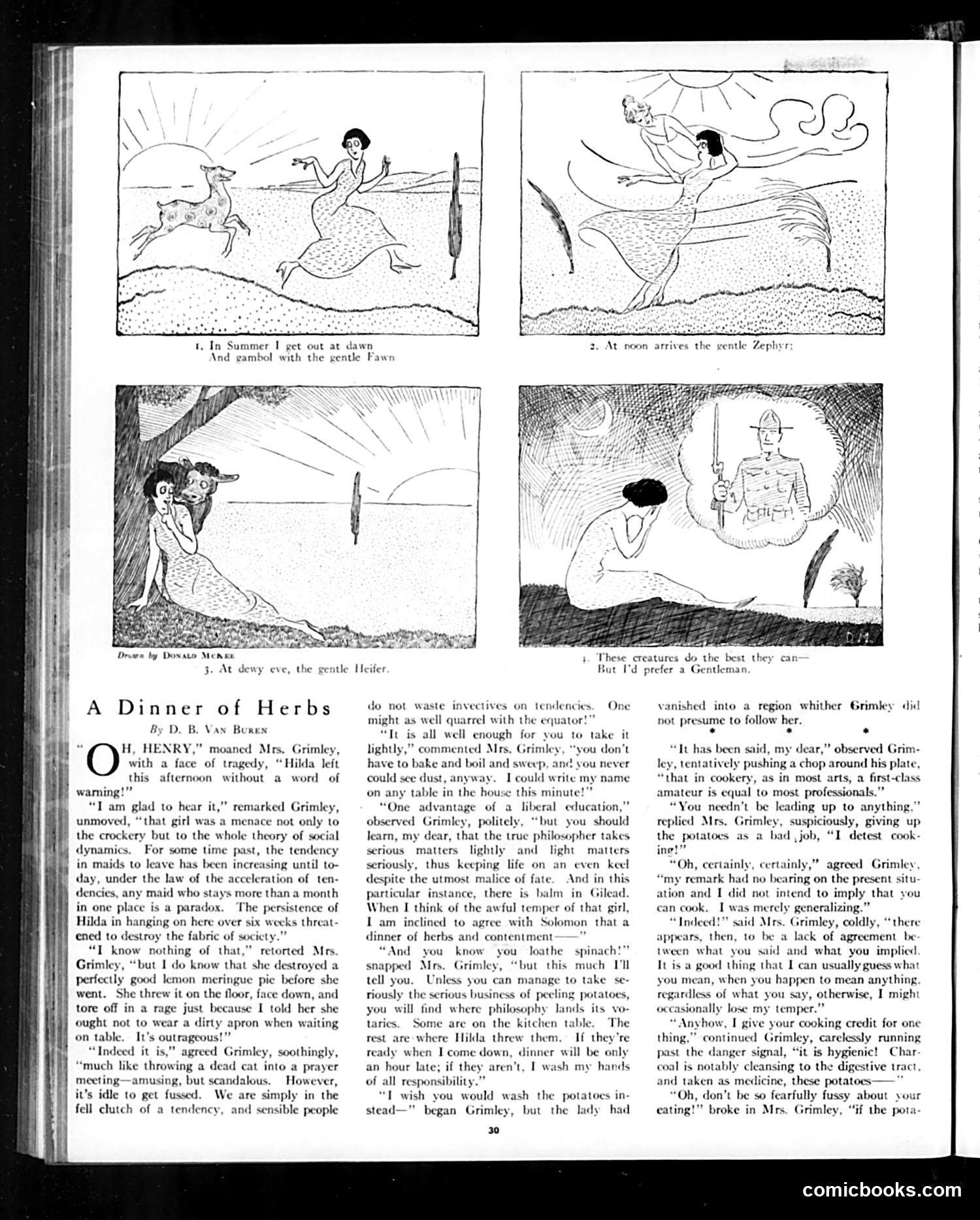
This story satirizes domestic tensions between a husband and wife through their dispute over a departed maid named Hilda. Mr. Grimley, a self-satisfied philosopher, dismisses his wife's frustration by invoking abstract "tendencies" and Solomon's wisdom about accepting humble circumstances ("better is a dinner of herbs...than a stalled ox"). Mrs. Grimley, meanwhile, must handle actual domestic labor—baking, sweeping, peeling potatoes—and finds his philosophical detachment infuriating. The satire targets smug male intellectualism: Grimley hides behind philosophy and platitudes to avoid acknowledging real household work. His passive-aggressive backhanded compliments about her cooking ("it is hygienic") further mock men who deploy learned rhetoric to patronize their wives while contributing nothing practical. The joke is that philosophy proves useless when potatoes need peeling.
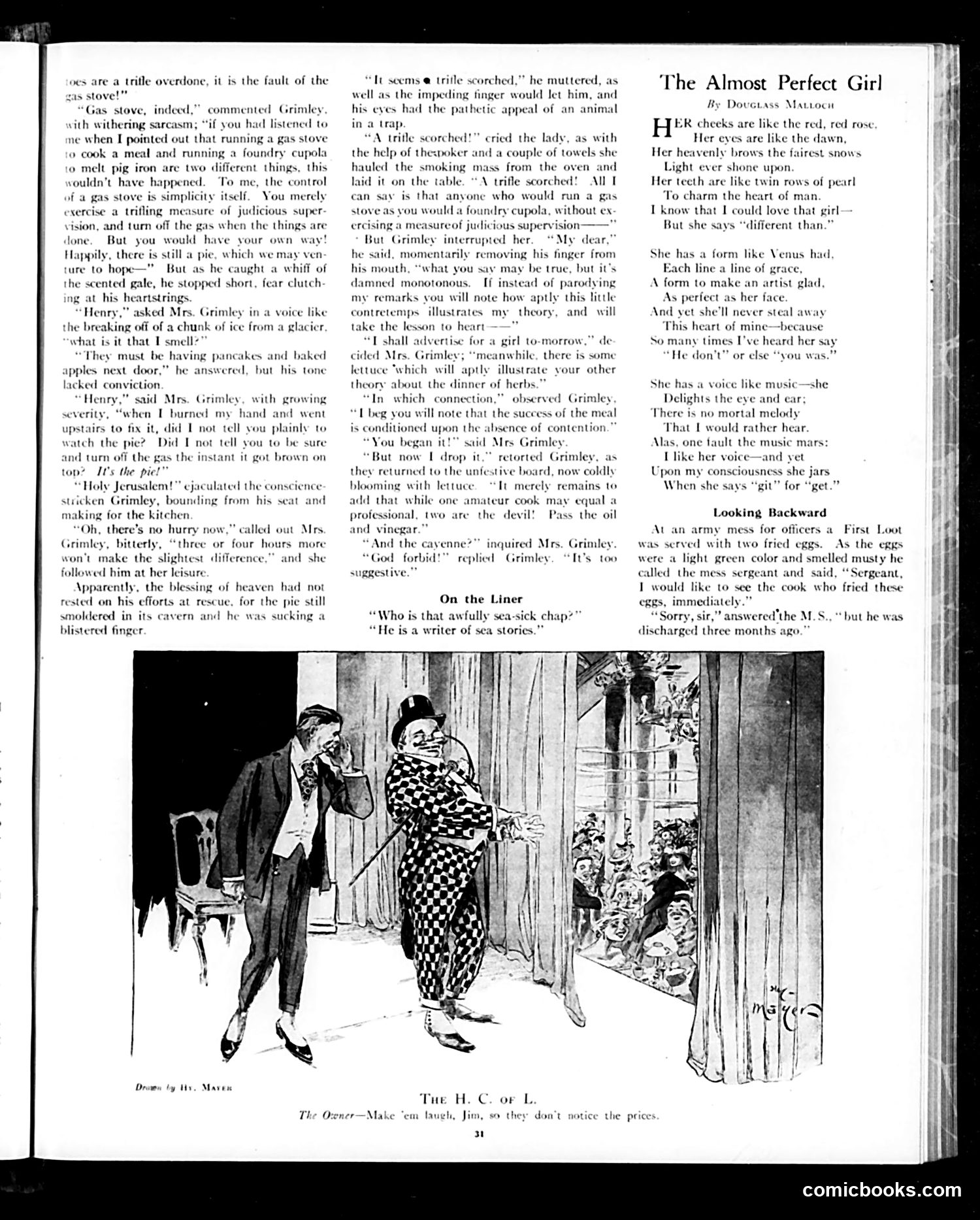
This page contains a domestic humor story about the Grimleys, a married couple whose dinner is ruined when Mr. Grimley neglects the pie in the oven. The satire targets **marital conflict and domestic incompetence**: Mrs. Grimley lectures her husband about proper gas stove operation (comparing his carelessness to running a foundry), while he complains her nagging is "monotonous." The joke is the mutually frustrating dynamic—he can't cook competently, she can't stop criticizing. The illustration shows them in a shop, likely representing the resolution (Mrs. Grimley decides to hire household help). Below is a poem titled "The Almost Perfect Girl," mocking male romantic idealization. It describes a woman with perfect physical beauty (rose cheeks, pearl teeth) but undermines this with a final line: she says "different than" instead of "different from"—implying that even near-perfect femininity is ruined by grammatical ignorance. The satire targets both shallow male appreciation of women and poor female education.
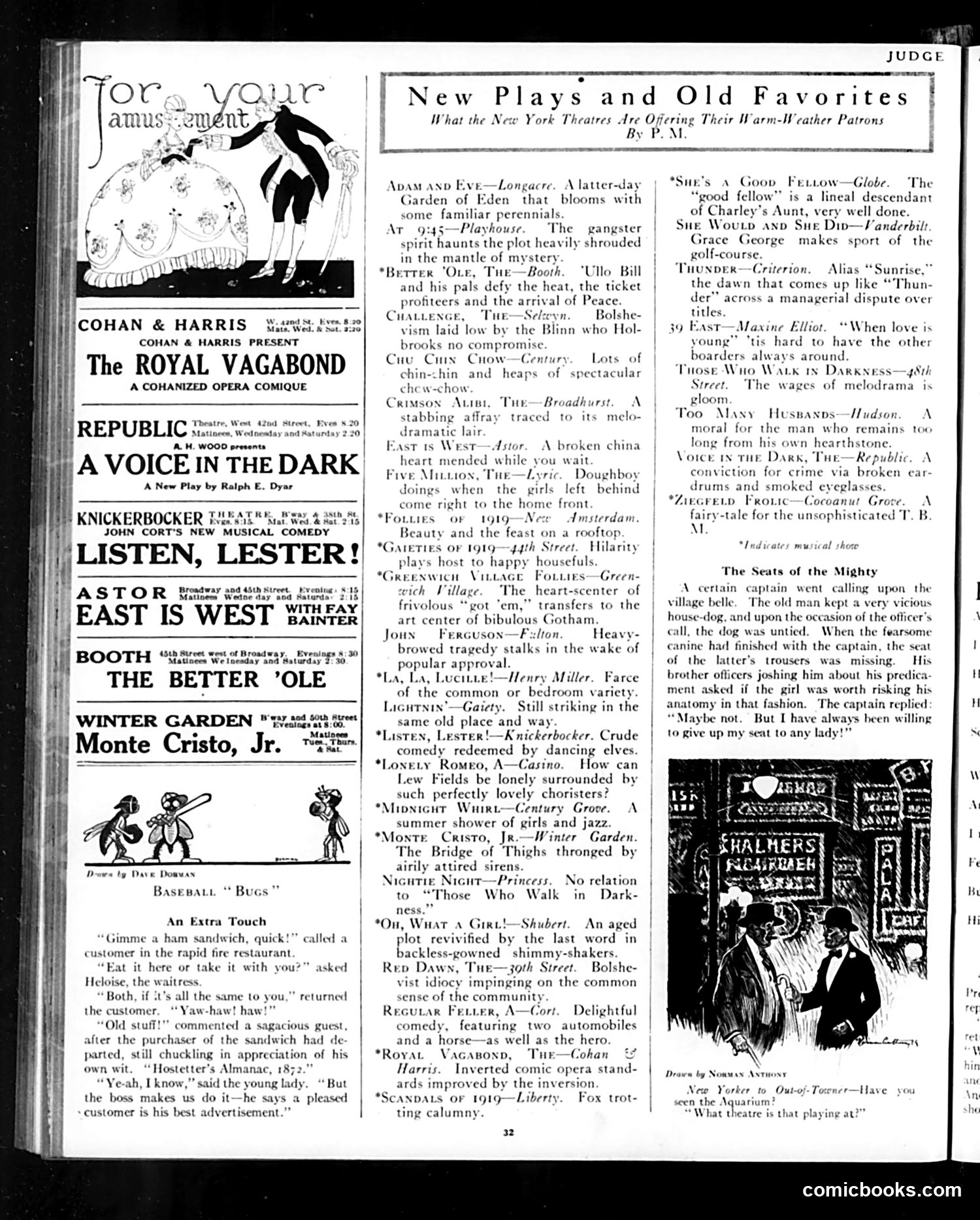
This page is primarily **theater advertising and reviews**, not political satire. It lists New York theatrical offerings for warm weather, mixing brief plot summaries with theater names and locations. The left side contains **theater advertisements** for popular Broadway shows (The Royal Vagabond, Listen, Lester!, East is West, Monte Cristo Jr., etc.), typical of entertainment trade publishing. The right side provides **capsule reviews** of current theatrical productions, using playful titles and brief descriptions—e.g., "She's a Good Fellow," "Those Who Walk in Darkness," "Too Many Husbands." At the bottom, a small **humorous anecdote** titled "The Seats of the Mighty" recounts a captain visiting a village belle whose untamed dog destroys the officer's trousers—a mild joke about the hazards of courtship. The page contains **one illustration** (bottom right) showing what appears to be a theater scene, likely advertising a specific production. Overall, this reflects Judge's entertainment coverage circa 1919, documenting Broadway's offerings rather than offering political commentary.
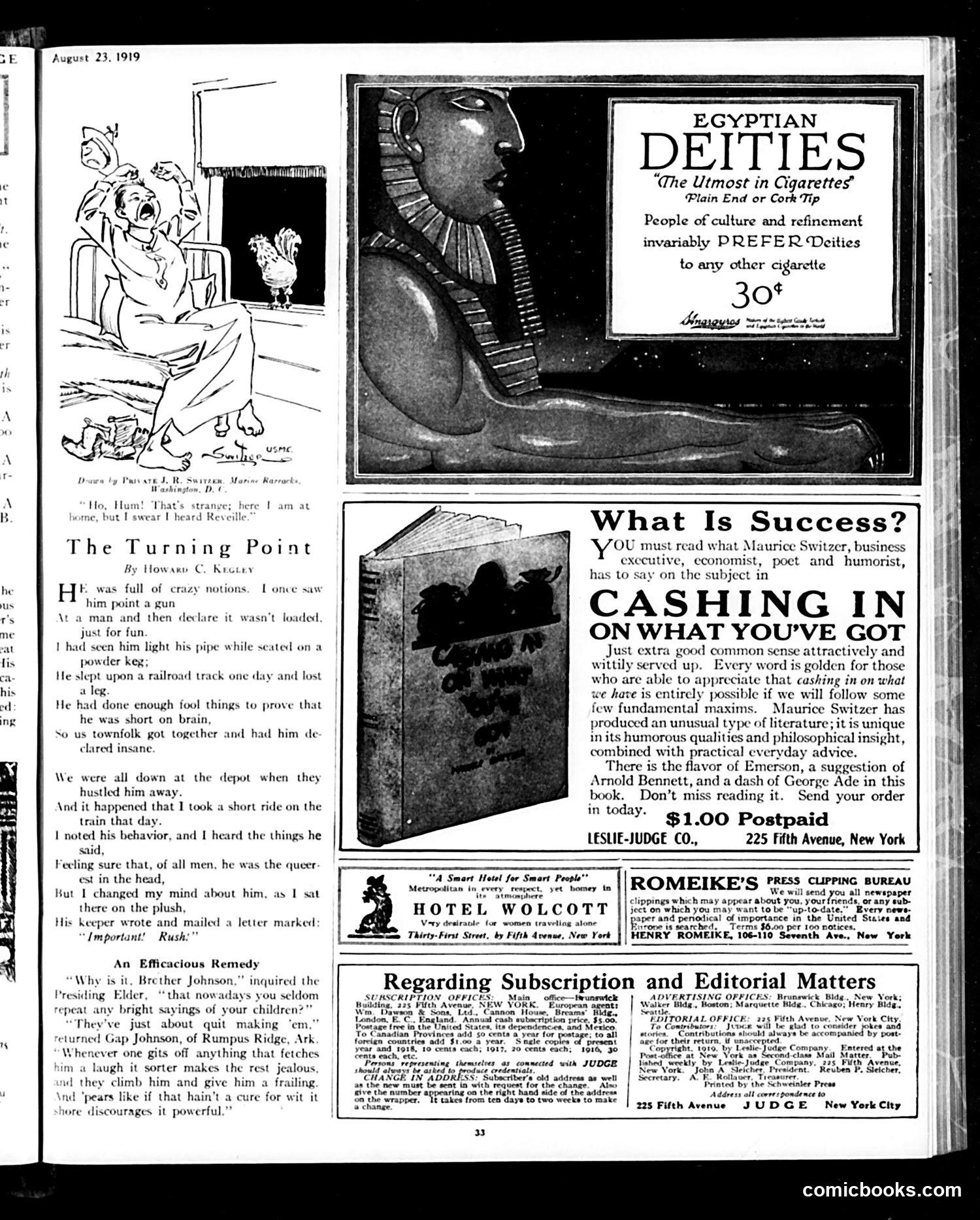
This page contains two fictional stories and period advertising. The main content is "The Turning Point" by Howard C. Kingley—a sentimental rural tale about a townsman deemed insane for reckless behavior (lighting pipes on powder kegs, sleeping on railroad tracks). The narrator initially agrees with the town's judgment but reconsiders after observing the man during a train ride, suggesting wisdom hidden beneath apparent madness. "An Efficacious Remedy" is a rural dialect joke where Gap Johnson explains he's stopped repeating his children's witty remarks because when they get laughs, siblings punish them with beatings, effectively suppressing their humor. The advertisements reflect 1919 consumer culture: Egyptian Deities cigarettes promise "culture and refinement," Maurice Switzer's business book *Cashing In on What You've Got* emphasizes practical success philosophy, and Hotel Wolcott markets itself as safe for women traveling alone—addressing contemporary concerns about women's independent mobility in cities.
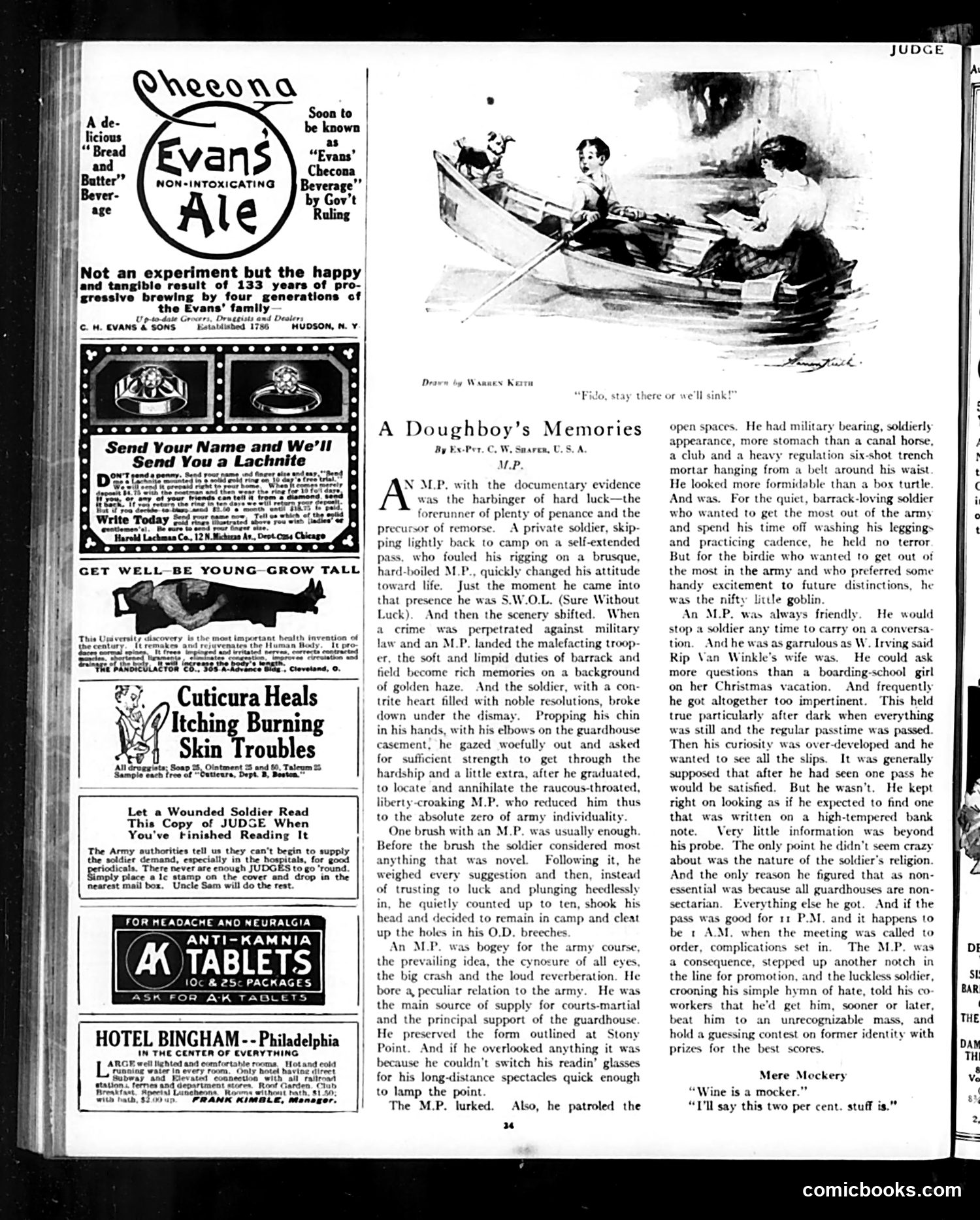
This page contains a short story titled "A Doughboy's Memories" about military police (M.P.s) during World War I. The narrative satirizes the M.P.'s role as the enforcer of army discipline and soldier morale. The piece describes M.P.s as intimidating figures who represent "hard luck" and punishment to enlisted men. A soldier encountering an M.P. while absent without leave (S.W.O.L.) would immediately face consequences. The satire portrays M.P.s as the army's "bogey"—simultaneously feared and resented by regular soldiers seeking to enjoy off-duty freedom. The humor lies in the exaggerated characterization: the M.P. is described as physically imposing ("more formidable than a box turtle"), equipped with a gun, and seemingly omnipresent in patrolling. The piece gently mocks both military authority and soldier behavior during wartime. The surrounding advertisements (for ale, patent medicines, hotels) are typical Judge magazine commercial content.
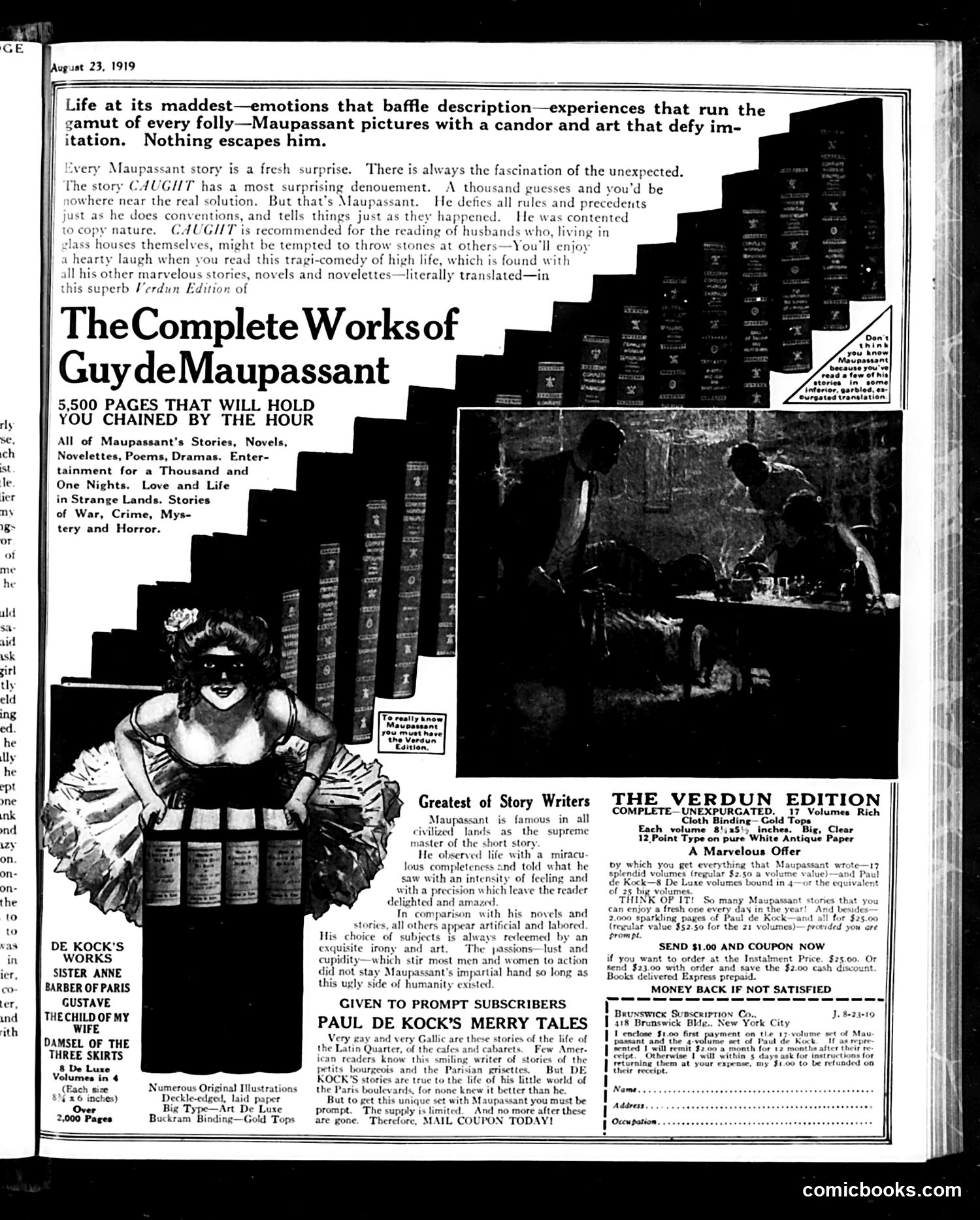
This page is primarily **advertising**, not satire or political commentary. It promotes "The Complete Works of Guy de Maupassant" in the "Verdun Edition"—a 17-volume set marketed to American readers. The advertisement emphasizes Maupassant's reputation for unflinching depictions of human nature, particularly moral failings and illicit behavior. The text specifically recommends the story "Caught" for husbands who might otherwise judge others' indiscretions, suggesting ironic self-awareness about hypocrisy. A secondary advertisement promotes Paul de Kock's "Merry Tales," positioning it as an accessible French alternative to Maupassant—stories of bohemian Paris life. The page uses dramatic imagery (silhouetted book spines, period photographs) and hyperbolic sales language ("5,500 pages that will hold you chained by the hour") typical of early 20th-century book marketing. There is **no political cartoon or social satire** present—this is commercial content designed to sell literature to middle-class readers.
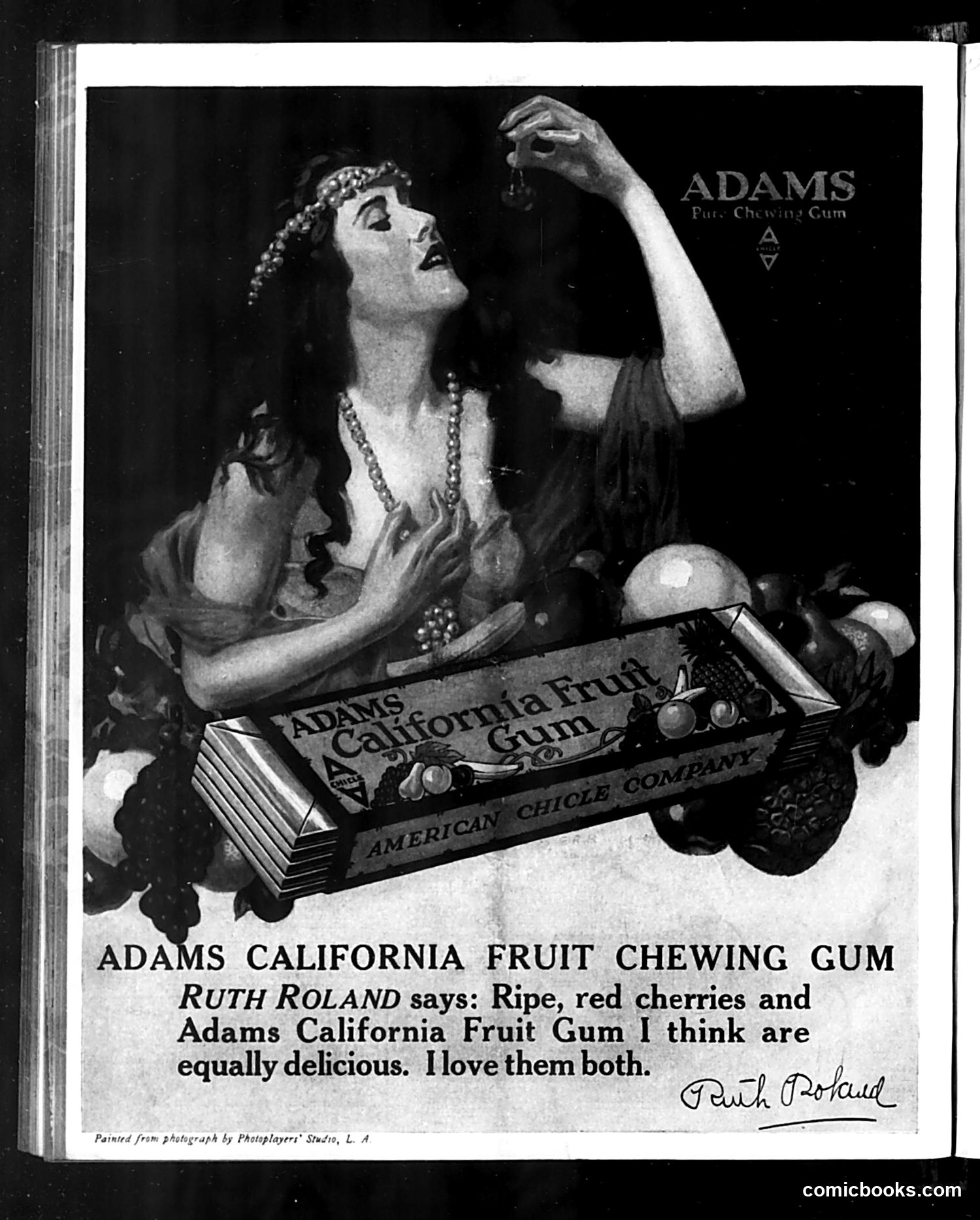
This is a **celebrity endorsement advertisement**, not political satire. It features Ruth Roland, a silent-film actress popular in the 1910s-1920s, endorsing Adams California Fruit Chewing Gum. The image shows her in theatrical costume (headband, jewels, draped fabric) in an exaggerated pose—holding gum aloft while gazing upward—typical of period advertising's melodramatic style. The "joke" or appeal relies on celebrity glamour: a famous actress claims to love the product as much as real cherries. This was standard advertising strategy of the era, leveraging film stars' popularity to sell consumer goods. The theatrical styling emphasizes luxury and indulgence rather than satirizing anything political or social.