
Judge, 1919-08-23 · page 6 of 36
Judge — August 23, 1919 — page 6: what you’re looking at
What you’re looking at
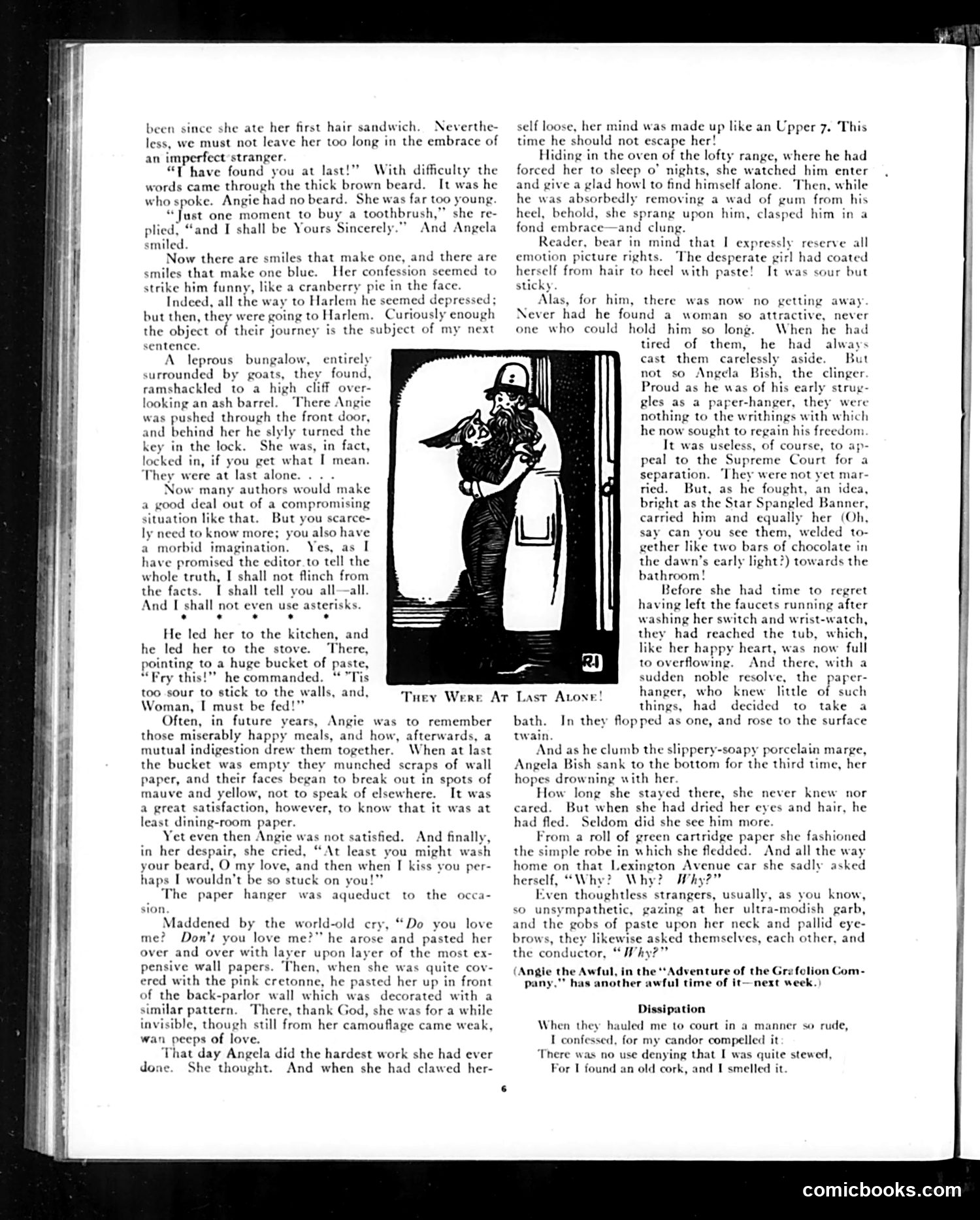
This page contains a serialized story titled "Angie the Awful, the Adventurer of the Gracious Company" (continuing next week). The main illustration shows a woman in what appears to be early 20th-century dress at a bathroom sink or tub, suggesting domestic comedy. The narrative describes a romantic relationship between two characters—a man and "Angela"—involving domestic struggles and reconciliation. The story emphasizes period-appropriate gender dynamics, with references to hairstyles, clothing, and courtship rituals typical of the era. At bottom, there's a short poem titled "Dissipation" about candor in court proceedings. **Note**: This appears to be primarily serialized fiction rather than political satire. The humor derives from domestic situations and character personality rather than social commentary.
📄 Transcribed text from this page (OCR, searchable)
Machine-transcribed from the original scan — historical spelling and the odd misread are preserved.
been since she ate her first hair sandwich. Neverthe- less, we must not leave her too long in the embrace of an imperfect stranger. : . “T have found you at last!” With difficulty the words came through the thick brown beard. It was he who spoke. Angie had no beard. She was far too young. “Just one moment to buy a toothbrush,” she re- plied, “and I shall be Yours Sincerely.” And Angela smiled. Now there are smiles that make one, and there are smiles that make one blue. Her confession seemed to strike him funny, like a cranberry pie in the face. Indeed, all the way to Harlem he seemed depressed; but then, they were going to Harlem, Curiously enough the object of their journey is the subject of my next sentence A leprous bungalow, entirely surrounded by goats, they found, ramshackled to a high cliff over- looking an ash barrel. There Angie was pushed through the front door, and behind her he slyly turned the key in the lock. She was, in fact, locked in, if you get what I mean. They were at last alone... . Now many authors would make a good deal out of a compromising situation like that. But you scarce- ly need to know more; you also have a morbid imagination. Yes, as I have promised the editor.to tell the whole truth, I shall not flinch from the facts. [ shall tell you all—all. And I shall not even use asterisks. . . . . . He led her to the kitchen, and he led her to the stove. There, pointing to a huge bucket of paste, “Fry this!” he commanded. Tis too sour to stick to the walls, and, Tuey Wert Woman, I must be fed! Often, in future years, Angie was to remember those miserably happy meals, and how, afterwards, a mutual indigestion drew them together. When at last the bucket was empty they munched scraps of wall paper, and their faces began to break out in spots of mauve and yellow, not to speak of elsewhere. It was a great satisfaction, however, to know that it was at least dining-room paper. Yet even then Angie was not satisfied. And finally, in her despair, she cried, “At least you might wash your beard, O my love, and then when I kiss you per- haps I wouldn’t be so stuck on you!” The paper hanger was aqueduct sion Maddened by the world-old cry, “Do you love me? Don't you love me?” he arose and pasted her over and over with layer upon layer of the most ex- pensive wall papers. Then, when she was quite cov- ered with the pink cretonne, he pasted her up in front of the back-parlor wall which was decorated with a similar pattern. There, thank God, she was for a while invisible, though still from her camouflage came weak, wan peeps of love. That day Angela did the hardest work she had ever done. She thought. And when she had clawed her- to the At Last Atoxe! self loose, her mind was made up like an Upper 7. This time he should not escape her! Hiding in the oven of the lofty range, where he had forced her to sleep o' nights, she watched him enter and give a glad howl to find himself alone. Then, while he was absorbedly removing a wad of gum from his heel, behold, she sprang upon him, clasped him in a fond embrace—and clung. Reader, bear in mind that I expressly reserve all emotion picture rights. The desperate girl had coated herself from hair to heel with paste! It was sour but sticky. Alas, for him, there was now no getting away Never had he found a woman so attractive, never one who could hold him so long. When he had tired of them, he had always cast them carelessly aside. But not so Angela Bish, the clinger Proud as he was of his early strug- gles as a paper-hanger, they were nothing to the writhings with which he now sought to regain his freedom It was useless, of course, to ap- peal to the Supreme Court for a separation. ‘They were not yet mar- ried. But, as he fought, an idea, bright as the Star Spangled Banner, carried him and equally her (Oh, say can you see them, welded to- gether like two bars of chocolate in the dawn’s early light?) towards the bathroom! Before she had time to regret having left the faucets running after washing her switch and wrist-watch, they had reached the tub, which, like her happy heart, was now full to overflowing. And there, with a sudden noble resolve, the paper- hanger, who knew little of such things, had decided to take a bath. In they flopped as one, and rose to the surface twain. And as he clumb the slippery-soapy porcelain marge, Angela Bish sank to the bottom for the third time, her hopes drowning with her How long she stayed there, she never knew nor cared. But when she had dried her eyes and hair, he had fled. Seldom did she see him mor From a roll of green cartridge paper she fashioned the simple robe in which she fledded. And all the way home on that Lexington Avenue car she sadly asked herself, “Why? Why? Why?” Even thoughtless strangers, usually, as you know, so unsympathetic, gazing at her ultra-modish garb, and the gobs of paste upon her neck and pallid eye- brows, they likewise asked themselves, each other, and the conductor, “Why?” Angie the Awful, in the Adventure of the Grzfolion Com- pany,"’ has another awful time of it—next week. Dissipation When they hauled me to court in a manner so rude, I confessed, for my candor compelled it ‘There was no use denying that I was quite stewed, For I found an old cork, and I smelled it. comicbooks.com