
A complete issue · 36 pages · 1919
Judge — August 16, 1919
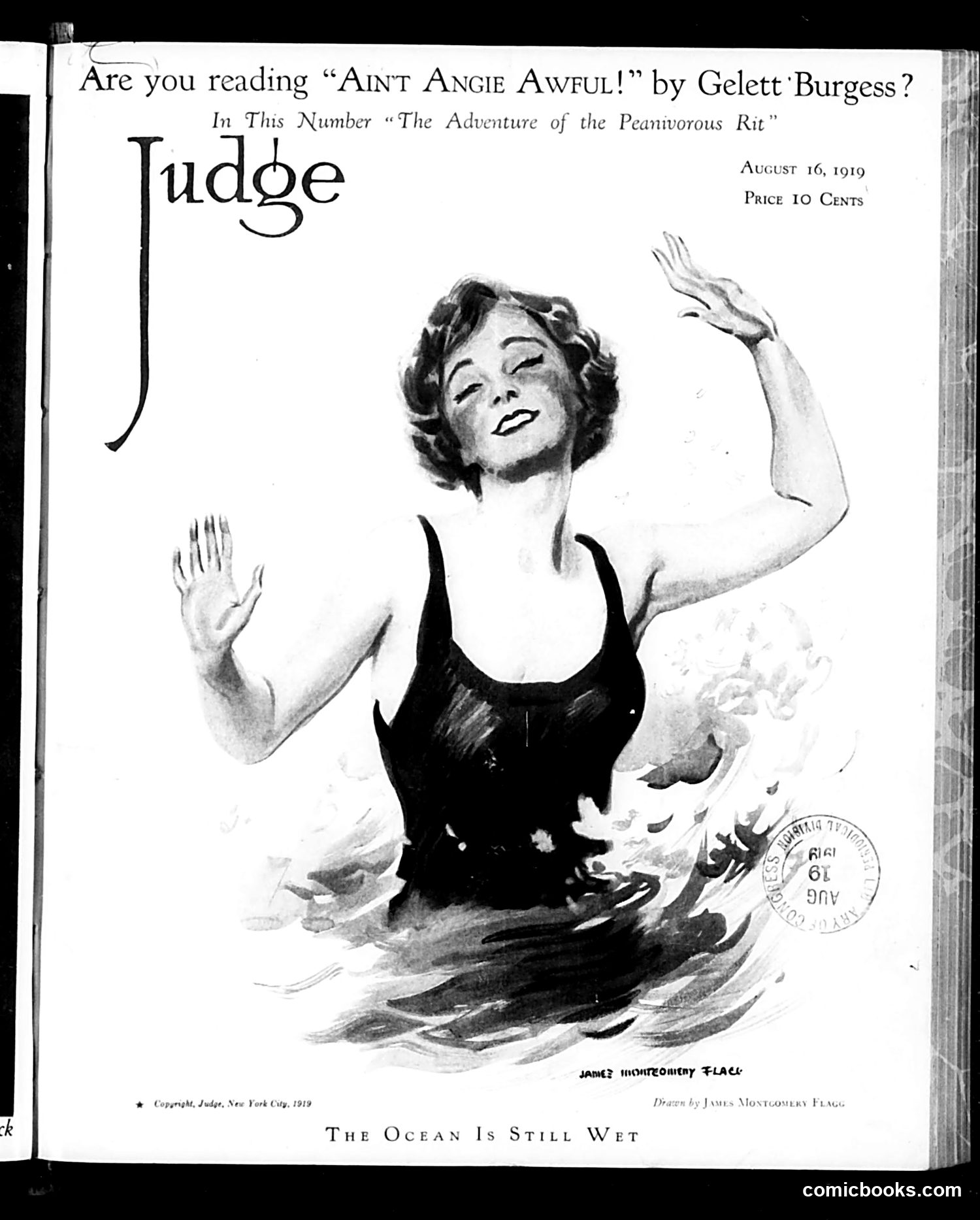
This is primarily a **magazine cover** rather than a political cartoon. The illustration by James Montgomery Flagg shows a woman in a bathing suit emerging from ocean waves, appearing joyful and relaxed. The caption "**The Ocean Is Still Wet**" is a humorous, understated statement—likely satirizing something contemporary, though the specific reference is unclear from this page alone. It may relate to post-WWI optimism or everyday life returning to normal after the war (which ended November 1918). The cover advertises Gelett Burgess's story "Ain't Angie Awful!" and "The Adventure of the Peanivorous Rat" inside. The price of 10 cents and Flagg's prominent signature indicate this was mainstream American popular entertainment, not hard-hitting political satire.
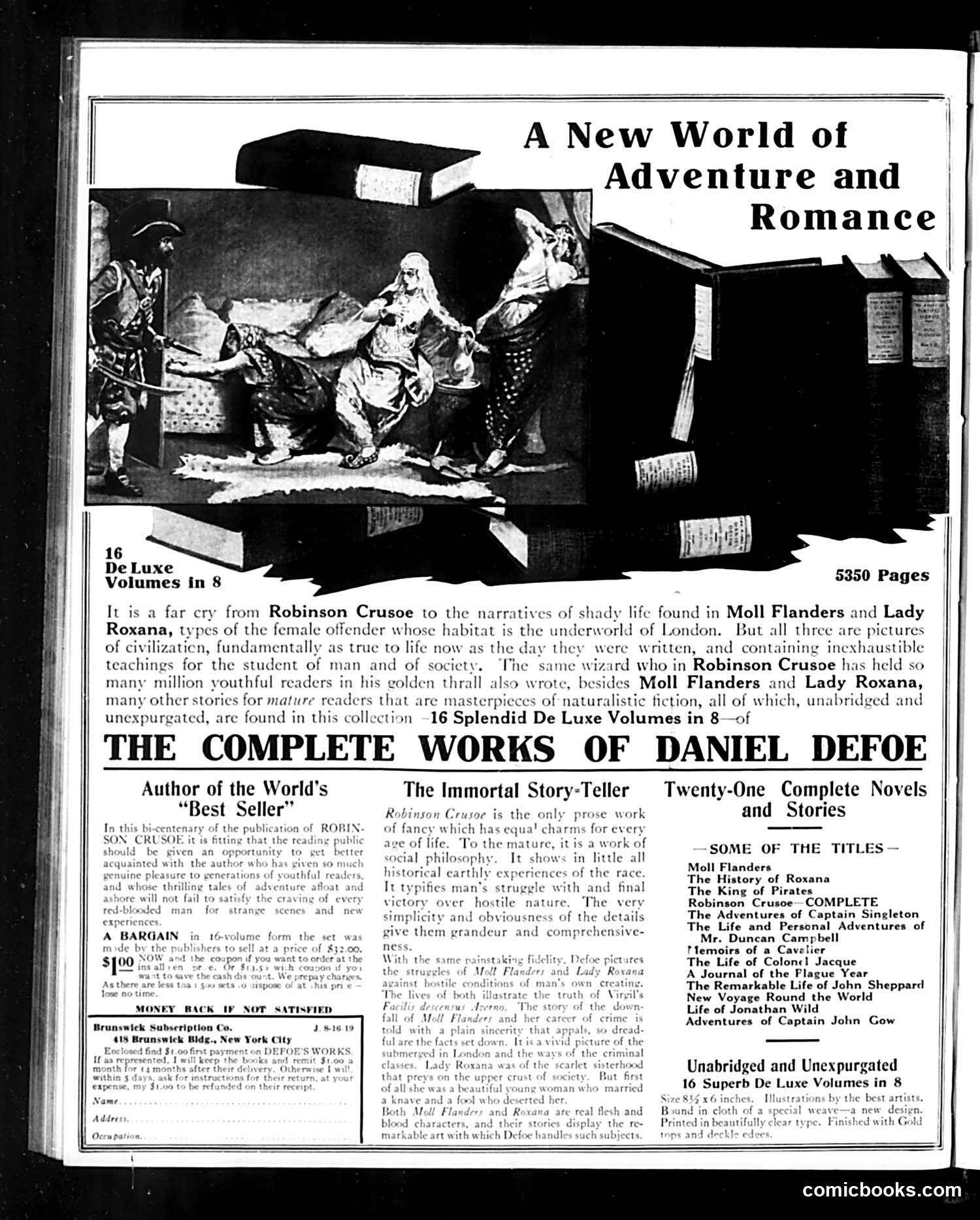
This page is **primarily advertising**, not satire or political commentary. It promotes "The Complete Works of Daniel Defoe" in a 16-volume de luxe edition for $1.00. The central image depicts a theatrical or literary scene—likely illustrating one of Defoe's famous works—showing figures in period costume in what appears to be an interior setting with books and furnishings. The advertisement emphasizes Defoe as "Author of the World's Best Seller" and highlights his most famous works: *Robinson Crusoe*, *Moll Flanders*, and *Lady Roxana*. It targets both youthful and mature readers, describing these as "masterpieces of naturalistic fiction." There is a small "Money Back If Not Satisfied" guarantee from Brunswick Book Subscription Co., typical of mail-order advertising from this era. No political satire or cartoon humor is evident on this page.
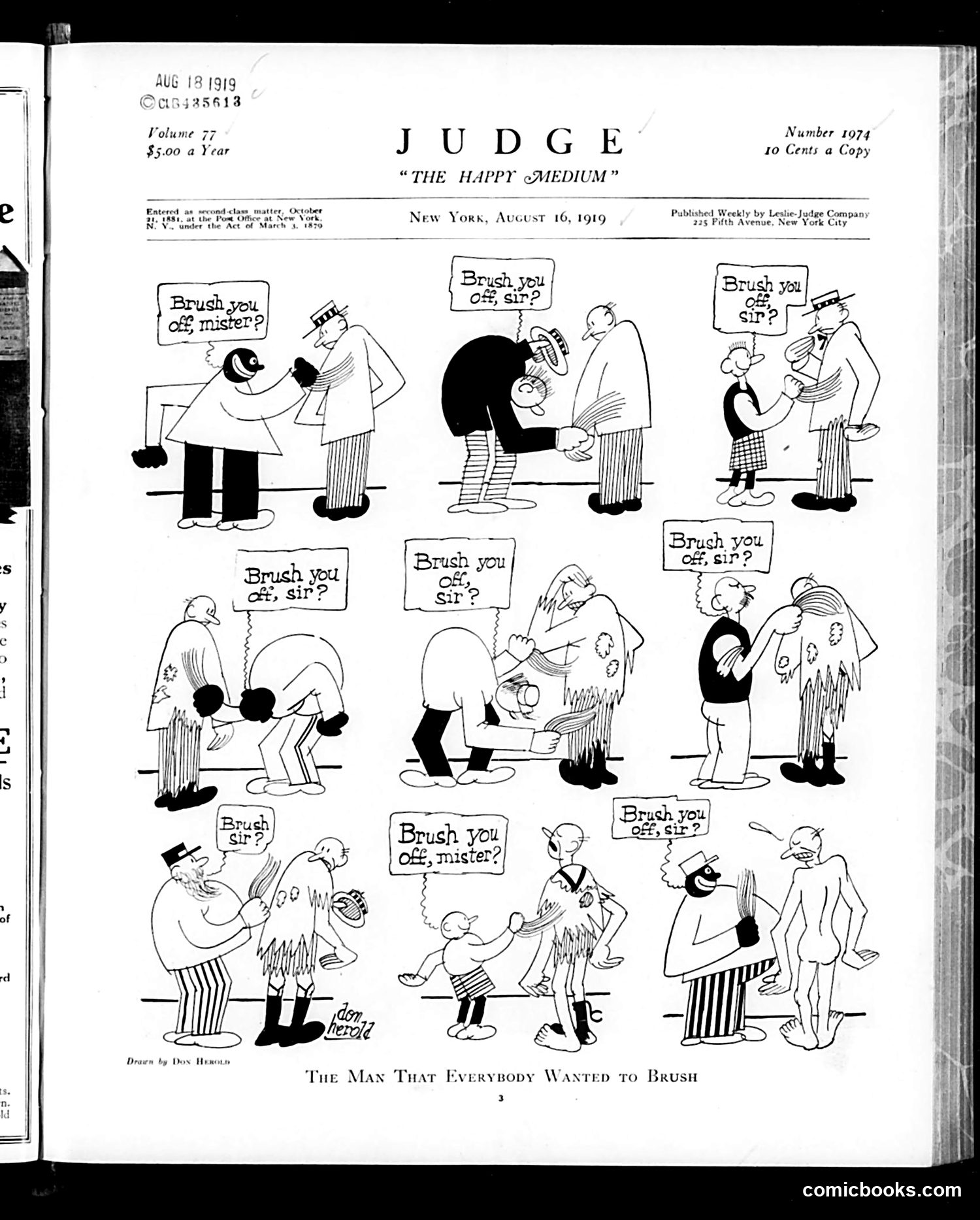
This cartoon satirizes a man who becomes the object of universal desire—but specifically to brush him off or attack him. The repeated refrain "Brush you off, sir?" creates the joke through double meaning: while "brush off" colloquially means to dismiss or rebuff someone, the cartoon depicts literal brushing and beating. The comic shows various figures (appearing to represent different social classes and professions) eagerly taking their turn striking this unfortunate man with brushes, brooms, and other implements. The satire likely targets a specific unpopular public figure or politician of August 1919, whom the cartoonist suggests everyone wanted to harm or humiliate. Without additional context, the specific target remains unclear, though the date places this during the turbulent post-WWI period.
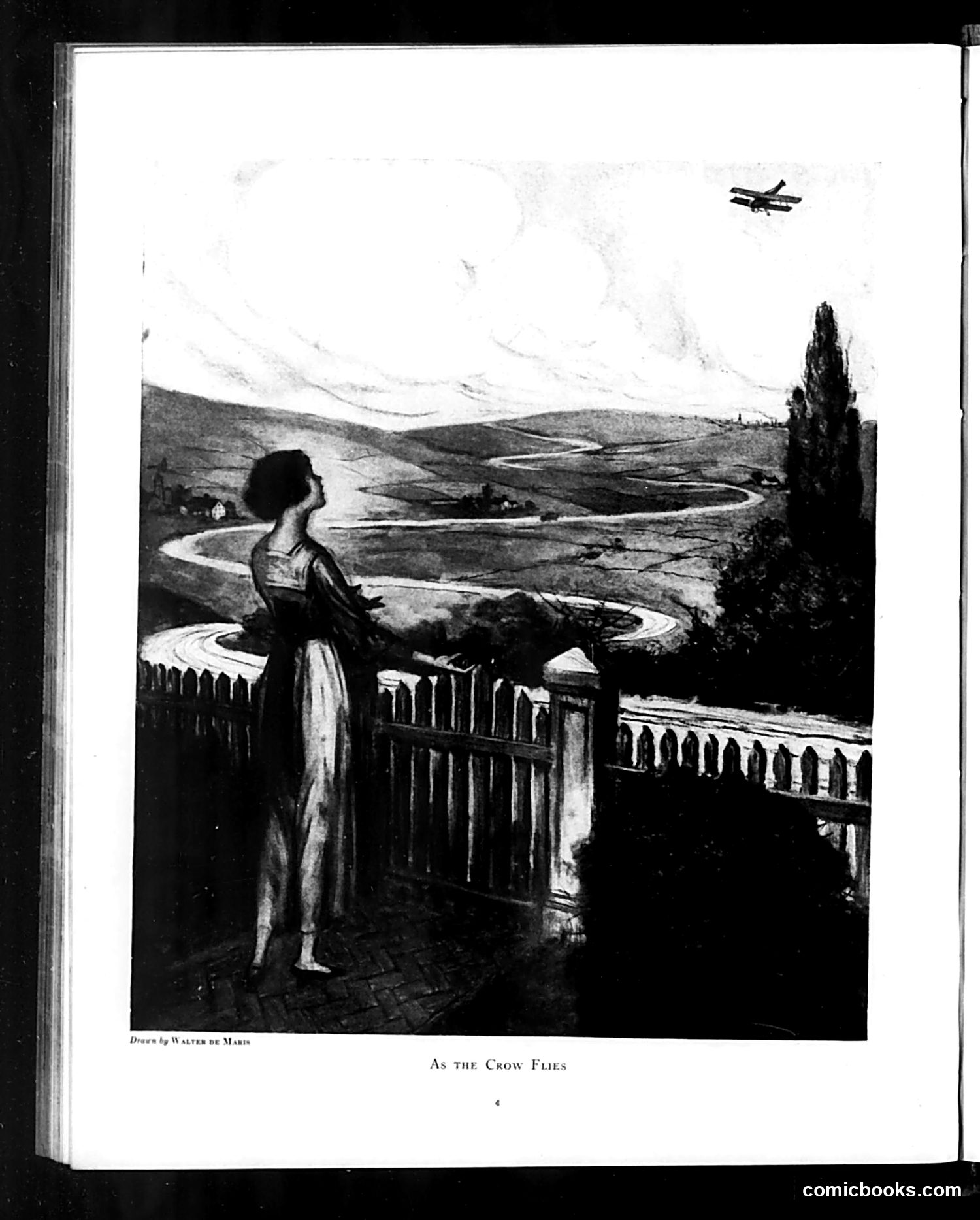
This illustration by Walter de Maris depicts a woman in classical dress gazing from a terrace toward a distant, idealized landscape. An airplane flies overhead in the upper right. The title "As the Crow Flies" is a common idiom meaning the most direct route between two points. The artwork appears to contrast romantic, pastoral imagery with modern aviation technology—suggesting themes about progress, distance, or the changing relationship between traditional aesthetics and contemporary innovation. The woman's contemplative pose and the inclusion of the airplane likely comment on how modern transportation was transforming perceptions of geography and romance in early 20th-century America. However, without additional context from Judge magazine's publication date, the specific satirical intent remains unclear.
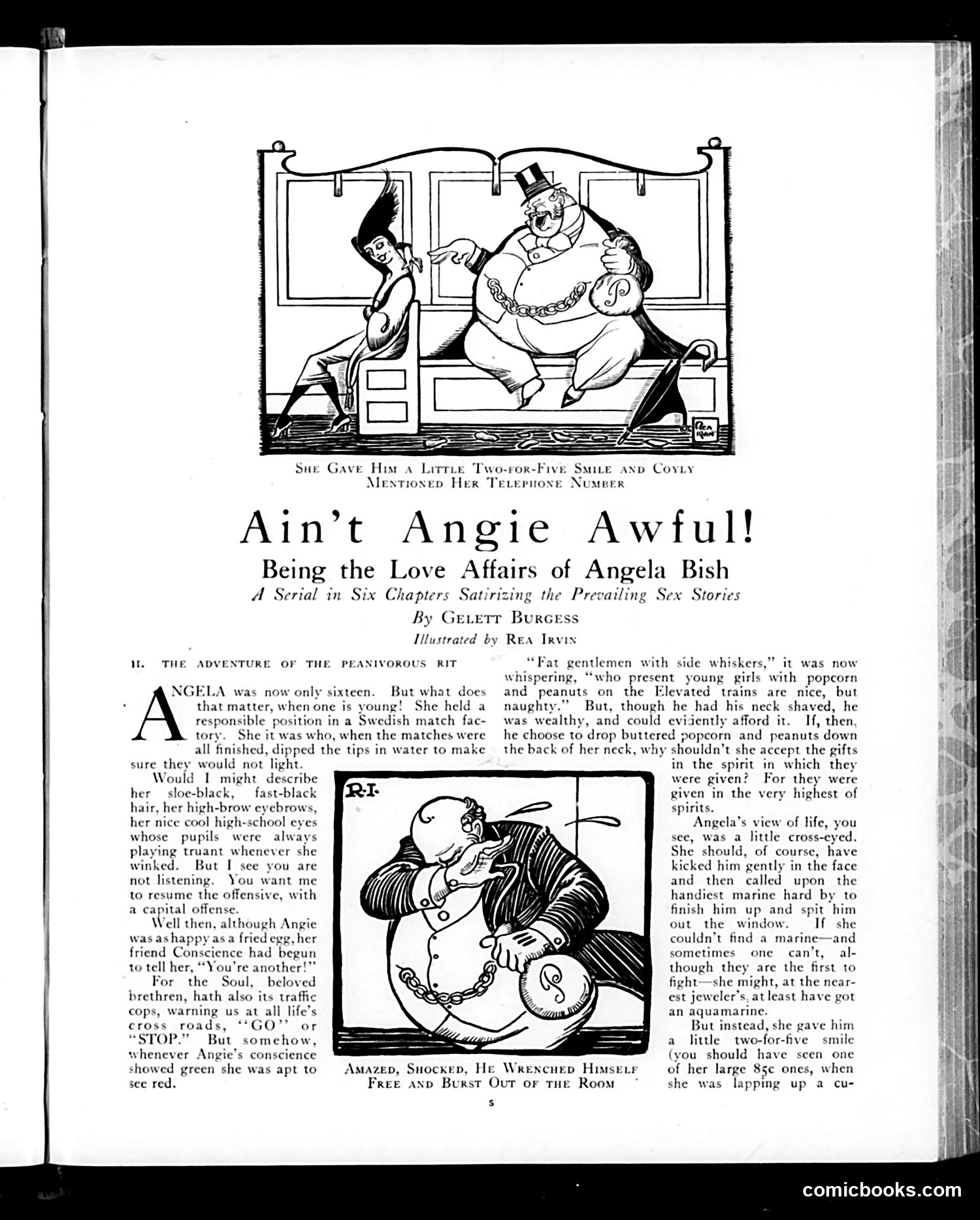
This is a satirical serial by Gelett Burgess about "Angela Bish," a young woman's romantic misadventures. The page shown is Chapter II, "The Adventure of the Peanivorous Rit." The top cartoon depicts a flirtation scene in what appears to be a train car—a woman gives a man a "two-for-five smile" and mentions her telephone number. The illustration below shows the man's exaggerated reaction. The text describes 16-year-old Angela accepting gifts from a wealthy "fat gentleman" during a train encounter, then rejecting his advances by kicking him out a window. The satire mocks both Angela's brazen behavior and the gentleman's presumptions—typical early-20th-century commentary on improper courtship and loose morality among young women.
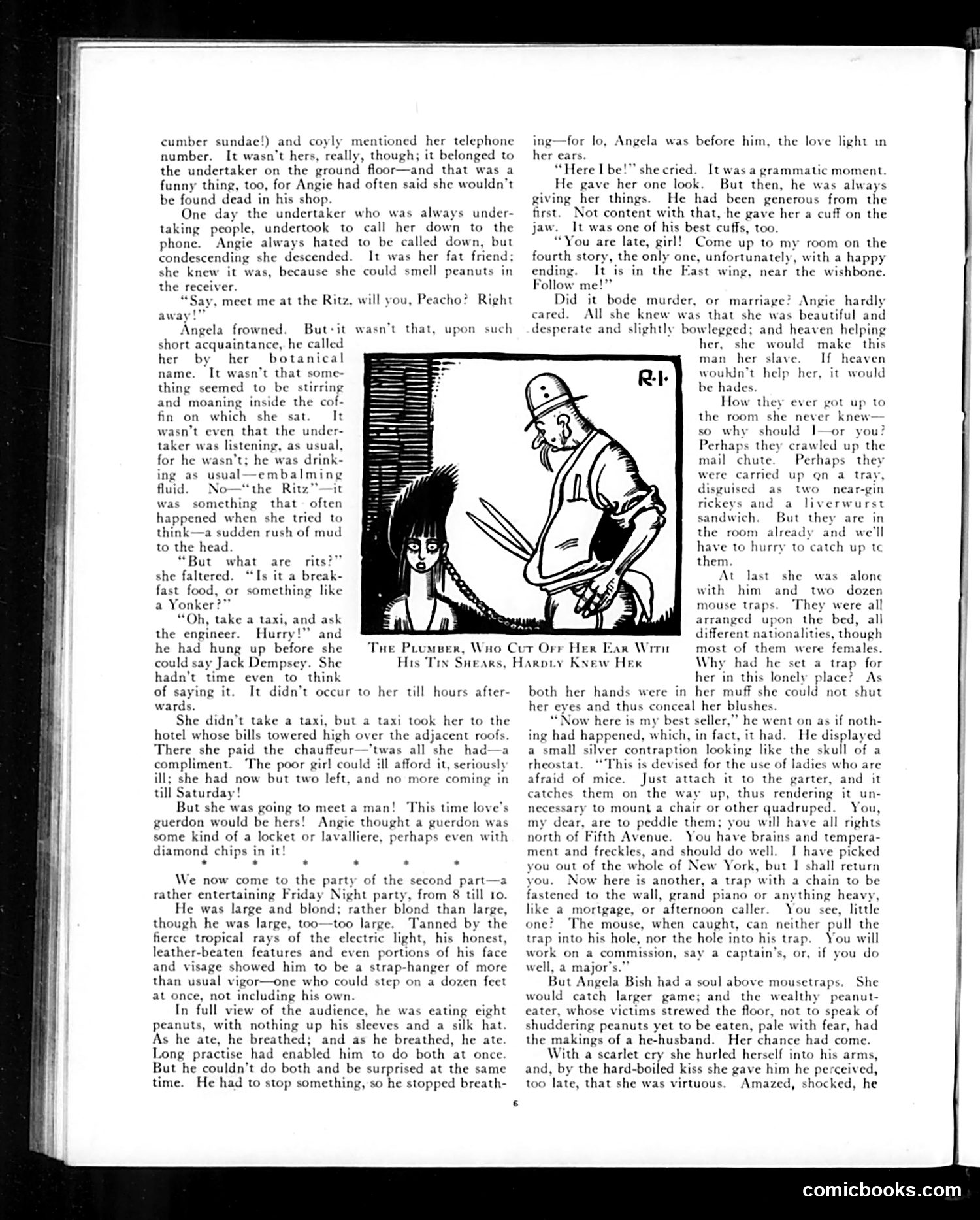
This page contains **narrative fiction rather than political satire**. It depicts a serialized romantic story titled "The Plumber, Who Cut Off Her Ear With His Tin Shears, Hardly Knew Her." The single cartoon illustration shows a plumber character interacting with a young woman named Angela. The narrative describes a romantic encounter at a hotel where the plumber meets Angela, with comedic emphasis on his working-class status contrasting with her desperation and beauty. The satirical element, if any, appears mild—poking gentle fun at class differences and romantic melodrama rather than addressing specific political events or figures. This represents **Judge's lighter entertainment content** rather than its typical political commentary.
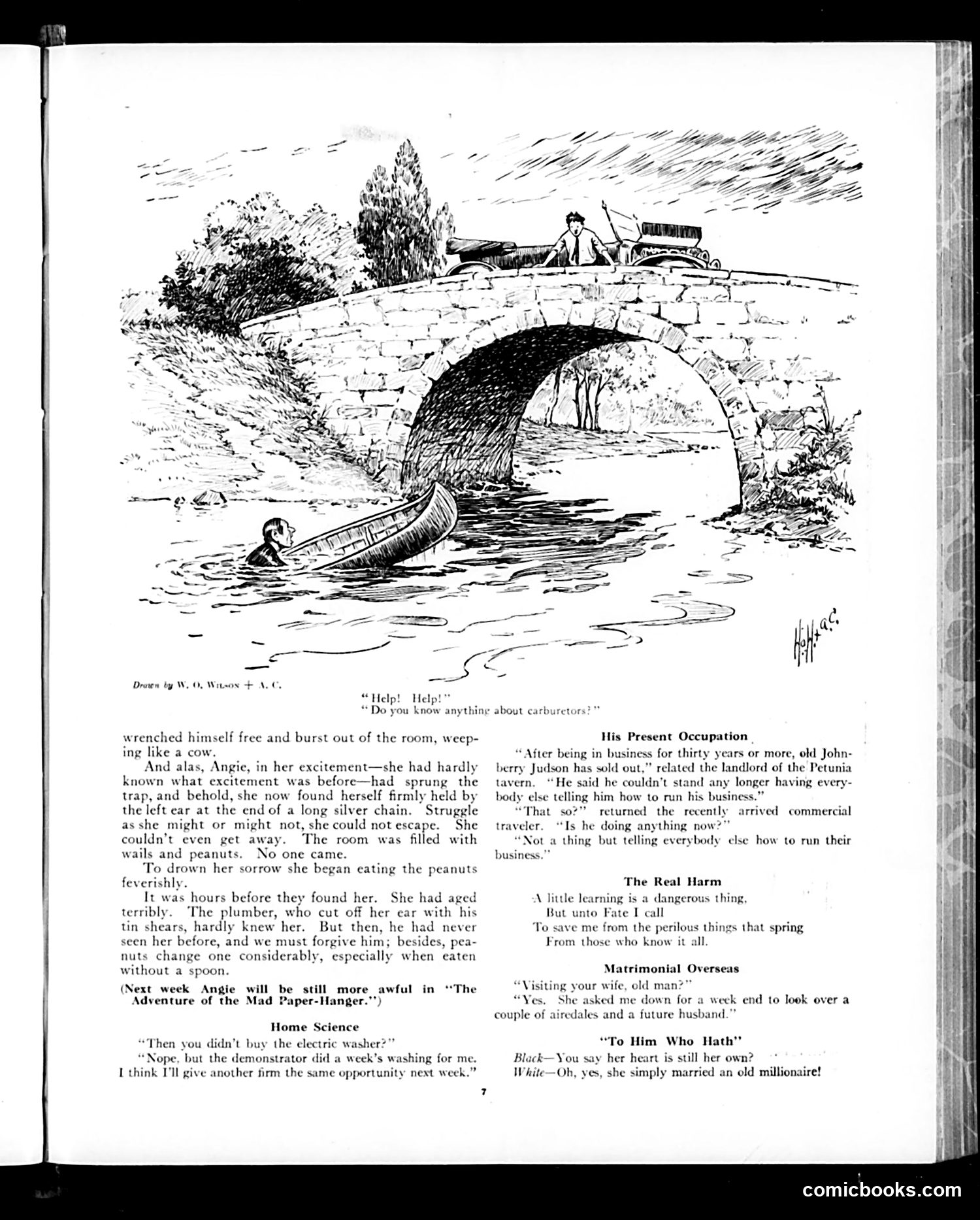
The main cartoon depicts a man in a car stuck under a stone bridge, calling for help about "carburetors"—a reference to early automobile troubles. The humor satirizes the then-new technology of automobiles and their mechanical complexity that befuddled ordinary people. The accompanying text snippets are brief satirical jokes typical of Judge's social commentary: - **"Home Science"** mocks the electric washer industry's aggressive sales tactics - **"His Present Occupation"** ridicules a retired businessman who now annoys others with unsolicited business advice—a common character type in early 20th-century satire - **"The Real Harm"** warns against half-educated know-it-alls - **"Matrimonial Overseas"** jokes about wealthy marriages and trophy wives These pieces reflect Judge's recurring themes: poking fun at new consumer technology, business culture absurdities, and social pretension among the emerging middle class.
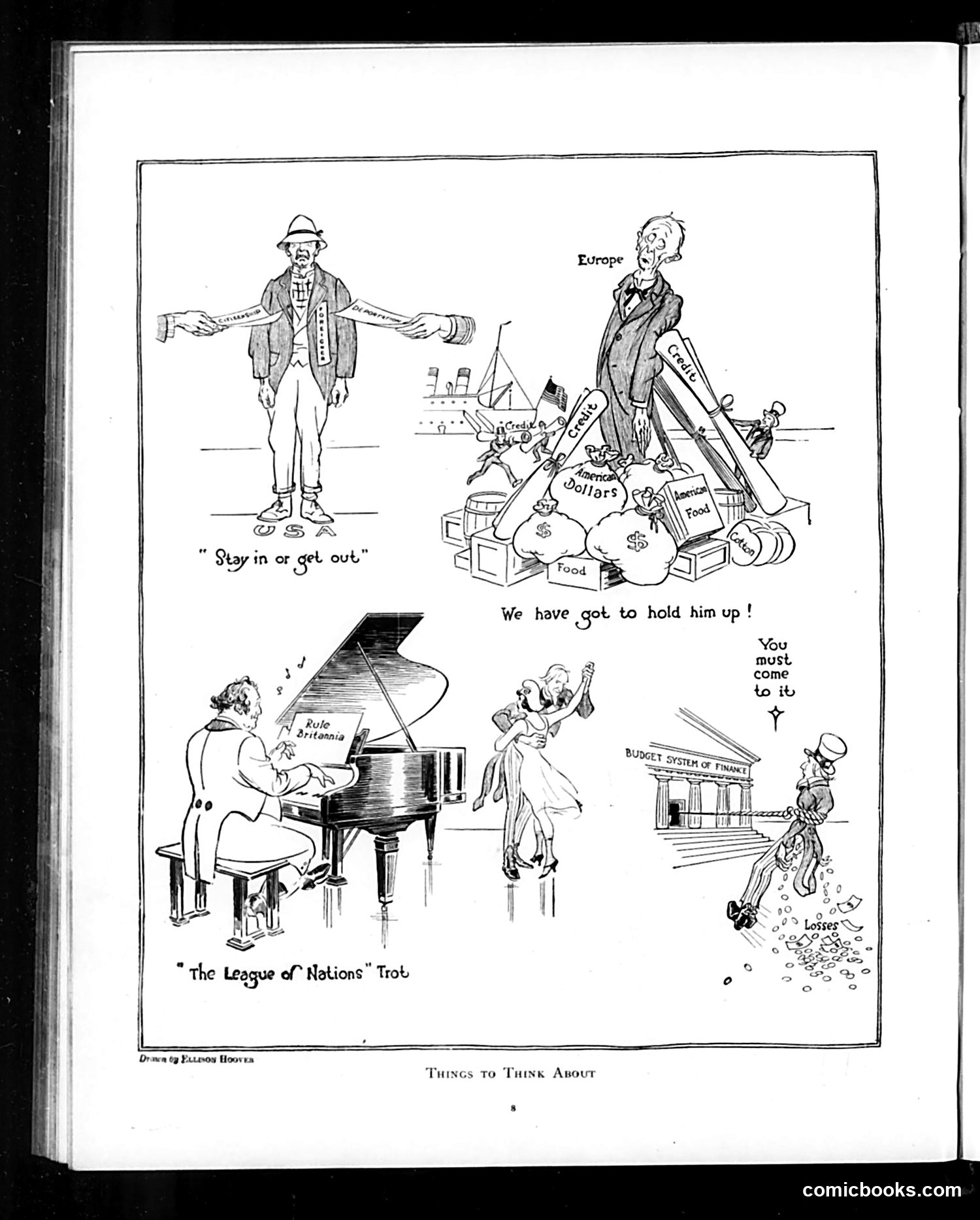
This page satirizes post-WWI international politics. The top left shows a figure with outstretched arms saying "Stay in or get out"—likely depicting American isolationism versus League of Nations involvement. The top right depicts "Europe" as a collapsing figure, supported by various nations and labeled resources (food, dollars, gold). The caption "We have got to hold him up!" mocks Europe's financial dependence. The bottom left shows Britannia (Britain, identifiable by "Rule Britannia" label) playing piano while nations dance—suggesting Britain's cultural influence amid post-war chaos. The bottom right depicts a figure tumbling with "Losses" and money, heading toward the "Budget System of Finance" building, satirizing financial instability and government budgeting struggles during the interwar period. The overall theme critiques post-war economic and political instability in Europe and questions America's role.
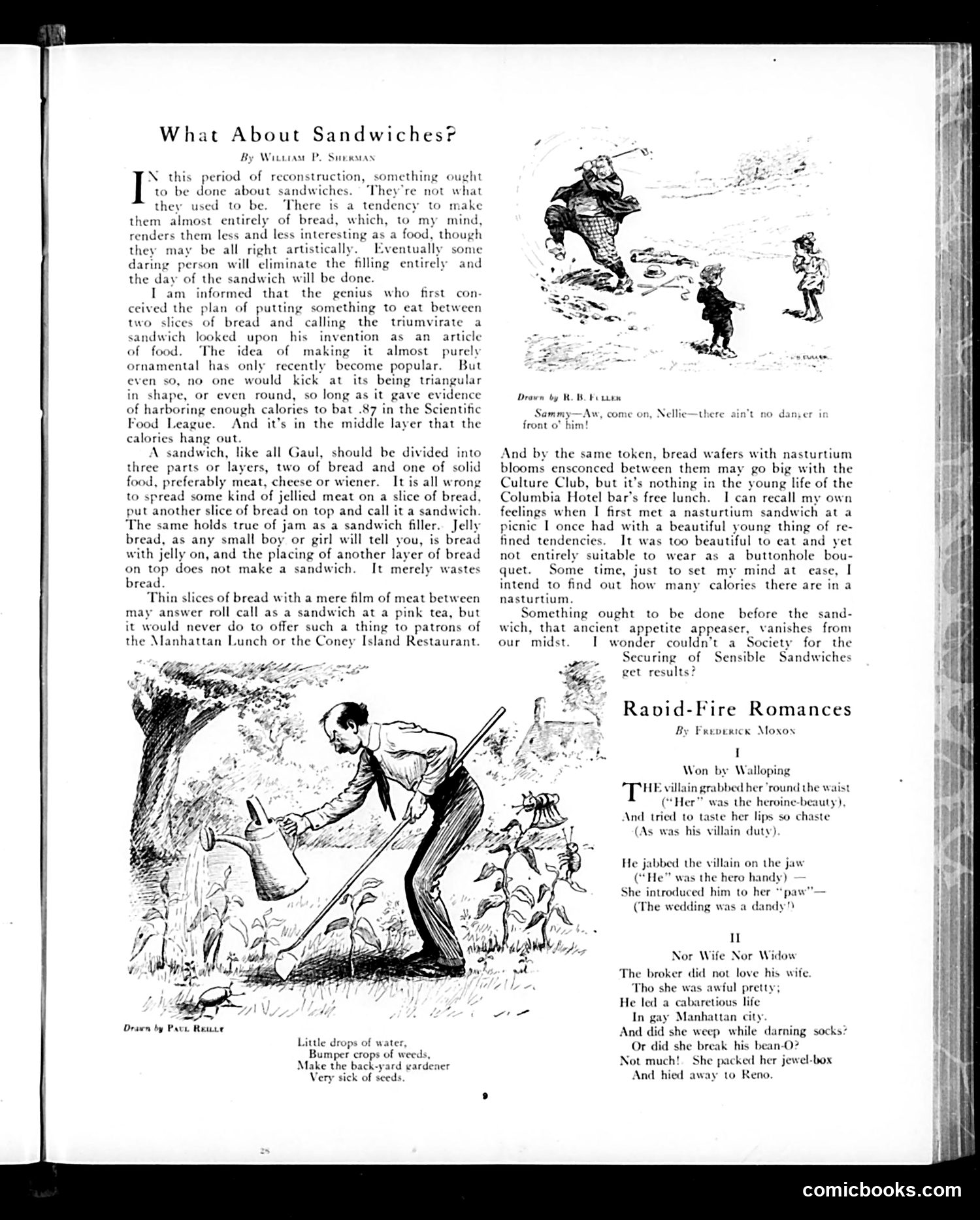
**"What About Sandwiches?"** is a humorous essay satirizing post-WWI American dining trends. The author complains that sandwiches have become mostly bread with minimal filling—criticized as "almost purely ornamental" rather than practical food. He argues sandwiches should contain substantial meat, cheese, or wieners, not decorative items like nasturtium flowers (popular among the "Culture Club"). The piece mocks both pretentious restaurants serving artsy, calorie-poor sandwiches and the broader "reconstruction" era's tendency toward style over substance. The accompanying cartoons illustrate physical humor unrelated to sandwiches. **"Rapid-Fire Romances"** offers brief, tongue-in-cheek verse about melodramatic scenarios: a hero and villain fighting over a heroine, and a wife who abandons her philandering husband for Reno (then famous as a divorce destination). These parody overly dramatic pulp fiction romances popular in the era.
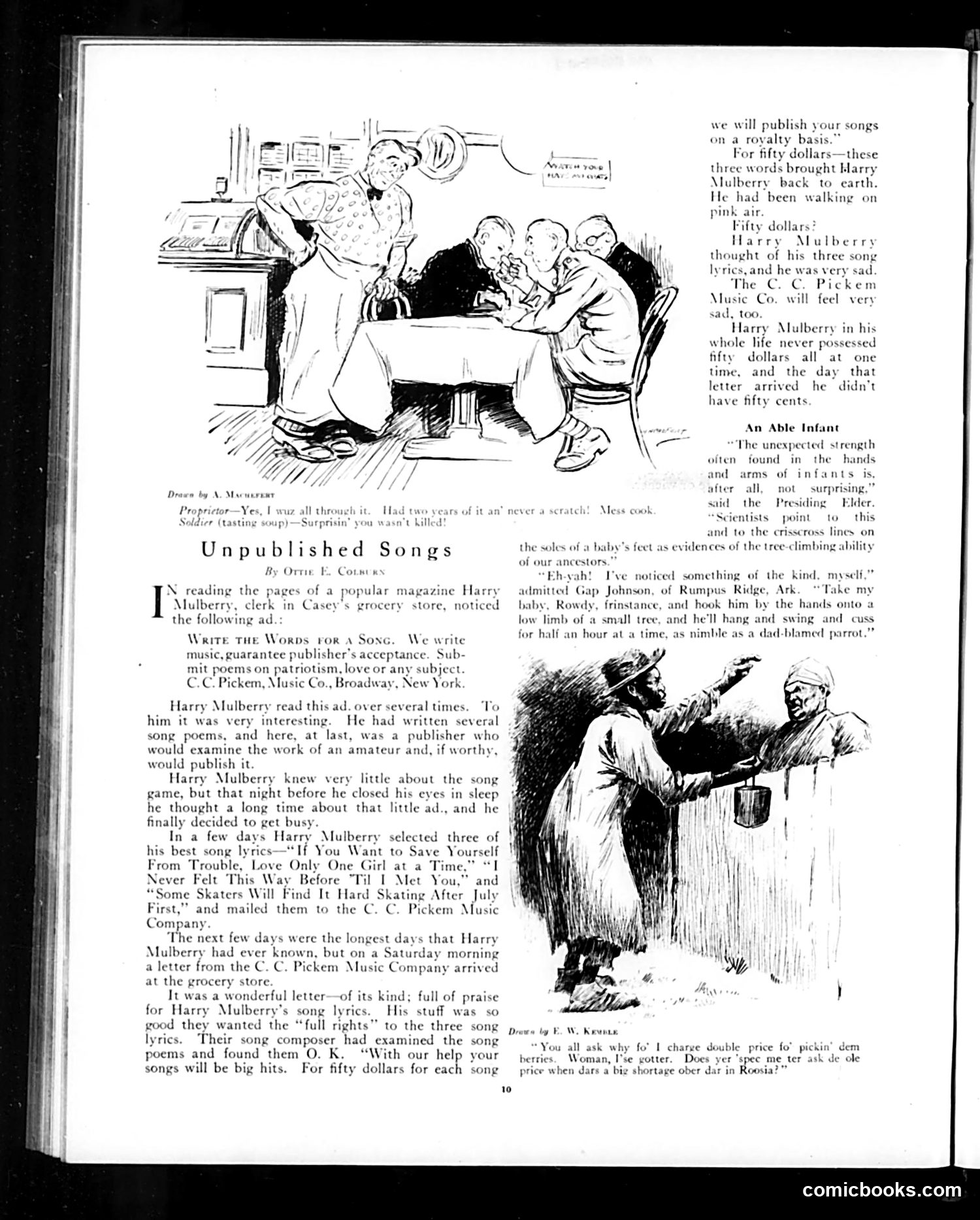
This page contains two satirical pieces from Judge magazine: **"Unpublished Songs"** (main story): Harry Mulberry, a grocery clerk, responds to an ad from C.C. Pickem Music Company promising to publish amateur songs. The company praises his three song lyrics and offers to publish them—for fifty dollars each. The satire targets predatory music publishing schemes that exploited hopeful amateurs by charging upfront fees while promising success. Mulberry, who has never possessed fifty dollars at once, is devastated. The joke: these "song mills" had no intention of making his work profitable; they profited from submission fees, not royalties. **"An Able Infant"** (lower right): A brief anecdote where Gap Johnson describes his baby's surprising strength and climbing ability, attributing it to evolutionary tree-climbing ancestry. The satire gently mocks pseudo-scientific explanations popular in the era, presenting folk observation dressed up as scientific reasoning. Both pieces ridicule common American hucksterism and pseudo-intellectualism of the period.
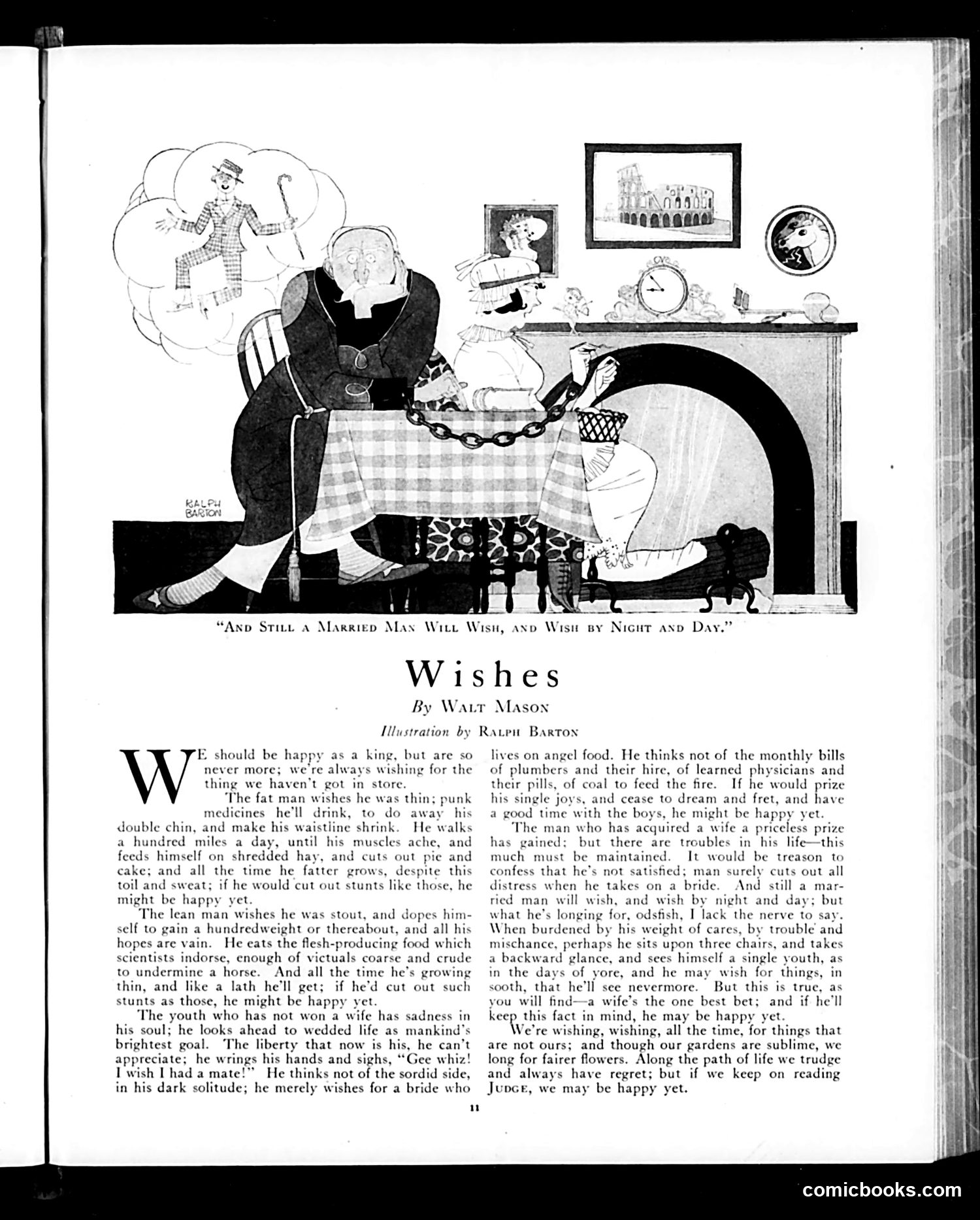
This is a humorous essay-poem illustrated by Ralph Barton satirizing human discontent. Mason catalogs universal wishes that prevent happiness: - **The fat man** wishes to be thin, exercises obsessively, yet grows fatter - **The lean man** wishes to be stout, eats constantly, yet grows thinner - **The unmarried youth** romanticizes marriage, ignoring its financial burdens (plumbers' bills, doctors' fees, heating costs) - **The married man** wishes he were single again, nostalgic for bachelorhood The central irony: people achieve the opposite of what they desire through futile effort. The illustration shows a chained man at a table with a woman, representing marital entrapment—the ultimate wish's disappointment. The piece concludes with self-promotional humor: reading *Judge* magazine itself offers the only genuine path to happiness. This satirizes both human nature's perpetual dissatisfaction and the magazine's own advertising.
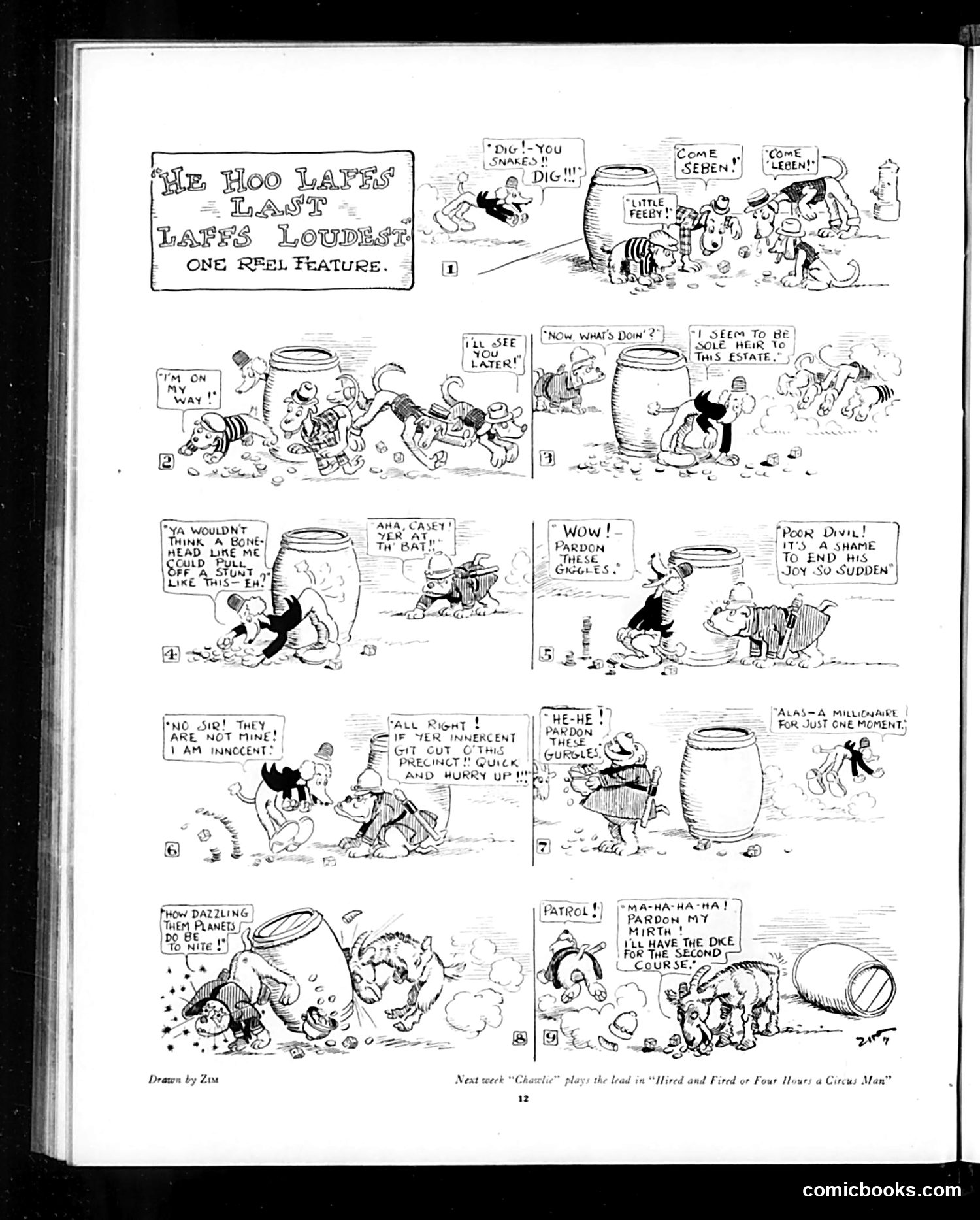
This is a slapstick comic strip featuring what appears to be knockabout comedy characters in the style of early silent films. The narrative follows a chaotic sequence: characters discover a large barrel, assume someone is hiding inside, and engage in physical comedy around it. The humor relies on visual gags and mistaken identity typical of 1910s-20s cinema—characters accusing each other of wrongdoing, someone claiming to be an "innocent" heir to an estate, and escalating silliness. References to a "Patrol" and "precinct" suggest police involvement, adding to the comedic chaos. The strip mimics the style of silent film comedies (particularly Charlie Chaplin-era slapstick), as indicated by the note about next week's "Charlie" feature. The satire is gentle—mocking the overwrought melodrama and physical excess of early cinema rather than targeting specific political figures or events.
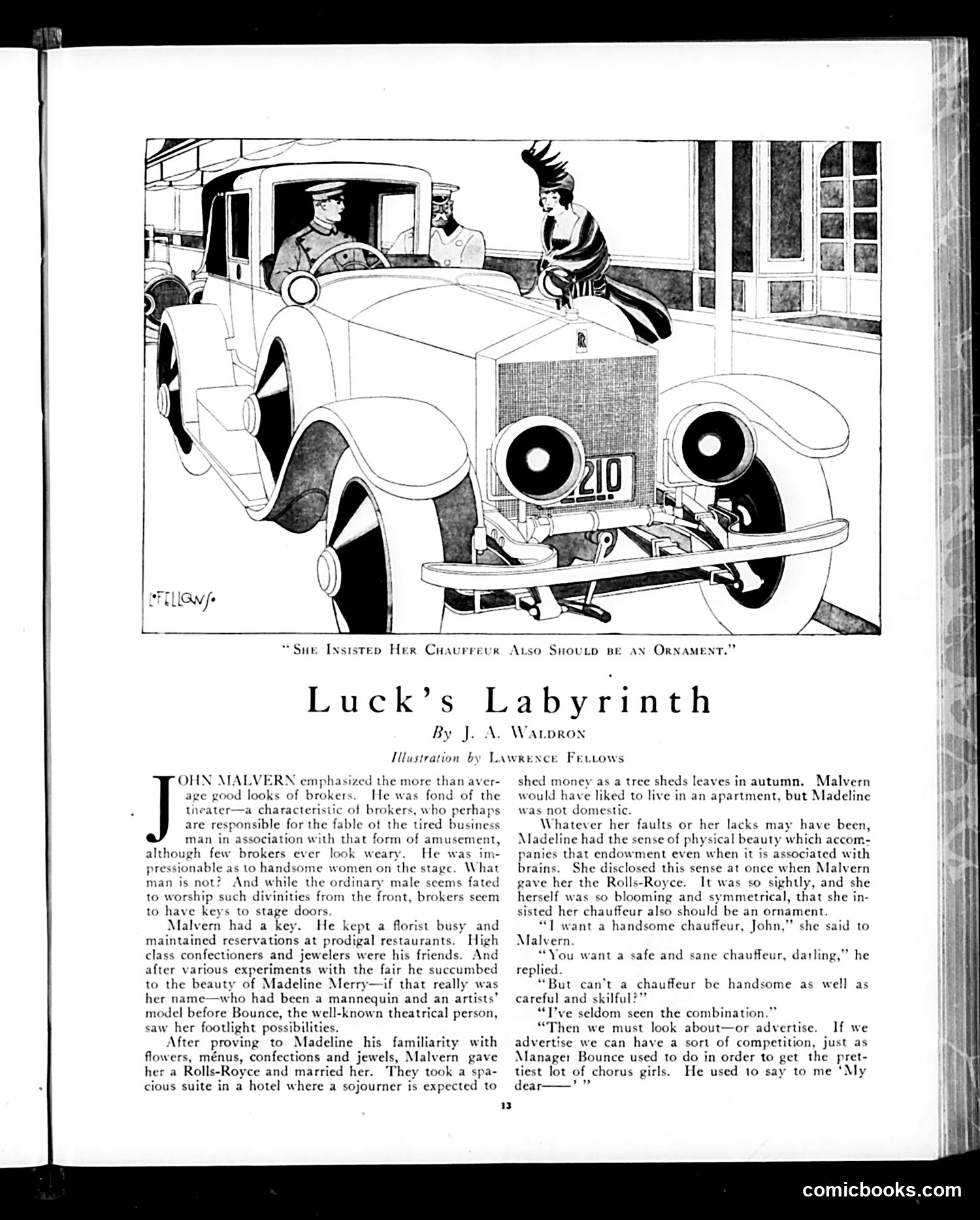
This is the opening of a serialized story satirizing wealthy, frivolous society. John Malvern, a prosperous stockbroker, represents the stereotypical "tired business man" who frequents theaters and pursues showgirls. He marries Madeline Merry, a former model and performer. The cartoon's caption—"She Insisted Her Chauffeur Also Should be an Ornament"—captures the satire's point: Madeline, concerned only with appearances and beauty, insists the chauffeur be handsome rather than merely competent and safe. This mocks wealthy wives who prioritize aesthetic display over practical concerns, and reflects period anxieties about women's frivolity and materialism. The lavish lifestyle (Rolls-Royce, hotels, jewels) and theatrical connections satirize nouveau riche excess. The story appears to follow how Madeline's shallow vanity creates complications—a common Judge magazine theme criticizing modern consumer culture and status-obsessed society.
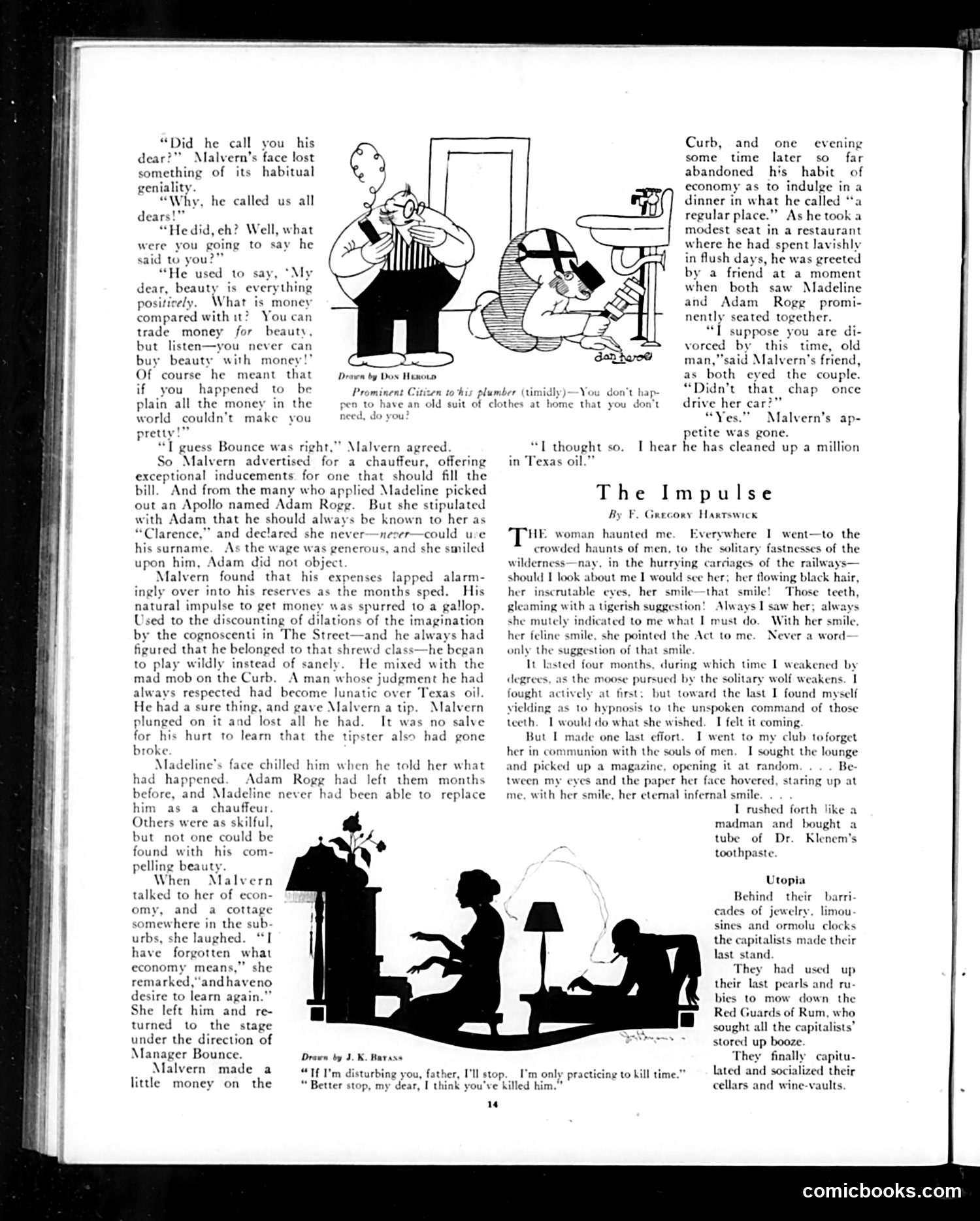
This page contains two distinct stories from Judge magazine: ## "The Malvern Story" (Left/Top) A cautionary tale about social climbing and financial ruin. Malvern, a wealthy man, hires an exceptionally handsome chauffeur named Adam Rogg (whom his wife Madeline insists on calling "Clarence"). Madeline becomes so enamored with the chauffeur's beauty that she abandons her marriage when Malvern loses his fortune through reckless stock speculation (specifically "Texas oil"—likely referencing oil boom speculation of the era). The satire targets: the superficiality of wealth-dependent relationships, the dangers of unregulated speculation, and the foolishness of men following stock tips from unreliable sources. ## "The Impulse" (Right) A psychological thriller by F. Gregory Hartswick about a man haunted by a mysterious woman's smile, which compels him toward unspecified dark action. The incomplete text suggests a crime-of-passion narrative. The cartoons illustrate both stories with simple silhouettes and line drawings typical of Judge's visual style.
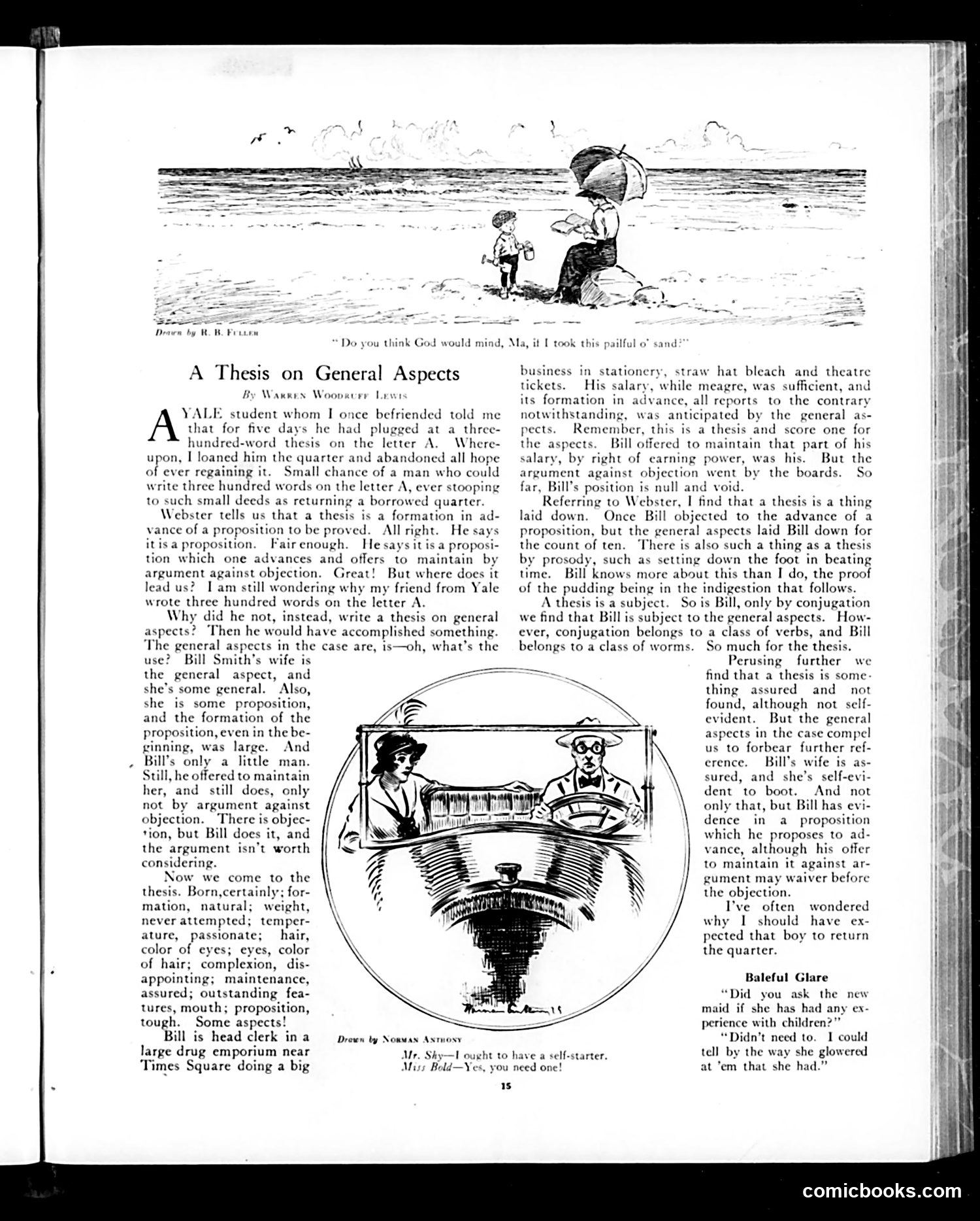
This is a humorous essay by Warren Woodworth Lewis satirizing academic pretension through the story of "Bill," a working-class drug store clerk in Times Square. The satire targets: (1) Yale students writing absurdly pedantic theses on trivial subjects (a three-hundred-word paper on the letter "A"), and (2) the gap between Bill's modest means and his large, difficult wife—described as the essay's central "general aspect." The humor relies on treating Bill's marital situation with mock-scholarly analysis: defining his wife through philosophical/grammatical terminology while emphasizing she's "some proposition" and Bill can barely "maintain" her. The two cartoons illustrate domestic scenes—a child on the beach, and a couple in a car—representing everyday life subjected to academic overthinking. The closing joke about the Yale student not returning a borrowed quarter suggests people obsessed with theoretical questions lack practical integrity—a common Progressive-era jab at ivory-tower intellectualism.
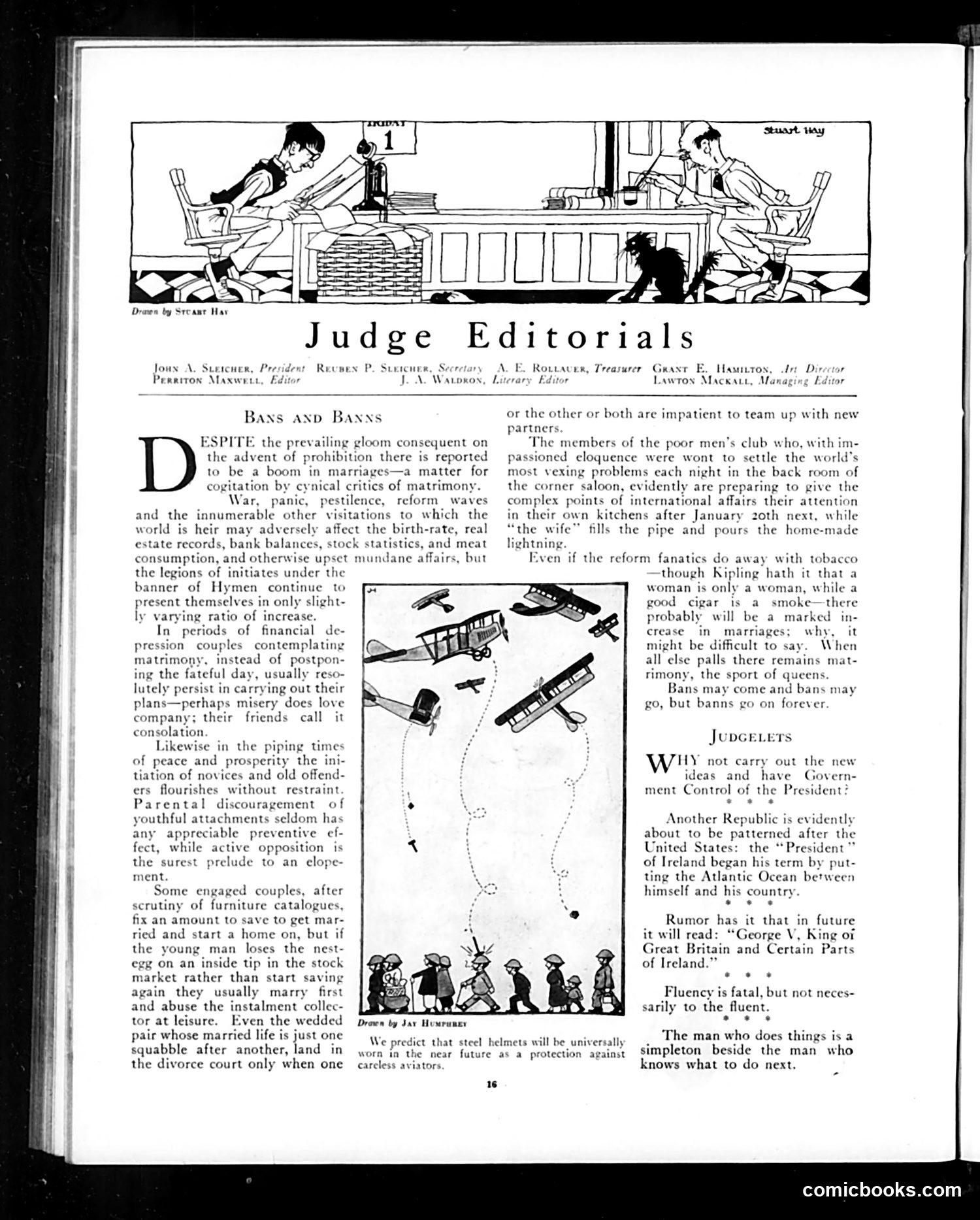
This editorial page satirizes early 1920s American social concerns, particularly **Prohibition** (enacted January 1920). The main editorial "Bans and Banns" jokes that despite Prohibition's gloom, marriage rates remain high—playing on the pun between "bans" (prohibition) and "banns" (marriage announcements). The article suggests couples marry impulsively regardless of economic conditions, and predicts Prohibition won't stop this trend. It mockingly implies that without saloons for intellectual debate, working-class men will now burden their wives with discussing "international affairs" at home. The cartoons appear to show aviation-related imagery, likely referencing contemporary aircraft technology. **"Judgelets"** are brief satirical quips about Irish independence (the new Irish "President" avoiding his own country) and British imperial claims ("Certain Parts of Ireland"), reflecting post-WWI geopolitical reorganization. The page's tone is conservative and cynical about social reform, particularly Prohibition's effectiveness and unintended marital consequences.
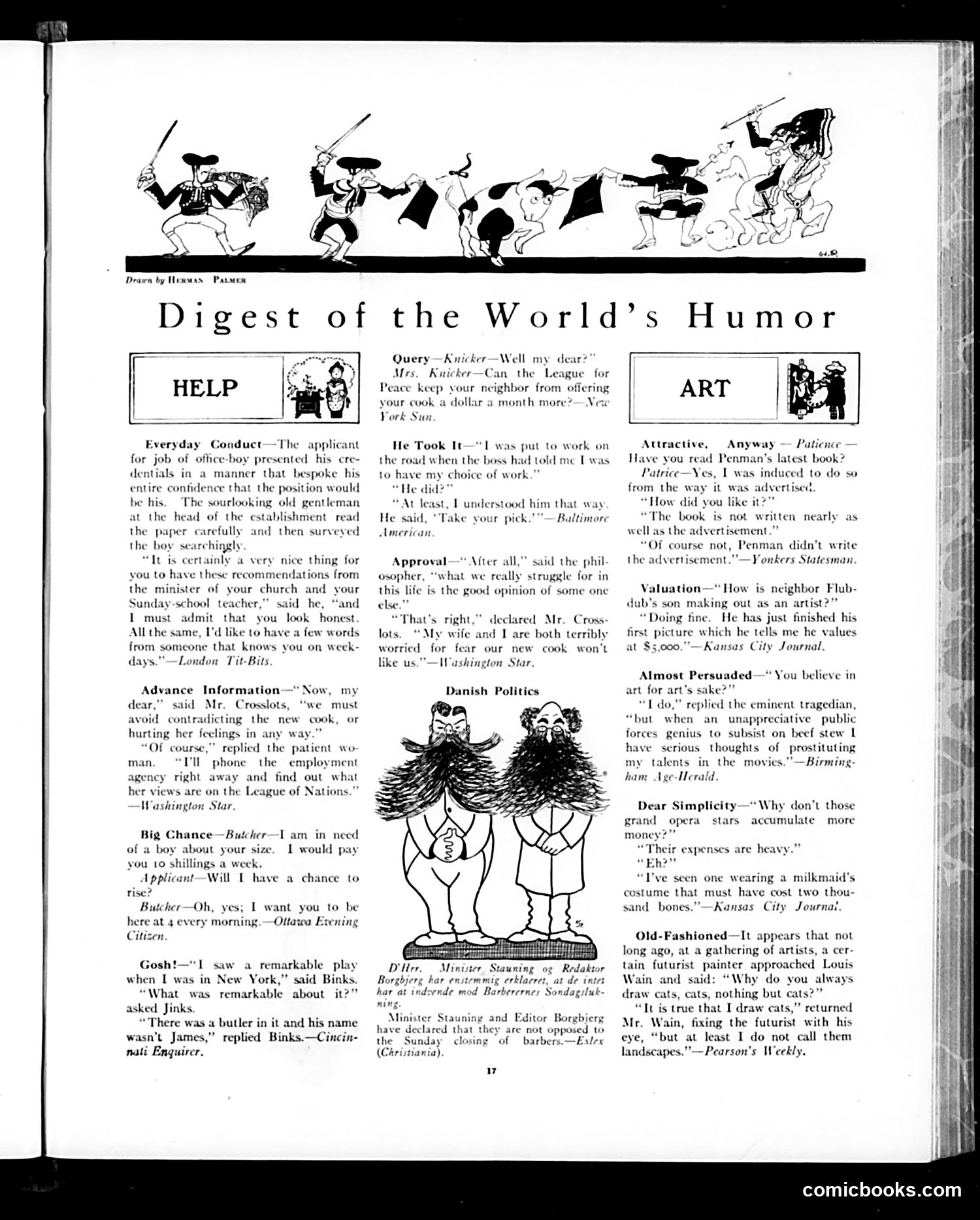
This page collects brief humorous anecdotes satirizing early 20th-century social conventions and attitudes. Key examples: **"Everyday Conduct"** mocks employer hypocrisy—an office manager trusts church references but distrusts the boy's weekday behavior, implying workers act differently away from authority. **"Advance Information"** jokes about the League of Nations obsession, suggesting newlyweds must consult employment agencies about a domestic worker's political views—absurd bureaucratic thinking. **"Danish Politics"** cartoon depicts two bearded Danish figures (likely Ministers Stauning and Borgbjerg) debating barber shop closures, referencing actual Danish political disputes. **"Almost Persuaded"** ridicules art criticism—a book praised for its advertisement rather than content, blaming the author for poor writing. **"Old-Fashioned"** features Louis Wain (famous cat illustrator) defending his cat paintings against "futurist" criticism, defending traditional art against modernist movements. Throughout, satire targets pretension, misplaced priorities, and social absurdities of the era.
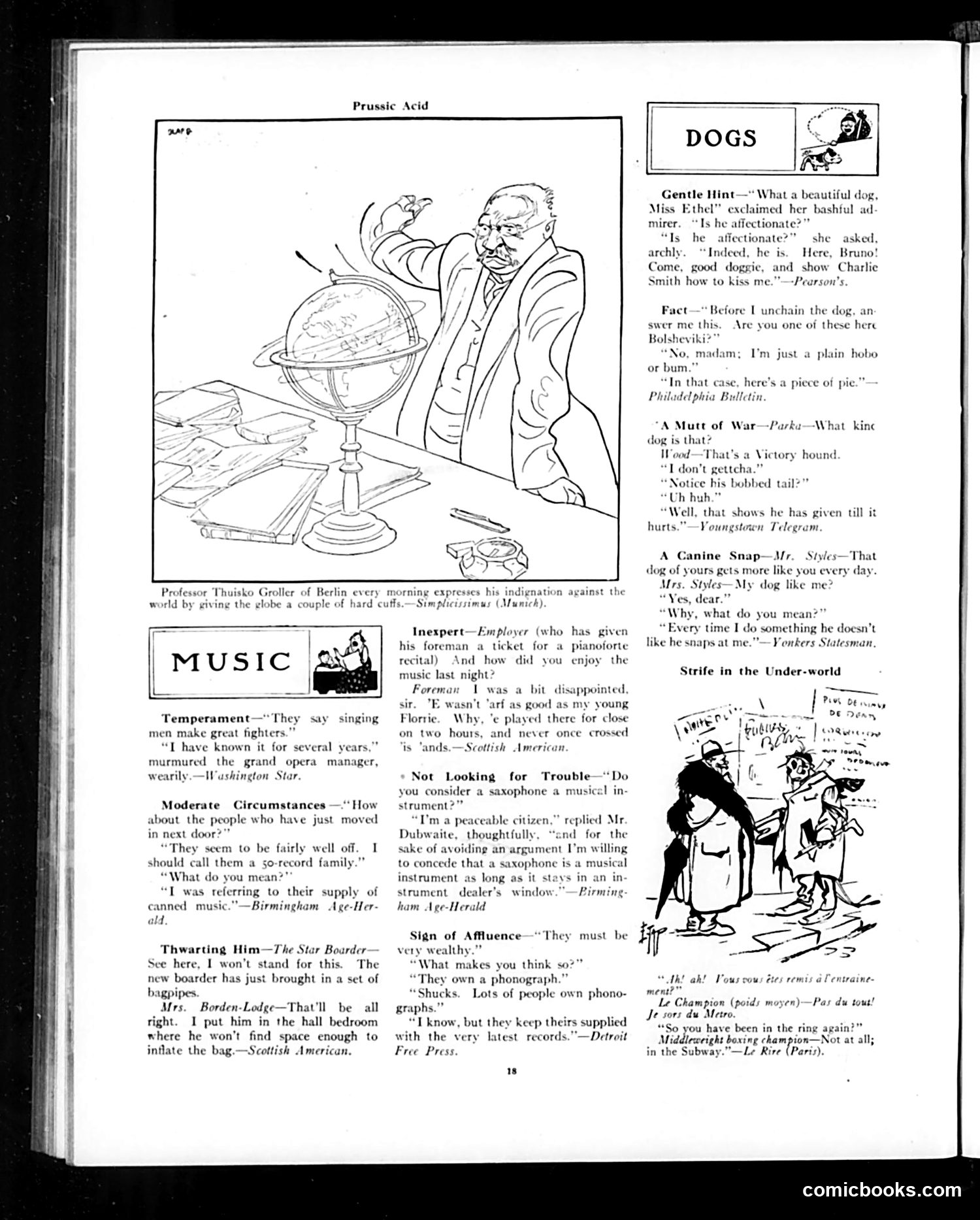
This page from Judge contains multiple brief humor pieces and cartoons on three topics: **Prussic Acid (top left):** A cartoon showing Professor Thursko Groller of Berlin striking a globe—satirizing German aggression and militarism through the caption's reference to his "daily indignation against the world" expressed via "hard cuffs." This likely references pre-WWI or interwar German belligerence. **Music (center/bottom left):** Six short comedic anecdotes mocking: - Opera singers' temperaments - Families defined by their "record collections" (phonographs) - Bagpipes as unbearably loud - Pianos as instruments for lengthy, tedious amateur performances - Saxophones as controversial/contentious instruments - Phonograph owners as status-conscious **Dogs (right side):** Multiple brief jokes about dogs reflecting on human nature—affection, resemblance, and compatibility between owners and pets. The "Strife in the Under-world" cartoon (bottom right) depicts a subway confrontation humorously mistaken for a boxing match, playing on urban life's chaos.
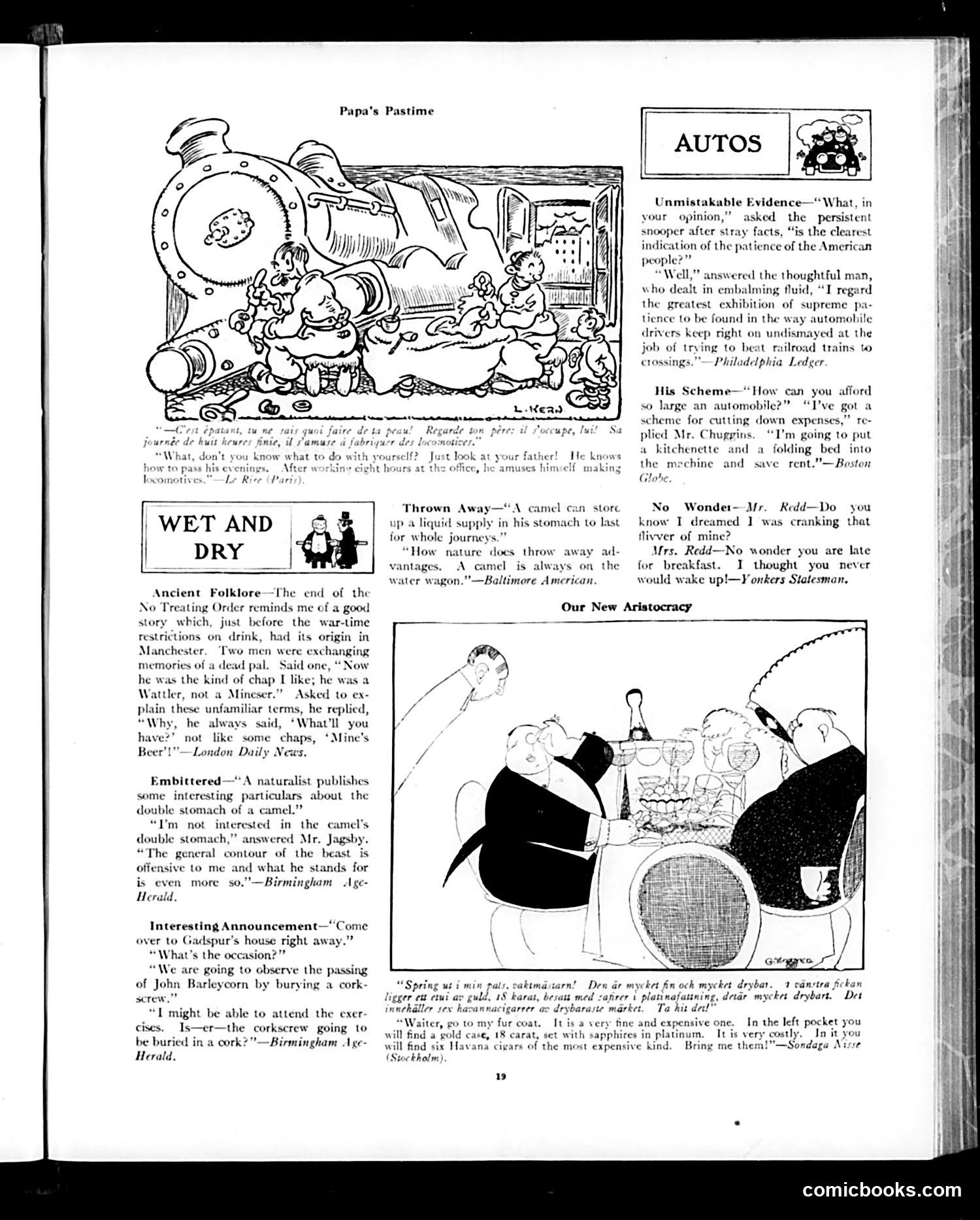
This page from *Judge* contains multiple short humorous anecdotes satirizing early 20th-century American society. **Key content:** The "Papa's Pastime" cartoon (top) depicts a father entertaining children with a toy train, illustrating domestic leisure. **Main satire targets:** 1. **Prohibition ("No Treating Order")**: A nostalgic joke about pre-Prohibition drinking culture and the etiquette of buying rounds. 2. **Automobile culture**: Multiple jokes mock the obsession with cars—people trying to beat trains at crossings, using automobiles as living spaces to save rent, and dreaming about cranking them (hand-starting). 3. **"Our New Aristocracy"**: A wealthy man boasts about his expensive possessions (fur coat, gold cigarette case with sapphires and platinum), satirizing nouveau-riche materialism and consumerism as the new status marker, replacing traditional aristocracy. The humor targets American anxieties about rapid industrialization, changing class structures, and consumer culture during the early automotive era.
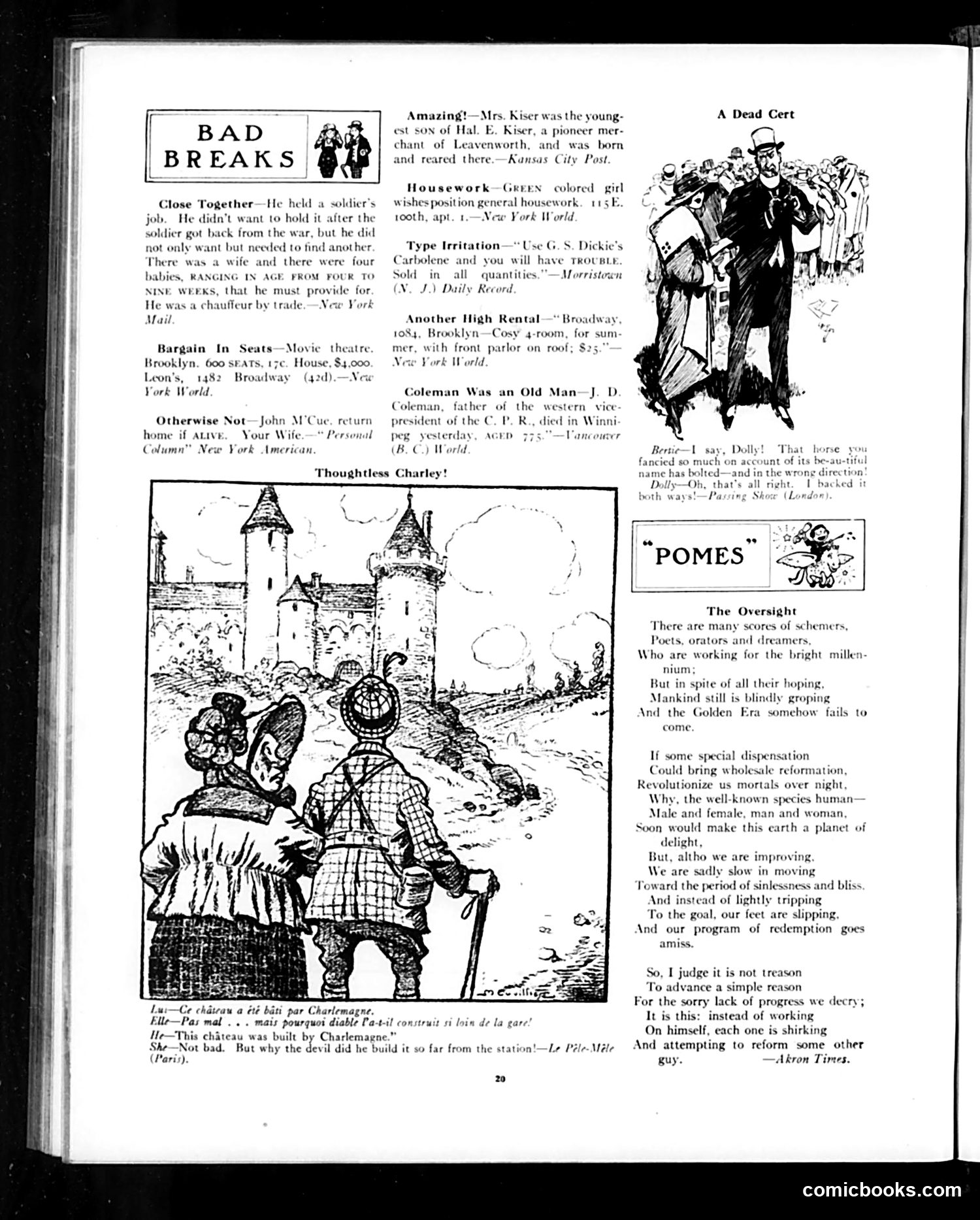
This page from *Judge* magazine contains brief satirical news items mocking newspaper classified ads and human misfortune, plus a political cartoon and poem. **"Thoughtless Charley"** cartoon depicts a medieval castle scene where a character questions why Charlemagne built his fortress far from the train station—absurd anachronism for satirical effect, mocking oblivious tourism or backwards thinking. **"A Dead Cert"** is a brief joke about a woman who backed a horse based solely on its appealing name, which then bolted in the wrong direction—satirizing foolish betting logic. **"The Oversight"** poem critiques progressive reformers and social dreamers. It argues that mankind makes slow progress toward utopia because people focus on reforming *others* rather than improving themselves. The satire targets idealistic activists who ignore personal moral development while pursuing grand societal transformation—a common *Judge* critique of reform movements. The page largely mocks human folly, shortsighted decision-making, and the gap between reformist ambitions and individual accountability.
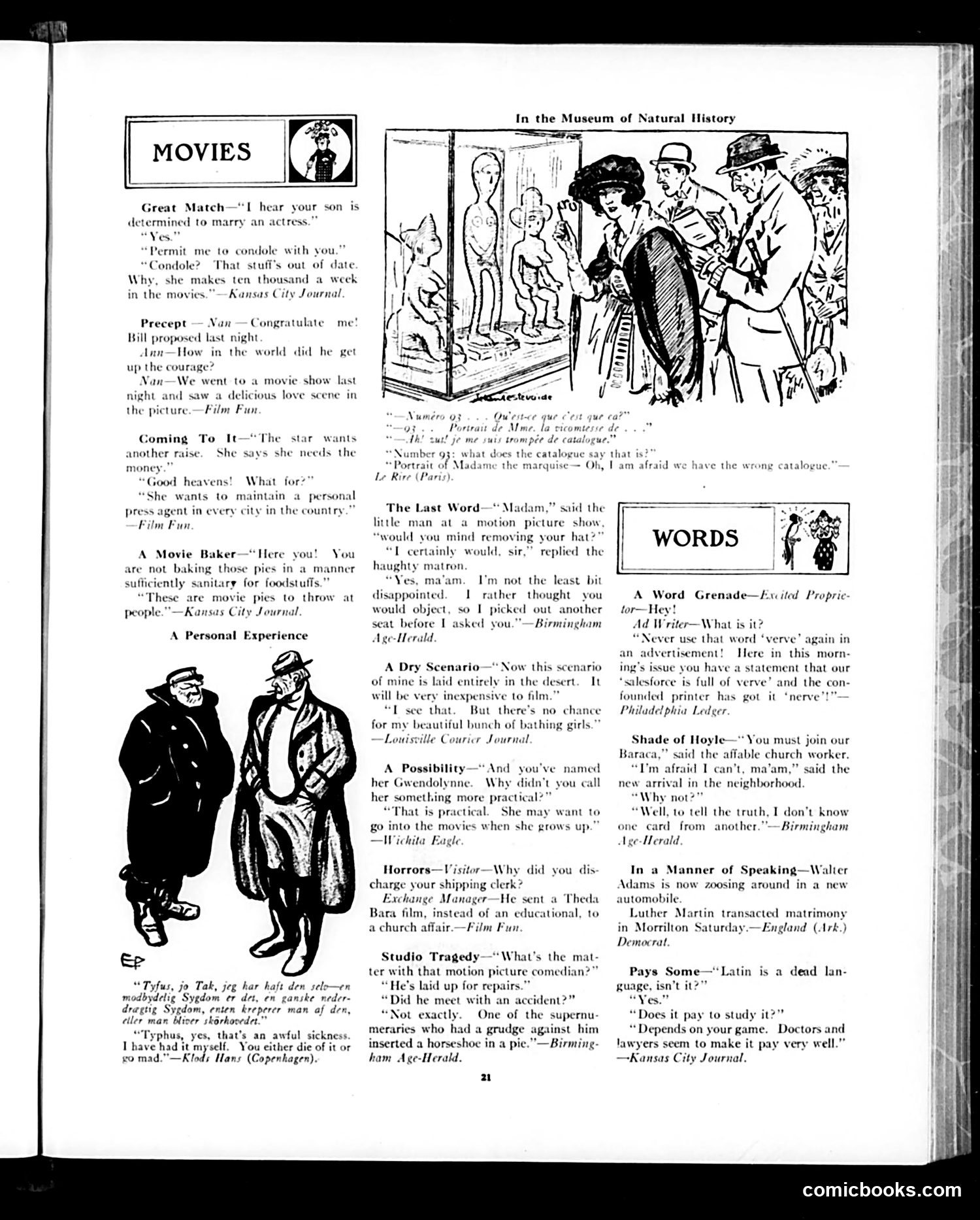
This page from the satirical magazine *Judge* collects brief comedy items mocking early cinema and contemporary society (likely 1910s-1920s based on references to film industry practices). **Movie Industry Satire:** Multiple jokes target Hollywood's rapid growth and absurdities—actresses earning enormous salaries, studios demanding expensive "raises," and the disconnect between film fantasy and reality. "A Movie Baker" jokes that even inedible props must meet sanitary standards, mocking the film industry's peculiar priorities. **Social Commentary:** The "Personal Experience" cartoon (in Danish) and anecdotes about church workers and automobile owners reflect period anxieties about modernity and changing social values. **The "Last Word" joke** inverts expectations: a theater patron's polite hat-removal request becomes passive-aggressive when he admits he'd already planned to move seats—a commentary on social pretense. **Notable:** Theda Bara reference confirms the 1910s-1920s timeframe; she was a famous silent film actress. The magazine collects brief, punchy gags typical of early 20th-century American humor publications.
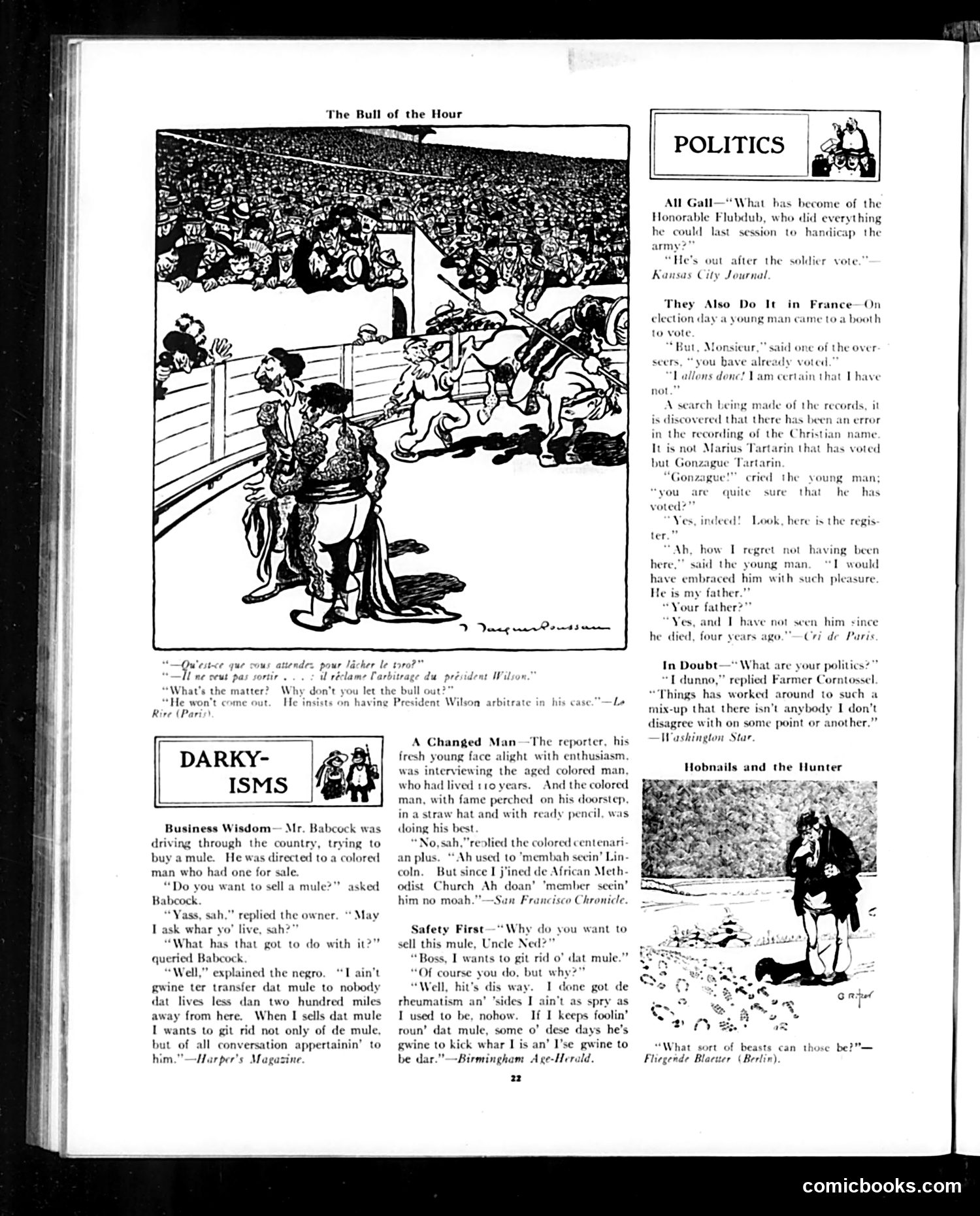
**Main Cartoon**: This depicts a bullfighting scene where a matador confronts a bull in an arena. The French caption references someone refusing to "come out" and invokes President Wilson to arbitrate. This appears to satirize a political figure (likely from WWI-era politics) who is being forced into action or commitment—the "bull" represents a difficult situation or opponent they're avoiding. The bullfighting metaphor suggests an inescapable confrontation. **Politics Section**: Multiple brief satirical items mock political hypocrisy and voter fraud: - "All Gall" criticizes a congressman who opposed military spending now seeking soldiers' votes - "They Also Do It in France" jokes about electoral fraud (voting the same person twice) - "In Doubt" shows a farmer so politically confused he disagrees with everyone **Lower Section**: Comic anecdotes about African American characters and mules—typical period humor stereotyping Black dialect and rural life. The page overall reflects early-20th-century American satirical journalism targeting political corruption and inconsistency.
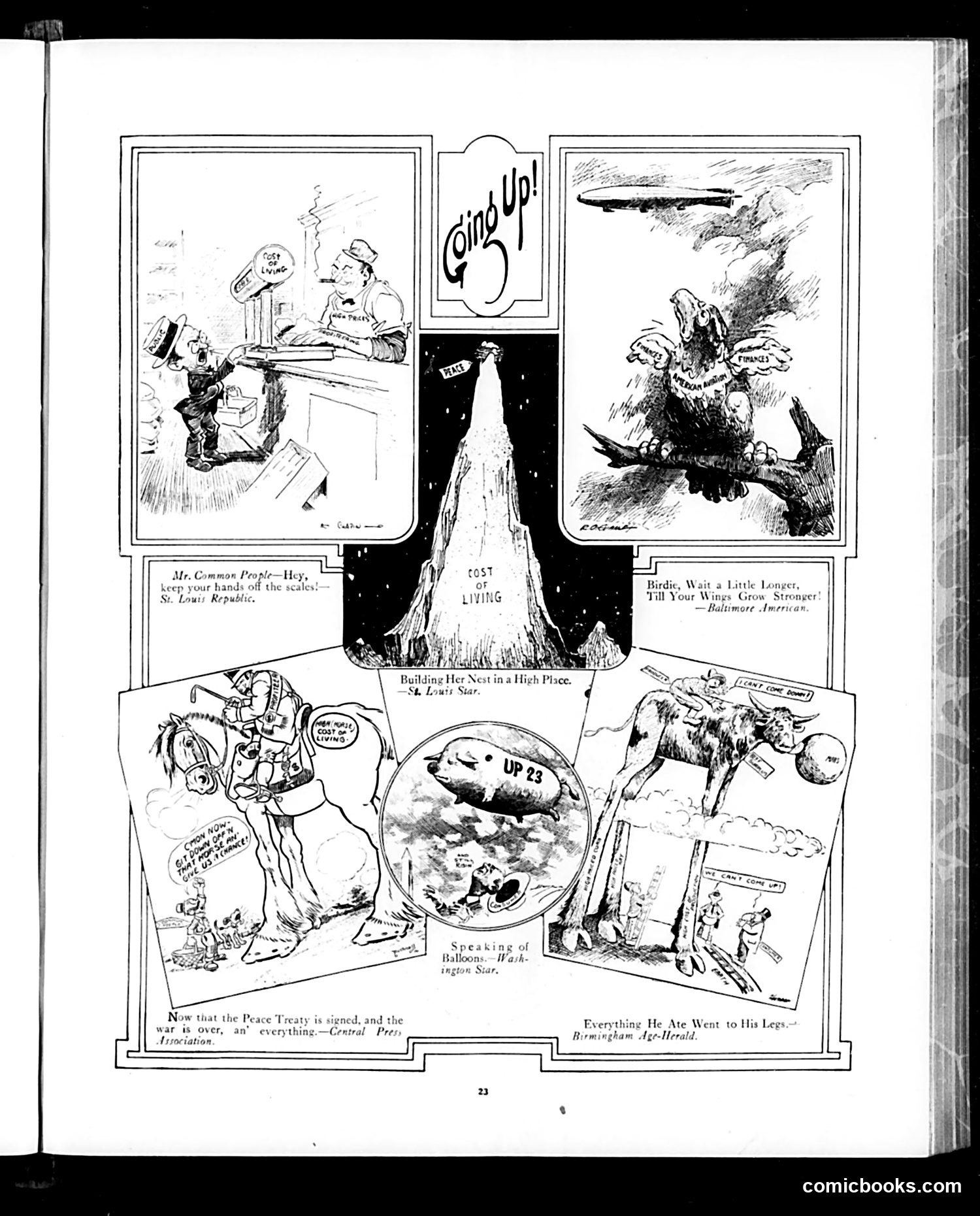
This Judge magazine page satirizes post-World War I America through interconnected bird imagery. The central "lost living" bird (appearing exhausted or depleted) represents the nation recovering from war's drain. Surrounding panels mock various post-war conditions: politicians making empty promises ("keep your hands off the scales"), war profiteers gorging themselves, and citizens struggling physically ("everything he ate went to his legs"—suggesting malnutrition or resource scarcity). The "Going Up!" centerpiece with the Peace Treaty suggests optimistic but fragile hopes for recovery. The "Baltimore American" and other newspaper attributions indicate these were contemporary observations about inflation, food shortages, and political hypocrisy in the immediate post-war period. The satire targets both government incompetence and the gap between official victory narratives and ordinary Americans' continued hardship.
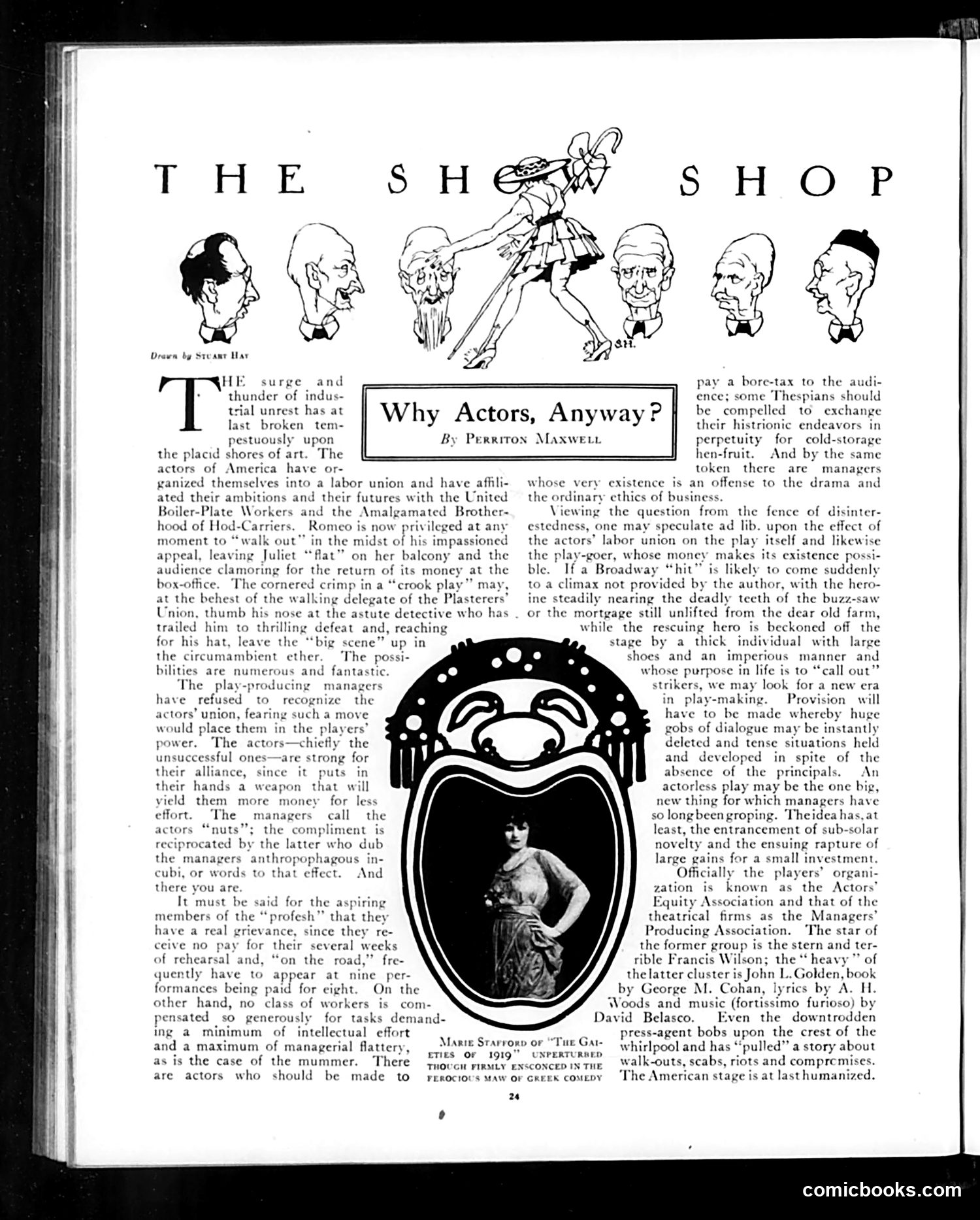
This article satirizes the newly-formed actors' labor union (Actors' Equity Association) and disputes with theatrical managers over wages and working conditions. The header illustration shows caricatured faces of prominent theater figures—likely including union leader Francis Wilson and manager John L. Golden (named in the text)—positioned around a dancing woman labeled "The Shell Shop," mocking theatrical artificiality. **The satire's main points:** 1. **Absurd strike consequences**: Actors might walk out mid-performance, leaving audiences and productions stranded 2. **Double standard**: Actors complain they rehearse unpaid and perform nine shows while paid for eight, yet are already generously compensated for work requiring minimal intellectual effort 3. **Contempt for actors**: The author suggests some performers should be barred entirely, implying many are untalented 4. **Veiled sympathy for managers**: Overall favoring the producing establishment against labor organizing The tone is dismissive toward working actors while grudgingly acknowledging legitimate grievances—typical Judge conservative editorial stance toward 1920s labor unionization.
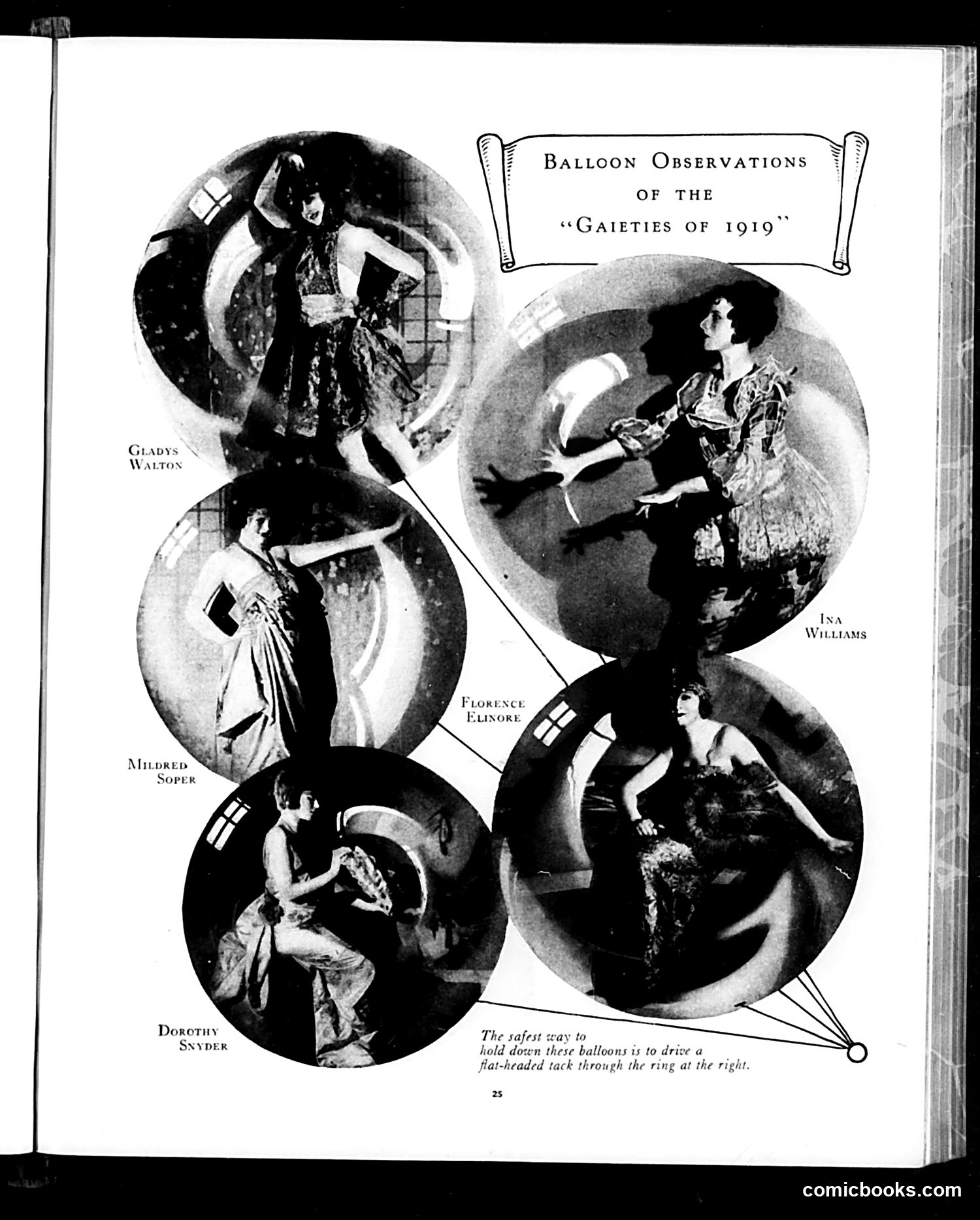
This page features five circular photographs of women labeled as actresses or performers: Gladys Walton, Mildred Soper, Dorothy Snyder, Florence Elinore, and Ina Williams. Each woman is positioned within a balloon illustration. The satirical caption suggests using a "flat-headed tack" to "hold down these balloons"—a commentary on the women's theatrical ambitions or inflated public profiles during 1919. The joke appears to mock either their celebrity status, their performances in the "Gaieties" (a theatrical revue), or perhaps their prominence in popular culture. The balloon metaphor implies these actresses' fame or reputations are insubstantial and need restraint. This reflects early 20th-century satirical humor about entertainment industry figures.
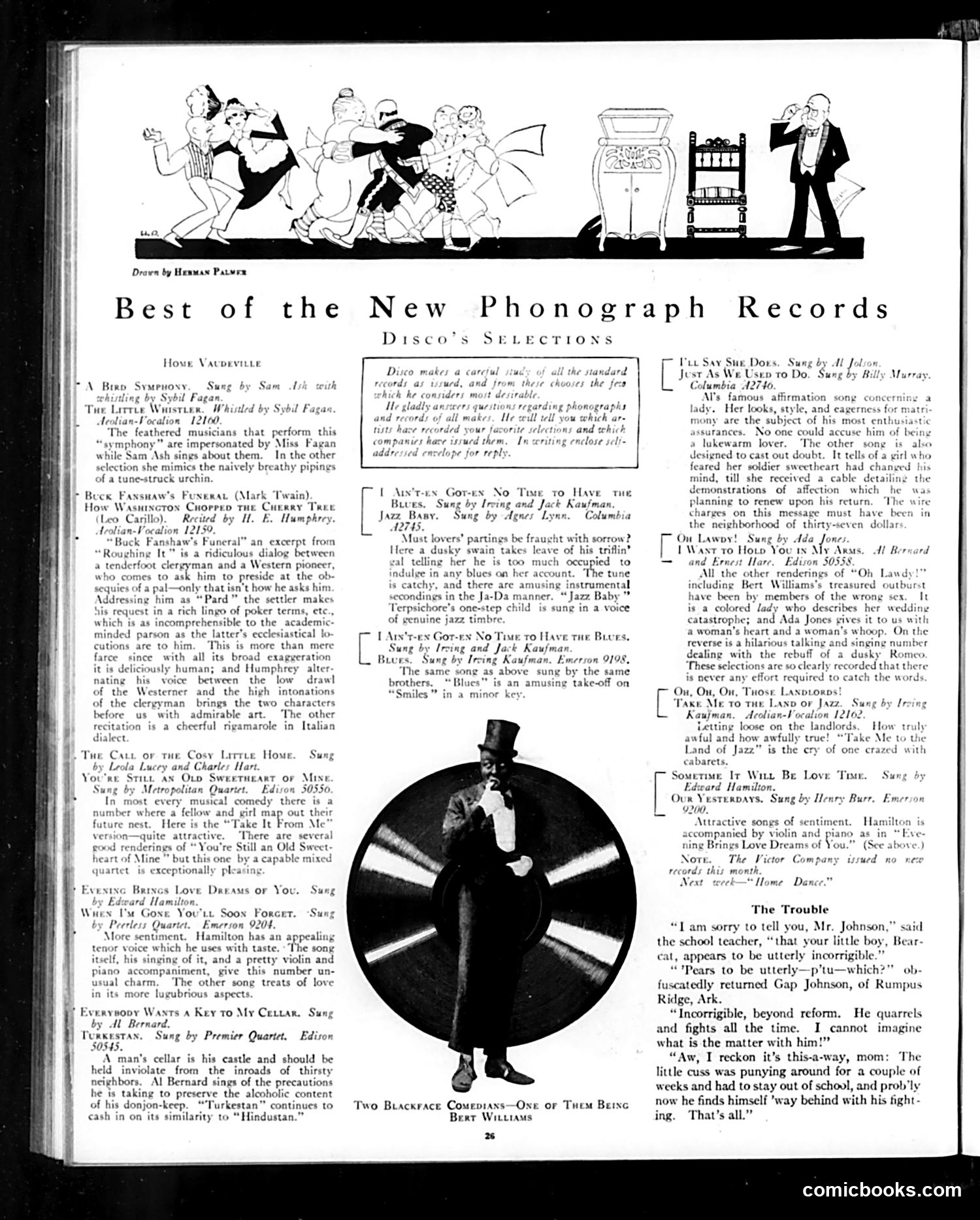
This page is primarily a **record review section** titled "Best of the New Phonograph Records," featuring Disco's music selections. The top illustration by Herman Palmer shows a stylized silhouette of people dancing and socializing around phonograph equipment—capturing the era's fascination with recorded music entertainment. The reviews discuss popular song recordings from artists like Al Jolson, Bert Williams, and various quartets, covering sentimental love songs and jazz numbers typical of the early 1920s. The small photograph shows **two blackface comedians—one being Bert Williams**, a famous African American performer who ironically performed in blackface makeup, reflecting the deeply racist entertainment conventions of that era. The sidebar story "The Trouble" depicts a school discipline issue involving a child named "Gap Johnson," suggesting a minor anecdote unrelated to the main content. This page reflects Judge's commercial advertising function—promoting entertainment products alongside light social commentary—rather than political satire.
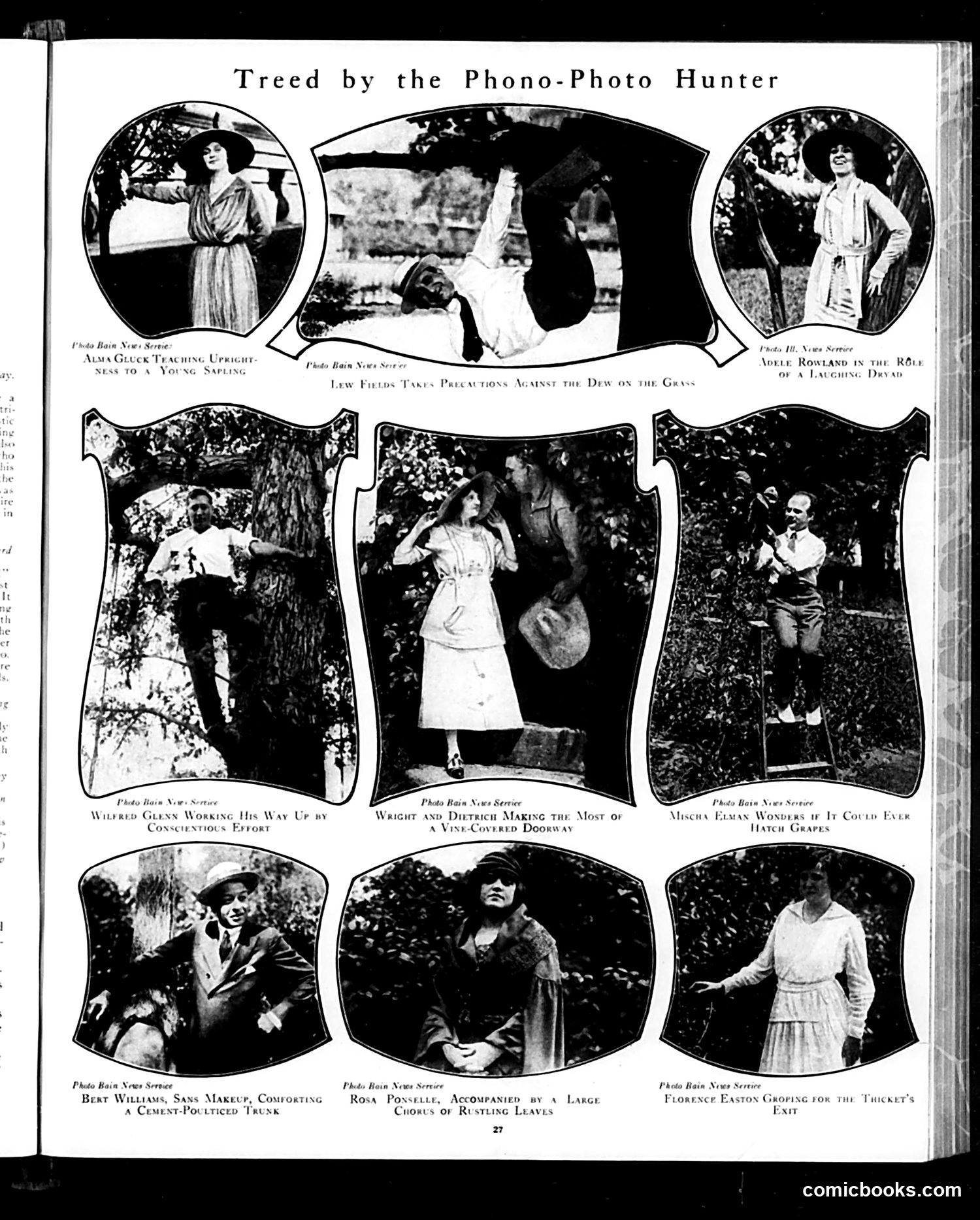
This page satirizes early phonograph and photography technology by presenting scenes of people caught unaware by recording devices. The title suggests subjects are being "hunted" by these new media—treated as prey being documented without consent. The nine photos show various scenarios: women teaching or posing outdoors, men working, people in compromising moments (one making effort climbing a tree, another caught near a doorway). Captions identify performers like Bert Williams and Rosa Ponselle, suggesting these are either staged film/recording scenes or candid captures of celebrities. The satire likely mocks the invasive nature of early cinema and phonograph recording—the novelty and sometimes undignified situations created when photographers and sound-recording equipment followed people. It plays on anxiety about new technologies capturing private moments, a concern as relevant then as privacy debates are today.
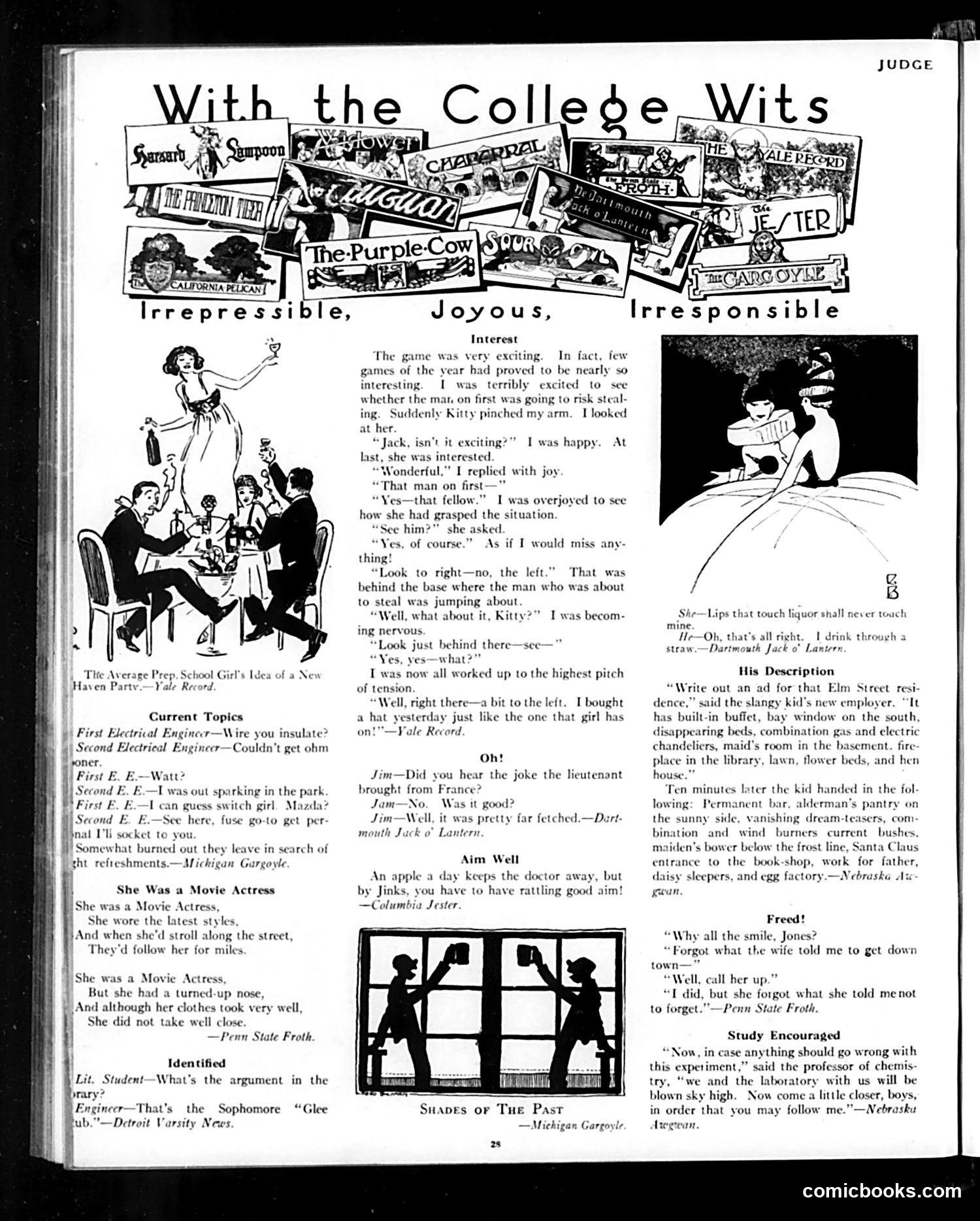
This page collects humor from college publications, satirizing undergraduate life circa early 20th century. The content includes: **Main cartoon**: "The Average Prep School Girl's Haven Party" depicts young women at a social gathering—likely mocking the superficiality and social anxieties of privileged girls' social events. **Recurring jokes target**: - Electrical engineering students (puns on "insulate," "ohm," "Mazda") - Movie actresses and their vanity - Young men's romantic incompetence - Absent-minded behavior during sports **The satire's point**: College humor magazines mocked their own communities—engineering students' pretentiousness, women's materialism (the girl noticing a hat during a baseball game), and the gap between romantic ideals and reality (the temperance joke about drinking through a straw). The "Study Encouraged" joke about a chemistry professor risks explosion while demanding students crowd closer is dark humor about academic danger and student naiveté—typical of period college humor's cynical tone. These are reprinted from competing college papers (Yale, Michigan, Penn State, Dartmouth, Nebraska), suggesting rivalry and shared collegiate culture.

This is primarily a **product advertisement** for Genco Razors, not political satire. The "cartoon" element is minimal—a single illustration showing a barber shaving himself. **The premise:** The ad plays on the idea that if a professional barber trusts a Genco razor enough to use it on himself (not just customers), it must be superior. This was a common advertising strategy: endorsement through professional use. **Key selling point:** The ad emphasizes that Genco razors are "built to strop"—their design (broad back, concave surface, supporting bulge) allows users to properly maintain the blade's edge themselves. This addresses a practical consumer concern: keeping razors sharp. **Secondary product:** A "Safege" model is mentioned for men preferring a guarded blade. **The guarantee:** "Genco Razors must make good or we will"—a confidence appeal typical of early 20th-century advertising. This is straightforward product marketing from 1919, not social commentary.
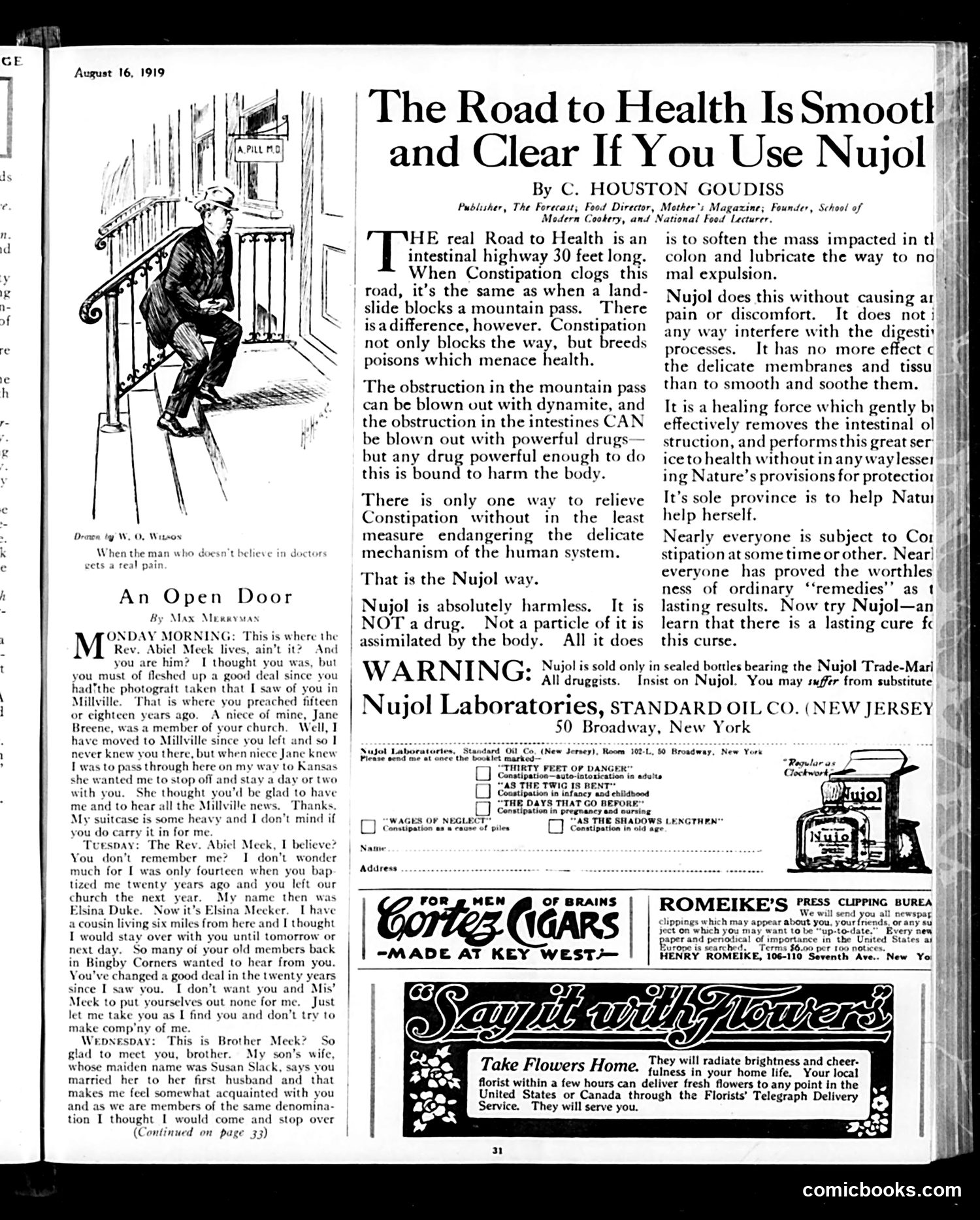
This page contains **two distinct sections**: a narrative story and a patent medicine advertisement. **The cartoon/story** ("An Open Door" by Max Merryman) depicts a recurring comedic scenario: a reverend repeatedly receives surprise visits from church members he hasn't seen in years. Each visitor arrives unannounced, expecting hospitality, mentioning shared history, and noting how the reverend has aged or changed. The humor lies in the reverend's mounting social obligation and the visitors' obliviousness to their imposition—they arrive with luggage, expect lodging, and cite tenuous connections ("my cousin's neighbor once attended your church"). It satirizes **rural American hospitality culture** and the difficulty of politely refusing unwanted guests. **The advertisement** promotes "Nujol," a mineral oil laxative. Notably, it includes a **warning against substitutes** and emphasizes the product is "NOT a drug"—likely because of contemporary regulations and skepticism toward patent medicines. This reflects the **pre-FDA era** when such claims were largely unregulated. The formal endorsement by "C. Houston Goudiss" lends false authority to what was essentially a mineral oil product.
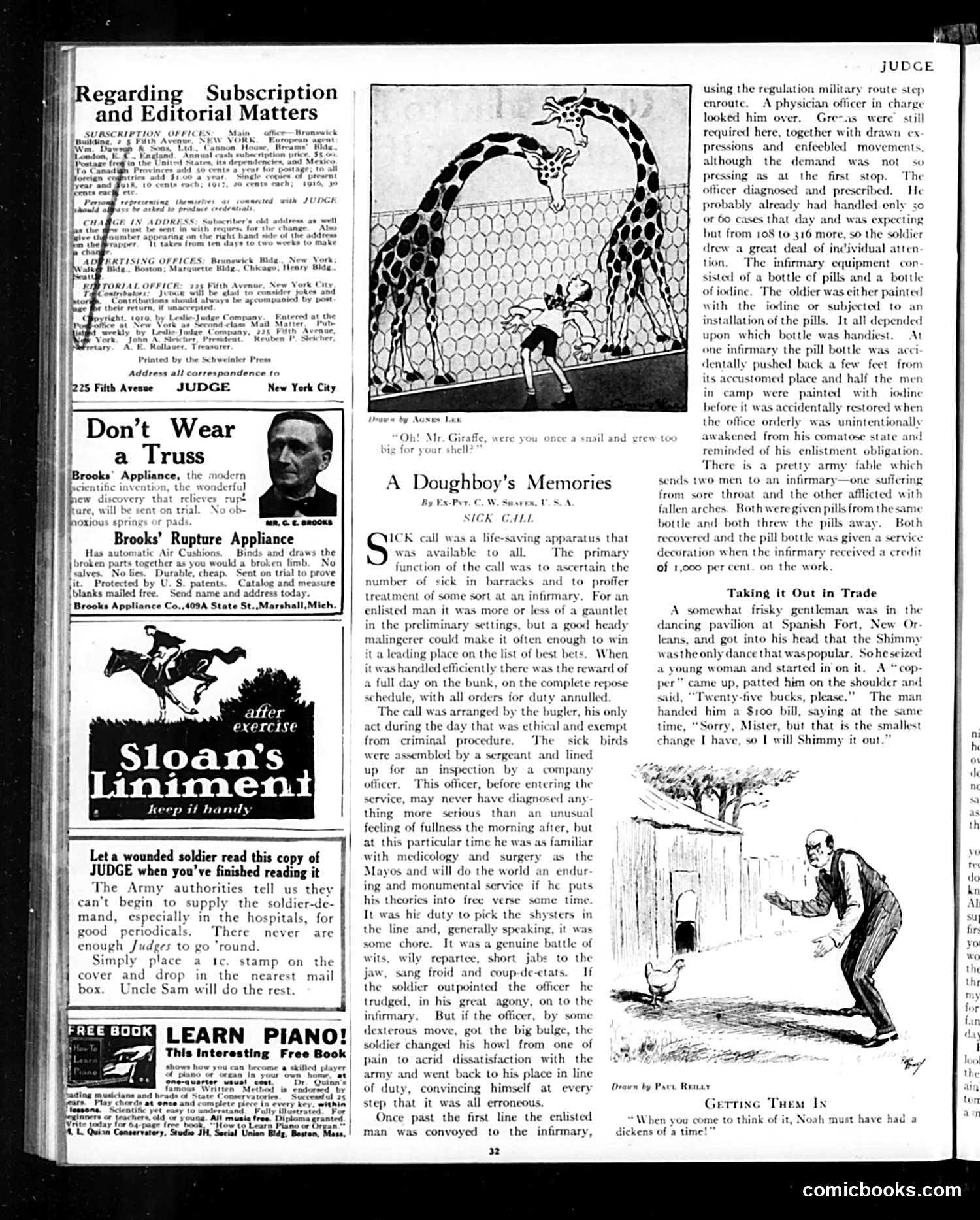
This page contains primarily **advertisements and editorial matter** rather than satirical cartoons requiring political context. The main illustrated content is "**A Doughboy's Memories**" by an ex-private, a humorous first-person account of Army medical procedures during World War I. The giraffe cartoon appears decorative rather than satirical—accompanying a quip about the animal outgrowing its shell, with no evident political meaning. The illustrations by Paul Beasley ("Getting Them In") depict soldiers in camp scenes, apparently supporting the doughboy's narrative about military life and medical treatment. The advertisements (Brooks' Rupture Appliance, Sloan's Liniment, Learn Piano) are standard commercial content. A notable public service notice encourages readers to donate used copies of Judge to hospitalized soldiers, reflecting WWI-era patriotic messaging. **No specific political satire or caricature is evident on this page.** It functions as mixed editorial/advertising content rather than commentary-driven satire.
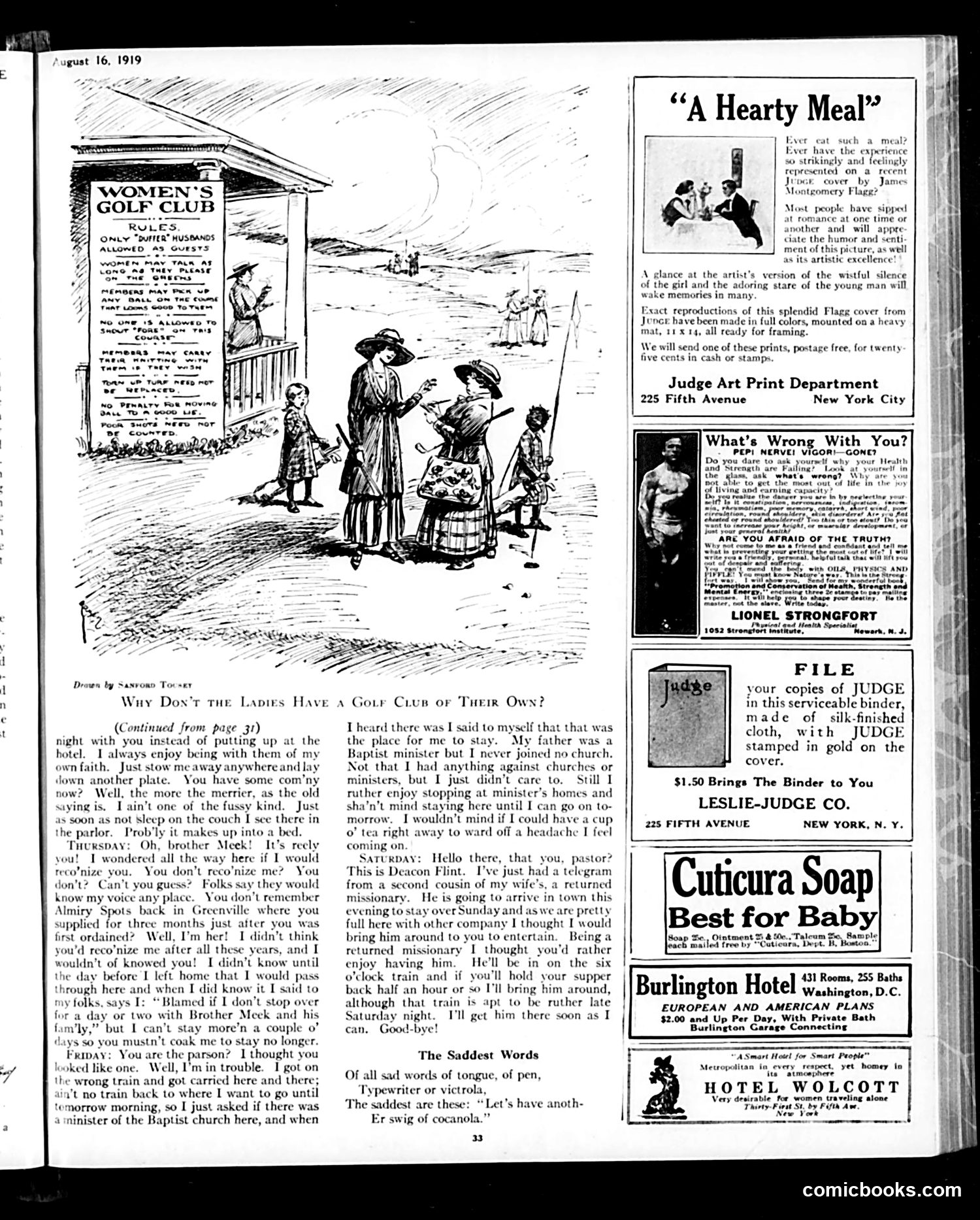
## Main Cartoon: "Why Don't the Ladies Have a Golf Club of Their Own?" This satirical cartoon criticizes exclusive male golf clubs by depicting women and children standing outside a clubhouse displaying rules that admit only "duffer husbands" as guests. The joke targets the era's gender segregation in leisure activities—women were excluded from these spaces while men could bring their wives as mere accompaniment. The accompanying text dialogue (continued from previous page) humorously portrays various uninvited guests imposing on a minister's hospitality, suggesting that some social boundaries, unlike golf club rules, cannot be enforced. ## Social Context This reflects 1919 America, when women had just gained voting rights but faced persistent exclusion from male-dominated institutions. The cartoon mocks both men's gatekeeping and the arbitrary nature of their "rules." ## Page Note The remainder consists of advertisements and advice columns typical of Judge's format, including unrelated product promotions.
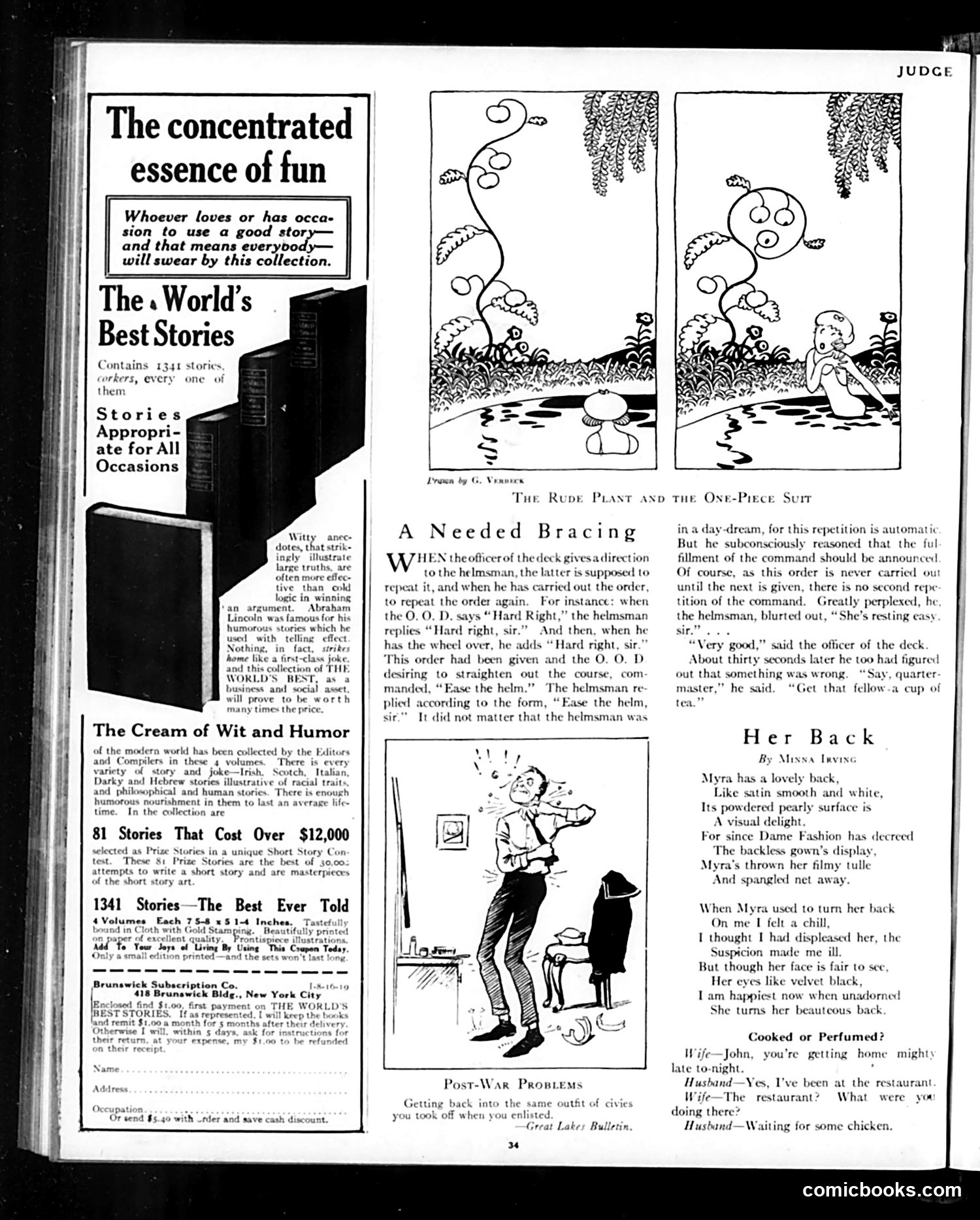
This page is primarily **advertising** for "The World's Best Stories," a four-volume collection of 1,341 stories marketed as suitable for all social occasions. The ads emphasize the collection's breadth—including Irish, Scottish, Italian, "Darky," and Hebrew stories—reflecting early 20th-century ethnic humor conventions that modern readers would find offensive. The page includes three unrelated pieces: a brief visual gag about naval protocol ("A Needed Bracing"), a poem celebrating female backs now visible due to modern backless gowns ("Her Back" by Minna Irving), and a one-panel joke about a husband claiming to wait for chicken at a restaurant. These scattered pieces are typical filler content for Judge magazine. The backless gown reference dates this to the 1920s-1930s era when such fashion was relatively new and scandalous. The material prioritizes commercial promotion over satirical commentary on current events.

This is primarily a **Camel cigarette advertisement** rather than political satire or editorial cartoon. The page features a large product advertisement from R.J. Reynolds Tobacco Company (dated August 16, 1919) promoting Camel cigarettes at 18 cents per package. The visual shows a stylized camel logo above overflowing cigarette packs. The copy employs marketing claims typical of early 20th-century tobacco advertising: emphasis on "choice Turkish and Domestic tobaccos," claims of exceptional flavor and smoothness, and assertions that Camels leave "no unpleasant cigaretty aftertaste or odor." Notably, the ad challenges consumers to compare Camels with competitors "at any price" and explicitly states there are no premiums or coupons—unusual transparency for the era. This appears in **Judge magazine**, a satirical publication, but the content itself is straightforward advertising rather than satire or commentary on contemporary events.
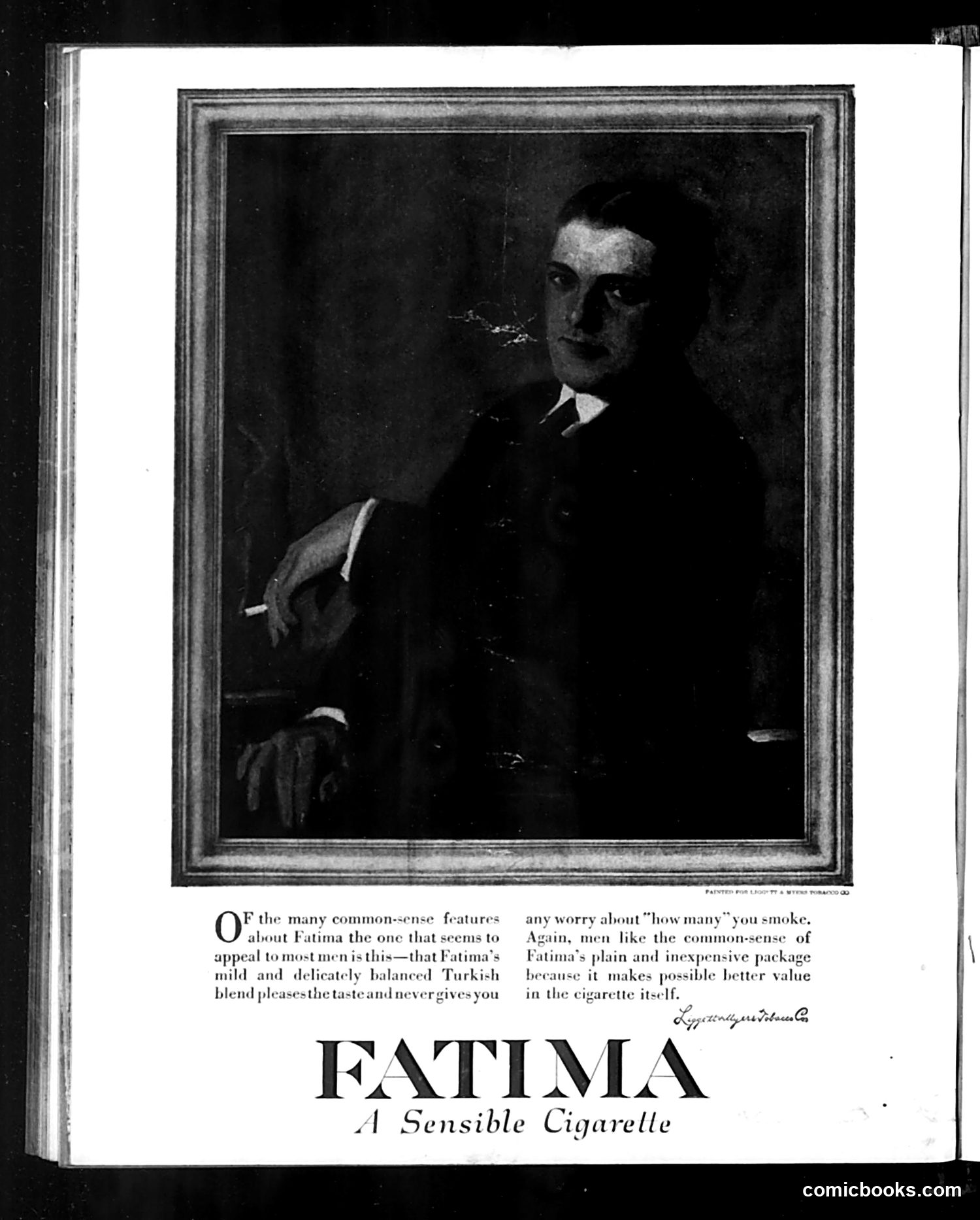
This is a cigarette advertisement for "Fatima: A Sensible Cigarette," not a political cartoon. The page features a formal portrait of a man in dark clothing smoking, positioned above advertising copy. The ad emphasizes that Fatima cigarettes appeal to men through their "mild and delicately balanced Turkish blend," claiming they "please the taste and never give you any worry about 'how many' you smoke." The text stresses the cigarette's "plain and inexpensive package" provides "better value in the cigarette itself." This represents early 20th-century tobacco marketing targeting male consumers by associating smoking with sophistication and practicality. The "sensible" framing ironically downplays health concerns while marketing the product as a rational choice.