
Judge, 1919-08-16 · page 13 of 36
Judge — August 16, 1919 — page 13: what you’re looking at
What you’re looking at
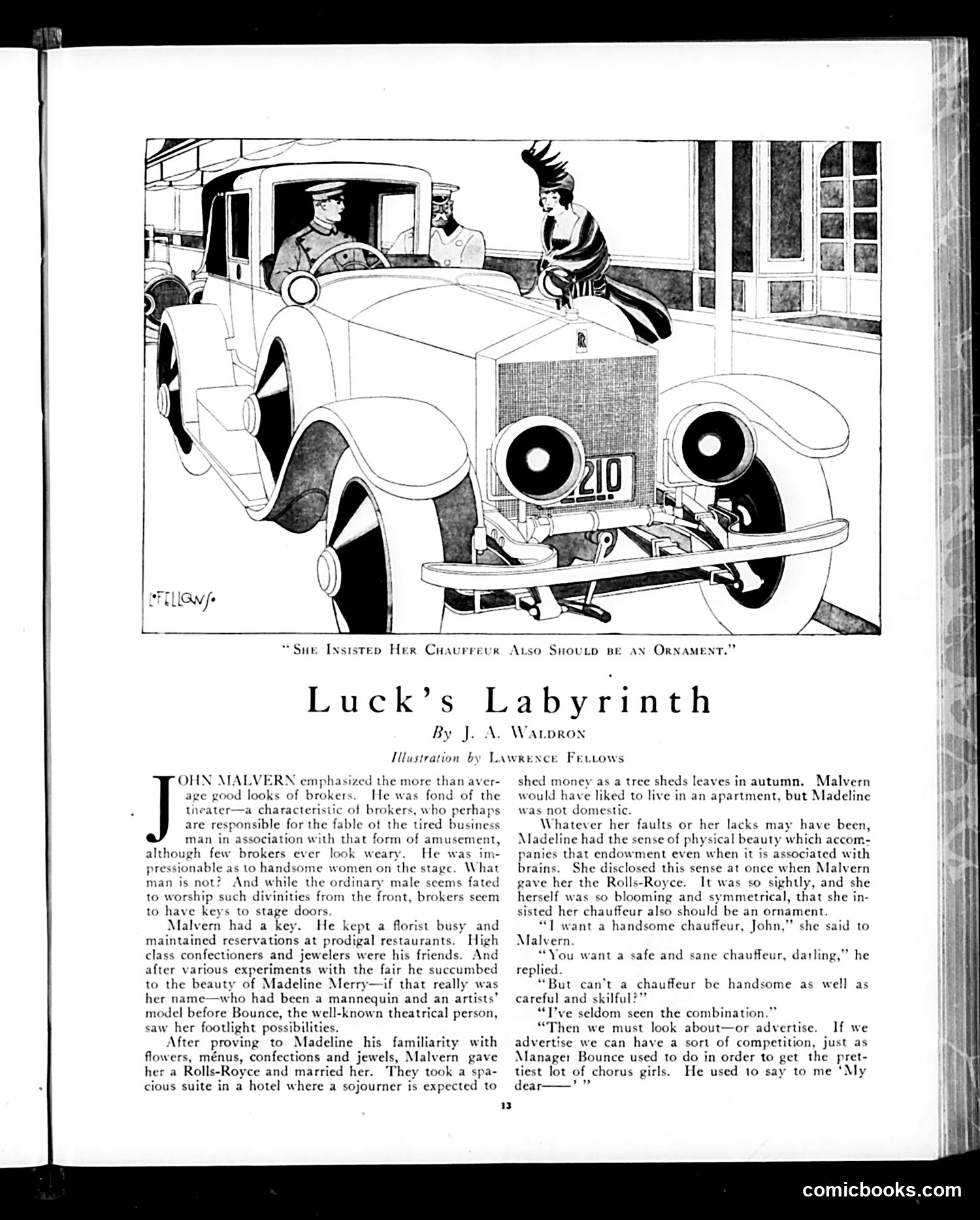
This is the opening of a serialized story satirizing wealthy, frivolous society. John Malvern, a prosperous stockbroker, represents the stereotypical "tired business man" who frequents theaters and pursues showgirls. He marries Madeline Merry, a former model and performer. The cartoon's caption—"She Insisted Her Chauffeur Also Should be an Ornament"—captures the satire's point: Madeline, concerned only with appearances and beauty, insists the chauffeur be handsome rather than merely competent and safe. This mocks wealthy wives who prioritize aesthetic display over practical concerns, and reflects period anxieties about women's frivolity and materialism. The lavish lifestyle (Rolls-Royce, hotels, jewels) and theatrical connections satirize nouveau riche excess. The story appears to follow how Madeline's shallow vanity creates complications—a common Judge magazine theme criticizing modern consumer culture and status-obsessed society.
📄 Transcribed text from this page (OCR, searchable)
Machine-transcribed from the original scan — historical spelling and the odd misread are preserved.
“Sue Insistep Her Cuaurreur Atso Suoutp BE AN OrNaAMENT.” Luck’s Labyrinth By J. A. Watprox Illustration by Lawrexce Fevrows OHN MALVERN emphasized the more than aver- age good looks of brokers. He was fond of the theater—a characteristic of brokers, who perhaps are responsible for the fable ot the tired business man in association with that form of amusement, although few brokers ever look weary. He was im- pressionable as to handsome women on the stage. What man is not? And while the ordinary male seems fated to worship such divinities from the front, brokers seem to have keys to stage doors Malvern had a key. He kept a florist busy and maintained reservations at prodigal restaurants. High class confectioners and jewelers were his friends. And after various experiments with the fair he succumbed to the beauty of Madeline Merry—if that really was her name—who had been a mannequin and an artists’ model before Bounce, the well-known theatrical person, saw her footlight possibilities. After proving to Madeline his familiarity with flowers, ménus, confections and jewels, Malvern gave her a Rolls-Royce and married her. They took a spa- cious suite in a hotel where a sojourner is expected to shed money as a tree sheds leaves in autumn. Malvern would have liked to live in an apartment, but Madeline was not domestic. Whatever her faults or her lacks may have been, Madeline had the sense of physical beauty which accom- panies that endowment even when it is associated with brains. She disclosed this sense at once when Malvern gave her the Rolls-Royce. It was so sightly, and she herself was so blooming and symmetrical, that she in- sisted her chauffeur also should be an ornament. “T want a handsome chauffeur, John,” she said to Malvern “You want a safe and sane chauffeur, darling,” he replied. “But can’t a chauffeur be handsome as well as careful and skilful?” “T’ve seldom seen the combination.” “Then we must look about—or advertise. If we advertise we can have a sort of competition, just as Manage: Bounce used to do in order to get the pret- tiest lot of chorus girls. He used to say to me ‘My dear ane ere aatl comicbooks.com