
Judge, 1919-08-16 · page 11 of 36
Judge — August 16, 1919 — page 11: what you’re looking at
What you’re looking at
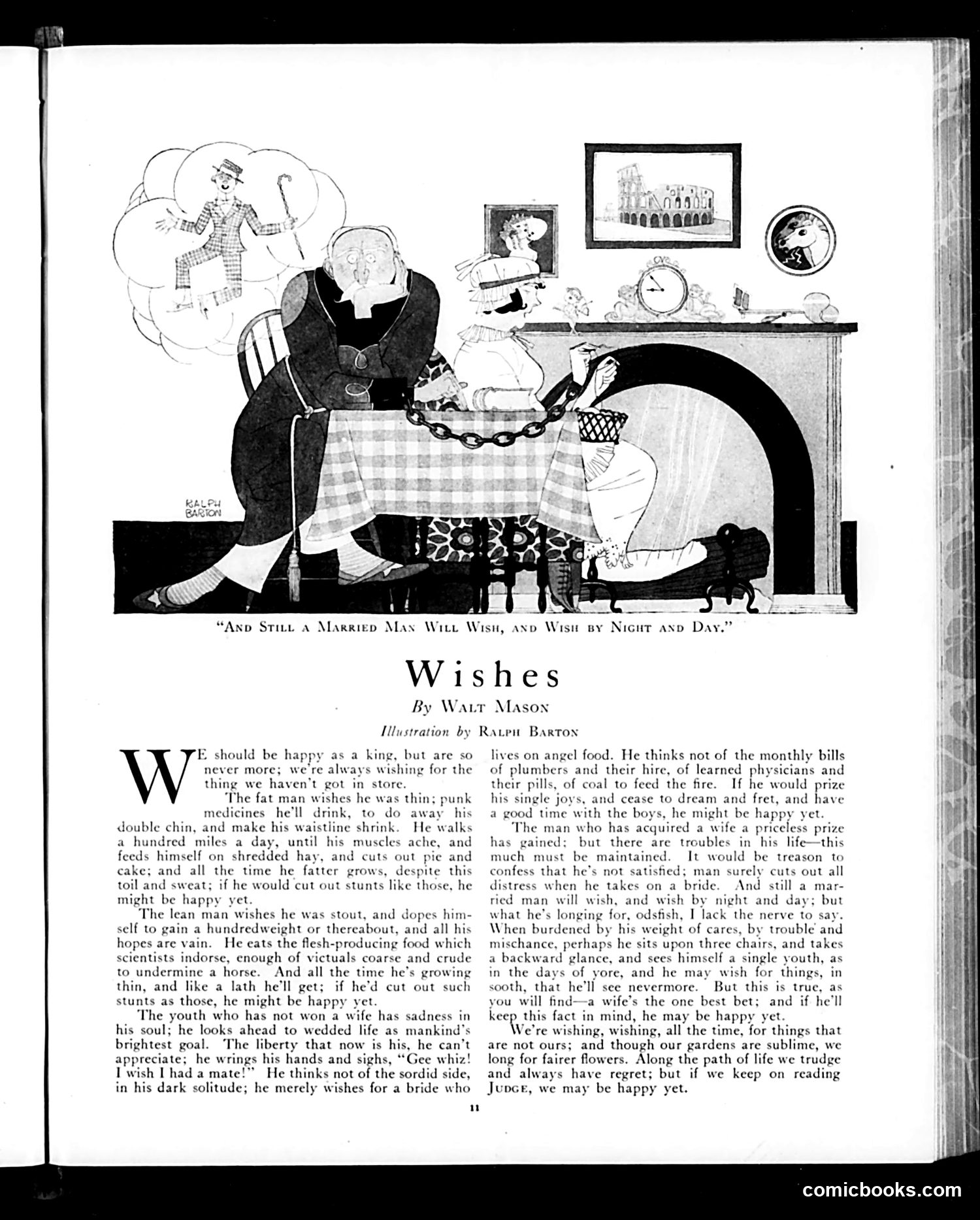
This is a humorous essay-poem illustrated by Ralph Barton satirizing human discontent. Mason catalogs universal wishes that prevent happiness: - **The fat man** wishes to be thin, exercises obsessively, yet grows fatter - **The lean man** wishes to be stout, eats constantly, yet grows thinner - **The unmarried youth** romanticizes marriage, ignoring its financial burdens (plumbers' bills, doctors' fees, heating costs) - **The married man** wishes he were single again, nostalgic for bachelorhood The central irony: people achieve the opposite of what they desire through futile effort. The illustration shows a chained man at a table with a woman, representing marital entrapment—the ultimate wish's disappointment. The piece concludes with self-promotional humor: reading *Judge* magazine itself offers the only genuine path to happiness. This satirizes both human nature's perpetual dissatisfaction and the magazine's own advertising.
📄 Transcribed text from this page (OCR, searchable)
Machine-transcribed from the original scan — historical spelling and the odd misread are preserved.
i 4 “Anp STILL 4 A Marrieo Man Witt Wisu, ano Wisi py Nicut ano Day.” Wishes By Watt Mason Illustration by Raveu * should be happy as a king, but are so never more; we're always wishing for the thing we haven't got in store. The fat man wishes he was thin; punk medicines he'll drink, to do away his double chin, and make his waistline shrink. He walks a hundred miles a day, until his muscles ache, and feeds himself on shredded hay, and cuts out pie and cake; and all the time he fatter grows, despite this toil and sweat; if he would cut out stunts like those, he might be happy yet The lean man wishes he was stout, and self to gain a hundredweight or thereabout, and all his hopes are vain. He eats the flesh-producing food which scientists indorse, enough of victuals coarse and crude to undermine a horse. And all the time he’s growing thin, and like a lath he'll get; if he’d cut out such stunts as those, he might be happy yet. The youth who has not won a wife has sadness in his soul; he looks ahead to wedded life as mankind’s brightest goal. The liberty that now is his, he can’t appreciate; he wrings his hands and sighs, “Gee whiz! I wish | had a mate!” He thinks not of the sordid side, in his dark solitude; he merely wishes for a bride who " Barton lives on angel food. He thinks not of the monthly bills of plumbers and their hire, of learned physicians and their pills, of coal to feed the fire. If he would prize his single joys, and cease to dream and fret, and have a good time with the boys, he might be happy ye' ‘The man who has acquired a wife a priceless prize has gained; but there are troubles in his life—this much must be maintained. It would be treason to confess that he’s not satisfied; man surely cuts out all distress when he takes on a bride. And still a mar- ried man will wish, and wish by night and day; but what he’s longing for, odsfish, I lack the nerve to say. When burdened by his weight of cares, by trouble and mischance, perhaps he sits upon three chairs, and takes a backward glance, and sees himself a single youth, as in the days of yore, and he may wish for things, in sooth, that he'll see nevermore. But this is true, as you will find—a wife’s the one best bet; and if he'll keep this fact in mind, he may be happy yet. We're wishing, wishing, all the time, for things that are not ours; and though our gardens are sublime, we long for fairer flowers. Along the path of life we trudge and always have regret; but if we keep on reading Jupce, we may be happy yet. comicbooks.com