
A complete issue · 36 pages · 1919
Judge — August 2, 1919
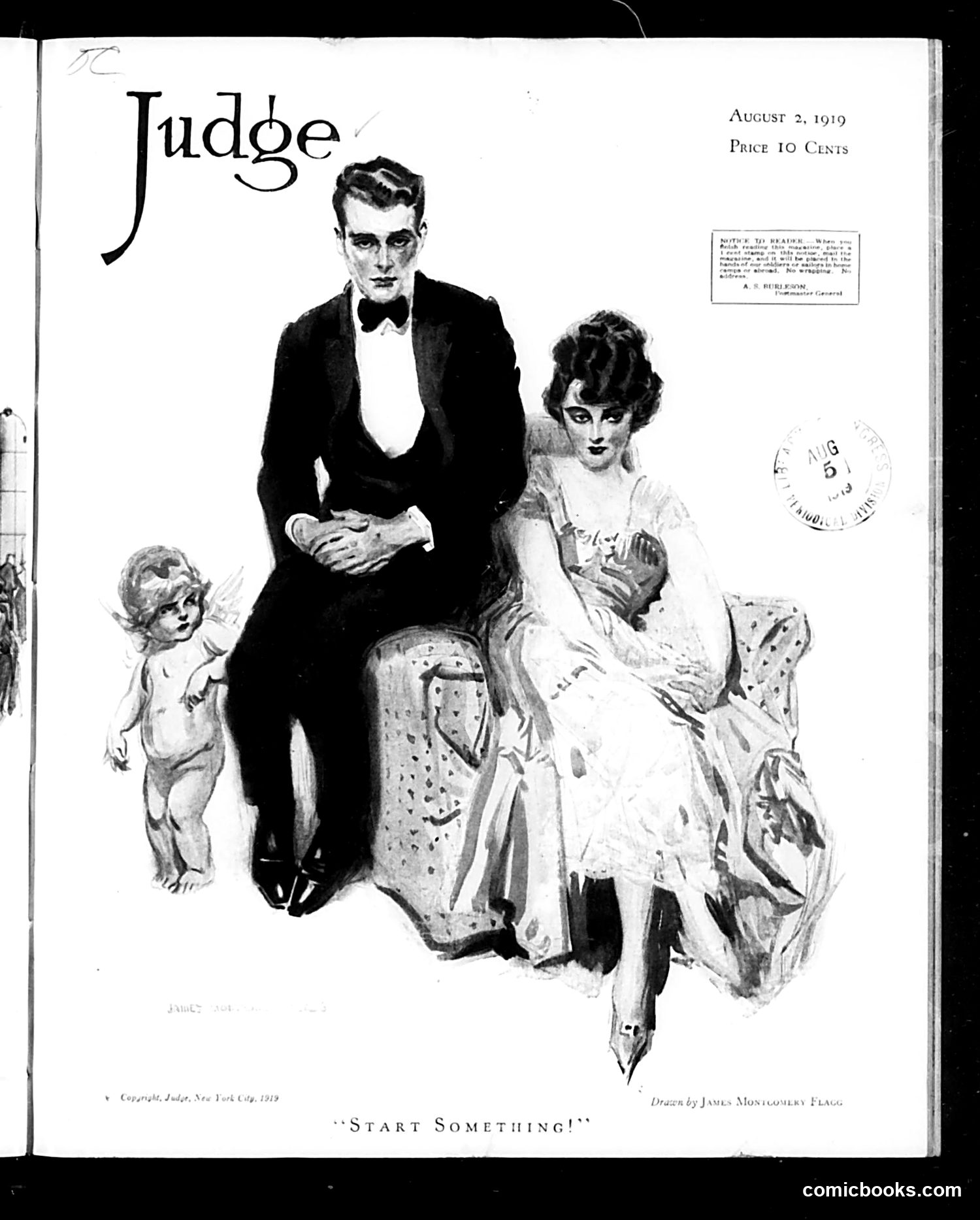
This illustration by James Montgomery Flagg depicts a well-dressed man in formal attire surrounded by cherubic children, with the caption "Start Something!" The cartoon likely satirizes postwar anxieties about family planning and population. The man's somewhat reluctant posture amid the playful children suggests commentary on either the burdens of large families or—more likely given 1919's context—concerns about encouraging procreation after World War I's devastating casualties. The phrase "Start Something!" carries ironic weight: it could mock men hesitant about fatherhood, or critique societal pressure to replenish the population depleted by the war. Without additional contextual text visible on this page, the precise satirical target remains somewhat ambiguous, though the tone appears gently comedic rather than harsh.
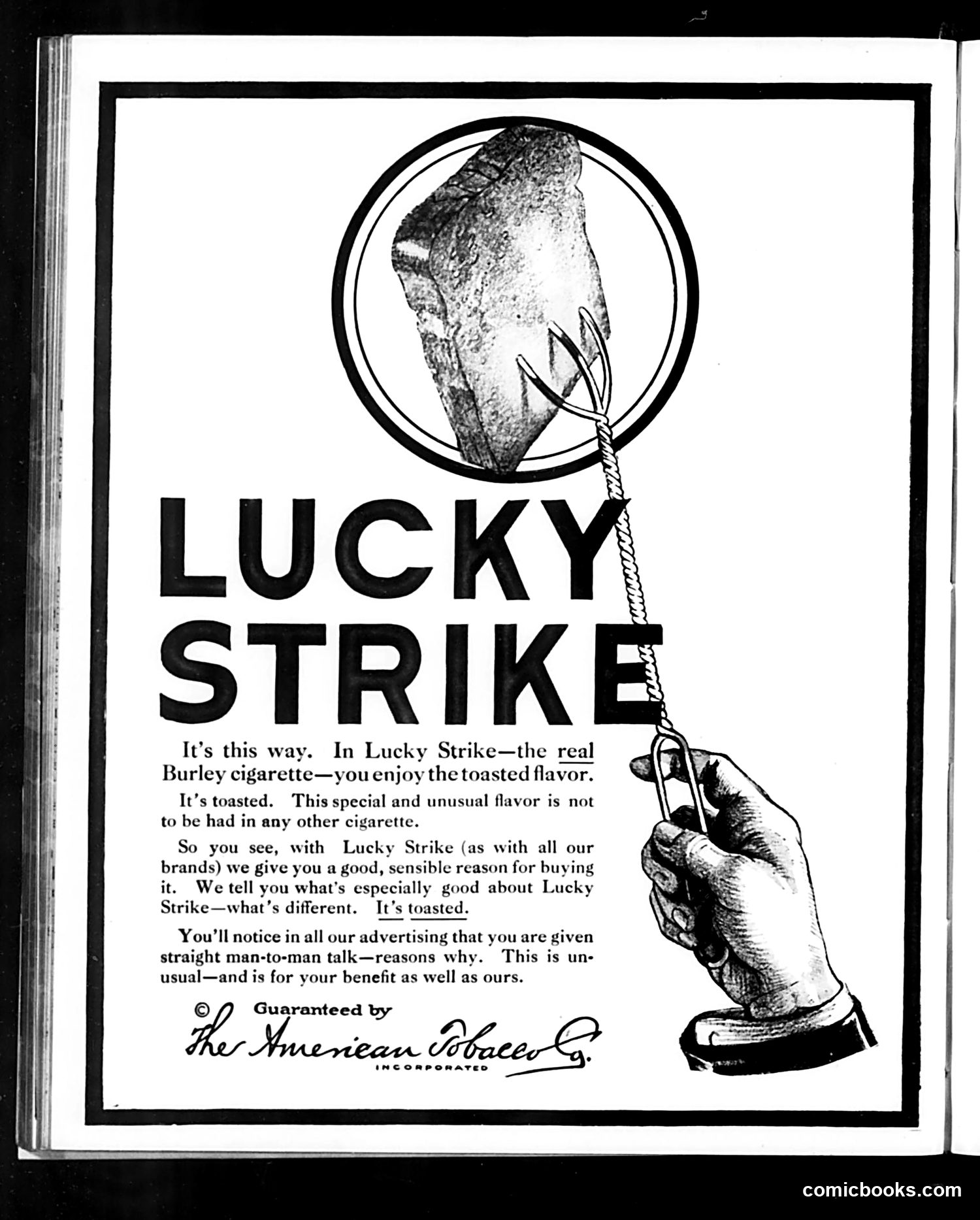
This is **not satire or political commentary**—it's a straightforward cigarette advertisement from *Judge* magazine, likely from the 1920s-30s based on the styling. The ad promotes Lucky Strike cigarettes, emphasizing that they are "toasted," claiming this unique process provides distinctive flavor unavailable in competitor brands. The imagery shows a hand holding a cigarette suspended by a rope over a flame, visually reinforcing the "toasted" claim. The text emphasizes "straight man-to-man talk" about product benefits, a marketing approach typical of the era. The American Tobacco Company's guarantee appears at bottom. This represents early cigarette advertising that made specific health and quality claims—practices later heavily regulated as tobacco's dangers became scientifically established.
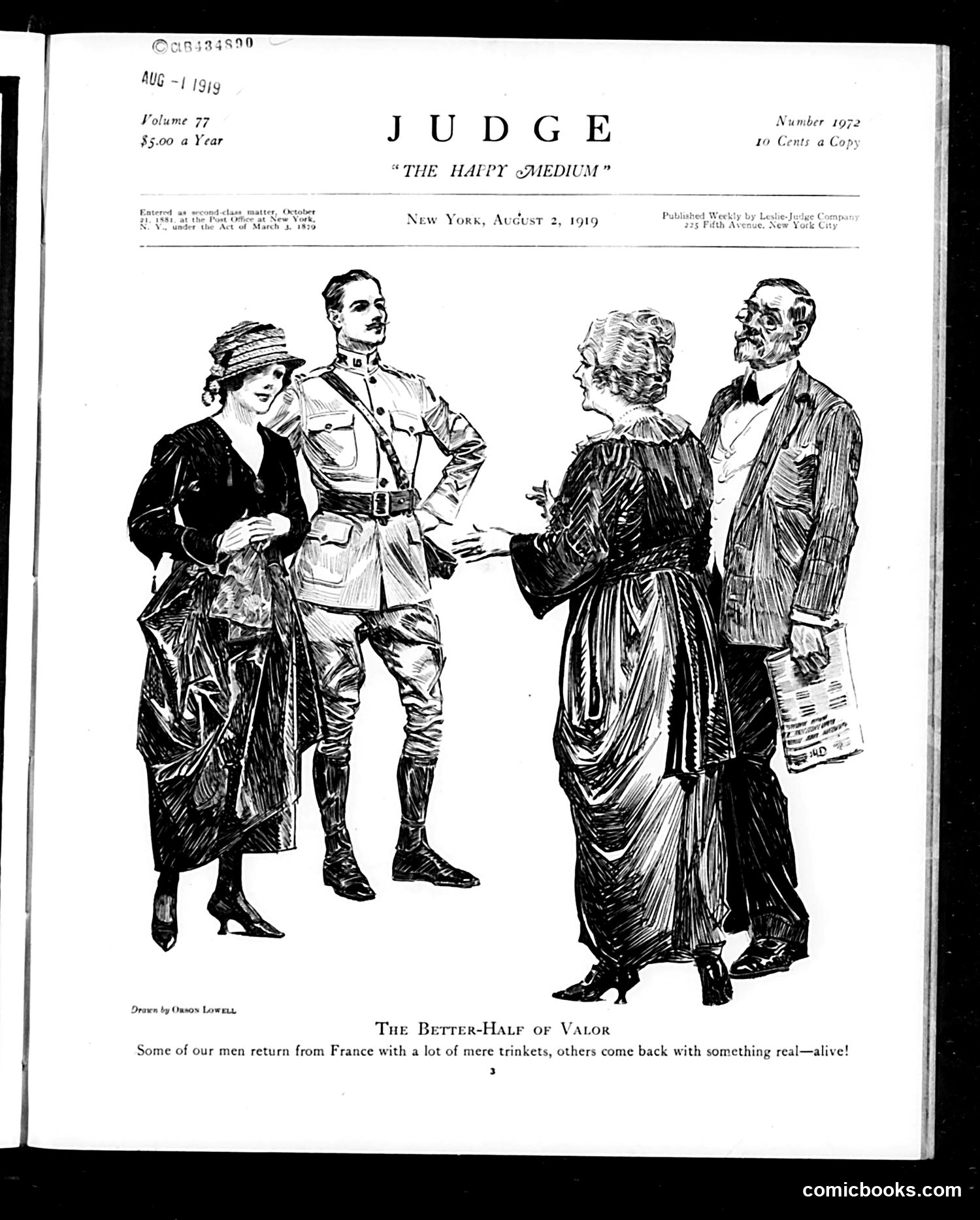
This August 2, 1919 *Judge* cartoon, drawn by Orson Lowell, satirizes soldiers returning from World War I. The caption reads: "Some of our men return from France with a lot of mere trinkets, others come back with something real—alive!" The left pair shows a soldier with a woman in fashionable dress (likely a romantic conquest or "trinket" from abroad). The right pair depicts an older couple—apparently a soldier reunited with his wife or sweetheart waiting at home. The satire mocks soldiers who pursue fleeting wartime romances versus those who maintain serious domestic relationships. "Valor's better half" puns on both military courage and domestic commitment, suggesting that faithfulness to one's actual partner represents truer valor than foreign dalliances. The cartoon reflects post-war anxieties about soldier morality and family stability.
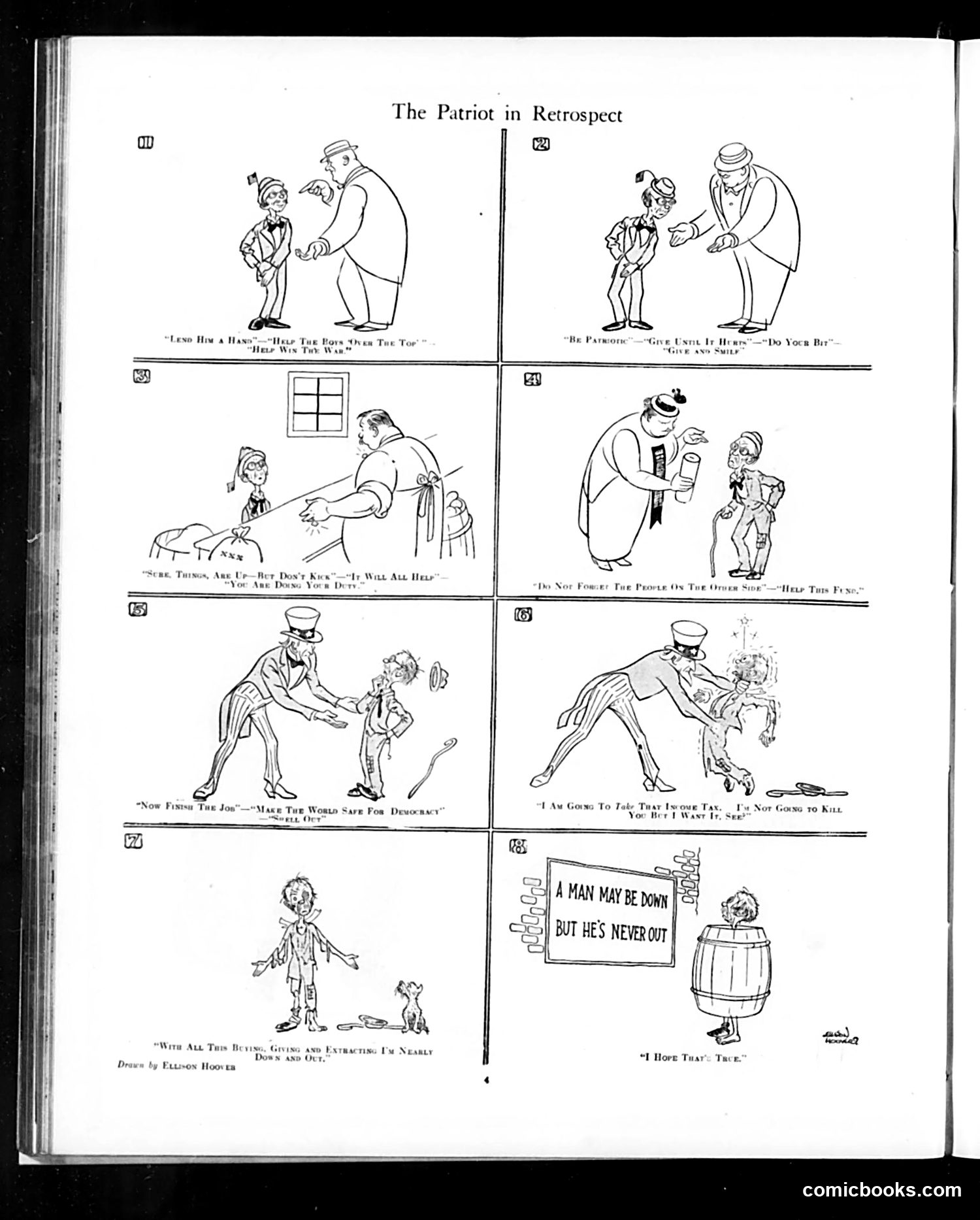
This page satirizes American patriotism through a series of scenes showing a man's changing relationship with patriotic ideals. The cartoon progresses from childhood ("Lend Him a Hand") through adulthood, depicting how the initial enthusiasm for patriotic duty gradually diminishes. Key scenes show: a child being encouraged toward patriotic service; an adult claiming patriotism while asking for personal favors; later scenes suggesting hypocrisy or self-interest replacing genuine patriotism; and finally, the closing message "A Man May Be Down But He's Never Out" paired with "I Hope That's True"—expressing skepticism about whether true patriotism survives practical life pressures. The satire critiques how Americans claim patriotic values while pursuing personal gain, suggesting patriotism often proves convenient rather than genuine.
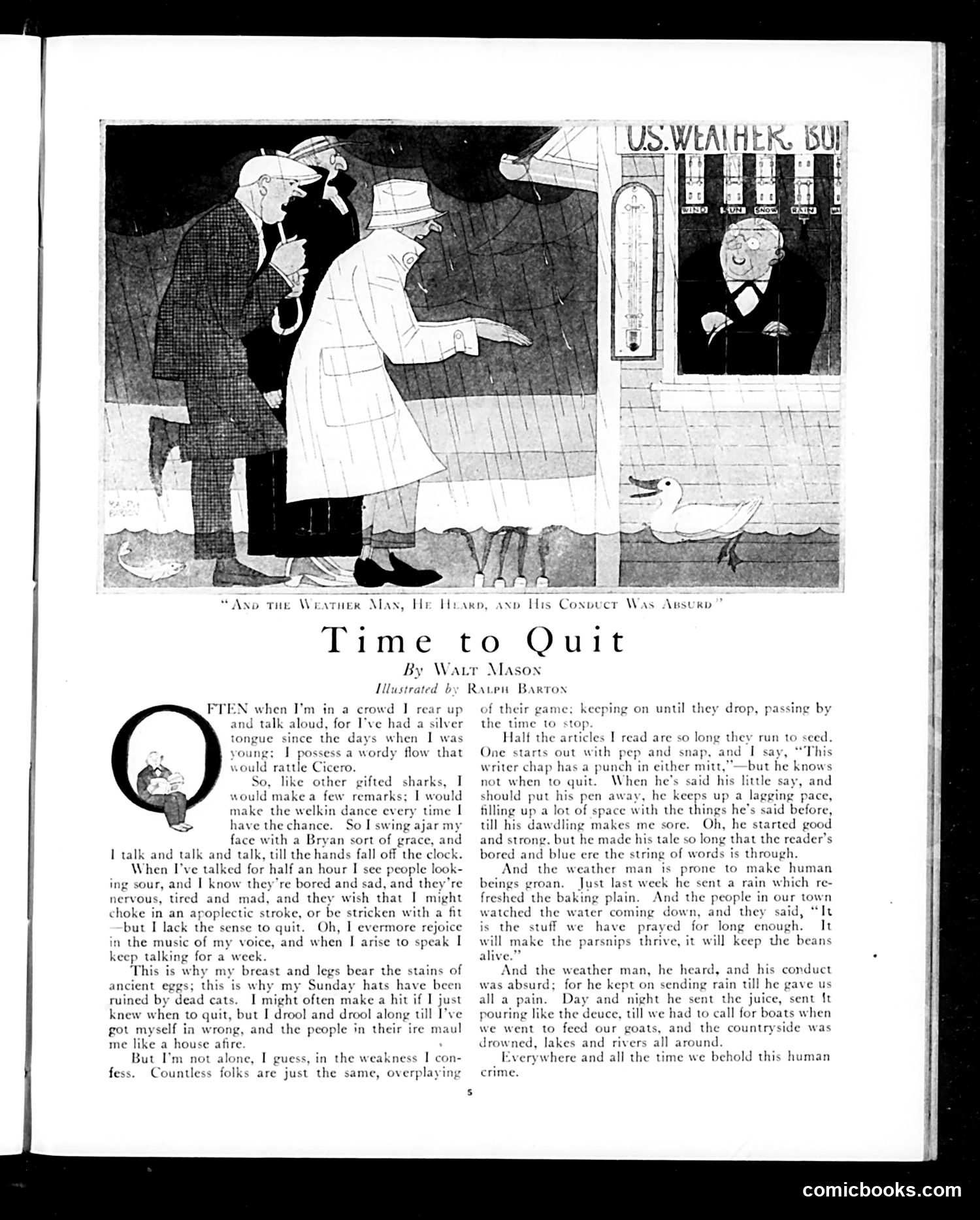
This cartoon satirizes verbose writers and speakers who won't stop talking. The illustration shows a couple in the rain consulting a weather bureau while a duck swims nearby—a visual joke about excessive, pointless communication. The accompanying essay by Walt Mason (illustrated by Ralph Barton) complains about people who talk endlessly in crowds, writers who submit overly long articles, and the "weather man" who keeps sending rain reports ad nauseam. Mason argues such figures lack the sense to quit when they should, comparing their behavior to ruining Sunday dinner by talking too long. The satire targets a common early-20th-century frustration: people in positions of authority (journalists, weather forecasters, public speakers) who abuse their platforms through wordiness and repetition rather than concise communication.
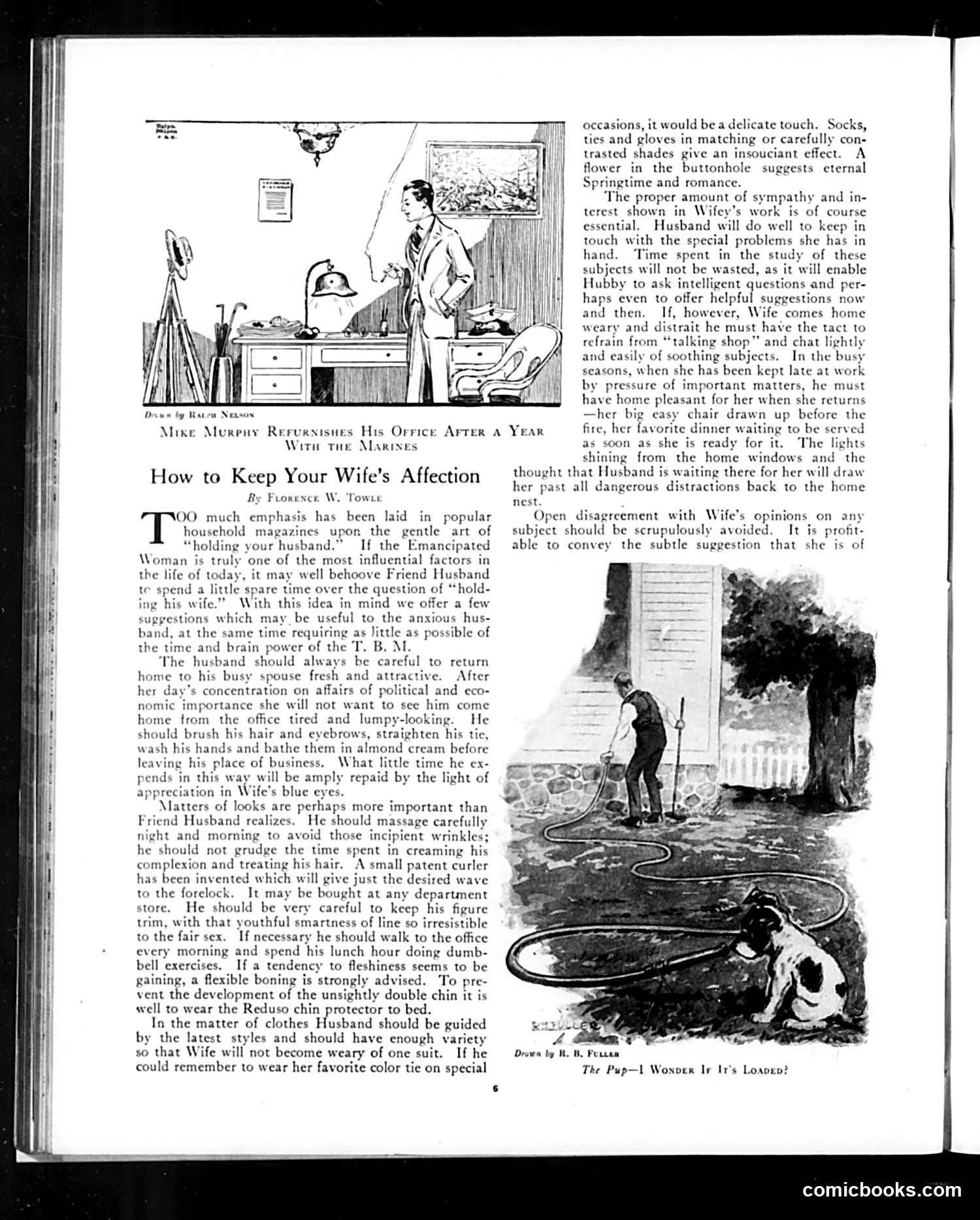
This page contains an article titled "How to Keep Your Wife's Affection" by Florence W. Towle, presenting satirical domestic advice to husbands. The accompanying illustrations show a husband returning home to his wife's approval. The satire mocks early 20th-century prescriptive gender roles by offering exaggerated "helpful suggestions" for husbands: grooming meticulously, maintaining physical fitness, wearing cologne, purchasing fashionable clothes, and bringing home flowers. The cartoon "The Pup—I Wonder If It's Loaded!" (illustrated by H.B. Fuller) appears unrelated to the main article. The humor lies in presenting domestic appeasement as requiring elaborate performance and self-maintenance from husbands—reflecting contemporary anxieties about marriage dynamics and the emerging consumer culture's emphasis on appearance and material goods as relationship maintenance tools.
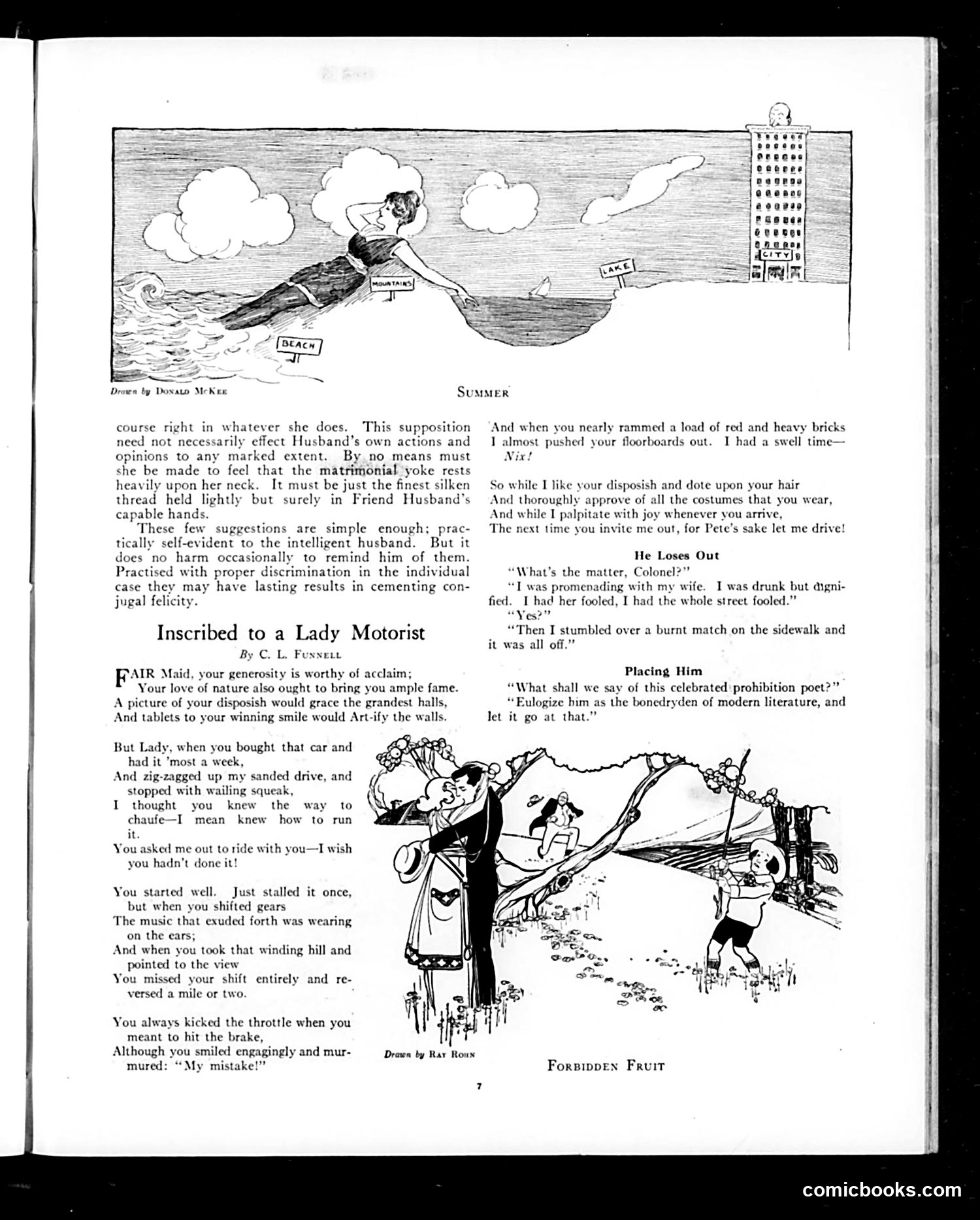
This page contains three satirical pieces mocking early 20th-century social conventions: **"Inscribed to a Lady Motorist"** (main poem): A husband humorously complains about his wife's terrible driving. She stalls, grinds gears, nearly crashes into buildings, confuses throttle and brake, yet smiles sweetly throughout. The satire targets both her incompetence behind the wheel and her manipulative charm—she relies on her appearance and demeanor rather than actual skill. The punchline: despite finding her attractive, he insists on driving himself next time. **"He Loses Out"**: A drunk man maintains dignified composure until he stumbles over a burnt match, revealing his intoxication. Social satire on maintaining facades and performative respectability. **"Placing Him"**: A brief joke about a "prohibition poet"—likely referencing Prohibition-era poets or one specific celebrated writer. The humor mocks overwrought literary praise by suggesting he be called "the bonedryden" (pun: "bone-dry" prohibition + "bard"). The page satirizes gender relations, automotive incompetence, and literary pretension typical of 1920s Judge humor.
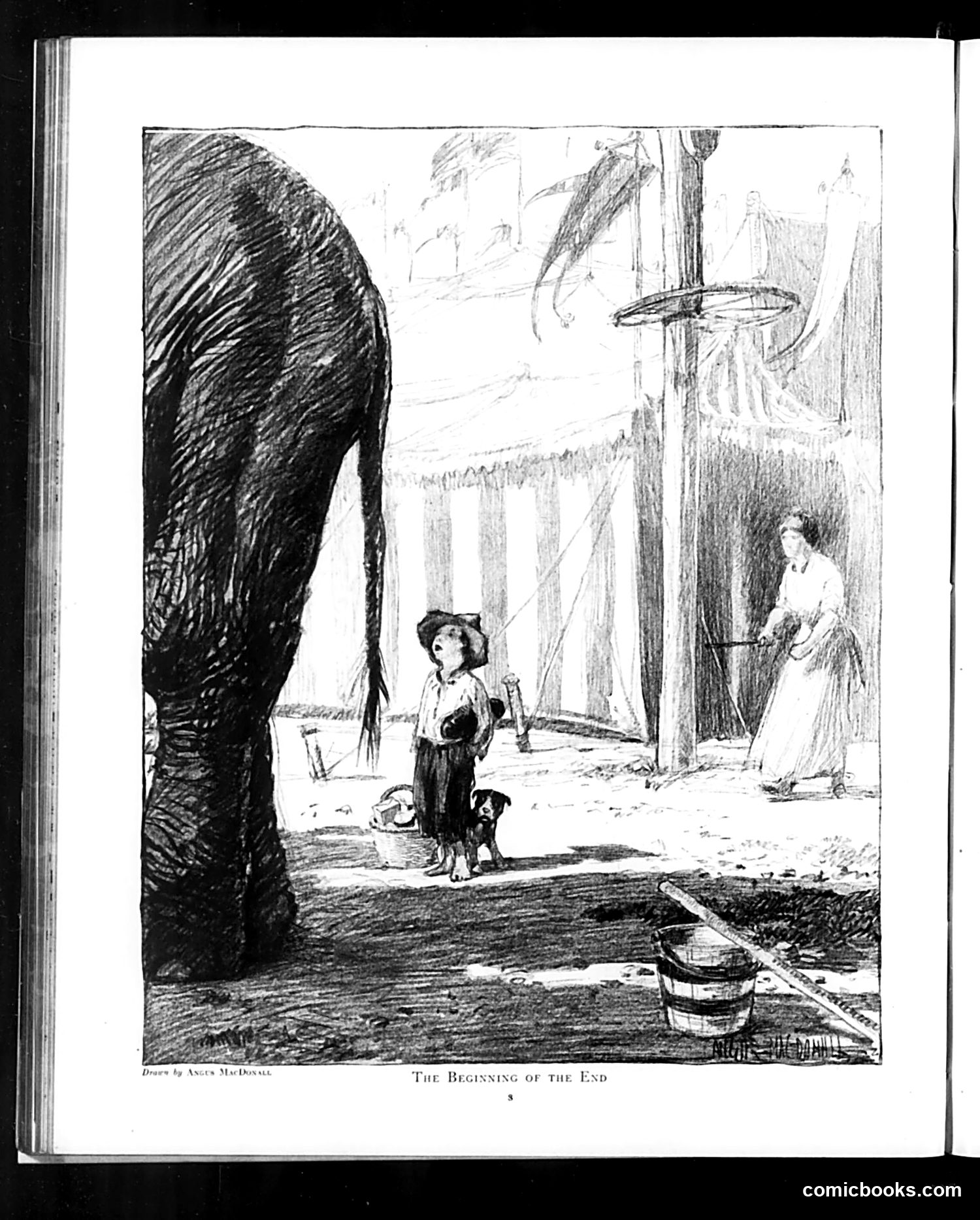
This illustration by Agnes MacDonnell depicts a stark, industrial scene: a massive tree trunk dominates the left foreground, while in the background, a woman in a long dress watches a child and dog near wooden structures and bare trees. The composition suggests environmental or social decay—the large, stripped tree and desolate landscape indicate deforestation or industrial destruction. The title "The Beginning of the End" implies commentary on ecological collapse or civilization's decline. The woman's distant, observational stance and the child's small figure emphasize human vulnerability before nature's destruction or industrial progress's consequences. This likely critiques late-19th or early-20th century American industrial expansion and its environmental costs, warning readers of approaching societal ruin.
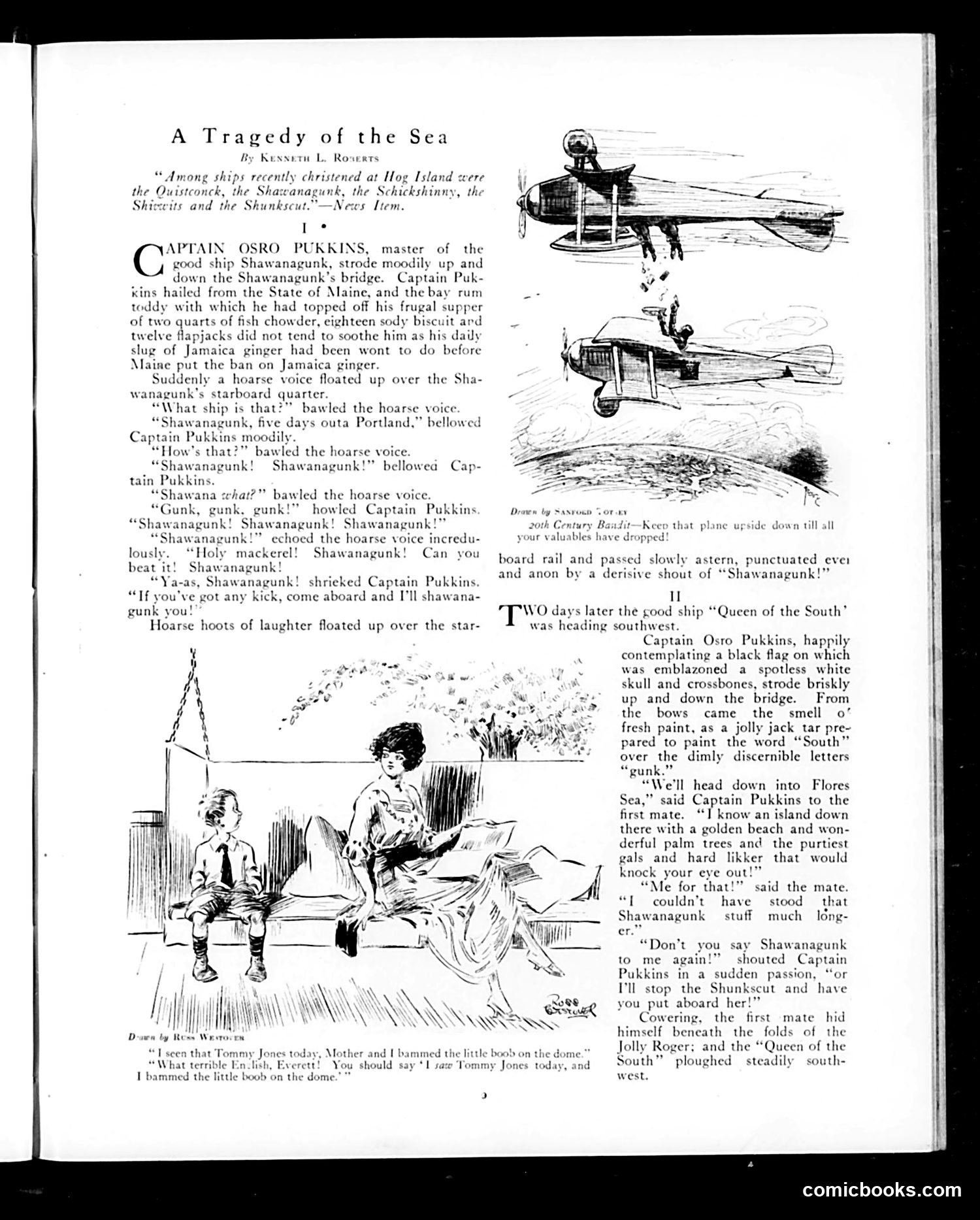
This is a humorous short story with illustrations, not political satire. It mocks the comical mishearing of a ship's name during a sea encounter. **The Setup:** Captain Osro Pukkins commands the "Shawanagunk," a ship christened at Hog Island (referencing a real WWI-era shipbuilding program). When another vessel hails him asking his ship's name, the repeated back-and-forth devolves into comedic chaos—Pukkins eventually just yells "Gunk, gunk, gunk!" because the other captain keeps mishearing "Shawanagunk." **The Joke:** The story plays on the absurdity of the ship's actual name and escalating miscommunication at sea. The punchline comes later when Pukkins converts to piracy, repainting his vessel "Queen of the South" by painting over "gunk" from the original name—the very word that caused all the confusion. The humor relies on wordplay, the Maine captain's colorful dialect, and the ridiculous situation rather than political commentary. It's lighthearted satire about naval bureaucracy and human stubbornness.
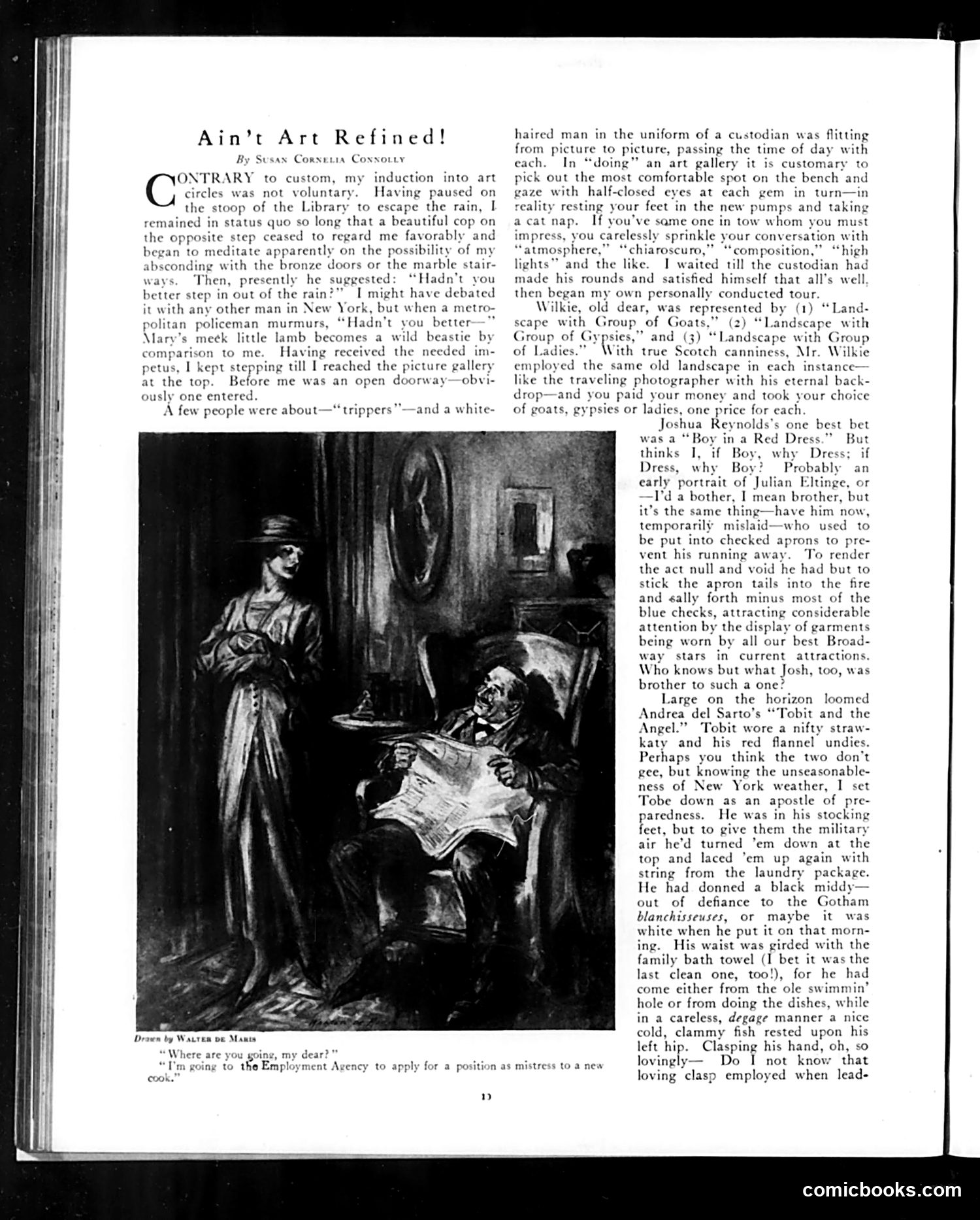
This is a humorous essay about visiting an art gallery in New York. The author, Susan Cornelia Connolly, satirizes both casual museum visitors ("trippers") and pretentious art appreciation. The illustration shows a custodian and visitor in a gallery. The satire mocks: 1. **Lazy museum-going**: People pick comfortable benches, half-close their eyes, and nap rather than genuinely engage with art. 2. **Pretentious art talk**: Visitors sprinkle conversations with terms like "chiaroscuro" and "composition" to appear cultured without real understanding. 3. **Artistic repetition**: She notes a painter (Wilkie) cynically reused the same landscape with different subjects (goats, gypsies, ladies) at identical prices—essentially mass-producing art. 4. **Confusing paintings**: She questions a Reynolds portrait of a "Boy in a Red Dress," joking it might be Julian Eltinge (a famous female impersonator performer), and humorously over-analyzes other artworks with absurdist logic. The piece mocks both art institutions and their pretentious visitors rather than attacking specific political targets.
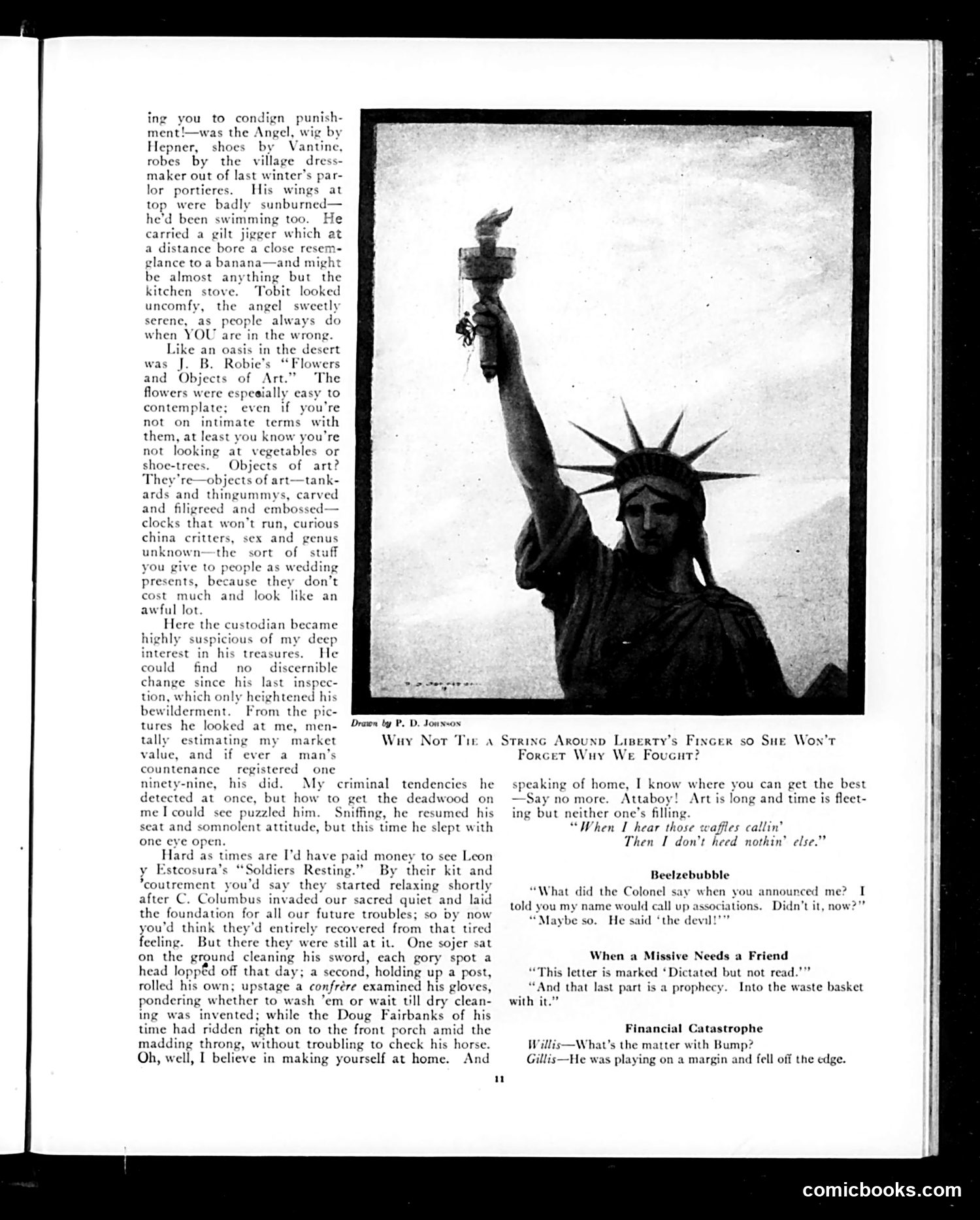
This page contains a mixed-media satirical piece centered on a drawing of the Statue of Liberty (titled "Why Not Tie a String Around Liberty's Finger so She Won't Forget Why We Fought?"). **The Main Cartoon's Point:** The image appears to reference WWI ("why we fought"), suggesting Americans were forgetting the war's purpose or sacrifice. The absurdist caption—literally tying a string around Liberty's finger as a memory aid—satirizes national forgetfulness about the conflict's meaning. **Supporting Content:** The page includes a lengthy narrative about visiting an art museum and viewing paintings by J.B. Robie and León y Estcosura (real artists of the period). The writer humorously observes pretentious "objects of art" and suspicious museum staff. **Humor Sections:** Brief comedic vignettes satirize American speech patterns ("When I hear those waffles callin'") and financial naïveté (someone losing money "playing on a margin"). The overall tone mocks both forgetfulness about war's lessons and American cultural pretension.
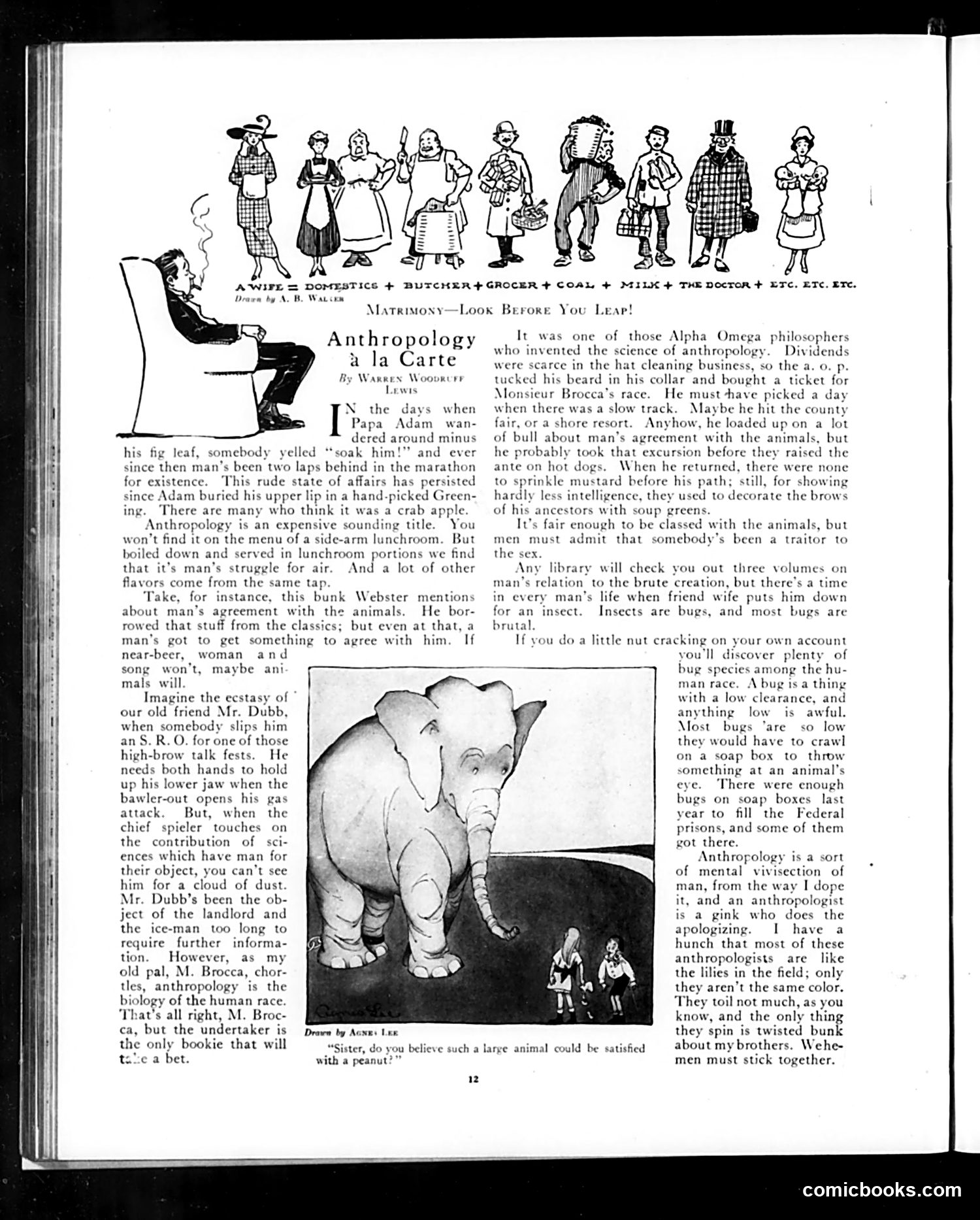
This page contains two satirical pieces mocking early 20th-century intellectual pretension. **Top cartoon**: "Matrimony—Look Before You Leap!" shows a man contemplating marriage as an equation: wife equals domestics, butcher, grocer, coal, milk, doctor, etc. The joke warns men that marriage means financial obligation to support a household and all its expenses. **Main article**: "Anthropology à la Carte" by Warren Woodworth Lewis ridicules "Alpha Omega philosophers" and anthropology as a fashionable but hollow pseudoscience. The author sarcastically suggests anthropologists—including one "Monsieur Brocca"—invented elaborate theories about human nature and man's relationship to animals to gain intellectual prestige and income, when they're actually just producing "twisted bunk." The elephant illustration appears unrelated but reinforces the absurdist tone. The overall satire targets wealthy intellectuals and academics who adopt impressive-sounding theories to appear cultured while contributing little of value. It's anti-elitist, dismissive of pseudoscientific thinking.
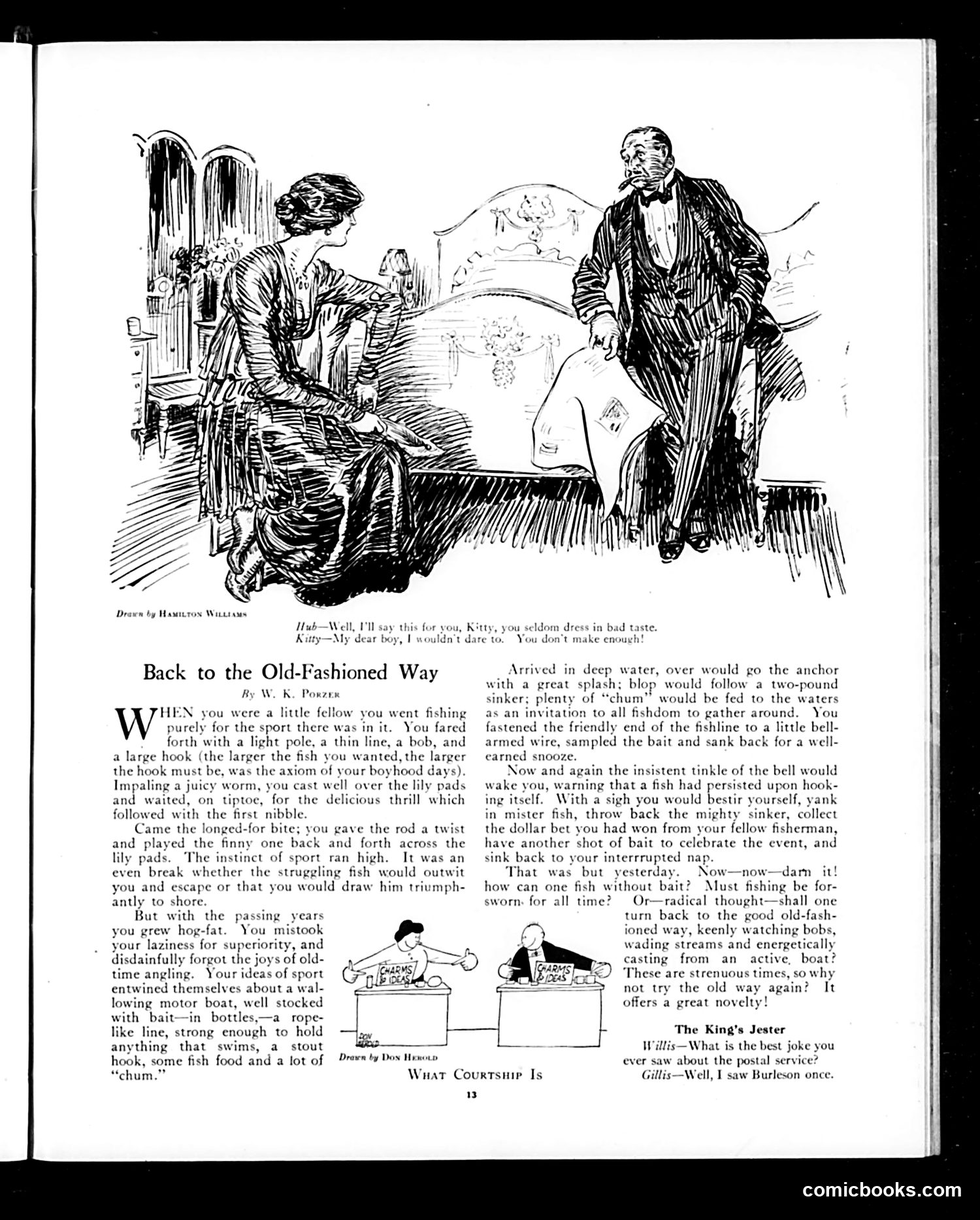
This article mocks the modern wealthy leisure class's abandonment of traditional fishing for lazy, mechanized alternatives. The author contrasts boyhood fishing—requiring skill, patience, and active participation with a simple pole and worm—with contemporary "sportsmen" who use motor boats, anchors, sinkers, and chum, then nap while a bell alerts them to caught fish. The satire targets upper-class complacency: these men have grown "hog-fat," mistaking their laziness for sophistication while betting money on effortless catches. The piece argues nostalgically for returning to genuine sport requiring actual effort and engagement. The illustration shows a couple's domestic disagreement, unrelated to the main article's fishing theme. The "King's Jester" joke references Albert Burleson, Postmaster General under Woodrow Wilson, using him as a punchline about postal service incompetence—typical period political humor.
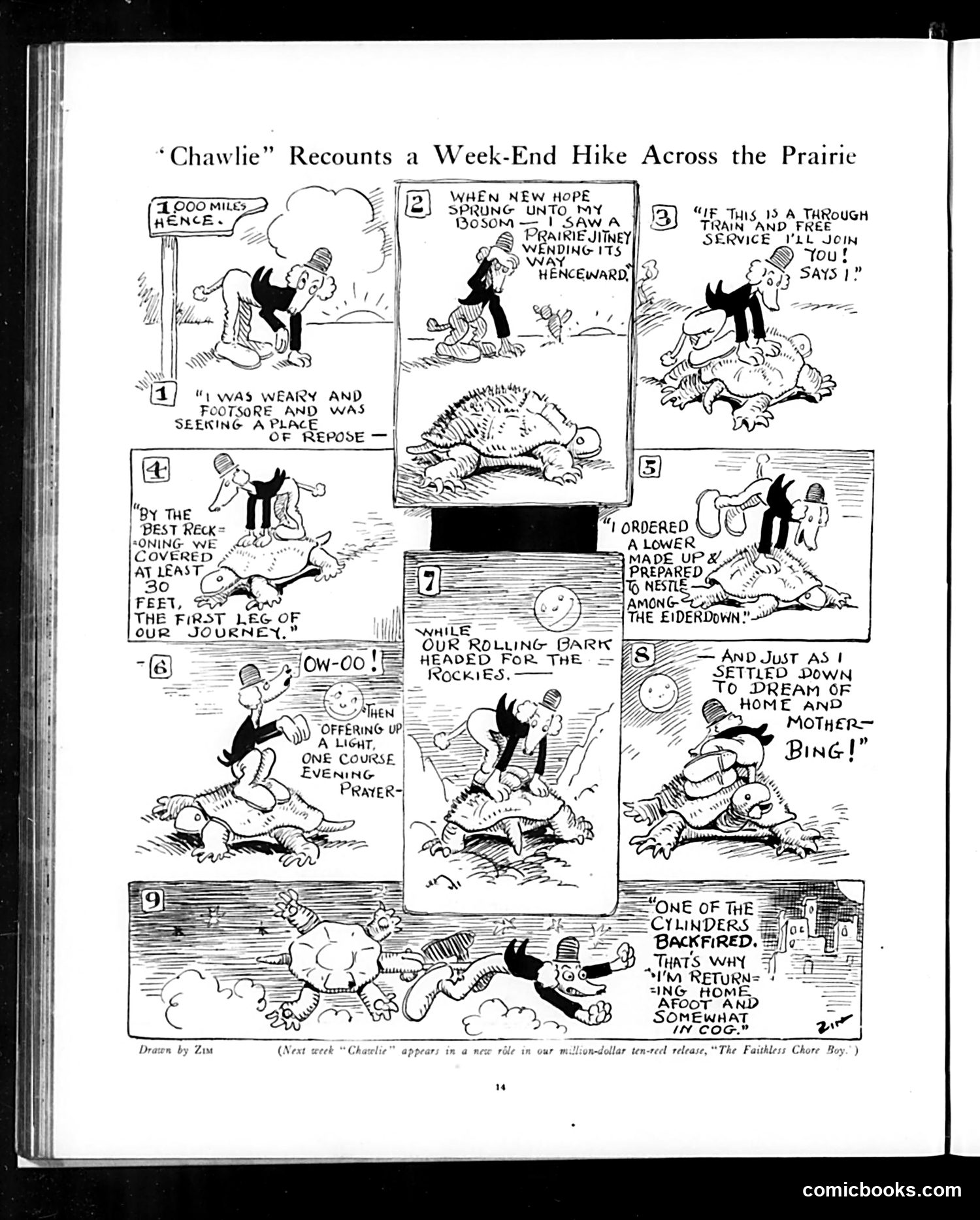
This is a humorous comic strip narrated by a character named "Chawlie" describing a disastrous weekend hiking trip across the American prairie. The story follows his misadventures: starting 1,000 miles away, boarding a train with false promises of free service, encountering a tortoise he mistakes for shelter, attempting to ride it, praying to survive, and ultimately being struck by a train's backfiring cylinders. The satire targets early 20th-century railroad advertising and travel promotion—the "New Hope" train and its exaggerated service claims. The humor derives from the character's malapropisms ("Chawlie," "boson" for boatswain), physical slapstick with the tortoise, and the ironic ending where he's knocked unconscious and returns home "somewhat in cog" (condition unclear/damaged). The strip spoofs both romantic prairie adventure narratives and unreliable transportation companies.
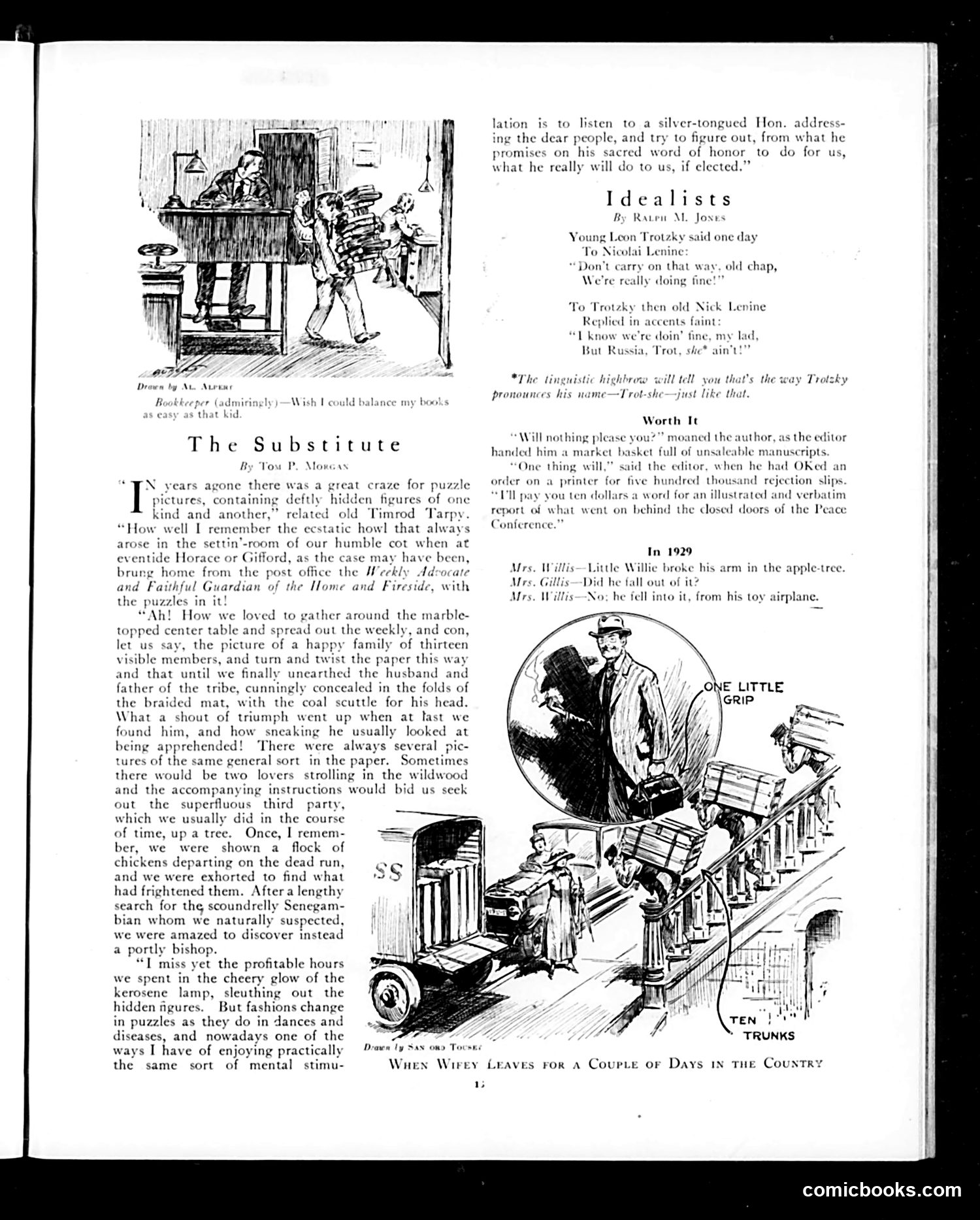
This page contains several satirical pieces mocking 1920s American politics and social life: **"Idealists"** lampoons Soviet leaders Lenin and Trotsky as delusional—they claim Russia is "doing fine" despite obvious catastrophic conditions, satirizing communist propaganda and denial of reality. **"The Substitute"** jokes about rejected manuscripts and editorial rejection slips, a common publishing-world complaint. **"The Substitute" (main story)** nostalgically references Victorian-era puzzle pictures (popular in magazines like *Weekly Advocate*), where readers hunted for hidden figures in illustrations—a common form of entertainment before modern diversions. **"In 1929"** shows changing times: a child breaks his arm not falling from a tree (old-fashioned) but from a toy airplane, satirizing how rapidly technology was transforming childhood and modern life. The caption "One Little Grip" and "Ten Trunks" emphasizes material excess. The overall theme: progress and modernity are replacing simpler, older pleasures and anxieties.
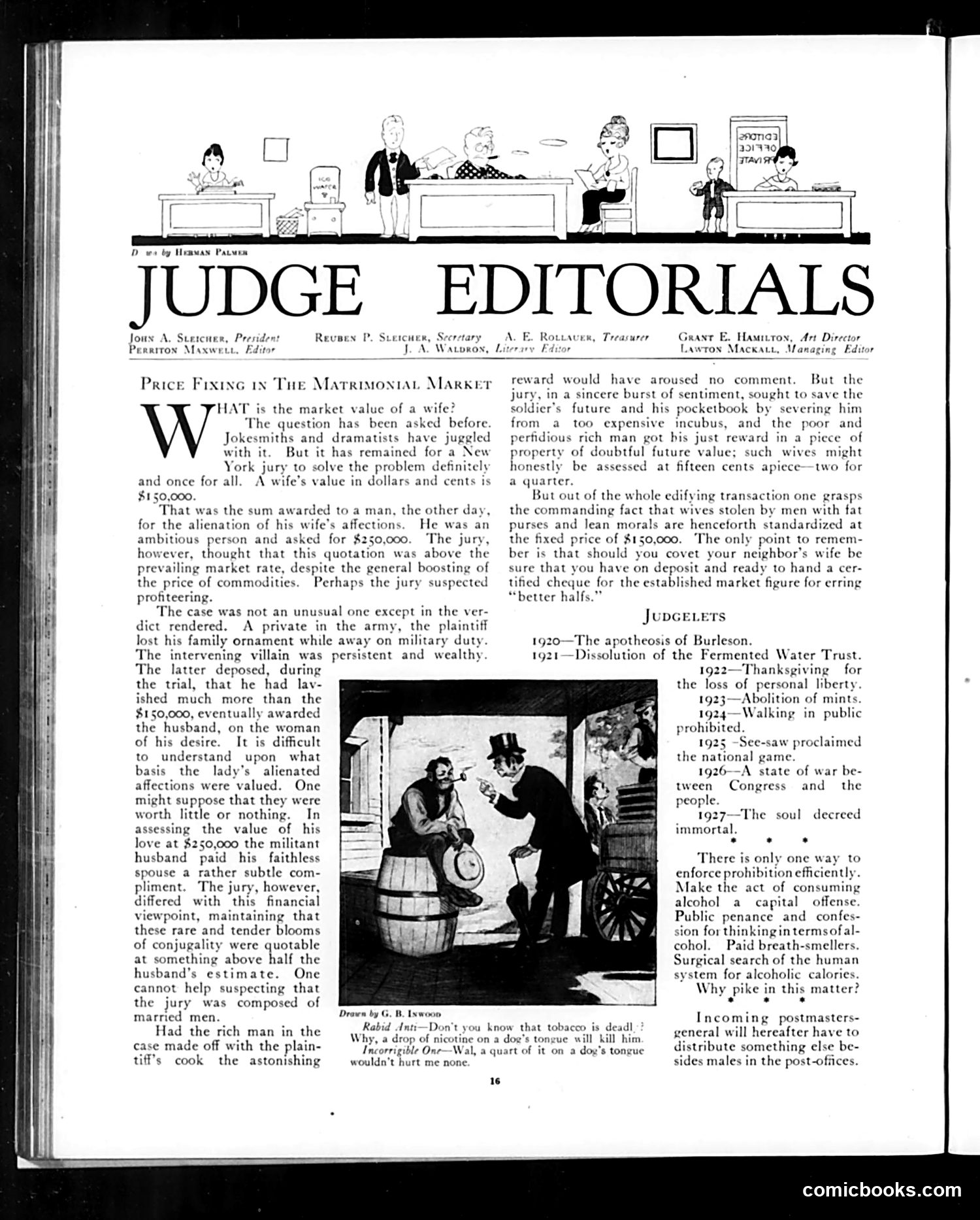
This page satirizes a New York court case awarding $150,000 in damages for "alienation of affections"—a legal action where a husband sued a wealthy man for seducing his wife. The editorial mocks the absurdity of monetizing a wife's value: the plaintiff demanded $250,000, but jurors (whom the editor suspects were married men) assessed her at half that amount, effectively establishing a market price for wives. The satire cuts multiple directions: it ridicules both the husband for valuing his "faithless spouse" so highly and the legal system for treating marital fidelity as a commodity. The editorial notes that if the wealthy man had seduced the cook instead, no one would care—highlighting how class status influenced both the affair and the judgment. The accompanying cartoon by G.B. Iswood makes a separate point about tobacco/nicotine dangers, appearing unrelated to the main editorial.
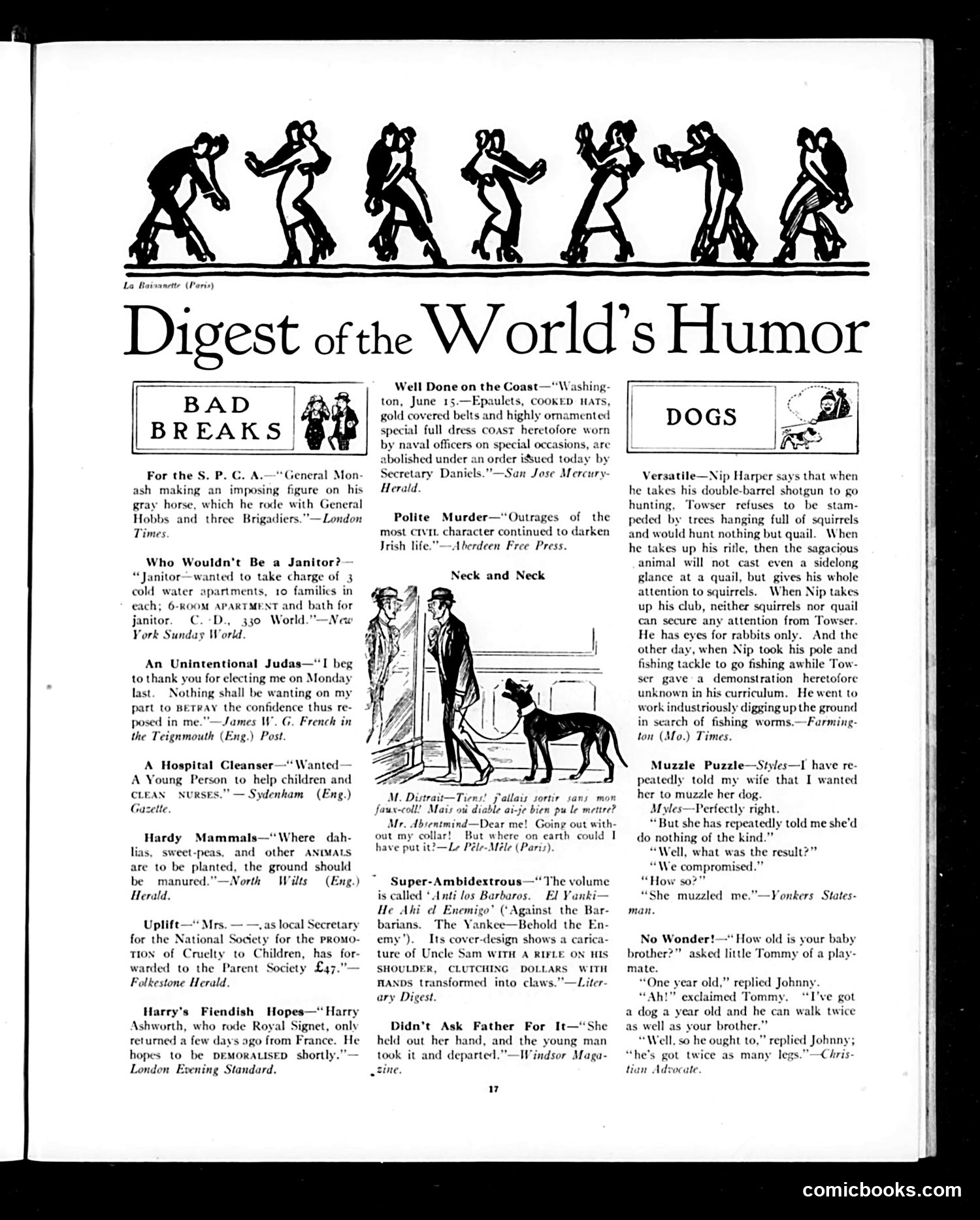
This page collects brief humorous anecdotes sourced from newspapers and magazines worldwide, presenting them as examples of unintentional comedy through typographical errors or awkward phrasing. The jokes exploit **accidental double meanings** created by misplaced words: a janitor "wanted" must also live in the apartment; a hospital seeks someone to "clean nurses" (implying they're dirty); and a politician thanks voters for electing him while he'll "BETRAY" their confidence. One cartoon shows a French gentleman and an absentminded Englishman discussing lost collars—a visual gag about carelessness. Another references American imperialism: a book cover depicts **Uncle Sam wielding a rifle while clutching dollars with claw-like hands**, critiquing U.S. foreign policy as exploitative. Dog anecdotes demonstrate animal intelligence through humorous exaggeration. The final joke contrasts a baby's mobility unfavorably with a dog's, a common contemporary humor trope.
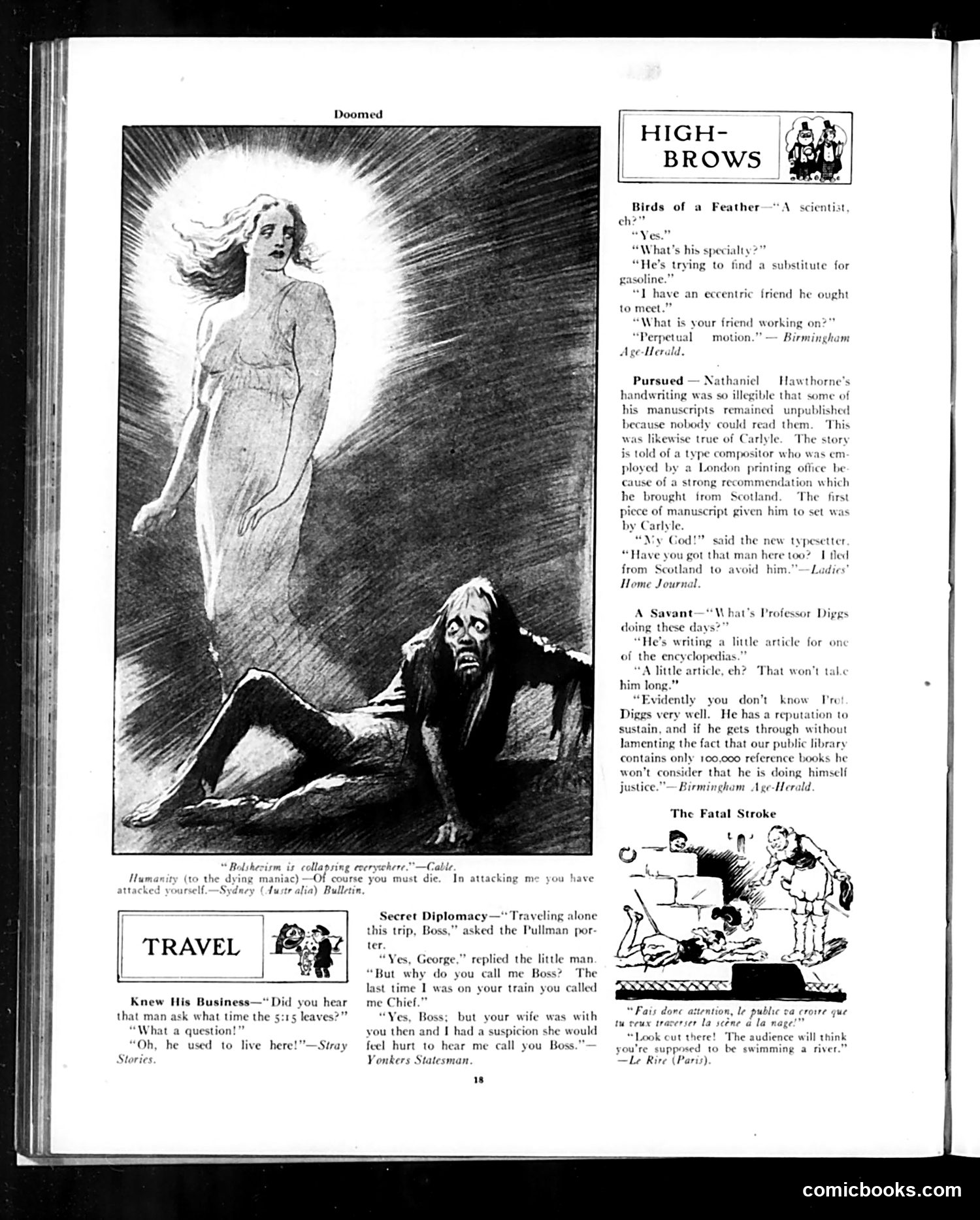
**The main illustration** depicts a ghostly female figure appearing to a terrified man, likely referencing Nathaniel Hawthorne's literary works (the "Pursued" section discusses Hawthorne). The dramatic gothic imagery suggests themes of supernatural haunting or psychological torment common in 19th-century literature. **The "High-Brows" section** satirizes intellectual pretension through anecdotes: a scientist seeking alternative fuels, someone pursuing "perpetual motion," and Professor Diggs writing encyclopedia entries while constantly complaining about insufficient reference materials. The humor mocks academics' self-importance and excessive verbosity. **The smaller cartoons and jokes** (under "Travel," "Secret Diplomacy," "The Fatal Stroke") offer light social humor—a porter's deferential language changing based on whether a wife is present, and theatrical absurdism. The page overall represents *Judge* magazine's characteristic blend of literary satire, social observation, and visual comedy targeting educated readers' foibles.
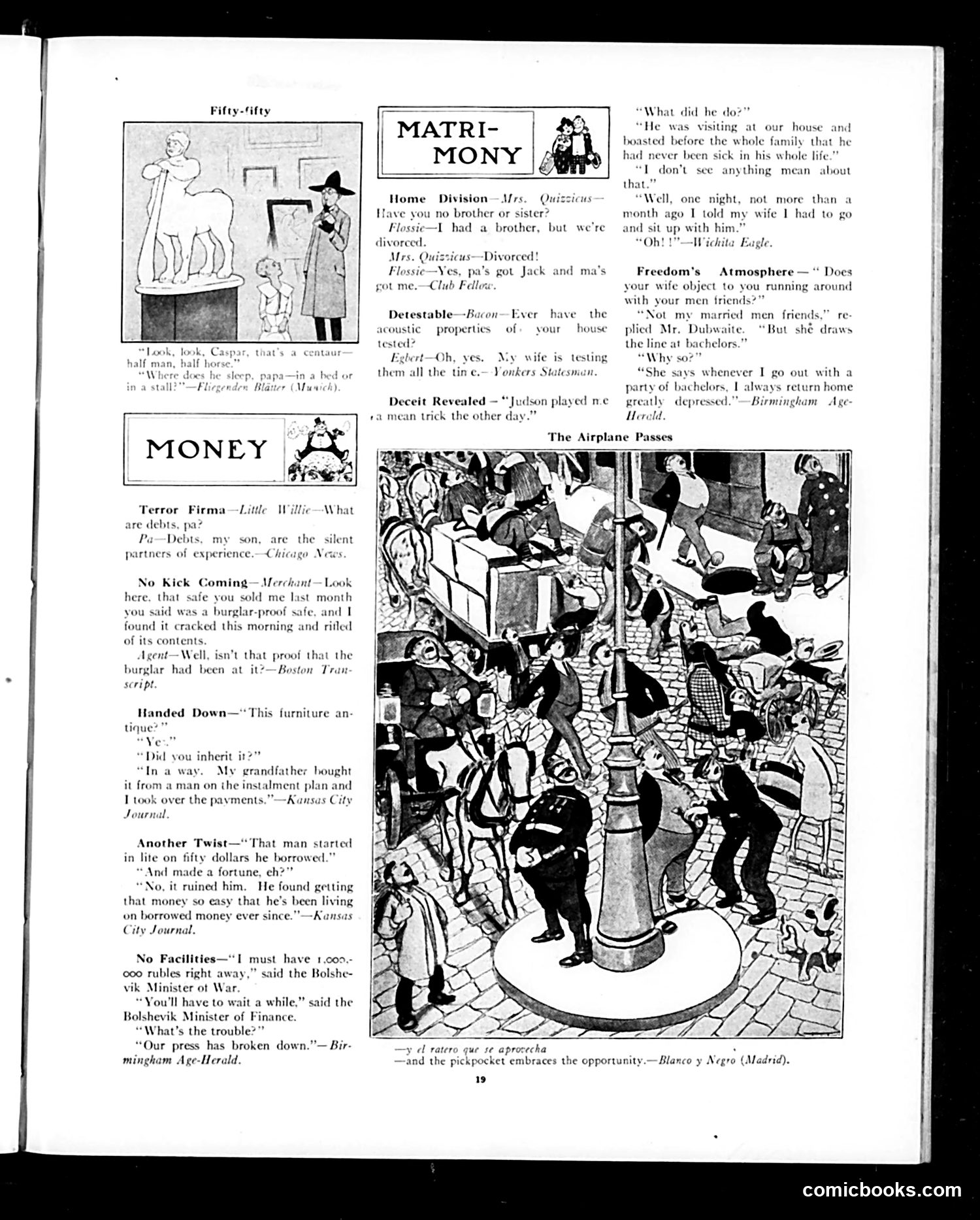
This page contains several short humorous anecdotes satirizing early 20th-century American life and contemporary politics. The **"Matrimony" and "Money" sections** feature domestic comedy: a divorced sibling (whose parents separated and each "got" a child), acoustic testing via a wife's complaints, and marital jealousy about bachelors. The **political content** appears in "No Facilities," mocking Bolshevik Russia's post-revolution chaos—the Soviet Minister of War needs 1 million rubles but the Minister of Finance claims the printing press is broken, satirizing Soviet economic dysfunction and propaganda machinery failures. The **"Fifty-fifty" cartoon** (top left) depicts a centaur, likely representing confused identity or the absurdity of inherited problems. Other sections mock debt as "silent partners," burglar-proof safes that fail, furniture purchased on installment plans, and borrowed money leading to ruin—all reflecting Depression-era anxieties about consumer debt and financial instability. **"The Airplane Passes"** illustration (bottom right) shows a crowded street scene; the caption references pickpocketing during the excitement of an airplane overhead—commentary on urban disorder and opportunistic crime.
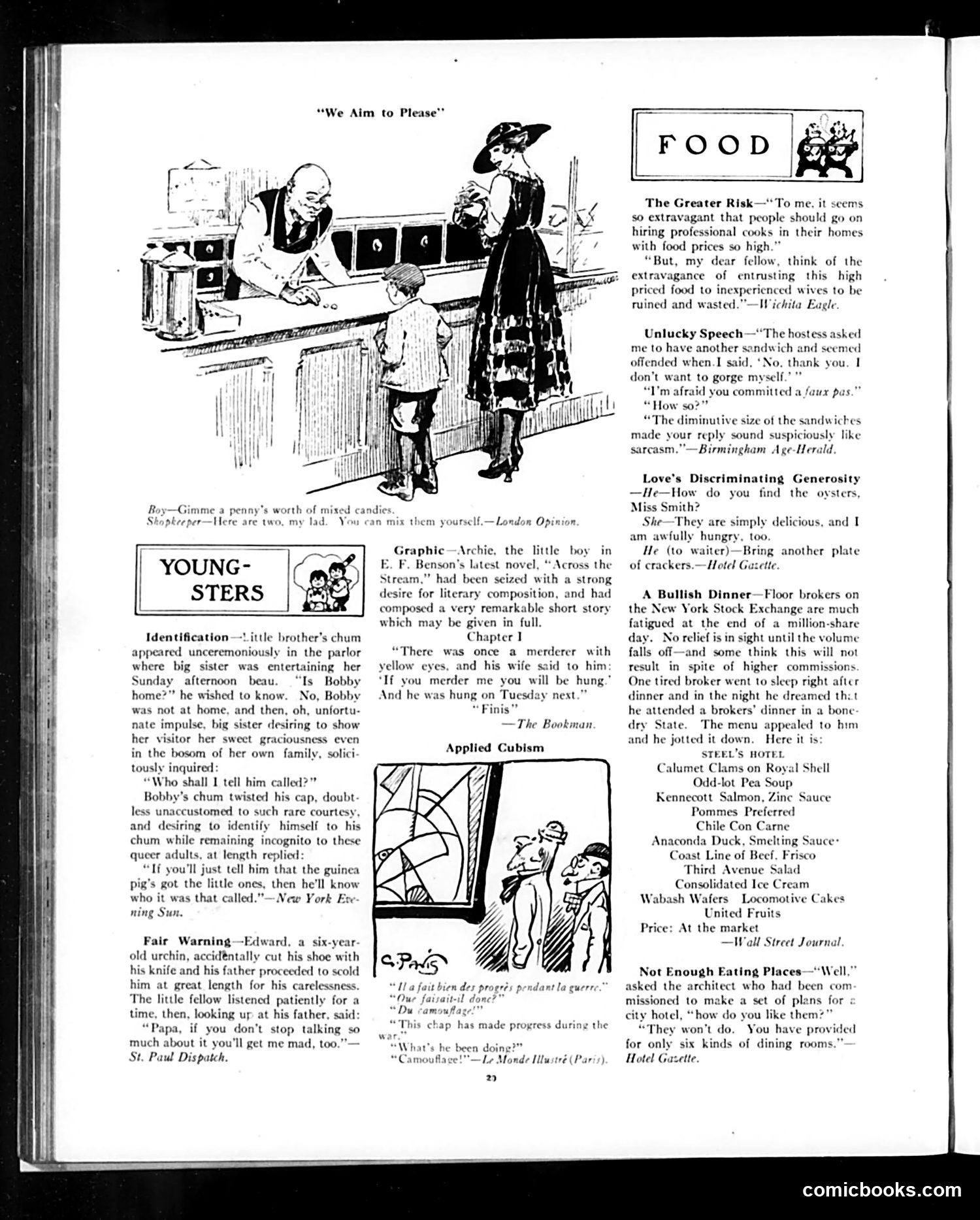
This page from *Judge* magazine contains several brief humorous anecdotes and one cartoon about early 20th-century social life. **The main illustration** ("We Aim to Please") shows a butcher or shopkeeper serving customers, likely satirizing service industry dynamics or food scarcity concerns (suggested by the "Food" header and references to high food prices in the text). **The content** consists of short jokes addressing: - **Class anxieties** about hiring professional cooks when food costs are high - **Social embarrassment** over small sandwich portions and unintended rudeness - **Stock market humor** featuring a broker's dream dinner with menu items named after stocks (Anaconda, Consolidated, etc.)—reflecting the magazine's wealthy audience **"Applied Cubism"** appears to be a visual joke about modernist art, though the cartoon itself is unclear. The anecdotes about children ("Youngsters" section) mock adult pretension and children's innocent honesty—typical period humor. Overall, this reflects *Judge*'s satirical focus on upper-middle-class concerns: servants, dining etiquette, investment culture, and modern art trends.
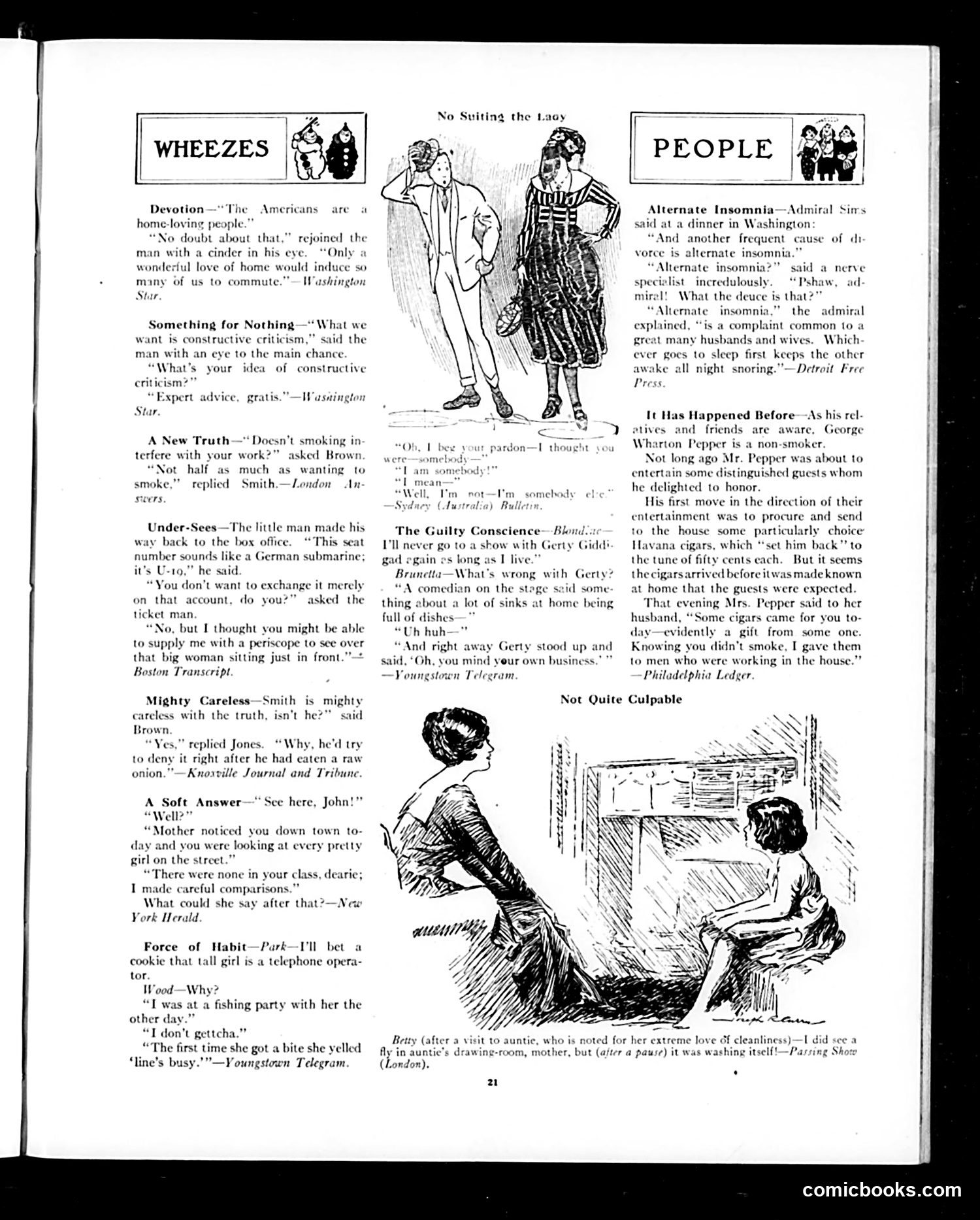
This page collects short humor pieces typical of *Judge* magazine's satirical format. The jokes target common social observations rather than specific political figures. **Key themes:** - **"Commuting"**: Mocks Americans' willingness to endure long commutes for suburban homes, framing it as forced rather than chosen - **"Constructive criticism"**: Satirizes those seeking free expert advice - **Theater seat U-10**: A WWI-era submarine reference; the joke plays on wartime anxieties (this likely dates to 1917-1918) - **Gender dynamics**: Multiple pieces mock marital relations—wives catching husbands looking at other women, "alternate insomnia" (snoring spouses), and housewives discarding valuable cigars **The "Not Quite Culpable" cartoon**: Depicts a woman catching a child at what appears to be a window or ledge, illustrating situations where blame is ambiguous. **Overall tone**: These are gentle domestic and workplace satires reflecting middle-class American anxieties, not hard political commentary. The humor relies on recognizable social situations and mild misogyny typical of the era.
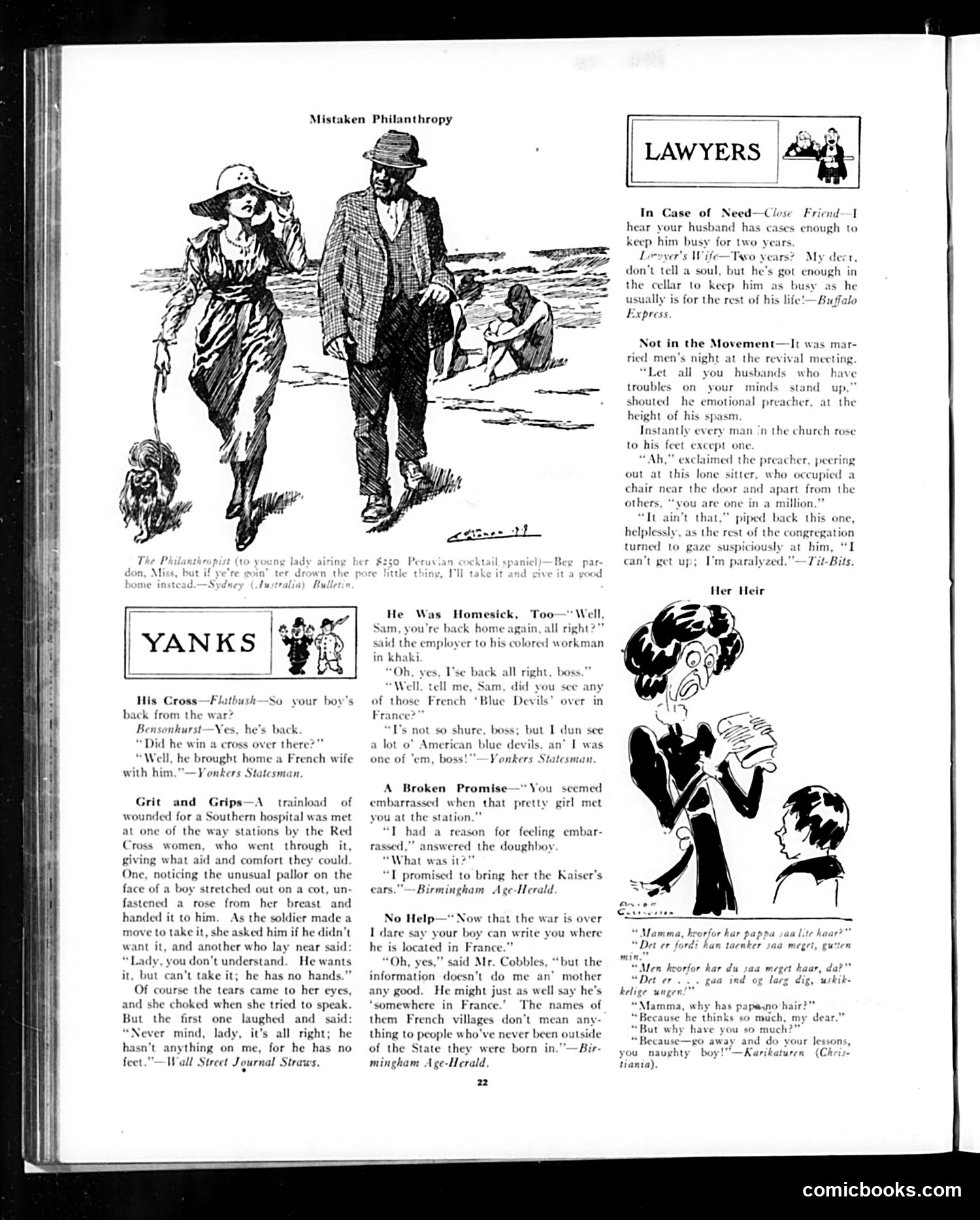
This page contains WWI-era humor anecdotes satirizing American attitudes toward the war and returning soldiers. **Key content:** The title cartoon shows a well-dressed couple with a child, captioned about a philanthropist giving a "$250 Peruvian cocktail" (implying misguided charity). **The anecdotes mock:** - **"His Cross"**: A soldier returns with a French wife, suggesting he gained a "cross" (burden) rather than military honor - **"He Was Homesick"**: A Black worker's confused observation of French soldiers, playing on dialect humor - **"A Broken Promise"**: A soldier joked about bringing the Kaiser's ears—obvious wartime bravado - **"No Help"**: A parent frustrated that French village names mean nothing without geographic context - **"In Case of Need"**: A wife hints her husband has hidden alcohol (Prohibition-era humor) - **"Not in the Movement"**: A paralyzed man cannot stand during a revival meeting—dark humor about war injuries The "Her Heir" cartoon discusses paternal baldness with dialect humor. **Overall satire**: These pieces gently mock American provincialism, returnee culture shock, and post-war readjustment through period-appropriate stereotypes.
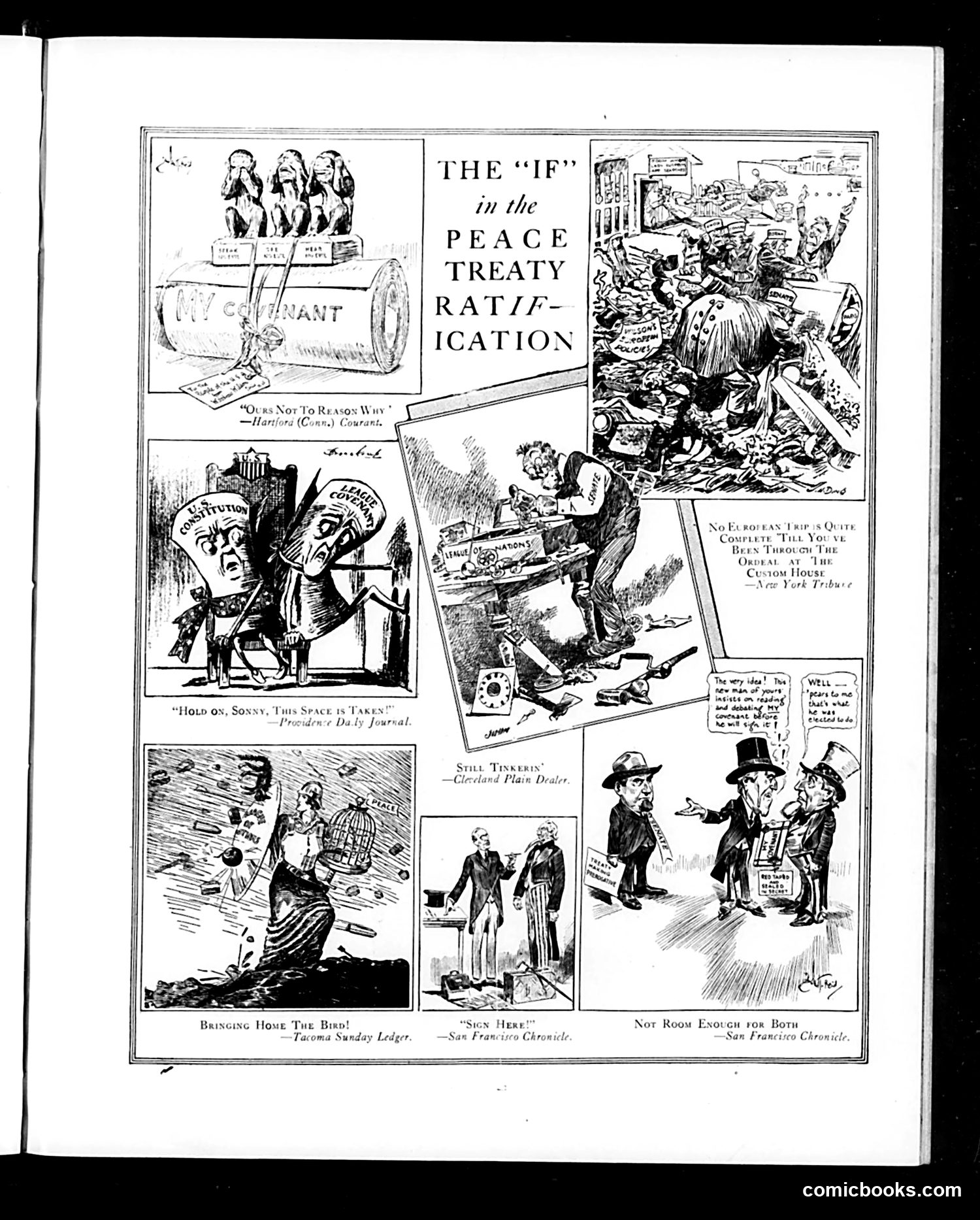
This Judge magazine page satirizes American political debate over ratifying a peace treaty—likely the Treaty of Versailles following World War I. The central theme, "THE 'IF' in the PEACE TREATY RATIFICATION," mocks how politicians loaded the treaty with conditional clauses and reservations. The cartoons depict: - **Top left**: Three figures cramped in a "covenant" container, suggesting overcrowding with conditions - **"Hold On, Sonny"**: Politicians fighting over treaty language and space - **"Bringing Home the Bird"**: Difficulty securing the agreement - **"Not Room Enough for Both"**: Competing political interests unable to coexist The satire targets how Senate Republicans (particularly isolationists) demanded so many modifications and reservations that ratification became nearly impossible. Each cartoon shows the chaos and contradiction created by politicians inserting "ifs" and conditions, ultimately strangling the treaty's passage.
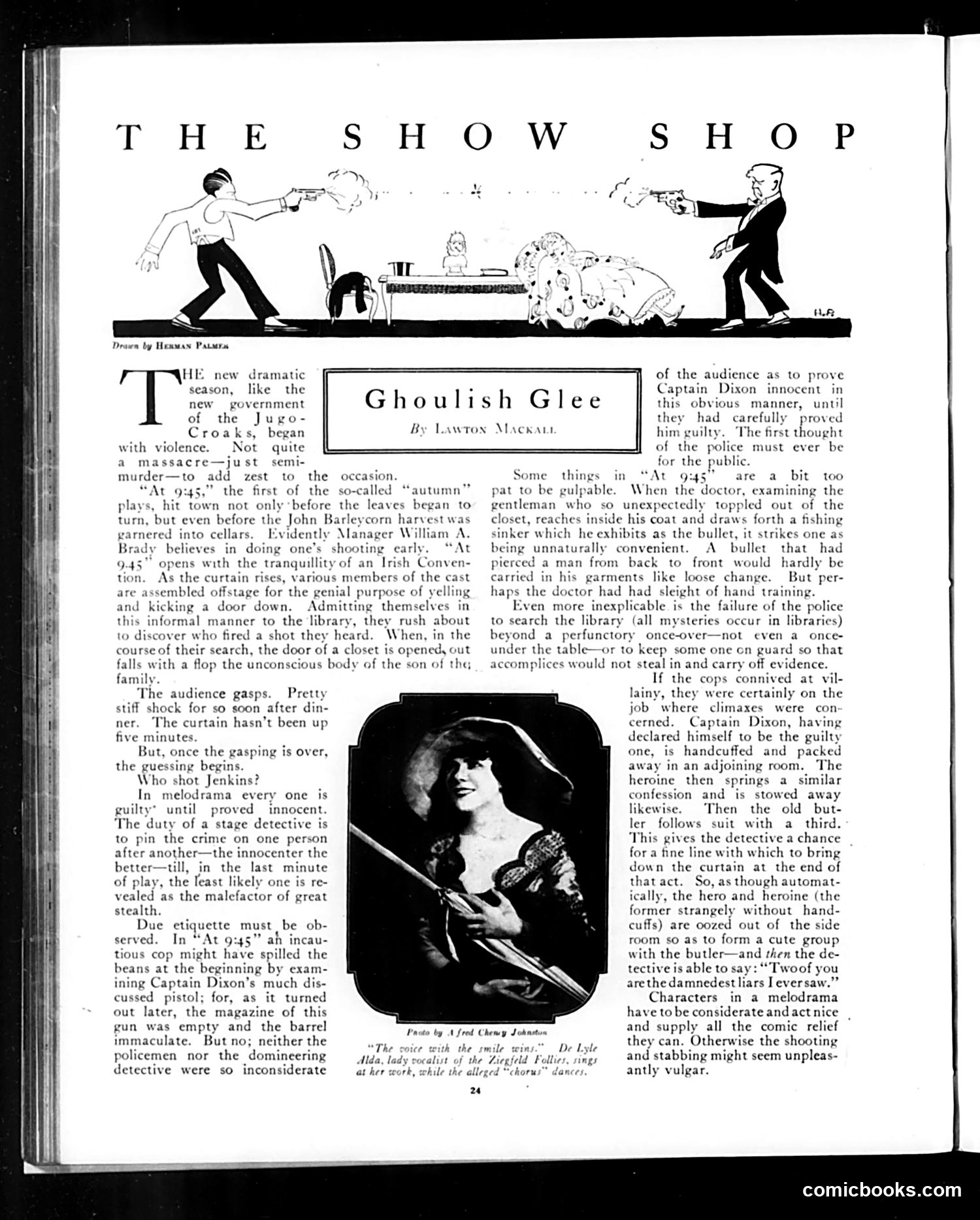
This is a theater review of a melodrama called "At 9:45," critiquing its implausible plot mechanics. The cartoon at top shows two figures firing pistols at each other across a stage set—a visual joke about the play's violent theatricality. The reviewer mocks the genre's conventions: characters are "guilty until proved innocent," detectives unnecessarily delay solving crimes for dramatic effect, and coincidences strain credibility (a bullet replaced by a fishing sinker, the police failing to search properly). The author notes that melodrama characters must remain "considerate"—supplying comic relief and behaving nicely—or else the constant shooting and stabbing would seem "unpleasantly vulgar." The satire targets not the play's violence itself, but rather its *illogical* plotting and the artificial constraints genre conventions impose on storytelling. The "Jugo-Croaks" reference (Yugoslavia's political turmoil) compares the play's chaotic structure to real-world disorder.
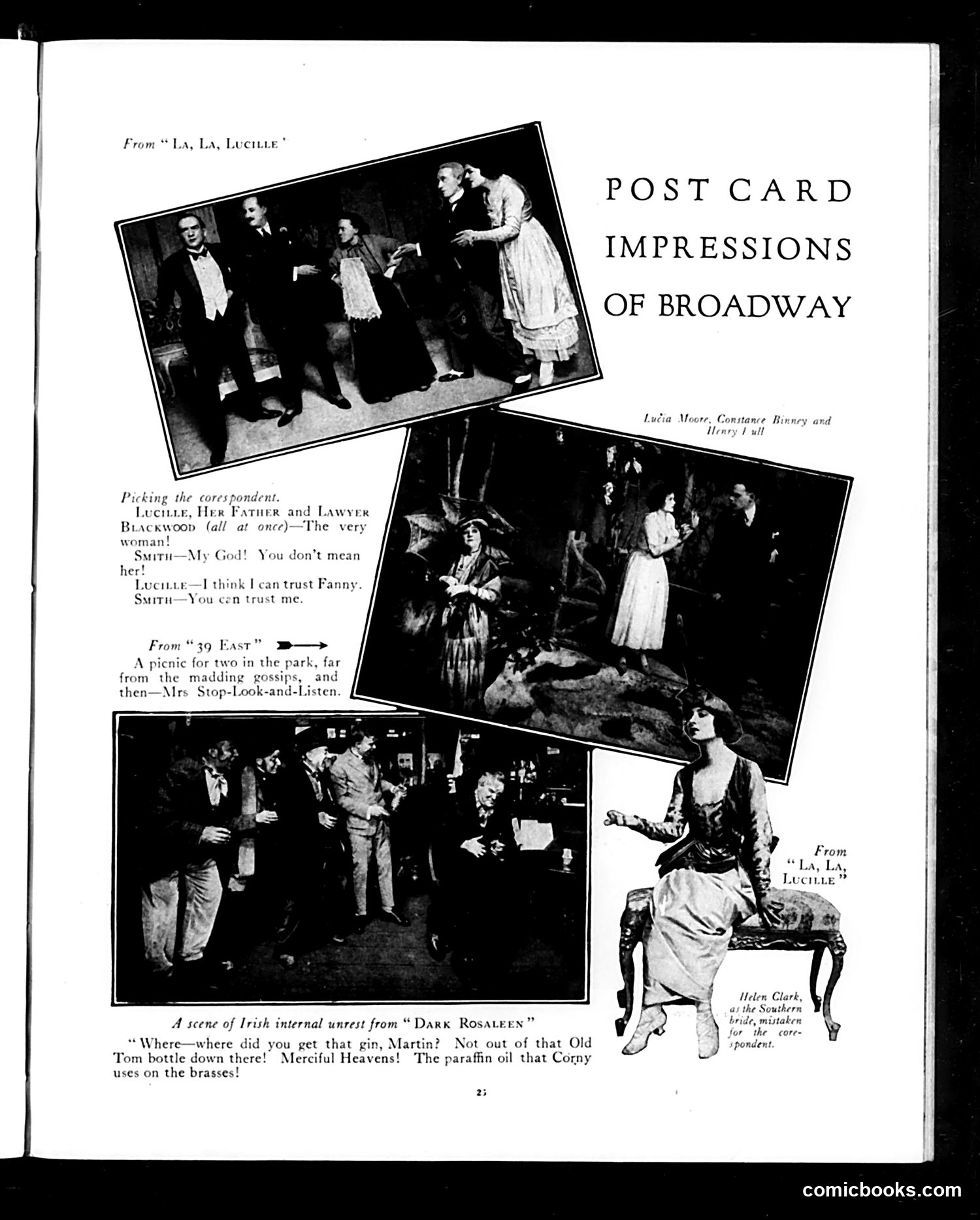
This page showcases scenes from early 20th-century Broadway plays, functioning as theatrical promotion rather than political satire. The content presents snippets from three productions: *La, La, Lucille*, *39 East*, and *Dark Rosaleen*. Each excerpt captures a comedic or dramatic moment—a paternity dispute ("You don't mean her!"), a romantic park rendezvous interrupted by a busybody, and an Irish domestic quarrel over illicit gin. The humor relies on common theatrical tropes of the era: marital complications, social meddling, and ethnic stereotyping (the Irish gin scene). These "impressions" functioned as entertainment previews for readers considering Broadway attendance. The page is essentially theatrical advertising disguised as editorial content—a common Judge practice blending entertainment gossip with gentle mockery of stage conventions.
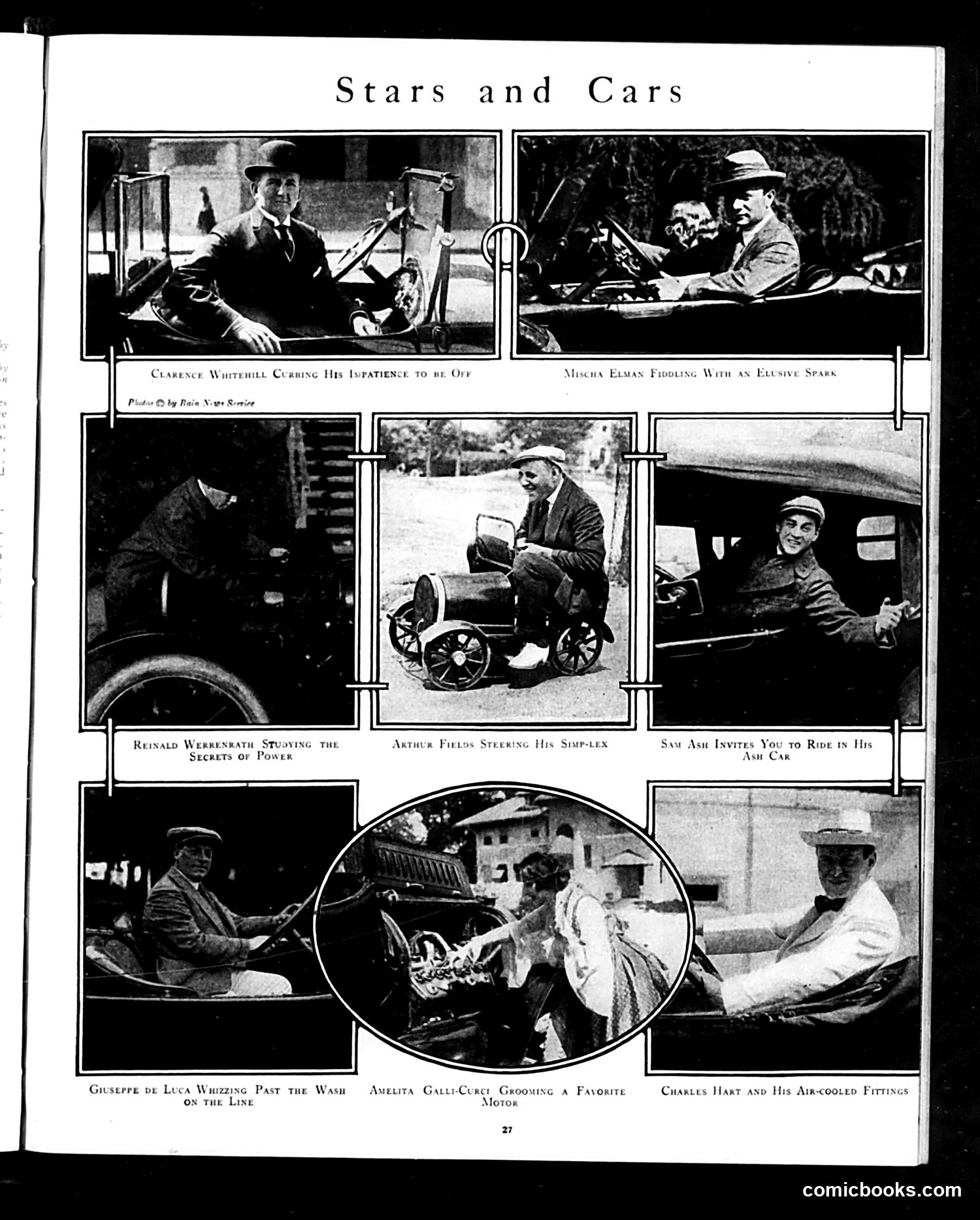
This page showcases early Hollywood celebrities posing with automobiles, a common Judge feature celebrating the intersection of celebrity culture and consumer goods. The captions identify silent-film stars including Clarence Whitehall, Mischa Elman, Reginald Werrenrath, Arthur Fields, Sam Ash, Giuseppe de Luca, Amelita Galli-Curci, and Charles Hart. The satire is gentle: these entertainment figures—musicians and actors—are humorously portrayed as automotive enthusiasts and mechanics, "studying" engines or proudly displaying their vehicles. The implicit joke targets both celebrity vanity and the emerging automobile culture of the 1920s. By placing highbrow performers (opera singers, classical musicians) in positions of automotive enthusiasm or mechanical tinkering, Judge mocks the era's fascination with cars as status symbols among the wealthy and famous. The page essentially ridicules the celebrity endorsement phenomenon itself—treating serious artists as mere shills for consumer products.
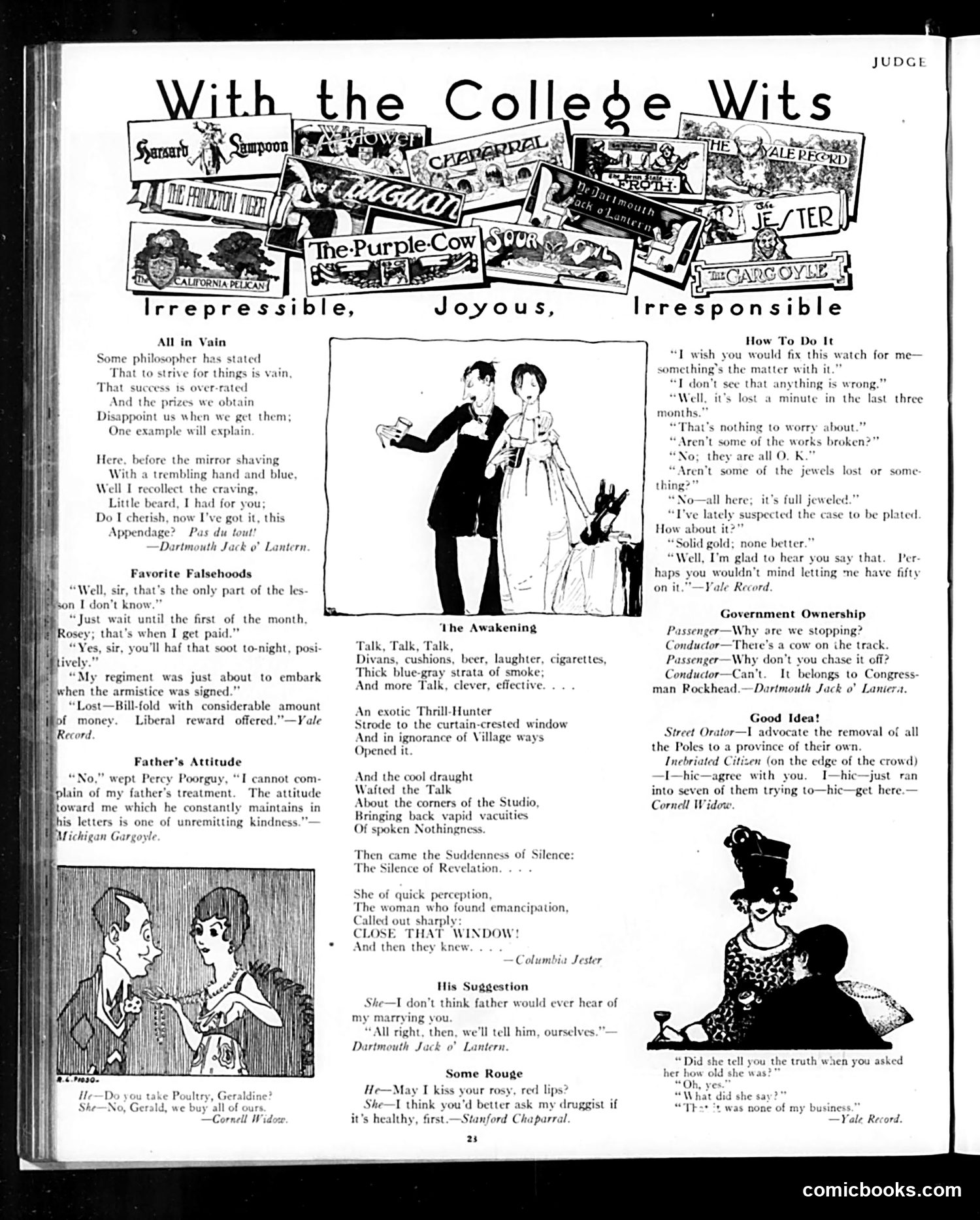
This page collects humorous anecdotes and light verse from various college humor magazines (Yale Record, Dartmouth Jack o' Lantern, Columbia Jester, Stanford Chaparral, Cornell Widow). The content reflects early 20th-century collegiate comedy rather than political satire. The humor targets universal student experiences: romantic rejection ("Father would never hear of marrying you"), broken promises about payday, false wartime stories, and petty dishonesty. "Some Rouge" mocks a woman who applies makeup (implying it's artificial or potentially unhealthy). "Government Ownership" makes a light jab at Congressional favoritism—Congressman Rockhead's cow blocks a train, untouchable because politicians protect their constituents' interests. The watch repair joke satirizes customer paranoia about minor flaws. The street orator piece uses casual ethnic humor typical of the era, with a drunk man agreeing to removing "Poles" (likely Polish immigrants), misunderstanding as a literal joke. Overall, this is collegiate humor: irresponsible, irreverent, and focused on youth culture rather than serious political commentary.

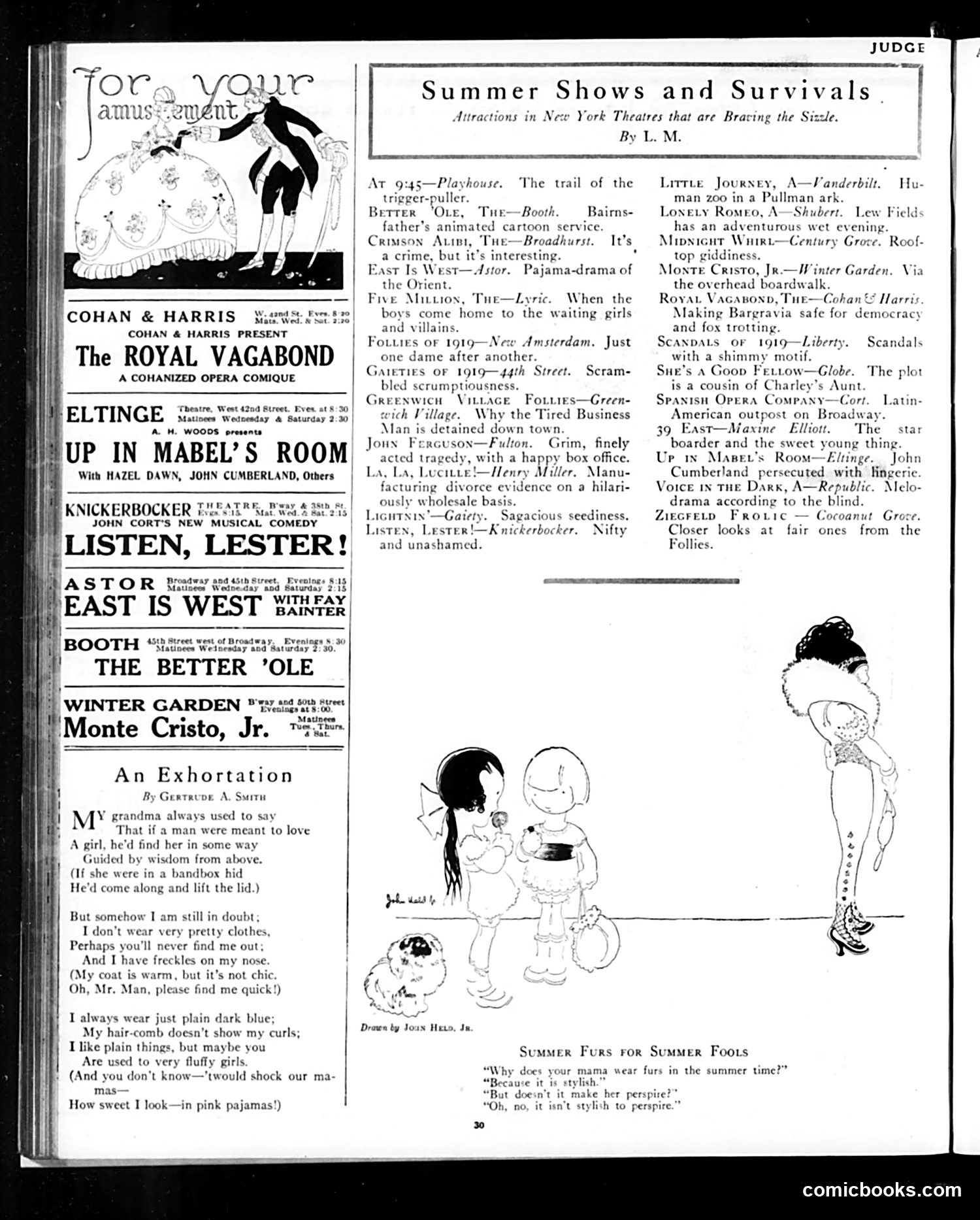
This page is primarily **theatrical advertising and reviews** for 1919 New York Broadway shows, with minimal political content. The main cartoon (bottom right, by John Held Jr.) depicts **summer fashion absurdity**: wealthy women wearing fur coats in hot weather. The joke satirizes upper-class vanity—the women prioritize appearing stylish over comfort, and perspiring publicly is considered "unstylish." This mocks the artificiality and impracticality of high society fashion conventions. The poem "An Exhortation" (left side) is a humorous female monologue about romance and plainness—a girl describing her unfashionable appearance while hoping a man will find her attractive anyway. It's gentle social satire about class consciousness and beauty standards of the era. The theatrical listings are mostly light comedies and musicals with titles referencing post-WWI themes ("Better 'Ole," "Scandals of 1919") and popular entertainments (Follies, romance plots). No significant political commentary is evident on this page.
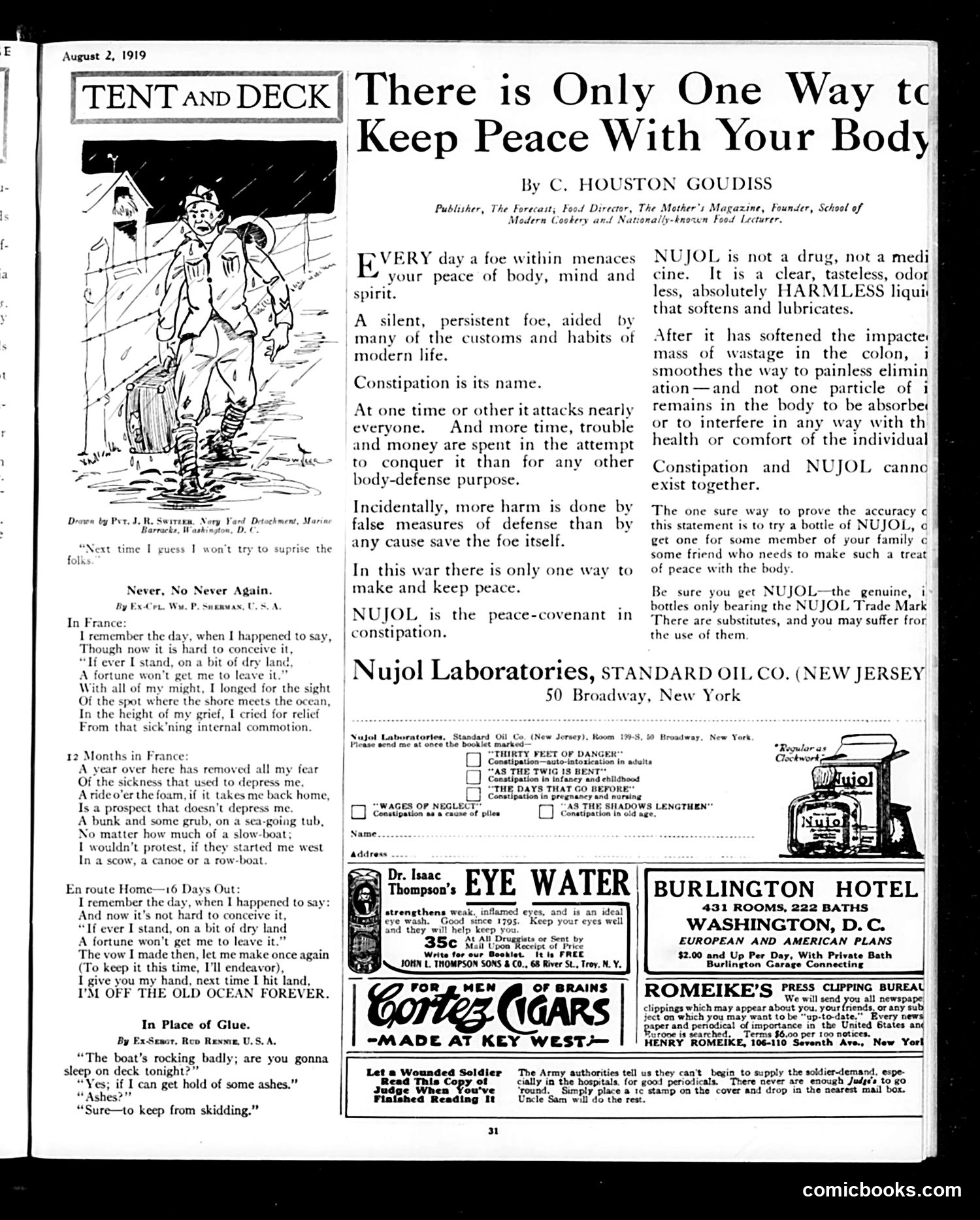
This August 1919 *Judge* page features soldier humor and advertising aimed at post-WWI servicemen. ## The Cartoons The "Tent and Deck" section contains brief comedic pieces by soldiers recounting their war experiences. The main cartoon depicts a soldier struggling aboard ship, captioned "Next time I guess I won't try to surprise the folks." The accompanying poems humorously contrast soldiers' initial homesickness in France with their later reluctance to leave after sixteen days at sea returning home—a reversal of expectations that plays on the disorientation of repatriation. A separate joke about "ashes" to prevent "skidding" on a rocking ship deck is simple physical comedy. ## The Advertising The dominant content is a full-page Nujol advertisement addressing constipation as "a silent, persistent foe," typical of 1919 patent medicine marketing. The ad also includes period remedies for eye water and cigar advertisements, reflecting typical magazine content of this era. The page primarily serves post-war soldiers returning to civilian life.
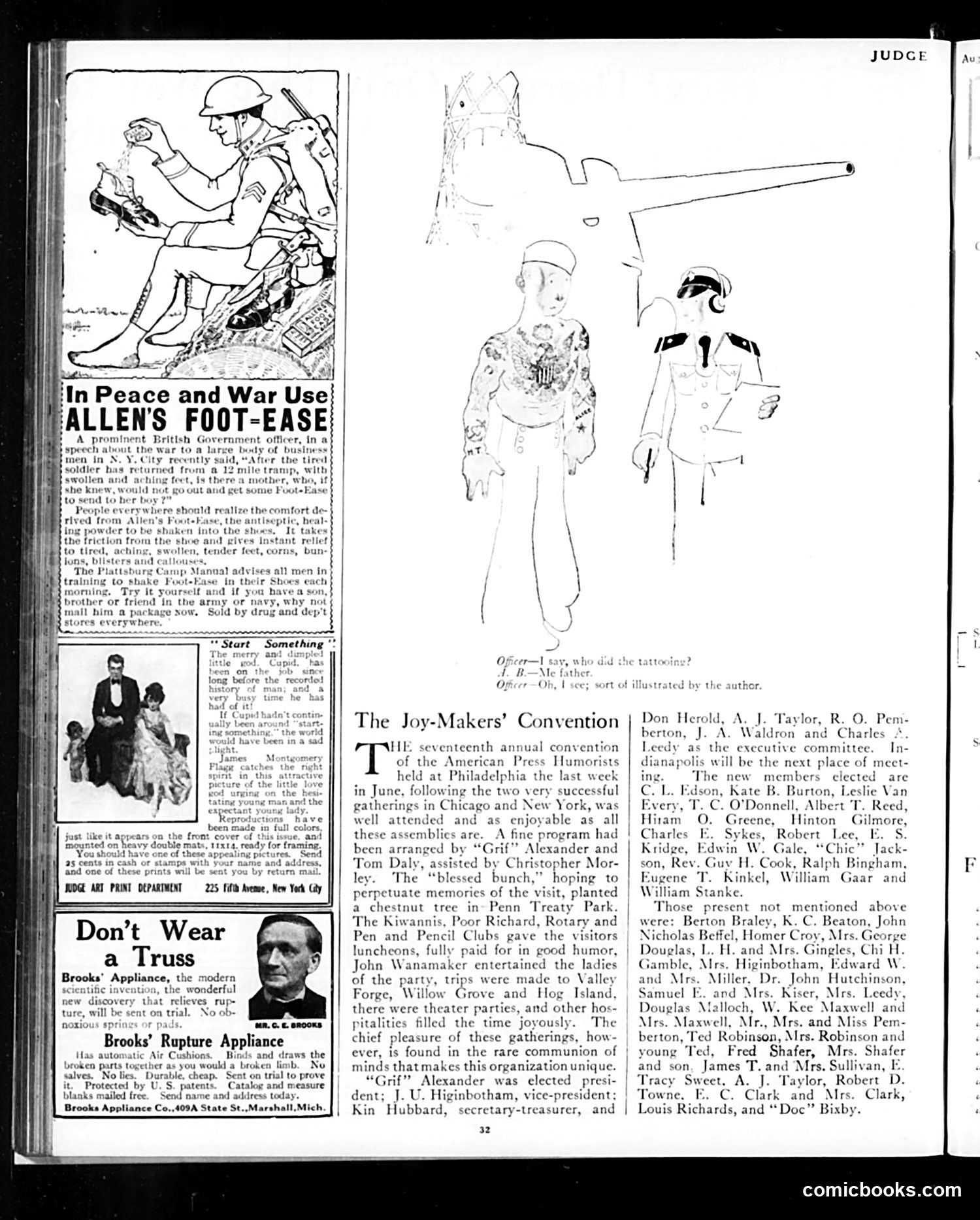
This page is primarily **advertising and convention reporting**, with minimal editorial cartooning. The advertisements promote consumer products (Allen's Foot-Ease, Brooks' Rupture Appliance) using appeals to soldiers and working men—reflecting post-WWI concerns about comfort and health. The main editorial content describes the **seventeenth annual convention of the American Press Humorists** held in Philadelphia in June. It celebrates a gathering of cartoonists, joke writers, and humor journalists—the magazine's own professional community. The piece is largely a society-style announcement listing attendees and activities (tree-planting at Penn Treaty Park, luncheons from civic clubs, trips to local attractions). The small cartoon near the top appears to show **military officers in conversation**, with one asking "who did the tattooing?"—a mild joke about military culture, likely unrelated to the main convention piece. This is essentially a **trade publication covering its industry's social event**, functioning as professional networking publicity rather than satirical commentary.
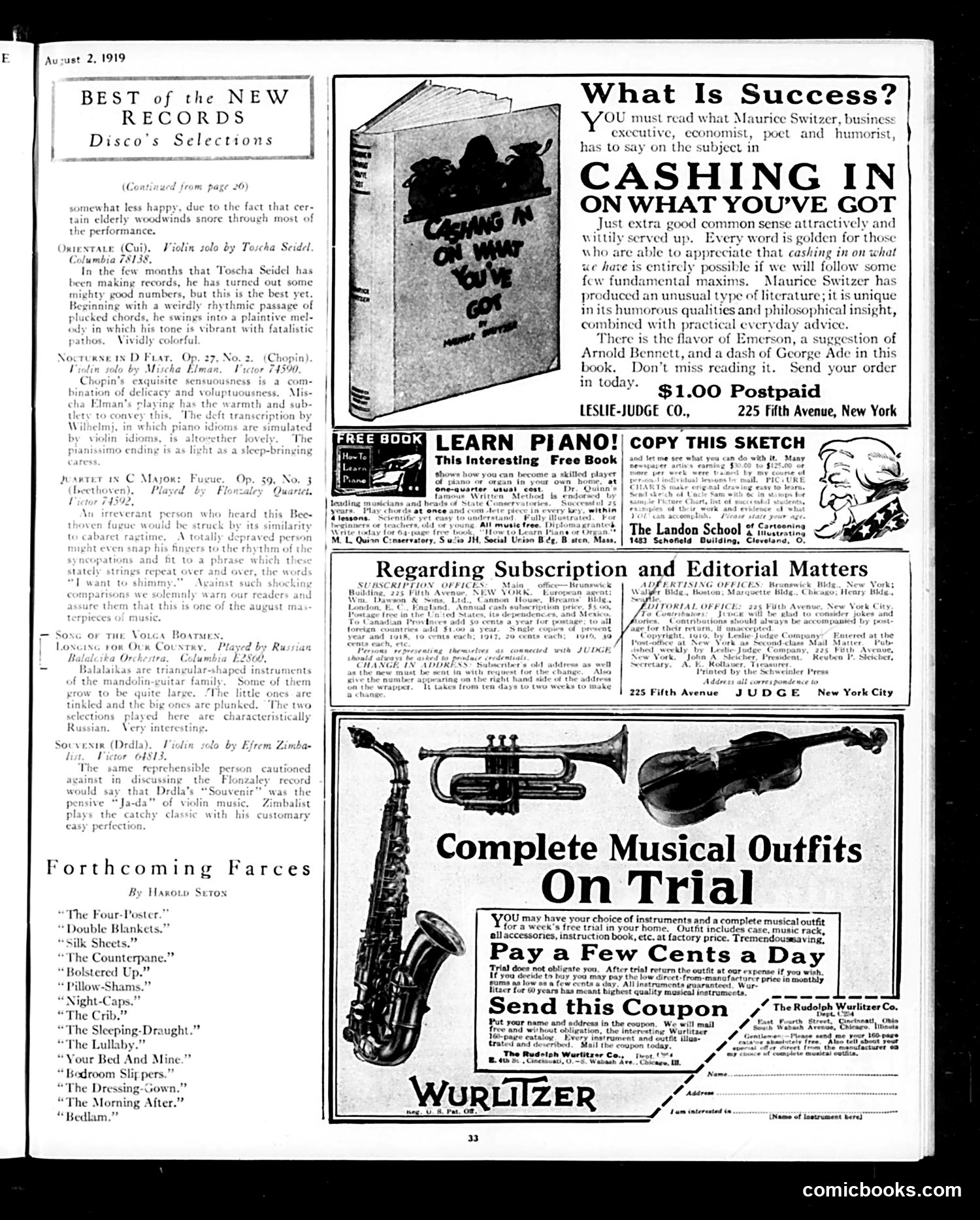
This is primarily an **advertising and editorial page** with minimal cartoon content. The page includes: **Main Advertisement**: Maurice Switzer's book "Cashing In On What You've Got"—a self-help title promising practical business advice wrapped in humor and philosophy. The ad compares Switzer to Emerson and George Ade, positioning the book as motivational literature for the post-WWI business class. **Other Advertisements**: Musical instrument trial offers and piano instruction books—reflecting 1919's commercial push toward home entertainment and self-improvement. **"Forthcoming Farces" Section**: Lists theatrical productions with domestic-themed titles ("Double Blankets," "Silk Sheets," "Pillow-Shams")—likely bedroom farces, a popular vaudeville/stage comedy genre of the era. **Editorial/Subscription Information**: Standard magazine masthead material. The page lacks significant political satire or cartoon commentary—it's a typical revenue-driven magazine interior mixing advertising with minimal editorial content, representative of early 20th-century American periodicals.
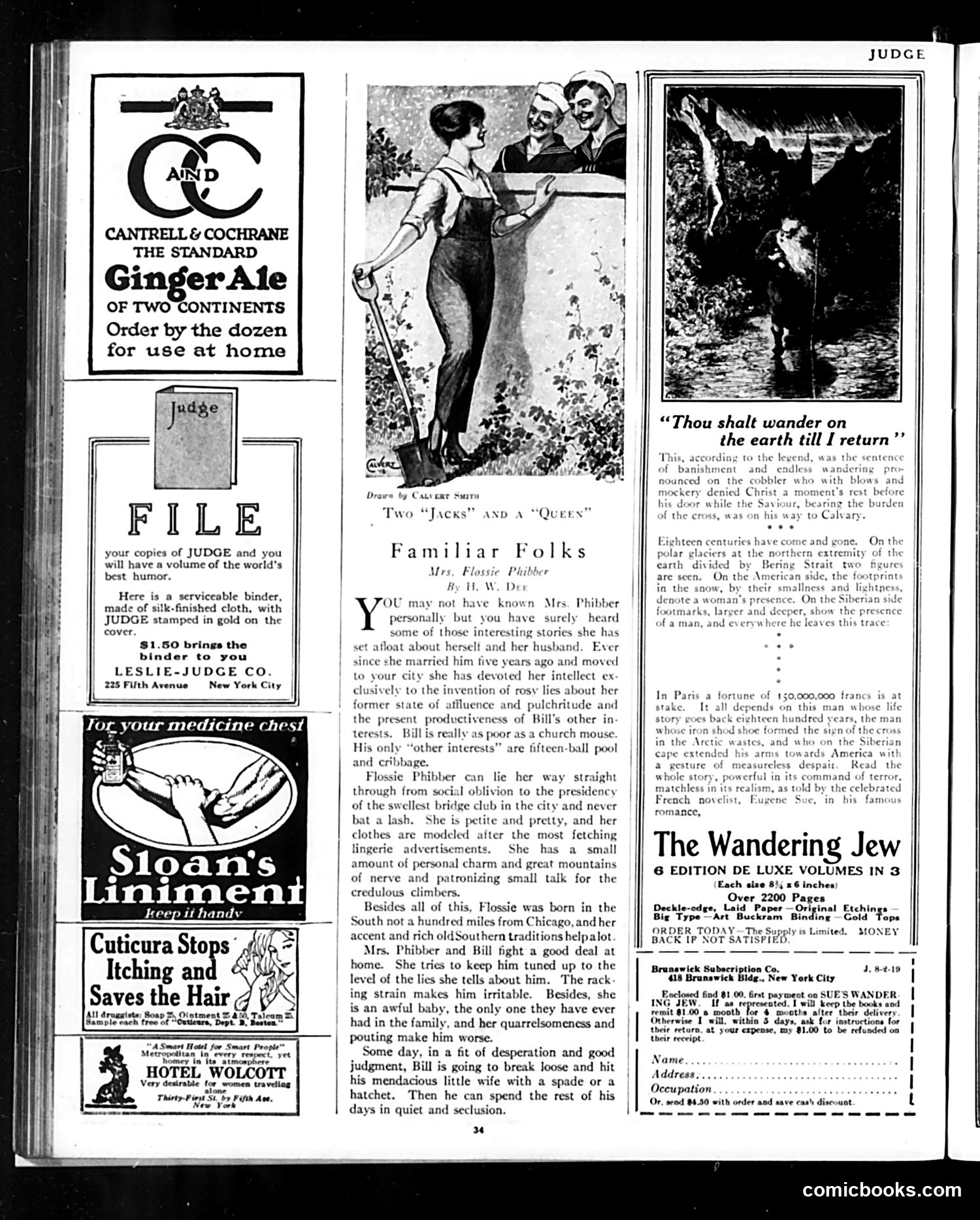
This page is primarily **advertising and a serialized humor column** rather than political satire. The main content is "Familiar Folks," a character sketch by H.W. Dee describing **Mrs. Flossie Phibber**—a social climber and compulsive liar who invents an affluent past and exaggerates her husband Bill's success. The satire targets **turn-of-century social pretension**: Flossie fabricates her way into prestigious bridge clubs despite being genuinely poor, her husband being broke (his "interests" are only pool and cribbage), and their marriage being contentious. The dark humor culminates in predicting Bill will eventually hit her with a spade or hatchet out of desperation. Surrounding the column are product advertisements (Ginger Ale, Sloan's Liniment, Cuticura, Hotel Wolcott) and a Judge magazine binder offer. A small illustration captioned "Two 'Jacks' and a 'Queen'" accompanies the text—likely a visual pun on playing cards related to the narrative.
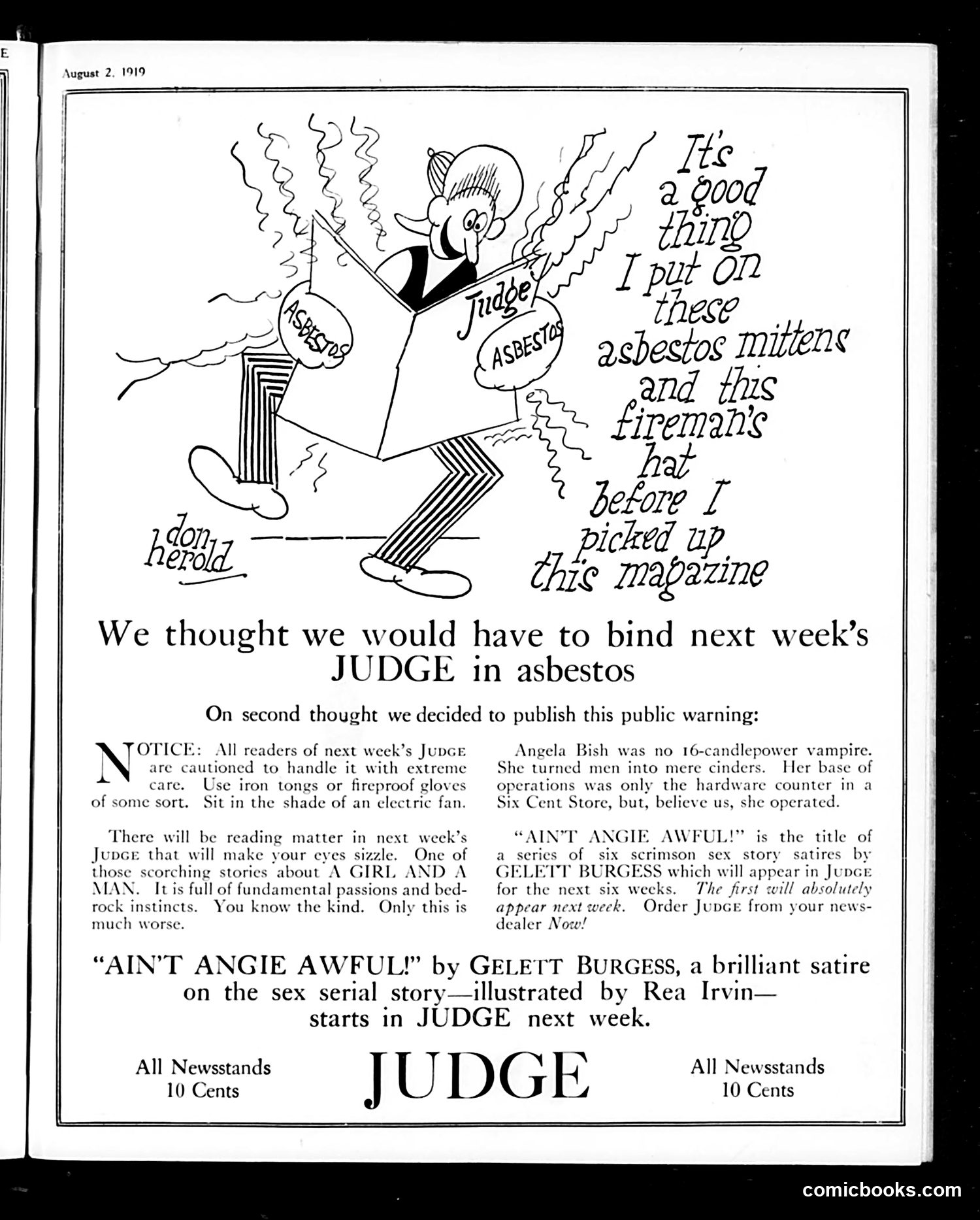
This is a self-promotional advertisement for *Judge* magazine's upcoming serialized story. The cartoon depicts a figure (representing next week's issue) overheating dramatically, surrounded by lightning bolts and labeled "asbestos"—a humorous exaggeration suggesting the content will be dangerously "hot" or scandalous. The satire targets pulp sex-serial stories, which were popular and sensationalistic magazine features of the era. *Judge* is mocking this genre by advertising "Ain't Angie Awful!" by Gelett Burgess as an intentional parody—a satirical take on overwrought tales of seductive women corrupting men through "fundamental passions and bed-rock instincts." The joke is that *Judge* claims the issue itself needs fireproof handling, warning readers to use "iron tongs" and sit "in the shade of an electric fan." This playful hyperbole announces Burgess's satirical six-part series while poking fun at the very genre it parodies. The advertisement costs 10 cents and appears dated August 2, 1919.
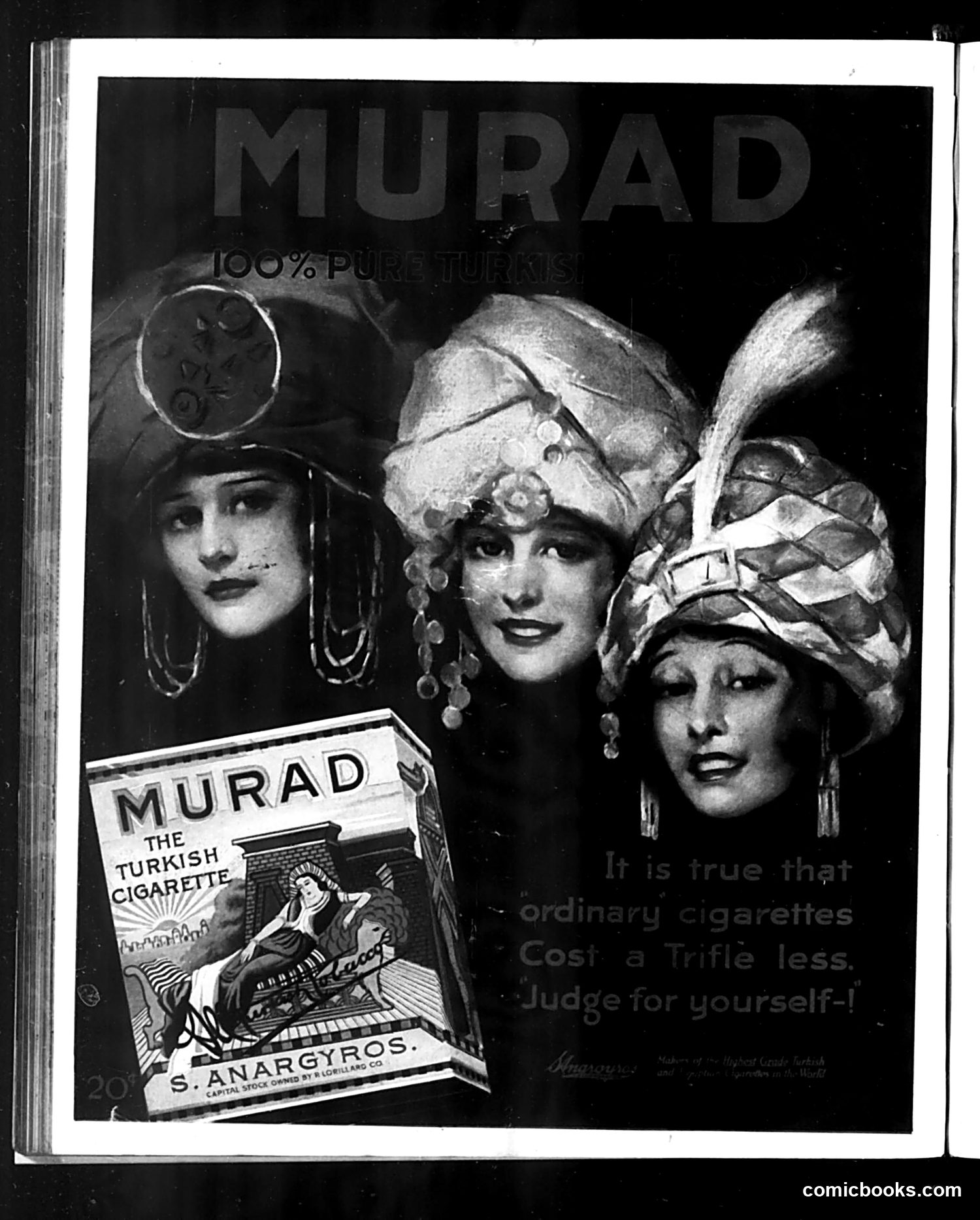
This is a vintage cigarette advertisement, not political satire. It features three women in exotic, orientalist costume (turbans, jewelry, theatrical makeup) promoting "MURAD — 100% PURE TURKISH" cigarettes by S. Anargyros. The tagline reads: "It is true that ordinary cigarettes cost a trifle less. Judge for yourself!" The ad uses the common early-20th-century marketing tactic of exotic "Turkish" imagery to sell cigarettes, appealing to consumer desires for luxury and worldliness. The women's costumes evoke orientalist fantasy rather than authentic Turkish dress. This reflects period attitudes toward non-Western cultures as exotic marketing tools, alongside competitive pricing claims typical of the era's aggressive cigarette advertising.