
Judge, 1919-08-02 · page 24 of 36
Judge — August 2, 1919 — page 24: what you’re looking at
What you’re looking at
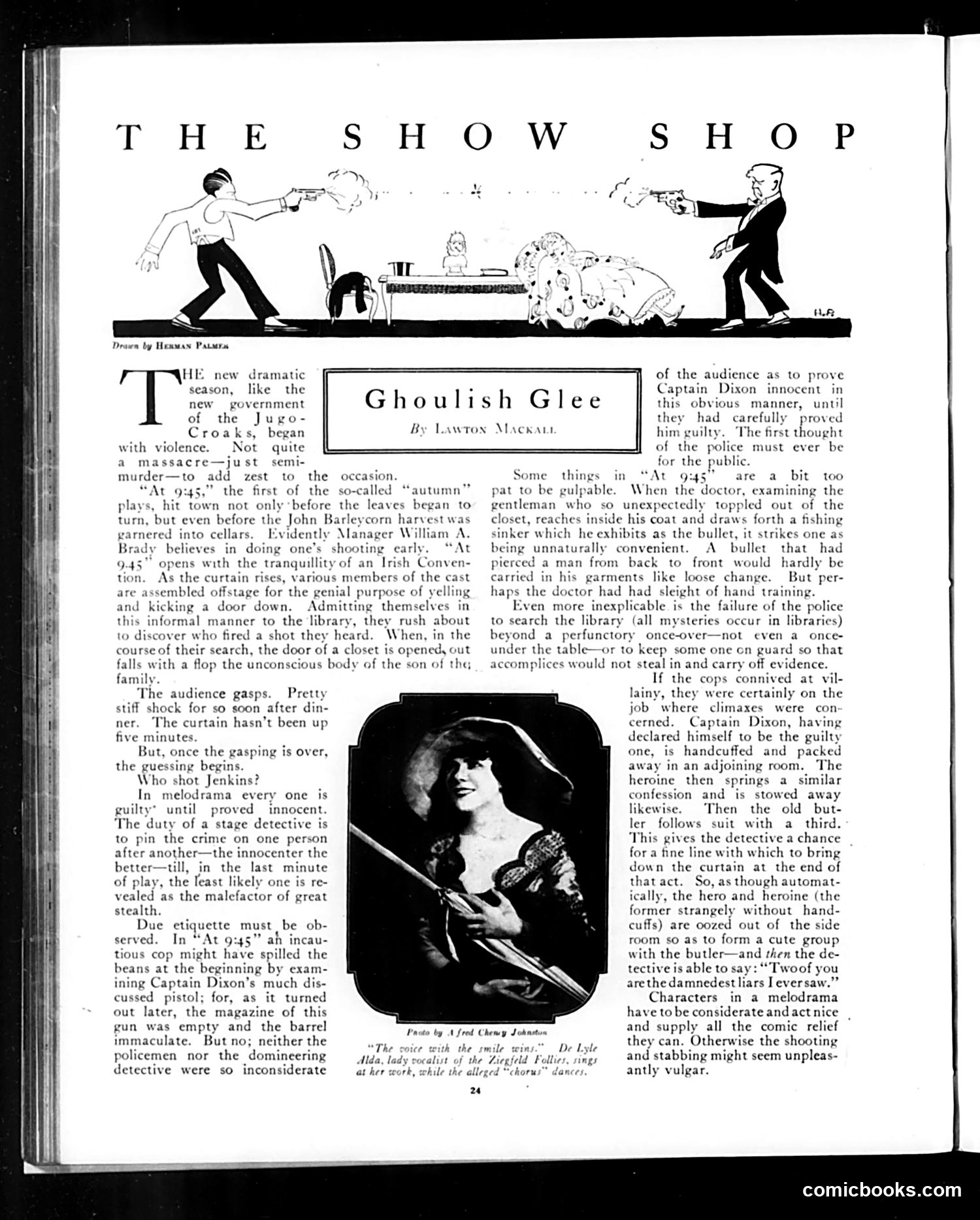
This is a theater review of a melodrama called "At 9:45," critiquing its implausible plot mechanics. The cartoon at top shows two figures firing pistols at each other across a stage set—a visual joke about the play's violent theatricality. The reviewer mocks the genre's conventions: characters are "guilty until proved innocent," detectives unnecessarily delay solving crimes for dramatic effect, and coincidences strain credibility (a bullet replaced by a fishing sinker, the police failing to search properly). The author notes that melodrama characters must remain "considerate"—supplying comic relief and behaving nicely—or else the constant shooting and stabbing would seem "unpleasantly vulgar." The satire targets not the play's violence itself, but rather its *illogical* plotting and the artificial constraints genre conventions impose on storytelling. The "Jugo-Croaks" reference (Yugoslavia's political turmoil) compares the play's chaotic structure to real-world disorder.
📄 Transcribed text from this page (OCR, searchable)
Machine-transcribed from the original scan — historical spelling and the odd misread are preserved.
Drawn by Hexwas Patacrs HE new dramatic season, like the new government of the Jugo- Croaks, began Ghoulish Glee By Lawton Mackau of the audience as to prove Captain Dixon innocent in this obvious manner, until they had carefully proved him guilty. The first thought of the police must ever be with violence. Not quite a massacre—just semi- murder—to add zest to the occasion. At 9:45," the first of the so-called “autumn” plays, hit town not only “before the leaves began to turn, but even before the John Barleycorn harvest was garnered into cellars. Evidently Manager William A. Brs believes in doing one’s shoot early. “At 9.45" opens with the tranquillity of an Irish Conven- tion. As the curtain rises, various members of the cast are assembled offstage for the genial purpose of yelling and kicking a door down. Admitting themselves in this informal manner to the library, they rush about to discover who fired a shot they heard. When, in the course of their search, the door of a closet is opened, out falls with a flop the unconscious body of the son of family. The audience gasps. Pretty stiff shock for so soon after din- ner. The curtain hasn’t been up five minutes. But, once the gasping is over, the guessing begins. Who shot Jenkins? In melodrama every one is guilty’ until proved innocent The duty of a stage detective is to pin the crime on one person after another—the innocenter the better—till, in the last minute of play, the least likely one is re- vealed as the malefactor of great stealth. Due etiquette must, be ob- served. In “At 9:45” ah incau- tious cop might have spilled the beans at the beginning by exam- ining Captain Dixon’s much dis- cussed pistol; for, as it turned out later, the magazine of this gun was empty and the barrel immaculate. But no; neither the policemen nor the domineering detective were so inconsiderate for the public. things in “At 9:45 are a bit too pat to be gulpable. When the doctor, examining the gentleman who so unexpectedly toppled out of the closet, reaches inside his coat and draws forth a fishing sinker which he exhibits as the bullet, it strikes one as bei unnaturally convenient. A bullet that had pierced a man from back to front would hardly be carried in his garments like loose change. But per- haps the doctor had had sleight of hand training. Even more inexplicable is the failure of the police to search the library (all mysteries occur in libraries) beyond a perfunctory once-over—not even a once- under the table—or to keep some one cn guard so that accomplices would not steal in and carry off evidence. If the cops connived at vi lainy, they were certainly on the job where climaxes were con cerned. Captain Dixon, having declared himself to be the guilty one, is handcuffed and packed away in an adjoining room. The heroine then springs a similar confession and is stowed away likewise. Then the old but- ler follows suit with a third. This gives the detective a chance fora fine line with which to bring down the curtain at the end of thatact. So, as though automat- ically, the hero and heroine (the former strangely without hand- cuffs) are oozed out of the side room so as to form a cute group with the butler—and then the de- tective is able to say: “ Twoof you arethedamnedestliars I eversaw.”” Characters in a melodrama have to be considerate and act nice and supply all the comic relief De byl they can. Otherwise the shooting Follies, and stabbing might seem unpleas- * dance antly vulgar. Some comicbooks.com