
A complete issue · 36 pages · 1919
Judge — July 26, 1919
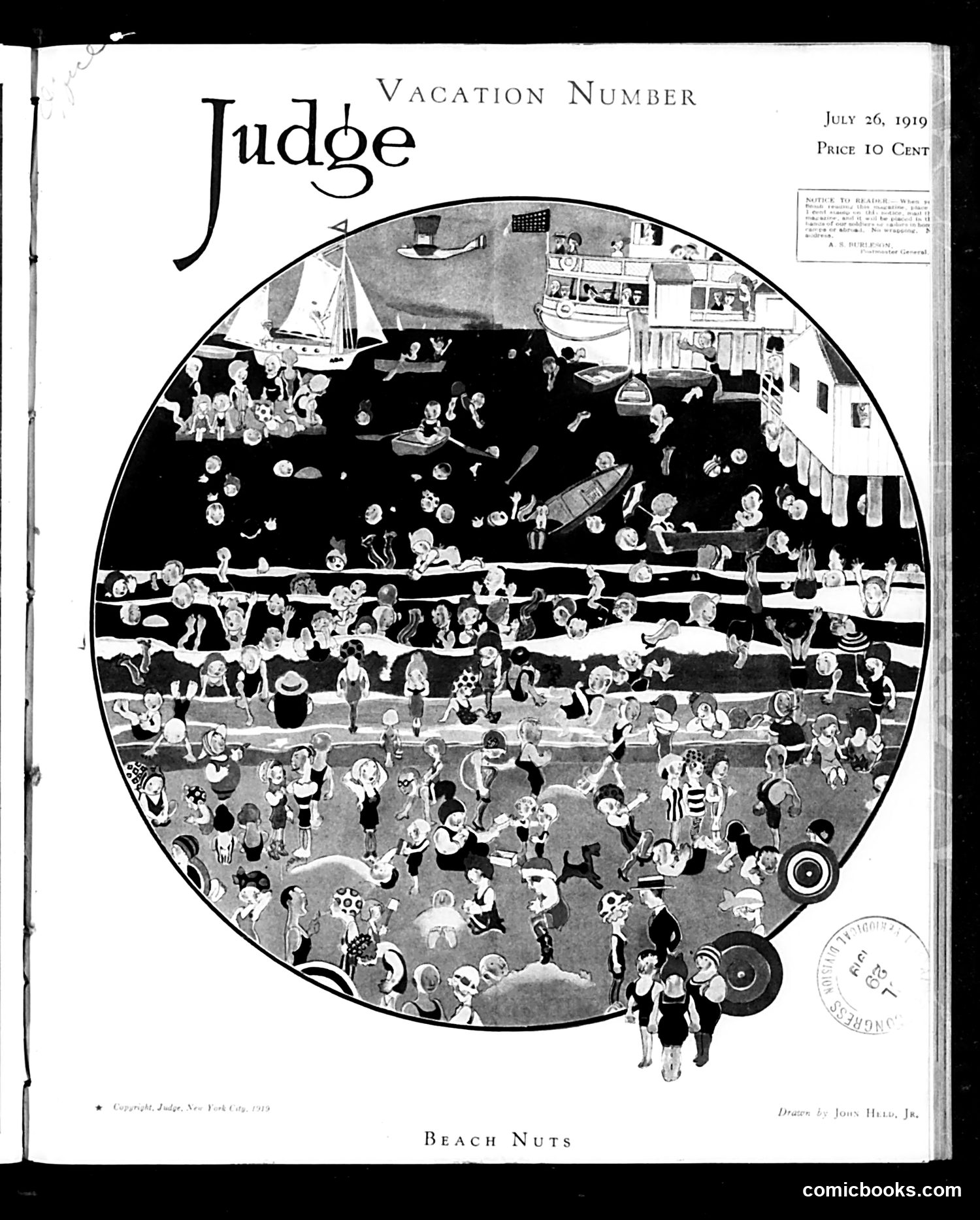
This is a humorous illustration titled "Beach Nuts" depicting a crowded beach scene during the 1919 summer vacation season. The circular composition shows hundreds of beachgoers engaged in typical leisure activities—swimming, sunbathing, playing games, and socializing. The satire appears to mock the chaotic masses descending on beaches for summer vacation, particularly the post-World War I leisure boom. The packed, almost overwhelming density of figures satirizes the popularity of beach culture and modern vacation trends among Americans. The title "Beach Nuts" suggests these vacationers are obsessed or frenzied about beach recreation. There's no obvious political messaging visible; rather, this is social satire about American recreational culture and mass tourism behavior.
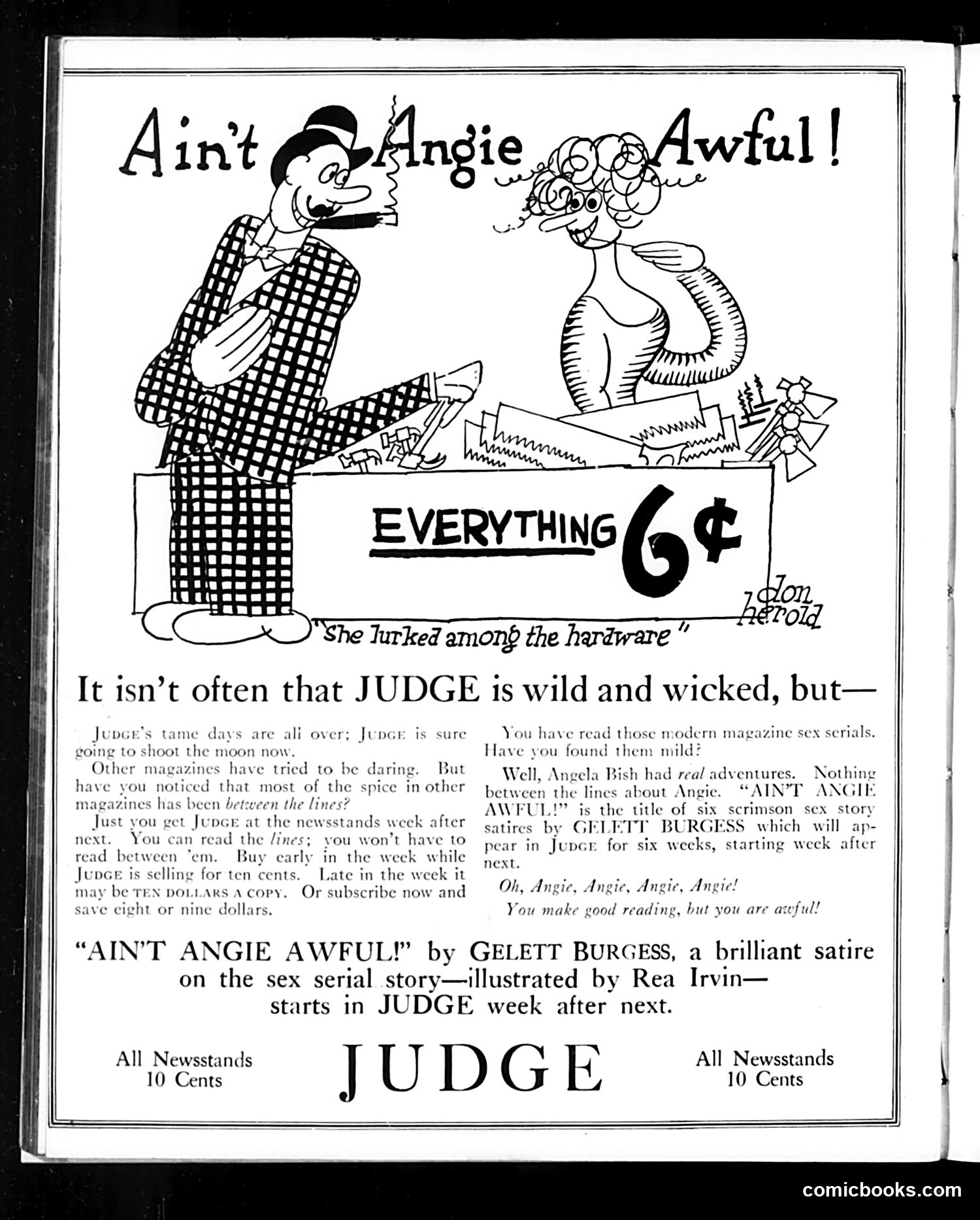
This is primarily an **advertisement for Judge magazine** rather than a political cartoon. The page promotes an upcoming serialized story titled "Ain't Angie Awful!" by Gelett Burgess, illustrated by Rea Irvin. The cartoon depicts a man in a checkered suit at a hardware store counter with a woman, captioned "She lurked among the hardware." The ad positions this as satirical commentary on sex serials—a popular but controversial magazine genre of the era. Judge advertises itself as offering daring content ("six scrimmon sex story satires") while maintaining respectability, priced at 10 cents. The humor targets both the proliferation of sex serials in competing magazines and readers' appetite for such material. No specific political figures are referenced; this reflects early 20th-century anxieties about literary morality and consumer culture.
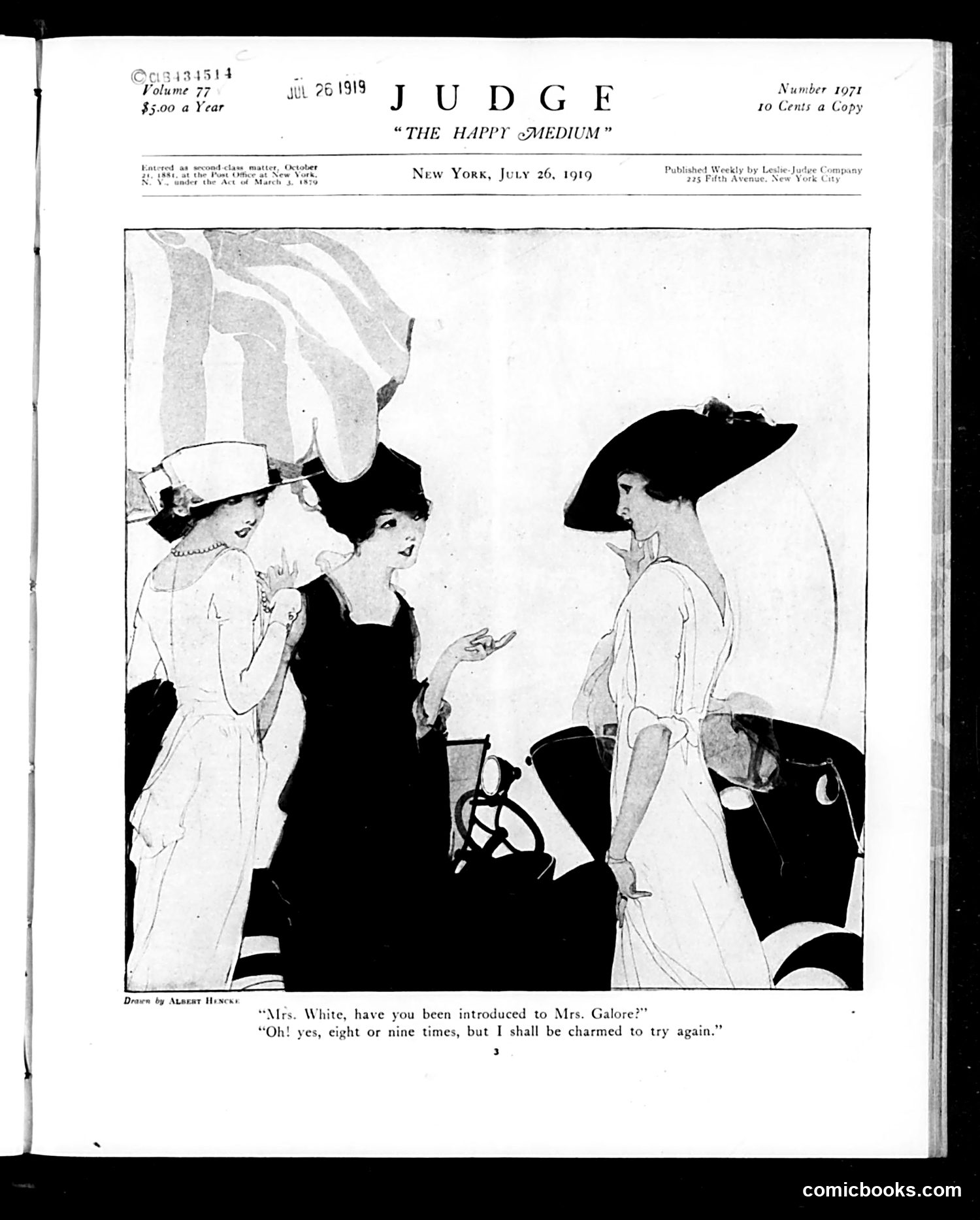
This single-panel cartoon depicts three fashionably dressed women at what appears to be a social gathering. The humor centers on a failed introduction: one woman asks if another ("Mrs. White") has met "Mrs. Galore," to which Mrs. White replies she's been introduced eight or nine times but will try again. The joke satirizes the social awkwardness of repeated introductions—likely poking fun at either high-society etiquette or the difficulty of remembering acquaintances at social events. The illustration, drawn by Albert Hirschfeld (a renowned caricaturist), captures the fashions of 1919, including period hats and clothing. The comic targets the pretension or forgetfulness of the social elite, a common Judge magazine theme.
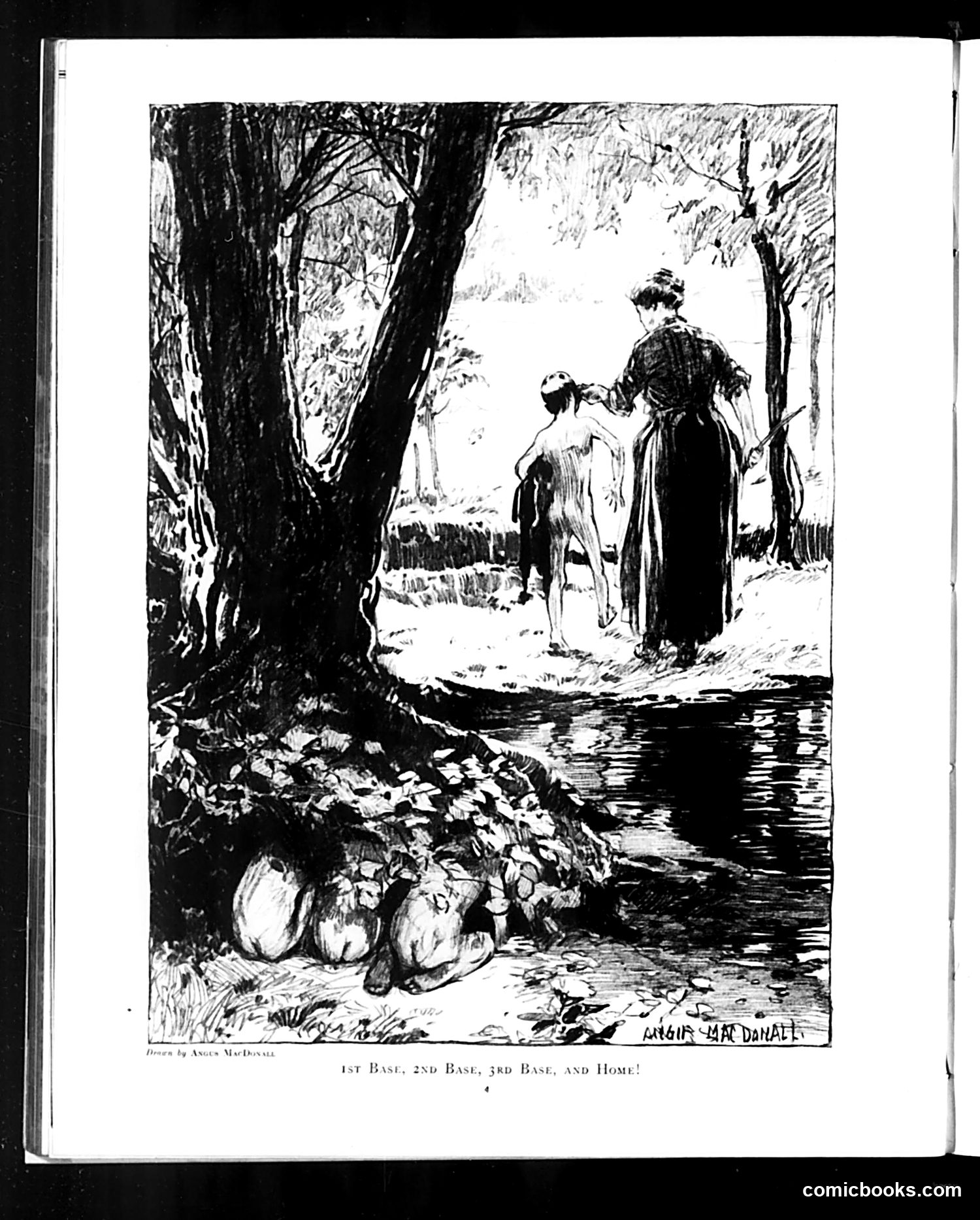
This illustration by Angus MacDonald (signed "MacDill") depicts a domestic scene titled "1st Base, 2nd Base, 3rd Base, and Home!" The cartoon uses baseball terminology as a metaphor for courtship progression. An adult woman and young girl stand by a tree beside a stream, watching a boy approach. The joke plays on the baseball bases as euphemisms for stages of romantic or physical intimacy—a common satirical device in early 20th-century American humor. The artwork's detailed naturalistic style contrasts with its cheeky subject matter, typical of *Judge* magazine's sophisticated approach to social commentary. The satire gently mocks contemporary courtship rituals and the anxieties surrounding young romance during this era.
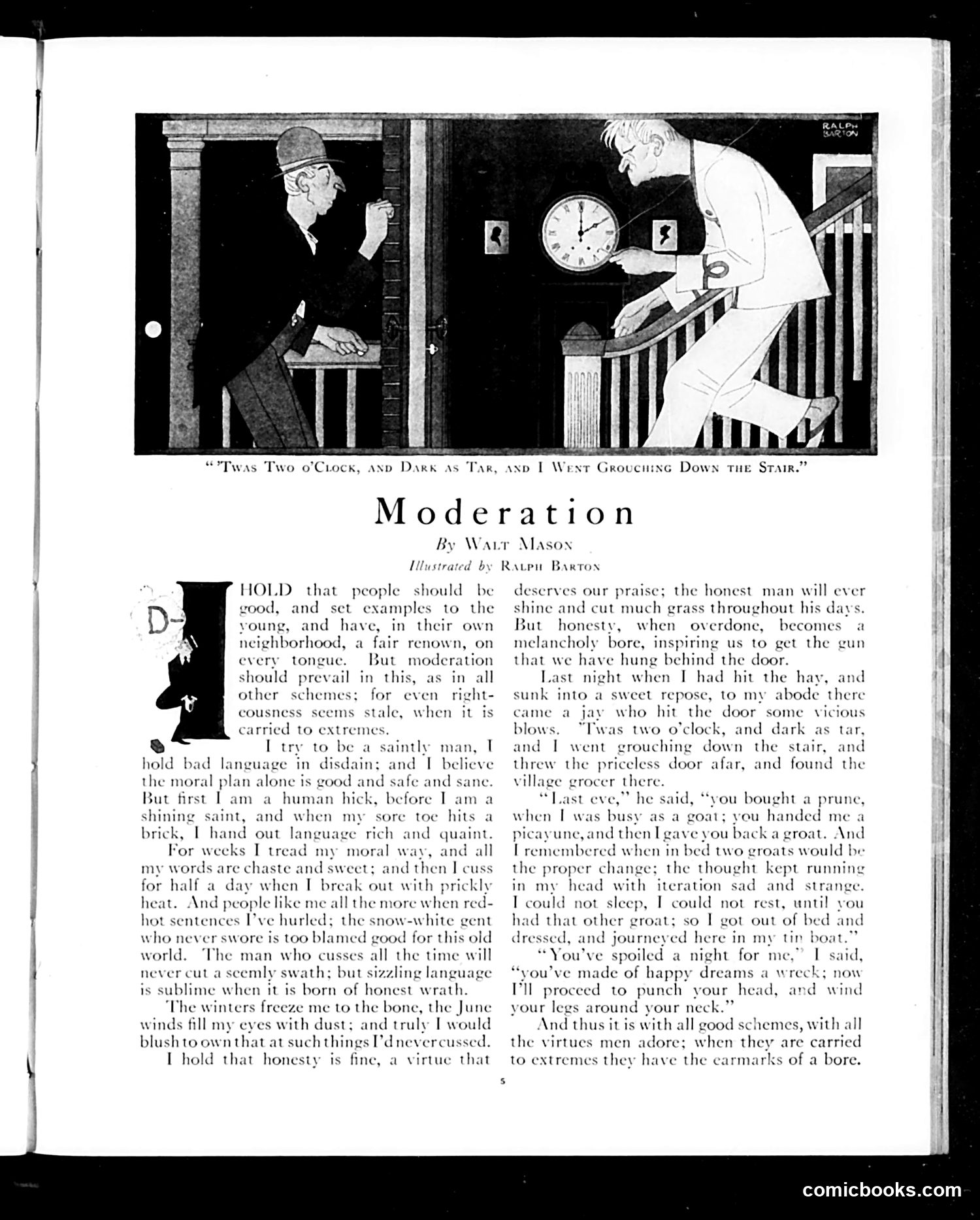
This story-illustration satirizes excessive virtue—specifically when moral righteousness becomes tedious and self-righteous. The narrative describes a man so committed to honesty and propriety that he becomes insufferable: he's endured mockery for being "saintly," has memorized moral platitudes, and constantly lectures others with "chaste and sweet" language. The cartoon's humor lies in the protagonist's complaint that even virtuous people like himself eventually break—he nearly punches someone over a dispute about goats. Mason's point: carried to extremes, even admirable qualities (honesty, moderation, propriety) become character flaws, making the virtuous person as unbearable as the vicious. The message criticizes performative morality and suggests balanced, realistic behavior surpasses extreme righteousness.
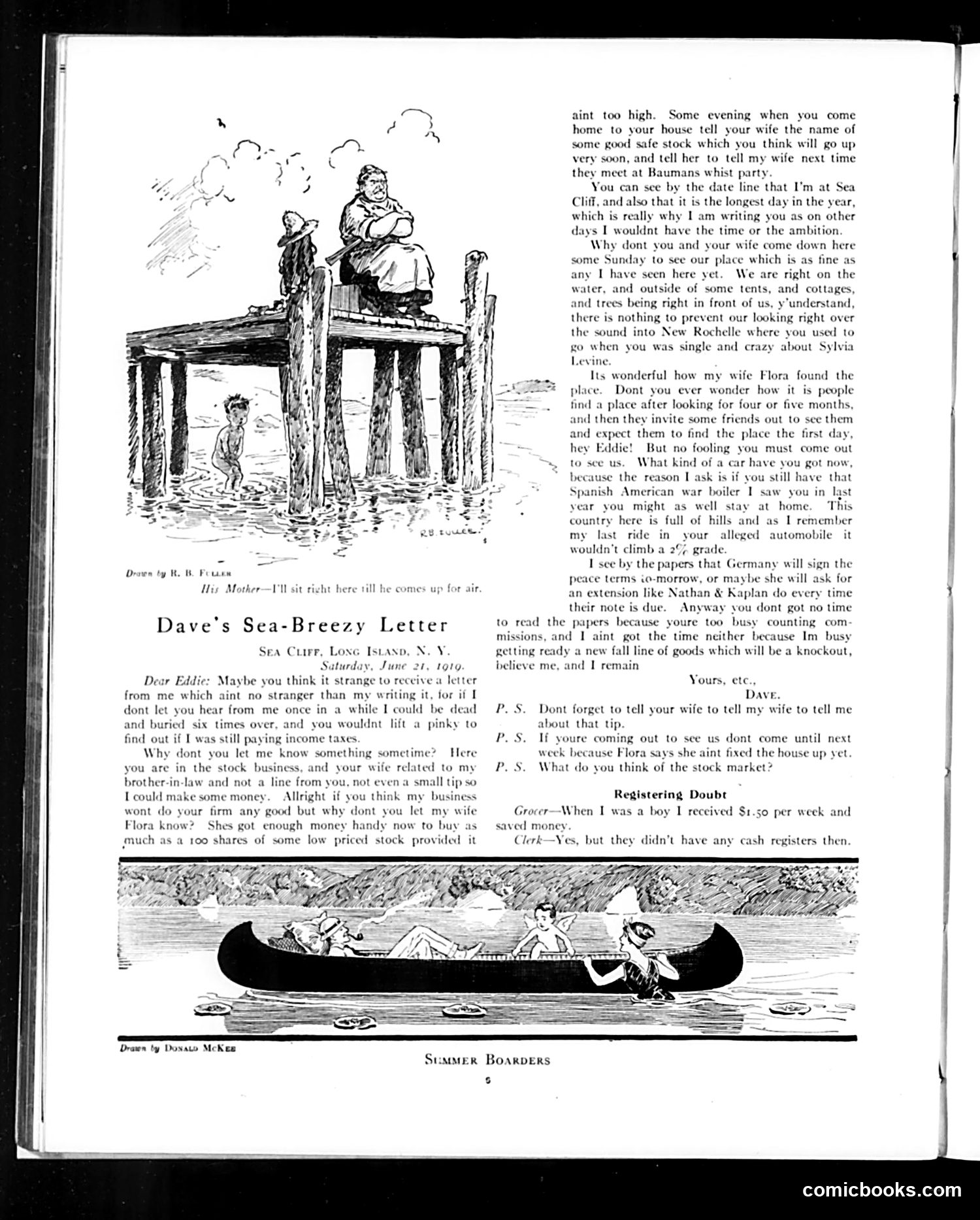
This page contains a humorous letter from a character named Dave at Sea Cliff, Long Island, describing his seaside property to the editor. The satire targets **post-World War I economic anxieties**: Dave boasts about his modest waterfront location while simultaneously mentioning stock tips, German peace terms, and a Spanish-American War boiler—mixing mundane vacation details with financial speculation and geopolitical concerns. The accompanying cartoons illustrate leisure activities (the top sketch shows people on a dock; the bottom depicts "Summer Boarders" in a canoe). The humor lies in Dave's contradictory advice—he brags about his property while asking about stock markets and war news, embodying the distracted, financially-anxious American of 1919 unable to simply enjoy a vacation.
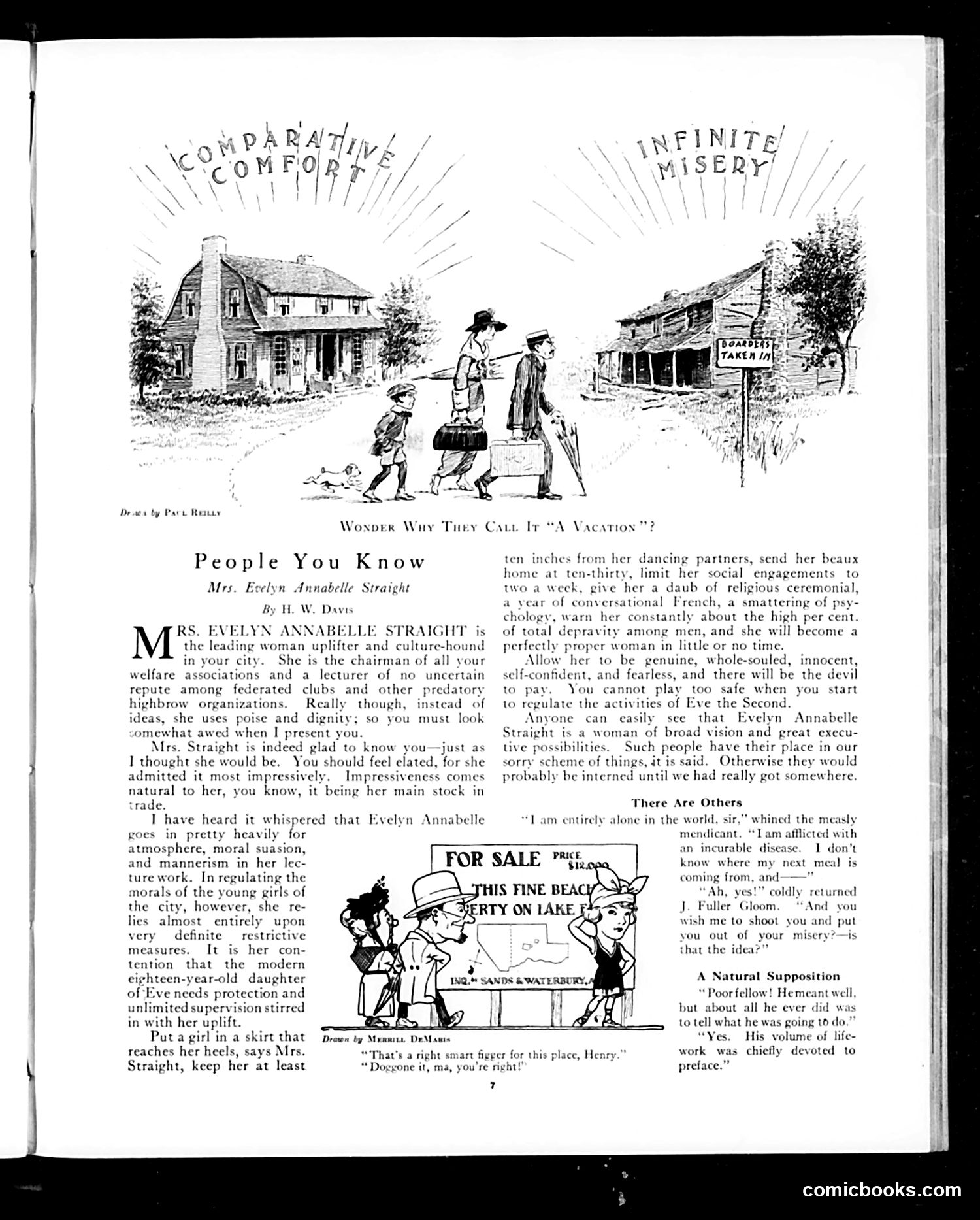
This page satirizes "Mrs. Evelyn Annabelle Straight," a stock character representing wealthy, self-righteous "culture-bound" women reformers of the early 20th century. The top cartoon contrasts her comfortable home with a run-down "boarding house," illustrating the hypocrisy: while she lectures about morality and "uplifting" young women, her actual advice is oppressively restrictive—hem skirts, limit dancing partners, enforce religious observance, suppress genuine self-expression. The satire mocks progressive-era reformism, suggesting these women wielded their "dignity" and moral authority to control others' lives rather than genuinely help. The phrase "Wonder Why They Call It 'A Vacation'?" implies that their restrictive "improvements" make life miserable. The side cartoons offer brief social humor about poverty and broken promises, padding the page alongside advertisements for beach property. Overall, Judge ridicules sanctimonious moral crusaders as counterproductive busybodies.
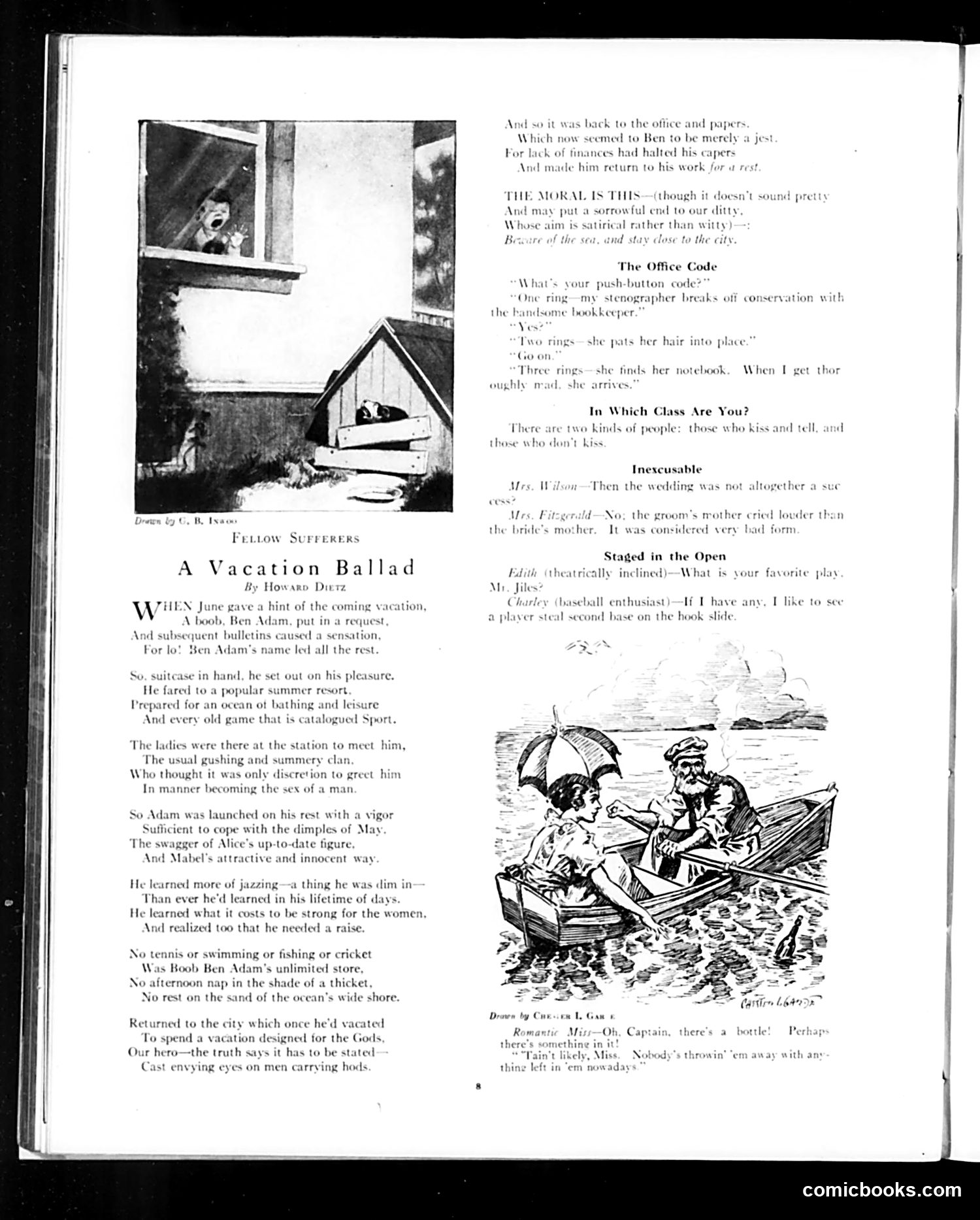
This page satirizes the working-class male's dilemma during the leisure age. The poem mocks "Boob Ben Adam," who takes a summer vacation but finds himself financially trapped—he must entertain the women at the resort (Alice and Mabel), learn to "jazz," and exhaust himself socially. The joke's punchline: he returns to the city envying manual laborers carrying hods (bricks), realizing he needs a raise just to afford leisure time. The satire targets early 20th-century gender dynamics and consumer culture. Working men were expected to perform masculinity through spending on entertainment and female companionship, yet their wages couldn't support this lifestyle. The moral warns staying close to the city is wiser than attempting costly vacations. The accompanying office humor sketches satirize workplace etiquette and gossip among clerical workers—stenographers, bookkeepers—reflecting the emerging white-collar office culture of the era.
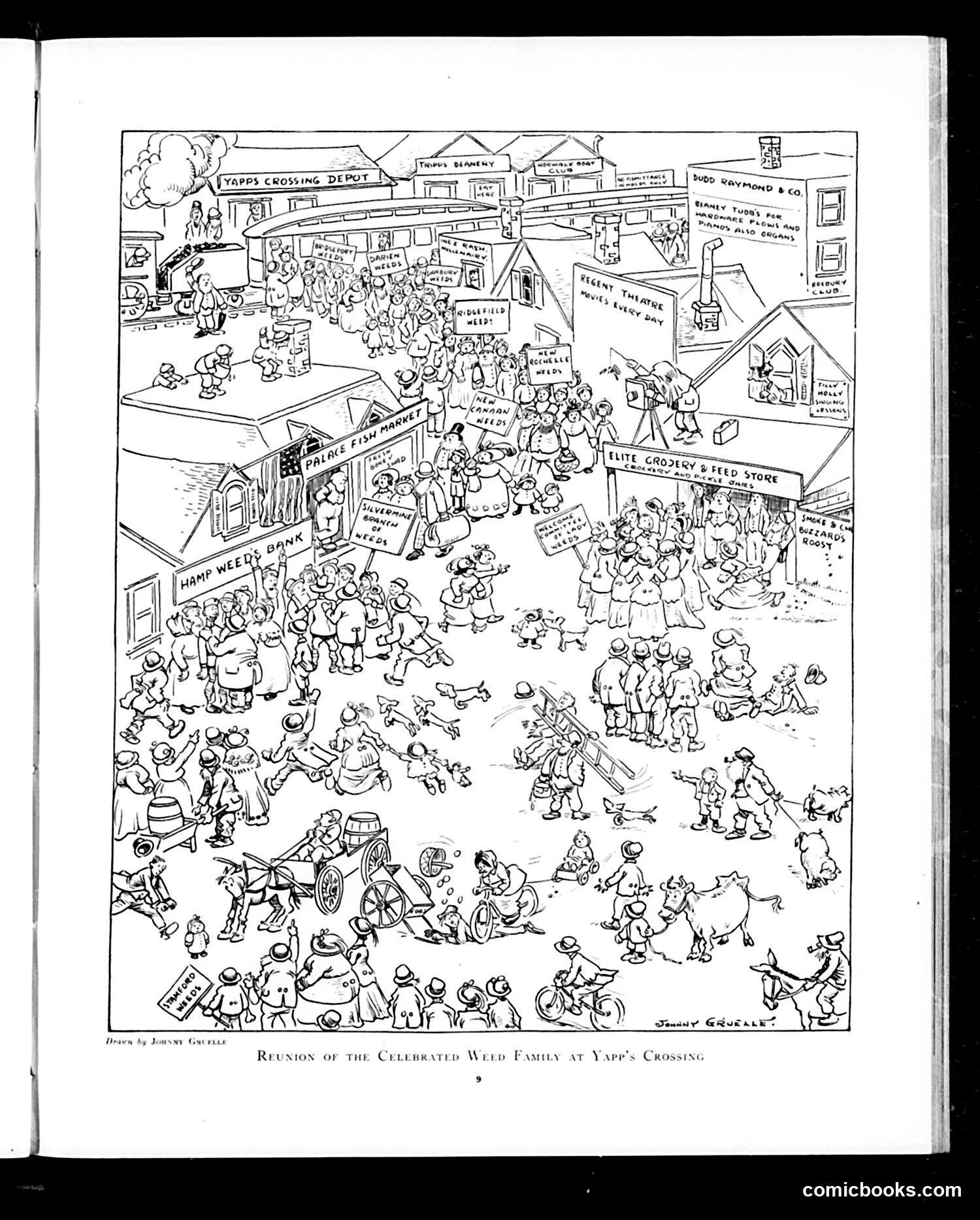
This is a humorous illustration titled "Reunion of the Celebrated Weed Family at Yapp's Crossing," drawn by Jimmy Gould. It depicts a crowded, chaotic gathering of numerous figures at a small-town location featuring various businesses (Yapp's Crossing Depot, Hamp Weeks Bank, Elite Grocery & Feed Store, etc.). The satire appears to target the "Weed family"—likely a reference to an undesirable or proliferating group. The joke plays on the double meaning: "weeds" as unwanted plants that spread rapidly, suggesting the family multiplies excessively. The crowded composition emphasizes this theme of overpopulation and disorder. The cartoon satirizes small-town life and family reunions, with the visual chaos suggesting that even a routine community gathering becomes overwhelming when involving such a large, unruly extended family. The style is typical of early-to-mid 20th-century Judge magazine satire.
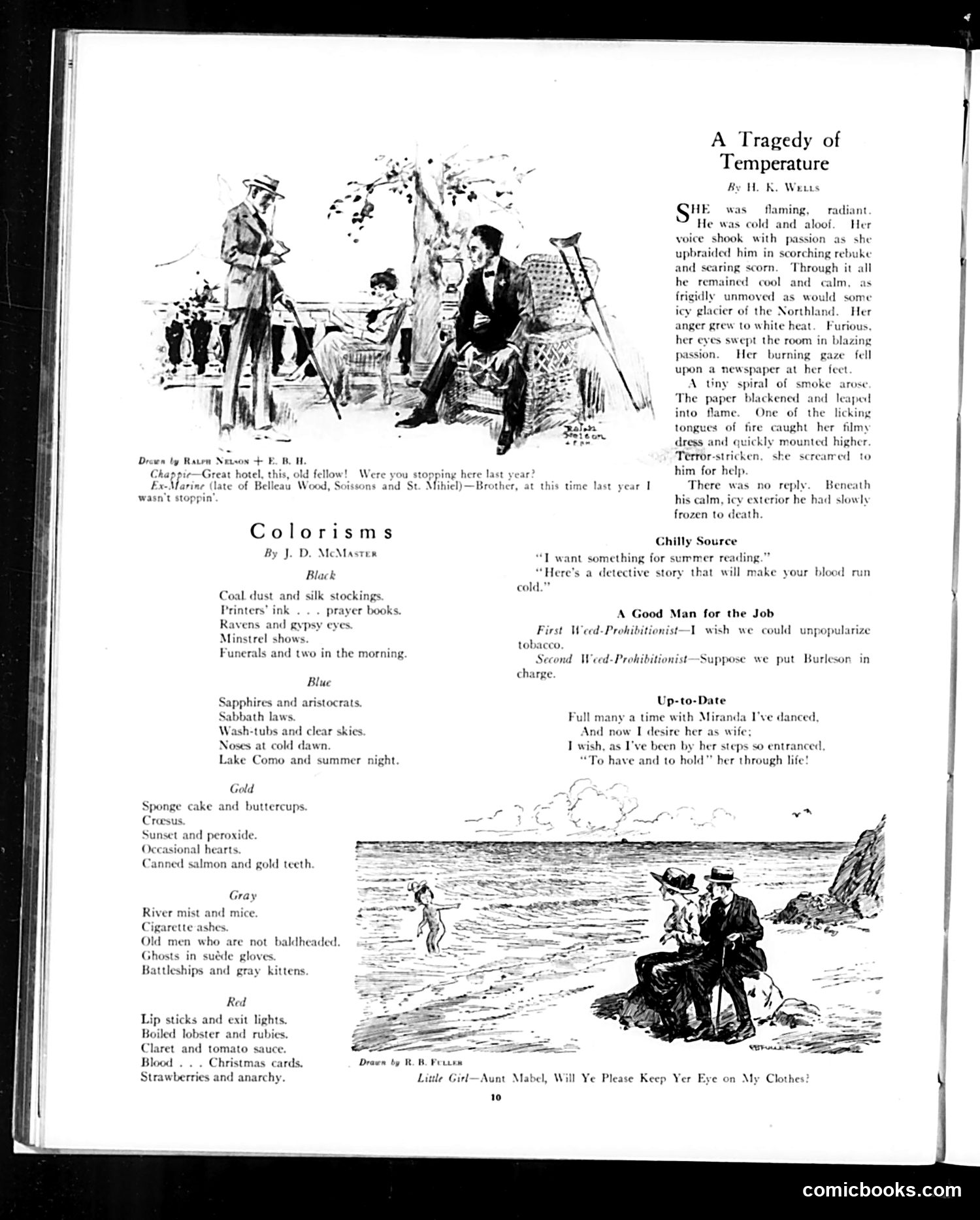
This page contains several distinct satirical pieces: **"A Tragedy of Temperature"** is a humorous short story playing on romantic clichés. A passionate woman confronts a coldly indifferent man. The irony: her rage literally ignites a newspaper at her feet, catching her dress on fire. She screams for his help, but he remains unmoved—not from emotional coldness, but because he's literally frozen to death beneath his calm exterior. It's absurdist humor mocking melodramatic relationship dynamics. **"Colorisms"** by J.D. McMaster is a poem associating colors with social concepts—Black with "minstrel shows" and "funerals," Gold with luxury items, Red with "anarchy." This reflects early-20th-century associative thinking about color symbolism, though the racial references date it uncomfortably. **The other brief sketches** include wordplay ("Chilly Source") and references to Prohibition-era politics (mentioning Burleson, likely Postmaster General Albert Burleson who enforced tobacco restrictions). The cartoons' specific references to contemporary figures or events aren't entirely clear from the visible text.
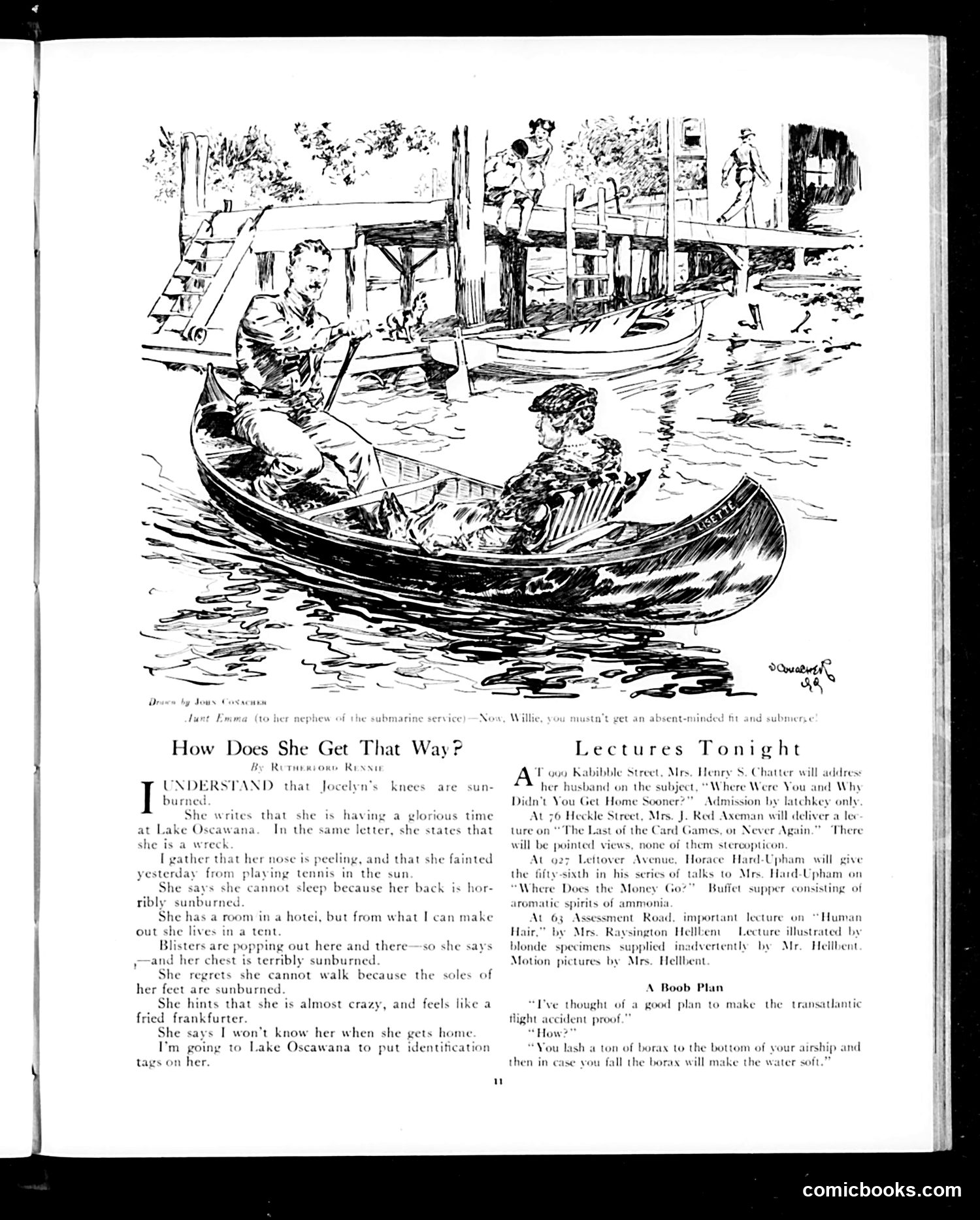
This page contains two distinct pieces from Judge magazine: **"How Does She Get That Way?"** is a humorous column by Rutherford Rennie about a woman (apparently named Jocelyn) who has severely overextended her time at a summer lake resort. The joke catalog her escalating sunburn injuries—peeling nose, blistered feet, sunburned chest—as she refuses to leave despite being incapacitated. The narrator husband threatens to go to Lake Oscawana to attach identification tags to her, treating her like luggage. The satire mocks both excessive leisure-seeking and wives' stubbornness, common domestic humor tropes of the era. **"Lectures Tonight"** is a parody listing of absurdly-titled women's lectures with names like "Mrs. Henry S. Chatter" and "Mrs. J. Red Axeman"—obvious puns suggesting gossipy or aggressive personalities. **"A Boob Plan"** is a brief joke about making transatlantic flights "accident proof" by adding borax to seawater—nonsensical pseudo-logic typical of period magazine humor. All target upper-middle-class leisure culture and domestic absurdities.
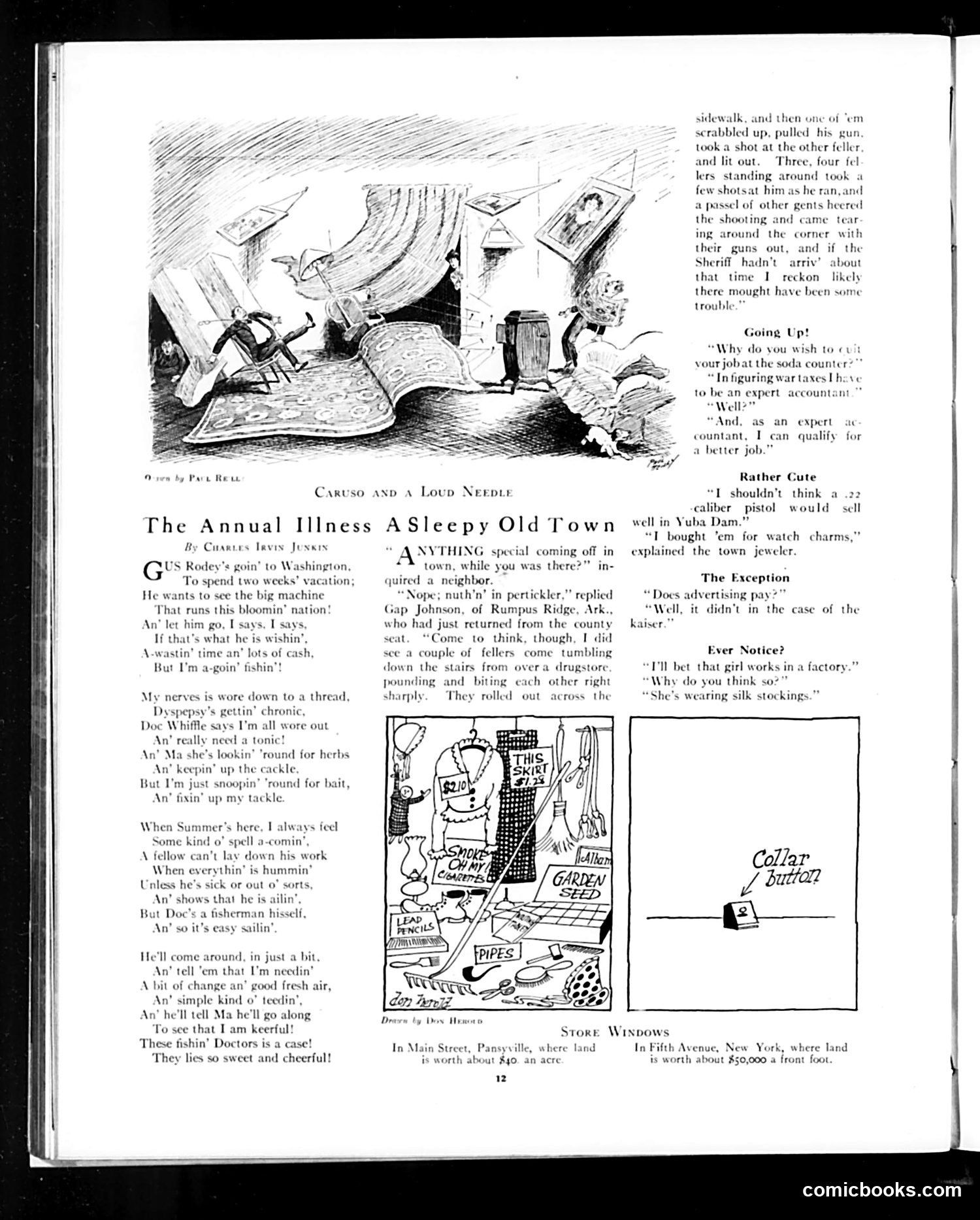
This page contains several unrelated short humorous pieces typical of Judge magazine's satirical format: **"The Annual Illness A Sleepy Old Town"** (poem by Charles Irvin Junkins): A rural narrator explains his need for a fishing vacation, claiming exhaustion and desperation for rest. The satire mocks the commonplace excuse of needing a doctor-prescribed break, with the doctor conveniently endorsing the fishing trip. **Short jokes** include: - A man seeking a soda counter job by claiming war-tax accounting expertise - A jewelry salesman explaining he bought .22 caliber pistols as "watch charms" (likely satirizing poor business judgment) - Advertising's failure (referencing the Kaiser, suggesting post-WWI timing) - A joke about silk stockings indicating factory work (commentary on working-class fashion aspirations) **Store Windows cartoon**: Contrasts land values—$40/acre in rural Pansyville versus $50,000/front foot in Fifth Avenue, New York, highlighting urbanization's economic disparity. The page reflects early 20th-century American humor targeting small-town life, wartime anxieties, and class differences.
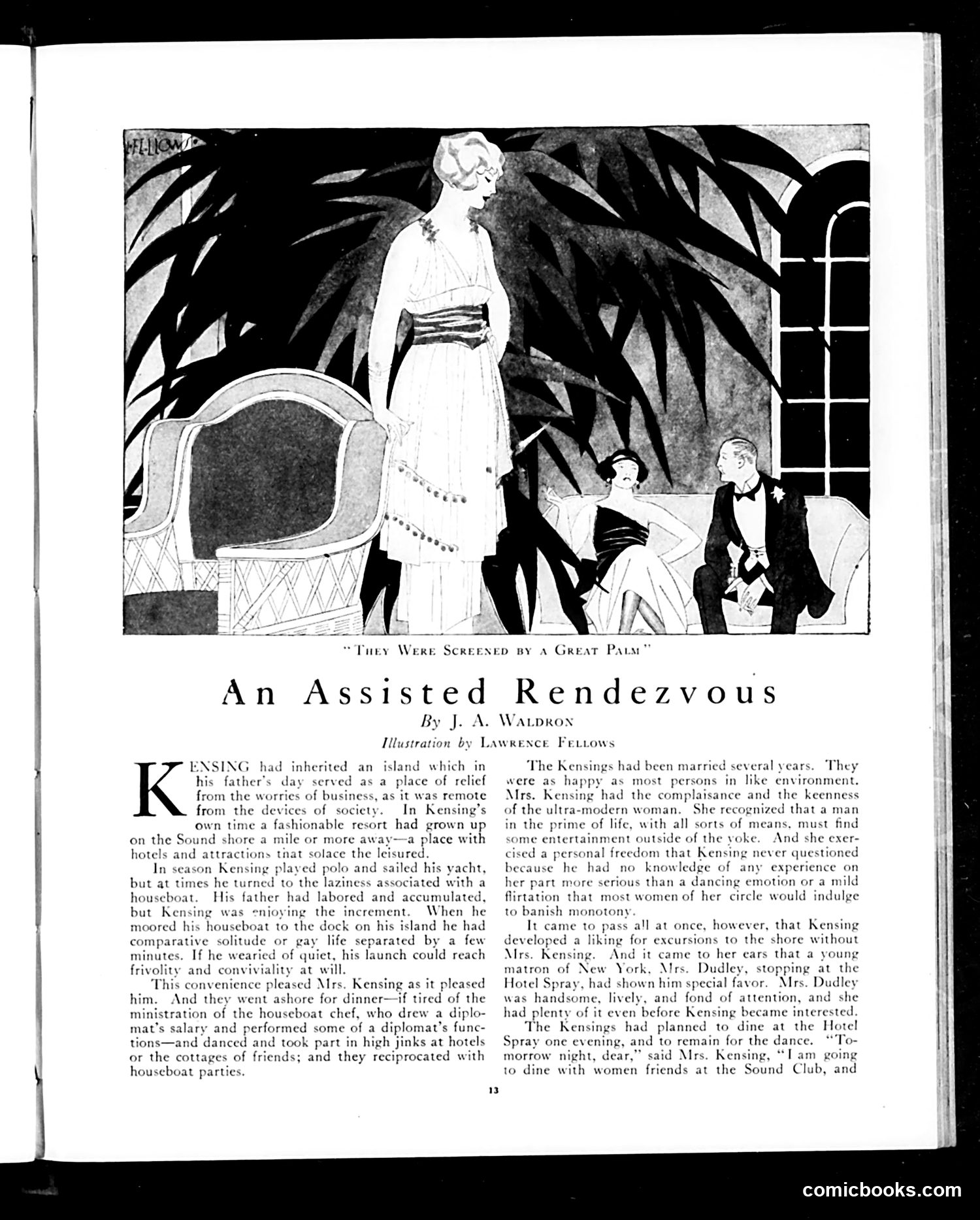
This is a short story illustration, not political satire. The narrative concerns wealthy leisure-class adults in what appears to be the 1920s, living near Long Island Sound. **The Setup:** Kensing, a wealthy man with inherited money, owns an island with a houseboat—a convenient retreat between his private property and fashionable resort hotels nearby. He and his wife Mrs. Kensing maintain a modern, permissive marriage where both pursue outside interests without serious objection. **The Conflict:** Kensing develops a romantic interest in Mrs. Dudley, an attractive visitor at a nearby hotel. Mrs. Kensing learns of this and plans her own evening out, ostensibly with women friends at the Sound Club. **The Satire:** The story gently mocks the "ultra-modern" wealthy couple's arrangement—their mutual infidelities dressed up as sophistication and freedom. The title's irony suggests Mrs. Kensing's evening is similarly arranged to facilitate her own romance, creating parallel "assisted rendezvous."
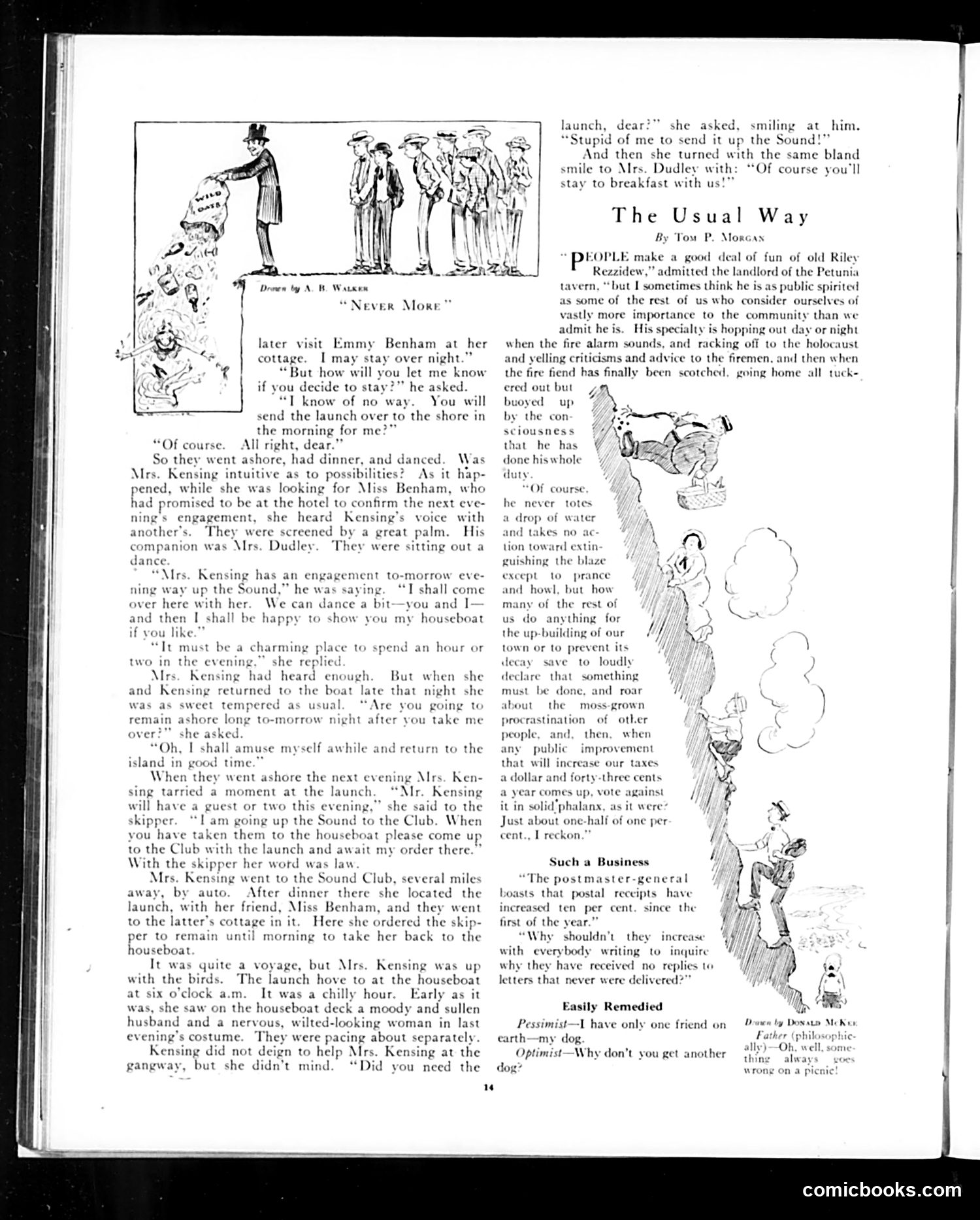
This page contains two distinct pieces of social satire: **"Never More"** (left): A domestic drama illustrated by A.B. Walker depicts a wife (Mrs. Kensing) discovering her husband's infidelity. She overhears him arranging a rendezvous with Mrs. Dudley at their houseboat while claiming business elsewhere. The satire lies in her response: rather than confrontation, she calmly orchestrates her revenge by summoning both the guilty parties to breakfast at the houseboat the next morning, publicly exposing the affair through forced social civility. The "usual way" women handled such situations in this era—through polite social manipulation rather than direct accusation. **"The Usual Way"** (right): Tom P. Morgan's story satirizes civic hypocrisy. Riley Rezzidew is mocked for his public-spirited fire-alarm responses, yet he contributes nothing practical—only noise and commentary. The piece critiques how citizens loudly demand community improvements and condemn "moss-grown procrastination" while voting against tax increases to actually fund such improvements. Both pieces expose gap between appearance and reality in social behavior.
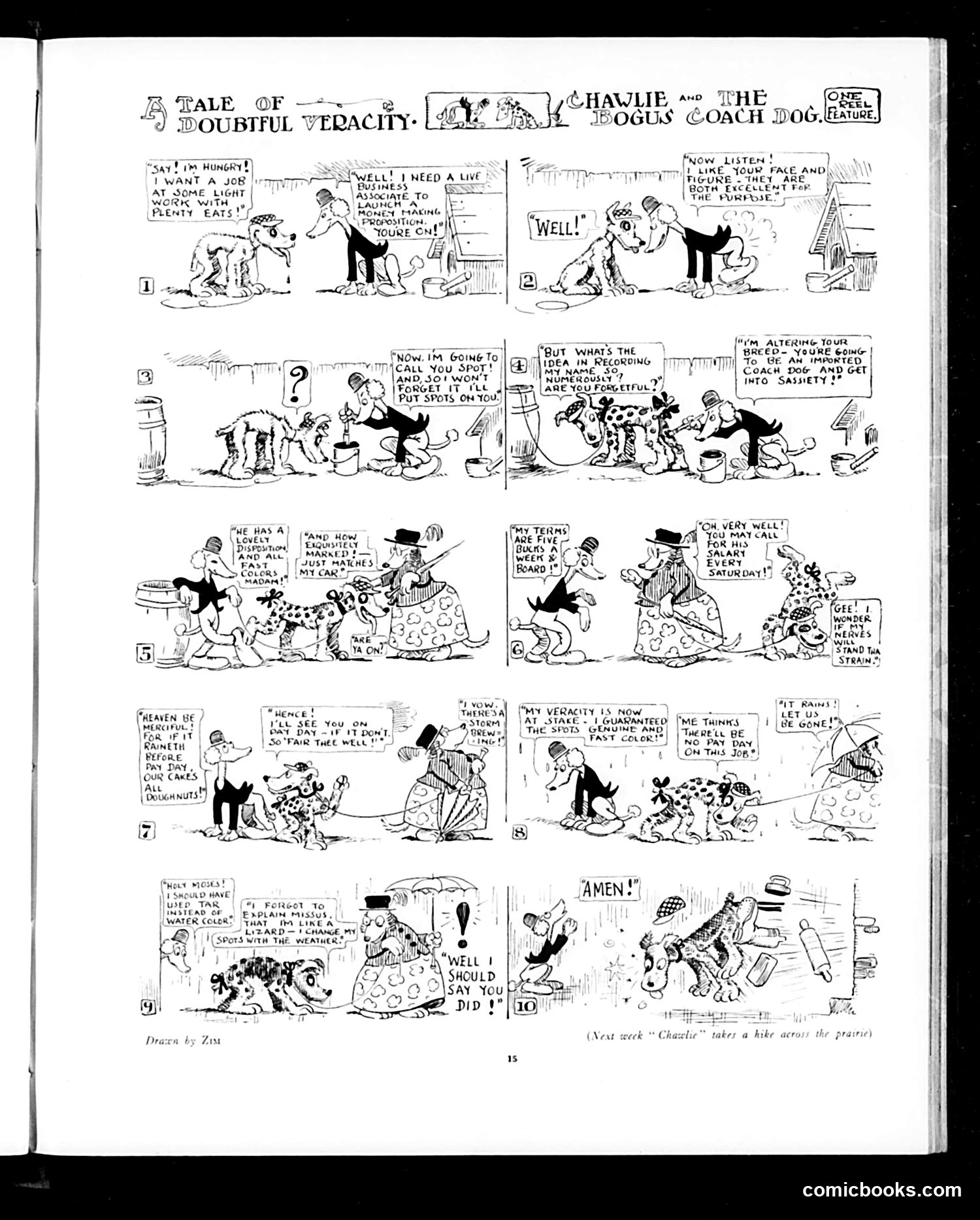
This comic strip satirizes a con artist's scheme to defraud an unemployed man. A desperate job-seeker agrees to a dubious "business proposition" involving a dog that supposedly changes color based on weather—a transparent fraud. The con man promises to rename the mutt "Spot" and rebrand it as a fashionable imported coach dog to sell to wealthy society customers. The satire targets both the charlatan's transparent dishonesty and the gullible victim's desperation. The "doubtful veracity" title mocks the con man's absurd claims about the dog's color-changing abilities and his promise that his credibility is now "at stake." The joke reflects turn-of-the-century anxieties about urban con games and the vulnerability of working-class men facing unemployment, where even obvious schemes become tempting when survival is at stake.
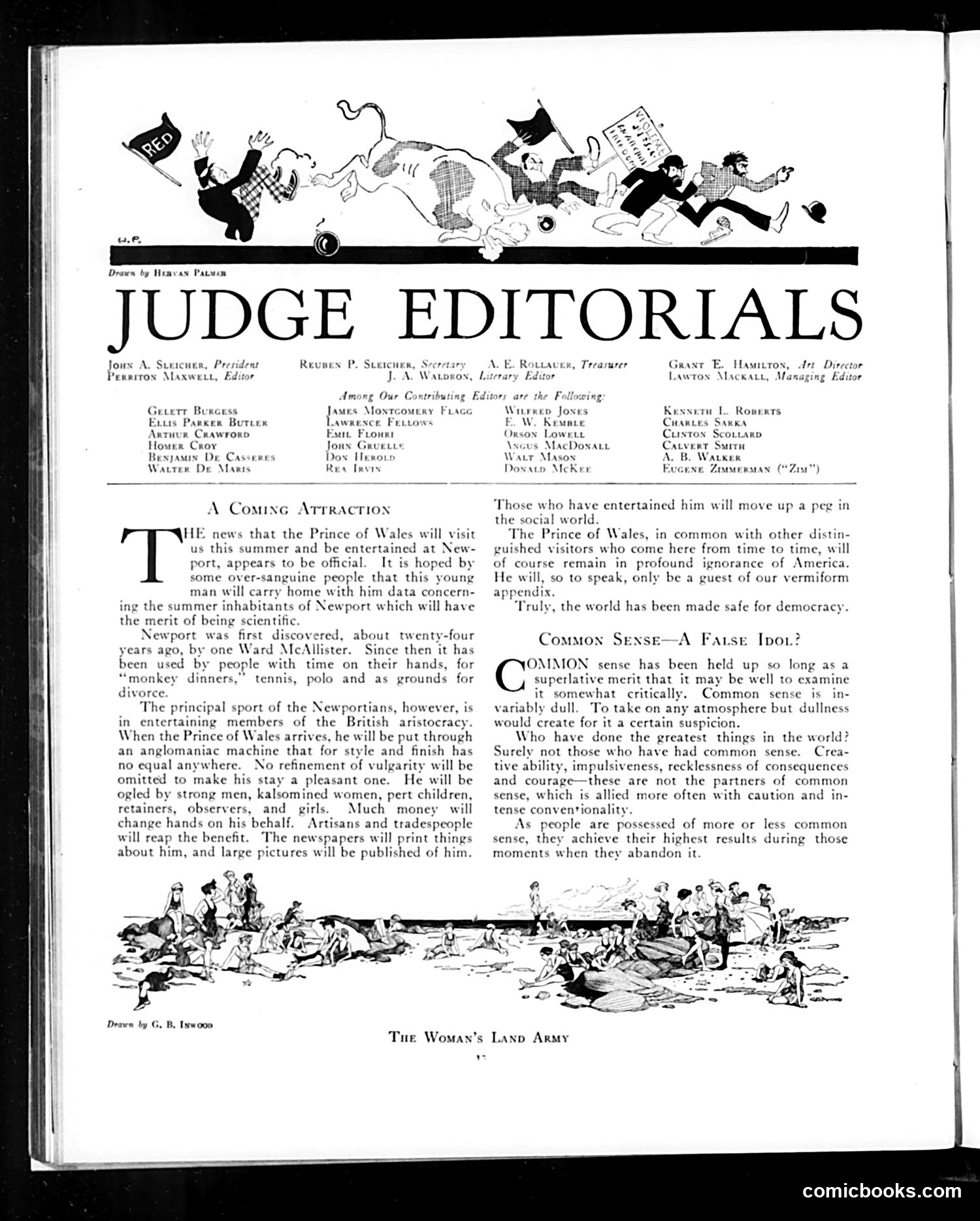
This editorial page from *Judge* magazine satirizes American high society's obsession with British aristocracy, specifically the anticipated visit of the Prince of Wales to Newport, Rhode Island—then America's premier wealthy resort. **"A Coming Attraction"** mocks Newport's social climbers who will treat the Prince as a trophy to display. The editorial sarcastically notes that Newport's main "sport" is entertaining British nobility, and that locals will fawn over him despite his remaining "in profound ignorance of America"—reduced to visiting only the social elite ("our vermiform appendix," a cutting anatomical comparison). The piece ridicules the anglomaniac pretension: women will be "kalsomined" (heavily made-up), newspapers will sensationalize his visit, and those who entertain him will gain social status. **"Common Sense—A False Idol?"** argues that society overvalues "common sense" as a virtue, when truly great achievements come from creativity, impulsiveness, and courage—qualities that abandon conventional thinking. Both editorials critique American social conformity and snobbery, particularly the era's deference to European aristocracy.
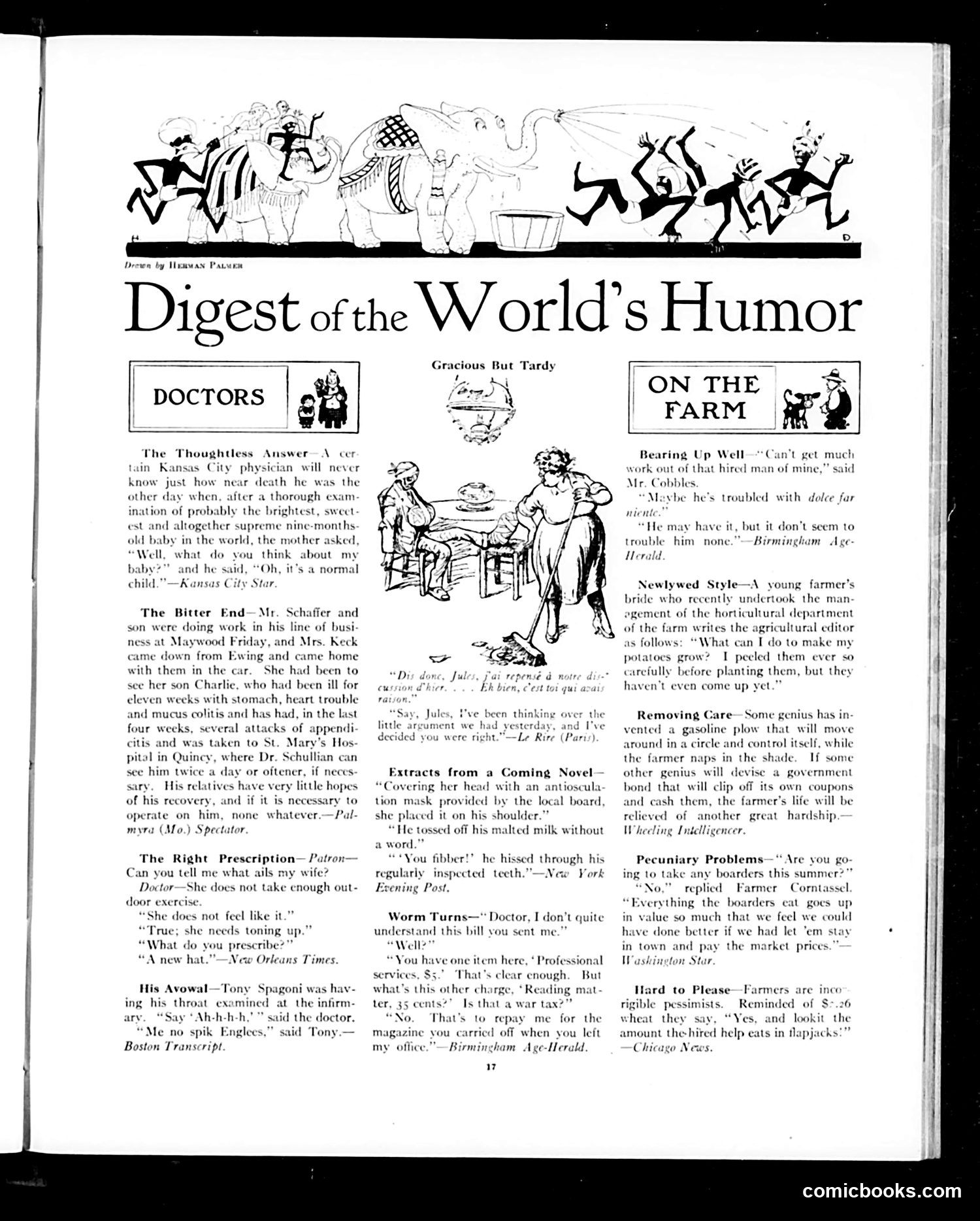
This is a humor digest page collecting brief jokes and anecdotes from various American newspapers, organized by theme (Doctors, On the Farm, etc.). The cartoon at top, drawn by Herrman Parker, depicts exaggerated figures in slapstick poses—typical Judge illustration style. The jokes reflect early 20th-century concerns: doctors' blunt assessments of babies, medical bills and "war taxes" (likely WWI-era), and farm life. One recurring theme mocks farmers as incurable pessimists—even when wheat prices rise to $5.26, they complain about labor costs. Another satirizes newlywed ignorance (peeling potatoes before planting). The humor targets class anxieties (hired help, boarders), medical professionalism, and rural vs. urban gaps. References to "flapjacks" and "dolce far niente" (Italian: sweet idleness) suggest contemporary slang and cosmopolitan awareness. Overall, it's gentle satire on everyday American life's absurdities.
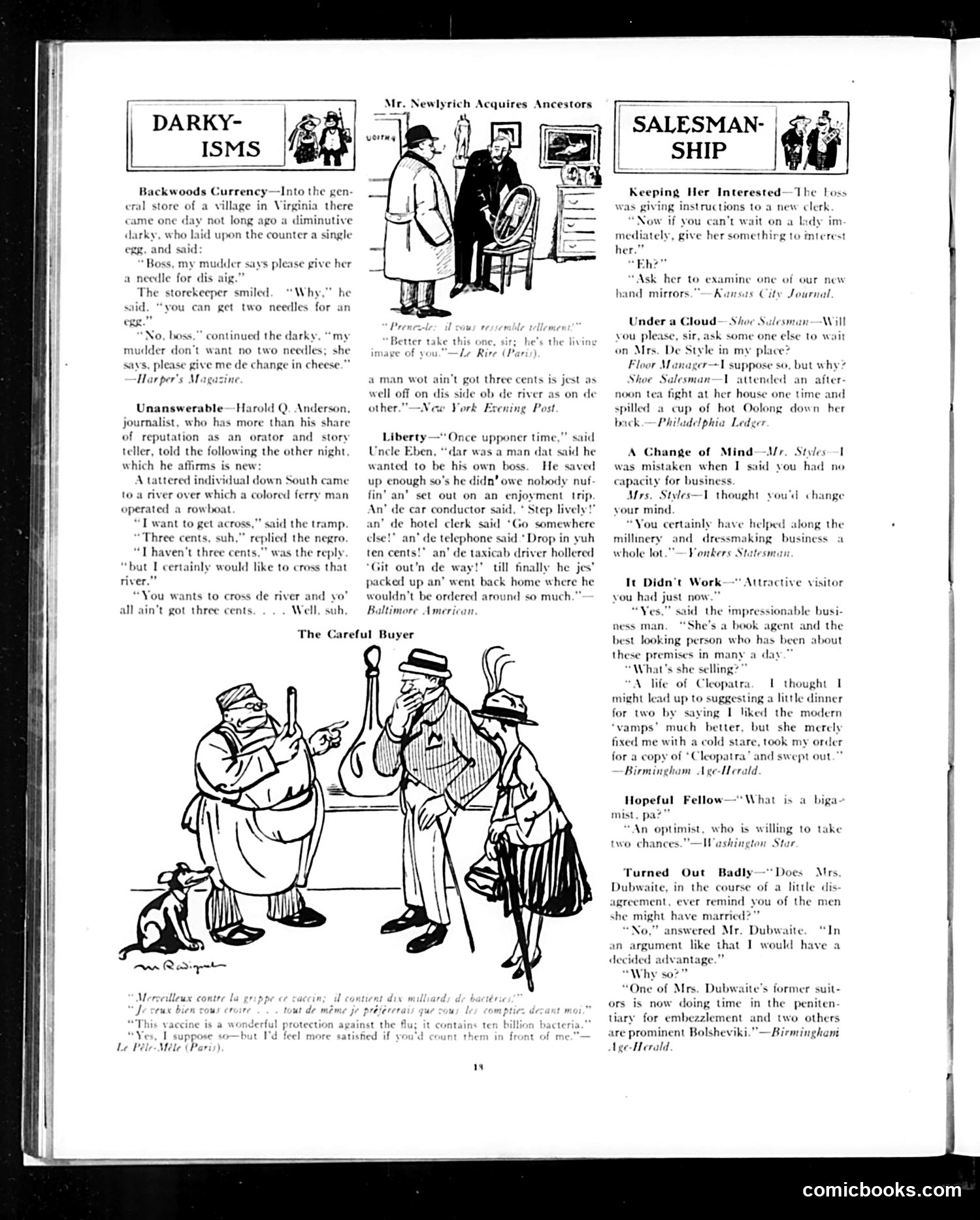
This page from the satirical magazine Judge contains several humor pieces stereotyping Black Americans and offering social commentary typical of early 20th-century American humor. **"Backwoods Currency" and "Unanswerable"** present racist dialect jokes featuring enslaved or poor Black characters ("darky") who speak in exaggerated vernacular. The humor relies on portraying them as simple-minded or illogical. **"Liberty"** uses Uncle Eben character to satirize the contradiction of American freedom—a man saves to be "his own boss" but finds himself constantly ordered around by conductors, clerks, and taxi drivers. The joke critiques how economic dependence undermines genuine liberty. **"The Careful Buyer"** cartoon and accompanying anecdotes satirize consumer culture and gender dynamics, depicting women as easily distracted shoppers and foolish spenders. The page reflects Judge's blend of racist stereotyping alongside social satire about American capitalism, labor relations, and consumer excess—humor conventions that would be considered offensive today.
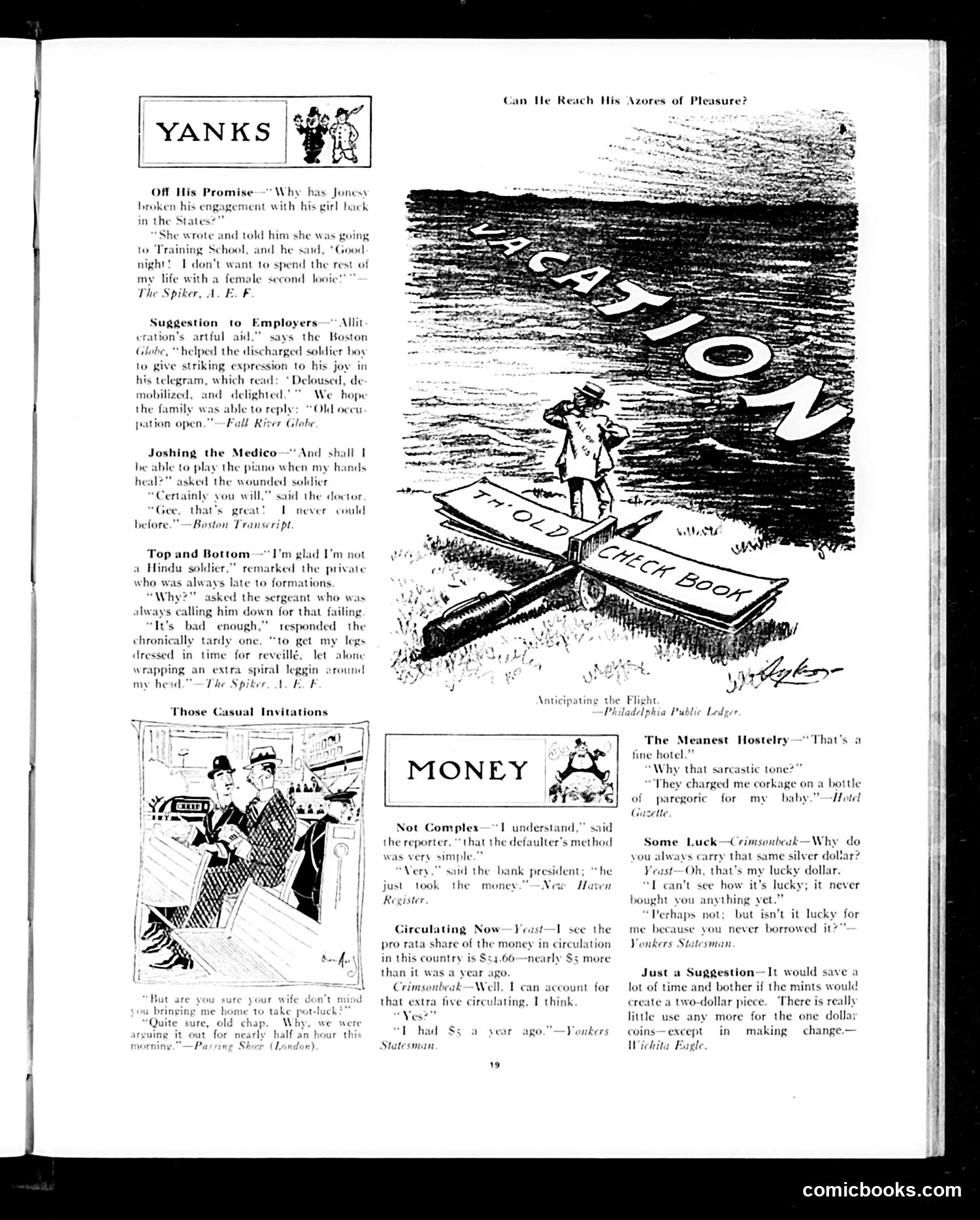
This page collects brief humor pieces and cartoons from WWI-era America, mostly featuring soldiers. Key satirical content includes: **"Off His Promise"**: A soldier's fiancée breaks their engagement, saying she won't spend life with a "female second looie" (lieutenant)—mocking both female military officers and the soldier's dismissive attitude. **"Joshing the Medico"**: Dark humor about a wounded soldier asking if he'll play piano after healing. The doctor's affirmative answer is funny because the soldier never could before—absurdist comedy about wartime injuries. **"Top and Bottom"**: A perpetually late soldier jokes about the difficulty of dressing his legs in time for reveille, let alone wrapping spiral leggings around his head—slapstick humor about military discipline and soldiers' complaints. **The cartoons and brief jokes** satirize military life, discharged soldiers, banking/currency issues, and hotel pricing. The tone is lighthearted despite wartime context, reflecting how American popular magazines used humor to process the war experience.
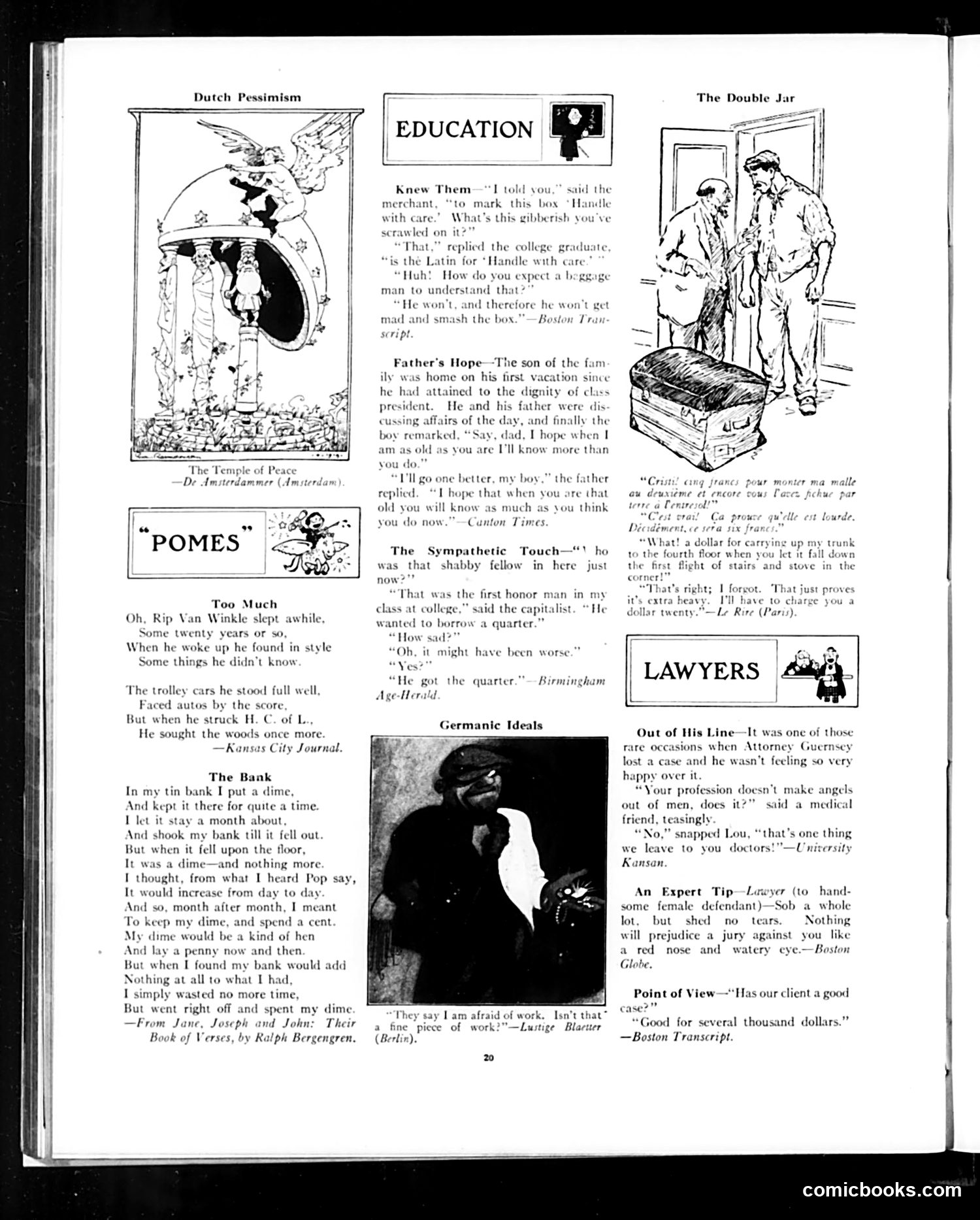
This page contains short humorous pieces satirizing early 20th-century American anxieties and social foibles. **"Dutch Pessimism"** references the post-WWI stereotype of Dutch/German fatalism, illustrated by Rip Van Winkle discovering the "H.C. of L." (High Cost of Living)—inflation that drove him back to the woods. This reflects post-war economic anxiety. **"The Bank"** mocks children's naïve expectations about compound interest and savings, presenting a child's disappointment that money doesn't multiply on its own. **"Education"** satirizes college graduates' impracticality: a Latin phrase "Handle with care" proves useless to baggage handlers, suggesting classical education lacks real-world utility. Other brief anecdotes lampoon optimistic fathers, capitalists' coldness toward poor college friends, and a lawyer's cynical courtroom advice to a female client—typical Judge humor targeting hypocrisy and pretension across professions and classes.
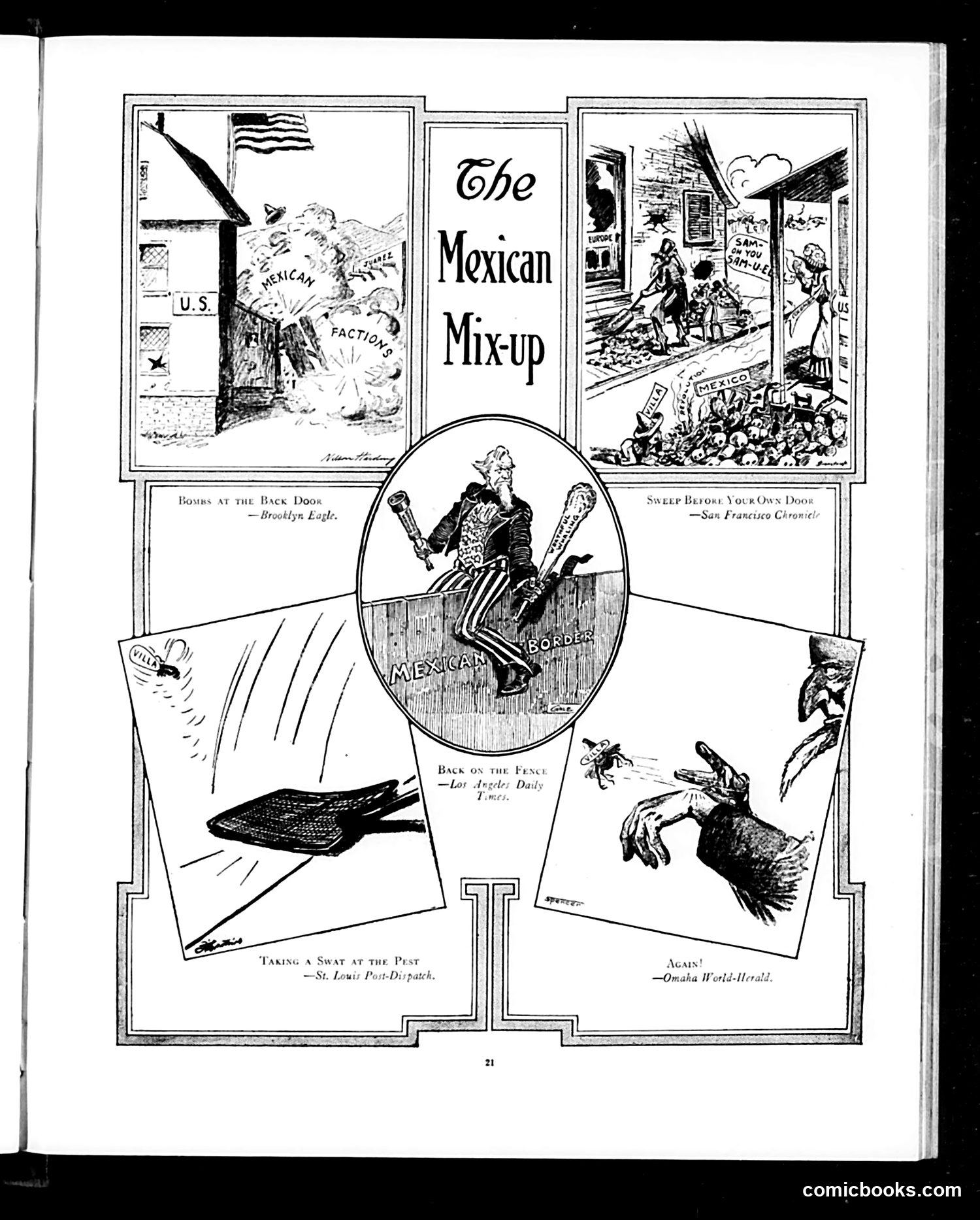
This satirical composition uses five panels to mock U.S.-Mexico relations and Mexican immigration/interference in American affairs around the early 20th century. **Central figure**: A caricatured Mexican official or politician (labeled "Mexican Border"), depicted with exaggerated features, sits astride the U.S.-Mexico border wielding weapons. **Surrounding scenes** show consequences attributed to Mexican instability: - Top left: "Bombs at the Back Door" (Brooklyn Eagle)—violence spilling into U.S. territory - Top right: "Swept Before Your Own Door" (San Francisco Chronicle)—internal American disorder - Bottom panels: pest infestations and chaos, metaphorically equating Mexican turmoil to spreading vermin The satire suggests Mexico's internal conflicts ("factions" visible in top left) create spillover problems for America. The overall message reflects xenophobic anxieties about Mexican influence during a period of border tensions and revolution.
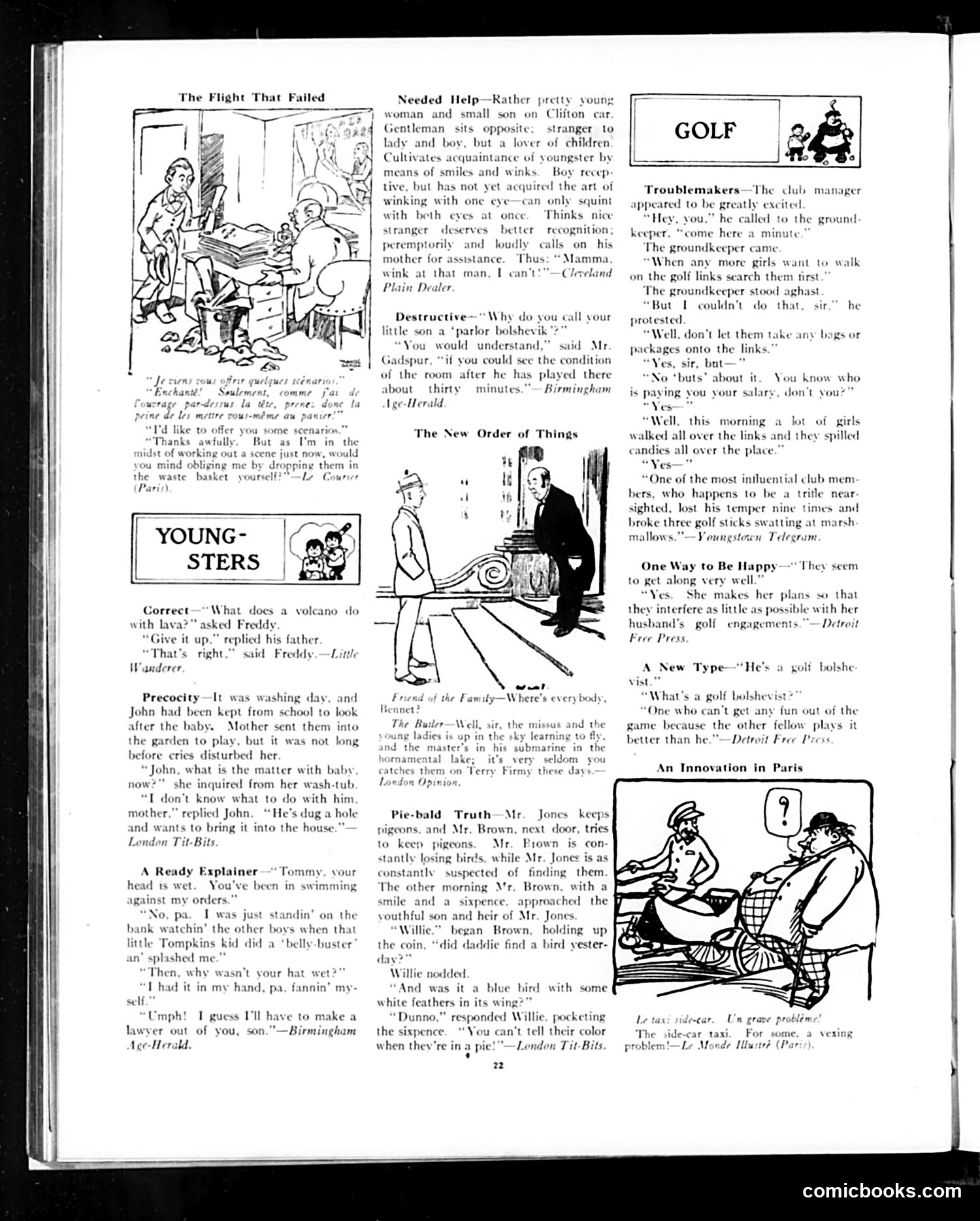
This page contains multiple short humor pieces satirizing early 20th-century social life and gender dynamics. **"The Flight That Failed"** and **"Needed Help"** mock social awkwardness and overeager strangers attempting friendliness with unfamiliar children. **"Troublemakers"** satirizes women's increasing presence in traditionally male spaces. A golf club manager demands the groundskeeper search female golfers for contraband, claiming women have disrupted the course by spilling candies that caused a club member to angrily swat at marshmallows with golf clubs. The humor targets both women's invasion of golf (a male preserve) and the absurd overreaction. **"One Way to Be Happy"** jokes that a wife succeeds by deliberately avoiding interference with her husband's golf—implying wives typically meddle in husbands' leisure activities. **"A New Type"** coins "golf bolshevik" (referencing the 1917 Russian Revolution's radical associations) to describe someone who plays poorly—connecting social disruption rhetoric to everyday incompetence. The page reflects anxieties about shifting gender roles and women's expanding social participation during the 1920s.
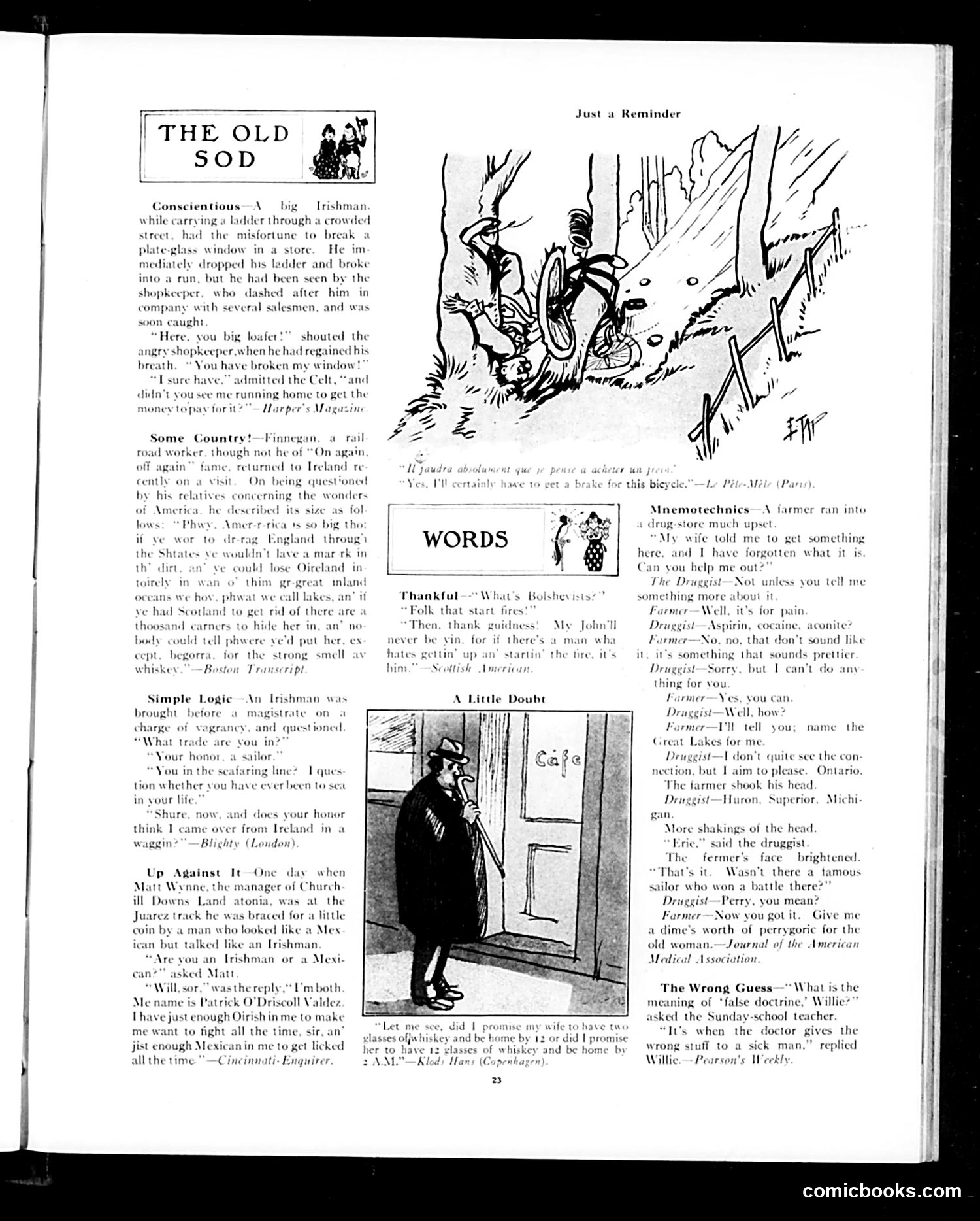
This page from *Judge* magazine contains multiple Irish-American humor pieces stereotyping Irish immigrants through dialect and perceived character traits. **Main cartoons and stories satirize Irish immigrants by:** 1. **"Conscientious"** — An Irishman breaks a store window, then runs home to get money to pay for it. The joke assumes Irish dishonesty; his honesty is treated as surprising. 2. **"Some Country!"** — An Irish railroad worker exaggerates America's size in heavily stereotyped brogue, suggesting Irish credulity and unfamiliarity with scale. 3. **"Simple Logic"** — An Irish vagrant's circular reasoning confuses a magistrate, mocking Irish intelligence. 4. **"Up Against It"** — An Irish-Mexican hybrid character claims sufficient Irish and Mexican heritage to justify fighting anyone—playing on stereotypes of both groups as naturally combative. The humor relies entirely on ethnic caricature, dialect jokes, and assumptions about Irish-Americans' supposed ignorance, dishonesty, and violence. The "Old Sod" (Ireland) reference frames Irish immigrants as foreign outsiders.
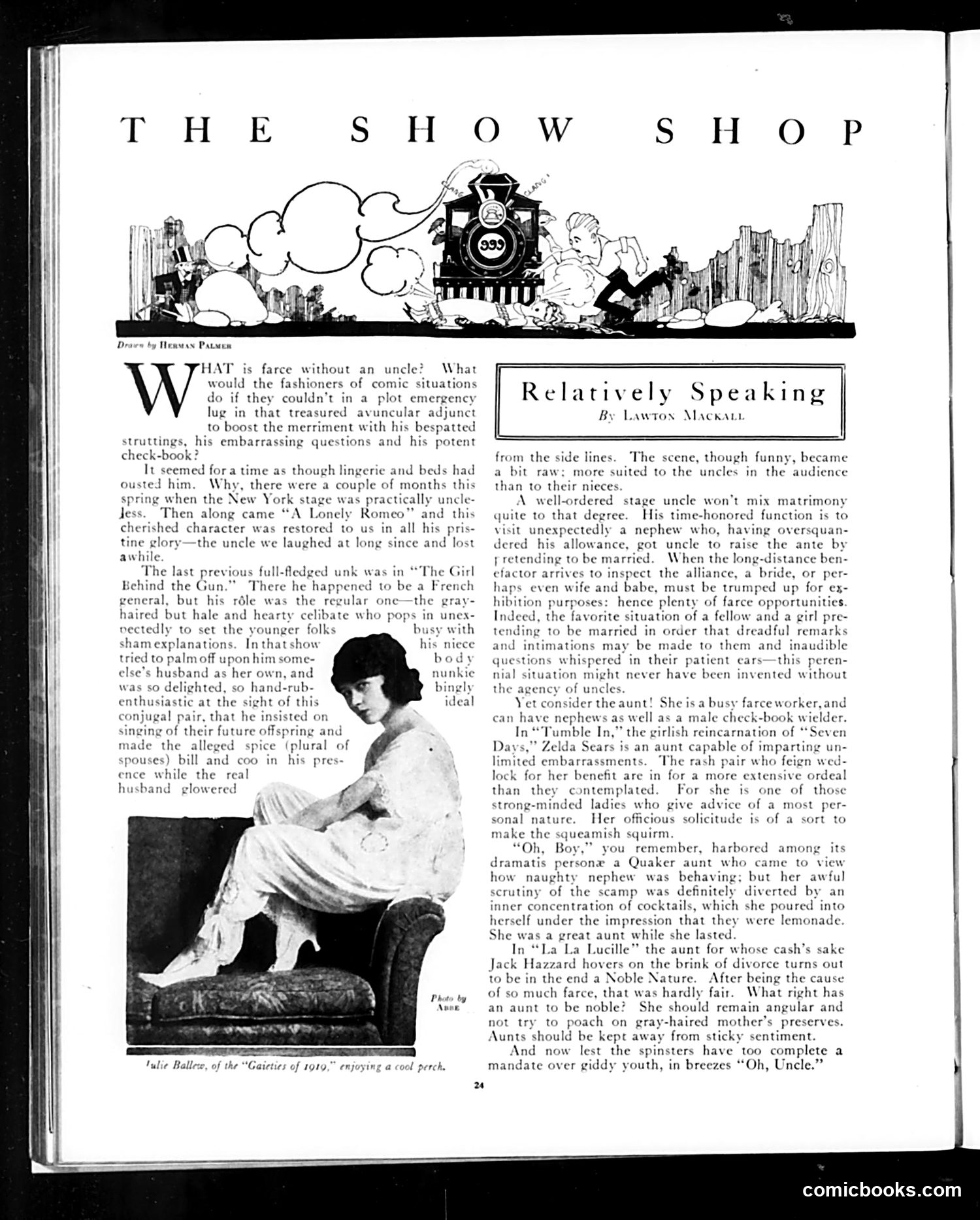
This page discusses the theatrical convention of the "uncle" character in farce comedies. The writer argues that uncles are essential to comedic plot devices—they arrive unexpectedly, provide embarrassment through intrusive questions, and most importantly, possess checkbooks to bail out spendthrift nephews. The accompanying photograph shows **Julie Hailée** from "Garrison's Girl," illustrating the type of romantic entanglement uncles typically expose. The piece then pivots to analyzing **aunts** as alternative comedic figures, citing specific Broadway productions: "Tumble In" (featuring Zelda Sears), "Oh Boy," and "La La Lucille." The satire argues aunts are equally disruptive but with different methods—offering unsolicited personal advice and moral complications rather than simple financial intervention. The central joke: theatrical formulas depend on meddling relatives, but aunts are arguably *worse* because they can't simply be bought off with money. The writer treats these stock characters as necessary dramatic mechanics audiences expected in 1920s comedies.
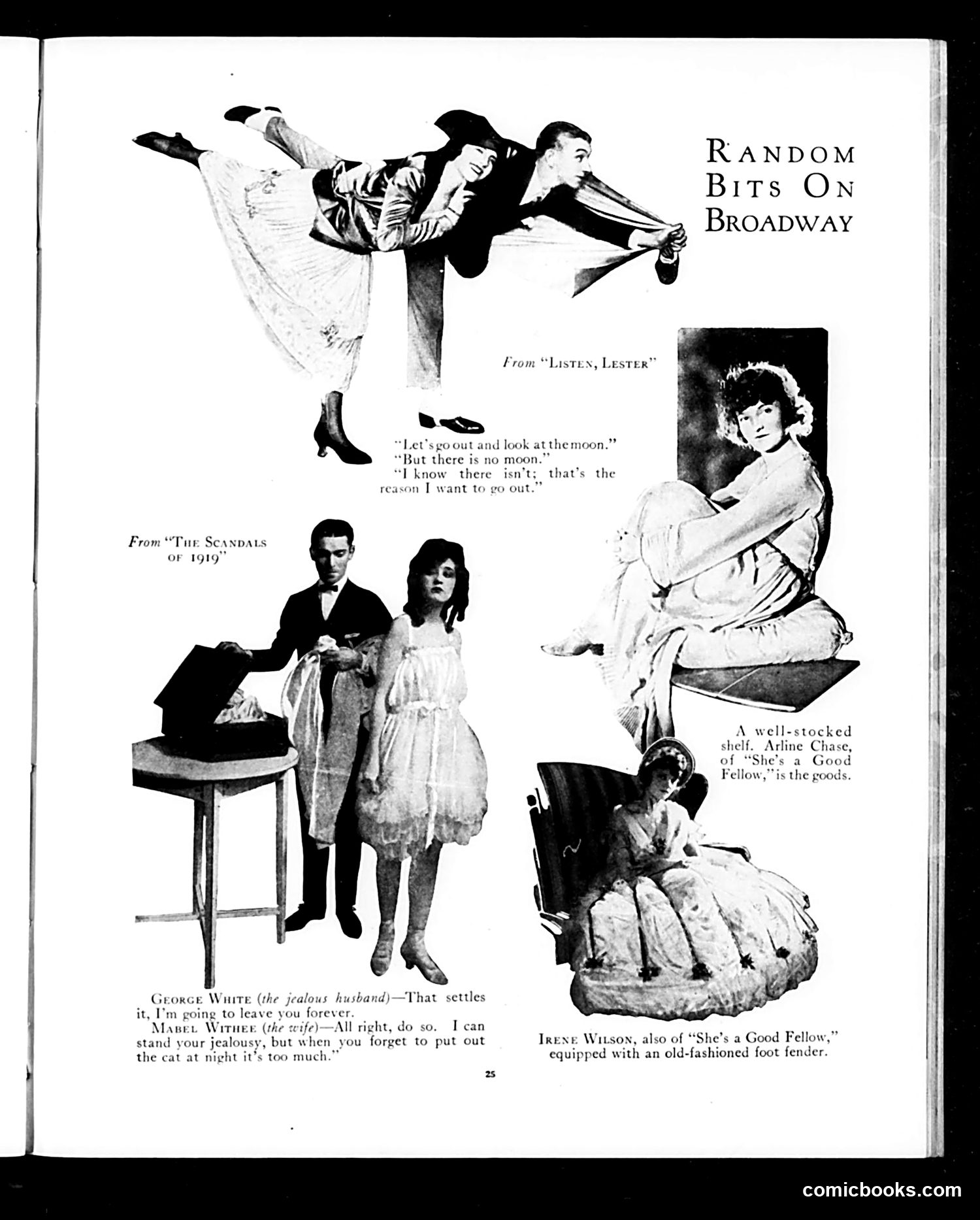
This page features theatrical humor from early 1920s Broadway productions. It presents comedic scenes and dialogue snippets from three plays: "Listen, Lester," "The Scandals of 1919," and "She's a Good Fellow." The jokes rely on domestic and romantic situations typical of stage comedy. One scene shows a jealous husband threatening to leave his wife, only for her to respond that she can tolerate his jealousy but not his neglecting household duties (forgetting to put out the cat). Another depicts a couple's absurdist courtship logic about viewing a non-existent moon. The page includes photographs of cast members, identifying actors like George White, Mabel Withers, Arline Chase, and Irene Wilson. Rather than political satire, this represents Judge magazine's theatrical coverage—entertainment journalism mixing stage gossip with light comedy to amuse readers familiar with contemporary Broadway productions.
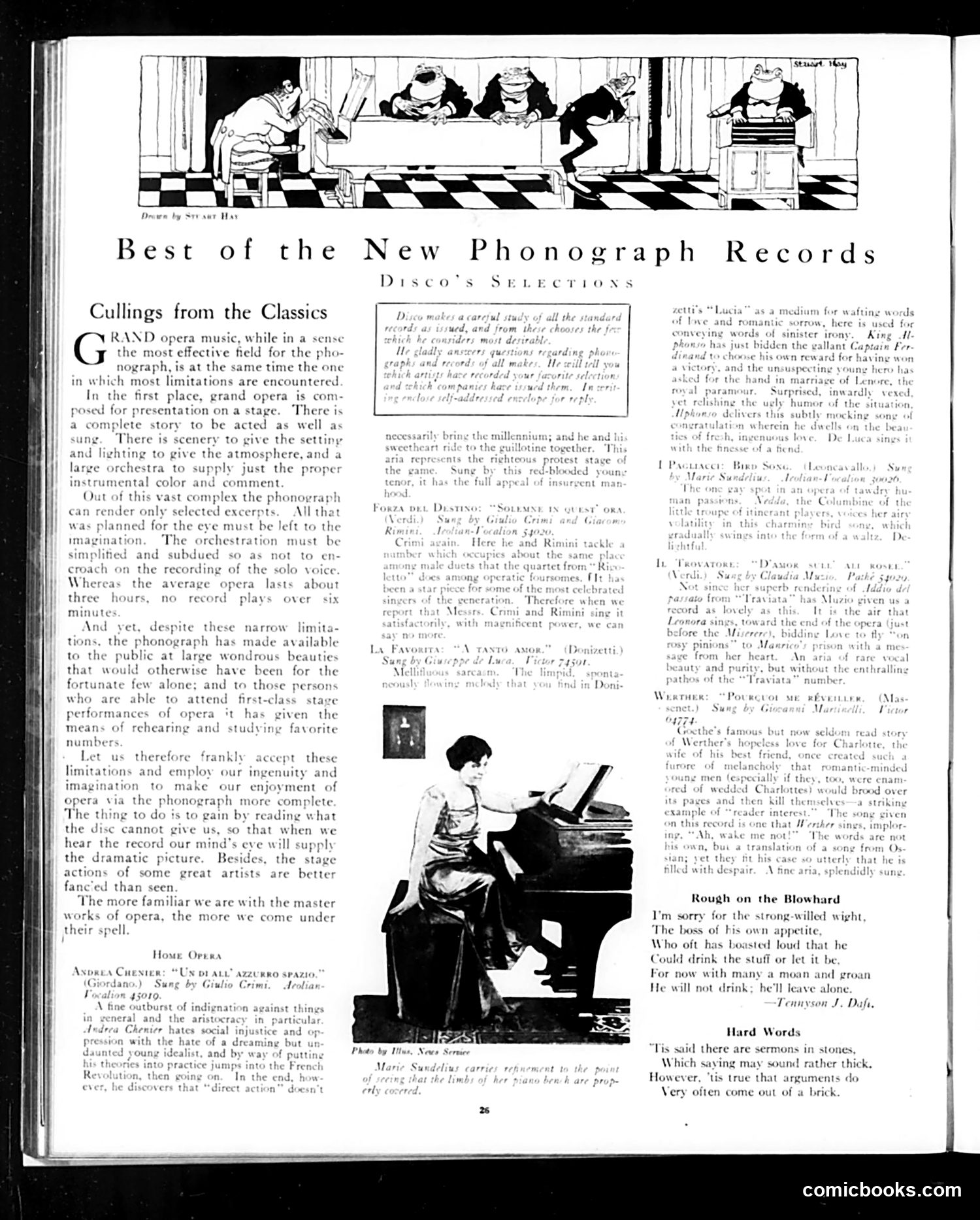
This page is primarily **editorial content about phonograph records**, not political satire. The main article discusses how grand opera recordings, while limited by the medium, allow the public access to performances otherwise unavailable except to the wealthy who could attend live theater. The small cartoons and verses at the bottom appear to be unrelated filler content: - **"Rough on the Blowhard"** is a humorous poem mocking a man who boasts he can control his drinking but cannot—a common temperance-era joke about self-delusion. - **"Hard Words"** is a brief verse suggesting that arguments, while seeming substantial, are often trivial ("come out of a brick"). The cartoon illustration showing a woman at a piano relates to the phonograph discussion above. This is primarily a **product review/cultural commentary page** rather than political satire. The date and specific historical context remain unclear from the visible text.
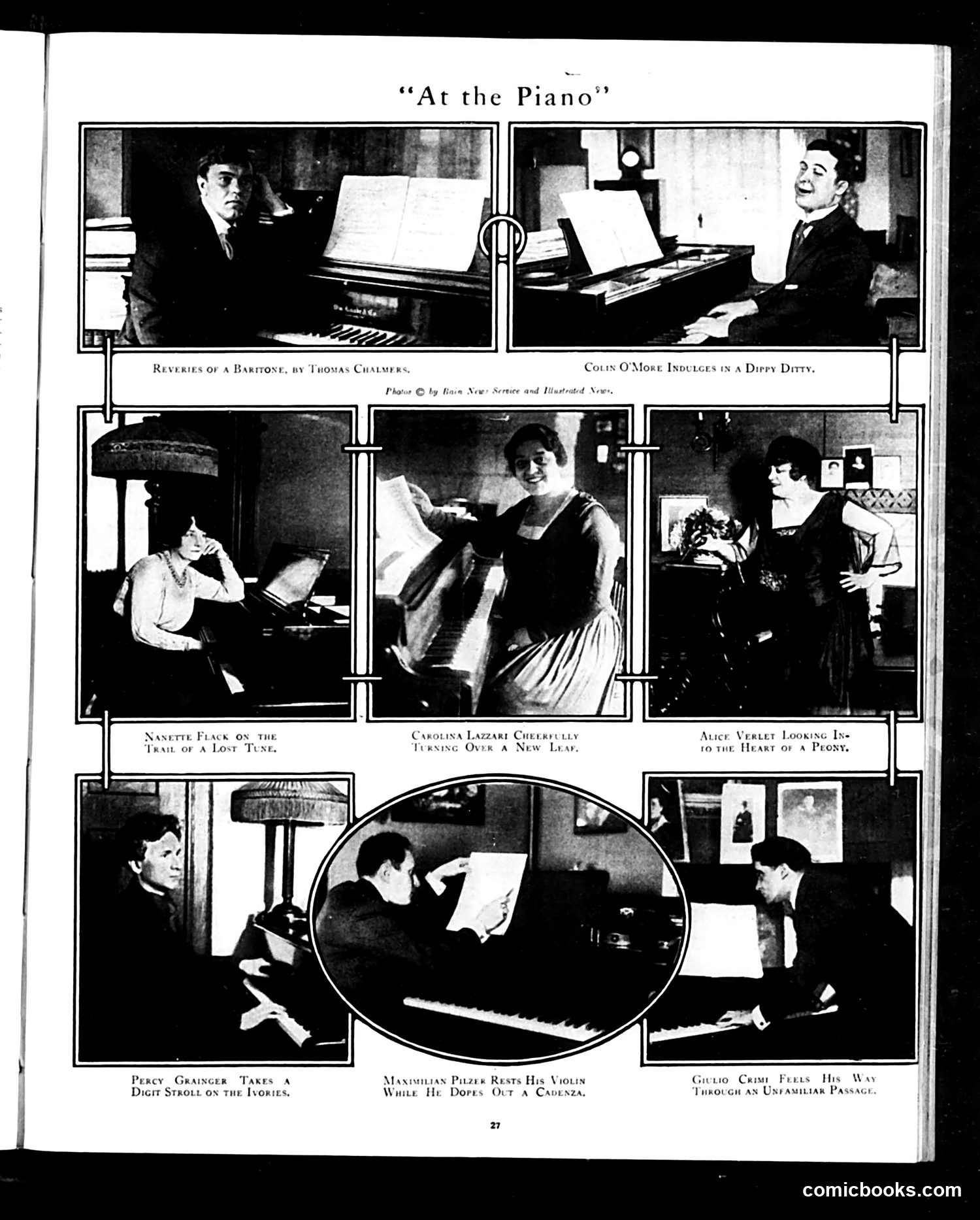
This page presents a series of humorous vignettes featuring musicians at the piano, likely from the early 20th century. The sketches appear to satirize different musical personalities and scenarios: The captions reference recognizable musicians of the era—**Percy Grainger** (Australian pianist), **Maximilian Pilzer** (violinist), and **Giulio Crimi** (appears to be an opera singer)—depicted in exaggerated or comedic situations. References like "Reveries of a Baritone" and "Turning Over a New Leaf" suggest satirical commentary on musicians' pretensions or eccentric behaviors. The humor relies on visual gags: musicians absorbed in their craft, struggling with sheet music, or caught in awkward moments. The page mocks both the artists themselves and Victorian-era musical culture—poking fun at concert performers' mannerisms and the sometimes overwrought sentimentality of classical music circles. Without clearer image resolution of all subjects, the specific targets remain partially unclear, but the satire targets recognizable public figures in music.
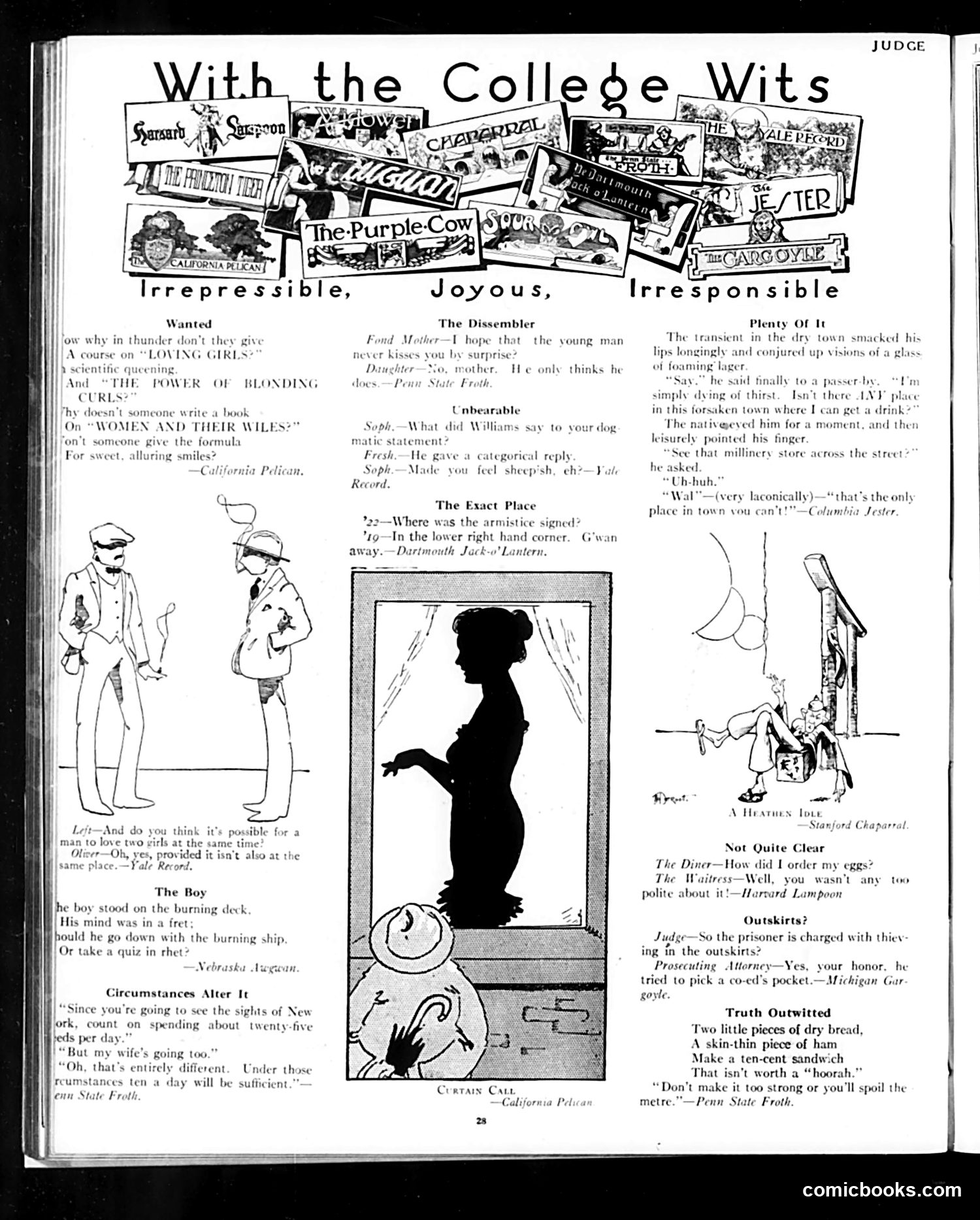
This page collects humorous short jokes and cartoons from college humor magazines of the early 20th century, arranged under the heading "Irrepressible, Joyous, Irresponsible." The content reflects college student culture and concerns of the era: romantic entanglements ("a man love two girls at the same time"), academic anxieties (choosing between a burning ship or a rhetoric quiz), and dating economics (calculating expenses for courting in New York). Several jokes play on gender dynamics and the "mystery" of feminine appeal ("the power of blonding curls"). One cartoon silhouette shows "Curtain Call," likely depicting a theatrical scene. Other jokes reference Prohibition-era concerns (seeking alcohol in a dry town) and contemporary dating protocols. The humor is gentle, domesticated satire aimed at college readers—poking fun at themselves rather than political targets. The page reflects 1920s anxieties about modern courtship, education, and changing social norms, presented through the lens of undergraduate life.
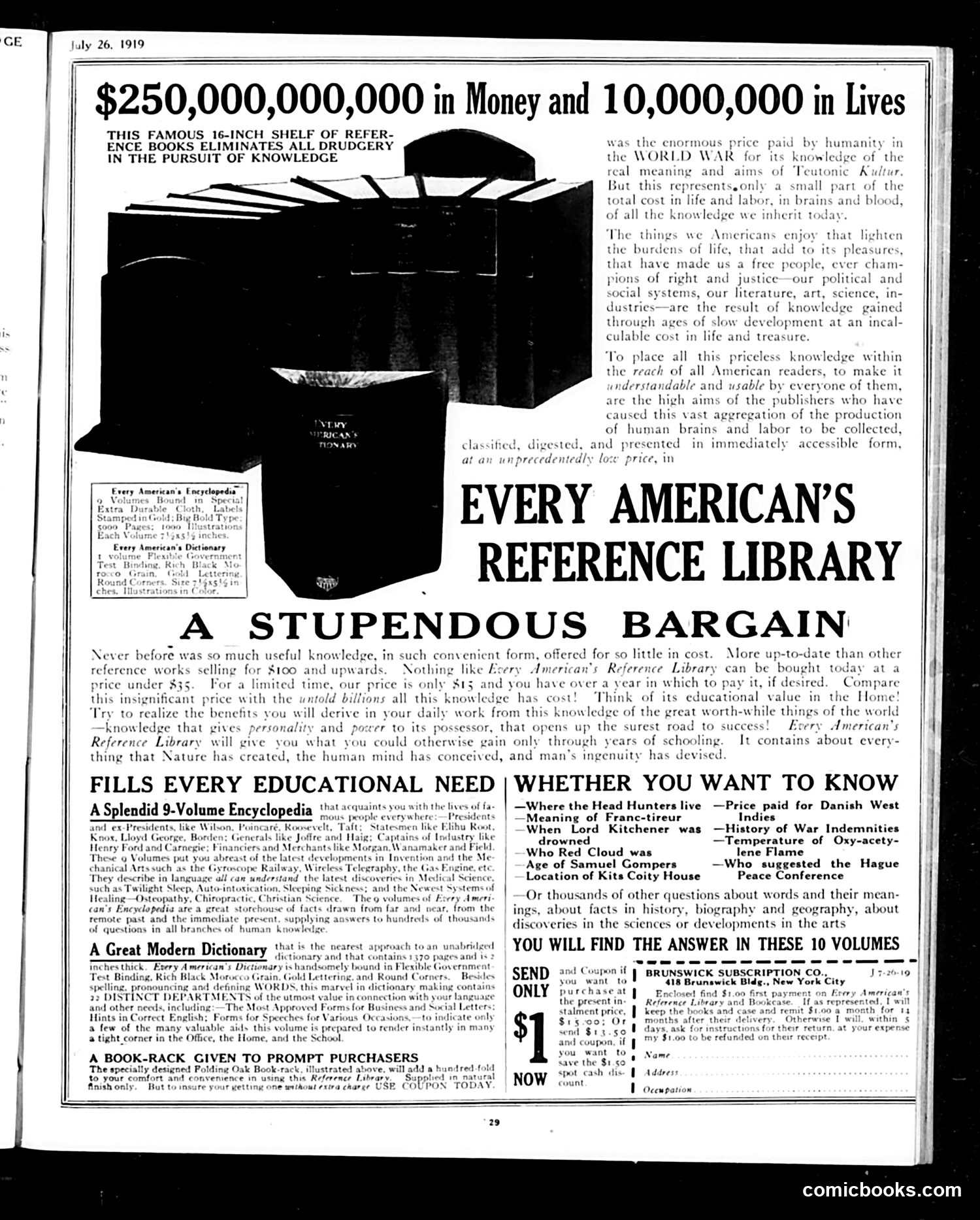
This page is primarily **advertising**, not editorial satire. It promotes "Every American's Reference Library"—a 9-volume encyclopedia set marketed as an affordable alternative to expensive reference works (normally $100+). The advertisement capitalizes on post-WWI sentiment by opening with a stark statistic: the war cost "$250,000,000,000 in Money and 10,000,000 in Lives." The copy argues that knowledge—America's inherited cultural and political achievements—represents the true value gained from that sacrifice. By making this knowledge "understandable and usable by everyone," the publishers position their encyclopedia as democratizing access to American education and success. The pitch emphasizes **practicality and patriotism**: knowledge "gives personality and power" and "opens up the surest road to success." The offered price ($1, with year-long payment terms) and included book-rack incentive target middle-class households seeking self-improvement during the post-war period. There is no political cartoon or satire visible—this is straightforward commercial messaging exploiting contemporary national sentiment.
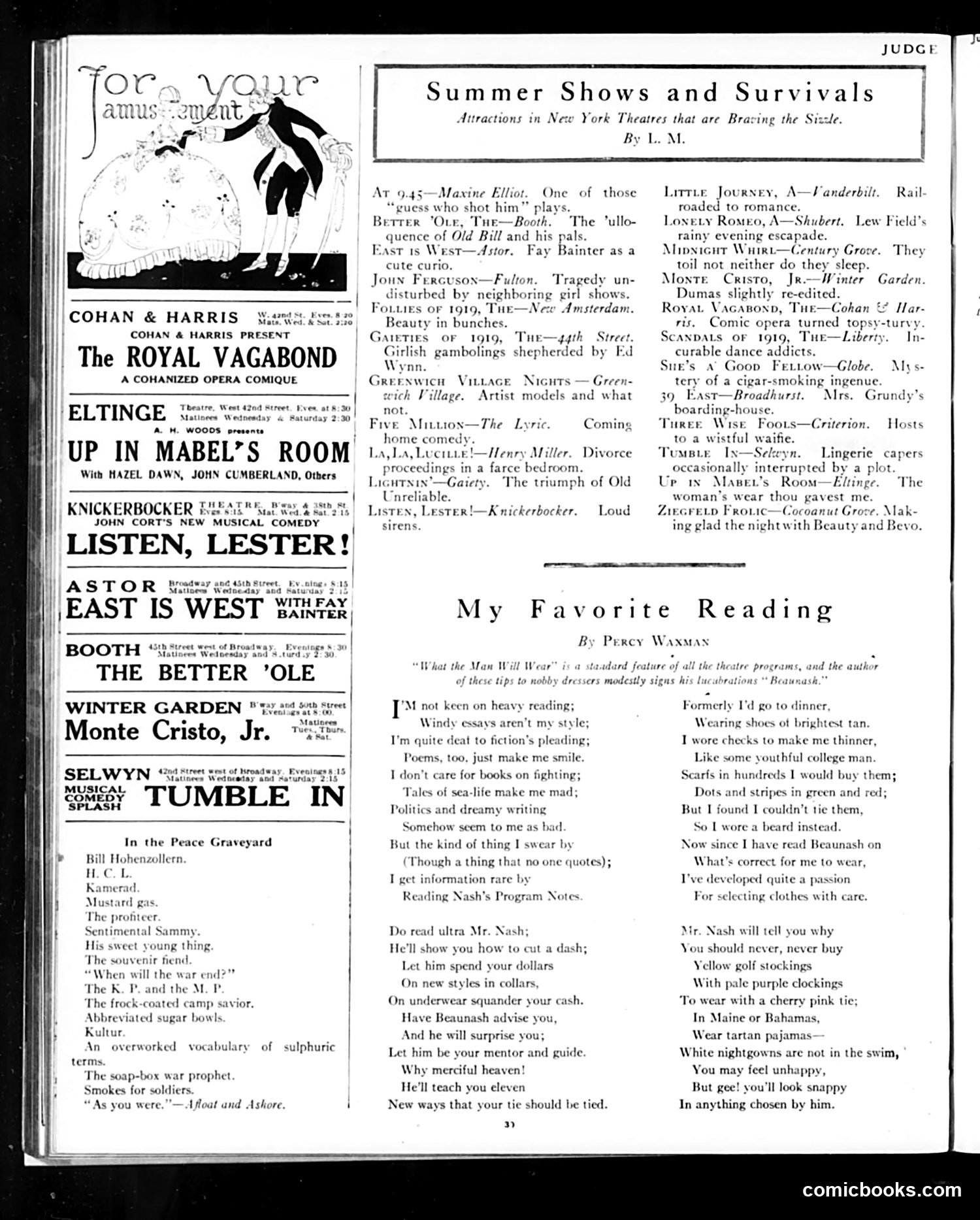
This page consists primarily of **theatrical advertisements and reviews**, not political satire. The left side advertises popular Broadway shows (The Royal Vagabond, Listen Lester!, Monte Cristo Jr., etc.), typical for Judge's entertainment coverage. The main satirical content appears in the sketch "In the Peace Graveyard" (listing topics like "Bill Hohenzollern" and "The soap-box war prophet"), which references **post-WWI America's disillusionment**—suggesting cynical commentary on war profiteering and political rhetoric following World War I's conclusion. The "My Favorite Reading" column by Percy Waxman humorously mocks fashion advice columns, particularly "Nash's Program Notes," satirizing the era's obsession with gentlemen's fashion guidance (ties, collars, undergarments). The poem ridicules how readers blindly follow style arbiters for trivial sartorial concerns. Overall, this appears to be a typical Judge issue mixing entertainment listings with gentle social satire about postwar attitudes and consumer culture.
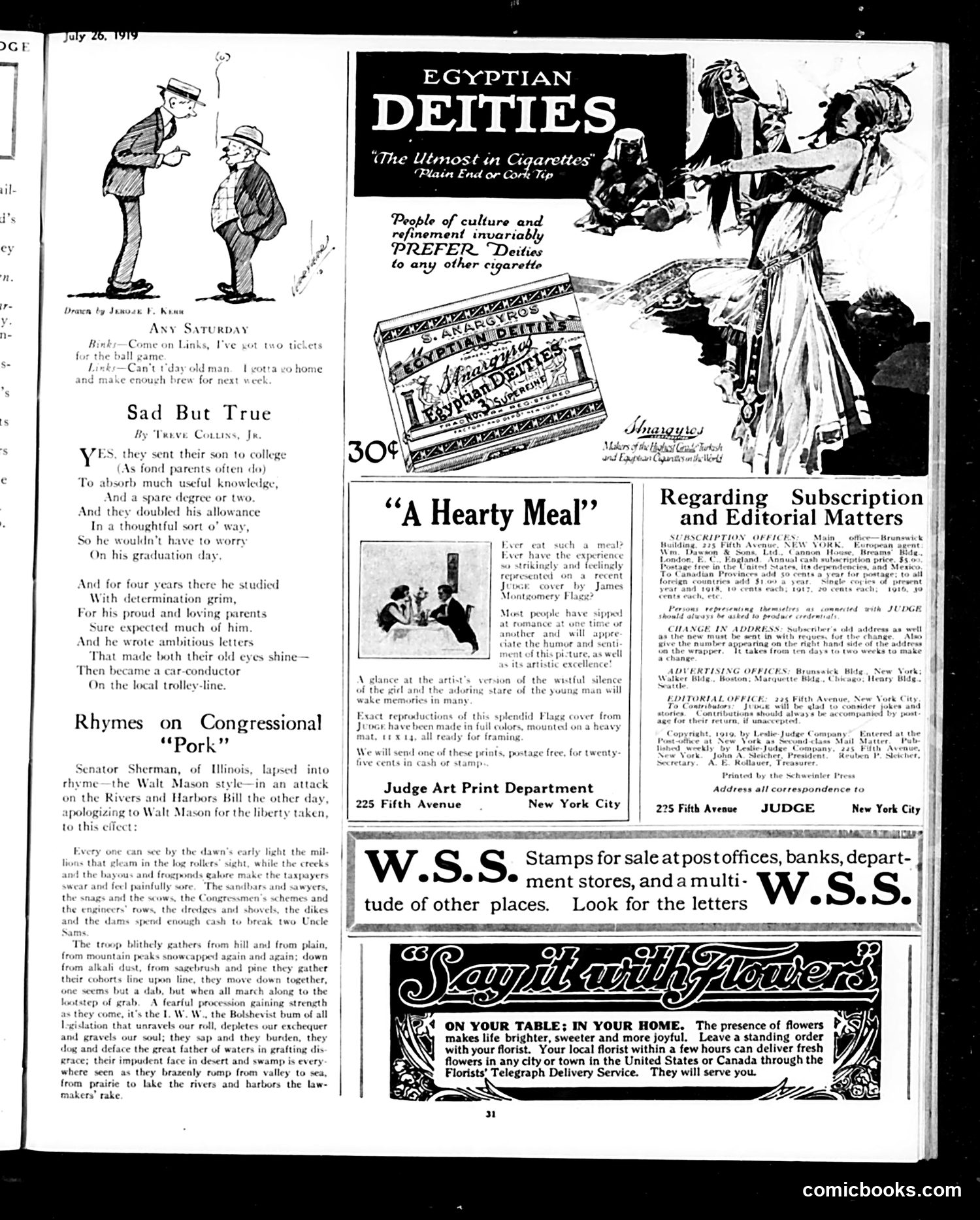
This page is primarily **advertising and light humor** rather than sharp political satire. **Main cartoon** ("Any Saturday"): Shows two men discussing baseball tickets—a simple domestic joke about a husband trying to attend a game while his wife expects him home. No political content. **"Sad But True"** (poem): A gentle satire on parental expectations. Parents sacrifice to send their son to college, doubling his allowance and expecting him to succeed, only for him to become a streetcar conductor—a working-class job. The joke is disappointed aspirations, not political commentary. **"Rhymes on Congressional 'Pork'"**: References Senator Sherman's actual attack on the Rivers and Harbors Bill (a spending measure), mimicking Walt Mason's popular verse style. "Pork barrel" spending was a genuine political complaint—wasteful federal projects benefiting specific regions. **Rest of page**: Cigarette ads, florist advertisements, and subscription information dominate the lower half. The Egyptian Deities cigarette ad uses Egyptology imagery (then fashionable) as branding. The page reflects 1919 concerns: education mobility, government waste, consumer products—nothing urgent or inflammatory.
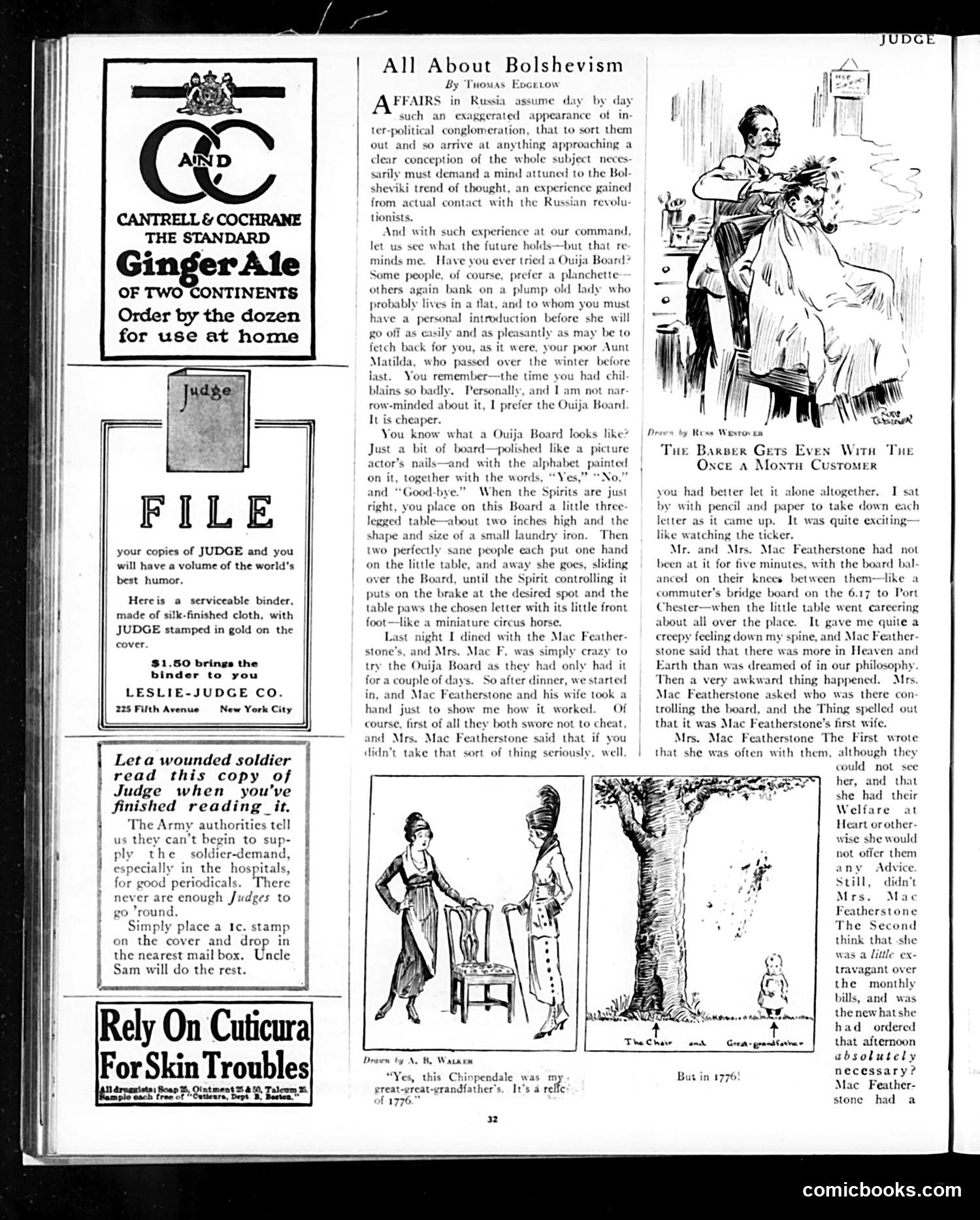
This page is primarily **advertising and filler content** rather than political satire. The main article, "All About Bolshevism" by Thomas Evelerow, satirizes Americans' ignorance about Russian communism by suggesting they'd get better answers from a Ouija Board than from actual knowledge. The implied joke: Bolshevism is so confusing and alien that supernatural spiritualism seems equally plausible. The cartoons illustrate a humorous anecdote about a Ouija Board séance at a dinner party—the "Spirit" controlling the board apparently reveals scandalous information, creating awkwardness among guests. This uses Bolshevism merely as a pretext to discuss America's fascination with spiritualism. The advertisements (Ginger Ale, Judge magazine binders, Cuticura skin products) and the appeal to donate Judge copies to wounded soldiers indicate this is a **wartime magazine issue**, likely WWI-era, mixing patriotic messaging with consumer marketing.
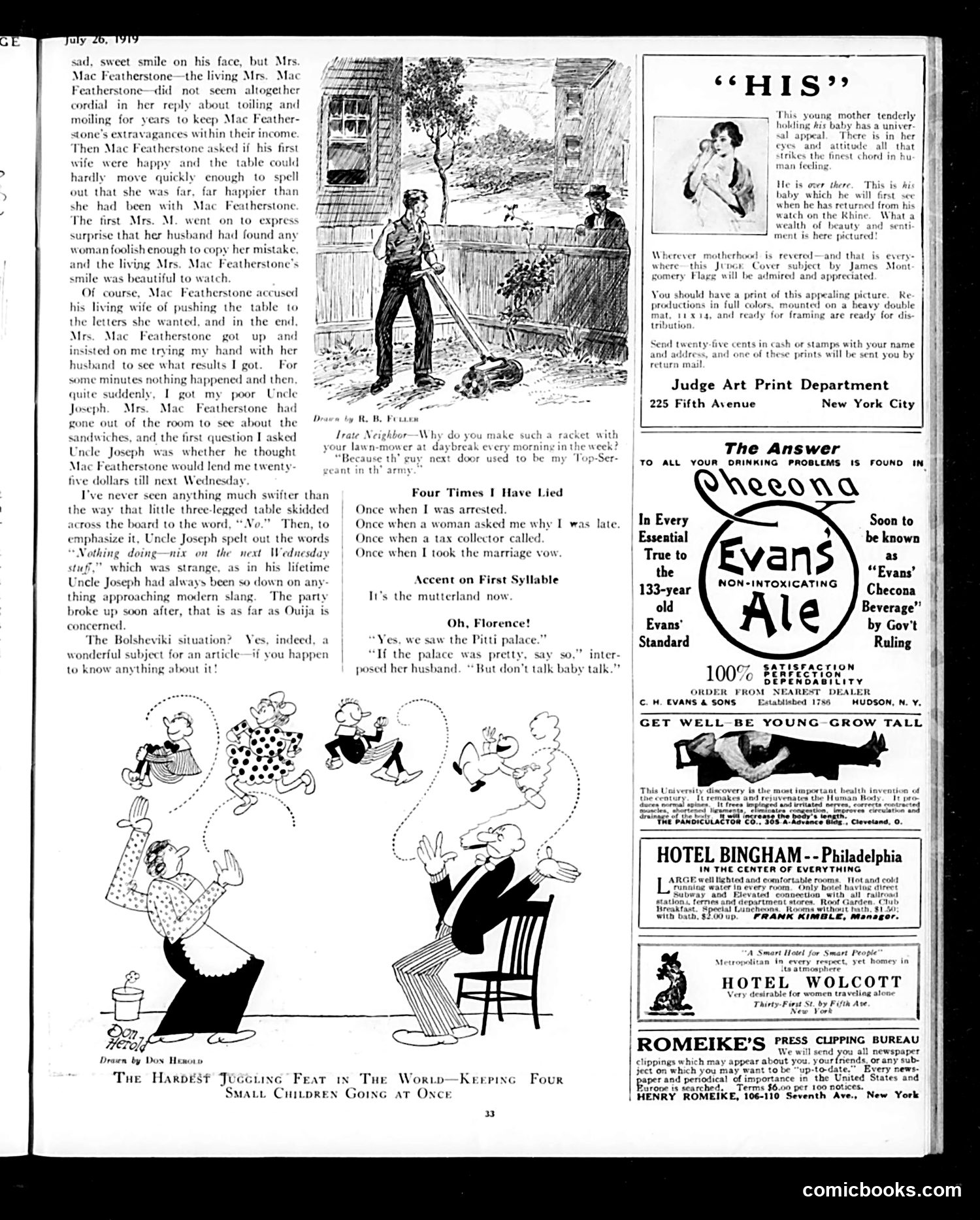
This page contains a humorous domestic story about a séance involving a Ouija board. The main narrative concerns "Mac Featherstone," a man who consults a spirit board while his current wife is present, and awkwardly receives messages from his first wife—creating comic tension between the two Mrs. Featherstone's. The cartoon at bottom left, titled "The Hardest Juggling Feat in the World," illustrates the joke with a man frantically juggling small children while sitting in a chair—a visual metaphor for managing multiple domestic complications simultaneously. The page is primarily filled with advertisements (Evans' Ale, hotels, print services, clipping bureaus) typical of Judge's revenue model. The era's reference to Bolsheviki, modern slang criticism, and marriage vow jokes reflect 1919 social attitudes. The separate "HIS" feature promotes a sentimental portrait of motherhood, contrasting with the satirical domestic humor elsewhere on the page.
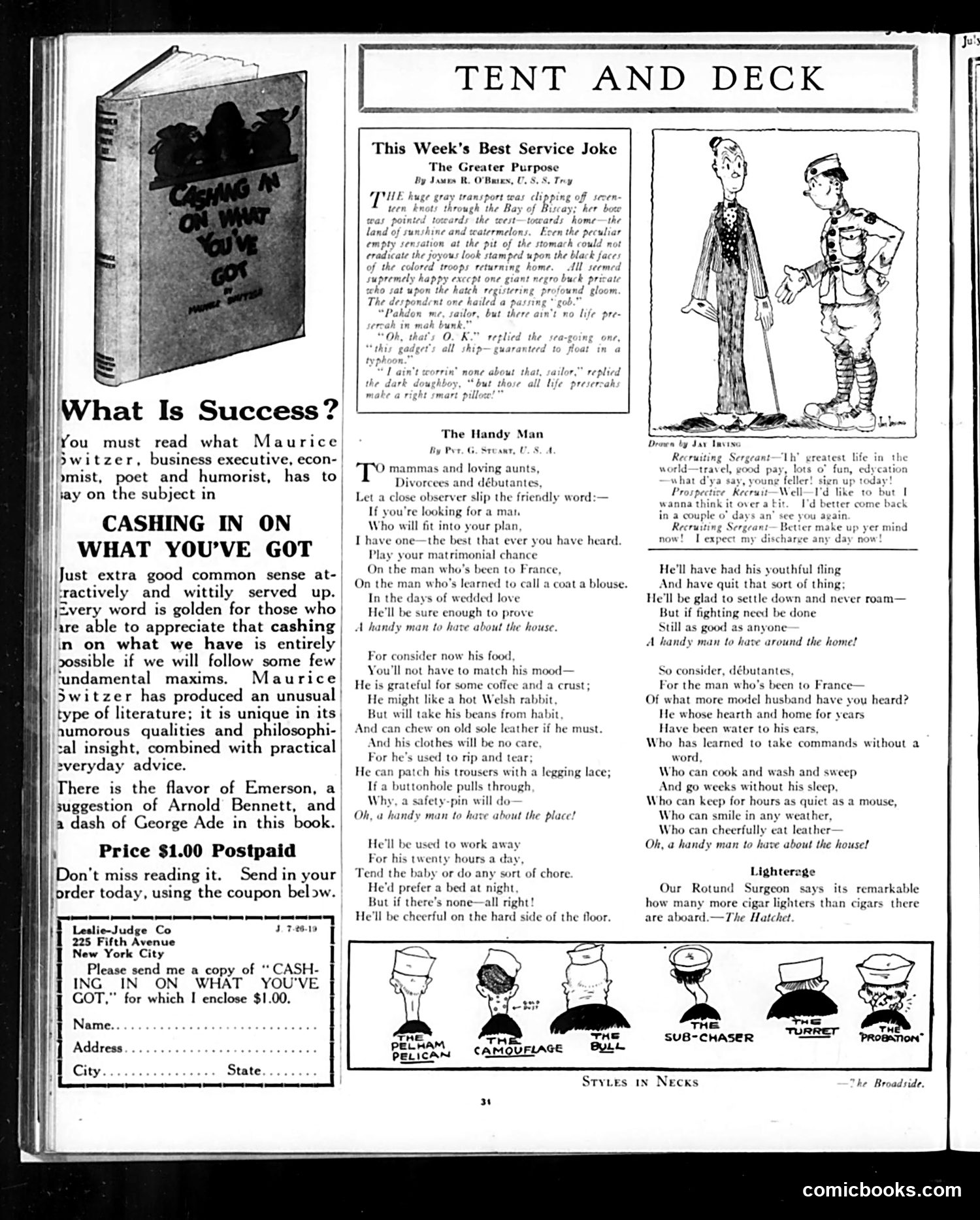
This page is primarily advertising and humor content from Judge magazine, not political satire. The main feature is an advertisement for Maurice Switzer's book "Cashing In On What You've Got," promoting it as practical business philosophy with literary flair comparable to Emerson and George Ade. The cartoons and poems are light service humor: **"The Handy Man"** satirizes the ideal husband as a war veteran who's been "to France"—implying post-WWI soldiers. The joke presents him as useful precisely because military service trained him to endure hardship, accept orders, repair things, and work without complaint. This reflects early 1920s attitudes toward returning servicemen as domestically valuable. **The neck styles illustration** shows contemporary fashion variations with military names (Pelham, Camouflage, Bull, Sub-Chaser, Turret, Prohibition), using WWI terminology humorously for civilian clothing. **"Lighterage"** is a brief naval joke about cigar lighters versus cigars aboard ship—likely a USN publication's humor. The page reflects post-WWI American culture and light, practical humor rather than serious satire.
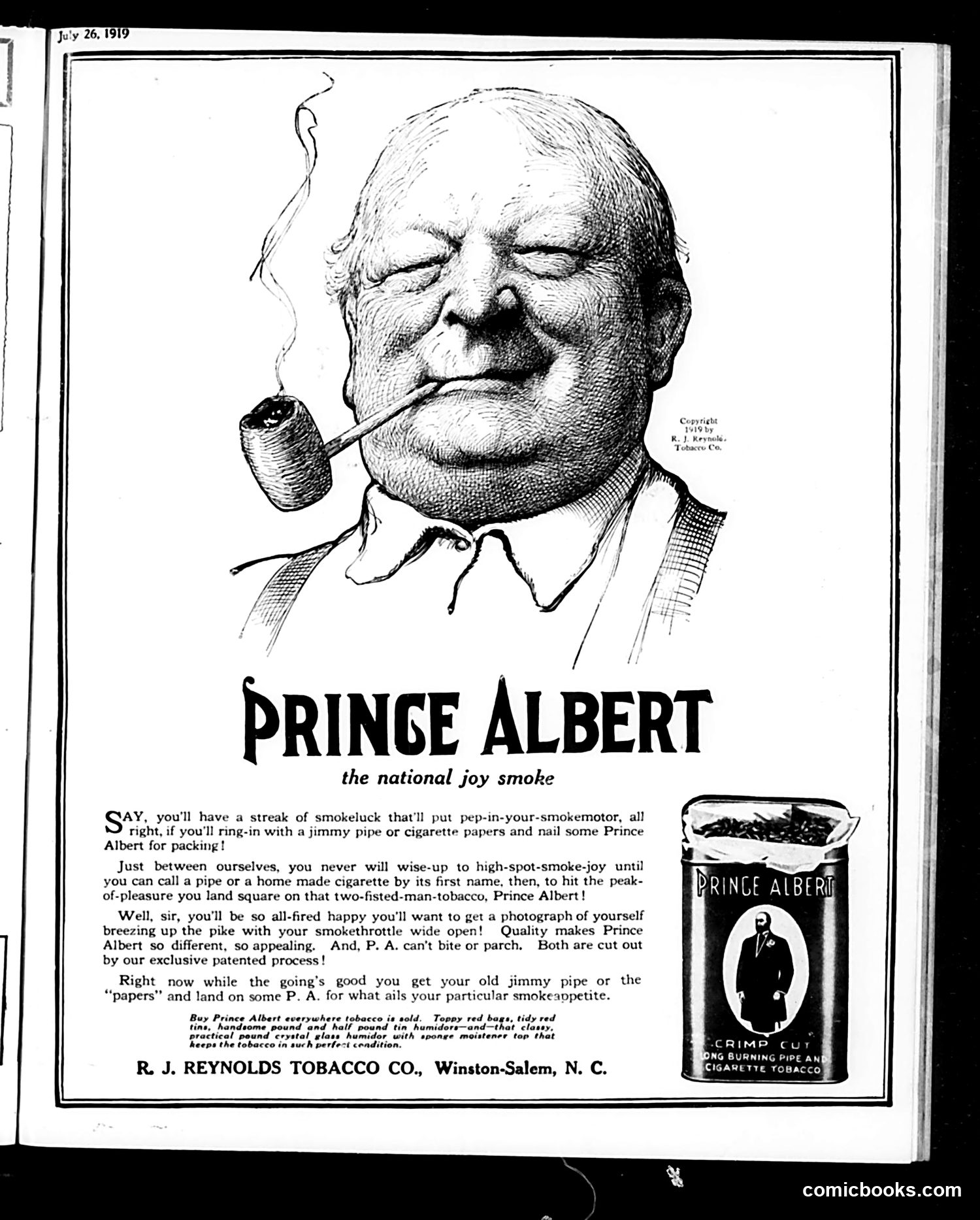
This is a **tobacco advertisement**, not political satire. It promotes Prince Albert pipe and cigarette tobacco through an illustrated portrait of an unnamed distinguished gentleman smoking a pipe. The ad uses period slang ("smokeluck," "smokemotor," "smokethrottle") and appeals to masculine identity—"two-fisted-man-tobacco" suggests virility and toughness. It emphasizes the product's quality and unique "patented process," and highlights its availability in various forms: loose tobacco, bags, tins, and humidors. The ad ran in *Judge*, a satirical magazine, but this particular page functions as straightforward commercial promotion rather than social commentary. It reflects early 20th-century advertising's casual approach to tobacco marketing, before health warnings or restrictions existed.
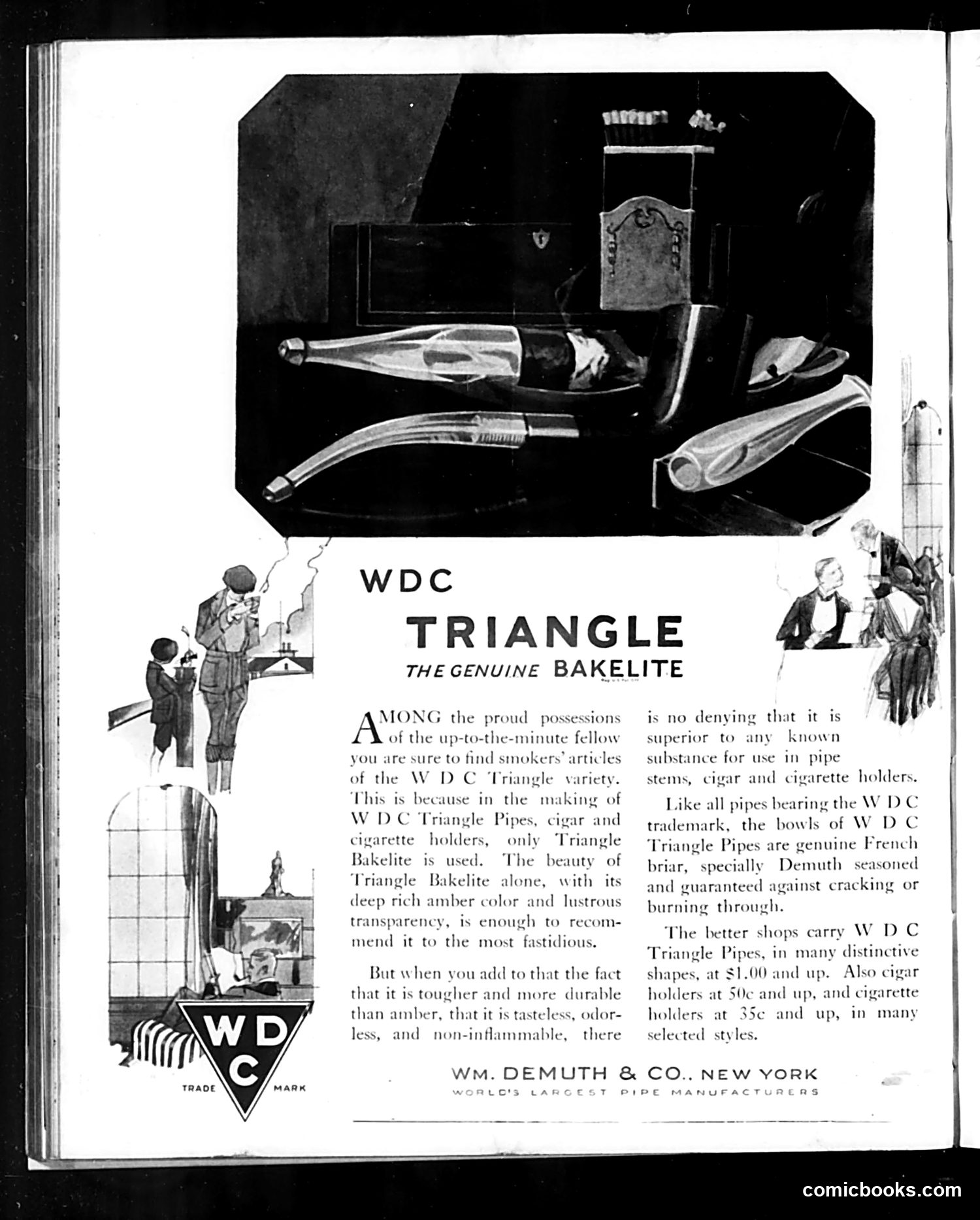
This page is **primarily an advertisement**, not satire or political commentary. It promotes WDC Triangle smoking pipes and accessories made by Wm. Demuth & Co., a major pipe manufacturer. The ad highlights **Bakelite**, an early synthetic plastic material, as a superior alternative to natural amber for pipe stems and cigarette holders. It emphasizes Bakelite's advantages: durability, tastelessness, odorlessness, and non-flammability—a selling point reflecting period concerns about fire hazards. The decorative illustrations show well-dressed men and period fashion, typical of advertisements targeting affluent male smokers. The French briar bowls and prices ($1.00 pipes, 35-50¢ holders) suggest a quality product for middle-to-upper-class consumers. There is **no discernible political or satirical content**—this is straightforward commercial advertising from Judge magazine's revenue stream.