
Judge, 1919-07-26 · page 13 of 36
Judge — July 26, 1919 — page 13: what you’re looking at
What you’re looking at
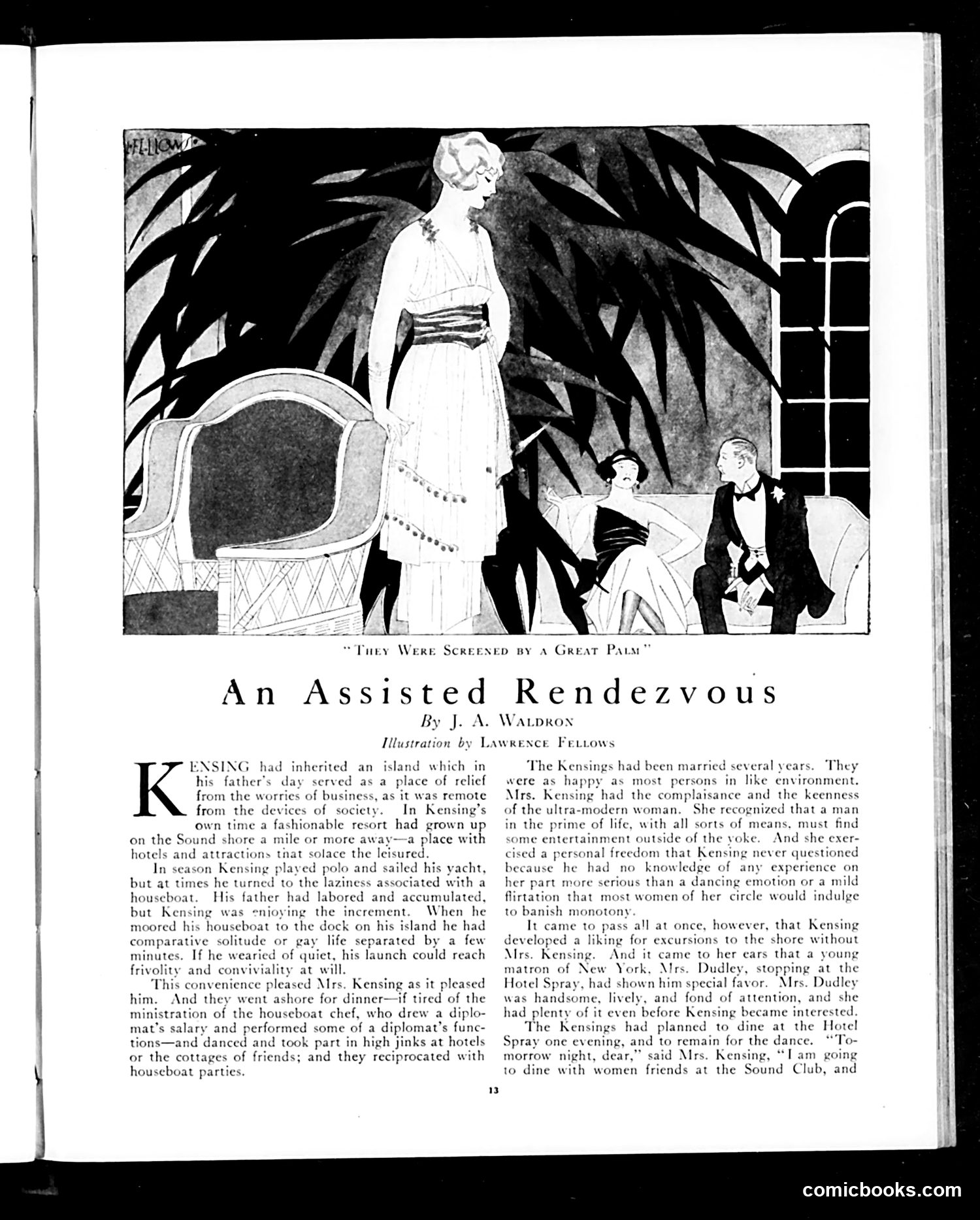
This is a short story illustration, not political satire. The narrative concerns wealthy leisure-class adults in what appears to be the 1920s, living near Long Island Sound. **The Setup:** Kensing, a wealthy man with inherited money, owns an island with a houseboat—a convenient retreat between his private property and fashionable resort hotels nearby. He and his wife Mrs. Kensing maintain a modern, permissive marriage where both pursue outside interests without serious objection. **The Conflict:** Kensing develops a romantic interest in Mrs. Dudley, an attractive visitor at a nearby hotel. Mrs. Kensing learns of this and plans her own evening out, ostensibly with women friends at the Sound Club. **The Satire:** The story gently mocks the "ultra-modern" wealthy couple's arrangement—their mutual infidelities dressed up as sophistication and freedom. The title's irony suggests Mrs. Kensing's evening is similarly arranged to facilitate her own romance, creating parallel "assisted rendezvous."
📄 Transcribed text from this page (OCR, searchable)
Machine-transcribed from the original scan — historical spelling and the odd misread are preserved.
“Turvy Were Screened sy a Great Patn” An Assisted Rendezvous By J. A. Watprox Tilustration by Lawrence Fettows ENSIN nad inherited an island which in his father’s day served as a place of relief from the worries of business, as it was remote from the dev In Kensing’s own time a fashionable resort had grown up on the Sound shore a mile or more away—a place with hotels and attractions that solace the leisured. In season Kensing played polo and sailed his yacht, but at times he turned to the laziness associated with a houseboat. His father had labored and accumula but Kensing was enioying the increment. When he moored his houseboat to the dock on his island he had comparative solitude or gay life separated by a few minutes. If he wearied of quiet, his launch could reach frivolity and conviviality at will. This convenience pleased Mrs. Kensing as it pleased him. And they went ashore for dinner—if tired of the ministration of the houseboat chef, who drew a diplo- mat’s salary and performed some of a diplomat’s func- tions—and danced and took part in high jinks at hotels or the cottages of friends; and they reciprocated with houseboat parties. es of society. ed, 13 ‘The Kensings had been married several years. They were as happy as most persons in like environment. Mrs. Kensing had the complaisance and the keenness of the ultra-modern woman. She recognized that a man in the prime of life, with all sorts of means, must find some entertainment outside of the yoke. And she exer- cised a personal freedom that Kensing never questioned because he had no knowledge of any experience on her part more serious than a dancing emotion or a mild flirtation that most women of her circle would indulge to banish monotony It came to pass all at once, however, that Kensing developed a liking for excursions to the shore without Mrs. Kensing. And it came to her ears that a young matron of New York, Mrs. Dudley, stopping at the Hotel Spray, had shown him special favor. Mrs. Dudley was handsome, lively, and fond of attention, and she had plenty of it even before Kensing became interested. The Kensings had planned to dine at the Hotel Spray one evening, and to remain for the dance. To- morrow n ” said Mrs. Kensing, “Iam going to dine with women friends at the Sound Club, and comicbooks.com