
A complete issue · 36 pages · 1919
Judge — July 5, 1919
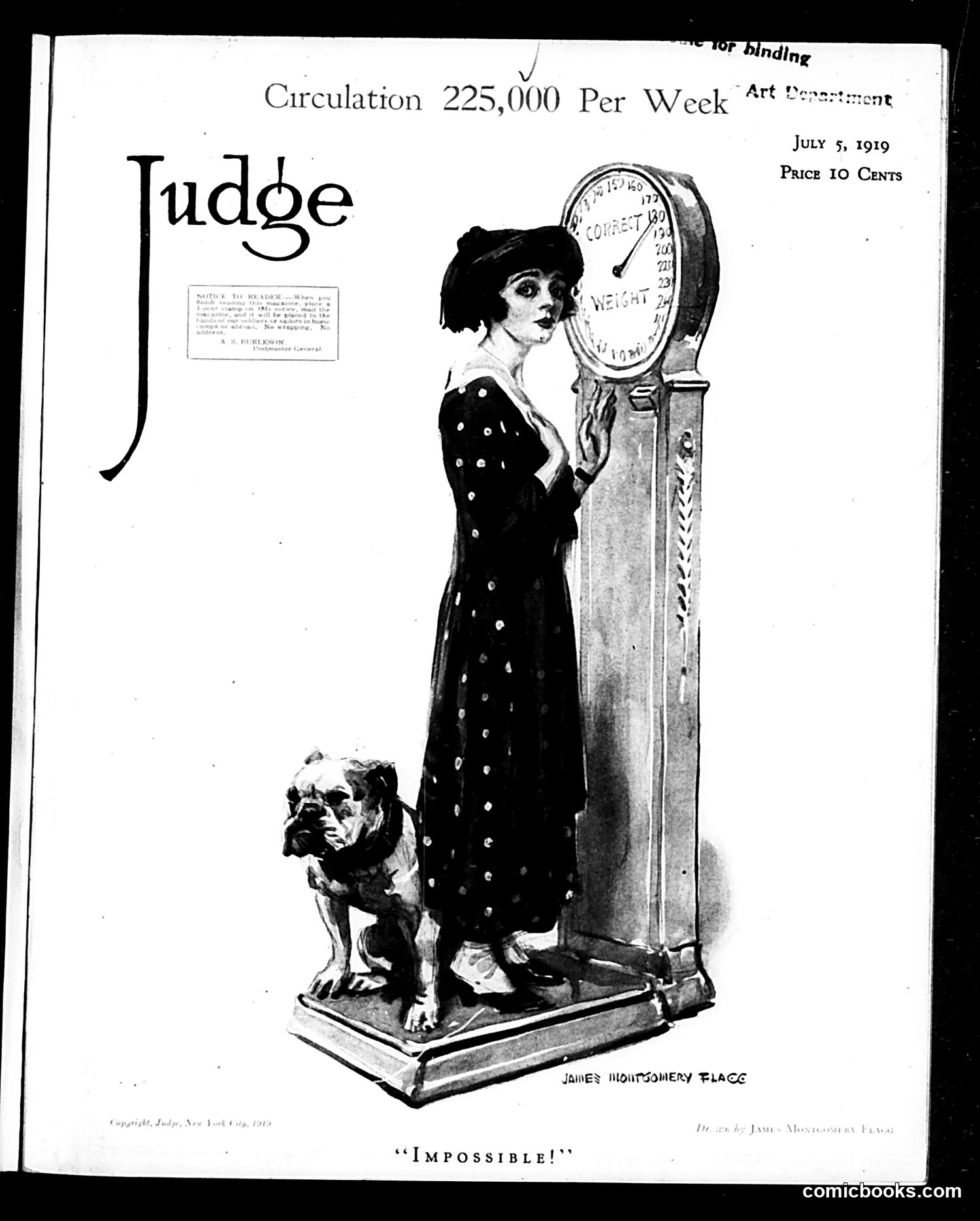
This cartoon satirizes weight-consciousness among fashionable women. A stylishly dressed woman in a polka-dotted dress checks herself on a scale while her bulldog watches. The caption "Impossible!" suggests she's shocked or denies the scale's reading—likely indicating she weighs more than expected or desired. The satire targets the vanity and body image anxieties of upper-class women in the 1920s, when slim silhouettes were fashionable. The artist (James Montgomery Flagg, a prominent illustrator) mocks both the woman's denial and the era's obsession with weight and appearance. The loyal dog serves as a silent, non-judgmental witness to human vanity, heightening the humor through contrast.
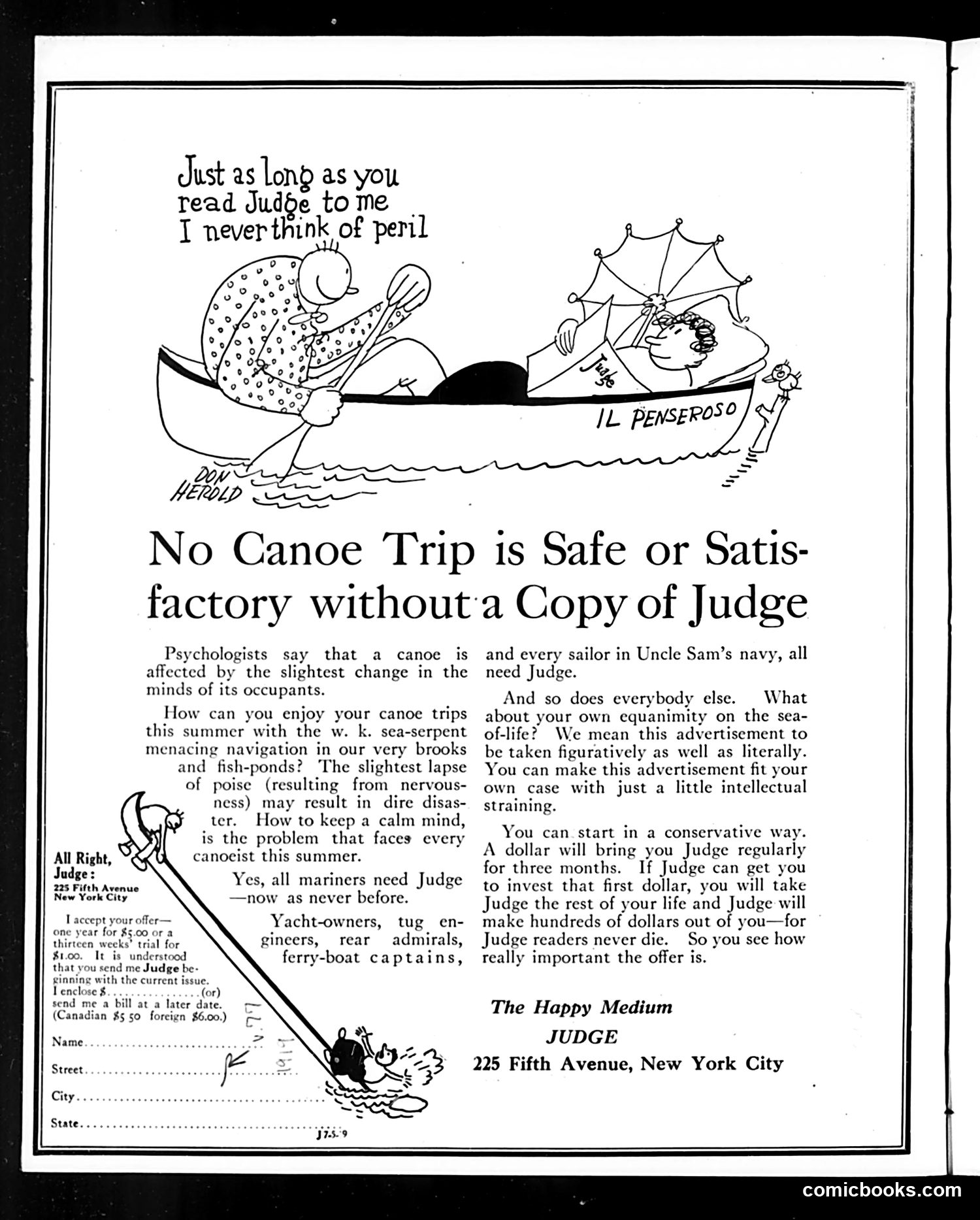
This is primarily a **humorous advertisement** for "Judge" magazine itself, disguised as satirical advice. The page uses playful cartoon illustrations of canoe trips to promote subscriptions. The central joke plays on psychological anxiety: the text claims that canoes are "affected by the slightest change in the minds of its occupants," creating nervousness that causes accidents. The satirical solution is absurd—reading Judge magazine supposedly keeps one calm enough to safely canoe. The advertisement targets middle-class leisure activities (summer canoe trips) and appeals to subscribers by claiming Judge provides necessary mental equilibrium. The bottom section offers subscription pricing ($1 for one year, $2.50 for three years). This represents early 20th-century magazine self-promotion through humor rather than direct selling—a common Judge advertising strategy.
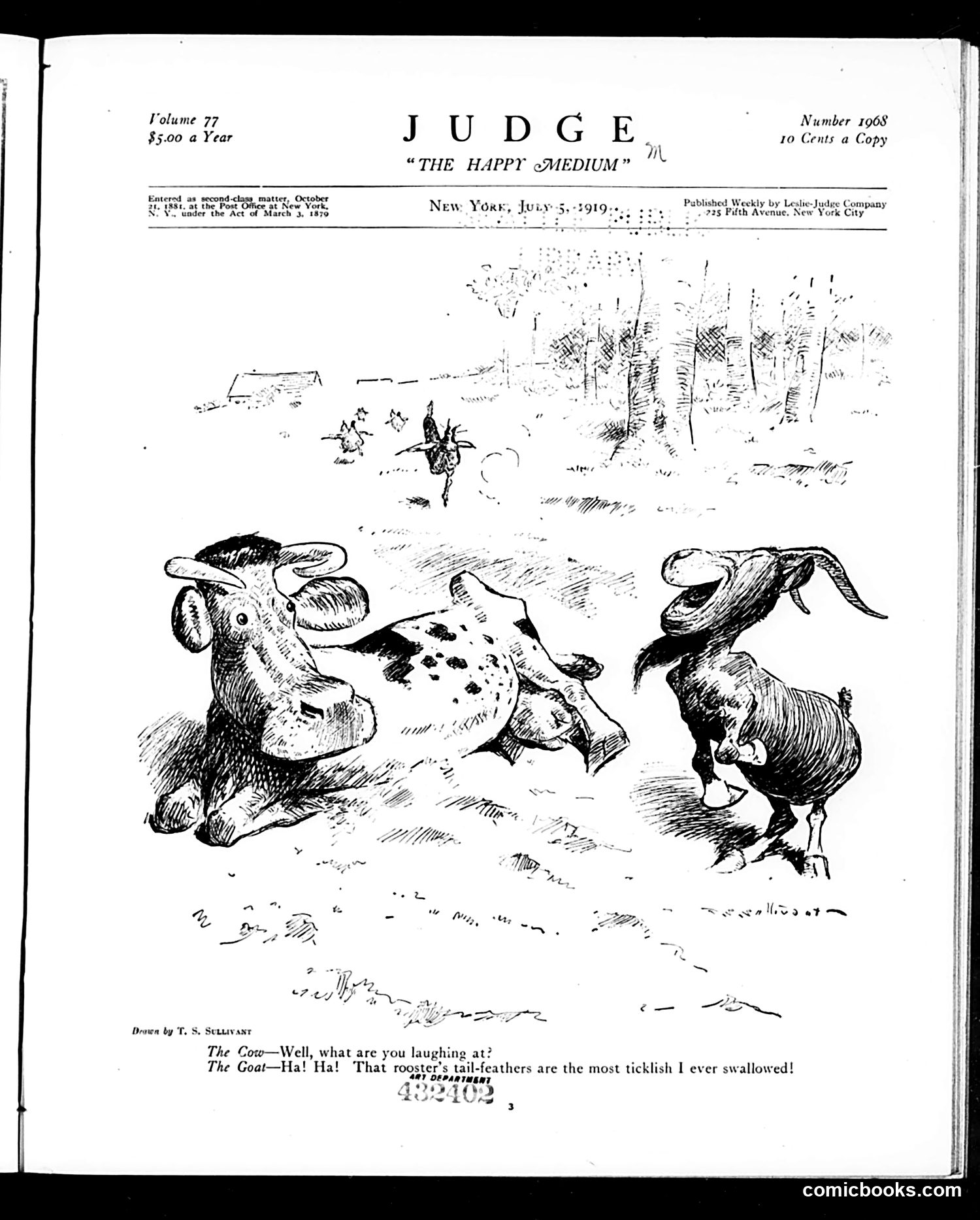
This is a simple farmyard humor cartoon from Judge magazine (July 5, 1919), drawn by T. S. Sullivant. It depicts three animals—a cow, a rooster, and a goat—in conversation. The cow asks what the goat is laughing about, and the goat replies that it swallowed the rooster's tail-feathers and finds them ticklish. The humor is purely slapstick and nonsensical rather than political or satirical. It relies on the absurdity of the scenario and anthropomorphic animal antics, typical of early 20th-century comic magazine filler content. There are no apparent political references or social commentary—it's simply meant to provoke mild amusement through wordplay and crude farm animal comedy.
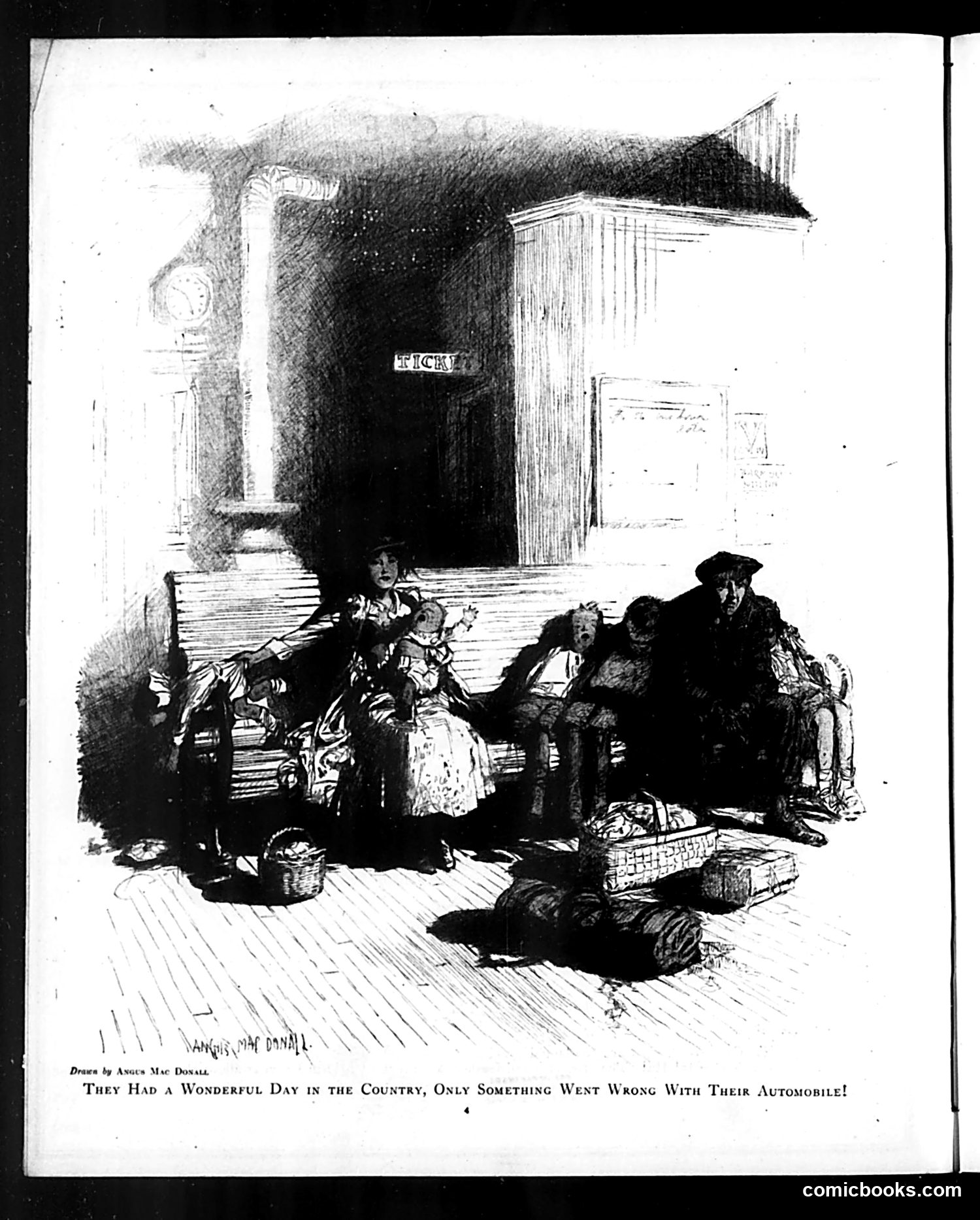
This illustration by Agnes MacDonald satirizes early automobile culture. The caption reads: "They Had a Wonderful Day in the Country, Only Something Went Wrong With Their Automobile!" The cartoon depicts well-dressed urbanites stranded outside a rural building (marked "KITCHEN"), sitting among their belongings and baskets. Their predicament illustrates a common early 1900s social anxiety: automobiles were still unreliable machines prone to mechanical failure, especially on country roads far from repair services. The satire targets the emerging leisure class's enthusiasm for motor trips despite automobiles' notorious unpredictability. The contrast between the passengers' formal attire and their awkward roadside predicament underscores the gap between aspirations and reality—a reliable automobile journey was hardly guaranteed, making these excursions often comedic disasters.
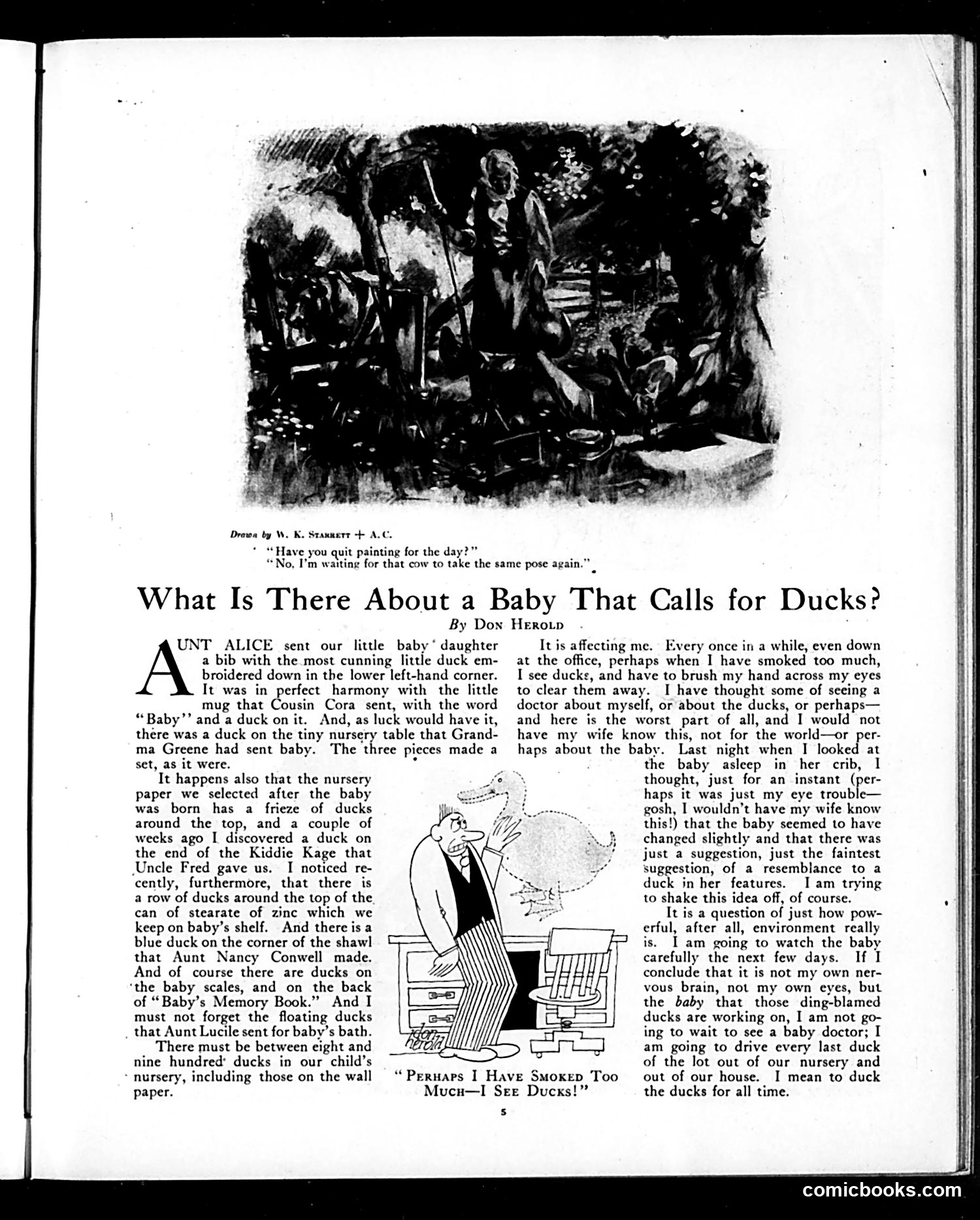
This is a humorous domestic article by Don Herold titled "What Is There About a Baby That Calls for Ducks?" The joke concerns a new baby gift from relatives—a mug and nursery items decorated with ducks—that has become an obsession. The author humorously describes how duck imagery has proliferated throughout the nursery: on wallpaper, scales, memory books, and bath toys. He's now paranoid that his baby is becoming duck-obsessed, even imagining the infant has duck-like features. The cartoon illustration shows a man at his desk, apparently distressed, with the caption "Perhaps I Have Smoked Too Much—I See Ducks!" reinforcing the absurdist premise. The satire gently mocks new-parent anxiety and the tendency of well-meaning relatives to shower babies with themed gift sets, creating unintended comedic excess.
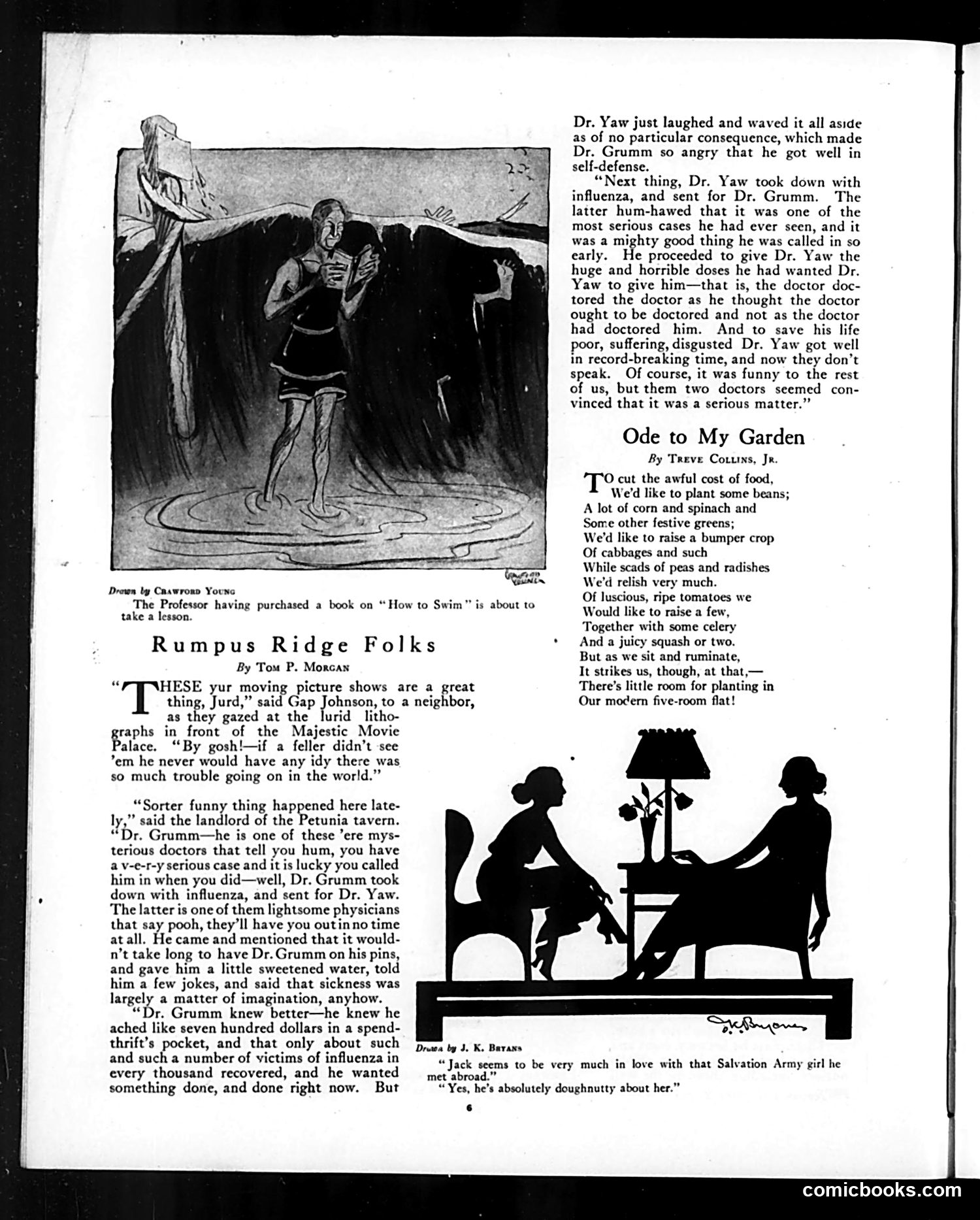
This page contains three pieces: 1. **"Rumpus Ridge Folks"** - A humorous story about two doctors (Grumm and Yaw) who treat each other during an influenza outbreak. The joke hinges on professional rivalry: Dr. Grumm, believing he needs doctoring, calls Dr. Yaw—then complains about the treatment, while Dr. Yaw recovers remarkably fast. The satire mocks medical pride and the irony of doctors being poor patients. 2. **"Ode to My Garden"** - A poem lamenting the impossibility of gardening in modern urban apartments ("five-room flats"), reflecting post-WWI housing constraints and nostalgia for rural life. 3. **A silhouette illustration** depicting a domestic scene, likely satirizing romantic or relationship dynamics. The content targets early 20th-century urban life, class concerns, and professional vanity.
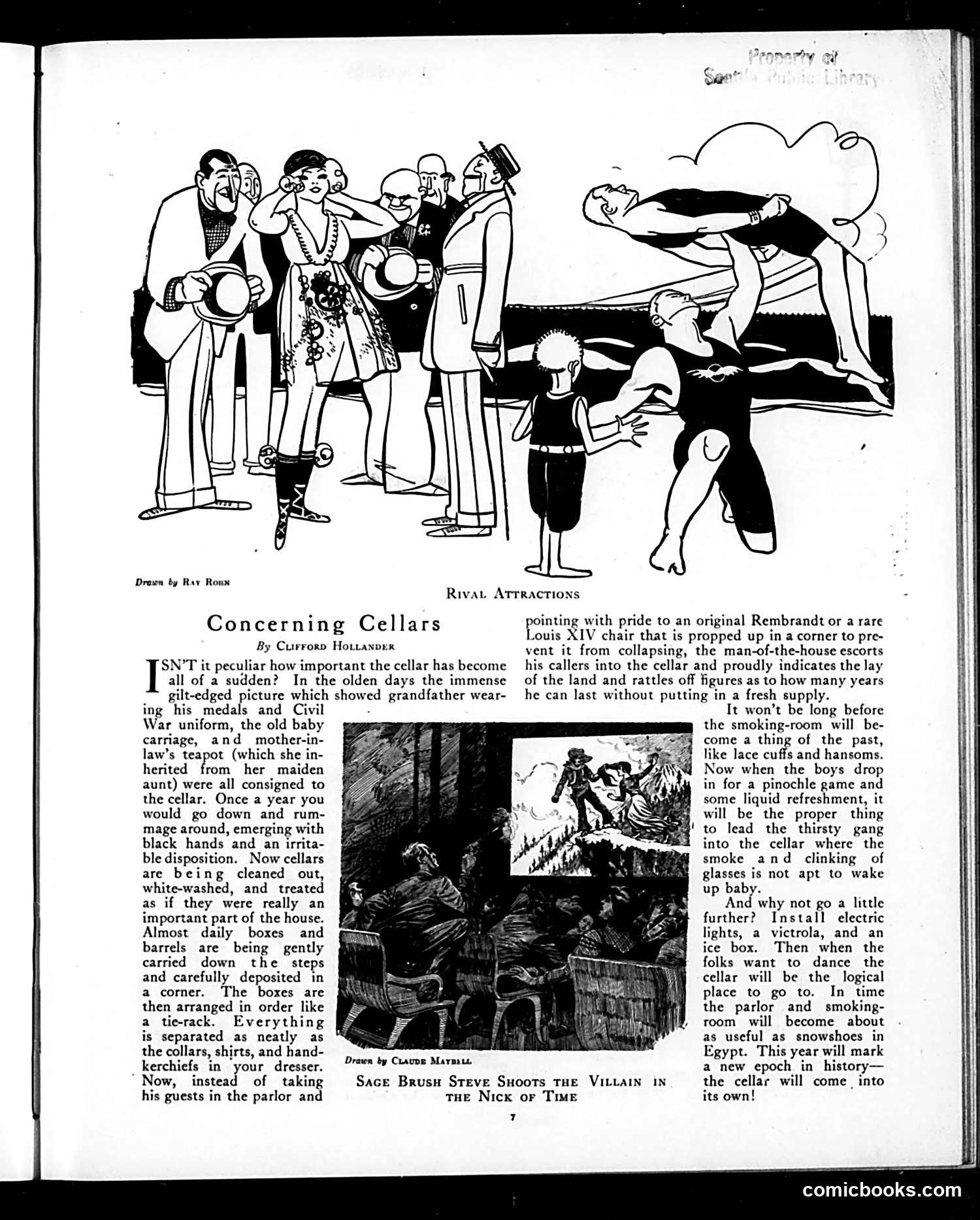
This article satirizes how American homeowners have suddenly begun treating cellars as valuable spaces during Prohibition (implied by references to "liquid refreshment" and storing goods). **The joke:** In the pre-Prohibition past, cellars were dumping grounds for unwanted heirlooms and junk. Now they're meticulously organized and proudly displayed to guests—because they're secretly storing alcohol. The author mockingly suggests installing "electric lights, a victrola, and an ice box" to make cellars social centers, predicting they'll replace parlors entirely. **The satire's target:** The hypocrisy and desperation of Americans evading Prohibition laws by converting basements into speakeasies and storage facilities. The piece pokes fun at homeowners' elaborate pretense that they're simply being tidy, when they're obviously stockpiling contraband. The accompanying illustration shows socialites and gentlemen in formal dress observing the cellar activities—reinforcing that illegal alcohol consumption had become fashionable among the upper classes.
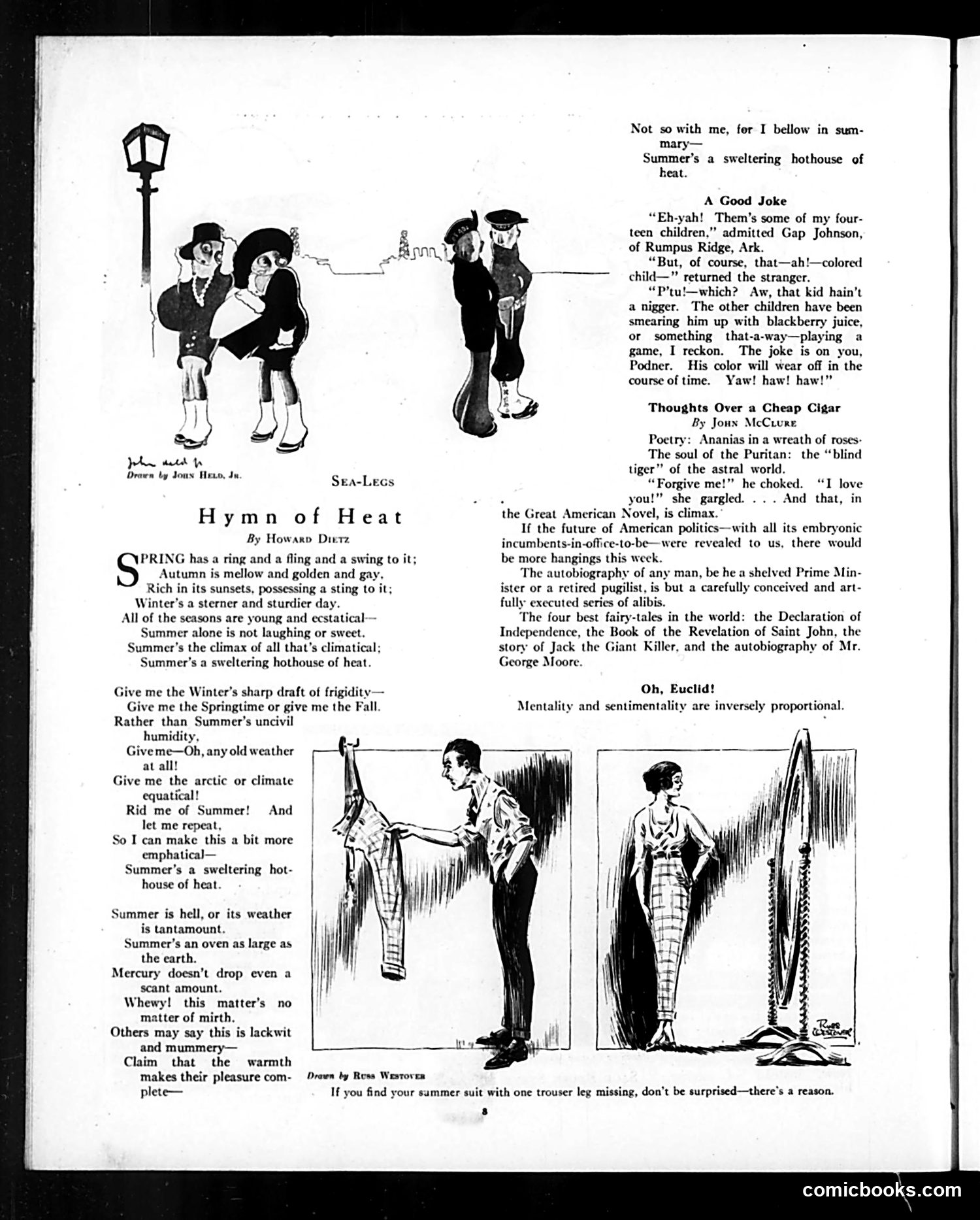
This page contains satirical content typical of early 20th-century Judge magazine: **"Sea-Legs" cartoon**: Two working-class figures (likely sailors or dock workers based on the title) are depicted with exaggerated features in a crude caricature style common to the era. **"Hymn of Heat"**: A poem by Howard Dietz complaining extensively about summer weather—straightforward seasonal satire with no political content. **"A Good Joke"**: A dialect-heavy story mocking rural Arkansas ("Gap Johnson, of Rumpus Ridge, Ark."). The "joke" relies on a racist premise: a child appears dark-skinned, but it's merely blackberry juice from children's games. The humor targets both rural dialect speakers and contains casual period racism. **"Thoughts Over a Cheap Cigar"**: Brief literary commentary on American politics and autobiographies, with social criticism about politicians' dishonesty. **Bottom cartoon by Ross Westeroven**: A domestic humor piece about summer suits shrinking or deteriorating in heat—no political content. The page reflects Judge's mix of weather complaints, rural mockery, and casual racism typical of early American satirical magazines.
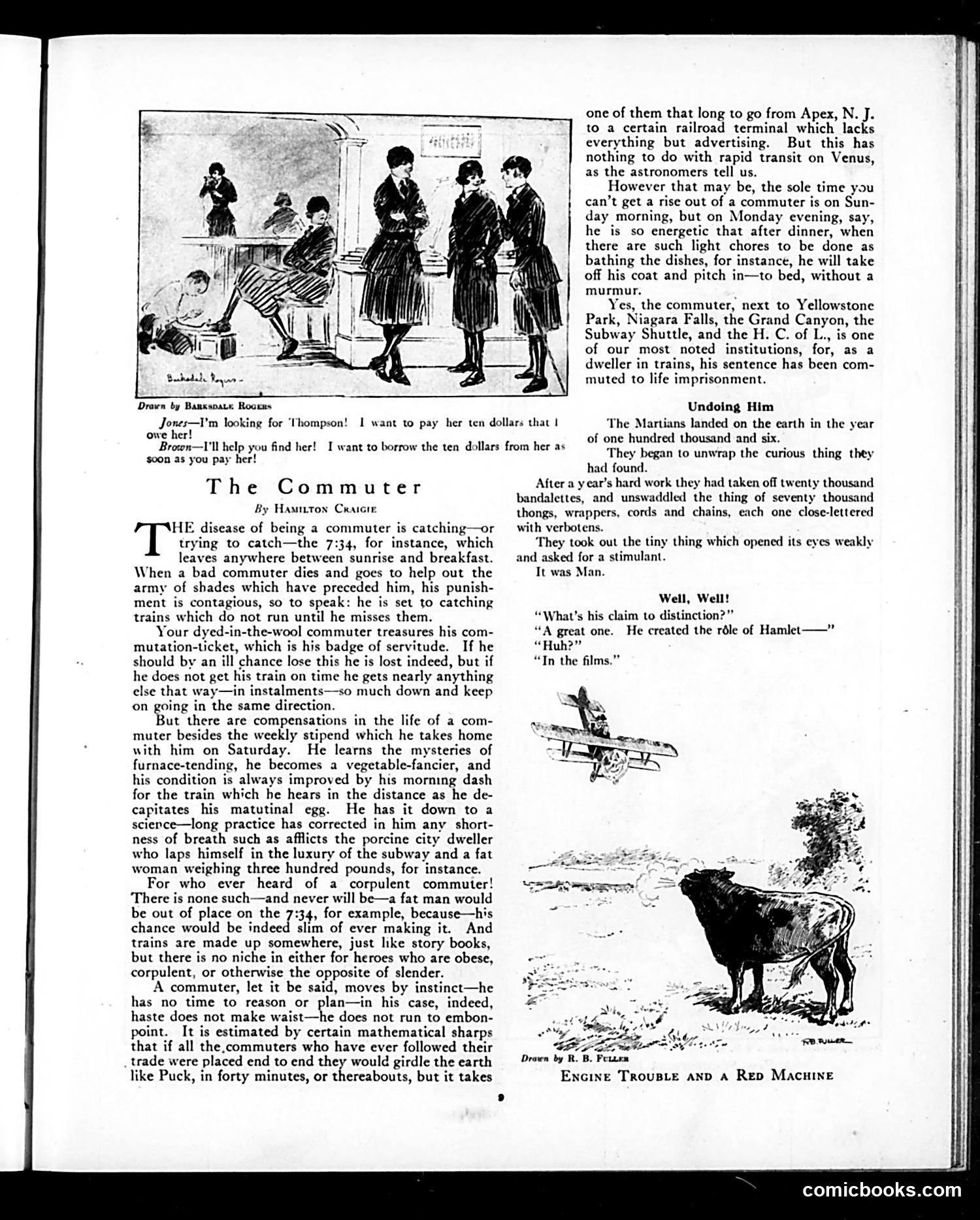
This page contains three satirical pieces mocking American urban life circa early 20th century. **"The Commuter"** by Hamilton Craigie is the main article, a humorous essay ridiculing the daily grind of commuters catching trains like the 7:34. Craigie jokes that commuters are so thin and exhausted they're practically invisible, that missing trains becomes habitual punishment, yet they treasure their commutation tickets as "badges of servitude." The piece satirizes how commuting supposedly keeps men fit (no obese commuters exist) while draining their vitality—they're energetic only on Monday evenings after work, collapsing without complaint into bed. **"Undoing Him"** is a sci-fi joke: Martians spend a year unwrapping layers of clothing/constraints from a mysterious Earth object, only to discover it's Man—reduced to asking for stimulants. The satire suggests humans are over-civilized, wrapped in societal restrictions. The cartoon illustration (top) and dialogue about borrowing money humorously depict working-class financial anxiety.
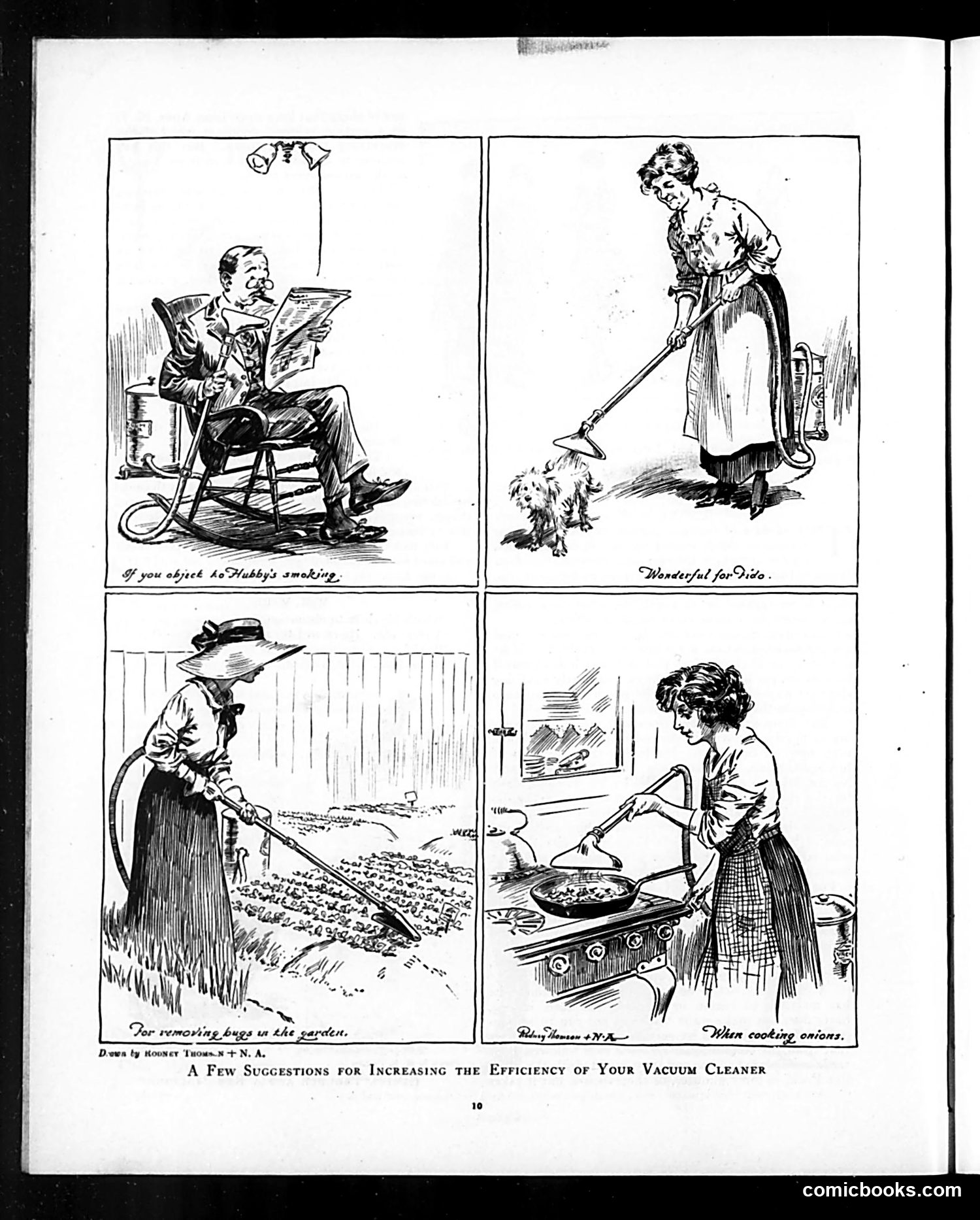
This is a satirical instructional comic from Judge magazine titled "A Few Suggestions for Increasing the Efficiency of Your Vacuum Cleaner." The four panels humorously redefine a vacuum cleaner's uses beyond household cleaning: 1. **Top left**: A man reads while smoking—the vacuum removes his cigar smoke. 2. **Top right**: A woman walks a small dog—the vacuum "cleans" the dog. 3. **Bottom left**: A woman gardens—the vacuum removes weeds/bugs from the garden. 4. **Bottom right**: A woman cooks—the vacuum removes cooking odors from onions. The satire mocks both the vacuum cleaner as a cure-all domestic appliance and traditional gender roles, suggesting women should use this device to solve all household annoyances. It's commentary on early 20th-century marketing that promoted labor-saving devices as solutions to every domestic problem.
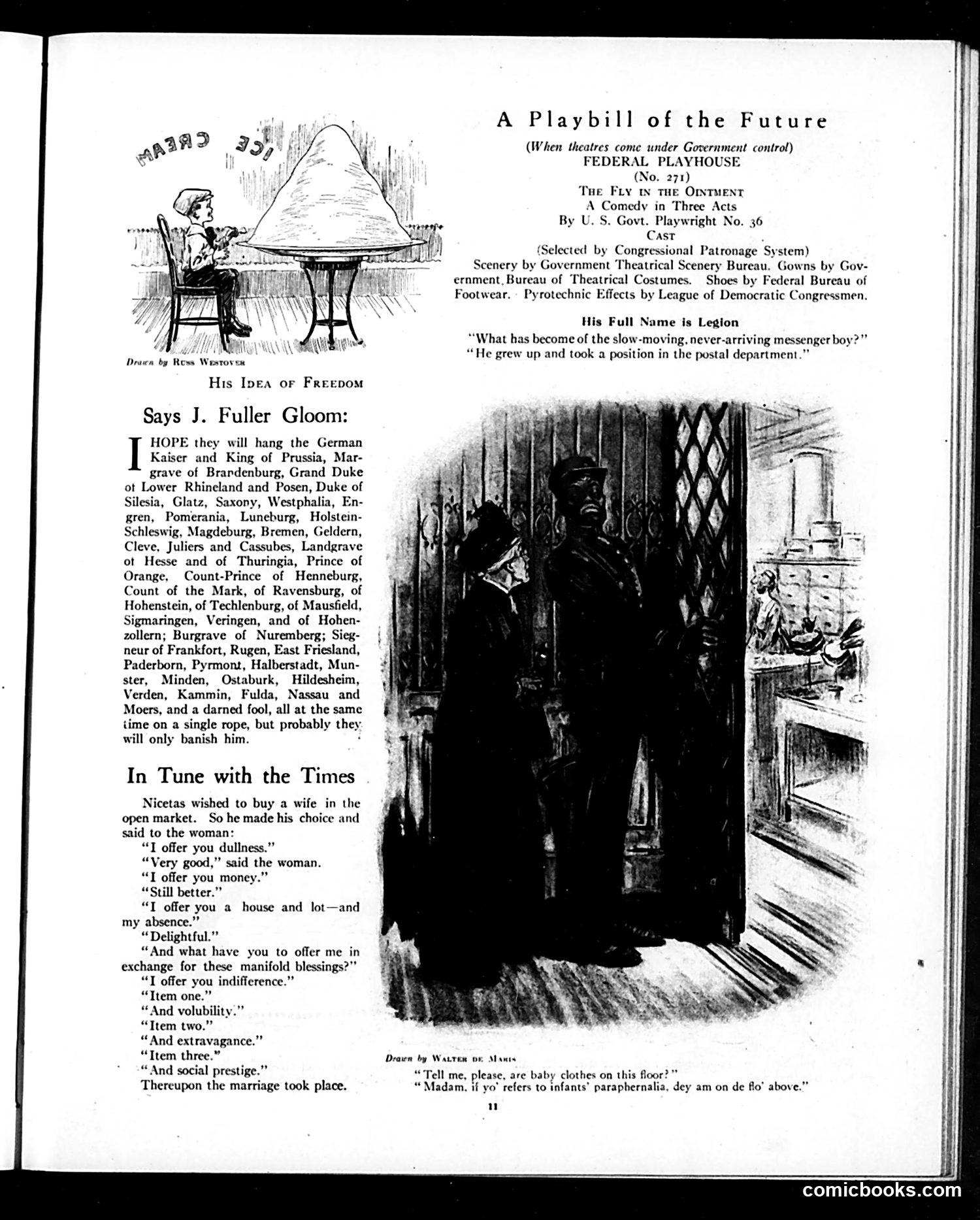
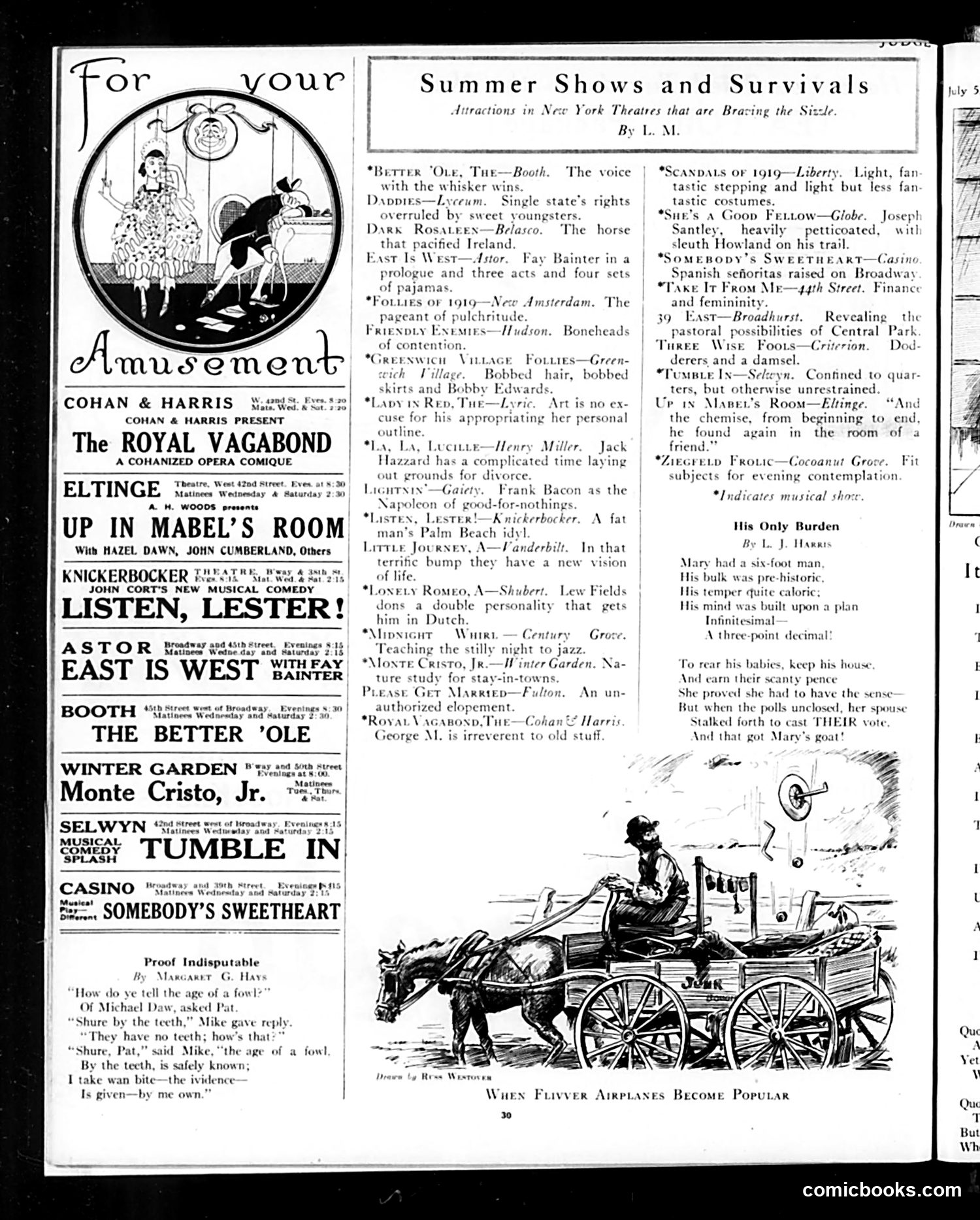
**"A Playbill of the Future"** satirizes government control of theaters during what appears to be WWI-era America. The mock playbill imagines a federal bureaucracy so expansive that every theatrical element—scenery, costumes, shoes, even pyrotechnic effects—falls under different government bureaus. This mocks concerns about expanding government overreach and wartime centralization of industry. **"His Idea of Freedom"** presents J. Fuller Gloom's lengthy tirade about hanging the German Kaiser, cataloging his numerous German titles. The satire targets jingoistic war rhetoric—the absurd litany of titles emphasizes how Americans obsess over enemy leaders while the joke's punchline suggests they'll likely just banish him, undercutting the bloodthirsty sentiment. **"In Tune with the Times"** uses matrimonial negotiation as social commentary on modern marriage and gender relations, where both parties cynically trade material comfort for emotional detachment. The cartoons appear designed for Judge's educated readership to critique government expansion, wartime hysteria, and changing social values.
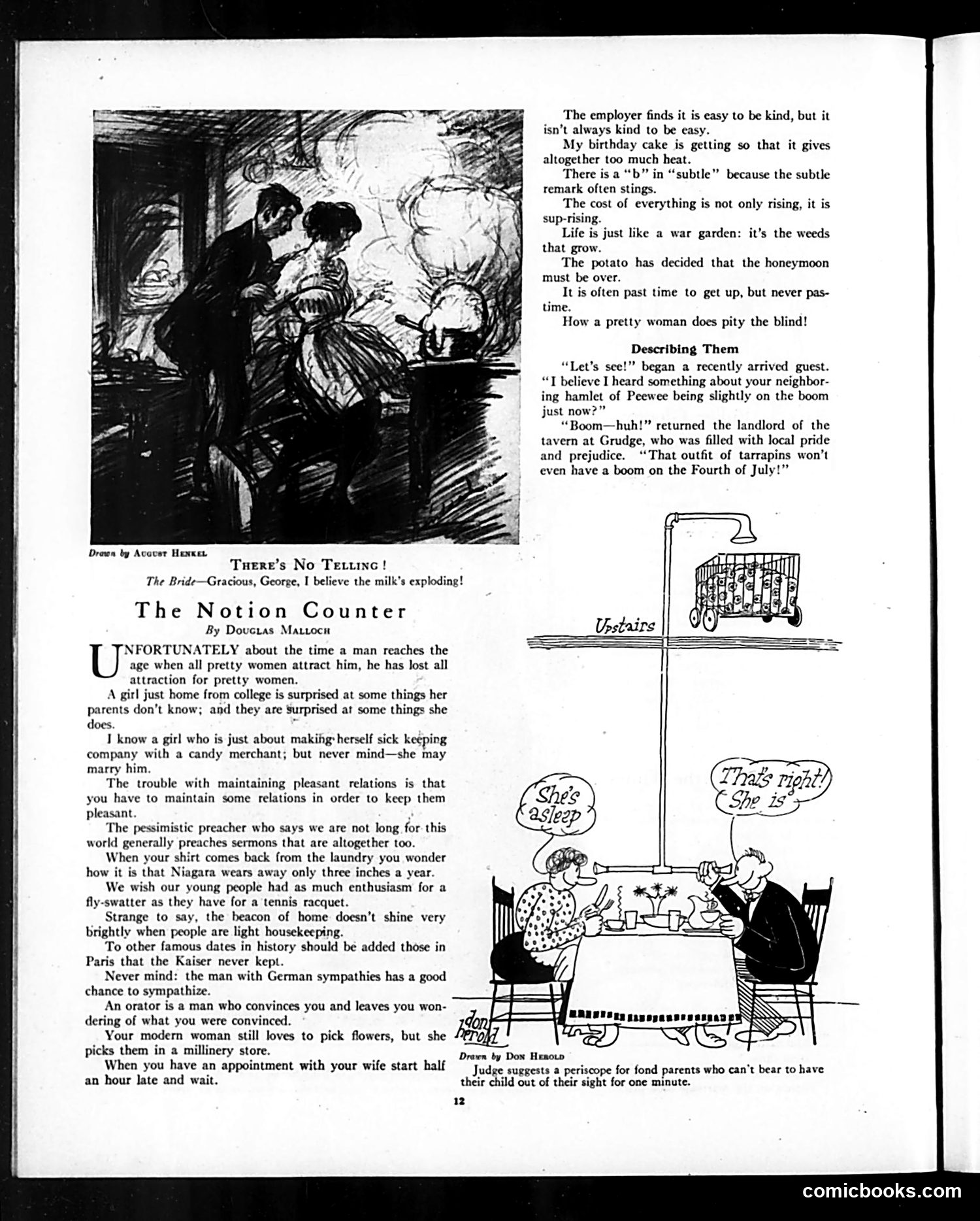
This page contains two distinct sections of satirical humor typical of early 20th-century Judge magazine: **Top cartoon ("There's No Telling!"):** A domestic scene where a bride alarmed exclaims the milk is "exploding"—likely referencing milk bottles that could burst from pressure or fermentation, a genuine household hazard of the era before reliable refrigeration. **"The Notion Counter" section:** A collection of one-liner observations and short jokes poking fun at contemporary social behaviors: the disconnect between aging men and their romantic appeal; college-educated daughters; relationships with tradesmen; marriage dynamics; gender roles; and wartime politics (the Kaiser reference suggests WWI-era publication). The final cartoon depicts parents wanting to constantly monitor their child, suggesting anxious parenting trends. The humor relies on domestic situations, gender stereotypes, and social commentary rather than political satire. The overall tone mocks modern life's absurdities and human nature's contradictions through brief, cynical observations—characteristic of Judge's satirical approach to American society.
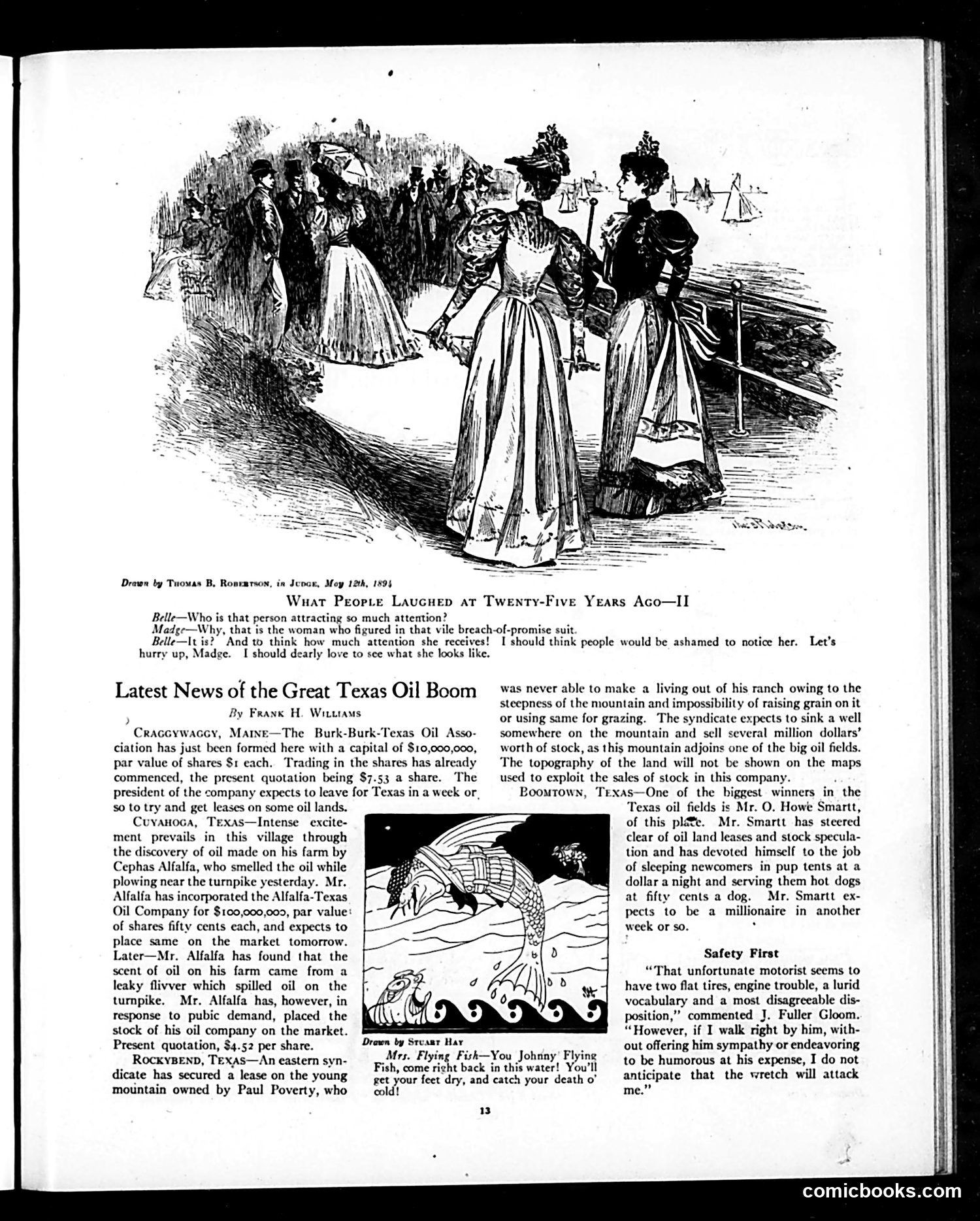
## Top Cartoon: "What People Laughed at Twenty-Five Years Ago" This depicts Victorian-era social scandal. Two women discuss a third woman who was involved in a "breach-of-promise suit"—a legal action where a woman sued a man for breaking an engagement promise. The satire mocks how society fixated on such scandals and the woman's reputation, suggesting these trials-by-publicity were both lurid entertainment and instruments of shame for women. ## Texas Oil Boom Articles These satirize the speculative oil boom frenzy of 1890s Texas. The humor shows absurdity at multiple levels: a farmer mistakes leaky automobile oil for natural reserves; syndicates incorporate with wildly inflated stock values; actual fortunes come not from oil but from housing and feeding desperate speculators. The joke exposes how fraudulent and irrational these investment schemes were—enriching promoters while honest prospectors lose money. ## Bottom Cartoon: "Safety First" A humorous motorist safety joke: a woman warns her husband (implied) not to help a stranded motorist, predicting he'll be attacked. Dark comedy about roadside dangers and motorcar culture.
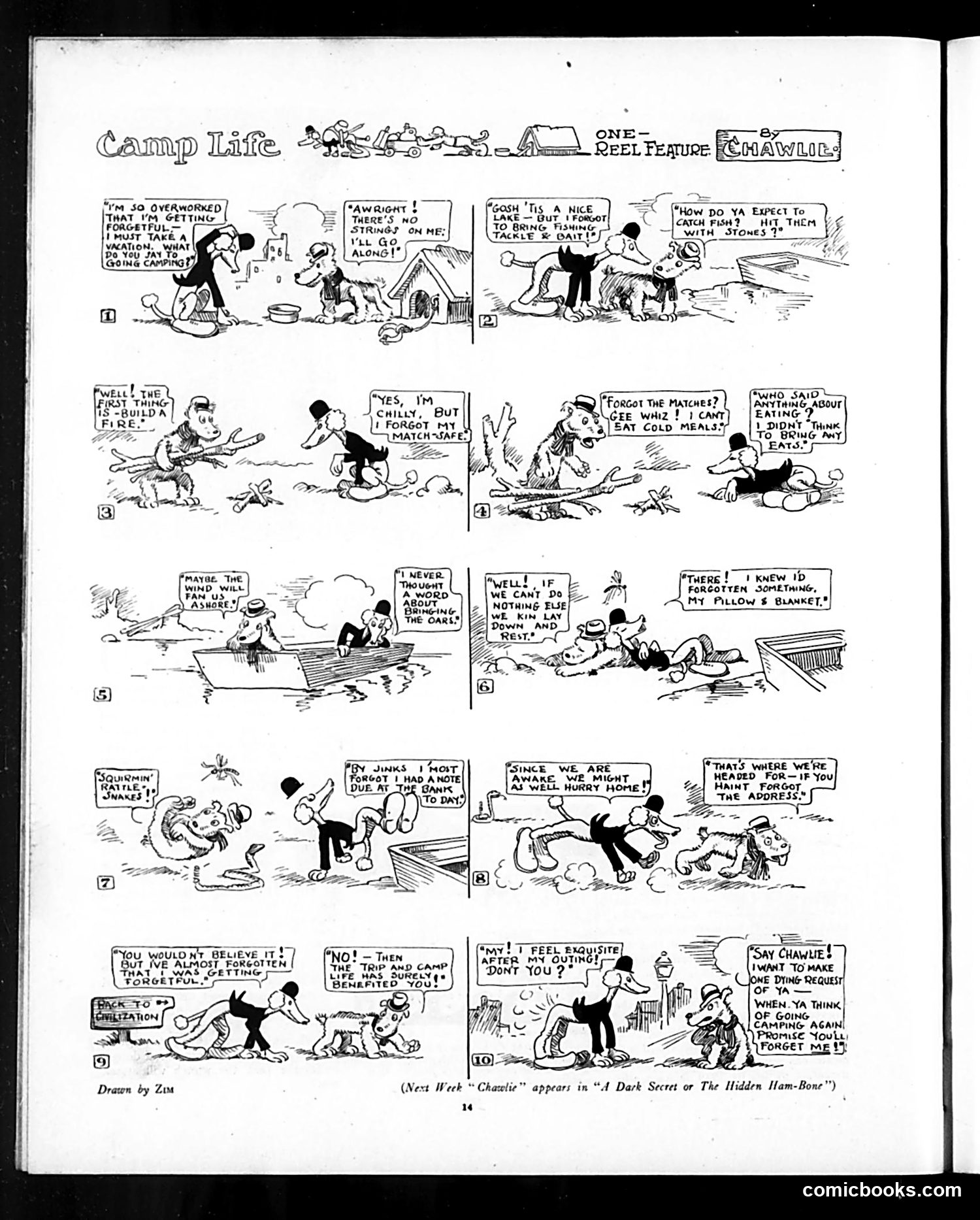
This is a slapstick comic strip about two men on a camping trip plagued by escalating forgetfulness. The narrative follows their misadventures: one character is so overworked he decides camping will help, but immediately forgets essentials—first matches, then food preparation, then his pillow and blanket. The humor escalates absurdly, culminating in them forgetting they've actually gone camping and returning home, only for one to realize mid-celebration that he forgot "the address" (their destination). The satire gently mocks urban overwork and the notion that camping provides restorative escape—instead, exhaustion renders the characters too scattered to manage even basic camping competence. The strip's title, "Camp Life," ironically undercuts any romanticization of outdoor recreation. The humor relies on physical comedy and repetitive gags typical of early-20th-century Judge magazine humor.
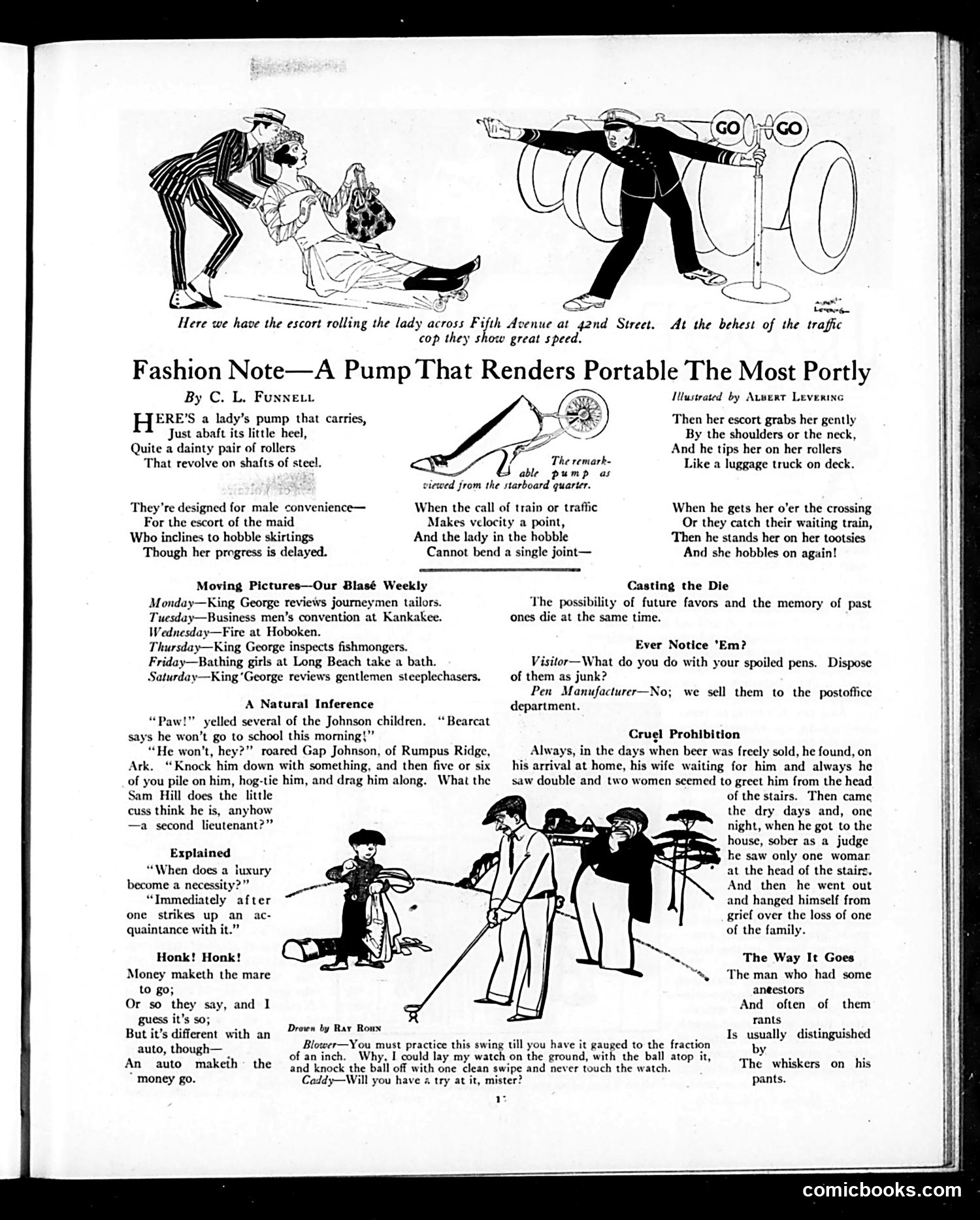
This page showcases early 1910s American satire across several pieces: **Fashion Note**: The main cartoon mocks the "hobble skirt" craze—restrictive women's fashion that severely limited movement. The joke: a gentleman must literally roll his immobilized female companion on wheeled "pumps" (shoes with rollers) across Fifth Avenue because she cannot walk or bend. The satire targets both the absurd fashion and the gallantry required to accommodate it. **Moving Pictures section**: Deadpan mockery of newsreels' mundane coverage—"King George reviews journeymen tailors" and similar trivial events treated as major news. **Other humor pieces** include: - A joke about Prohibition's effects on a man's marriage (he saw "double" when drunk; now sober and alone, he despairs) - Social commentary on luxury becoming necessity after one "acquaintance with it" - A golf lesson about precision The page satirizes fashion excess, media banality, and Prohibition's social consequences—all contemporary 1910s concerns.
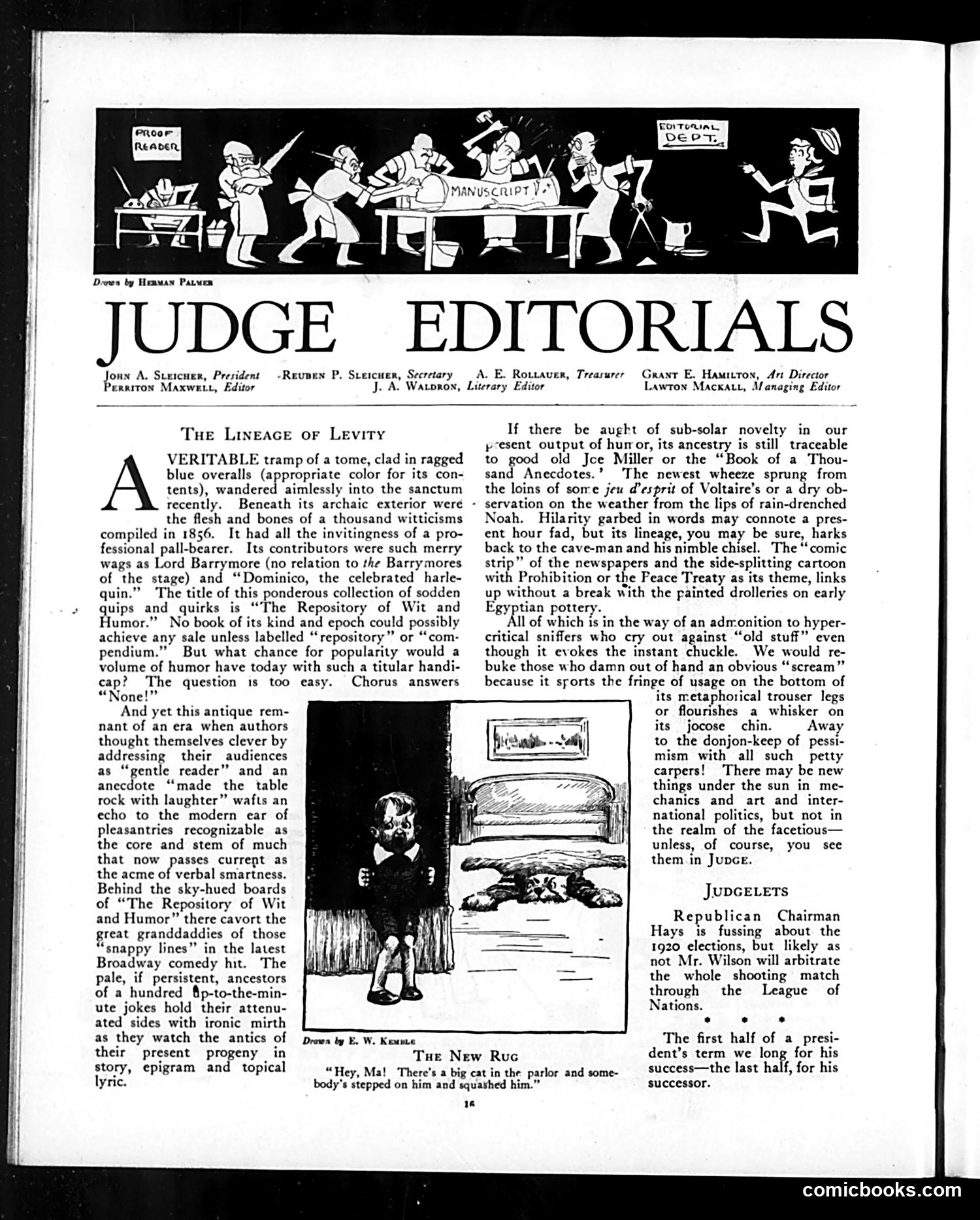
This editorial page critiques complaints about "old" humor. The main article, "The Lineage of Levity," defends recycled jokes by tracing humor's ancestry from ancient Egyptian pottery through Lord Barrymore's witticisms to modern comic strips and cartoons. The author argues that while mechanics and politics evolve, humor fundamentally doesn't—today's "snappy lines" descend directly from Joe Miller's jests and Voltaire. The satirical point: contemporary critics who dismiss jokes as stale or derivative are missing the point. Humor's repetitive nature is timeless, not a modern failing. The "Judgelets" section (brief satirical notes) references 1920 election politics: Republican Chairman Will Hays fusses over elections while President Wilson may arbitrate disputes through the League of Nations—implying executive overreach. The final quip suggests presidents enjoy their first term but anticipate successors in the second, mocking political self-interest.
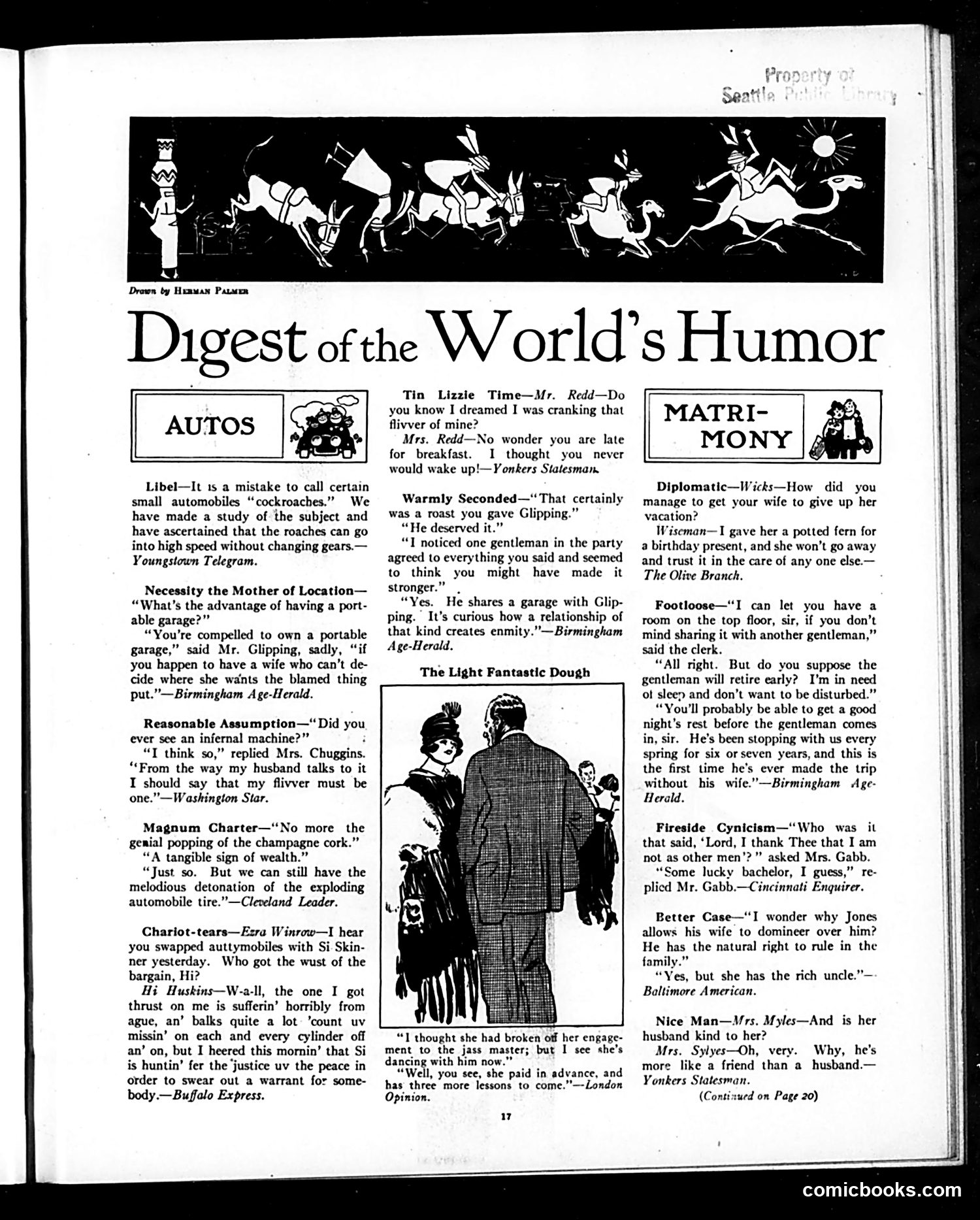
This page collects brief humorous anecdotes organized by topic, reflecting early 20th-century American social attitudes. The jokes center on automobiles (particularly cheap "flivvers"), marriage dynamics, and gender relations. The automobile humor satirizes the unreliability of early cars—engines that misfire, need hand-cranking, and break down constantly. "Tin Lizzie" was period slang for cheap, temperamental vehicles. The marriage jokes reveal era-typical gender stereotypes: wives are indecisive about where to park, husbands must manage their wives' behavior, and women are inherently dependent or manipulative. Notably, one joke suggests a woman stays with a dance instructor because she "paid in advance"—implying transactional rather than romantic motivation. The cartoon "The Light Fantastic Dough" (center) depicts a man and woman dancing, illustrating this paid-lesson scenario. Overall, the humor assumes male readers will recognize and laugh at complaints about wives' irrationality, financial manipulation, and domestic power—common themes in period comedic publications.
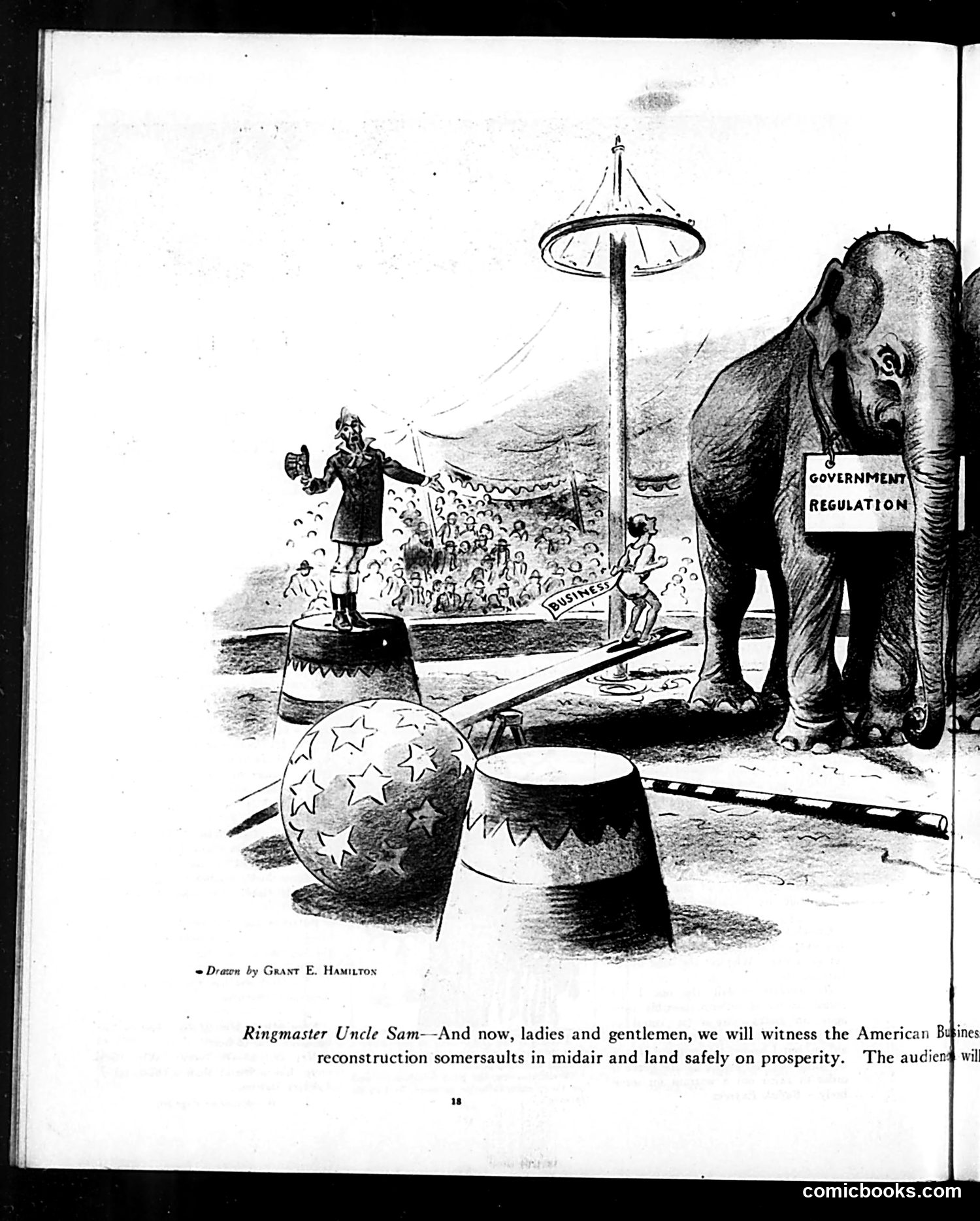
This Grant E. Hamilton cartoon satirizes American business during the Reconstruction era. "Uncle Sam" appears as a ringmaster directing a circus act, with the "American Business" represented by an elephant labeled "Government Regulation." The cartoon mocks the precarious balancing act of post-Civil War economic recovery, suggesting that prosperity depends on dangerous, unstable "somersaults" performed under government control. The circus setting emphasizes the artificiality and risk involved—what should be straightforward economic recovery is instead depicted as a dangerous performance requiring careful orchestration. The elephant carrying the "Government Regulation" sign suggests the burden of federal oversight on American enterprise. The satire criticizes either excessive government interference in business reconstruction or the inherent instability of the recovery process itself.
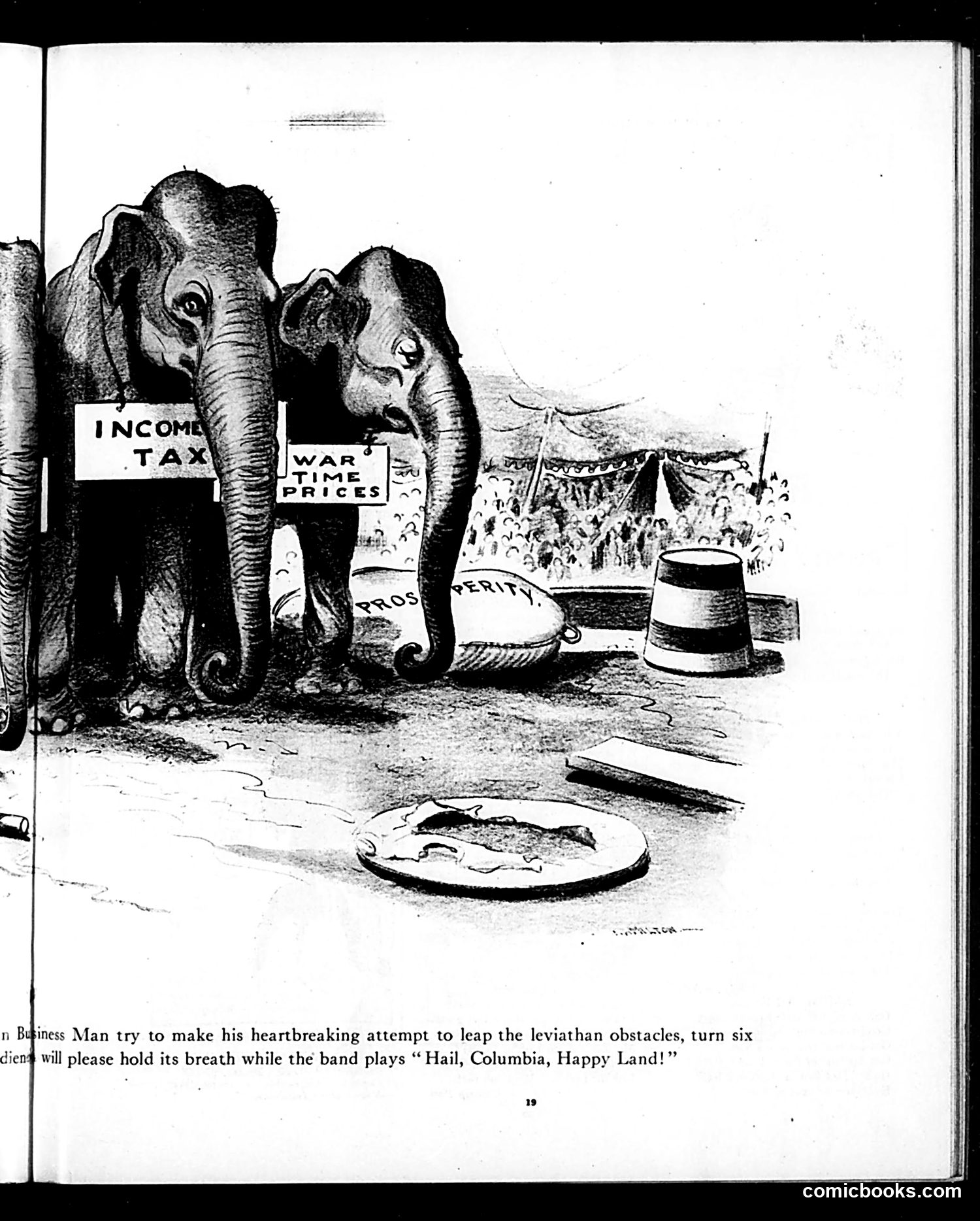
This is a satirical cartoon from *Judge* magazine depicting "Business Man" attempting to leap over two large elephants labeled "Income Tax" and "War Time Prices." The elephants represent major economic obstacles facing American business during what appears to be a World War I-era publication. Additional barriers are visible in the background, including what appears to be a "Prosperity" sign. The caption humorously notes that "six friends will please hold its breath while the band plays 'Hail, Columbia, Happy Land!'" The satire mocks the difficulty businesses faced navigating wartime economic pressures—particularly income taxation and inflation—while politicians optimistically promoted American prosperity. The impossible athletic feat symbolizes the absurdity of expecting commercial success under such constrained conditions.
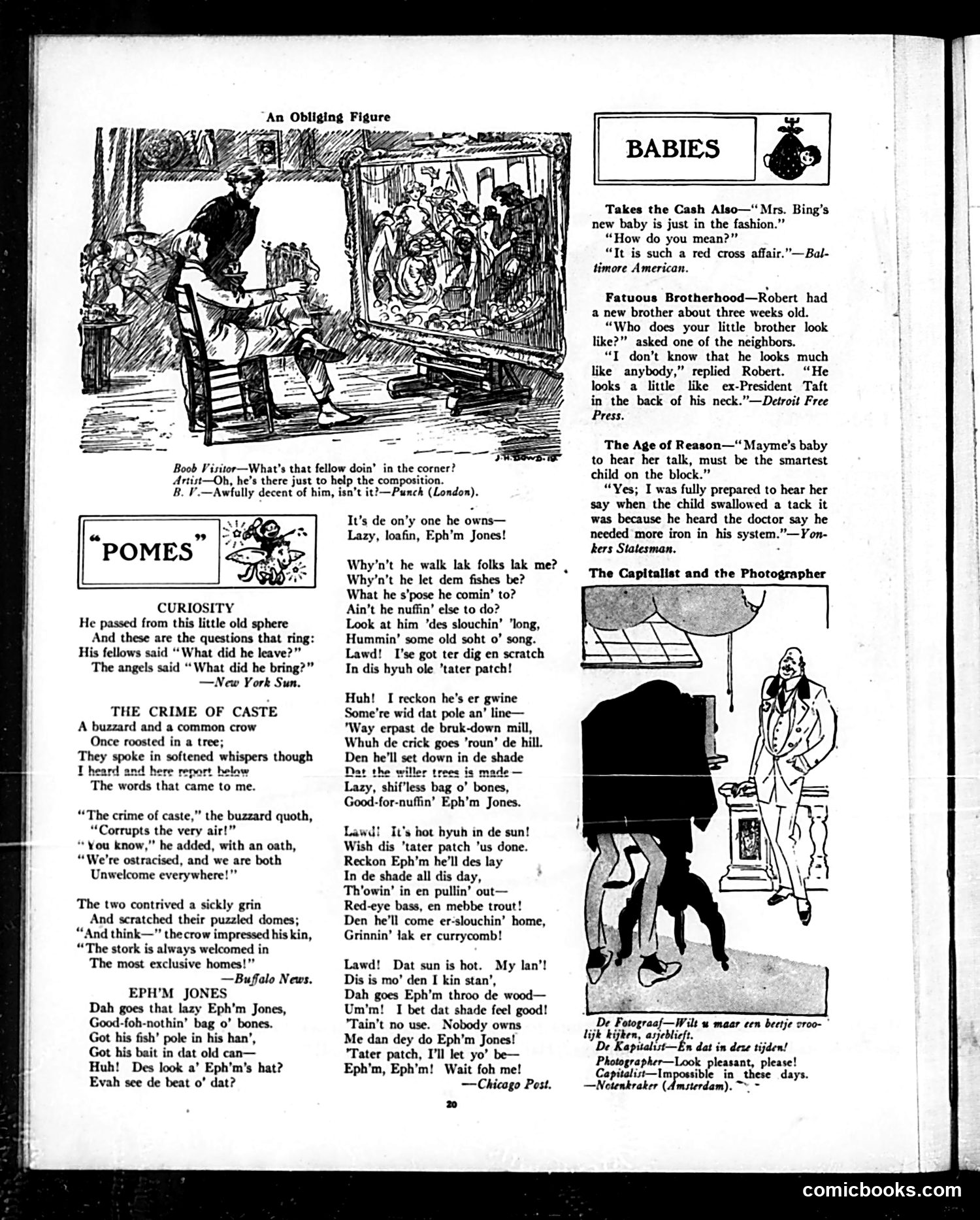
This page contains several satirical pieces typical of early 20th-century humor magazines: **"An Obliging Figure"** (top cartoon): A gentle art-world joke about a model posing for a composition painting. **"The Crime of Caste"**: A poem satirizing hypocrisy—a buzzard and crow complain about social discrimination while themselves participating in class exclusion (noting that storks are welcomed in "exclusive homes"). The irony critiques how even the lower classes perpetuate snobbery. **"Eph'm Jones"**: A dialect poem with racist caricature of a Black man lazily fishing while others labor. This reflects period stereotypes common in Judge's humor. **"Babies" section**: Brief comic anecdotes about infants, including one referencing ex-President Taft's appearance—typical light domestic humor. **"The Capitalist and the Photographer"** (bottom cartoon): Dark humor about economic depression, where a wealthy businessman cannot "look pleasant" due to financial strain—likely referencing economic hardship of the era (possibly pre-WWI or 1920s recession). The page reflects Judge's mix of political satire, social commentary, and period-typical (often offensive) humor.
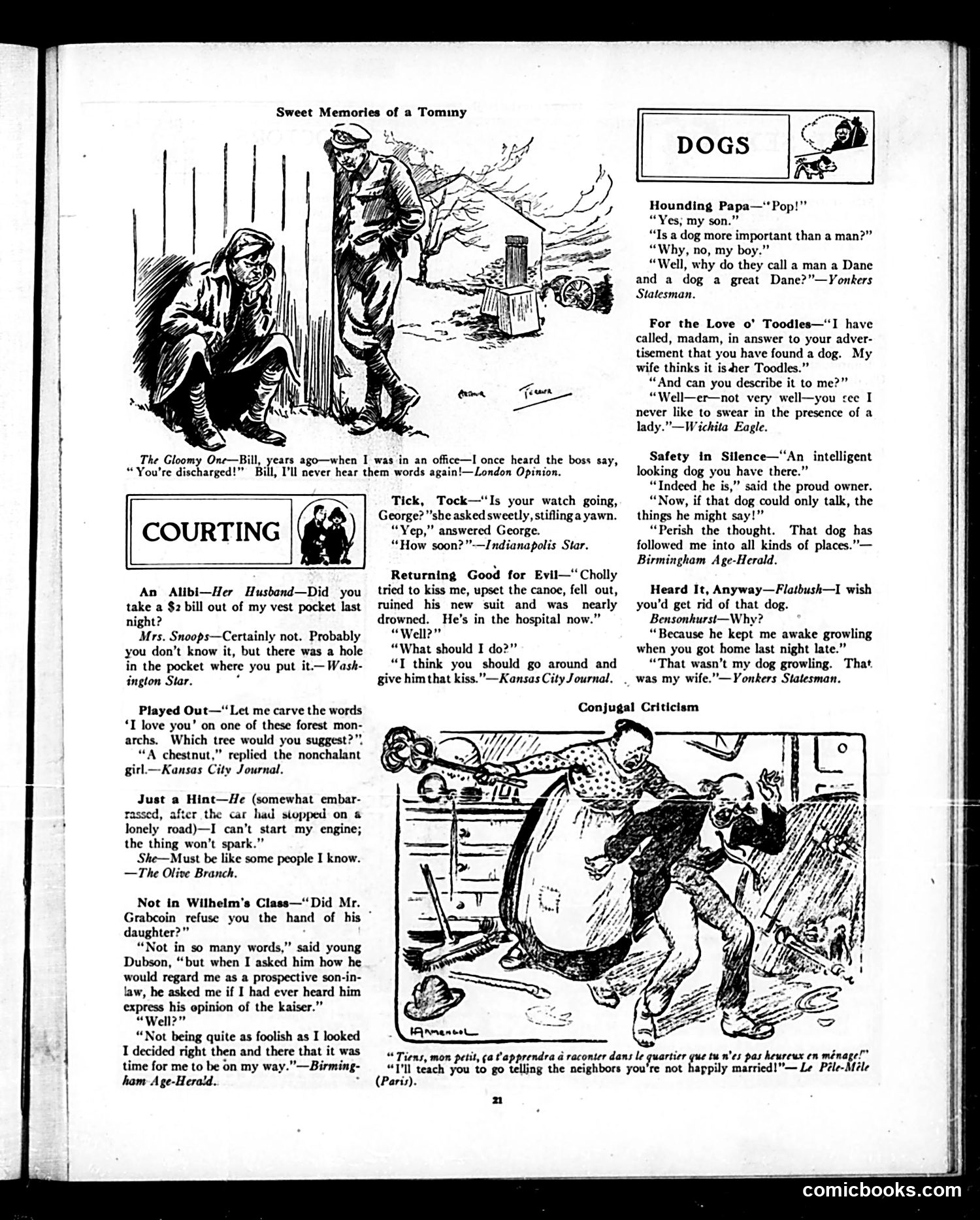
This page from Judge magazine collects humorous anecdotes and cartoons about courtship, marriage, and dogs—typical early 20th-century comic fare. **The Jokes:** The "Courting" and "Dogs" sections present brief quips playing on marital misunderstandings, romantic mishaps, and pet-related humor. Examples: a wife denies stealing money but claims a hole was already in the pocket; a man can't start his car engine and a woman compares him to people who similarly "won't spark." **The Main Cartoon:** "Conjugal Criticism" depicts a husband being physically disciplined by his wife (shown hitting him) for complaining to neighbors about their unhappy marriage. The French caption emphasizes teaching him not to air domestic troubles publicly. **Social Context:** These pieces reflect period attitudes: wives as witty tricksters, marriage as naturally contentious, and domestic disputes as comedic material. The cartoon's violent humor toward a man suggests satirizing masculine complaints about marriage while reinforcing the period's expectation that married couples hide problems from public view. The page is lighthearted social satire reflecting contemporary gender dynamics and marriage customs.
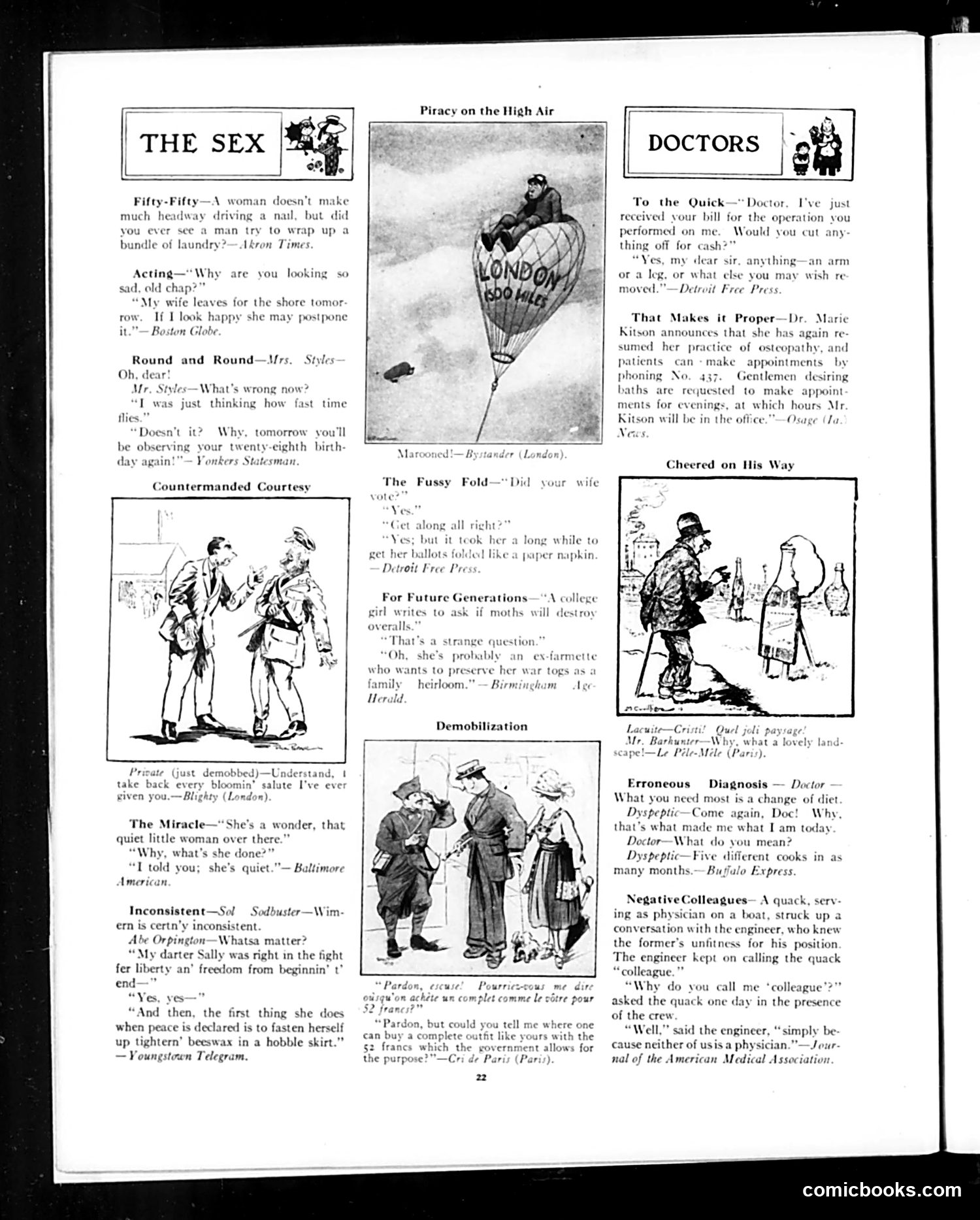
This page collects brief humorous anecdotes organized by topic ("The Sex," "Doctors"). The cartoons and jokes satirize early 20th-century social attitudes. **"The Sex" section** mocks gender dynamics: wives' driving incompetence, women's vanity about aging, and the "hobble skirt" craze—a restrictive fashion women adopted despite advocating for wartime freedoms, revealing hypocrisy. **"Doctors" section** ridicules medical practitioners: one doctor offers to amputate for payment; another osteopath (Dr. Kitson) conveniently schedules male clients only during evening "baths"; a physician prescribes diet changes that caused the patient's condition; a quack calls himself "colleague" with an engineer who knows he's a fraud. **Central cartoon** depicts "Piracy on the High Air"—a hot-air balloon labeled "London" being "marooned," likely referencing WWI aviation warfare or post-war travel anxieties. **"Demobilization"** shows soldiers returning home, reflecting post-WWI repatriation concerns. The humor targets professional incompetence, gender inconsistency, and wartime disruptions familiar to contemporary readers.
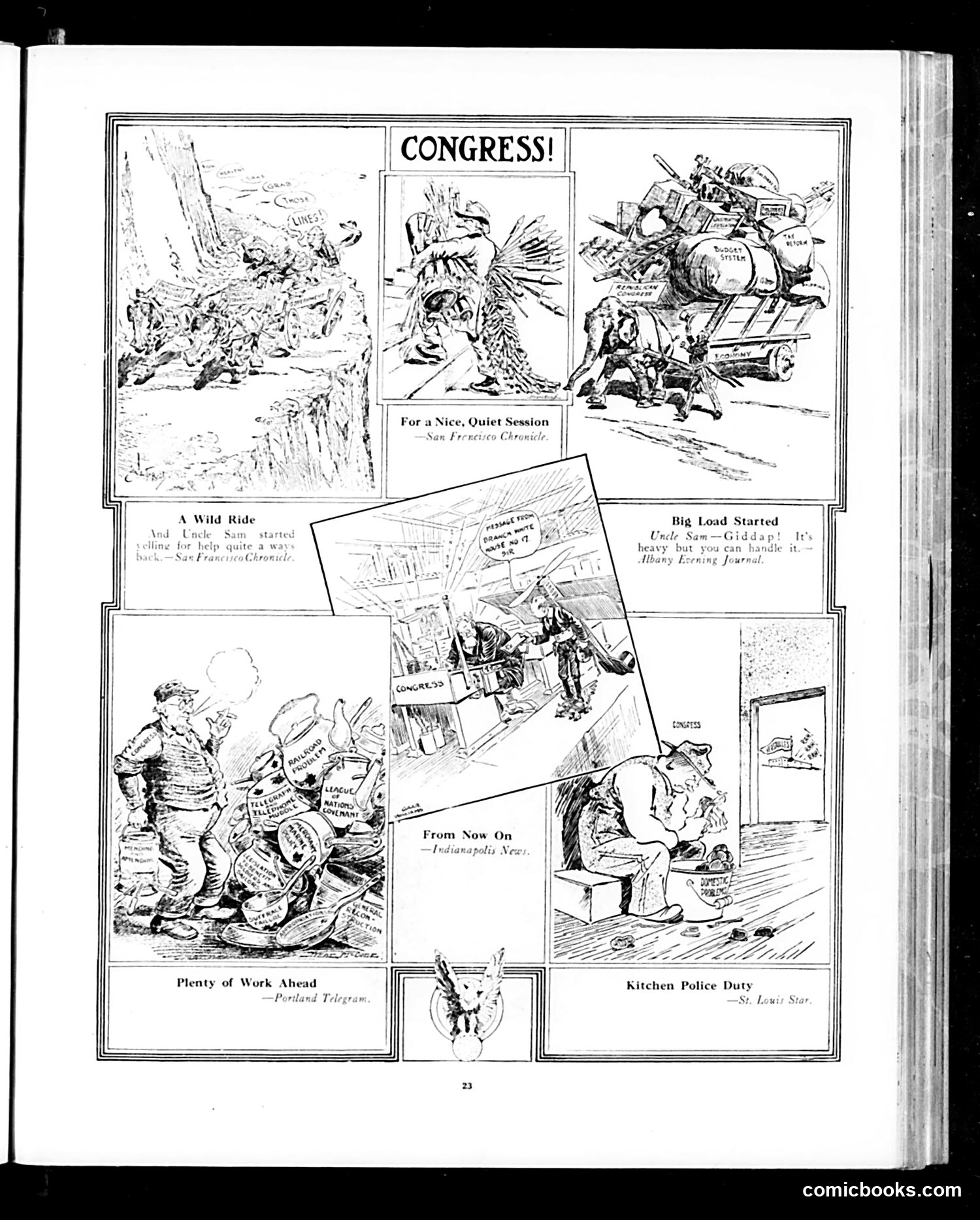
This page presents satirical commentary on Congress using Uncle Sam as the central figure. The cartoons mock Congressional dysfunction through visual metaphors: **"A Wild Ride"** and **"Big Load Started"** depict Congress as chaotic and burdensome—Uncle Sam struggling with an overwhelming cart of legislative business. **"Plenty of Work Ahead"** shows Congress as a tangled mess of competing interests and responsibilities. **"For a Nice, Quiet Session"** and **"From Now On"** suggest ironic hope for orderly proceedings, contrasted with the visual chaos elsewhere. **"Kitchen Police Duty"** implies Congress members are relegated to menial tasks. The overall message critiques Congress as disorganized, inefficient, and overburdened. The cartoons use slapstick imagery—collisions, pileups, confusion—to suggest governmental incompetence and gridlock, likely reflecting contemporary frustrations with legislative gridlock.
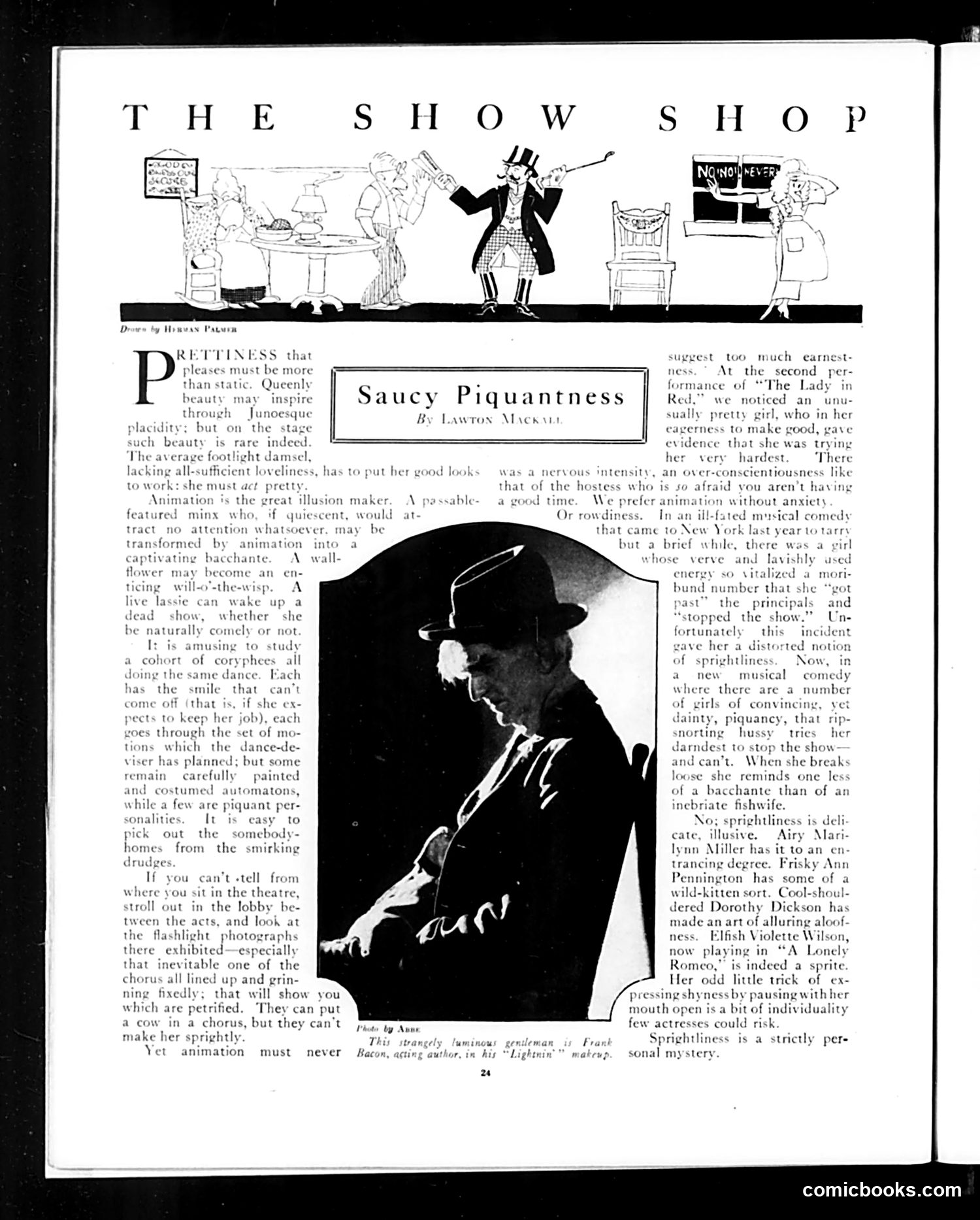
This page discusses theatrical performance qualities, specifically critiquing "prettiness" versus genuine stage presence. The article "Saucy Piquantness" by Layton Mencke examines why some actresses succeed while others fail, despite comparable looks. The central argument: physical beauty alone is insufficient for stage success. The author contrasts "prettiness" (mechanical, lifeless) with "sprightliness" (an intangible, personal quality that captivates audiences). Named actresses discussed include Airy Marilynn Miller, Frisky Ann Pennington, Dorothy Dickson, and Elfish Violette Wilson—all praised for possessing this elusive charm. The piece critiques a nervous hostess-type performer who overdoes earnestness, and references an unnamed musical comedy from the previous year featuring an overly anxious performer who "stopped the show" by breaking character. The satire targets theatrical pretension: technique and coaching cannot manufacture genuine stage magnetism. It's an art form requiring personality, not merely physical presentation.
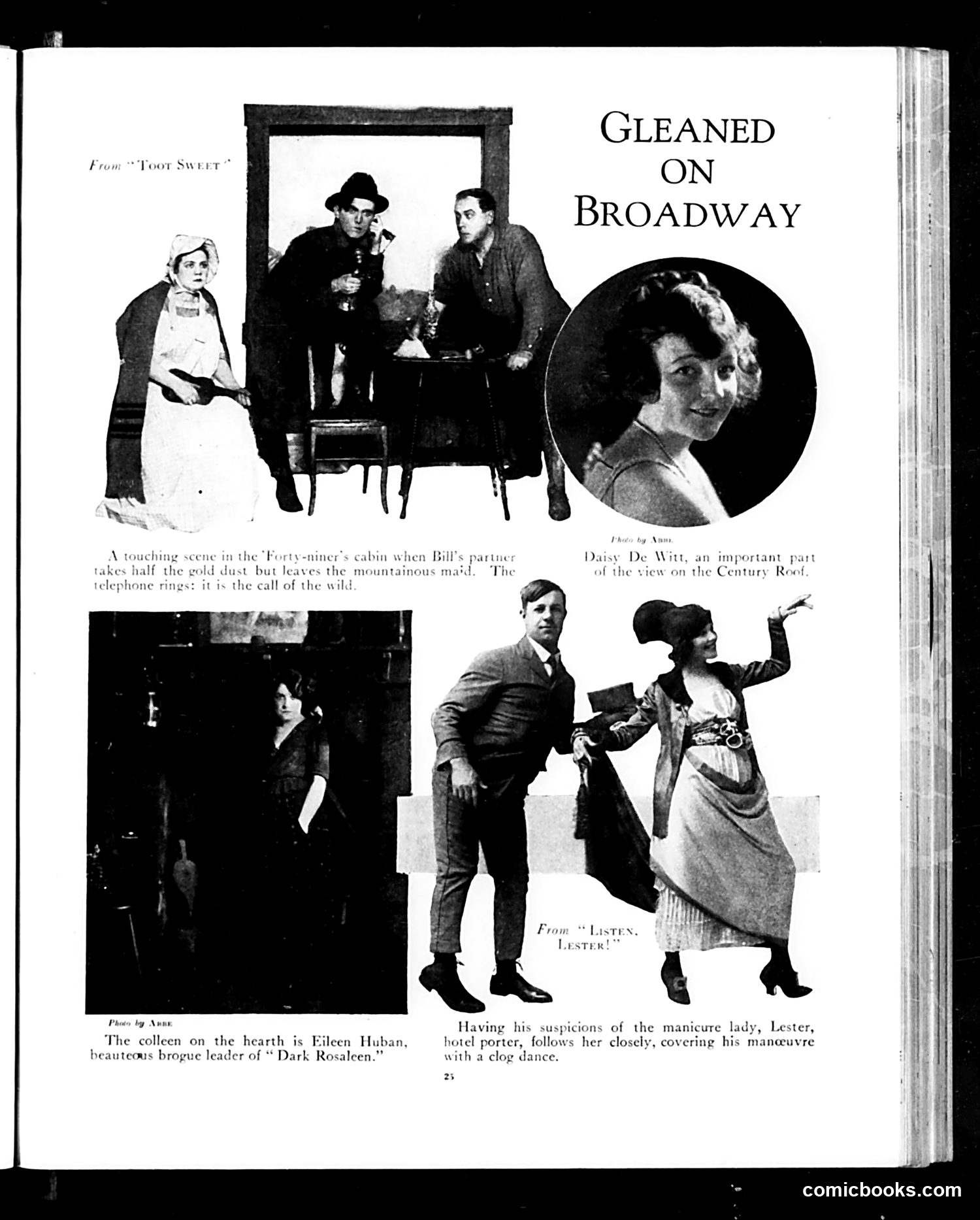
This page showcases theatrical scenes from Broadway productions, not political satire. It features photographs from plays including "Toot Sweet" and "Listen, Lester!" The images depict comedic situations: a cabin scene involving gold prospectors, and a hotel porter (Lester) suspiciously following a manicure lady while disguising his surveillance with a clog dance. There's also a portrait of Daisy De Witt, described as "an important part of the view on the Century Roof." This is entertainment journalism—a common Judge feature showcasing current stage productions and actors for readers interested in Broadway gossip and theater news. The "satire" is gentle, situational humor derived from plot scenarios rather than political commentary. The page documents early 20th-century theatrical culture and performers.
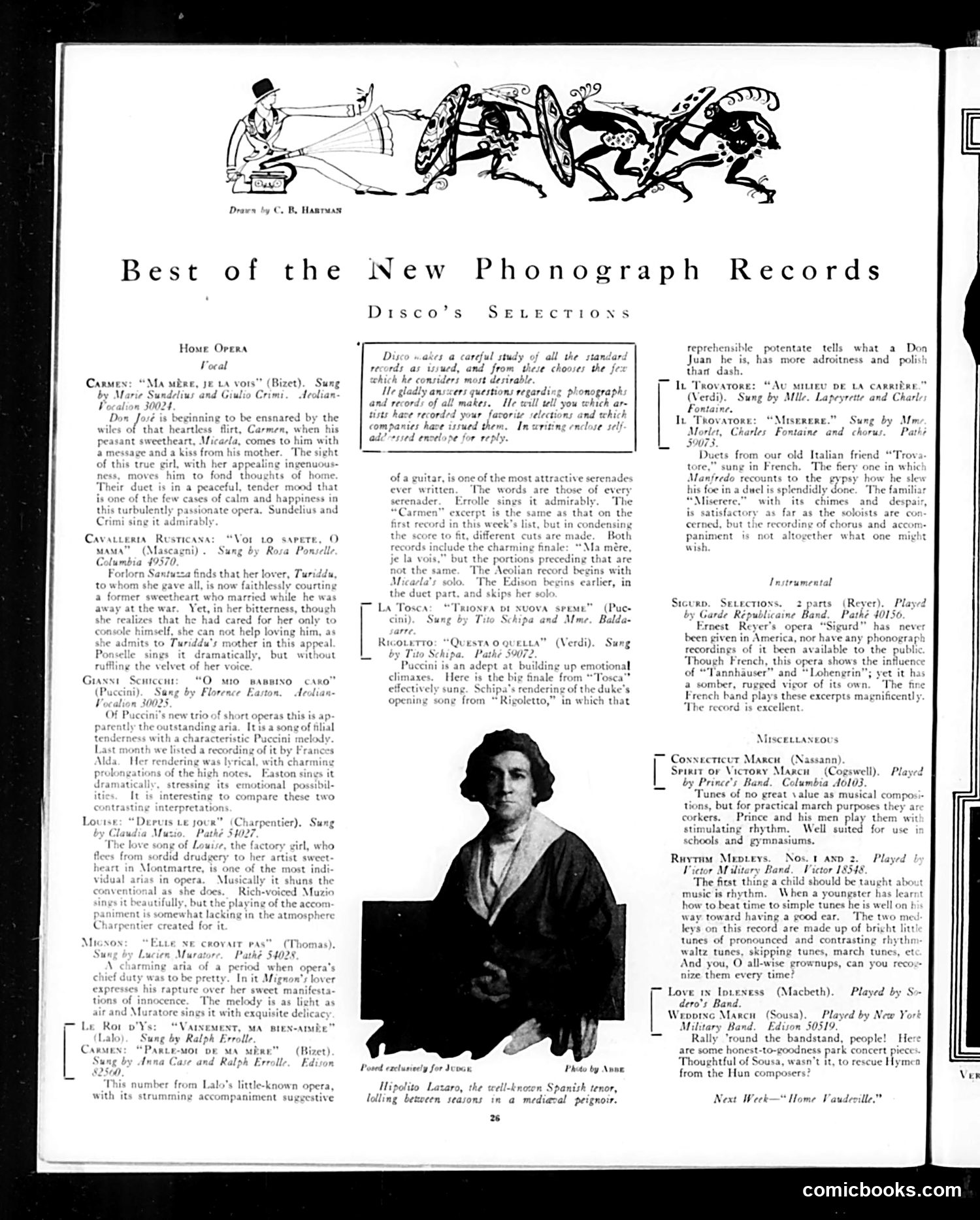
This page from *Judge* is primarily **a music/phonograph record review section**, not political satire. The small cartoon at the top by C.B. Hartman appears to show a comedic sequence of figures with musical instruments—likely illustrating the entertainment theme—but it's decorative rather than satirical. The bulk of the page reviews "Best of the New Phonograph Records," featuring opera selections (Carmen, Cavalleria Rusticana, La Tosca, Il Trovatore) and instrumental recordings by military bands. The reviews discuss vocal performances and recordings quality. The only potentially topical element is a reference to "the Hun composer" in the final section about wedding marches—likely an anti-German jab during or shortly after World War I, when such references were common in American publications. Otherwise, this is straightforward entertainment criticism and advertising for phonograph records, typical of *Judge*'s middle pages during this era.
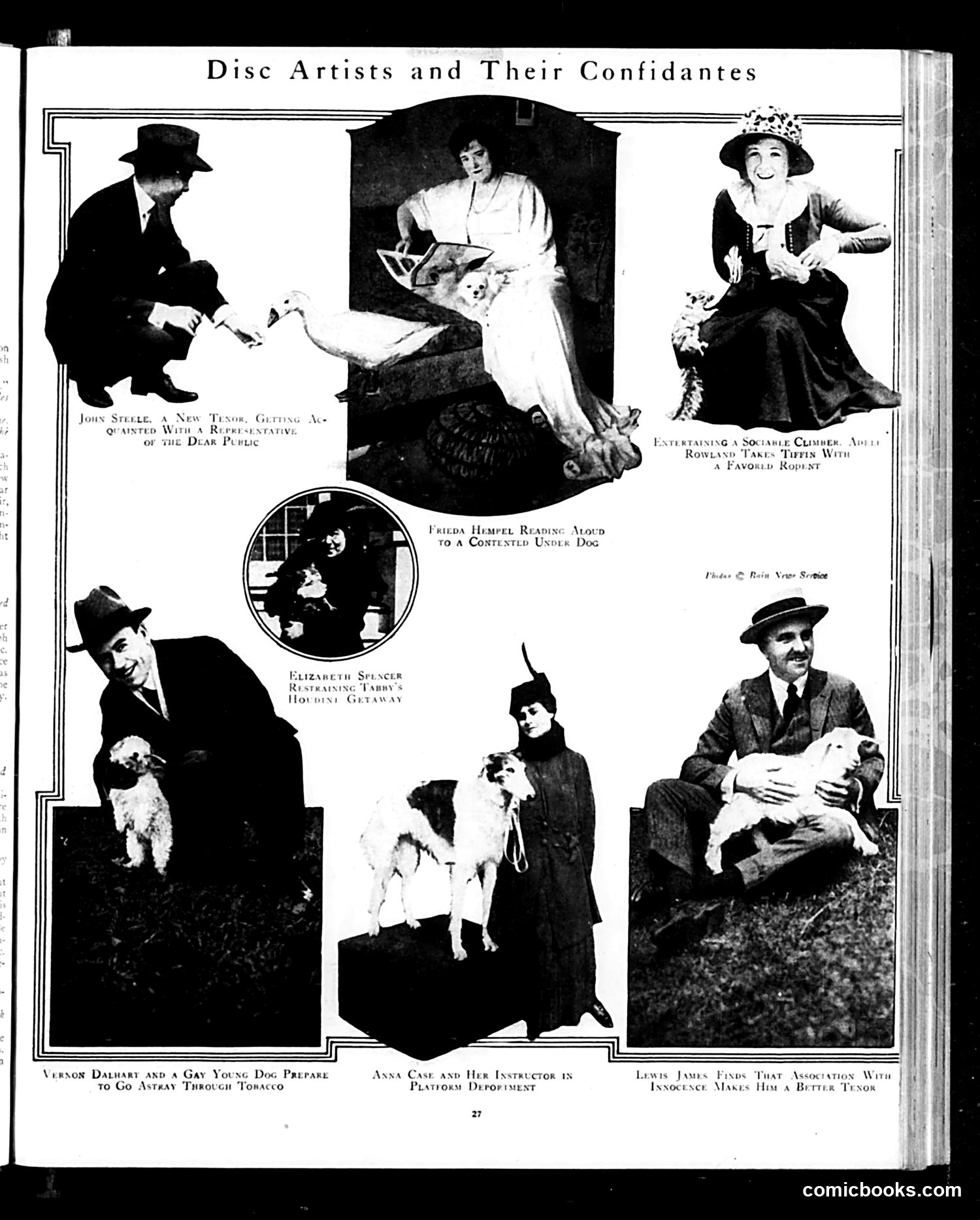
This page from *Judge* magazine satirizes early film actors and their pets—humorously captioned as their "confidantes." The layout presents six photographs of entertainers posing with dogs, styled as if the animals are trusted companions or advisors. The satire works through absurdist humor: captions suggest the dogs influence their owners' decisions (e.g., one dog helps an actor "go astray through tobacco," another makes an association "better"). This mocks both the vanity of theatrical personalities and the era's emerging celebrity culture. The page's title—"Disc Artists"—likely refers to phonograph recording artists, suggesting this appeared during early cinema/vaudeville's transition to recorded entertainment. The humor relies on treating pet-owner relationships as consequential, playing on audiences' fascination with entertainers' private lives. Without identifying specific actors, the page's joke is clear: celebrities were being publicly discussed in trivial, gossipy ways.
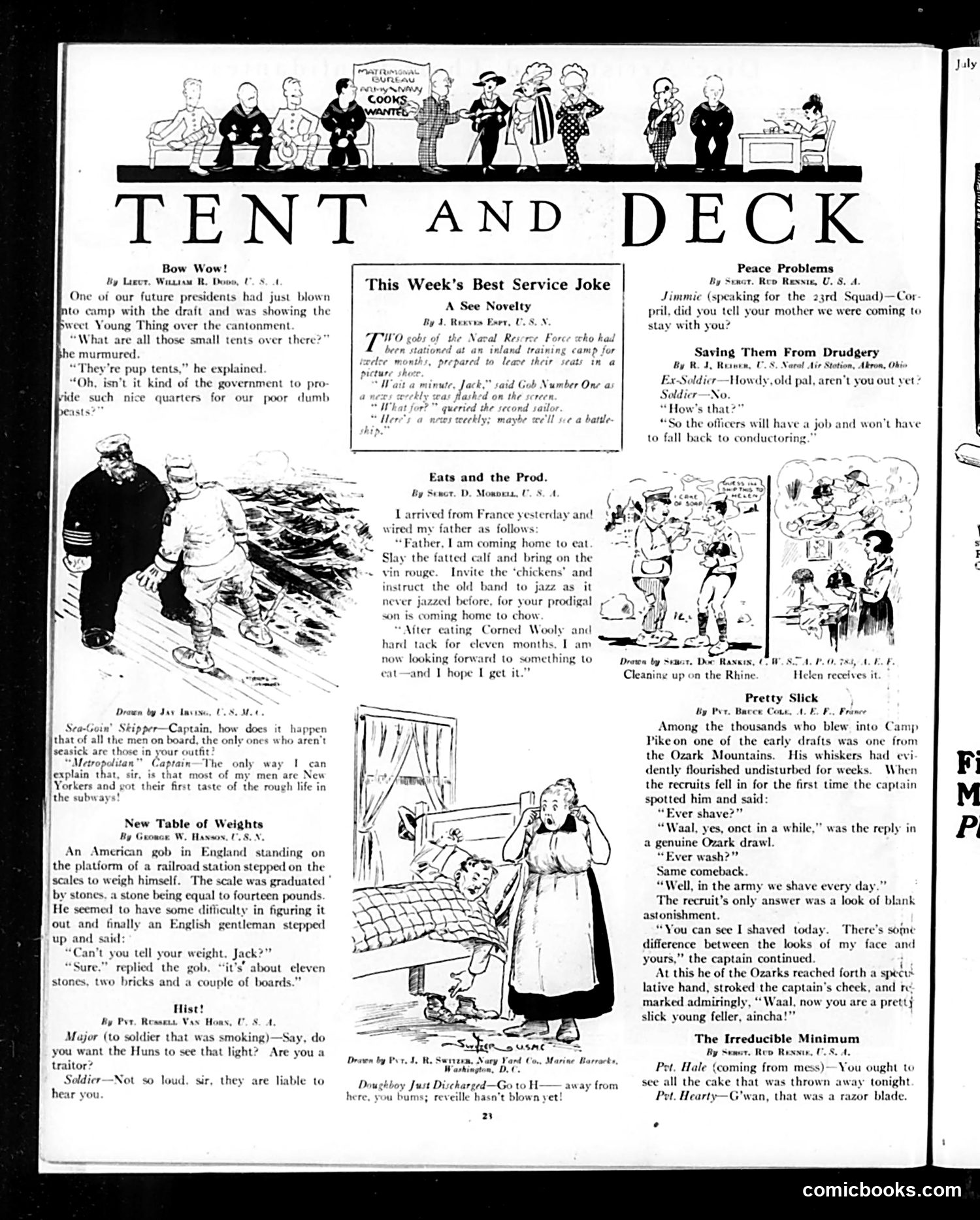
This page collects military jokes from World War I, targeting soldiers and officers. The humor relies on recruits' naïveté about army life: **"Bow Wow"**: A drafted civilian mistakes "pup tents" for government kindness toward enlisted men—the joke being that small, uncomfortable quarters are standard, not a privilege. **"New Table of Weights"**: An American sailor (called a "gob") unfamiliar with the British stone-weight system gives a nonsensical answer using "bricks and boards"—mocking American soldiers' ignorance abroad. **"Pretty Slick"**: An Ozark hillbilly recruit, shocked that soldiers shave daily, admires the captain's smooth face as if he's unusually skilled—the joke being the recruit's backwoods ignorance of basic hygiene. Other pieces joke about food shortages ("Eats and the Prod"), discipline ("Hist!"), and post-war unemployment. The satire targets soldiers as "dumb" country boys and New Yorkers unaccustomed to military standards.
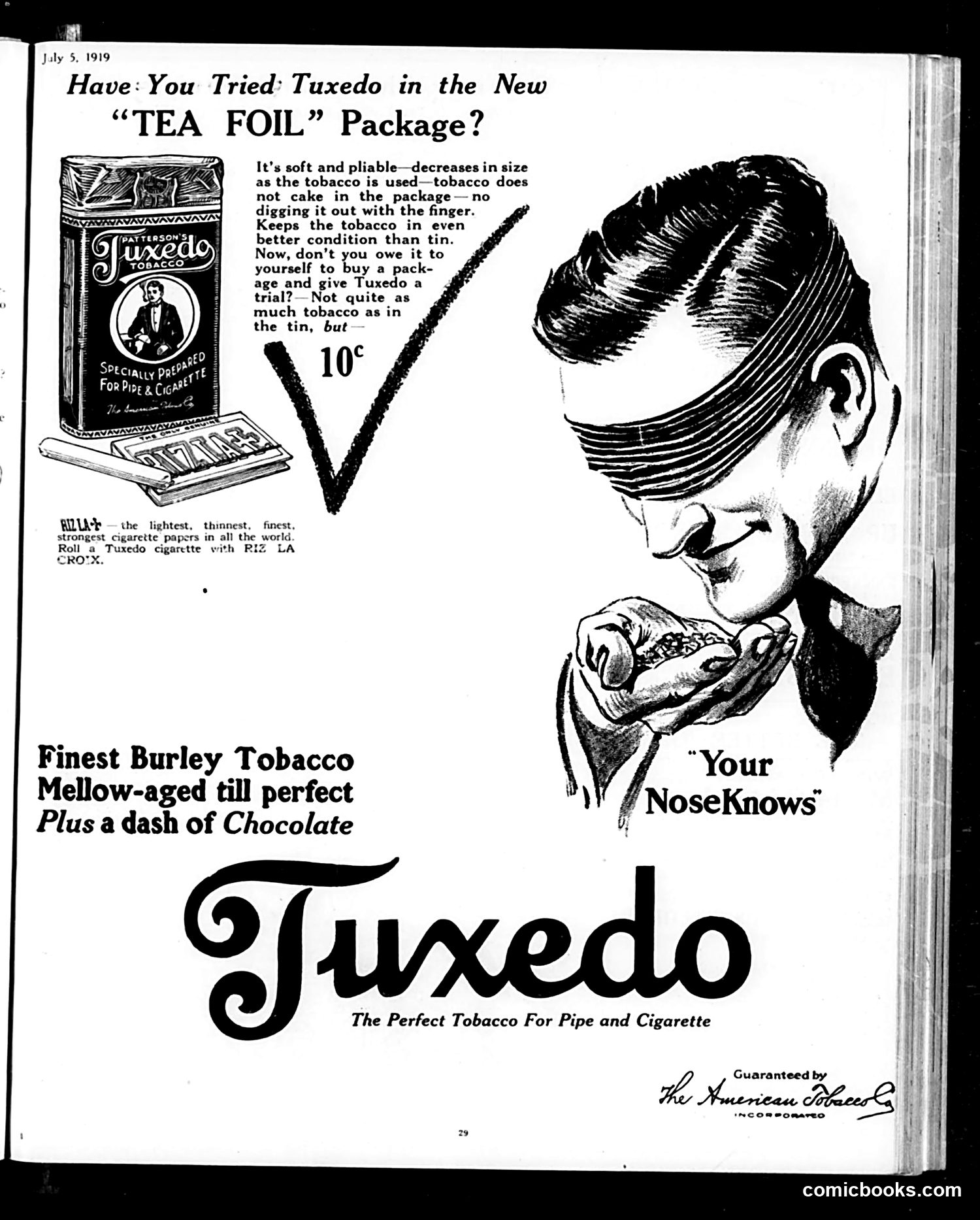
This page is **entirely a tobacco advertisement**, not political satire. It's a Tuxedo brand tobacco ad from July 5, 1919, promoting their new "Tea Foil" packaging innovation. The ad features: - A product image showing the foil package - Marketing copy emphasizing that the soft, pliable foil wrapper keeps tobacco fresher than tin cans and decreases in size as used - A caricatured man's face with the slogan "Your Nose Knows," suggesting the product's quality is obvious - Claims about the tobacco blend (burley, chocolate notes) and recommended cigarette papers (Riz La Croix) - Price: 10 cents There is **no political or satirical content** visible. This is straightforward commercial advertising in a magazine, capitalizing on post-WWI consumer product innovation. The exaggerated facial features are typical period advertising illustration rather than political caricature.
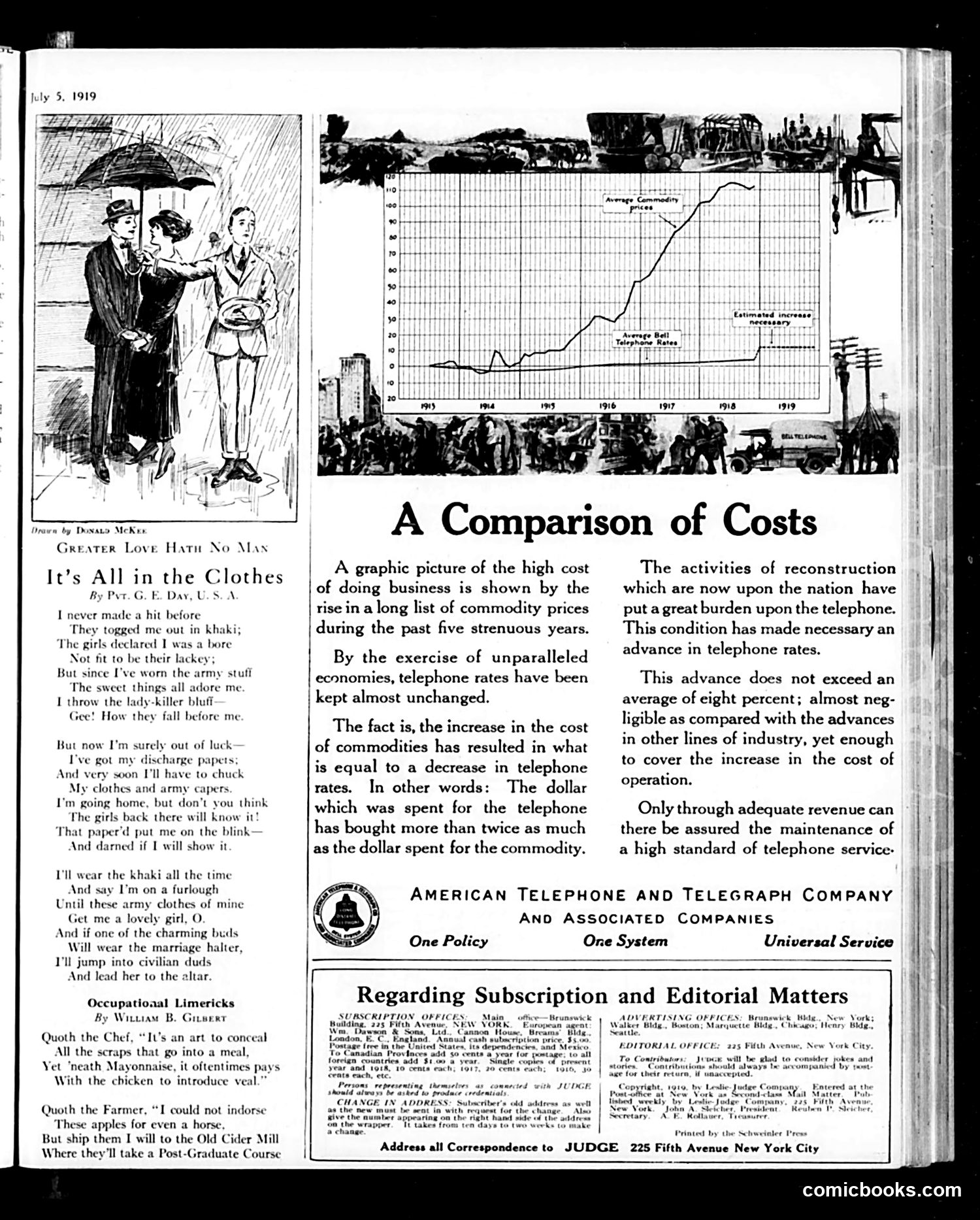
This page contains satirical poetry and advertising rather than traditional political cartoons. **"It's All in the Clothes"** is a humorous poem about a WWI soldier who discovers that his military uniform makes him attractive to women. The joke: once discharged, he plans to keep wearing khaki and pretend he's on furlough to maintain his newfound appeal—suggesting that wartime romance was driven by uniform prestige rather than genuine attraction. **"Occupational Limericks"** offers dark humor about professional dishonesty: a chef conceals scraps in meals, and a farmer sells subpar apples for cider-making rather than direct sale. **"A Comparison of Costs"** is essentially telephone company propaganda. Published amid post-WWI inflation (1919), it argues that while commodity prices skyrocketed, telephone rates remained stable—thus actually *decreasing* in real value. The company justifies a rate increase as necessary for maintaining service quality during national reconstruction. The page reflects 1919 concerns: returning soldiers, wartime economic disruption, and corporate messaging during inflation.
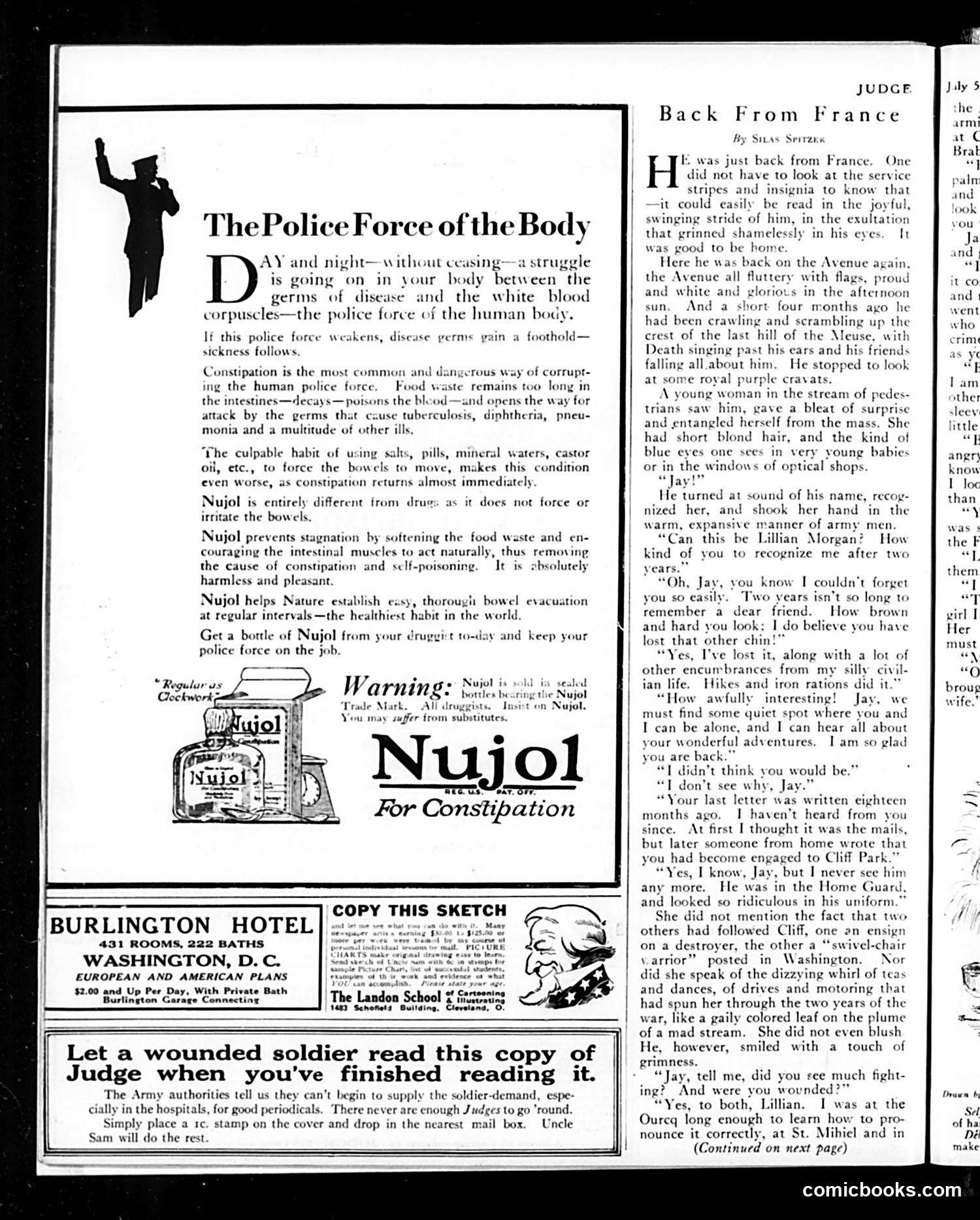
This page contains a **Nujol laxative advertisement** disguised as health education. The "Police Force of the Body" uses militaristic metaphor (white blood cells as "police") to explain constipation as a threat to bodily defense—a marketing strategy targeting early-20th-century anxieties about infection and disease. The ad argues that harsh laxatives worsen constipation, while Nujol (mineral oil) naturally encourages bowel movements. This reflects genuine medical debate of the era about constipation's dangers. The right column contains an unrelated short story titled "Back From France" about a WWI soldier reuniting with a woman named Lillian Morgan on an American avenue. The narrative captures post-war homecoming sentiment. At bottom, a public service notice requests readers donate used copies of *Judge* magazine to wounded soldiers in hospitals—reflecting wartime charitable efforts.
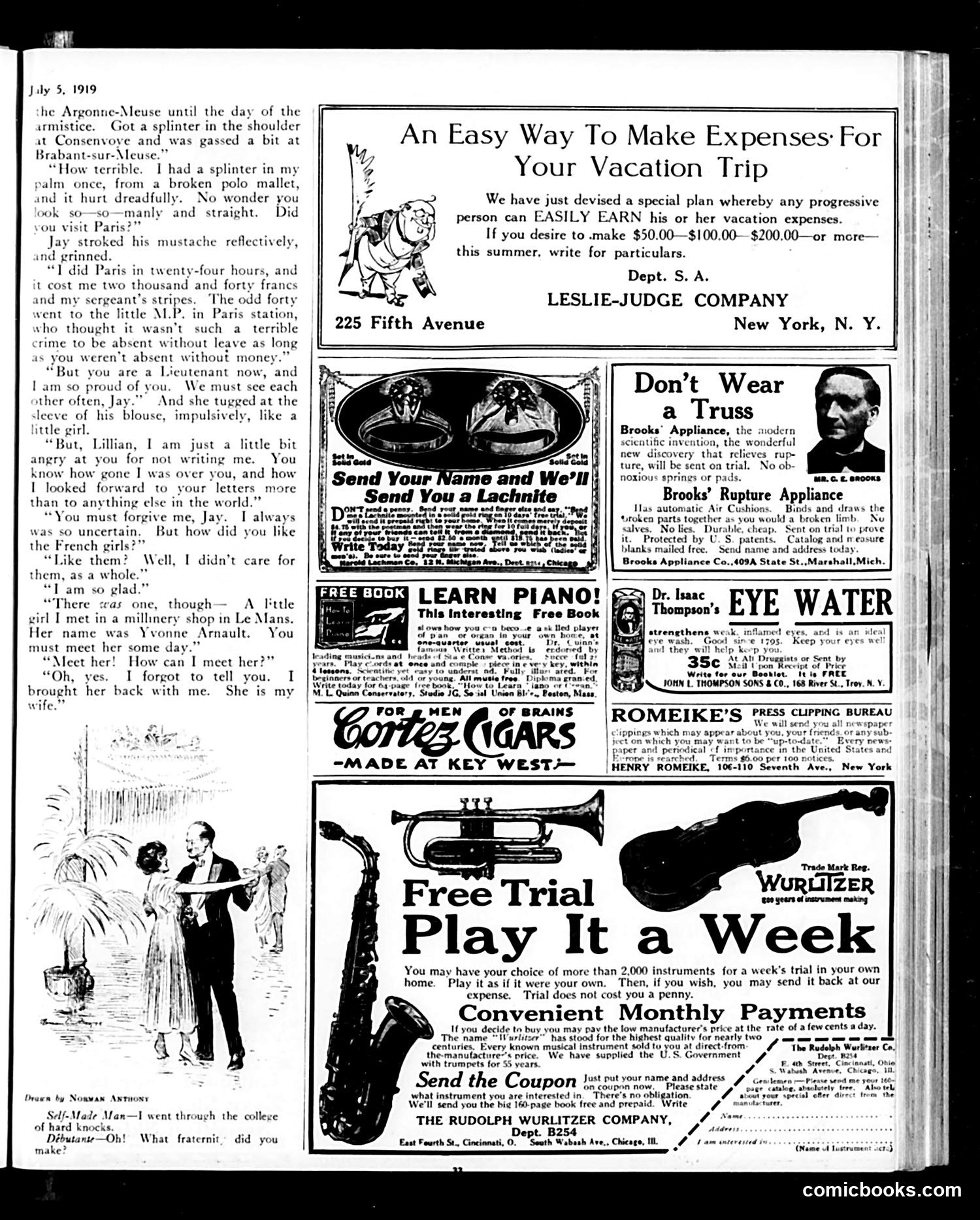
This page blends satirical fiction with period advertising. **The Main Story**: A comic narrative about "Jay," a WWI veteran who casually mentions he brought back a French wife (Yvonne Arnault) from Le Mans—delivering the punchline that he "forgot to tell" his American girlfriend Lillian. The satire mocks both the casual infidelity of soldiers returning from Europe and the obliviousness of stay-at-home romance. **The Cartoon** (bottom left, by Norman Anthony): A "Self-Made Man" claims he went through "the college of hard knocks." A debutante asks what fraternity he joined—satirizing how self-made success stories are incompatible with elite college fraternity culture. **The Advertisements** dominate the page: vacation expense schemes, medical devices (trusses, eye water), music lessons and instrument rentals, cigars, and press clipping services. These reflect 1919 consumer culture and mail-order commerce typical of the era. The overall tone reflects post-WWI attitudes: cynicism about returning soldiers, American fascination with European entanglements, and consumer optimism.
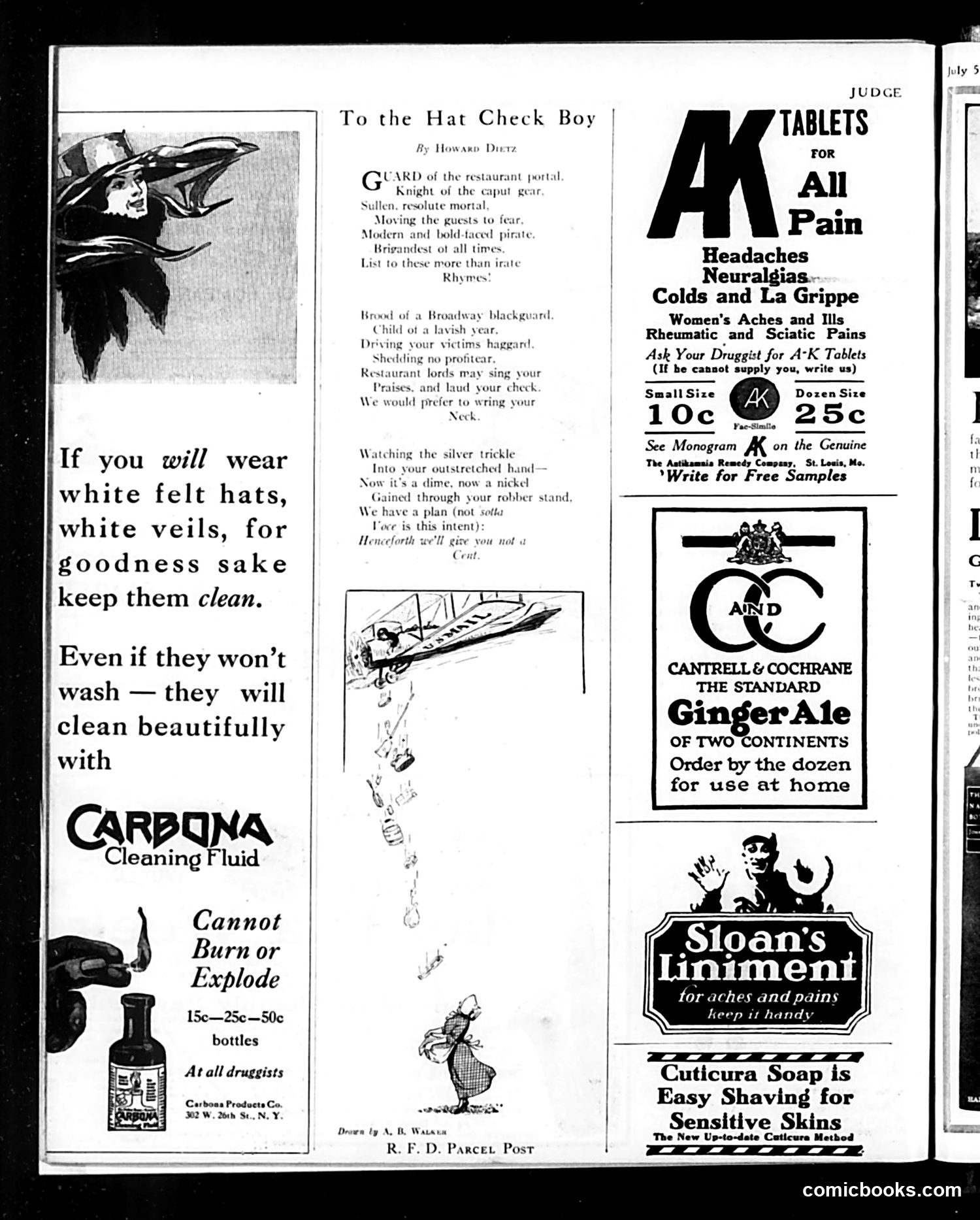
This page features a satirical poem by Howard Dietz attacking restaurant hat check attendants. In the early 20th century, checking hats was standard at upscale restaurants, but the practice was notorious for tipping abuses—attendants would pressure diners for gratuities by holding coats or hats "hostage" until compensated. The poem characterizes the hat check boy as a "pirate" and "brigand" who exploits guests through guilt and social pressure ("driving your victims haggard"). The author sarcastically notes that restaurant owners praise these workers for generating tip revenue, but suggests the public would prefer to "wring [their] neck[s]." The accompanying illustration shows a figure in period dress, likely representing the stereotypical hat check attendant depicted in the satire. The page is predominantly advertisements for patent medicines and consumer goods, typical of Judge's advertising revenue model.
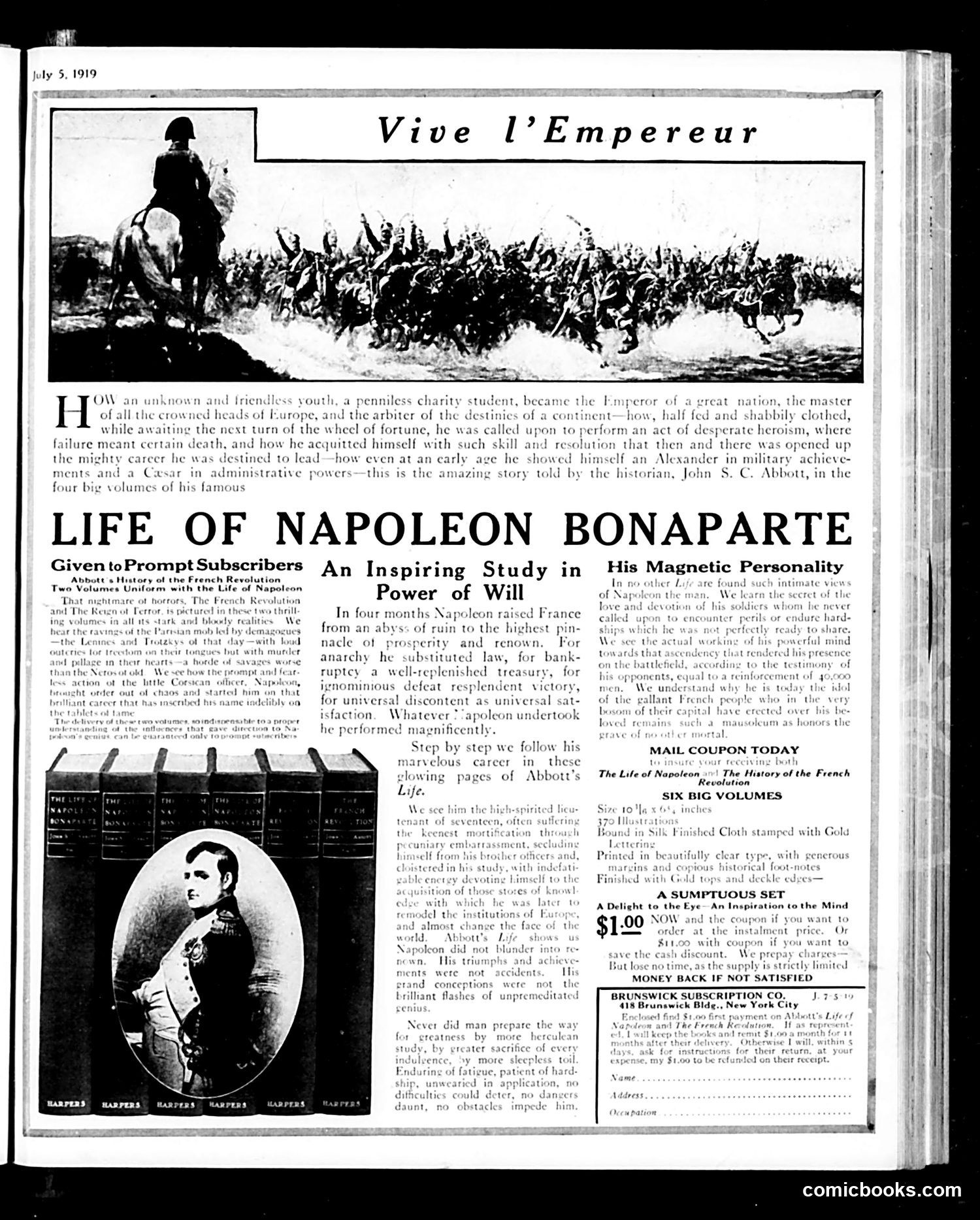
This is primarily an **advertisement**, not a political cartoon. The page promotes a subscription offer for Abbott's six-volume *Life of Napoleon Bonaparte*, published July 5, 1919—shortly after World War I ended. The ad uses romantic language about Napoleon's rise from poverty to power, emphasizing his "will" and ability to transform chaos into order. The illustration shows Napoleon on horseback addressing troops, a classic heroic pose. **Context we'd miss today**: In 1919, this was promoting nationalist and militaristic ideals—celebrating a military strongman who conquered through force. The emphasis on "power of will" and individual genius had unfortunate resonance with rising fascist movements of the 1920s-30s. The ad appears designed to appeal to readers nostalgic for strong leadership after WWI's devastation. The subscription offer ($1.00 down, installments accepted) targets working-class readers seeking self-improvement through historical knowledge—a common early 20th-century marketing pitch.
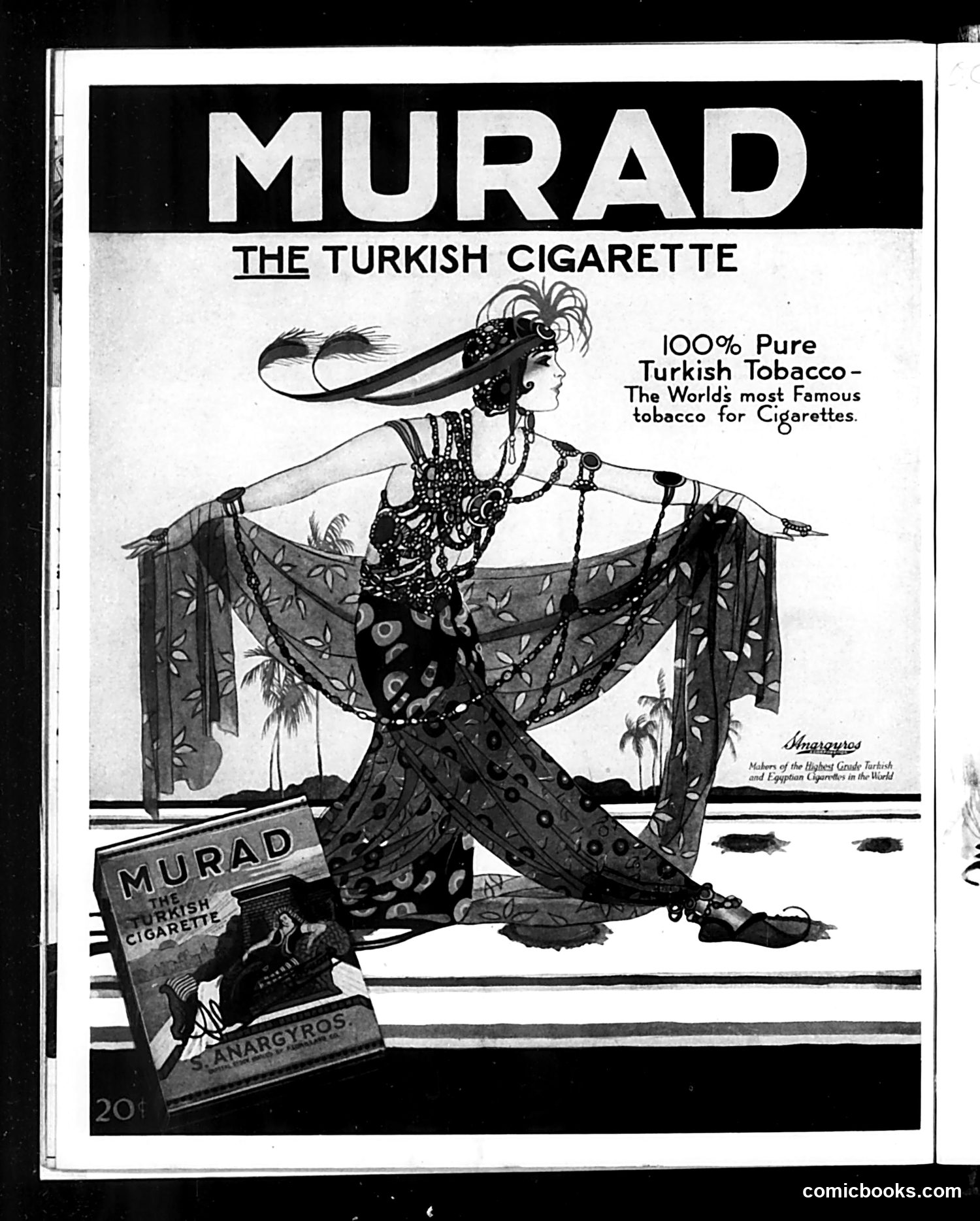
This is a **cigarette advertisement**, not political satire. It promotes Murad brand Turkish cigarettes, emphasizing "100% Pure Turkish Tobacco—The World's most Famous tobacco for Cigarettes." The imagery uses **Orientalist aesthetics** common in early 20th-century advertising: a woman in elaborate Turkish-inspired costume with flowing fabrics and a turban, striking an exotic pose. This visual style was typical marketing for Turkish tobacco products of the era, trading on Western fascination with "the Orient." The advertisement includes a product package showing the Murad branding and notes the manufacturer (appears to be "Sinargyros" based on OCR'd text), identified as makers of "the Highest Grade Turkish and Egyptian Cigarettes in the World." The price shown is 20¢, typical for cigarette packages of that period.