
Judge, 1919-07-05 · page 11 of 36
Judge — July 5, 1919 — page 11: what you’re looking at
What you’re looking at
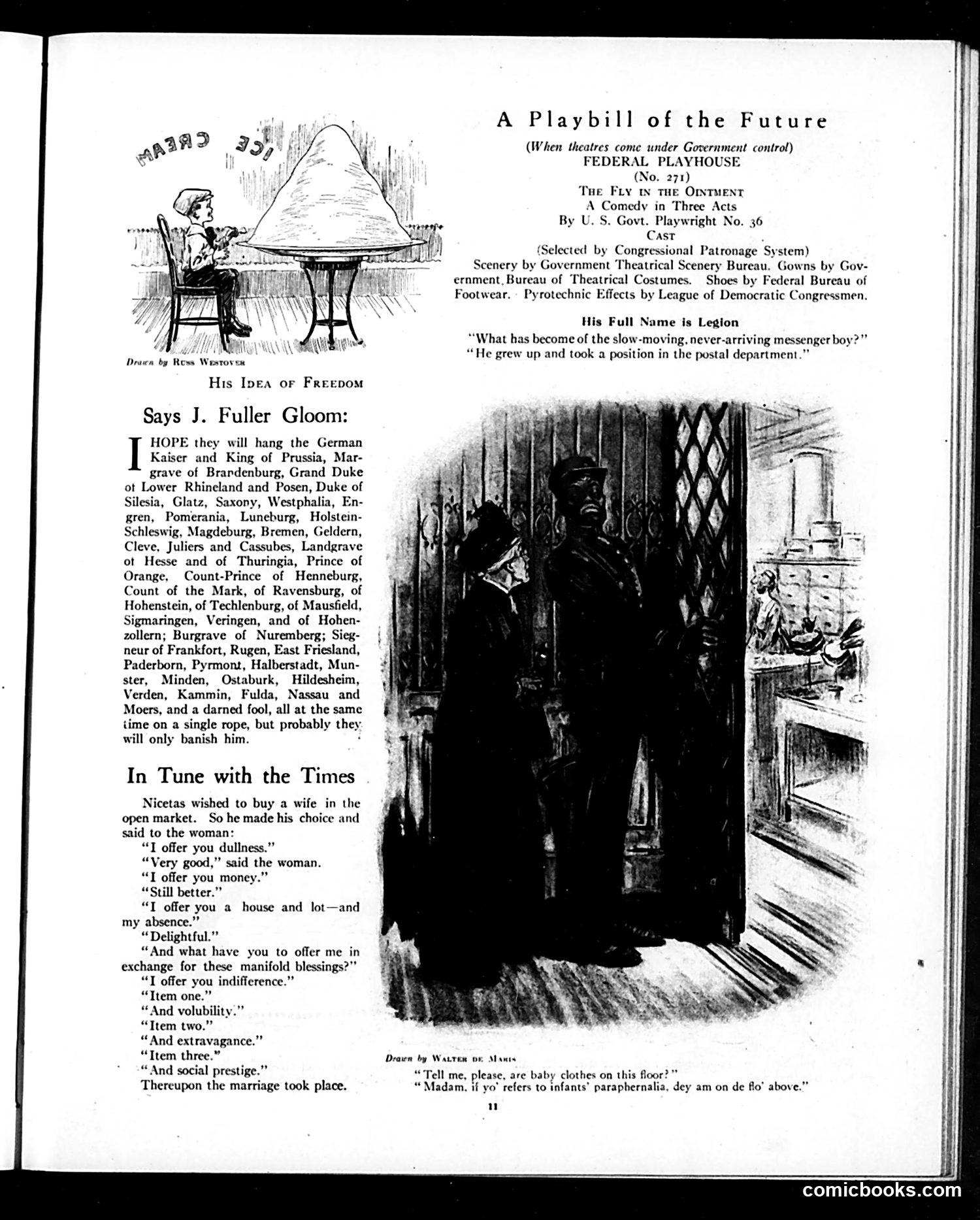
**"A Playbill of the Future"** satirizes government control of theaters during what appears to be WWI-era America. The mock playbill imagines a federal bureaucracy so expansive that every theatrical element—scenery, costumes, shoes, even pyrotechnic effects—falls under different government bureaus. This mocks concerns about expanding government overreach and wartime centralization of industry. **"His Idea of Freedom"** presents J. Fuller Gloom's lengthy tirade about hanging the German Kaiser, cataloging his numerous German titles. The satire targets jingoistic war rhetoric—the absurd litany of titles emphasizes how Americans obsess over enemy leaders while the joke's punchline suggests they'll likely just banish him, undercutting the bloodthirsty sentiment. **"In Tune with the Times"** uses matrimonial negotiation as social commentary on modern marriage and gender relations, where both parties cynically trade material comfort for emotional detachment. The cartoons appear designed for Judge's educated readership to critique government expansion, wartime hysteria, and changing social values.
📄 Transcribed text from this page (OCR, searchable)
Machine-transcribed from the original scan — historical spelling and the odd misread are preserved.
A Playbill of the Future (When theatres come under Government control) FEDERAL PLAYHOUSE (No. 271) Tae Fry w tHe OmtMent A Comedy in Three Acts By U. S. Govt. Playwright No. 36 Cast {Selected by Congressional Patronage System) Scenery by Government Theatrical Scenery Bureau. Gowns by Gov- ernment. Bureau of Theatrical Costumes. Shoes by Federal Bureau of Footwear. Pyrotechnic Effects by League of Democratic Congressmen. His Full Name is Legion “What has become of the slow-moving, never-arriving messenger boy?” “He grew up and took a position in the postal department.” Druca by Ross Westoven His Ipea or Freepom Says J. Fuller Gloom: HOPE they will hang the German Kaiser and King of Prussia, Mar- grave of Brardenburg, Grand Duke ot Lower Rhineland and Posen, Duke of Silesia, Glatz, Saxony, Westphalia, En- gren, Pomerania, Luneburg, Holstein- Schleswig, Magdeburg, Bremen, Geldern, Cleve, Juliers and Cassubes, Landgrave ot Hesse and of Thuringia, Prince of Orange, Count-Prince of Henneburg, Count of the Mark, of Ravensburg, of Hohenstein, of Techlenburg, of Mausfield, Sigmaringen, Veringen, and of Hohen- zollern; Burgrave of Nuremberg; Sieg- neur of Frankfort, Rugen, East Friesland, Paderborn, Pyrmont, Halberstadt, Mun- ster, Minden, Ostaburk, Hildesheim, Verden, Kammin, Fulda, Nassau and Moers, and a darned fool, all at the same time on a single rope, but probably they. will only banish him. ‘ In Tune with the Times Nicetas wished to buy a wife in the open market. So he made his choice and said to the woman: “T offer you dullness.” “Very good,” said the woman. “TI offer you money.” “Still better.” “T offer you a house and lot—and my absence.” “Delightful.” “And what have you to offer me in exchange for these manifold blessings?” “T offer you indifference.” “Ttem one.” “And volubility.” “Ttem two.” “And extravagance.” “Ttem three.” Draien by Warten oe Monts And social prestige. “Tell me, please, are baby clothes on this floor?” Thereupon the marriage took place. “Madam, if yo" refers to infants’ paraphernalia, dey am on de flo’ above.” u comicbooks.com