
Judge, 1919-07-05 · page 8 of 36
Judge — July 5, 1919 — page 8: what you’re looking at
What you’re looking at
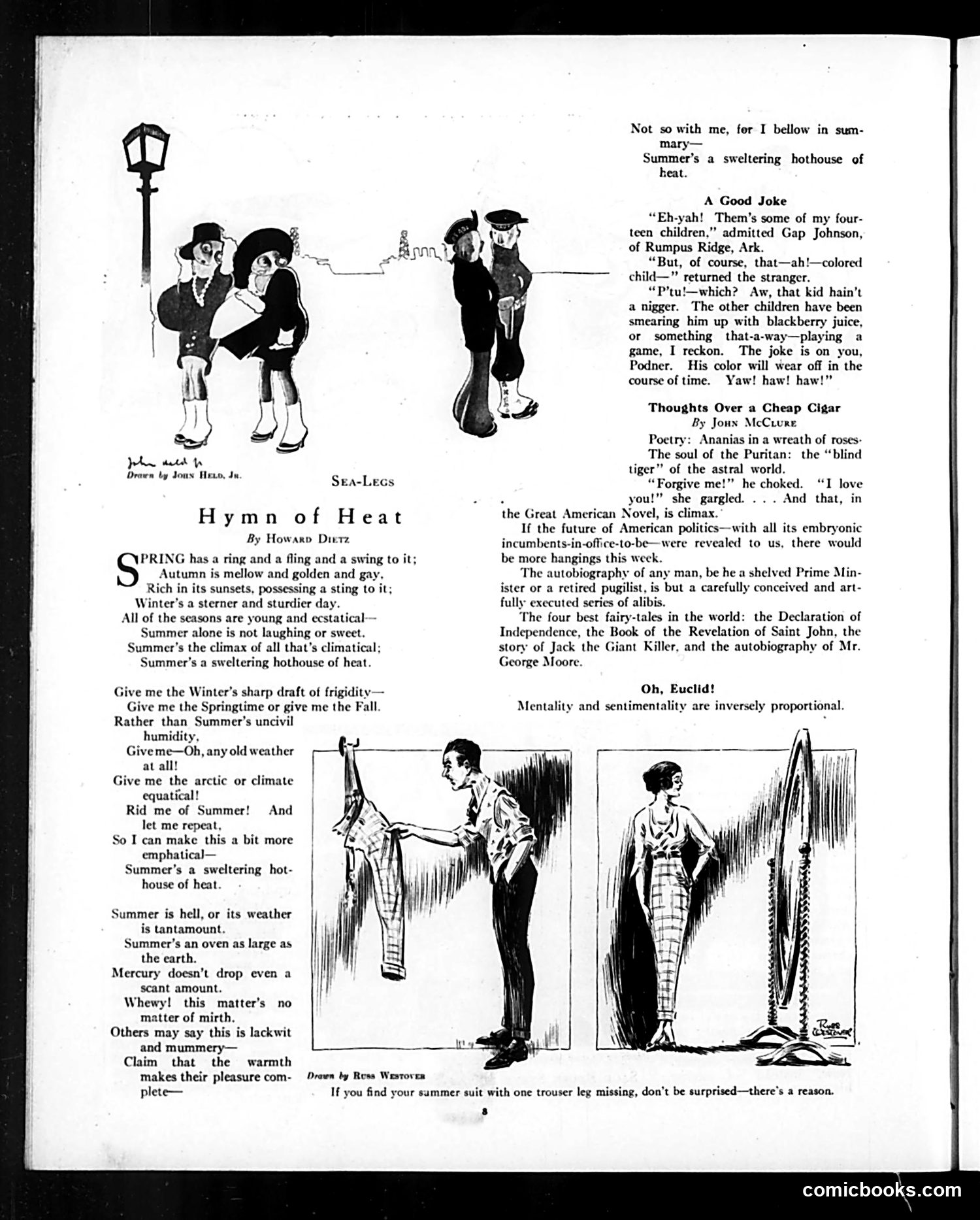
This page contains satirical content typical of early 20th-century Judge magazine: **"Sea-Legs" cartoon**: Two working-class figures (likely sailors or dock workers based on the title) are depicted with exaggerated features in a crude caricature style common to the era. **"Hymn of Heat"**: A poem by Howard Dietz complaining extensively about summer weather—straightforward seasonal satire with no political content. **"A Good Joke"**: A dialect-heavy story mocking rural Arkansas ("Gap Johnson, of Rumpus Ridge, Ark."). The "joke" relies on a racist premise: a child appears dark-skinned, but it's merely blackberry juice from children's games. The humor targets both rural dialect speakers and contains casual period racism. **"Thoughts Over a Cheap Cigar"**: Brief literary commentary on American politics and autobiographies, with social criticism about politicians' dishonesty. **Bottom cartoon by Ross Westeroven**: A domestic humor piece about summer suits shrinking or deteriorating in heat—no political content. The page reflects Judge's mix of weather complaints, rural mockery, and casual racism typical of early American satirical magazines.
📄 Transcribed text from this page (OCR, searchable)
Machine-transcribed from the original scan — historical spelling and the odd misread are preserved.
Not so with me, fer I bellow in sum- mary— Summer’s a sweltering hothouse of heat. A Good Joke “Eh-yah! Them’s some of my four- teen children,” admitted Gap Johnson, of Rumpus Ridge, Ark. “But, of course, that—ah!—colored child—” returned the stranger. “P'tu!—which? Aw, that kid hain’t a nigger. The other children have been smearing him up with blackberry a or something that-a-way—playing a game, I reckon. The joke is on you, Podner. His color will wear off in the course of time. Yaw! haw! haw!” Thoughts Over a Cheap Cigar By Jonx McCiure Poetry: Ananias in a wreath of roses- The soul of the Puritan: the “blind tiger” of the astral world. “Forgive me!” he choked. “I love a ti you!” she gargled. the Great American Novel, is climax. A yin 'S f H cat If the future of American politics—with all its embryonic By Howarn Dierz incumbents-in-office-to-be—were revealed to us, there would OP kan has a ring and a fling and a swing to it; be more hangings t ek. Drown ty Joux Hero, Jn. Autumn is mellow and golden and gay, The autobiography of any man, be he a shelved Prime Min- is but a carefully conceived and art- Rich in its sunsets, possessing a sting to it; ister or a retired pugilis Winter's a sterner and sturdier day. fully executed series of alibis. All of the seasons are young and ecstatical ‘The four best fairy-tales in the world: the Declaration of Summer alone is not laughing or sweet. Independence, the Book of the Revelation of Saint John, the Summer's the climax of all that’s climatical; story of Jack the Giant Killer, and the autobiography of Mr. Summer's a sweltering hothouse of heat. George Moore. Give me the Winter's sharp draft of frigidi Oh, Euclid! Give me the Springtime or give me the Fall. Mentality and sentimentality are inversely proportional. Rather than Summer's uncivil . humidity, Give me—Oh, any old weather at all! Give me the arctic or climate equatical! Rid me of Summer! And let me repeat, So I can make this a bit more emphatica]— Summer's a sweltering hot- house of heat. Summer is hell, or its weather is tantamount. Summer's an oven as large as the earth. Mercury doesn’t drop even a scant amount. Whewy! this matter’s no matter of mirth. Others may say this is lackwit and mummery— ak Claim that the warmth makes their pleasure com- Prawn by Ress Westoven plete— If you find your summer suit with one trouser leg missing, don’t be surprised—there’s a reason. comicbooks.com \