
A complete issue · 37 pages · 1919
Judge — June 28, 1919
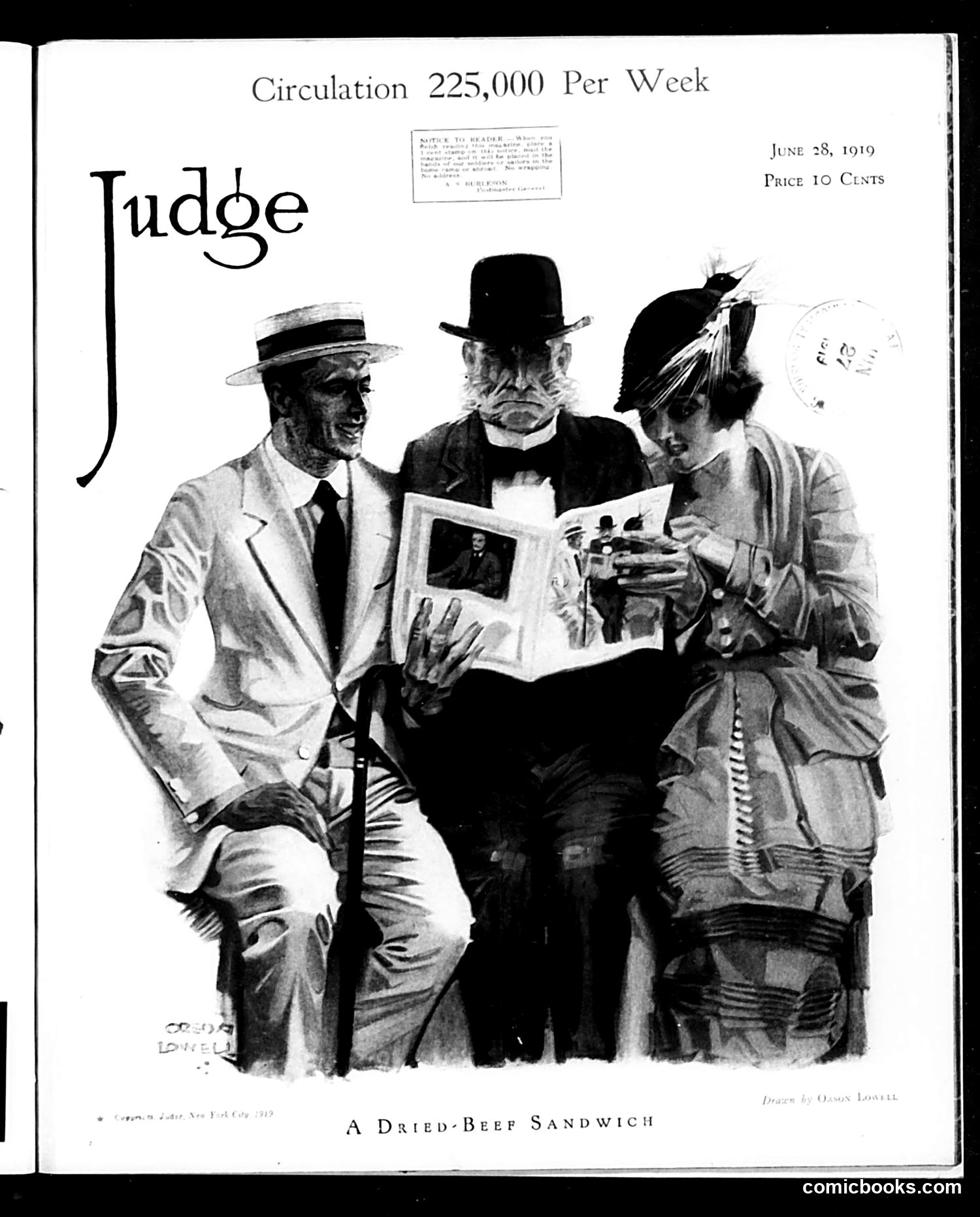
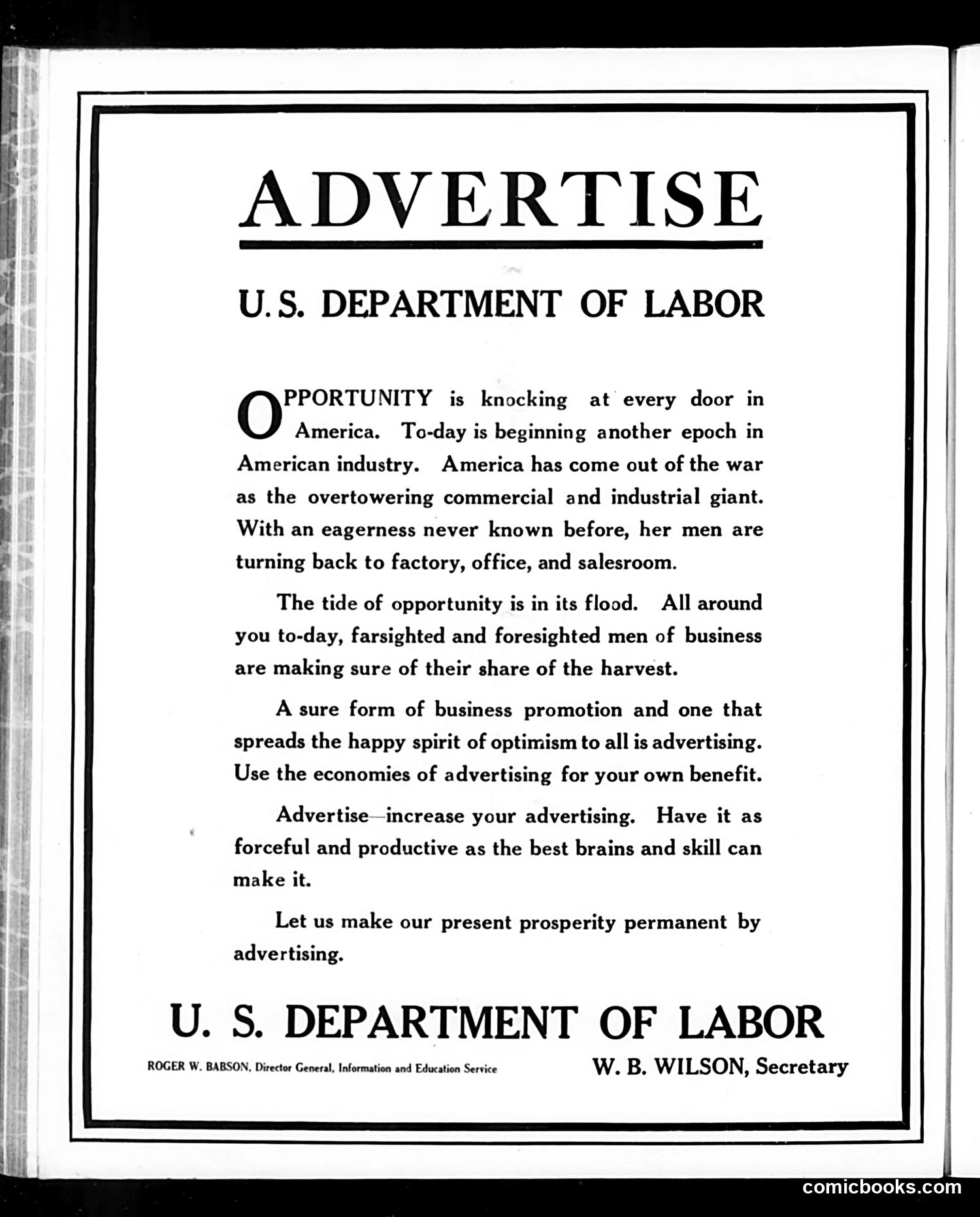
This is not a satirical cartoon but rather a **straight advertisement** from the U.S. Department of Labor, likely from the post-World War I era (the text references "came out of the war"). The ad promotes **increased advertising as economic policy**. It argues that advertising spreads optimism and business confidence, encouraging commercial growth during America's post-war industrial expansion. The Department of Labor is essentially endorsing advertising as patriotic business practice that will ensure "permanent prosperity." There is **no satire or political commentary here**—this is government messaging encouraging American businesses to advertise aggressively. By modern standards, it appears to blur the line between public service announcement and pro-business advocacy, treating advertising itself as a form of national economic stimulus.
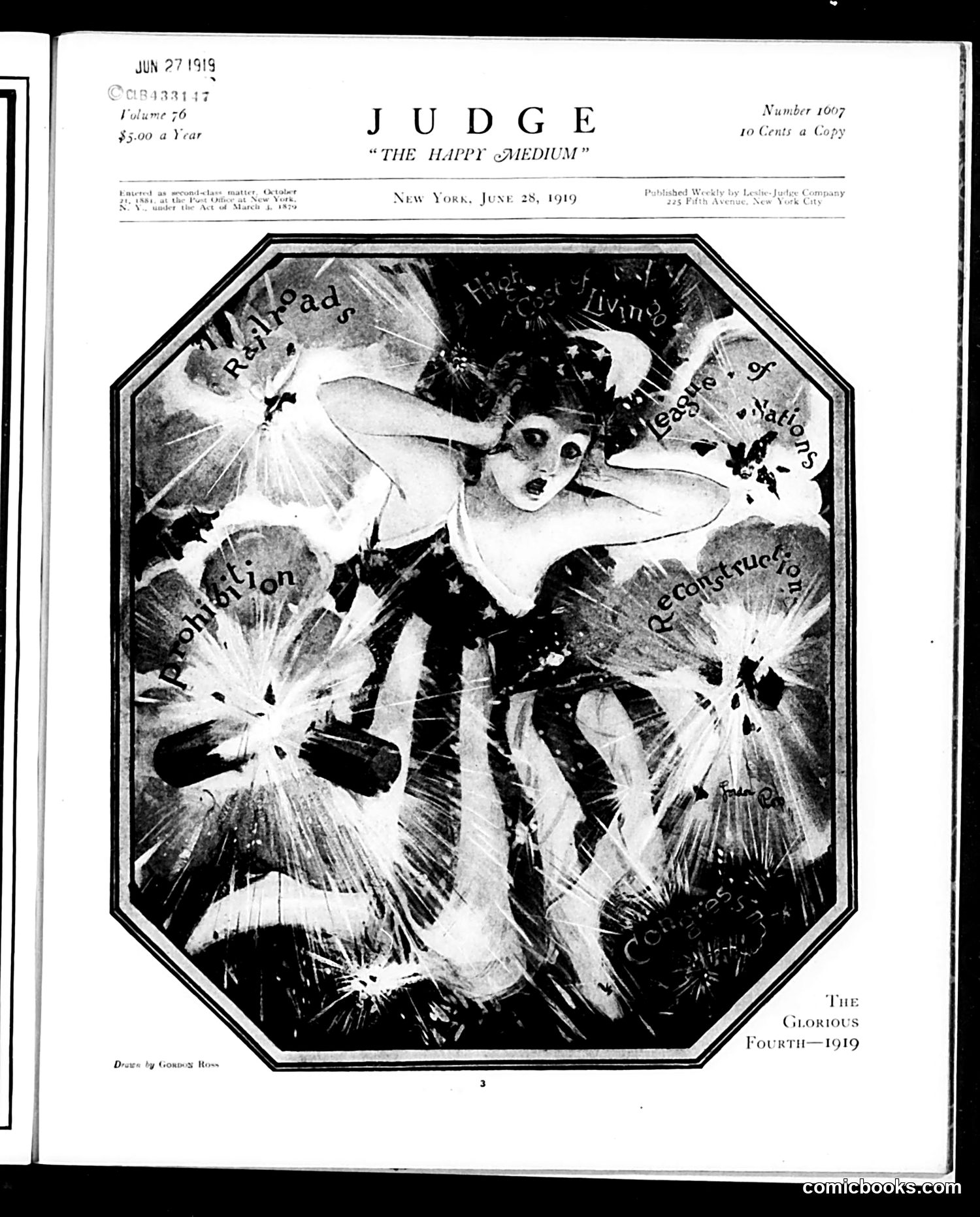
This illustration titled "The Glorious Fourth—1919" depicts a woman surrounded by bursting fireworks labeled with various concepts: "Prohibition," "Woman Suffrage," "Higher Cost of Living," "Peace," and "Reconstruction." The satire appears to celebrate (or mock) major social changes happening in 1919 America. Prohibition and woman suffrage were both recent victories for reform movements. However, the inclusion of "Higher Cost of Living" alongside celebratory imagery suggests irony—the artist may be critiquing the chaos or unintended consequences of these reforms, particularly post-WWI inflation and social upheaval. The drawing style and the figure's theatrical pose emphasize the explosive, unpredictable nature of rapid social transformation during this turbulent period.
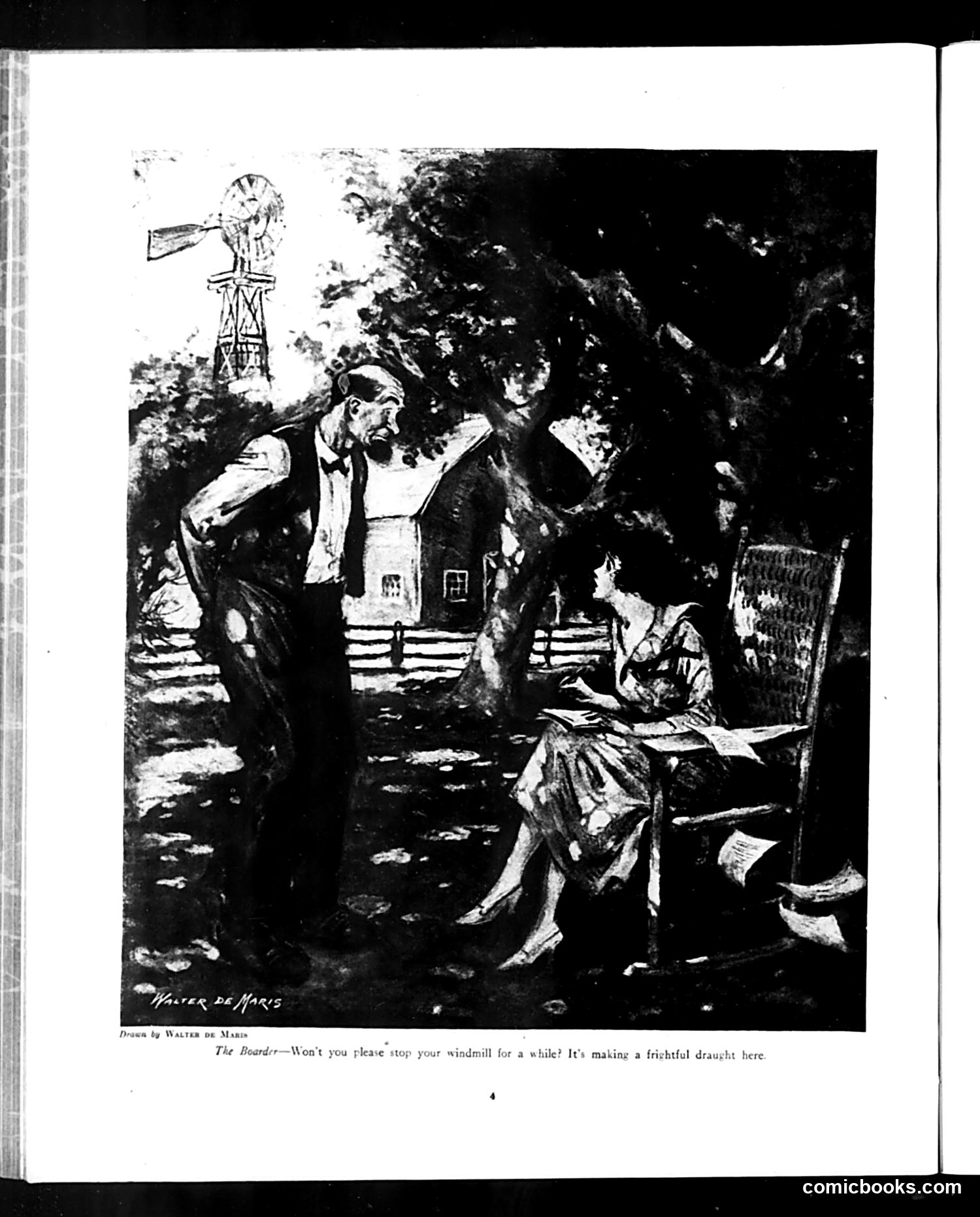
This cartoon depicts a domestic scene where a man (the boarder) is speaking to a woman seated in a chair. He requests that she stop operating her windmill, claiming it's creating "a frightful draught here." The humor relies on a double meaning: "draught" refers both to an air current and to a drink. The seated woman appears to be the homeowner or landlady, while the man is presumably a paying resident. The satire seems to target either the inconveniences of boarding house life or possibly critiques an overly demanding tenant who complains about minor domestic operations. The windmill visible in the background suggests a rural or semi-rural setting. The cartoon's point appears social commentary on boarding house dynamics and interpersonal friction between residents and landladies.
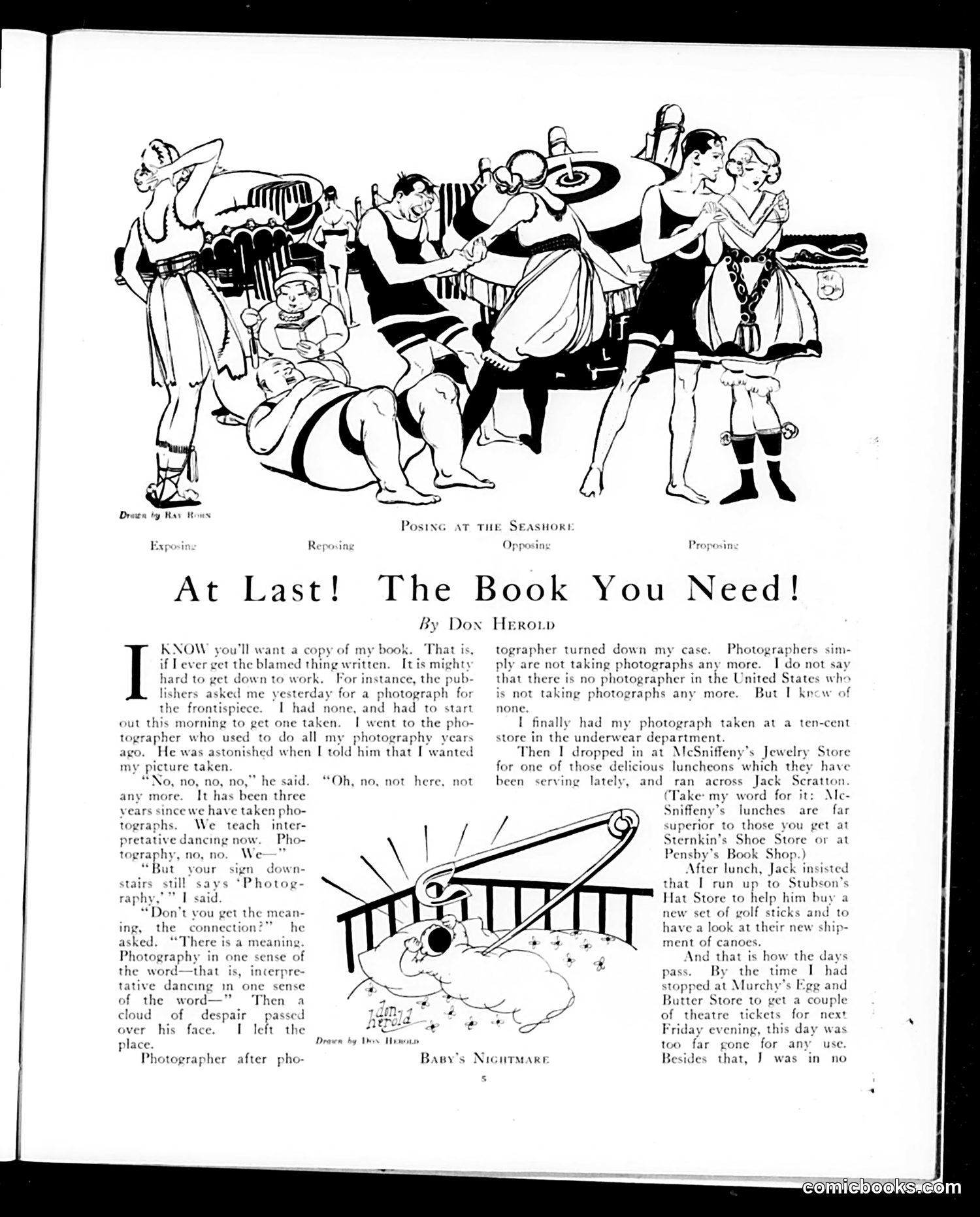
This page contains a humorous article titled "At Last! The Book You Need!" by Dox Herold about the difficulty of getting a photograph taken. The piece satirizes the experience of trying to have one's picture taken for publication—the photographer is uncooperative, claims to be too busy, and keeps refusing the assignment. The top illustration labeled "Posing at the Seashore" depicts four poses: "Exposing," "Reposing," "Opposing," and "Proposing"—a visual joke about different beach behaviors or romantic scenarios. The lower illustration titled "Baby's Nightmare" shows a surreal, humorous image of an infant in an unsettling situation, likely intended as comedic commentary on parenting anxieties or childhood fears. The article's humor relies on relatable frustrations with photography services common to that era.
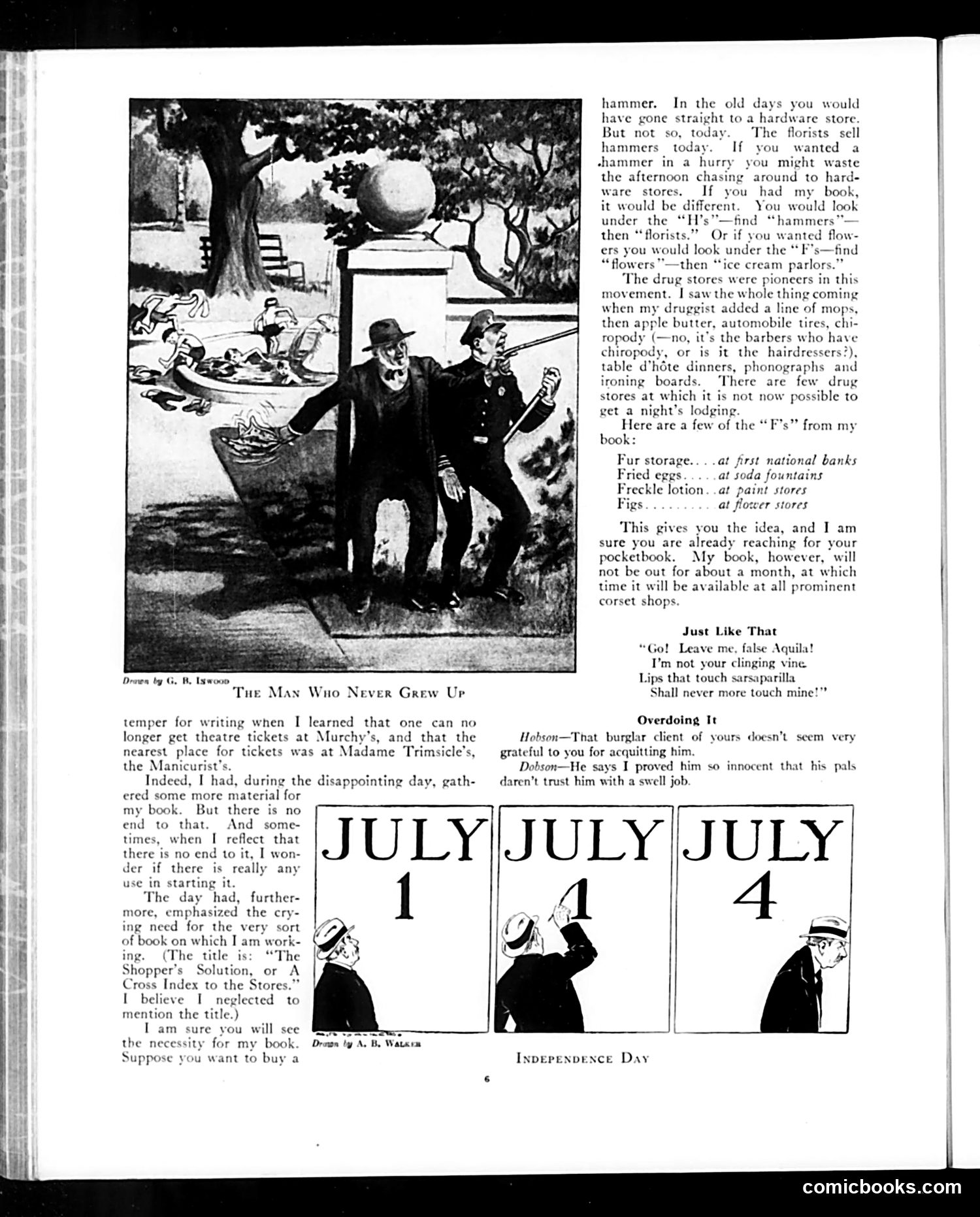
This cartoon satirizes the opening of new retail establishments that have replaced traditional specialty shops. The author laments that you can no longer buy theater tickets at Murphy's or get them at Madame Trimsisle's or the Manicurist's—instead, these services now appear in unexpected places like drug stores, florists, and paint shops. The illustration shows two bewildered men in a park, apparently searching for a simple item. The satire targets the chaotic modernization of retail, where consumers can no longer find goods and services through straightforward, logical channels. The joke is that shopping has become so disorganized that adults must navigate it like lost children, hence "the man who never grew up"—perpetually confused by contemporary commerce.
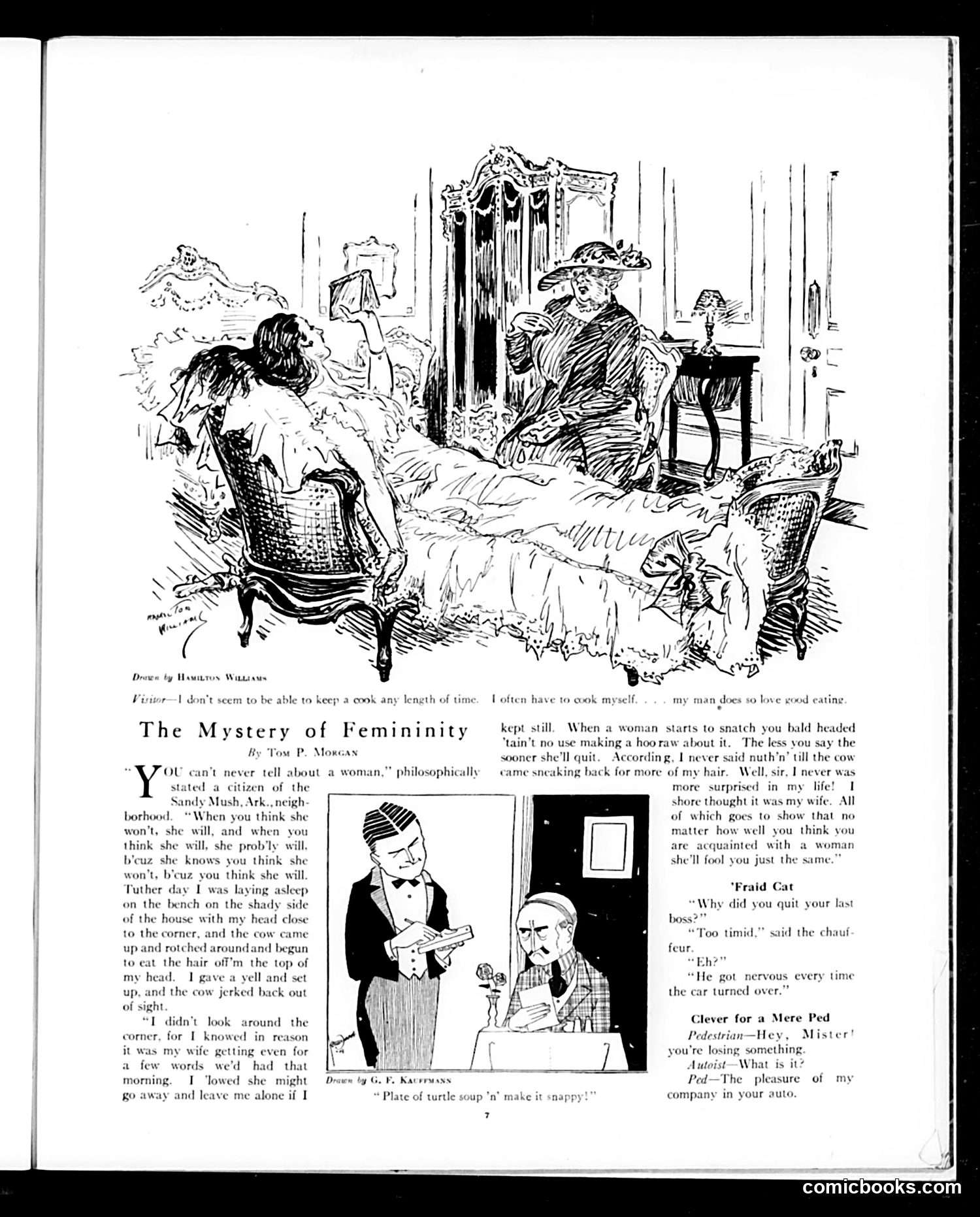
This page satirizes the unpredictability of women through rural, working-class male perspectives. The main story by Tom P. Morgan presents a backwoods Arkansas man recounting how a cow ate his hair while he slept—yet he assumed it was his wife getting revenge for an argument. The joke relies on the era's stereotype that women are inherently vengeful and illogical, so even a cow's actions seemed plausibly attributable to a wife's spite. The accompanying cartoons mock male anxieties about women's incomprehensibility: one depicts a timid chauffeur who quit because his boss "got nervous every time the car turned over"; another shows a pedestrian flattering an automobilist by claiming he enjoys the man's company. The overall theme treats women—and by extension, anyone perceived as "other"—as mysterious, unpredictable, and fundamentally unknowable. This reflects early 20th-century gender attitudes dismissing women as illogical or emotionally unstable.
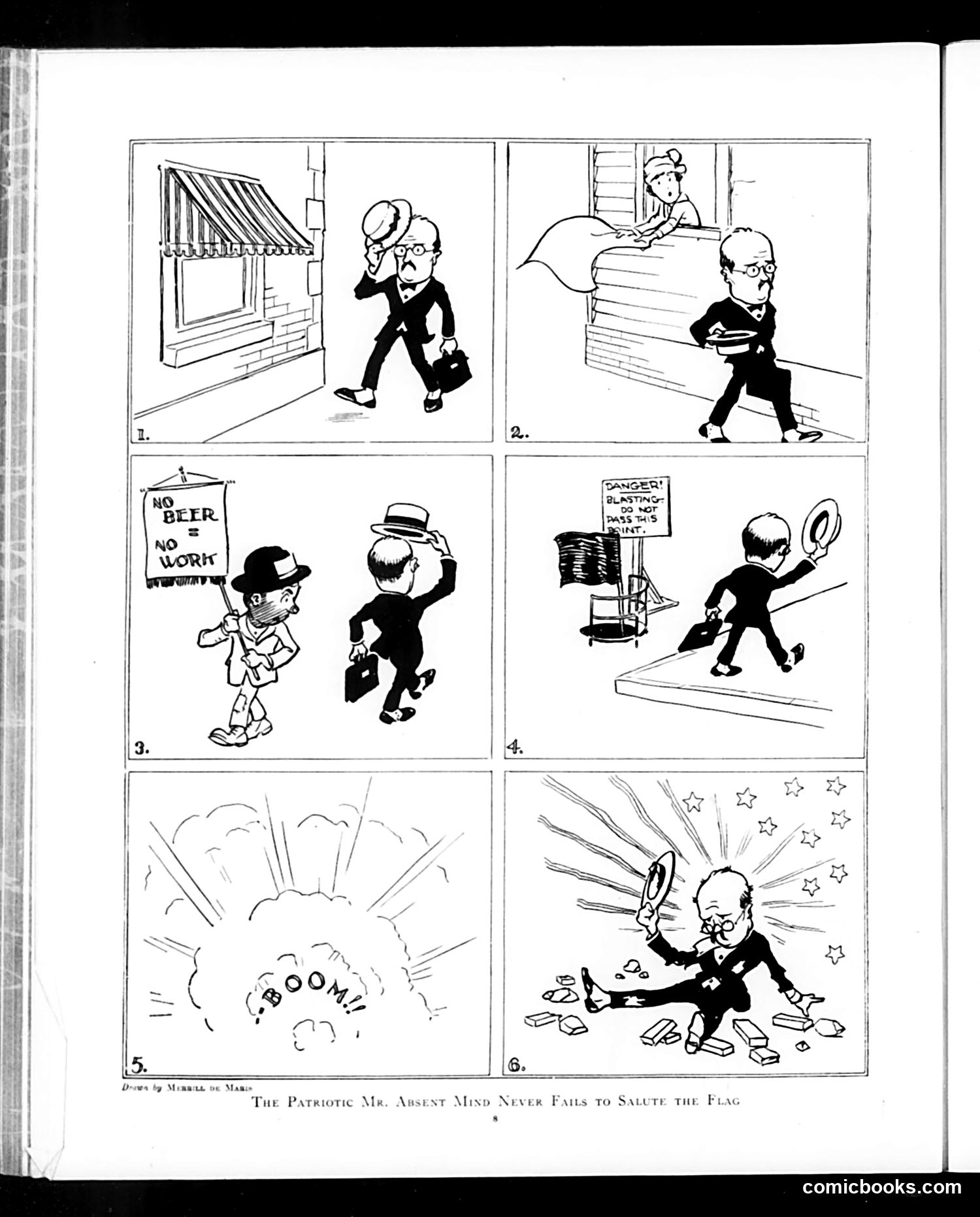
This six-panel satirical comic follows an absent-minded businessman through his day. Despite being distracted and preoccupied—dodging storefronts, carrying large packages, protesting labor shortages with a "No Beer = No Work" sign, and narrowly avoiding a construction blast—the character consistently salutes the flag in each scene. The satire appears to mock blind patriotism: the man automatically performs patriotic gestures (flag salutes) regardless of circumstances, while remaining indifferent to or oblivious of practical matters around him. The joke suggests that empty patriotic gestures require no actual engagement or thought, contrasting performative nationalism with genuine civic awareness or responsibility.
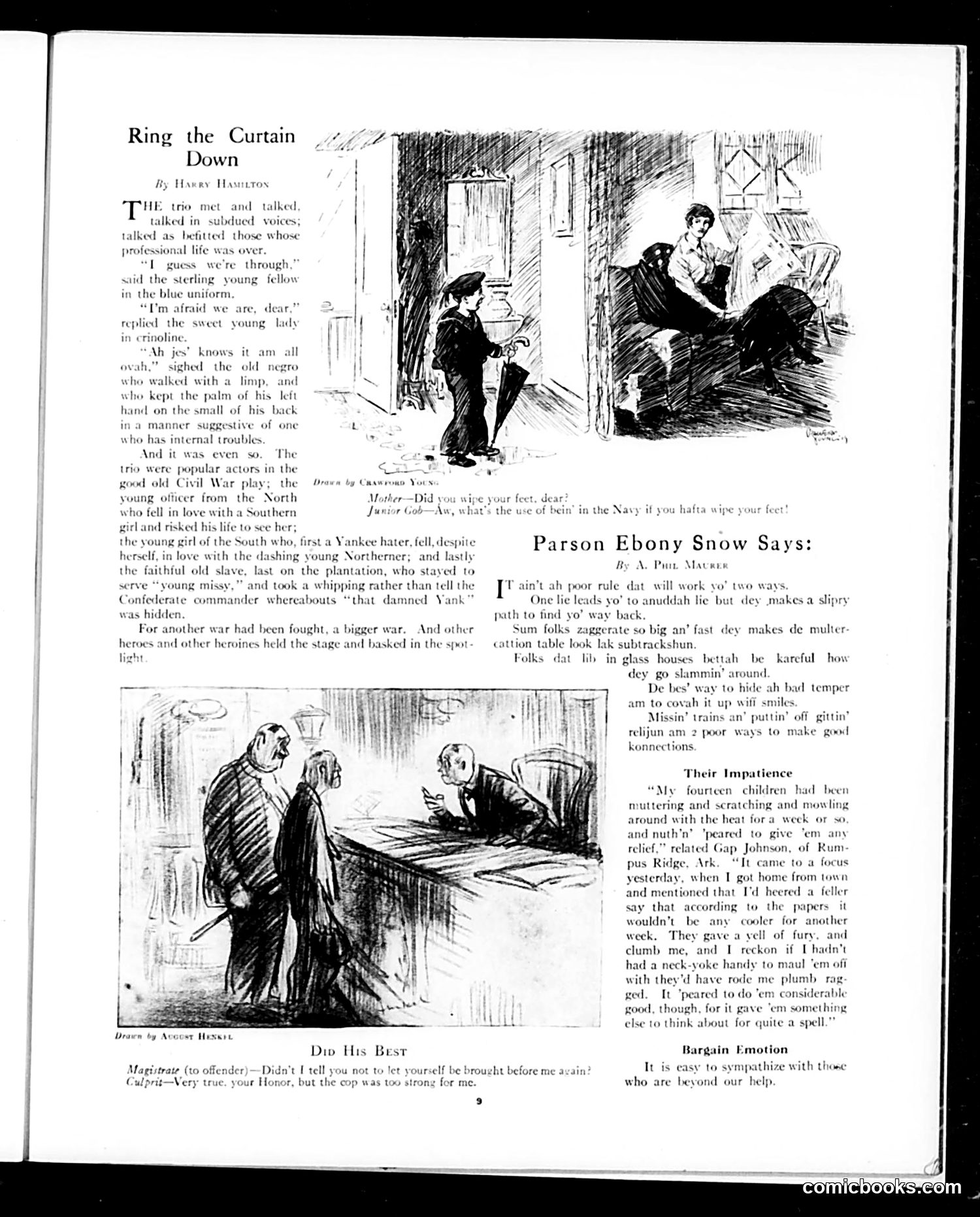
This page contains three separate satirical pieces from *Judge* magazine: **"Ring the Curtain Down"** (top): A sentimental story about three actors—a Union soldier, a Southern belle, and an elderly enslaved man—who portrayed these same roles in Civil War theatrical productions. The satire suggests that post-war America is trying to "close the curtain" on Civil War narratives, yet these stock characters (the noble North, the conflicted South, the faithful servant) had become worn theatrical clichés. The story implies these simplified war-story archetypes are exhausted and no longer resonate. **"Did His Best"** (middle): A magistrate's court scene where a man explains his arrest philosophically—the policeman's strength overcame his good intentions. It's light satirical commentary on urban law enforcement. **"Parson Ebony Snow Says"** and other items (right): These are humorous dialect pieces using African American vernacular, typical of the era's casual racial humor in mainstream magazines—representing the prejudiced comedic conventions of early 20th-century American periodicals.
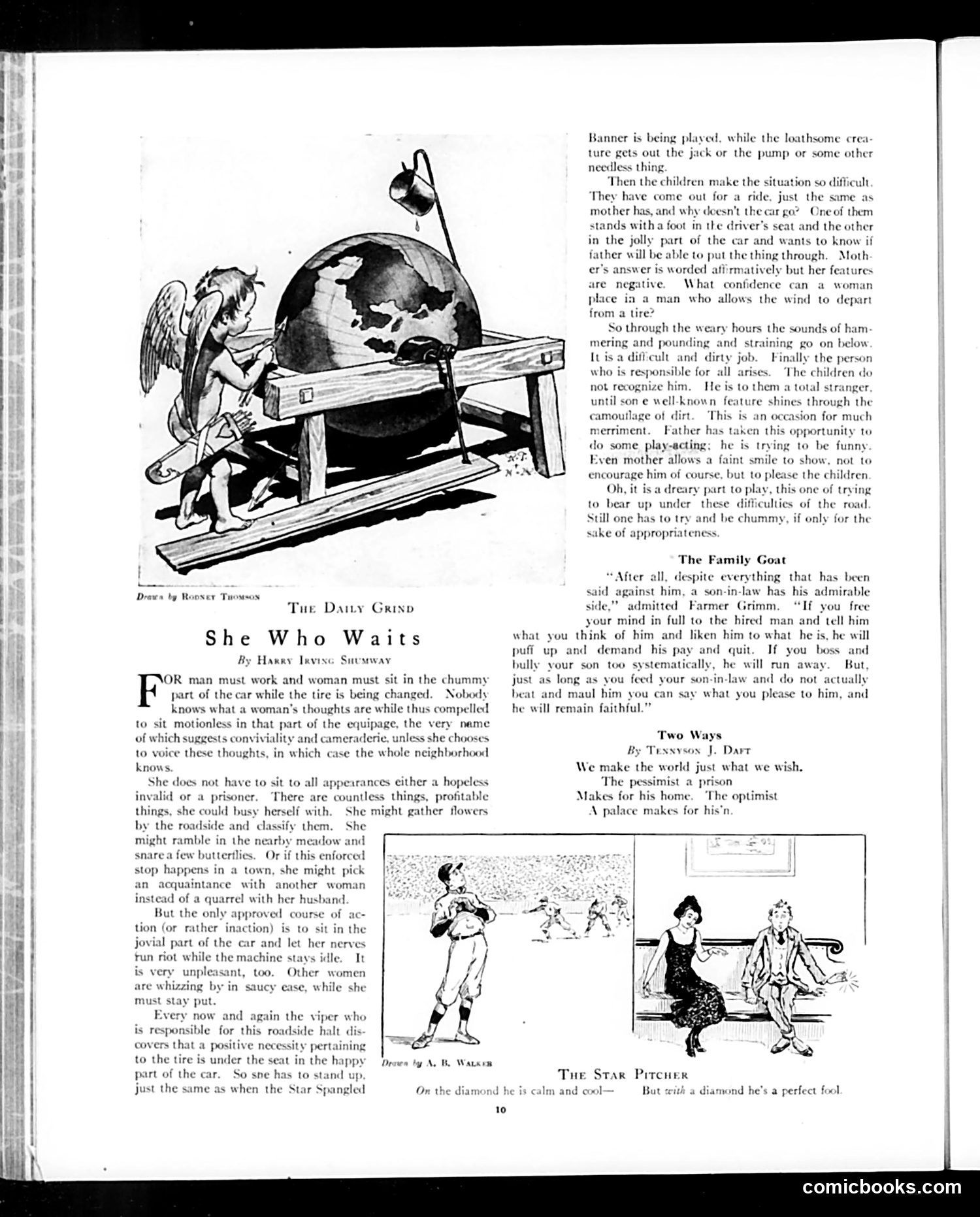
This page satirizes the early automobile era's gender dynamics. The main cartoon depicts a woman confined to the car's back seat while a man changes a flat tire—a common roadside occurrence before reliable tires existed. The satire targets the woman's enforced passivity: she must sit idle in the "chummy part" (back seat) while her husband labors, unable to help or even leave without appearing improper. The text mockingly catalogs what she *could* do (gather flowers, sketch) but *shouldn't* because social convention demands she "bear up" and remain decorously stationary. The children's presence compounds her anxiety—they ask when the car will move again, undermining her composure. When the father finally emerges covered in dirt, he attempts levity to ease the family's frustration, but the mother's forced smile masks her real irritation. This reflects early 1900s gender expectations: women were passengers, not agents, during mechanical crises—trapped by both circumstance and propriety.
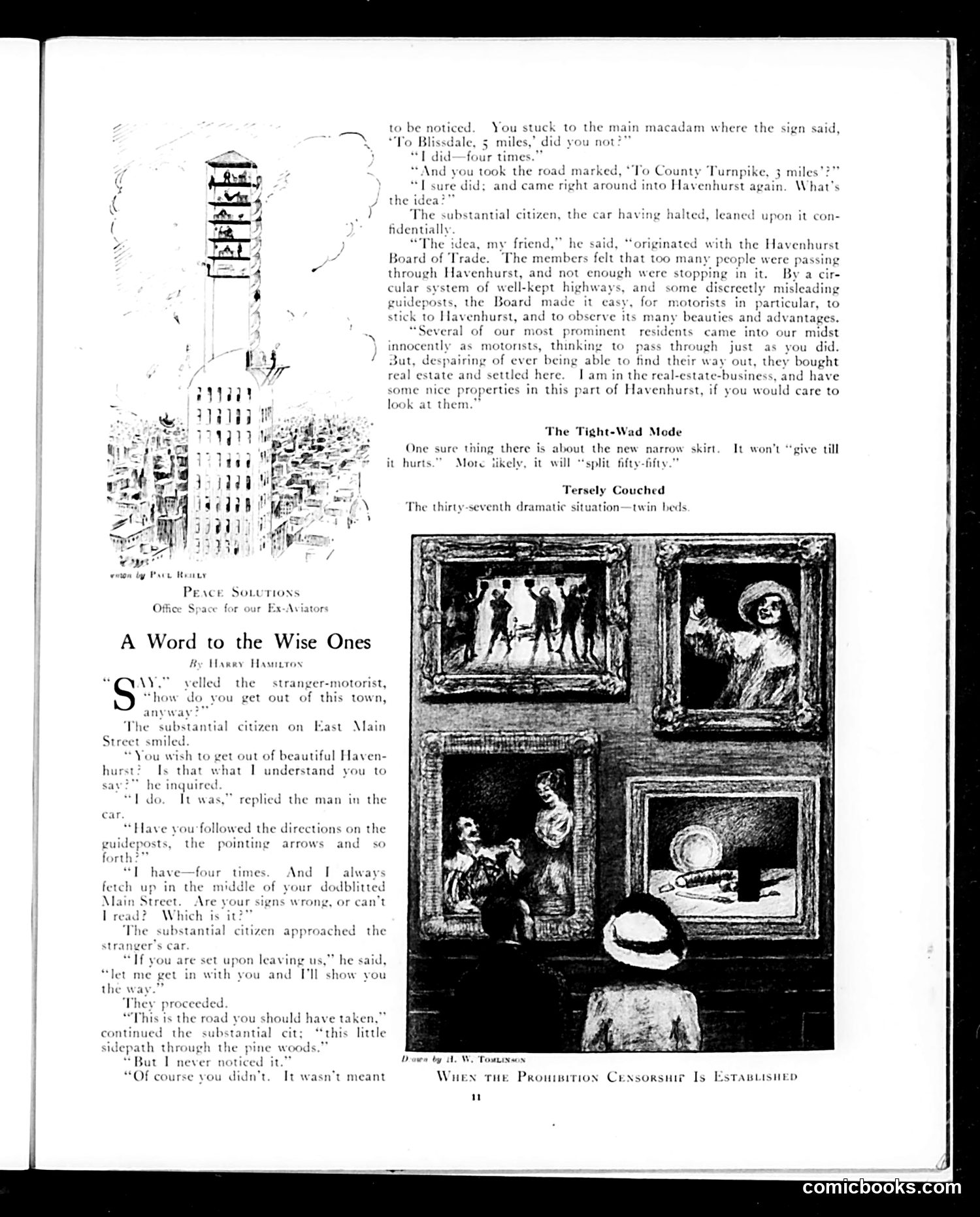
**"A Word to the Wise Ones"** satirizes small-town deception disguised as civic pride. A motorist repeatedly gets lost trying to leave Havenhurst despite following directional signs. A local reveals the truth: the town's Board of Trade *deliberately* created a confusing road system to trap passing motorists into stopping and eventually buying property there. Several prominent residents "innocently" became trapped this way themselves. The satire mocks: - Small towns' desperation to retain visitors and revenue - Dishonest business practices masked by friendly hospitality - The irony that con-artists get caught in their own schemes **"The Tight-Wad Mode"** is a brief, separate joke about narrow skirts—likely referencing 1920s fashion trends—suggesting tight clothing will "split fifty-fifty" (tear down the middle). The page also shows illustration examples and appears part of Judge magazine's satirical commentary on American social and commercial practices.
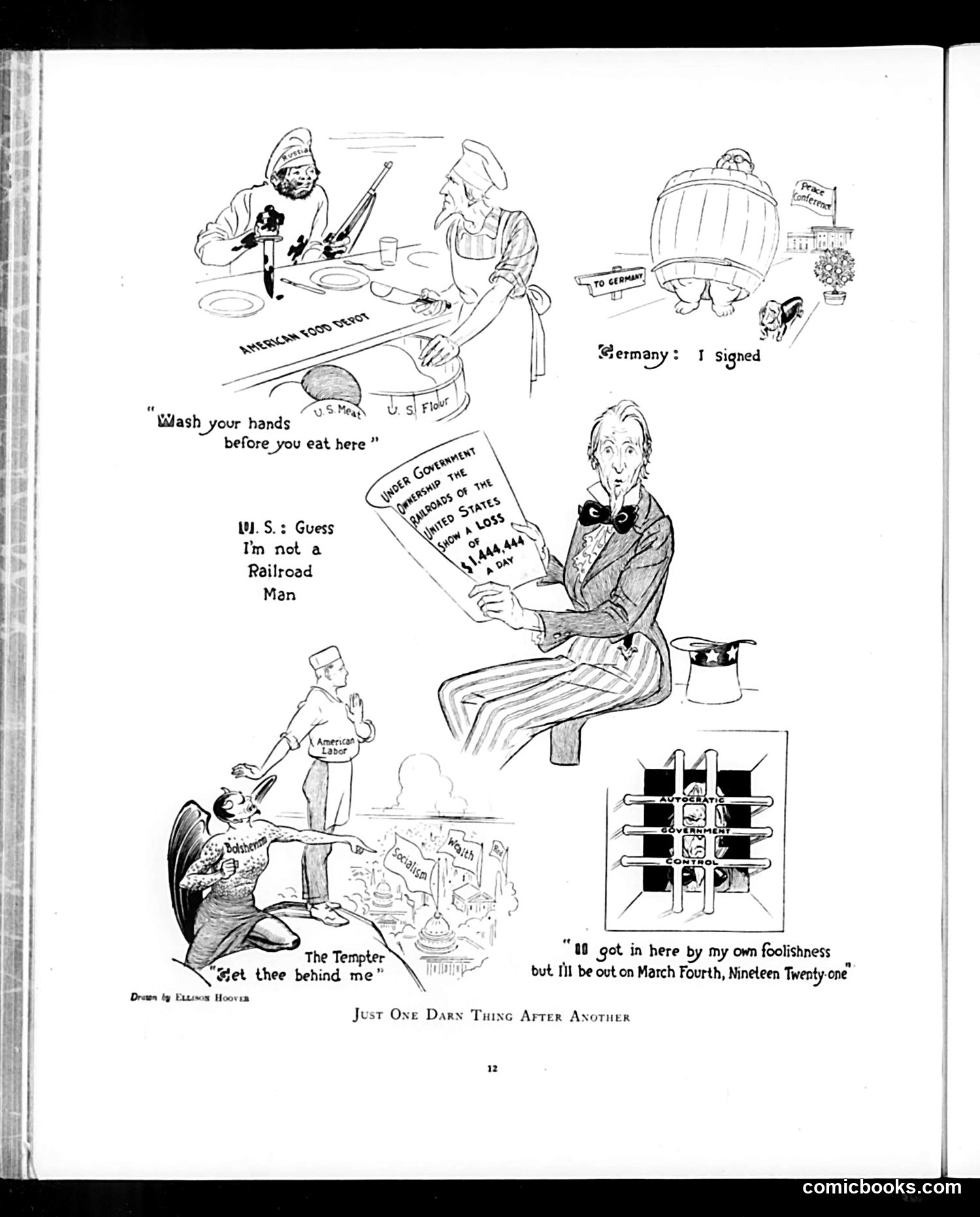
This political cartoon satirizes America's post-WWI troubles through interconnected vignettes: **Top scene**: A soldier with a rifle confronts someone about food safety ("Wash your hands before you eat here"), labeled "American Food Depot." **Germany panel**: References the Treaty of Versailles, with Germany saying "I signed"—mocking Germany's forced acceptance of harsh peace terms. **Central figure**: A worried man holds a document about "Under Government Control" and massive U.S. financial losses, representing economic chaos. **Bottom scenes**: Include a figure labeled "The Tempter" and an "American" representative, suggesting internal political corruption and temptation. **Bottom right**: A diagram implying institutional gridlock or bureaucratic entanglement. The final quote about March 4, 1921 likely references Warren G. Harding's inauguration, suggesting hope that a new administration would resolve these mounting crises—food safety issues, war debt, government control, and political dysfunction.
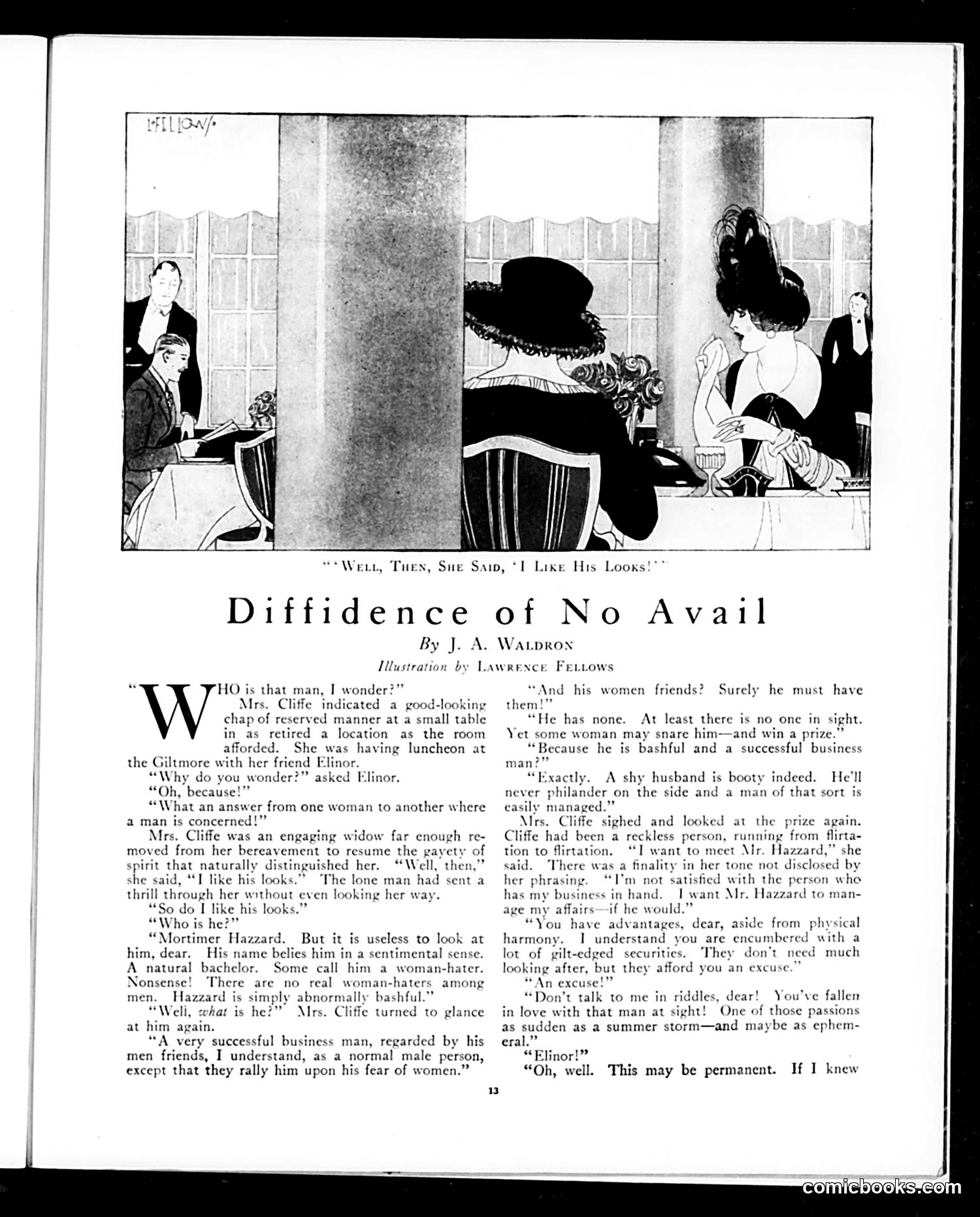
This 1920s short story satirizes romantic pursuits and gender dynamics among wealthy urbanites. Two women—Mrs. Cliffe (a widow) and Elinor—lunch at an upscale hotel and spot an attractive businessman, Mortimer Hazzard. Elinor explains he's famously bashful around women, which the women view as advantageous: a shy husband won't philander and is "easily managed." Mrs. Cliffe decides to pursue him, claiming she needs him to manage her financial securities. Elinor sees through this, suggesting she's fallen instantly in love. The satire targets female marital calculation—Mrs. Cliffe exploits the assumption that a timid man makes a controllable husband, while also using wealth (securities) as bait. The humor lies in reversing the typical seduction narrative: the woman pursues the reluctant man strategically, not romantically.
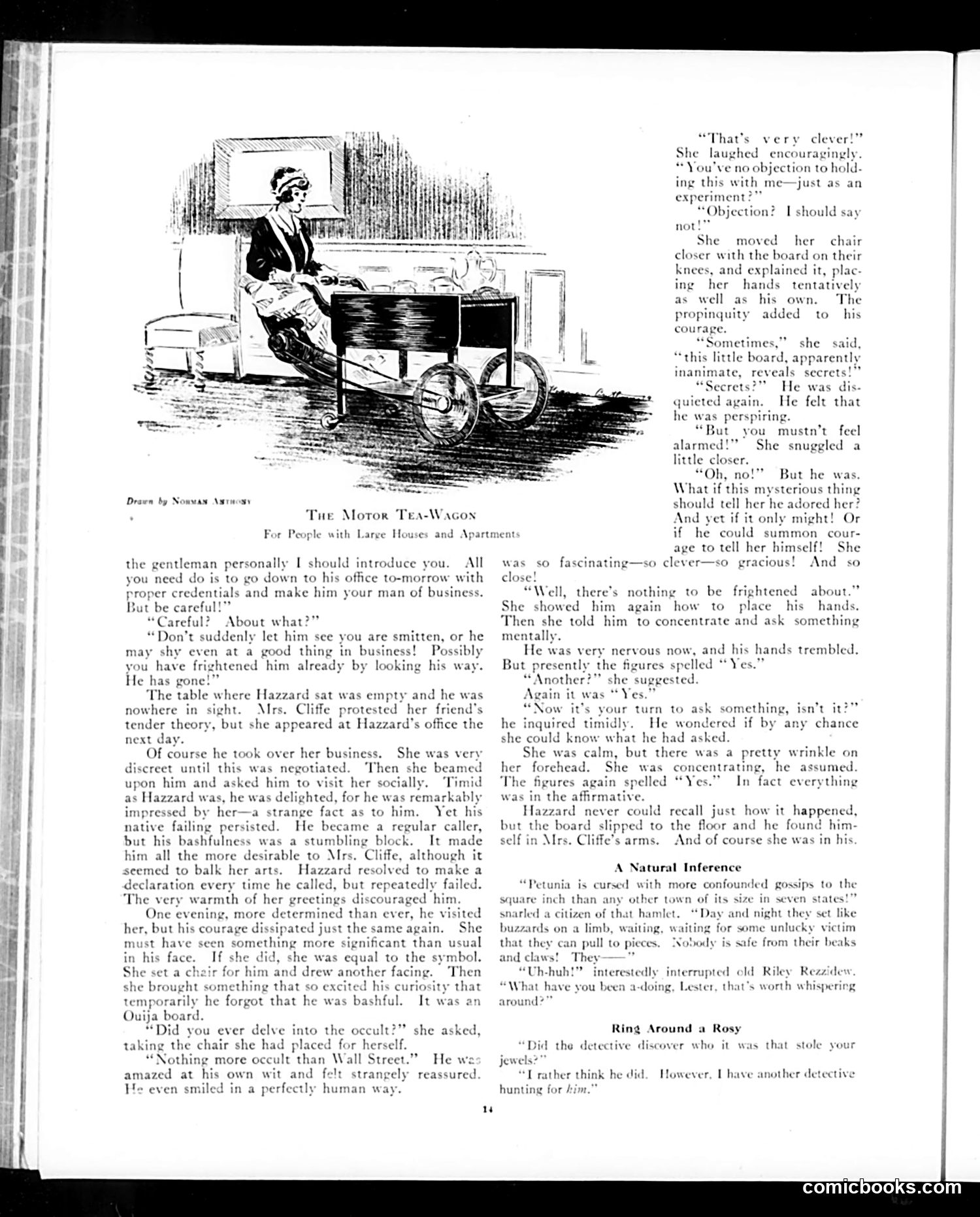
This page presents a satirical narrative about a bashful businessman named Hazzard and a widow, Mrs. Cliffe, who uses a Ouija board to manipulate him into romance. The cartoon illustrates "The Motor Tea-Wagon"—a novelty vehicle for wealthy households. The story mocks early 20th-century spiritualism and séance culture. Mrs. Cliffe deliberately employs the Ouija board as a seduction tool, knowing it will excite Hazzard's curiosity and lower his guard. The satire targets both the credulity of those believing in occult communication and the calculated feminine strategy of using pseudo-mystical props for romantic advantage. The joke's point: spiritualism was fashionable nonsense easily exploited by clever women to overcome men's social inhibitions. The board's "answers" are obviously Mrs. Cliffe's manipulation, yet Hazzard remains oblivious—a critique of masculine gullibility and the era's obsession with supernatural parlor games.
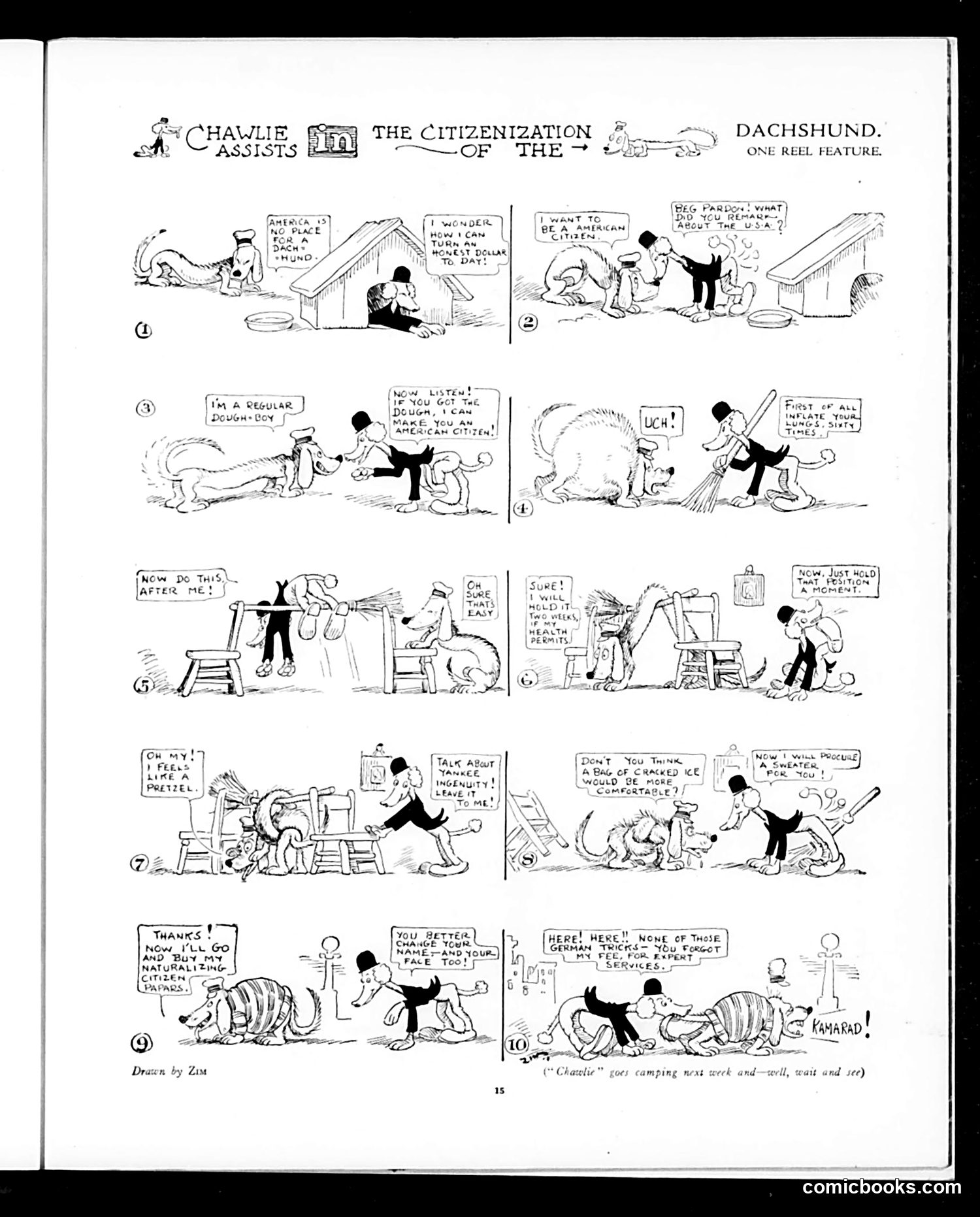
This is a satirical comic strip about a dachshund's attempt to become an American citizen during what appears to be the early 20th century—likely around World War I, when German-Americans faced suspicion and pressure to "Americanize." **The satire:** Charlie (a human character) puts the dachshund through absurd "citizenship" tests—teaching it American manners, having it renounce "German tricks," and attempting to transform its behavior and identity. The dachshund's German breed is treated as a liability requiring correction. **The joke:** The strip mocks both paranoid anti-German sentiment and the era's obsession with forced assimilation. It suggests the hysteria was so extreme that even a dog faced discrimination. The final panel shows Charlie instructing the dachshund to abandon "German tricks"—the implication being that suspicion of anything "German" was irrational, even when applied to a dog's natural behavior. This reflects real historical anxiety about German-Americans during WWI.
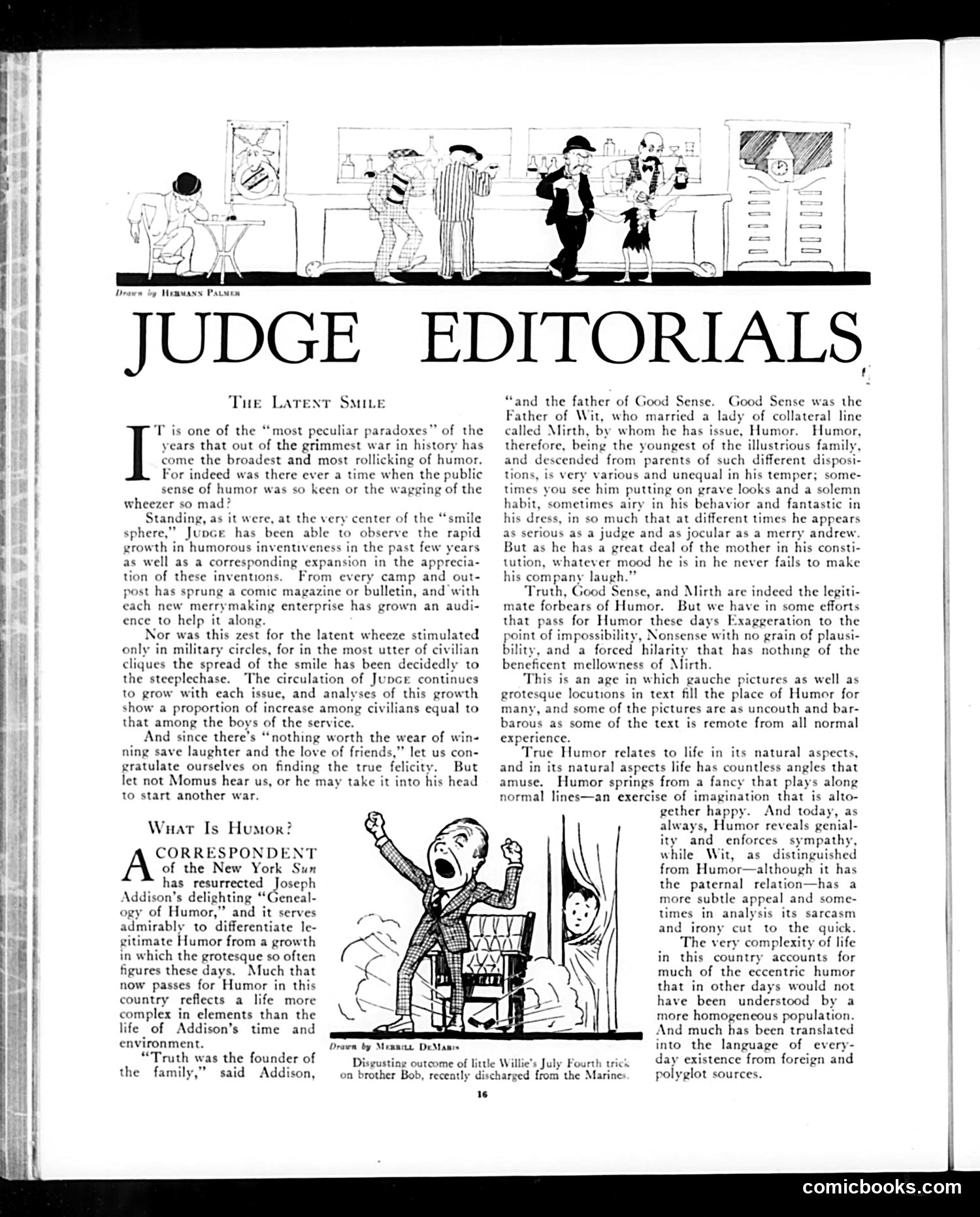
This page from *Judge* magazine discusses humor's role during wartime (likely WWI, given the Marine reference). The editorial argues that despite "the grimmest war in history," American humor has flourished—evidenced by *Judge*'s growing circulation among both soldiers and civilians. The piece traces humor's genealogy through Joseph Addison's essay, establishing "Truth" as humor's ancestor, with descendants including "Good Sense," "Wit," and "Mirth." The editorial distinguishes *legitimate* humor—which relates to life's natural aspects and "plays along normal lines"—from contemporary "grotesque" humor relying on exaggeration and forced hilarity. The small cartoon depicts a boy's prank on his recently-discharged Marine brother, illustrating humor's simpler, more innocent forms. The editorial essentially argues that *Judge* represents refined humor rooted in observation and sympathy, contrasting with cruder comedic trends.
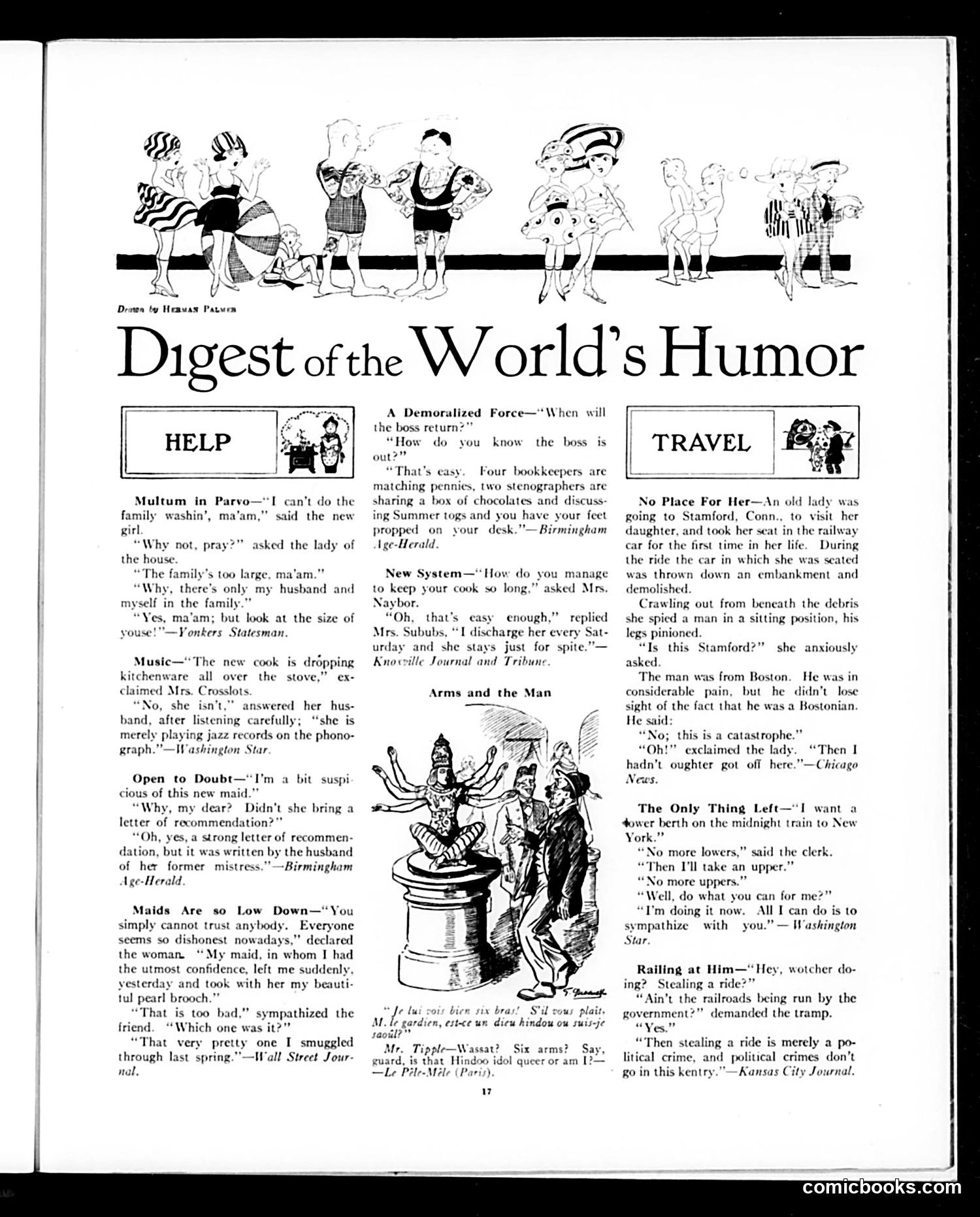
This page collects brief humorous anecdotes reflecting contemporary concerns. The jokes mock domestic servants ("Maids Are so Low Down," "Open to Doubt"), playing on class anxieties about household help's dishonesty and unreliability—common preoccupations in early 20th-century middle-class households. "A Demoralized Force" satirizes workplace disorder, depicting idle office workers (matching pennies, discussing fashion) during the boss's absence—likely reflecting post-WWI economic disruption or labor concerns. "The Only Thing Left" and "Railing at Him" reference government-run railroads, appearing to critique public administration of transit as inefficient or permissive. The tramp's claim that "political crimes don't go in this kentry" under government control mocks either government incompetence or perceived leniency. One cartoon shows a multi-armed Hindu deity figure, captioned in French, making a joke about cultural confusion or religious "otherness." These pieces represent Judge magazine's satirical targets: working-class dishonesty, bureaucratic incompetence, and social anxiety during an era of labor unrest and changing social structures.
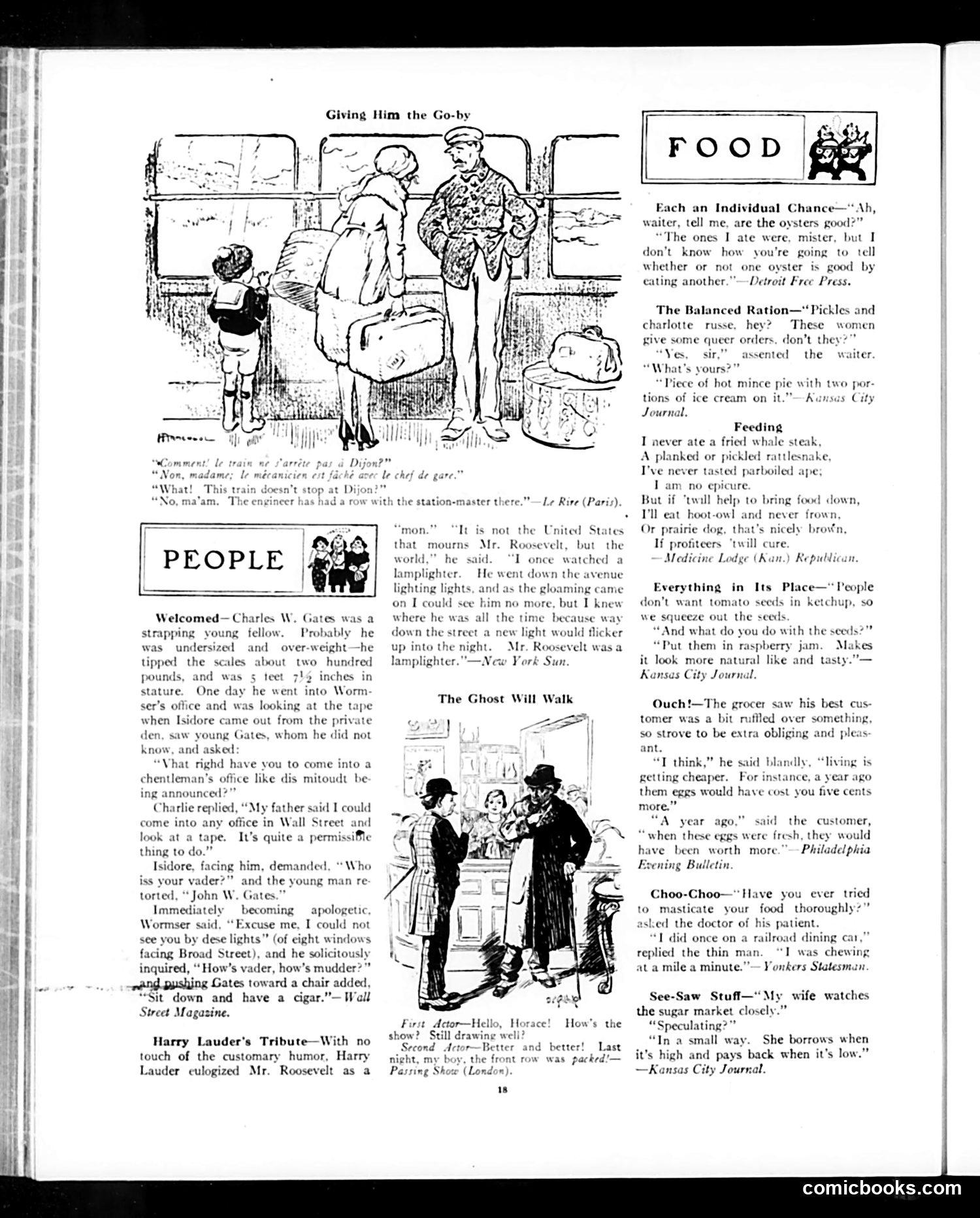
This page from *Judge* magazine contains satirical anecdotes and jokes rather than political cartoons. The content addresses early 20th-century American social and economic concerns: **"Welcomed"** mocks class deference: a young man enters a Wall Street office claiming his father is John W. Gates (a wealthy industrialist). The office manager immediately becomes obsequious upon hearing this name, abandoning his initial rudeness—satirizing how wealth commands respect regardless of merit. **"Harry Lauder's Tribute"** references the Scottish entertainer praising President Roosevelt as a "lamplighter" for bringing hope during dark times—likely referencing Roosevelt's progressive policies. The remaining items are brief restaurant and domestic humor jokes about food, pricing, and household management, reflecting wartime or post-war inflation concerns (references to egg prices and food profiteering suggest scarcity-era anxieties). The overall page satirizes class hierarchy, materialism, and economic anxieties of the era.
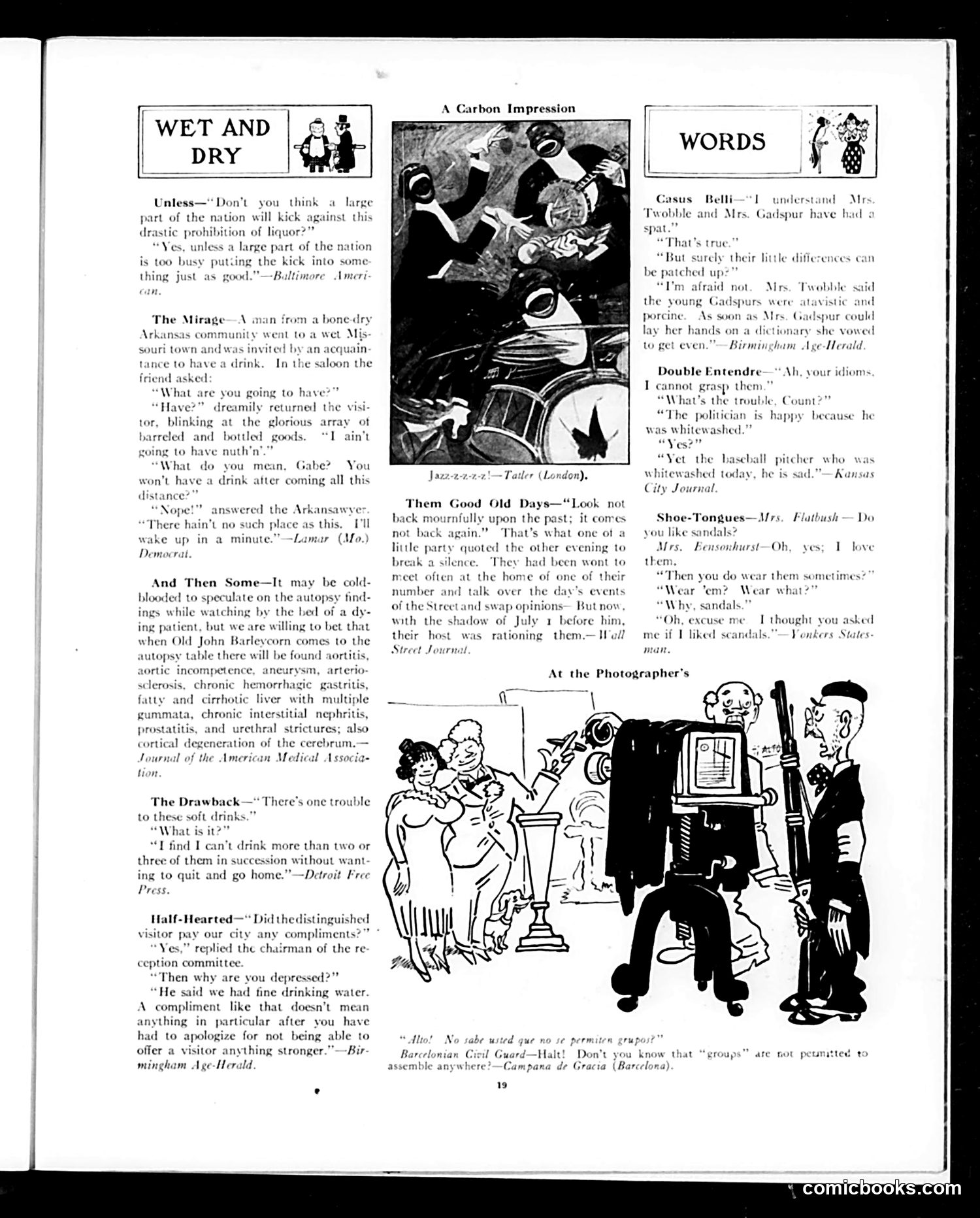
This page satirizes **Prohibition**, likely from around the 1920s when the "drastic prohibition of liquor" was enacted in America. The left column contains humorous anecdotes mocking Prohibition's effects. "The Mirage" jokes about a dry-state visitor confused by absent saloons. "And Then Some" darkly speculates that chronic drinkers' autopsies will reveal alcohol-related diseases—implying heavy drinking was common pre-Prohibition. "The Drawback" mocks substitutes (soft drinks), while "Half-Hearted" satirizes cities losing prestige without alcohol to offer visitors. The right column, "Words," contains brief witticisms about marital discord, baseball, and sandals—filler content typical of the era. **"A Carbon Impression"** (center photo) appears to show a speakeasy or illegal drinking scene, reinforcing the page's theme that Prohibition drove drinking underground rather than eliminating it. The cartoons mock Prohibition as impractical and socially damaging, a common Judge stance on the controversial policy.
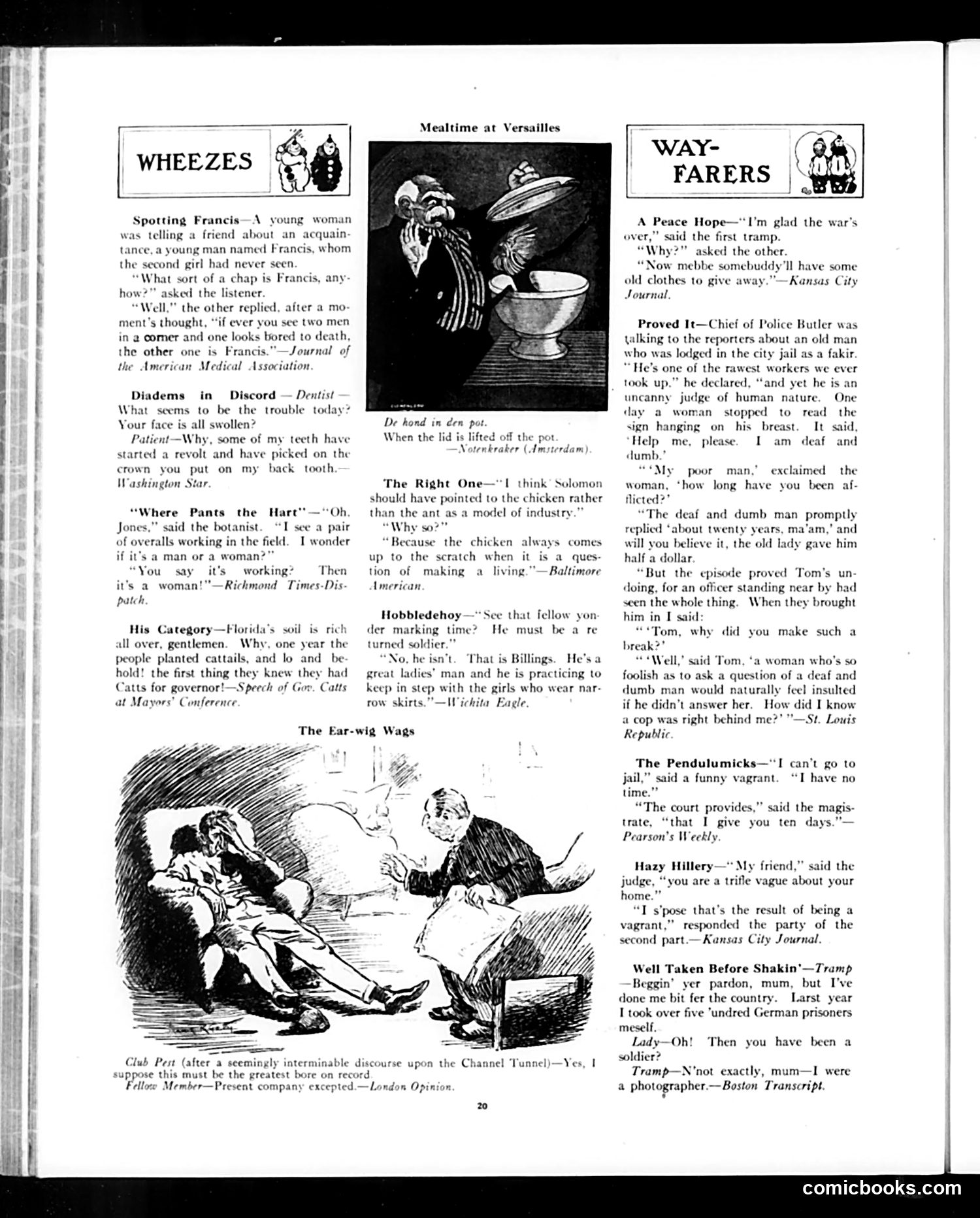
This page contains humorous anecdotes ("Wheezes" and "Way-Farers") typical of early 20th-century American humor magazines, plus two cartoons. **"Mealtime at Versailles"** (center): The Dutch caption and illustration depict the Treaty of Versailles negotiations (post-WWI peace settlement). The image shows figures around a pot being lifted—likely satirizing the complex, contentious nature of the peace talks, with the "pot" representing the outcome being contested or scrutinized. **"The Ear-wig Wags"** (lower left): A sketch of two figures in conversation, apparently depicting gossip or eavesdropping (hence "ear-wig"). The anecdotes mock various social types: a boring man named Francis, dental problems, gender ambiguity of laborers, military recruitment, beggars and vagrants, and judicial processes. One joke references a deaf-mute fakir deceiving charitable women. The humor relies on period stereotypes about class, gender, disability, and military service—reflecting contemporary attitudes toward poverty, disability, and immigrant/working-class figures.
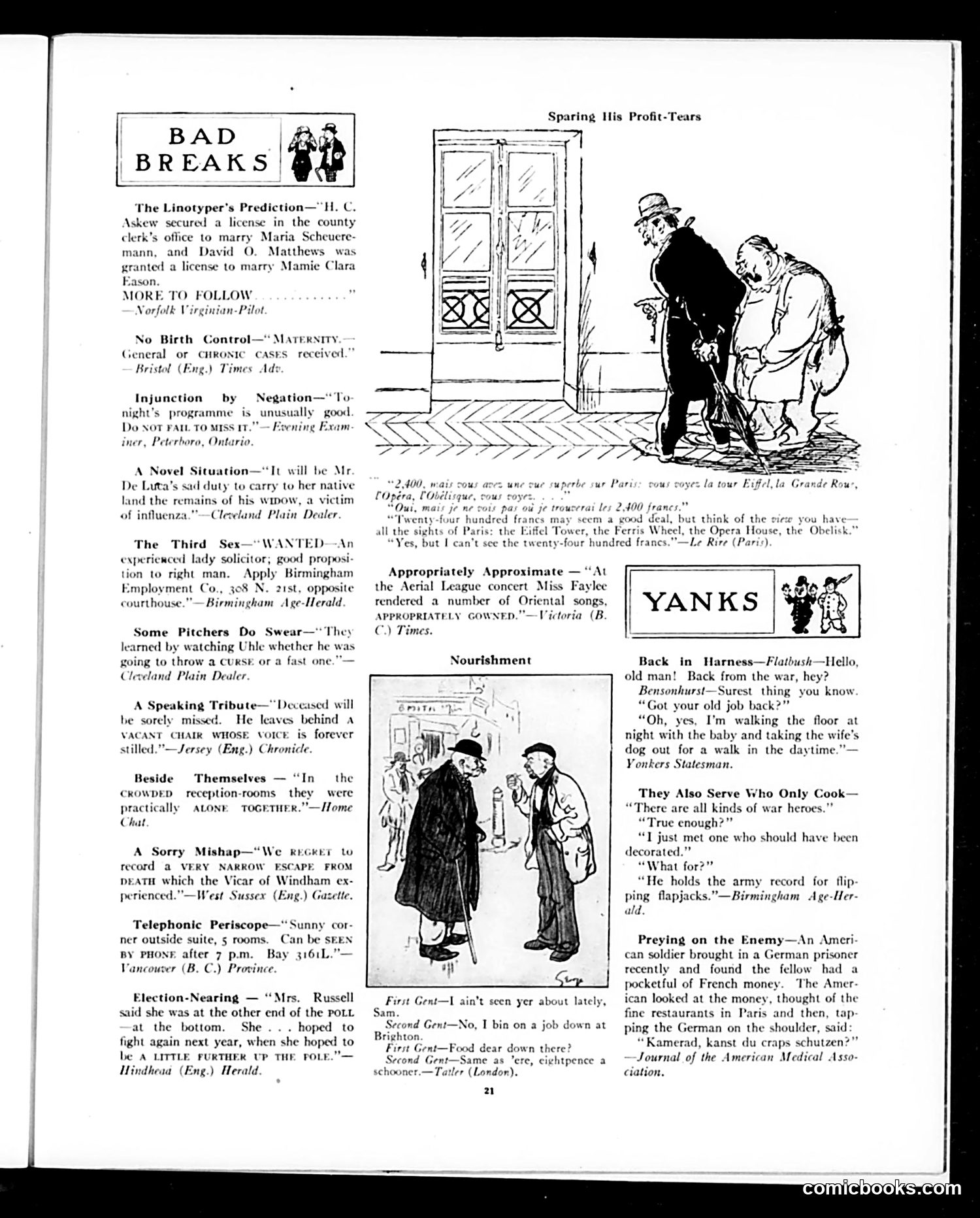
This page from *Judge* magazine is a humor column featuring short, punchy jokes built on **unfortunate newspaper typos and unintentional double meanings**—the "bad breaks" of the title. The format mines comedy from real newspaper clippings where editing errors create unintended meanings. For example: - A maternity hospital advertises accepting "chronic cases" (implying endless pregnancies) - A death notice says a vicar had a "narrow escape from death" (he survived, awkwardly phrased) - A woman promises to fight again "further up the pole" (suggesting pole-climbing rather than political advancement) The cartoons scattered throughout appear to show everyday scenes: a well-dressed man speaking to a worker, and two men conversing on a street. The bottom half includes various short anecdotes and jokes about post-WWI life—soldiers returning home, wartime food rationing, and an American soldier exploiting a German prisoner's money for gambling ("craps"). The humor relies on readers recognizing real newspaper absurdities, making this an early form of media satire.
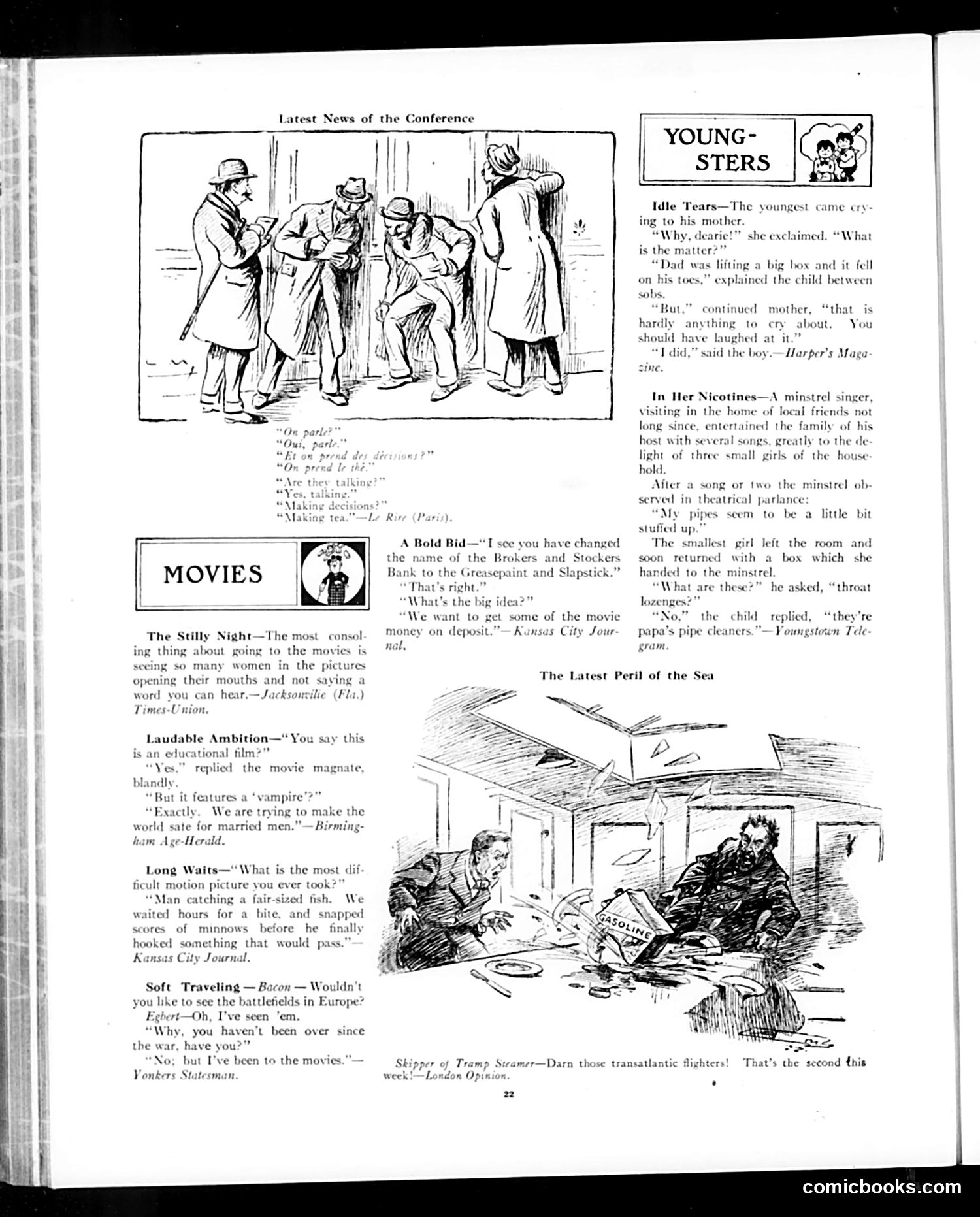
This page from Judge contains several satirical pieces about early cinema and contemporary social humor. The top cartoon depicts a conference scene with men in discussion, captioned with French phrases about "parties" and "tea-making"—likely mocking diplomatic conferences of the era through absurdist dialogue. The **Movies section** collects humorous anecdotes about cinema-going. "The Stilly Night" jokes that movies' appeal is watching women sit silently with open mouths—satirizing both silent film audiences and female behavior. Other pieces mock motion picture production difficulties (catching fish for scenes) and suggest movies serve as "educational" content for married men seeking escape, with a veiled reference to "vampire" actresses. The **"Young-Sters"** section presents children's jokes, including one where a child brings pipe cleaners to a visiting minstrel singer, misunderstanding his complaint about "stuffed pipes." **"The Latest Peril of the Sea"** illustration (bottom right) shows a shipwreck scene, with caption joking about "transatlantic flighters"—likely referencing early aviation disasters or submarine warfare concerns from the WWI era. The overall tone is light, domestic humor typical of Judge's satirical approach to contemporary American life and emerging entertainment culture.
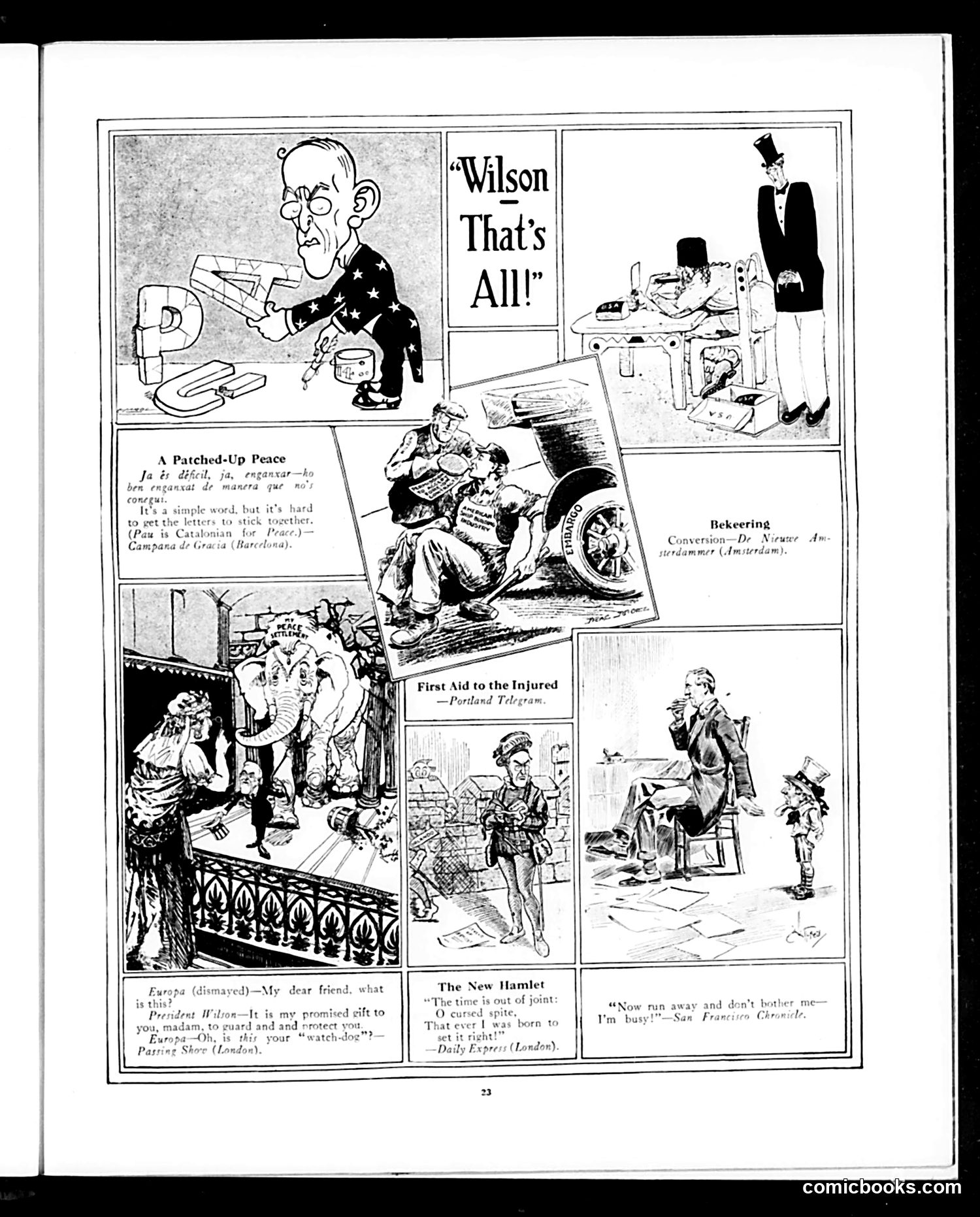
This Judge magazine page satirizes President Woodrow Wilson's approach to World War I peace negotiations. The central caricature depicts Wilson as a figure attempting to "patch up" peace—shown literally patching together broken pieces labeled with war-related terms. The comic strips below mock Wilson's efforts as inadequate and contradictory. "A Patched-Up Peace" suggests his solutions are temporary fixes rather than genuine resolution. "First Aid to the Injured" implies superficial treatment of war's devastation. "The New Hamlet" references Shakespeare's indecisive protagonist, questioning Wilson's commitment. The overall satire criticizes Wilson for proposing half-measures and compromises regarding WWI, rather than decisive action. The magazine presents him as ineffectual—merely "patching" problems rather than solving them fundamentally.
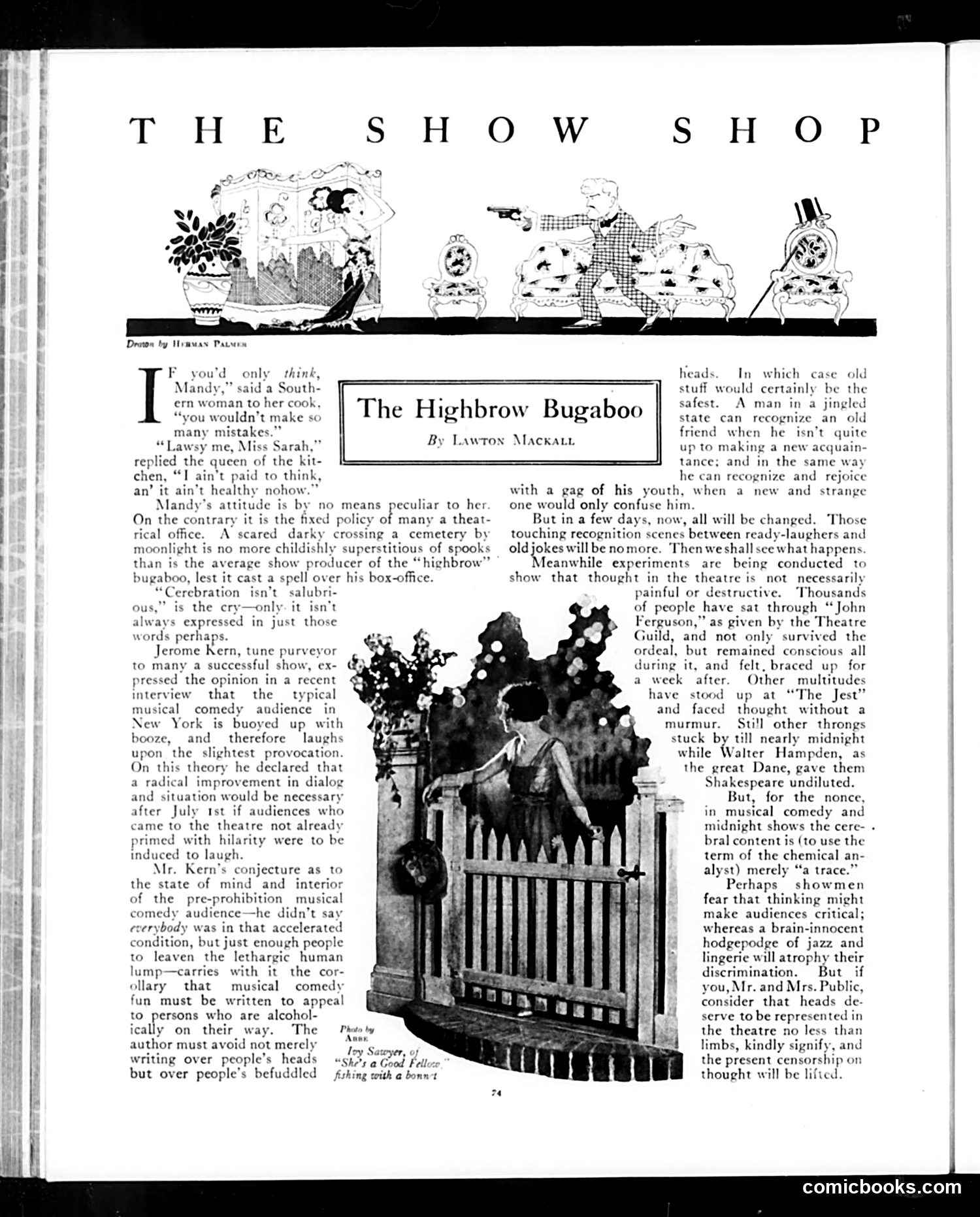
This article by Lawton Mackall satirizes theatrical producers' fear of intellectual content in musical comedy. The opening dialogue mocks a Southern cook who claims thinking is "unhealthy"—used as a metaphor for producers' avoidance of "highbrow" material, fearing it will jinx box-office returns. Mackall argues producers wrongly assume audiences need alcohol to enjoy shows and therefore write down to drunk patrons. He cites composer Jerome Kern's theory that post-alcohol audiences require only familiar, simple humor. However, Mackall counters this with evidence that theatre audiences *can* handle serious thought: plays like "John Ferguson" and Shakespeare performances have succeeded without dumbing down content. He challenges the assumption that "brain-innocent" entertainment (jazz, lingerie) is necessary and appeals to the public to demand intellectual respect in theatre—that heads deserve representation alongside bodies on stage. The satire targets producer cowardice masquerading as audience psychology.
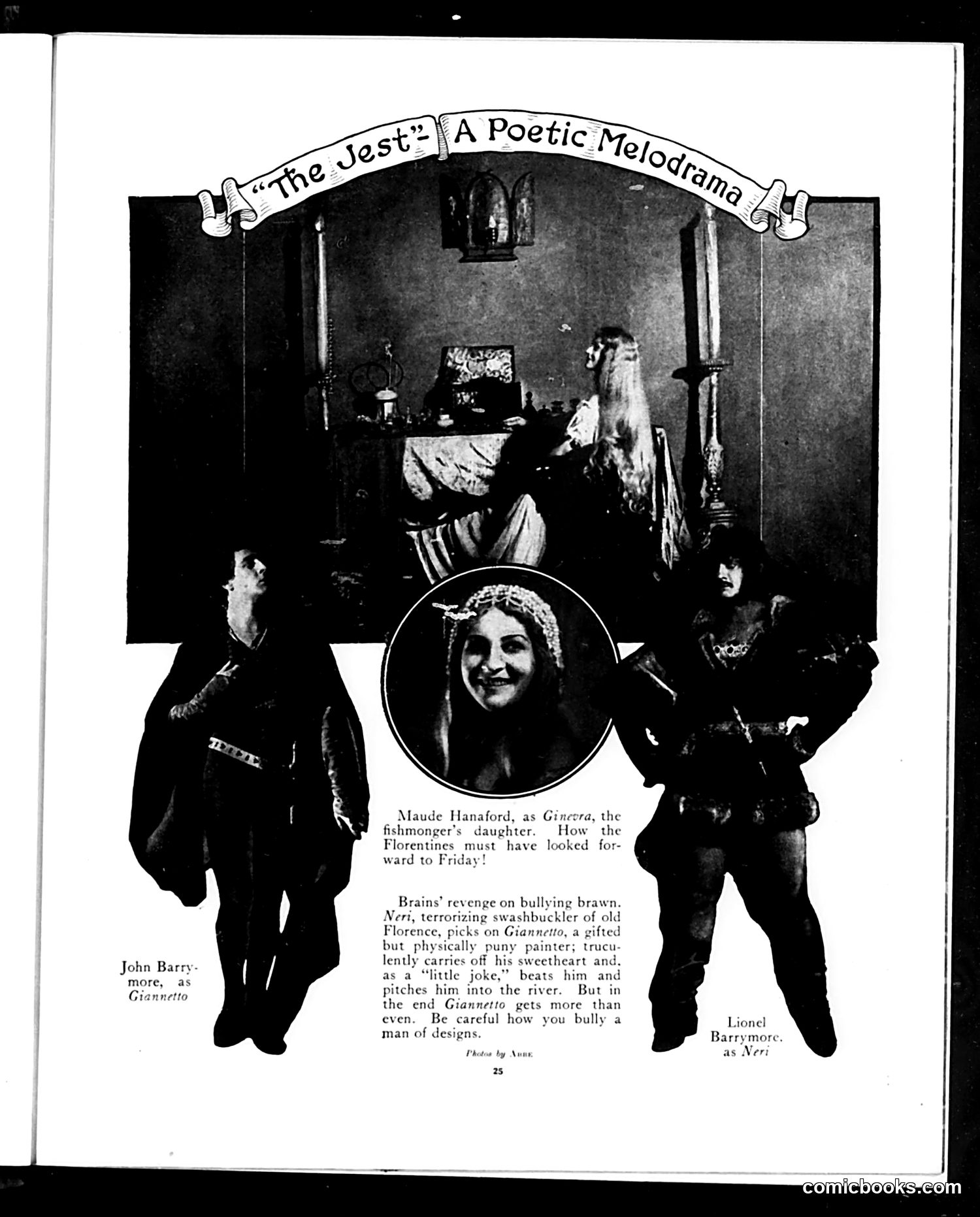
This page reviews a theatrical production titled "The Jest," featuring actors John Barrymore and Lionel Barrymore. The melodrama is set in Florence and concerns two male characters—Giannetto (the physically weak but clever protagonist) and Neri (a brutish bully)—competing for Gineora, a fishmonger's daughter. The satire mocks the plot's contrived morality: despite Neri's initial bullying advantage, Giannetto ultimately triumphs through cunning rather than strength. The caption's ironic tone ("Be careful how you bully a man of designs") suggests Judge magazine found the tale's revenge narrative both predictable and overwrought—typical melodramatic fare where intellectual schemes defeat brute force. The production appears designed to showcase the famous Barrymore brothers in a swashbuckling period piece, though the magazine treats it with genteel mockery.
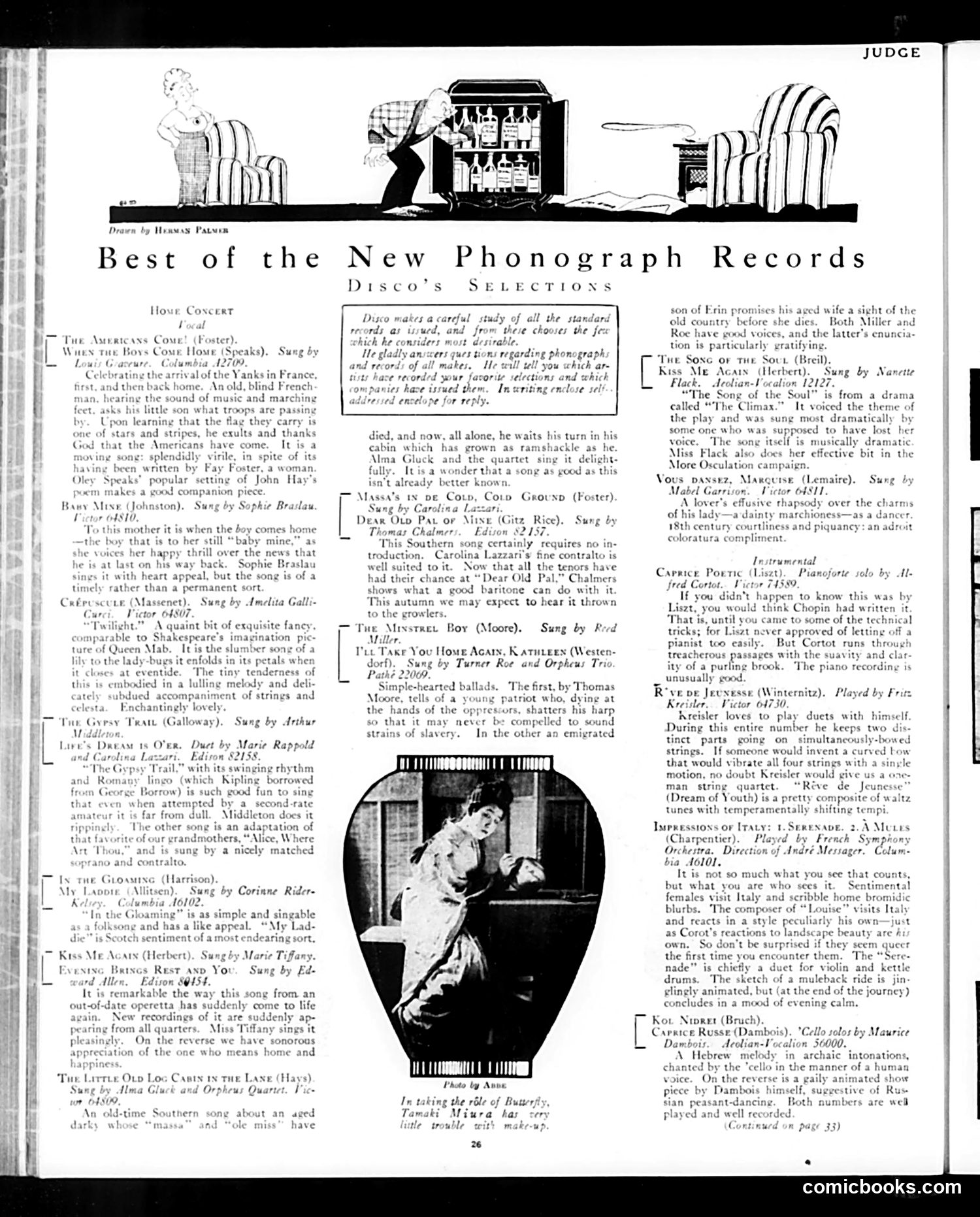
This page is primarily a **music review column**, not political satire. It showcases phonograph record recommendations from "Disco's Selections," a regular feature in Judge magazine. The content reviews operatic and vocal recordings from the early 20th century, featuring performers like Enrico Caruso and Tamaki Miura (a Japanese opera singer). The centered photograph shows two performers in what appears to be an operatic scene. The satirical element is **subtle and embedded in the reviews themselves**—the writer uses witty, sardonic commentary to critique performances. For instance, comments about singers range from praise to gentle mockery of their interpretive choices. This represents Judge's broader cultural function: mixing **entertainment criticism with humor** for educated, middle-class readers. The Art Deco-style header drawing (credited to Herman Pfeifer) adds visual sophistication typical of the magazine's design aesthetic during this period.
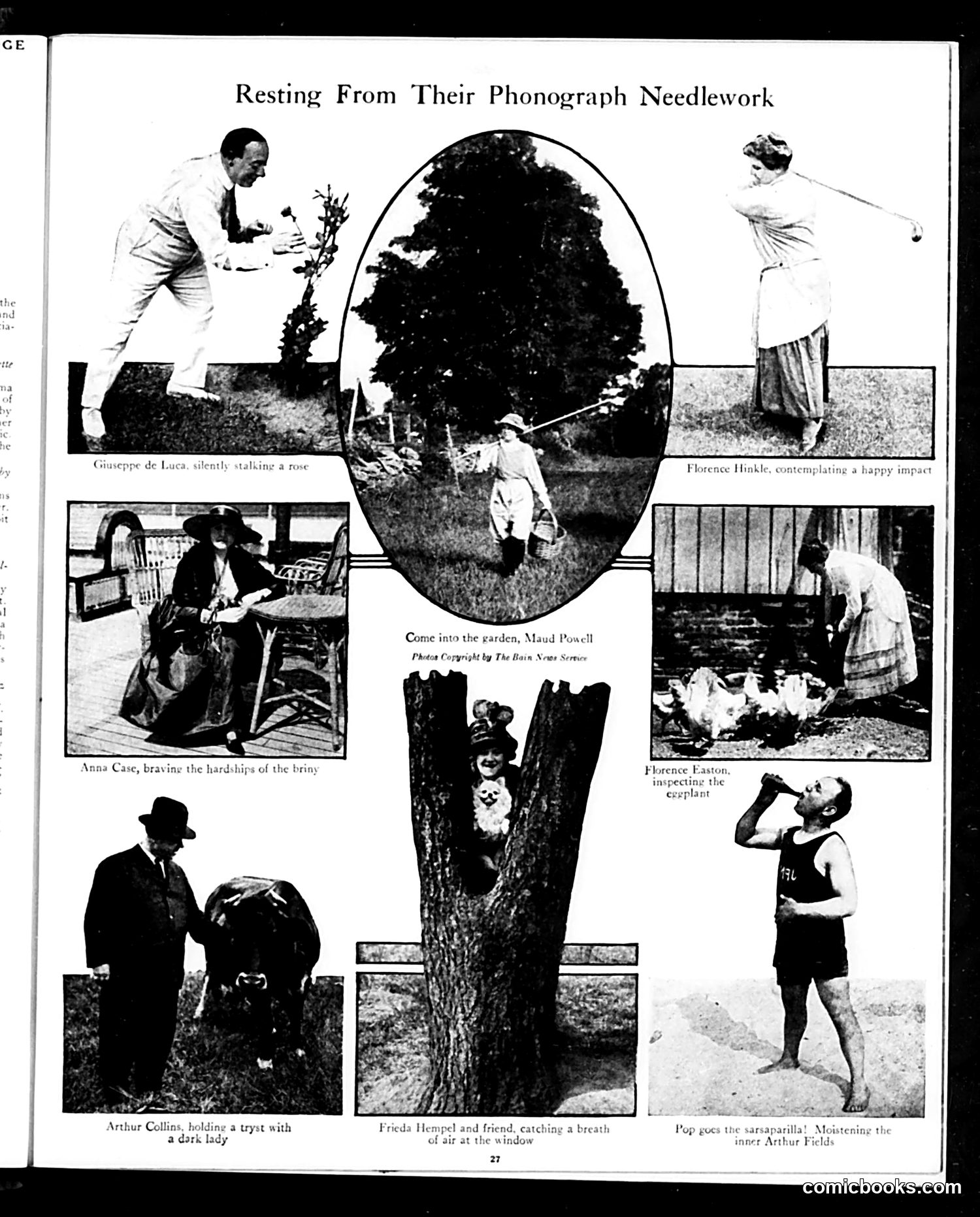
This page shows celebrities "resting" from recording sessions for phonographs—the era's recording technology. The central oval features Maud Powell (a renowned violinist), with surrounding photos of performers including Giuseppe de Luca, Florence Hinkle, Anna Case, Florence Easton, Arthur Collins, and Frieda Hempel engaged in leisure activities: stalking roses, contemplating impacts, catching breaths at windows, holding trysts, and moistening throats. The humor derives from the contrast between these performers' dignified public personas and their mundane, sometimes awkward private moments. The title's "needlework" puns on phonograph needles while suggesting tedious labor. This appears to celebrate early recording artists during the phonograph's commercial rise, treating their domestic relaxation as charming human interest content for Judge's readership.
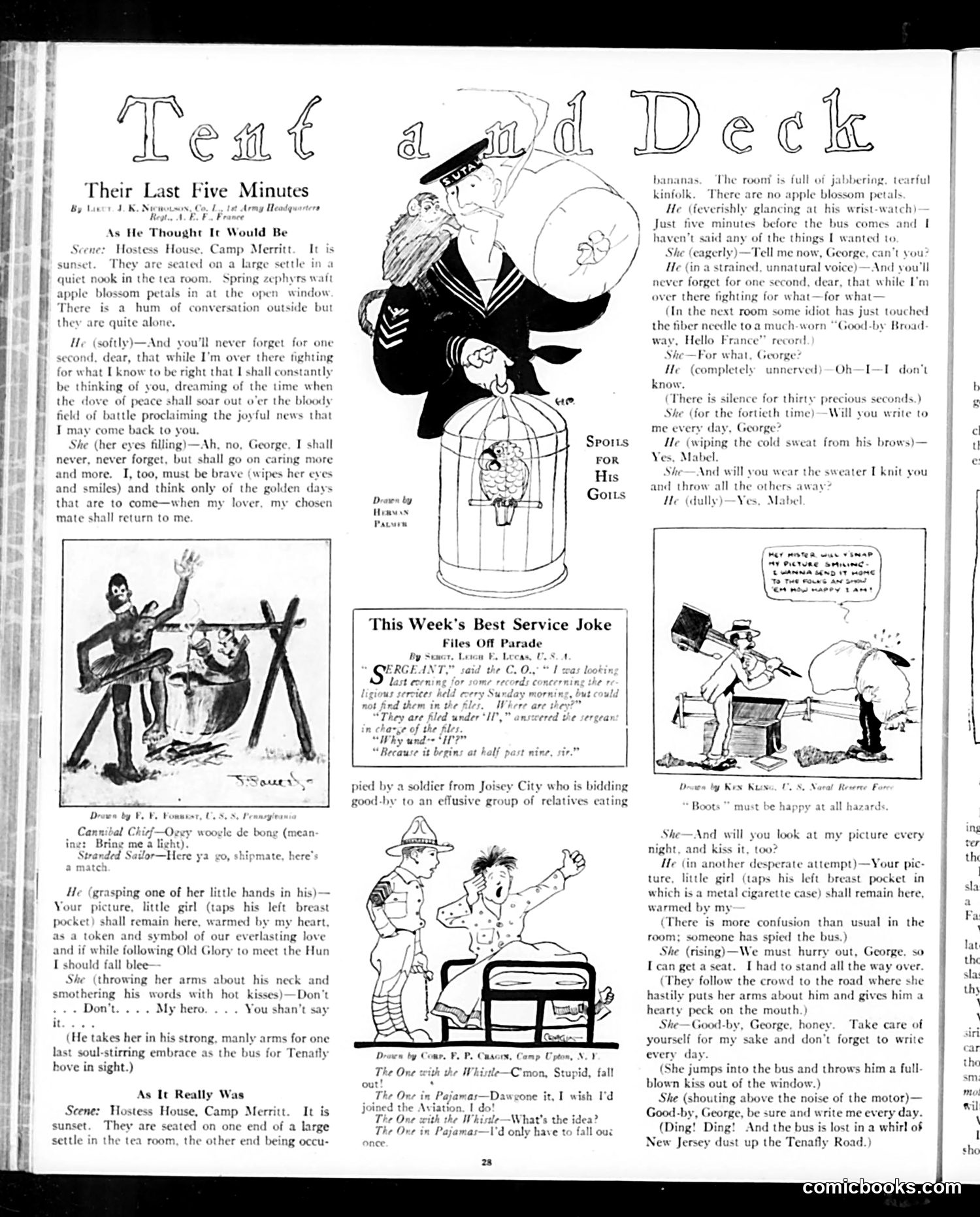
This page contrasts sentimental expectations with gritty reality during World War I. The upper section, "As He Thought It Would Be," depicts an idealized farewell: a soldier and his girlfriend in a quiet tea room sharing romantic promises—he'll carry her picture, think of her constantly, and return. "As It Really Was" brutally deflates this. The same couple is surrounded by noisy relatives eating bananas. He's distracted, sweating nervously, forgetting what to say. She repeatedly asks if he'll write and wear her sweater. When the bus arrives, there's chaos and confusion—she struggles to find a seat and shouts goodbye above engine noise before being lost in dust. The satire mocks both the overwrought romantic fantasy soldiers and civilians cherished about departures, and the messy, awkward, unglamorous reality. The joke targets readers who indulge in sentimental wartime fiction divorced from actual human experience.
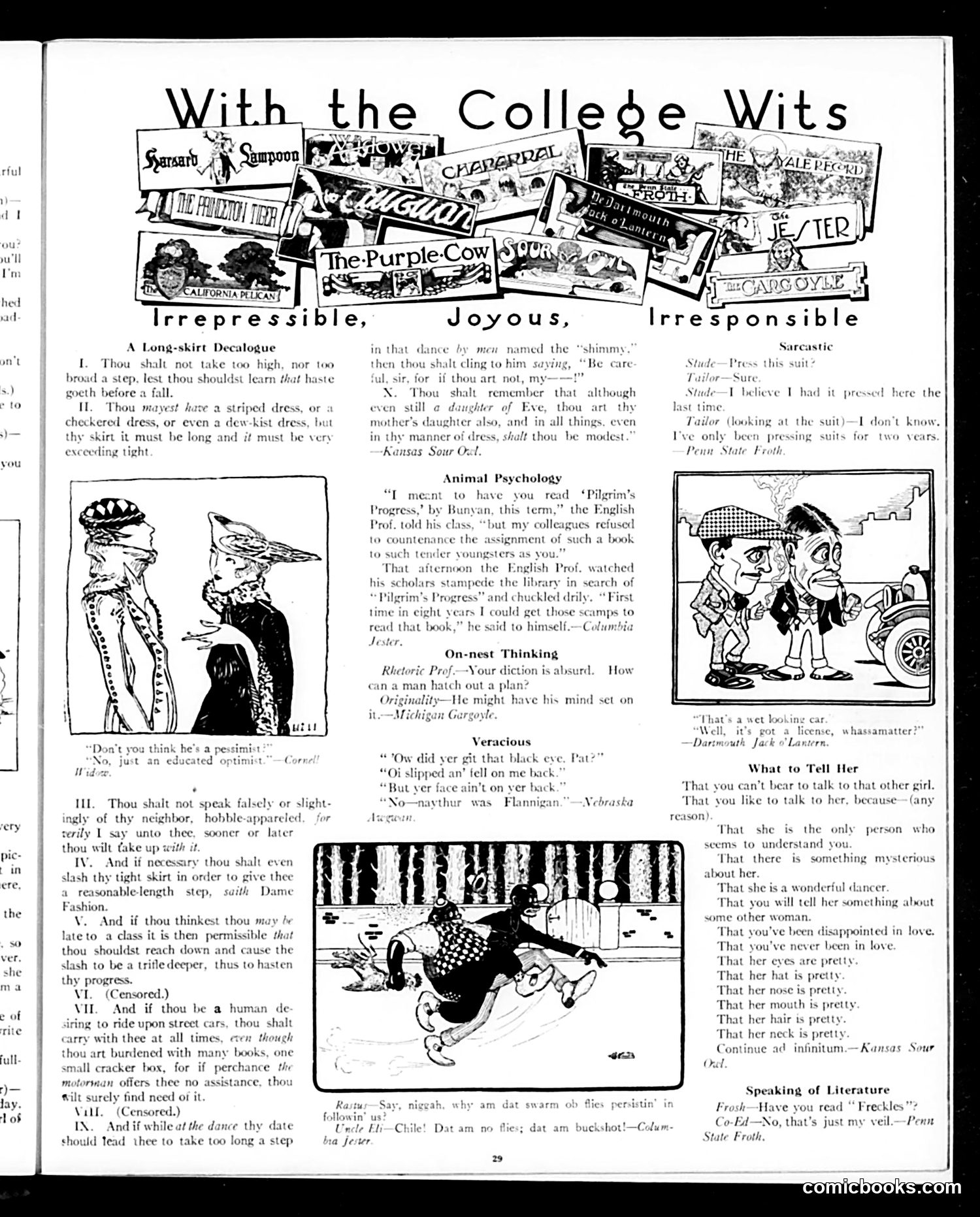
This page from *Judge* is a humor compilation targeting college life, circa 1910s-1920s. The main feature is "A Long-skirt Decalogue"—a mock-biblical satire on the then-controversial "hobble skirt," a fashionably restrictive garment that severely limited women's stride length. The "commandments" humorously warn female students against taking long steps, slashing their skirts immodestly to move faster, or arriving late to class. The surrounding vignettes are college-humor pieces: an English professor amused that students finally checked out *Bunyan's Pilgrim's Progress*; a rhetoric professor criticizing student diction; and various quips about dating and literature. One cartoon shows students with an old car, suggesting automobile humor was topical. The satire targets both women's fashion constraints and broader collegiate social pretensions—the page mocks students' pretended intellectualism while poking fun at restrictive dress codes.
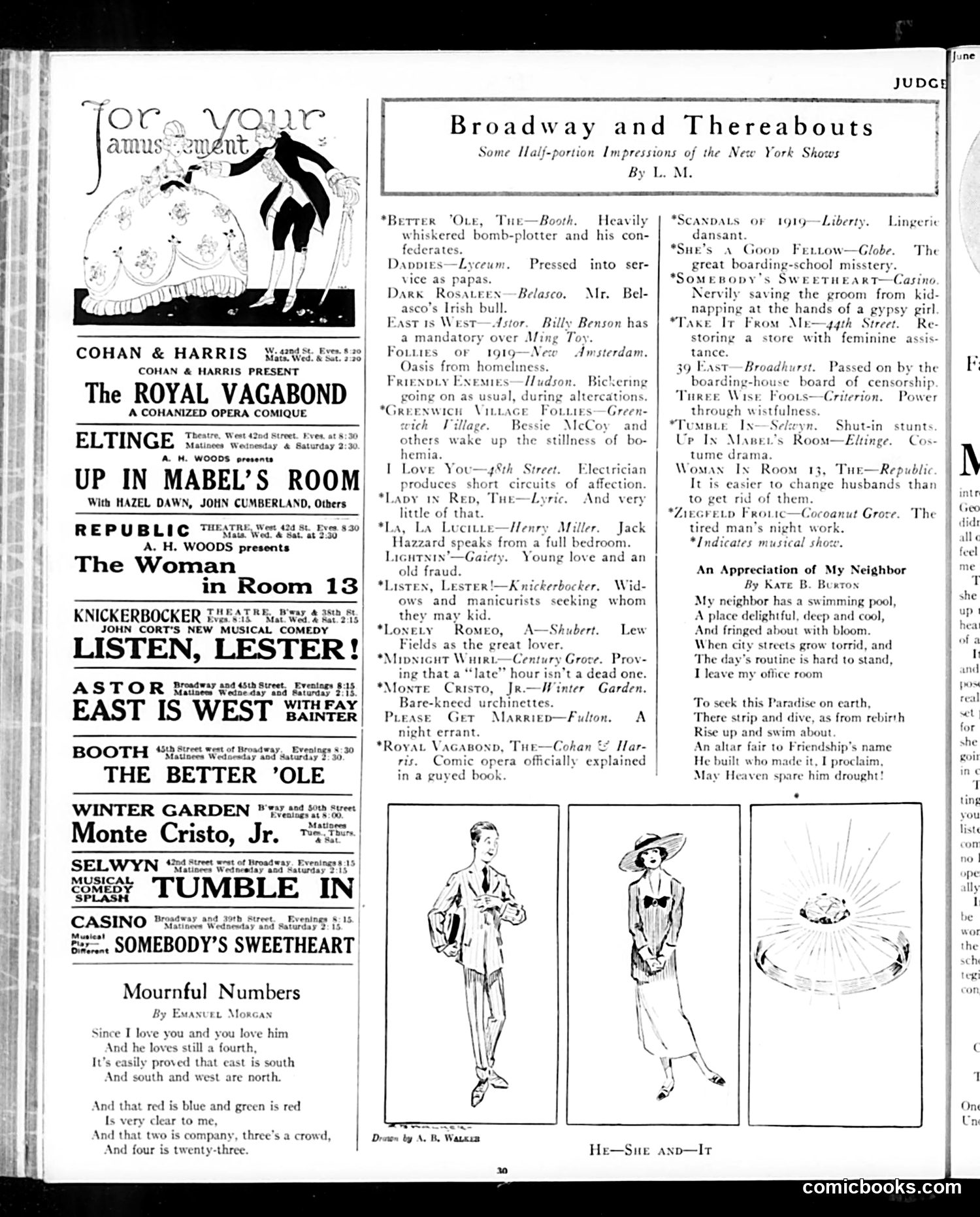
This page is primarily **theater advertising and criticism**, not political satire. It showcases New York Broadway shows circa 1919, with brief, witty synopses of current productions. The "Broadway and Thereabouts" section offers **satirical one-liners** about shows: "The Royal Vagabond" involves a "cohanized opera," "East is West" features a "mandatory over Ming Toy," and "Listen, Lester!" mocks widow and manicurist characters "seeking whom they may kid." The accompanying illustrations show fashionable 1919 dress designs—men in suits and women in hats—labeled "He—She and—It," likely commentary on contemporary gender fashions. **"Mournful Numbers"** is absurdist poetry playing with logical fallacies (if A loves B loves C, then "east is south"). The neighbor appreciation poem celebrates someone's swimming pool as an "altar fair to Friendship"—gentle satire on leisure-class amenities. This is essentially **society-page entertainment coverage**, not political commentary.
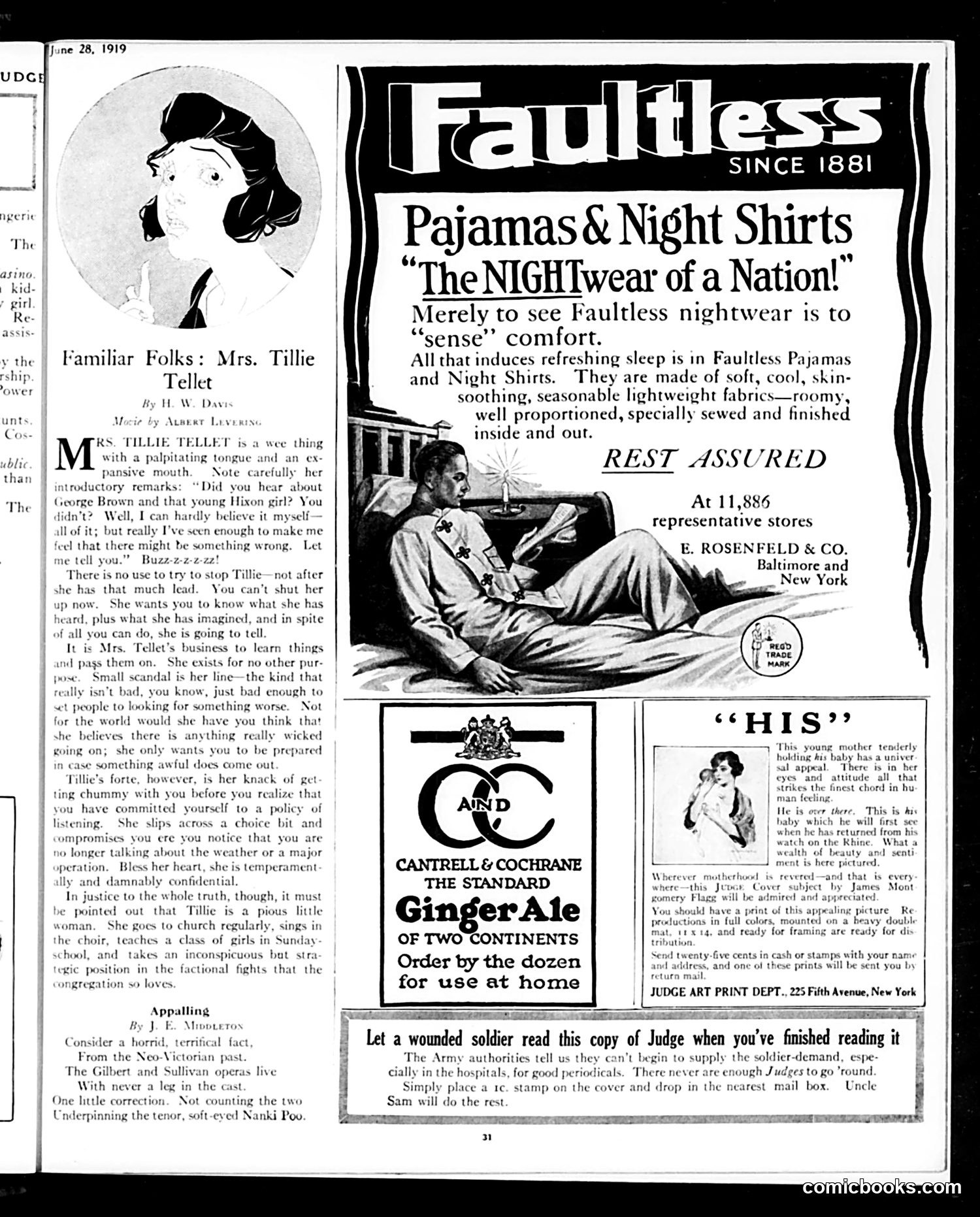
This page contains three distinct elements: **"Familiar Folks: Mrs. Tillie Tellet"** — A character sketch satirizing a gossipy, small-town busybody. Mrs. Tellet is depicted as someone who collects and spreads minor scandals under the guise of piety. The satire targets her manipulative style: she charms people into confidences, then compromises them before they realize it. The piece notes the contradiction that she's church-going and respectable while being fundamentally meddlesome. This reflects post-WWI anxieties about social propriety and community judgment. **Advertisements** — Faultless pajamas, Ginger Ale, and a Judge Art Print promoting patriotic sentiment (a mother with a soldier's baby), encouraging readers to distribute the magazine to wounded soldiers. **"Appalling"** — A brief note about Gilbert & Sullivan operas and historical casting choices; appears incomplete or fragmentary. The page primarily satirizes small-town gossip culture while using advertising to support wartime morale efforts.
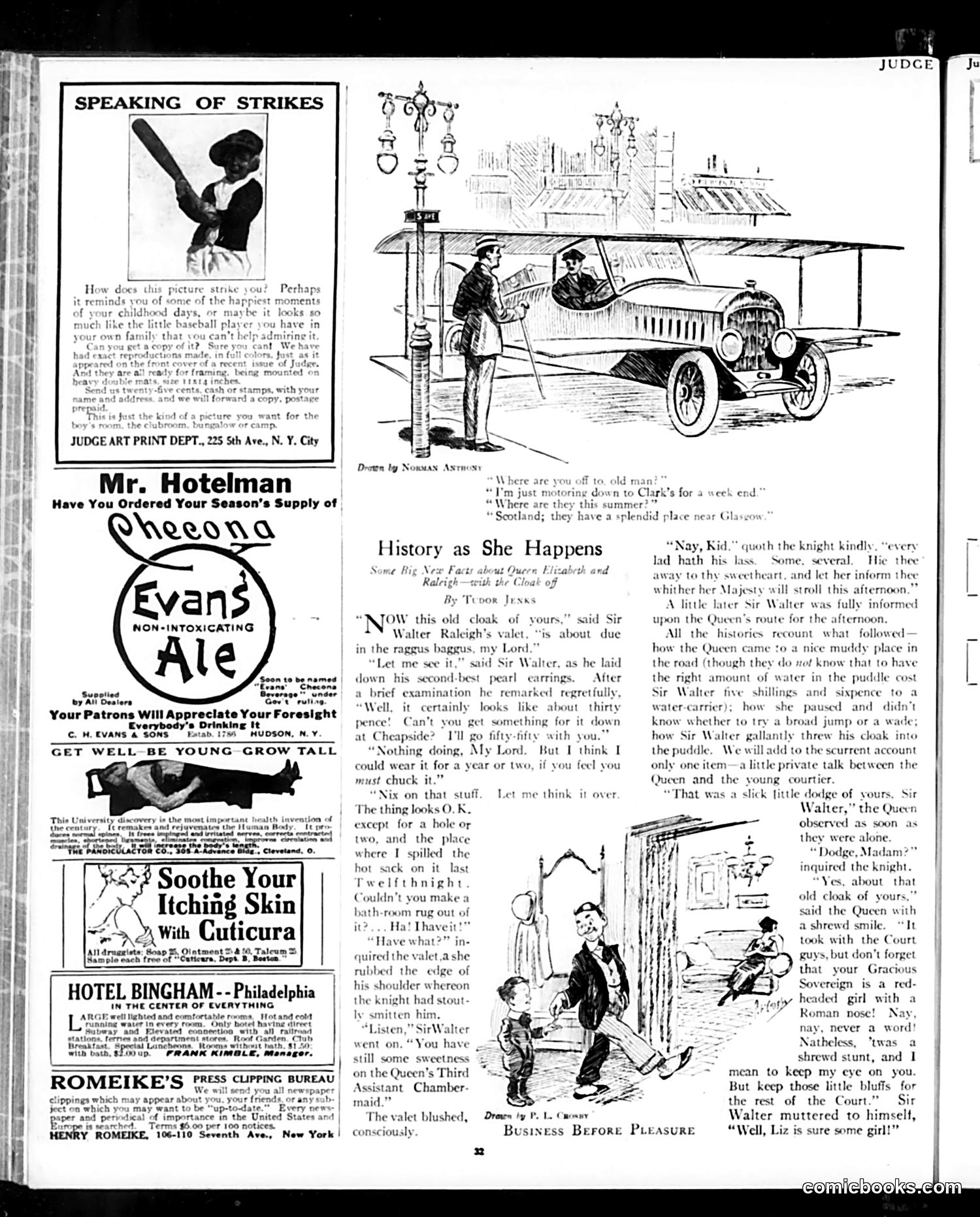
This story illustrates Judge magazine's humorous rewriting of historical legend. The narrative depicts Sir Walter Raleigh allegedly throwing his cloak over a puddle for Queen Elizabeth I—a famous anecdote about courtly gesture and romance. The satire works on multiple levels: it reveals the "true" mercenary details behind the romantic myth (he paid a water-carrier five shillings sixpence), suggests Raleigh's real motive was impressing the Queen to advance his position ("a slick little dodge"), and shows the Queen herself recognizing and appreciating his calculated flattery. The final panel's joke—a young courier's romantic entanglement with "Liz"—undercuts the historical grandeur further, treating the iconic queen as an ordinary girl susceptible to smooth talk. The piece mocks both the sanitized versions of history taught to readers and the timeless human motivations (ambition, romance, self-interest) hiding beneath grand historical narratives.
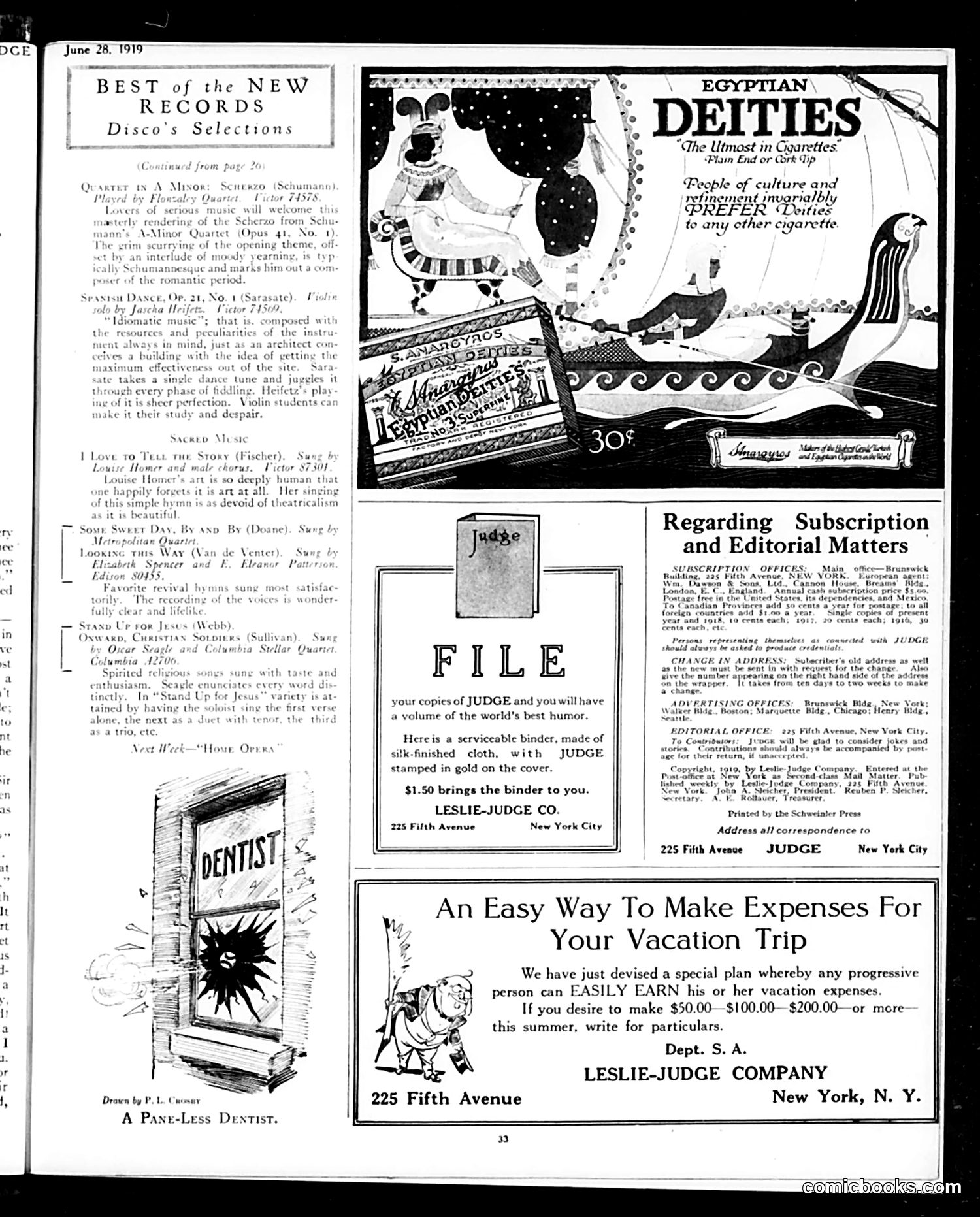
This is primarily an **advertising and editorial page** rather than satirical content. The main visual elements are: 1. **Egyptian Deities cigarette ad** (top right): Uses Egyptian imagery and hieroglyphics to market cigarettes, claiming they're preferred by "people of culture and refinement." This reflects early-20th-century marketing that associated exotic foreign imagery with sophistication. 2. **"A Pan-Less Dentist" cartoon** (left side): A small drawing showing what appears to be a dentist's sign with an explosion or impact effect. The joke likely plays on the dentist operating without proper equipment ("pan-less"). The page is mostly **Leslie-Judge Company advertisements**—promoting magazine binders, subscription services, and a vacation-earnings scheme. The "Easy Way to Make Expenses" ad offers readers a chance to earn $50-$200 by summer, likely recruiting salespeople or agents for the company. This represents typical magazine monetization of the era: mixing editorial content with aggressive direct advertising.
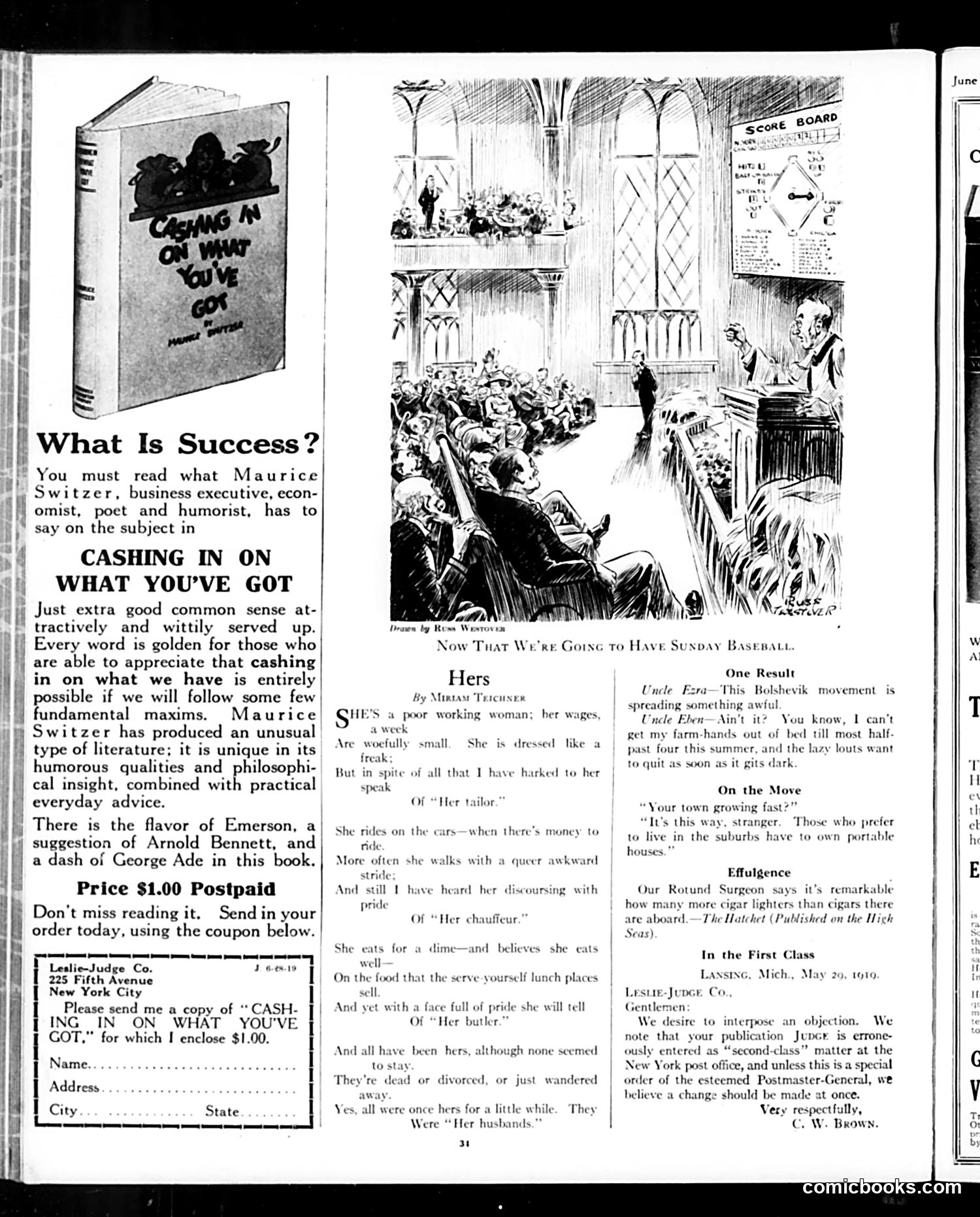
**"Hers"** (main cartoon): This satirical poem ridicules a working-class woman who adopts pretentious affectations above her station. She's poor—earning minimal wages, eating at dime lunch counters, riding streetcars—yet constantly refers to "her tailor," "her chauffeur," and "her butler." The joke: these were all transient men in her life (husbands, presumably, who left or died). She conflates romantic relationships with having servants, revealing both her delusion and the precariousness of working women's economic dependence on men. The satire targets class aspiration and the desperation underlying it. **Other content**: The page includes a book advertisement for "Cashing In On What You've Got" by Maurice Switzer—a self-help work combining philosophical advice with humor—plus several brief jokes about contemporary life (Bolshevism, suburban mobility, shipboard observations). The cartoons reflect Judge magazine's typical targets: social climbing, class anxiety, and working-class struggles in early 20th-century America.
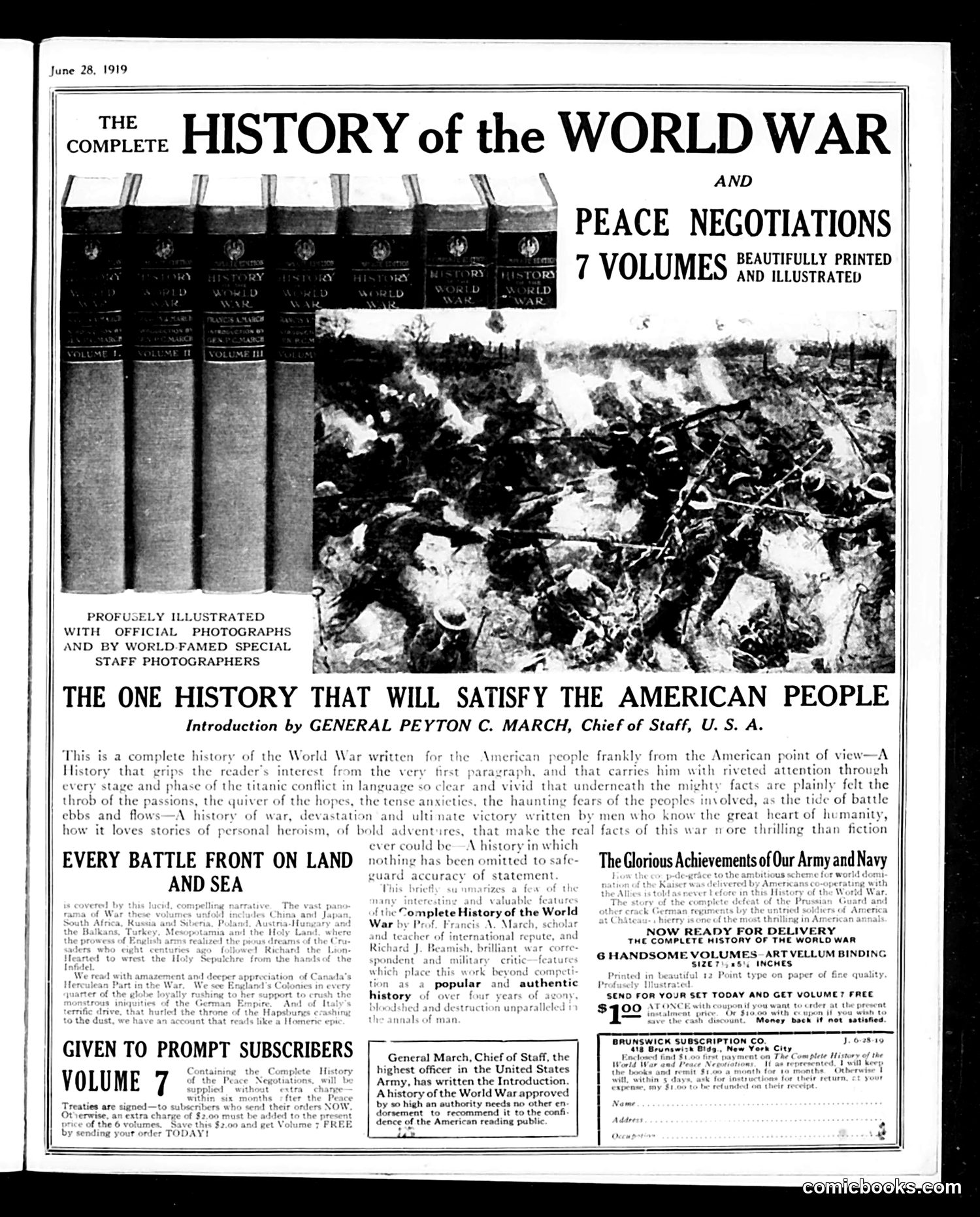
This is primarily a **full-page advertisement**, not a cartoon. It advertises a seven-volume history of World War I and peace negotiations, published by Brunswick Subscription Company. The ad's appeal is significant for its **historical context**: dated just days after the Treaty of Versailles was signed (June 28, 1919), it markets a comprehensive American perspective on the war. The endorsement by **General Peyton C. March**, the U.S. Army's Chief of Staff, lends military authority and credibility. The language emphasizes appeal to American patriotism and pride—"the one history that will satisfy the American people"—promising vivid, dramatic accounts of battles and American achievements. This marketing strategy reflects post-war American appetite for triumphalist narratives about their military role. The photograph of combat shows trenches and explosions, typical of WWI imagery used to authenticate historical narratives. There is **no satirical content** visible; this is straightforward commercial advertising capitalizing on American interest in the recently concluded war.
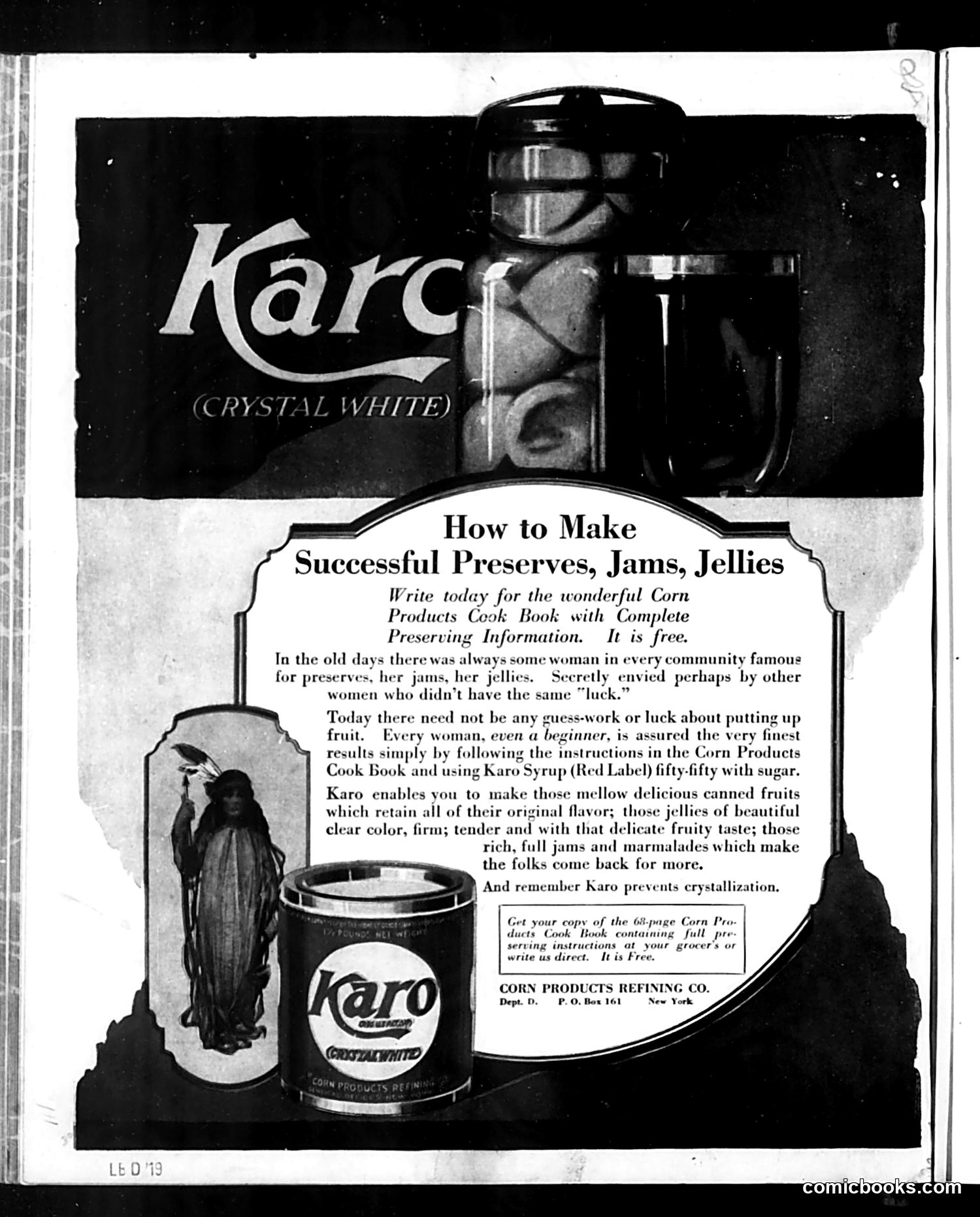
This is a **product advertisement, not political satire**—a full-page ad for Karo syrup's "Crystal White" brand. The ad targets women homemakers by promising to democratize a traditionally prestigious domestic skill. Historically, women famous for superior preserves enjoyed social status and "luck" that others envied. The advertisement's pitch: modern women need no longer rely on talent or intuition—Karo syrup, used fifty-fifty with sugar, guarantees success for "even a beginner." The imagery shows a jar of Karo syrup alongside a bundle of dried peppers or similar produce, emphasizing home food preservation. The company offers a free 64-page cookbook to encourage product adoption. This reflects early 20th-century marketing that leveraged **progressive messaging**—framing commercial products as liberating tools that removed mystery from housework, making expertise accessible to all women regardless of natural ability.
I can see this is a page from Judge magazine, but the image shows an almost entirely blank white page with only the binding visible on the left side and "comicbooks.com" watermarked at the bottom right. There is no visible cartoon, illustration, text content, or meaningful imagery that I can analyze. This appears to be either a blank page from the original publication, a scanning error, or a page that has not reproduced legibly in this digital format. Without visible content to examine, I cannot identify figures, political references, or explain any satirical intent. To provide the historical analysis you've requested, I would need a page with clearly visible illustrations or text.