
Judge, 1919-06-28 · page 24 of 37
Judge — June 28, 1919 — page 24: what you’re looking at
What you’re looking at
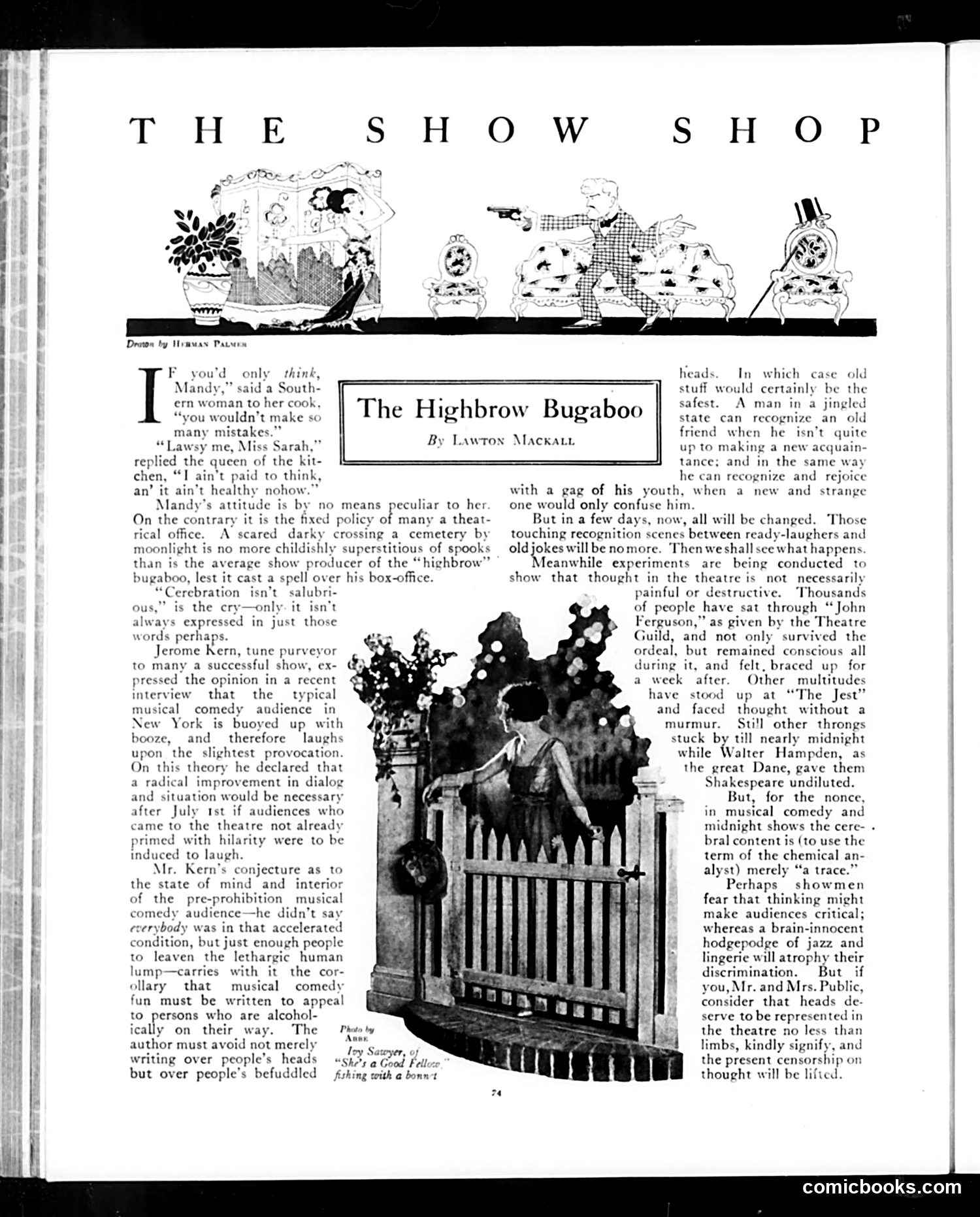
This article by Lawton Mackall satirizes theatrical producers' fear of intellectual content in musical comedy. The opening dialogue mocks a Southern cook who claims thinking is "unhealthy"—used as a metaphor for producers' avoidance of "highbrow" material, fearing it will jinx box-office returns. Mackall argues producers wrongly assume audiences need alcohol to enjoy shows and therefore write down to drunk patrons. He cites composer Jerome Kern's theory that post-alcohol audiences require only familiar, simple humor. However, Mackall counters this with evidence that theatre audiences *can* handle serious thought: plays like "John Ferguson" and Shakespeare performances have succeeded without dumbing down content. He challenges the assumption that "brain-innocent" entertainment (jazz, lingerie) is necessary and appeals to the public to demand intellectual respect in theatre—that heads deserve representation alongside bodies on stage. The satire targets producer cowardice masquerading as audience psychology.
📄 Transcribed text from this page (OCR, searchable)
Machine-transcribed from the original scan — historical spelling and the odd misread are preserved.
ee ed are Drawon by Hrawan Paton F you'd only think, Mandy,” said a South- ern woman to her cook, “you wouldn’t make so many mistakes. “Lawsy me, Miss Sarah,” replied the queen of the kit- chen, “I ain’t paid to think an’ it ain’t healthy nohov Mandy’s attitude is by no means peculiar to her On the contrary it is the fixed policy of many a theat- rical offic A scared darky crossing a cemetery by moonlight is no more childishly superstitious of spooks than is the average show producer of the “highbrow” bugaboo, lest it cast a spell over his box-office. “Cerebration isn’t salubri- ous,” is the cry—only. it isn’t always expressed in just those words perhaps. Jerome Kern, tune purveyor to many a successful show, ex- pressed the opinion in a recent interview that the typical musical comedy audience in New York is buoyed up with booze, and therefore laughs upon the slightest provocation. On this theory he declared that a radical improvement in dial and situation would be necessary after July ist if audiences who came to the theatre not already primed with hilarity were to be induced to laugh. Mr. Kern’s conjecture as to the state of mind and interior of the pre-prohibition musical comedy audience—he didn’t say everybody was in that accelerated condition, but just enough people to leaven the lethargic human lump—carries with it the cor- ollary that musical comedy fun must be written to appeal to persons who are alcohol ically on their way. The author must avoid not merely writing over people’s heads but over people’s befuddled Photo by ley Satoyer, “She's @ Good Fellec ng with a bonnet By Lawton Mackatn heads. In which case old stuff would certainly be the safest. A man in a jingled The Highbrow Bugaboo | Sri can feesenize an ll friend when he isn’t quite up to making a new acquain- tance; and in the same way he can recognize and rejoice with a gag of his youth, when a new and strange one would only confuse him. But in a few days, now, all will be changed. Those touching recognition scenes between ready-laughers and old jokes will be nomore. Then we shall sce what happens Meanwhile experiments are being conducted to show that thought in the theatre is not necessarily painful or destructive. ‘Thousands of people have sat through “John Ferguson,” as given by the Theatre Guild, and not only survived the ordeal, but remained conscious all during it, and felt, braced up for a week after. Other multitudes have stood up at “The Jest” and faced thought without a murmur. Still other throngs stuck by till nearly midnight while Walter Hampden, as the great Dane, gave them Shakespeare undiluted. But, for the nonce, in musical comedy and midnight shows the cere- - bral content is (to use the term of the chemical an- alyst) merely “a trace.” Perhaps showmen ] fear that thinking might make audiences critical; whereas a brain-innocent hodgepodge of jazz and lingerie will atrophy their discrimination. But if you, Mr. and Mrs. Public, consider that heads de- serve to be represented in | the theatre no less than limbs, kindly signify, and the present censorship on thought will be lifted. comicbooks.com