
A complete issue · 36 pages · 1919
Judge — June 21, 1919
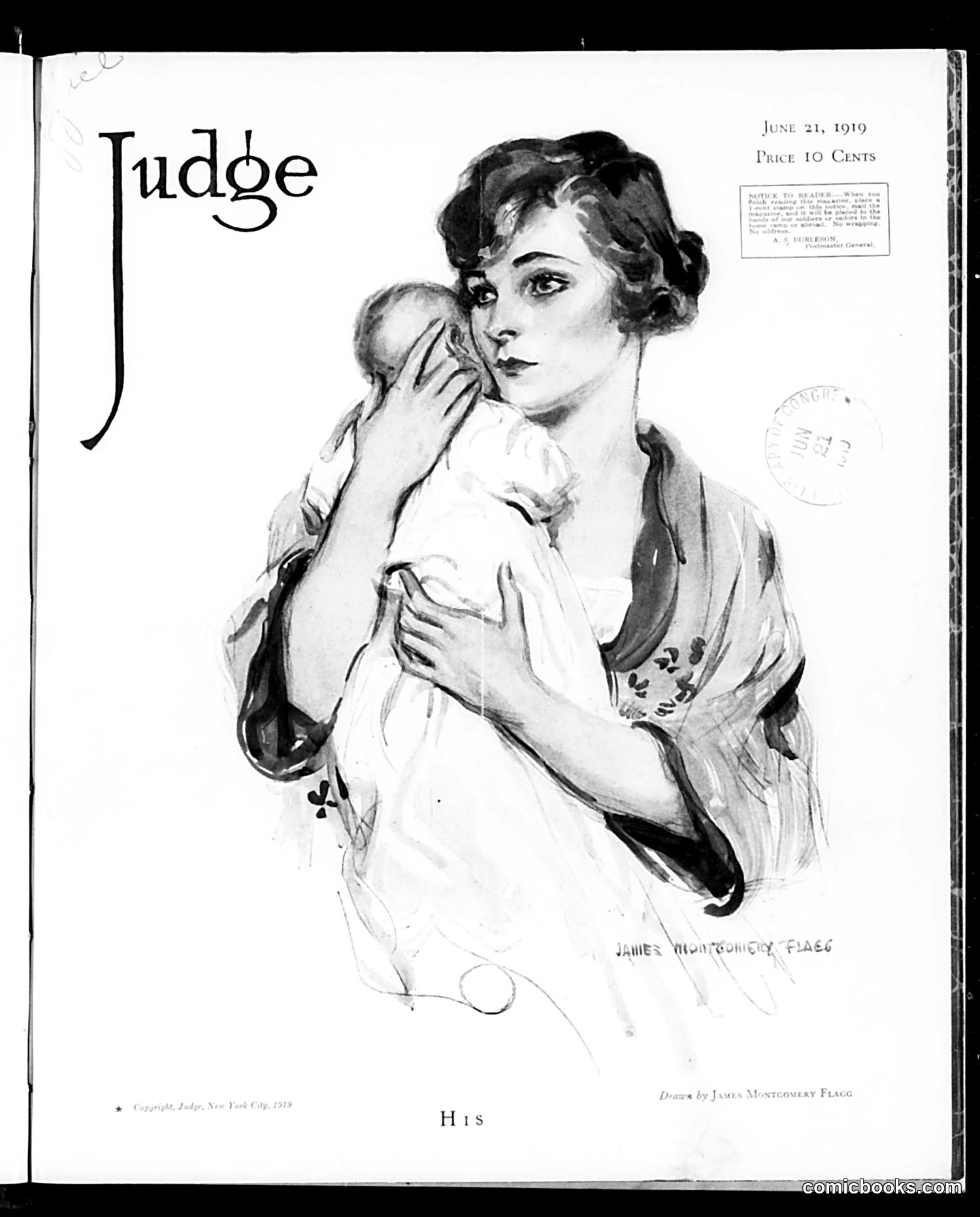
This appears to be a cover illustration rather than a political cartoon. The drawing by James Montgomery Flagg depicts a fashionable young woman holding an infant, titled "His" at the bottom. The image seems to represent motherhood as a desirable feminine ideal in the post-WWI era. The woman's elegant dress, sophisticated styling, and tender pose with the baby present an aspirational portrait of modern womanhood. This likely reflects broader 1919 cultural messaging about women's roles following World War I—balancing contemporary fashion and independence with traditional motherhood ideals. The satirical magazine's purpose here appears decorative rather than satirical, serving as a cover image celebrating feminine domesticity.
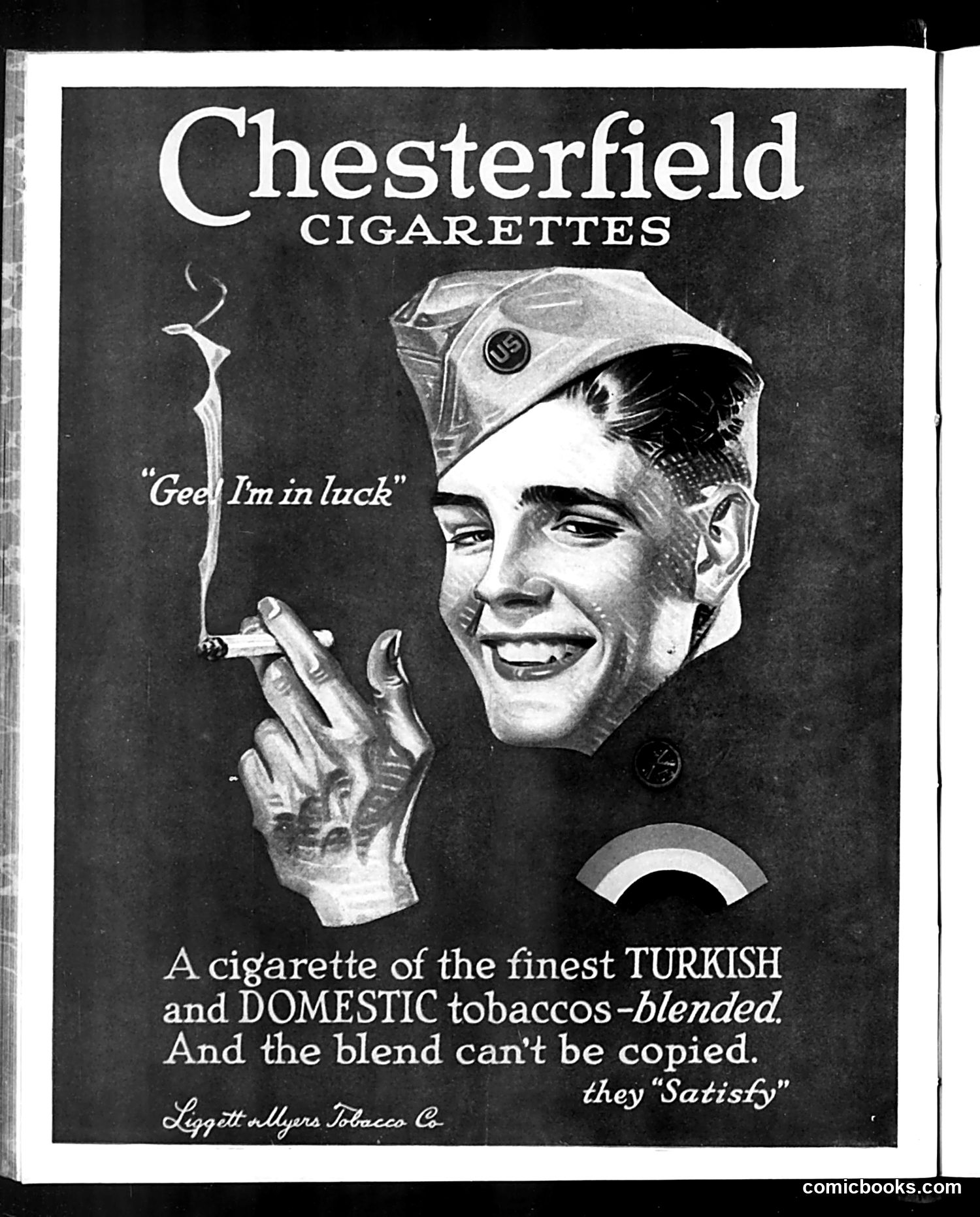
This is a **Chesterfield cigarette advertisement**, not satirical content. It features a smiling soldier in military uniform and cap, holding a cigarette with the tagline "Gee, I'm in luck." The ad appeals to servicemen by associating smoking with good fortune and camaraderie. It emphasizes the cigarette's blend of "Turkish and Domestic tobaccos" as superior and uncopyable, ending with "they 'Satisfy'"—Chesterfield's famous slogan. The imagery reflects **wartime marketing** (likely WWI or WWII era), when cigarette companies heavily targeted military personnel. The soldier represents the idealized consumer: young, confident, and pleased to have access to this "finest" product. This represents straightforward tobacco advertising rather than political satire.
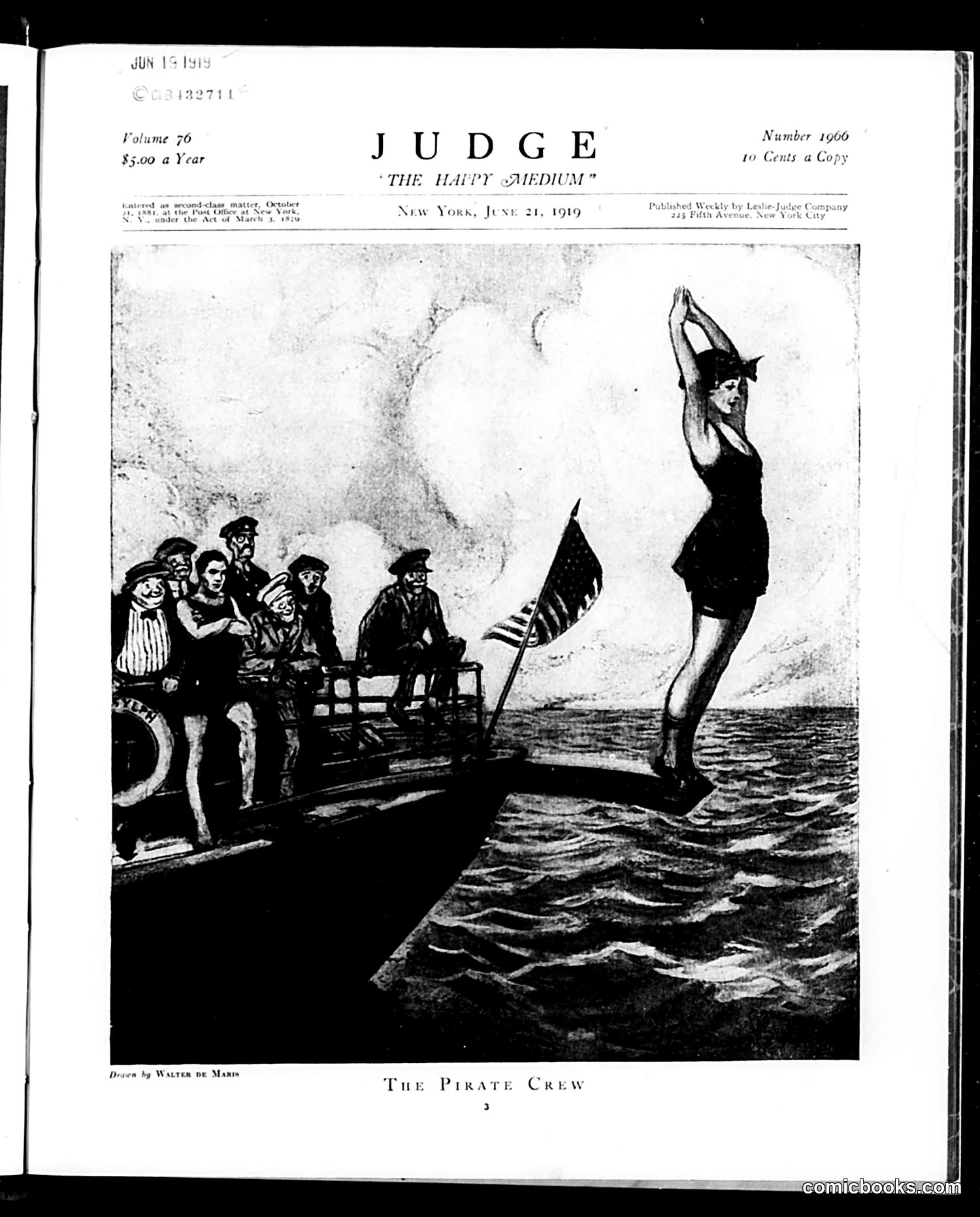
This illustration by Walter de Maris depicts a woman in a bathing suit diving or swimming away from a boat full of fully-clothed men. The title "The Pirate Crew" suggests satire about predatory behavior. The specific context remains unclear without additional information, but this likely references either: - Contemporary anxieties about women's increasing freedom (bathing suits were still controversial in 1919) - A specific scandal or news story from 1919 - General satire about men pursuing women The contrast between the woman's modern, revealing swimwear and the men's formal dress emphasizes social friction over changing gender norms and women's autonomy in the post-WWI era. The "pirate" metaphor suggests the men are viewed as threatening or predatory toward the independent woman.
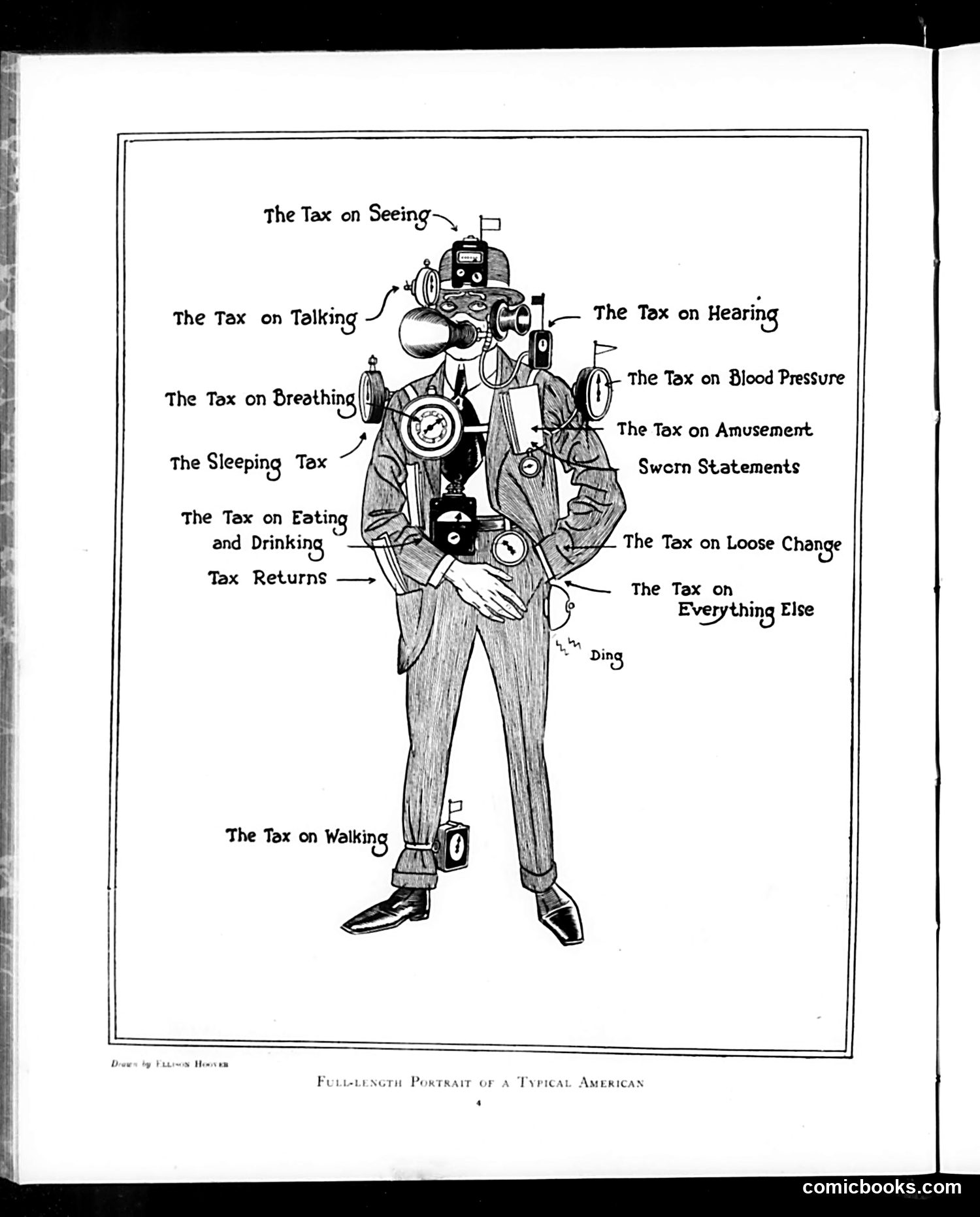
This satirical cartoon depicts an average American citizen as a walking collection of taxes and fees. Each body part is labeled with a different tax burden: seeing, talking, hearing, breathing, eating and drinking, sleeping, walking, blood pressure, amusement, loose change, and "everything else." The cartoon critiques the comprehensive nature of taxation in America—the idea that citizens are taxed on virtually every activity and aspect of life, from basic bodily functions to leisure. The figure appears mechanical and overburdened, suggesting citizens are reduced to tax-generating machines. The artist (credited as "drawn by [name]") satirizes government taxation policies as invasive and omnipresent. This reflects early-to-mid 20th-century American concerns about expanding government reach and tax burden. The humor lies in the exaggeration: tax collectors seemingly profit from everything a person does.
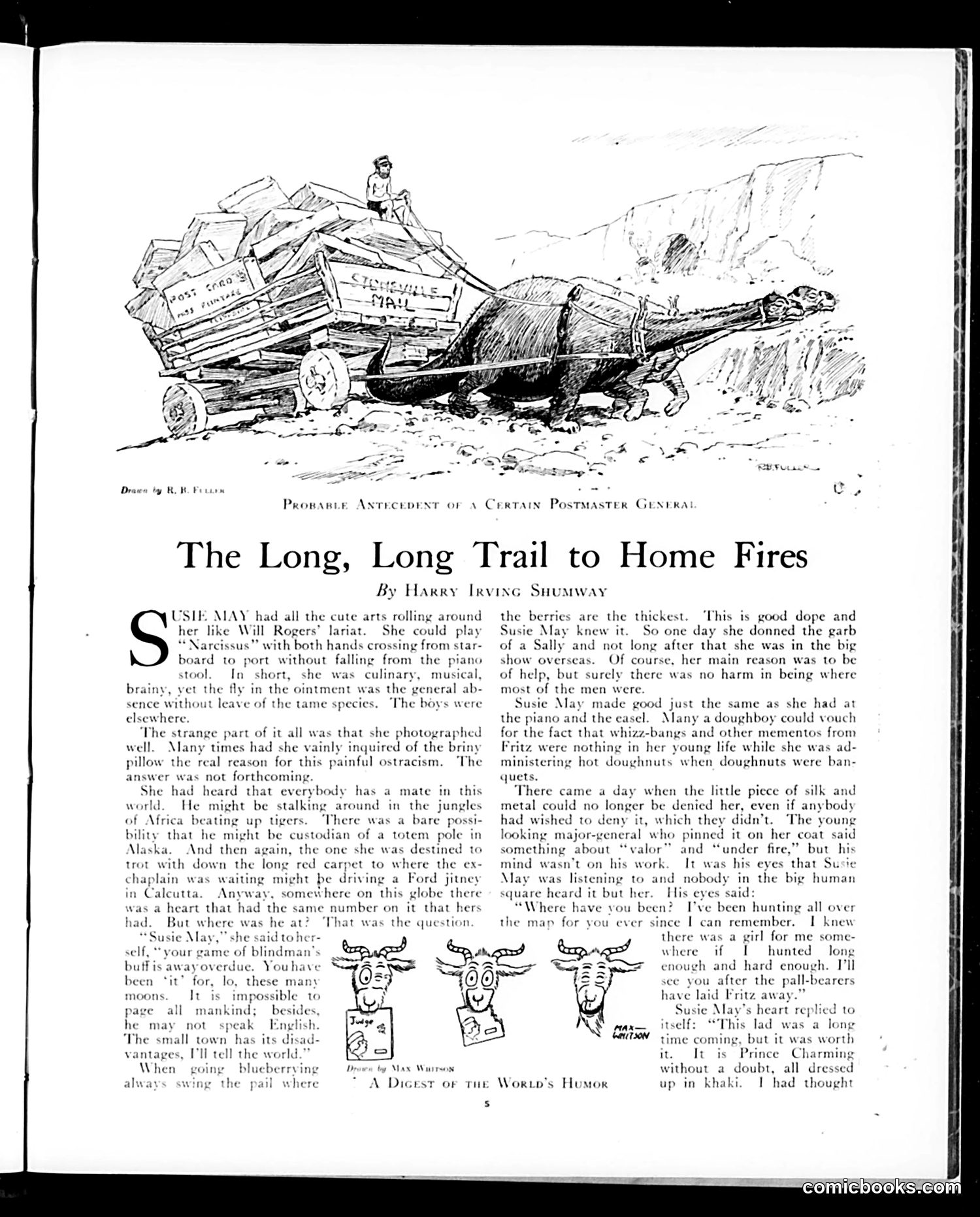
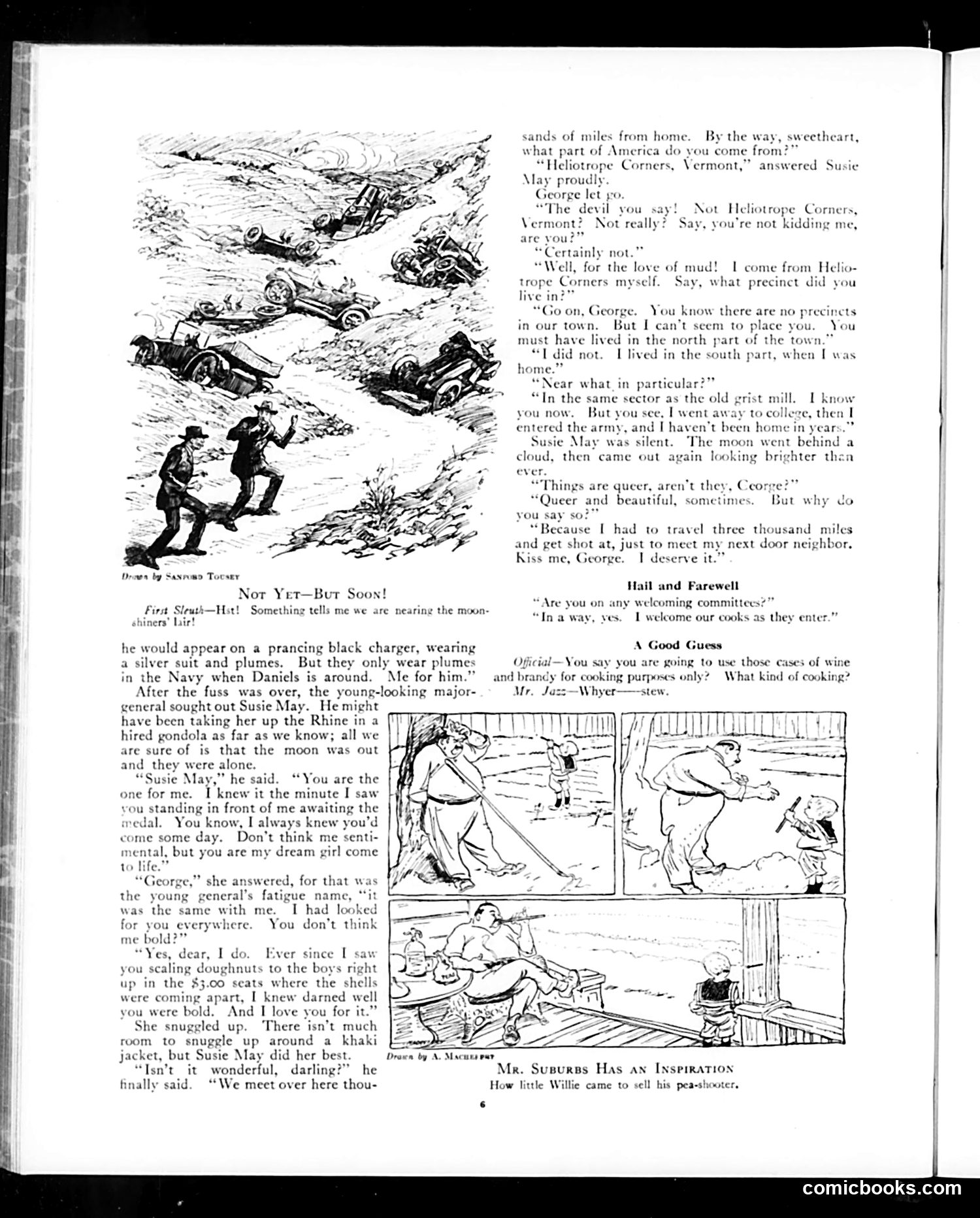
This page contains narrative fiction with illustrations rather than political satire. The main story, "Not Yet—But Soon!", depicts a romantic wartime narrative where a soldier (George) encounters Susie May from Heliotrope Corners, Vermont. The text reveals George has been away at war for a year and traveled 3,000 miles to reunite with his sweetheart. The bottom comic strip, "Mr. Suburbs Has an Inspiration," shows a domestic scene about selling a pea-shooter—appears to be light humor about suburban family life. This represents Judge's non-satirical content: sentimental romantic fiction aimed at wartime audiences, likely from WWI era based on military references. The page demonstrates the magazine's broader appeal beyond political commentary.
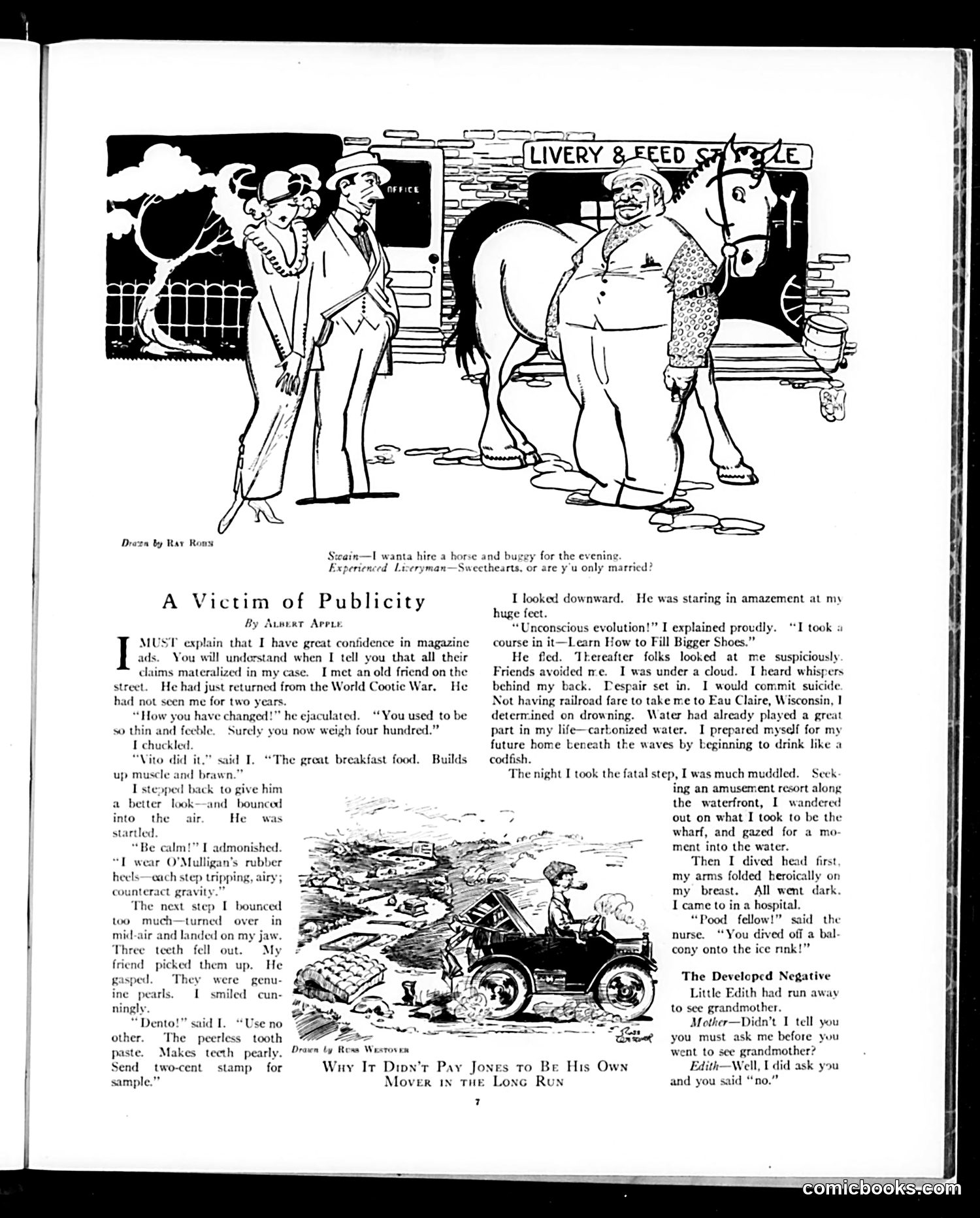
This page contains two satirical pieces typical of early 20th-century American humor. **"A Victim of Publicity"** mocks the credibility of magazine advertising claims. The protagonist takes a breakfast cereal ad literally—"Learn How to Fill Bigger Shoes"—and develops enormous feet. This causes social embarrassment and attempted suicide. The joke satirizes how people blindly trust advertising promises and how physical oddities invite social ridicule. The absurd consequences illustrate the gap between ad claims and reality. **The top cartoon** jokes about class and marital status. A man renting a horse and buggy asks whether the liveryman wants them for "sweethearts or...only married?" The humor suggests married couples are less romantic or exciting than unmarried ones—a mild critique of domestic life's perceived dullness. **"The Developed Negative"** is a brief joke about a child who asked permission before visiting grandmother, technically obeying while violating intent—typical early-century children's humor about literal compliance versus obedience. The page represents Judge's mix of social satire, advertising mockery, and domestic humor.
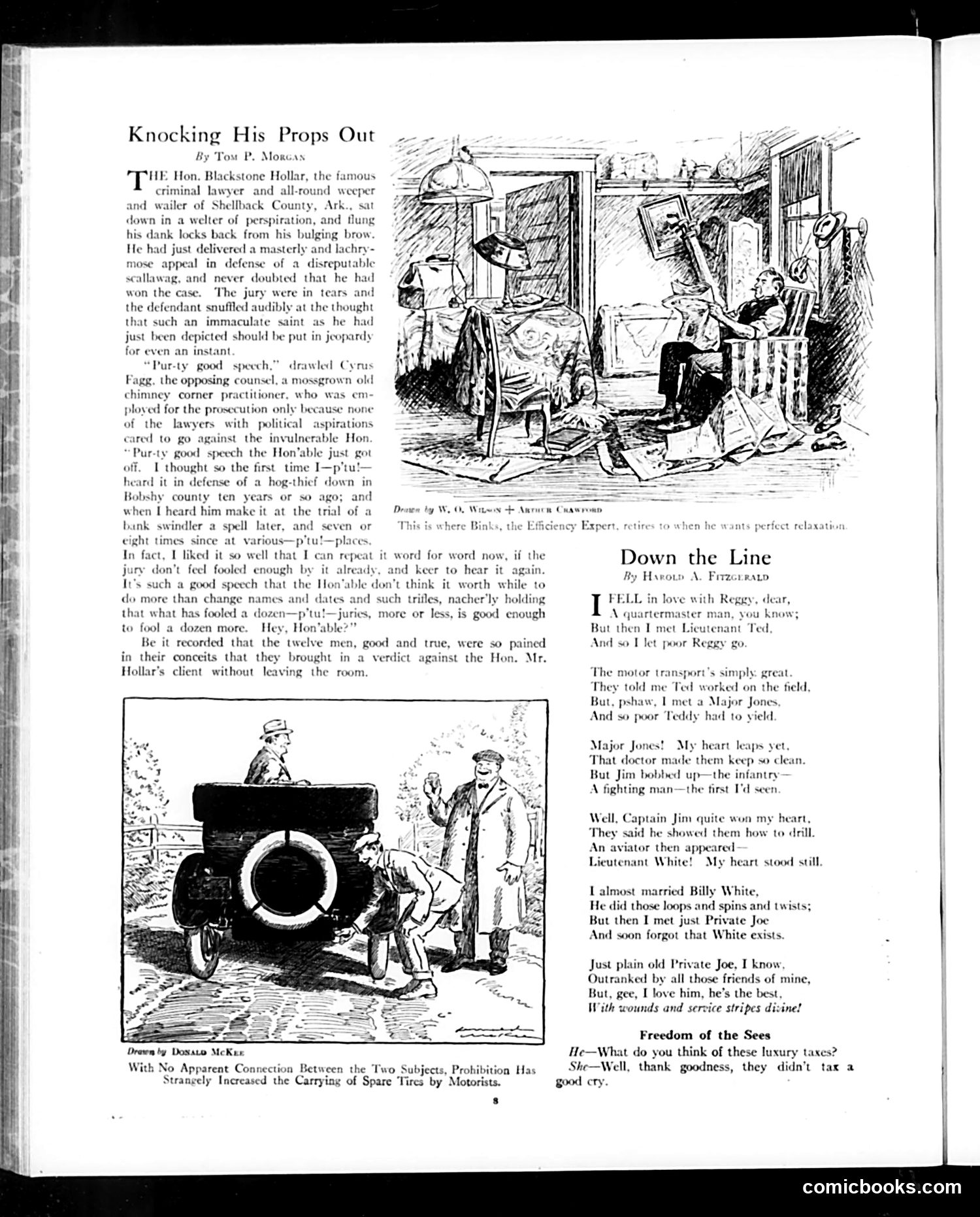
**The Main Cartoon (top):** Depicts Hon. Blackstone Hollar, a theatrical criminal defense lawyer from Arkansas, confronted by opposing counsel Cyrus Fagg. Fagg exposes Hollar's trick: he recycles the same emotional speech across multiple trials, simply changing names and dates. The satire mocks lawyers who rely on theatrical manipulation and repetitive rhetoric rather than actual legal argument—Fagg has heard this exact "masterful" performance at least eight times defending different criminals (including a hog-thief and bank swindler). **The Point:** This ridicules courtroom theatricality and the vulnerability of juries to emotional manipulation over substantive legal reasoning. The jury, moved to tears by Hollar's performance, never realizes they're hearing recycled material—exposing both lawyer dishonesty and jury gullibility. **Bottom Content:** A poem titled "Down the Line" about a woman's romantic adventures with military men of increasing rank; a brief joke about luxury taxes not taxing "a good cry."
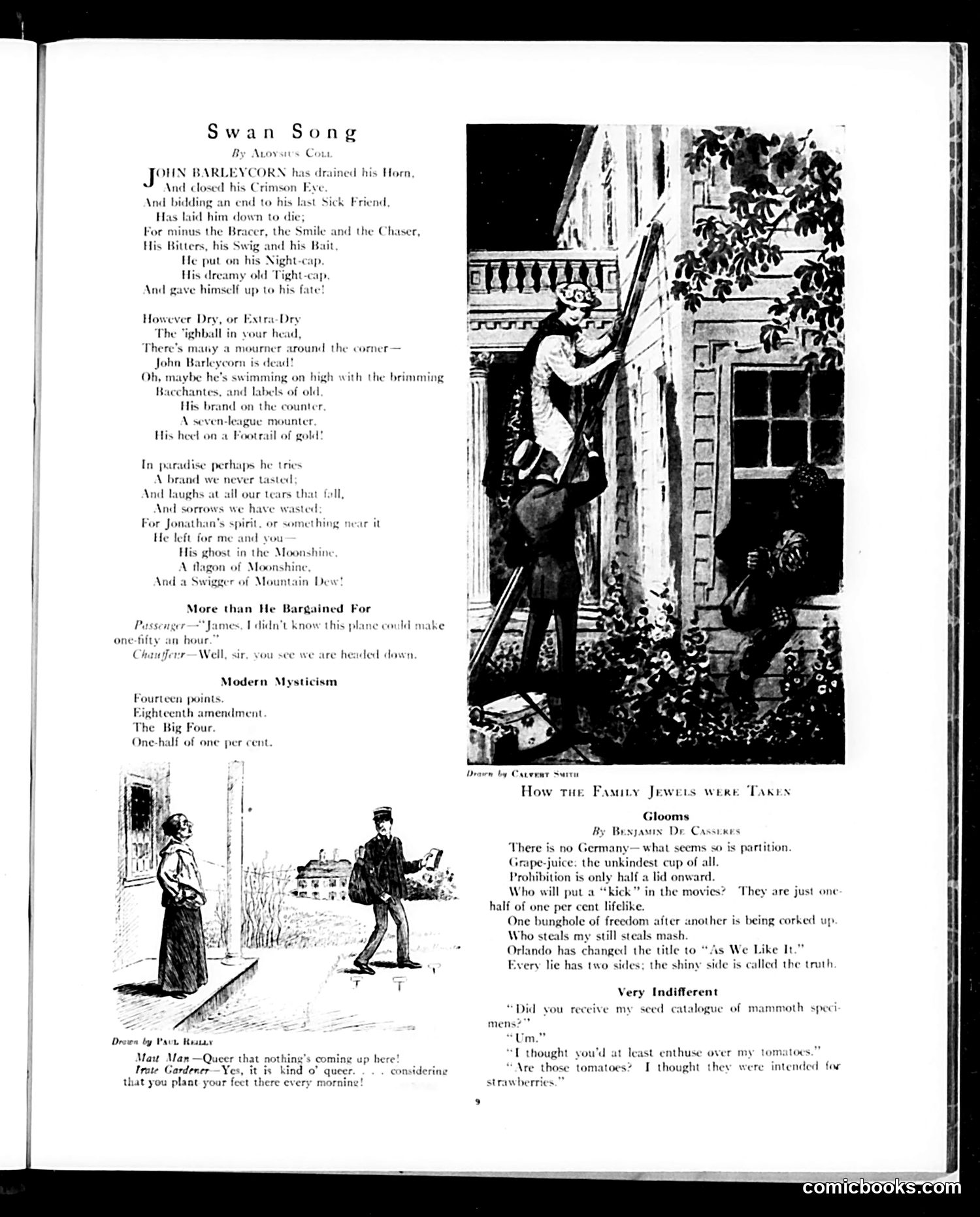
**"Swan Song"** is an elegy for "John Barleycorn"—a personification of alcohol itself. Written as Prohibition takes effect (the 18th Amendment), the poem mourns whiskey's "death" with mock solemnity, imagining the spirit of drinking ascending to an afterlife of moonshine and "Mountain Dew." The satire mocks both prohibitionists' righteousness and drinkers' nostalgia. **"Modern Mysticism"** cynically lists abstract concepts (Fourteen Points, Eighteenth Amendment, "The Big Four") as if they're incomprehensible mysteries—suggesting post-WWI idealism and reform measures are meaningless jargon. **The cartoon dialogue** appears to mock airplane safety claims and bureaucratic evasion. **"Glooms"** offers bitter one-liners about partition, Prohibition ("one bunghole of freedom after another being corked up"), and post-war disillusionment—suggesting reform movements create as many problems as they solve. The page overall expresses satirical skepticism toward contemporary progressive reforms and wartime idealism.
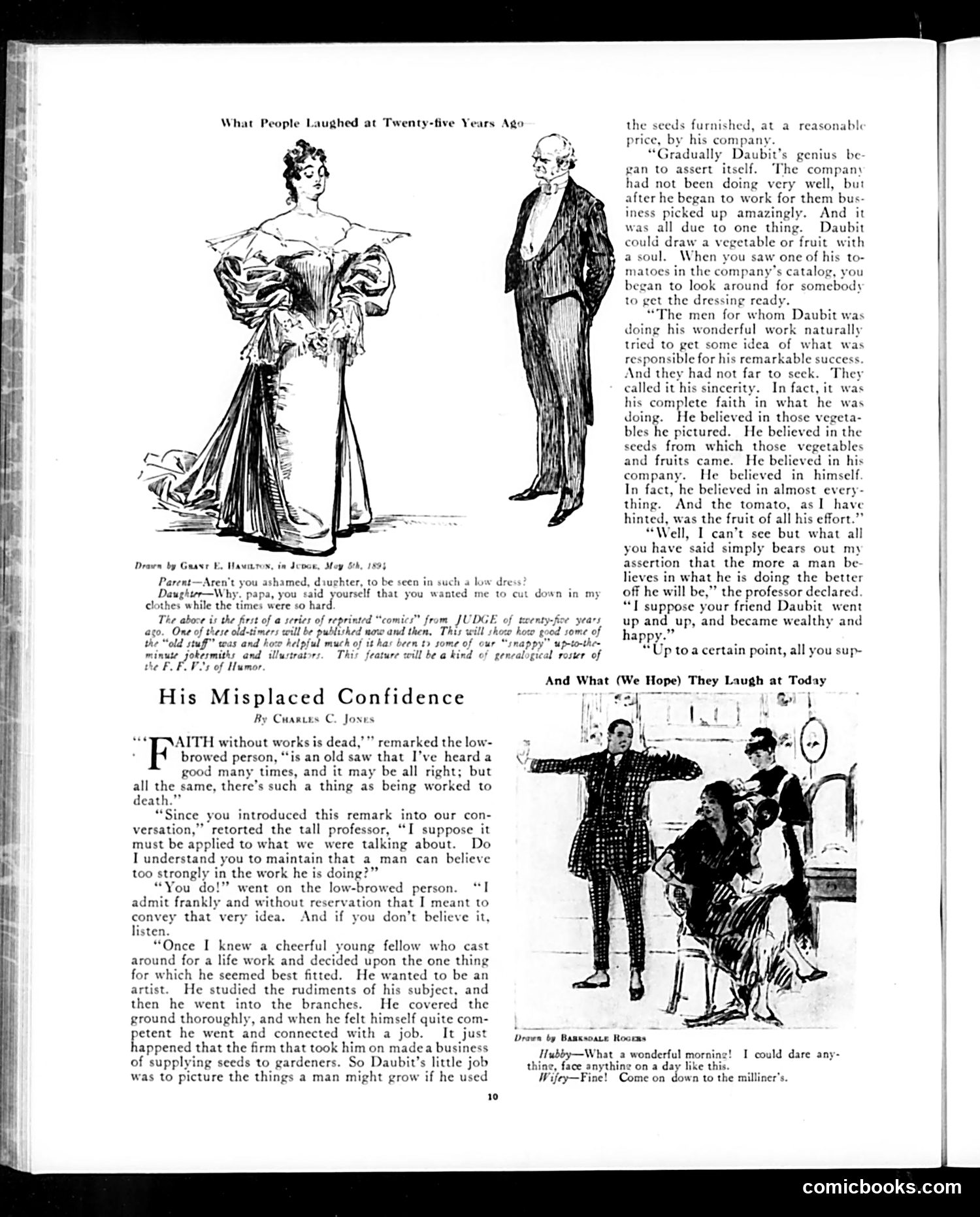
This page contains two separate satirical pieces from *Judge* magazine, separated by roughly 25 years. **Top section ("What People Laughed at Twenty-five Years Ago"):** A 1895 cartoon mocks changing fashion standards. A father complains his daughter wears an immodestly low-cut dress; she responds that *he* told her to economize during hard times. The satire targets hypocrisy—parents demanding daughters dress modestly while simultaneously pressuring them to reduce household expenses, forcing cheaper (and skimpier) clothing choices. **Bottom section ("His Misplaced Confidence"):** A dialogue between a "low-browed person" and an intellectual professor debates whether excessive belief in one's work is harmful. The story of "Daubit," a seed-catalog illustrator whose sincere faith in vegetables made him successful, serves as counterargument—suggesting that unwavering belief in one's work *does* guarantee success. The second section's modern cartoon shows a husband praising the day, while his wife manipulates him into visiting the milliner—satirizing wives exploiting husbands' good moods for shopping.
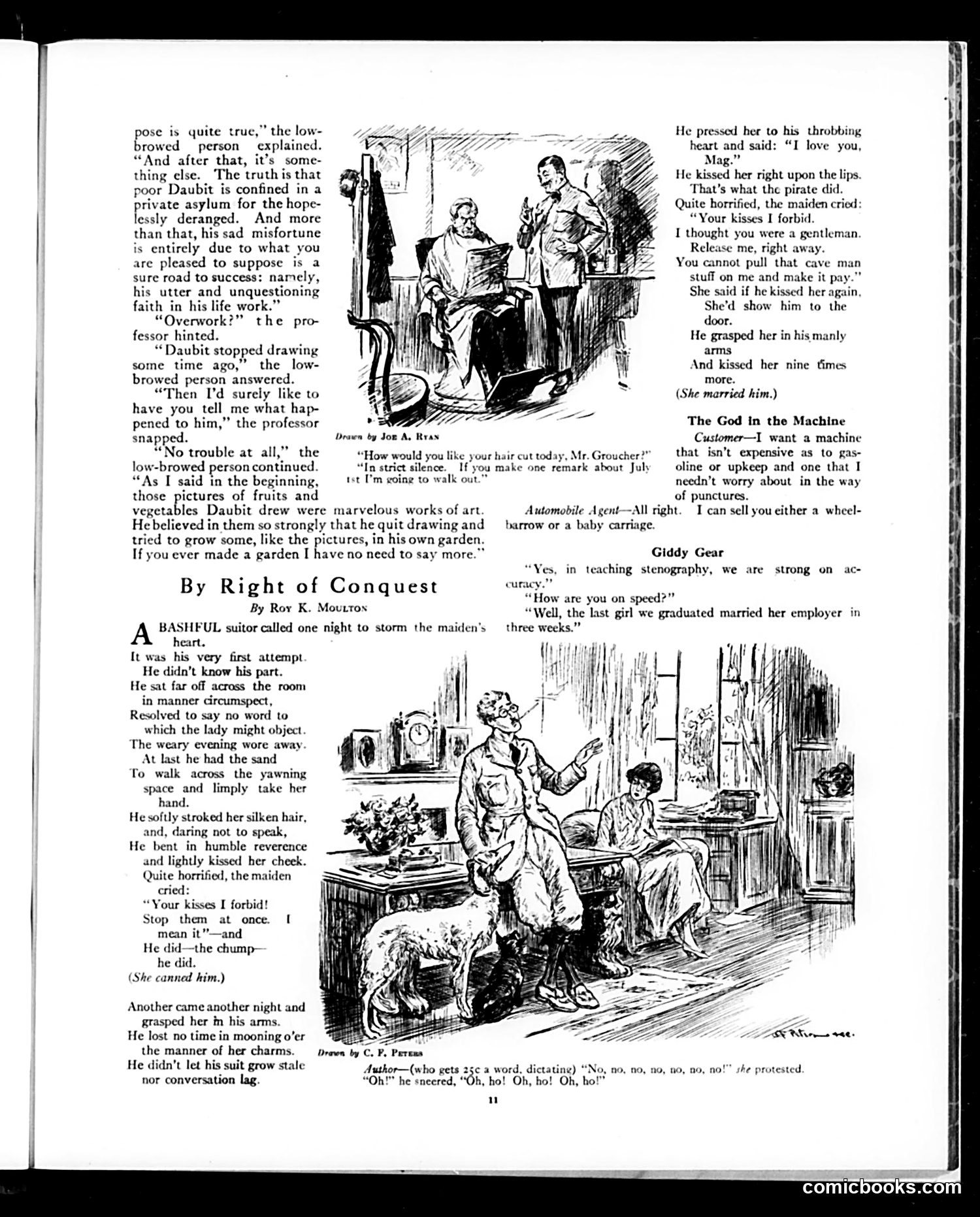
This page contains three satirical pieces typical of early 20th-century American humor: **"By Right of Conquest"** (Roy K. Moulton): A narrative poem mocking contrasting courtship styles. A bashful suitor fails by being too respectful and timid; when the maiden forbids his kisses, he obeys and she rejects him ("canned him"). A bolder suitor ignores her protests, kisses her repeatedly anyway, and she marries him. The satire targets Victorian courtship conventions while suggesting aggressive male persistence was rewarded—reflecting period attitudes about gender dynamics that modern readers would recognize as promoting coercion. **"The God in the Machine"**: A brief joke about automobile salesmen addressing customer concerns about fuel costs and maintenance. **"Giddy Gear"**: A quip about stenography instructors noting their graduates marry employers quickly, implying secretaries marry their bosses. The illustrations and text work together to present humor based on period gender relations, workplace dynamics, and consumer culture. The tone assumes readers share these social assumptions.
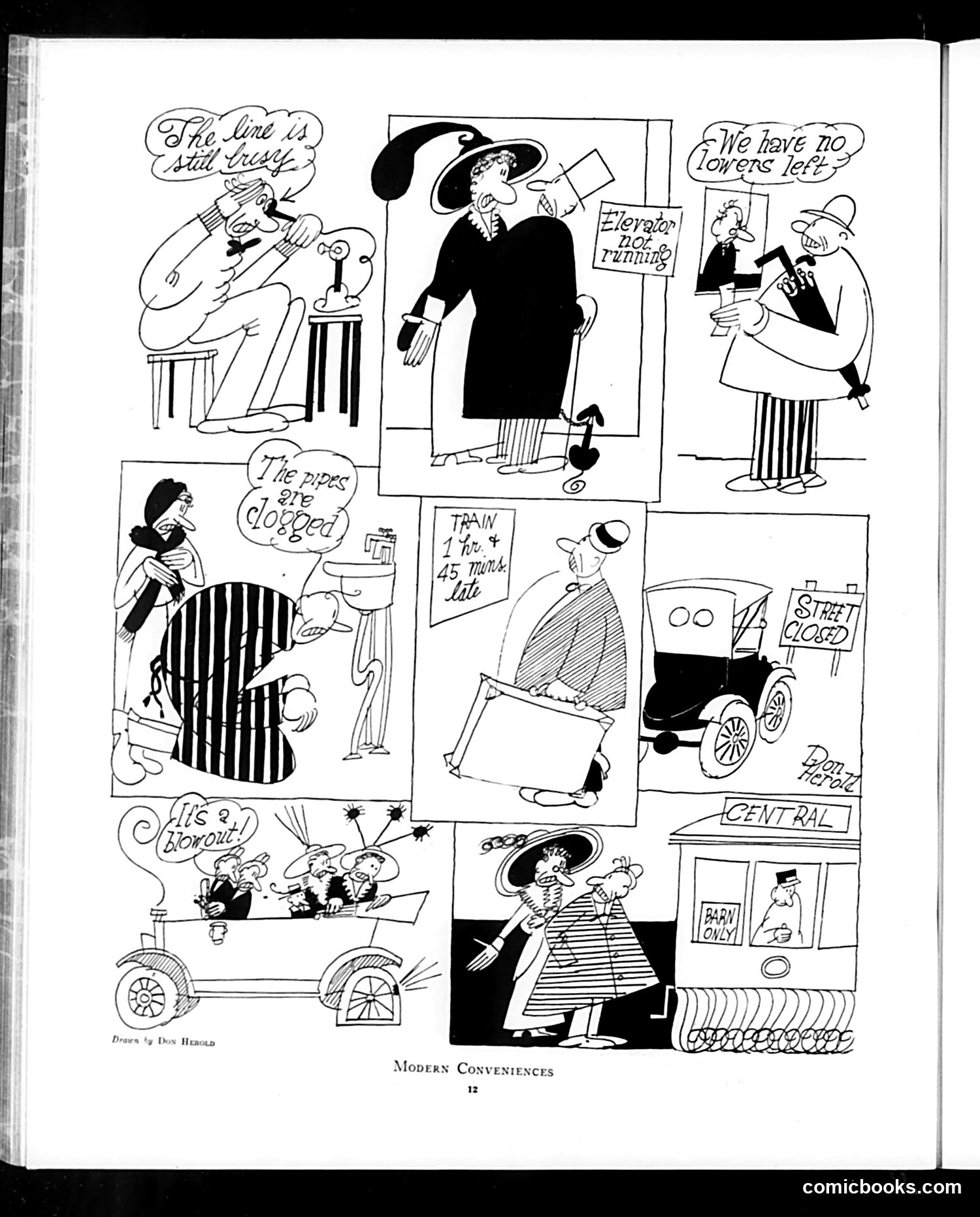
This cartoon satirizes the chaos of modern urban life, particularly apartment living in what appears to be the 1920s-30s. Each panel depicts a common frustration: - A woman complains about noisy plumbing ("The line is still busy") - An "Elevator not running" sign leaves residents stranded - Tenants struggle with broken utilities and poor service - A woman comments "The pipes are clogged" - A train arrives 45 minutes late - A store displays "Street closed" - The final panel shows a woman with children at a "Baby only" facility The title "Modern Conveniences" is ironic—these supposedly convenient urban amenities repeatedly fail, inconvenience residents, and create absurd situations. The humor targets the gap between promised modernization and actual unreliable service delivery in contemporary city life.
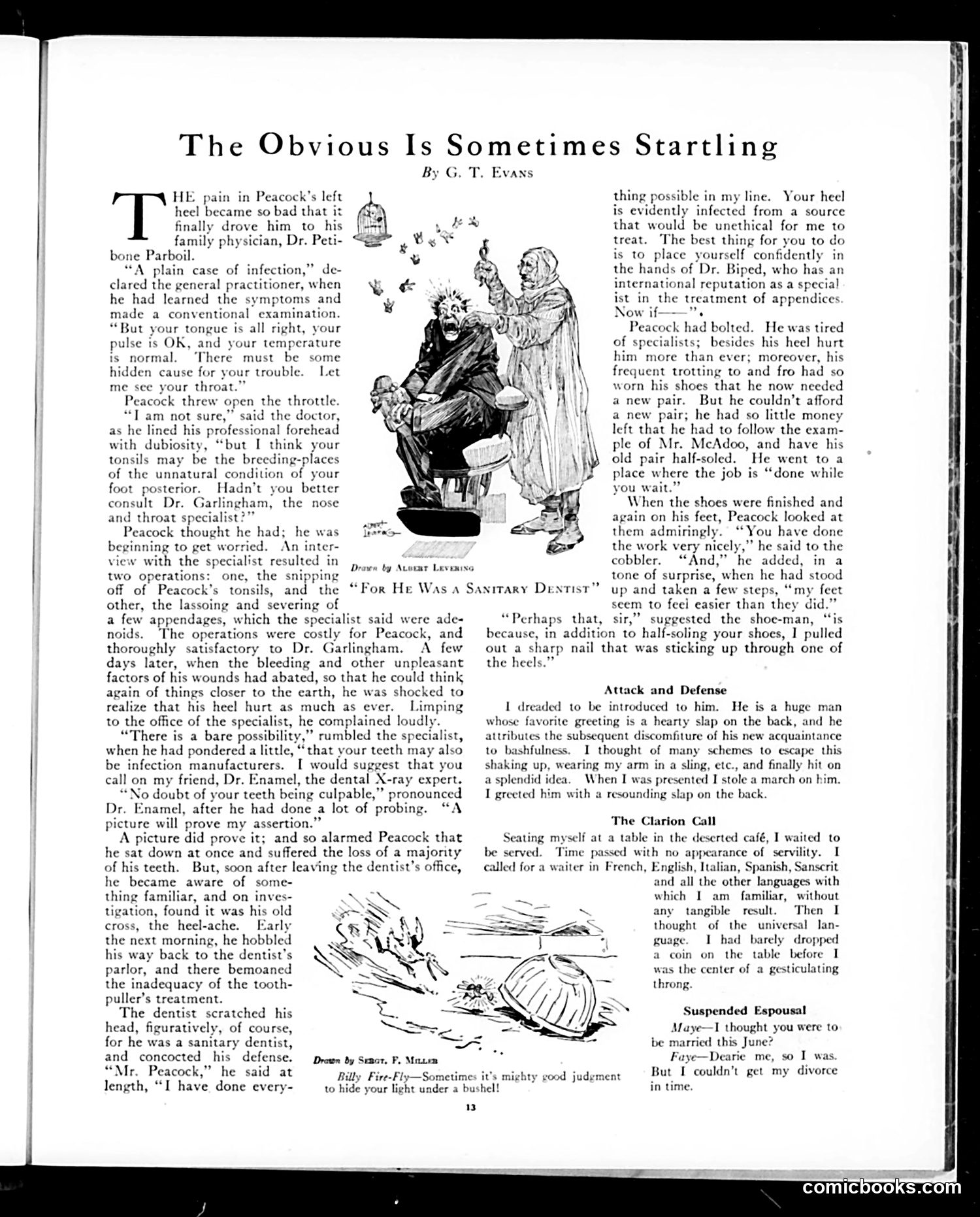
This story mocks the early 20th-century medical establishment's tendency toward unnecessary specialization and procedures. **The Plot:** A man named Peacock visits his general practitioner with a heel infection. Rather than diagnosing the actual problem, the doctor refers him to a throat specialist, who removes his tonsils and adenoids. When the heel still hurts, a dental specialist extracts most of his teeth. None of these expensive, invasive procedures help. **The Satire:** The joke is that after all these specialists fail—tonsils, teeth, appendix removal—the real solution comes from the humble **shoe cobbler**, who simply re-soles his worn shoes. The heel pain was caused by worn footwear, not infection. **The Point:** This attacks how doctors over-specialize and perform unnecessary procedures for profit, while missing obvious causes. The title "The Obvious Is Sometimes Startling" suggests that simple, practical solutions get overlooked when specialists chase complex diagnoses. It's social criticism of medical greed and incompetence dressed as satirical humor.
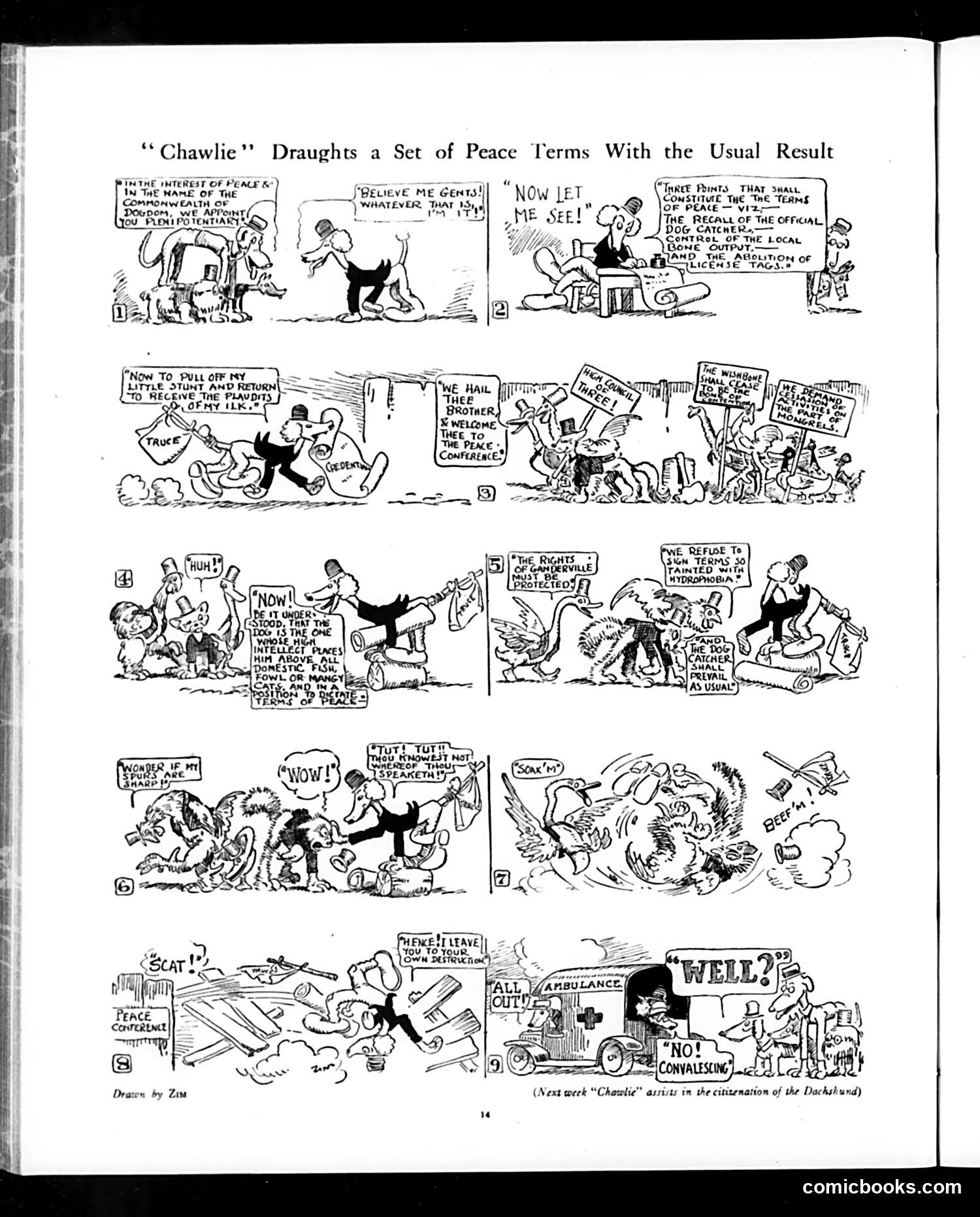
This nine-panel satirical comic by Zim mocks failed peace negotiations, likely referencing early-20th-century diplomatic efforts (possibly WWI-era). "Chawlie" (Charlie) appears to be a caricatured negotiator attempting to draft peace terms. The satire follows a pattern: each panel shows increasingly absurd demands and escalating chaos as the negotiation progresses. What begins as formal diplomacy devolves into physical altercation, property destruction, and ultimately an ambulance—suggesting the "peace conference" ends violently rather than peacefully. The joke satirizes the futility of peace negotiations, portraying diplomats as simultaneously pompous and ineffectual. The recurring phrase "with the usual result" underscores the cartoonist's cynicism: regardless of sincere efforts, peace talks inevitably collapse into conflict. This reflects period skepticism about diplomatic solutions to international disputes.
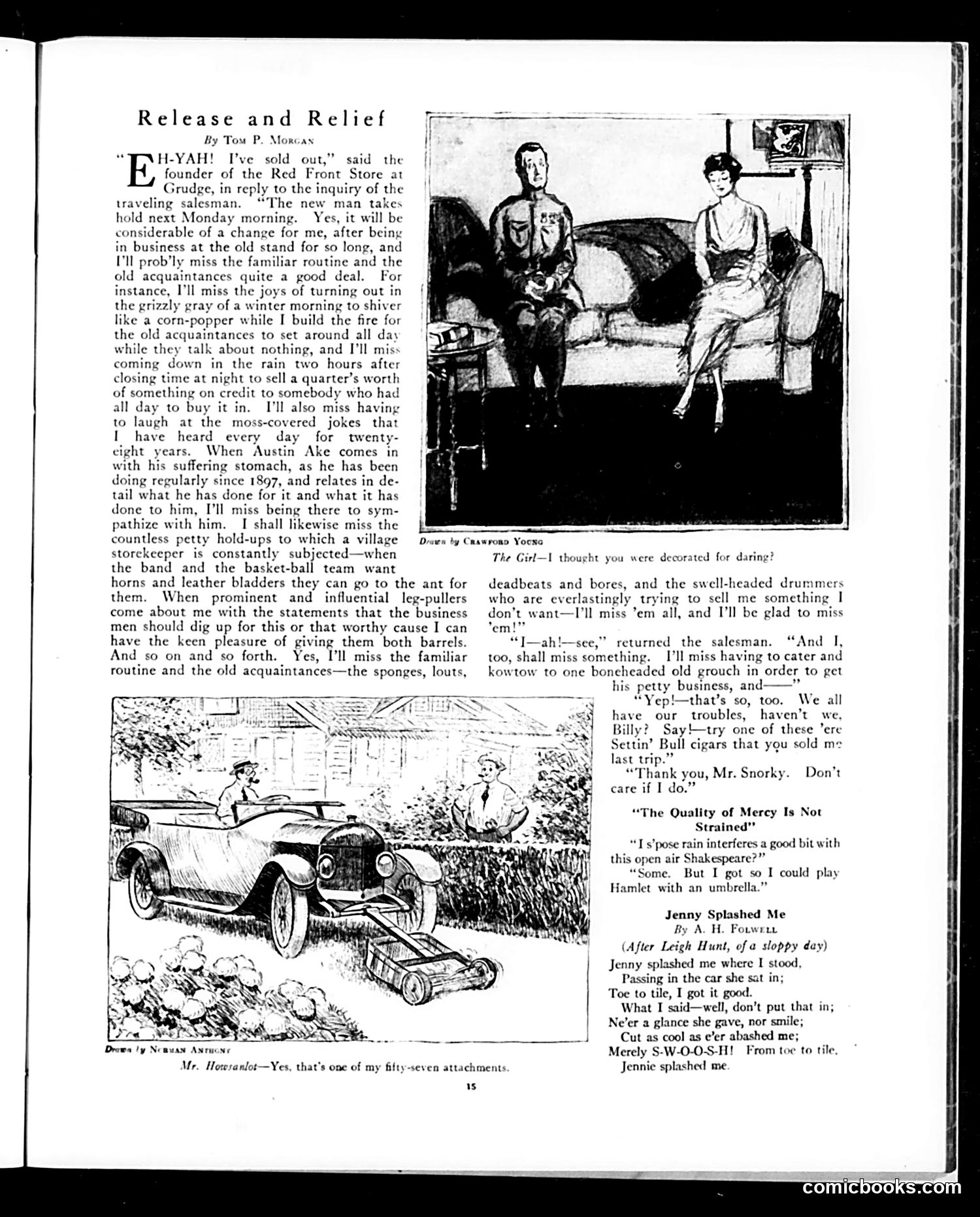
This page satirizes the bittersweet emotions of a rural shopkeeper selling his business. The founder of the "Red Front Store at Grudge" tells a traveling salesman he's retiring after decades—and reveals he'll simultaneously miss AND despise his job. The humor lies in the contradiction: he lists genuine hardships (winter mornings, unpaid credit sales, chronic customer Austin Ake's complaints since 1897, constant pestering from organizations for donations) alongside claiming he'll "miss" them. The salesman echoes this irony—he too will "miss" having to grovel to the "boneheaded old grouch." The accompanying illustration of a car with a lawn-mower attachment and the separate poem "Jenny Splashed Me" are unrelated lighter content. Together, the pieces capture early 20th-century small-town commercial life's exhausting social obligations masked by conventional politeness.
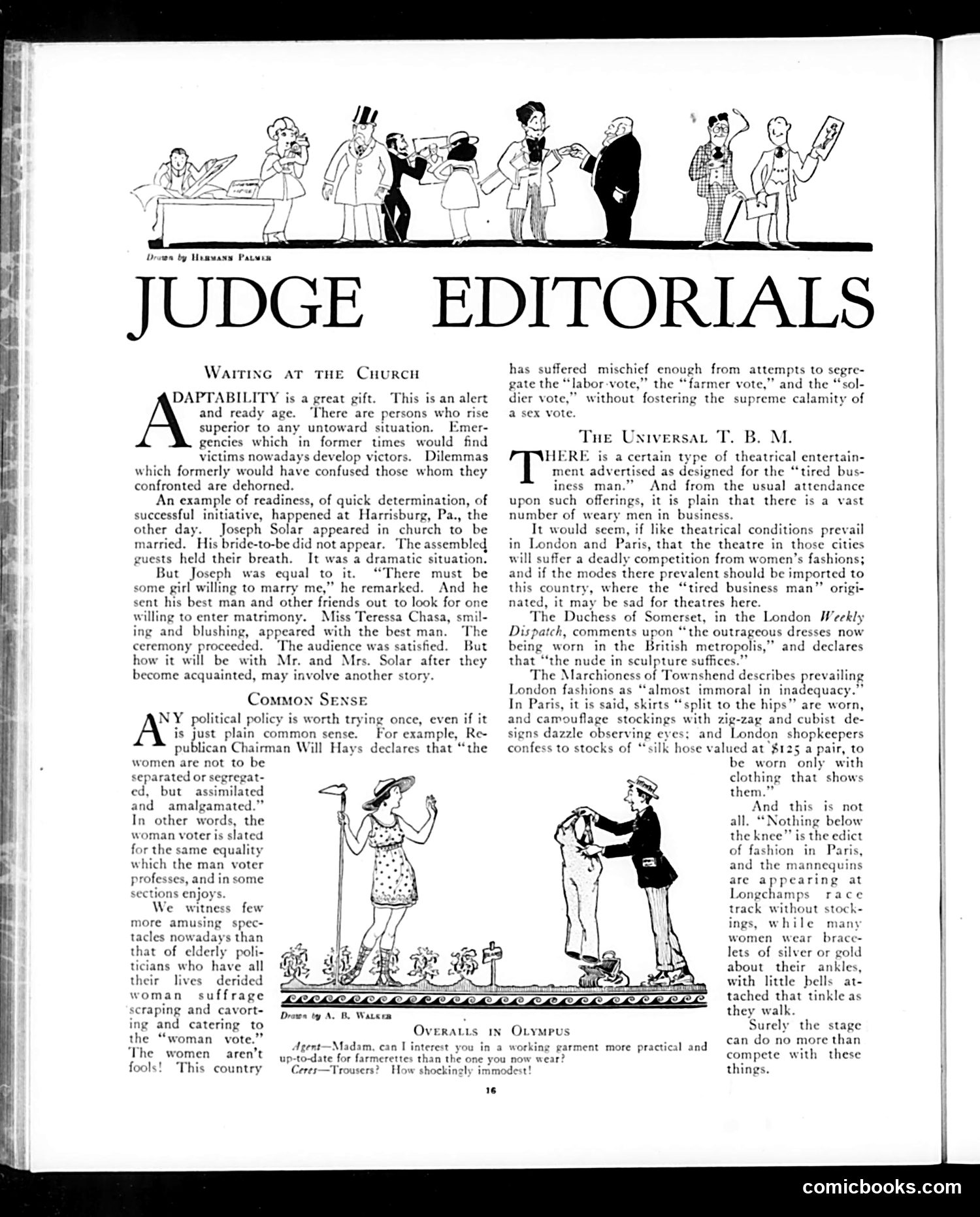
This page contains three satirical editorials with accompanying cartoons, likely from the 1920s based on references to women's suffrage and fashion. **"Waiting at the Church"** mocks a man (Joseph Solar) whose bride doesn't appear at his wedding in Harrisburg, PA—so he simply asks friends to find *any* willing woman to marry instead. The satire targets both his absurd adaptability and the casual nature of marriage. **"Common Sense"** criticizes Republican Chairman Will Hays's claim that women voters should be "assimilated" rather than treated as a separate "sex vote." The editorial sarcastically notes politicians who previously derided women's suffrage now embrace it for electoral purposes. **"The Universal T.B.M."** (Tired Business Man) compares theatrical entertainment to the competition posed by increasingly scandalous women's fashions in London and Paris—featuring hemlines "split to the hips," expensive silk stockings, and ankle bracelets with bells. The accompanying cartoon depicts women in revealing athletic wear, with a vendor hawking "practical" overalls as superior workwear.
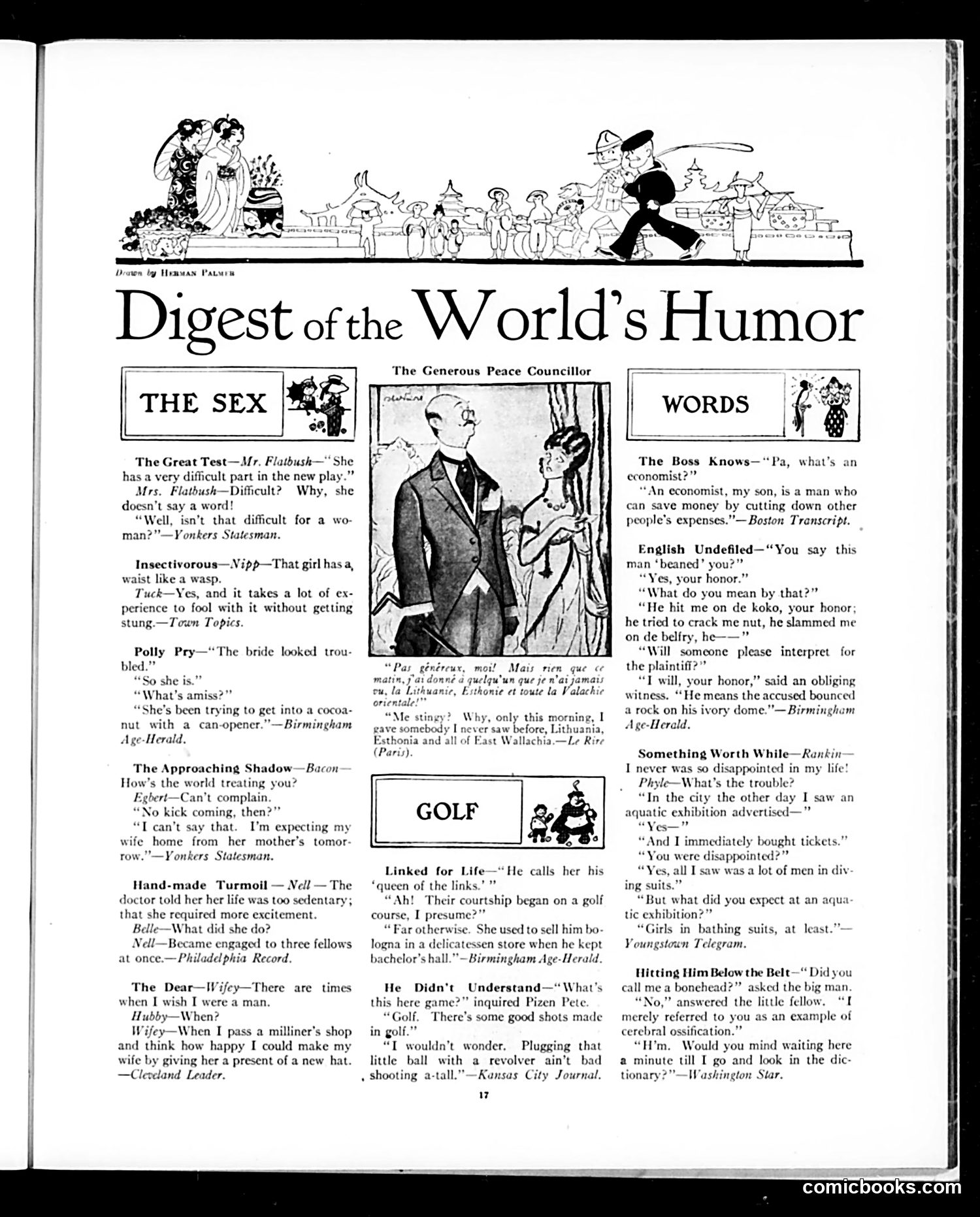
This page collects short jokes organized by topic (Sex, Words, Golf) from various American newspapers and magazines, a common Judge feature. The central cartoon depicts "The Generous Peace Councillor"—likely referencing post-WWI peace negotiations—where a diplomat makes grand claims about bringing peace to Eastern European nations (Lithuania, Esthonia, Wallachia) while a woman appears skeptical or unimpressed. The jokes themselves reflect early 20th-century humor: wordplay about women's silence being "difficult," the economic definition of an "economist" (someone who saves money by cutting others' expenses), and crude puns like hitting someone's head as "cerebral ossification." The golf jokes mock non-golfers who don't understand the sport. The humor is period-specific—assumptions about gender roles, dated slang ("beaned," "koko"), and satirical takes on political posturing that modern readers would need historical context to fully appreciate.
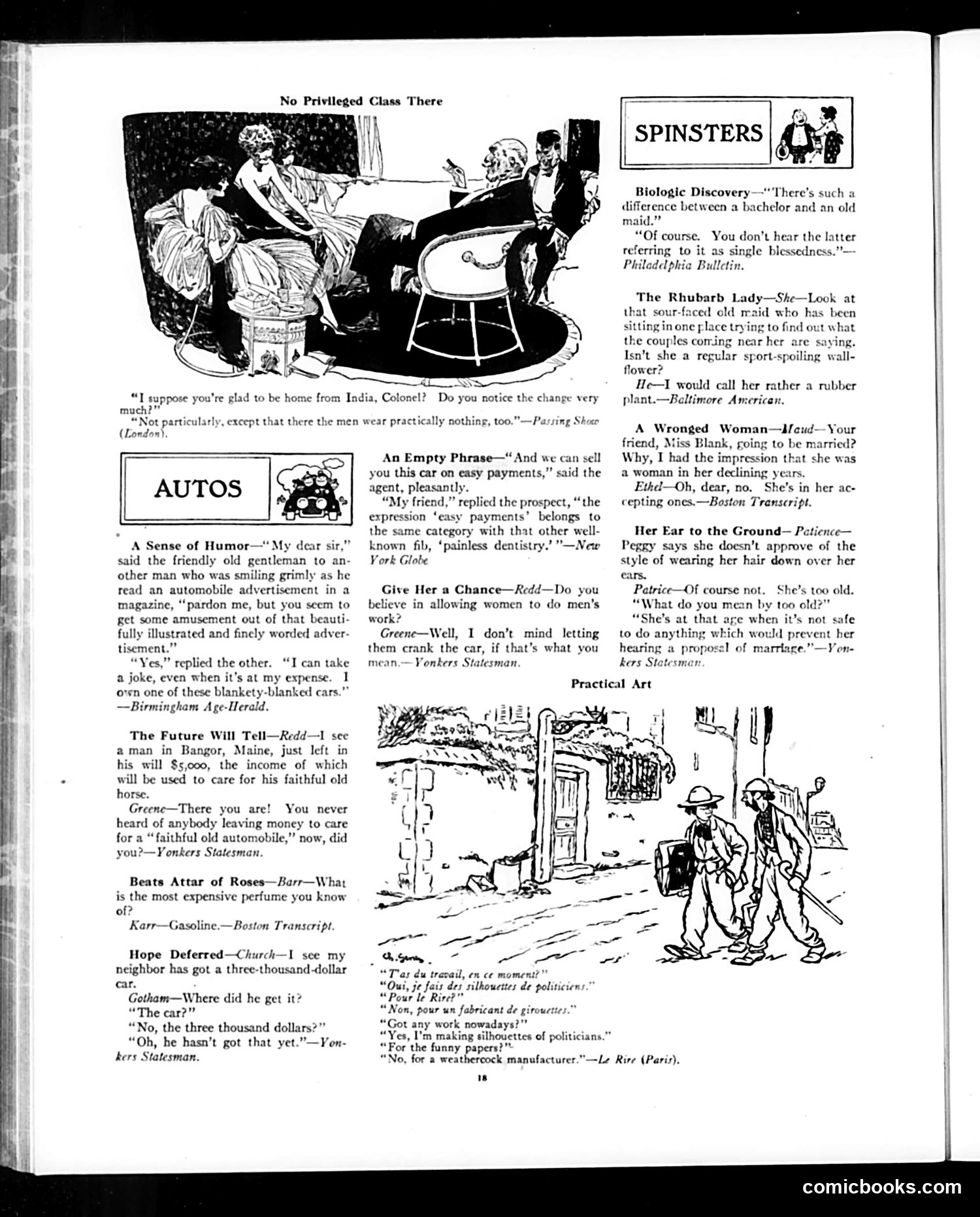
This page contains humorous short anecdotes satirizing early 20th-century American attitudes toward automobiles, wealth, and gender roles. **The "AUTOS" section** mocks car culture through jokes about expense and reliability. One anecdote highlights the absurdity of "easy payments"—suggesting this phrase is as misleading as "painless dentistry." Another jokes that a wealthy neighbor can afford a $3,000 car but not the $3,000 itself, satirizing nouveau riche pretension. A final quip suggests women should be allowed to "crank the car" (hand-start it)—demeaning women's capabilities. **The "SPINSTERS" section** uses misogynistic humor about unmarried women as perpetual gossips and obstacles to romance. One anecdote compares an eavesdropping spinster to a "rubber plant"—passive and useless. **"Practical Art"** (in French) concludes with irony: a silhouette artist makes caricatures of politicians—not for humor magazines, but for weathercock manufacturers, suggesting politicians are as changeable and unreliable as wind-direction indicators. The page reflects period attitudes: celebration of automobiles as status symbols, dismissal of women's roles, and cynical views of politicians.
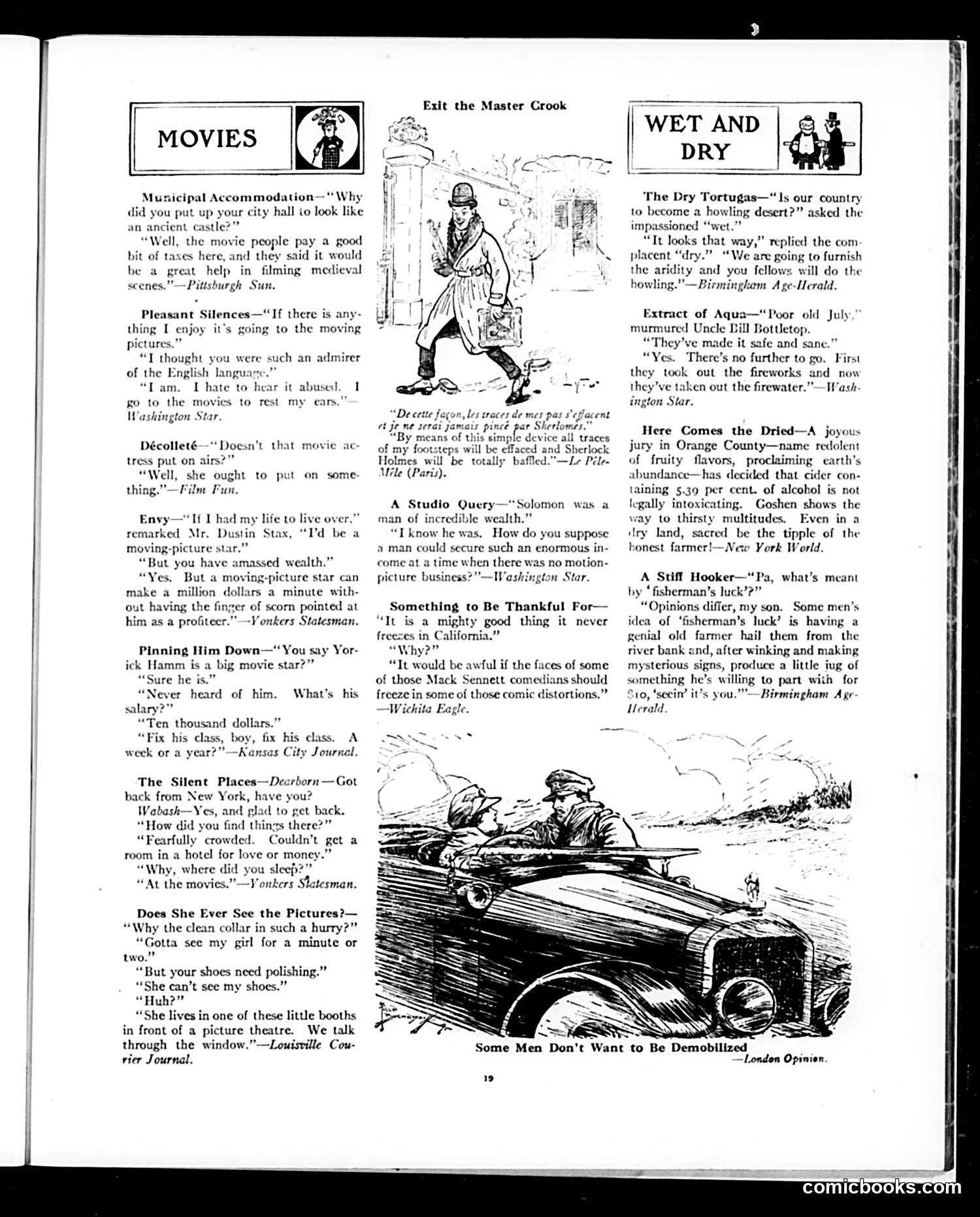
This page from Judge (likely early 1920s) contains satirical short jokes and cartoons mocking silent films, Hollywood, and Prohibition-era concerns. **Film Industry Satire:** Multiple jokes ridicule movie stars' pretensions and the film industry's influence. References to "Dustin Stax" and "Yorick Hamm" mock how wealthy, untalented actors command enormous salaries while "profiteers" face social scorn—contrasting Hollywood's moral permissiveness with public judgment of wartime profiteering. **Prohibition Humor:** The "Wet and Dry" section satirizes the Prohibition debate. "Wet" advocates (opposing alcohol bans) and "dry" proponents exchange barbs. A jury declaring cider with 5.39% alcohol non-intoxicating mocks legal loopholes. The "Stiff Hooker" joke references farmers covertly selling illegal liquor. **Social Commentary:** Jokes about movie theaters as dating venues and people avoiding crowds by sitting in cinema booths reflect urbanization anxieties. The cartoon "Some Men Don't Want to Be Demobilized" (bottom) likely references post-WWI soldiers reluctant to leave military service. The humor targets emerging consumer culture, legal contradictions, and social change.
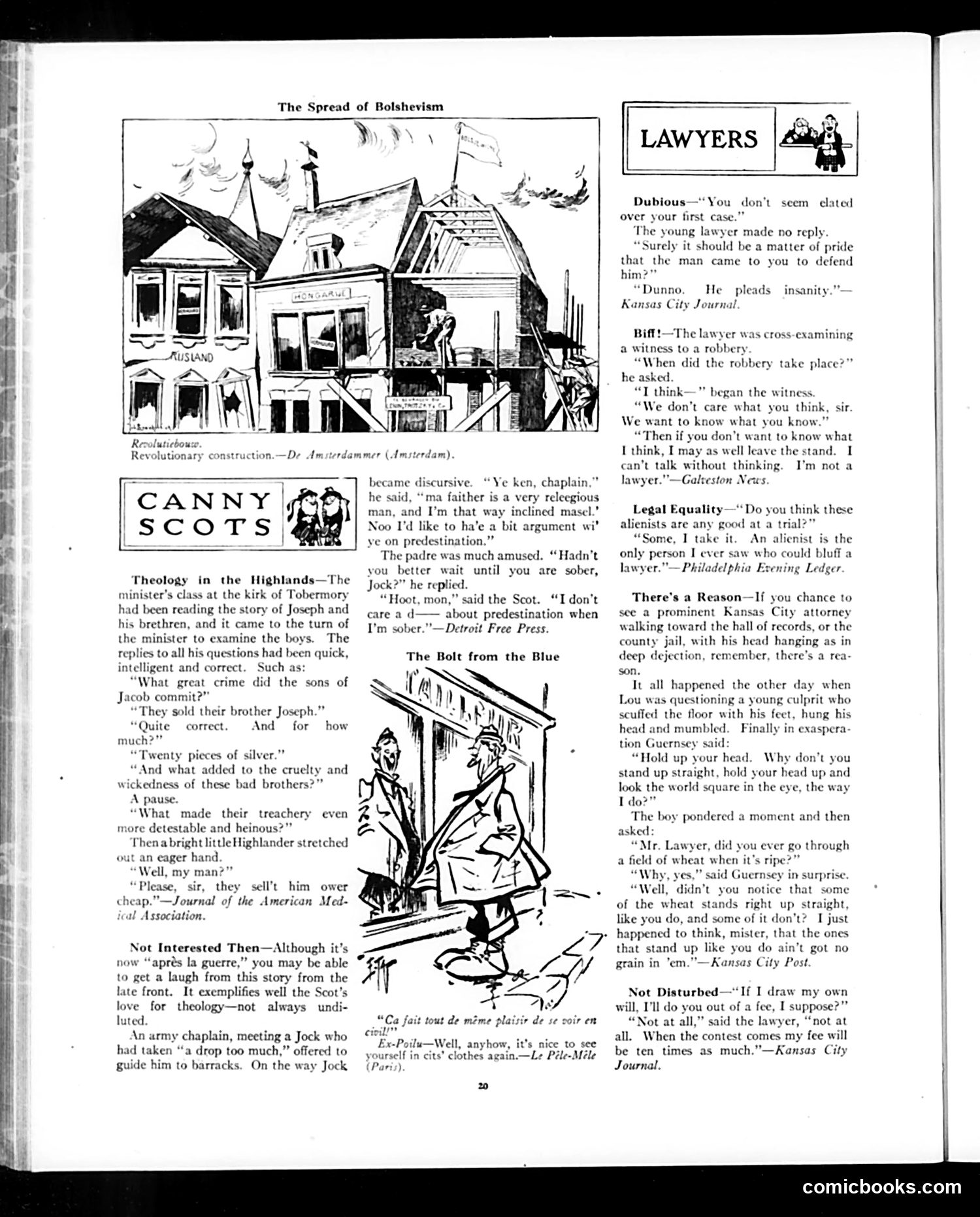
This page from *Judge* magazine contains political cartoons and humorous anecdotes about lawyers and social issues. **"The Spread of Bolshevism"** (top left): The illustration depicts burning buildings labeled "Holland" and "Russia," visualizing the fear of revolutionary communist expansion spreading across Europe after the 1917 Russian Revolution. This reflects post-WWI American anxieties about Bolshevism threatening Western nations. **The lawyer jokes** (right column) satirize the legal profession through brief anecdotes mocking lawyers' logic, courtroom tactics, and financial self-interest. Examples include a lawyer unimpressed by defending an "insane" client, and an attorney who profits from will contests. **Other content** includes Scottish dialect humor ("Canny Scots," "Theology in the Highlands") and a French anecdote about WWI soldiers. The page reflects early 1920s American concerns: anti-communist sentiment, skepticism of professional institutions, and nostalgia for wartime camaraderie among Allied forces.
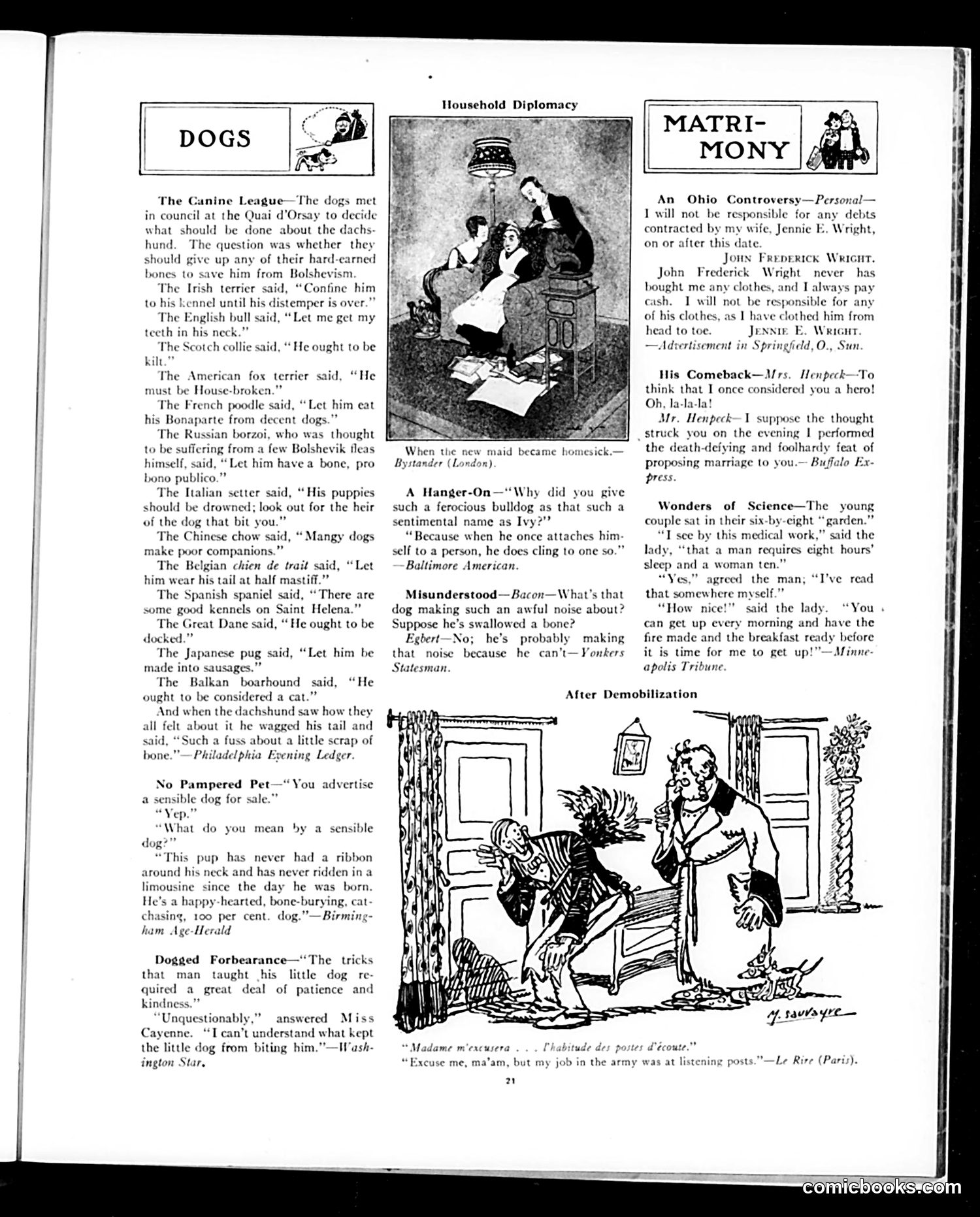
This page from the satirical magazine **Judge** contains multiple short humor pieces commenting on post-World War I social issues. The lead piece, "The Canine League," is a political allegory where different national dog breeds debate how to handle a dachshund (representing Germany) threatened by Bolshevism. Each nation's suggested approach reflects its stereotyped character: the American wants it "house-broken," the French dismissive, the Russian sympathetic, the Japanese brutal. The dachshund's indifference ("wagged his tail") suggests satirical skepticism about international concern. The "Matrimony" section features three brief domestic quarrels: a husband disclaiming responsibility for his wife's debts (she counters she clothed him), a wife mocking her husband's wartime heroism, and a couple discussing sleep requirements with ironic practical implications. "After Demobilization" depicts a soldier explaining his wartime duty involved "listening posts"—satirizing the mundane reality behind military service. The humor targets post-war domestic tensions, international politics, and the gap between wartime rhetoric and peacetime reality.
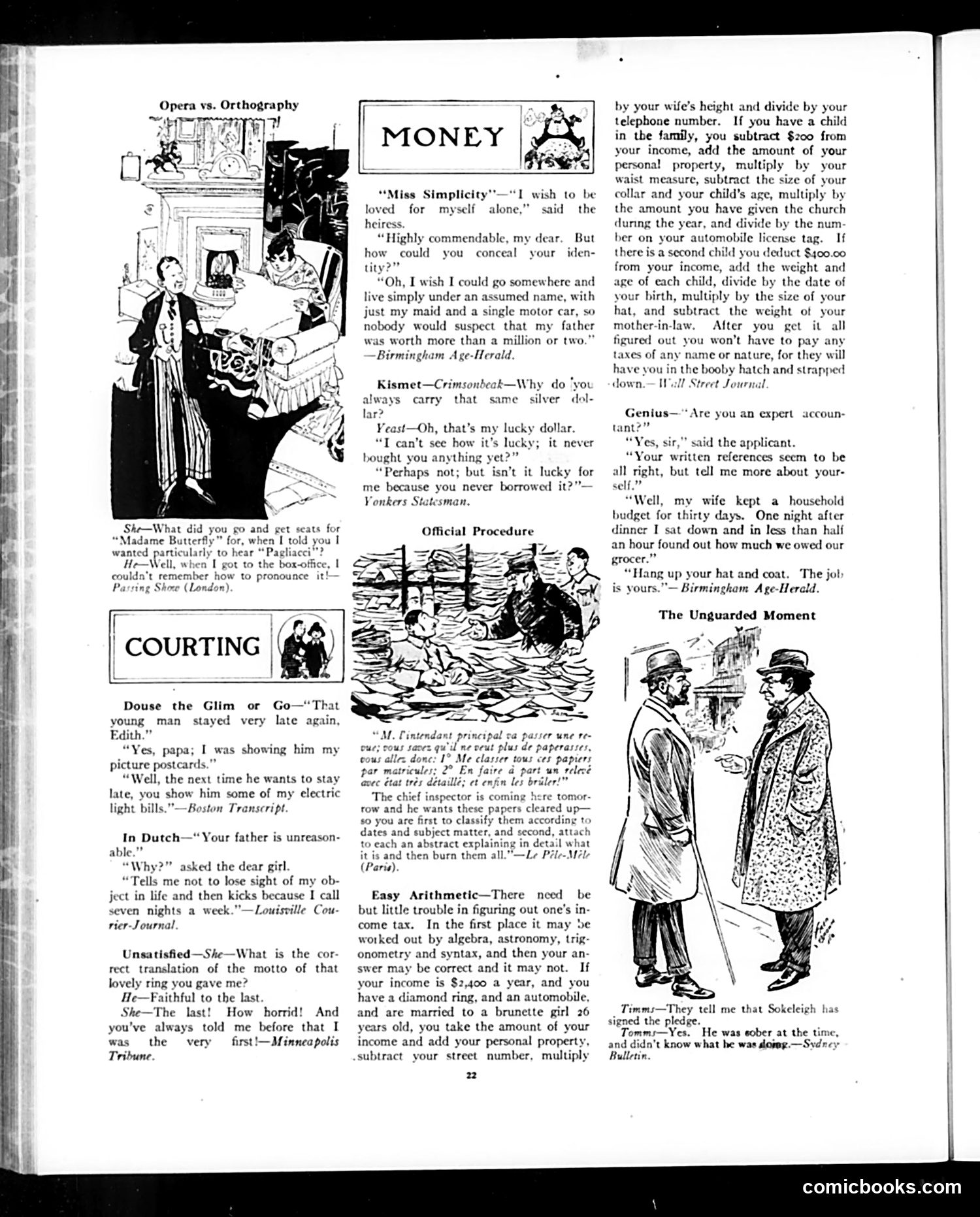
This page collects short humor pieces satirizing early 20th-century social and domestic life. The cartoons mock contemporary anxieties: **"Opera vs. Orthography"** jokes that a man bought wrong opera tickets due to pronunciation difficulty—satirizing both pretension around high culture and male incompetence. **"Courting" section** ridicules courtship rituals: a young man's persistent late-night visits, fathers' attempts to discourage suitors with electric bills, and women's mercenary attitudes toward engagement rings. **"Official Procedure"** (French-captioned) satirizes bureaucratic absurdity—a chief inspector demands papers be classified, abstracted, and then burned. **"Easy Arithmetic"** mocks the byzantine U.S. income tax system by listing ridiculous calculation methods (dividing by phone numbers, wife's height), suggesting the tax code is so incomprehensibly complex it drives people insane. **"The Unguarded Moment"** depicts two men; the caption's reference to "Sokoleigh" and a pledge suggests mocking drunken declarations. These pieces target upper-class pretension, marital discord, bureaucratic waste, and tax system absurdity—themes resonating with early 20th-century American readers.
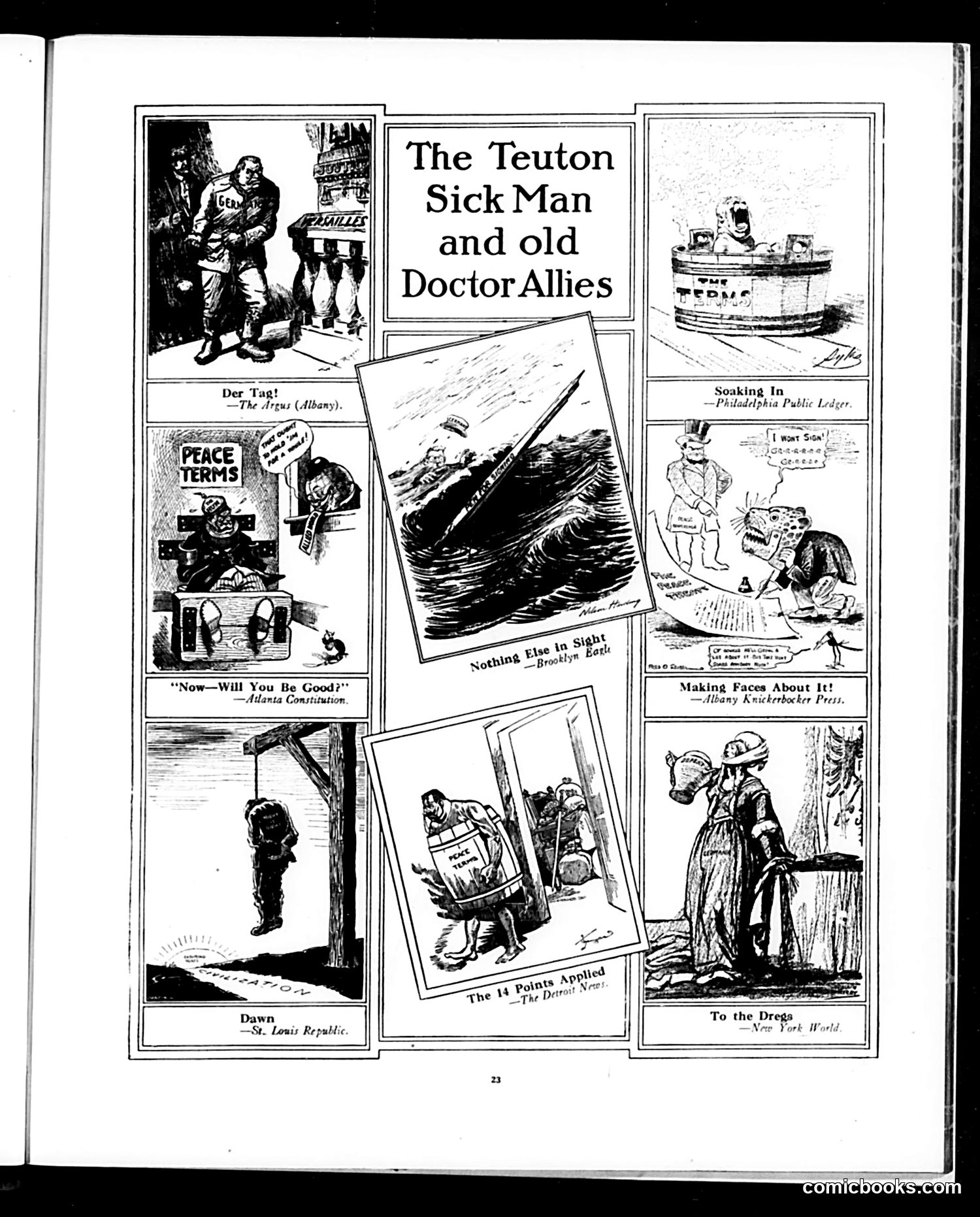
This WWI-era political cartoon depicts Germany ("The Teuton Sick Man") being treated by Allied doctors. The sequence shows Germany's deteriorating condition through various metaphors: a sinking ship ("Nothing Else in Sight"), peace terms being imposed ("Now—Will You Be Good?"), execution by hanging ("Dawn"), and ultimately the application of harsh conditions ("The 14 Points Applied," "To the Dregs"). The cartoon satirizes Germany's military defeat and the punitive post-war treatment by Allied forces. "Der Tag" (German for "The Day") references Germany's pre-war militarism. The Allied doctors appear helpless or vindictive as they administer increasingly severe remedies to their "patient," suggesting the cartoonist's commentary on whether the peace settlement would genuinely heal or merely punish the defeated nation.
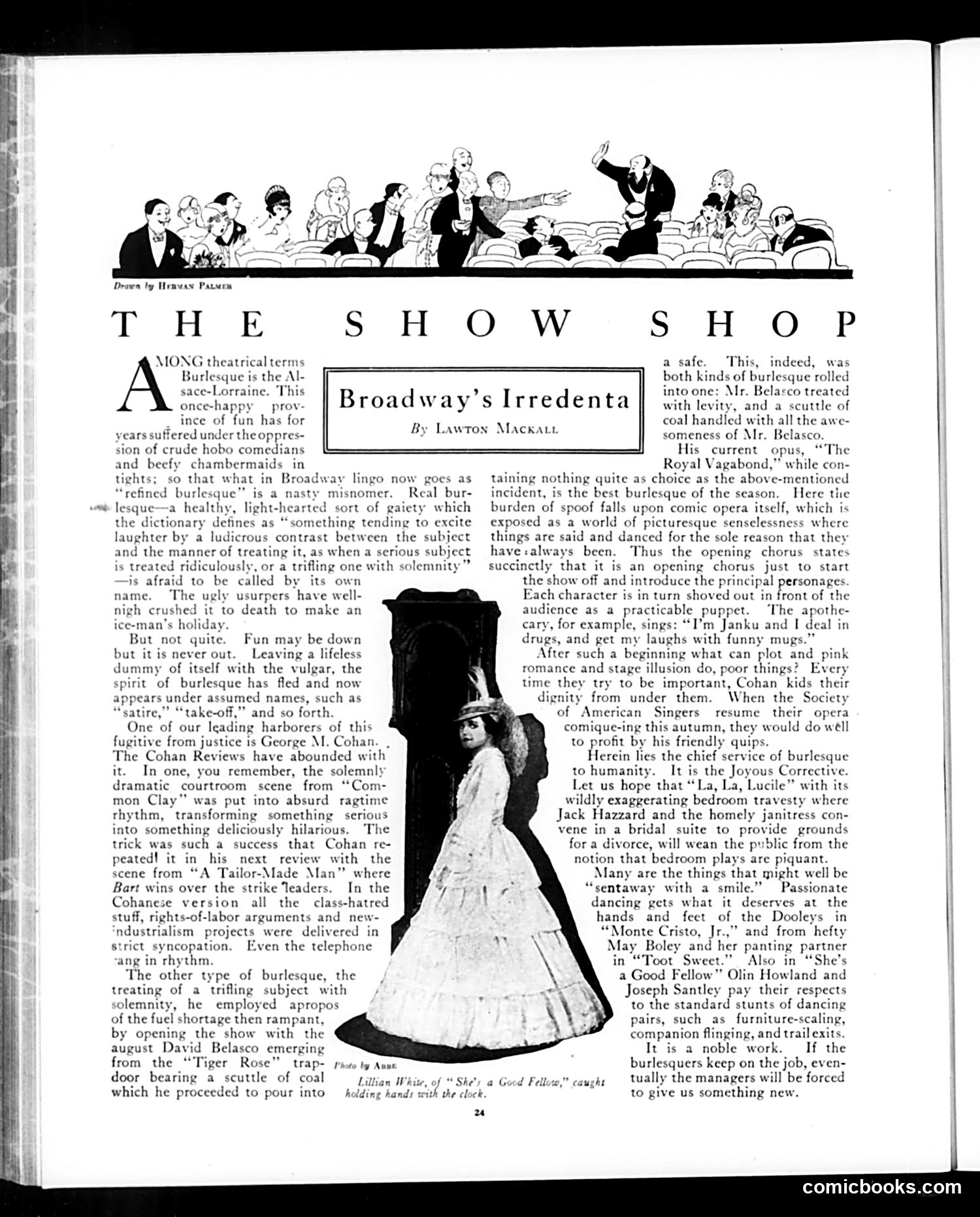
This article discusses burlesque theater, specifically praising it as social satire. The author argues that true burlesque—comedy through exaggerated contrast—has been suppressed by crude performers, but survives under assumed names like "satire" and "take-off." The piece celebrates **George M. Cohan** as a leading practitioner, highlighting how he transformed serious dramatic scenes (from "Common Clay" and "A Tailor-Made Man") into absurd ragtime numbers, making audiences laugh at class-conflict arguments through ridicule rather than earnestness. The article praises burlesque as "the Joyous Corrective"—using mockery to deflate pretension in comic opera and serious drama. It mentions contemporary shows like "La, La, Lucile" and "The Royal Vagabond" as examples where burlesque effectively punctures audience sentimentality about romance and bedroom farce. The accompanying illustration (by Herman Palmer) shows a theatrical audience in period dress, establishing the context of early 20th-century Broadway entertainment.
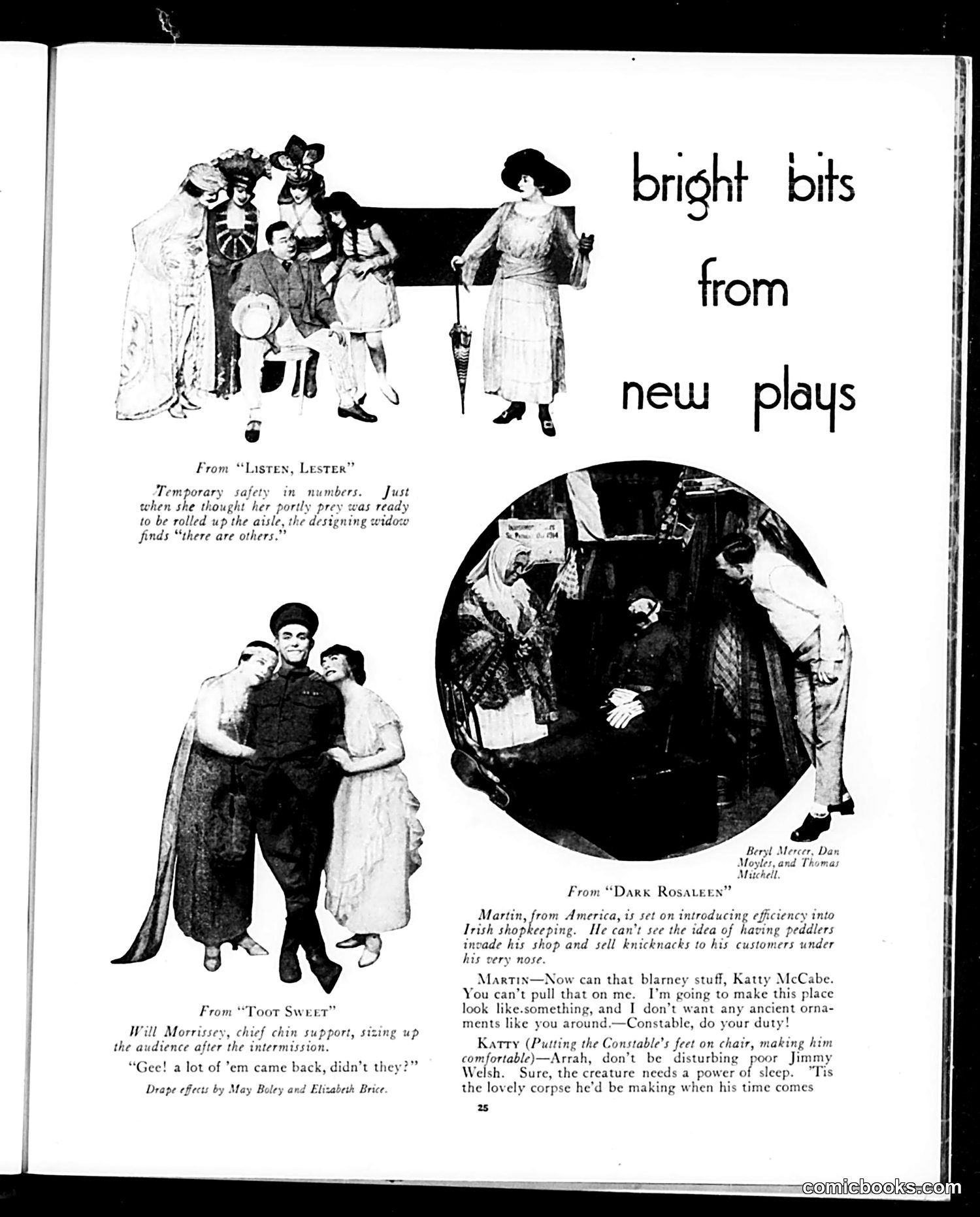
This page presents comedic excerpts from three Broadway productions, illustrated with stills or drawings from the performances. **"Listen, Lester"** satirizes a predatory widow's schemes: she's targeting a wealthy man for marriage, but discovers rivals ("there are others"), undermining her design. **"Dark Rosaleen"** depicts Irish-American culture clash. An American businessman named Martin attempts to impose American efficiency on an Irish shop, dismissing traditional Irish street vendors and customs as "ancient ornaments." A character named Katty McCabe resists by having a constable rest comfortably while a (possibly drunk) Jimmy Welsh sleeps—the joke being that Irish charm and resistance subvert the American's modernization efforts. **"Toot Sweet"** shows actor Will Morrissey addressing the audience directly after intermission, joking that many viewers left but surprisingly returned. These excerpts showcase early 20th-century theater's reliance on ethnic stereotyping, slapstick, and direct audience engagement for comedy.
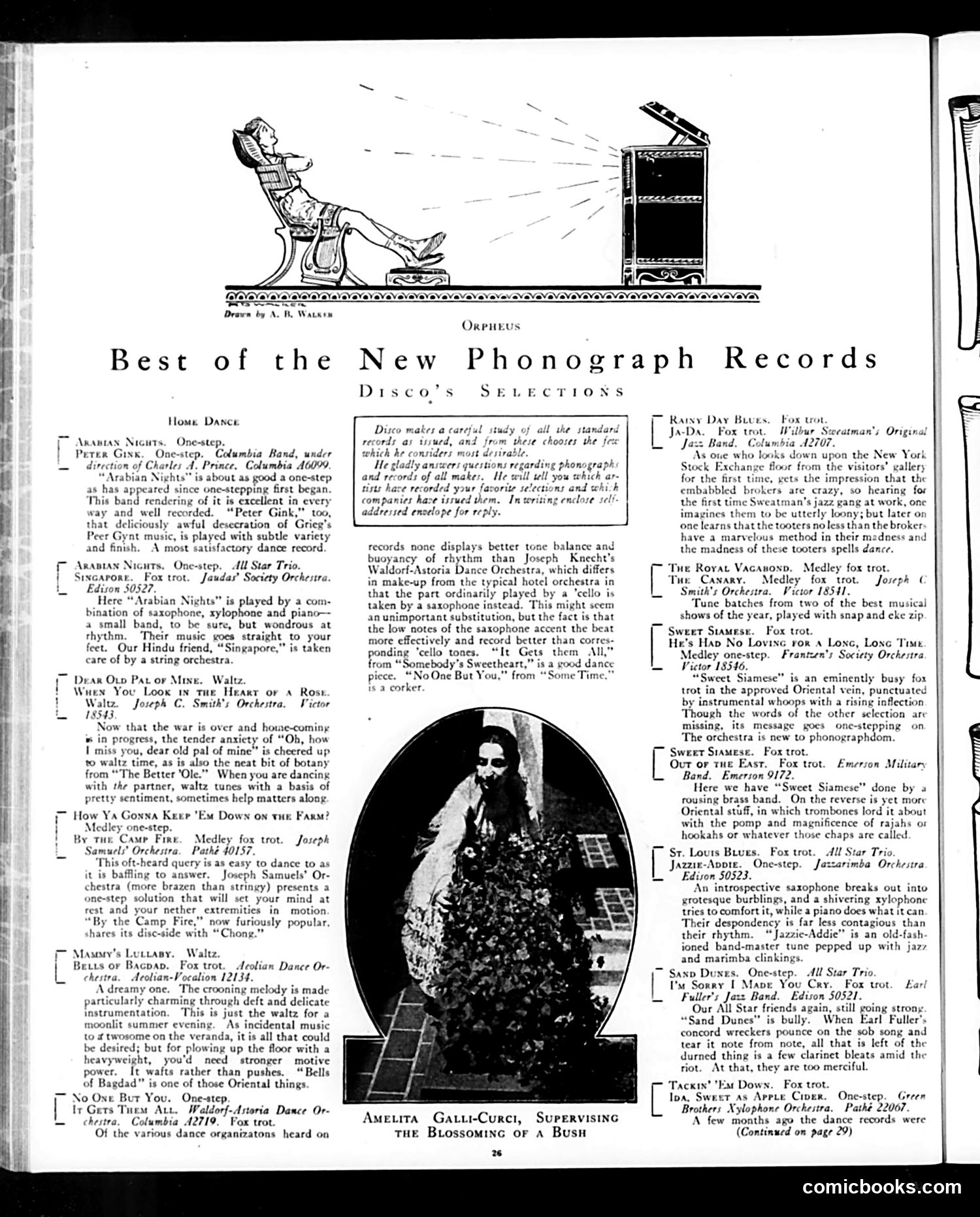
This page is primarily a **record review section** titled "Best of the New Phonograph Records: Disco's Selections," not a political cartoon. The illustrated header showing Orpheus (mythological musician) with a gramophone is decorative branding. The content reviews dance records—one-steps, waltzes, and fox trots—popular in the immediate post-World War I era (references to "now that the war is over and home-coming is in progress"). The reviews discuss orchestras like the Waldorf-Astoria Dance Orchestra and note technical details like saxophone versus cello instrumentation. The photograph shows **Amelita Galli-Curci**, a celebrated opera singer, "supervising the blossoming of a bush"—likely an amusing caption that's part of the magazine's humor content rather than satire. This page reflects early 1920s popular entertainment: phonograph records were cutting-edge technology, and dance music was a major commercial product. The reviews indicate what was considered acceptable home entertainment for middle-class Americans.
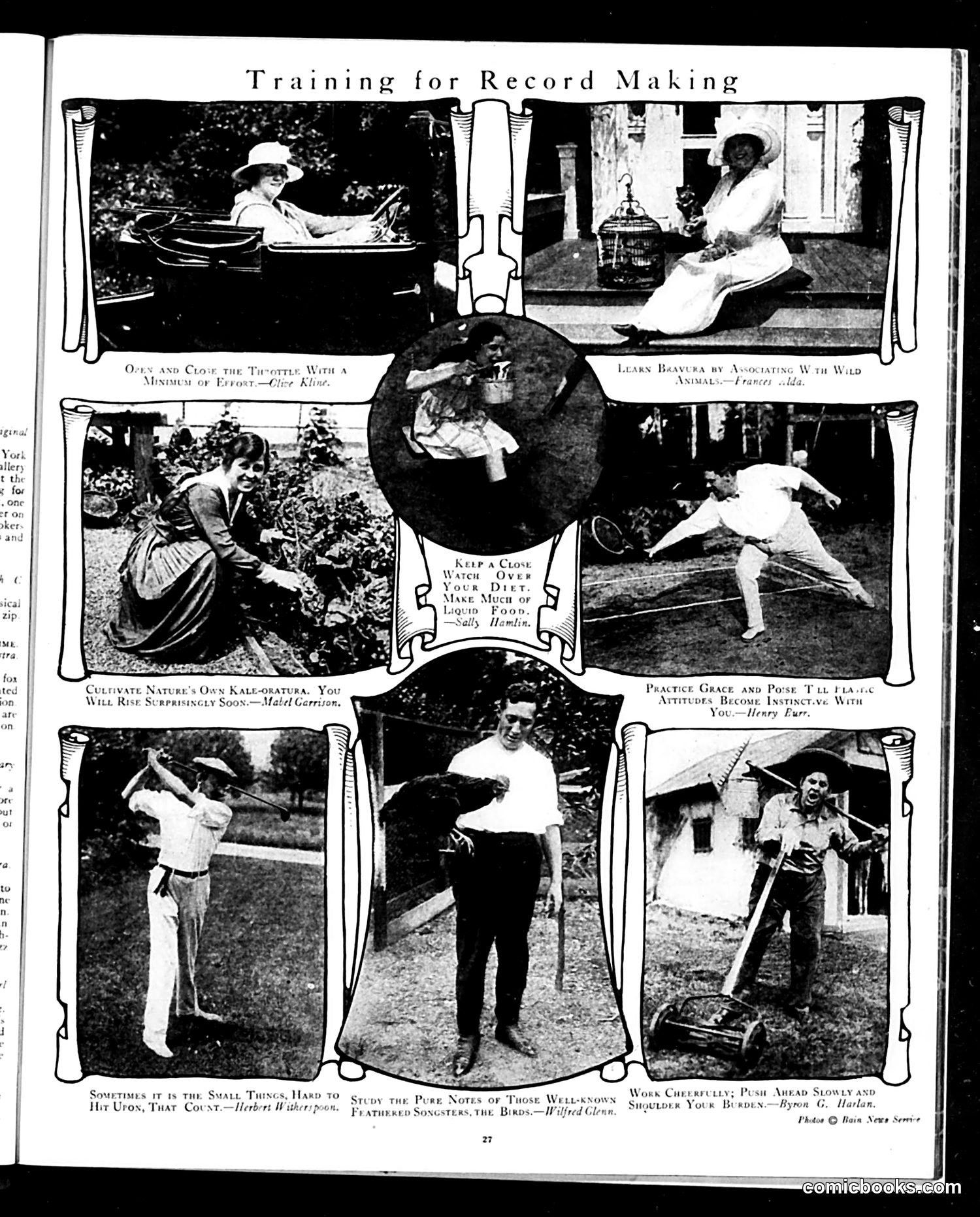
This page satirizes women's athletic training through humorous photographic vignettes with comedic captions. The content depicts various training activities—operating a throttle, associating with wild animals, cultivating vegetables, practicing gymnastics, and performing athletic movements—presented as earnest preparation for breaking records. The satire targets early 20th-century women's athletics, likely mocking both the novelty of female competitive sports and the pseudo-scientific training advice circulating at the time. Captions by apparent contributors (Olive Kline, Sally Hamlin, Mabel Garrison, etc.) offer absurd instruction: studying bird songs, maintaining diet vigilance, and developing "instinctive" grace. The humor derives from presenting ridiculous, unrelated activities as legitimate athletic preparation, satirizing the era's uncertainty about women's sports training and perhaps gender assumptions about female athleticism itself.
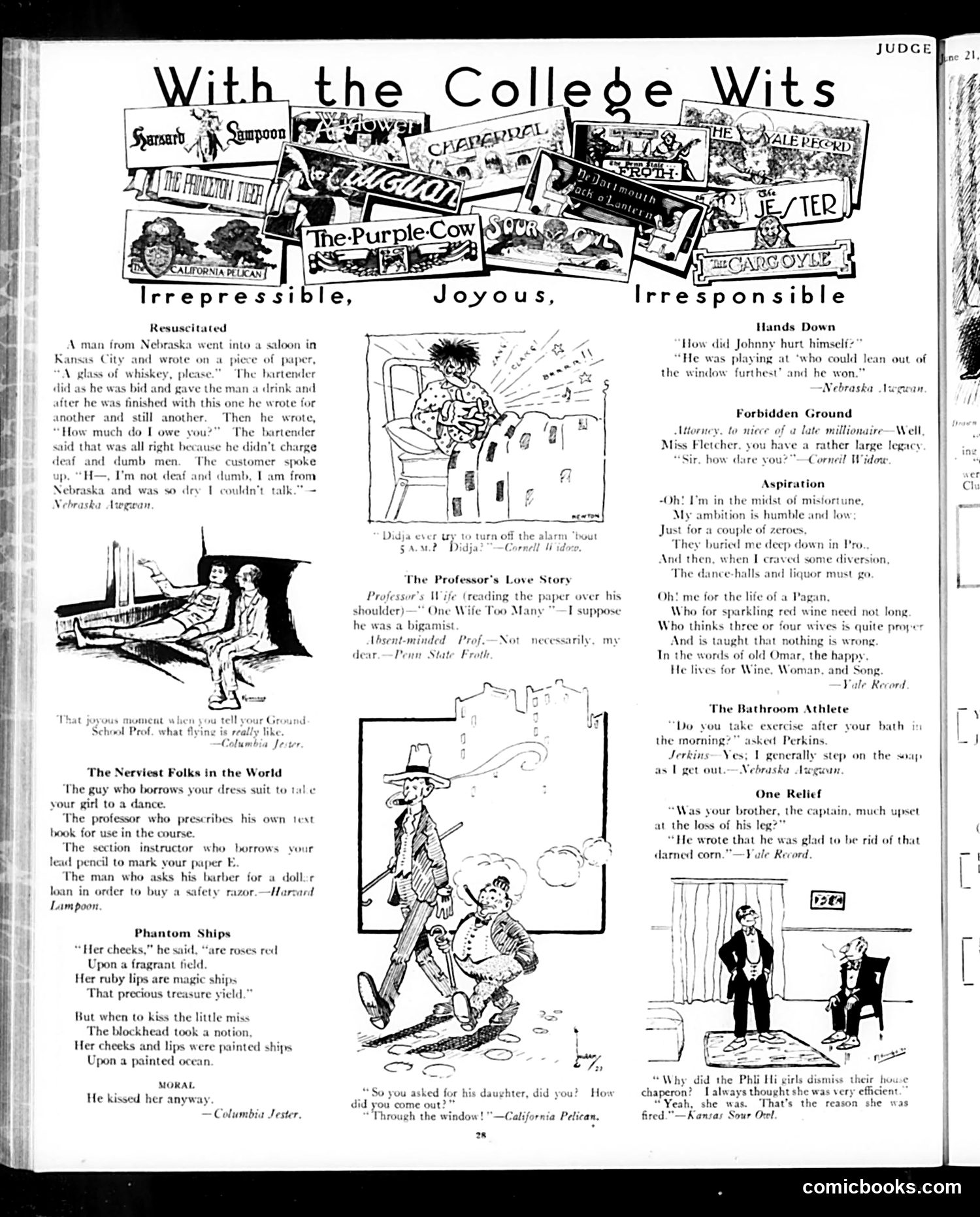
This is a humor compilation page featuring short jokes and cartoons attributed to various college publications (Nebraska, Harvard, Yale, Columbia, etc.). The content reflects early 20th-century college humor conventions: **Key themes:** - **Deaf-mute saloon joke**: Plays on stereotypes about non-verbal communication and Nebraska regional humor - **Professor's Love Story**: Satirizes academic absent-mindedness and bigamy (the professor dismisses his own textbook as biased) - **College stereotypes**: Nervy behavior (borrowing dress suits, money) and bathroom exercise jokes typical of college publications - **Romance mockery**: "Phantom Ships" parodies flowery romantic poetry with crude punchlines about painted faces **The satire's point**: These pages mock college life—professorial pretension, student financial desperation, athletic vanity, and earnest romantic posturing. The humor is broad, sometimes cruel, and relies on physical comedy and sexual innuendo rather than sophisticated wit.
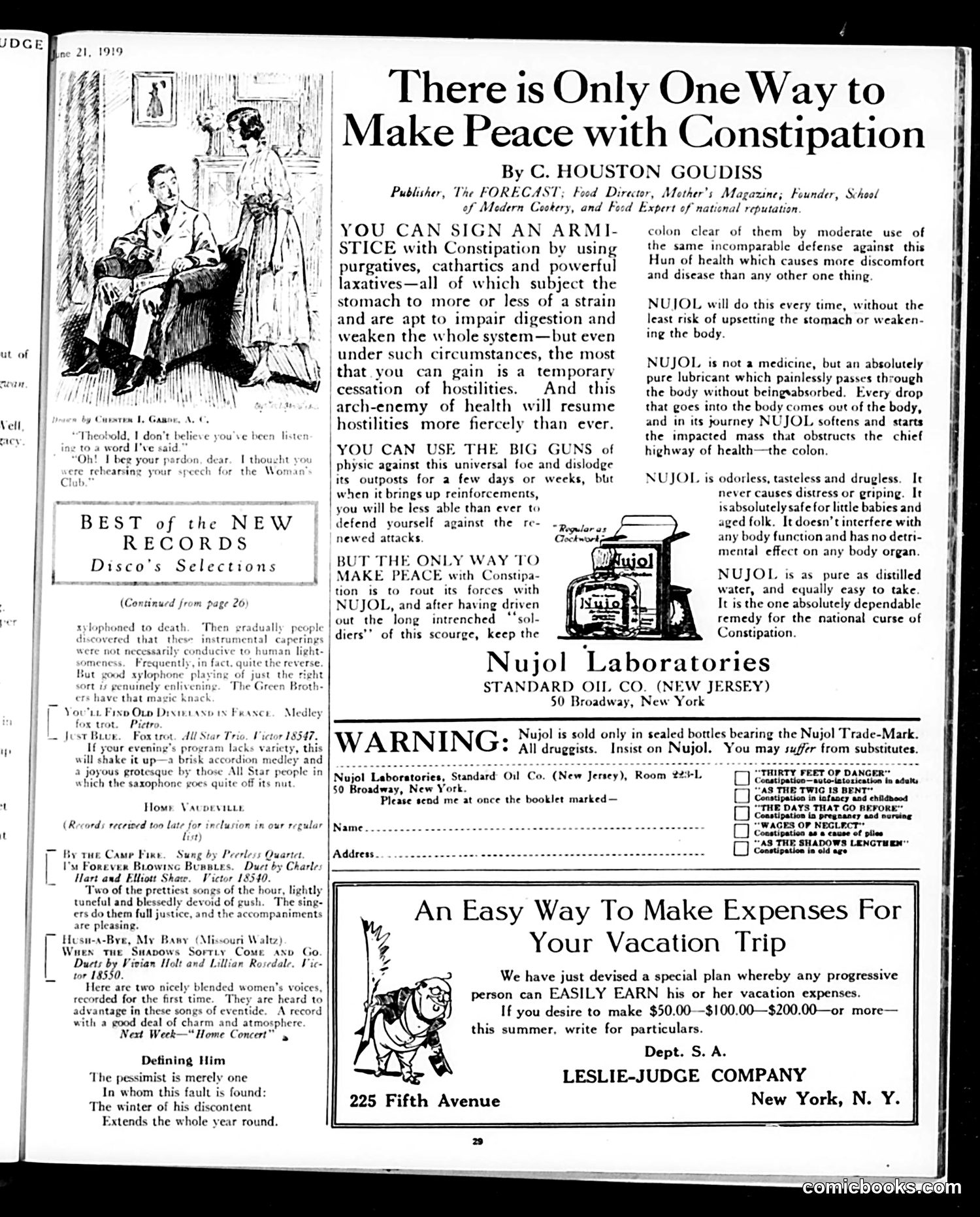
This page is primarily **advertising content** disguised as editorial material. The dominant feature is a full-page advertisement for "Nujol," a mineral oil laxative marketed by Standard Oil Company. **The Main Advertisement:** The headline uses military/war metaphor—"Make Peace with Constipation"—comparing digestive problems to armed conflict. Written by C. Houston Goudiss (a real food expert of the era), it argues that harsh purgatives and cathartics only provide temporary relief, whereas Nujol works as a pure lubricant that "passes through" the body without absorption. **The Satire/Context:** The war language reflects 1919 post-WWI sensibilities. The ad positions Nujol as superior to aggressive treatments, using the period's obsession with "scientific" medicine and health products. **Secondary Content:** The page includes record reviews ("Best of the New Records"), a brief poem about pessimism, and another advertisement for Leslie-Judge Company's vacation expense plan. The cartoon illustration (upper left) appears decorative—a couple in domestic setting—supporting the health/wellness theme rather than offering political commentary.
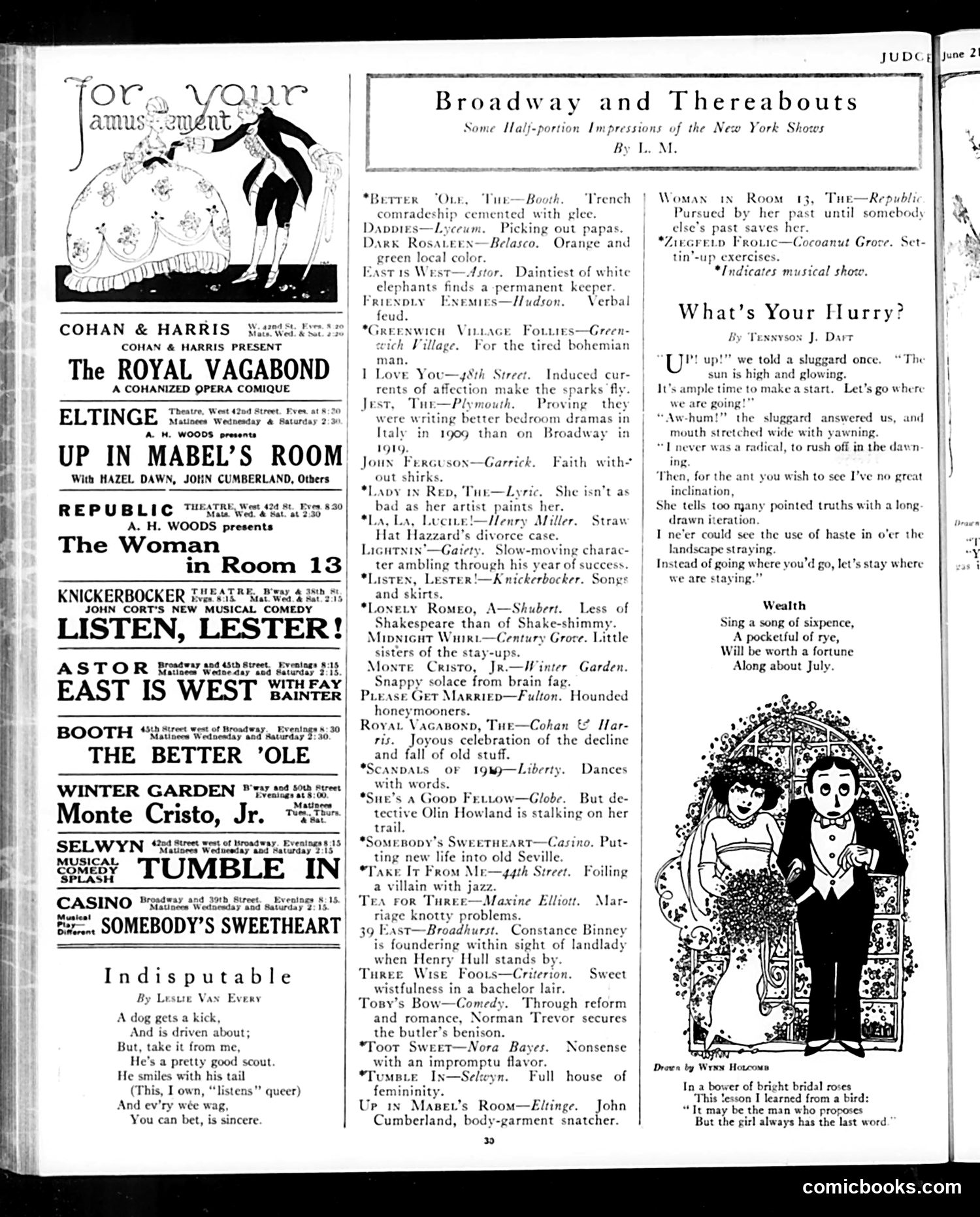
This page is primarily **theater advertisements and reviews** for Broadway shows circa 1919, with minimal political cartoon content. The small cartoon at top-left ("For Your Amusement") shows a stylized figure in silhouette—likely a flapper or fashionable woman—in an art deco style typical of the era. It's decorative rather than satirical. The main content is a **Broadway column** reviewing contemporary theatrical productions with brief, witty descriptions. Notable shows include "The Royal Vagabond," "Listen, Lester!," and "The Woman in Room 13"—typical comedies and musicals of post-WWI New York. The right side includes a short poem "What's Your Hurry?" about a lazy character, and an illustrated marriage announcement with art by Wynn Holcomb. **Context for modern readers:** This reflects 1919 entertainment culture when Broadway dominated American leisure and Judge magazines mixed advertisements with theatrical criticism for an urban, educated audience.
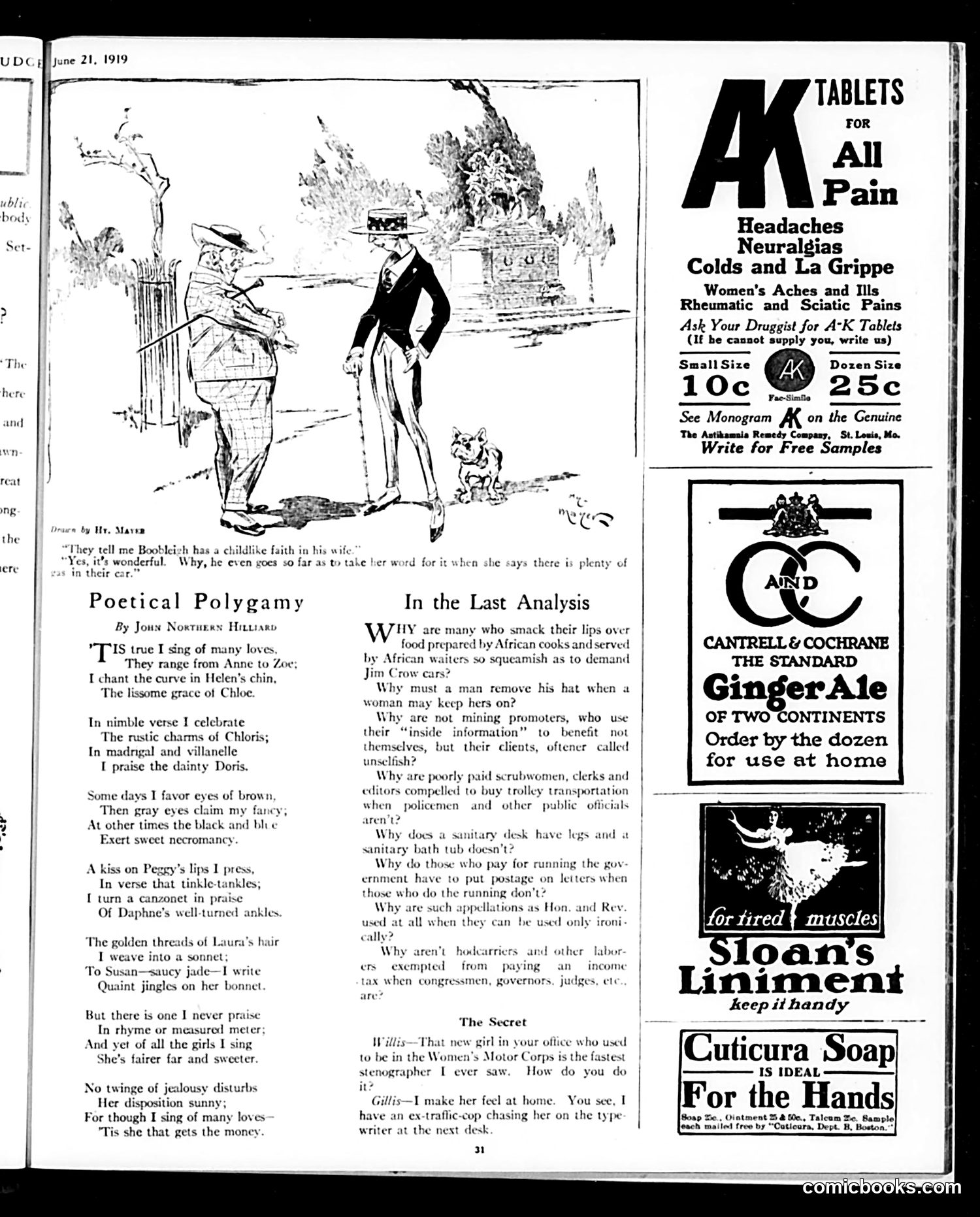
This page mixes humor and social commentary typical of *Judge's* satirical style. **"Poetical Polygamy"** satirizes a poet who writes romantic verses about many women—Helen, Chloe, Peggy, Laura, Susan, and others—but never praises his wife. The joke's punchline reveals his true motive: his wife "gets the money." The satire targets both male infidelity and the hypocrisy of romantic poets who claim artistic passion while their real interest is financial. **"In the Last Analysis"** presents rhetorical questions questioning American social contradictions: Why do people avoid "Jim Crow cars" (segregated rail cars) yet employ Black servants? Why arbitrary gender rules about hat-wearing? Why don't wealthy mine promoters get credit for helping clients? These questions expose systemic inequities and hypocrisies in early 20th-century American life—class divisions, racial segregation, and corruption. **"The Secret"** is a brief office joke about hiring an attractive stenographer by having a fake "ex-traffic cop" chase her on the typewriter to motivate speed. The remainder is period advertising for pain tablets, ginger ale, liniment, and soap.
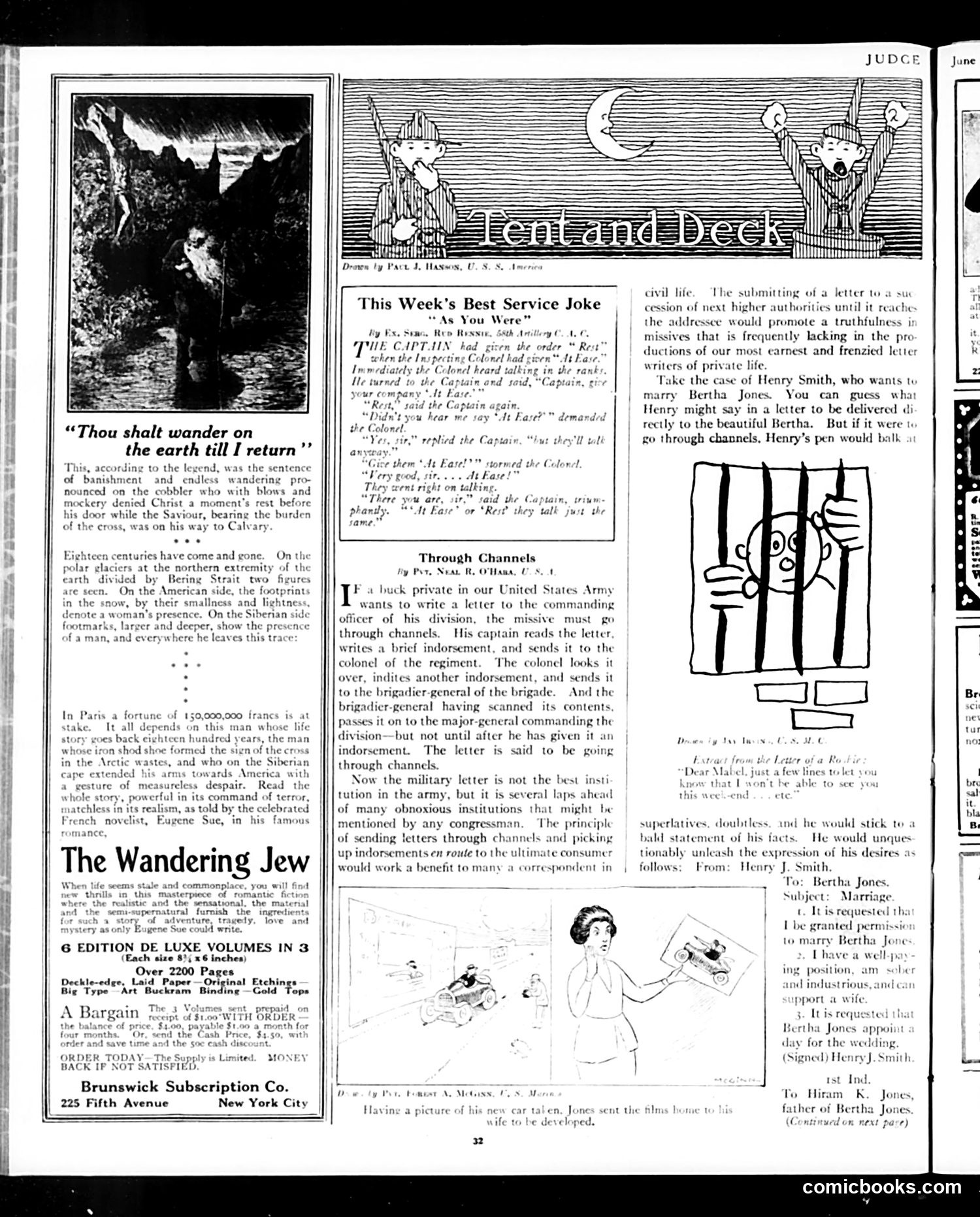
This page contains satirical humor about military bureaucracy and social conventions from the early 20th century. **"Through Channels"** is the main piece—a joke about Army letter-writing protocol. It explains that soldiers must route correspondence through multiple officers (captain, colonel, brigadier-general, major-general), each adding endorsements. The satire suggests this cumbersome system, while tedious, actually improves civilian correspondence by forcing writers to drop romantic exaggeration and stick to facts. The example shows Henry Smith's marriage proposal to Bertha Jones: without channels, it would be flowery nonsense; routed through military hierarchy, it becomes a dry, factual memo requesting permission to marry on a specific date. The humor lies in contrasting military red tape's obvious absurdity with its accidental benefit—imposing honesty on emotionally dishonest letter-writers. The other content includes a service joke about military commands and advertisements for de Luxe volumes and subscriptions. The page satirizes both bureaucratic inefficiency and human tendency toward exaggeration in personal correspondence.
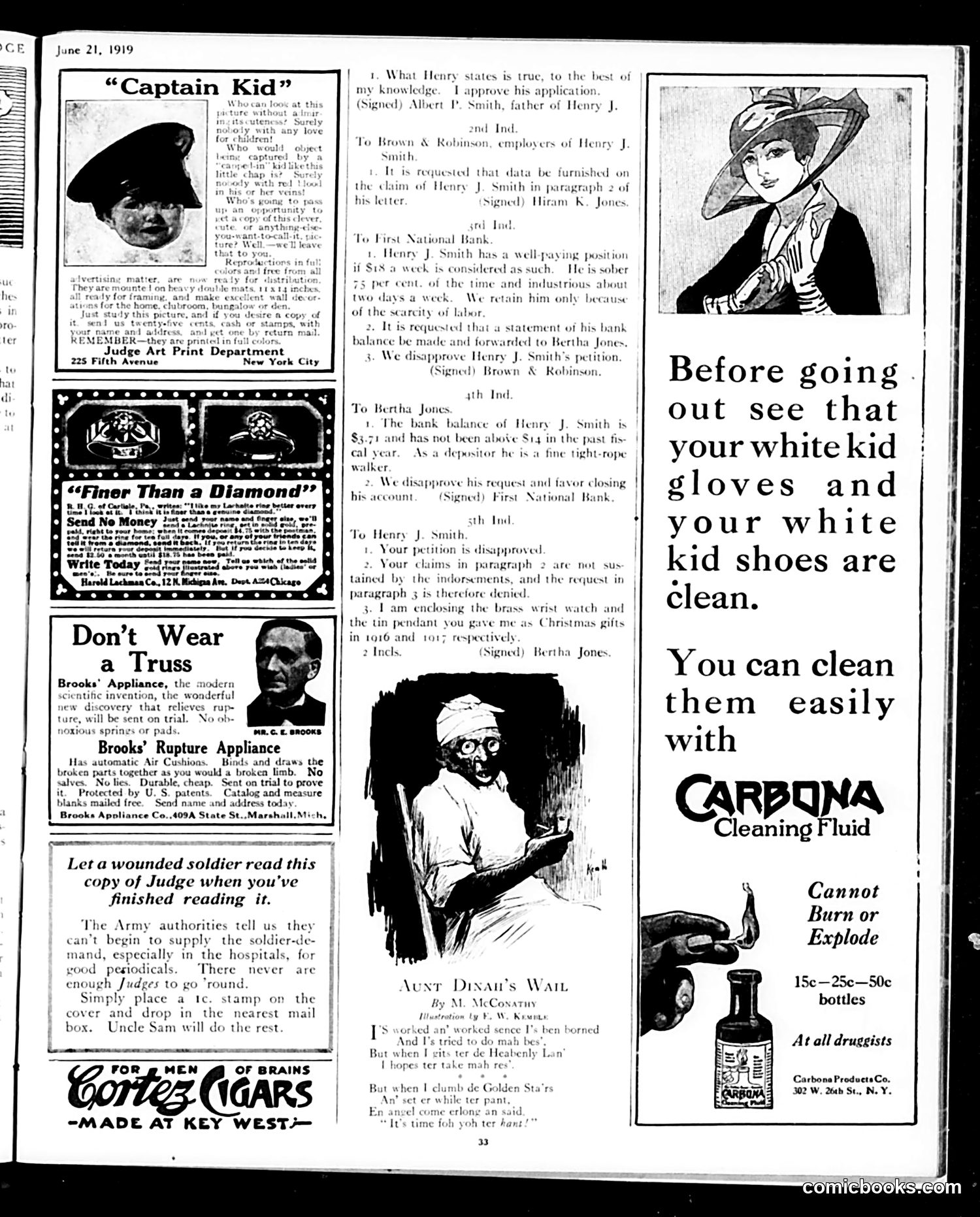
This page satirizes a young man named Henry J. Smith's failed attempt to marry Bertha Jones. The "Captain Kid" cartoon (upper left) shows Smith as an absurdly swaggering figure claiming romantic conquest, captioned with boastful language about winning a girl. The page's central content presents Smith's actual petition for marriage approval, followed by brutally dismissive responses from authority figures—his father, his employers Brown & Robinson, his bank, and finally Bertha Jones herself. Each letter denies his claims or request: his bank balance is questioned, his wages ($18/week) are deemed inadequate, and Bertha flatly refuses, even demanding return of gifts he'd given her in 1916-1917. The satire mocks the gap between Smith's self-aggrandizing "Captain Kid" persona and his actual inability to win approval or affection—a commentary on working-class aspiration and romantic delusion in post-WWI America.
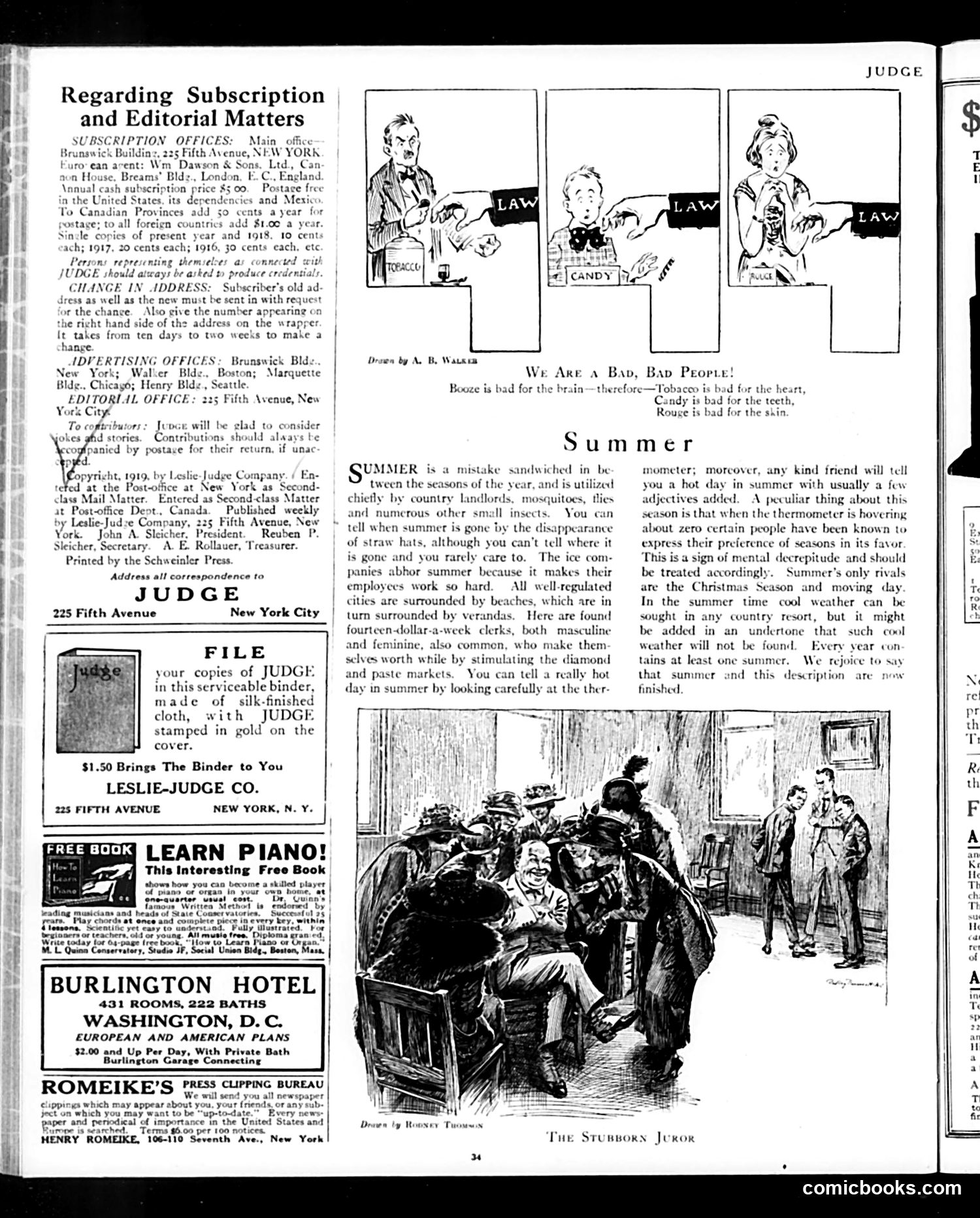
This page contains two distinct elements: **"The Stubborn Juror"** (bottom illustration by Homer Davenport): A courtroom scene depicting a juror resisting pressure from other jurors during deliberations. The image shows multiple figures crowding around a single stubborn figure, likely satirizing jury dynamics—specifically how one holdout juror can resist the collective will of the jury box. This reflects contemporary concern about jury integrity and the challenge of reaching unanimous verdicts. **"Summer" Editorial**: The top section offers satirical commentary on the American summer season, mocking it as a mistake between seasons that benefits only mosquitoes and landlords. The piece ridicules summer's heat, the gap between poor clerks and wealthy vacationers at beaches, and the illogical human preference for summer. The absurdist closing—"We rejoice to say that summer and this description are now finished"—suggests the piece was published in late summer or early fall. The page is primarily advertisement and editorial content, dated 1919.
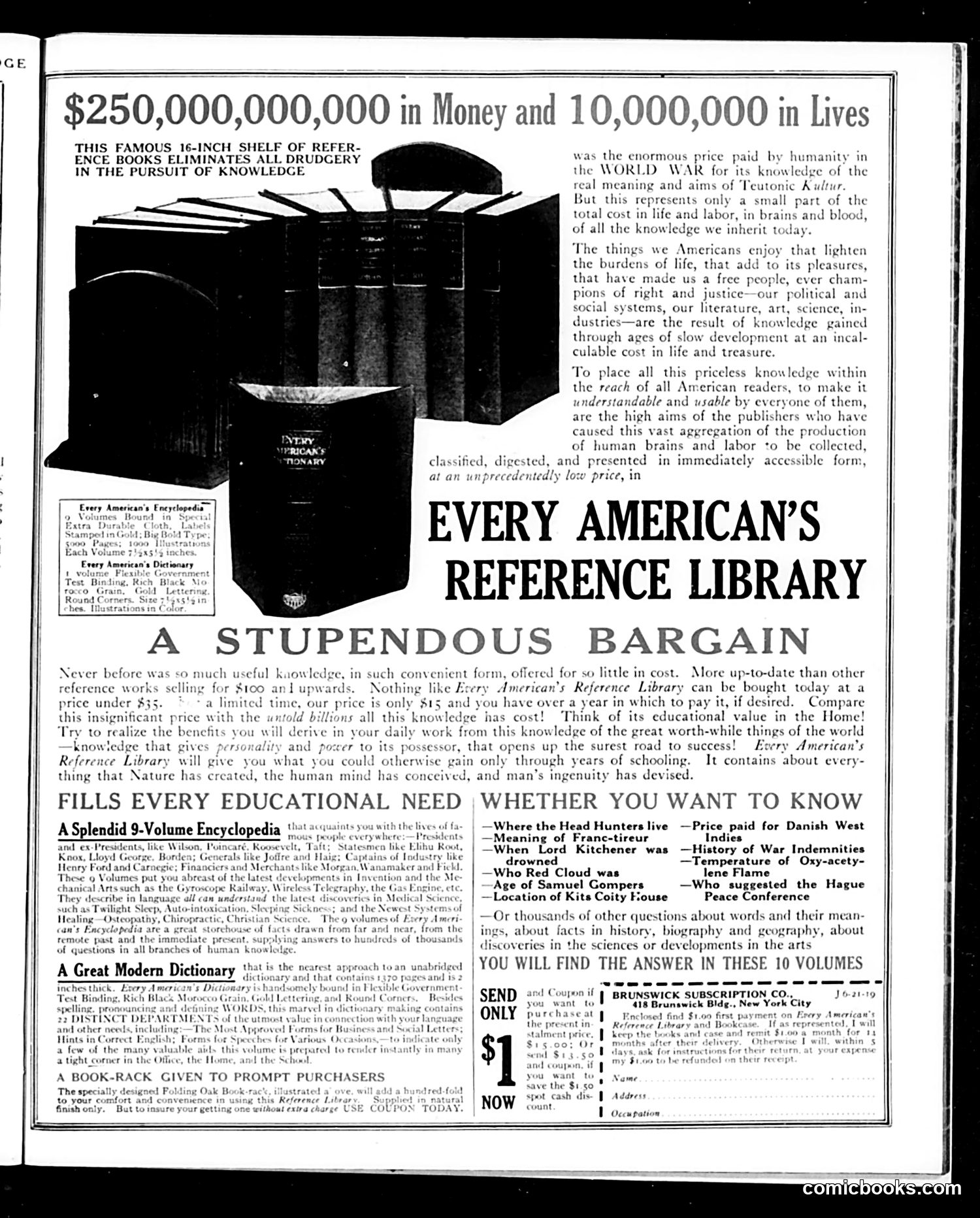
This is primarily a **full-page advertisement** for "Every American's Reference Library"—a 10-volume encyclopedia set marketed as an affordable alternative to expensive reference works. ## Key Rhetorical Strategy The ad opens with a vivid reference to **World War I** ("the WORLD WAR"), framing knowledge acquisition as patriotic duty. It argues that Americans' freedoms and achievements stem from accumulated knowledge, and that making this knowledge accessible to all citizens is a national imperative. ## The Sales Pitch The advertisement emphasizes: - **Affordability**: $1 down payment (under $15 total), compared to $100+ for competing sets - **Comprehensiveness**: 9-volume encyclopedia covering history, biography, science, invention - **Practical utility**: Answers everyday questions about obscure facts The sample questions listed (ranging from Native American history to chemical processes) suggest the set's broad scope aimed at the "average American" reader. ## Context This appears designed for post-WWI American readers seeking self-improvement and practical knowledge—reflecting 1920s-era optimism about democratizing education through affordable publishing.
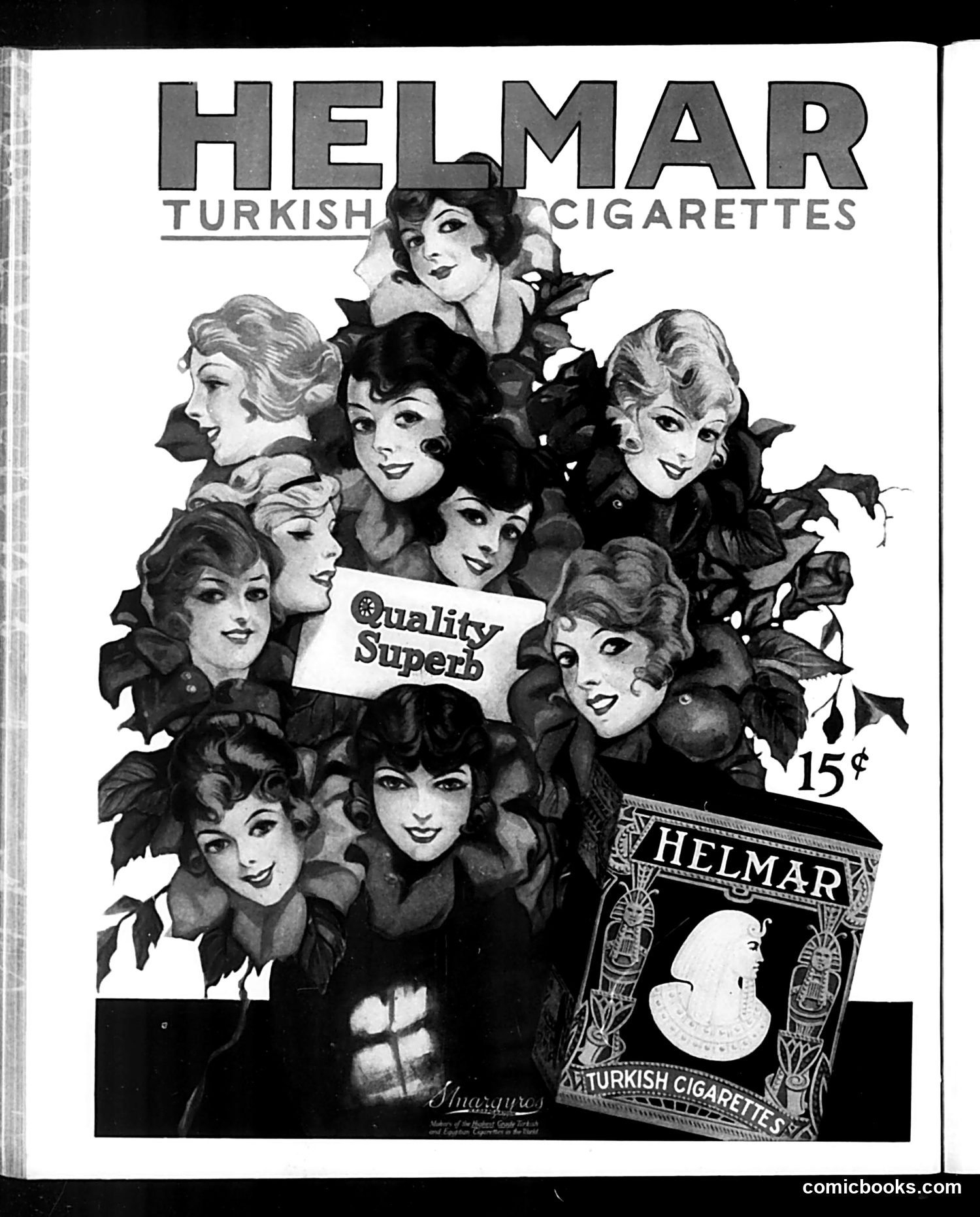
This is a **cigarette advertisement**, not a political cartoon. It promotes Helmar Turkish Cigarettes, priced at 15¢ per pack. The ad features approximately a dozen stylized female faces arranged in an decorative composition, representing idealized "Quality Superb" women of the era. The faces display 1920s-30s styling—bobbed hair, makeup, and fashionable clothing typical of the flapper period. The accompanying cigarette package shown displays a classical profile of a woman, reinforcing the product's aspirational marketing toward female consumers. This reflects an era when cigarette advertising increasingly targeted women, particularly through associations with sophistication, modernity, and glamour. The repeated female imagery served as both decoration and implicit endorsement—the idea that smoking this product aligned with fashionable, attractive femininity.