
Judge, 1919-06-21 · page 10 of 36
Judge — June 21, 1919 — page 10: what you’re looking at
What you’re looking at
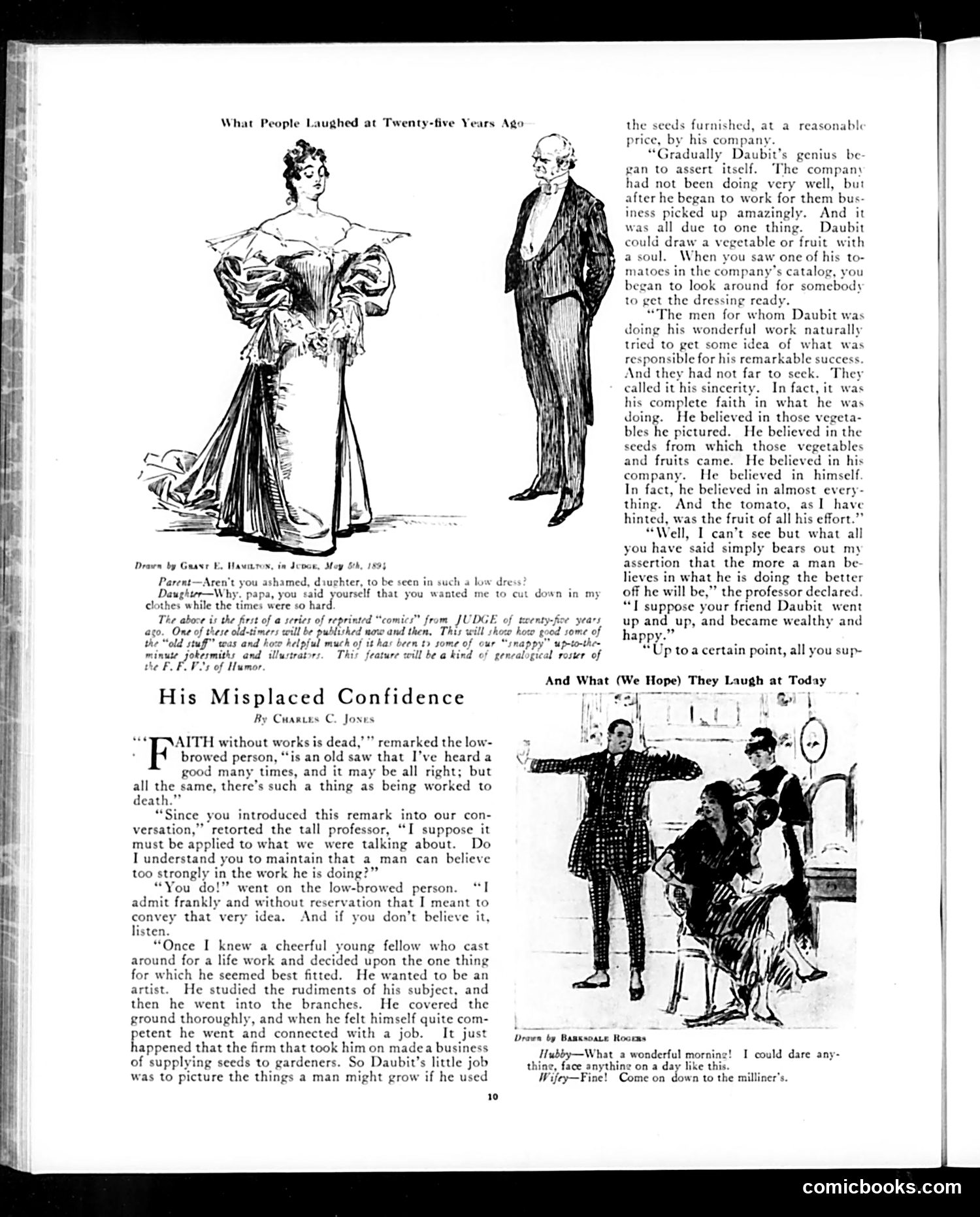
This page contains two separate satirical pieces from *Judge* magazine, separated by roughly 25 years. **Top section ("What People Laughed at Twenty-five Years Ago"):** A 1895 cartoon mocks changing fashion standards. A father complains his daughter wears an immodestly low-cut dress; she responds that *he* told her to economize during hard times. The satire targets hypocrisy—parents demanding daughters dress modestly while simultaneously pressuring them to reduce household expenses, forcing cheaper (and skimpier) clothing choices. **Bottom section ("His Misplaced Confidence"):** A dialogue between a "low-browed person" and an intellectual professor debates whether excessive belief in one's work is harmful. The story of "Daubit," a seed-catalog illustrator whose sincere faith in vegetables made him successful, serves as counterargument—suggesting that unwavering belief in one's work *does* guarantee success. The second section's modern cartoon shows a husband praising the day, while his wife manipulates him into visiting the milliner—satirizing wives exploiting husbands' good moods for shopping.
📄 Transcribed text from this page (OCR, searchable)
Machine-transcribed from the original scan — historical spelling and the odd misread are preserved.
What People Laughed at Twenty-five Years Ago the seeds furnished, at a reasonabl price, by his company. “Gradually Daubit’s genius be gan to assert itself. The company had not been doing very well, but after he began to work for them bus- iness picked up amazingly. And it was all due to one thing. Daubit could draw a vegetable or fruit with a soul. When you saw one of his to- matoes in the company’s catalog, you began to look around for somebody to get the dressing ready. “The men for whom Daubit was doing his wonderful work naturally tried to get some idea of what was responsible for his remarkable success. And they had not far to seck. They } called it his sincerity. In fact, it was his complete faith in what he was doing. He believed in those vegeta- bles he pictured. He believed in the seeds from which those vegetables and fruits came. He believed in his company. He believed in himself In fact, he believed in almost every- thing. And the tomato, as 1 have hinted, was the fruit of all his effort.”” “Well, I can’t see but what all you have said simply bears out my assertion that the more a man be Parent—Aren't you ashamed, daughter, to be seen in such a low dress lieves in what he is doing the better | Daughtrp—Why. papa, you said yourself that you wanted me to cut down in my off he will be,” the professor declared | clothes while the times were so hard. “T suppose your friend Daubit went Drawn by Gaasr E. Hawitton, in depar, Moy Sth, 1895 The aboce is the first of a series of reprinted “comics” from JUDGE ce years up and up, and became wealthy and * ago. One of these old-timers will be published now and then, This some of happy.” i the “old stuff” was and hoz helpful much of it har been t» some 1 “snappy” up-to-thee Bron en . lly minuse jokesmiths and illustrators. This feature will be a kind of genealogical rosuer of Pp toa certain point, all you sup- the FFs of Humor And What (We Hope) They Laugh at Today His Misplaced Confidence Pe ee ; ei | Ry Cuarces C. Joes ste AITH without works is dead,’ remarked the low- browed person, “is an old saw that I’ve heard a good many times, and it may be all right; but all the same, there’s such a thing as being worked to i) death.” “Since you introduced this remark into our con- | versation,” retorted the tall professor, “I suppose it must be applied to what we were talking about. Do I understand you to maintain that a man can believe too strongly in the work he is doing?” “You do!” went on the low-browed person. “I admit frankly and without reservation that I meant to t convey that very idea. And if you don’t believe it, ‘i listen. Hy “Once I knew a cheerful young fellow who cast ' around for a life work and decided upon the one thing i] for which he seemed best fitted. He wanted to be an artist. He studied the rudiments of his subject, and then he went into the branches. He covered the } ground thoroughly, and when he felt himself quite com- petent he went and connected with a job. It just Drews’ty Bimsesicn Roses | happened that the firm that took him on made a business Hubby What a’ woadestol worntag! I could dare anys | of supplying seeds to gardeners. So Daubit’s little job thin Ge snythine on a day like this. ’ was to picture the things a man might grow if he used Wifey—Fine! Come on down to the milliner's. comicbooks.com