
Judge, 1919-06-21 · page 16 of 36
Judge — June 21, 1919 — page 16: what you’re looking at
What you’re looking at
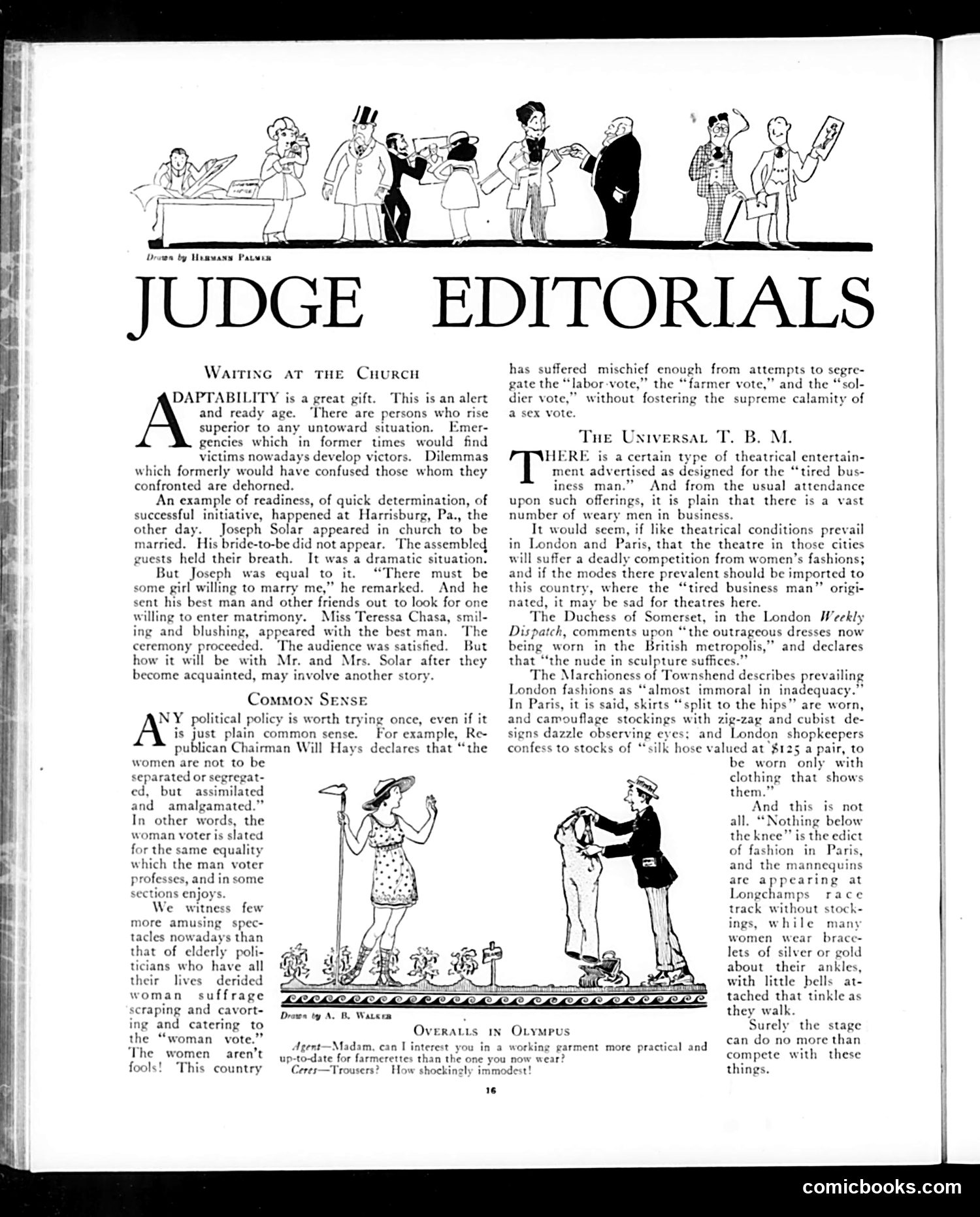
This page contains three satirical editorials with accompanying cartoons, likely from the 1920s based on references to women's suffrage and fashion. **"Waiting at the Church"** mocks a man (Joseph Solar) whose bride doesn't appear at his wedding in Harrisburg, PA—so he simply asks friends to find *any* willing woman to marry instead. The satire targets both his absurd adaptability and the casual nature of marriage. **"Common Sense"** criticizes Republican Chairman Will Hays's claim that women voters should be "assimilated" rather than treated as a separate "sex vote." The editorial sarcastically notes politicians who previously derided women's suffrage now embrace it for electoral purposes. **"The Universal T.B.M."** (Tired Business Man) compares theatrical entertainment to the competition posed by increasingly scandalous women's fashions in London and Paris—featuring hemlines "split to the hips," expensive silk stockings, and ankle bracelets with bells. The accompanying cartoon depicts women in revealing athletic wear, with a vendor hawking "practical" overalls as superior workwear.
📄 Transcribed text from this page (OCR, searchable)
Machine-transcribed from the original scan — historical spelling and the odd misread are preserved.
phat Deven ty Himwany Patwun JUDGE EDITORIALS Wartinc aT THE CuuRcH DAPTABILITY is a great gift. This is an alert and ready age. ‘There are persons who rise superior to any untoward situation. Emer- gencies which in former times would find victims nowadays develop victors. Dilemmas which formerly would have confused those whom they confronted are dehorned. An example of readiness, of quick determination, of successful initiative, happened at Harrisburg, Pa., the other day. Joseph Solar appeared in church to be married. His bride-to-be did not appear. “The assembled, guests held their breath. It was a dramatic situation. But Joseph was equal to it. here must be some girl willing to marry me,” he remarked. And he sent his best man and other friends out to look for one willing to enter matrimony. Miss Teressa Chasa, smil- ing and blushing, appeared with the best man. The ceremony proceeded. The audience was satisfied. But how it will be with Mr. and Mrs. Solar after they become acquainted, may involve another story. Common S Y political policy is worth trying once, even if it A is just plain common sense. For example, Re publican Chairman Will Hays declares that “the women are not to be separated or segregat- ed, but assimilated and amalgamated.” In other words, the woman voter is slated for the same equality which the man voter professes, and in some sections enjoys. We witness few more amusing spec- tacles nowadays than that of elderly poli- ticians who have all their lives derided has suffered mischief enough from attempts to segre- gate the “labor-vote,” the “farmer vote,” and the “sol- dier vote,” without fostering the supreme calamity of a sex vote. Tue Universat B. HERE is a certain type of theatrical entertain- ment advertised as designed for the “tired bus- iness man.” And from the usual attendance upon such offerings, it is plain that there is a vast number of weary men in business. It would seem, if like theatrical conditions prevail in London and Paris, that the theatre in those cities will suffer a deadly competition from women’s fashions; and if the modes there prevalent should be imported to this country, where the “tired business man” origi- nated, it may be sad for theatres here. The Duchess of Somerset, in the London Weekly Dispatch, comments upon ‘the outrageous dresses now being worn in the British metropolis,” and declares that “the nude in sculpture suffices.” The Marchioness of Townshend describes prevailing London fashions as most immoral in inadequacy.” In Paris, it is said, skirts “split to the hips” are worn, and camouflage stockings with zig-zag and cubist de- signs dazzle observing eves; and London shopkeepers confess to stocks of “silk hose valued at $125 a pair, to be worn only with > clothing that shows IR them.” And this is not all. “Nothing below the knee” is the edict of fashion in Paris, and the mannequins are appearing at Longchamps race track without stock- ings, while many women wear brace- lets of silver or gold about their ankles, with little bells at- woman suffrage scraping and cavort- ing and catering to the “woman vote.” The women aren't up-to-date for farm fools! This country Ceres—Trousers Drows ty A.B. Wateen ; Overatts rettes than the How shockingly in Otympus Agent—Madam, can I interest you in a working garment more practical and you now wear? : modest! things. tached that tinkle as they walk. Surely the stage can do no more than compete with these comicbooks.com