
A complete issue · 36 pages · 1919
Judge — March 15, 1919
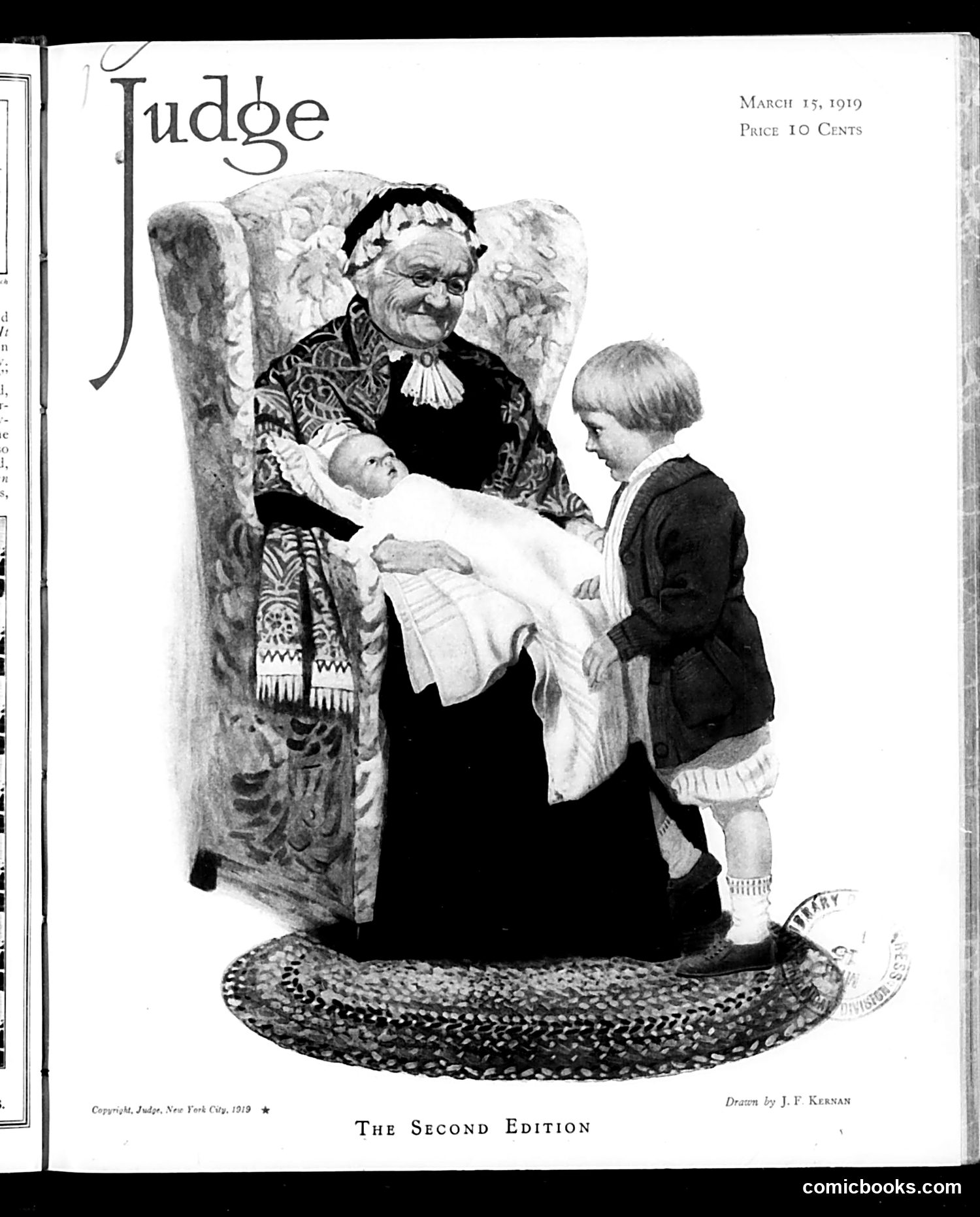
This cartoon depicts an elderly woman holding a newborn infant while a young boy watches. The title "The Second Edition" suggests a satirical commentary on reproduction or legacy. Given the 1919 date (immediately post-World War I), this likely references the anticipated "second generation" following the war—either mocking concerns about population recovery, or more probably, making a joke about society repeating its mistakes. The woman's wrinkled appearance contrasted with the infant may emphasize cyclical nature of human folly. The ornate chair and formal domestic setting suggest middle or upper-class context. The artist is credited as J.F. Kernan. Without additional caption text visible, the exact satirical target remains somewhat unclear, though post-war social commentary is evident.
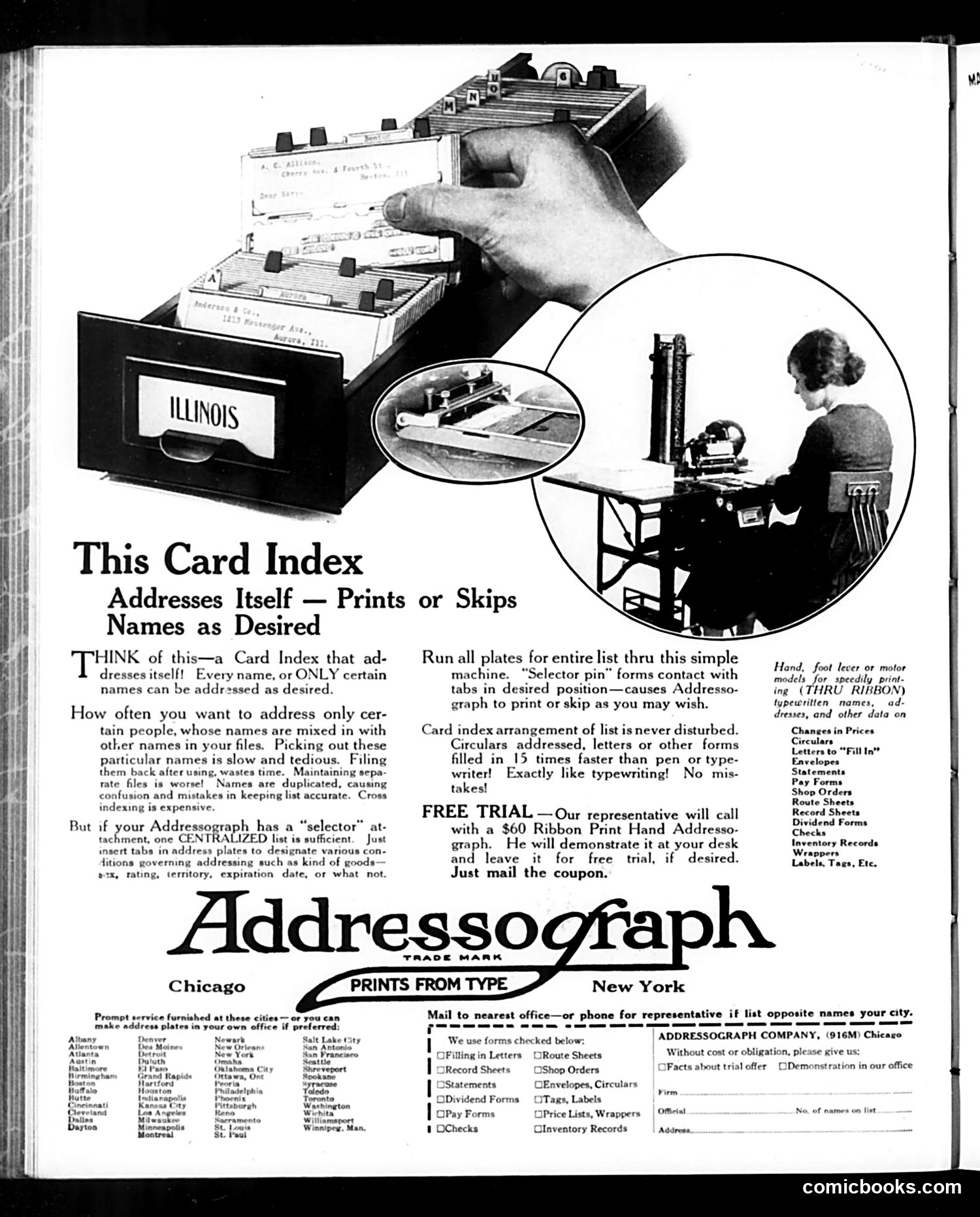
This page is **not a political cartoon but a business advertisement** for the Addressograph Company, headquartered in Chicago and New York. The ad promotes an automated card-index and addressing machine designed for businesses. The main image shows the Illinois model with stacked address cards and a hand inserting a plate. A circular inset depicts a woman operating the machine at a desk. The advertisement emphasizes the machine's efficiency: it can selectively print or skip addresses as desired, addressing multiple names without manual filing delays. The copy highlights time-saving benefits for businesses handling large mailing lists. A "free trial" coupon is included, and the bottom section lists cities where prompt service is available. This is straightforward early 20th-century business-to-business marketing.
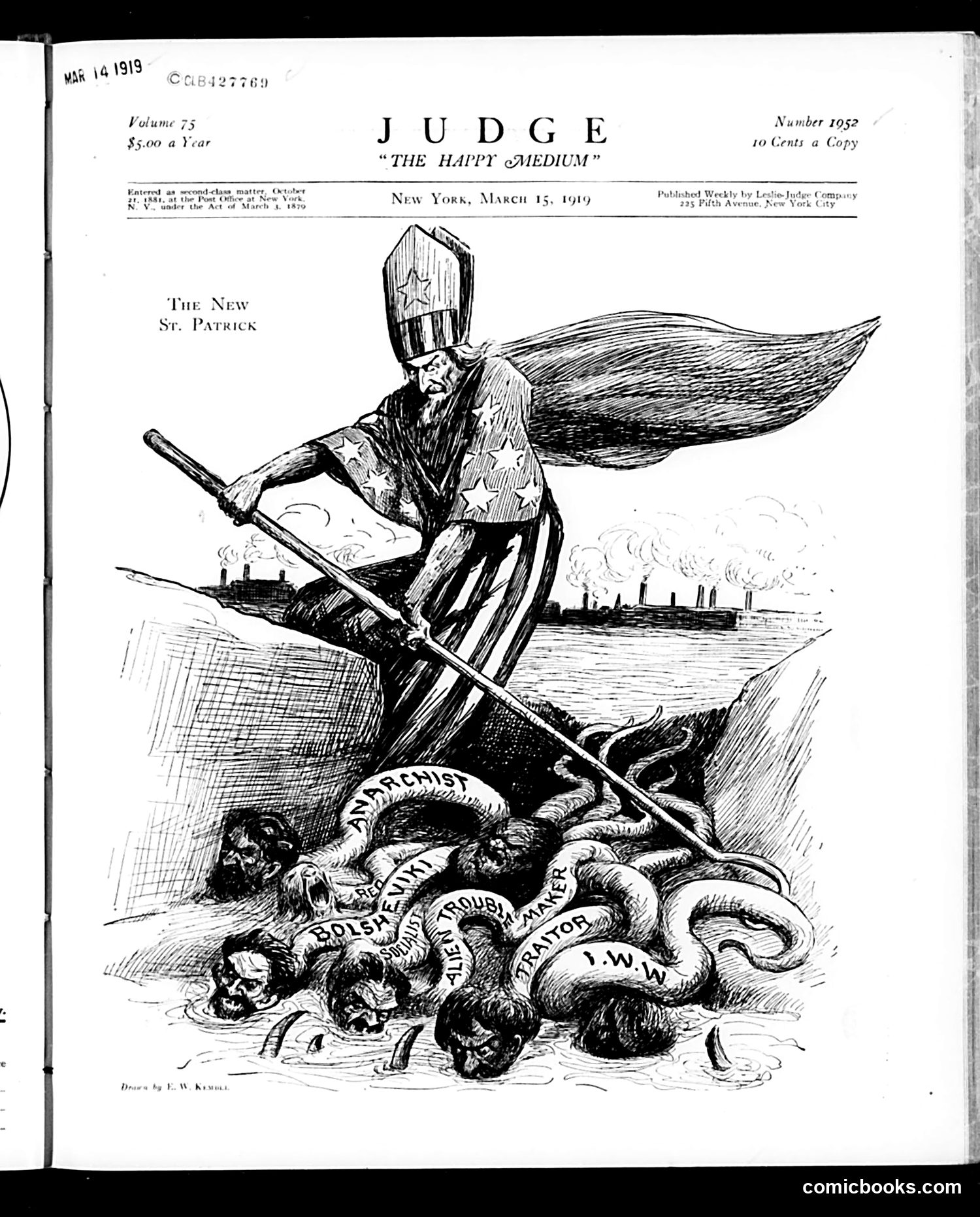
**Publication:** Judge magazine, March 15, 1919 **The Image:** A figure dressed as St. Patrick (with bishop's mitre and stars-and-stripes cape) wields a staff, striking at a writhing mass of snakes labeled with names including "Bolshevism," "I.W.W." (Industrial Workers of the World), and what appears to be "Anarchy" and "Syndicalism." Industrial smokestacks line the background. **The Satire:** This is anti-radical propaganda from the post-WWI "Red Scare" period (1919-1920). The cartoon presents American patriotism as a modern St. Patrick "driving out snakes"—here representing socialist, communist, and anarchist movements perceived as threatening American society. The Irish saint reference likely plays on St. Patrick's Day timing, while the industrial setting emphasizes labor radicalism as the target. The cartoon advocates aggressive suppression of leftist ideology.
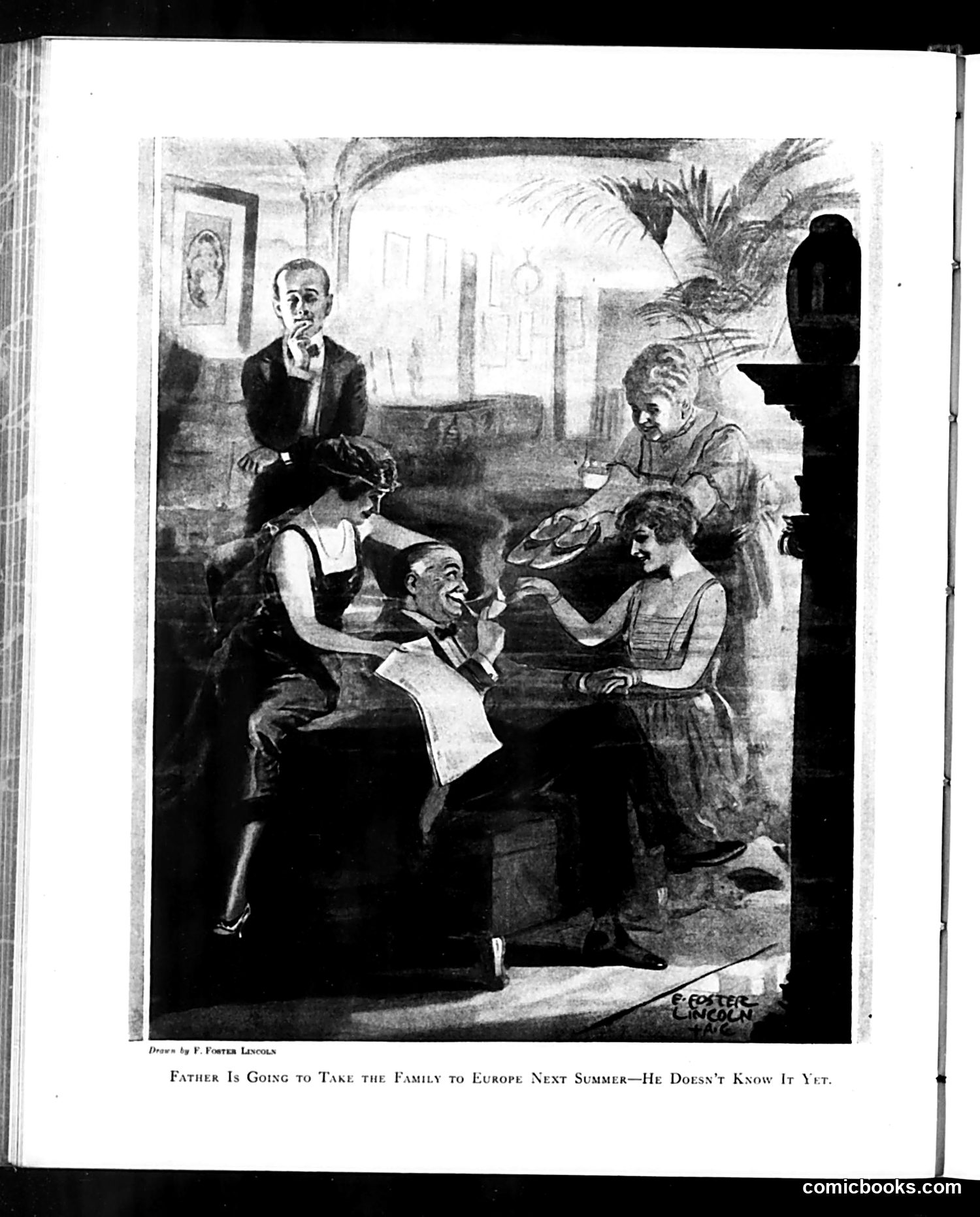
This cartoon by F. Forrest Lincoln depicts a domestic scene where a father announces plans to take his family to Europe the following summer, though he hasn't yet informed them. The humor derives from the gap between the father's secret intention and the family's ignorance—a common comedic scenario about paternal authority and surprise announcements. The satire likely targets early 20th-century affluent Americans' casual attitudes toward expensive European travel. The well-dressed figures in a comfortable interior setting suggest wealth. The joke plays on how fathers would make unilateral decisions about family travel without consultation, and the dramatic irony of the father's confident certainty about something the family doesn't yet know. This reflects Judge magazine's typical humor: domestic situations revealing class attitudes and gender dynamics of the era.
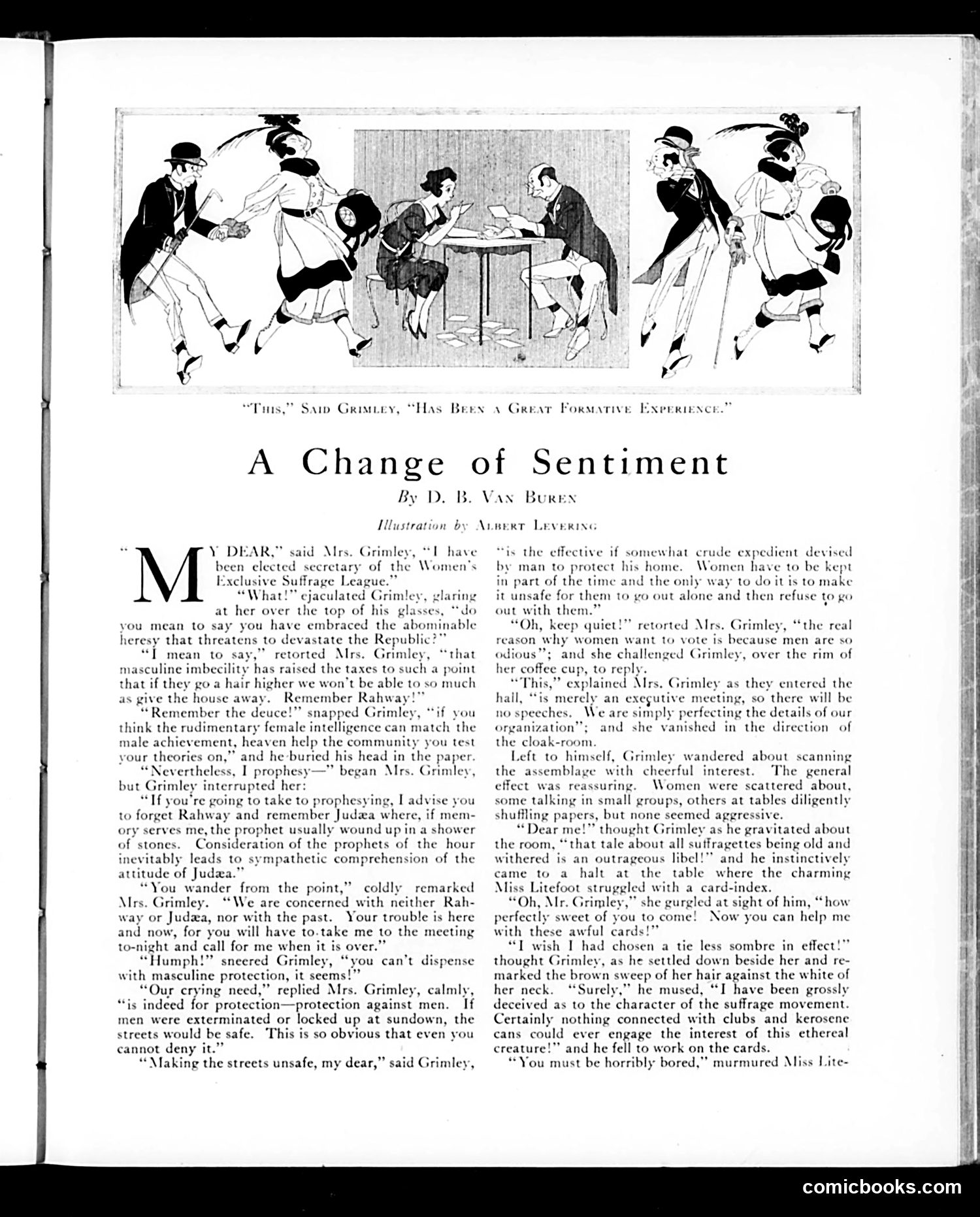
This story by D.B. Van Buren satirizes early 20th-century debates over women's suffrage and social activism. The illustration shows women at what appears to be a Women's Suffrage League meeting. The satire centers on Mr. Grimley's evolving attitude. He initially opposes women's activism, citing protective paternalism ("women have to be kept in part of the time") and concern about street safety. However, after attending the meeting and observing women's "ethereal" interest in card games rather than serious political engagement, he softens—finding them harmless and charming rather than threatening. The joke mocks both suffragists (portrayed as vapid) and anti-suffrage arguments (revealed as patronizing pretexts). It suggests women's political involvement poses no real threat to male authority.
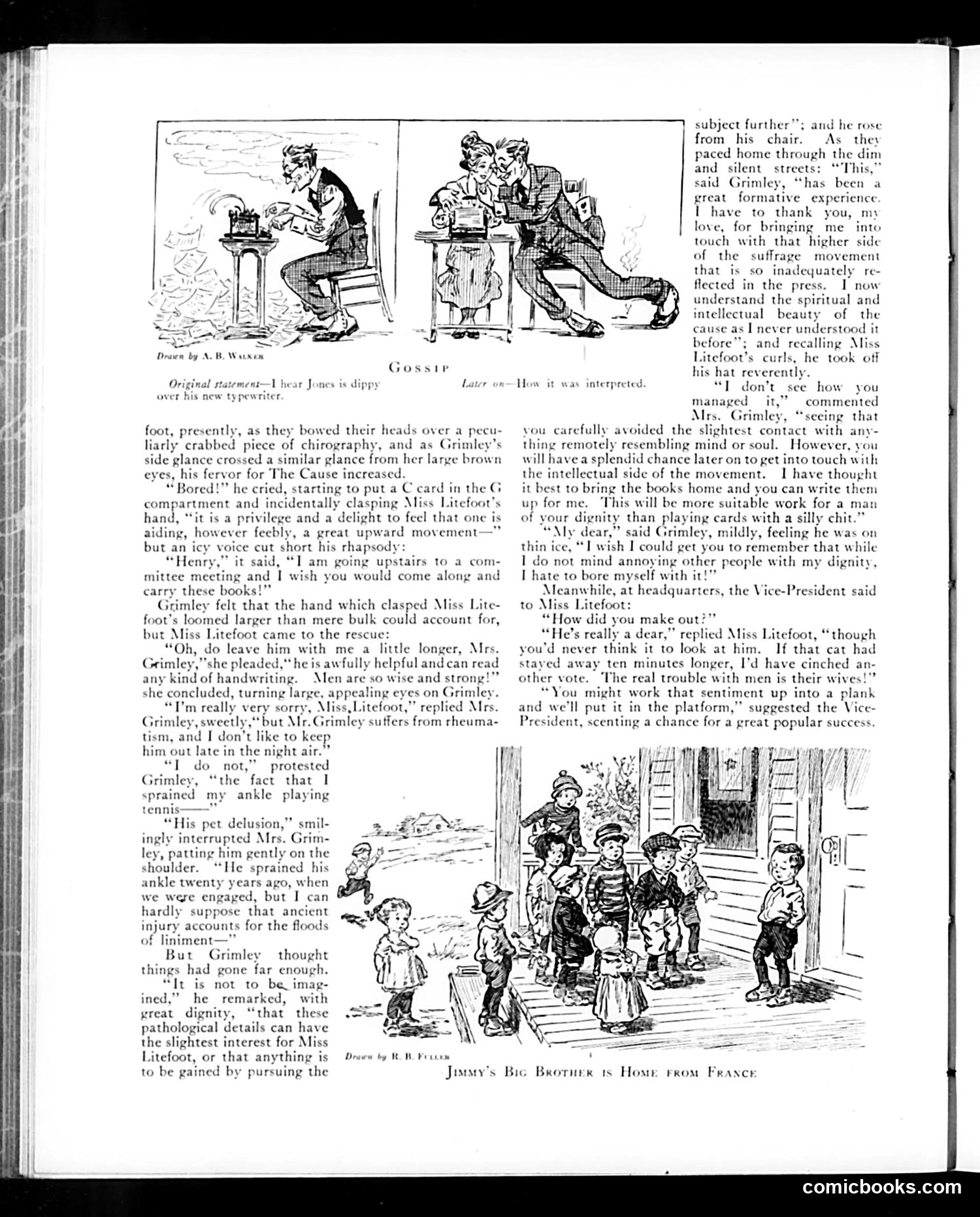
This page contains two cartoon panels and accompanying narrative text satirizing political gossip and communication mishaps. **Top cartoons** ("Gossip"): Show a man spreading rumors about Jones's new typewriter (left), then how those rumors were misinterpreted through retelling (right)—a visual metaphor for how information distorts as it spreads. **Main narrative**: Characters named Grimley and Miss Litefoot discuss a pressing issue. Grimley advocates bringing Miss Litefoot into contact with "higher" intellectual movements, while she resists, fearing loss of dignity. The Vice-President's comments about wives causing trouble suggests this relates to women's political participation—likely the suffrage debate of the early 1900s. **Bottom cartoon** ("Jimmy's Big Brother is Home from France"): Depicts children welcoming a soldier returning from World War I, suggesting post-war social reintegration themes.
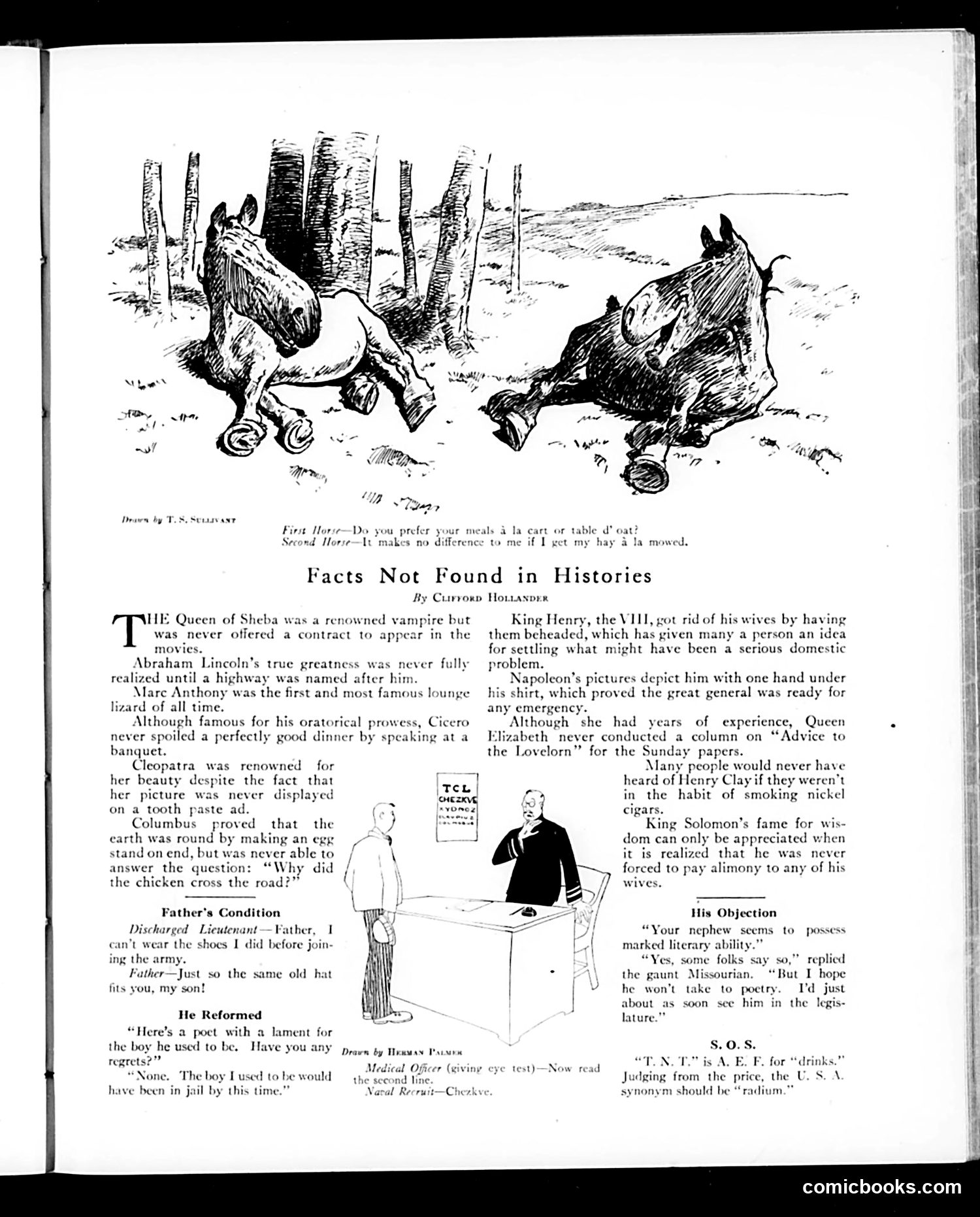
This page presents humorous "alternative facts" about famous historical figures, mocking both popular misconceptions and modern absurdities. The column by Clifford Hollander uses anachronistic jokes—attributing modern inventions or concerns to historical figures who couldn't have experienced them. Examples include: the Queen of Sheba never appeared in movies; Lincoln's fame came from a highway named after him (not his actual accomplishments); King Henry VIII's wife-beheading is presented as marital advice; Napoleon's hand-in-shirt pose proved military readiness; and King Solomon never paid alimony (implying his polygamy was fortunate). The scattered jokes below mock contemporary issues: a soldier's uniform fit, a reformed boy who'd have been jailed otherwise, and literary ambitions. The "S.O.S." entry jokes that "T.N.T." means "drinks" in military slang, and U.S.A. products are so expensive they should be called "radium." The top cartoon shows two horses discussing meal preferences—likely simple visual humor unrelated to the text.
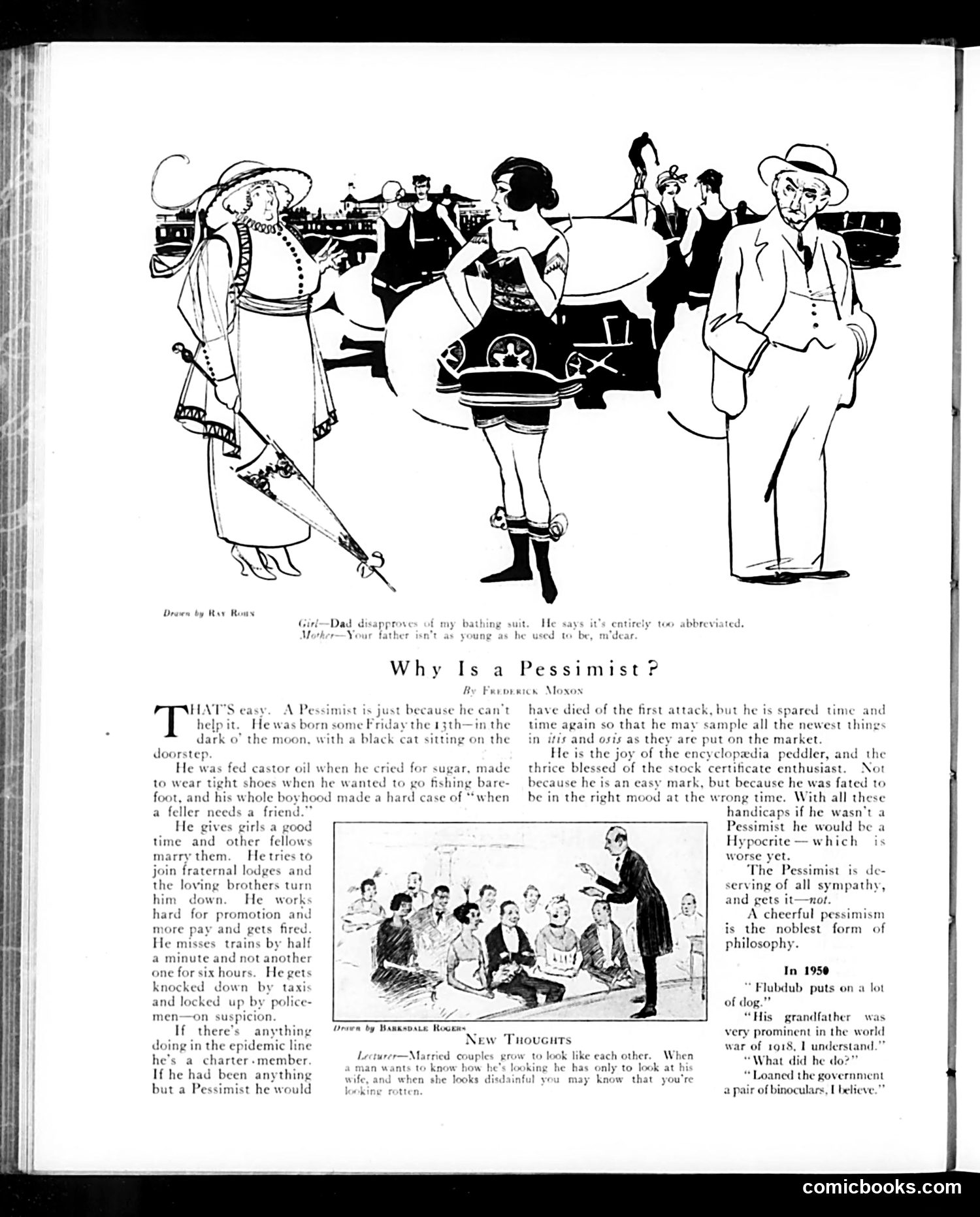
This page satirizes the "Pessimist"—a character type born under unlucky circumstances (Friday the 13th, black cat present) whose entire life consists of misfortune and failed hopes. The humor lies in exaggerating how pessimists attract bad luck: fed castor oil instead of sugar, forced into tight shoes, rejected by fraternal lodges despite efforts to join, fired despite working hard, missing trains by mere minutes. The satire's target is the pessimistic worldview itself—the author argues such people are actually **useful to society** (benefiting encyclopedia and stock-certificate salesmen) and deserve "no sympathy" precisely because they're pessimists. The final ironic point: "A cheerful pessimism is the noblest form of philosophy." The companion cartoon "New Thoughts" humorously depicts married couples growing to resemble each other physically. The 1950 dated examples at bottom appear to be additions or references, somewhat unclear in purpose.
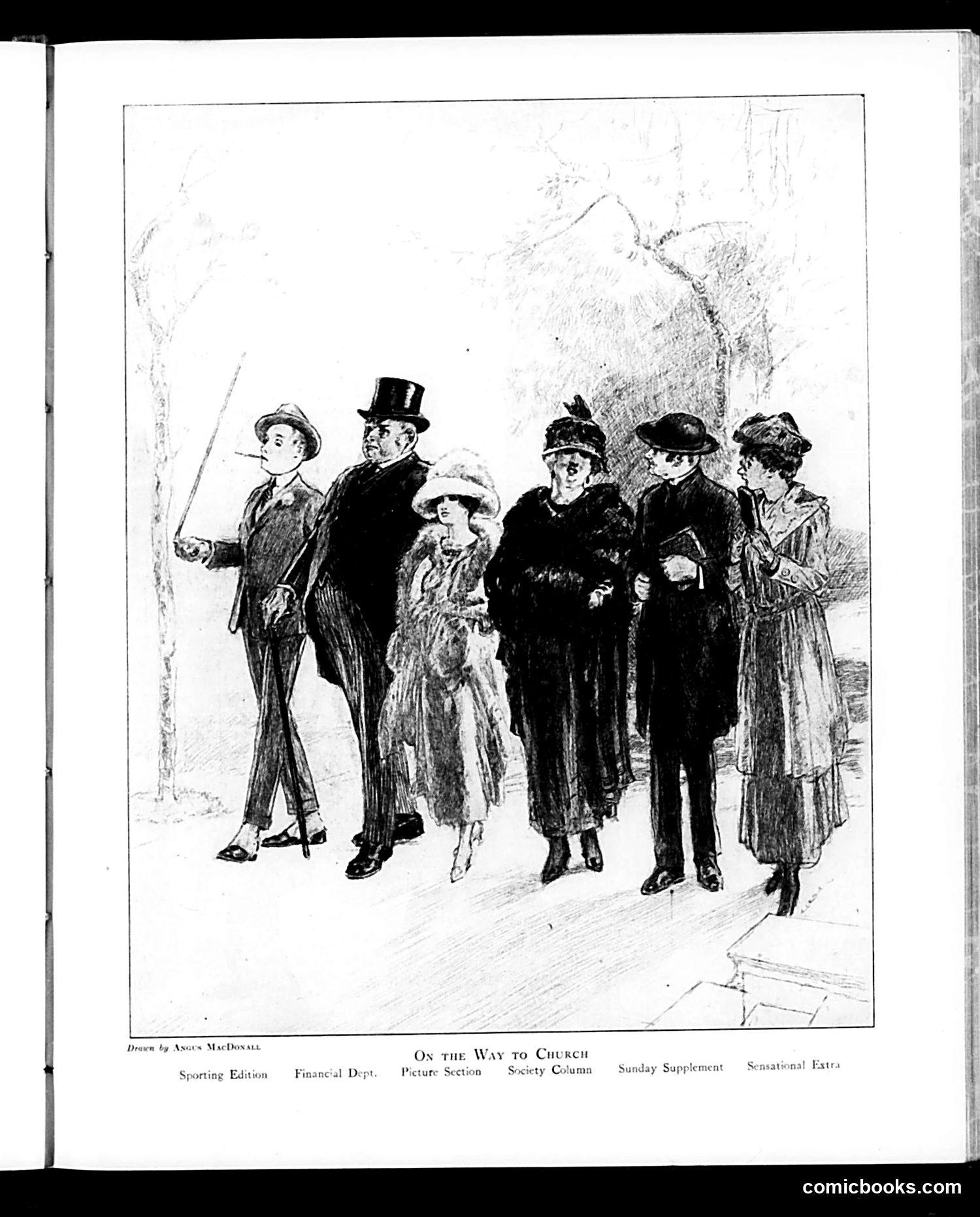
This illustration by Angus Macdonald depicts six well-dressed Edwardian-era figures walking together, apparently en route to Sunday services. The satire likely critiques the gap between public religious observance and private behavior—a common Judge magazine theme. The characters' formal attire and composed expressions suggest they're performing respectability for society, while the title's matter-of-fact presentation hints at hypocrisy. The page's header references multiple magazine sections (Sporting, Financial, Picture Section, Society Column, Sunday Supplement), suggesting this image appeared in a context mixing leisure activities with religious duty—perhaps satirizing how church attendance functioned as social obligation rather than spiritual practice among the upper classes. The specific identities of these figures remain unclear without additional context.
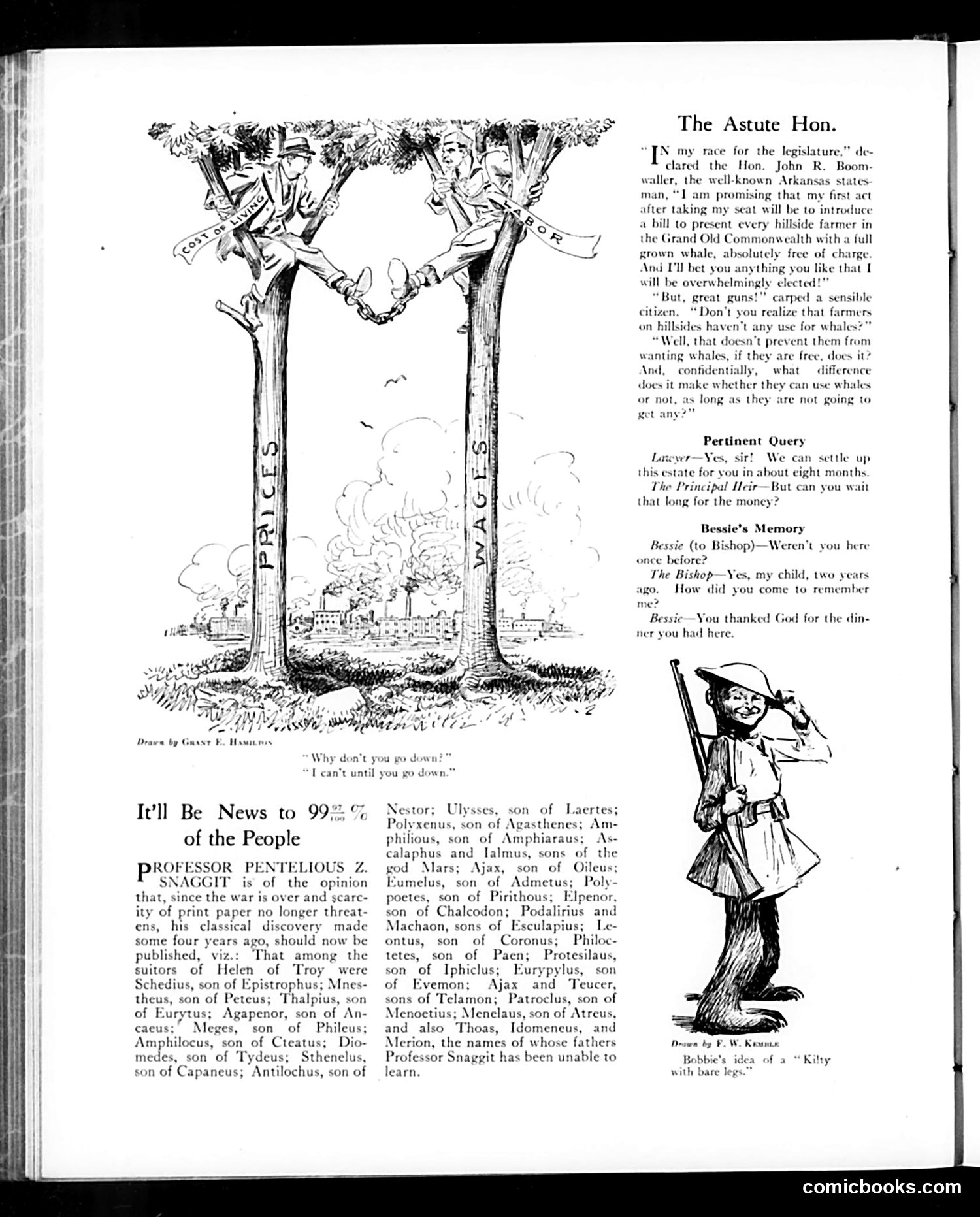
**Main Cartoon - "The Astute Hon."** This satirizes a cynical Arkansas politician (Hon. John R. Boomwaller) promising hillside farmers free whales—an absurdly useless gift. The joke exposes hollow campaign rhetoric: the politician admits the gift has no practical value, yet confidently expects election because voters want "free" things regardless of utility. It mocks both demagogic politicians and gullible voters who support impractical promises. **Supporting Content** The page includes two brief joke pieces: one about a lawyer deliberately delaying estate settlement to earn fees, and another about a bishop remembered only for thanking God before dinner—mocking both mercenary lawyers and insincere clergy. The lengthy text about Homer's Trojan War suitors appears unrelated satire, possibly mocking pedantic classical scholarship or wartime paper scarcity. **Overall Message**: Post-WWI skepticism toward authority figures (politicians, lawyers, clergy) making false or self-serving promises.
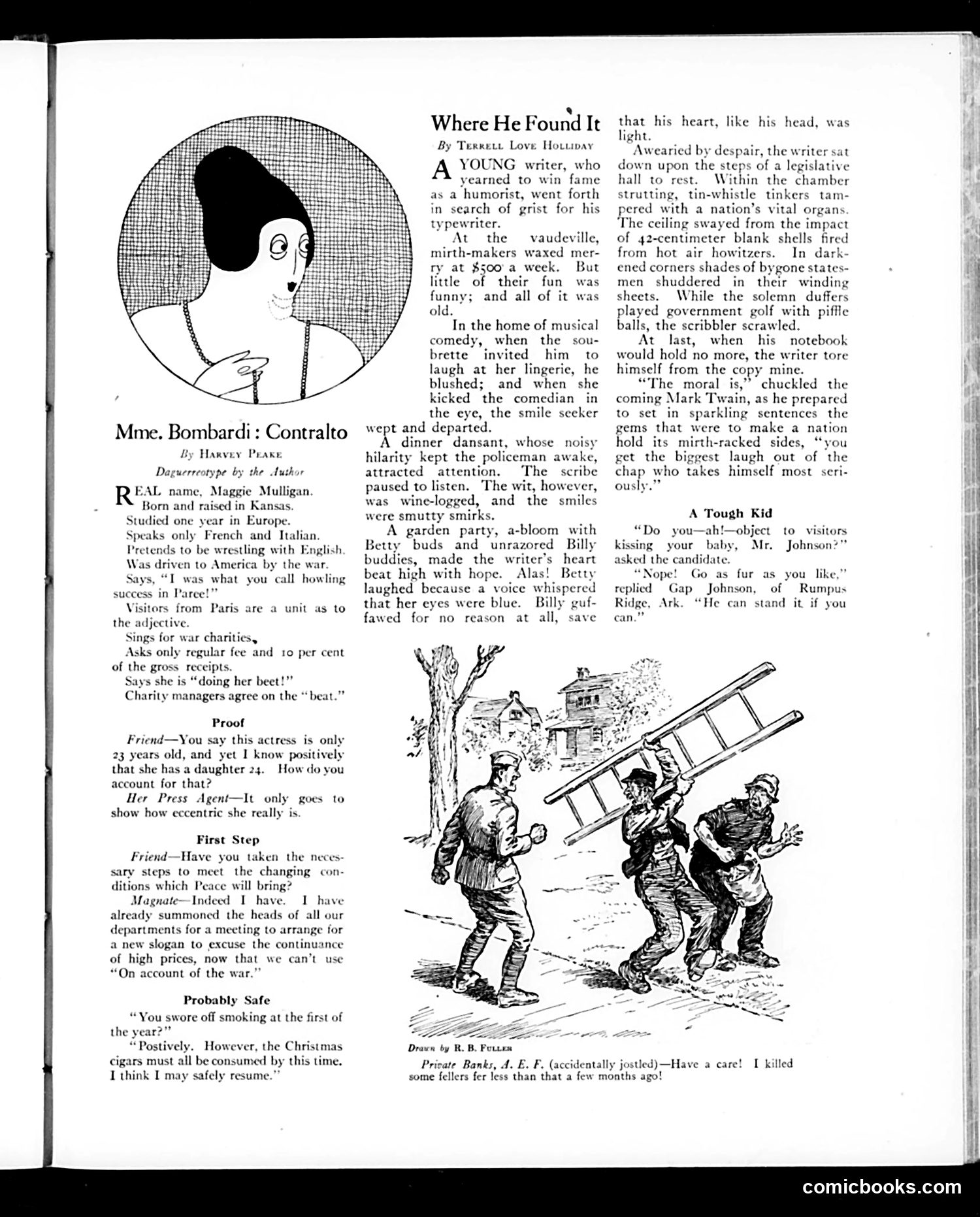
This page contains three satirical pieces targeting post-WWI American society: **"Mme. Bombardi: Contralto"** mocks a fake European opera singer—really "Maggie Mulligan from Kansas"—who claims French/Italian fluency and Parisian training while obviously being a fraud. The satire targets Americans' gullibility toward ersatz European sophistication and the entertainment industry's deceptions. **"Where He Found It"** follows a struggling humorist searching for comedy material. He finds vaudeville, musical theater, and dinner parties all unfunny and stale. Only in a chaotic legislative hall—where incompetent politicians literally bungle governing ("tin-whistle tinkers tampered with a nation's vital organs")—does he discover genuine absurdity. The joke: real humor lies in actual governmental dysfunction, not manufactured entertainment. The remaining brief satirical quips mock businessmen planning price-gouging justifications post-war, and New Year's smoking resolutions. Overall, the page critiques post-war American culture: manufactured entertainment, consumer gullibility, government incompetence, and corporate hypocrisy.
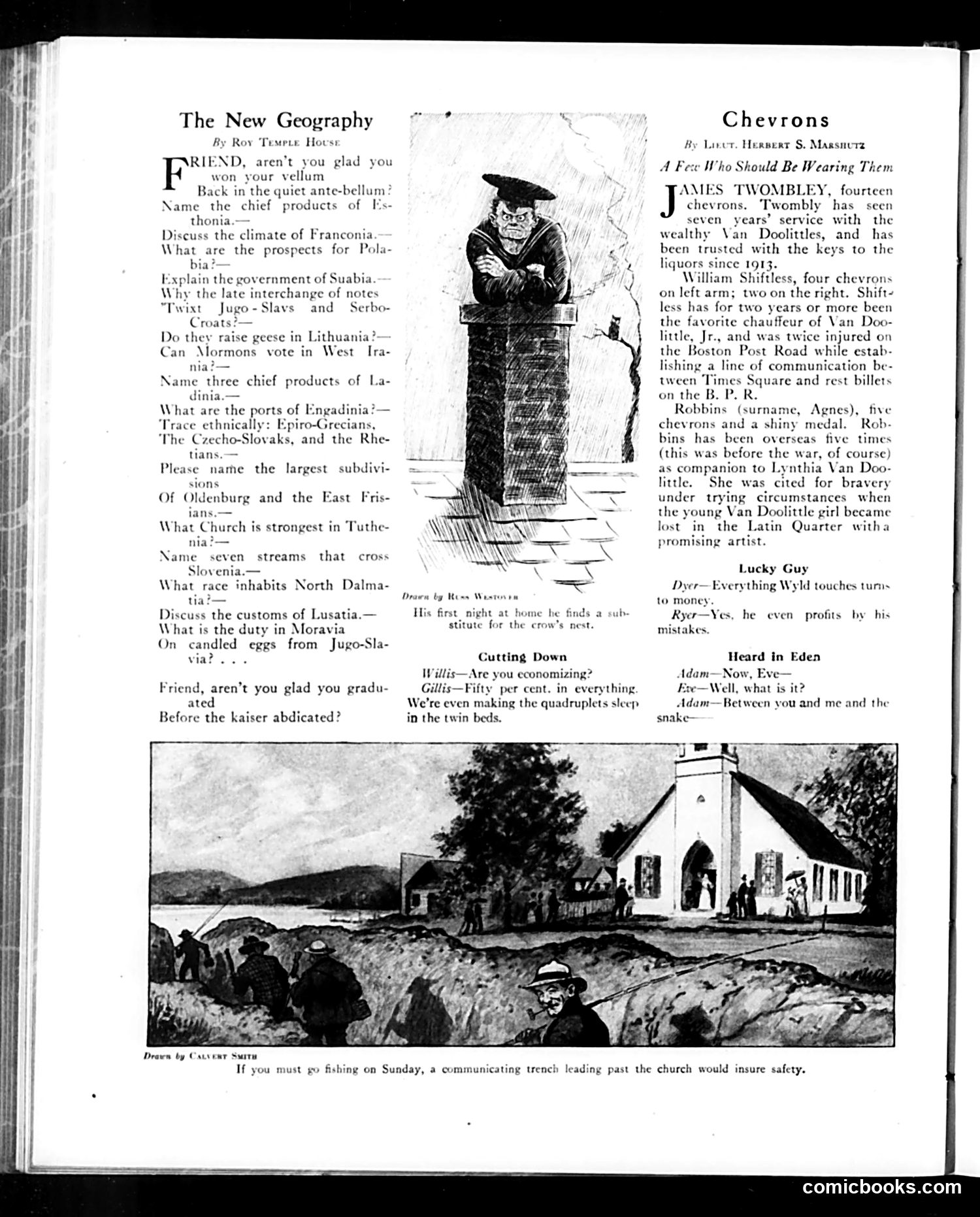
This cartoon mocks post-WWI geography education. Roy Temple House satirizes how the Treaty of Versailles (1919) created numerous new or renamed European nations and regions—many with unfamiliar, tongue-twisting names like "Engadinia," "Czechoslovaks," "Czecho-Slovaks," and "Jugo-Slavs." The humor lies in the absurdist quiz questions about these newly redrawn borders, products, and customs of places most Americans couldn't locate or pronounce. The joke: schoolchildren and adults now face an impossibly complicated geography lesson because the war radically redrew Europe's political map, replacing empires with smaller successor states. The opening quip—"aren't you glad you graduated before the kaiser abdicated?"—reinforces this: readers escaped school before this geographic chaos was institutionalized into curricula. The other items on the page (Chevrons, Cutting Down, Heard in Eden) are unrelated satirical pieces.
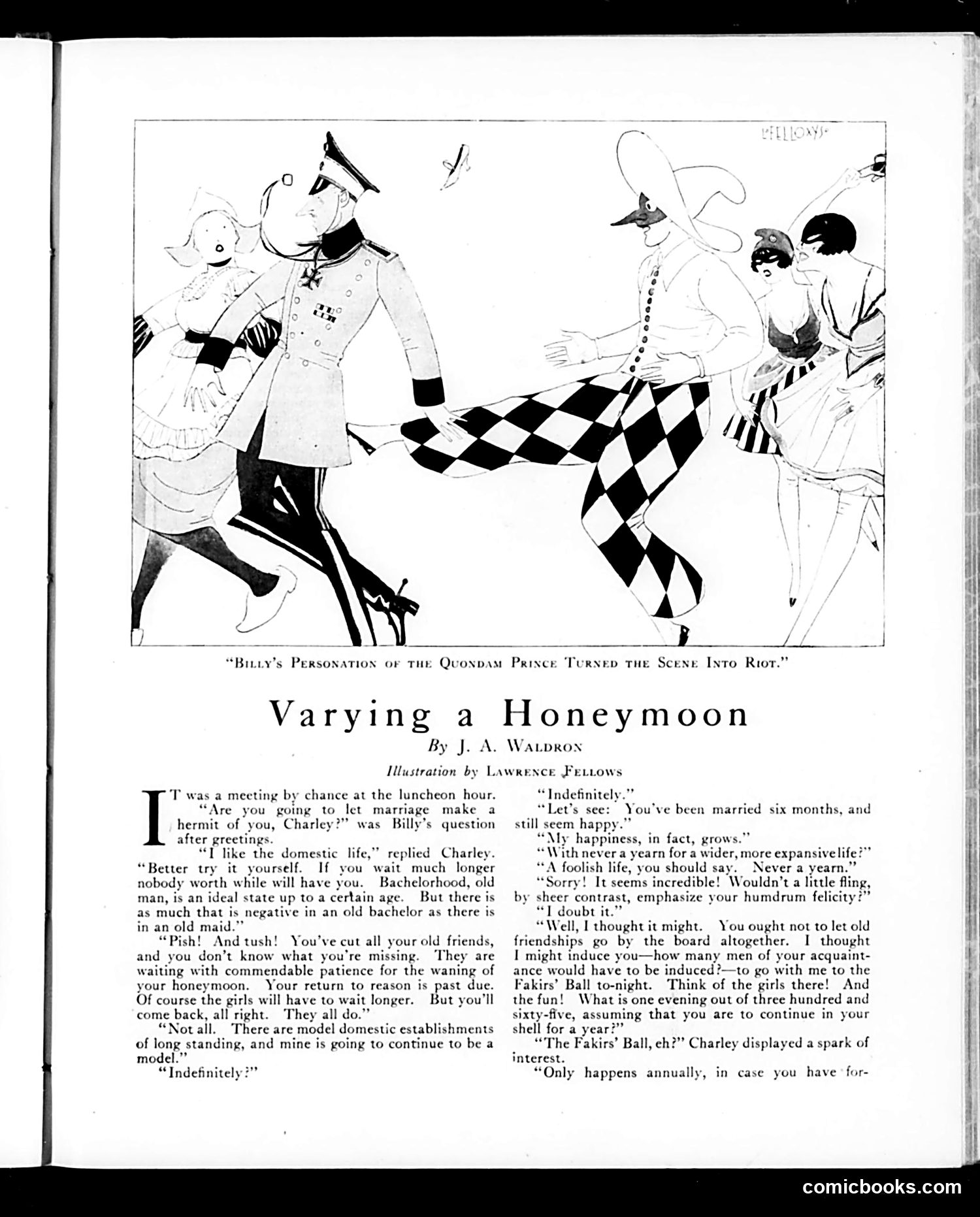
This story satirizes newlywed domesticity versus bachelor social life. The illustration shows a man (Charley) in military dress being tempted by his friend Billy to abandon married life and attend the glamorous "Fakirs' Ball"—an annual social event featuring fashionable women. The satire mocks Charley's claim that his six-month marriage brings increasing happiness without any desire for outside entertainment or old friendships. Billy pressures him by suggesting that domestic contentment is naive and that even brief social escapades would enhance married life by contrast. The caption references "Billy's Personation of the Quondam Prince" turning "the scene into riot," suggesting Billy's flirtations or wild behavior will disrupt Charley's careful domestic order. The joke targets both smug newlyweds and persistent bachelors trying to reclaim married friends for nightlife—a tension between settling down and remaining socially active that clearly resonated with Judge's readers.
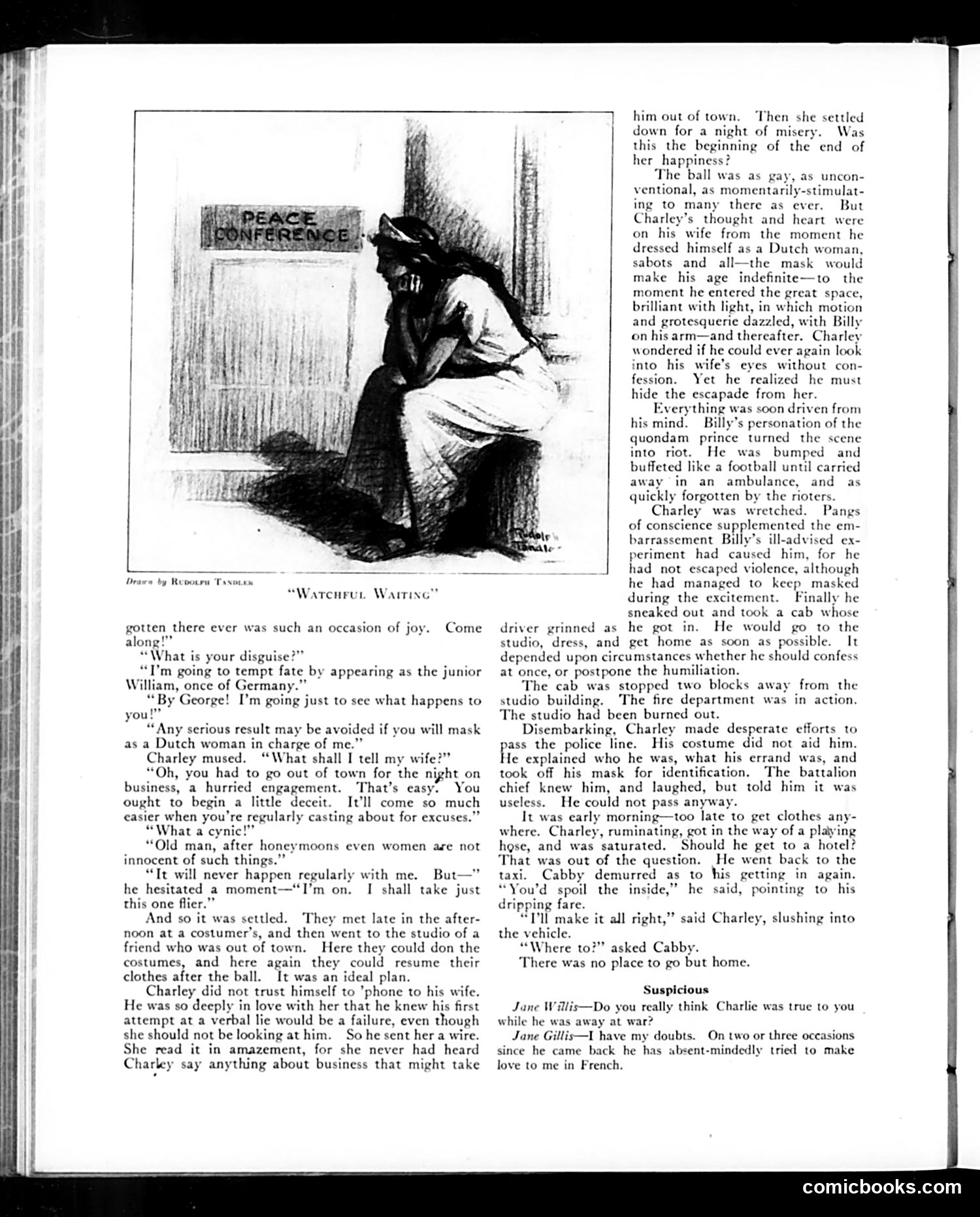
This satirical story-cartoon appears to reference the era of WWI and American neutrality politics (the "Peace Conference" sign visible in the illustration). The narrative follows a married man, Charley, who attends a masquerade ball in disguise as a Dutch woman, deceiving his wife about a business trip. The satire operates on multiple levels: Charley's moral compromise—lying to his wife—mirrors broader anxieties about deception during wartime. His costume as someone "of Germany" (likely a reference to German neutrality or identity) adds political subtext. The escalating disasters (a riot, a studio fire, soaking) that follow his transgression suggest divine comeuppance or karmic retribution for his dishonesty. The title "Watchful Waiting" likely references President Woodrow Wilson's famous policy phrase regarding America's posture toward international conflicts—suggesting the cartoon satirizes how private moral failings mirror national hypocrisy or questionable decision-making during this tense historical moment.
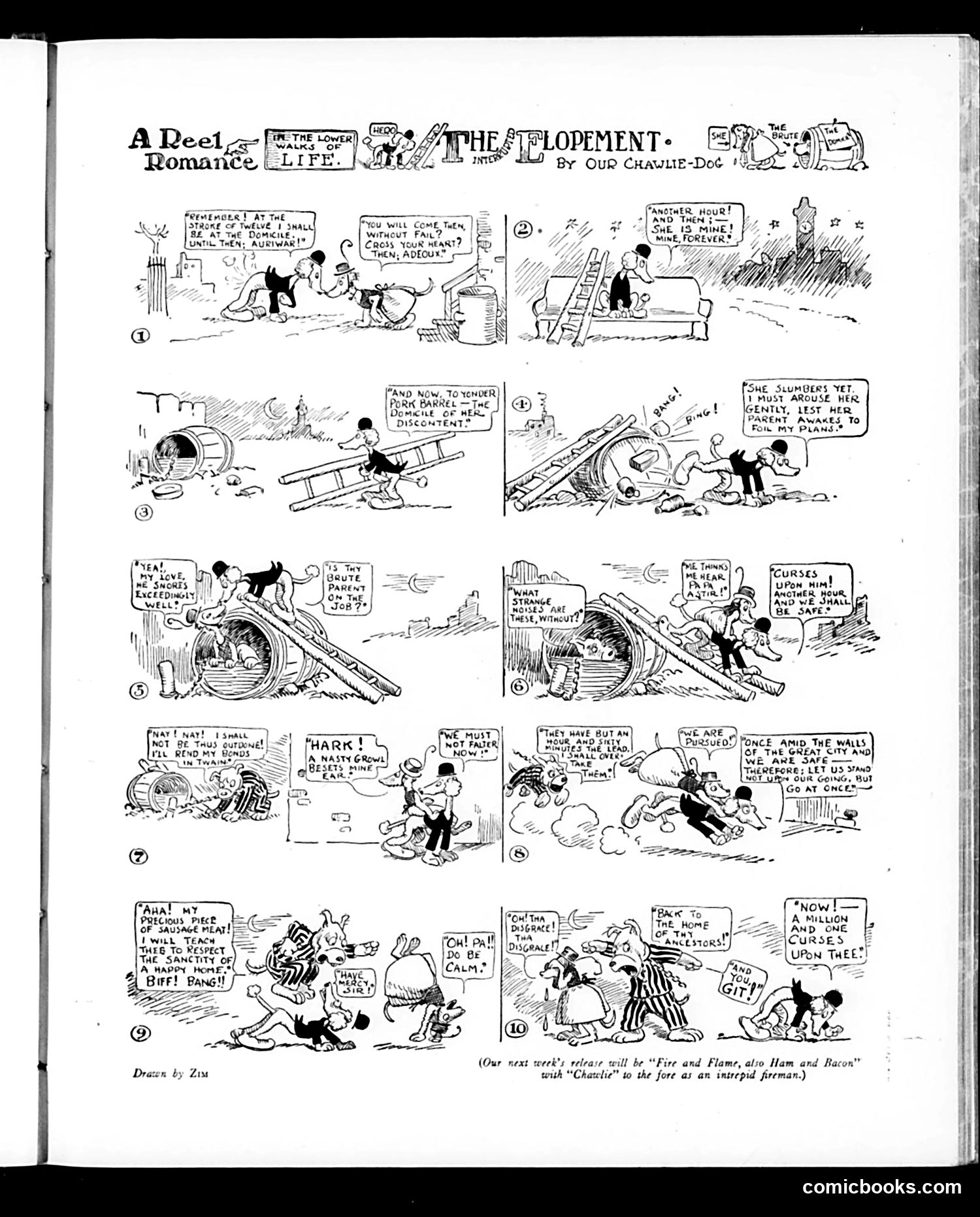
This is a silent-film parody comic strip by "Our Charlie-Dog," drawn by Zim. It mocks the melodramatic conventions of early cinema through slapstick humor involving anthropomorphized dogs. The plot: A male dog attempts to elope with a sleeping female dog, sneaking her out via a drainpipe and ladder. Her parents discover the plan and chase the couple. The strip escalates absurdly—the pursuers accidentally destroy property (a barrel, a ladder), encounter obstacles, and the elopers hide inside a large pipe. Eventually they escape "within the walls of the great city" where they're safe from discovery. The satire targets overwrought romantic melodramas common in 1920s silent films: passionate declarations ("precious piece of sausage meat"), parental disapproval, midnight escapes, and increasingly farcical chase sequences. The animal characters heighten the absurdity, reducing high dramatic tension to dog-level concerns. This type of broad, physical comedy mirrors the slapstick style of silent film comedies themselves.
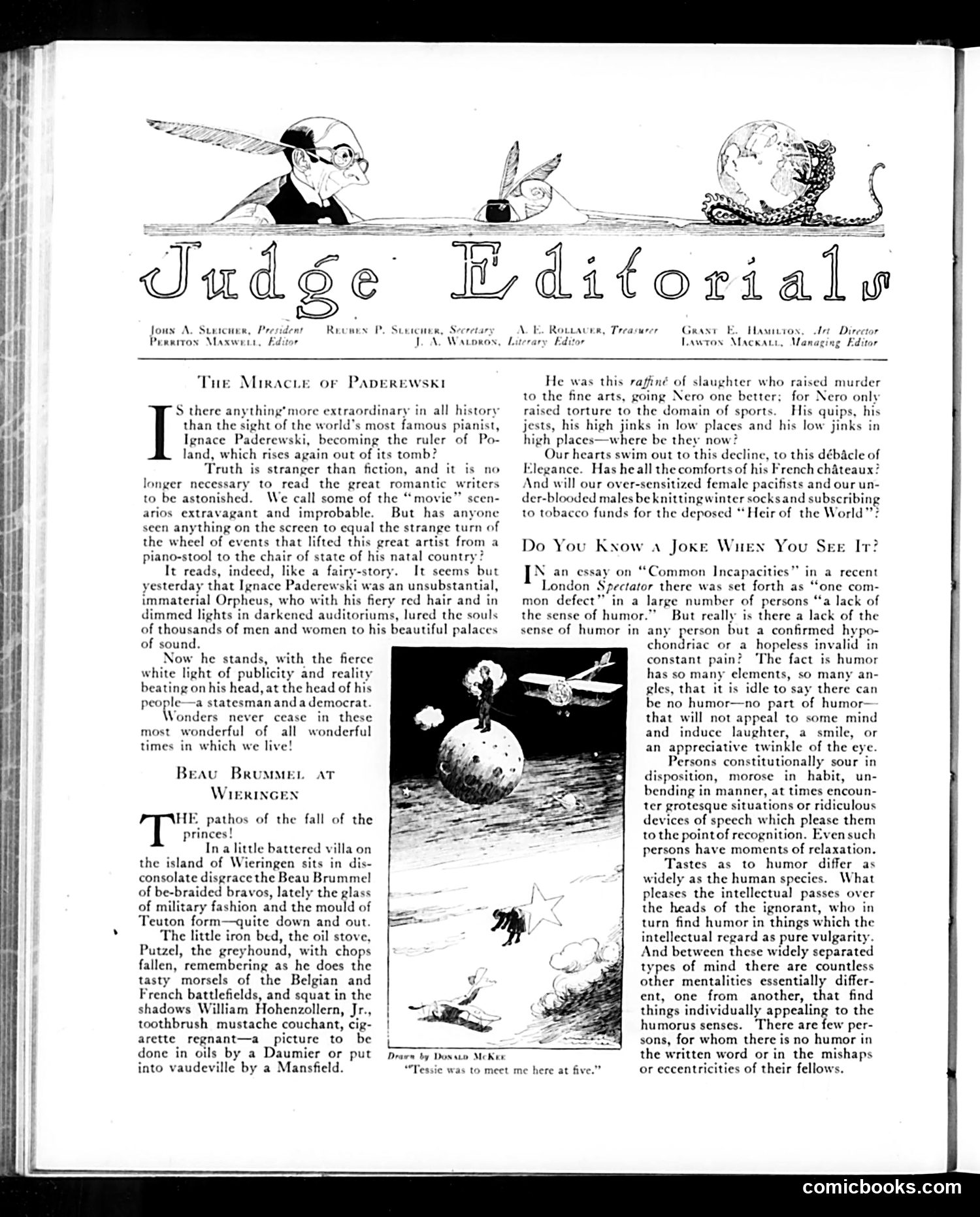
This page contains two separate editorial pieces from Judge magazine, likely from 1919-1920 (based on historical context): **"The Miracle of Paderewski"**: This celebrates Polish pianist Ignace Paderewski's transition from musician to statesman following Poland's restoration to independence after World War I. The piece marvels at this "fairy-story" transformation—a cultural figure becoming a political leader. The accompanying cartoon at top left appears to be caricature-based satire, though specific identities are unclear from the image alone. **"Beau Brummel at Wieringen"**: This discusses the fall of Wilhelm II (the German Kaiser), now exiled and living in reduced circumstances on an island in the Netherlands. The reference to "Beau Brummel" (a famous dandy) mocks his former military vanity. The piece uses ironic sympathy ("our over-sensitized female pacifists") questioning whether post-war Americans should support the deposed "Heir of the World." **"Do You Know a Joke When You See It?"**: A separate essay on humor and its universal appeal. The page reflects post-WWI attitudes toward European leadership changes.
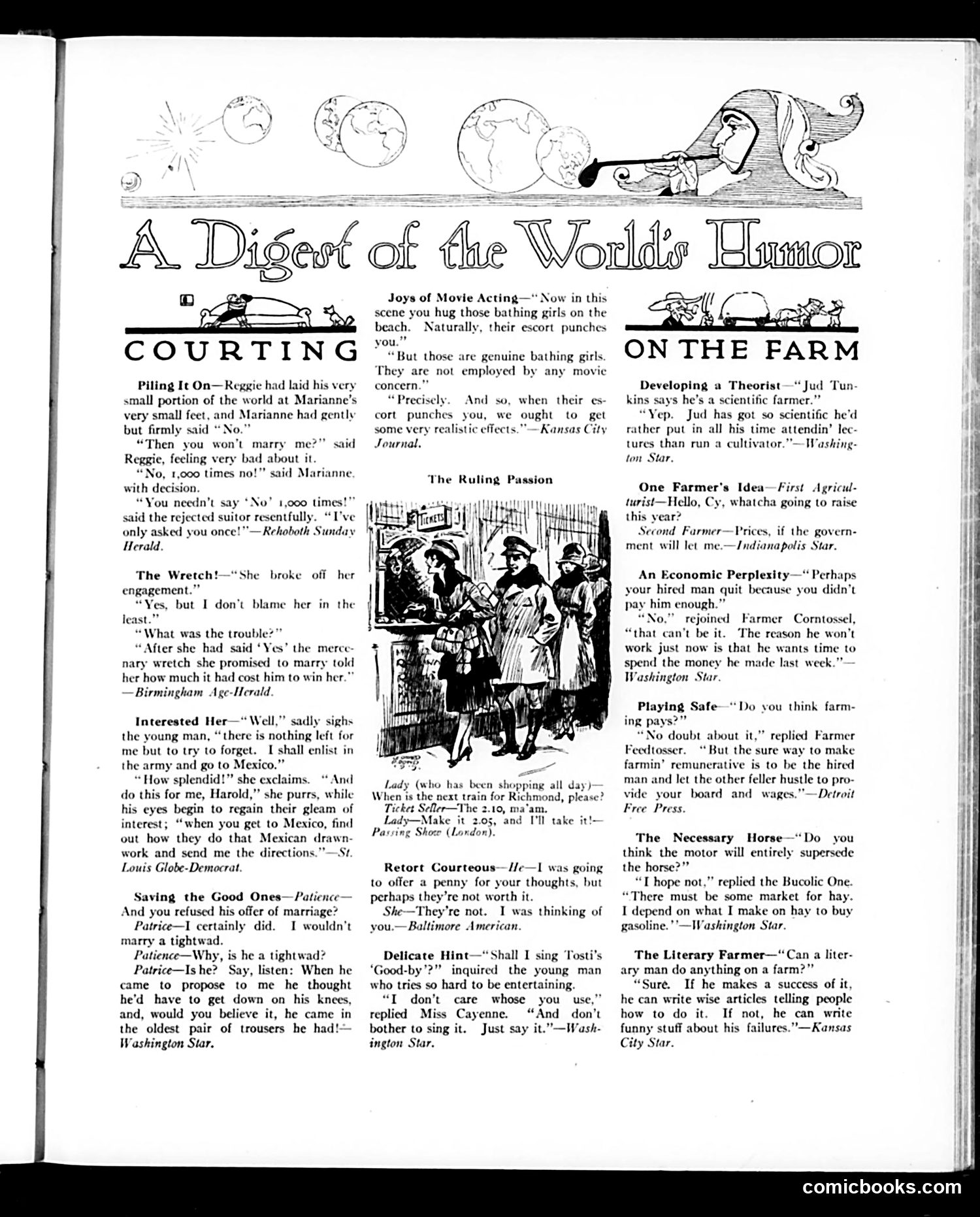
This page collects brief humorous anecdotes organized into two columns: courtship jokes on the left, farming jokes on the right. The humor reflects early 20th-century social attitudes. **Courtship section**: The jokes mock romantic conventions—men's elaborate marriage proposals, women's materialism (the "mercenary wretch" who reveals proposal costs), and gender dynamics where women control romantic outcomes through acceptance or rejection. **Farm section**: These jokes satirize rural life during agricultural mechanization. They mock farmers' resistance to scientific methods ("Developing a Theorist"), economic struggles (hoping to profit from price increases), labor disputes (hired men wanting leisure), and anxieties about modernization (motors replacing horses). The central illustration depicts "The Ruling Passion"—a shopping-obsessed woman negotiating train departure times, suggesting women's consumer behavior as their defining trait. The humor assumes middle-class urban readers familiar with both traditional courtship rituals and contemporary agricultural debates.
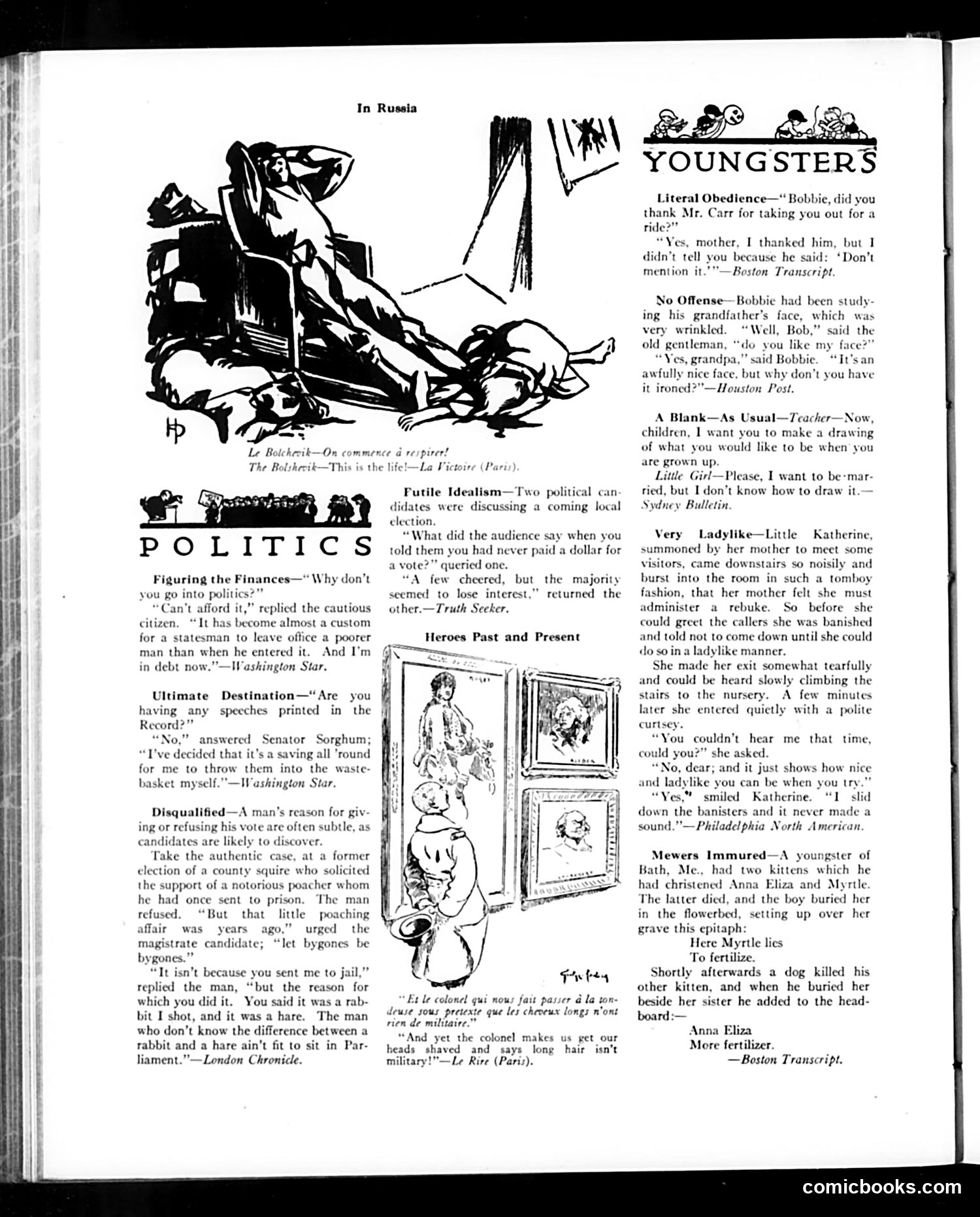
This page collects political and social humor typical of early 20th-century American satire. **"Politics" Section:** These brief jokes mock corrupt American politics—specifically that politicians enter office wealthy but leave poor (implying graft), that Senator Sorghum wastes speeches by discarding them undelivered, and that voters judge candidates on absurdly specific grounds (one man refuses to vote for a magistrate who mislabeled the game he'd poached). **"Heroes Past and Present" cartoon:** Depicts a military officer examining portraits, likely satirizing military hypocrisy—the French caption suggests officers enforce rigid grooming standards ("short hair") while ignoring such rules themselves. **"Youngsters" section:** Humorous anecdotes about children taking adult instructions literally (a boy thanks someone but hides the reason; a girl doesn't acknowledge wrinkles tactfully; Katherine learns "ladylike" behavior through mischief). **"Mewers Immured":** A darkly comic epitaph where a boy buries dead kittens with increasingly blunt headstones about decomposition. The overall tone is genteel satire targeting politics, military authority, and domestic life.
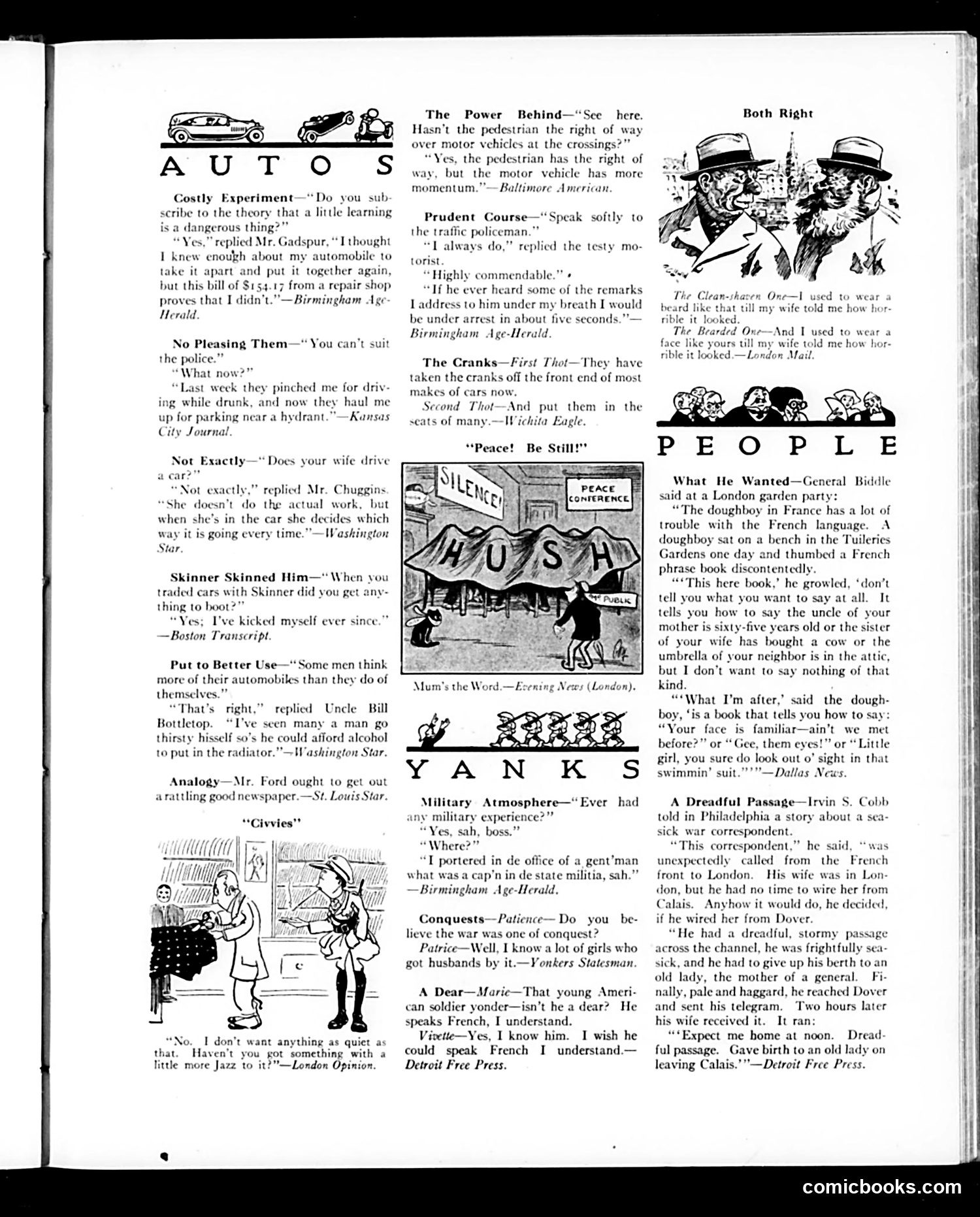
This page from **Judge** (a satirical magazine) collects brief automobile-related humor pieces reflecting post-WWI American culture. The jokes mock: 1. **Male incompetence with cars**: Men overestimate mechanical knowledge, leading to expensive repair bills; wives actually control direction despite men "driving." 2. **Traffic enforcement absurdity**: Police enforce contradictory parking rules; motorists hide frustration behind fake politeness toward officers. 3. **Class/race humor**: A porter's "military experience" consists of working for an officer—reflecting period racial attitudes. 4. **Automobile obsession**: Men prioritize cars over drinking, suggesting emerging car culture's grip on American society. 5. **WWI soldier culture**: American "doughboys" in France struggle with the language, wanting practical phrases rather than textbook examples. The cartoons and anecdotes collectively satirize the rapid social changes automobiles brought—challenging traditional gender roles, authority structures, and American soldiers' encounters abroad—through lighthearted, period-typical humor.
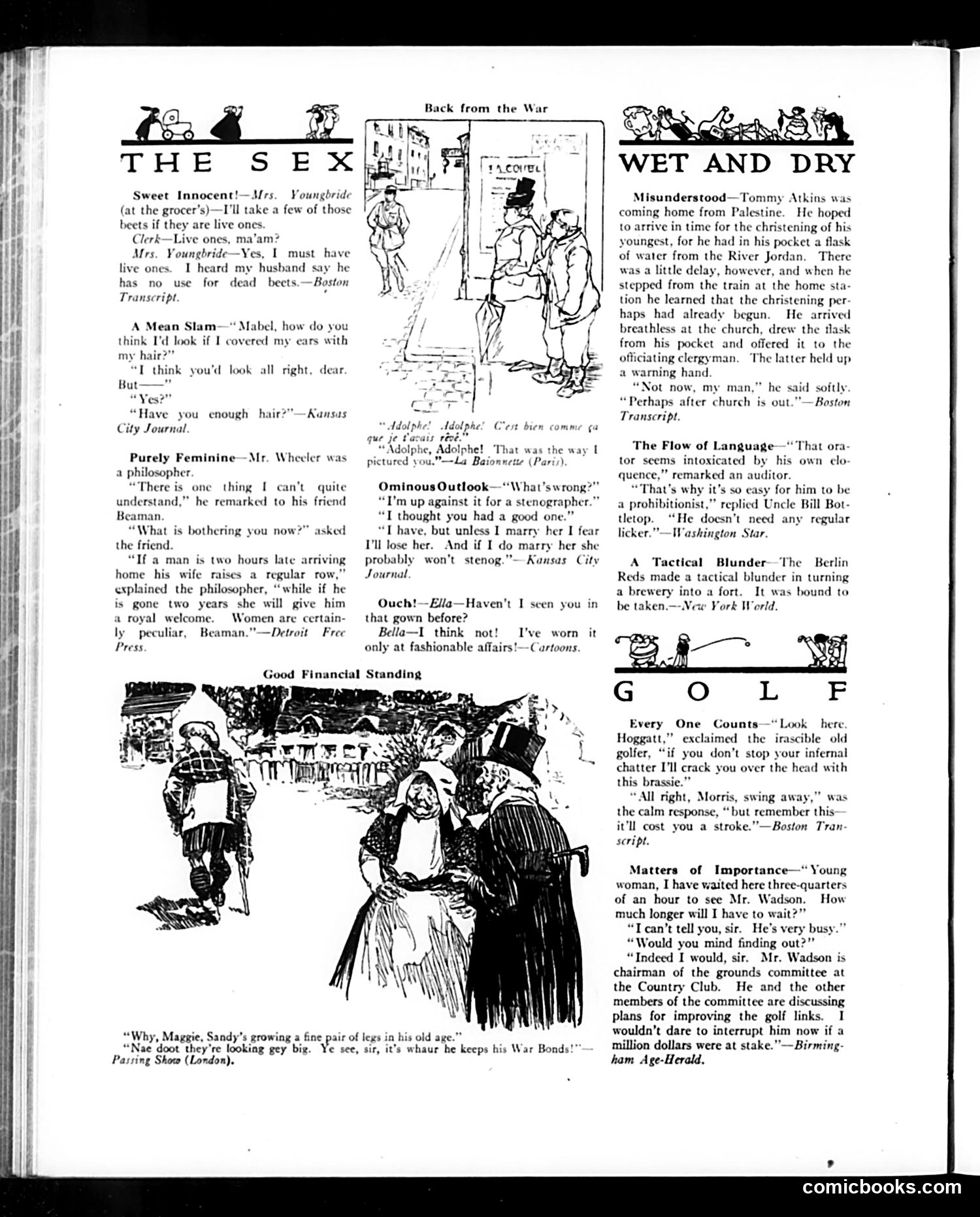
This page contains multiple brief satirical jokes typical of Judge magazine's humor. The central themes mock gender relations, wartime absurdities, and social pretensions: **"The Sex" section** features jokes about wives' logic (a newlywed wanting "live beets"), marital dynamics (husbands' tardiness versus long absences), and workplace power (stenographers threatening to quit if married). **"Back from the War"** includes a cartoon about a soldier arriving late to his baby's christening with Jordan River water, which a priest rejects as unsuitable—satirizing soldiers' naïveté about religious practice. **"Good Financial Standing"** jokes that a Scottish man's War Bonds are so valuable he's "growing" them like legs. **"Golf"** section mocks the sport's cultural importance: a golfer threatens violence over chatter, and a chairman of the golf committee is so important that interrupting him for business is unthinkable—even for million-dollar matters. The humor targets middle-class pretension, matrimonial absurdity, and wartime displacement.
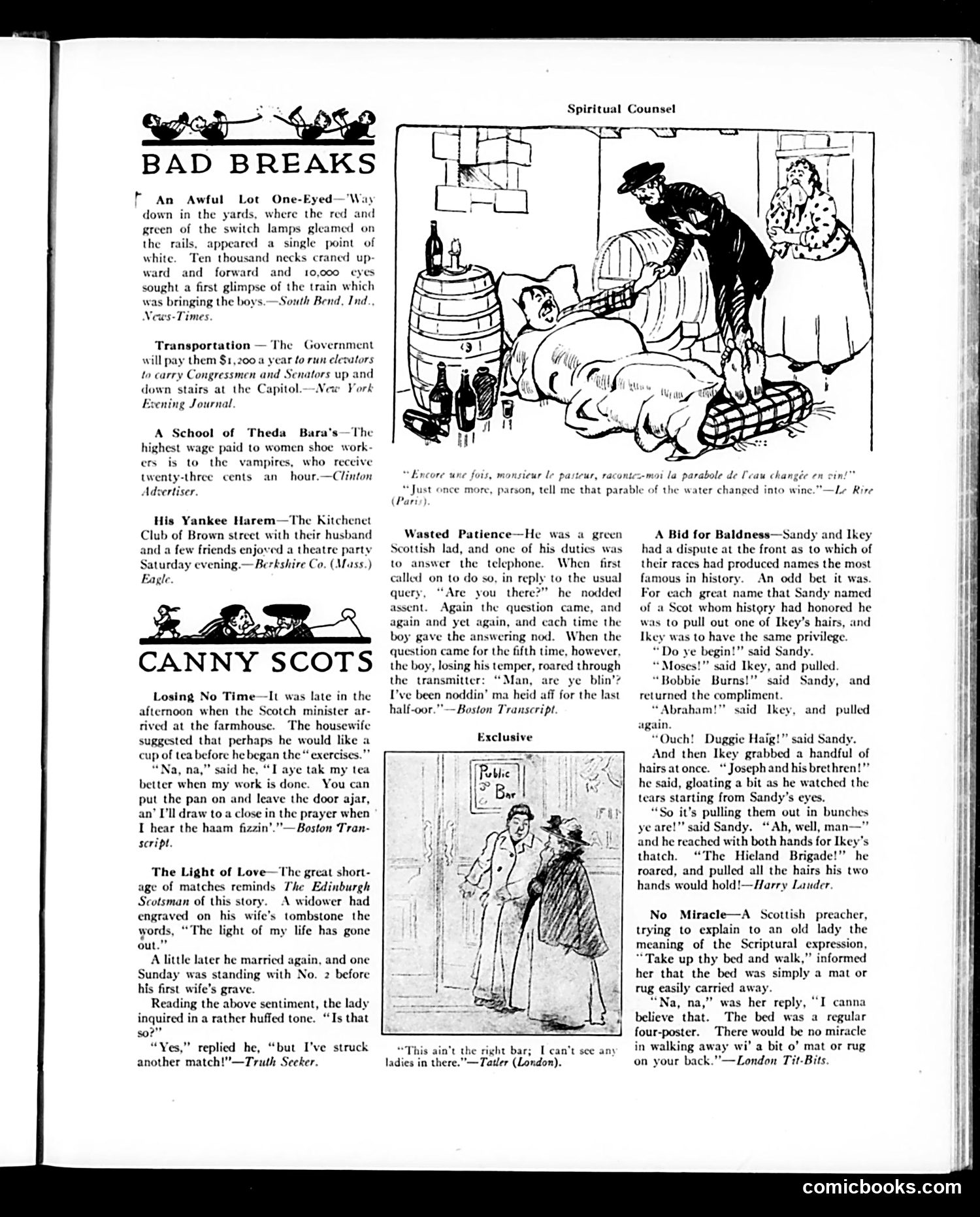
This page from the satirical magazine *Judge* collects brief humorous anecdotes organized by ethnic stereotype. The "Bad Breaks" section mocks various groups through short newspaper clippings. The "Canny Scots" section stereotypes Scottish frugality and literal-mindedness—a widower's quip about "striking another match" after remarrying, a minister prioritizing tea over prayer, and a boy who literally nods instead of verbally answering a telephone. The "Spiritual Counsel" cartoon depicts a priest explaining the biblical miracle of water turning to wine to a parishioner. One anecdote plays on Irish-Jewish rivalry ("Sandy and Ikey") where they compete naming famous historical figures from their respective cultures, pulling each other's hair with each claim—Field Marshal Douglas Haig appears as Scotland's contribution. The satire relies on period ethnic stereotypes: Scottish thrift and bluntness, Jewish abundance, and Irish physicality. A "Tatler (London)" joke mocks an exclusive bar by noting the absence of women. The humor is crude by modern standards, reflecting early 20th-century American magazine conventions.
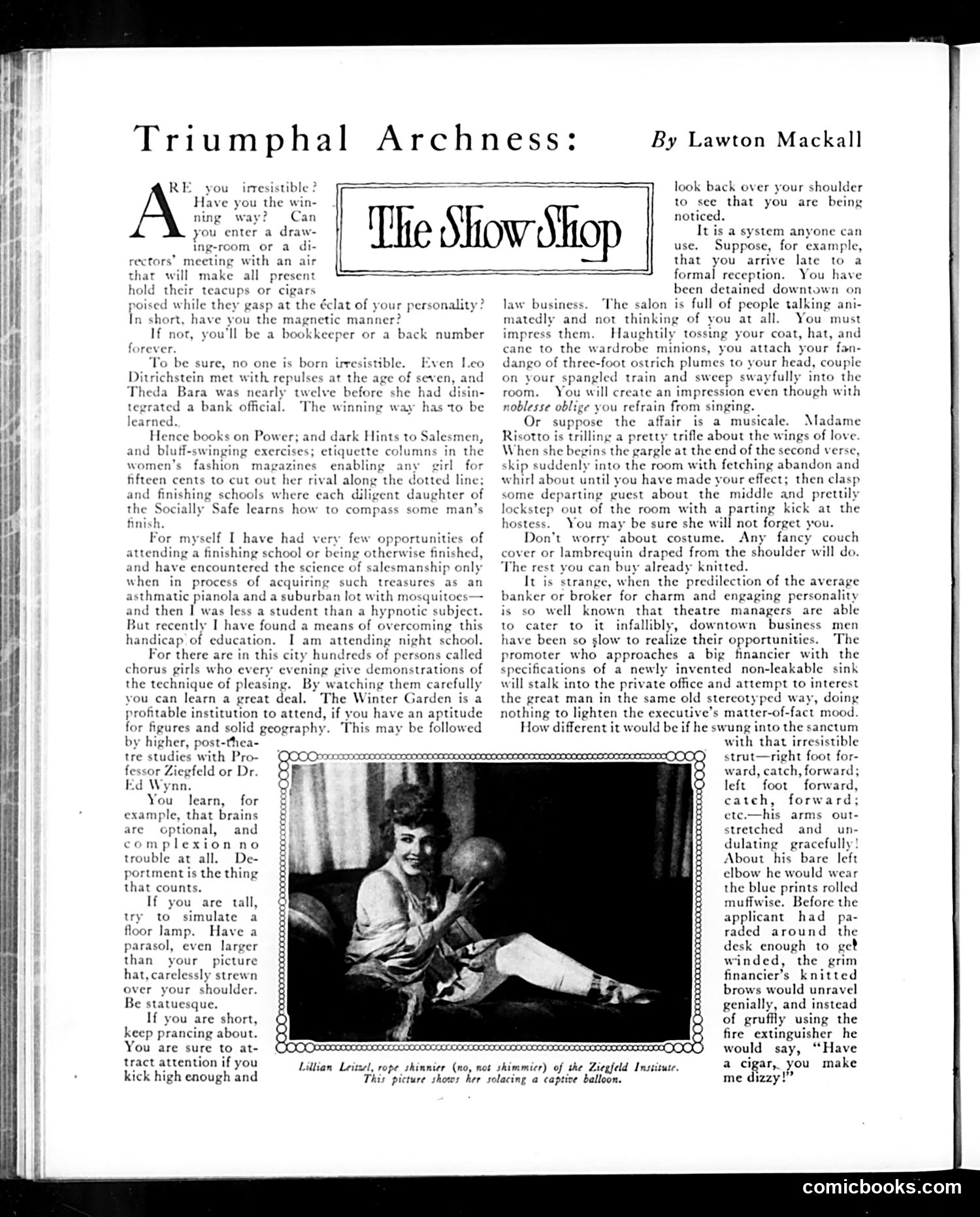
This article by Lawton Mackall satirizes the obsession with acquiring "charm" and "winning ways" to climb socially. The author mocks self-help books and finishing schools promising to teach irresistibility. The central joke: Mackall claims he's learned charm not from etiquette columns but by studying **chorus girls at the Winter Garden** (a famous Broadway venue). He cites "Professor Ziegfeld" (Florenz Ziegfeld, the legendary theatrical producer) and Ed Wynn as his teachers. The accompanying photograph shows **Lillian Leitzel**, a famous Ziegfeld performer, described sarcastically as a "rope shimmer" at the "Ziegfeld Institute," posed with a balloon. The satire targets two things: (1) the desperation of people trying to buy personality through instruction, and (2) the idea that theatrical performers represent an ideal of social grace worth imitating. The humor lies in the absurdity—that learning to "impress" through elaborate costume and dramatic entrance mimics meaningless theatrical performance rather than genuine appeal.
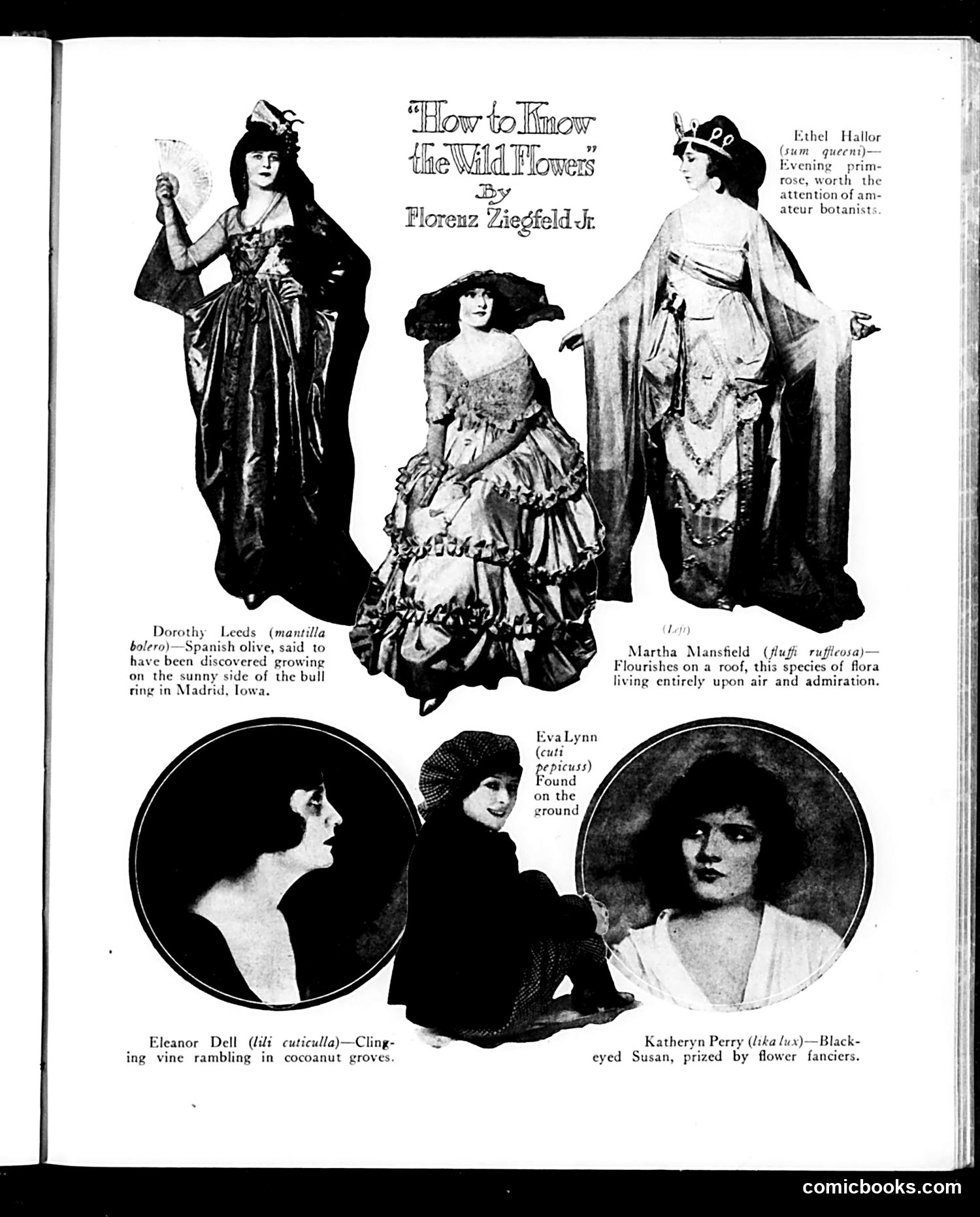
This is a satirical feature by Florenz Ziegfeld Jr. (the famous Broadway impresario) that humorously reimagines famous actresses as wildflowers. Each woman is assigned a fictional Latin botanical name and a comedic "natural habitat" description that mocks either her public image or career. The joke targets Ziegfeld's own chorus girls and actresses: Dorothy Leeds is compared to a Spanish olive found at a bullring; Martha Mansfield to a rooftop flower; Eva Lynn to a ground-dwelling species; Eleanor Dell to a climbing vine in coconut groves; and Katheryn Perry to a "Black-eyed Susan." The satire mocks both the pretensions of botanical classification and theatrical celebrity culture—treating glamorous stage performers as specimens to be catalogued and described with mock-scientific precision. It's social commentary wrapped in whimsy about the commodification of actresses in early 20th-century entertainment.
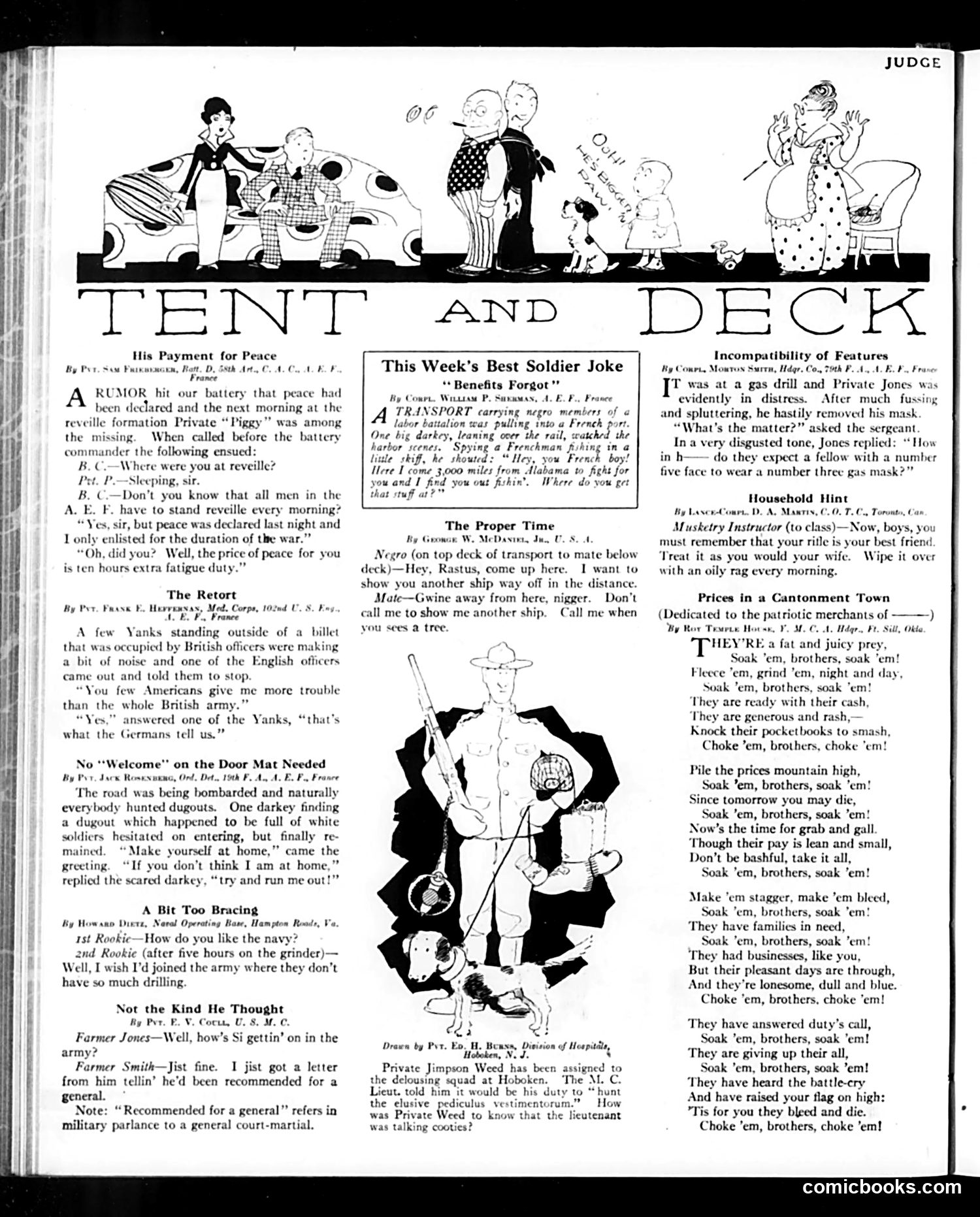
This page collects soldier jokes and anecdotes from American Expeditionary Forces (A.E.F.) personnel during World War I, mocking military life and army discipline. Key pieces include: **"His Payment for Peace"**: A soldier avoids reveille after hearing peace was declared, claiming he'd only enlisted "for the duration of the war." He's punished with extra fatigue duty—the joke being the war hasn't actually ended. **"The Retort"**: American soldiers outmatch British complaints about trouble-making; a Yank quips that Germans say the same thing, suggesting Americans are formidable soldiers. **Racial humor**: Multiple jokes feature African American soldiers in stereotypical dialect ("darkey," "nigger"), reflecting the deeply racist attitudes of 1910s military culture. One depicts a Black soldier unfamiliar with ships; another shows confusion over military terminology. **General military ribbing**: Jokes about naval recruit drilling, a farmer misunderstanding "recommended for a general" (meaning court-martial), and rifle maintenance. The page reveals both period humor conventions and the era's casual, institutionalized racism.
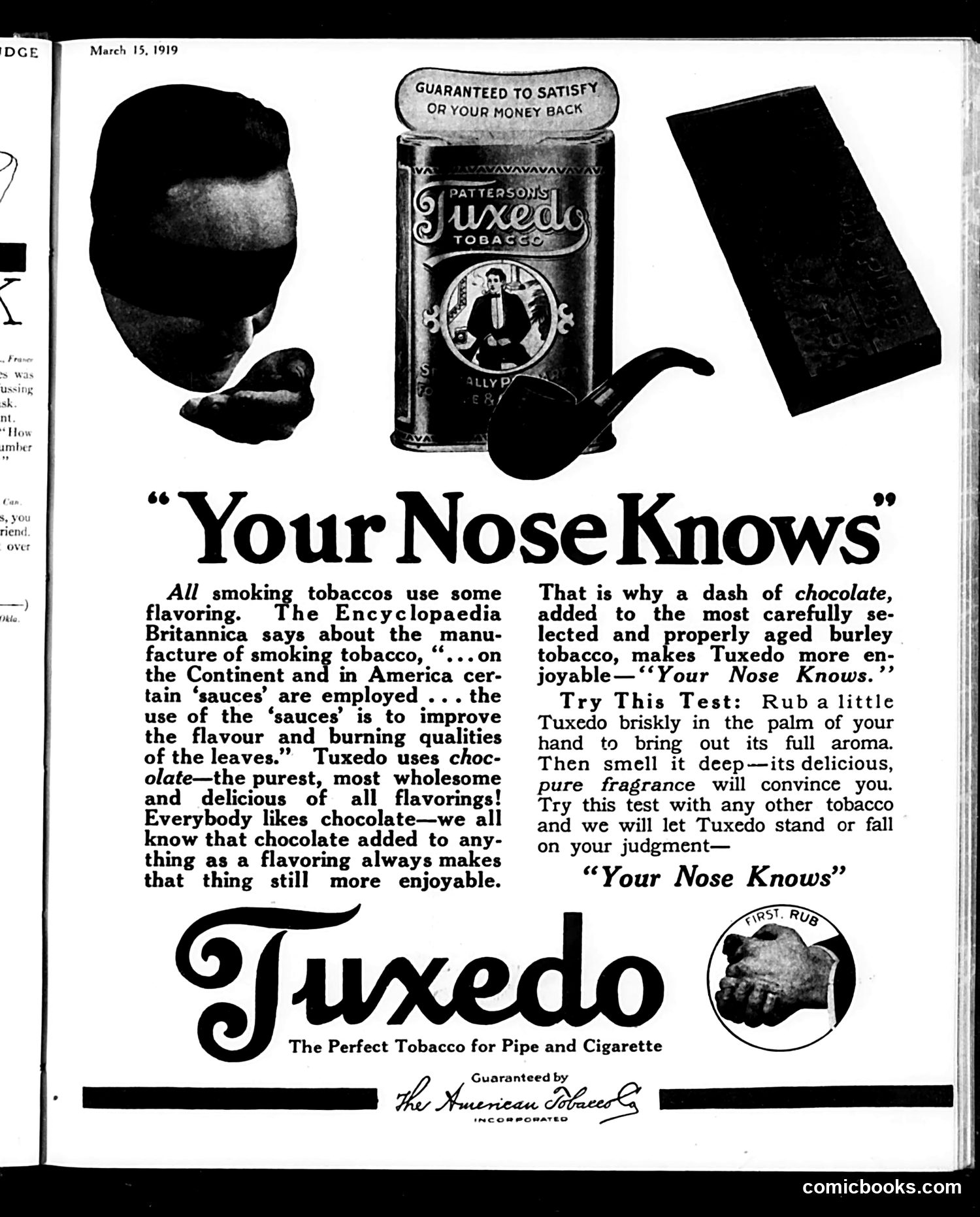
This is a **tobacco advertisement**, not a political cartoon or satire. The page is from Judge magazine (March 15, 1919) but contains a paid advertisement for Tuxedo brand smoking tobacco. The ad uses the slogan "Your Nose Knows" to market chocolate-flavored tobacco. It references the Encyclopaedia Britannica to establish credibility about tobacco "sauces" (flavorings), then argues that chocolate is the "purest, most wholesome" flavoring option. The visual elements show a pipe, tobacco tin, and a hand demonstrating the "smell test" to prove Tuxedo's superior aroma compared to competitors. The appeal is straightforward marketing: chocolate flavoring makes tobacco more enjoyable, and consumers should trust their sense of smell to verify quality. This reflects early-20th-century advertising practices—making health/scientific claims about consumer products that would later face heavy regulation.
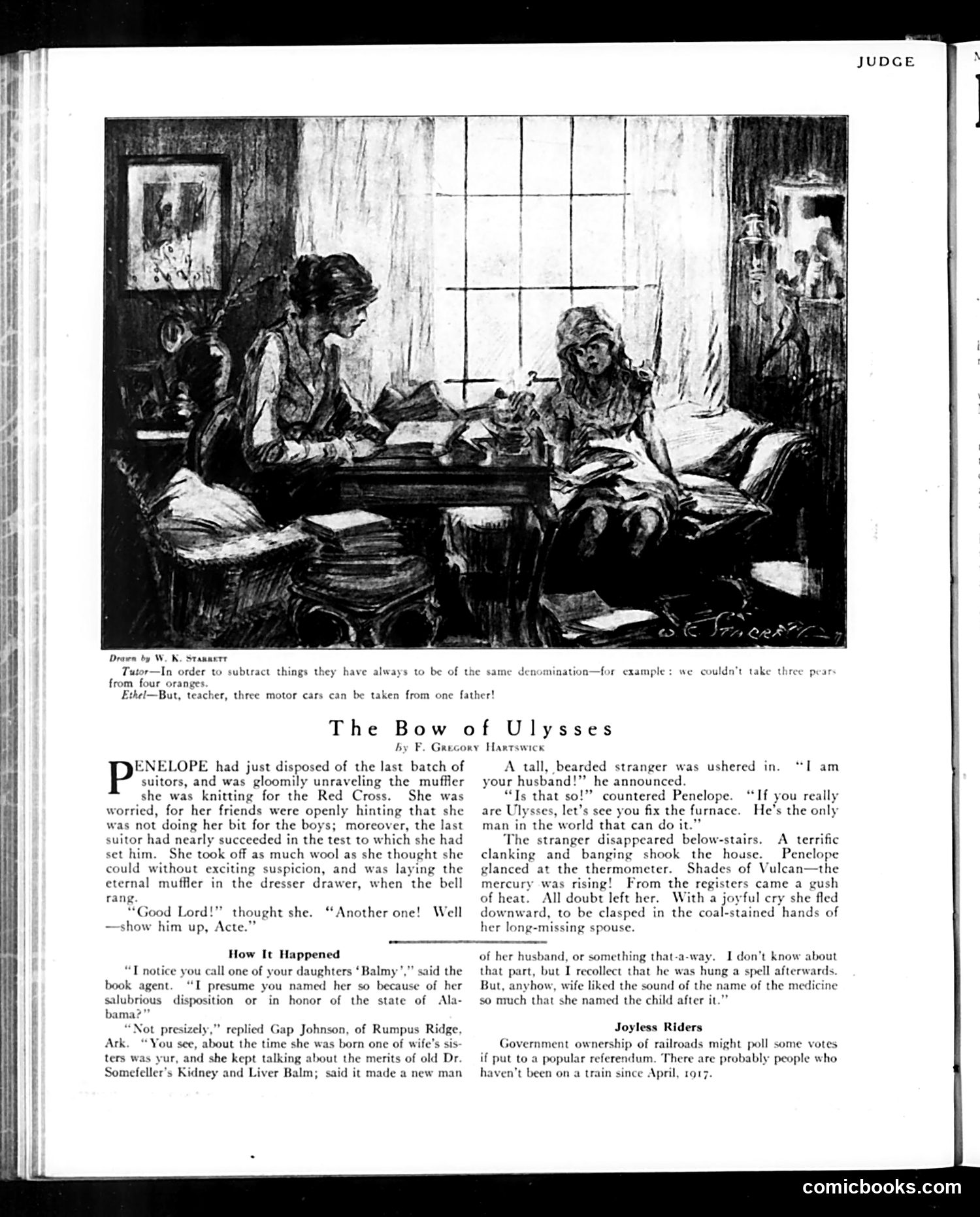
**The Bow of Ulysses** (main story): A satirical take on the Greek myth. Penelope, famous for waiting years for her husband Ulysses, is now anxious about impressing wartime suitors. When a bearded stranger claims to be Ulysses and proves himself by fixing her furnace, she joyfully accepts him. The joke: the modern Penelope's test of identity isn't heroic deed but practical household repair—a commentary on how wartime domestic concerns have replaced classical romance. **How It Happened** (sidebar): A father names his daughter "Balmy" after a patent medicine (Dr. Somefeller's Kidney and Liver Balm) his sister wouldn't stop praising during the baby's birth. The humor mocks both dubious medicinal products and how casually parents sometimes named children based on trivial circumstances. **Joyless Riders**: A brief political quip suggesting most Americans haven't ridden trains since April 1917 (U.S. entry into WWI), implying government railroad ownership wouldn't gain popular support since the public barely uses trains anyway. The tutor cartoon appears disconnected educational humor about subtraction.
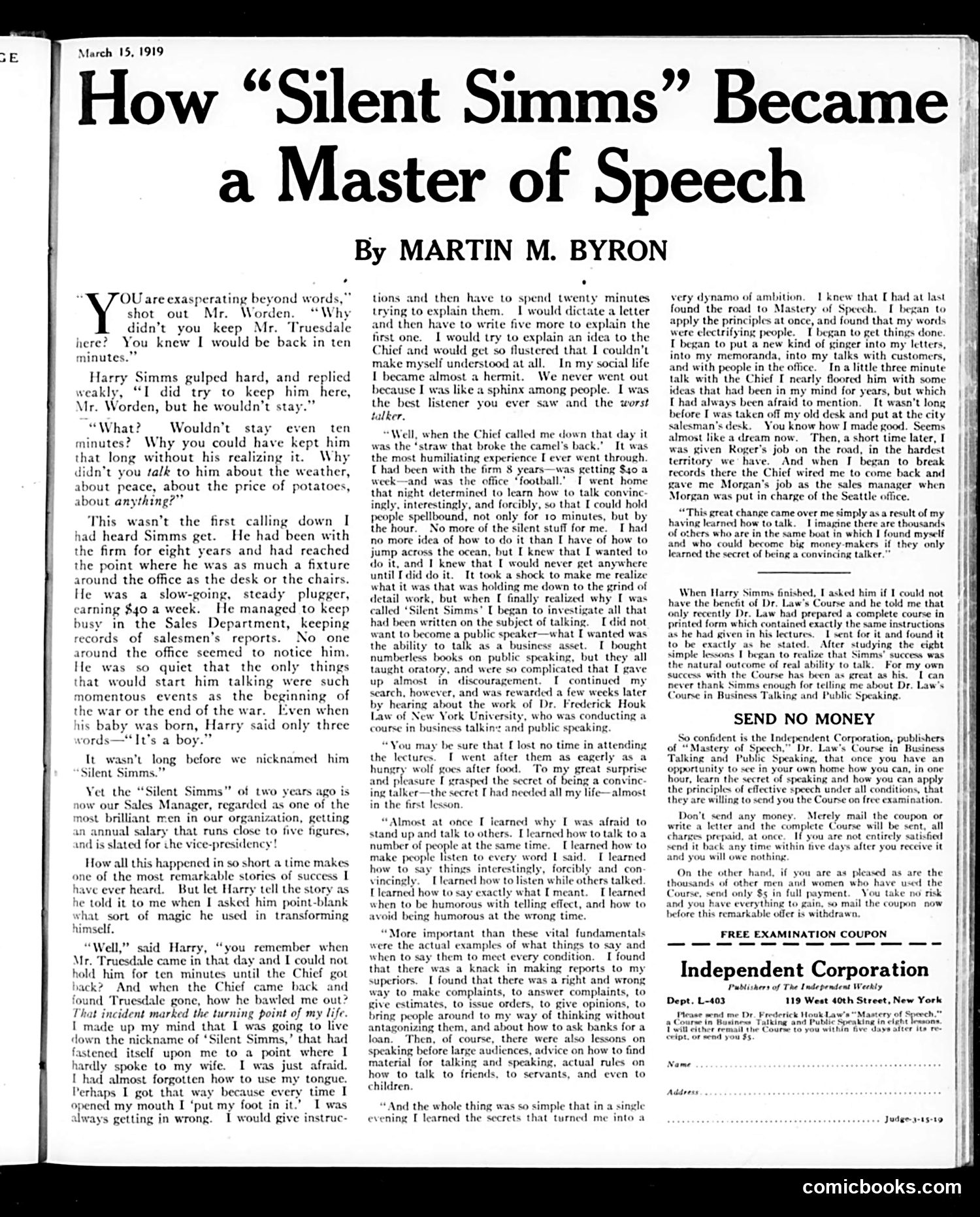
This is a *Judge* magazine article (March 1919) recounting how an office clerk nicknamed "Silent Simms" transformed himself into a confident public speaker and company executive. The narrative follows Harry Simms, a timid $40/week Sales Department clerk so quiet he barely spoke even at home. After being humiliated by his boss for failing to detain a client, Simms resolves to overcome his shyness and learn effective communication. The article documents his self-improvement journey—studying public speaking books, practicing with colleagues, and learning to speak "convincingly, interestingly, and forcibly." Through determination, he becomes the firm's Sales Manager earning five figures and marked for vice-presidency. This reflects post-WWI American optimism about self-improvement and ambition. The piece champions transformation through willpower—a common theme in business magazines of the era. It's essentially an inspirational biography promoting the value of communication skills and personal reinvention.
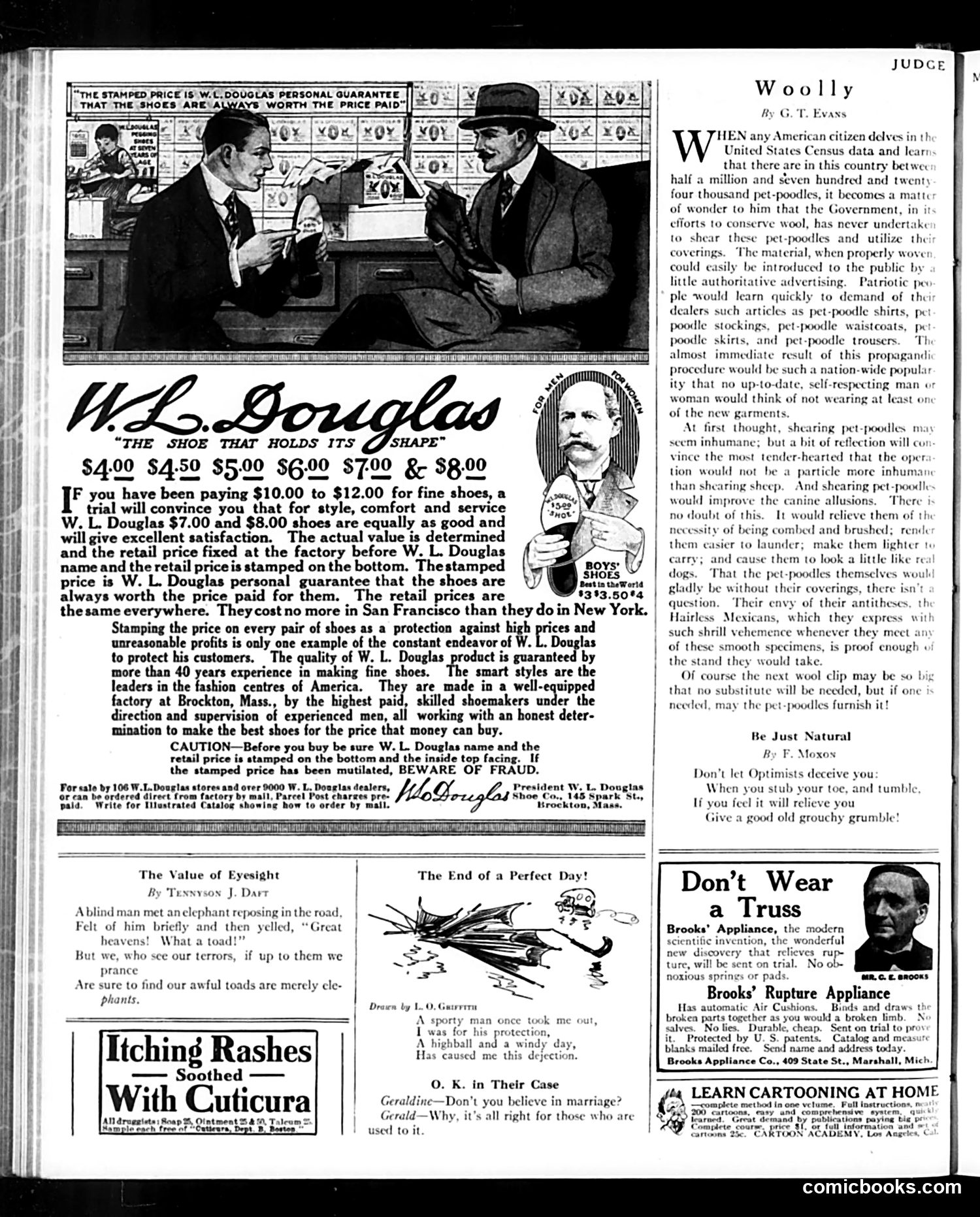
This page is primarily **advertising for W.L. Douglas shoes**, a major early 20th-century brand. The large advertisement features two men in suits discussing shoes, with price guarantees stamped on the bottom—Douglas's signature marketing innovation. The text emphasizes value: shoes costing $7-8 dollars are claimed equal to competitors' $10-12 products. The right column contains **satirical articles** unrelated to shoes. "Woolly" by G.T. Evans humorously proposes the U.S. government should harvest wool from the 500,000+ pet poodles in America to conserve resources—comparing it to sheep-shearing and joking that poodles secretly envy "Hairless Mexicans" (a dog breed). This is a patriotic conservation satire, likely from WWI era when wool was rationed. The other brief pieces—"Be Just Natural," "The Value of Eyesight," and "O.K. in Their Case"—are typical Judge magazine humor: short, cynical observations on everyday life.
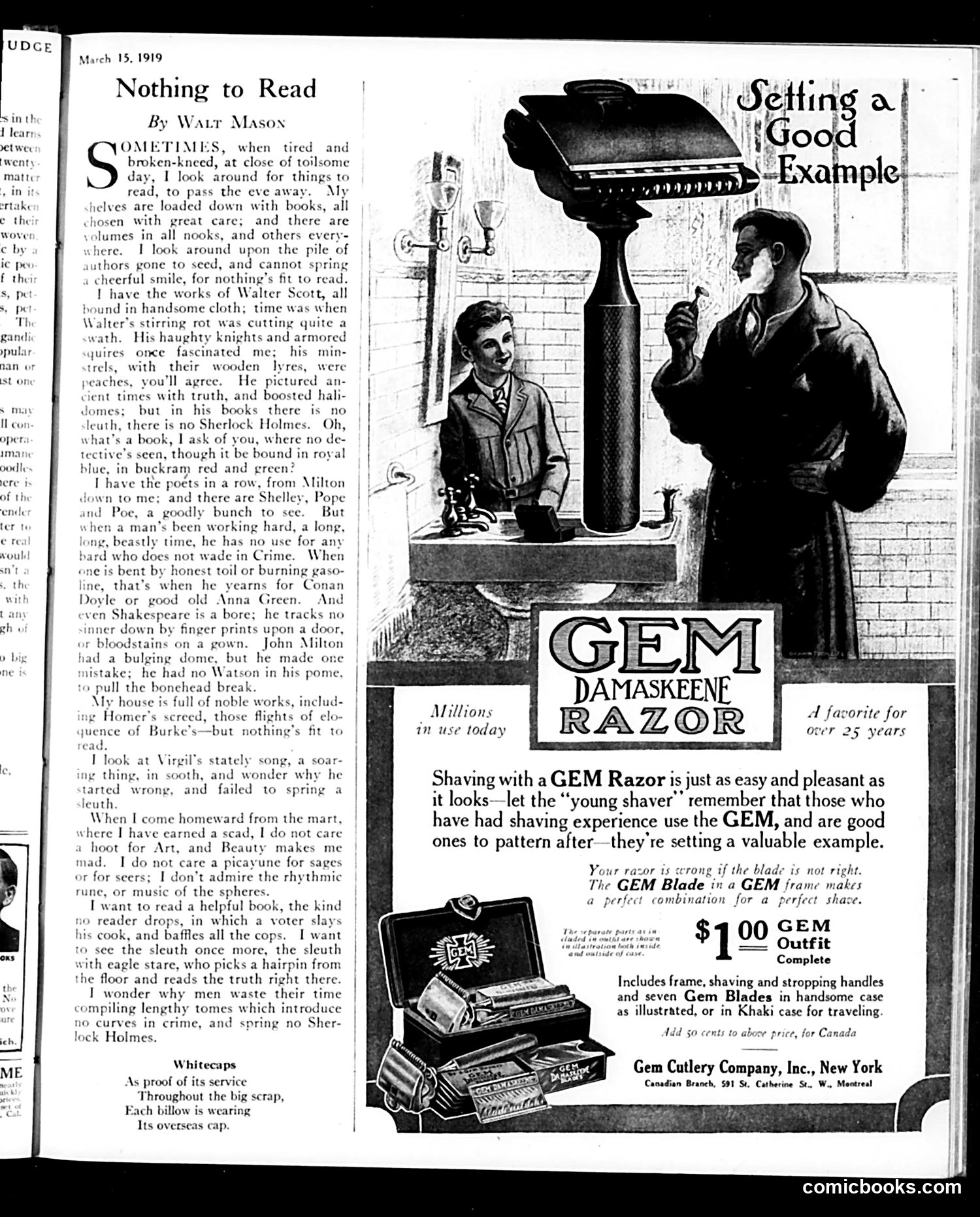
This page contains two distinct elements: a satirical essay and a razor advertisement. **"Nothing to Read" Essay (Left Side):** Walt Mason's 1919 column satirizes modern reading tastes. Mason complains that his classical library—works by Walter Scott, Shakespeare, Milton, and Virgil—now seems worthless because readers demand detective fiction and crime stories instead. He mocks how men tired from honest labor no longer appreciate "noble works" but crave mystery novels featuring Sherlock Holmes-type detectives solving crimes through fingerprints and bloodstain analysis. The satire's point: popular culture and mass-market detective fiction were displacing serious literature, a concern reflecting early 20th-century anxieties about declining literary standards. **"Setting a Good Example" (Right Side):** A GEM Damascene razor advertisement shows an adult demonstrating proper shaving technique to a young boy, marketed as "setting a valuable example." The ad emphasizes the razor's 25-year reputation and affordability ($1.00 complete). The advertisement exploits aspirational messaging common to the era: purchasing quality goods demonstrates good judgment and moral character.
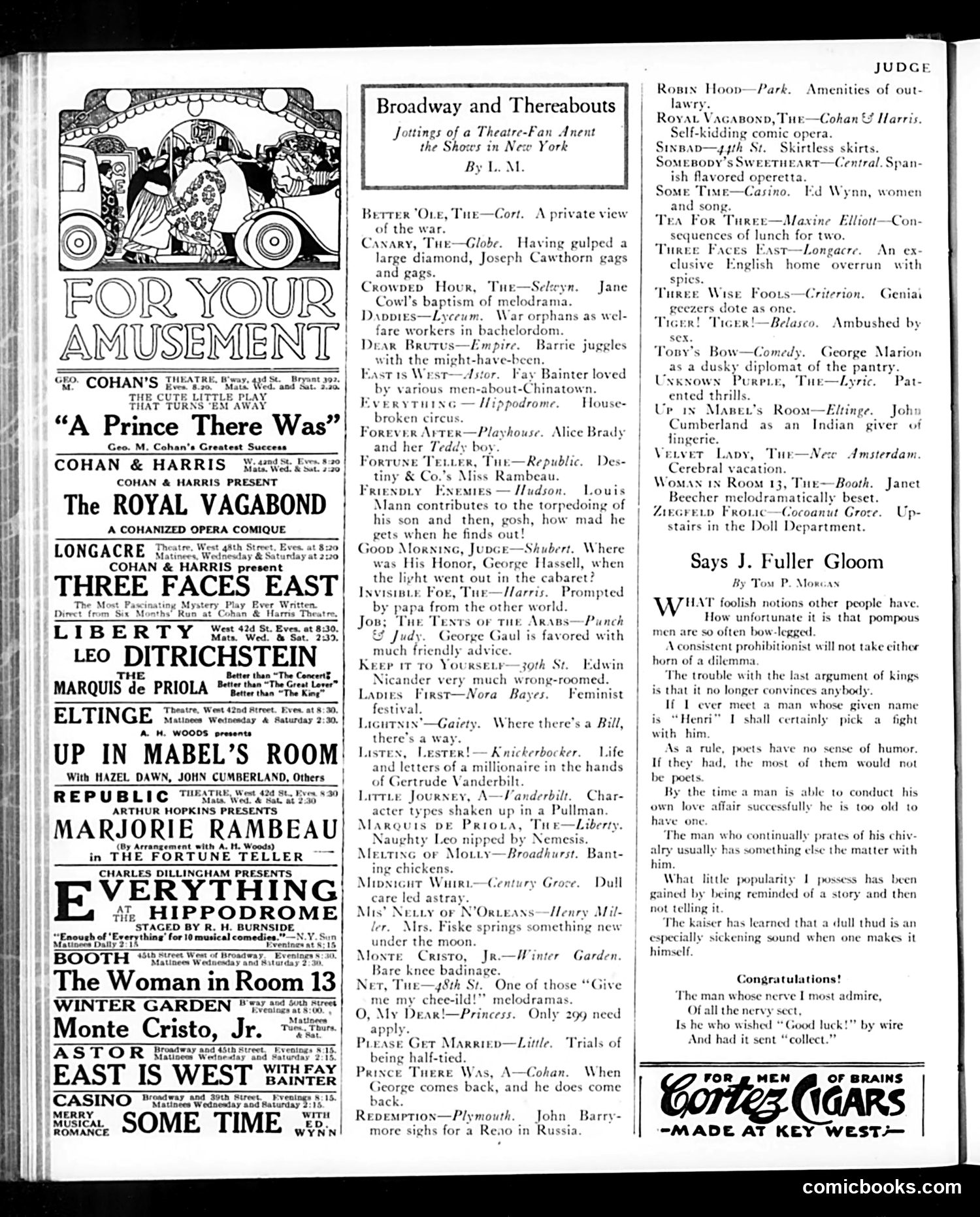
This page is primarily **theater listings and advertisements** for New York shows, with a small section of theater criticism by "J. Fuller Gloom" on the right side. The cartoon at the top left depicts a theater performance scene with an ornate proscenium arch and audience members, illustrating the "For Your Amusement" theme. **The criticism** is a humorous opinion piece about male behavior. Gloom sarcastically critiques men for pompousness and affectation, suggesting they're delusional about their own importance. He jokes that "a dull thud is an especially sickening sound when one makes it himself"—implying self-important men are oblivious to how ridiculous they appear. The piece is a light social satire targeting masculine vanity and pretense, typical of Judge's satirical tone toward contemporary social foibles. The bulk of the page consists of Broadway theater advertisements and plot summaries of current productions, many involving romantic plots and comedies popular in this era (appears to be early 1920s based on style).
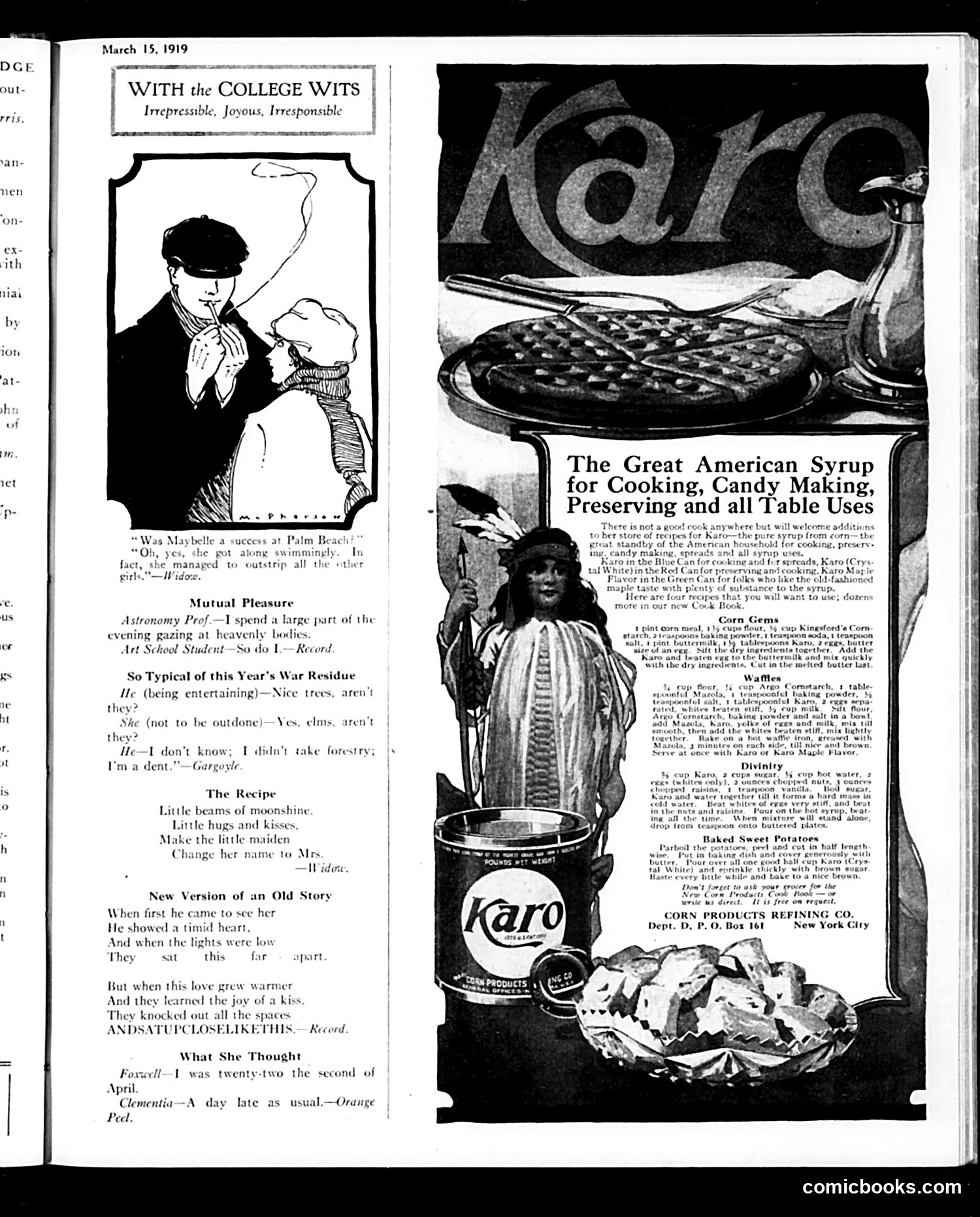
This page mixes college humor with advertising. The left column features "College Wits"—brief jokes targeting young students and romantic courtship customs of the era. The humor centers on predictable tropes: astronomy students gazing at "heavenly bodies" (double meaning), post-war dating etiquette, and a poem about couples sitting progressively closer during romantic moments. The recurring theme is youthful romance and social awkwardness, typical of college humor magazines of that period. One joke references forestry knowledge as something "dents" (dentistry students) wouldn't possess—suggesting inter-departmental ribbing. The right side is primarily a Karo syrup advertisement featuring a large bottle and promotional text about cooking uses. The ad is unrelated to the satirical content; Judge survived through advertising revenue alongside its editorial humor.
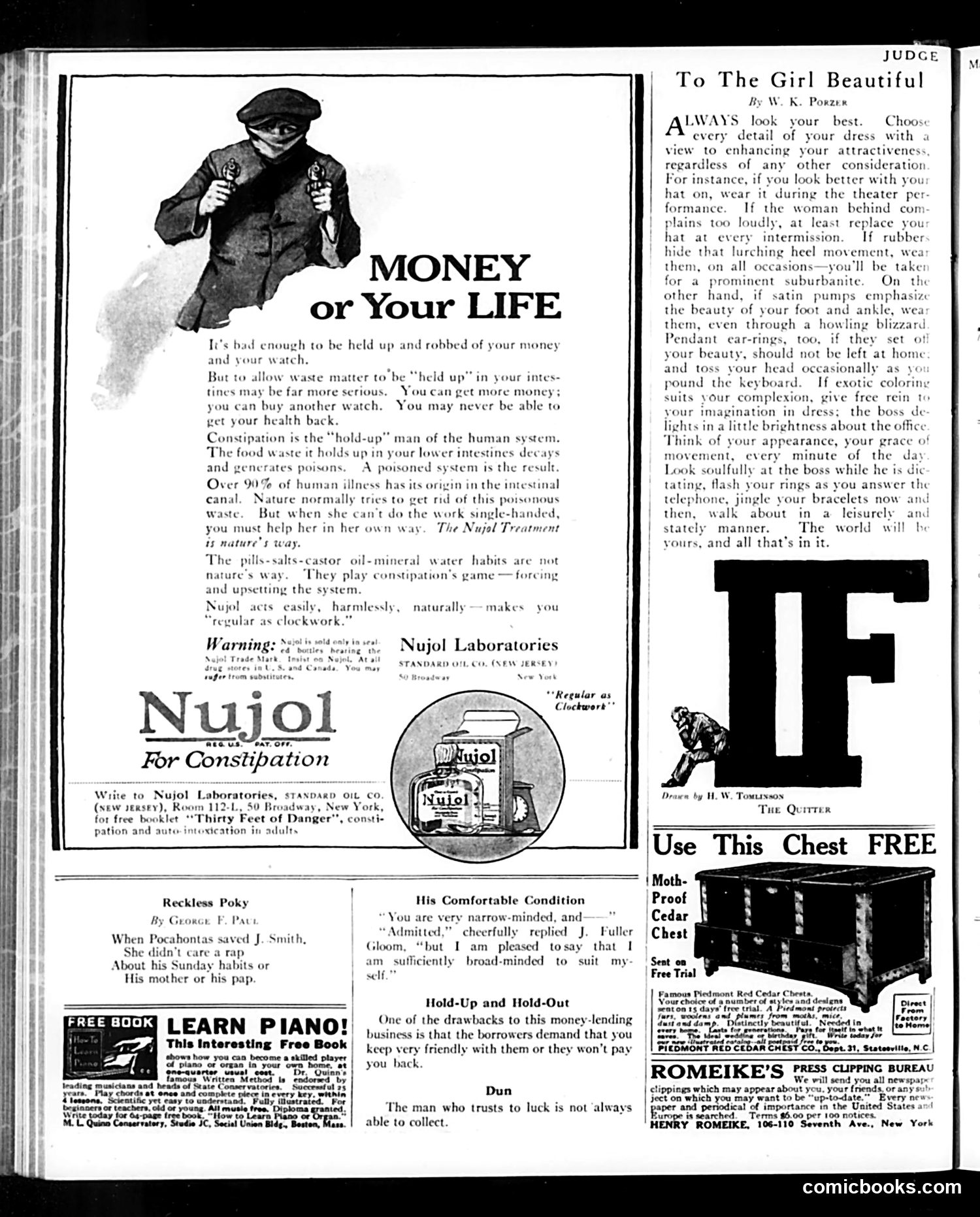
This page mixes satirical editorial content with period advertisements. The main cartoon/article "Money or Your Life" uses constipation as extended metaphor for societal problems. A figure depicted as a criminal ("hold-up" man) represents constipation literally blocking the human digestive system. The satire argues that waste retention is worse than robbery because it poisons the body—a common early-20th-century health anxiety linking bowel regularity to overall vitality. The accompanying Nujol advertisement capitalizes on this fear, promoting a laxative as "nature's way" versus harsh pills and salts. The page reflects Progressive Era obsession with bodily efficiency and scientific solutions to health. The sidebar "To The Girl Beautiful" offers satirical advice about appearance and workplace behavior, suggesting women should prioritize looking attractive over consideration for others (wearing hats in theaters despite blocking views). Lower sections contain unrelated comic snippets and advertisements typical of Judge's format—mixing humor, medical/patent remedies, and consumer goods.
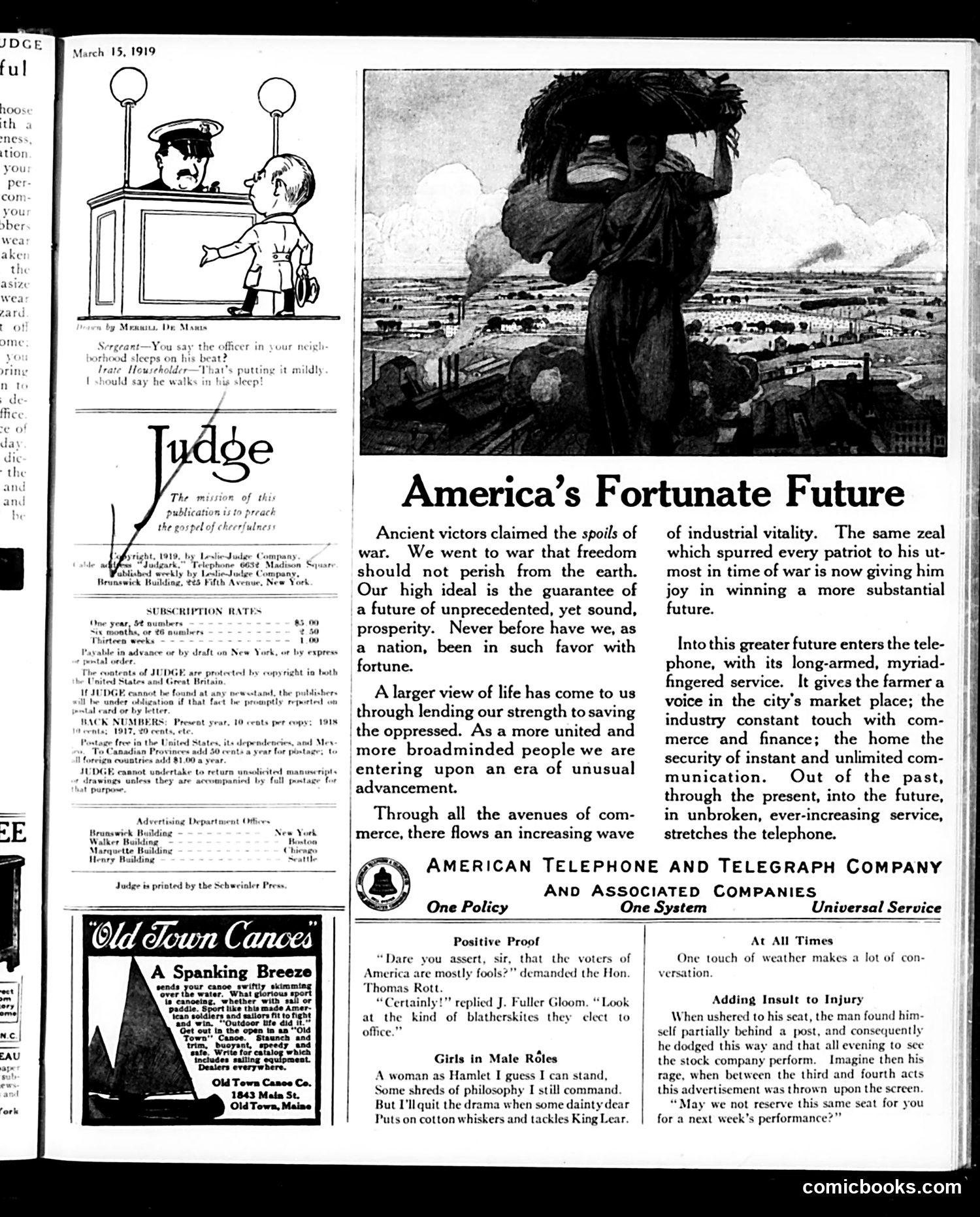
This page is primarily an **AT&T advertisement** disguised as editorial content, titled "America's Fortunate Future." Published just after WWI's end, it frames telephone infrastructure as essential to post-war American prosperity and national advancement. The ad argues that just as patriotism won the war, the same spirit now drives industrial progress—with the telephone as the connective technology enabling farmers, industry, and homes to communicate seamlessly. The left column contains brief satirical jokes: one mocks voters as "fools" for electing incompetent politicians; another jokes about actresses playing male Shakespearean roles (a topical reference to early 20th-century theatrical trends); a third humorously complains about theater patrons being partially blocked by pillars, then insulted by ads during intermission. The page reflects 1919 optimism about technology and American recovery, while the small jokes provide typical Judge-style domestic and political humor.
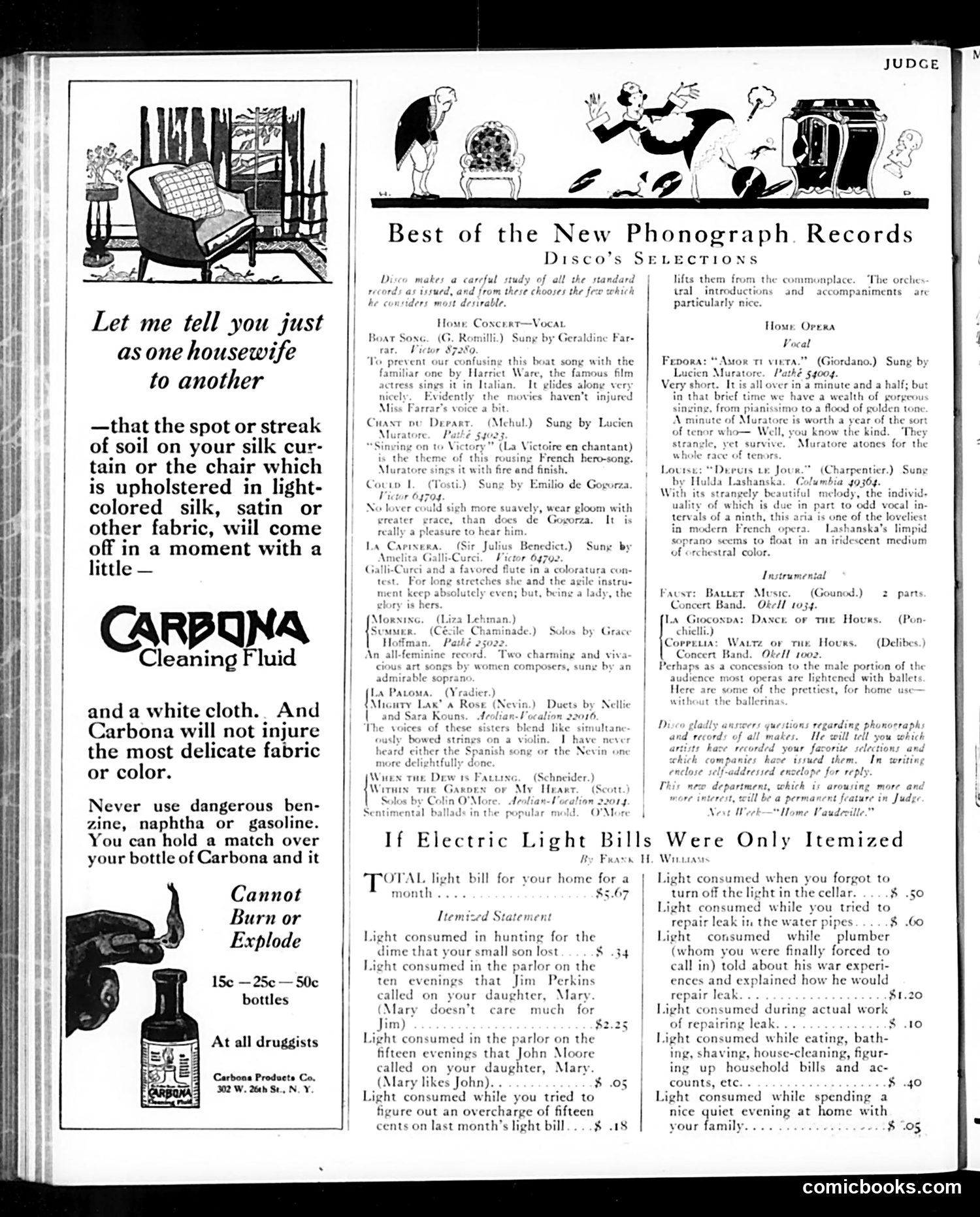
This page contains **two unrelated pieces**: a Carbona cleaning fluid advertisement (left) and phonograph record reviews with a satirical article (right). **The Advertisement** uses the common early 20th-century marketing tactic of "housewife-to-housewife" testimonials. It emphasizes Carbona's safety by demonstrating you can hold a match over the bottle without explosion—a selling point distinguishing it from flammable competitors like gasoline or benzene. **The Satire**: "If Electric Light Bills Were Only Itemized" humorously breaks down a $5.67 monthly electric bill into absurd line items: light used while searching for a lost item ($34), entertaining suitors ($2.25 each for competing boyfriends), failed home repairs, and leisure activities. The joke mocks both the opaque nature of utility billing and domestic life's inefficiencies—wasted electricity on hunting, courtship, and failed DIY repairs. It's gentle middle-class humor targeting household frustrations rather than political commentary.
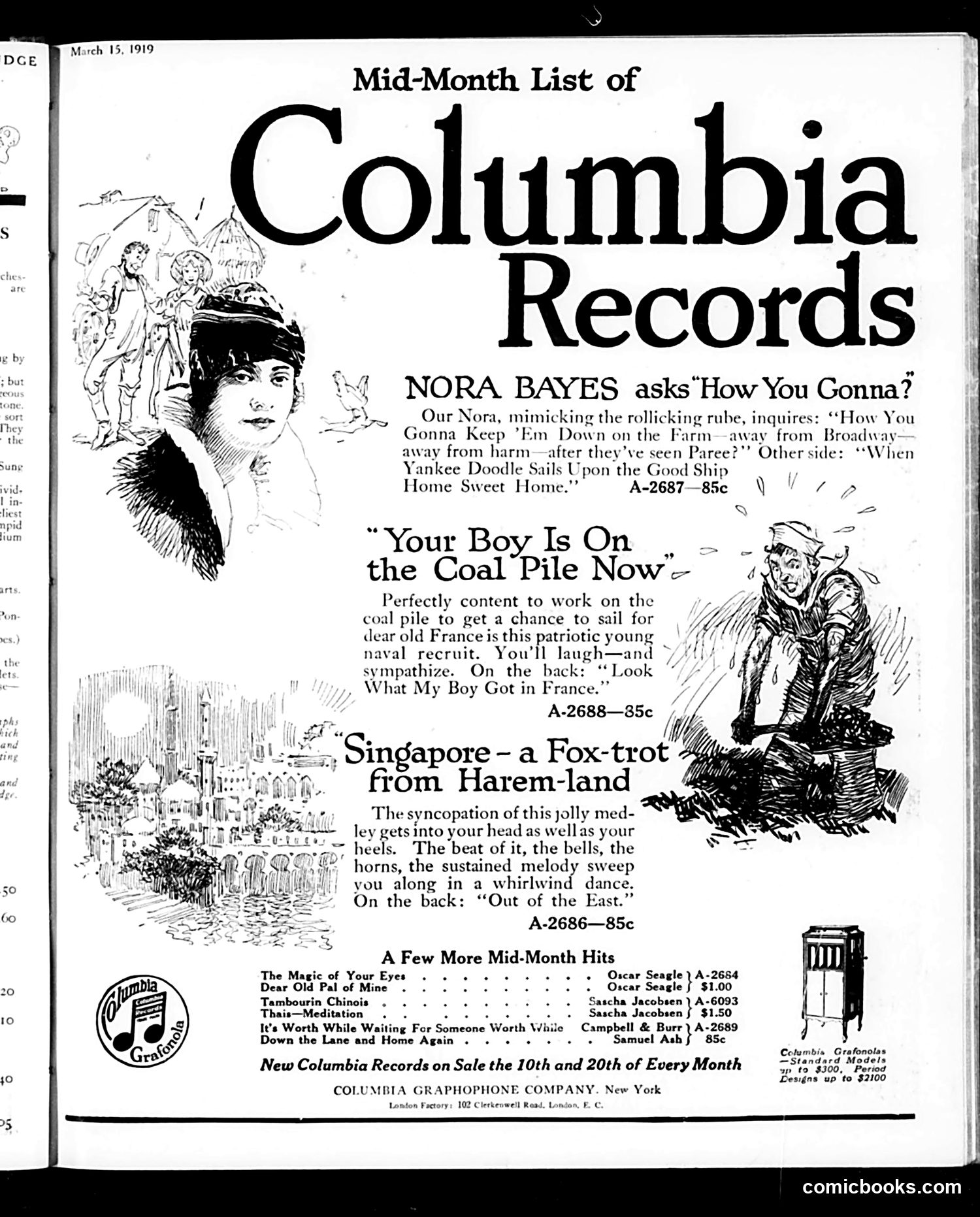
This is primarily a **record advertisement**, not political satire. However, the song titles reflect WWI-era themes relevant to March 1919 (just after the Armistice): **"How You Gonna Keep 'Em Down on the Farm"** — A famous 1919 song about soldiers returning from France. The joke: rural boys who've experienced Paris and war won't settle for farm life anymore. Singer Nora Bayes performs this hit. **"Your Boy Is On the Coal Pile Now"** — A patriotic novelty record celebrating young men working menial jobs (coal piles) to earn passage serving in France during the war. The sentimental B-side asks what souvenirs he brought home. **"Singapore - a Fox-trot from Harem-land"** — An exotic dance number, unrelated to the war theme. The page captures post-WWI American culture: soldiers' restlessness after European exposure, patriotic nostalgia, and the entertainment industry capitalizing on wartime emotions through popular song recordings.
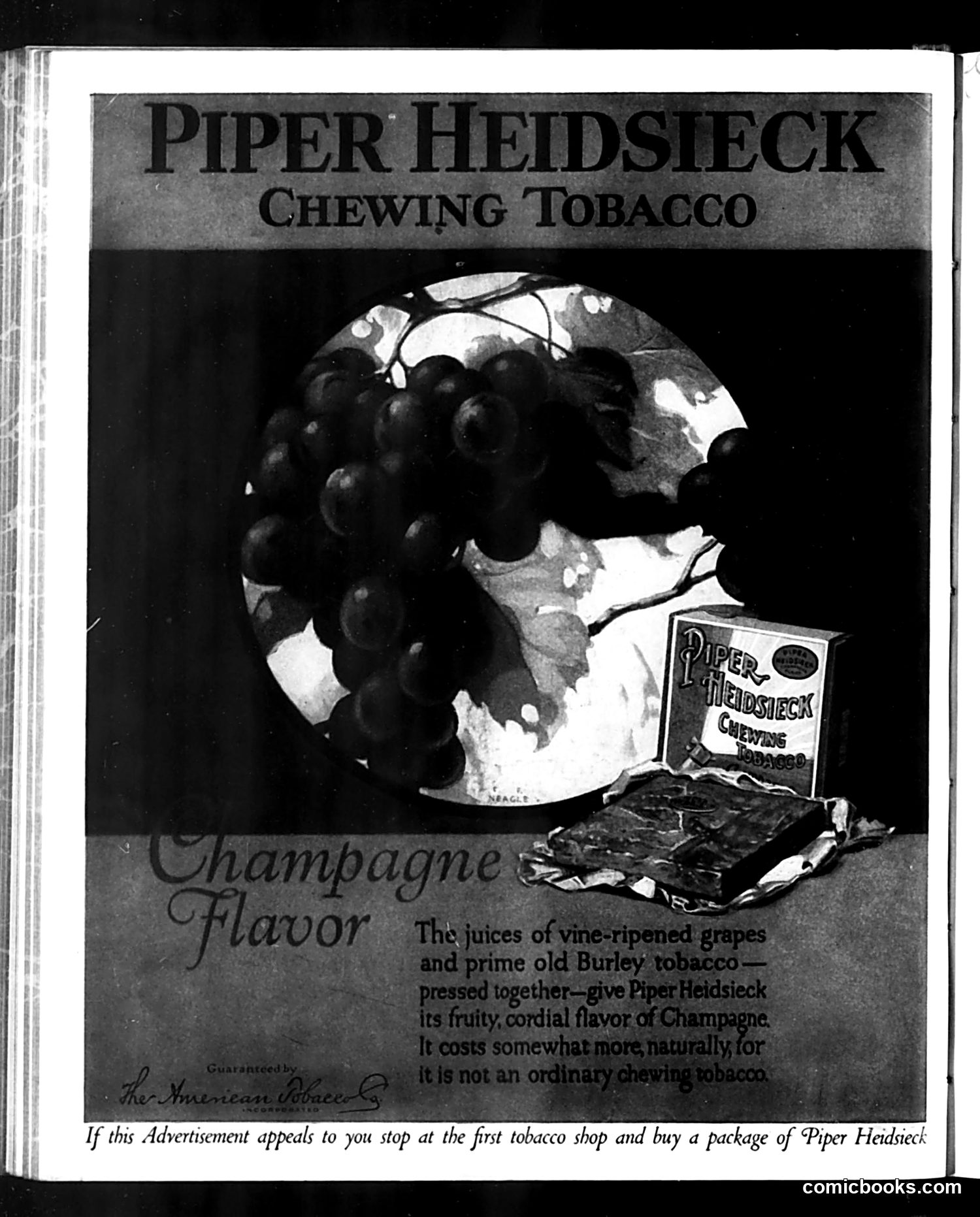
This is a **commercial advertisement**, not satirical content. It promotes Piper Heidsieck chewing tobacco, emphasizing a "Champagne Flavor" variant. The ad features a large bunch of dark grapes with a product package displayed nearby. The pitch combines grapes and "prime old Burley tobacco" to create a fruity, champagne-like chewing experience. The advertisement acknowledges this costs more than ordinary chewing tobacco, positioning it as a premium product. The call-to-action encourages readers to purchase the product at tobacco shops. This represents straightforward early 20th-century advertising in *Judge* magazine—using food imagery and luxury associations to market tobacco products, before modern health warnings or advertising restrictions existed.