
Judge, 1919-03-15 · page 19 of 36
Judge — March 15, 1919 — page 19: what you’re looking at
What you’re looking at
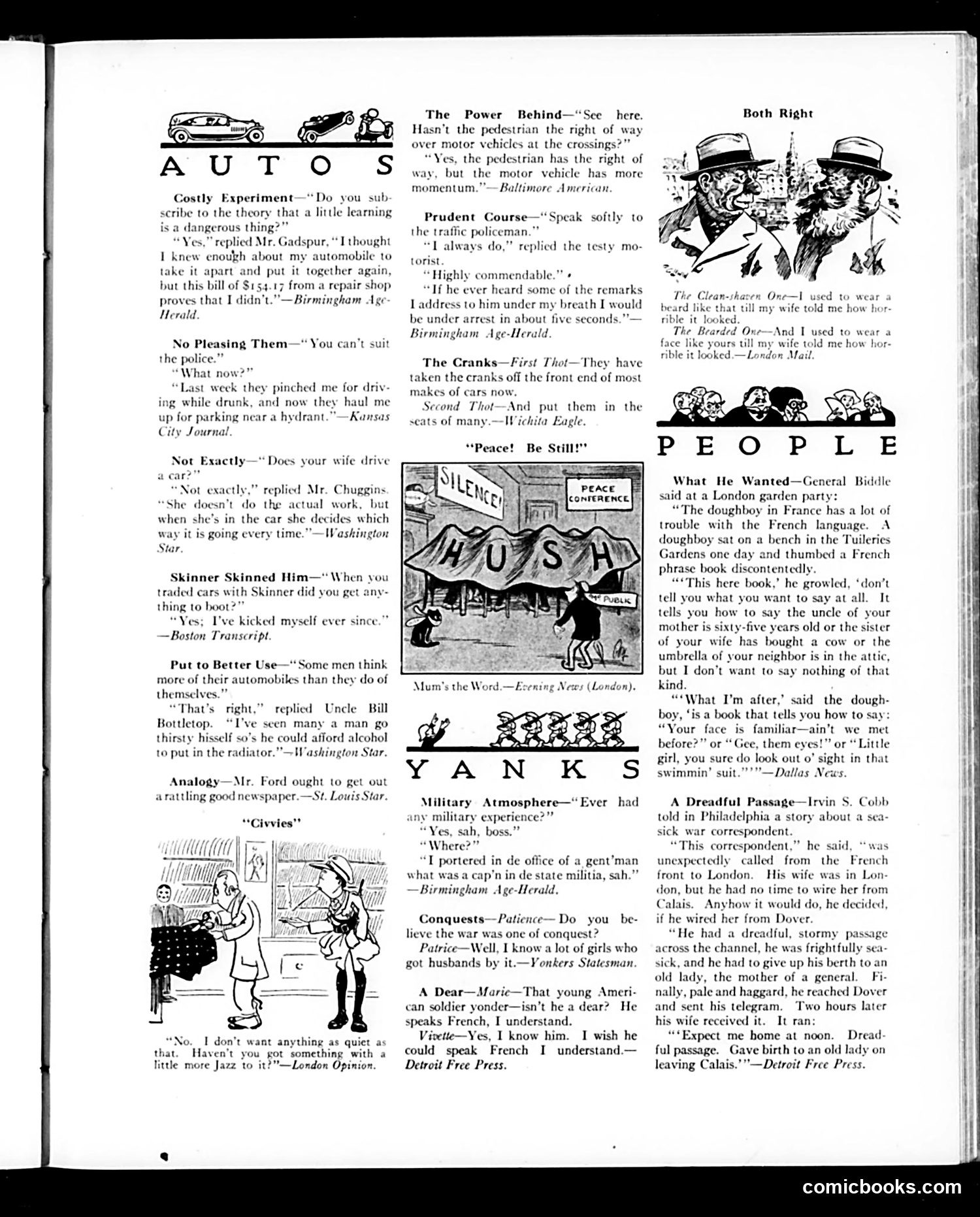
This page from **Judge** (a satirical magazine) collects brief automobile-related humor pieces reflecting post-WWI American culture. The jokes mock: 1. **Male incompetence with cars**: Men overestimate mechanical knowledge, leading to expensive repair bills; wives actually control direction despite men "driving." 2. **Traffic enforcement absurdity**: Police enforce contradictory parking rules; motorists hide frustration behind fake politeness toward officers. 3. **Class/race humor**: A porter's "military experience" consists of working for an officer—reflecting period racial attitudes. 4. **Automobile obsession**: Men prioritize cars over drinking, suggesting emerging car culture's grip on American society. 5. **WWI soldier culture**: American "doughboys" in France struggle with the language, wanting practical phrases rather than textbook examples. The cartoons and anecdotes collectively satirize the rapid social changes automobiles brought—challenging traditional gender roles, authority structures, and American soldiers' encounters abroad—through lighthearted, period-typical humor.
📄 Transcribed text from this page (OCR, searchable)
Machine-transcribed from the original scan — historical spelling and the odd misread are preserved.
Costly Experiment—*Do you sub scribe to the theory that a little learning is a dangerous thing?” “Yes,” replied Mr. Gadspur, “I thought I knew enough about my automobile to take it apart and put it together again, but this bill of $154.17 from a repair shop proves that I didn’t.” —Birmingham Age Herald. No Pleasing Them—“ You can’t suit the police. “What now?” “Last week they pinched me for driv- ing while drunk, and now they haul me up for parking near a hydrant.”"—Kansas City Journal. Not Exactly—* Does your wife drive acar?” Not exactly,”” replied Mr. Chuggins “She doesn’t do the actual work, but when she’s in the car she decides which way it is going every time.” —IWashkington Star. Skinner Skinned Him—" When you traded cars with Skinner did vou get any- thing to boot?” “Yes; I've kicked myself ever since —Boston Transcript. Put to Better Use—‘* Some men think more of their automobiles than they do of themselves. “That's right,” replied Uncle Bill Bottletop. “I’ve seen many a man go thirsty hisself so’s he could afford alcohol to put in the radiator.” Washington Star, Analogy—Mr. Ford ought to get out arattling good newspaper.—St. Louis Star. “Civvies”’ “No. I don’t want anything as quiet as that. Haven't you got something with a little more Jazz to it?”—London Opinion. The Power Behind—“Sce here. Hasn't the pedestrian the right of wa over motor vehicles at the crossings? “Yes, the pedestrian has the right of way, but the motor vehicle has more mentum Baltimore American. Prudent Course—“Speak softly to the traffic policeman.” I always do,” replied the testy mo- torist “Highly commendable.” « “If he ever heard some of the remarks 1 address to him under my breath I would be under arrest in about five seconds.”"— Birmingham Age-Herald. The Cranks—First Thot—They have taken the cranks off the front end of most makes of cars now. Second Thot—And put them in the seats of many.—Wichita Eagle. “Peace! Be Still!” Military Atmosphere—“ Ever had y military experience?” “Yes, sah, boss.”” “Where?” “TI portered in de office of a gent’man what was a cap’n in de state militia, sah.”” —Birmingham Age-Herald, Conquests—Patience—Do you be- lieve the war was one of conquest? Patrice—Well, I know a lot of girls who got husbands by it.—Yonkers Statesman A Dear—Marie—That young Ameri- can soldier yonder—isn’t he a dear? He speaks French, I understand. Vivette—Yes, 1 know him. I wish he could speak French I understand.— Detroit Free Press. Both Right The Clean-shaven One—1 used beard like that till my wife told me how looked. ded One—And I used to we face like yours till my wife to t looked.—Lond What He Wanted—General Biddle said at a London garden part “The doughboy in France has a lot of trouble with the French language. A doughboy sat on a bench in the Tuileries rdens one day and thumbed a French phrase book discontentedly. “*This here book,’ he growled, ‘don’t tell you what you want to say at all. It tells you how to say the uncle of your mother is sixty-five years old or the sister of your wife has bought a cow or the umbrella of your neighbor is in the attic, but I don’t want to say nothing of that kind. “*What I’m after,’ said the dough- boy, ‘is a book that tells you how to say: “Your face is familiar—ain’t we met before?” or “Gee, them eyes!” or “ Little girl, you sure do look out o’ sight in that swimmin’ suit.”"’""—Dallas News. A Dreadful Passage—Irvin S. Cobb told in Philadelphia a story about a sea- sick war correspondent. This correspondent,” he said, unexpectedly called from the French front to London. His wife was in Lon- don, but he had no time to wire her from Calais. Anyhow it would do, he decided, if he wired her from Dover. “He had a dreadful, stormy passage across the channel, he was frightfully sea- sick, and he had to give up his berth to an old lady, the mother of a general. Fi- nally, pale and haggard, he reached Dover and sent his telegram. Two hours later his wife received it. It ran: “*Expect me home at noon. Dread- ful passage. Gave birth to an old lady on leaving Calais.’ —Detroit Free Press. was comicbooks.com