
A complete issue · 32 pages · 1919
Judge — February 8, 1919
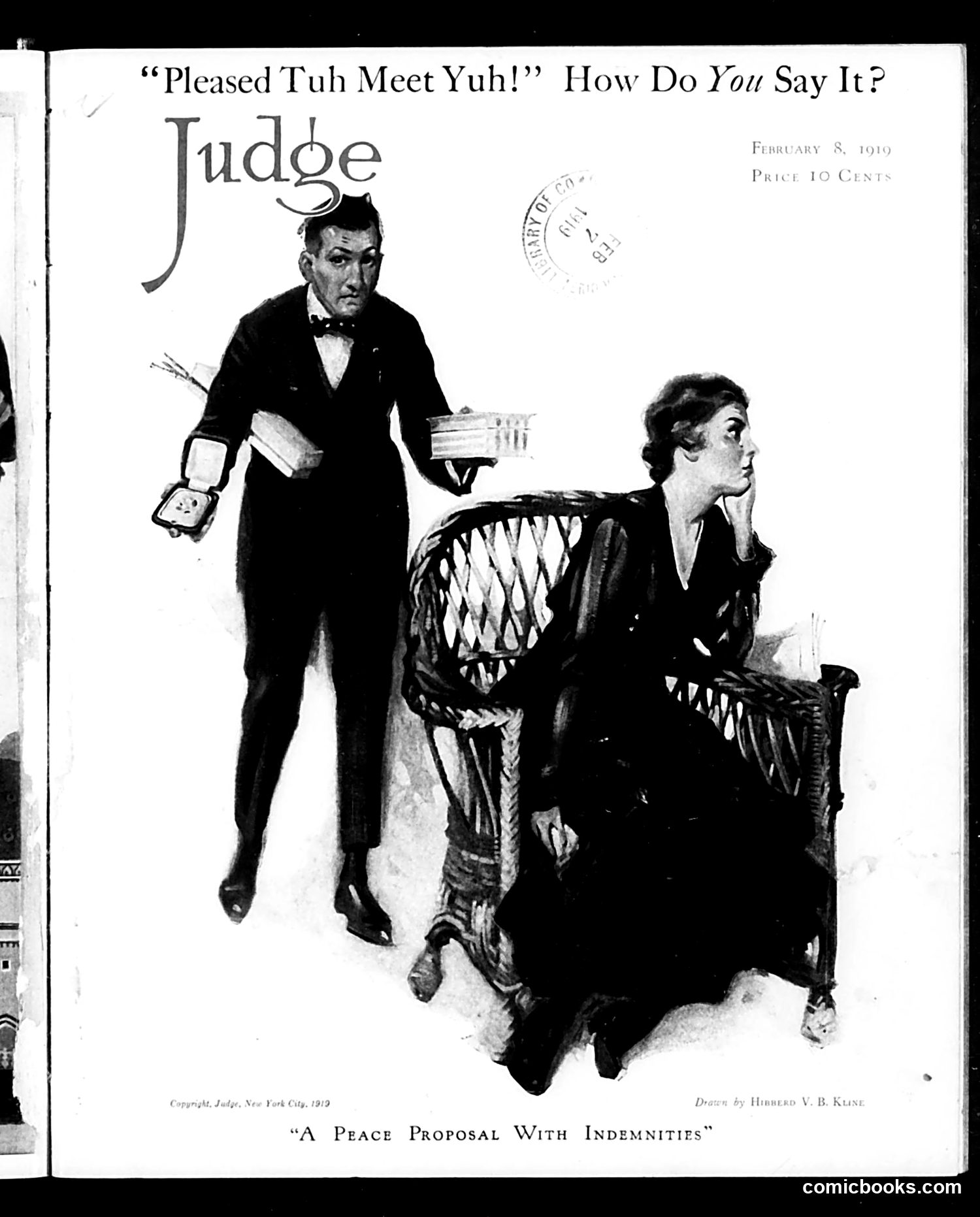
This political cartoon satirizes post-World War I peace negotiations. The caption "A Peace Proposal With Indemnities" suggests commentary on reparations being debated at the Paris Peace Conference (concluded just weeks later). The well-dressed man in the background appears to represent a diplomat or negotiator, while the woman in the ornate chair likely symbolizes a nation or national interest—possibly Germany or a defeated power. The "indemnities" (financial penalties) are humorously portrayed through the figure emerging from or inhabiting the chair itself, suggesting these monetary demands are inseparable from the peace terms. The overall message critiques how peace settlements were laden with punitive financial requirements rather than genuine reconciliation—a prescient commentary, as harsh reparations later fueled resentment.
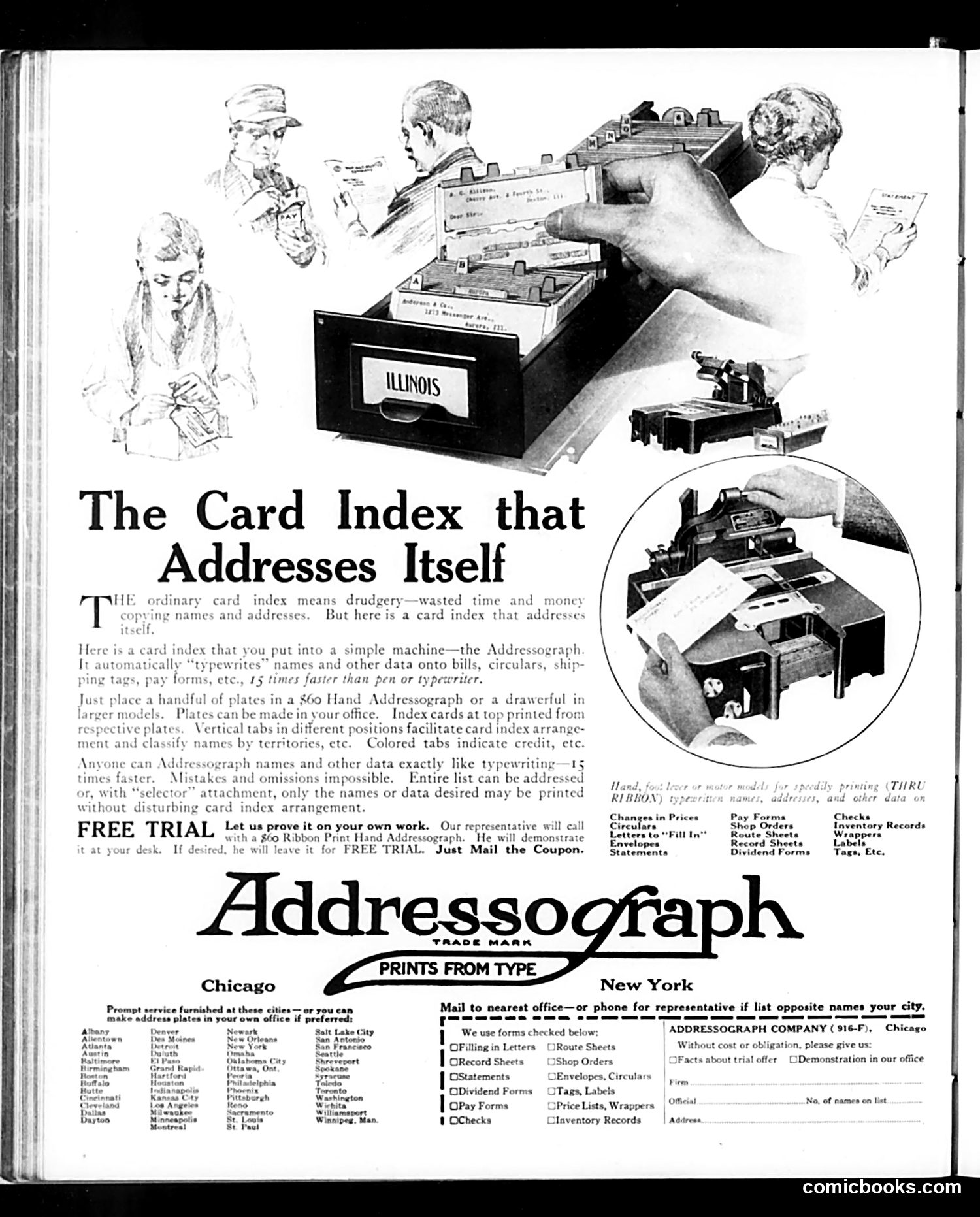
This page is primarily **advertising, not satire or political commentary**. It promotes the "Addressograph," a mechanical addressing machine marketed as a time-saving business tool. The headline claims the device "addresses itself"—meaning it automates the tedious task of copying names and addresses onto envelopes, bills, and circulars. The sketched figures on the left appear to be generic office workers, not political caricatures. The ad emphasizes the Addressograph prints "15 times faster than pen or typewriter" and offers a free trial. The circular inset shows the machine itself in operation. The bottom half lists office locations in Chicago and New York, with checkboxes for various business forms the machine could print on (pay forms, checks, labels, etc.). This is straightforward early-20th-century business equipment advertising, not editorial content.
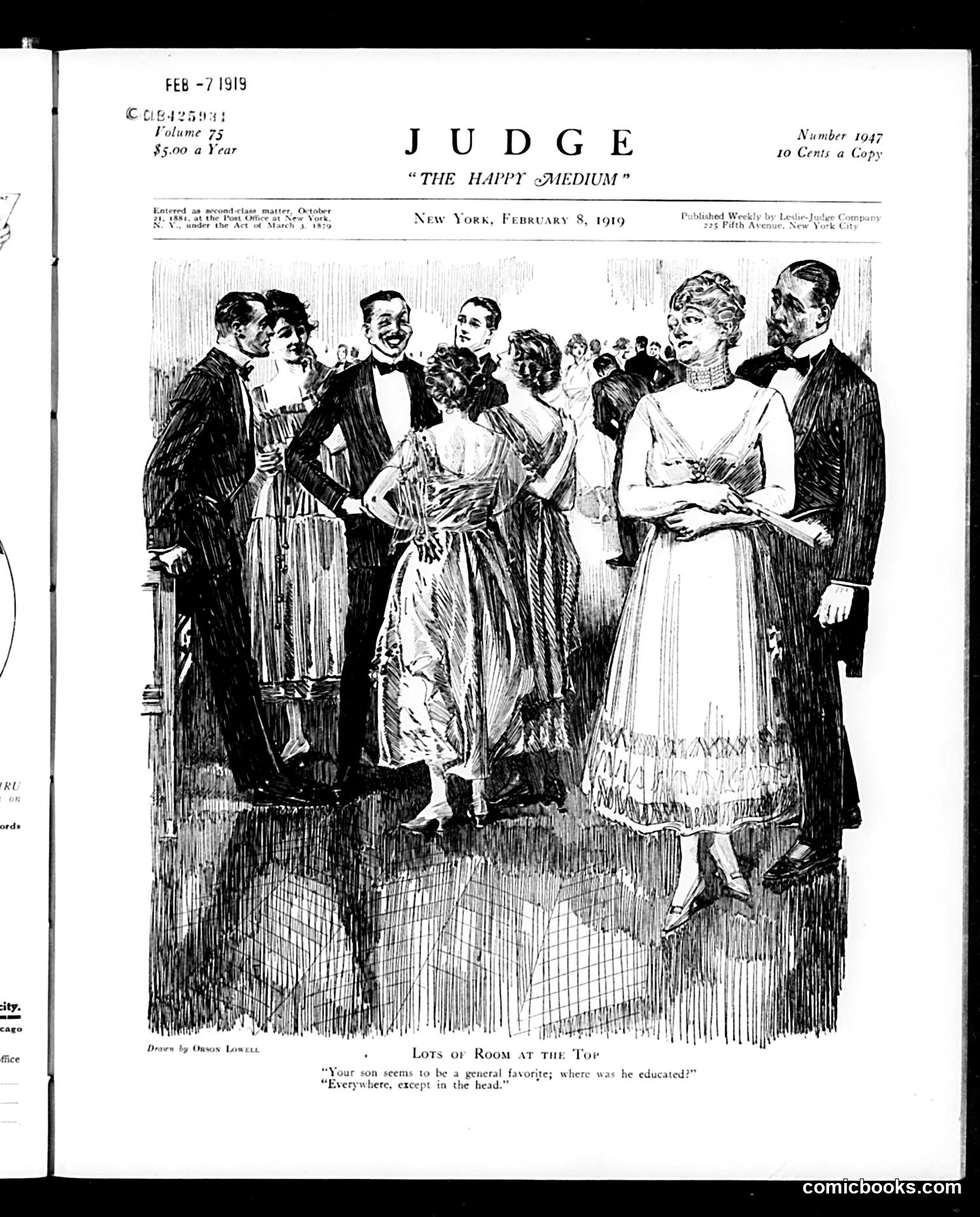
This cartoon, titled "Lots of Room at the Top," satirizes social mobility and education through a joke about a privileged young man. The caption reads: "Your son seems to be a general favorite; where was he educated?" / "Everywhere, except in the head." The scene depicts an elegant society gathering with well-dressed figures in formal attire. The satire mocks a wealthy family whose son is socially successful despite apparent lack of intelligence or serious education. The joke suggests that among the elite classes, social connections and manners matter more than actual intellect or learning. This reflects post-WWI American attitudes about class privilege and the superficiality of high society.
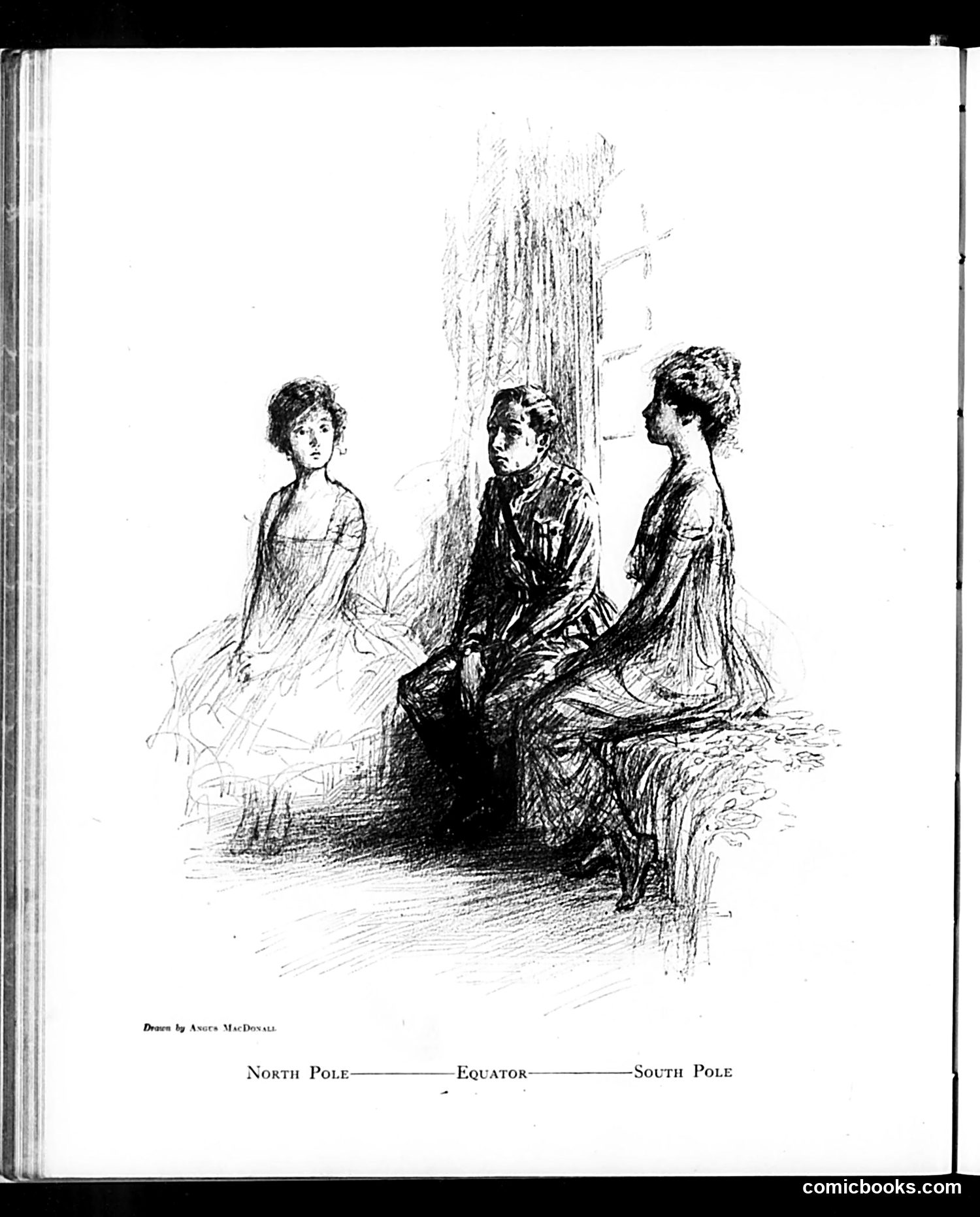
This sketch by Agnes MacDonald depicts three women seated together, labeled at the bottom as "North Pole — Equator — South Pole." The satire appears to comment on **women's fashion and body ideals across different "climates."** The central figure wears dark, heavy clothing (suggesting the bundled style of cold regions), while the figures on either side wear lighter garments. This likely mocks the **exaggerated differences in women's dress codes** supposedly required by geography—a satirical jab at Victorian-era fashion dictates that claimed women needed dramatically different silhouettes depending on location. The cartoon suggests these arbitrary fashion rules were absurd, as the women's actual body shapes appear similar despite their supposedly different "polar" positions. It's social satire targeting rigid fashion conventions of the era.
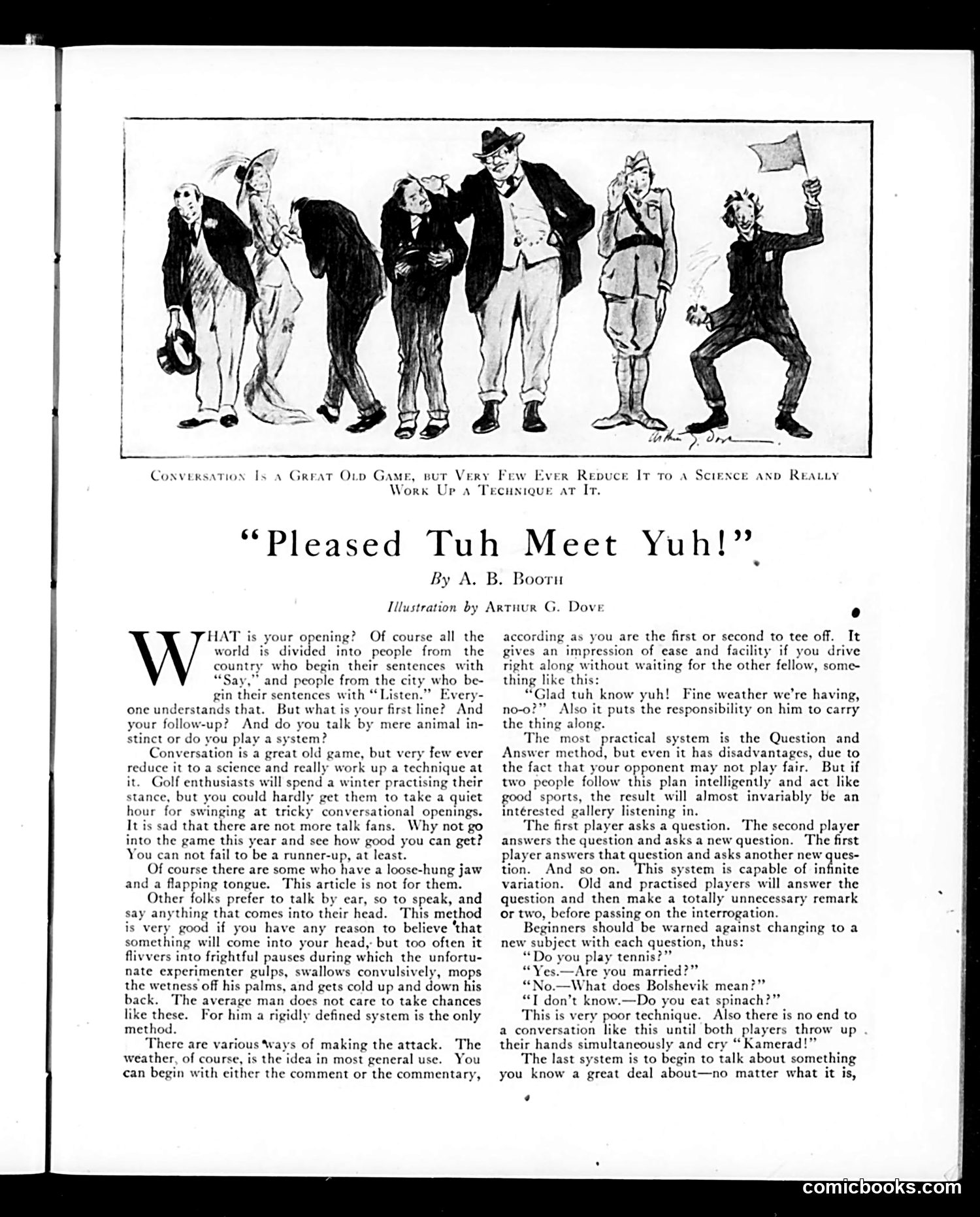
This article discusses conversation as a social skill, illustrating various conversational types through cartoon figures. The piece critiques people who lack conversational technique—those with "loose-hung jaws," excessive chatterers, and those who monopolize discussion. The satire targets social awkwardness in upper-class contexts, where conversation was considered an art requiring practice and skill. The illustration depicts different conversational personalities: the enthusiastic greeter, the shy participant, the aggressive interrupter, the military or authoritarian type, and the theatrical gesticulator. The article advocates the "Question and Answer method" as the most practical system for intelligent conversation. It warns against poor technique, such as abruptly changing subjects or forcing simultaneous hand gestures while saying "Knavero!"—satirizing affected, unnatural conversational behavior among the socially pretentious.
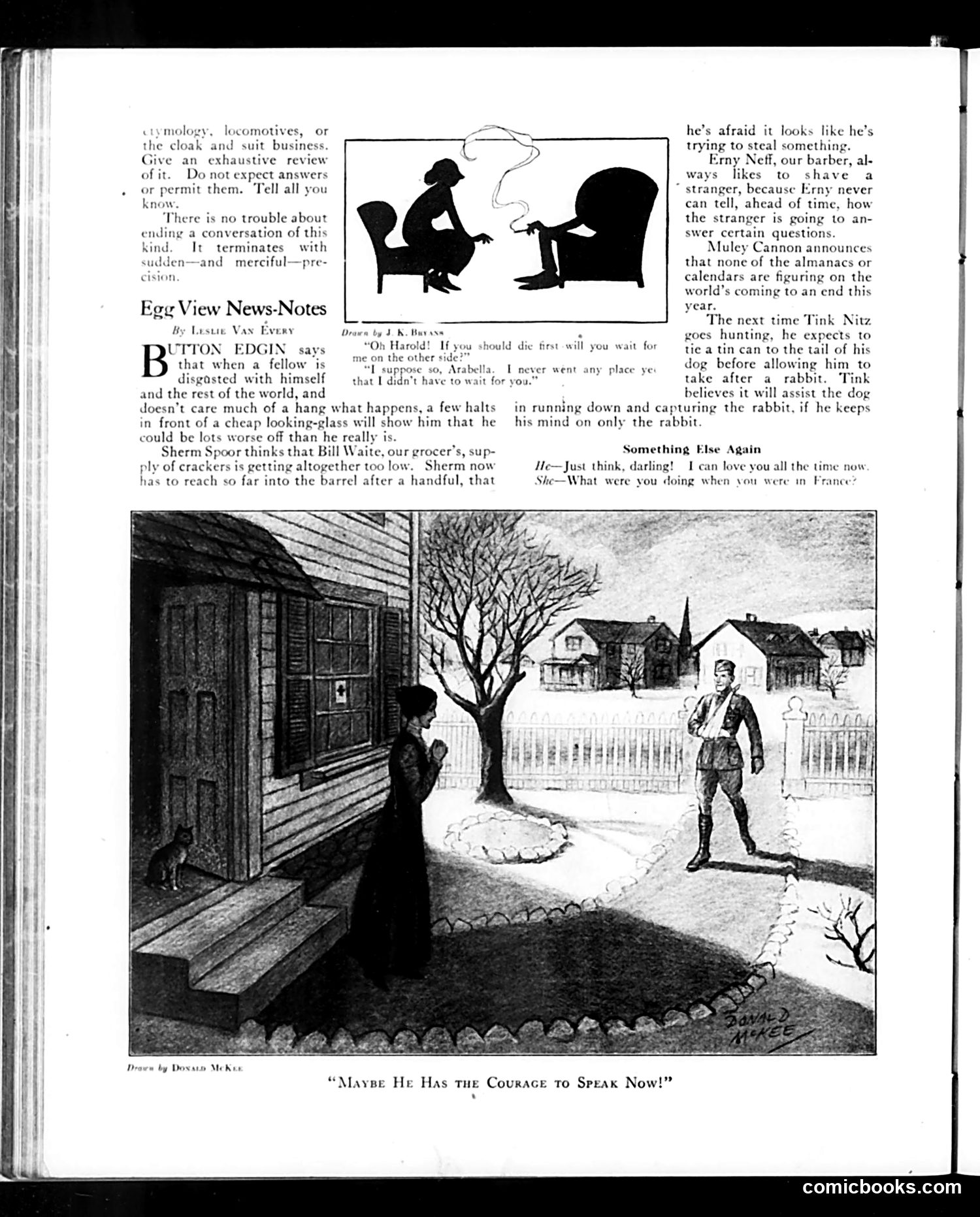
This page contains two unrelated sections: **Upper section ("Egg View News-Notes"):** Humorous anecdotes about local characters—Burton Edgin, Sherm Spoor, and others—making observations about human behavior (vanity, social climbing, courtship). These are brief jokes without political significance. **Lower cartoon ("Maybe He Has the Courage to Speak Now!"):** A winter scene showing a woman watching from a house window as a uniformed soldier approaches. The caption suggests the woman is hoping the soldier will finally declare his feelings. This appears to be a romantic/domestic joke about wartime, likely referencing WWI (based on the uniform style), playing on the anxiety of women waiting for soldiers to return and express their emotions. Neither section contains obvious political satire or caricature of public figures.
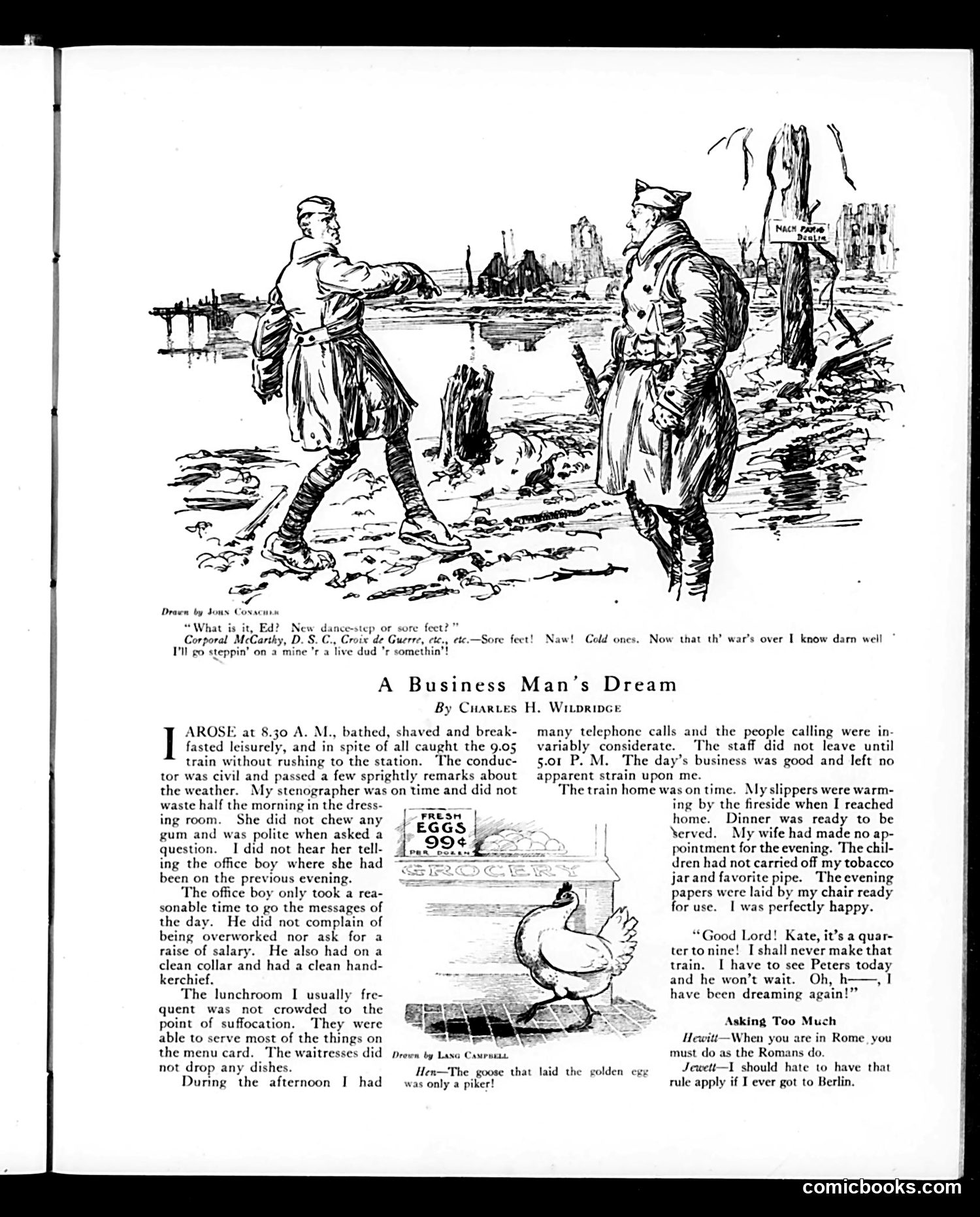
This page satirizes the unrealistic fantasies of American businessmen in the post-WWI era. The main story depicts an absurdly perfect day: employees arrive on time and behave respectfully, the stenographer doesn't gossip, lunch crowds are manageable, staff work late without complaint, and home life is ideal—wife prepared dinner, children didn't steal his tobacco. The punchline reveals it's a dream; he actually oversleeps and panics about missing his train. The top cartoon depicts a war-weary soldier (identified by military decorations: D.S.C., Croix de Guerre) complaining about sore feet now that WWI has ended—implying soldiers faced harsh conditions during combat and expect relief in peacetime. The "golden egg" goose illustration is a visual joke about unrealistic expectations, referencing Aesop's fable about killing the goose that laid golden eggs—a metaphor for destroying something valuable through impatience or greed. Together, these pieces mock both postwar disillusionment and the impossibly optimistic expectations businessmen held about returning to normalcy.
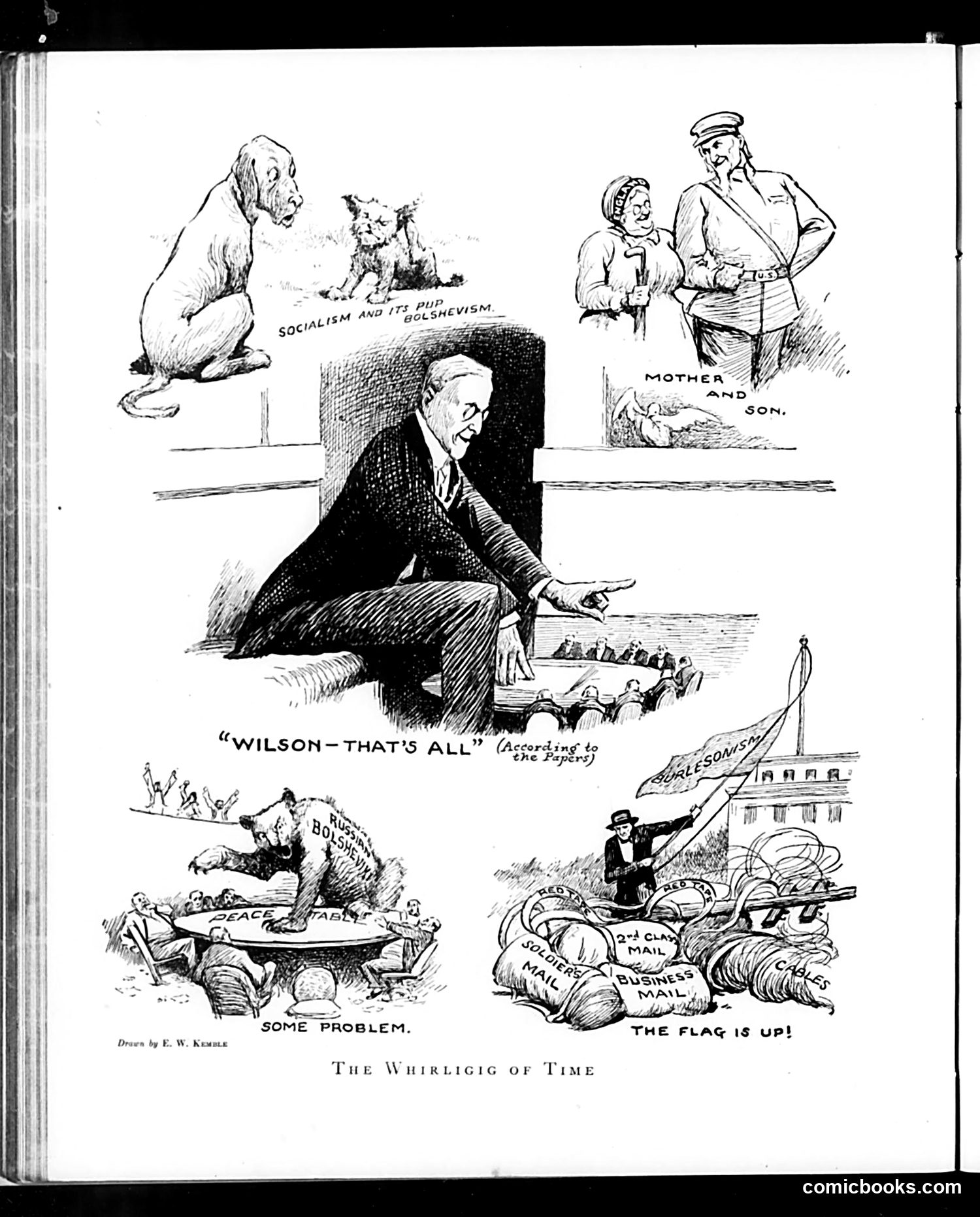
This political cartoon by E.W. Kemble satirizes President Wilson's handling of multiple crises. The central figure (Wilson) is depicted overwhelmed by competing demands: socialism and Bolshevism (top left), a mother and son (top right), domestic problems including mail delivery and business issues (bottom right labeled "The Flag is Up!"), and labor unrest (bottom left, labeled "Some Problem"). The title suggests time's cyclical nature—Wilson faces a dizzying array of simultaneous problems he cannot fully resolve. The "whirligig" metaphor conveys chaotic spinning. The cartoonist critiques Wilson's administration as unable to manage post-WWI America's social upheaval, economic disruption, and ideological tensions simultaneously. The satirical framing suggests these crises spin endlessly without clear solutions.
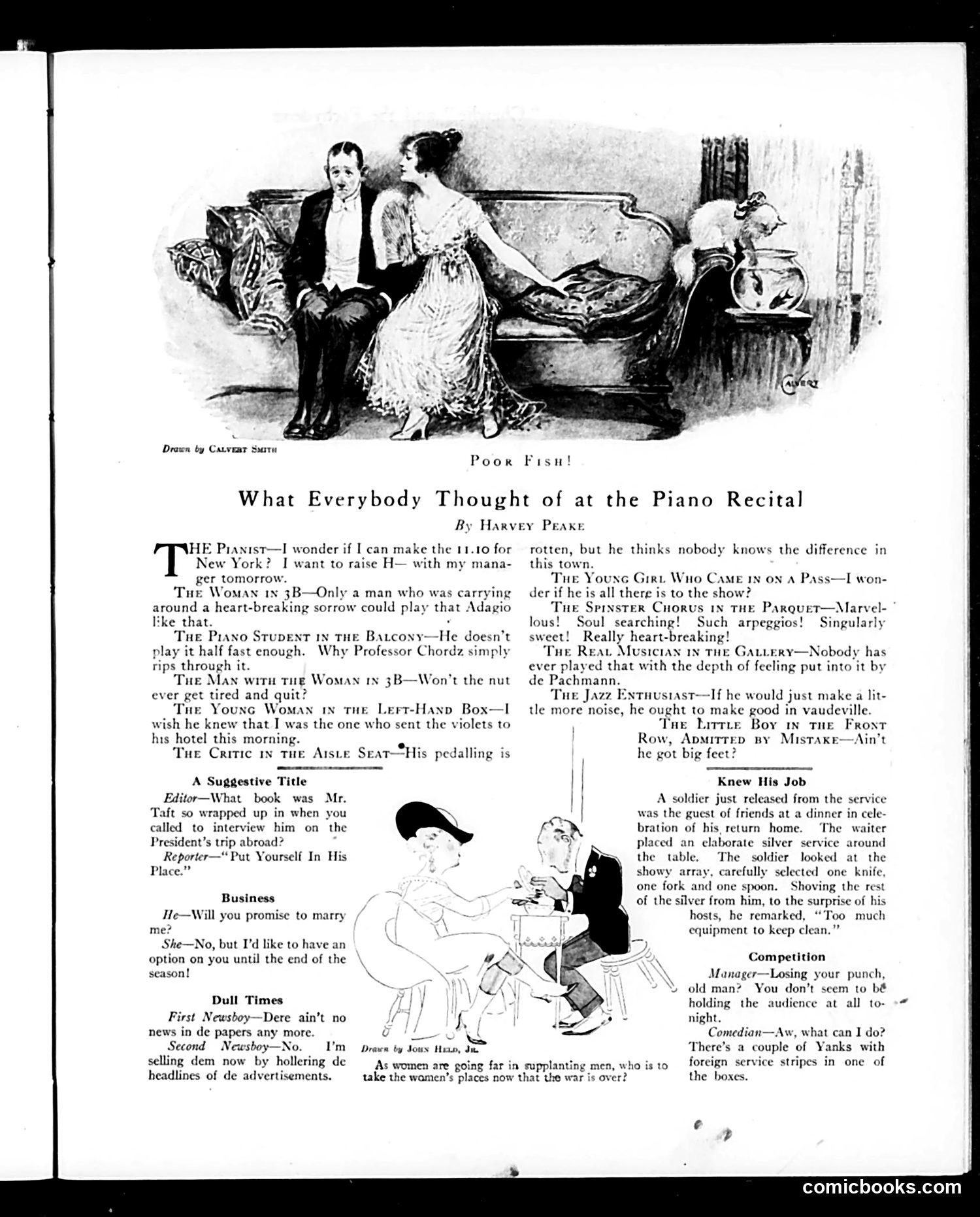
This page satirizes the pretensions and distracted thoughts of concert-goers attending a piano recital. Rather than listening genuinely, each audience member mentally indulges selfish concerns: the pianist worries about catching a train and his manager; an emotionally-moved woman romanticizes the performer; a student judges his technique; a couple wants him to finish; a young woman hopes he noticed her flowers; and a critic focuses on pedaling technique. A child simply notices his large feet. The humor lies in the gap between polite concert etiquette and actual internal thoughts—nobody is truly engaged with the music itself. The title "Poor Fish!" suggests the naive pianist, unaware his audience isn't genuinely appreciating his performance. The surrounding short humor pieces mock wartime social changes and romantic/business absurdities, likely from the WWI era given references to soldiers and women's new roles.
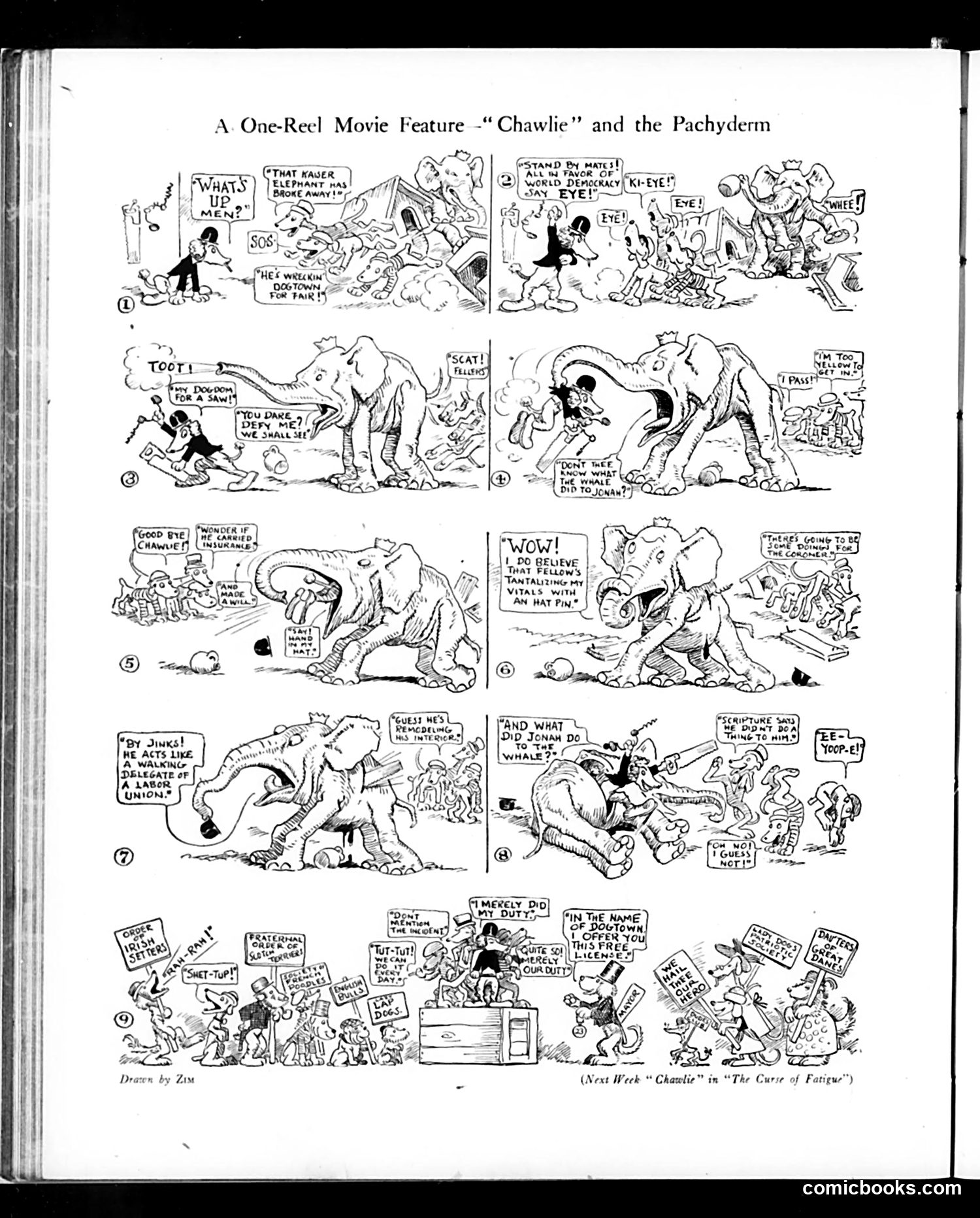
This is a satirical comic strip lampooning Charlie Chaplin's famous "Tramp" character encountering an elephant (the pachyderm). The strip parodies both Chaplin's slapstick films and contemporary political anxieties. The humor centers on the Tramp's repeated, futile attempts to control or reason with the elephant through various schemes—each ending in comedic disaster. References to "World Democracy," "hat pins," and bureaucratic confusion suggest this mocks both Chaplin's earnest political pronouncements and government incompetence of the era. The final panel shows crowds of onlookers with signs, parodying public discourse and official responses to chaos. The subtitle promises next week's episode will involve "The Curse of Fatigue," extending the joke. Drawn by Zim, this appears designed to ridicule both silent-film celebrity culture and early 20th-century American political confusion—using slapstick to deflate pretension.
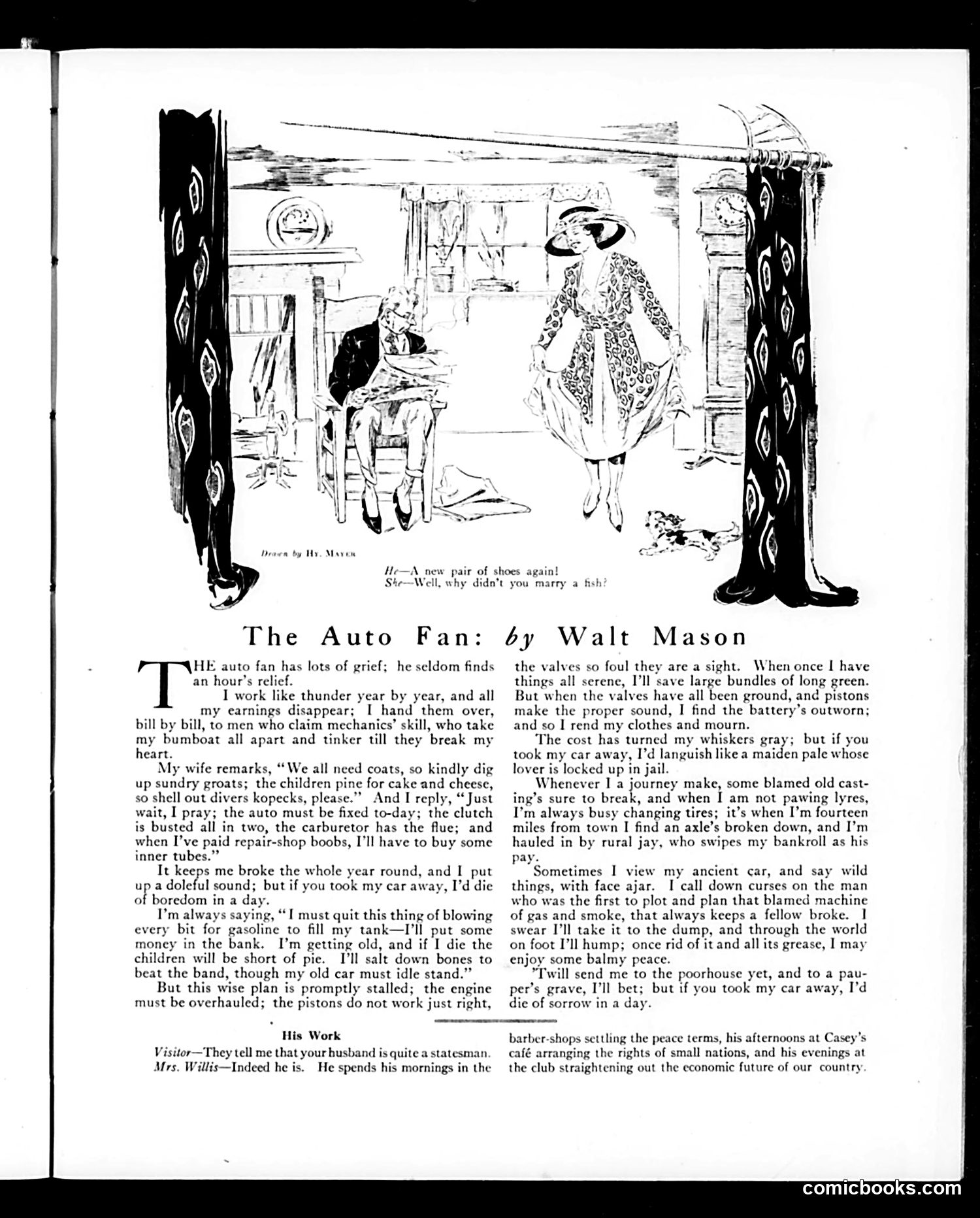
This satirical poem mocks the emerging automobile culture of early 20th-century America. The narrator is an everyman trapped in financial servitude to his car—constantly paying mechanics, buying parts, and repairing breakdowns, yet paradoxically unable to abandon it despite recognizing it as a money-draining burden. The humor targets the contradiction of the automobile age: cars were marketed as liberating machines, yet owners found themselves enslaved to maintenance costs and gasoline expenses that consumed their earnings. The comic strip illustration above depicts a domestic dispute where the wife demands new clothes while the husband complains the car needs fixing—illustrating how automobile ownership competed with basic family needs. The accompanying "His Work" joke reinforces the theme: while the husband pontificates about politics in barbershops and cafes, his wife notes the irony that an actual "statesman" spends his time in idle male chatter rather than real statesmanship—a secondary jab at masculine pretense.
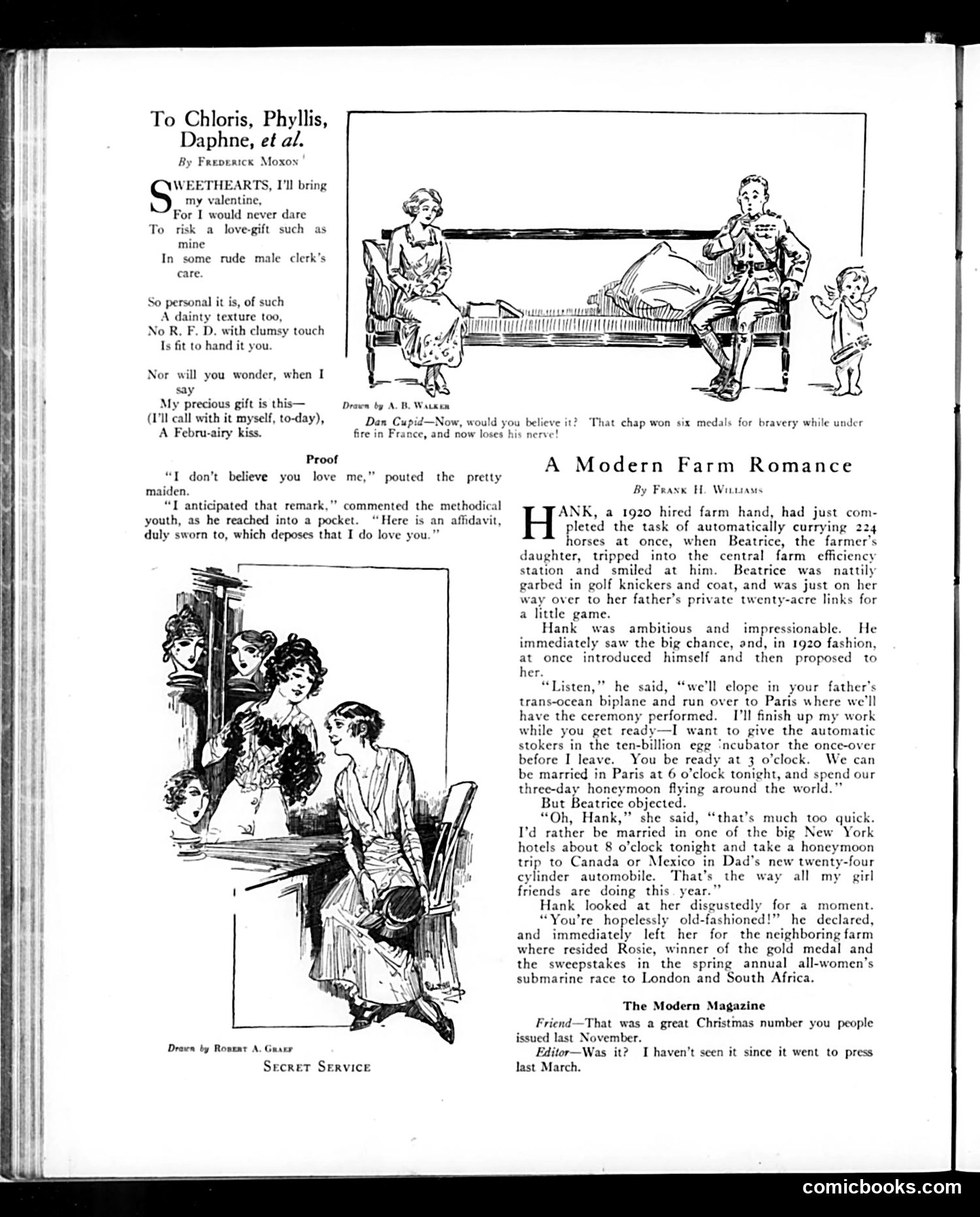
This page contains three satirical pieces typical of 1920s humor: **"Sweethearts" (top left):** A gentle romantic poem mocking the postal service by suggesting hand-delivery of a Valentine's kiss—implying mail carriers were too rough-handed for delicate love tokens. **"Proof" (middle left):** A joke about romantic skepticism, where a suitor responds to his girlfriend's doubt with a notarized legal affidavit declaring his love—satirizing excessive formality and the absurdity of trying to "prove" emotion through bureaucracy. **"A Modern Farm Romance" (right side):** The main story parodies 1920s modernization and changing courtship customs. Hank, a farm hand, proposes via airplane elopement to Paris, but Beatrice rejects this as *too modern*, preferring conventional hotel weddings and automobile honeymoons "like all my girl friends." The satire suggests the Jazz Age's rapid social change created generational confusion about what counted as fashionable romance. The final absurdity—Rosie's "submarine race to London and South Africa"—emphasizes the ridiculous extremes of 1920s aspirations.
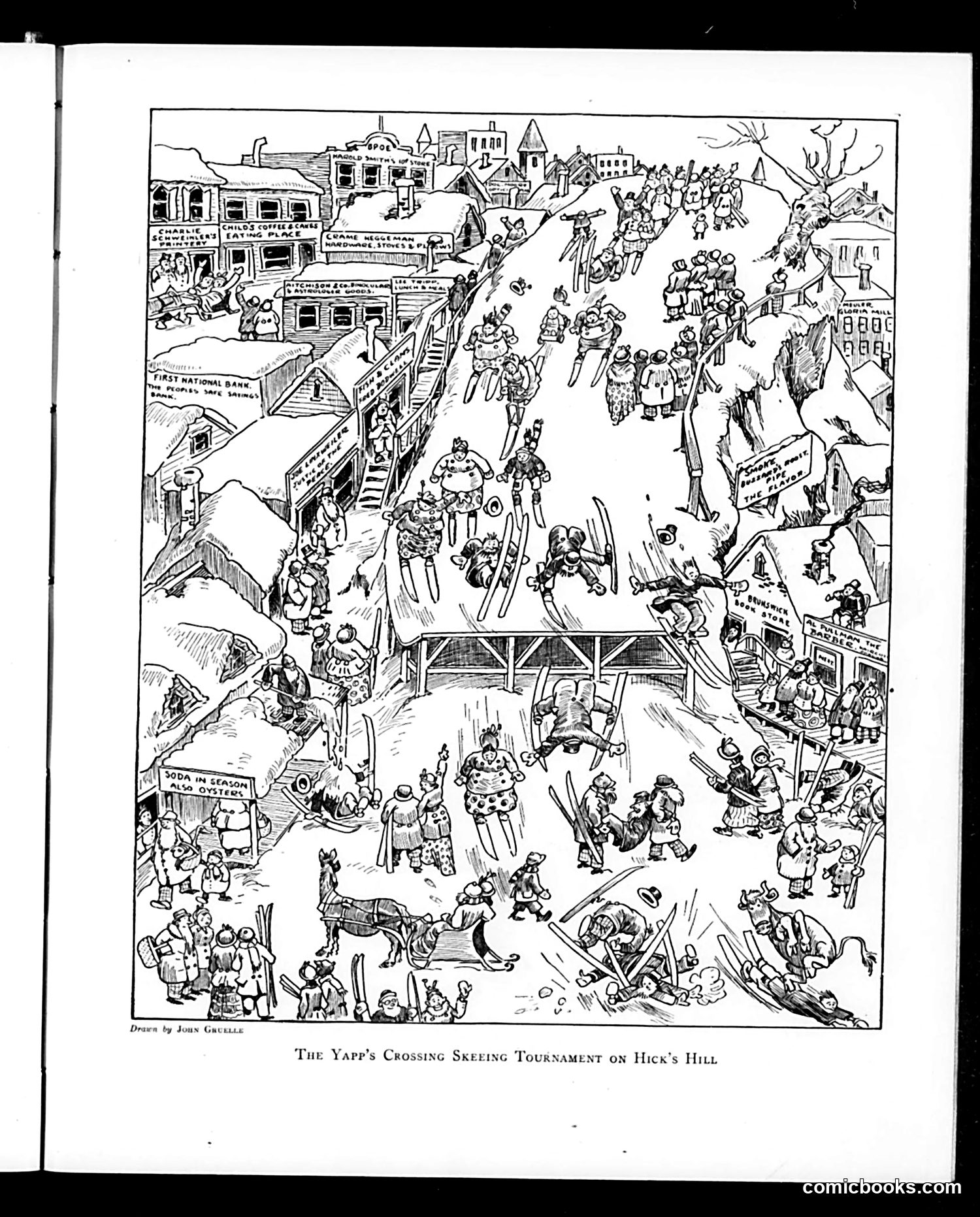
This is a humorous illustration by John Gould depicting a winter ice-skating scene. The drawing shows numerous people engaged in various skating activities and mishaps on what appears to be a frozen area near a small town or village. The satire likely mocks the chaos of amateur winter sports competitions or small-town recreation. Several visible storefronts and buildings suggest commercial establishments (including what appears to be a bank and various shops), placing this in an established community rather than remote countryside. The crowded composition, with people falling, colliding, and in various states of comic distress, satirizes the disorder and lack of skill typical of casual recreational skating tournaments. The specific location reference "Hick's Hill" suggests rural or unsophisticated participants, adding a class-based comedic element typical of Judge magazine's humor.
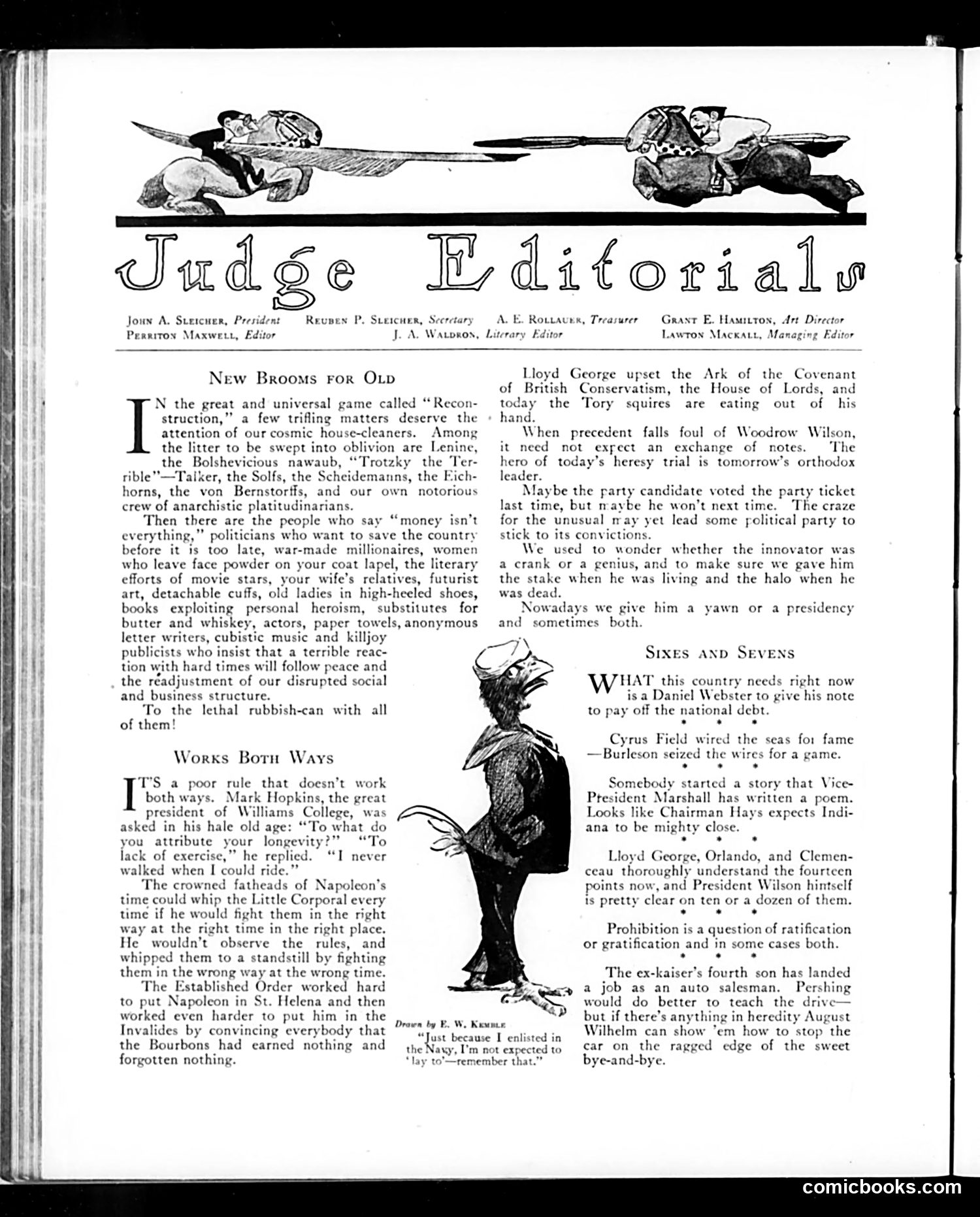
This is the editorial section of Judge magazine, likely from 1919-1920, focusing on post-WWI "reconstruction" politics. **Main Editorial ("New Brooms for Old"):** Satirizes the post-war cleanup of discredited figures and ideas. It targets actual enemies (Lenin, Trotsky) alongside absurd targets (face powder on lapels, futurist art), mocking the era's sweeping rejection of the old order. **"Works Both Ways":** Uses historical examples (Napoleon, the Bourbons) to argue that unconventional thinking succeeds despite—not because of—established rules. References Woodrow Wilson and Lloyd George as modern innovators reshaping politics. **"Sixes and Sevens" (brief quips):** - Jokes about needing a Daniel Webster to solve national debt - References Postmaster General Burleson seizing telegraph wires during wartime - Mocks Vice-President Marshall's rumored poetry - Comments on the ex-Kaiser's son becoming a car salesman The page reflects post-war American skepticism toward both radical change and outdated institutions, with particular focus on Wilson administration figures.
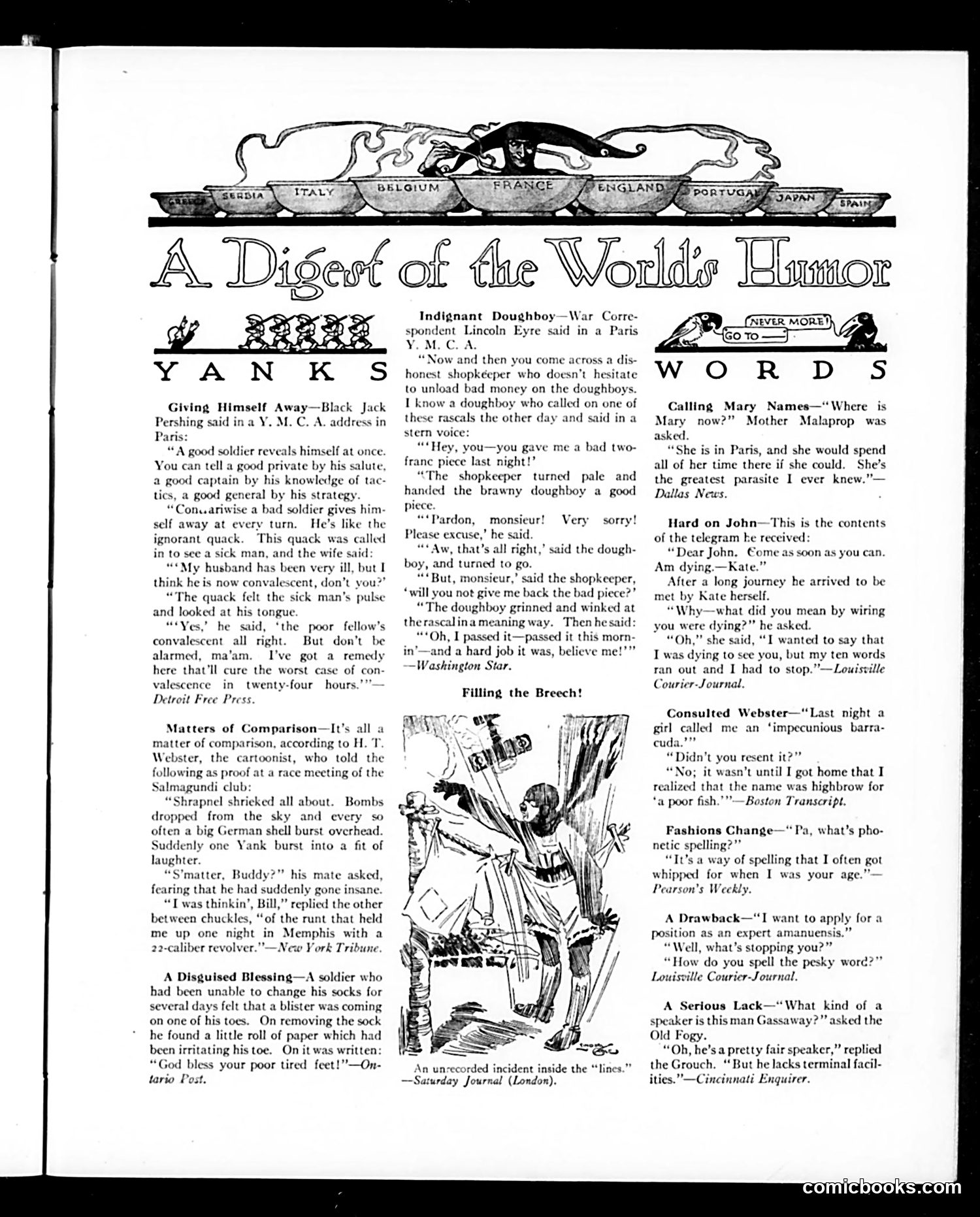
This page collects brief humorous anecdotes, many related to World War I. The header illustration shows a dog walking across countries labeled Belgium, France, England, Portugal, Japan, and Spain—likely satirizing how the war spread globally. The jokes include military humor: General "Black Jack" Pershing's observation that soldiers reveal themselves by their bearing; a doughboy (American soldier) who passes counterfeit French francs to a shopkeeper; and soldiers' experiences with socks and blisters. Other humor focuses on everyday absurdities: a woman confusing "parasite" with "Paris," a girl's garbled telegraph ("dying" instead of "dying to see you"), and spelling difficulties. The "Filling the Breech" cartoon (center) appears to depict a soldier situation, though details are unclear. The page reflects American WWI-era popular culture—gentle mockery of military life, French interactions, and linguistic confusion—presenting war through a lens of comedy and everyday mishaps rather than tragedy.
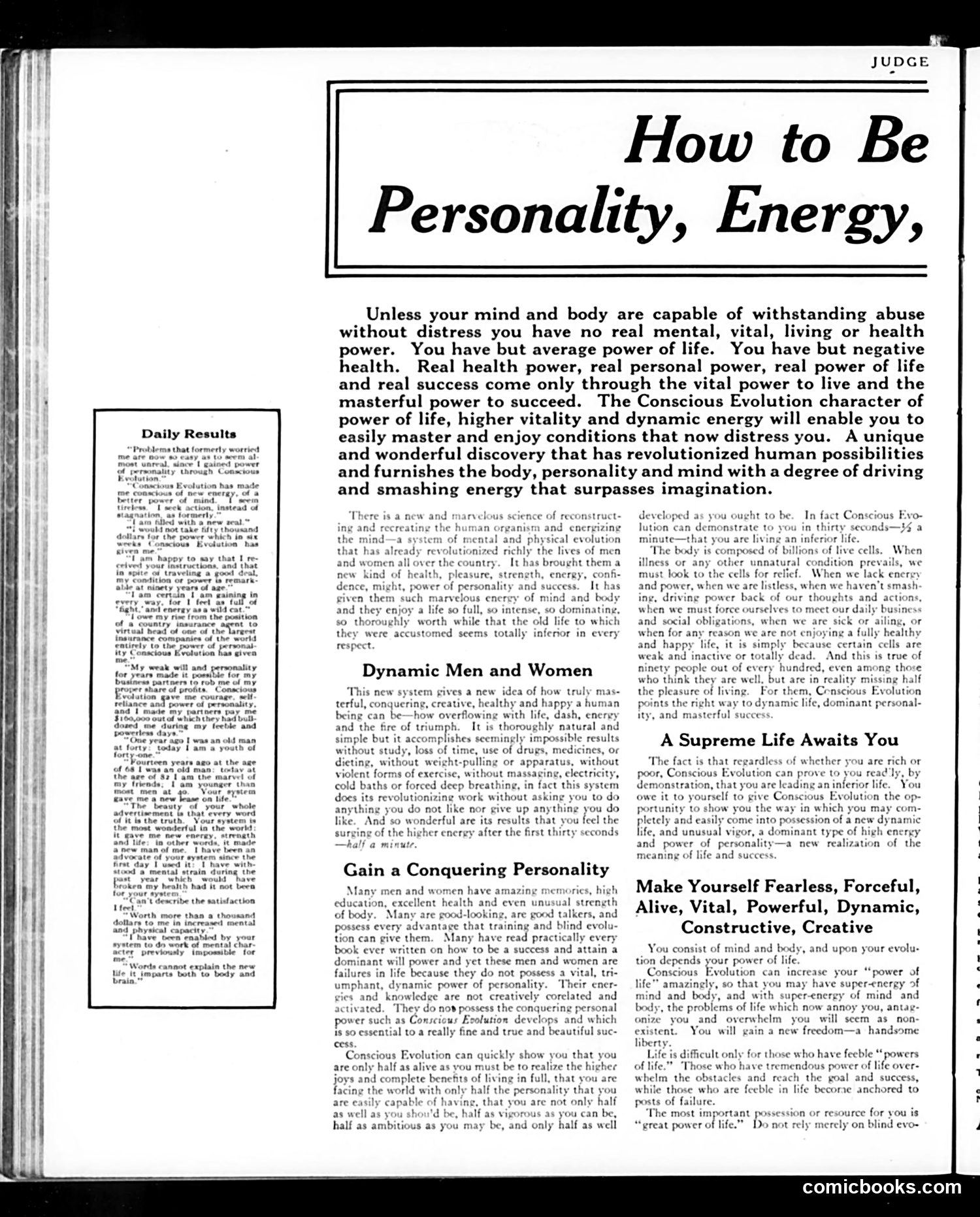
This appears to be a **self-help advertisement masquerading as editorial content**, typical of early 20th-century magazine publishing. The page promotes "Conscious Evolution"—a pseudoscientific system claiming to unlock hidden mental and physical powers. The "Daily Results" sidebar contains testimonials from purported users describing transformation from weakness to vitality. The main text promises that this method delivers "dynamic energy," "conquering personality," and superior "power of life" without exercise, diet, study, or medication—accomplishing results in "thirty seconds." **The satire (if intentional)** likely targets the era's proliferation of dubious self-improvement schemes and pseudoscience marketed to insecure readers. However, the advertisement's prominent placement in *Judge* suggests it may be genuine promotional content rather than satire, reflecting the magazine's actual advertising practices during this period. The breathless, hyperbolic language and impossible claims would read as absurd to modern audiences but apparently appealed to contemporary readers seeking quick personal transformation.
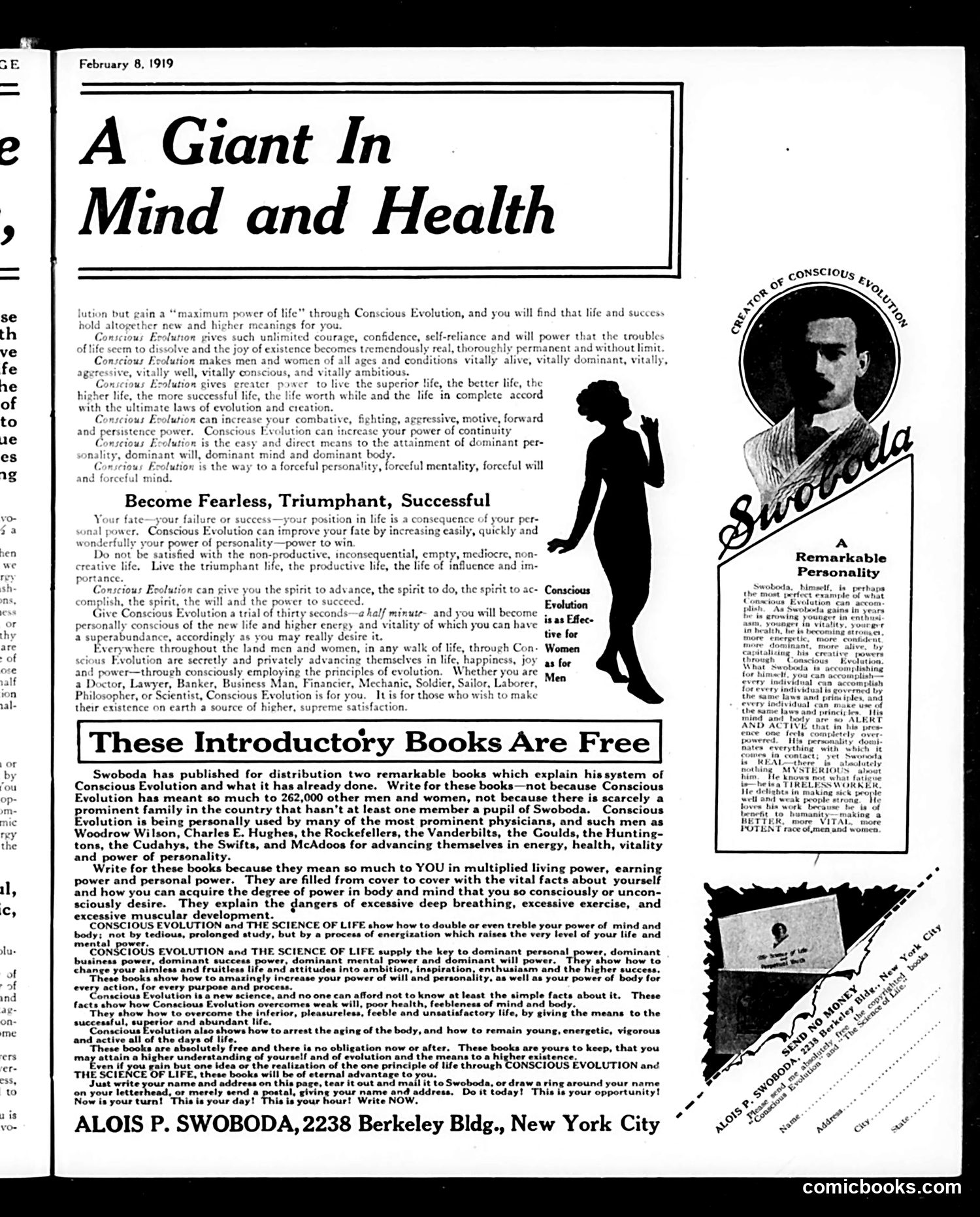
This page is primarily a full-page advertisement for "Conscious Evolution," a self-help system marketed by Alois P. Swoboda. The ad features a silhouetted figure in an ascending pose, suggesting personal improvement and triumph. **The "satire" here is subtle or absent**—this appears to be a genuine advertisement rather than satirical content. The ad claims Swoboda's system enables readers to become "Fearless, Triumphant, Successful" through mental discipline and evolutionary self-improvement. It name-drops prominent figures (Woodrow Wilson, Rockefellers, Vanderbilts) as purported users, a common early-20th-century marketing tactic. **Context for modern readers**: This reflects the era's widespread "New Thought" and personal improvement movements—pre-dating modern self-help but using similar pseudo-scientific language about "conscious evolution" and untapped human potential. The promise of multiplied "power" through mental training was characteristic of popular psychology circa 1919.
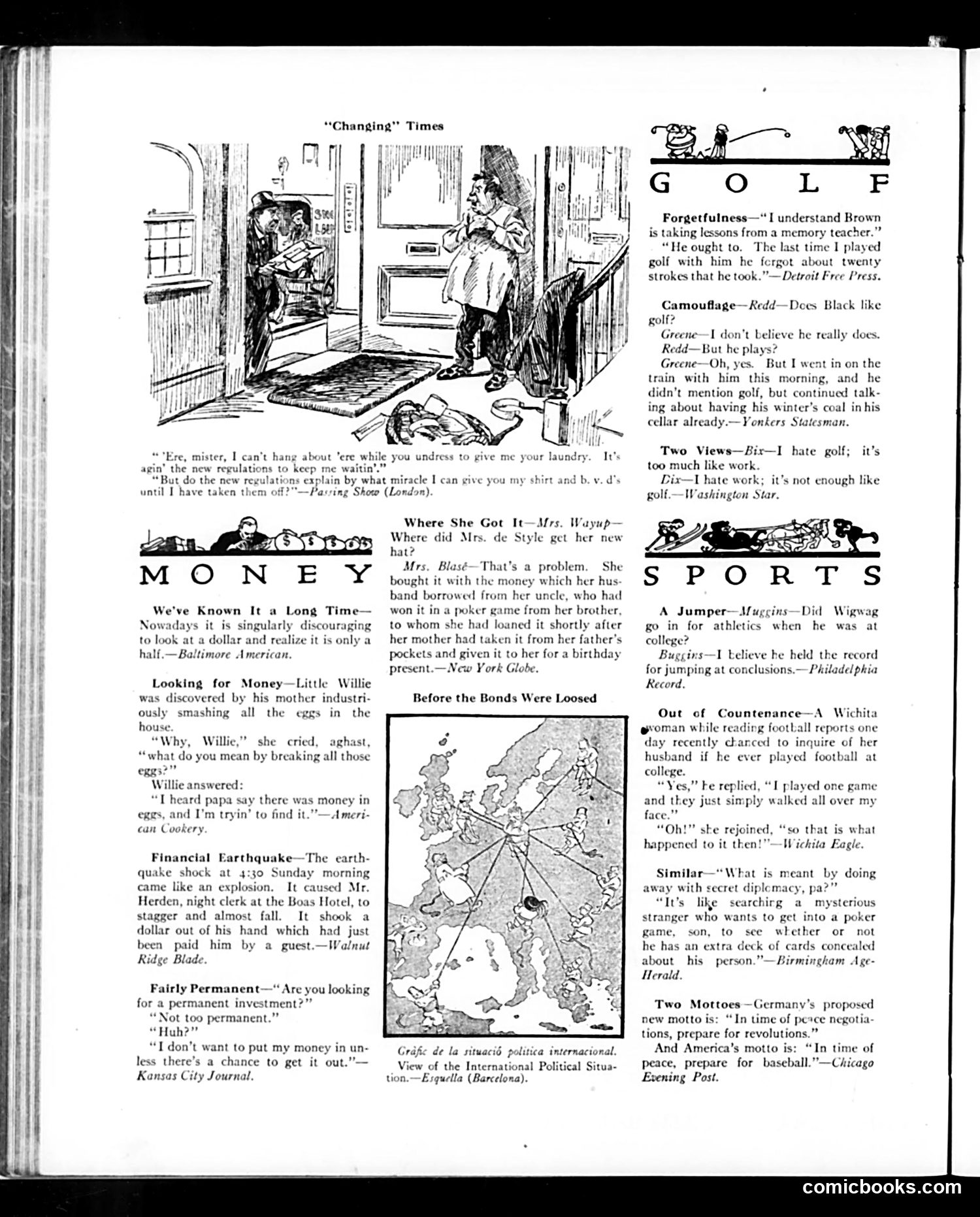
This page collects brief humorous anecdotes mocking early 20th-century American attitudes toward money, labor, and social pretense. The opening cartoon shows a laundryman confronting new workplace regulations—likely post-WWI labor reforms—that paradoxically prevent him from doing his job efficiently. The satire targets bureaucratic absurdity. The "Money" section ridicules financial anxiety during economic uncertainty. "Looking for Money" jokes that a child literally breaks eggs after hearing money is "in" them. Multiple pieces mock Americans' obsession with wealth and their inability to keep money—whether through poor investments, marital entanglement, or simple anxiety. The sports and social sections use lighter humor: golfers who pretend indifference, athletes who "jump at conclusions," a husband whose face got trampled in college football. The map cartoon titled "Before the Bonds Were Loosed" (unclear reference, possibly pre-WWI European politics) contrasts with the page's domestic focus. Overall, Judge satirizes American materialism, workplace regulations, and social pretense during a period of economic and political flux.
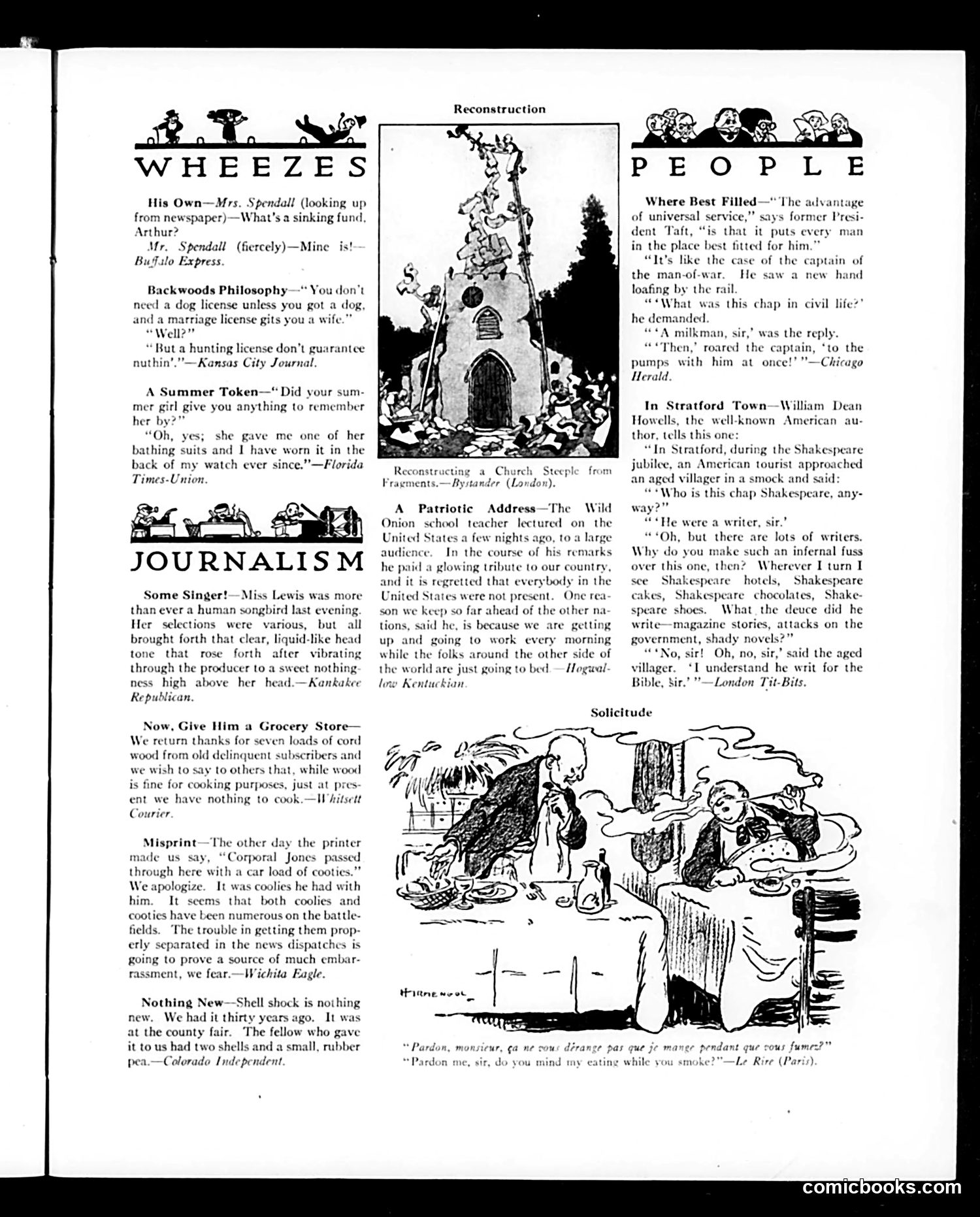
This page collects short humorous anecdotes organized by topic ("Wheezes," "Journalism," "People," "Solicitude"). The central image shows a church steeple being reconstructed, labeled "Reconstructing a Church Steeple from Fragments" (London). **The jokes target:** - Domestic misunderstandings (husbands misinterpreting financial terms) - Rural naïveté (backwoods logic about licenses) - Newspaper errors and inefficiency (printers confusing "coolies" with "cooties"; papers accepting cordwood as payment) - American ignorance of Shakespeare (a tourist dismisses him as just another writer despite ubiquitous commercialization) - Military hierarchy (a captain reassigning a loafing sailor to the pumps) **The satire reflects early 20th-century American preoccupations:** newspaper industry struggles, rural/urban cultural divides, and American tourists' philistinism abroad. The "Reconstruction" image likely alludes to post-WWI rebuilding. The page is primarily lighthearted social comedy rather than overtly political satire.
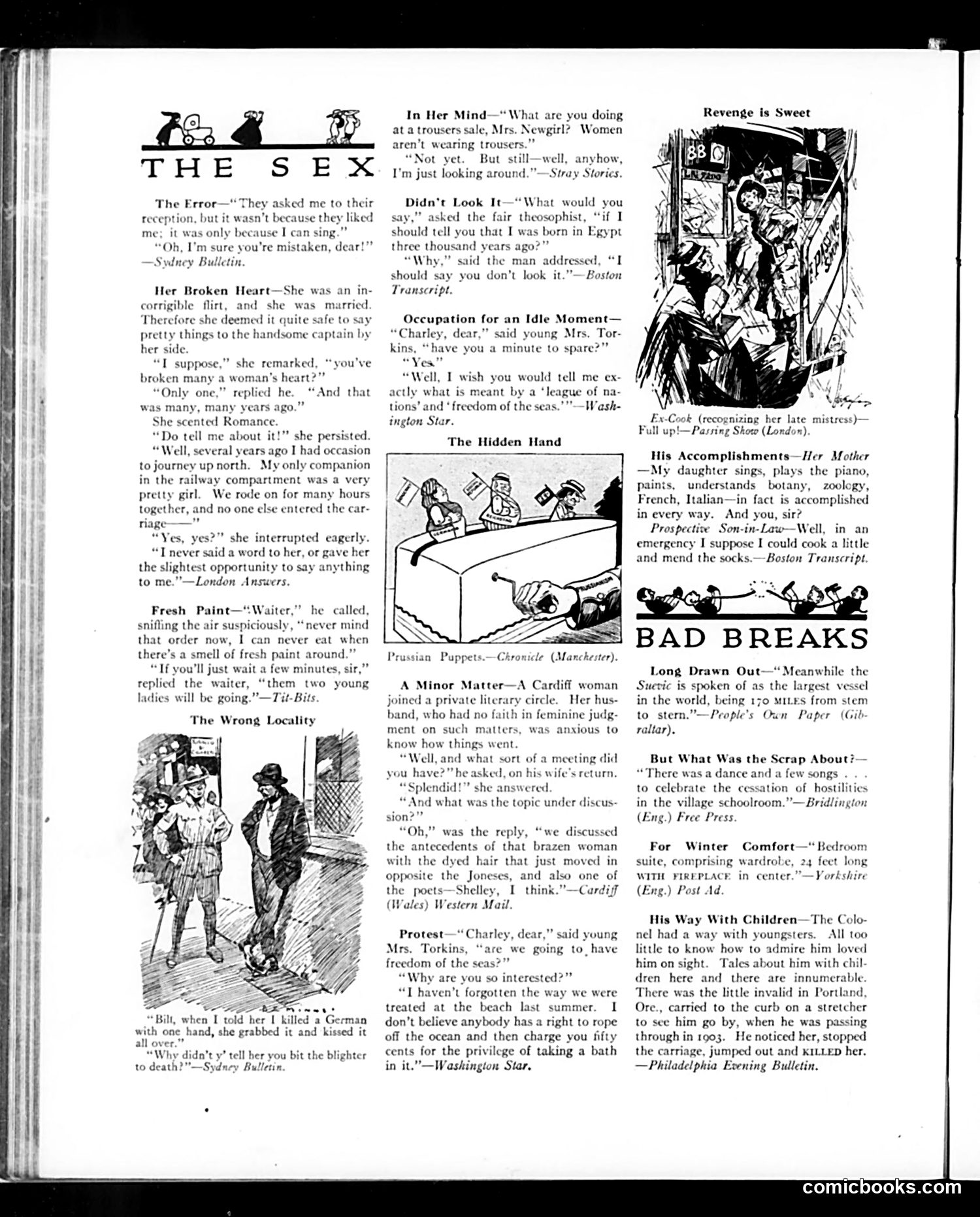
This page from the satirical magazine *Judge* contains multiple short humor pieces typical of early 20th-century American comedy. The cartoons and jokes target familiar social situations: **"The Wrong Locality"** (illustrated): A man explains he killed a German soldier in WWI hand-to-hand combat, but his companion questions why he didn't "tell her" about it—implying the man should have boasted to impress a woman. The humor relies on the absurdity of bragging about killing. **"Revenge is Sweet"**: An ex-cook recognizes her former employer on the street but ignores her ("Full up!"), suggesting servants' satisfaction in reversing social hierarchy. **"Bad Breaks"**: This section collects newspaper printing errors—a ship described as "170 miles" long, a school dance celebrating "cessation of hostilities," a bedroom with a fireplace in the center—mocking careless journalism. The remaining pieces joke about gender relations, marital dynamics, and misunderstandings typical of period humor. The overall tone reflects 1920s sensibilities about class, gender roles, and the amusement value of social gaffes.
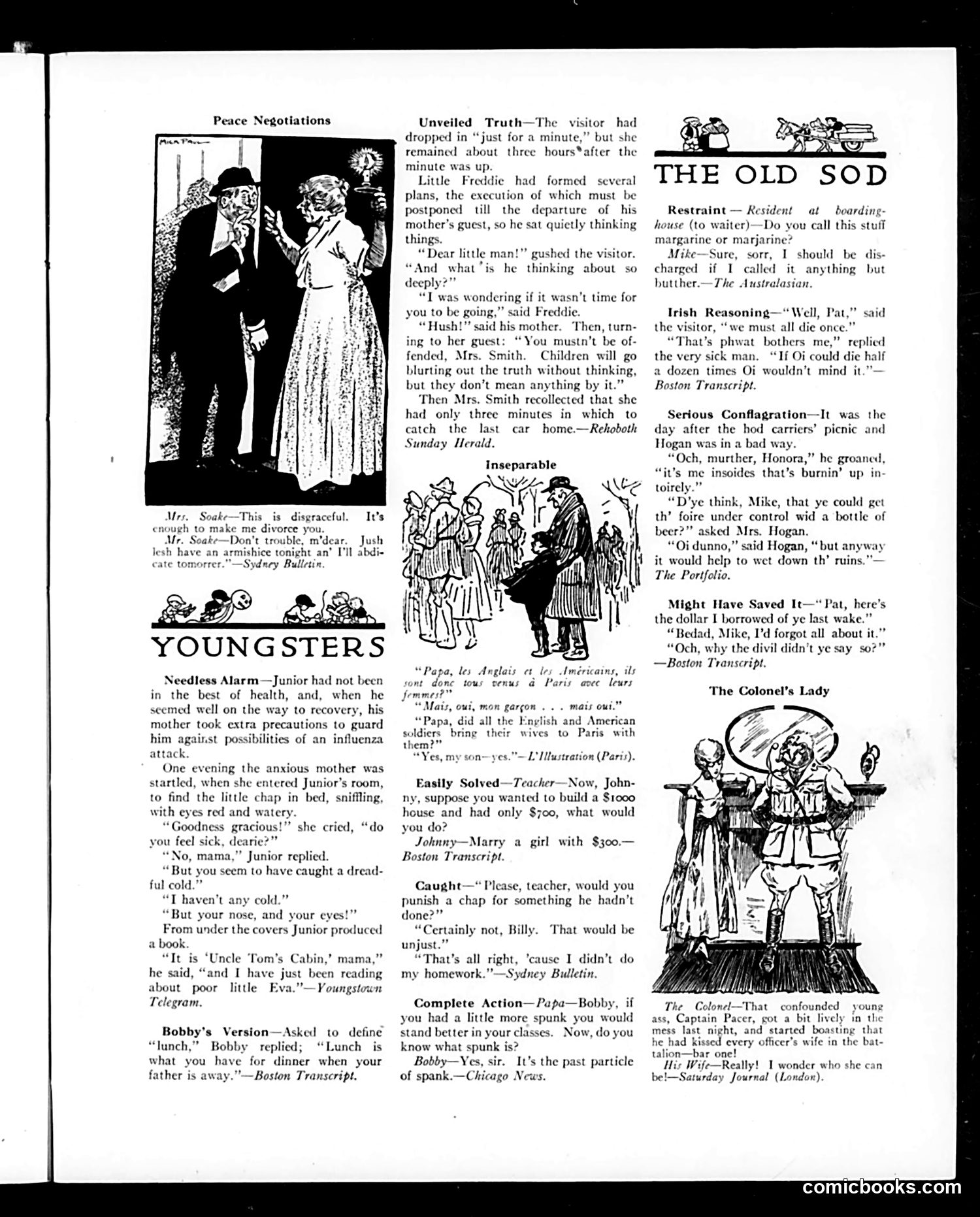
This page contains multiple short humorous anecdotes and cartoons typical of early 20th-century American satire. The top cartoon, "Peace Negotiations," depicts a domestic dispute, likely referencing post-WWI peace talks through marital humor—a common satirical parallel of the era. The "Youngsters" section offers children's jokes, including one where a boy reading *Uncle Tom's Cabin* cries over Little Eva's death, and another where a child defines "lunch" as what you eat when father is away—poking fun at domestic life and parental absence. "The Old Sod" section collects Irish-themed jokes featuring stereotypical Irish characters (Mike, Pat, Hogan, Honora) with exaggerated dialect, reflecting the Irish-American immigrant humor popular in period magazines. These jokes play on Irish speech patterns and supposed illogical reasoning for comedic effect. Other brief jokes target teachers, children's honesty, and boarding-house food quality. The cartoons and text reflect Judge's satirical focus on domestic life, social awkwardness, and ethnic stereotyping typical of 1910s-1920s American humor magazines.
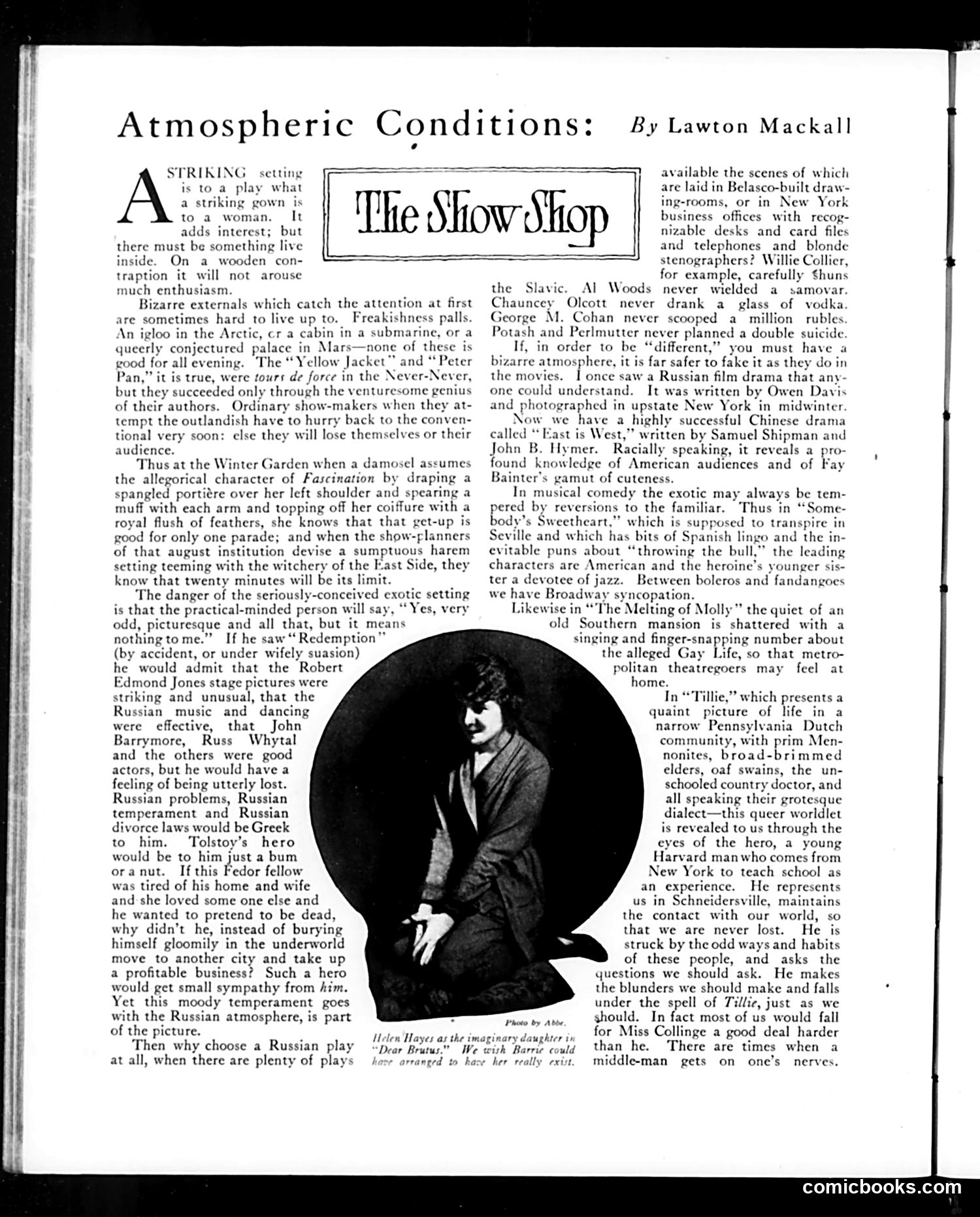
This is a theater criticism column by Lawton Mackall examining whether exotic stage settings enhance or hinder dramatic productions. The central argument: striking, unusual settings (Russian palms, Arctic igloos, Eastern harems) initially capture attention but risk alienating audiences who find the unfamiliar atmosphere incomprehensible or emotionally distant. The featured photograph shows Helen Hayes as the allegorical character "Fascination" in an elaborate costume with feathers and spangled drapery—exemplifying the "bizarre externals" Mackall critiques. Mackall argues producers like Al Woods and George M. Cohan succeed by avoiding heavy ethnic atmosphere, instead "faking" exotic settings theatrically. He praises "East is West" (a Chinese-themed play) and musical comedies that balance exotic elements with familiar comedy, claiming this formula works better than immersing audiences in incomprehensible foreign problems and temperaments—specifically referencing Tolstoy's Russian themes as too alien for practical American audiences. The satire targets both pretentious experimental theater and the practical limitations of audience sympathy.
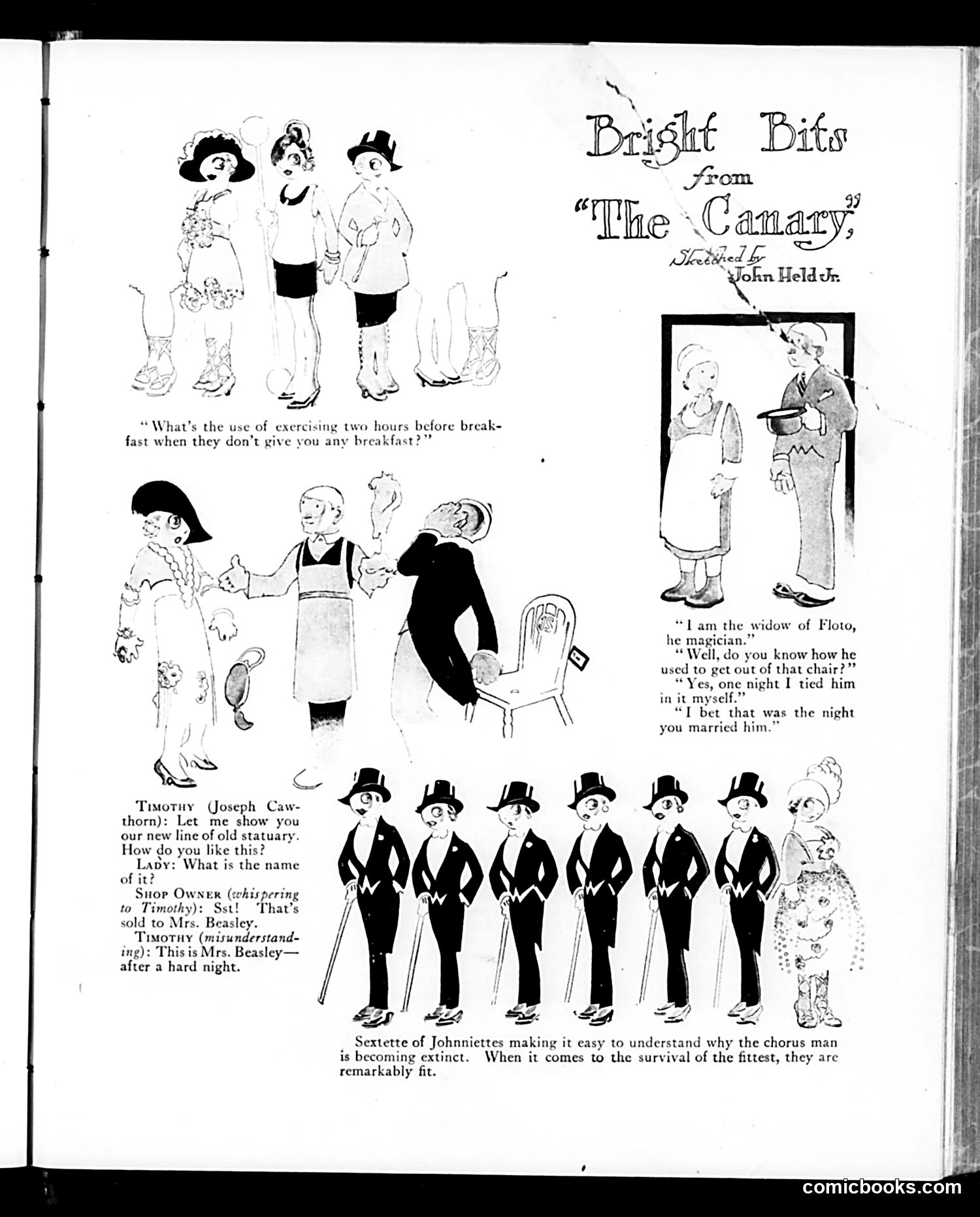
This page collects humor sketches from a theatrical production called "The Canary," illustrated by John Held Jr. The jokes target early 20th-century social concerns: **Top sketch**: Satires pre-breakfast exercise fads—a fitness trend among the wealthy, mocked as pointless if no meal follows. **Middle sketch**: A widow jokes about her magician husband (Floto), implying she "escaped" marriage through trickery, using his own escape-artist methods against him. **Lower sketches**: Timothy and the shop owner misunderstanding involves selling statuary to "Mrs. Beasley," with a crude joke about her exhaustion after a night out. **Bottom caption**: References the "sextette of Johnniettes" (chorus girls), joking that despite chorus girls supposedly becoming "extinct," those in this show are notably fit—satirizing both theatrical labor and Darwinian-era "survival of the fittest" language applied to showgirls. The humor relies on theatrical references, physical comedy misunderstandings, and period-appropriate social satire about exercise fads and stage entertainment.
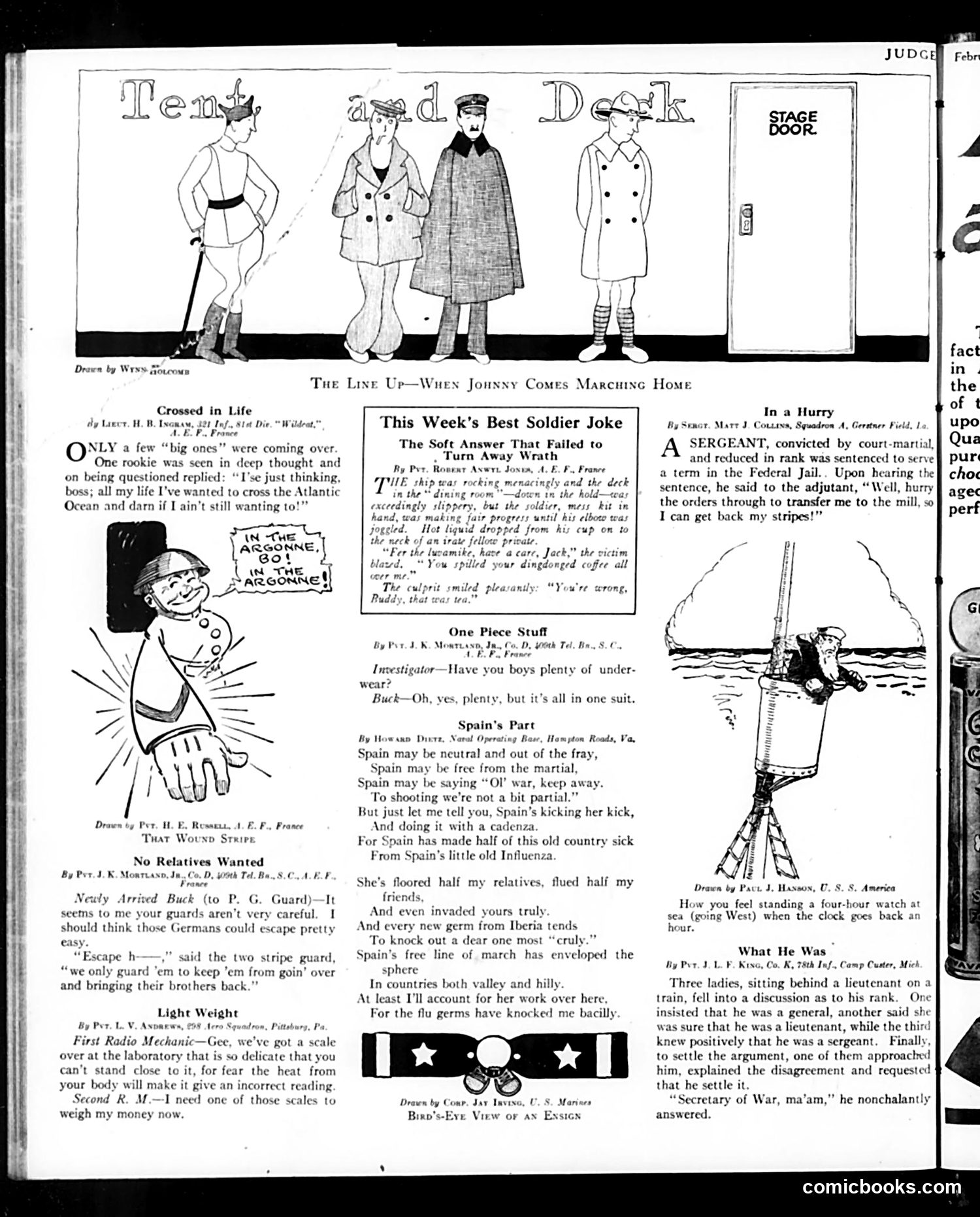
This page from *Judge* magazine features WWI-era soldier humor drawn by servicemen themselves. The cartoons satirize military life and contemporary issues: **"Crossed in Life"** jokes about a rookie's ironic desire to cross the Atlantic—he finally gets his wish, but as a soldier rather than a civilian passenger. **"No Relatives Wanted"** pokes fun at German POW guards, suggesting soldiers prevent escapes partly to stop Germans from recruiting relatives to invade America. **"Spain's Part"** addresses the 1918 influenza pandemic (the Spanish flu), blaming Spain humorously for spreading the disease globally—a topical reference to the deadly epidemic affecting troops. **"In a Hurry"** presents dark humor: a court-martialed sergeant wants quick transfer to Federal prison to regain his stripes faster than through military service. The remaining jokes target military absurdities: delicate laboratory scales, uniform shortages, and rank confusion. These were soldier-written contributions, reflecting frontline perspectives on wartime frustrations, discipline, and the period's major public health crisis.

This page is primarily **advertising, not satire**. It's a full-page advertisement for Tuxedo brand smoking tobacco, placed in *Judge* magazine. The ad promotes Tuxedo's chocolate flavoring as superior to competitors, using the slogan "Your Nose Knows" to appeal to consumers' sensory judgment. The imagery shows a man's face and hand demonstrating the suggested test: rubbing tobacco in your palm to release aroma, then smelling it to compare quality. The copywriting cites the *Encyclopaedia Britannica* to lend scientific credibility to the claim that tobacco "sauces" (flavorings) improve smoking quality. The "money-back guarantee" was a common early 20th-century sales tactic to build consumer confidence. This reflects **pre-health-warning era tobacco marketing**, when such products were advertised without disclaimers about health risks.
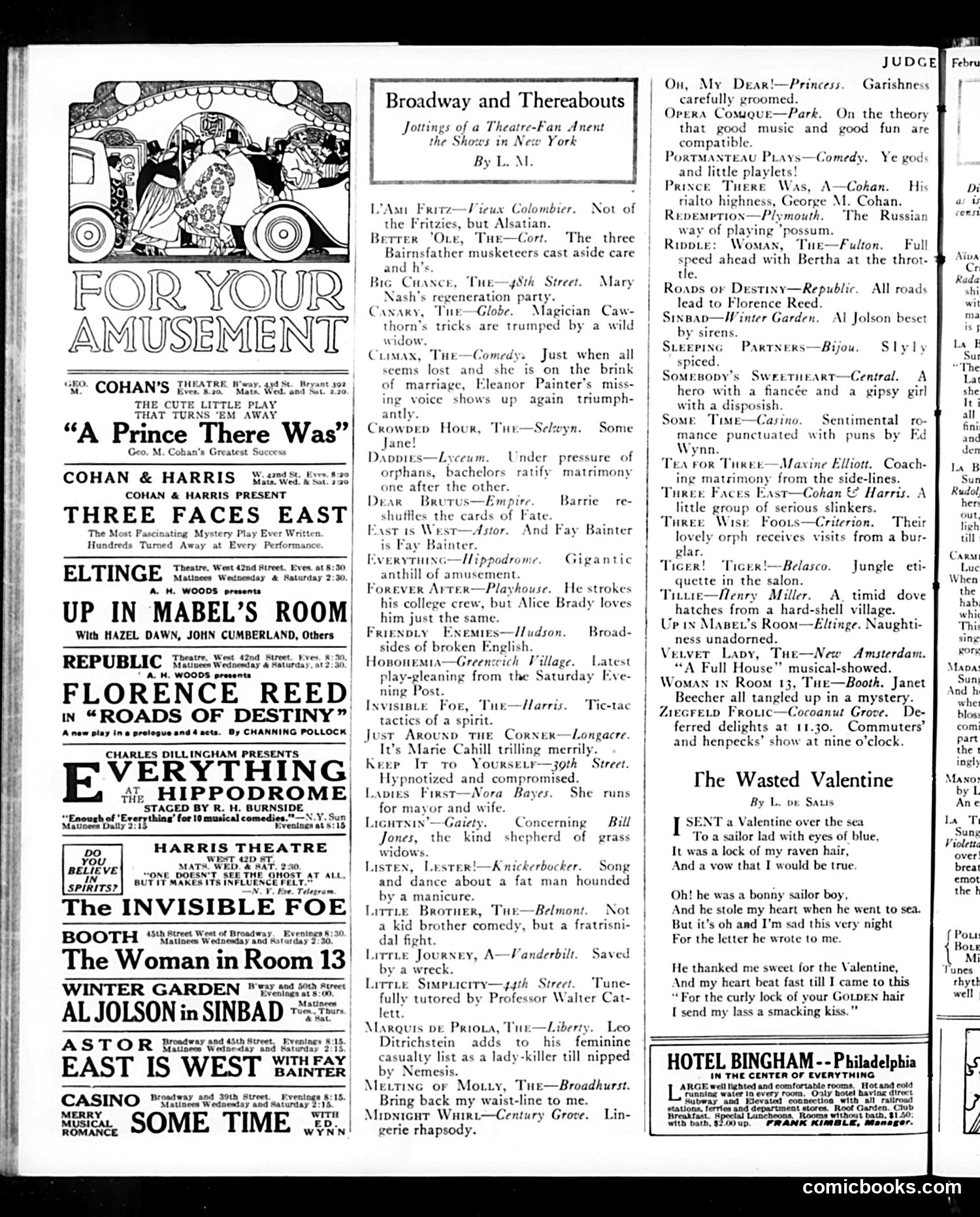
This page is primarily **advertising and theatre listings** rather than political satire. The left side displays advertisements for Broadway shows (Cohan's "A Prince There Was," "Three Faces East," etc.), while the right side contains a theatre critic's brief, witty reviews of current New York productions. The reviews use punchy, coded descriptions: "*Berter 'Ole*" references Bairnsfather's military cartoons; "*East is West*" notes Fay Bainter's performance; "*Climax*" jokes that Eleanor Painter's "missing voice shows up again triumphantly." The sole literary content is "The Wasted Valentine," a sentimental poem about a sailor. **Bottom right**: Hotel Bingham advertisement. This reflects early 1920s Broadway culture—the page targets theatre-goers with entertainment listings, not political commentary.
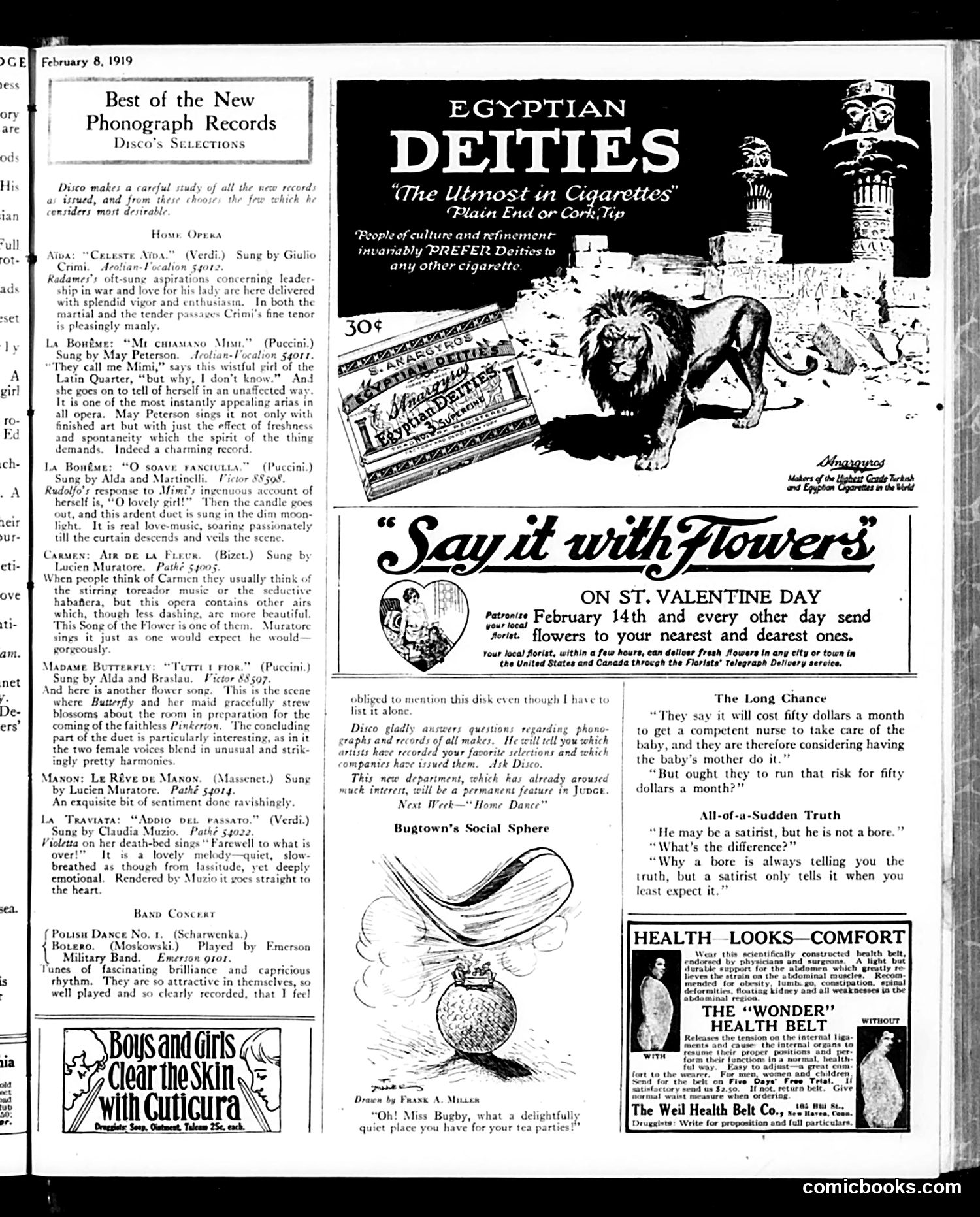
This page is primarily **advertisements and entertainment content** rather than political satire. The main elements are: **Egyptian Deities Cigarettes ad**: Features Egyptian temple imagery with a lion, marketing cigarettes as the choice of "people of culture and refinement"—typical early-20th-century luxury advertising using exotic imagery. **"Say it with Flowers" ad**: Promotes florists' Valentine's Day service, emphasizing the Florists' Telegraph Delivery network. **Bugtown's Social Sphere cartoon**: A small domestic humor sketch about someone praising Miss Bugby's house as a "quiet place" for tea parties—gentle, non-political humor. **"The Long Chance" and "All-of-a-Sudden Truth"**: Brief humorous anecdotes about baby care costs and satirist behavior—mild social commentary without specific political targets. The page's bulk comprises **phonograph record reviews** by "Disco," discussing opera recordings. This reflects 1919 cultural interests in classical music and emerging recording technology—not satire but entertainment journalism typical of Judge's content beyond its political cartoons.
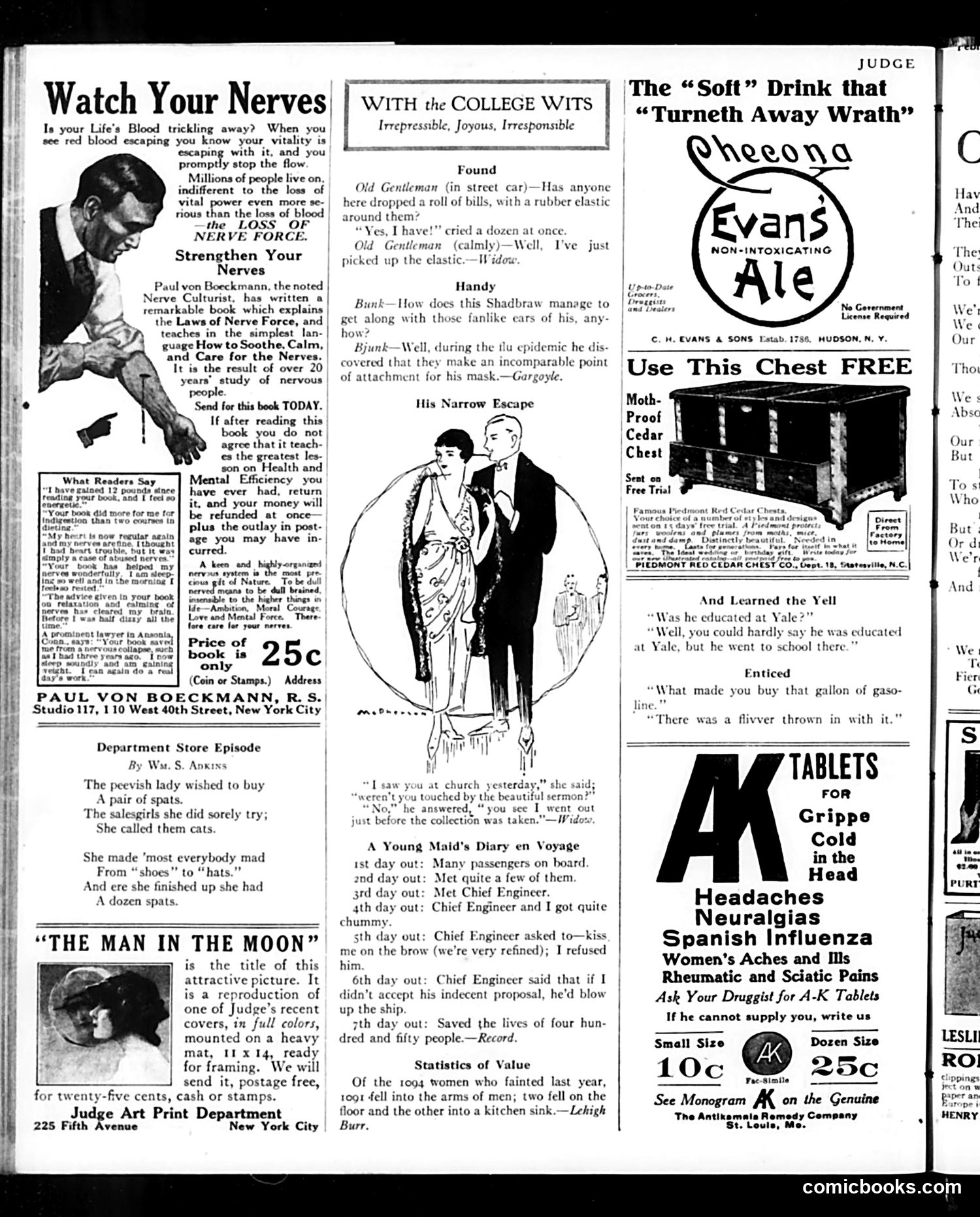
This page from *Judge* magazine showcases period humor and advertising: **The main humor pieces** mock earnest modern anxieties. A college wit section presents jokes about absent-mindedness (a man finding a rubber band after dozens claim the lost money), and flirtation at sea (a woman's shipboard diary claiming to save 450 lives after a chief engineer's advances). The "Department Store Episode" satirizes an irritable customer who demands increasingly unreasonable products. **The advertisements** reflect early 20th-century concerns: Paul von Boeckmann's "Nerve Force" book promises to cure exhaustion and mental dullness—a common pitch exploiting Victorian anxieties about modern life. Evans' non-intoxicating ale and AK tablets for "Spanish Influenza" reference the 1918-19 pandemic directly. **The tone** is lighthearted social observation mixed with pseudo-scientific health claims we'd now recognize as dubious marketing. The satire assumes readers value self-improvement literature and patent remedies while mocking those who take them overly seriously.
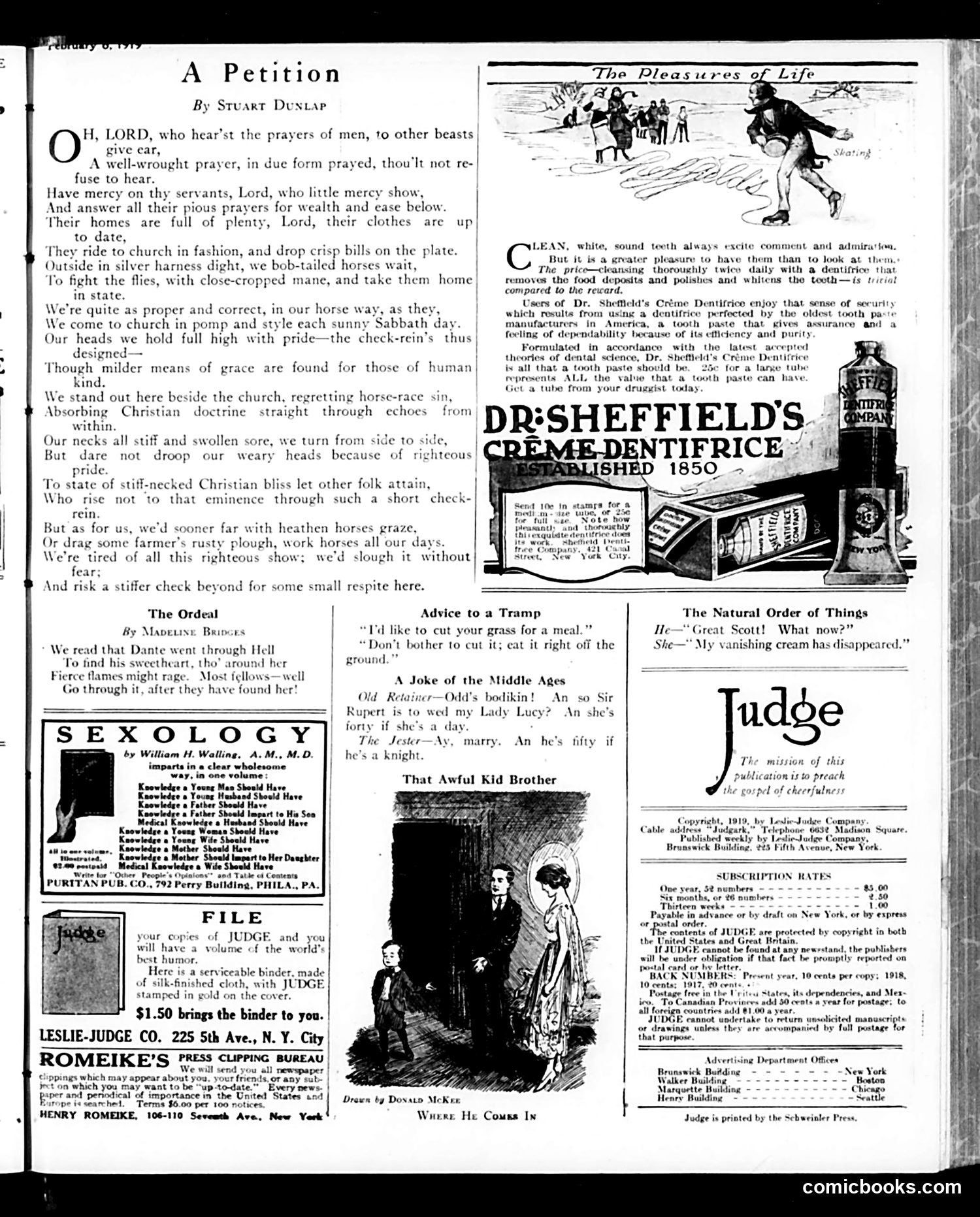
This poem mocks wealthy Christians' moral hypocrisy through an extended metaphor using horses. The "petition" is ostensibly from horses pulling carriages of the wealthy to church. The satire targets the contradiction between outward piety and actual behavior: these Christians dress fashionably, ride in silver-harnessed carriages, and perform ostentatious charity ("drop crisp bills on the plate"), yet the horses—subjected to painful "check-reins" (devices forcing unnaturally arched necks) and exhausting labor—suffer for their masters' vanity. The horses' complaint is that while they're forced into displays of "righteous" propriety and Christian virtue, they'd prefer honest labor ("work horses") without the pretense. The "stiff-necked Christian bliss" pun emphasizes how physical constraint mirrors spiritual self-deception. The piece satirizes both class exploitation and the ostentatious moralism of the Gilded Age wealthy, suggesting their religion is mere performance masking cruelty and selfishness.
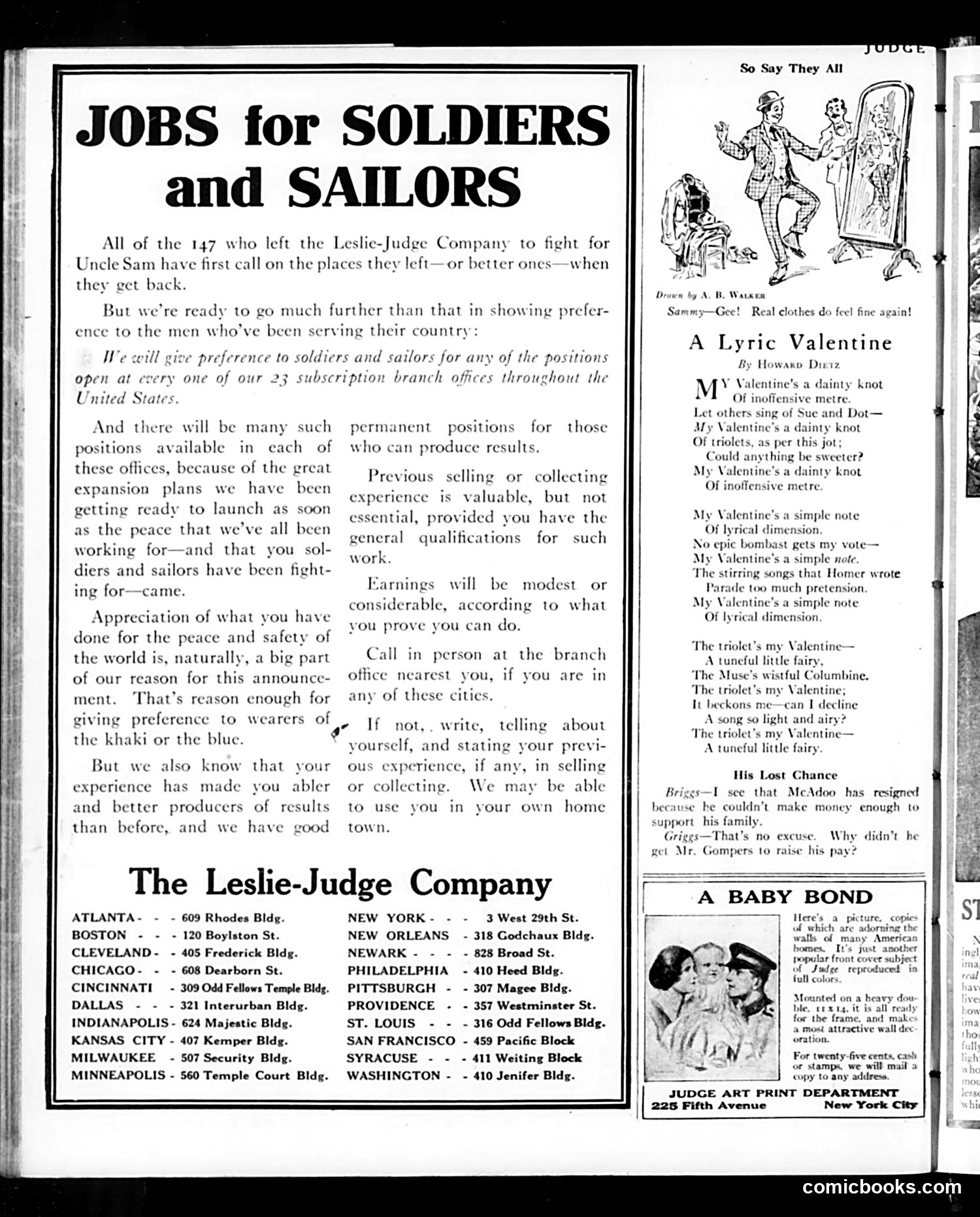
This page is primarily a **wartime employment advertisement** by The Leslie-Judge Company (the publisher of Judge magazine itself). The main text announces that the company will prioritize hiring returning soldiers and sailors, noting that 147 of their employees left to fight in what appears to be **World War I**. They promise preference in hiring and permanent positions at 23 branch offices nationwide. The smaller cartoon titled "So Say They All" depicts a soldier or sailor in new civilian clothes, with the caption suggesting satisfaction at wearing regular clothing again after military service—a light joke about returning to civilian life. The page also includes unrelated content: a Valentine's Day poem by Howard Dietz and a brief humorous item about William McAdoo (a real Treasury Secretary who resigned in 1918) and labor leader Samuel Gompers, joking about pay raises. The **patriotic hiring pledge** reflects genuine wartime sentiment and labor shortages circa 1918.
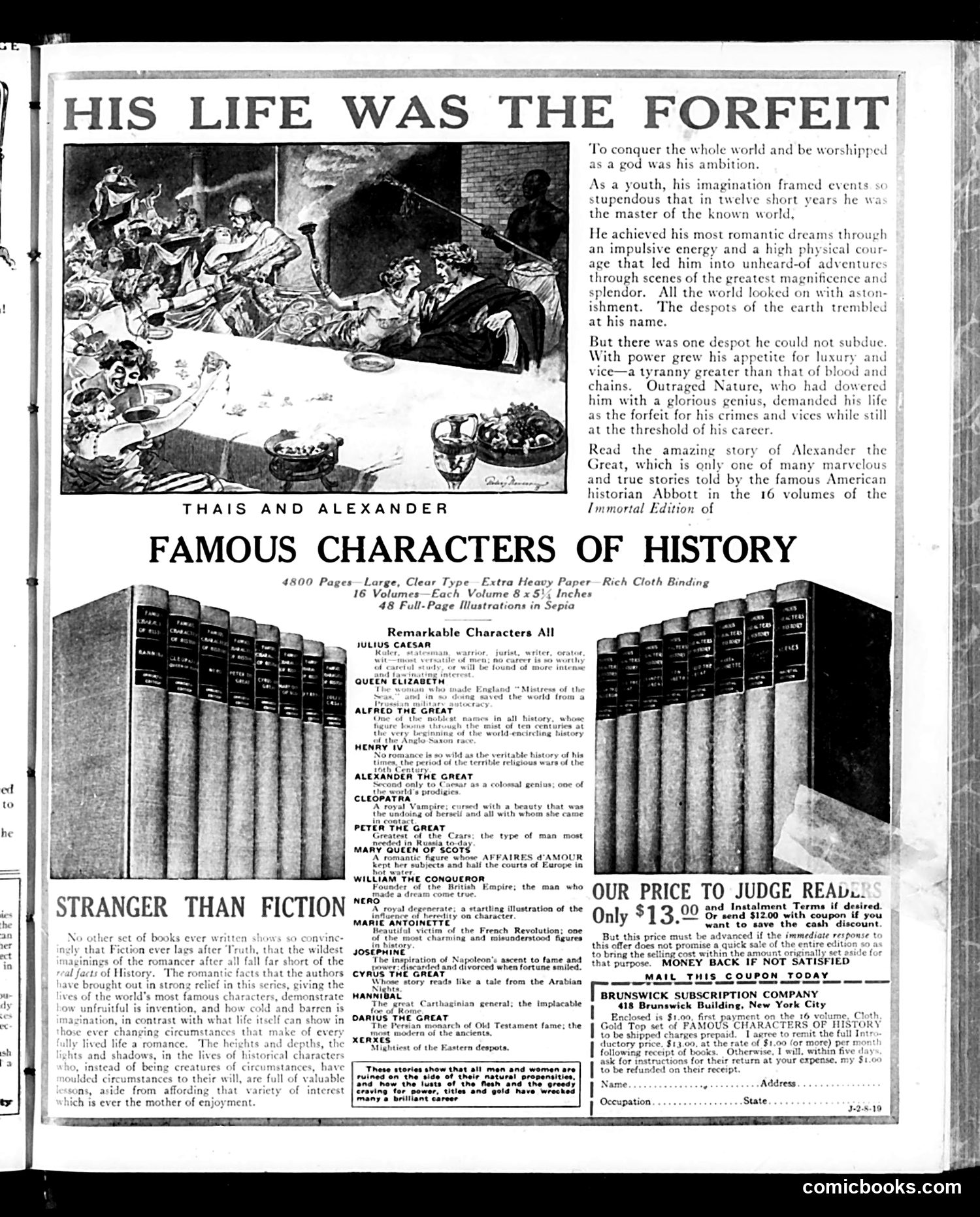
This page is primarily **advertising**, not satire. It promotes "Famous Characters of History," a 16-volume biographical encyclopedia by historian Abbott. The illustration labeled "Thais and Alexander" depicts Alexander the Great at a banquet with his companion Thais. The accompanying text uses Alexander as a cautionary tale: despite conquering the world in twelve years, he ultimately destroyed himself through luxury and vice, becoming enslaved to appetite rather than overcoming his enemies. Nature itself demanded his life as "forfeit" for his crimes and excesses. This framing—presenting Alexander's moral downfall alongside his military glory—serves the advertisement's purpose: to entice readers with dramatic historical narratives of "remarkable characters." The moralistic tone suggests the book appeals to readers seeking both entertainment and edifying lessons about ambition, power, and virtue. The advertisement lists other historical figures covered (Julius Caesar, Cleopatra, Peter the Great, etc.) and emphasizes the work's 4,800 pages, quality printing, and affordable installment pricing.

This page is **purely commercial advertising**, not satire or political content. It's an Argo Corn Starch product advertisement from an era when Judge magazine included paid ads alongside humor content. The ad features: - A large product box image with a Native American figure (the brand mascot) - Photographs of finished baked goods (rolls, pastries, cakes) - Testimonial-style text encouraging housewives to discover "new and delicious uses" for corn starch - Three recipe examples: pie crust, orange cream pie, and Parkerhouse rolls - A call for readers to submit their own recipes The appeal is straightforward: positioning Argo as essential for quality home baking and cooking. The Native American imagery reflects early-20th-century marketing conventions (corn being associated with Native Americans). This represents the consumer advertising landscape of Judge's readership—middle-class American women managing households.