
Judge, 1919-02-08 · page 22 of 32
Judge — February 8, 1919 — page 22: what you’re looking at
What you’re looking at
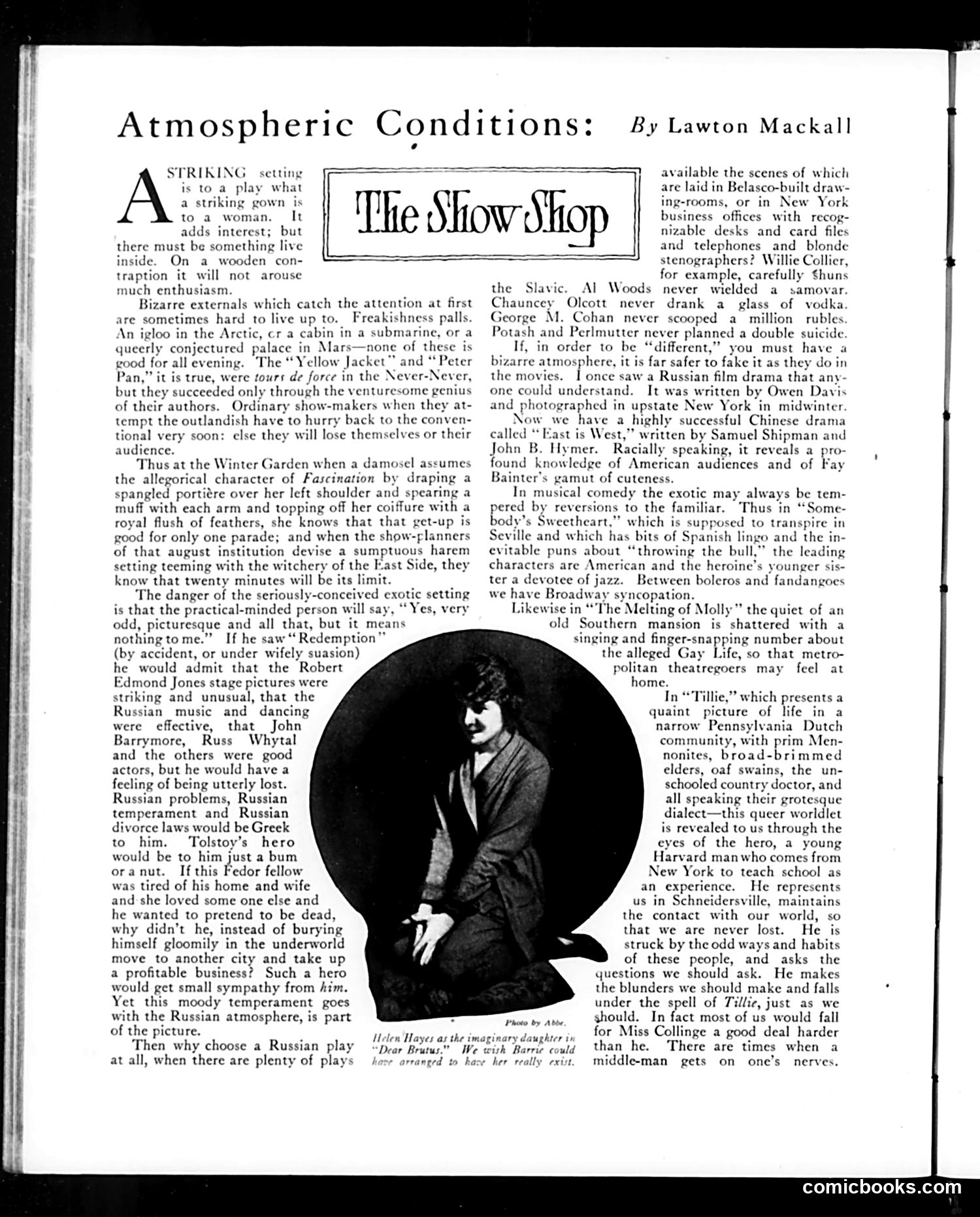
This is a theater criticism column by Lawton Mackall examining whether exotic stage settings enhance or hinder dramatic productions. The central argument: striking, unusual settings (Russian palms, Arctic igloos, Eastern harems) initially capture attention but risk alienating audiences who find the unfamiliar atmosphere incomprehensible or emotionally distant. The featured photograph shows Helen Hayes as the allegorical character "Fascination" in an elaborate costume with feathers and spangled drapery—exemplifying the "bizarre externals" Mackall critiques. Mackall argues producers like Al Woods and George M. Cohan succeed by avoiding heavy ethnic atmosphere, instead "faking" exotic settings theatrically. He praises "East is West" (a Chinese-themed play) and musical comedies that balance exotic elements with familiar comedy, claiming this formula works better than immersing audiences in incomprehensible foreign problems and temperaments—specifically referencing Tolstoy's Russian themes as too alien for practical American audiences. The satire targets both pretentious experimental theater and the practical limitations of audience sympathy.
📄 Transcribed text from this page (OCR, searchable)
Machine-transcribed from the original scan — historical spelling and the odd misread are preserved.
Syn eemangn Atmospheric Conditions: By Lawton Mackall STRIKING | setting —— 7 is to a play what a striking gown is to a woman. It adds interest; but there must be something live Tie Siow Stop | available the scenes of which are laid in Belasco-built draw- ing-rooms, or in New York business offices with recog- nizable desks and card files and telephones and blonde stenographers? Willie Collier, inside. On a wooden con- traption it will not arouse much enthusiasm. Bizarre externals which catch the attention at first are sometimes hard to live up to. Freakishness palls. An igloo in the Arctic, cr a cabin in a submarine, or a queerly conjectured palace in Mars—none of these is good for all evening. The ‘Yellow Jacket” and “ Peter Pan,” it is true, were tours de force in the Never-Never, but they succeeded only through the venturesome genius of their authors. Ordinary show-makers when they at- tempt the outlandish have to hurry back to the conven- tional very soon: else they will lose themselves or their audience. Thus at the Winter Garden when a damosel assumes the allegorical character of Fascination by draping spangled portiére over her left shoulder and spearing a muff with each arm and topping off her coiffure with a royal flush of feathers, she knows that that get-up is good for only one parade; and when the show-planners of that august institution devise a sumptuous harem setting teeming with the witchery of the East Side, they know that twenty minutes will be its limit. The danger of the seriously-conceived exotic setting is that the practical-minded person will say, “ Yes, very odd, picturesque and all that, but it m nothing to me.” If he saw “ Redemption (by accident, or under wifely suasion) he would admit that the Robert Edmond Jones stage pictures were striking and unusual, that the Russian music and dancing were effective, that John Barrymore, Russ Whytal and the others were good actors, but he would have a feeling of being utterly lost. Russian problems, Russian temperament and Russian divorce laws would be Greek to him. Tolstoy’s hero would be to him just a bum oranut. If this Fedor fellow was tired of his home and wife and she loved some one else and he wanted to pretend to be dead, why didn’t he, instead of burying himself gloomily in the underworld move to another city and take up a profitable business? Such a hero would get small sympathy from him. Yet this moody temperament goes with the Russian atmosphere, is part of the picture. Then why choose a Russian pla at all, when there are plenty of play for example, carefully Shuns the Slavic. Al Woods never wielded a samovar. Chauncey Olcott never drank a glass of vodka. George M. Cohan never scooped a million rubles Potash and Perlmutter never planned a double suicide. If, in order to be “different,” you must have a bizarre atmosphere, it is far safer to fake it as they do in the movies. I once saw a Russian film drama that any- one could understand. It was written by Owen Davis and photographed in upstate New York in midwinter Now we have a highly successful Chinese drama called “ East is West,” written by Samuel Shipman and John B. Hymer. Racially speaking, it reveals a pro: found knowledge of American audiences and of Fay Bainter’s gamut of cuteness. In musical comedy the exotic may always be tem- pered by reversions to the familiar. Thus in ‘“Some- body’s Sweetheart,” which is supposed to transpire in Seville and which has bits of Spanish lingo and the in- evitable puns about “throwing the bull,” the leading characters are American and the heroine’s younger sis- ter a devotee of ja Between boleros and fandangoes we have Broadway syncopation. Likewise in “The Melting of Molly” the quiet of an old Southern mansion is shattered with a singing and finger-snapping number about the alleged Gay Life, so that metro- politan theatregoers may feel at home. In “Tillie,” which presents a quaint picture of life in a narrow Pennsylvania Dutch community, with prim Men- nonites, broad-brimmed elders, oaf swains, the un- schooled country doctor, and all speaking their grotesque dialect—this queer worldlet is revealed to us through the eyes of the hero, a young Harvard manwho comes from New York to teach school as an experience. He represents us in Schneidersville, maintains the contact with our world, so that we are never lost. He is struck by the odd ways and habits of these people, and asks the questions we should ask. He makes the blunders we should make and falls under the spell of Tillie, just as we should. In fact most of us would fall for Miss Collinge a good deal harder than he. There are times when a middle-man gets on one’s nerves. Photo by Abbe ary daughter in sh Barrie could e her really exist. oes aes comicbooks.com