
Judge, 1919-02-08 · page 11 of 32
Judge — February 8, 1919 — page 11: what you’re looking at
What you’re looking at
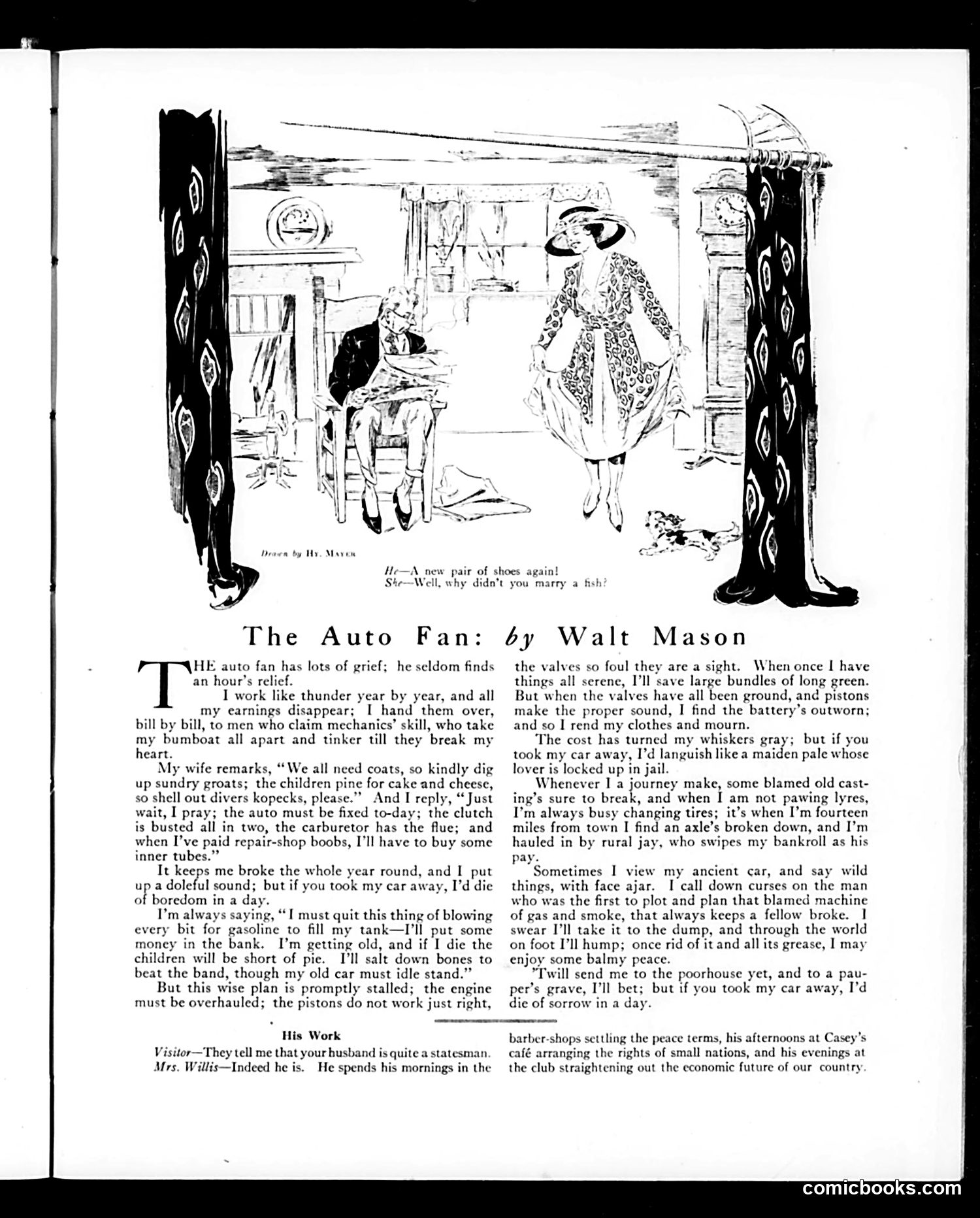
This satirical poem mocks the emerging automobile culture of early 20th-century America. The narrator is an everyman trapped in financial servitude to his car—constantly paying mechanics, buying parts, and repairing breakdowns, yet paradoxically unable to abandon it despite recognizing it as a money-draining burden. The humor targets the contradiction of the automobile age: cars were marketed as liberating machines, yet owners found themselves enslaved to maintenance costs and gasoline expenses that consumed their earnings. The comic strip illustration above depicts a domestic dispute where the wife demands new clothes while the husband complains the car needs fixing—illustrating how automobile ownership competed with basic family needs. The accompanying "His Work" joke reinforces the theme: while the husband pontificates about politics in barbershops and cafes, his wife notes the irony that an actual "statesman" spends his time in idle male chatter rather than real statesmanship—a secondary jab at masculine pretense.
📄 Transcribed text from this page (OCR, searchable)
Machine-transcribed from the original scan — historical spelling and the odd misread are preserved.
ven by My. Maven He—A new pair of shoes again! She The Auto Fan: HE auto fan has lots of grief; he seldom finds an hour's relief. I work like thunder year by year, and all my earnings disappear; I hand them over, bill by bill, to men who claim mechanics’ skill, who take my bumboat all apart and tinker till they break my heart. My wife remarks, “We all need coats, so kindly dig up sundry groats; the children pine for cake and cheese, so shell out divers kopecks, please.” And I reply, “Just wait, I pray; the auto must be fixed to-day; the clutch is busted all in two, the carburetor has the flue; and when I’ve paid repair-shop boobs, I'll have to buy some inner tubes.” It keeps me broke the whole year round, and I put up a doleful sound; but if you took my car away, I’d die of boredom in a day. I’m always saying, “I must quit this thing of blowing every bit for gasoline to fill my tank—I’ll put some moncy in the bank. I’m getting old, and if I die the children will be short of pie. I'll salt down bones to beat the band, though my old car must idle stand.” But this wise plan is promptly stalled; the engine must be overhauled; the pistons do not work just right, Well, why didn’t you marry a fish 6y Walt Mason the valves so foul they are a sight. When once | have things all serene, I'll save large bundles of long green. But when the valves have all been ground, and pistons make the proper sound, I find the battery’s outworn; and so I rend my clothes and mourn. The cost has turned my whiskers gray; but if you took my car away, I’d languish like a maiden pale whose lover is locked up in jail. Whenever I a journey make, some blamed old cast- ing’s sure to break, and when I am not pawing lyres, I’m always busy changing tires; it’s when I’m fourteen miles from town I find an axle’s broken down, and I’m hauled in by rural jay, who swipes my bankroll as his pay. Sometimes I view my ancient car, and say wild things, with face ajar. I call down curses on the man who was the first to plot and plan that blamed machine of gas and smoke, that always keeps a fellow broke. 1 swear I'll take it to the dump, and through the world on foot I’ll hump; once rid of it and all its grease, | may enjoy some balmy peace. ’T will send me to the poorhouse yet, and to a pau- per’s grave, I'll bet; but if you took my car away, I'd die of sorrow in a day. His Work Visitor—They tell me that your husband is quite a statesman Mrs. Willis—Indeed he is. He spends his mornings in the barber-shops settling the peace terms, his afternoons at Casey’s café arranging the rights of small nations, and his evenings at the club straightening out the economic future of our country comicbooks.com