
Judge, 1919-02-08 · page 5 of 32
Judge — February 8, 1919 — page 5: what you’re looking at
What you’re looking at
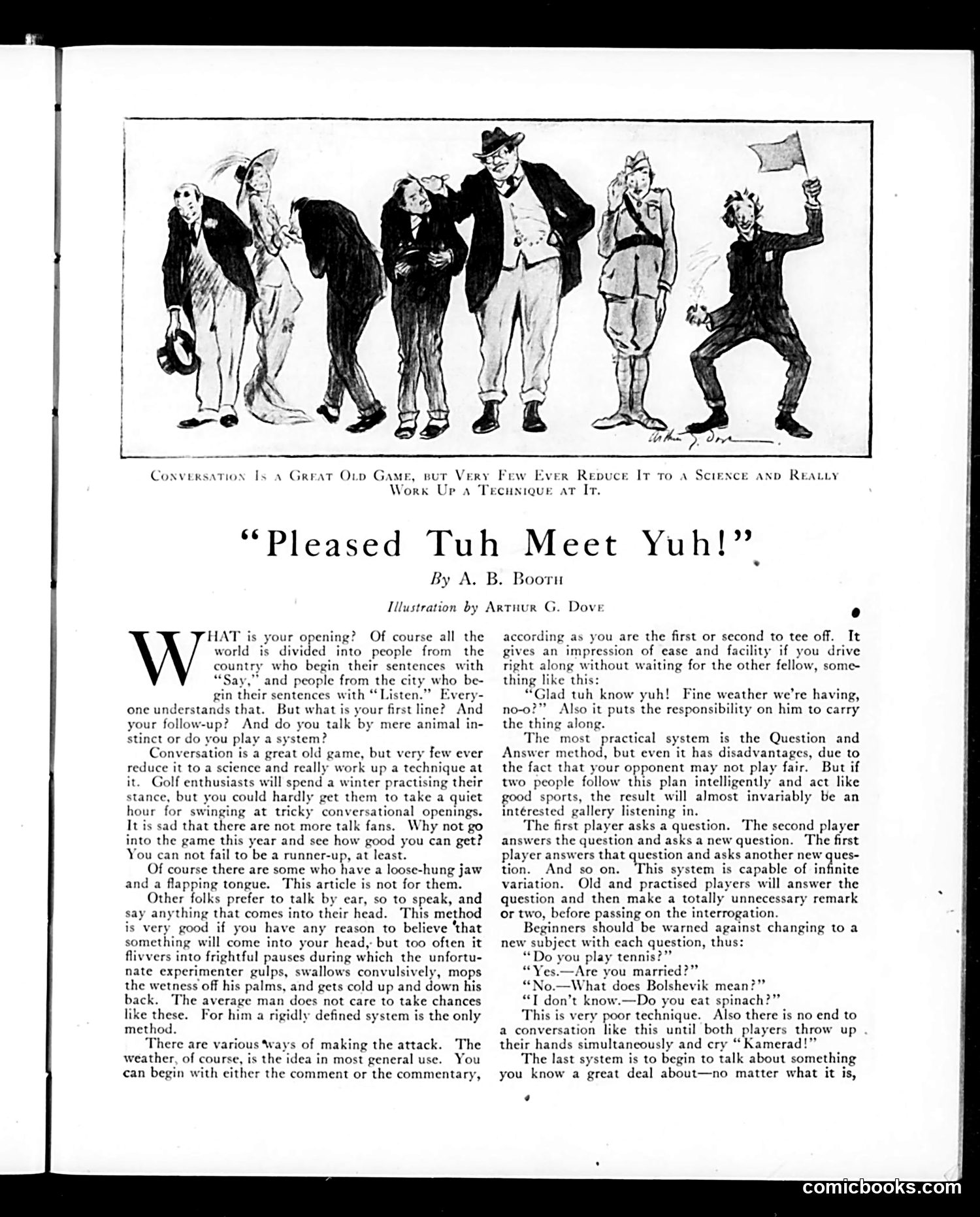
This article discusses conversation as a social skill, illustrating various conversational types through cartoon figures. The piece critiques people who lack conversational technique—those with "loose-hung jaws," excessive chatterers, and those who monopolize discussion. The satire targets social awkwardness in upper-class contexts, where conversation was considered an art requiring practice and skill. The illustration depicts different conversational personalities: the enthusiastic greeter, the shy participant, the aggressive interrupter, the military or authoritarian type, and the theatrical gesticulator. The article advocates the "Question and Answer method" as the most practical system for intelligent conversation. It warns against poor technique, such as abruptly changing subjects or forcing simultaneous hand gestures while saying "Knavero!"—satirizing affected, unnatural conversational behavior among the socially pretentious.
📄 Transcribed text from this page (OCR, searchable)
Machine-transcribed from the original scan — historical spelling and the odd misread are preserved.
Conversation Is a Great Oro Game, put Very Few Ever Repuce It to a Science and Reatty Work Up a Tecunique at It. “Pleased Tuh Meet Yuh!” By A. B. Booru Illustration by Artuur G. Dove e HAT is your opening? Of course all the world is divided into people from the country who begin their sentences with “Say,” and people from the city who be- gin their sentences with “Listen.” Every- one understands that. But what is your first line? And your follow-up? And do you talk by mere animal in- stinct or do you play a system? Conversation is a great old game, but very few ever reduce it to a science and really work up a technique at it. Golf enthusiasts will spend a winter practising their stance, but you could hardly get them to take a quiet hour for swinging at tricky conversational openings. It is sad that there are not more talk fans. Why not go into the game this year and see how good you can get? You can not fail to be a runner-up, at least. Of course there are some who have a loose-hung jaw and a flapping tongue. This article is not for them. Other folks prefer to talk by ear, so to speak, and say anything that comes into their head. This method is very good if you have any reason to believe ‘that something will come into your head, but too often it flivvers into frightful pauses during which the unfortu- nate experimenter gulps, swallows convulsively, mops the wetness off his palms, and gets cold up and down his back. The average man does not care to take chances like these. For him a rigidly defined system is the only method. There are various ways of making the attack. The weather, of course, is the idea in most general use. You can begin with cither the comment or the commentary, according as you are the first or second to tee off. It gives an impression of ease and facility if you drive right along without waiting for the other fellow, some- thing like thi “Glad tuh know yuh! Fine weather we're having, no-o?” Also it puts the responsibility on him to carry the thing along. The most practical system is the Question and Answer method, but even it has disadvantages, due to the fact that your opponent may not play fair. But if two people follow this plan intelligently and act like good sports, the result will almost invariably be an intérested gallery listening in. ‘The first player asks a question. The second player answers the question and asks a new question. The first player answers that question and asks another new ques- tion. And so on. This system is capable of infinite variation. Old and practised players will answer the question and then make a totally unnecessary remark or two, before passing on the interrogation. Beginners should be warned against changing to a new subject with each question, thus: “Do you play tennis “Yes.—Are you married?” “No.—What does Bolshevik mean?’ “T don’t know.—Do you eat spinach?” This is very poor technique. Also there is no end to a conversation like this until both players throw up their hands simultaneously and cry “ Kamerad!” The last system is to begin to talk about something you know a great deal about—no matter what it is, comicbooks.com