
A complete issue · 32 pages · 1919
Judge — February 1, 1919
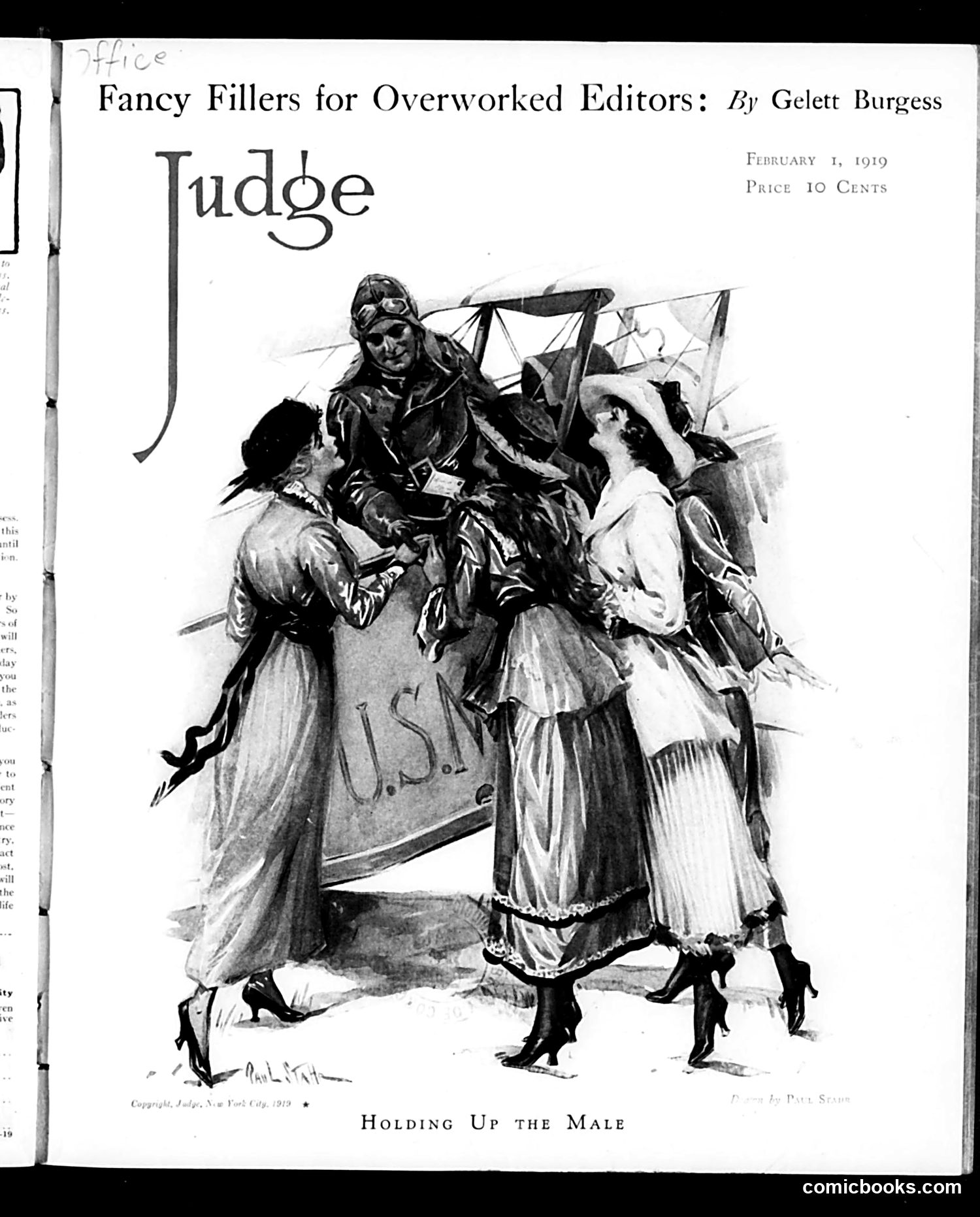
This satirical illustration depicts "Holding Up the Male"—a commentary on women's newfound political power following World War I and the imminent passage of women's suffrage (ratified in August 1919). The cartoon shows two women in fashionable dress literally "holding up" or supporting a male aviator figure, likely representing either returning soldiers or male authority generally. The "U.S." marking on his clothing suggests American identity. The satire suggests that women were now propping up or controlling male figures in society. The title plays on "holding up" banks—implying women were "robbing" men of their traditional dominance. This reflects anxieties about changing gender roles during this transitional period for American women's rights.
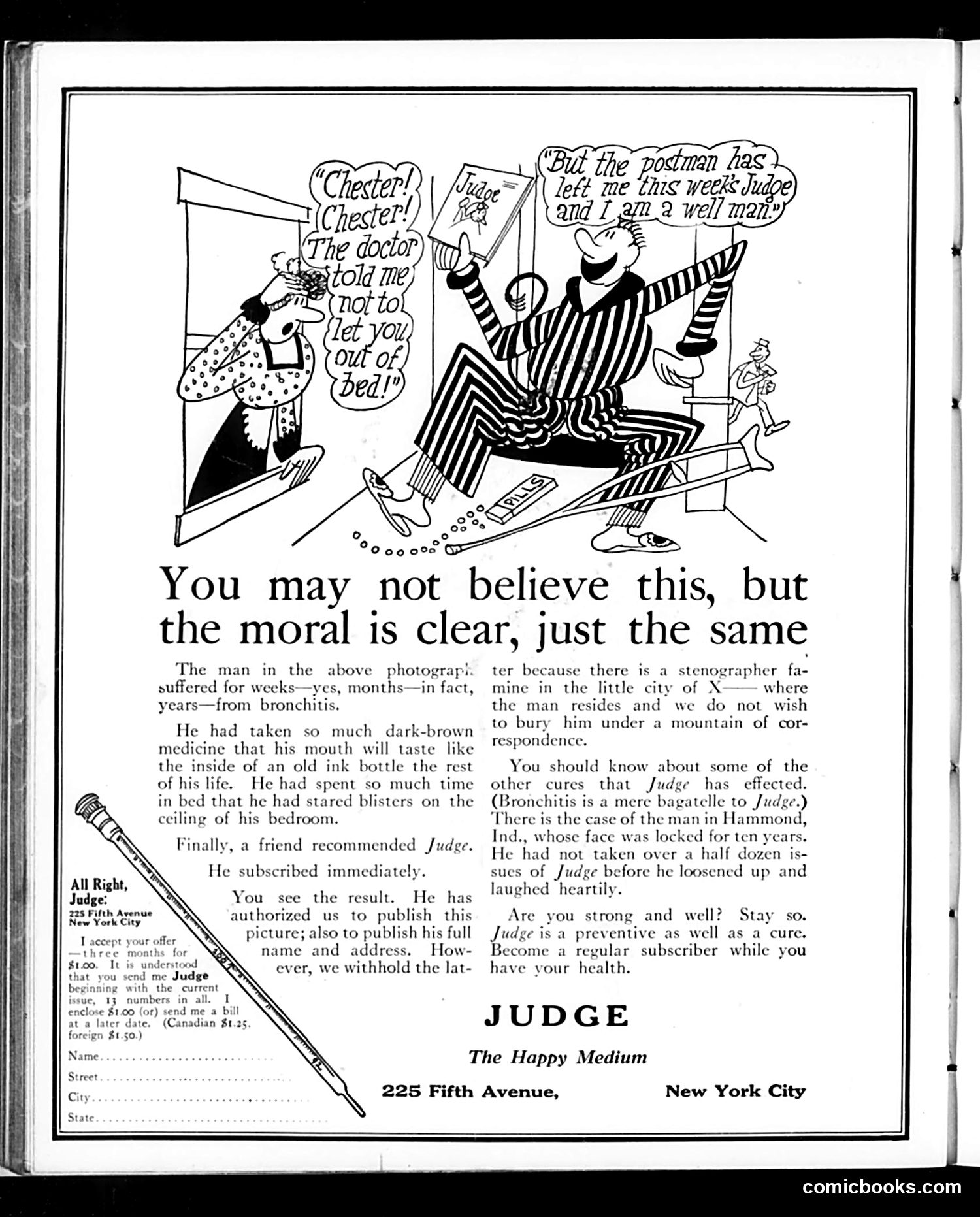
This page is primarily an **advertisement for Judge magazine itself**, disguised as editorial content. The cartoon shows a man who suffered from bronchitis for years until a friend recommended subscribing to Judge. The "moral" claims that Judge's humor provides preventive and curative health benefits. The satire is **self-referential**: Judge humorously suggests its own magazine is medicinal. The exaggerated testimonial—a man literally confined to bed until reading Judge—mocks both patent medicine advertising of the era and magazines' inflated claims about their value. The subscription coupon below reinforces this is primarily a **marketing pitch**. For modern readers, this reflects early 20th-century advertising's loose relationship with health claims and how publications used humor to promote themselves.
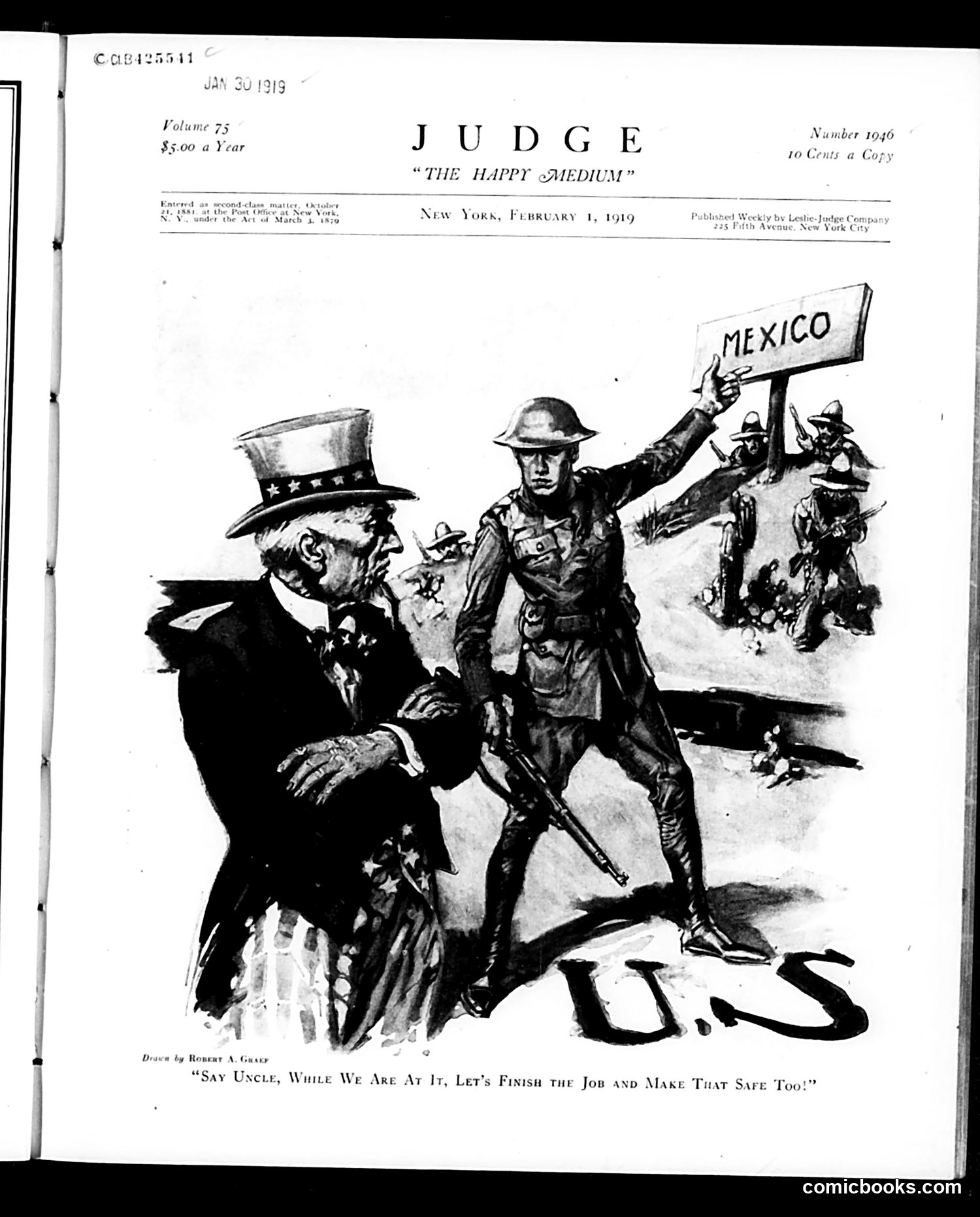
This cartoon depicts **Uncle Sam** (left, in starred top hat) speaking to an American soldier holding a "Mexico" sign. The caption reads: "Say Uncle, While We Are At It, Let's Finish the Job and Make That Safe Too!" The satire addresses **U.S. military intervention in Mexico**. In 1919, America had recently withdrawn troops from Mexico following years of involvement in that nation's civil conflicts. The cartoon appears to advocate for **continued or expanded military action** against Mexico, framing it as "finishing the job" of making the region "safe"—likely referring to American security interests. The soldier and armed figures in the background suggest military readiness, while Uncle Sam's expression conveys persuasive intent toward escalating involvement.
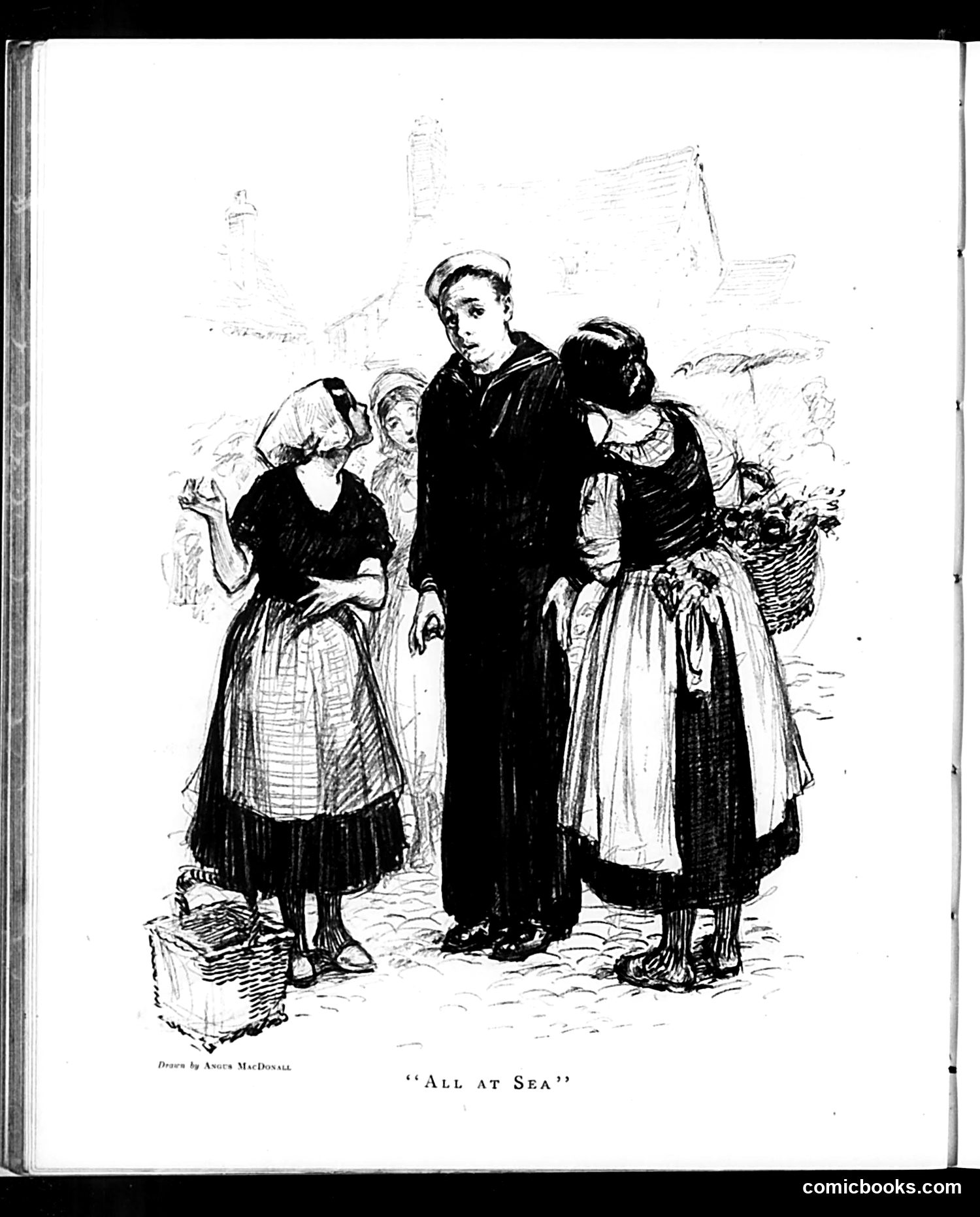
This illustration by Agnes MacDonald depicts a clergyman (identifiable by his dark clerical robes) surrounded by three working-class women carrying baskets, apparently at a seaside location. The title "All at Sea" suggests confusion or disorientation. The satire likely comments on class tensions or the clergy's disconnect from ordinary people's lives. The women appear to be fishwives or market vendors—working poor—while the clergyman stands centrally, suggesting either his confusion about their circumstances or an awkward social interaction across class lines. Without additional context about Judge magazine's specific publication date or contemporary events, the precise political reference remains unclear, though it appears to critique either clerical naivety regarding common people or institutional hypocrisy regarding social conditions.
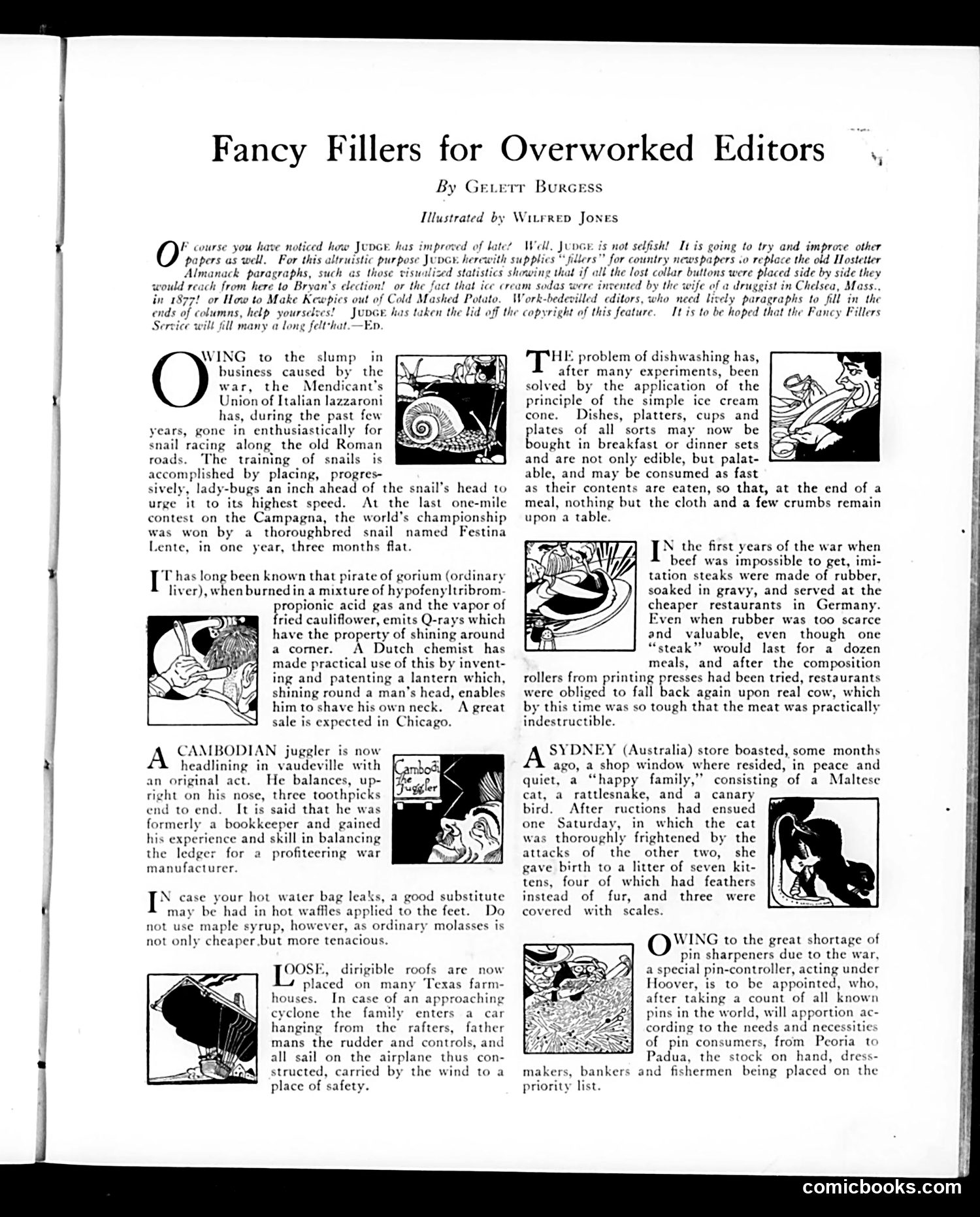
This page presents humorous filler items—brief, whimsical stories—designed for newspaper editors needing quick content. The pieces mock wartime shortages and absurdities: 1. **Snail Racing**: Italian unions trained snails for racing competitions, playing on both Italian stereotypes and the absurdity of wartime labor. 2. **Dishwashing Innovation**: Edible plates (ice cream cones) that dissolve after use—satirizing desperate solutions to shortages. 3. **Rubber Steaks**: During WWI beef rationing, restaurants served rubber disguised as meat, highlighting food scarcity's ridiculous consequences. 4. **Sydney Pet Story**: A humorous anecdote about a Maltese family's chaotic pet situation (snake, canary, kittens), illustrating domestic chaos. 5. **Pin Shortage**: A "pin controller" appointed to ration pins globally—mocking bureaucratic overreach during wartime. The page satirizes both wartime deprivation and governmental response absurdity.
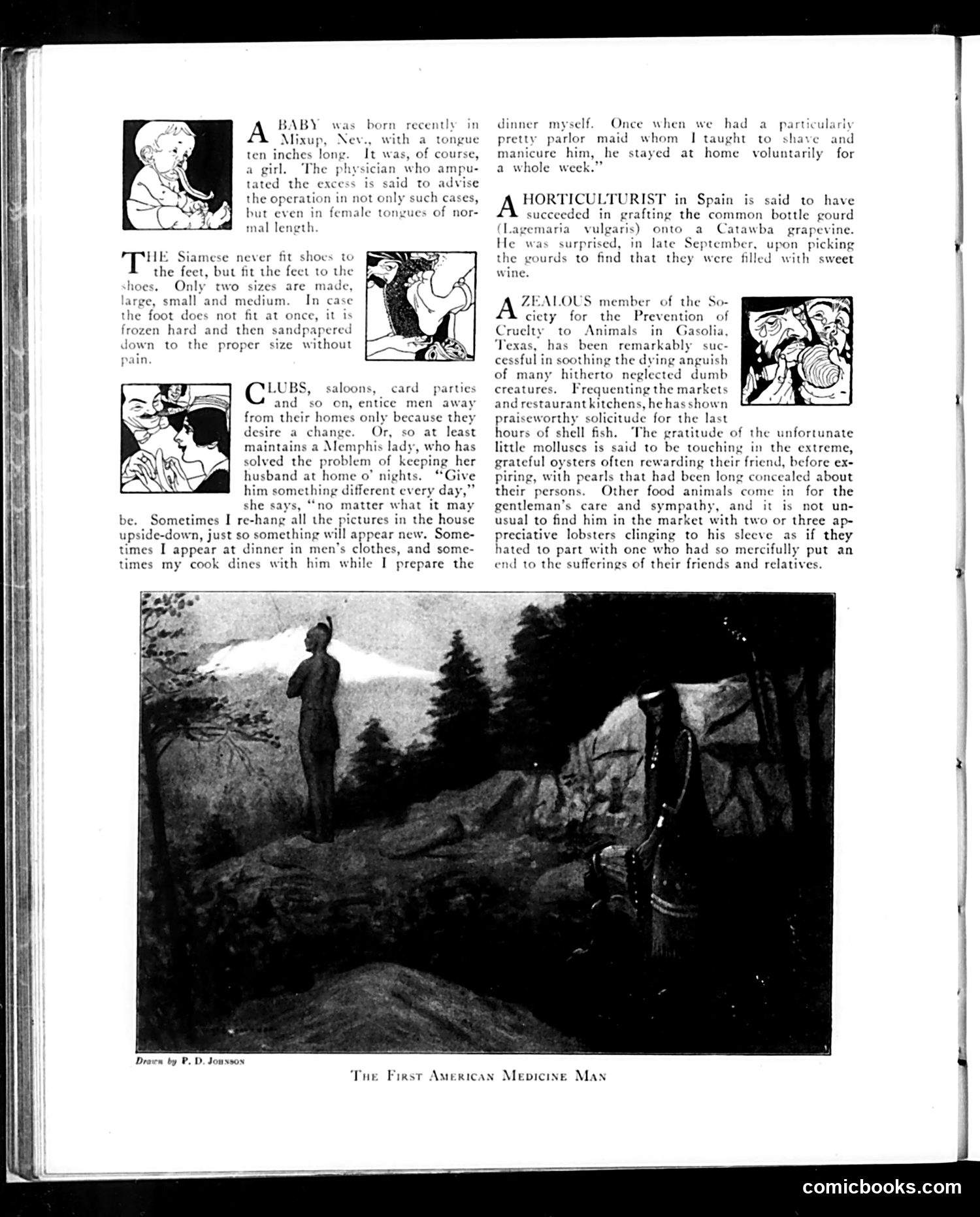
This page contains four unrelated satirical anecdotes with small illustrations: 1. **Baby's Tongue**: A medical item about a baby born in Mixup, Nevada with an unusually long tongue—a girl. The joke concerns the physician's advice about tongue reduction surgery. 2. **Siamese Shoes**: A brief quip about Siamese twins and shoe-fitting difficulties, playing on the term "Siamese" as fashionable slang. 3. **Clubs and Infidelity**: Satirizes husbands who frequent clubs and card parties to escape home life, with a wife's sarcastic suggestion to "give him something different" by rearranging furniture. 4. **Animal Cruelty Advocate**: Describes a Texan successfully grafting common bottle gourds onto Catawba grapevines, and praises an animal welfare activist for his merciful treatment of neglected creatures in markets. The large illustration depicts "The First American Medicine Man"—likely a historical or anthropological reference.
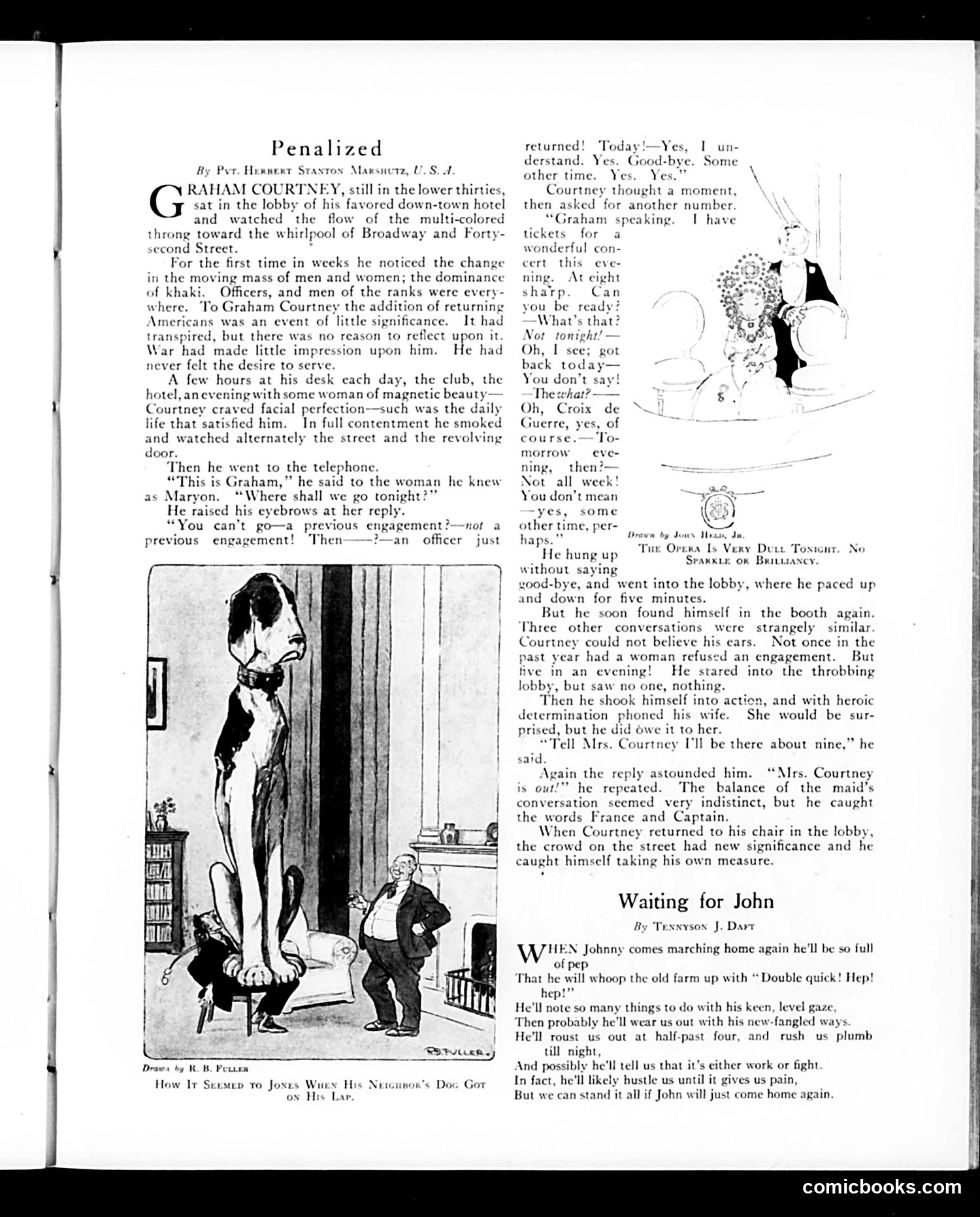
This story satirizes a self-absorbed bachelor, Graham Courtney, who ignores the social changes of post-WWI America. While khaki-uniformed soldiers and officers return home as heroes, Courtney remains indifferent—his life revolves around casual affairs, clubs, and entertainment. The joke: when Courtney attempts to arrange an evening with various women, he's repeatedly refused because they have prior commitments to returning servicemen. Even his wife is out with "a Captain" and the "Croix de Guerre" (French military decoration). The satire mocks Courtney's obliviousness and selfishness. He finally phones his wife only after other women reject him, forced to confront that his shallow lifestyle no longer matters in a society now honoring military service. The "penalization" is social: his indifference to the war has left him abandoned and irrelevant. The second piece, "Waiting for John," celebrates returning soldiers as energetic, purposeful heroes who will revitalize American farm life.
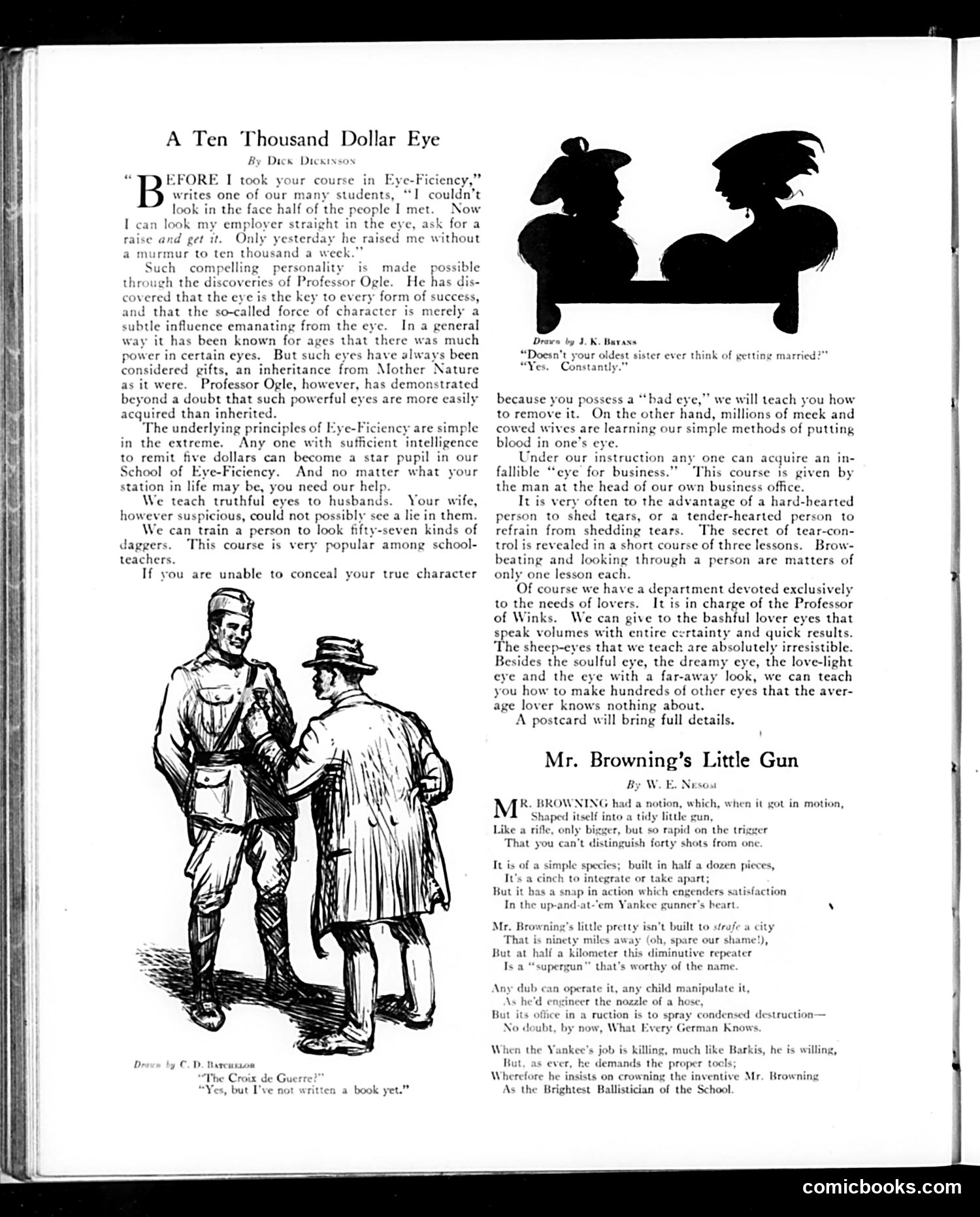
**"A Ten Thousand Dollar Eye"** satirizes the era's proliferation of mail-order self-improvement courses. The fictional "Professor Ogle" sells a correspondence course in "Eye-Ficiency"—teaching people to manipulate others through practiced eye contact and expressions (the "soulful eye," "sheep-eyes," etc.). The satire mocks both the absurd promise that success derives from eye control and the gullible public willing to pay five dollars for such instruction. The student's testimonial about getting a raise simply by looking employers in the eye epitomizes the scam's hollow claims. **"Mr. Browning's Little Gun"** celebrates the Browning automatic rifle, a real weapon of the era, praising its rapid-fire capability and ease of use. Given the World War I context (references to "Yankee gunner" and "German"), this appears promotional rather than satirical—celebrating American military technology.
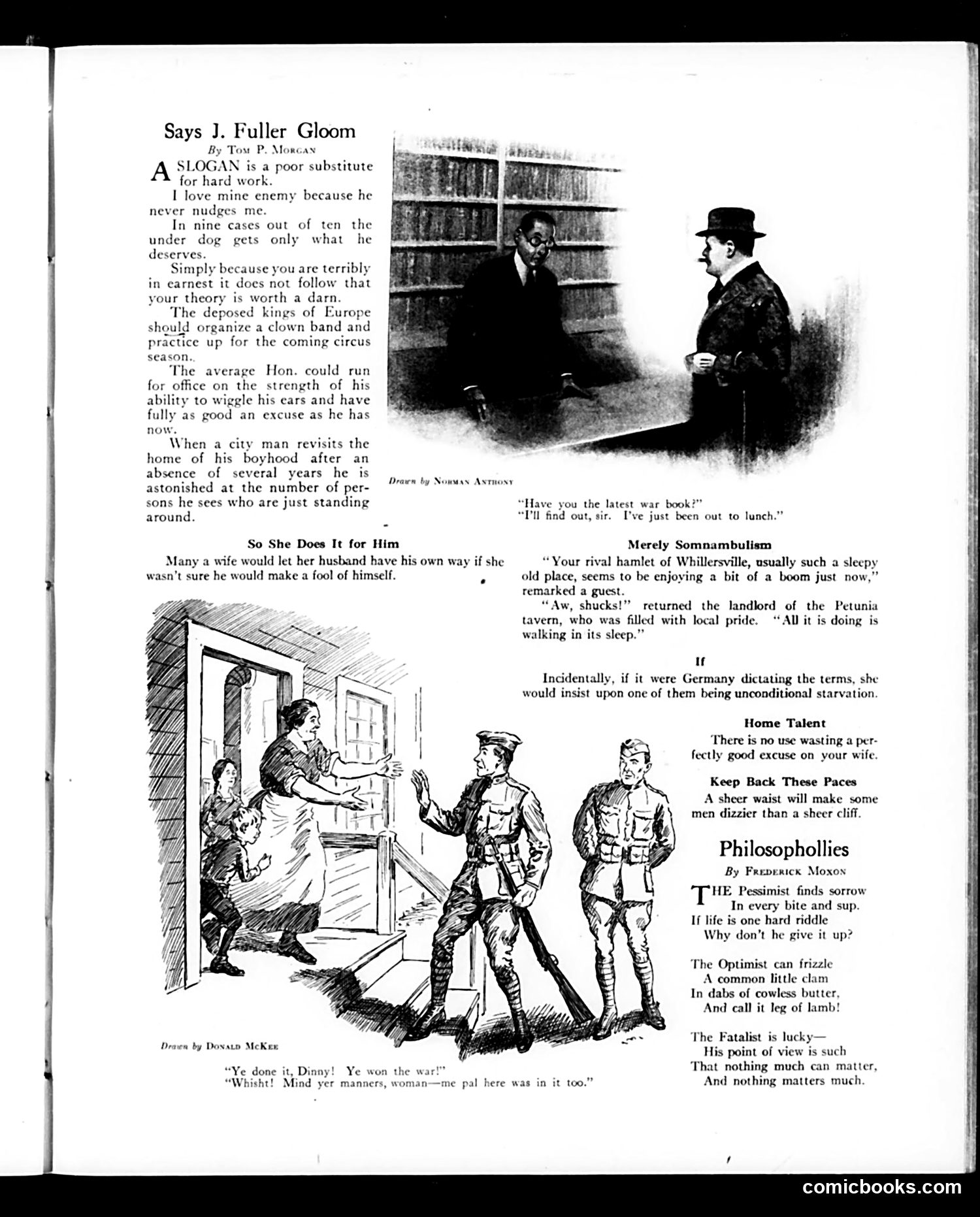
This page contains satirical commentary and humor typical of Judge magazine's style. The top section features "J. Fuller Gloom" offering cynical observations about society—mocking slogans, praising enemies who don't nag, and suggesting politicians could run on the ability to wiggle their ears. The reference to "deposed kings of Europe" organizing "a clown band" likely alludes to post-WWI European politics and diminished monarchies. The middle cartoon "So She Does It for Him" depicts soldiers being welcomed home, with a woman's pragmatic approach to managing her husband. The lower section includes brief humorous sketches and "Philosophollies"—poetic musings on pessimism, optimism, and fatalism. References to "Germany dictating terms" and "the war" suggest this is post-WWI (likely early 1920s), when such topics dominated American discourse. Overall, the page combines political satire with domestic humor and philosophical whimsy typical of the era's satirical press.
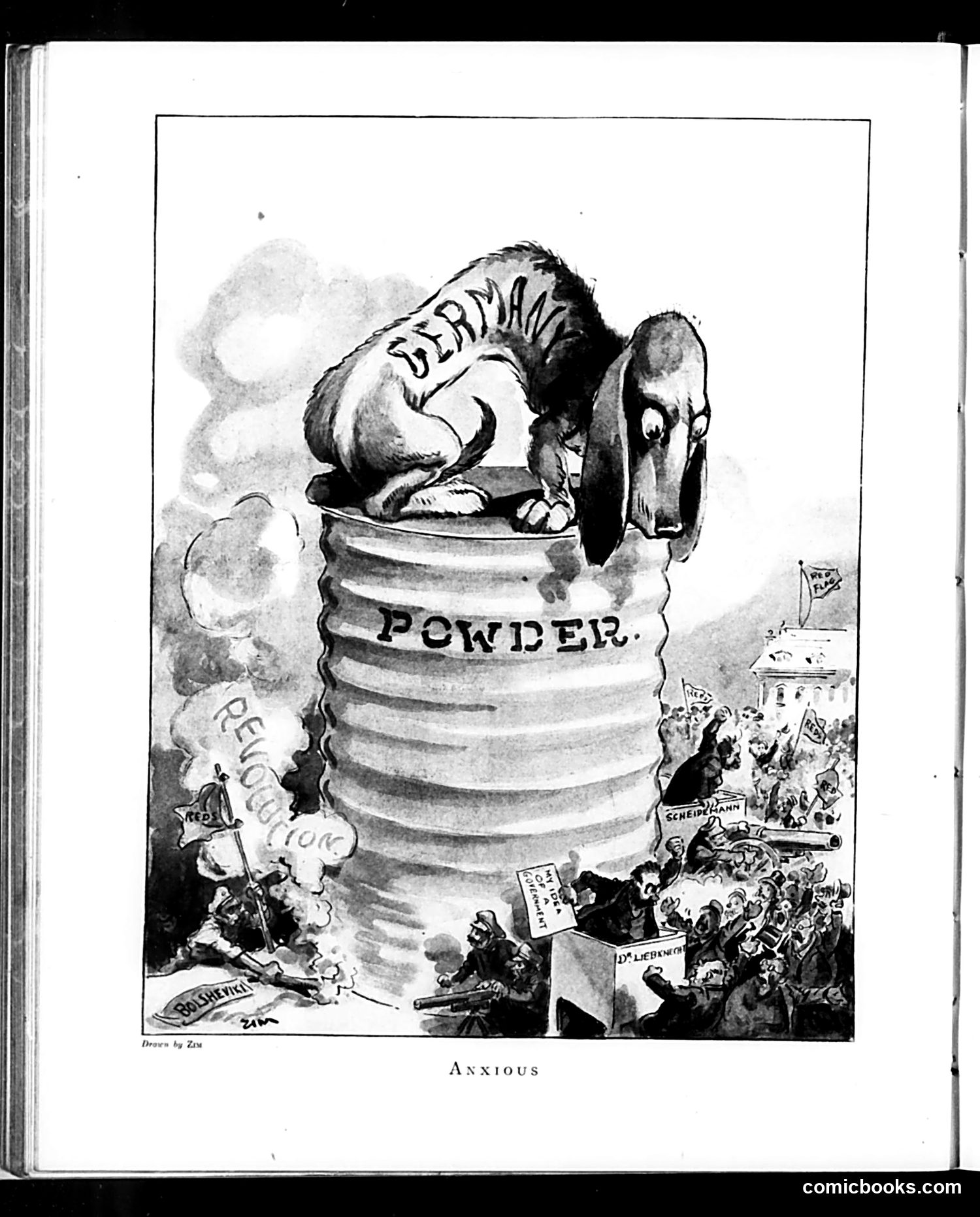
This political cartoon depicts a large powder keg labeled "GERMANY" and "POWDER" with a menacing face emerging from it. The figure appears distressed or aggressive. At the base, various armed figures and crowds gather, suggesting military mobilization or conflict. The cartoon likely references pre-World War I tensions, portraying Germany as an explosive, unstable threat. The "powder keg" metaphor was common in early 20th-century political discourse to describe volatile European geopolitics. The crowds and military activity at the base suggest international anxiety about potential German aggression. The title "Anxious" confirms the cartoon's theme: depicting widespread concern about German militarism and the threat of continental war. The artist (Zim) uses exaggeration and metaphor to convey public unease about European instability.
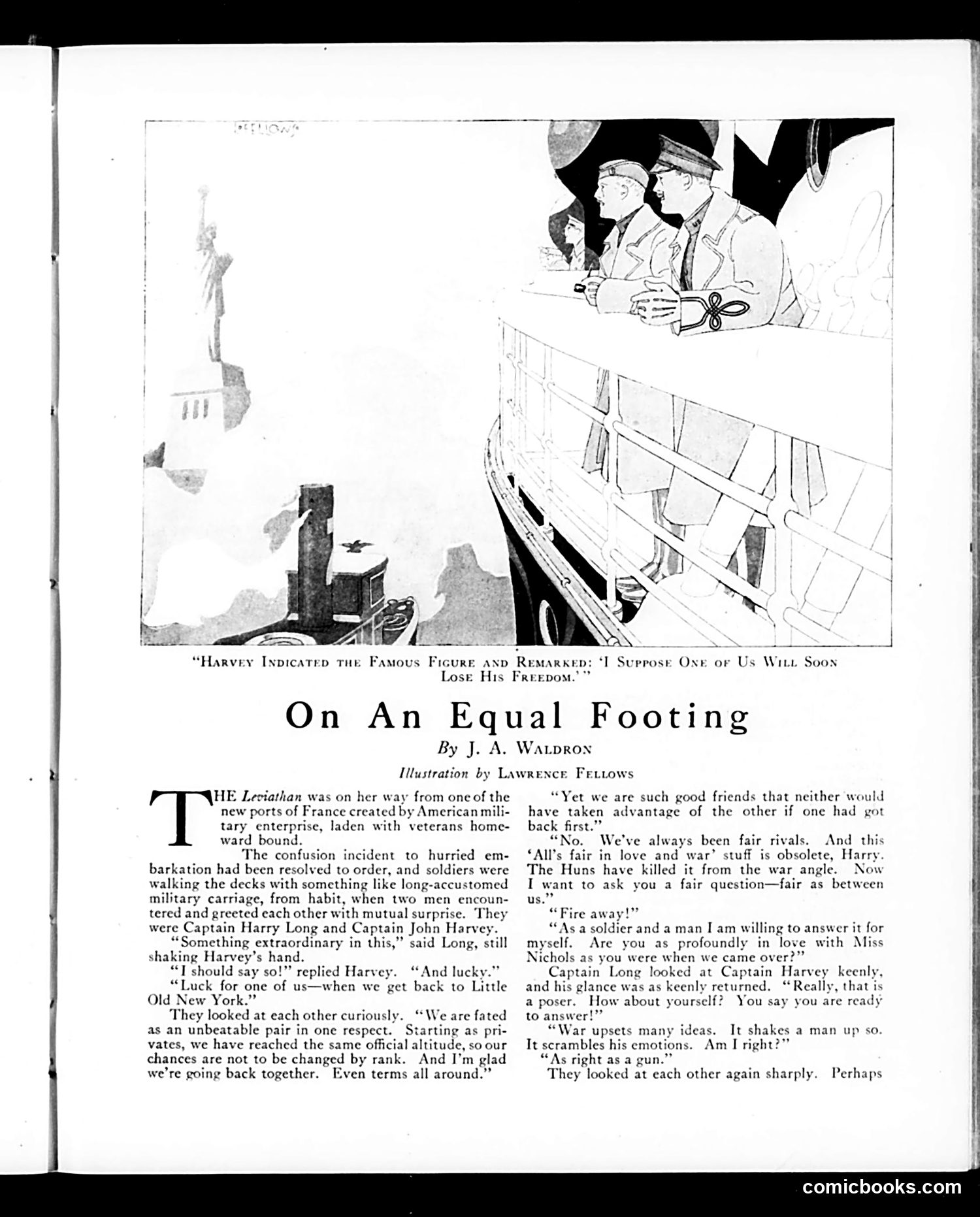
This is a post-WWI short story illustration about two American Army officers, Captain Harry Long and Captain John Harvey, reuniting on a transport ship returning veterans from France. The satire concerns romantic rivalry: both men are equally in love with the same woman (Miss Nichols) and equally ranked as captains—hence "equal footing." The joke hinges on their gentlemanly agreement that wartime emotions have scrambled their feelings, making it unclear who truly loves her most. The caption's reference to one man losing his "freedom" suggests marriage anxiety—a common post-war theme in Judge magazine. The story explores how military rank equality and wartime chaos have rendered their romantic competition essentially unresolvable, subverting traditional romantic competition tropes through bureaucratic and emotional equivalence.
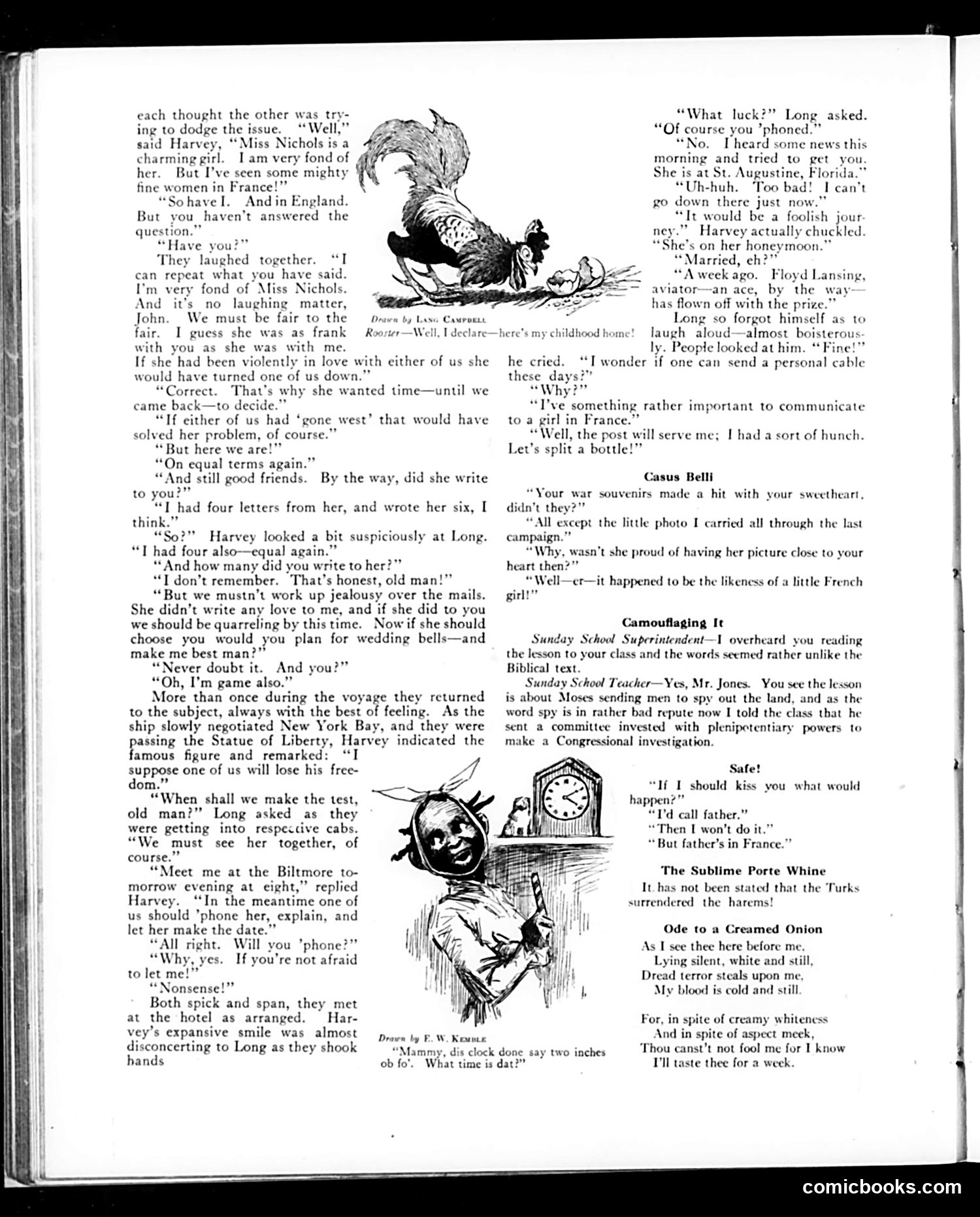
This page contains **interconnected short stories and humor** typical of Judge magazine's format, rather than political cartoons. The main narrative follows two soldiers, Harvey and Long, who both court the same woman, Miss Nichols, during WWI. **The central joke**: Both men write to her equally while deployed, neither knows the other's correspondence volume, and they agree to let *her* choose between them upon returning home. The punchline: she's married a third man (aviator Floyd Lansing) and gone to Florida on her honeymoon—solving the romantic dilemma through an unexpected third party. **Secondary humor sections** include crude jokes about military life and a Sunday School teacher disguising the word "spy" as "scout" due to wartime suspicions. The **satirical context** reflects post-WWI American attitudes: soldiers' romantic entanglements, male rivalry presented as gentlemanly, and casual acceptance of deception in courtship. The cartoons by Lune Campbell and E.W. Kemble illustrate these scenarios with period-appropriate drawings. This reflects early 20th-century satirical magazine conventions blending romance, military humor, and social commentary.
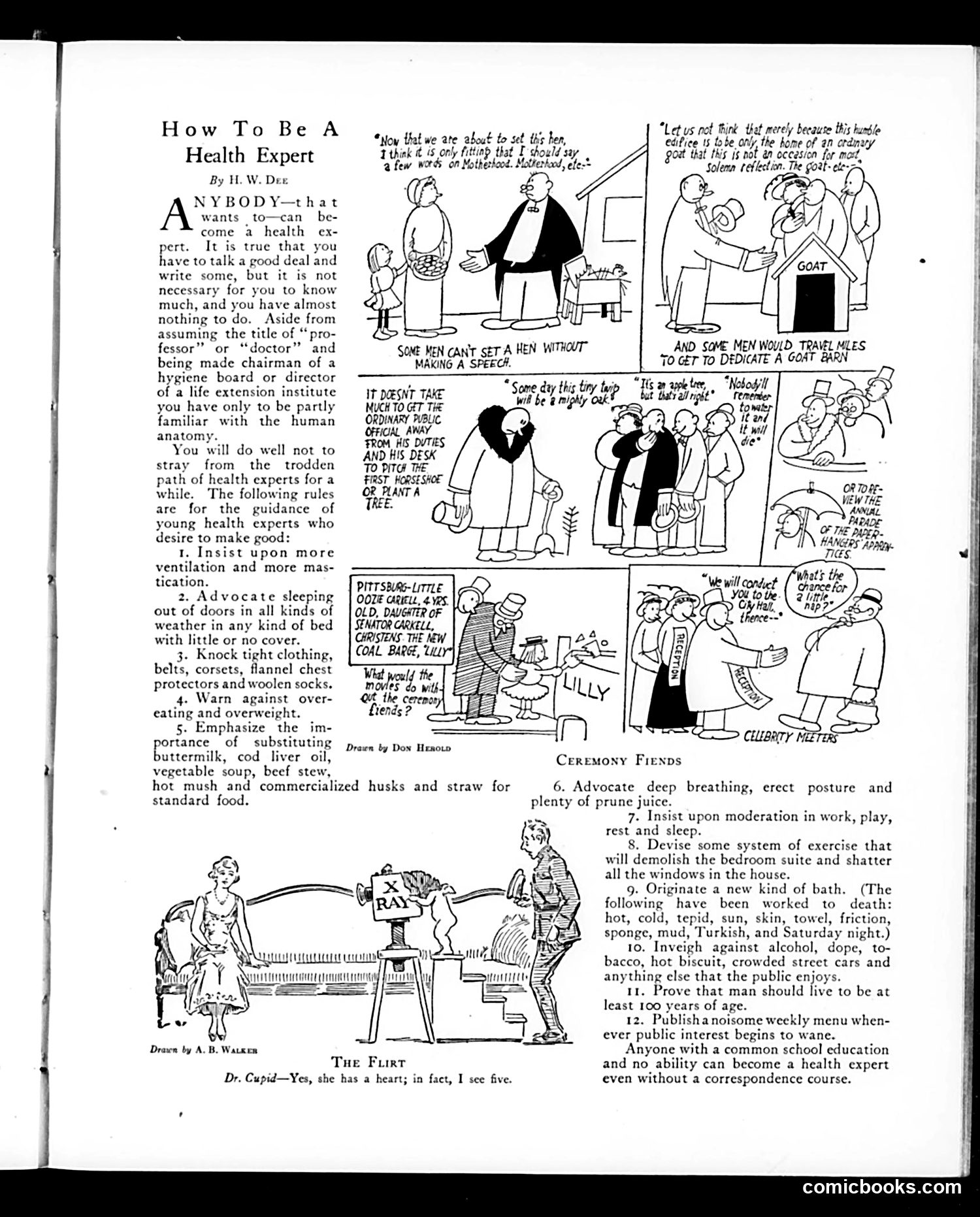
This satirical article mocks the early 20th-century proliferation of self-proclaimed "health experts"—figures who required no formal credentials, yet dispensed trendy wellness advice to the public. The author, H.W. Dee, exposes their formula: adopt an impressive title ("Professor" or "Doctor"), make vague proclamations about ventilation and mastication, and advocate fashionable but often contradictory health fads (sleeping outdoors, avoiding tight clothing, drinking buttermilk and cod liver oil). The accompanying cartoons illustrate the absurdity: pompous men making lengthy speeches about trivial health matters (setting a hen, planting a tree), promoting peculiar bathing methods, and pushing restrictive diets. The humor targets how these "experts" achieved prominence through mere assertiveness and pseudo-scientific jargon rather than actual knowledge. The final jab—that anyone with "common school education and no ability" could become a health expert—emphasizes the fraudulence of this emerging industry of health charlatans.
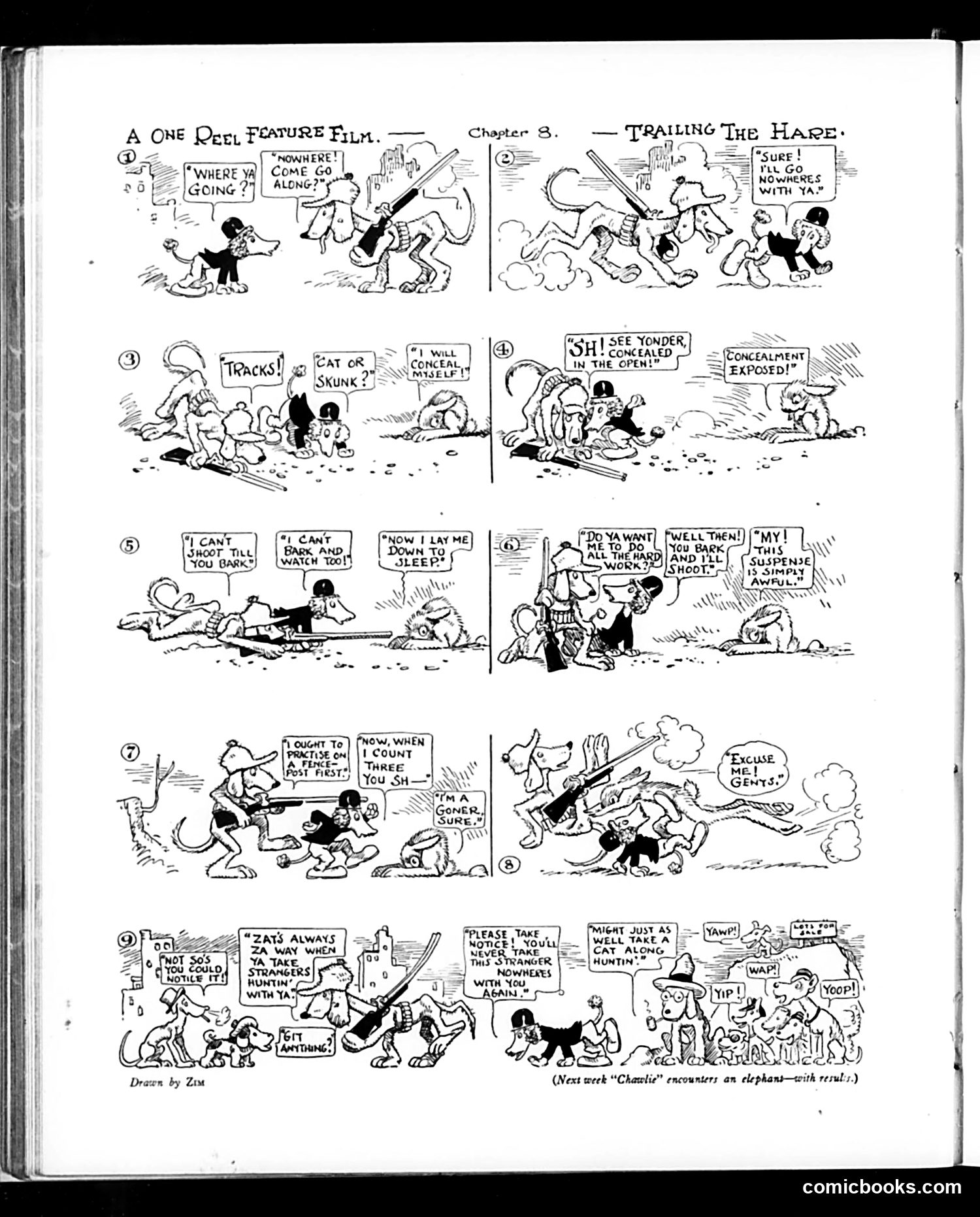
This is a slapstick comedy strip featuring cartoon animals (a dog and what appears to be a hare or rabbit) engaged in a chase and hunting scenario. The humor relies on physical comedy and role-reversals: the hunter becomes hunted, characters struggle with contradictory tasks (can't both bark and watch), and absurd situations escalate. The title references a literal chase. The strip's jokes are domestic and situational—miscommunication, failed plans, and comedic violence—rather than political satire. This appears to be light entertainment filler content typical of Judge magazine's humor pages, drawn by "Zim" (visible signature). The note about "Charlie" encountering elephants next week suggests this was serialized entertainment for general audiences, likely from the 1920s-1930s era based on style and printing.
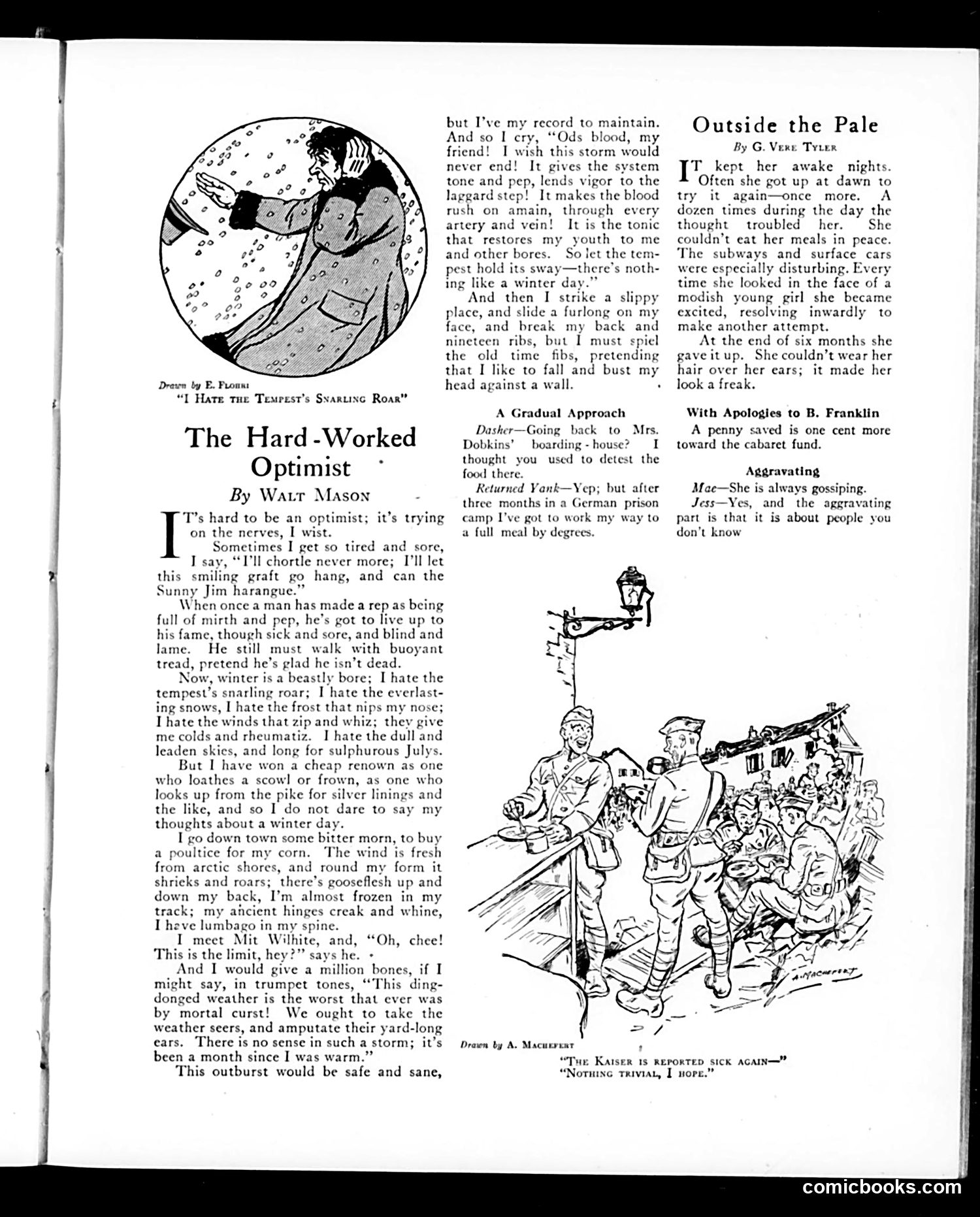
This page contains three distinct satirical pieces from Judge magazine: **"The Hard-Worked Optimist"** by Walt Mason mocks people who maintain a cheerful public persona despite genuine misery. The speaker claims to love winter while detailing his actual suffering—frozen joints, colds, and falls—because he's built a reputation as an upbeat person. The satire targets forced positivity and the social pressure to maintain appearances. **"A Gradual Approach"** is a brief joke about a returned WWI prisoner who endured a German prison camp so harsh that even poor boarding-house food seems palatable by comparison. It comments on the extreme hardships of the war. **"Outside the Pale"** describes a woman obsessed with styling her hair, losing sleep and appetite over whether to wear it over her ears, ultimately giving up because it makes her look "a freak." This satirizes excessive vanity and fashion anxiety. The bottom cartoon references the Kaiser being "reported sick again"—likely commentary on Wilhelm II's health during WWI (circa 1914-1918), mixing dark humor about enemy leadership.
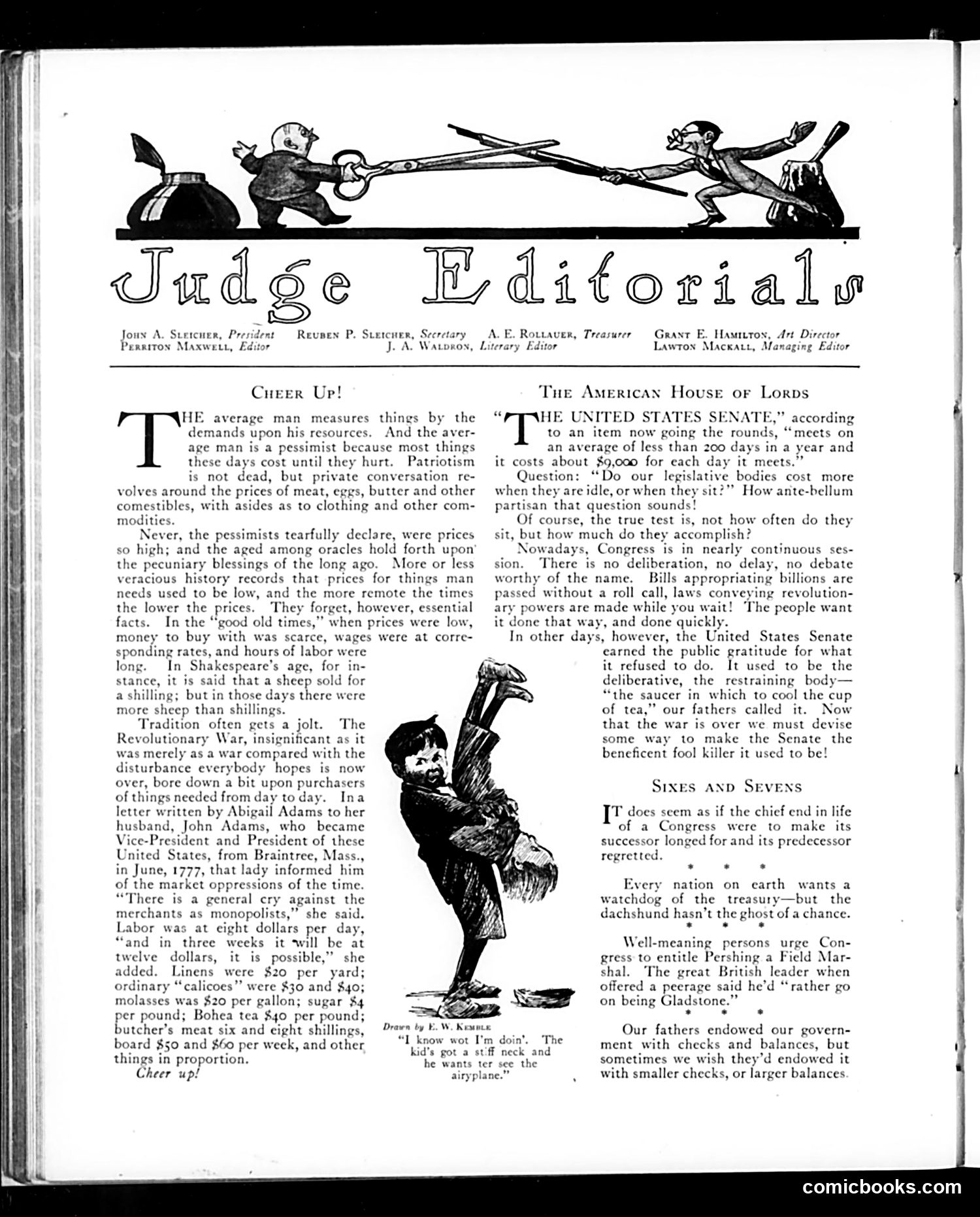
This page contains three distinct satirical pieces from Judge magazine (post-WWI era, given Pershing reference). **"Cheer Up!"** argues nostalgia for "cheaper old times" is misleading. Using Abigail Adams's 1777 letter as evidence, the editor shows Revolutionary War prices were similarly inflated—linens at $20/yard, sugar at $4/pound. The point: high prices aren't new; what matters is wages and purchasing power, not absolute numbers. A corrective to popular complaint. **"The American House of Lords"** mocks the U.S. Senate's expense ($9,000 per meeting day) and inefficiency. It contrasts the modern Senate—rushing bills through without debate—with the Founding Fathers' vision of a deliberative, restraining body ("saucer to cool the cup of tea"). Satire suggests the Senate should be a "fool killer" that prevents hasty legislation. **"Sixes and Sevens"** briefly criticizes Congress's tendency to make successors longed-for and predecessors regretted, then suggests Congress honor General Pershing as Field Marshal. The cartoon shows two figures in a tug-of-war with crossed staffs, illustrating editorial conflict.
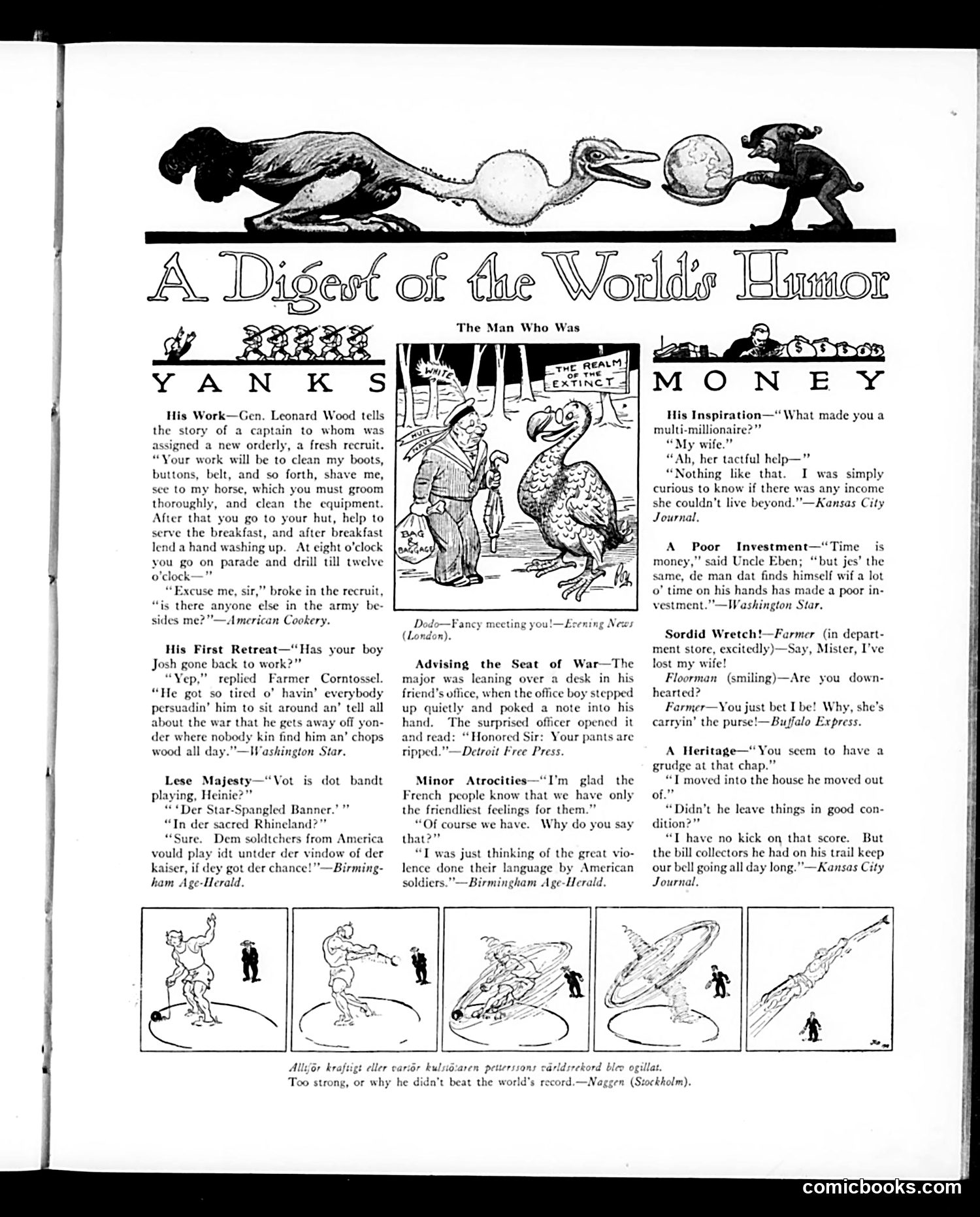
This page collects brief satirical anecdotes and jokes organized around three themes: **Yanks** (American military life), **The Man Who Was Money** (wealth/marriage), and related social commentary. The content reflects early-20th-century American humor: - **Military jokes** mock the absurdity of military discipline and soldiers avoiding war talk by disappearing into the woods - **WWI-era references** appear in jokes about American soldiers in France and German sensitivity to American bands playing patriotic music near German lines - **Wealth satire** includes a millionaire whose wife's extravagance motivated his success, and commentary on time as money - **Social humor** covers mundane domestic irritations: lost wives (who carry the purse), bill collectors, moving into houses with lingering debts The bottom cartoon strip (text unclear) appears to show a physical gag about missing a world record. The overall tone is gentle mockery of American character, military life, and domestic economics—typical of Judge's satirical approach to contemporary society.
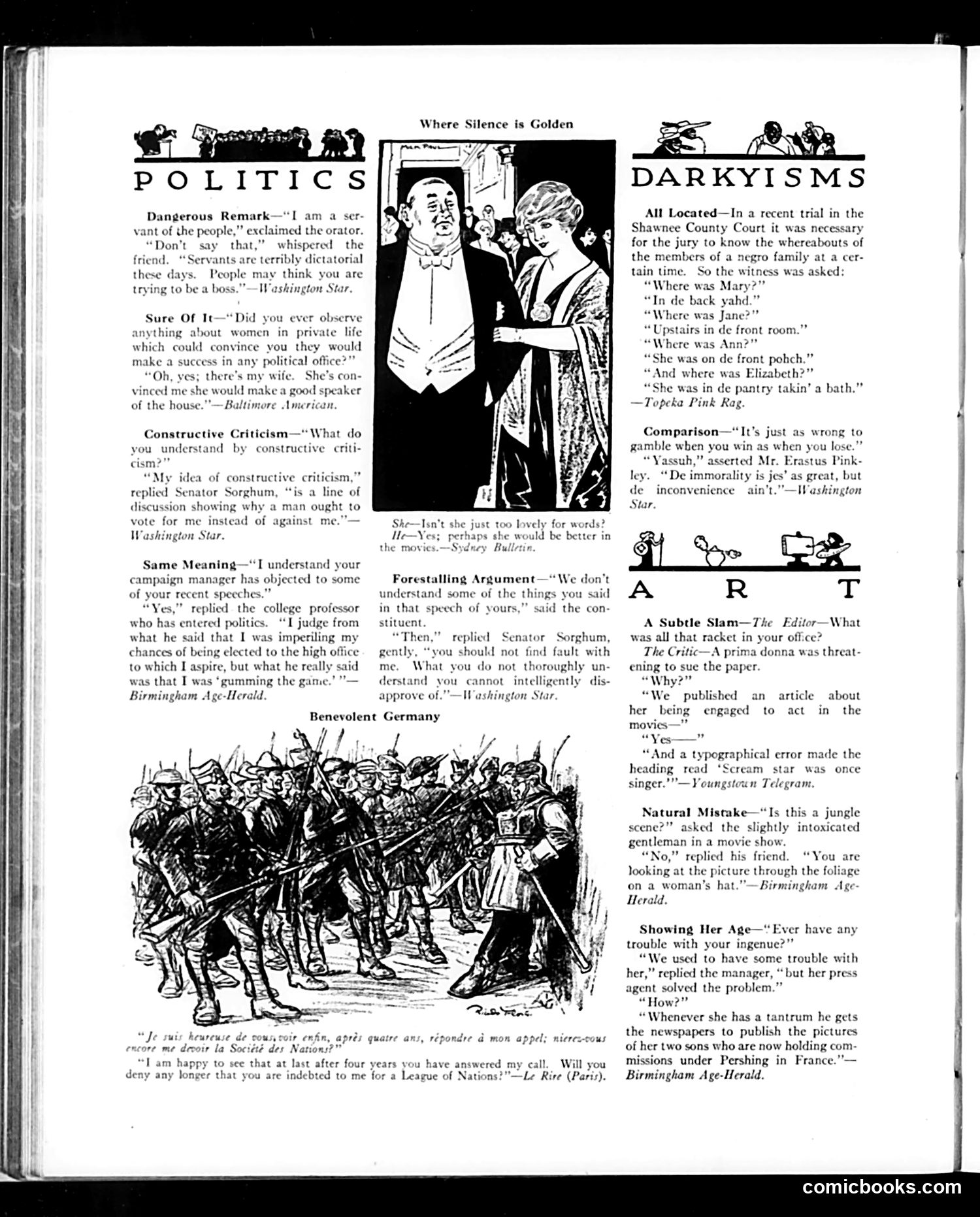
This page from Judge magazine contains political humor and racist stereotypes typical of early 20th-century American satire. **POLITICS section** mocks politicians through short jokes: Senator Sorghum appears as a recurring character representing self-serving politicians who twist language to avoid accountability. One joke satirizes women's suffrage by suggesting a politician's wife convinced him she'd make a good Speaker—implying women are naturally manipulative rather than politically capable. **DARKYISMS section** (an offensive period heading) collects racist "humor" featuring African American characters with exaggerated dialect. These jokes rely on crude stereotypes portraying Black people as simple, unintelligent, and comical—standard racist content for this era. **ART section** contains brief editorial jokes about publishing mishaps and show business. The "Benevolent Germany" illustration (bottom left) appears to reference World War I and Germany's military actions, though context is limited. The overall page reflects Judge's formula: political mockery paired with deeply racist content normalized for contemporary white audiences.
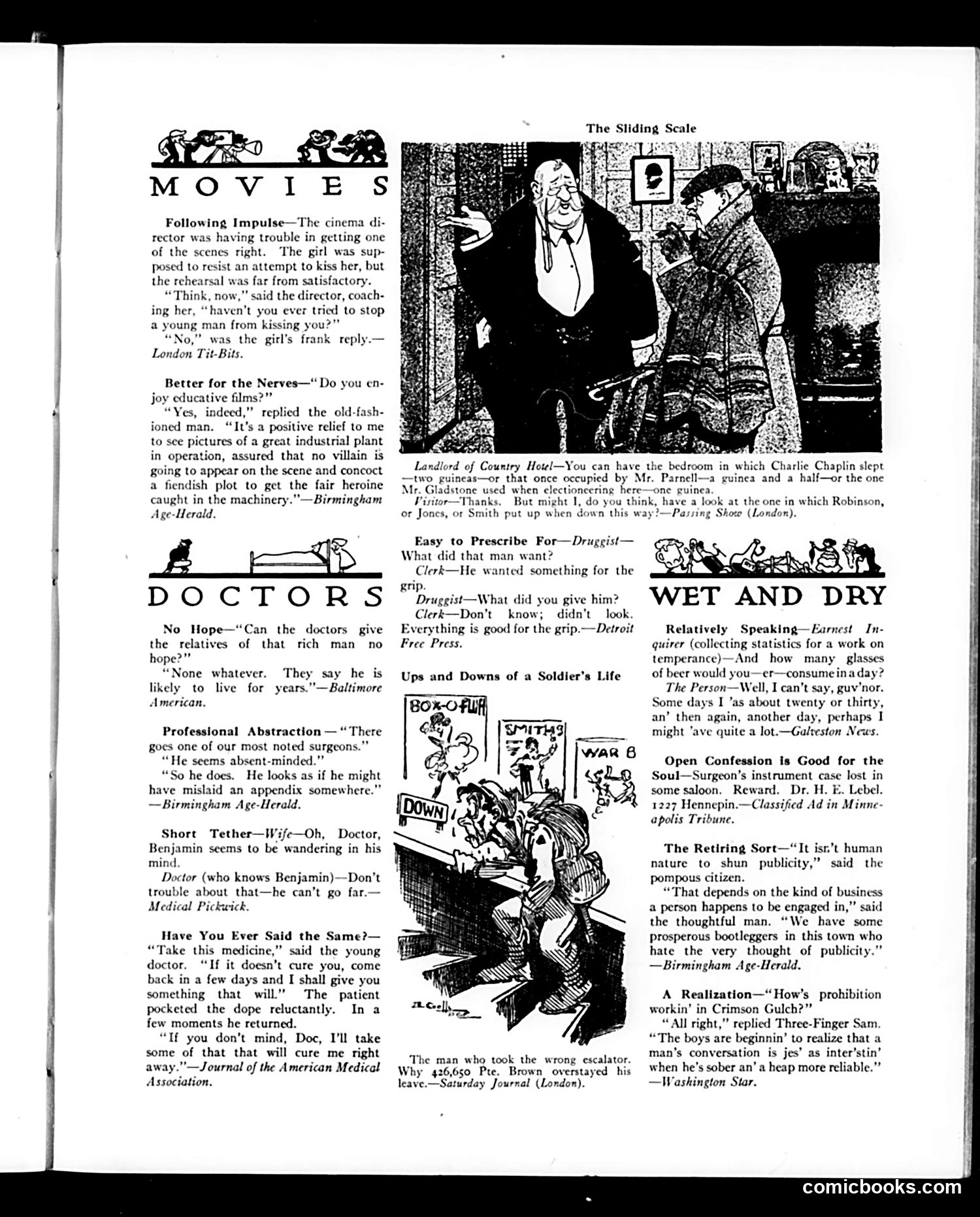
This page contains various short humorous anecdotes typical of Judge's satirical format. **"The Sliding Scale"** cartoon depicts a landlord showing potential lodgers the bedroom where Charlie Chaplin (the famous silent film star) once slept, asking exorbitant prices for progressively lesser accommodations—a joke about inflated rents based on celebrity association. The surrounding jokes mock early-20th-century concerns: cinema directors struggling with actresses, doctors' vague prescriptions, Prohibition enforcement, and bootleggers' social awkwardness. One item references "prohibition workin' in Crimson Gulch," reflecting post-1920 anxieties about alcohol bans. Another sardonically notes a surgeon's lost instrument case in a saloon—implying widespread drinking even in professional settings. The humor is largely observational, poking fun at contemporary social absurdities rather than targeting specific political figures.
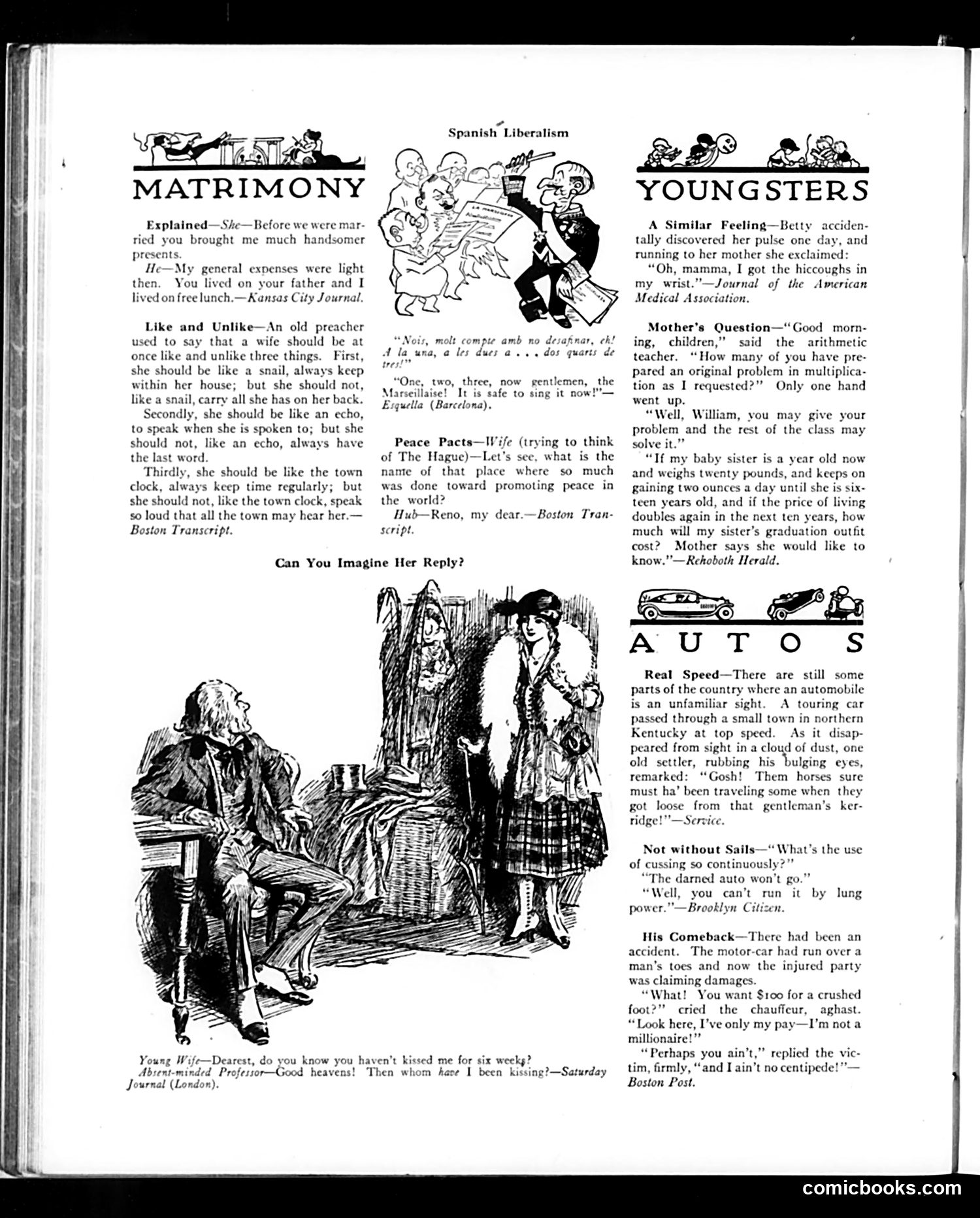
This Judge magazine page contains humorous anecdotes satirizing early 20th-century American life across several themes: **Matrimony section**: Jokes about marriage's financial realities—a husband's gifts decrease after wedding because he no longer needs to impress or has free resources. The cartoons mock traditional gender roles with ironic comparisons (wives like snails, echoes, clocks). **Spanish Liberalism**: A political cartoon showing Spanish revolutionaries singing the "Marseillaise" (French revolutionary anthem), suggesting Spain's liberal movements borrowed rhetoric from France. **"Autos" section**: Rural Americans encountering automobiles for the first time. An old settler mistakes a speeding car for runaway horses—satirizing rural unfamiliarity with modern technology. Other jokes play on the car's mechanical unreliability and the social friction between wealthy auto owners and injured pedestrians. **"Youngsters"**: School humor about children's innocent misunderstandings and mathematical problems reflecting economic anxiety (inflation fears). The overall tone mocks rapid social change, class differences, and the gap between rural tradition and urban modernity in Progressive Era America.
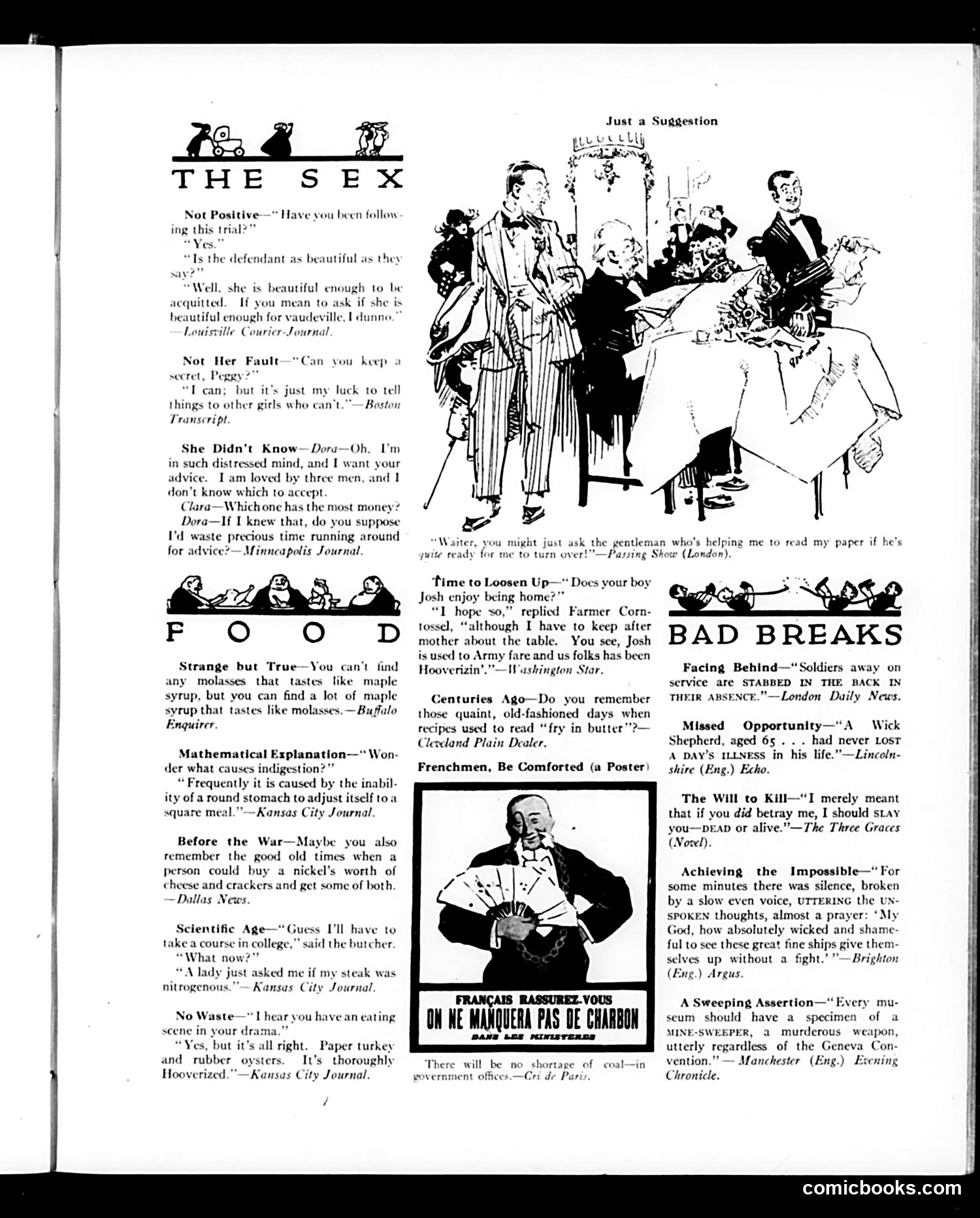
This page from Judge magazine contains primarily **humor columns and brief jokes** rather than political cartoons. The content reflects **early 20th-century American attitudes**, likely WWI-era based on references to "Hooverizing" (food rationing under Herbert Hoover's Food Administration). The jokes target familiar domestic situations: courtroom beauty, keeping secrets, romantic indecision, food quality decline, and wartime shortages. One section titled "Bad Breaks" compiles ironic newspaper clippings—soldiers "stabbed in the back" during service, a shepherd's perfect health record interrupted. A French poster ("Frenchmen, Be Reassured") promises no coal shortage in government offices, likely satirizing wartime bureaucratic inefficiency or resource management. The humor is predominantly **social satire aimed at middle-class readers**—poking fun at women's vanity, domestic life complications, and the absurdities of wartime restrictions rather than advancing serious political arguments. The cartoons (visible but undated) appear to illustrate selected jokes.
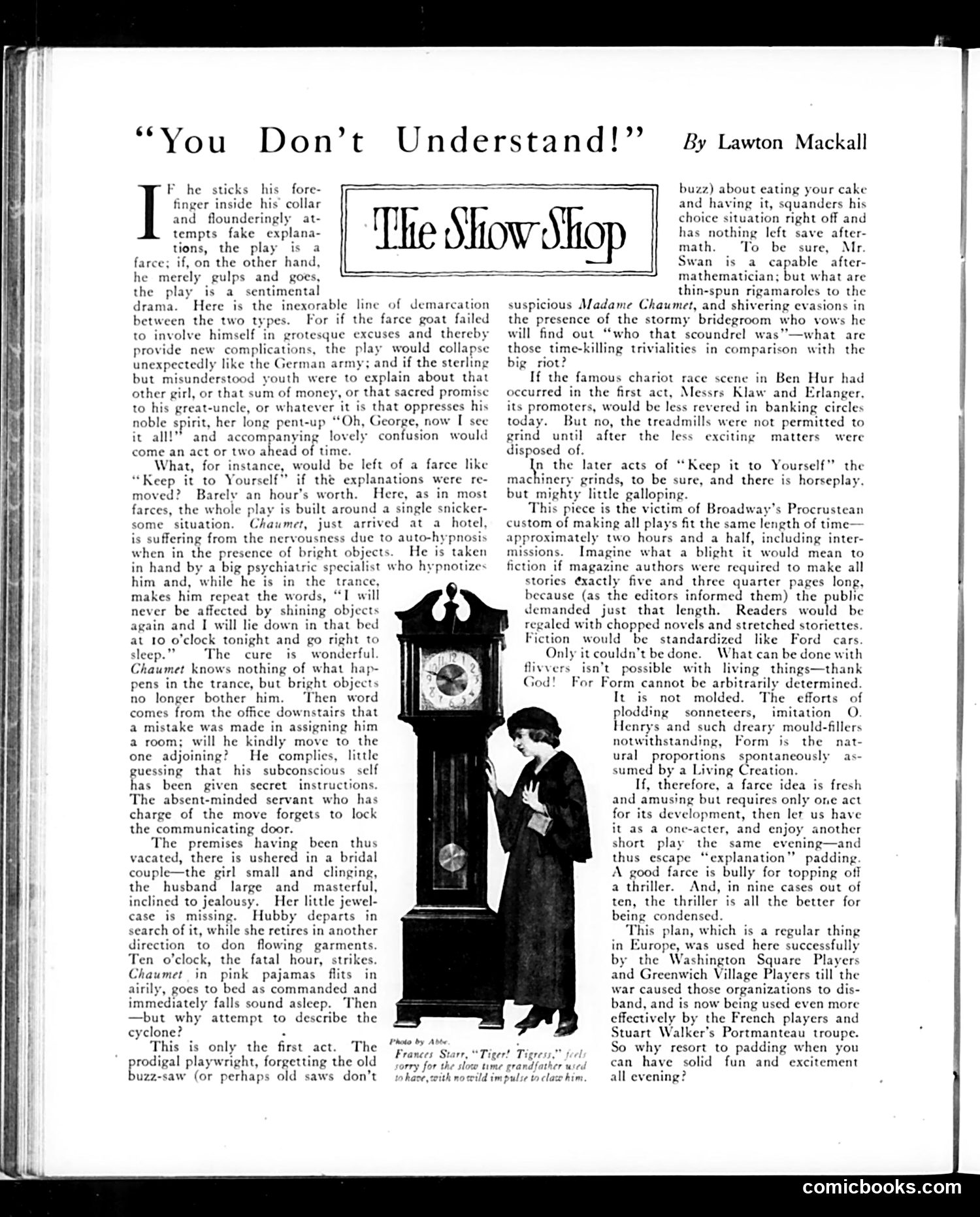
This article by Lawton Mackall critiques a Broadway farce called "Keep it to Yourself." Mackall argues that farces depend on **physical comedy and misunderstandings**, not lengthy explanations—the protagonist must flounder and bluster rather than actually explain things clearly. He illustrates this through the play's absurd plot: a man in a hypnotic trance goes to bed in the wrong room during a honeymoon, causing chaos. Mackall's point is that the play wastes its first act on plot setup when the "cyclone" of comedy should happen earlier. The broader satire targets **Broadway's standardized format**: producers force all plays into a rigid two-and-a-half-hour structure, regardless of what the story needs. A farce loses its energy when padded with exposition; comedic timing suffers under commercial constraints. The reference to *Ben-Hur*'s famous chariot race illustrates how dramatic set pieces must come at the *right* moment, not when studio schedules demand.
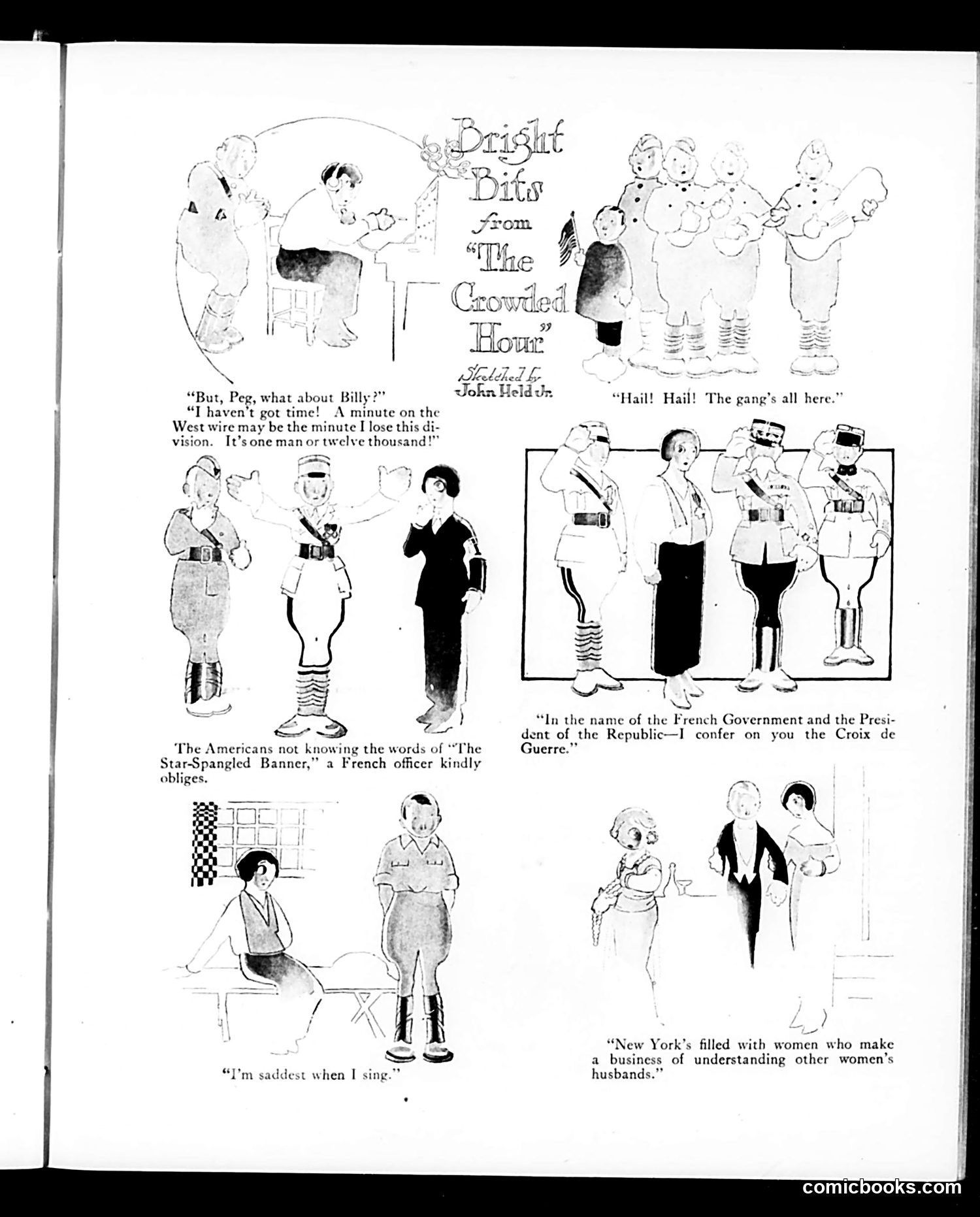
This page from *Judge* satirizes American military involvement in World War I through several vignettes illustrated by John Held Jr. The top scene mocks an American officer prioritizing military communications over personal concerns—a soldier dismisses his wife's worry about their son Billy, claiming military duty supersedes family. Another panel jokes about American soldiers' ignorance: unable to sing "The Star-Spangled Banner," they require a French officer to teach them their own national anthem—satirizing American cultural illiteracy. The "Croix de Guerre" panel depicts French military decoration ceremony, likely commenting on the alliance between American and French forces. The final panels shift to domestic satire: one jokes about women who meddle in others' marriages, another plays on a singer's melancholy. These reflect broader *Judge* humor about American home-front society during wartime, mixing military commentary with social observation about gender relations and American character.
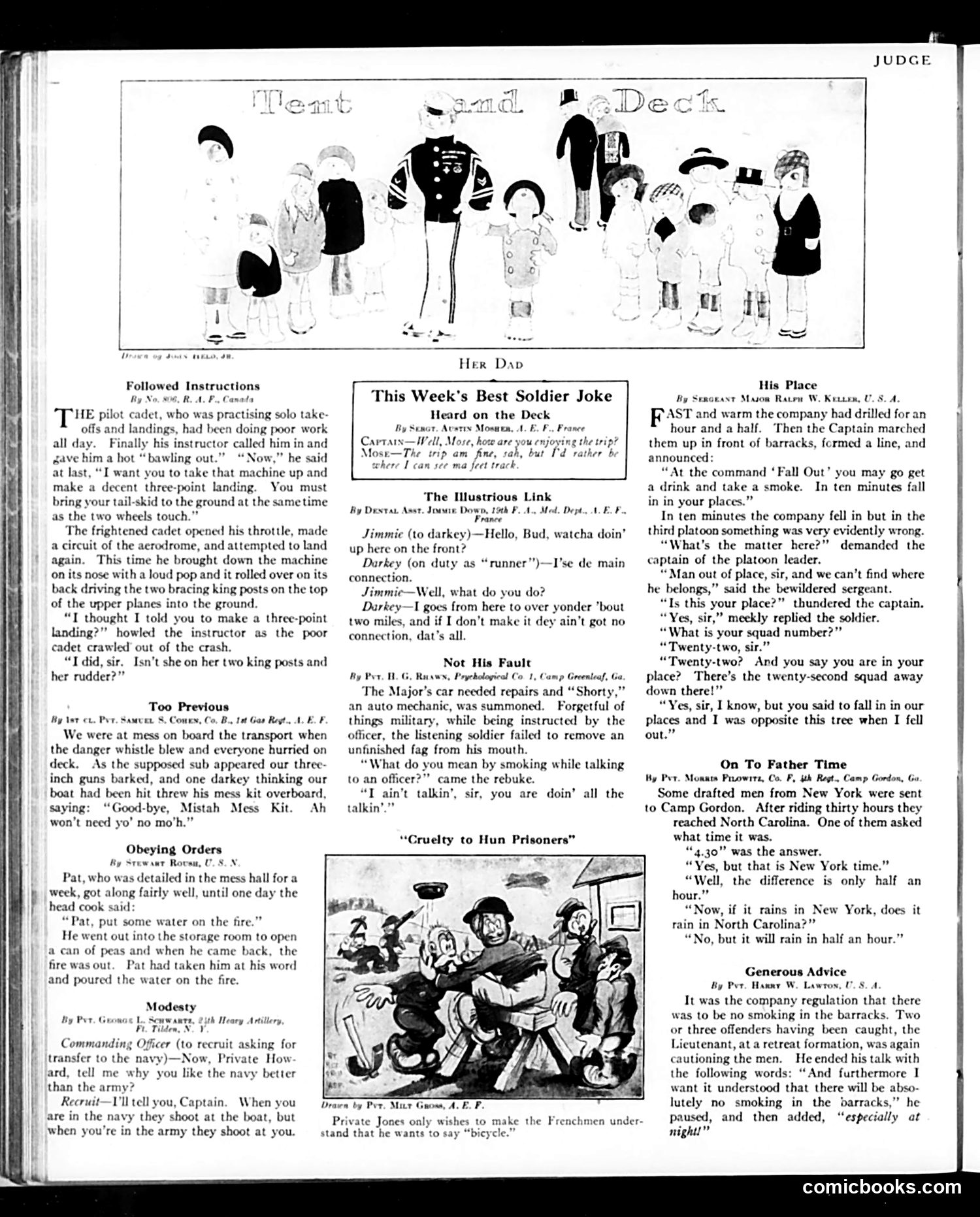
This page from **Judge** (a WWI-era American satirical magazine) collects humorous military anecdotes written by soldiers. The jokes mock military life through misunderstandings and literal obedience: - **"Followed Instructions"**: A pilot cadet takes landing orders literally, crash-landing on wing struts and rudder instead of wheels. - **"Too Previous"**: A Black soldier, hearing danger signals, throws his mess kit overboard thinking the ship was hit—racial stereotyping typical of the era. - **"Obeying Orders"**: Pat literally pours water on a fire when ordered to "put water on the fire," misunderstanding the idiom. - **"The Illustrious Link"**: A Black soldier as a "runner" (messenger) claims to be the communication system itself. - **"Not His Fault"**: A soldier continues smoking during an officer's rebuke, arguing the officer is "talkin'" not him. The cartoons consistently employ racist dialect and stereotypes for Black soldiers and Irish soldiers, reflecting contemporary prejudices. The humor targets military bureaucracy's absurdities and literal-minded obedience.
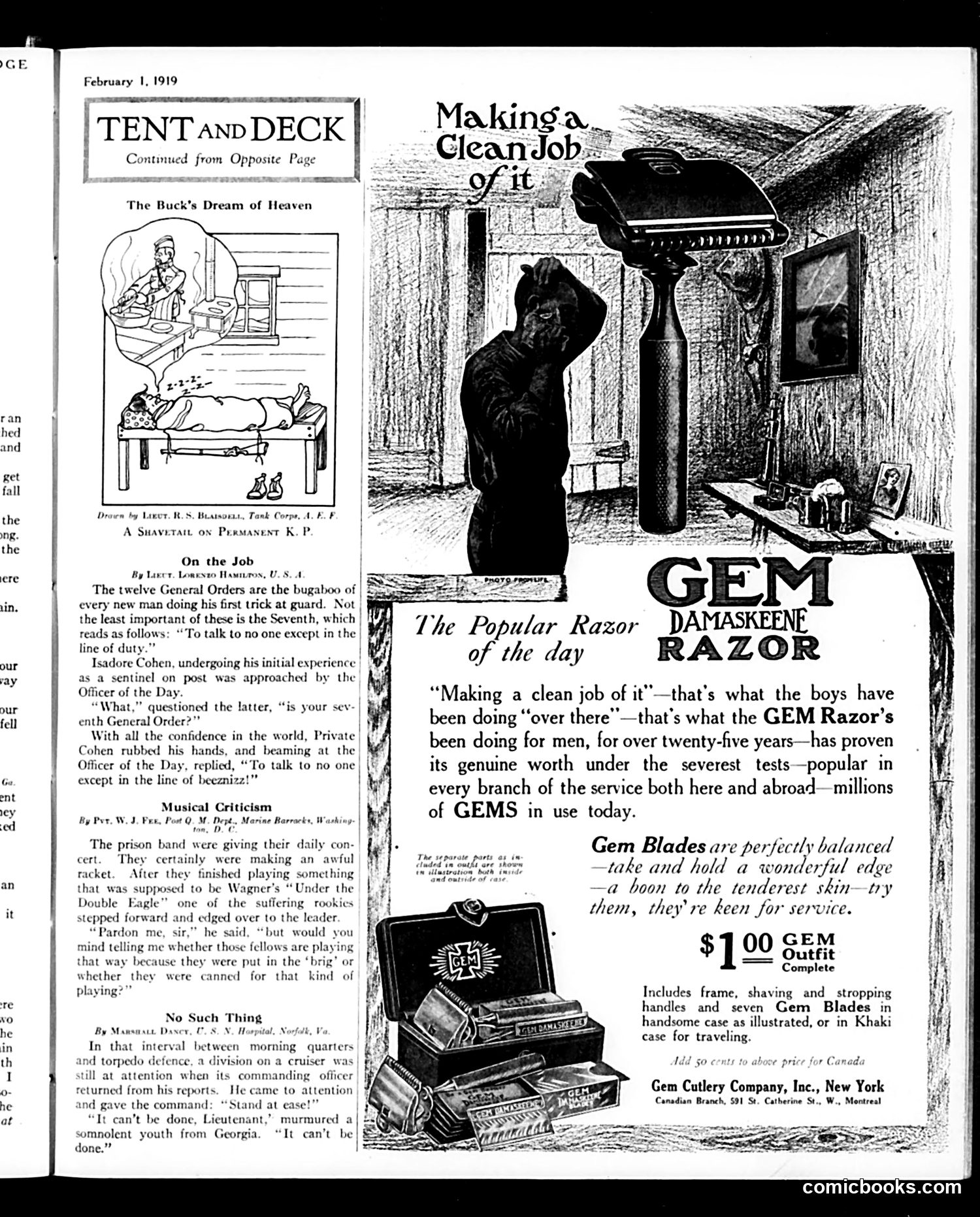
This page contains three military-themed humorous anecdotes ("Tent and Deck" section) plus a Gem Razor advertisement. **The Cartoons/Stories:** All three brief pieces satirize military life during or just after World War I (the page references soldiers "over there"). They mock: 1. **"The Buck's Dream of Heaven"** - A soldier's fantasy of comfortable quarters versus harsh reality 2. **"On the Job"** - A new recruit misunderstands General Order #7 (silence on guard duty), humorously reciting it to his superior 3. **"Musical Criticism"** and **"No Such Thing"** - Anecdotes mocking poor military band performance and a soldier's deadpan defiance of orders **The Advertisement:** The large Gem Razor ad capitalizes on wartime messaging, claiming the razors have proven themselves "under the severest tests" in military service "over there," positioning consumer goods as battlefield-proven and patriotic. The humor derives from enlisted men's perspective on military absurdities and discipline.
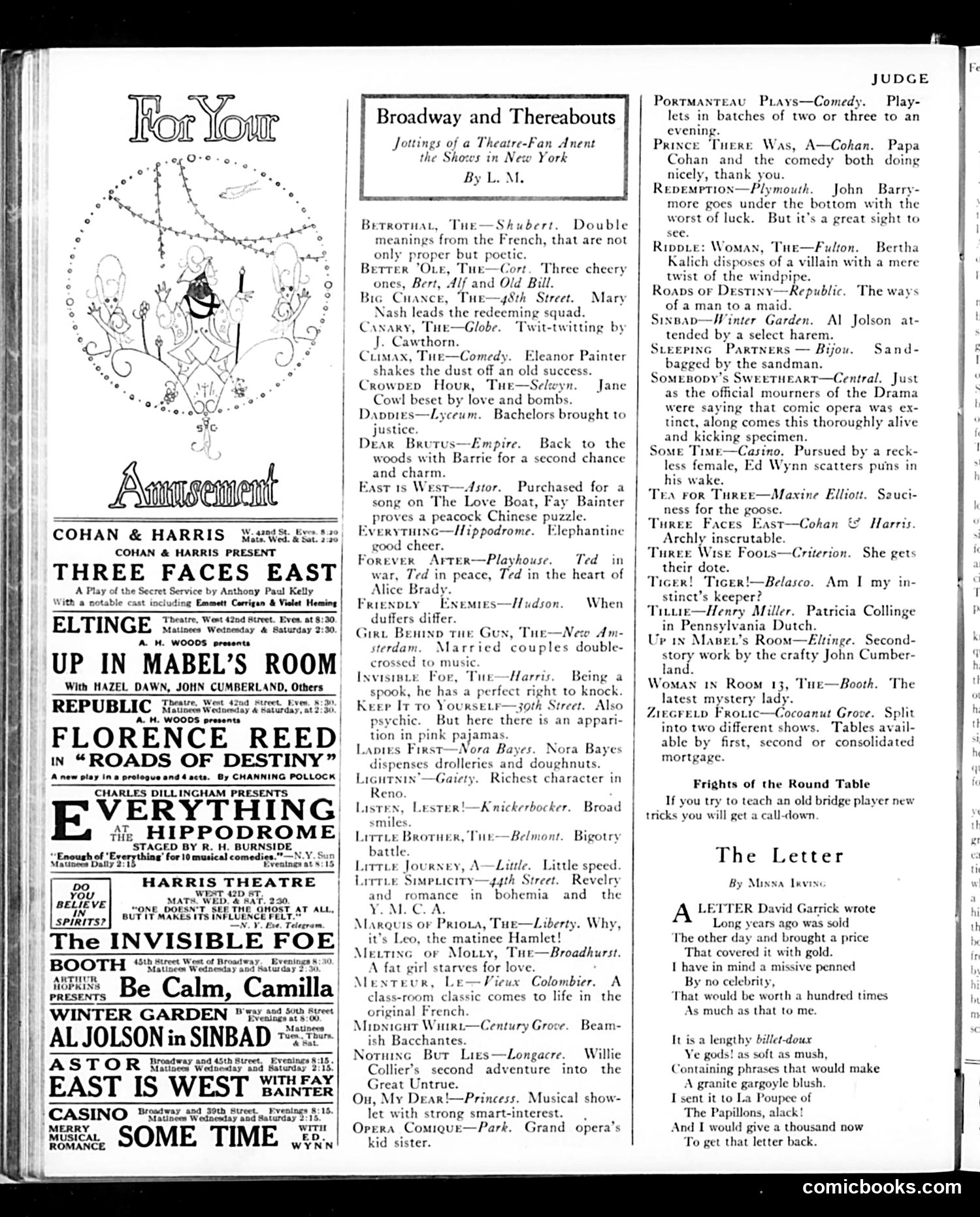
This page is primarily **theater advertising and reviews**, not political satire. It lists Broadway shows running in New York, with brief critical commentary by "L.M." The left side features **large advertisements** for current productions, including plays like "Three Faces East," "Up in Mabel's Room," and notably **Al Jolson in "Sinbad"** at the Winter Garden. The decorative illustration at top-left appears to be generic theatrical ornamentation rather than political commentary. The right side contains a **theater column** reviewing recent shows, using witty, condensed descriptions—typical of early 20th-century theater criticism. References are to specific actors (John Barrymore, Fay Bainter, Nora Bayes) and theaters rather than political figures. The only non-theatrical content is a poem titled **"The Letter"** by Minna Irving at bottom-right. This is essentially a **theater guide page** serving Judge's readers interested in New York entertainment, without apparent political or satirical intent.
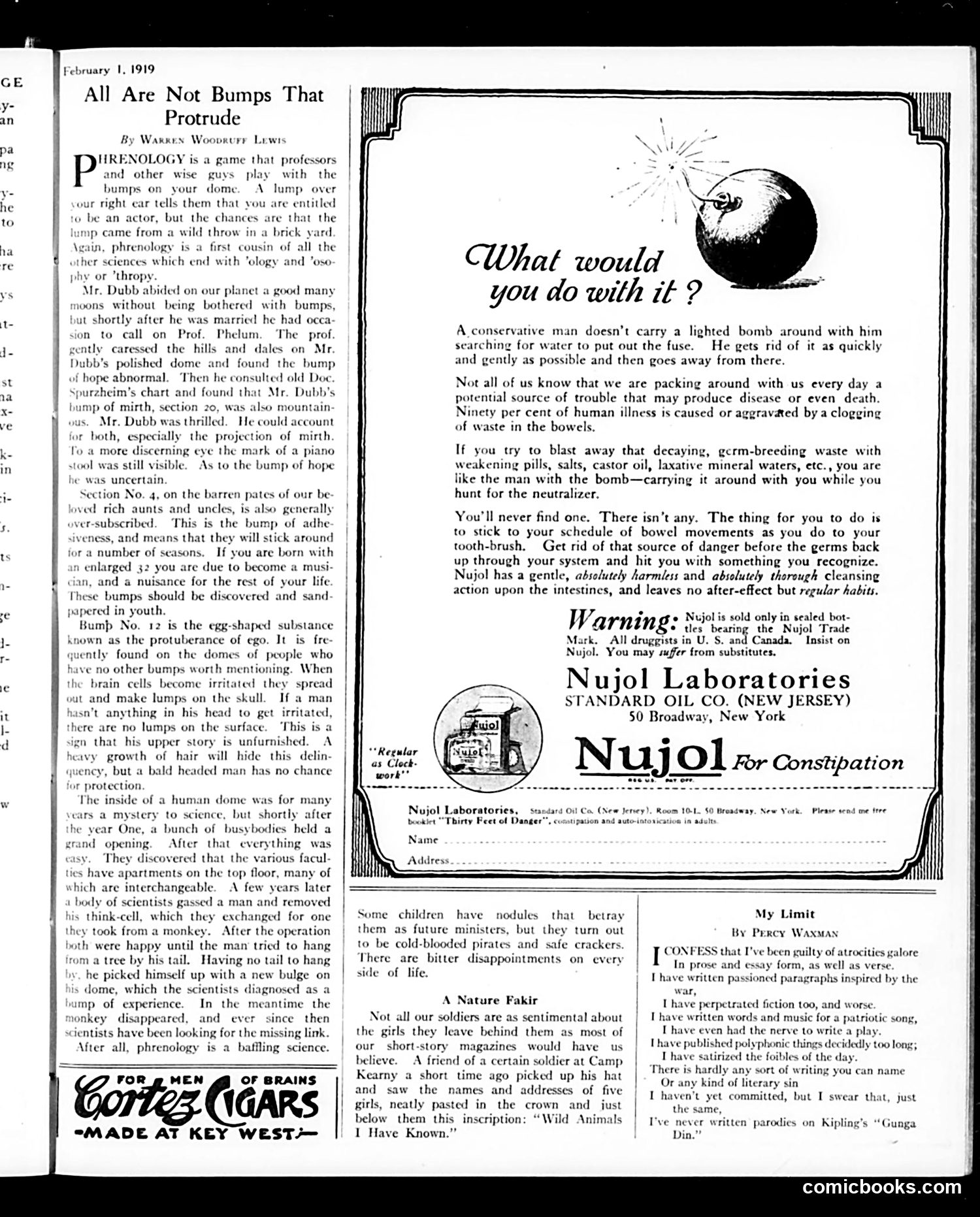
This February 1, 1919 *Judge* page contains two distinct items: **Left side:** A humorous essay mocking **phrenology**—a pseudoscience claiming skull bumps revealed personality and ability. The author satirizes how absurd this is, describing ridiculous "bumps" (bump of mirth, ego, experience) that supposedly predict one's fate. The joke: phrenology was already discredited as junk science, yet people still believed it. **Right side:** A **Nujol laxative advertisement** disguised as health advice. The ad uses the metaphor of a "bomb" (constipation/intestinal waste) to warn readers that bowel problems cause most illness. It pitches Nujol as the gentle solution versus harsh purgatives. This reflects 1919 America's obsession with digestive health and patent medicines. The juxtaposition is ironic: the left mocks pseudoscience while the right hawks dubious medical claims—both reflect the era's confused relationship with health "science."
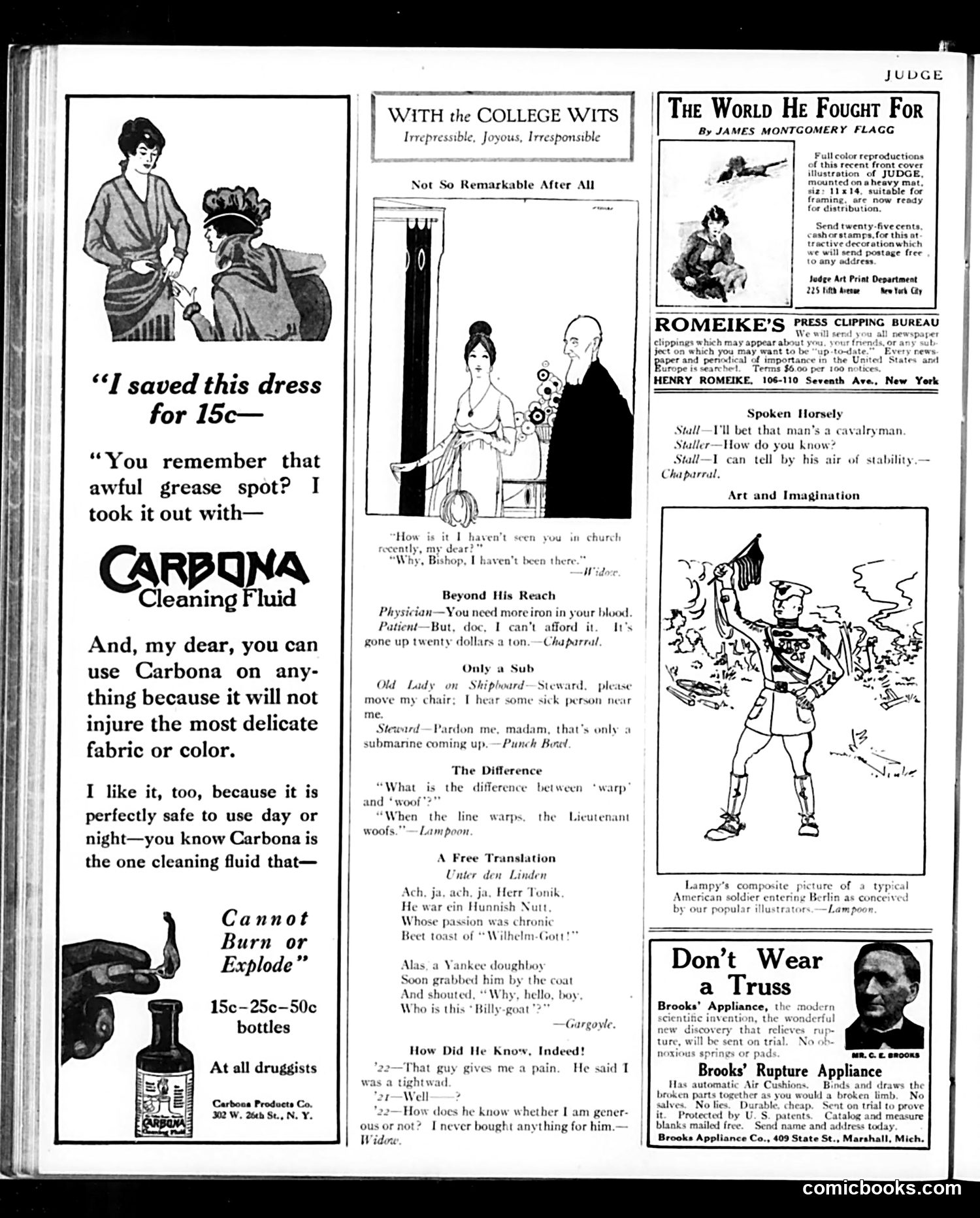
This page is primarily **advertising and humor content** rather than political satire. The dominant feature is a **Carbona Cleaning Fluid advertisement** showing two women discussing how the product removed a grease stain from a dress for 15 cents—emphasizing safety and versatility. The remaining content consists of **collegiate humor** and light social jokes: - **"With the College Wits"** section collects brief, punchy jokes from college humor magazines (Chaparral, Lampoon, Punch Bowl) - Topics include military references (a submarine, a cavalryman, a "doughboy"), romantic misunderstandings, and economic complaints (a patient can't afford iron because prices rose) - An illustration by James Montgomery Flagg depicts an American soldier in Berlin - Additional ads promote press clipping services and a "rupture appliance" (truss alternative) The humor reflects **post-WWI American culture**—references to soldiers, inflation, and casual dating—but contains **no sharp political commentary**. This appears to be a typical 1920s magazine mixture of advertising and lightweight collegiate wit.
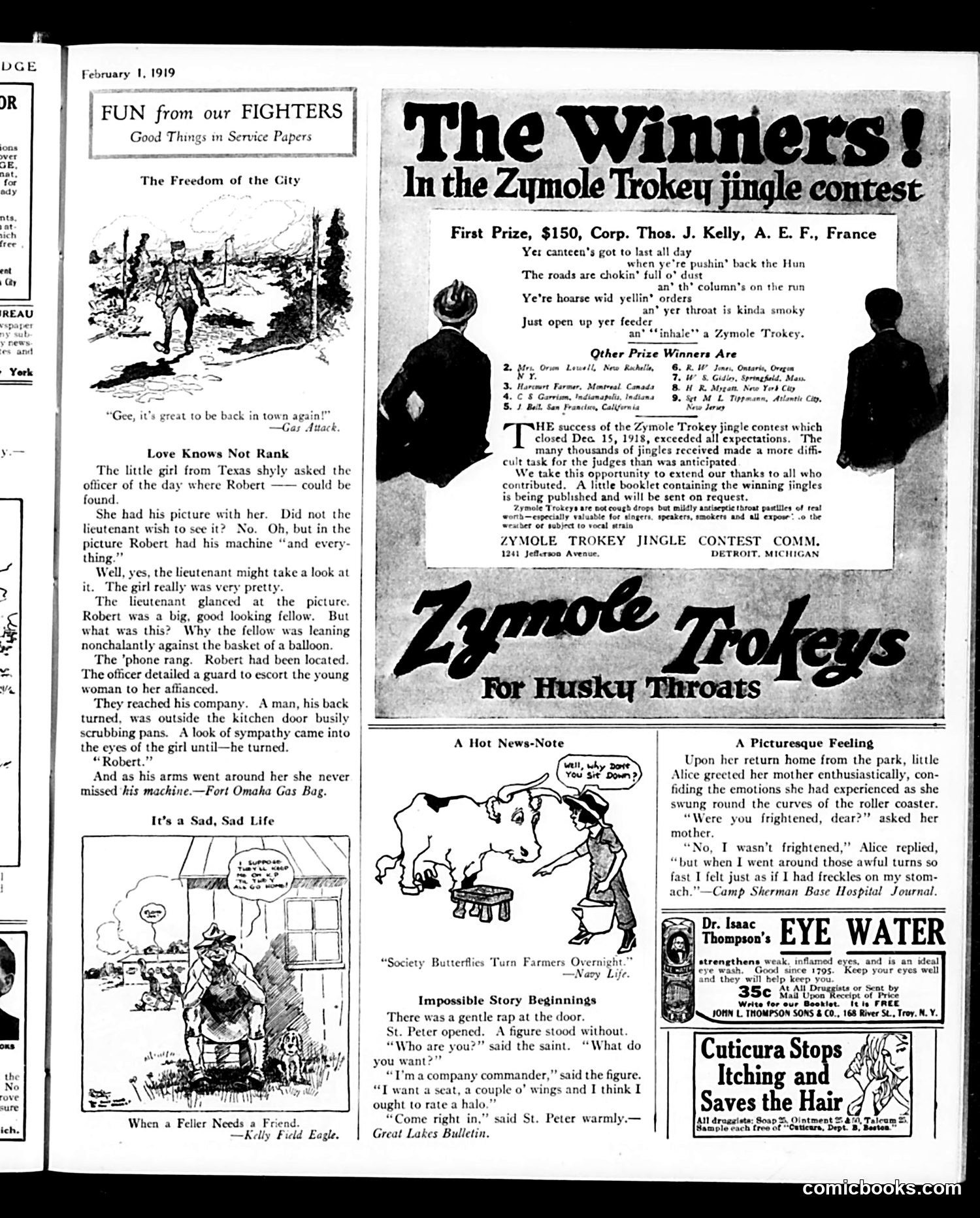
This February 1919 *Judge* page combines military humor with advertising, reflecting post-WWI American culture. The cartoons celebrate soldiers returning home after the war's November 1918 armistice. "Love Knows Not Rank" depicts a soldier's girlfriend discovering her beau leaning against a **balloon basket**—indicating he's an aviator, a prestigious military role. The joke: she doesn't care about his machine; romantic love transcends military hierarchy. The **Zymole Trokey jingle contest** advertises throat lozenges marketed to soldiers, soldiers, and smokers. The winning jingle, by Corp. Kelly in France, romanticizes trench conditions (dust, shouting orders, smoky throats) while promoting the product as relief. Minor humor pieces include a child describing roller-coaster sensations as "freckles on my stomach"—absurdist wartime publication content. The page blends nostalgic military sentiment with commercial advertising targeting returning servicemen, capturing 1919's transitional moment between war and peacetime.
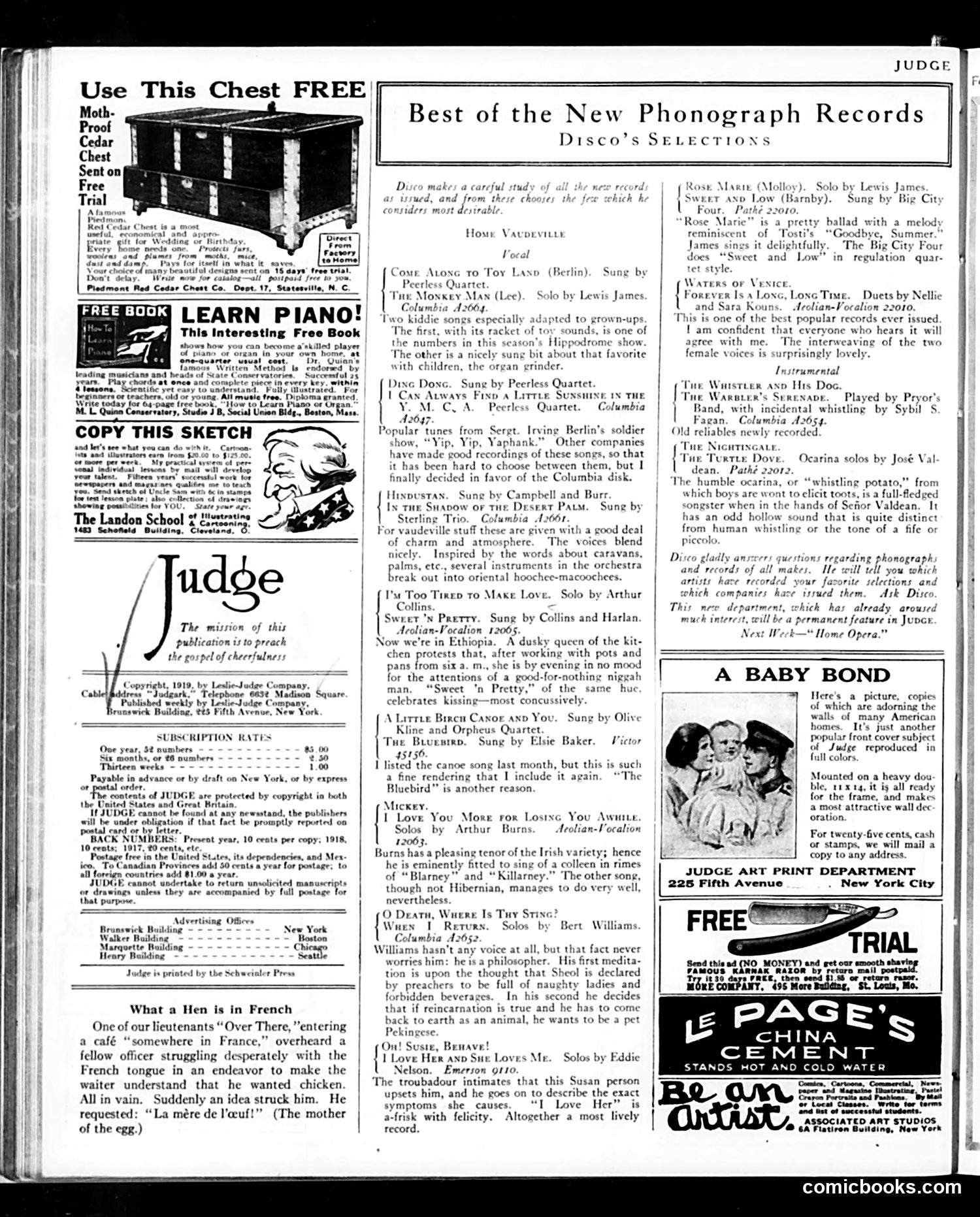
This page is primarily **advertising and editorial content** rather than political satire. The main elements include: **"Copy This Sketch" section**: A drawing competition inviting readers to submit artistic work, with prizes offered—typical early 20th-century reader-engagement advertising. **"Learn Piano" and similar ads**: Standard mail-order educational course advertisements common to the era. **Phonograph Records reviews**: The substantive editorial content discusses new record releases, including patriotic soldier songs from Irving Berlin's "Yip, Yaphank" and popular standards. **"What a Hen is in French" anecdote**: A humorous WWI story about an American lieutenant attempting to order chicken in France, settling on "la mère de l'uf" (mother of the egg)—playing on language barrier comedy and soldiers' overseas experiences. The page reflects **1919 American popular culture**: post-WWI nostalgia, entertainment commerce, and light humor. No significant political satire is apparent—this is primarily a magazine filler page mixing advertisements with light entertainment content typical of Judge's era.
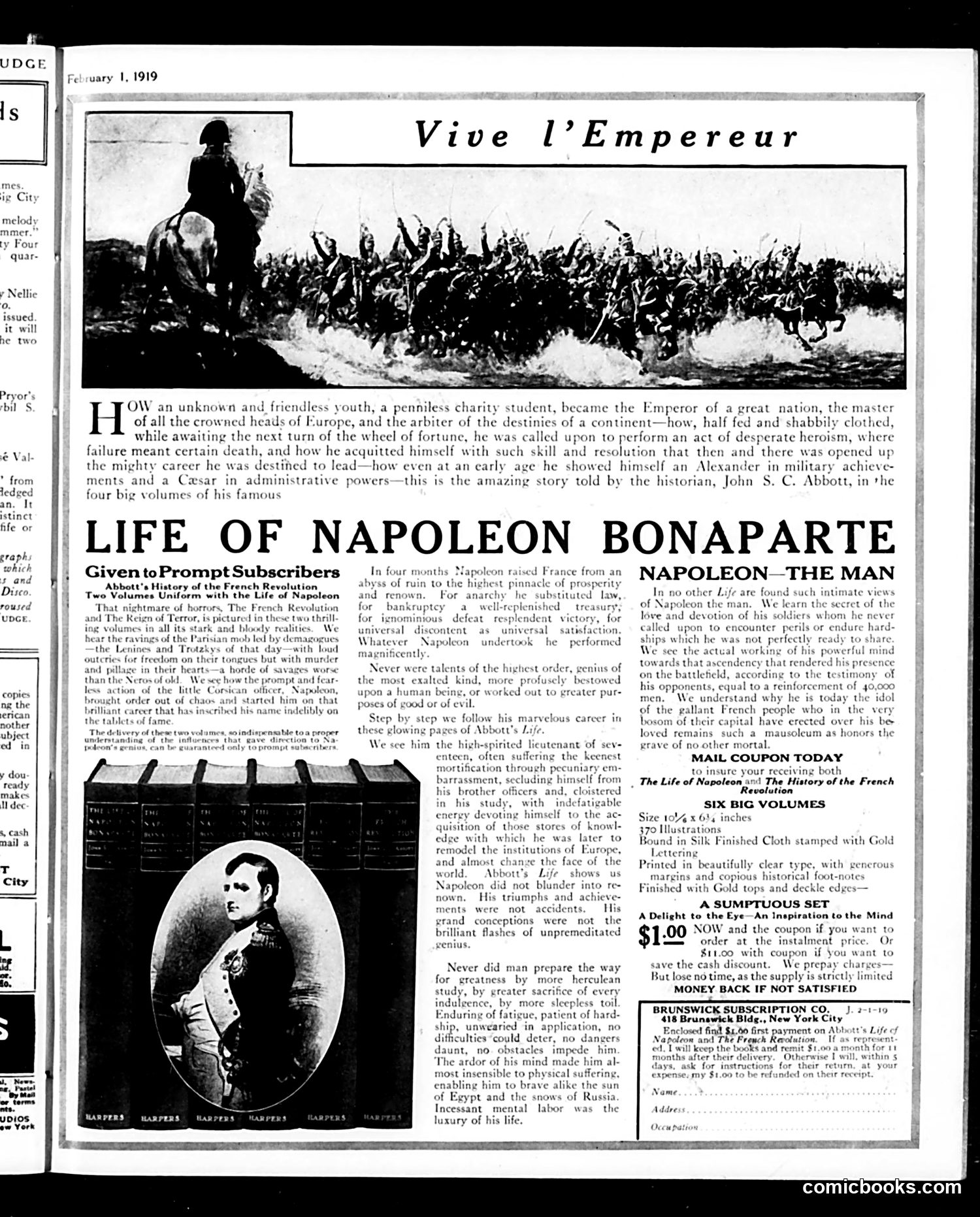
This page is primarily a **mail-order advertisement** for a two-volume biography set: John S.C. Abbott's *Life of Napoleon Bonaparte* and *The History of the French Revolution*. The heading "Vive l'Empereur" (Long Live the Emperor) and the dramatic illustration of Napoleon on horseback addressing troops establish the romantic, heroic tone Judge is marketing. The advertisement emphasizes Napoleon's unlikely rise from "unknown and friendless youth" to continental master—a narrative of ambition and genius overcoming poverty. The timing (February 1919, just after WWI's end) is notable: Americans were reassessing European history and power. The ad appeals to readers' intellectual aspirations by offering a "sumptuous set" of 370 illustrations in silk-finished cloth for $1.00 down, framing it as cultural self-improvement. This is essentially **soft-sell advertising disguised as historical editorial content**—a common Judge practice—rather than satire or political commentary.
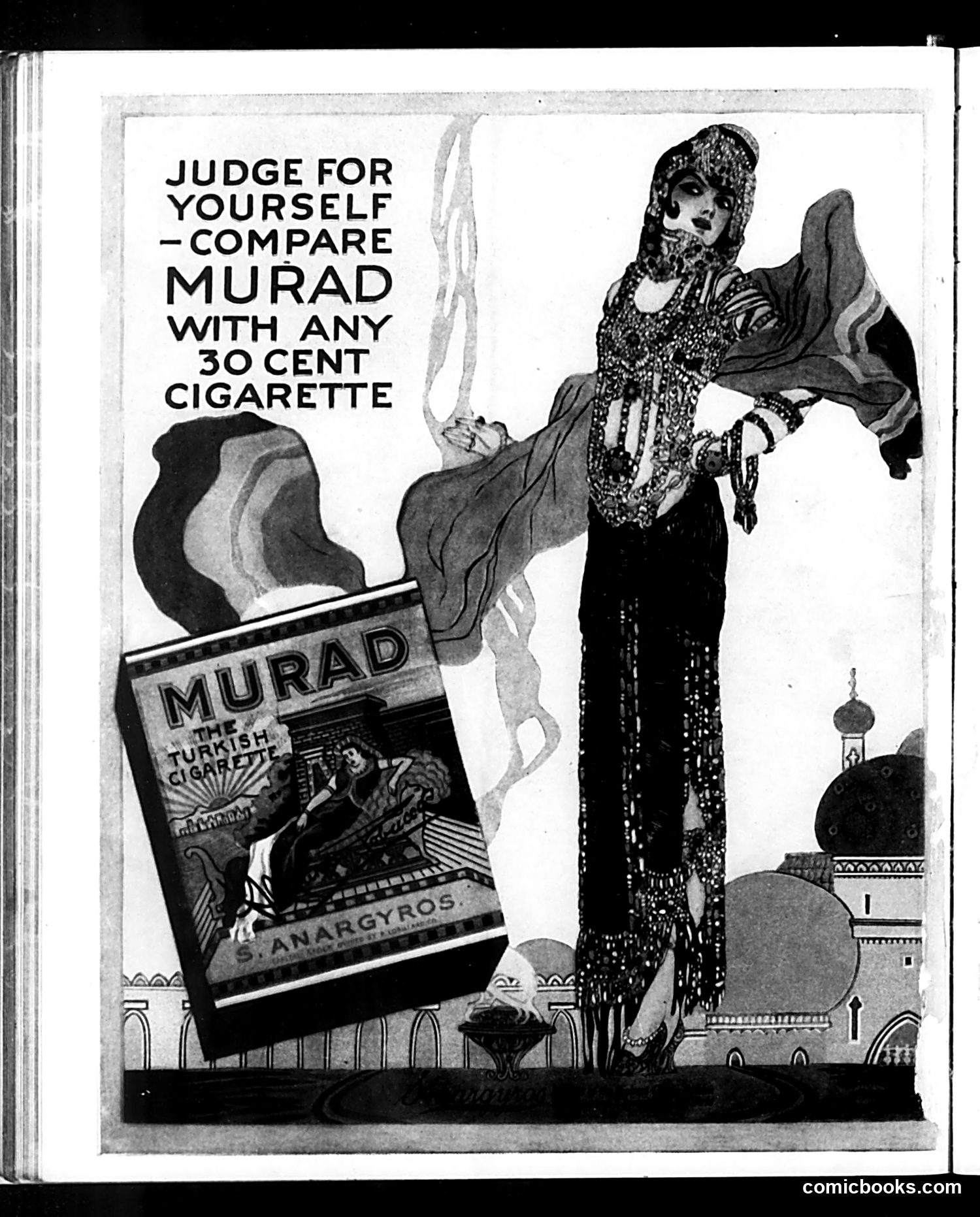
This is an advertisement for Murad Turkish cigarettes, not political satire. The illustration depicts an orientalized female figure in elaborate Middle Eastern costume holding a Murad cigarette package. The ad's appeal relies on exotic imagery popular in early 20th-century marketing—associating the product with luxury, sophistication, and distant glamour. The "judge for yourself" tagline invites consumers to compare Murad's quality against competitors priced at 30 cents, suggesting Murad offered premium value. The ornate architectural elements and costume underscore the "Turkish" branding, though the imagery is stereotypical Western fantasy rather than authentic representation. This reflects advertising conventions of the era, when cigarette marketing heavily deployed exoticized imagery to create aspirational appeal.