
Judge, 1919-02-01 · page 22 of 32
Judge — February 1, 1919 — page 22: what you’re looking at
What you’re looking at
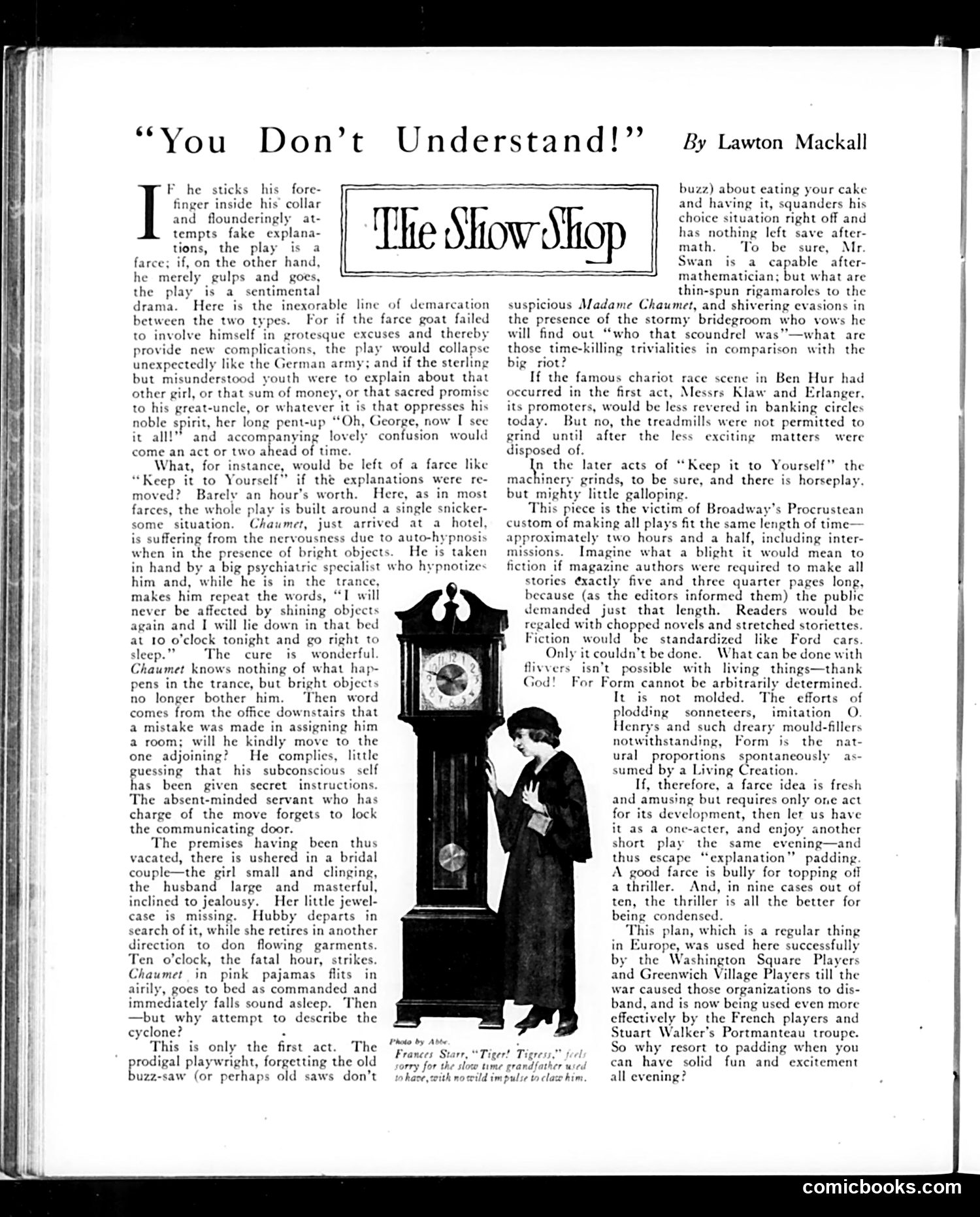
This article by Lawton Mackall critiques a Broadway farce called "Keep it to Yourself." Mackall argues that farces depend on **physical comedy and misunderstandings**, not lengthy explanations—the protagonist must flounder and bluster rather than actually explain things clearly. He illustrates this through the play's absurd plot: a man in a hypnotic trance goes to bed in the wrong room during a honeymoon, causing chaos. Mackall's point is that the play wastes its first act on plot setup when the "cyclone" of comedy should happen earlier. The broader satire targets **Broadway's standardized format**: producers force all plays into a rigid two-and-a-half-hour structure, regardless of what the story needs. A farce loses its energy when padded with exposition; comedic timing suffers under commercial constraints. The reference to *Ben-Hur*'s famous chariot race illustrates how dramatic set pieces must come at the *right* moment, not when studio schedules demand.
📄 Transcribed text from this page (OCR, searchable)
Machine-transcribed from the original scan — historical spelling and the odd misread are preserved.
“You Don’t Understand!” By Lawton Mackall F he sticks his fore- finger inside his collar and flounderingly at- tempts fake explana- tions, the play is a farce; if, on the other hand, buzz) about eating your cake and having it, squanders his choice situation right off and has nothing left save after- The Sliow Sliop math. To be sure, Mr. Swan is a capable after- he merely gulps and goes, the play is a sentimental drama. Here is the inexorable line of demarcation between the two types. For if the farce goat failed to involve himself in grotesque excuses and thereby provide new complications, the play would collapse unexpectedly like the German army; and if the sterling but misunderstood youth were to explain about that other girl, or that sum of money, or that sacred promise to his great-uncle, or whatever it is that oppresses his noble spirit, her long pent-up “Oh, George, now [ see it all!” and accompanying lovely confusion would come an act or two ahead of time. What, for instance, would be left of a farce like “Keep it to Yourself” if the explanations were re- moved? Barely an hour’s worth. Here, as in most farces, the whole play is built around a single snicker- some situation. Chaumet, just arrived at a hotel, is suffering from the nervousness due to auto-hypnosis when in the presence of bright objects. He is taken in hand by a big psychiatric specialist who hypnotiz him and, while he is in the tran makes him repeat the words, “I will never be affected by shining objects again and I will lie down in that bed at 10 o'clock tonight and go right to sleep. The cure is wonderful. Chaumet knows nothing of what hap- pens in the trance, but bright objects no longer bother him. ‘Then word comes from the office downstairs that a mistake was made in assigning him a room; will he kindly move to the one adjoining? He complies, little guessing that his subconscious self has been given secret instructions. The absent-minded servant who has charge of the move forgets to lock the communicating door. The premises having been thus vacated, there is ushered in a bridal couple—the girl small and clinging, the husband large and masterful, inclined to jealousy. Her little jewel- case is missing. Hubby departs in search of it, while she retires in another direction to don flowing garments. Ten o'clock, the fatal hour, strikes. thaumet in pink pajamas flits in airily, goes to bed as commanded and immediately falls sound asleep. Then —but why attempt to describe the cyclone? < This is only the first act. The Uae by Abe prodigal playwright, forgetting the old far! $ buzz-saw (or perhaps old saws don’t inher mathematician; but what are thin-spun rigamaroles to the suspicious Madame Chaumet, and shivering evasions in the presence of the stormy bridegroom who vows he will find out “who that scoundrel was’—what are those time-killing trivialities in comparison with the big riot? If the famous chariot race scene in Ben Hur had occurred in the first act, Messrs Klaw and Erlanger, its promoters, would be less revered in banking circles today. But no, the treadmills were not permitted to grind until after the less exciting matters were disposed of. \n the later acts of “Keep it to Yourself” the machinery grinds, to be sure, and there is horseplay. but mighty little galloping. This piece is the victim of Broadway's Procrustean custom of making all plays fit the same length of time— approximately two hours and a half, including inter- missions. Imagine what a blight it would mean to fiction if magazine authors were required to make all stories ¢xactly five and three quarter pages long, because (as the editors informed them) the public demanded just that length. Readers would be regaled with chopped novels and stretched storiettes. Fiction would be standardized like Ford cars Only it couldn’t be done. What can be done with flivvers isn’t possible with living things—thank God! For Form cannot be arbitrarily determined. It is not molded. The efforts of plodding sonneteers, imitation O. Henrys and such dreary mould-fillers notwithstanding, Form is the nat- ural proportions spontaneously as- sumed by a Living Creation. If, therefore, a farce idea is fresh and amusing but requires only one act for its development, then let us have it as a one-acter, and enjoy another short play the same evening—and thus escape “explanation” padding A good farce is bully for topping off a thriller. And, in nine cases out of ten, the thriller is all the better for being condensed. This plan, which is a regular thing in Europe, was used here successfully by the Washington Square Players and Greenwich Village Players till the war caused those organizations to dis- band, and is now being used even more effectively by the French players and Stuart Walker's Portmanteau troupe. So why resort to padding when you can have solid fun and excitement all evening? comicbooks.com