
Judge, 1919-02-01 · page 16 of 32
Judge — February 1, 1919 — page 16: what you’re looking at
What you’re looking at
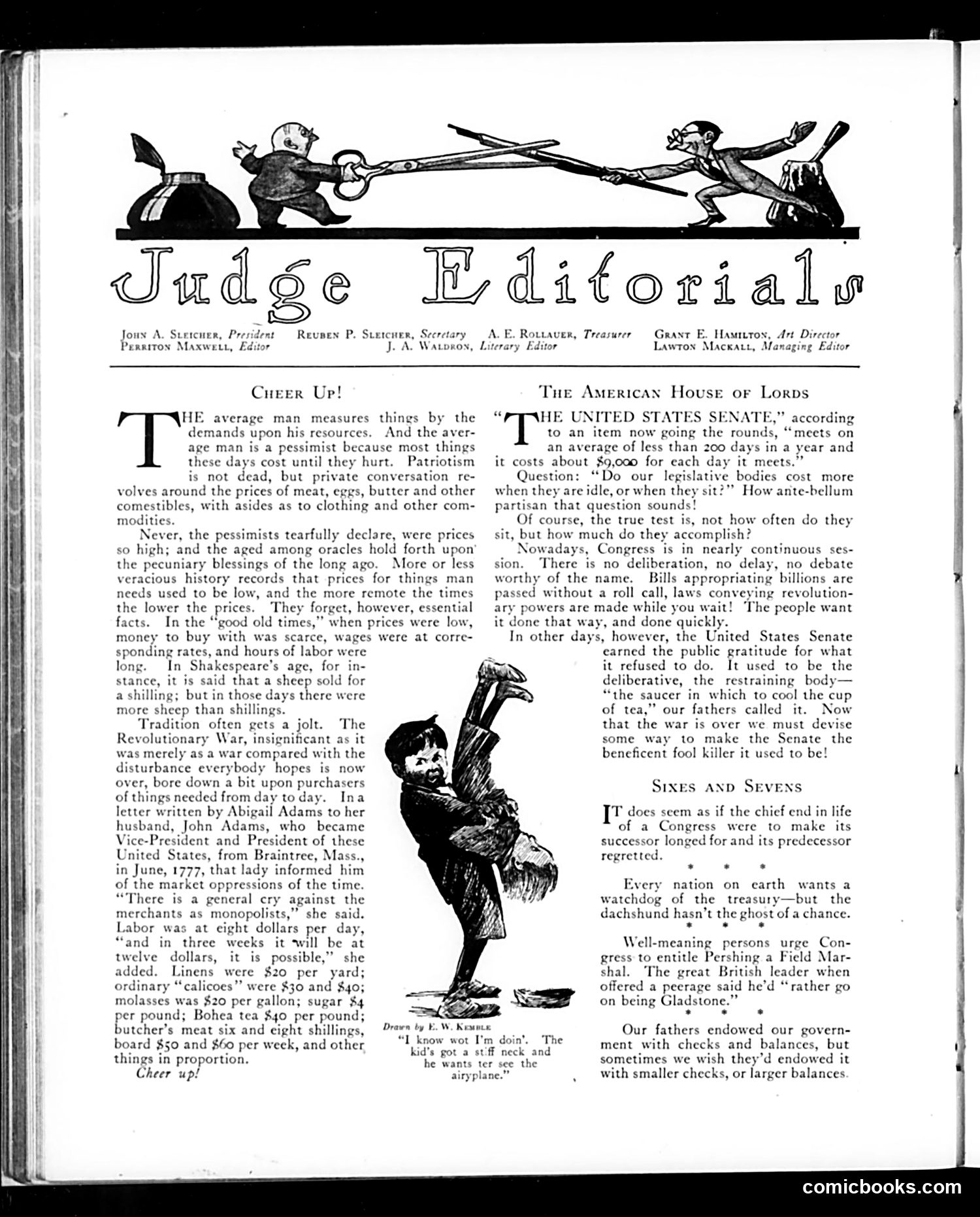
This page contains three distinct satirical pieces from Judge magazine (post-WWI era, given Pershing reference). **"Cheer Up!"** argues nostalgia for "cheaper old times" is misleading. Using Abigail Adams's 1777 letter as evidence, the editor shows Revolutionary War prices were similarly inflated—linens at $20/yard, sugar at $4/pound. The point: high prices aren't new; what matters is wages and purchasing power, not absolute numbers. A corrective to popular complaint. **"The American House of Lords"** mocks the U.S. Senate's expense ($9,000 per meeting day) and inefficiency. It contrasts the modern Senate—rushing bills through without debate—with the Founding Fathers' vision of a deliberative, restraining body ("saucer to cool the cup of tea"). Satire suggests the Senate should be a "fool killer" that prevents hasty legislation. **"Sixes and Sevens"** briefly criticizes Congress's tendency to make successors longed-for and predecessors regretted, then suggests Congress honor General Pershing as Field Marshal. The cartoon shows two figures in a tug-of-war with crossed staffs, illustrating editorial conflict.
📄 Transcribed text from this page (OCR, searchable)
Machine-transcribed from the original scan — historical spelling and the odd misread are preserved.
e iy Stetcner, Secretary Revsen P. : J. AL Watprox, £ Joux A. Stetcuen, Presi Pearttos Maxwett, Edit Cueer Up! HE average man measures demands upon his resourc age man is a pessimist because most things these days cost until they hurt. Patriotism is not dead, but private conversation re- volves around the prices of meat, ¢ butter and other comestibles, with asides as to clothing and other com- modities. Never, the pessimists tearfully declare, were prices so high; and the aged among oracles hold forth upon the pecuniary blessings of the long ago. More or less veracious history records that prices for things man needs used to be low, and the more remote the times the lower the prices. They forget, however, essential facts. In the “good old times,” when prices were low, money to buy with was scarce, wages were at corre- sponding rates, and hours of labor were long. In Shakespeare’s age, for in- stance, it is said that a sheep sold for ashilling; but in those days there were more sheep than shillings. Tradition often gets a jolt. The Revolutionary War, insignificant as it was merely as a war compared with the disturbance everybody hopes is now over, bore down a bit upon purchasers of things needed from day to day. Ina letter written by Abigail Adams to her husband, John Adams, who became Vice-President and President of these United States, from Braintree, Mass., in June, 1777, that lady informed him of the market oppressions of the time. “There is a general cry against the merchants as monopolists,” she said. Labor was at eight dollars per day, “and in three weeks it will be at twelve dollars, it is possible,” she added. Linens were $20 per yard; ordinary “calicoes” were $30 and $40; molasses was $20 per gallon; sugar $4 per pound; Bohea tea $40 per pound; butcher’s meat six and eight shillings board $50 and $60 per week, and other things in proportion. Cheer up! things by the And the aver- he wa crary Editor Drawn by EW. Keweue “I know wot I'm doin’, kid’s got a stiff neck and $ ters airyplane. iforials dl Rottaver, Treasurer Grant Lawton Mackatt, Tue American House or Lorps * according “meets on “T's UNITED STATES SENAT to an item now going the rounds, an average of less than 200 days in a year and it costs about $9,000 for each day it meets. Question: “Do our legislative bodies cost more when they are idle, or when they sit?”” How ante-bellum partisan that question sounds! Of course, the true test is, not how often do they sit, but how much do they accomplish? Nowadays, Congress is in nearly continuous ses- sion. here is no deliberation, no delay, no debate worthy of the name. Bills ap; propriating billions are passed without a roll call, laws conveying revolution- ary powers are made while you wait! The people want it done that way, and done quickly. In other days, however, the United States Senate earned the public gratitude for what it refused to do. It used to be the deliberative, the restraining body— “the saucer in which to cool the cup of tea,” our fathers called it. Now that the war is over we must devise some way to make the Senate the beneficent fool killer it used to be! Sixes AND SEVENS [7 does scem as if the chief end in life of a Congress were to make its successor longed for and its predecessor regretted. Every nation on carth wants a watchdog of the treasury—but the dachshund hasn’t the ghost of a chance. . * * * * . Well-meaning persons urge Con- gress to entitle Pershing a Field Mar- shal. The great British leader when offered a peerage said he'd “rather go on being Gladstone.” * * Our fathers endowed our govern- ment with checks and balances, but sometimes we wish they’d endowed it with smaller checks, or larger balances. . The the comicbooks.com