
A complete issue · 32 pages · 1918
Judge — December 14, 1918
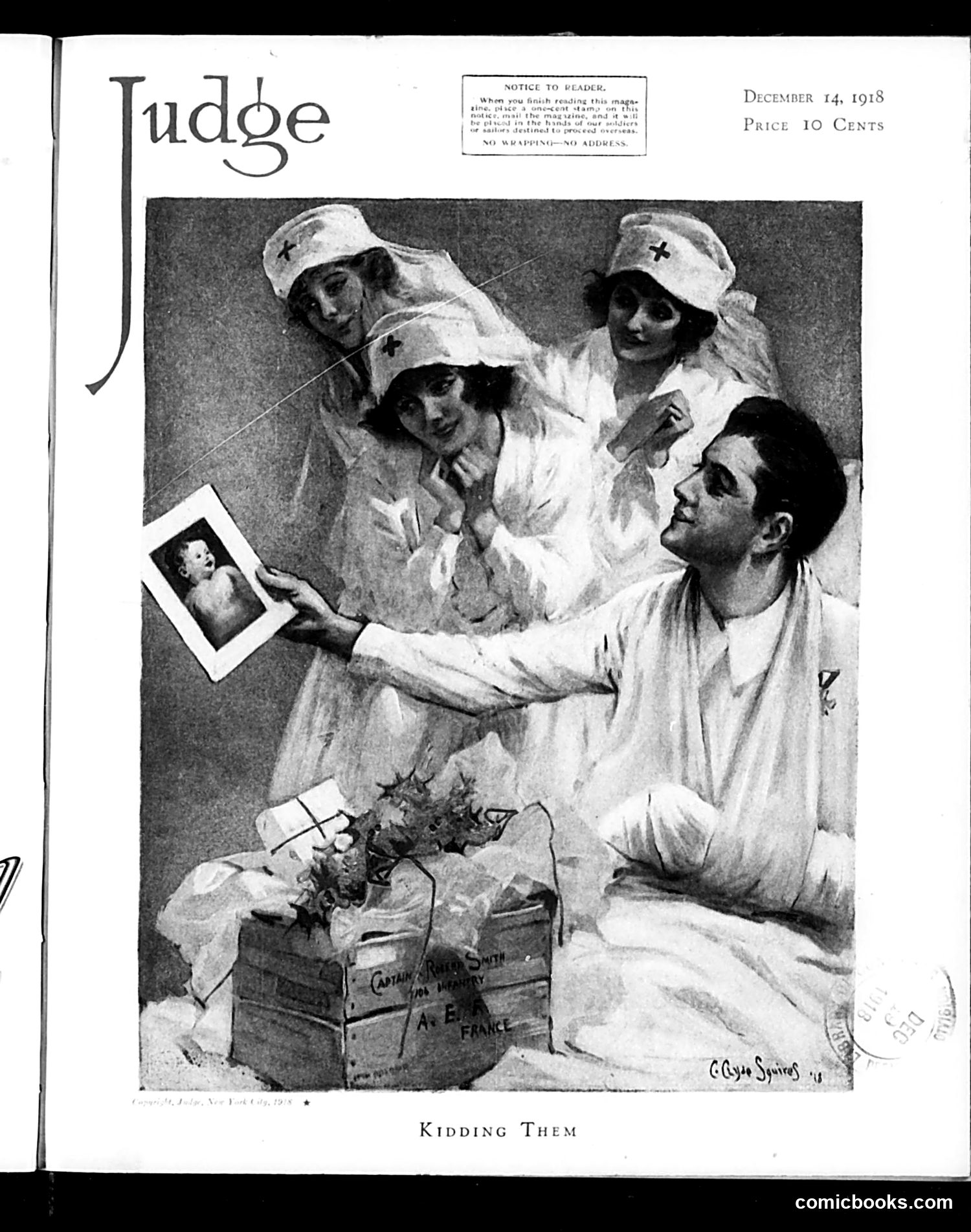
This cartoon depicts nurses showing a photograph to a wounded soldier in a hospital bed, with a package labeled "Comfort Kit for Infantry" nearby. The title "Kidding Them" suggests the nurses are attempting to boost the soldier's morale through cheerful interaction and care items. Published just after World War I's armistice (November 1918), this satirizes hospital morale efforts during the war's conclusion. The "comfort kits" reference real Red Cross and charitable packages sent to soldiers. The satire appears to mock the somewhat artificial cheerfulness nurses and caregivers employed to comfort wounded men—the "kidding" or gentle deception of pretending all was well when soldiers faced serious injuries and trauma.
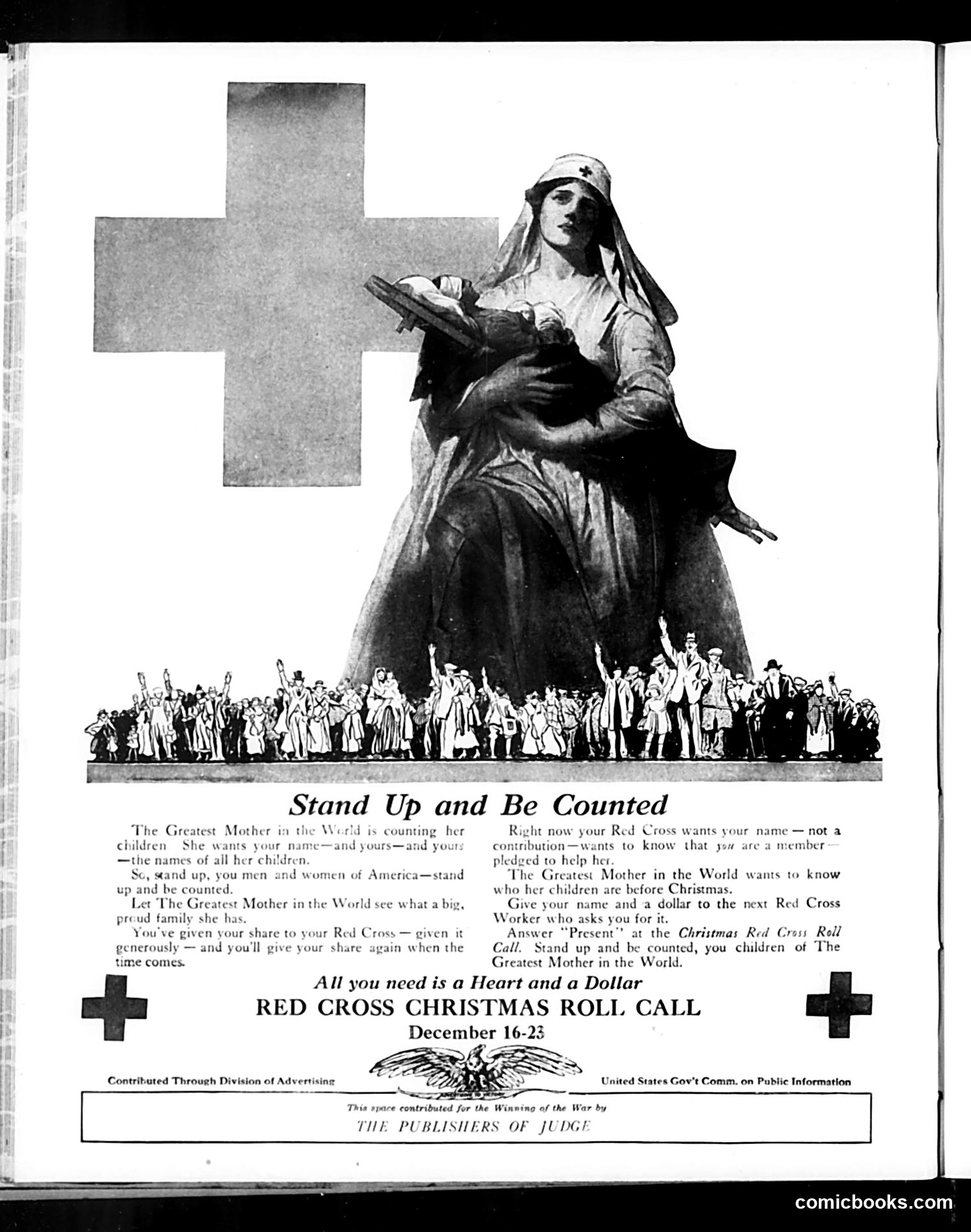
This is **not satire** but rather a **patriotic public service advertisement** for the Red Cross Christmas Roll Call, dated December 16-23. The image depicts a monumental female figure (representing "The Greatest Mother in the World"—a personification of America or humanitarian values) sheltering children beneath a large cross. A crowd of small figures stands below, representing citizens. The text appeals emotionally to Americans to donate "a heart and a dollar" to the Red Cross, framing membership as standing with "The Greatest Mother" and her children. This appears to be **World War I-era messaging**, using maternal symbolism to encourage patriotic financial support for war relief efforts. The advertisement was contributed by Judge magazine's advertising division and the U.S. Government Committee on Public Information—official wartime propaganda channels.
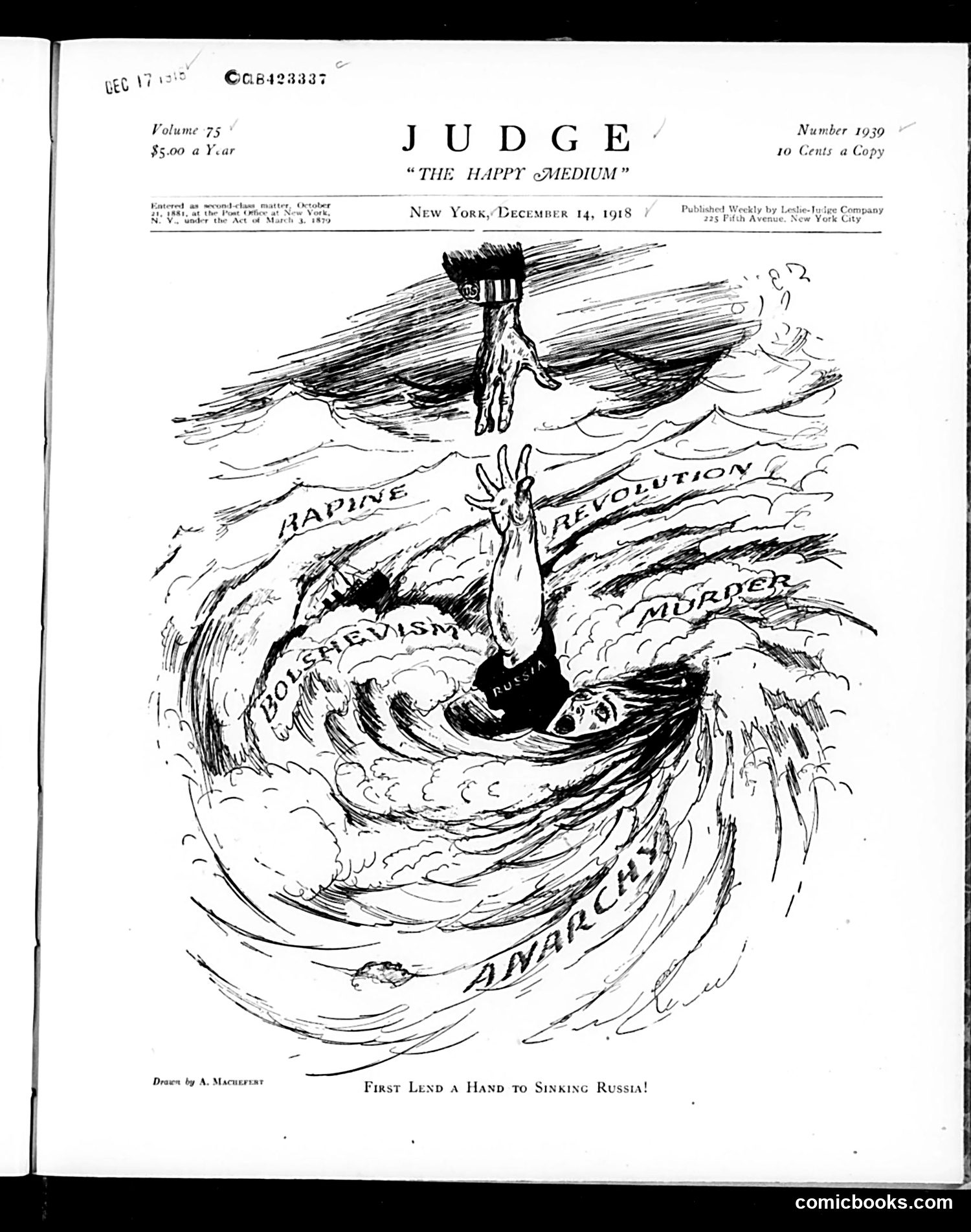
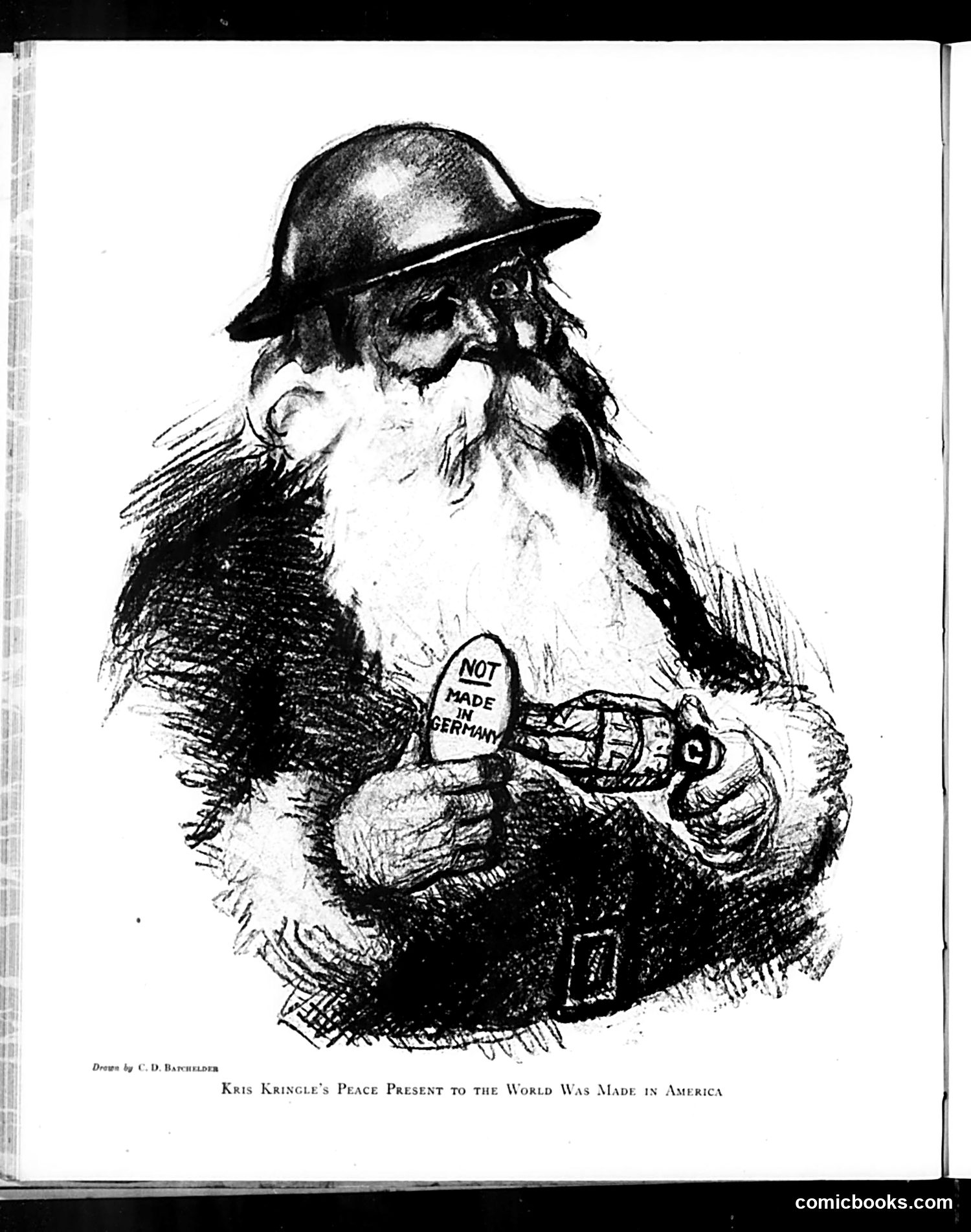
This cartoon by C.D. Bachelder, from the satirical magazine *Judge*, depicts a bearded figure wearing a military helmet holding a grenade labeled "NOT MADE IN GERMANY." The caption reads "Kris Kringle's Peace Present to the World Was Made in America." The satire appears to reference World War I-era tensions, using "Kris Kringle" (Santa Claus) as a personification of America. The joke contrasts American versus German manufacturing—the grenade, a weapon, ironically becomes a "peace present." The caption suggests America's military production and intervention would bring peace, a common propagandistic message during U.S. involvement in WWI. The "NOT MADE IN GERMANY" label emphasizes American superiority and distinguishes U.S. weapons from German ones.
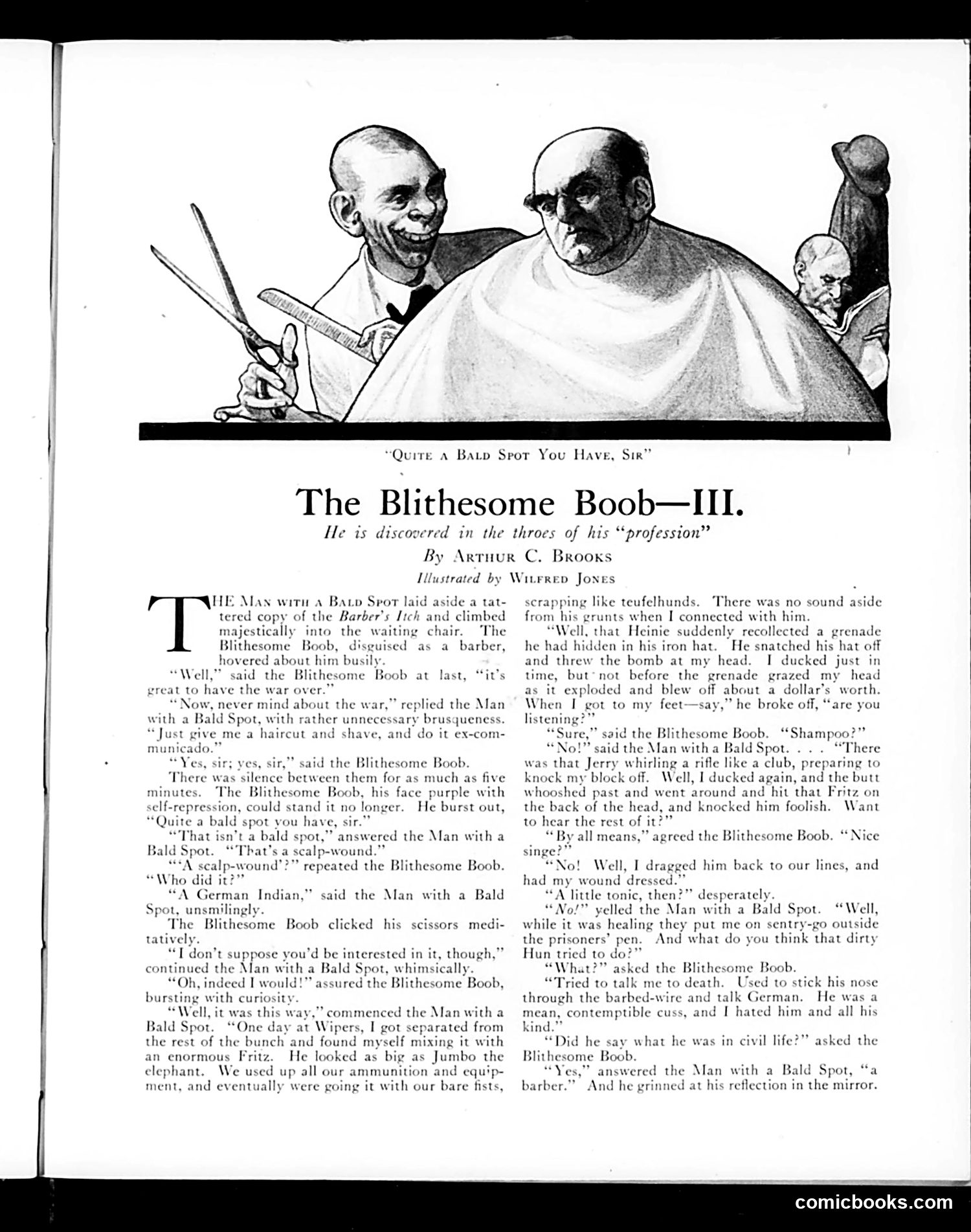
This satirical story by Arthur C. Brooks (illustrated by Wilfred Jones) depicts a barber discovering his customer is a German soldier disguised as a civilian. The humor centers on the soldier's incompetence: he has a bald spot from a grenade wound hidden under his hat, and reveals his identity through poor German-accented English and suspicious behavior. The satire targets German soldiers as bumbling infiltrators during what appears to be World War I. The "Blithesome Boob" character—seemingly a recurring Judge figure—serves as the everyman narrator exposing enemy incompetence through an ordinary barber encounter. The joke relies on anti-German stereotyping and wartime suspicion of enemy agents, typical of American satirical magazine content during WWI.
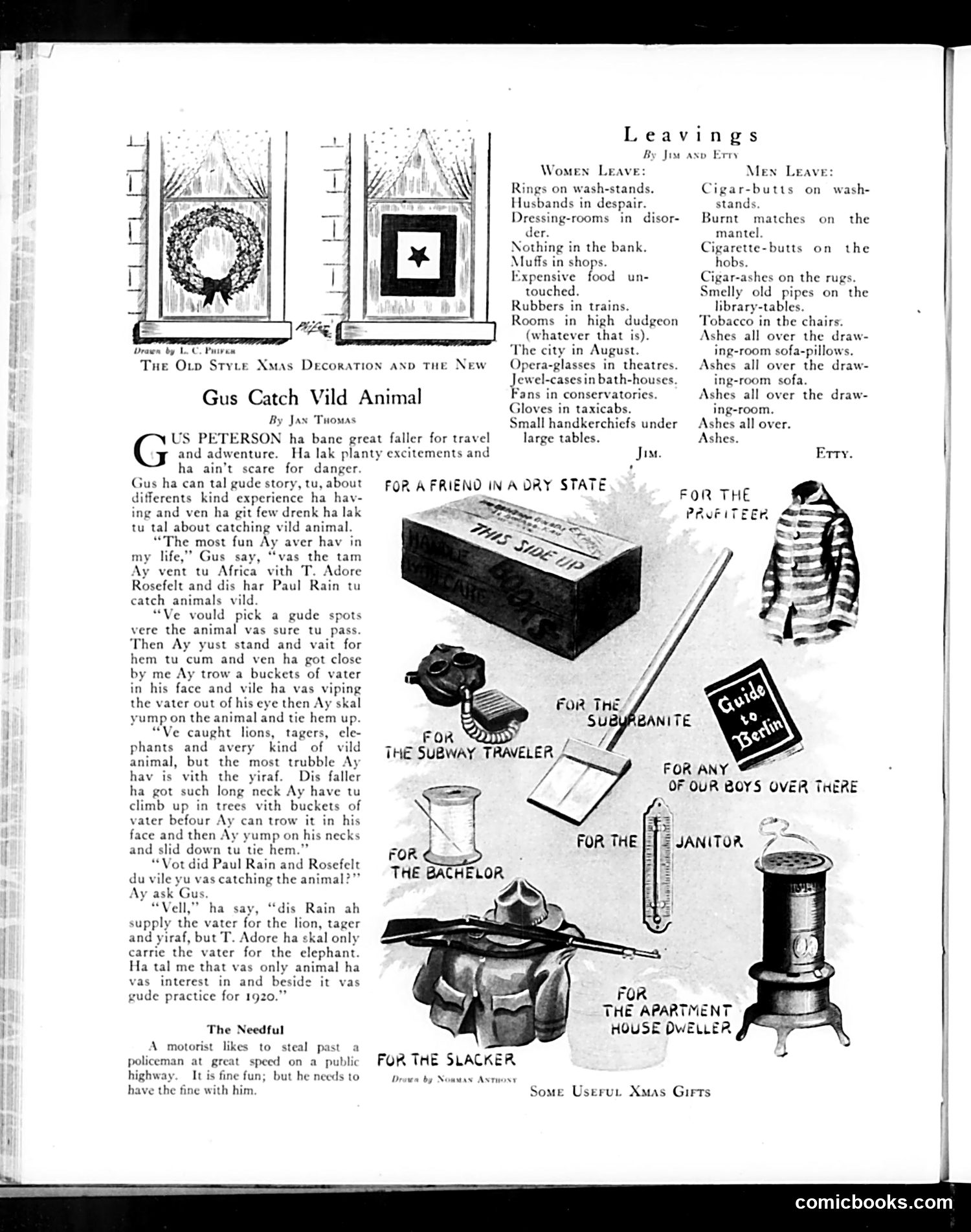
This page from *Judge* magazine contains primarily humorous content rather than political satire. The main feature is "Gus Catch Wild Animal," a comedic story by Jax Thomas about Gus Peterson's exaggerated hunting adventures in Africa. The dialect-heavy narrative mocks both tall tales and African safari narratives popular in early 20th-century literature. The "Leavings" section offers satirical observations about urban life—women leaving rings on washstands, men leaving cigar butts on rugs—poking fun at domestic untidiness and gender stereotypes. "Some Useful Xmas Gifts" presents tongue-in-cheek holiday suggestions targeted at various social types (bachelors, janitors, slackers, suburbanites), satirizing both consumerism and social classes. The humor relies on stereotypes and gentle mockery of contemporary urban society rather than specific political commentary.
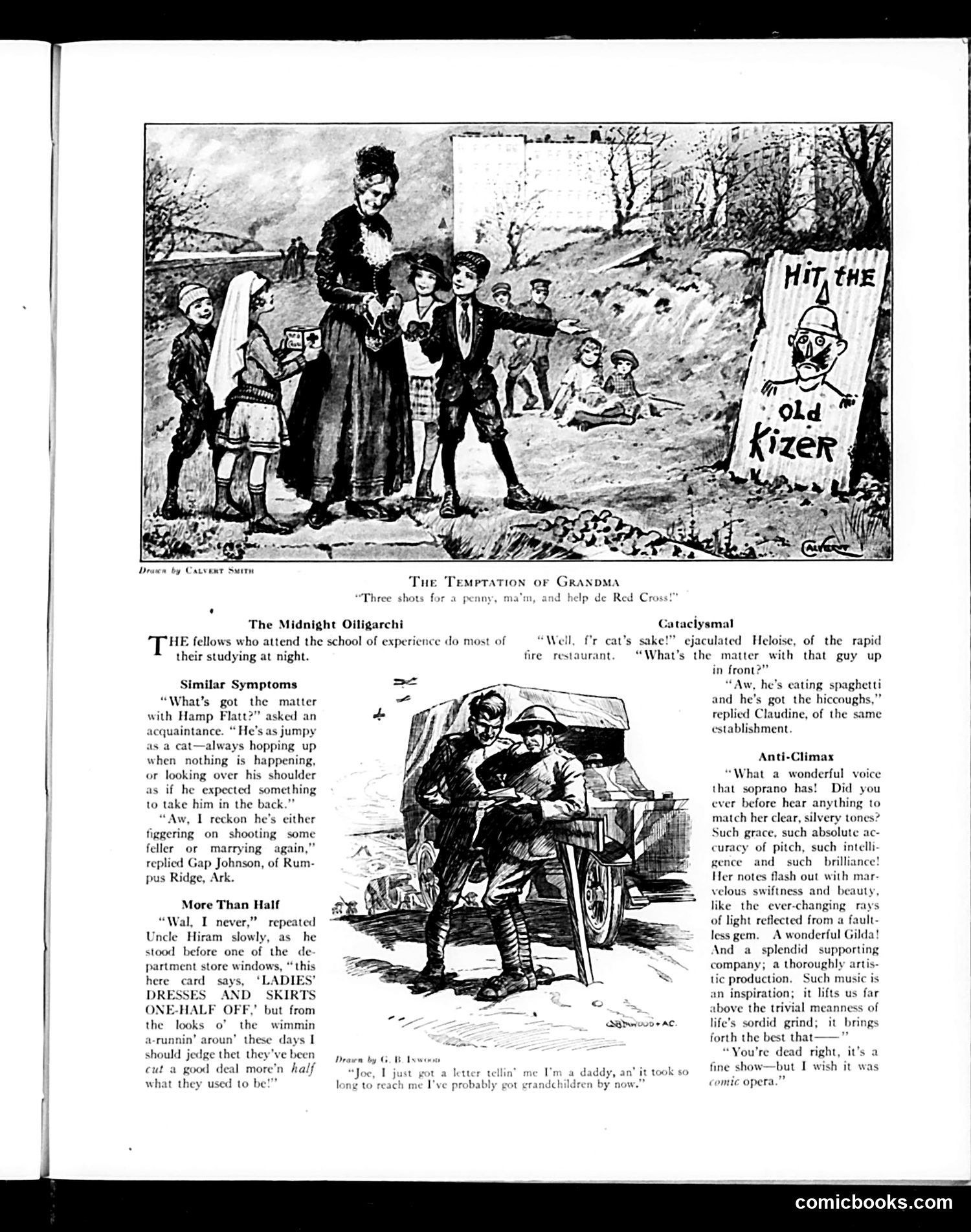
This page from *Judge* magazine contains humorous anecdotes rather than political commentary. The top cartoon, "The Temptation of Grandma," shows children soliciting donations for the Red Cross by appealing to an elderly woman—likely satirizing WWI-era charitable campaigns. The four text sections below mock everyday social situations: a nervous man (possibly anxious about commitment), a restaurant patron with hiccups while eating spaghetti, and an opera enthusiast whose rapturous praise is deflated when someone wishes it were "comic opera" instead. The final joke, "More Than Half," is a dig at women's fashion—specifically the shorter hemlines becoming fashionable in the 1920s. An old man notes a store sign advertising "one-half off" ladies' skirts, then quips that women have actually cut their skirts far more than that, referencing the scandalous shortening of women's dress lengths during this era. This reflects conservative anxiety about changing women's fashion and social roles.
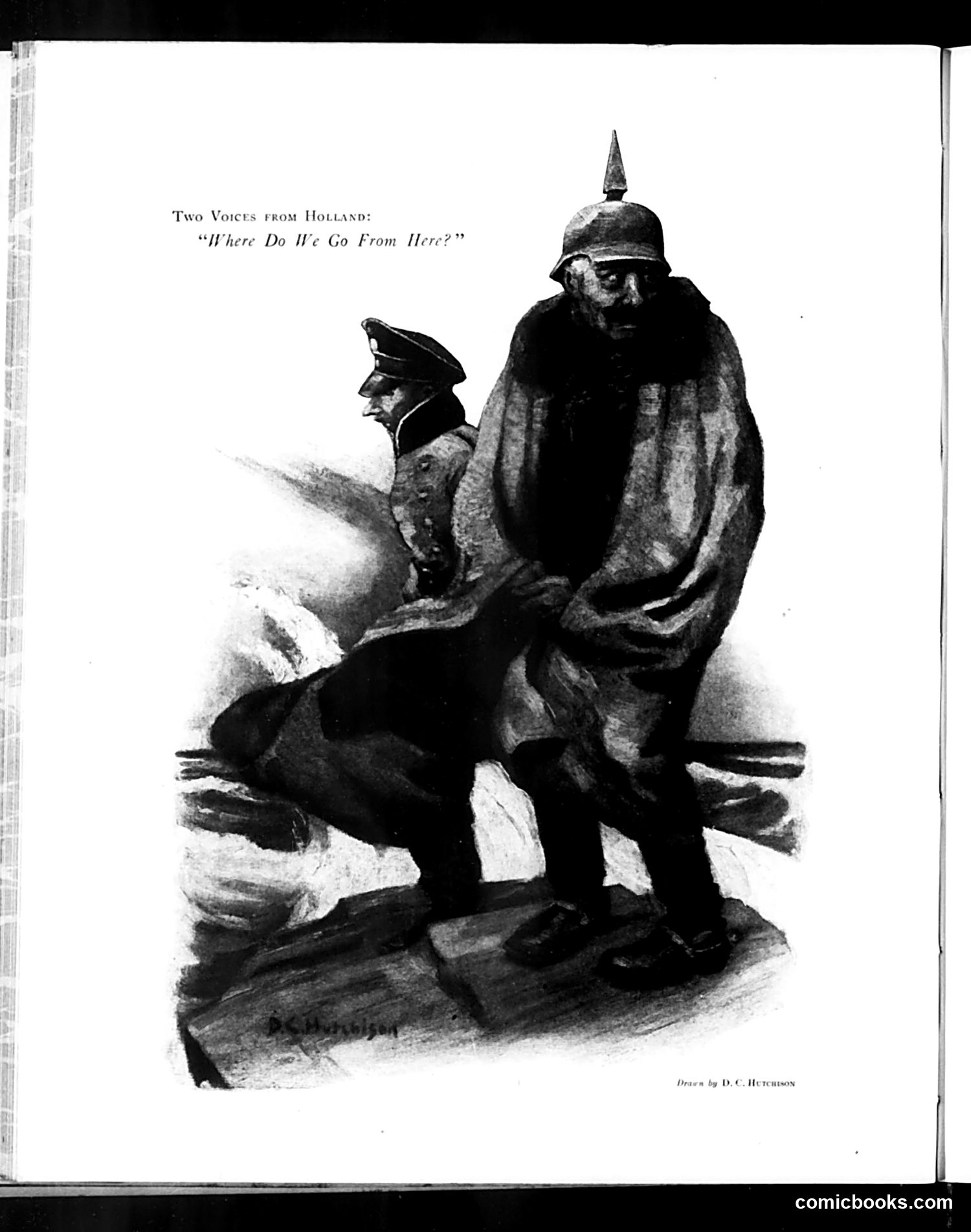
This political cartoon depicts two German military figures—likely representing German leadership or the German state—riding together on what appears to be a sinking or collapsing vessel. The figure in front wears a Prussian spiked helmet (Pickelhaube), the iconic symbol of German militarism. The cartoon's title references "Holland" (the Netherlands) and poses the anxious question "Where Do We Go From Here?"—suggesting uncertainty about Germany's future direction, likely during or after World War I. The sinking vessel imagery implies Germany's military or political situation is deteriorating. The satirical point critiques German leadership's lack of clear direction during a period of national crisis, using the shipwreck metaphor to suggest impending disaster or defeat. The cartoon is drawn by D.C. Hutchinson.
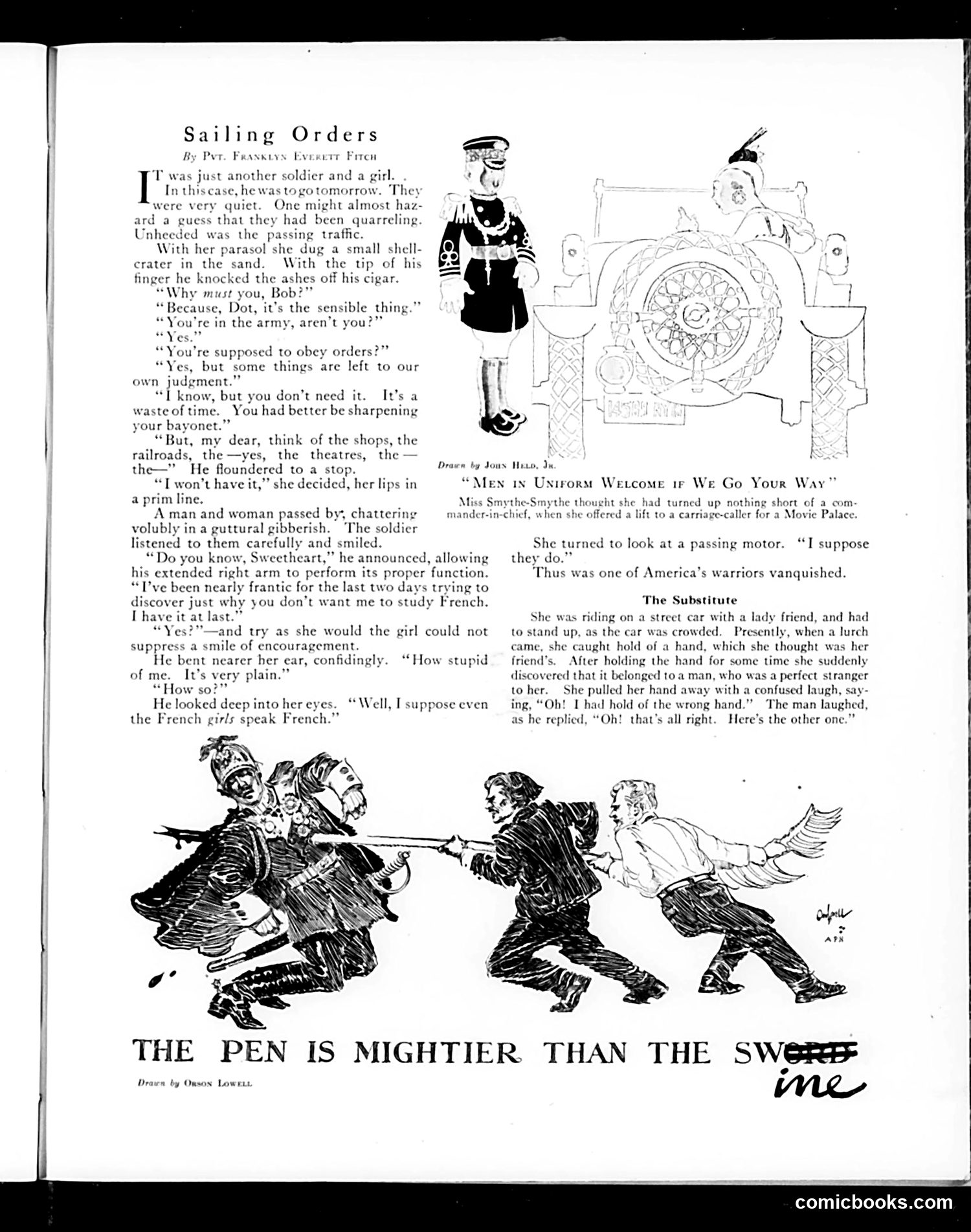
This page from *Judge* contains wartime romance humor, likely from WWI era based on military references. **"Sailing Orders":** A soldier must deploy tomorrow. His girlfriend Dot demands he focus on military duty rather than civilian pleasures (shops, theaters, studying French). The joke's punchline: he finally realizes she's jealous of French girls, not concerned about his patriotic obligations. The satire gently mocks romantic drama during wartime—her "sensible" demands mask personal insecurity. **"Men in Uniform Welcome if We Go Your Way":** A woman offers a military officer a ride in her car, hoping to impress him. The cartoon satirizes how civilians lionized uniformed soldiers during wartime, presenting this as an opportunity for romantic advancement. **"The Substitute":** On a crowded streetcar, a woman accidentally holds a stranger's hand thinking it's her friend's. When she realizes the mistake, he cheerfully offers his other hand. The joke plays on wartime conditions (crowded public transit) creating awkward social situations and unexpected "substitutions" for normal courtship. All three pieces humorously address homefront romance disrupted by military service.
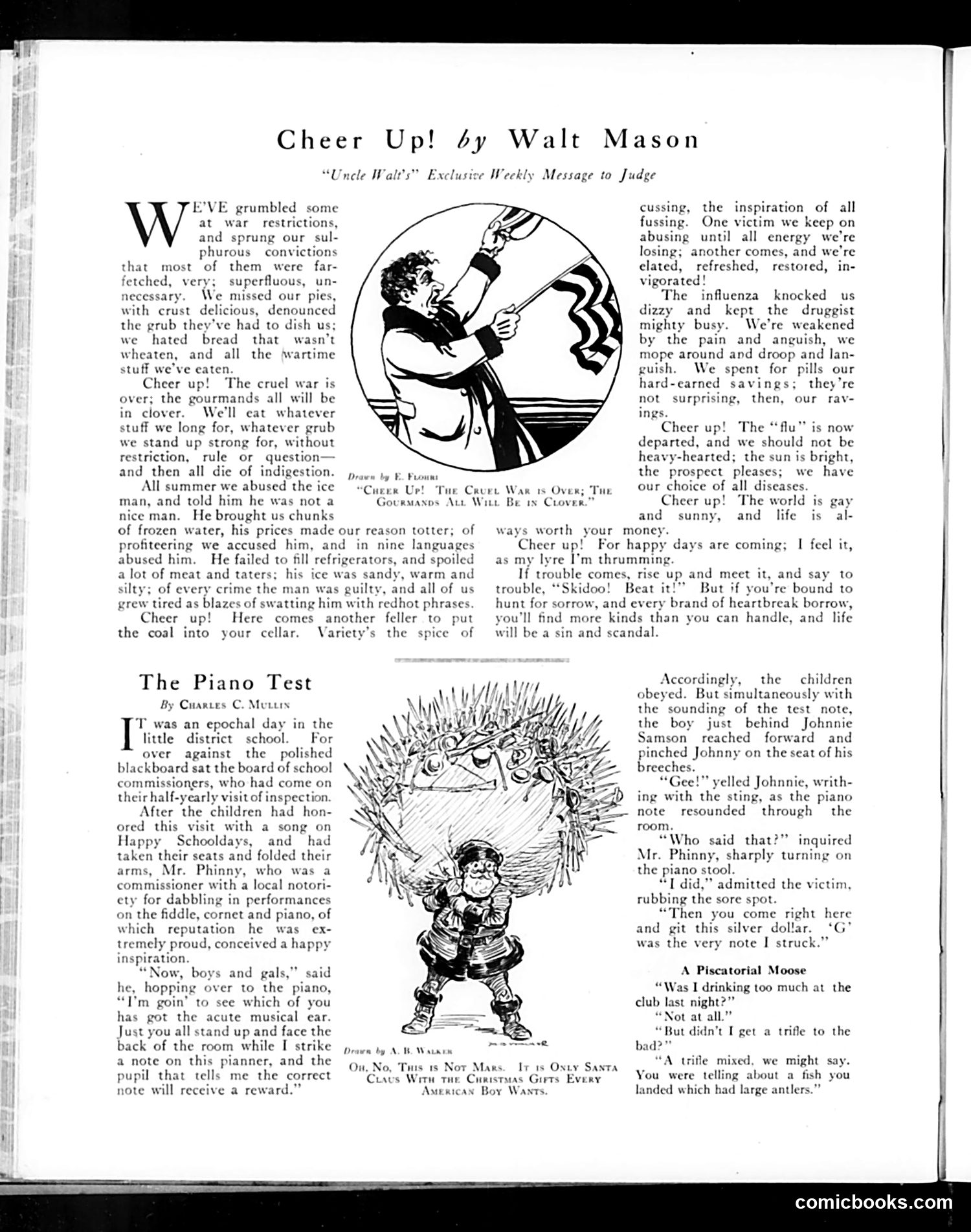
**"Cheer Up!" by Walt Mason** is a morale-boosting essay written during or just after World War I. Mason acknowledges wartime complaints—rationing, restrictions, abuse of ice delivery men and coal dealers—but urges readers to stay optimistic now that "the cruel war is over." He references the recent influenza pandemic ("the flu"), encouraging resilience through hardship. The tone is deliberately folksy and encouraging, typical of Mason's "Uncle Walt" persona. **"The Piano Test" by Charles C. Mullin** is a humorous school story. A visiting school commissioner administers a musical ear test, asking students to identify piano notes. A boy named Johnnie Samson is pinched by the student behind him during the test, causing him to cry out. The commissioner assumes Johnnie called out the piano note, rewarding him—unaware of the prank. The joke satirizes both educational pretension and innocent child mischief.
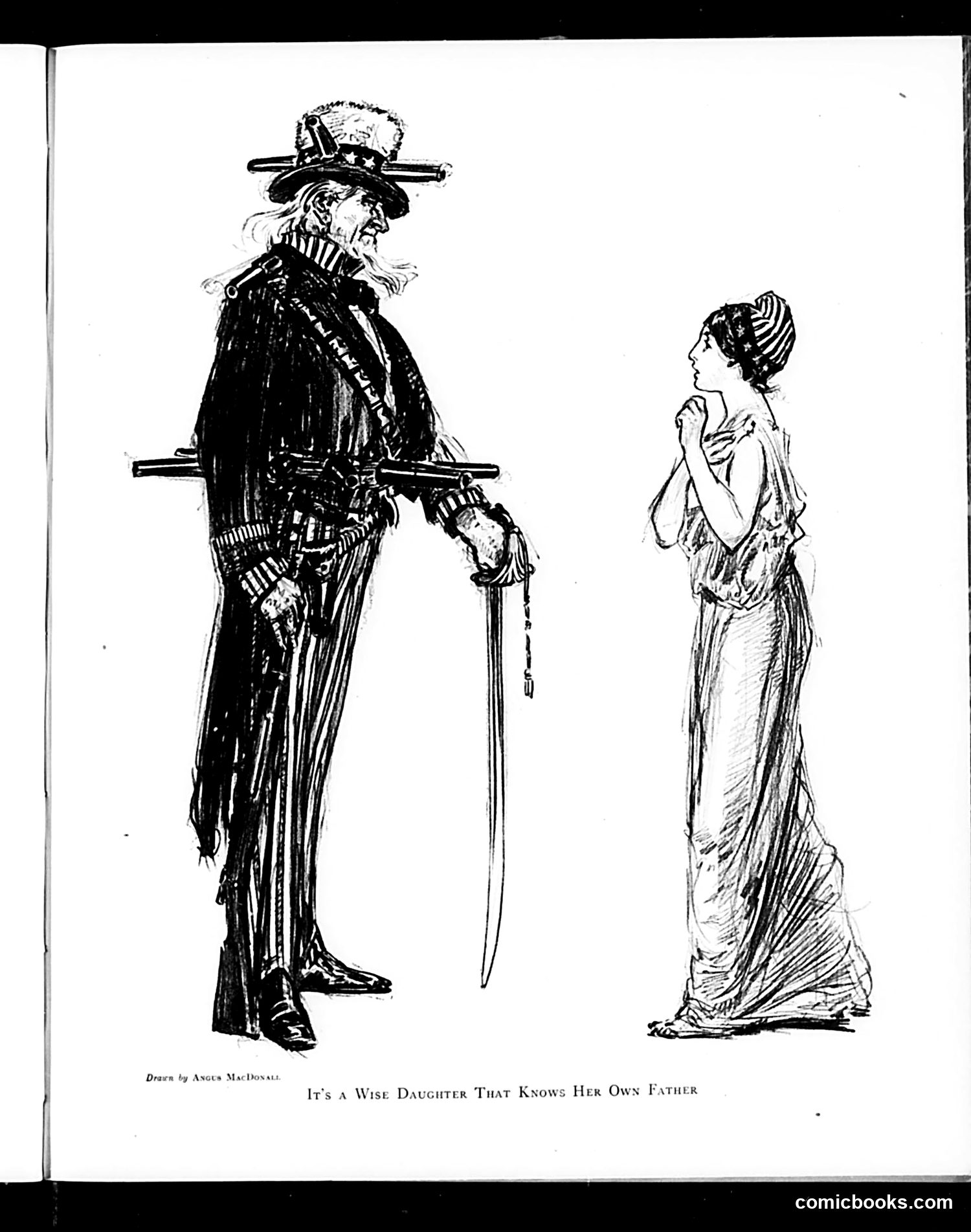
This single-panel cartoon depicts an elegantly dressed woman confronting a tall, gaunt man in tattered formal wear carrying a rifle and sword. The caption reads "It's a Wise Daughter That Knows Her Own Father." The satire appears to reference **paternity uncertainty or illegitimacy**, playing on the proverb "It's a wise child that knows his own father." The disheveled, armed man's appearance suggests poverty, dissipation, or moral degradation. The woman's composed bearing contrasts sharply with his decrepit state. Without knowing the specific publication date or context from Judge magazine's archives, the precise political or social target remains unclear—though it likely comments on class differences, family shame, or questions of legitimacy in early 20th-century American society. The artist is credited as Angus MacDonald.
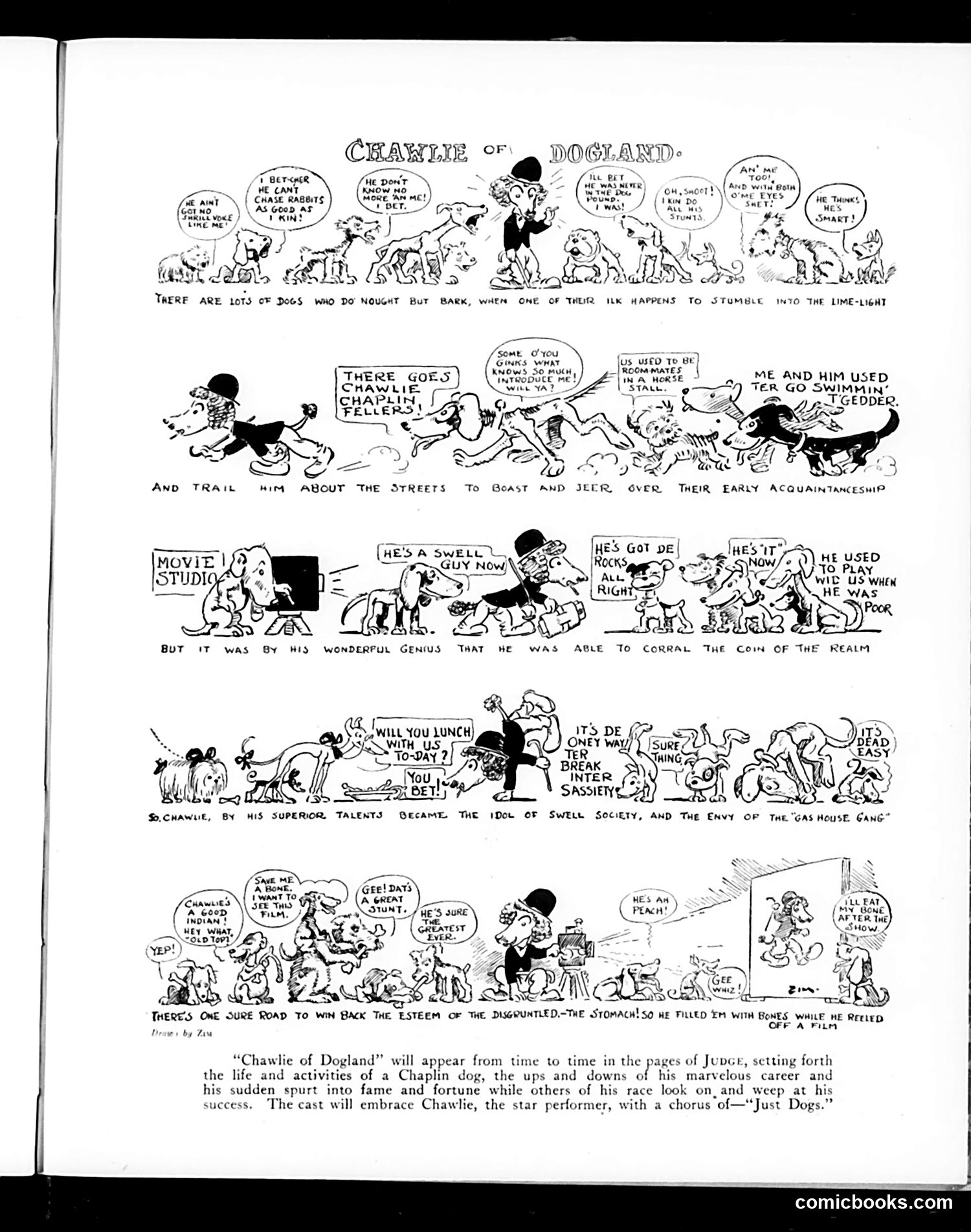
This is a satirical comic strip about "Chawlie," a dog character clearly based on **Charlie Chaplin**, the famous silent-film comedian who rose to sudden stardom in the 1910s-1920s. The narrative follows Chaplin's career arc: once a nobody who merely barked like other dogs, he stumbles into the spotlight, becomes a movie star through "wonderful genius," and rises to celebrity status where he's envied and courted by high society. The satire targets the fickleness of fame—other dogs who once jeered at him now seek his company and lunch invitations. The final panel's caption about filling stomachs with bones references Chaplin's use of slapstick and physical comedy to win back public favor, portrayed here literally as the dog-star feeding the masses to regain their esteem. The joke for Judge's readers was likely mocking both Chaplin's rapid ascent and the absurdity of celebrity culture itself—reducing a major entertainment phenomenon to a dog's unprincipled scramble for social validation.
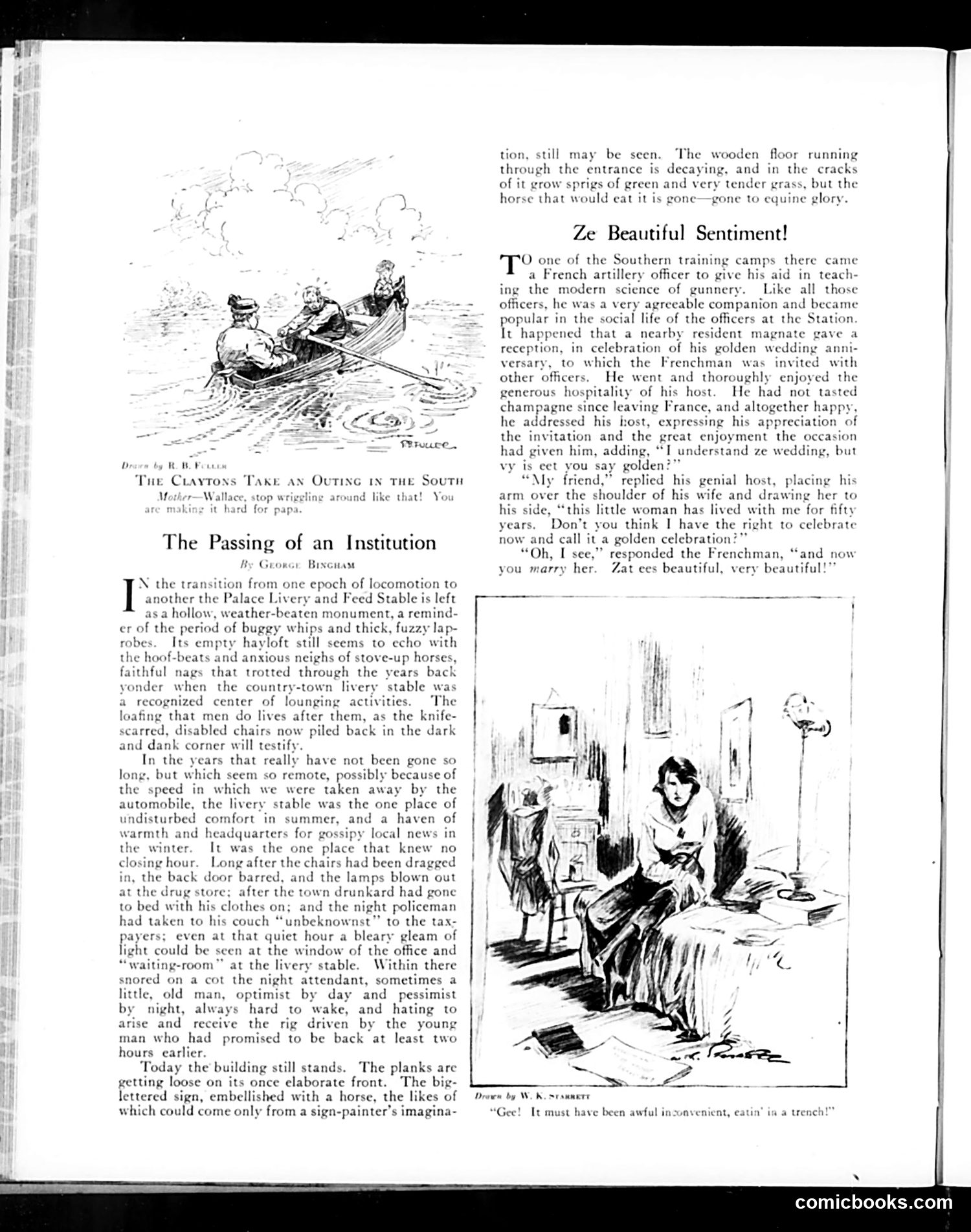
This page contains two separate pieces: **"The Passing of an Institution"** by George Bingham describes the decline of a Southern livery stable—once a social hub for horses, gossip, and leisure activities. The piece is nostalgic satire about how automobiles have rendered this old gathering place obsolete. **"Ze Beautiful Sentiment!"** depicts a French artillery officer at a Southern military camp celebrating his golden wedding anniversary. The humor derives from his broken English ("ze wedding," "vy is et you say golden?") and his host's reply about marrying the woman ("Zat ces beautiful, very beautiful!"). The satire mocks both exaggerated French sentimentality and the awkwardness of cross-cultural social interaction. The accompanying illustrations show period-appropriate settings: the outing scene and an interior domestic moment.
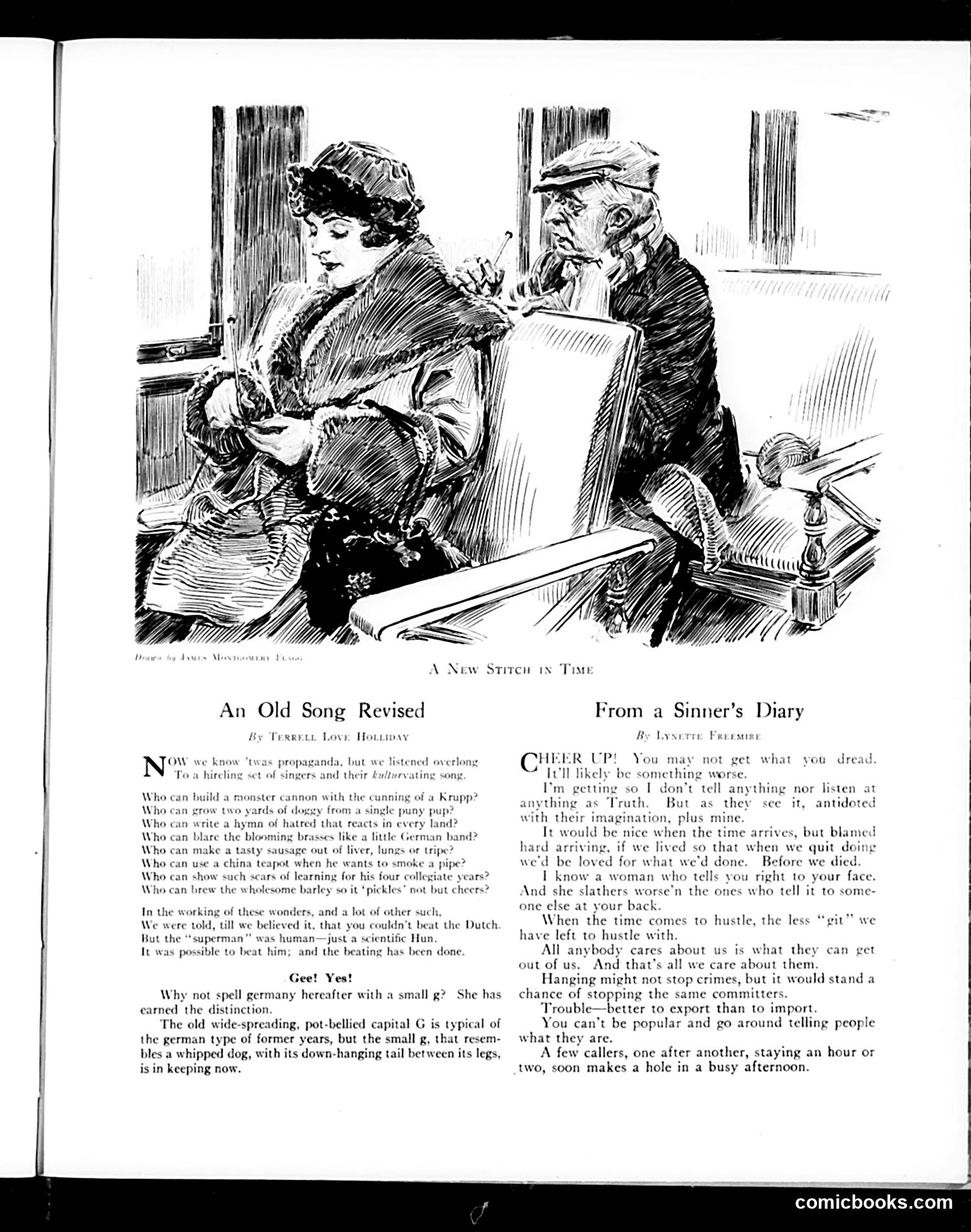
This Judge magazine page contains two satirical pieces from the WWI era, likely 1917-1918. **"An Old Song Revised"** mocks German superiority claims by parodying a Dutch folk rhyme. The text ironically catalogs German "accomplishments" (building cannons, growing vegetables, making sausage) while asserting that "you couldn't beat the Dutch." The satire's punch: Germans, once thought unbeatable, have now been defeated ("the beating has been done"). The accompanying note suggests spelling "Germany" with a lowercase "g"—arguing the proud, capital-G Germanic type has been humbled into a "whipped dog" with a drooping tail between its legs. **"From a Sinner's Diary"** is unrelated moralizing commentary on social hypocrisy and human nature, not political satire. The cartoon illustration shows a well-dressed woman and an older man in what appears to be an office or study, likely accompanying one of these pieces, though the specific connection is unclear from the visible image alone.
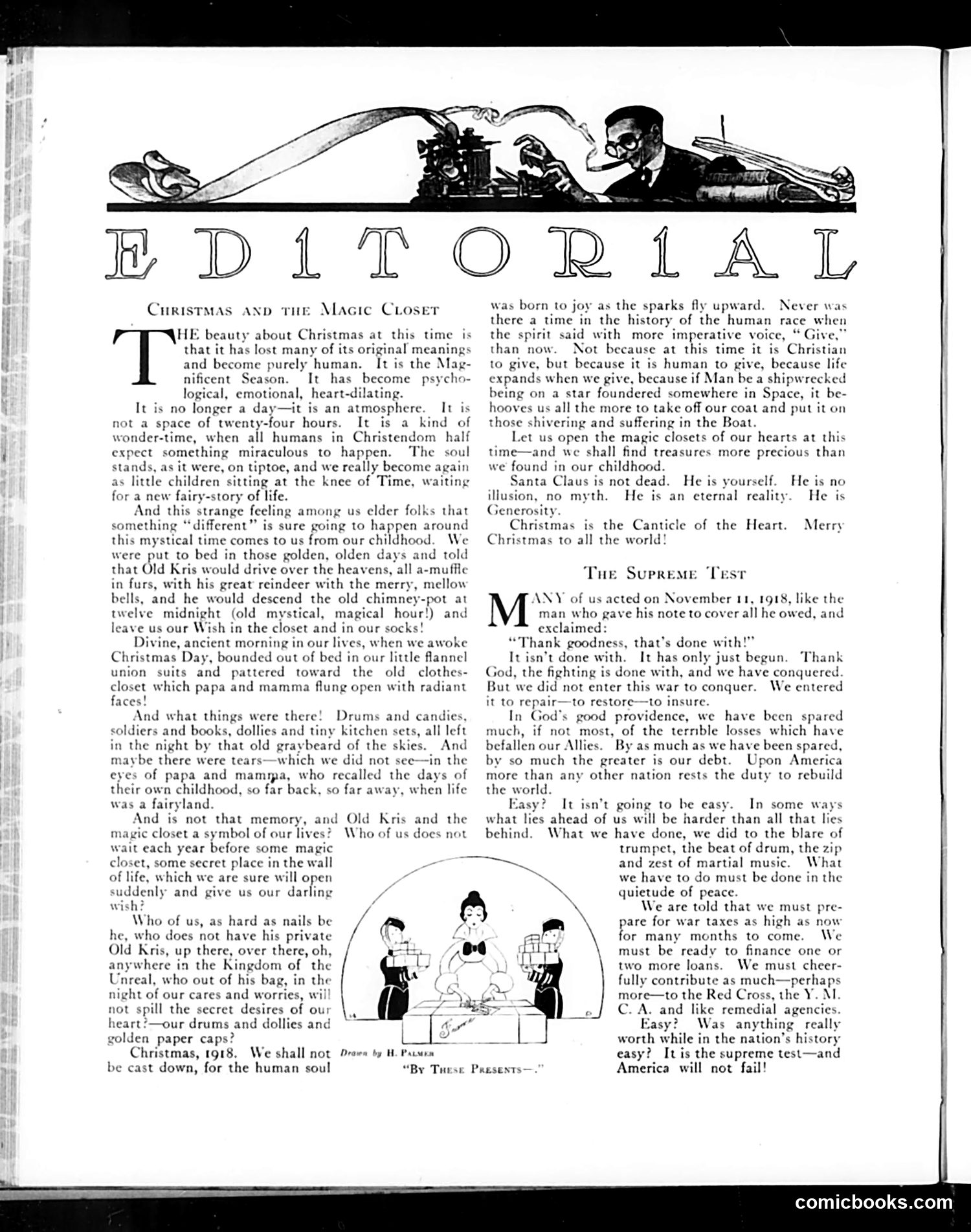
This page contains two editorials published shortly after WWI's November 11, 1918 armistice. **"Christmas and the Magic Closet"** is a nostalgic essay about childhood Christmas memories and the "magic closet" (likely a wardrobe or storage space) where children found gifts. The author uses this metaphor to suggest Americans should open their "hearts" to generosity during wartime hardship. The piece reframes Santa Claus as a symbol of human generosity rather than literal mythology—a spiritually uplifting message for a nation exhausted by war. **"The Supreme Test"** addresses post-war obligations. It warns Americans not to assume victory means the war effort is finished. The editorial urges continued sacrifice: paying war taxes, financing reconstruction loans, and supporting relief organizations (Red Cross, Y.M.C.A.) to help devastated Allied nations. The "supreme test" is America's moral responsibility to rebuild what war destroyed, not merely to celebrate military victory. The tone is earnest and patriotic, appealing to American duty beyond the battlefield.
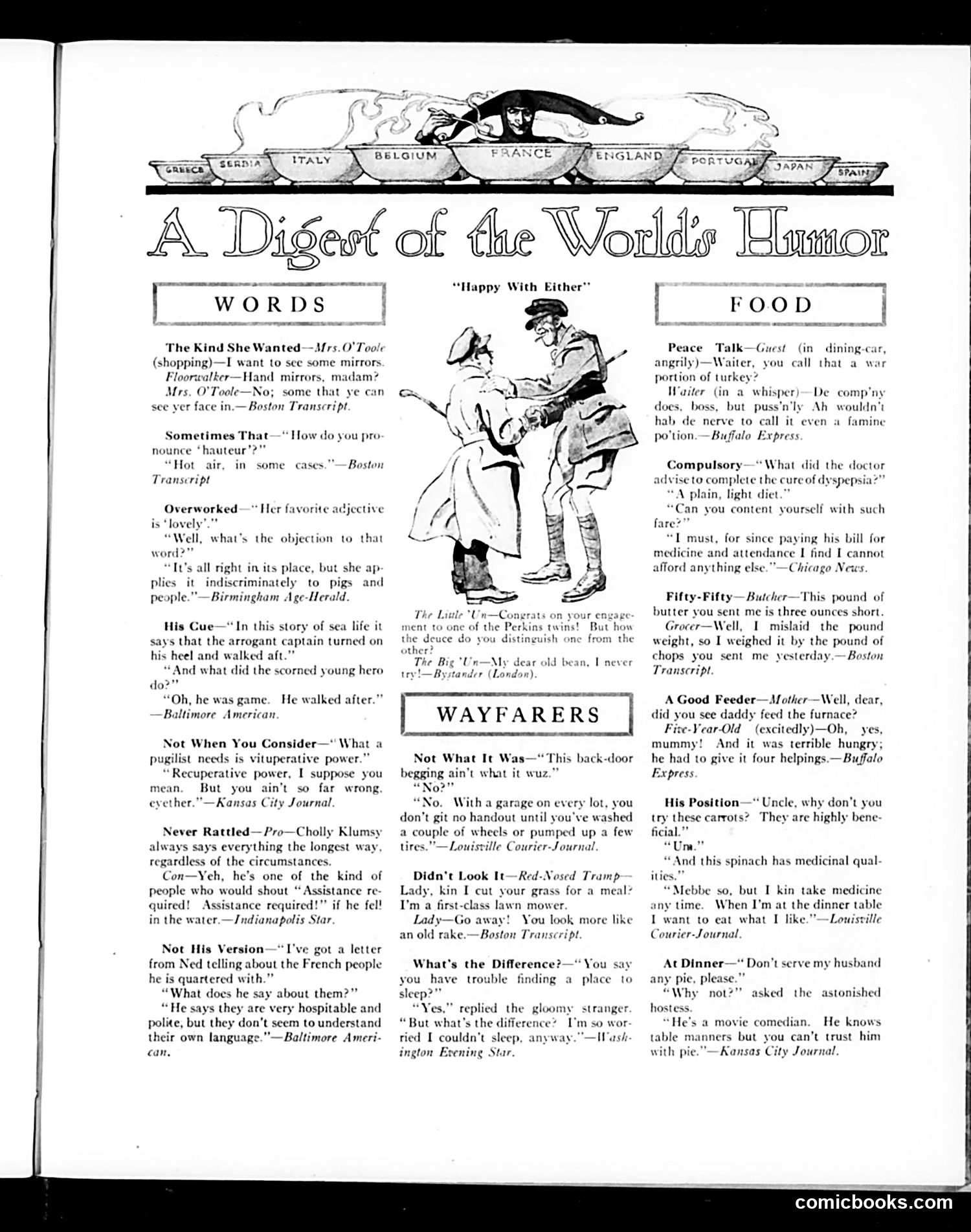
This page from *Judge* magazine collects brief humorous anecdotes organized by category: "Words" (linguistic jokes), "Wayfarers" (tramp/vagrant humor), and "Food" (dining jokes). The top illustration shows a figure riding various national labels—a visual pun on consuming international "humor." The jokes reflect early 20th-century American attitudes: class-conscious humor about working-class immigrants ("French people...don't seem to understand their own language"), gender stereotypes (wives controlling husbands' eating habits), and economic hardship (Depression-era tramps negotiating for meals). The "Fifty-Fifty" butcher joke satirizes wartime or postwar food rationing and black-market dealings. Several jokes mock lower-class speech patterns and behaviors—the servant's dialect, the vagrant's broken English—typical of the period's mainstream humor. The cartoon functions as a lighthearted miscellany offering safe, domestic comedy rather than political satire, reflecting *Judge*'s shift toward general-audience entertainment.
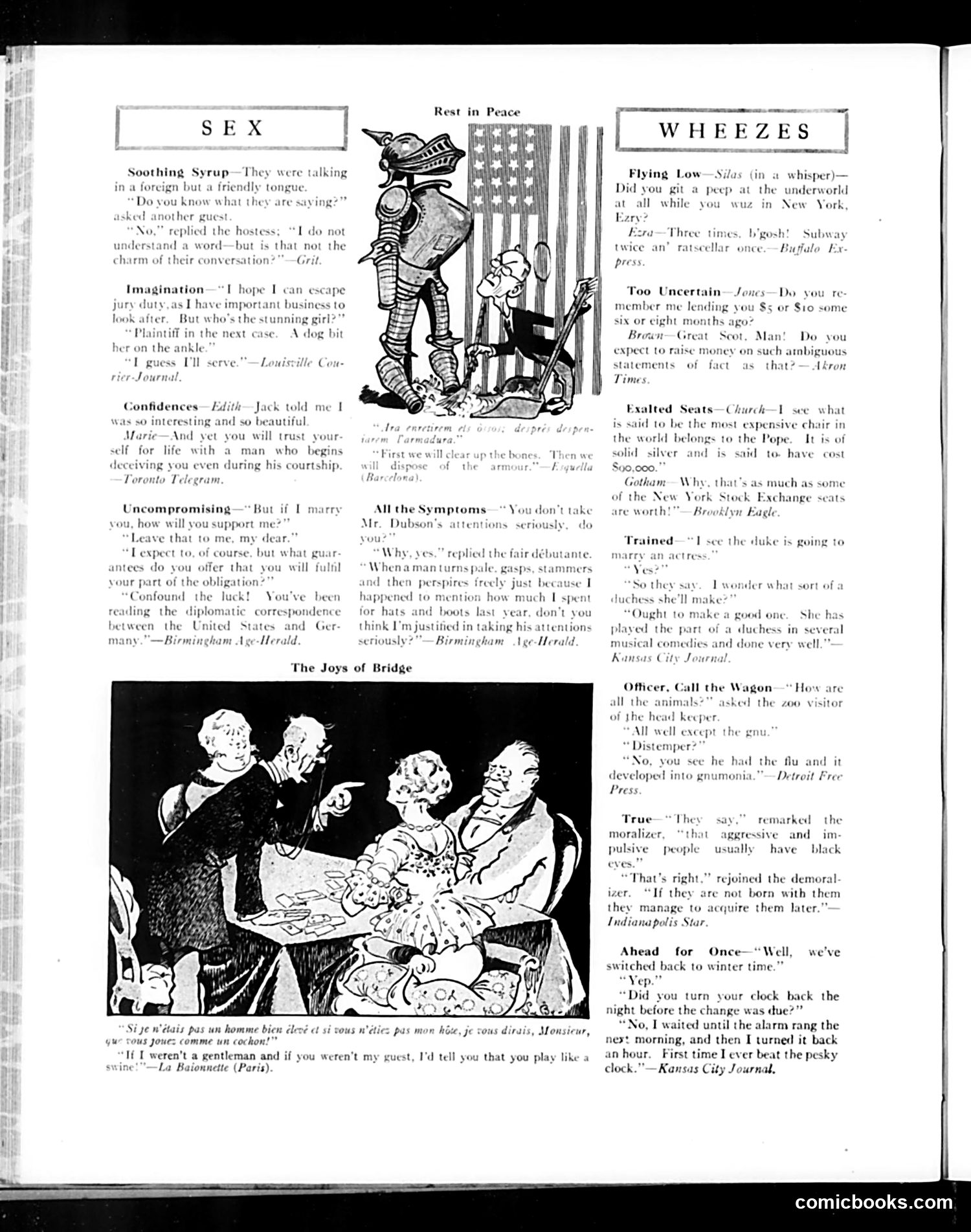
This page contains two sections: humorous anecdotes ("Sex" and "Wheezes") and a cartoon titled "The Joys of Bridge." **The main cartoon** depicts four people playing bridge, with French caption suggesting someone is boasting about their card-playing skills. The joke satirizes bridge as a social activity where players make questionable decisions and inflate their abilities—a common target of early 20th-century humor about parlor games. **The text sections** collect brief jokes and witticisms from newspapers about everyday situations: romantic misunderstandings, lending money, expensive church furniture, zoo visits, and daylight saving time. These represent Judge's typical format of reprinting clever quips submitted by readers or gleaned from other publications. **The satire targets** include marriage negotiations, social pretension, bridge-playing incompetence, and the minor frustrations of modern life. The tone is light and domestic rather than political—characteristic of Judge's mixed content combining commentary on social customs with pure entertainment.
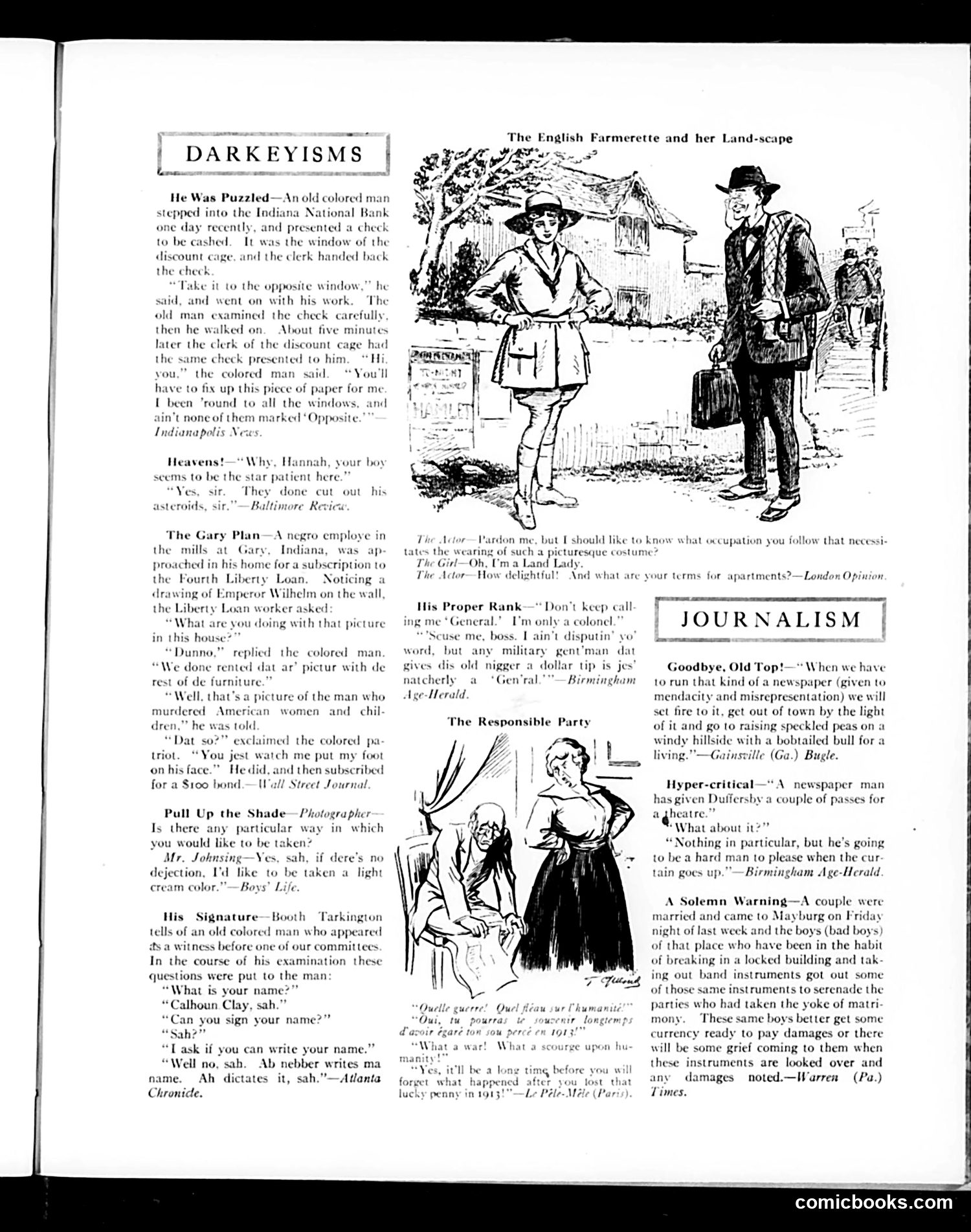
This page from *Judge* magazine collects racist humor prevalent in early 20th-century American media. The "Darkeyisms" section contains jokes mocking African Americans through dialect, stereotyping, and caricature. **Key content:** The jokes depict Black people as dim-witted, servile, or confused. Examples include a man unable to follow banking instructions, confusion about military rank, and malapropisms presented as comedic. One anecdote involves a man renting furniture including a picture of Kaiser Wilhelm; the humor relies on the stereotype of Black patriotism being performatively simple. **Historical context:** This represents widely-accepted racist entertainment of the era. The term "Darkeyisms" itself references a dehumanizing slur. The caricatures and dialect spelling were standard in mainstream publications, reflecting the casual, systemic racism of early 20th-century America. **For modern readers:** This is a historical artifact documenting normalized prejudice. The "humor" targets a marginalized group and relies entirely on negative stereotypes. It's valuable primarily as evidence of period attitudes, not entertainment. The adjoining "Journalism" section appears unrelated satirical commentary on newspaper practices.
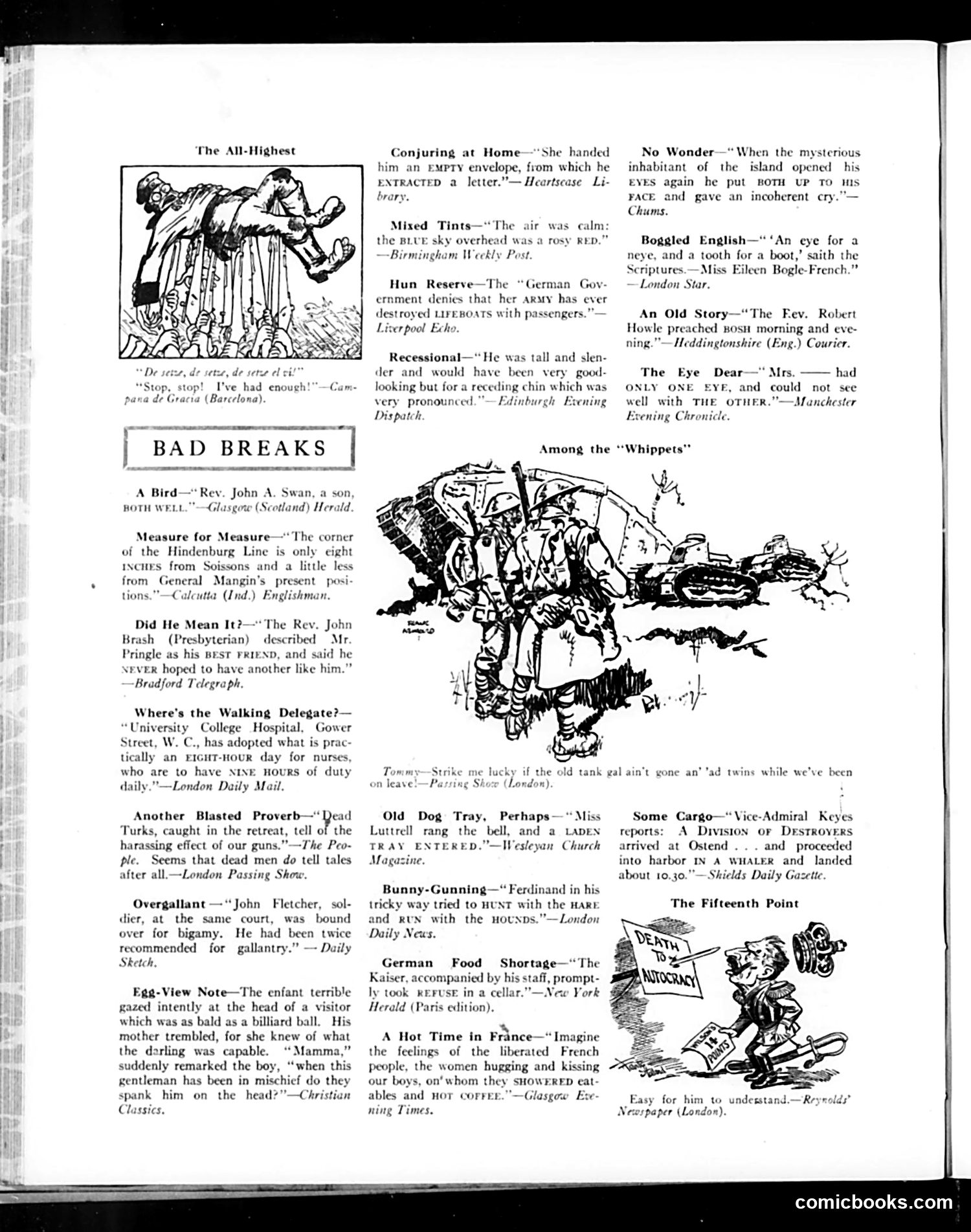
This page from *Judge* magazine collects humorous "bad breaks"—unintentionally funny newspaper quotes and typos. The main cartoon, "The All-Highest," depicts the German Kaiser being spanked by Allied forces, captioned with a Spanish phrase meaning "Stop, I've had enough!"—mocking Germany's weakening WWI position. The text sections are brief comedic items exploiting newspaper errors: contradictions (nurses working nine hours despite an eight-hour policy), unfortunate word choices ("a laden tray ENTERED" instead of being carried), and dark wartime humor (dead men telling tales after all). These satirize sloppy editing and careless phrasing. "The Fifteenth Point" references Wilson's Fourteen Points peace proposal, suggesting a humorous 15th point about death by newspaper. The overall effect is wartime propaganda humor—mocking both German leadership and domestic incompetence while maintaining morale during WWI through pointed ridicule.
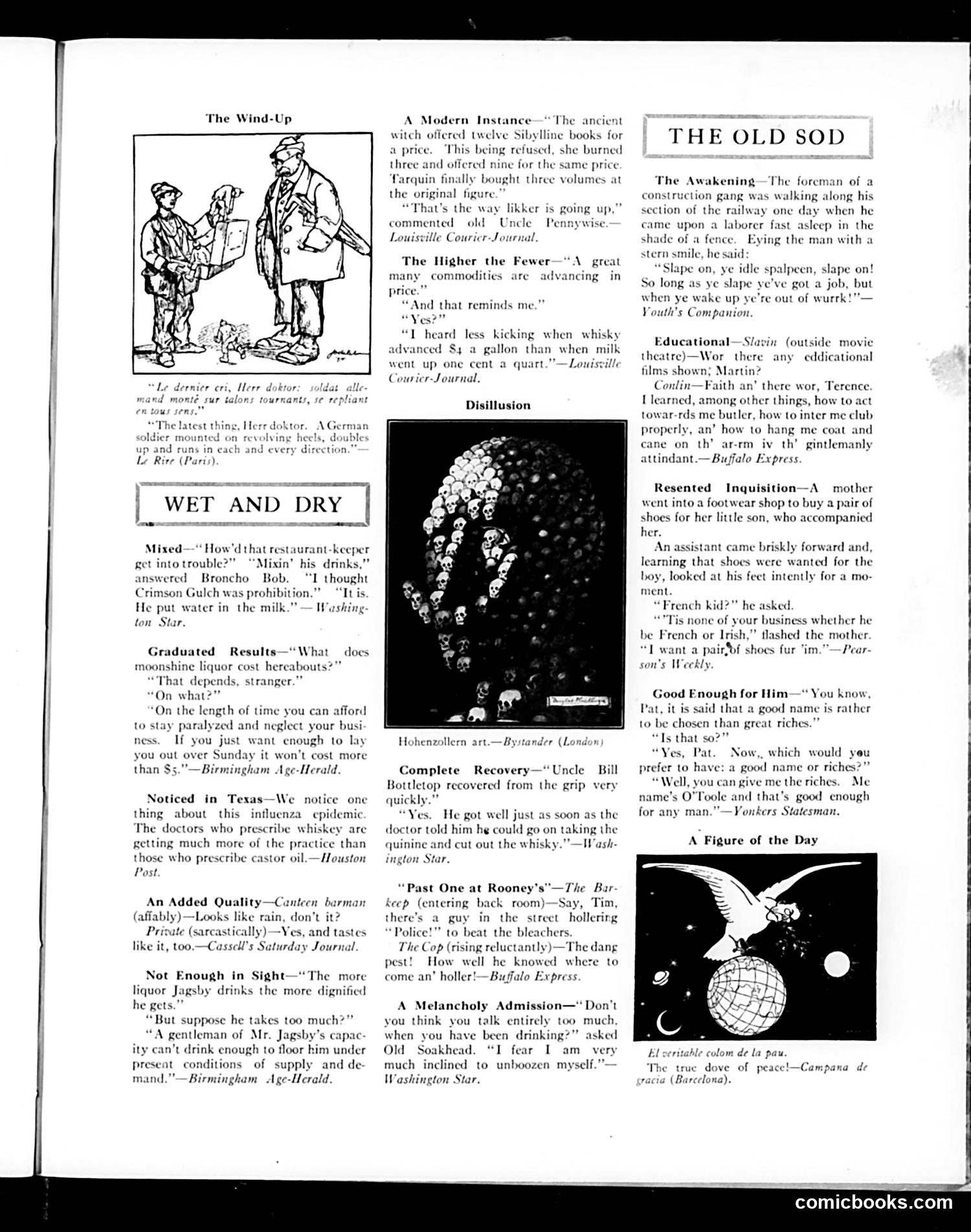
This page reflects Prohibition-era American satirical humor (the magazine was publishing during the 1920s liquor ban). The "Wind-Up" cartoon shows a man winding up a woman like a toy—likely satirizing something contemporary, though the specific reference isn't entirely clear from the visible text. The primary satire throughout concerns **bootleg whiskey and alcohol scarcity during Prohibition**. Jokes about "moonshine liquor" costs, doctors prescribing whiskey, and liquor price inflation all mock the absurdity of the ban and its consequences. One joke jokes that doctors profiting from prescribing whiskey during Prohibition get more business than castor oil prescribers—highlighting the hypocrisy of "medicinal alcohol" exceptions. "The Old Sod" section contains Irish-immigrant dialect humor typical of 1920s publications, depicting working-class Irish laborers and domestic servants. The "Disillusion" image appears to be an artistic print unrelated to the text.
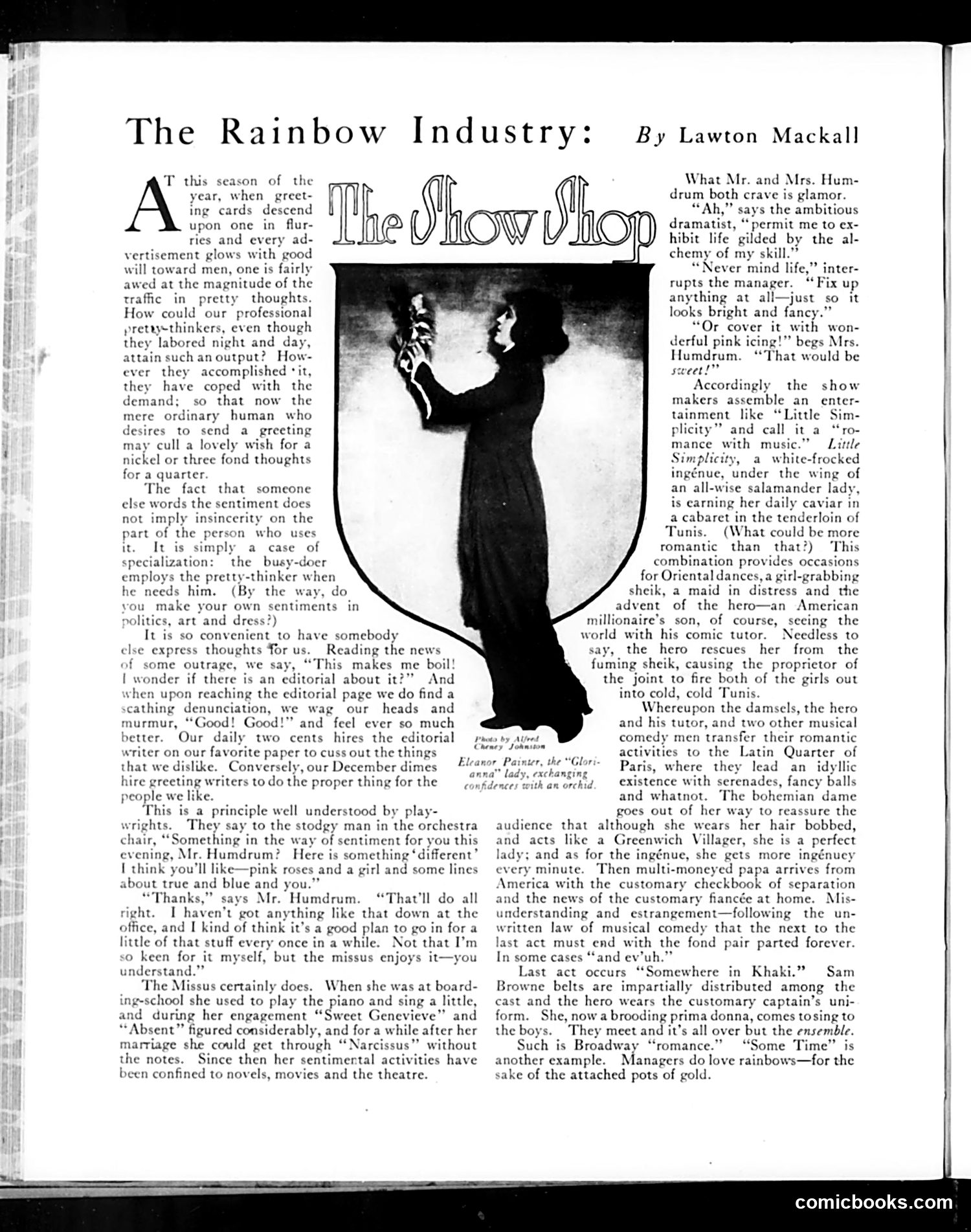
This article by Lawton Mackall satirizes early 20th-century commercial sentimentality and theatrical escapism. The accompanying image shows Eleanor Painter, a "Gloriana" lady, exchanging confidences with an orchid—visualizing the article's theme. Mackall critiques how ordinary people ("Mr. and Mrs. Humdrum") outsource sentiment by purchasing greeting cards rather than writing genuine messages. He extends this mockery to Broadway musical theatre, which he argues provides manufactured "glamor" divorced from reality. The shows feature exotic, implausible plots (white-frocked ingénues in Tunisian cabarets, American millionaires rescuing girls) designed purely for escapist entertainment. The satire's point: modern audiences passively consume pre-packaged emotions and fantasies rather than engaging authentically with life or art. Both greeting cards and Broadway represent the "Rainbow Industry"—a lucrative business selling prettified unreality to the masses.
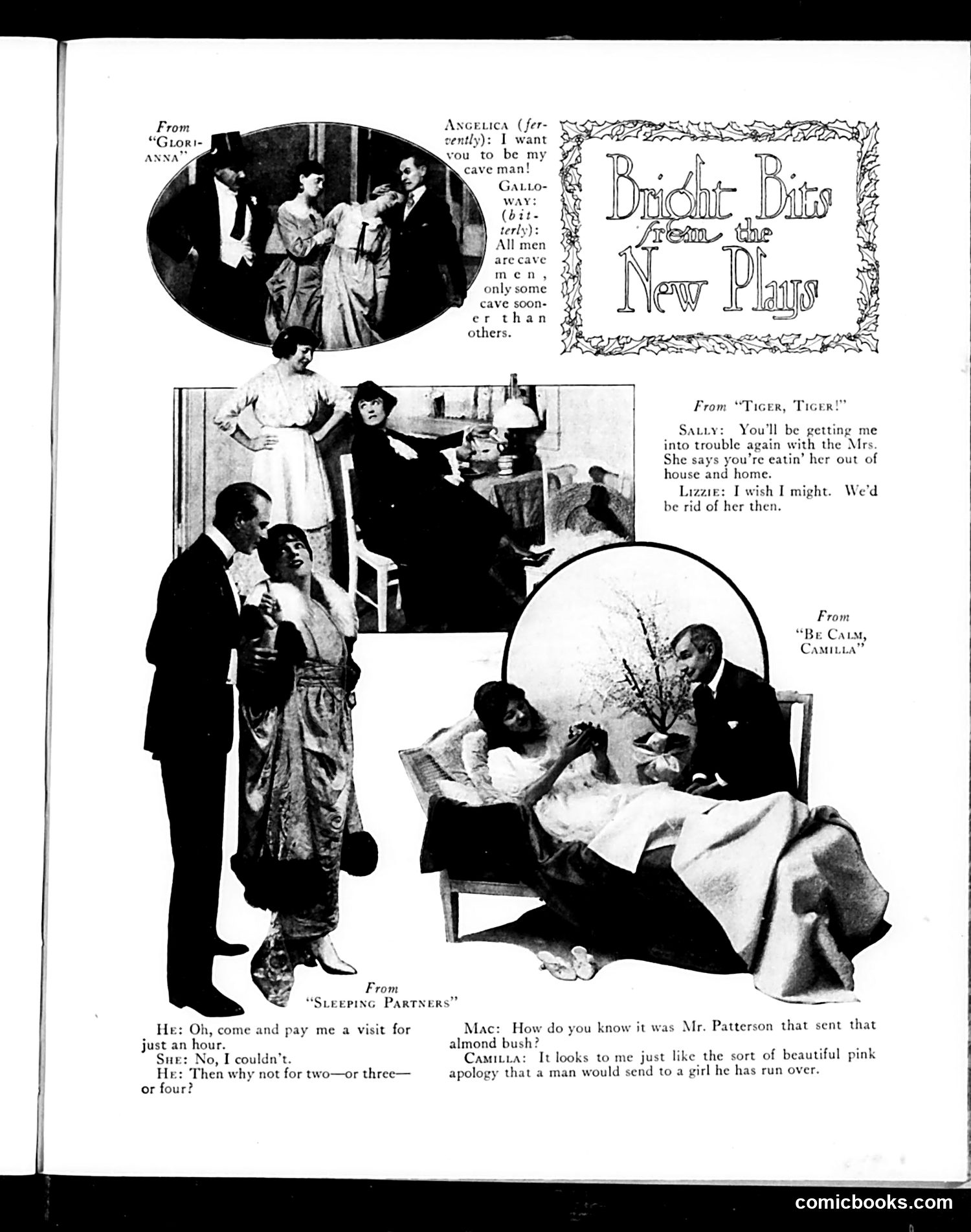
This page features multiple satirical vignettes mocking early 20th-century romantic and social conventions: **"Bright Bits from the New Plays"** showcases excerpts from theatrical productions. The top scene from "Glorianna" jokes about male dominance—a woman wants a "cave man," but a man bitterly retorts that all men are inherently domineering; some just reveal it sooner. **"Sleeping Partners"** satirizes transactional relationships: a man propositions a woman for paid intimate visits; she refuses, but he pushes for longer arrangements, suggesting casual sexual commerce. **"Tiger, Tiger!"** depicts domestic discord—a woman complains her husband's friend eats them out of house and home; the friend darkly wishes he could eat the complaining wife instead. **"Be Calm, Camelia"** mocks courtship rituals: when a woman receives flowers from a man, she cynically interprets them as an "apology" for running her over—suggesting men use gifts to manipulate women they've wronged. The overall satirical thrust critiques male behavior as predatory, dishonest, and self-serving in romantic contexts.
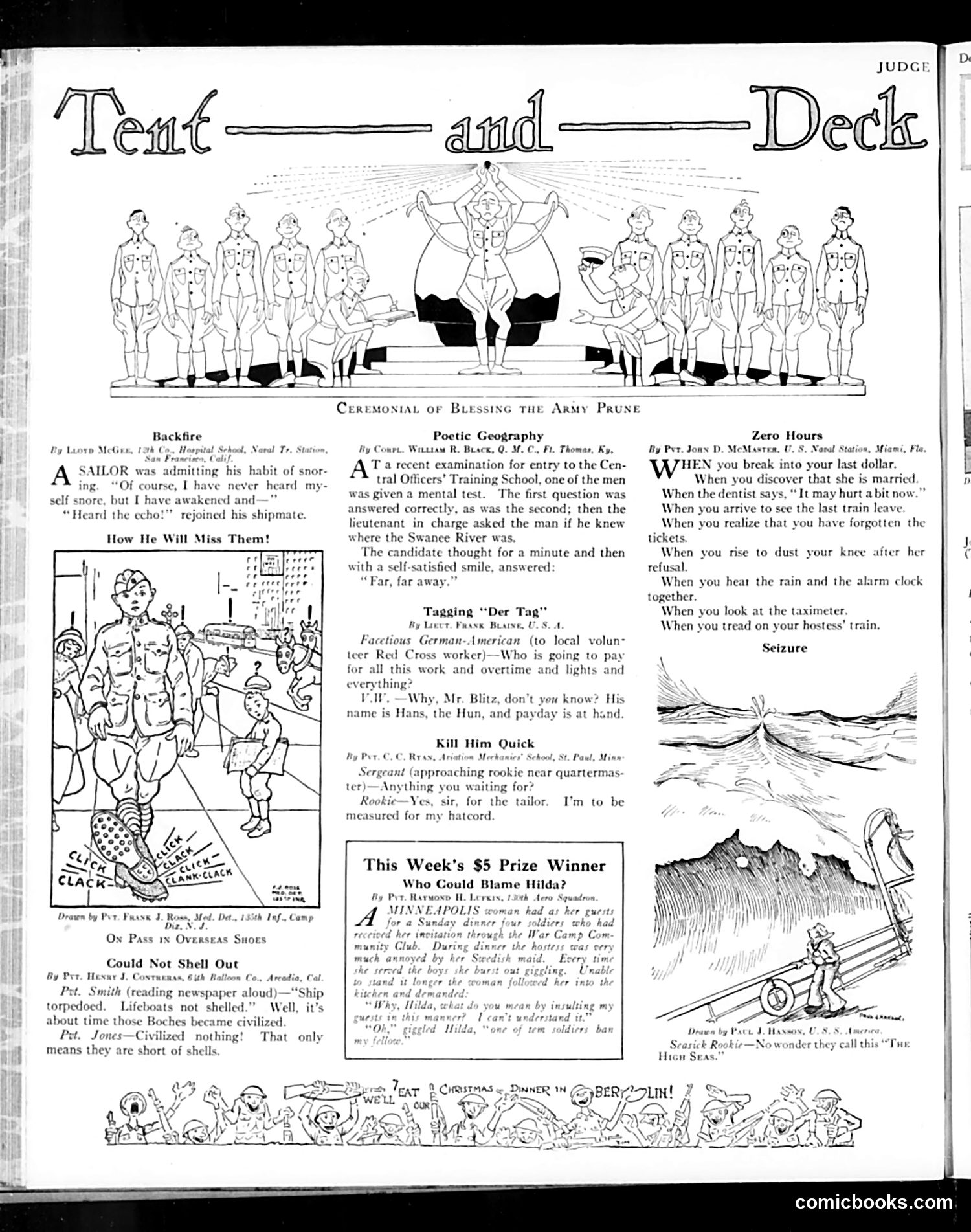
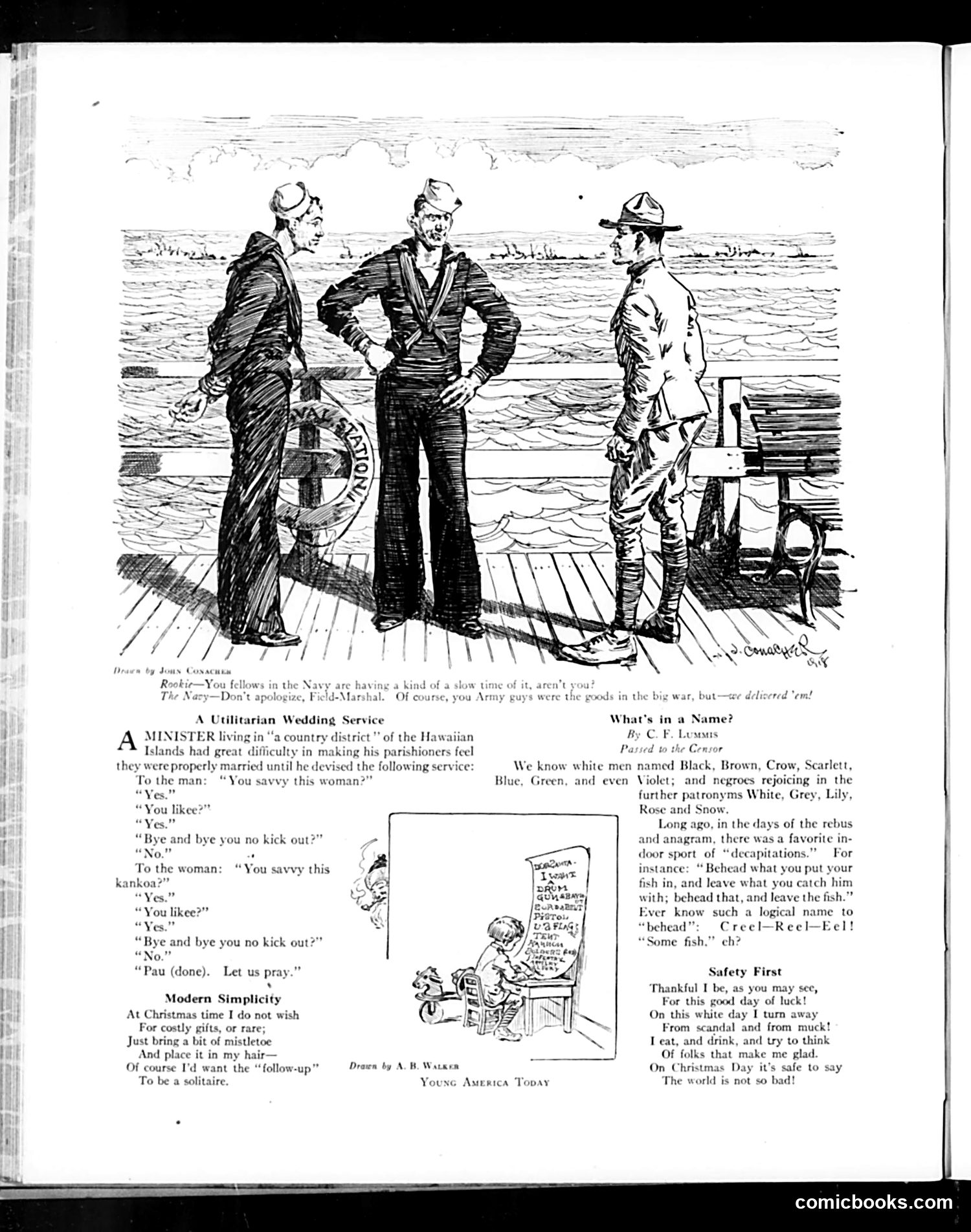
This page collects brief military jokes and cartoons from World War I era. The content mocks soldiers' everyday complaints and observations: **"How He Will Miss Them!"** depicts a sailor joking about never hearing himself snore, only the echo—implying loud snoring will annoy bunkmates. **"Poetic Geography"** ridicules a recruit at officer training who answers that the Swanee River is "far, far away"—a nonsensical response showing military education gaps. **"Tagging 'Der Tag'"** features a German-American laborer asking who pays for Red Cross work, with the punchline that "Hans, the Hun" (the enemy) will pay through eventual Allied victory. **"Zero Hours"** lists humorous "worst moments" soldiers face—missed trains, forgotten tickets, romantic rejection, seasickness. The satire gently mocks military life's discomforts and soldier naiveté while supporting the war effort through patriotic humor. The magazine was aimed at civilian audiences to boost morale through lighthearted military observations.
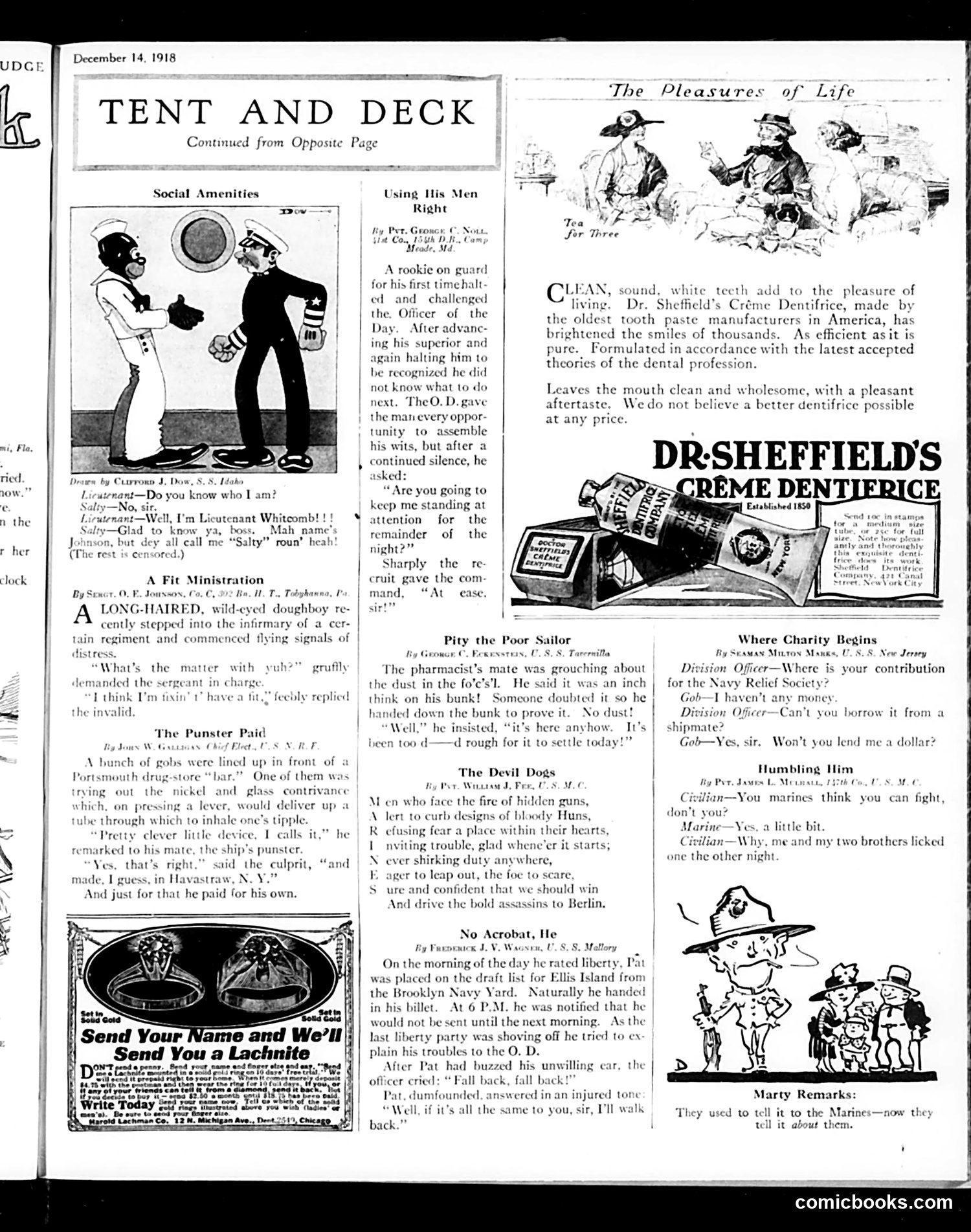
This page contains military humor from the final weeks of World War I, featuring jokes and anecdotes about American soldiers ("doughboys") and sailors. The cartoons mock military life and personalities. "Social Amenities" depicts an officer and enlisted man introducing themselves with awkward formality. "A Fit Ministration" shows a sergeant dealing with a disoriented recruit. "The Punster Paid" is a bar joke where a sailor must buy a drink after making a pun about Haverstraw, New York. Other pieces humorously depict soldiers' complaints: a sailor exaggerating dust in his bunk, Marines' self-aggrandizing boasts, and a recruit's frustration being reassigned just before shore leave. The advertisements (Dr. Sheffield's toothpaste and a lucite jewelry send-away) are period-appropriate commercial content. The overall tone reflects wartime morale-boosting humor targeting military readers—self-deprecating jokes about military hierarchy, enlisted complaints, and masculine braggadocio typical of trench-era publications.
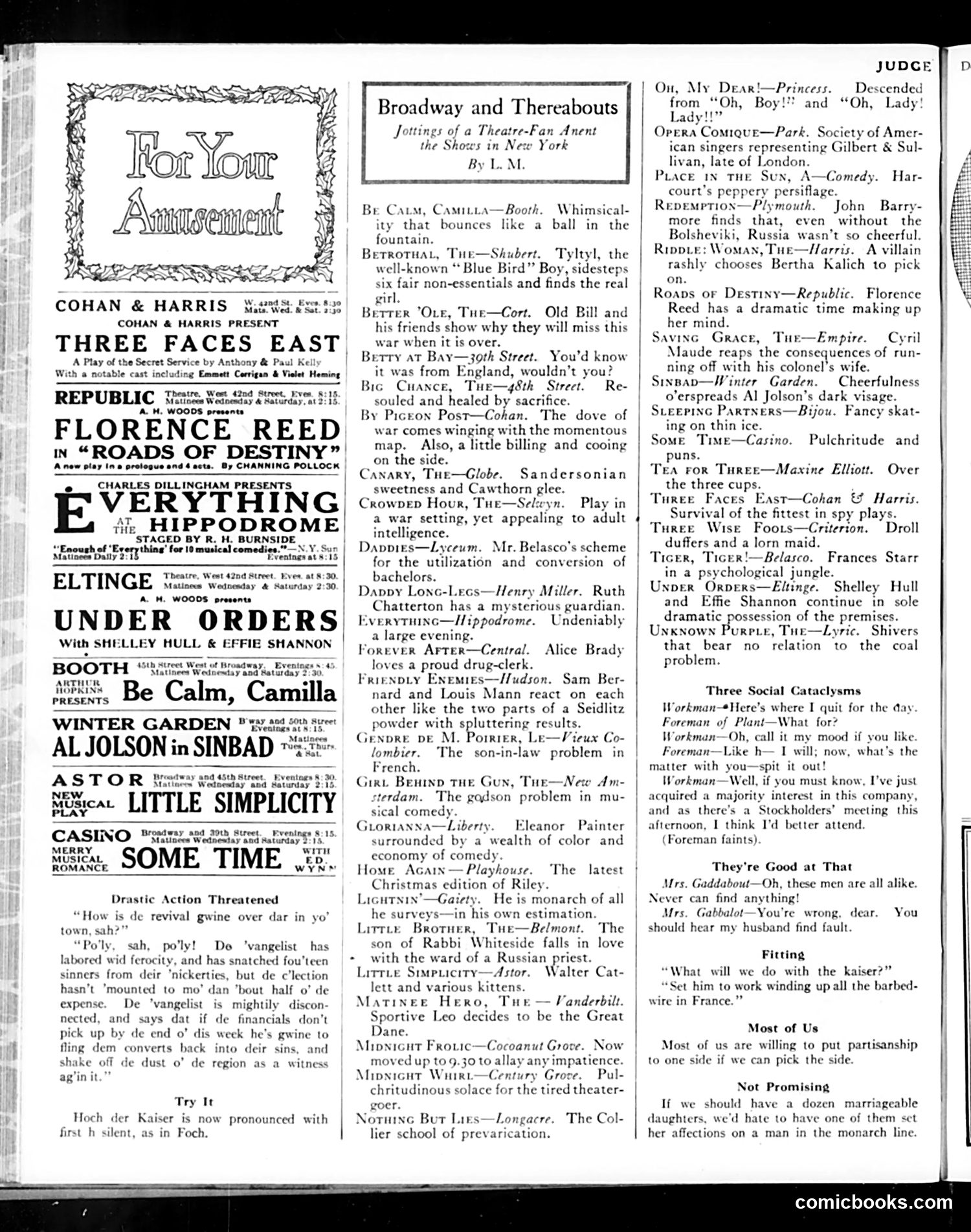
This page is primarily **theater advertising and reviews**, not political satire. The main content consists of Broadway show advertisements and capsule reviews by "L.M." of current New York productions. The only satirical content appears in the lower section: a **dialect humor piece** featuring two Black speakers discussing a failed revival meeting. The evangelist, frustrated that collections haven't covered expenses, threatens to "fling dem converts back into deir sins." This represents period racist stereotyping common in early 20th-century American humor—using exaggerated dialect and portraying Black characters as subjects of mockery. The theater reviews themselves offer no political commentary, merely brief quips about show content (war themes, romance plots, comedic performers like Al Jolson). The "Try It" section jokes about pronouncing "Kaiser" with silent H, a minor WWI-era pun. The page is dated by references to ongoing war concerns and reflects theatrical entertainment during the World War I period.
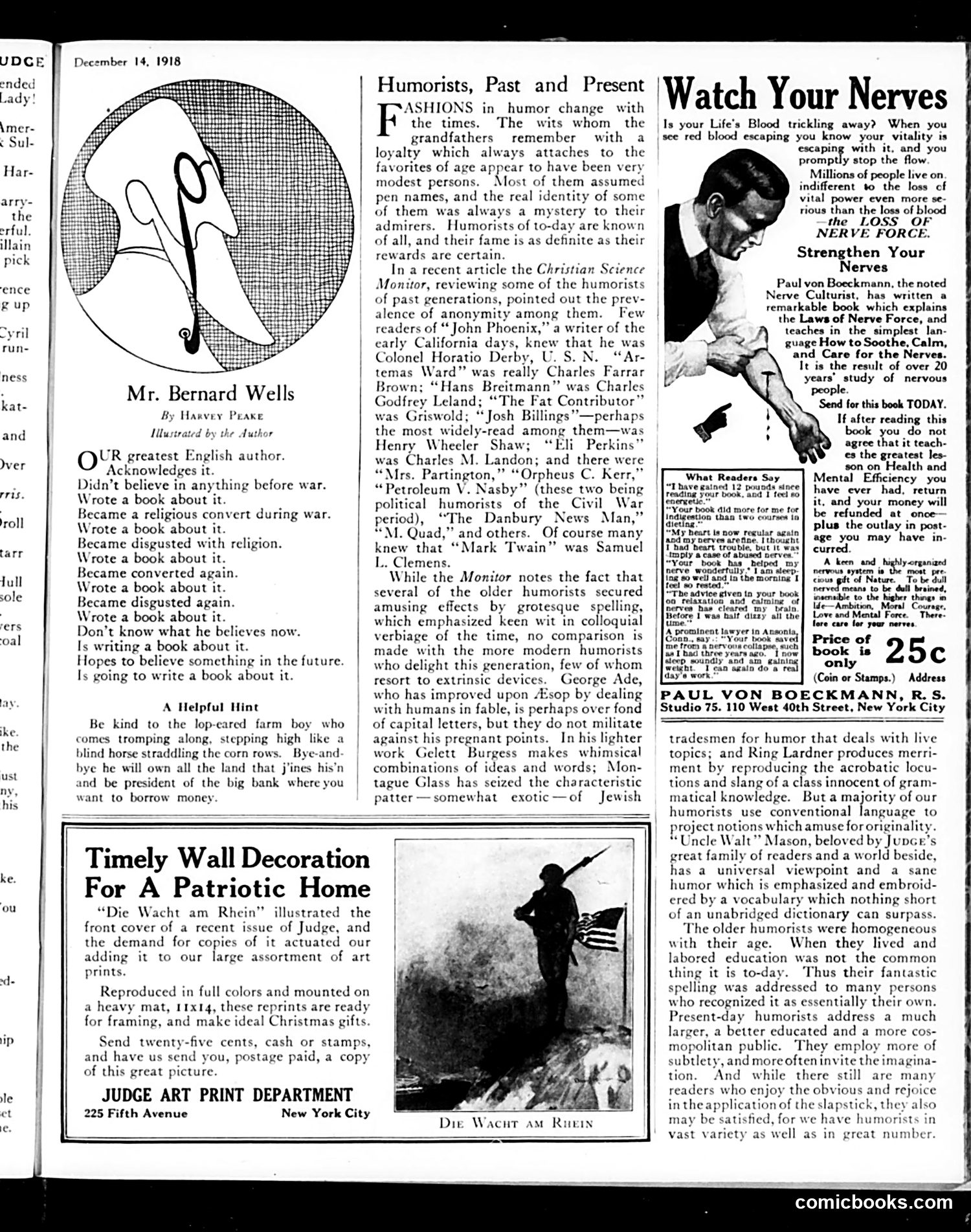
**The Bernard Wells Cartoon:** This is a satirical portrait of English author H.G. Wells, mocking his perceived intellectual inconsistency. The accompanying text traces Wells's repeated cycles of belief and disbelief—converting to religion during WWI, then abandoning it, then reconverting—with the joke that he writes a book about each transformation. The satire suggests Wells is a perpetually vacillating thinker who capitalizes on his changing convictions through publishing. **The Humorists Article:** This is primarily a nostalgic essay about 19th-century American humorists (Mark Twain, Josh Billings, Artemus Ward, etc.) who famously wrote under pseudonyms and used deliberately misspelled dialect for comic effect. The piece notes that modern humorists like George Ade rely less on these "extrinsic devices," preferring wit grounded in situation and character rather than gimmicks. The page also contains period medical advertising unrelated to the satire.
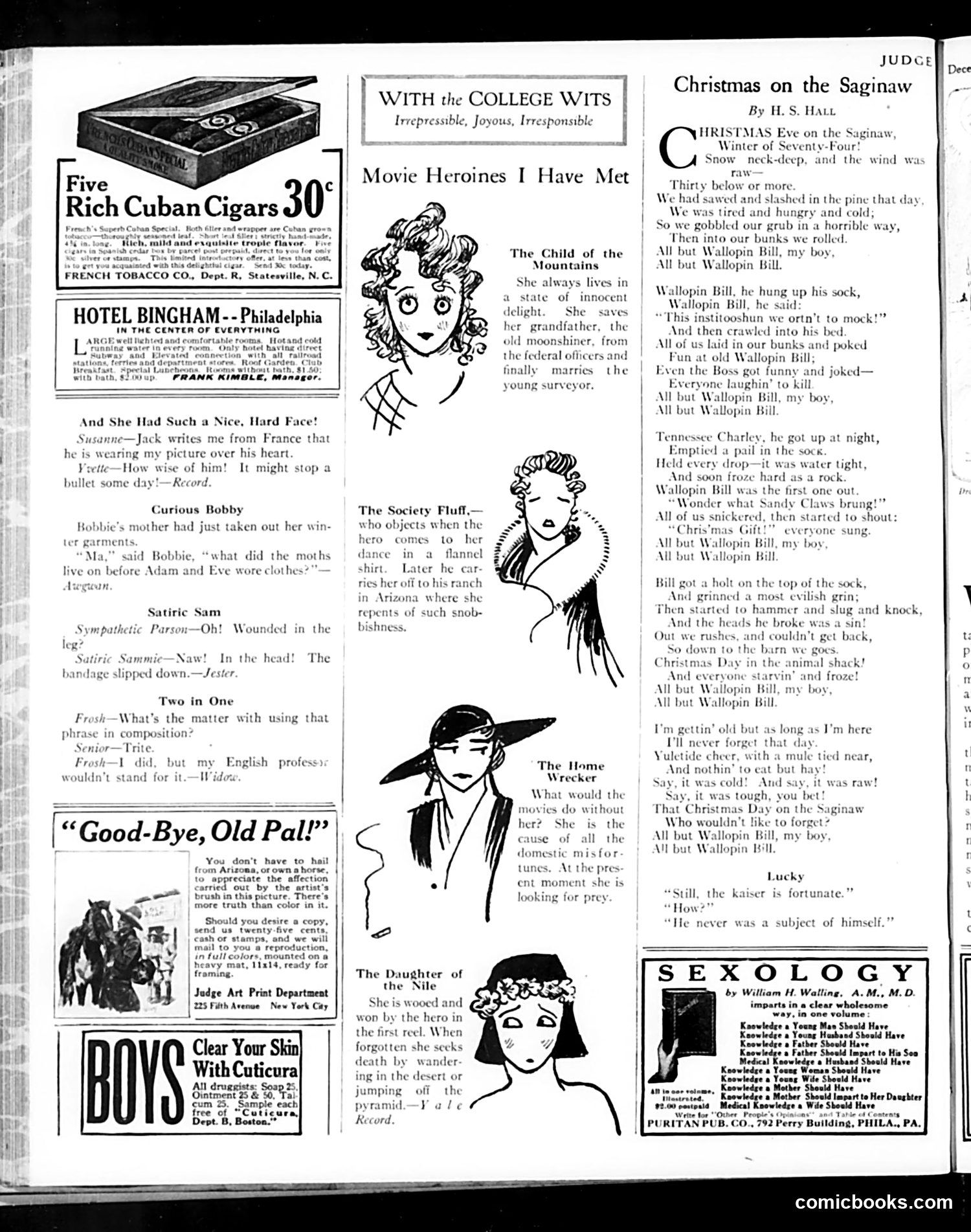
This page from *Judge* magazine contains college humor and advertisements typical of early 20th-century American satirical publishing. **"With the College Wits"** presents brief humorous anecdotes mocking college students and their romantic mishaps—standard fare for the era's college humor magazines. **"Movie Heroines I Have Met"** satirizes silent-film melodrama tropes through illustrated character sketches: innocent mountain girls, desert wanderers, and Egyptian heroines who follow predictable narrative patterns (innocence, abandonment, redemption). The satire targets formulaic Hollywood plots rather than specific films. **"Christmas on the Saginaw"** is a sentimental frontier poem about loggers celebrating Christmas in harsh conditions, with "Wallopin Bill" as the earnest outsider mocked by coworkers—a common narrative device. The advertisements (cigars, hotel, skin cream, sexology book) reflect period marketing practices targeting male readers. Overall, this represents typical Judge content: college-focused humor, silent-cinema satire, and nostalgic Americana, with no identifiable political commentary.
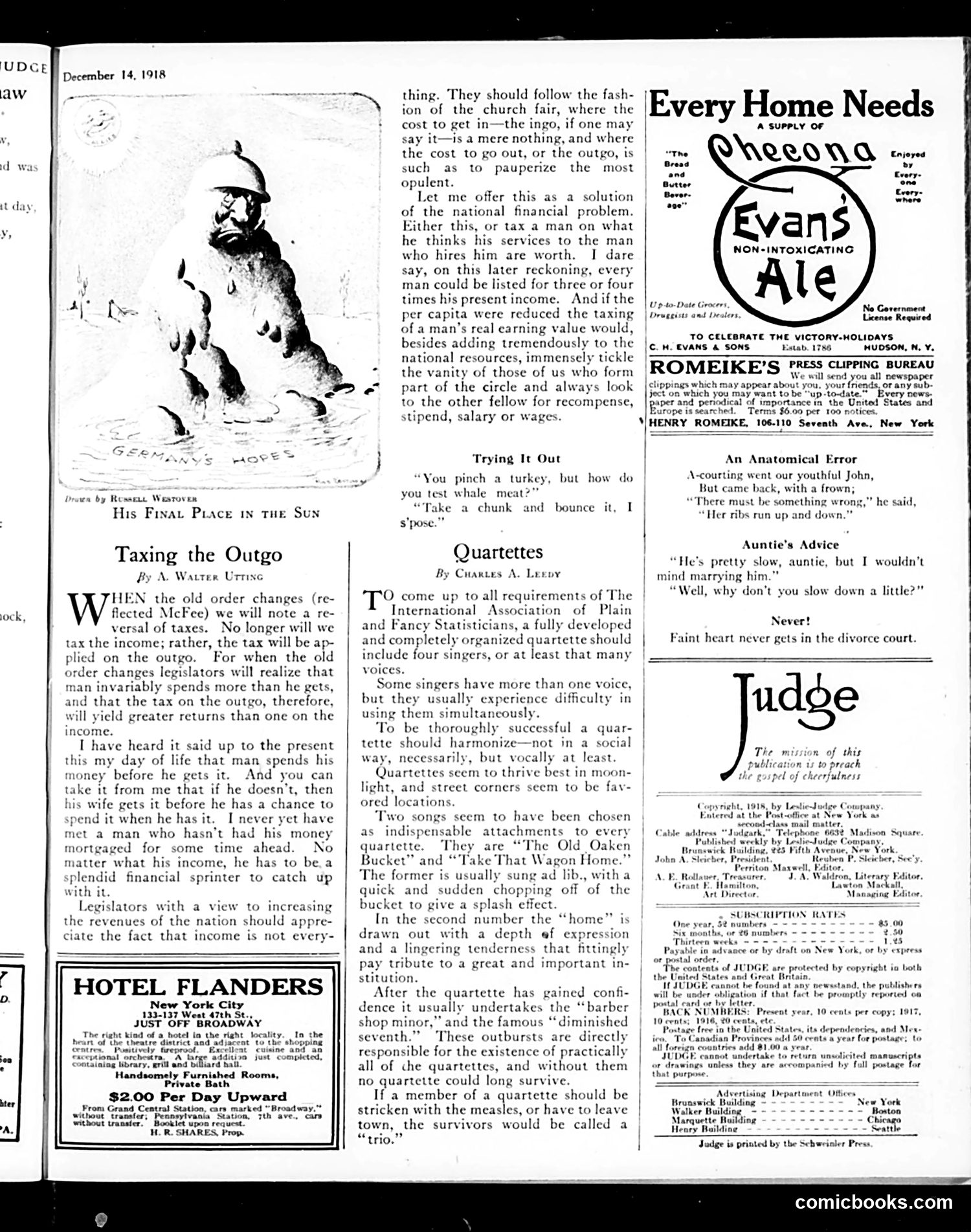
## Main Cartoon: "His Final Place in the Sun" The illustration by Russell Westover depicts **Germany** as a defeated, cowering figure—drawn as a large, hunched character labeled "Germany's Hopes"—positioned in the sun's shadow. This references Germany's recent military defeat in World War I (Armistice signed November 11, 1918). The "final place" satirizes Germany's diminished global status after losing the war. ## "Taxing the Outgo" Essay This satirical piece proposes taxing **spending (outgo) rather than income**—a humorous solution to post-war national finances. The author suggests people spend money before earning it, so taxing expenditures would generate more revenue. The church fair analogy mocks the gap between what people pay to attend versus what they spend once there. ## Supporting Content The page includes light humor pieces ("Trying It Out," "Quartettes," "Auntie's Advice") and advertisements for Evans non-intoxicating ale and Hotel Flanders—typical magazine filler. **Context**: This is post-WWI America, when war-related taxation and national debt were major concerns.
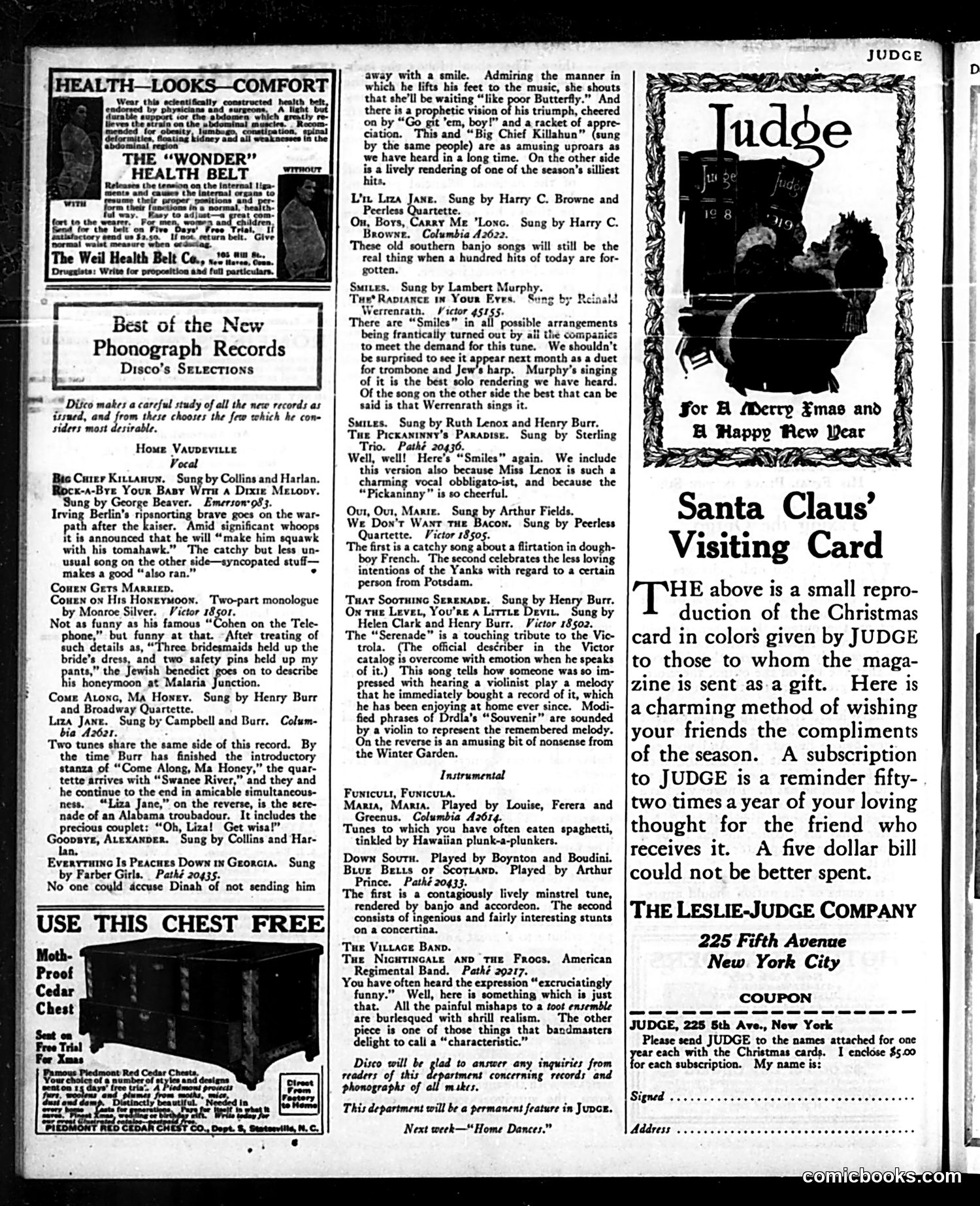
This page is primarily a **phonograph record review column** titled "Best of the New Phonograph Records," not a political cartoon. The reviewer (credited as "Disco") evaluates recently released 78 RPM records, mostly vocal performances from popular singers of the era. **Context for modern readers:** The reviews focus heavily on **World War I-era songs**—Irving Berlin's "Big Chief Killahun" celebrates military aggression against "the kaiser," while "We Don't Want the Bacon" mocks German leadership ("a certain person from Potsdam"). Songs like "Come Along, Ma Honey" and "Liza Jane" represent popular sentimental or novelty numbers of the period. The column reflects early 20th-century entertainment tastes: ragtime, syncopation, sentimental ballads, and comedic monologues. The right side contains a **Christmas gift promotion** for Judge magazine subscriptions—a reminder this is a seasonal issue. The satirical magazine's humor here is gentle—poking fun at record quality and repetitive trends rather than sharp political commentary.
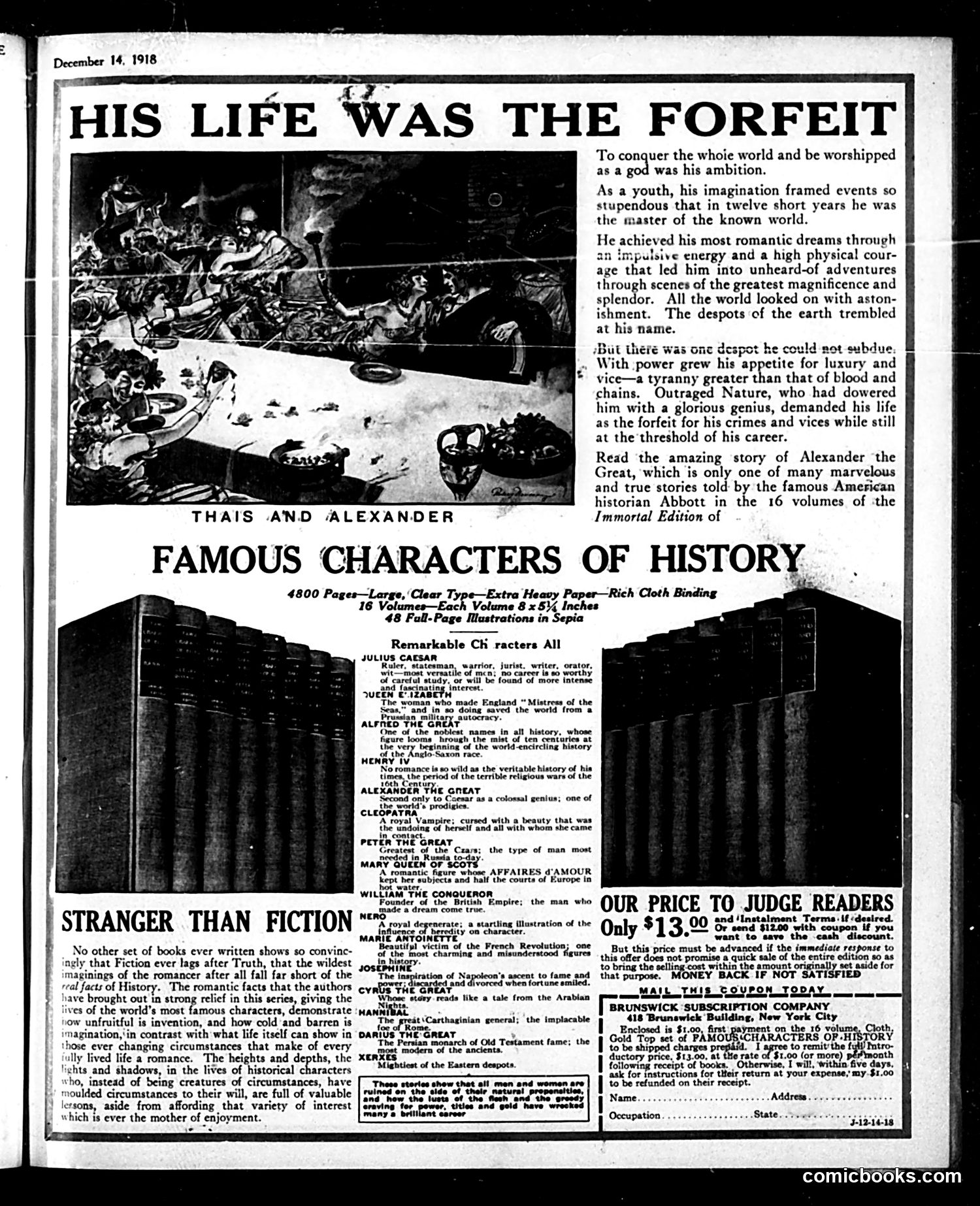
This page is primarily **advertising**, not satire or political cartoon. It promotes a 16-volume book series called "Famous Characters of History" by American historian Abbott. The top illustration depicts **Alexander the Great** with his court, accompanying an article titled "His Life Was the Forfeit." The text argues that Alexander's ambition to conquer the world and be worshipped as a god ultimately destroyed him—his power bred vice and luxury that "Outraged Nature" demanded as forfeit for his crimes and vices. The advertisement uses this morality tale to market the book series, emphasizing that historical truth surpasses fiction. It lists remarkable historical figures (Julius Caesar, Queen Elizabeth, Alfred the Great, Cleopatra, Napoleon, etc.) to entice readers. **Context for modern readers**: This reflects early 20th-century didactic publishing—using historical biography as moral instruction. The Alexander story may subtly resonate with WWI audiences (the magazine's date is shortly after war's end), though the advertisement itself makes no explicit contemporary political commentary.
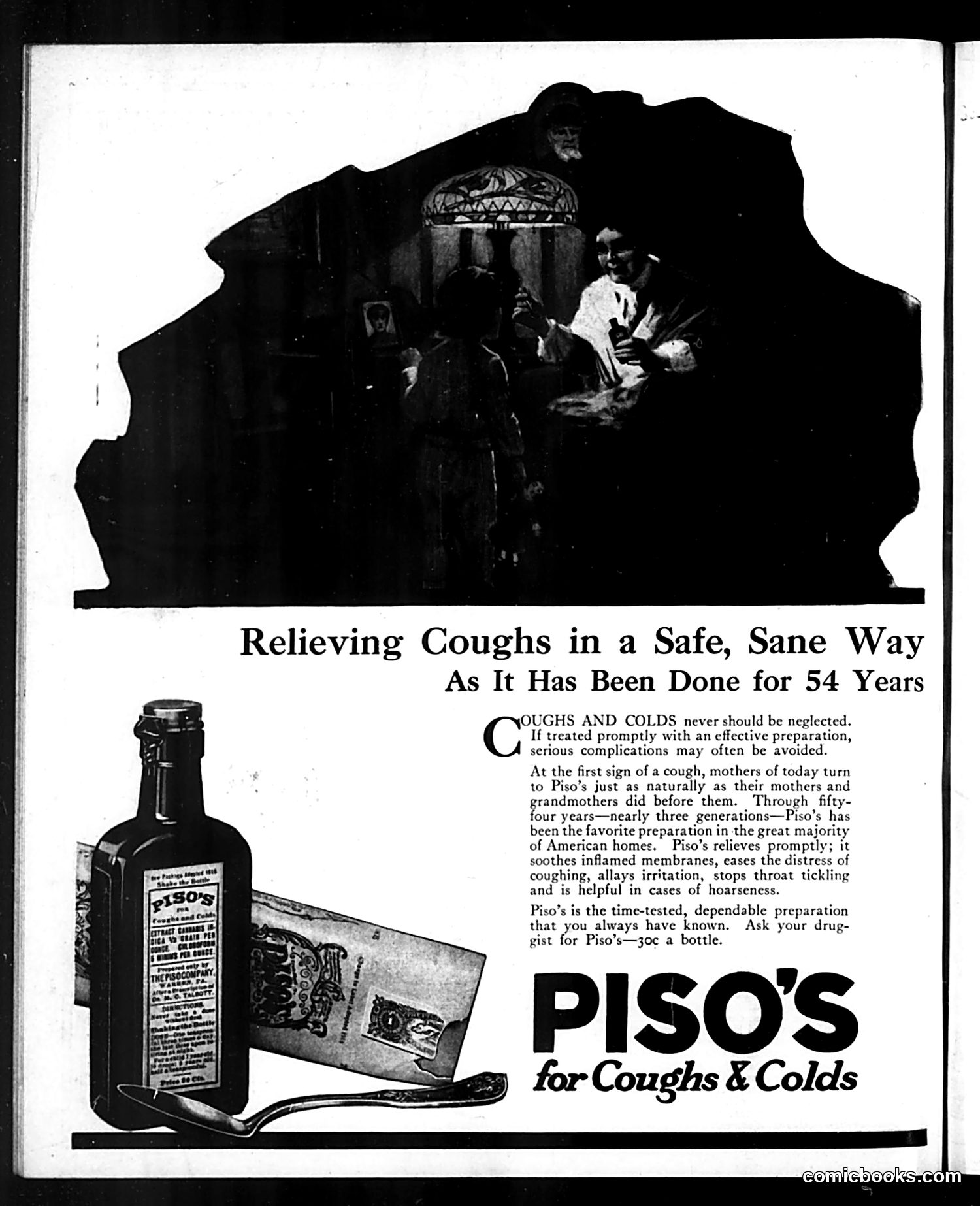
This is a **Piso's cough medicine advertisement**, not satire or political content. The page promotes Piso's, a commercial patent medicine for treating coughs and colds. The ad emphasizes tradition and family trust—claiming 54 years of use across three generations of American mothers. The dramatic illustration at top shows an interior scene (possibly a sick room or home), though details are unclear in the silhouette. The text stresses safety ("safe, sane way") and effectiveness, positioning Piso's as a reliable, time-tested remedy available at drugstores for 30 cents. This reflects early 20th-century advertising strategies that appealed to maternal responsibility and generational continuity. **There is no political satire here**—this is straightforward product advertising, likely from Judge magazine's commercial section. Such ads were common in period publications and normalized patent medicines that later faced FDA regulation.