
Judge, 1918-12-14 · page 22 of 32
Judge — December 14, 1918 — page 22: what you’re looking at
What you’re looking at
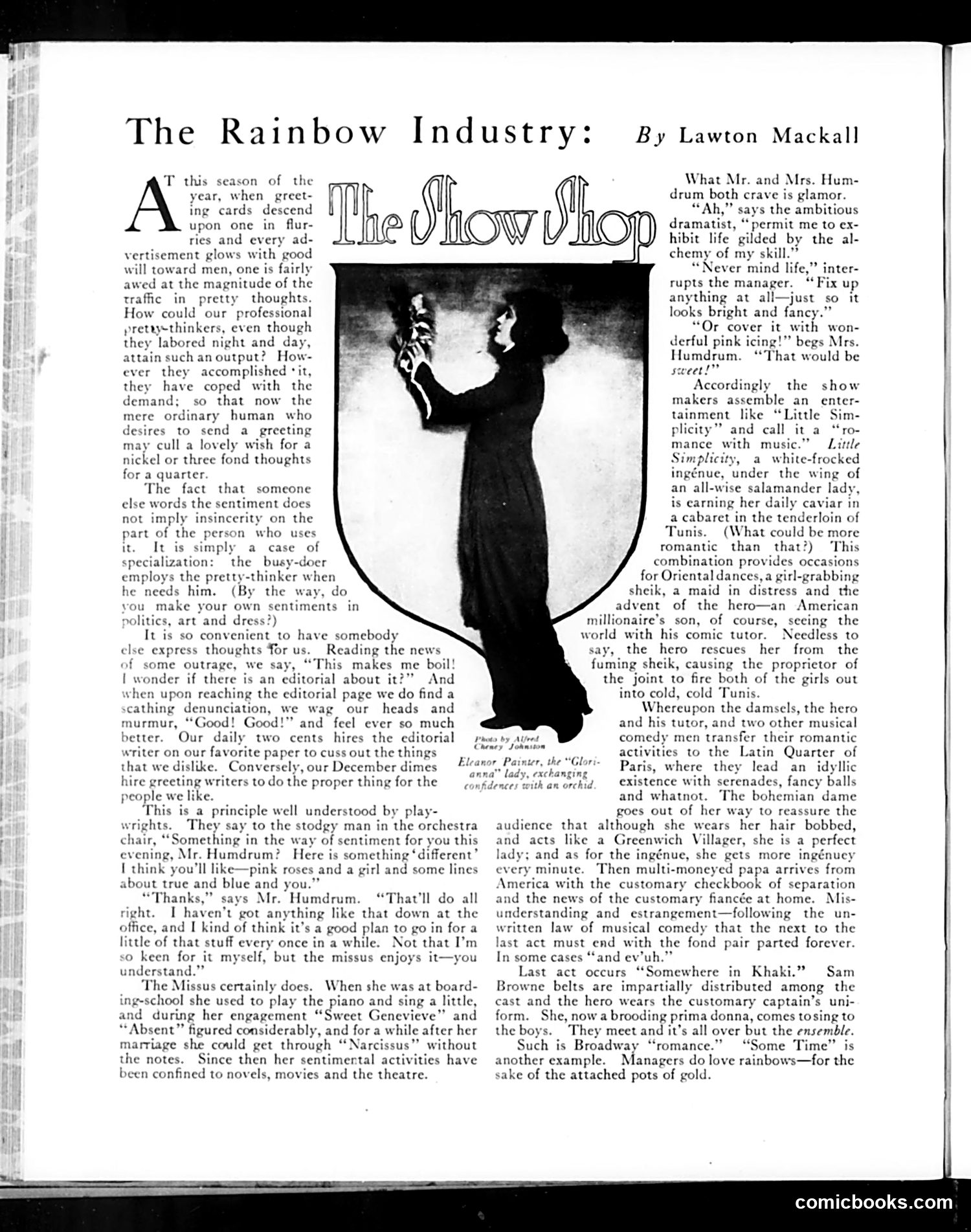
This article by Lawton Mackall satirizes early 20th-century commercial sentimentality and theatrical escapism. The accompanying image shows Eleanor Painter, a "Gloriana" lady, exchanging confidences with an orchid—visualizing the article's theme. Mackall critiques how ordinary people ("Mr. and Mrs. Humdrum") outsource sentiment by purchasing greeting cards rather than writing genuine messages. He extends this mockery to Broadway musical theatre, which he argues provides manufactured "glamor" divorced from reality. The shows feature exotic, implausible plots (white-frocked ingénues in Tunisian cabarets, American millionaires rescuing girls) designed purely for escapist entertainment. The satire's point: modern audiences passively consume pre-packaged emotions and fantasies rather than engaging authentically with life or art. Both greeting cards and Broadway represent the "Rainbow Industry"—a lucrative business selling prettified unreality to the masses.
📄 Transcribed text from this page (OCR, searchable)
Machine-transcribed from the original scan — historical spelling and the odd misread are preserved.
The Rainbow Industry: T this season of the year, when greet- ing cards descend upon one in flur- ries and every ad- vertisement glows with good will toward men, one is fairly awed at the magnitude of the traffic in pretty thoughts. How could our professional preteysthinkers, even though they labored night and day, attain such an output? How- ever they accomplished ‘it, they have coped with the demand; so that now the mere ordinary human who desires to send a greeting may cull a lovely wish for a nickel or three fond thoughts for a quarter The fact that someone else words the sentiment does not imply insincerity on the part of the person who uses it. It is simply a case of specialization: the busy-doer employs the pretty-thinker when he needs him. (By the way, do you make your own sentiments in politics, art and dress?) It is so convenient to have somebody else express thoughts for us. Reading the news of some outrage, we say, “This makes me boil! | wonder if there is an editorial about it?” And upon reaching the editorial page we do find a scathing denunciation, we wag our heads and murmur, “Good! Good!” and feel ever so much better. Our daily two cents hires the editorial writer on our favorite paper to cuss out the things that we dislike. Conversely, our December dimes re greeting writers to do the proper thing for the people we like. This is a principle well understood by play- ights. They say to the stodgy man in the orchestra chair, “Something in the way of sentiment for you this evening, Mr. Humdrum? Here is something ‘different’ I think you'll like—pink roses and a girl and some lines about true and blue and you.” Thanks,” says Mr. Humdrum. “That'll do all ht. I haven't got anything like that down at the office, and I kind of think it’s a good plan to go in for a little of that stuff every once in a while. Not that I’m so keen for it myself, but the missus enjoys it—you understand.” The Missus certainly does. When she was at board- ing-school she used to play the piano and sing a little, nd during her engagement “Sweet Geneviev and Absent” figured considerably, and for a while after her marriage she could get through “Narcissus” without the notes. Since then her sentimental activities have been confined to novels, movies and the theatre. dence: By Lawton Mackall What Mr. and Mrs. Hum- drum both crave is glamor. “Ah,” says the ambitious dramatist, “permit me to ex- hibit life gilded by the al- chemy of my skill. “Never mind life,” inter- rupts the manager. “Fix up anything at all—just so it looks bright and fancy.” “Or cover it with won- derful pink icing!” begs Mrs. Humdrum. ‘That would be sweet!” Accordingly the show makers assemble an_ enter i like “Little Sim- * and call it a “ro- mance with music.” Little Simplicity, a white-frocked ingénue, under the wing of an all-wise salamander lady, is carning her daily caviar in a cabaret in the tenderloin of Tunis. (What could be more romantic than that?) This combination provides occasions for Oriental dances, a girl-grabbing sheik, a maid in distress and the advent of the hero—an American millionaire’s son, of course, seeing the world with his comic tutor. Needless to say, the hero rescues her from the fuming sheik, causing the proprietor of the joint to fire both of the girls out into cold, cold Tunis. Whereupon the damsels, the hero and his tutor, and two other musical comedy men transfer their romantic activities to the Latin Quarter of Paris, where they lead an_ idyllic existence with serenades, fancy balls and whatnot. The bohemian dame goes out of her way to reassure the audience that although she wears her hair bobbed, and acts like a Greenwich Villager, she is a perfect lady; and as for the ingénue, she gets more ingénucy every minute. Then multi-moneyed papa arrives from America with the customary checkbook of separation nd the news of the customary fiancée at home. Mis- nderstanding and estrangement—following the un- written law of musical comedy that the next to the last act must end with the fond pair parted forever. In some cases “and ev’uh.” Last act occurs “Somewhere in Khaki.” Sam Browne belts are impartially distributed among the cast and the hero wears the customary captain’s uni- form. She, now a brooding prima donna, comes tosing to the boys. They meet and it’s all over but the ensemble. Such is Broadway “romance.” “Some Time” is another example. Managers do love rainbows—for the sake of the attached pots of gold. Sho " lady, exckangin comicbooks.com