
A complete issue · 32 pages · 1918
Judge — October 26, 1918
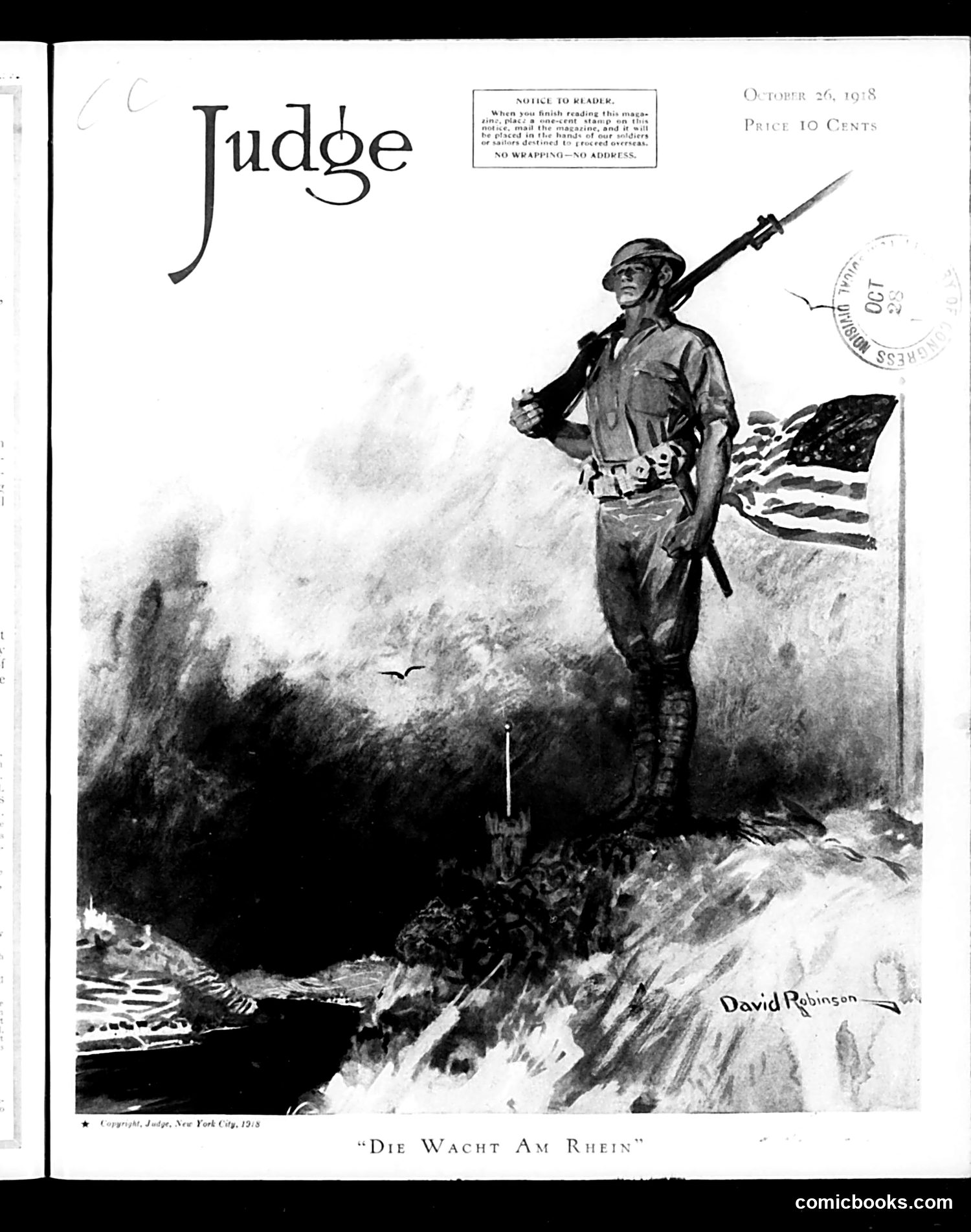
This Judge magazine cover from October 26, 1918 depicts an American soldier standing vigilantly at what appears to be a fortified position, with the American flag prominently displayed behind him. The title "Die Wacht Am Rhein" (German: "The Watch on the Rhine") is a famous German patriotic song. The satire works by appropriating this German nationalist anthem for American purposes—suggesting American soldiers now guard the Rhine River and German borders, implying Allied military victory in World War I (which ended weeks later in November 1918). The soldier's resolute stance symbolizes American military strength and the defeat of German militarism. This is triumphalist propaganda artwork celebrating the anticipated Allied victory in the final weeks of WWI.
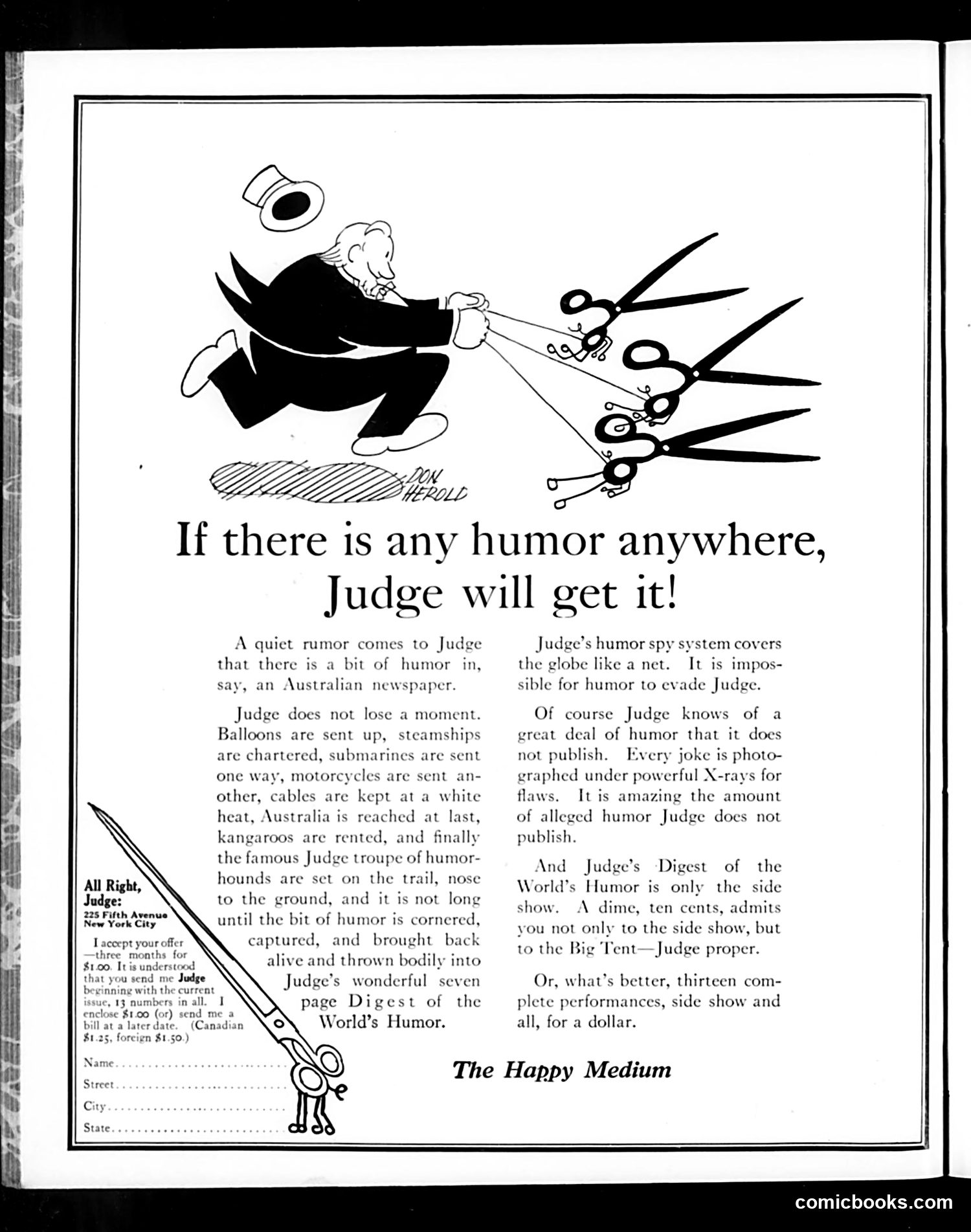
This page promotes Judge magazine's humor content. The main cartoon shows a man in formal attire being chased by multiple pairs of scissors—a visual metaphor suggesting that Judge magazine hunts down and "cuts out" humor from around the world to publish. The accompanying text humorously claims Judge has an extensive "humor spy system" that covers the globe, making it impossible for any joke to escape their notice. It references Judge's ability to locate humor anywhere, from Australia to submarines, comparing their humor-gathering efforts to an elaborate international operation. The page functions primarily as **self-promotional advertising** for Judge's humor digest and side publications, highlighting the magazine's comprehensive coverage of global comedy and satire. The subscription offer appears in the lower left corner.
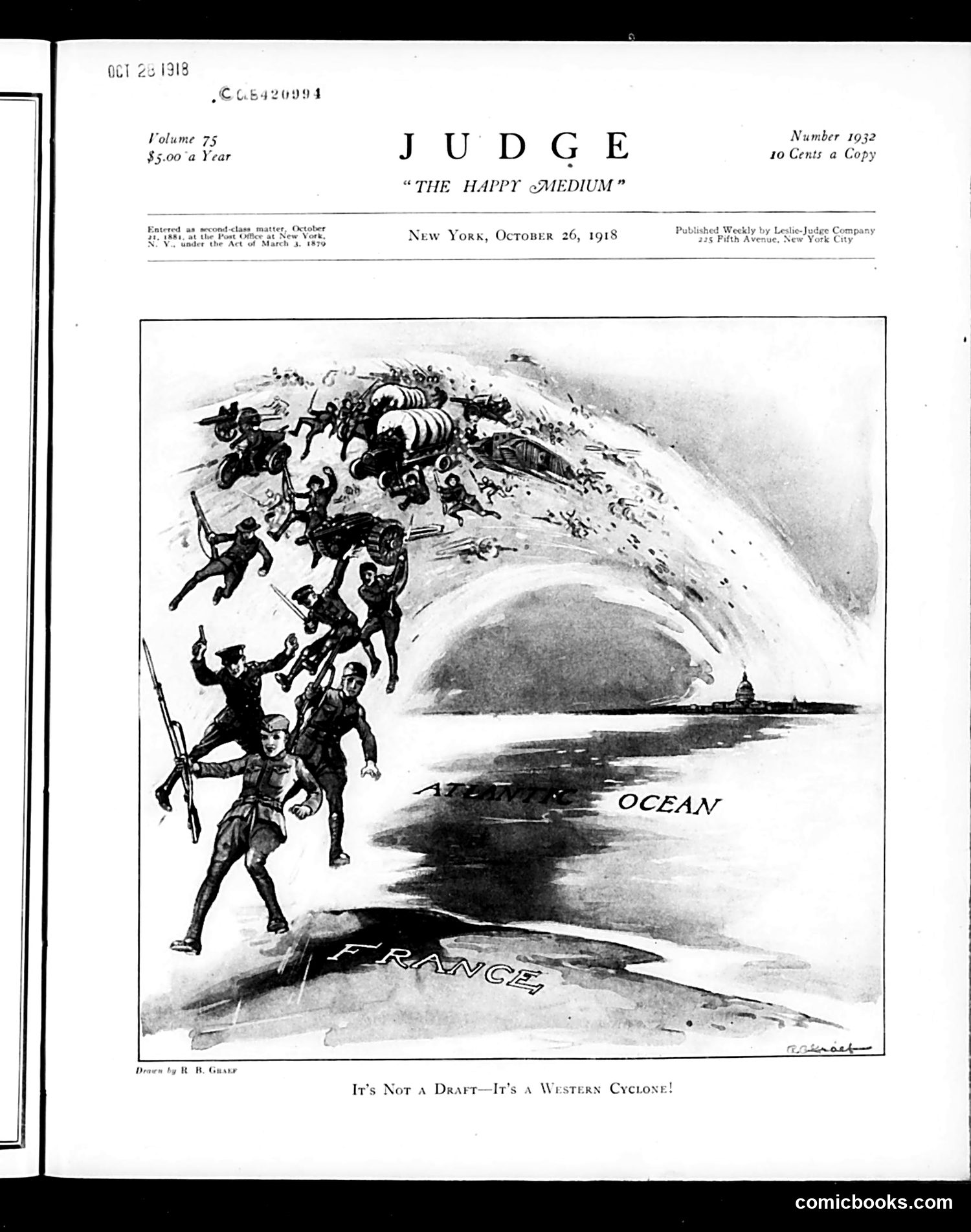
**Publication Details:** Judge, Volume 75, October 26, 1918. Subtitle: "The Happy Medium" **The Cartoon:** Titled "It's Not a Draft—It's a Western Cyclone!" and drawn by R. B. Gsass, this depicts soldiers and military equipment being violently swept upward in a massive spiral or cyclone. France and the Ocean are labeled in the background. **Historical Context:** Published during the final weeks of World War I (which ended November 11, 1918), this appears to satirize the rapid, chaotic mobilization of American forces being sent to France. The "Western cyclone" likely references America's forceful military intervention, presenting it as an irresistible natural force rather than an orderly "draft." The swirling chaos humorously captures the intensity of wartime troop movements.
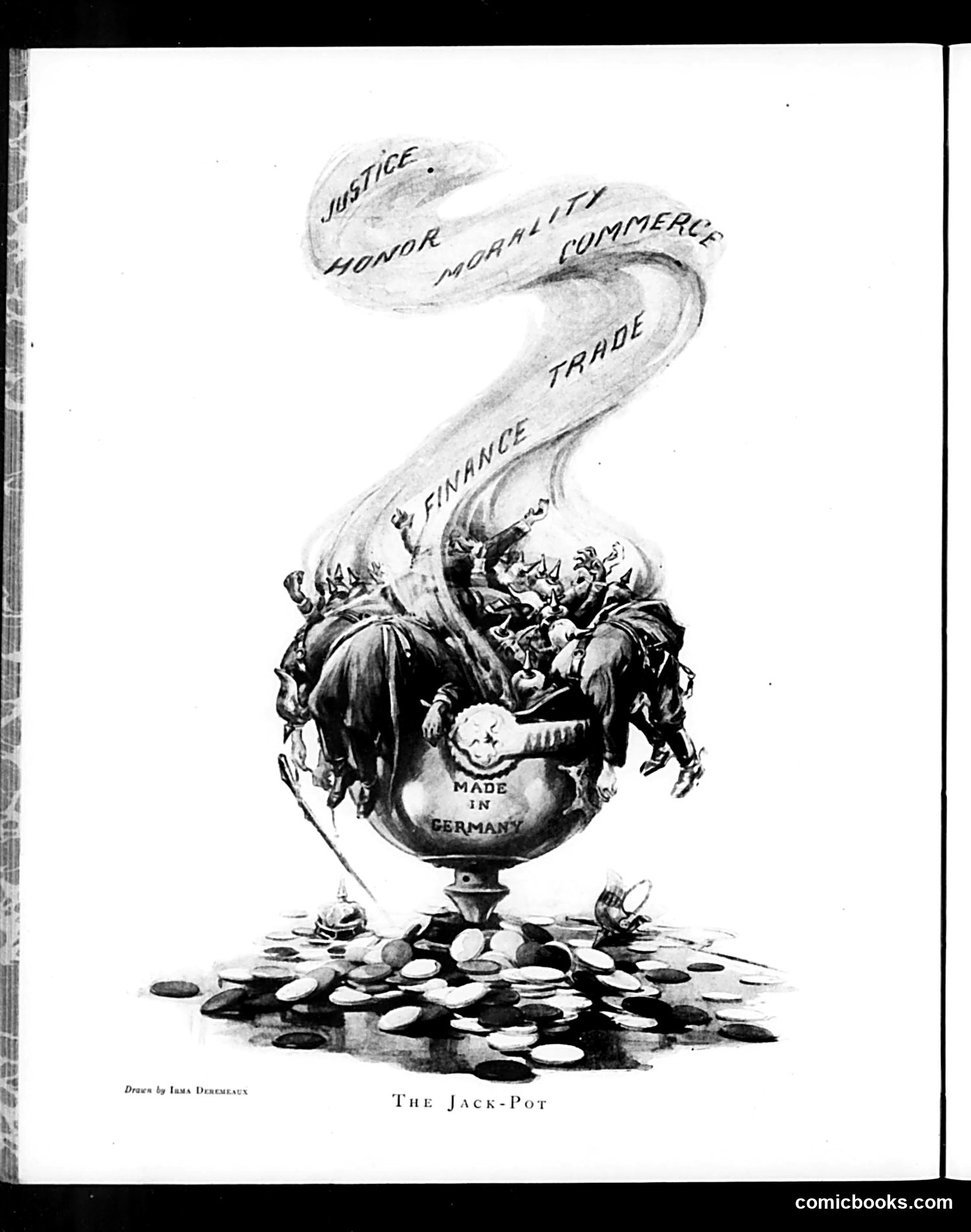
This satirical cartoon, drawn by John Dunceux, depicts a cauldron labeled "Made in Germany" overflowing with demonic figures. A serpentine ribbon rising from it reads: "Justice, Honor, Morality, Commerce, Trade, Finance." The satire critiques Germany's conduct in international affairs, suggesting that German actions in commerce, finance, and trade—marketed under claims of justice and honor—are actually corrupt and destructive. The "jack-pot" metaphor implies these practices accumulate like gambling winnings into a dangerous, explosive mixture. The scattered coins below suggest wealth gained through questionable means. This cartoon likely reflects American concerns about German economic or military expansion, appearing before or during periods of U.S.-German tension.
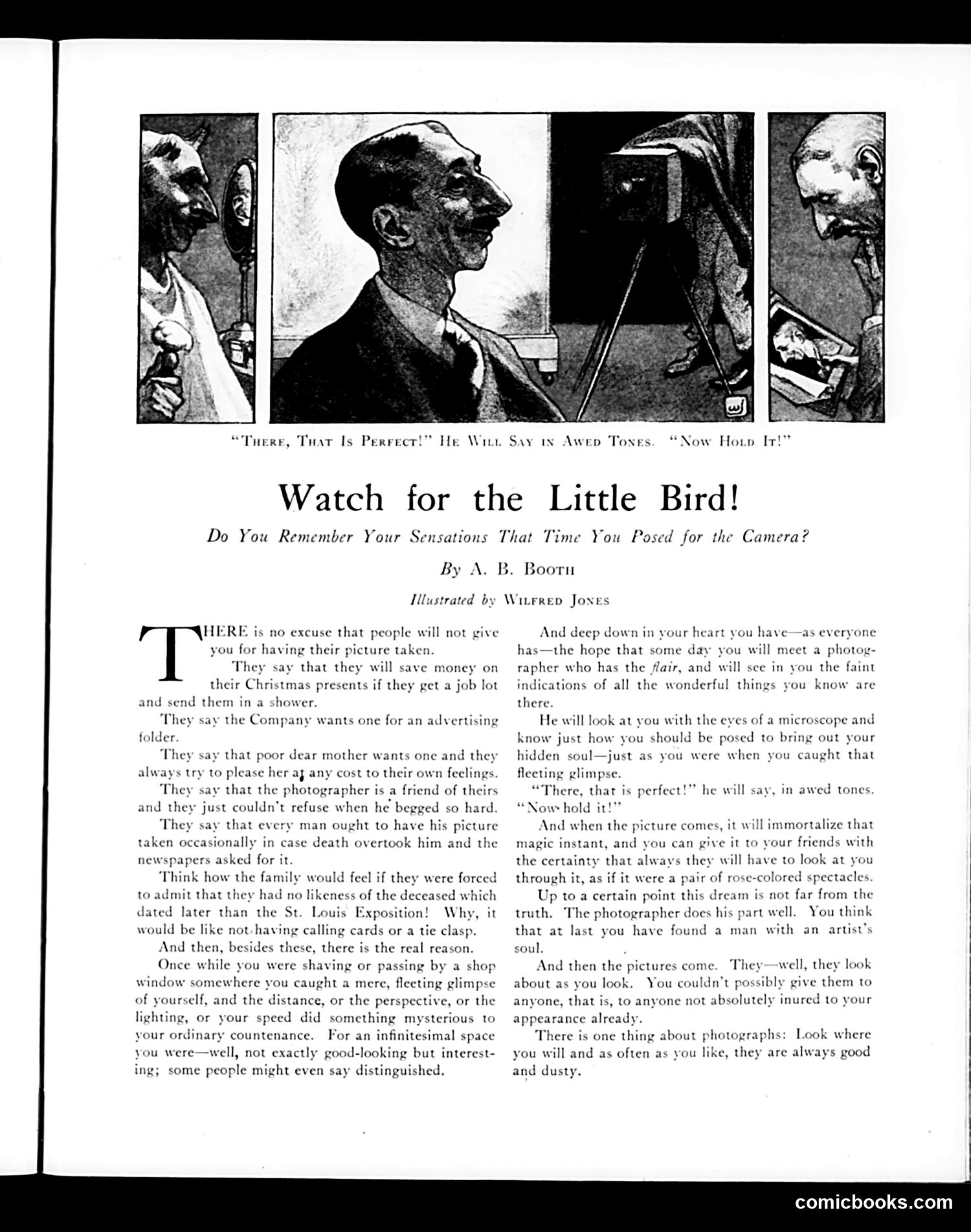
This is not a political cartoon but a humorous essay by A. B. Booth about photography, illustrated by Wilfred Jones. The "little bird" references the photographer's traditional instruction to say "cheese" or watch for a signal (bird) during portrait sessions. The essay satirizes the romanticized expectations people have about professional photography—hoping the photographer will magically capture their "hidden soul" and best self. Booth humorously deflates this dream, noting that photographs actually reveal people as they are: the poses feel awkward, and the results often disappoint. The illustrations show a photographer directing subjects through various poses and expressions, capturing the theatrical, often uncomfortable nature of early 20th-century portrait photography. The satire gently mocks both photographers' grandiose claims and subjects' naive hopes.
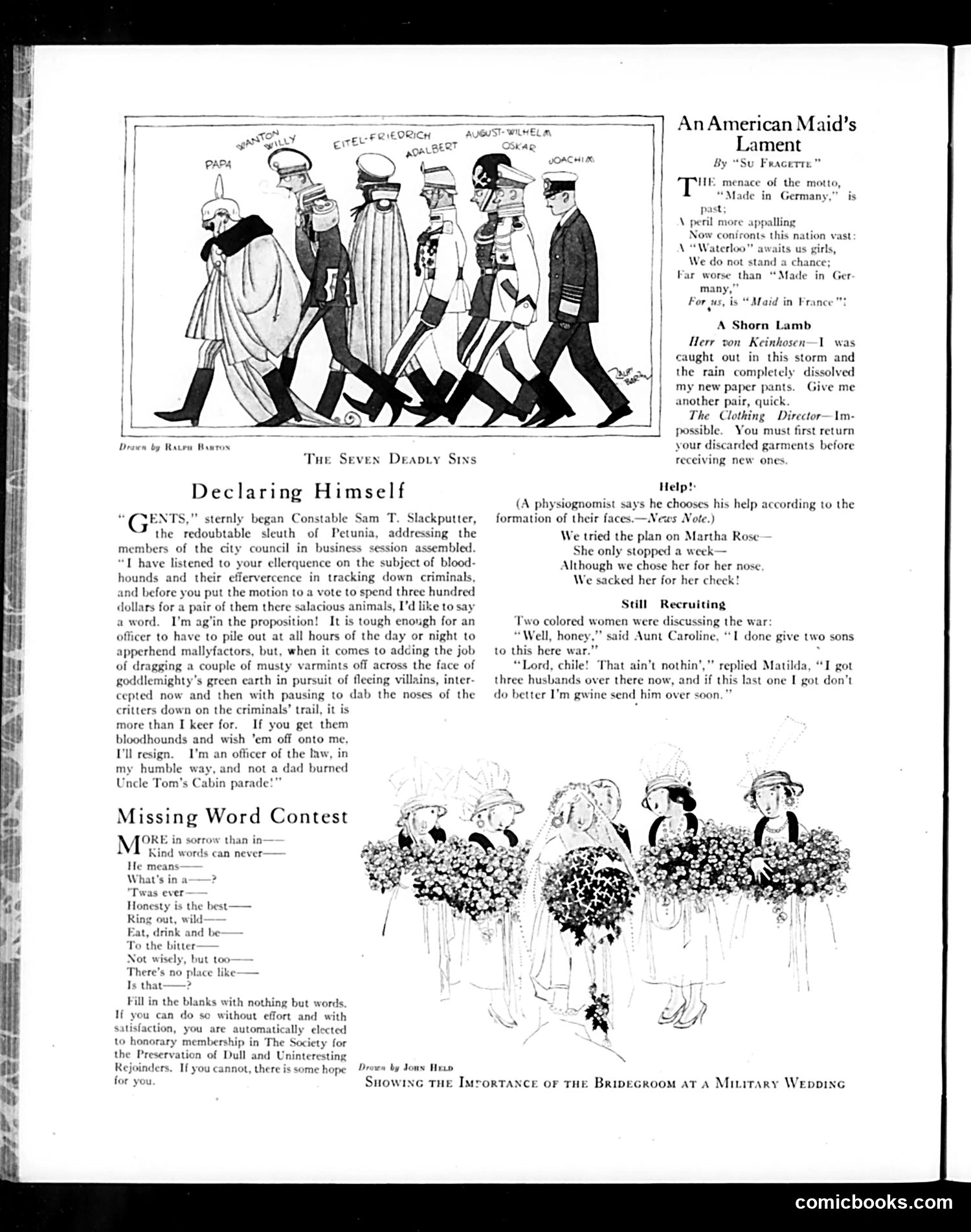
**"The Seven Deadly Sins: Declaring Himself"** depicts German military figures, satirizing German militarism during what appears to be the WWI era. The cartoon labels various German officers and officials, presenting them as embodying destructive militaristic values. **"An American Maid's Lament"** expresses anti-German sentiment, mourning American women's concerns about foreign competition—likely referencing wartime anxiety about German products and culture dominating American markets. The other humorous items ("A Shorn Lamb," "Help!," "Still Recruiting," "Missing Word Contest") are typical magazine filler content unrelated to the political cartoons. The page reflects Judge magazine's pro-Allied, anti-German editorial stance during the WWI period, using satire to reinforce American patriotic sentiment and anxieties about foreign influence.
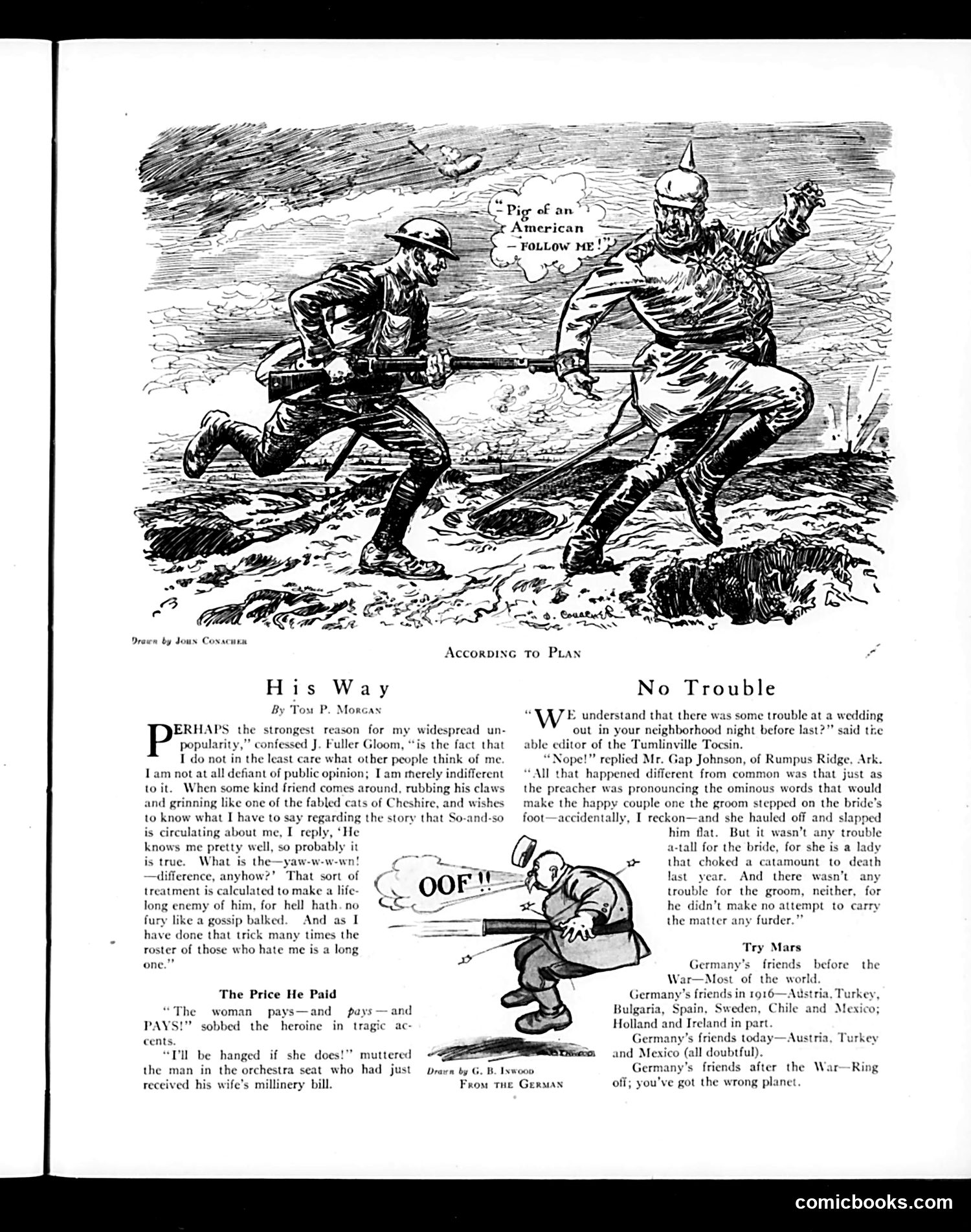
This page contains three satirical pieces from World War I-era Judge magazine: **Top cartoon "According to Plan"**: An American soldier bayonets a German soldier. The German says "Pig of an American—follow me!" The satire mocks German military tactics or propaganda about combat. **"His Way" and "The Price He Paid"**: Humorous fiction pieces unrelated to politics—one about an indifferent man's unpopularity, another about a husband's shock at his wife's hat bill. **"No Trouble"**: A rural anecdote about a bride who physically overpowers the groom—gentle humor about frontier toughness. **"Try Mars"**: The sharpest political content. This satirizes Germany's diplomatic isolation during WWI, contrasting Germany's pre-war alliances (most nations) with 1916 allies (Austria, Turkey, Bulgaria, Spain, Sweden, Chile, Mexico) and post-war prospects (Austria, Turkey, Mexico only—"all doubtful"). The punchline suggests Germany should relocate to Mars given its friendlessness.
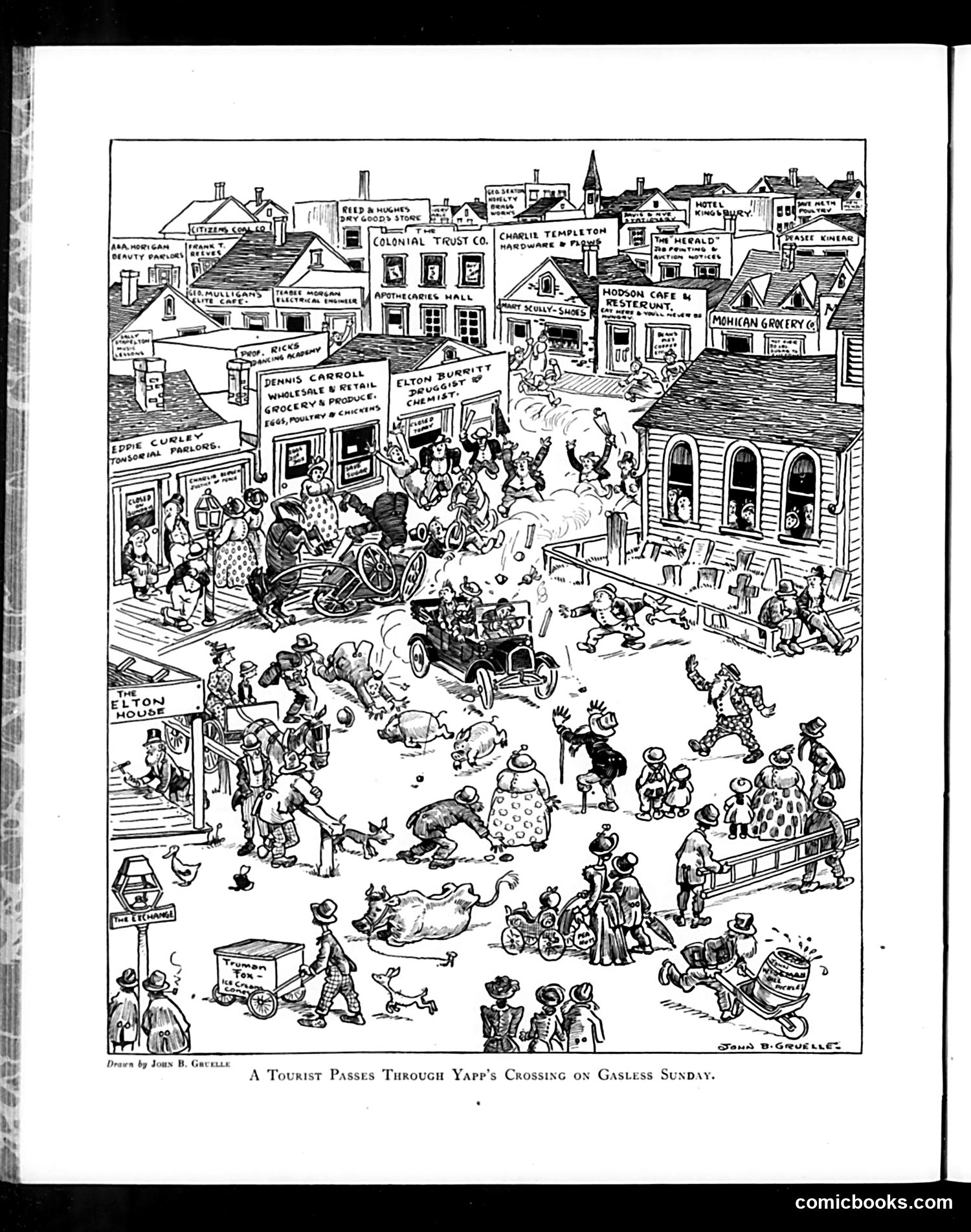
This satirical illustration by John B. Guevelle depicts chaos in a small town street during an enforced "gasless Sunday"—a wartime rationing measure limiting automobile fuel use. The cartoon mocks the disruption caused by removing cars from a typically automobile-dependent American community. The title's irony is apparent: without gasoline, the crossing becomes anarchic rather than orderly. A diverse crowd of townspeople, children, animals, and makeshift vehicles (hand-carts, bicycles) flood the street where cars normally dominated. The labeled storefronts (Colonial Trust Co., Dennis Carroll groceries, etc.) establish this as a recognizable American town. The satire critiques how dependent modern commerce and social life had become on automobiles by the early twentieth century. The "tourist" observing this bedlam would find the town utterly transformed and dysfunctional without motorized transport—the cartoon's pointed commentary on American car culture's grip on civic life.
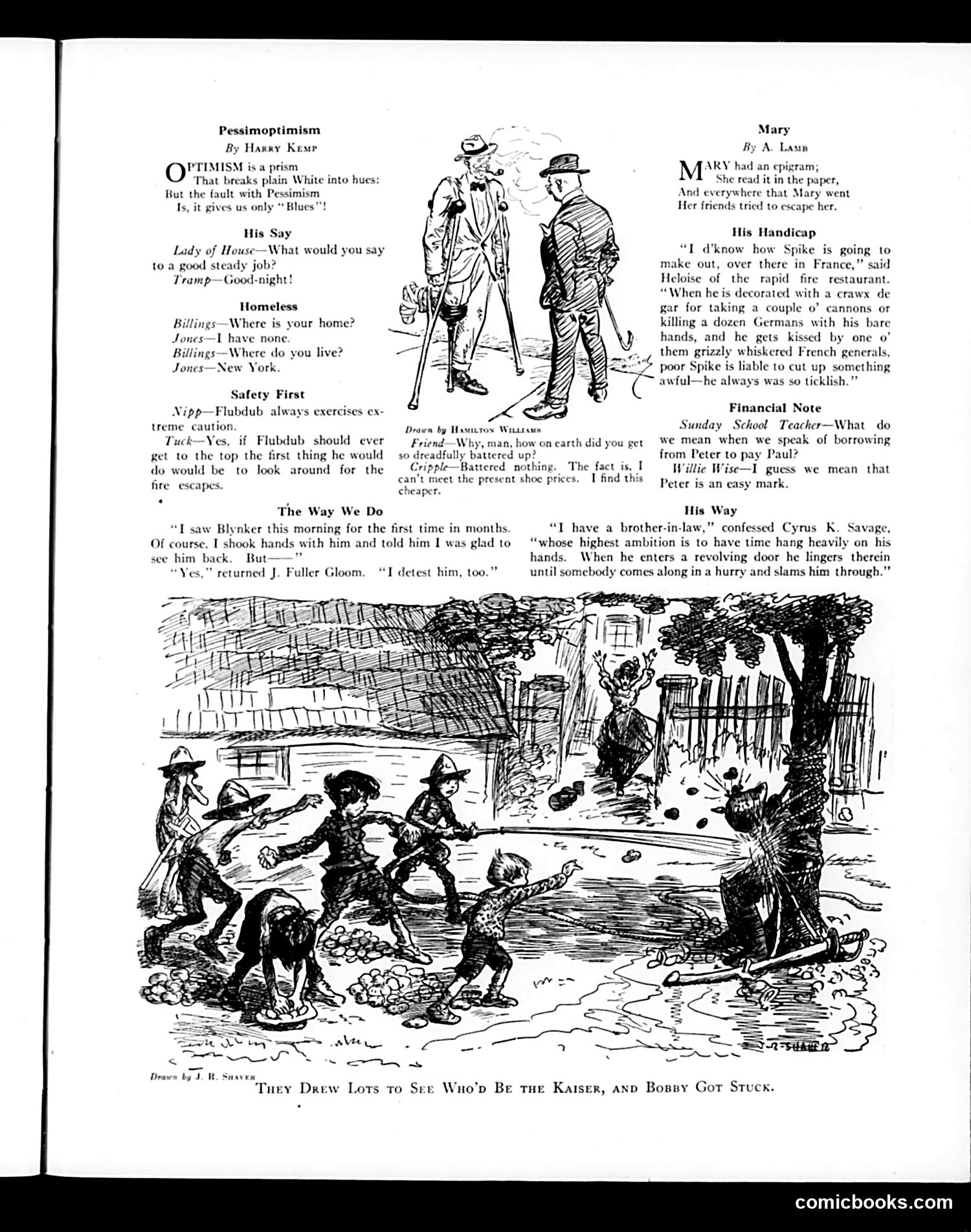
This page from *Judge* magazine contains several short humorous pieces and jokes typical of early 20th-century American satire. The bottom illustration, "They Drew Lots to See Who'd Be the Kaiser, and Bobby Got Stuck," references World War I. Children are drawing lots (deciding by chance) to assign roles in a game, with one child apparently assigned the role of the Kaiser (German Emperor Wilhelm II, the enemy). The joke mocks the Kaiser as an undesirable role no one wants. The other pieces are brief comic vignettes: "Mary" mocks someone who repeats witty remarks; "Pessimoptimism" plays on the words "optimism" and "blues"; various short dialogues joke about homelessness, ticklishness, shoe prices, and social awkwardness. These are lightweight humor pieces exploiting puns, wordplay, and observations about contemporary manners and wartime anxieties—typical of satirical magazines of this era aimed at middle-class readers.
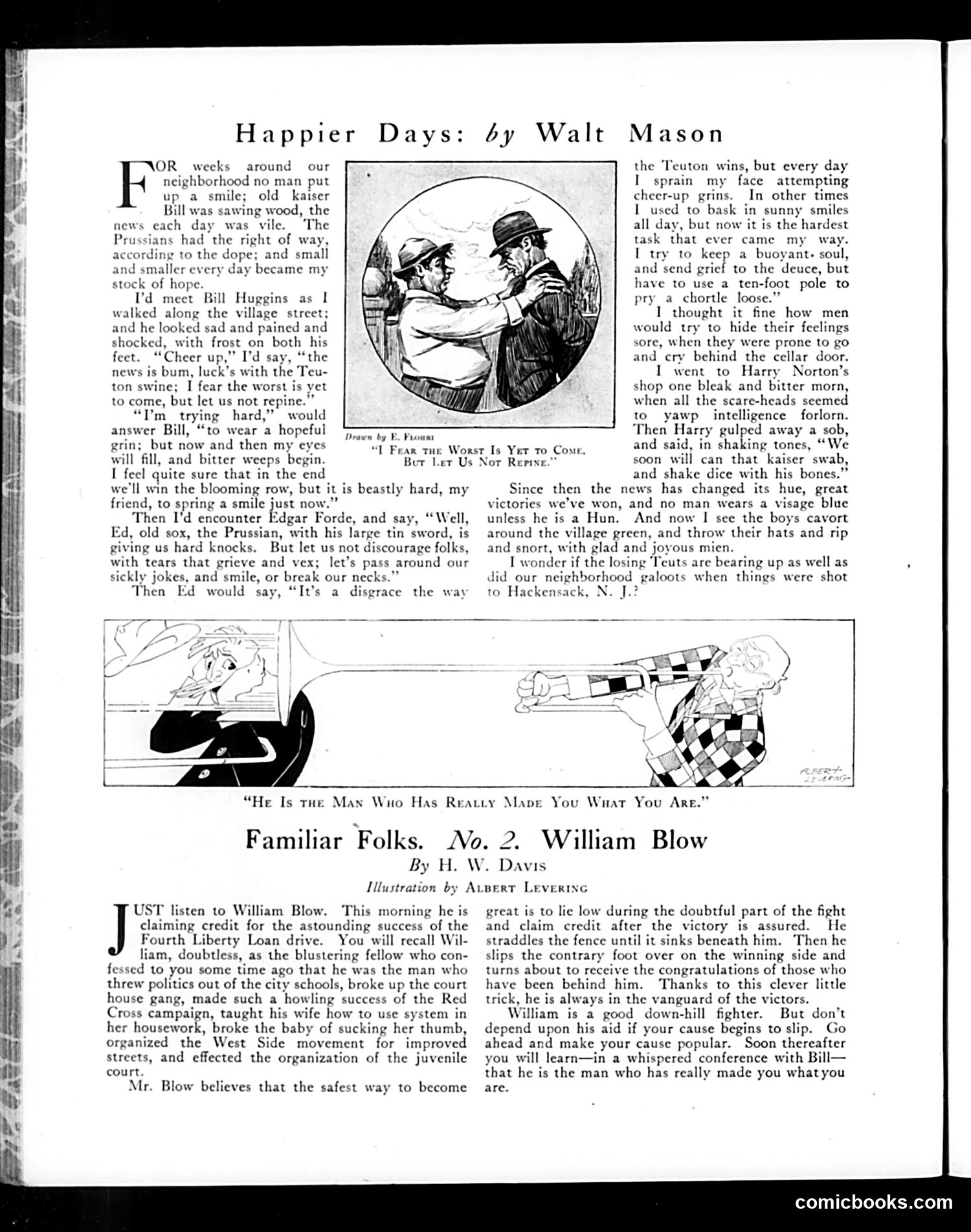
This page contains two pieces of social commentary from WWI-era *Judge* magazine. **"Happier Days"** (by Walt Mason) describes the morale shift as American fortunes improved against Germany ("Kaiser Bill"). Townspeople initially despaired as "Prussians had the right of way," but gradually regained hope through forced cheerfulness. The narrative celebrates ordinary citizens' resilience, ending with relief that "the losing Teuts" must now suffer what Americans endured. **"Familiar Folks: William Blow"** (by H.W. Davis) satirizes a blustering opportunist who claims credit for every civic success—Liberty Loan drives, school reform, Red Cross work—but only *after* outcomes prove successful. The cartoon illustrates his cowardice: he "straddles the fence until it sinks beneath him," then "slips the contrary foot over on the winning side." The satire mocks those who hide during struggles then claim victory, portraying a recognizable social type rather than a specific individual.
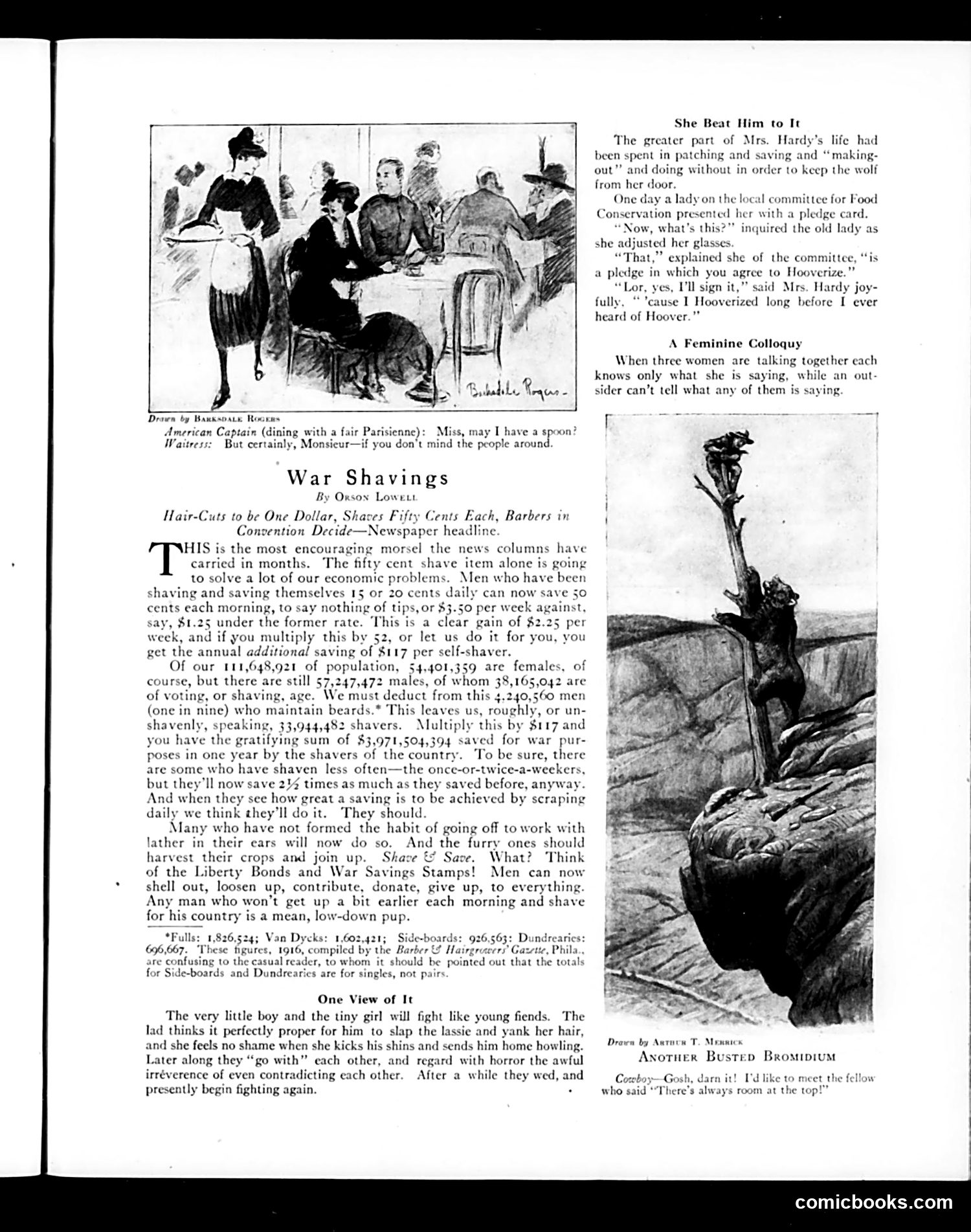
This page contains WWI-era American satire attacking economic waste and promoting patriotic sacrifice. **"War Shavings"** is the main satirical piece. It mocks a barbers' convention decision to lower shave prices to 50 cents, sarcastically celebrating this as a major contribution to the war effort. The author absurdly calculates that multiplying minimal daily savings across millions of male shavers yields nearly $4 billion annually for "war purposes." The satire targets both the barbers' modest price cut and Americans' tendency to exaggerate trivial personal sacrifices as patriotic duty. The piece cynically urges men to wake earlier and shave daily "for his country," implying that such gestures are meaningless compared to actual wartime contributions like War Savings Stamps and Liberty Bonds. **Other cartoons** address wartime themes: "She Beat Him to It" jokes about food conservation (Hooverizing—rationing under Herbert Hoover's program), while "One View of It" satirizes how couples' relationships change from fighting youth to marital conflict. The top cartoon depicts an American soldier's awkward dining etiquette in Paris. The overall message criticizes inflated patriotic rhetoric surrounding minor economic measures.
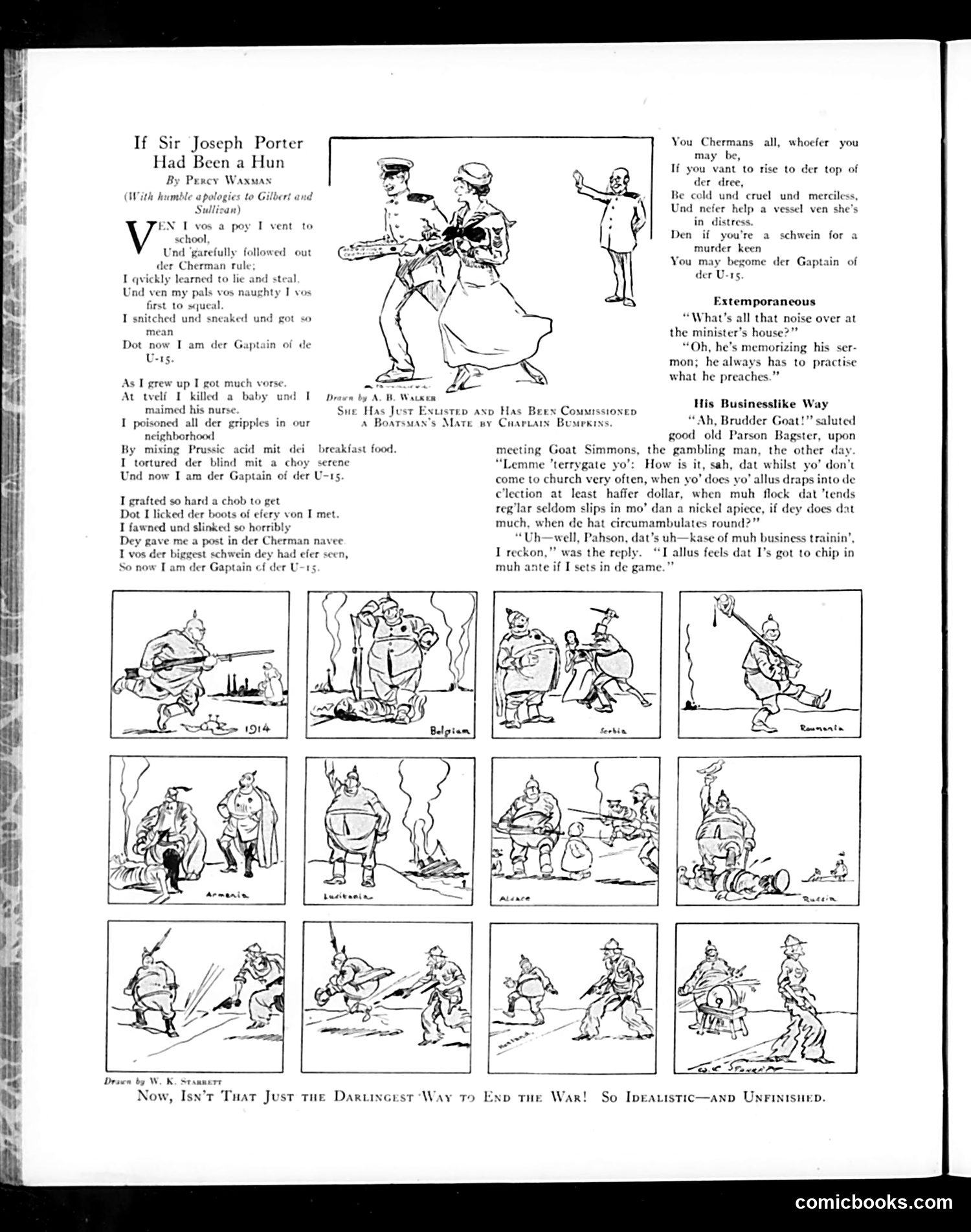
This page contains WWI-era satire mocking German militarism and U-boat warfare. The main piece, "If Sir Joseph Porter Had Been a Hun," parodies Gilbert and Sullivan's *HMS Pinafore*. A German U-boat captain boasts in broken English that he rose through cruelty, theft, murder, and cowardice—satirizing how the German military system allegedly rewarded brutality over merit. The poem suggests German officers achieved rank through immorality rather than ability. The twelve comic panels below depict increasingly violent "solutions" to ending the war, culminating in absurd brutality—mocking German militarism as barbaric and unthinking. Two lighter pieces appear on the right: a joke about a minister rehearsing sermons, and a humorous story about a gambling man's "business training" donating generously to church collections like betting antes. The overall message: Germany's military culture is morally corrupt and worthy of ridicule.
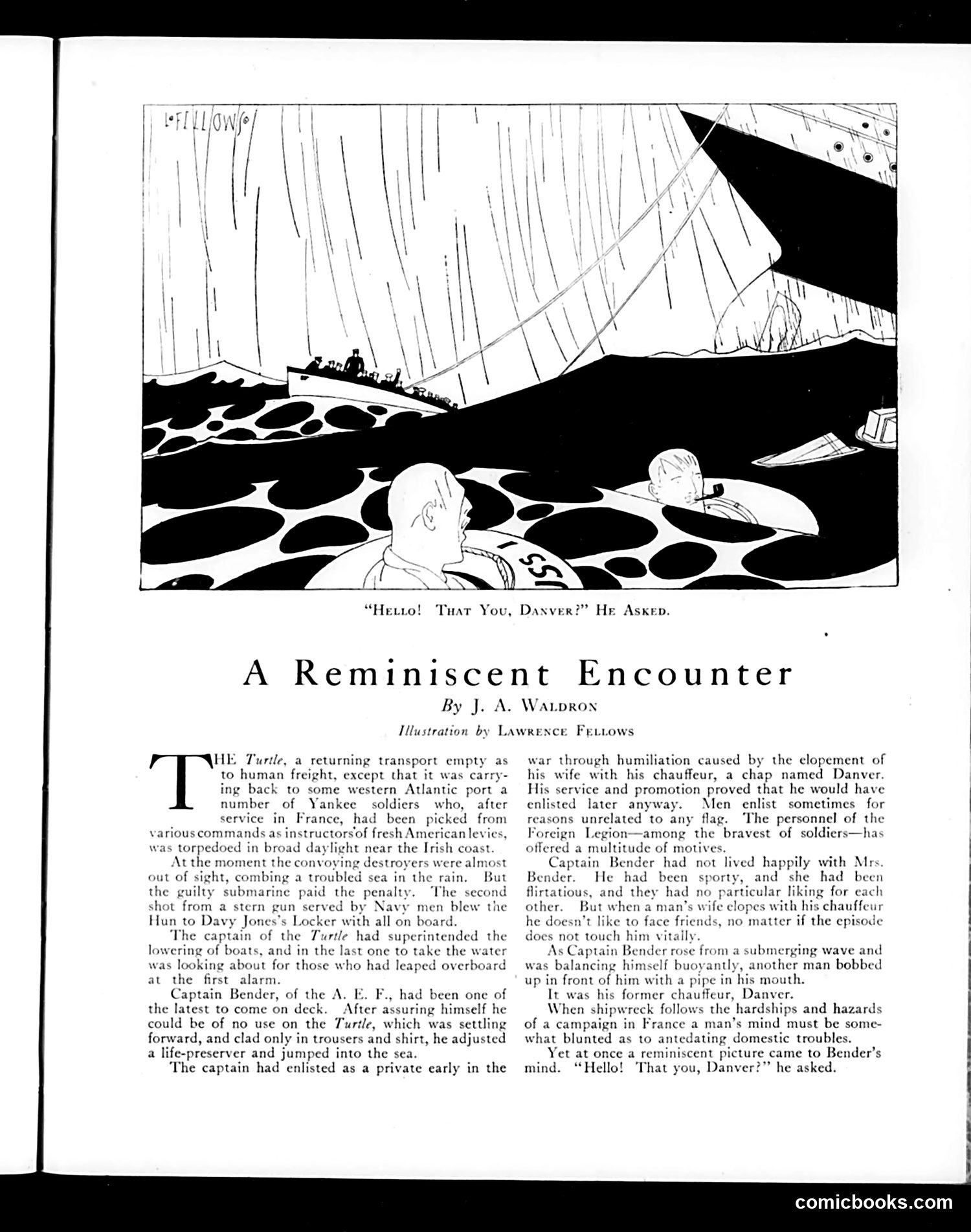
This is a WWI-era short story (not a satirical cartoon) about two men—Captain Bender and Danver, his former chauffeur—who unexpectedly encounter each other in the ocean after their transport ship, the *Turtle*, is torpedoed near Ireland. The dramatic irony is that Danver had run away with Bender's wife before the war, humiliating him. Bender enlisted partly out of shame rather than patriotism. Now, after surviving combat in France and a German U-boat attack, Bender finds himself face-to-face with the man who wronged him—both literally in the water, both survivors. The story's point appears to be about how wartime trauma and survival can put personal grievances into perspective. The illustration shows them in the water amid wreckage, about to have an awkward reunion. This is sentimental fiction rather than satire, reflecting post-WWI American literature's interest in soldier experiences and redemption.
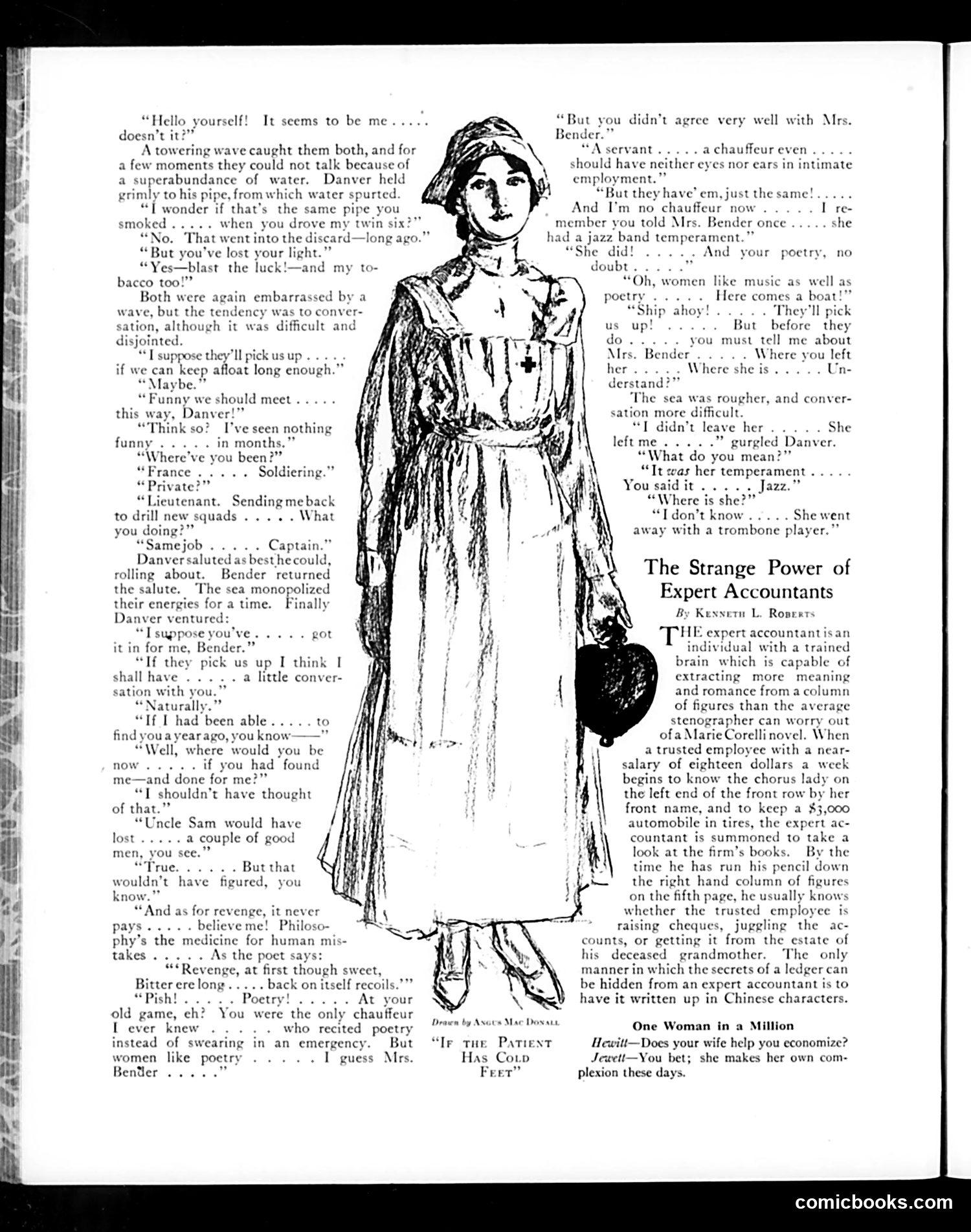
This page contains two distinct pieces of content: **The Main Illustration and Dialogue**: A sketch shows two men (Danver and Bender) clinging to wreckage at sea, having a conversation about their past. The dialogue reveals that Bender was Danver's chauffeur who left employment, and they discuss Bender's former girlfriend—a woman with a "jazz band temperament" who left Bender for "a trombone player." The satire mocks the familiar trope of servants/working-class men entangled with unreliable women, while the coincidental sea rescue allows for awkward reminiscence about class and romantic misfortune. **"The Strange Power of Expert Accountants"**: A separate article by Kenneth L. Roberts satirizes how accountants—trained to extract meaning from columns of figures—are relied upon to detect employee theft or financial fraud. The humor lies in portraying the accountant's almost supernatural ability to deduce misconduct (embezzlement, check fraud) from numerical patterns, treating spreadsheets with the romantic drama usually found in novels. Both pieces use working-class characters and romantic/financial complications as subjects for gentle satire typical of Judge magazine's era.
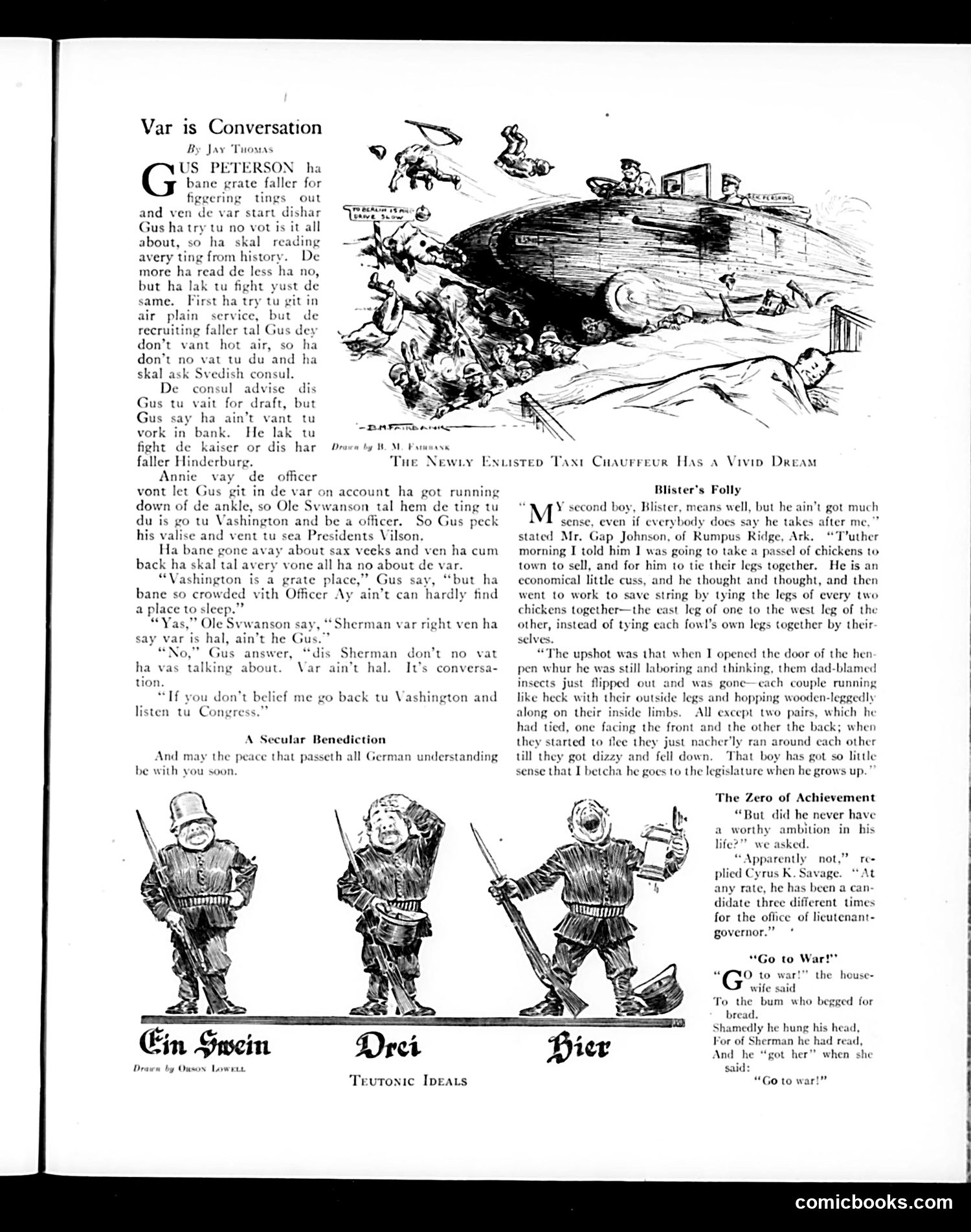
This page satirizes Swedish-American immigrants during WWI through the character Gus, depicted speaking broken English with thick Scandinavian dialect. The main article mocks Gus's attempt to enlist: he reads history to understand the war, tries joining the air service, gets rejected due to a sprained ankle, and attempts to become an officer by visiting President Wilson. Upon returning to Washington, he claims the war "ain't hal. It's conversation"—satirizing how civilians and Congress endlessly debate war without understanding it. The bottom cartoon "Teutonic Ideals" depicts German militarism through three soldiers in increasingly aggressive poses, captioned "Ein Swein / Drei / Bier" (One Pig / Three / Beer)—mocking Germanic culture stereotypes. Other brief pieces include "Blister's Folly" (a rural humor story) and "Go to War!" (dark satire of a beggar told to enlist). The satire targets both immigrant confusion and political rhetoric around American involvement in WWI.
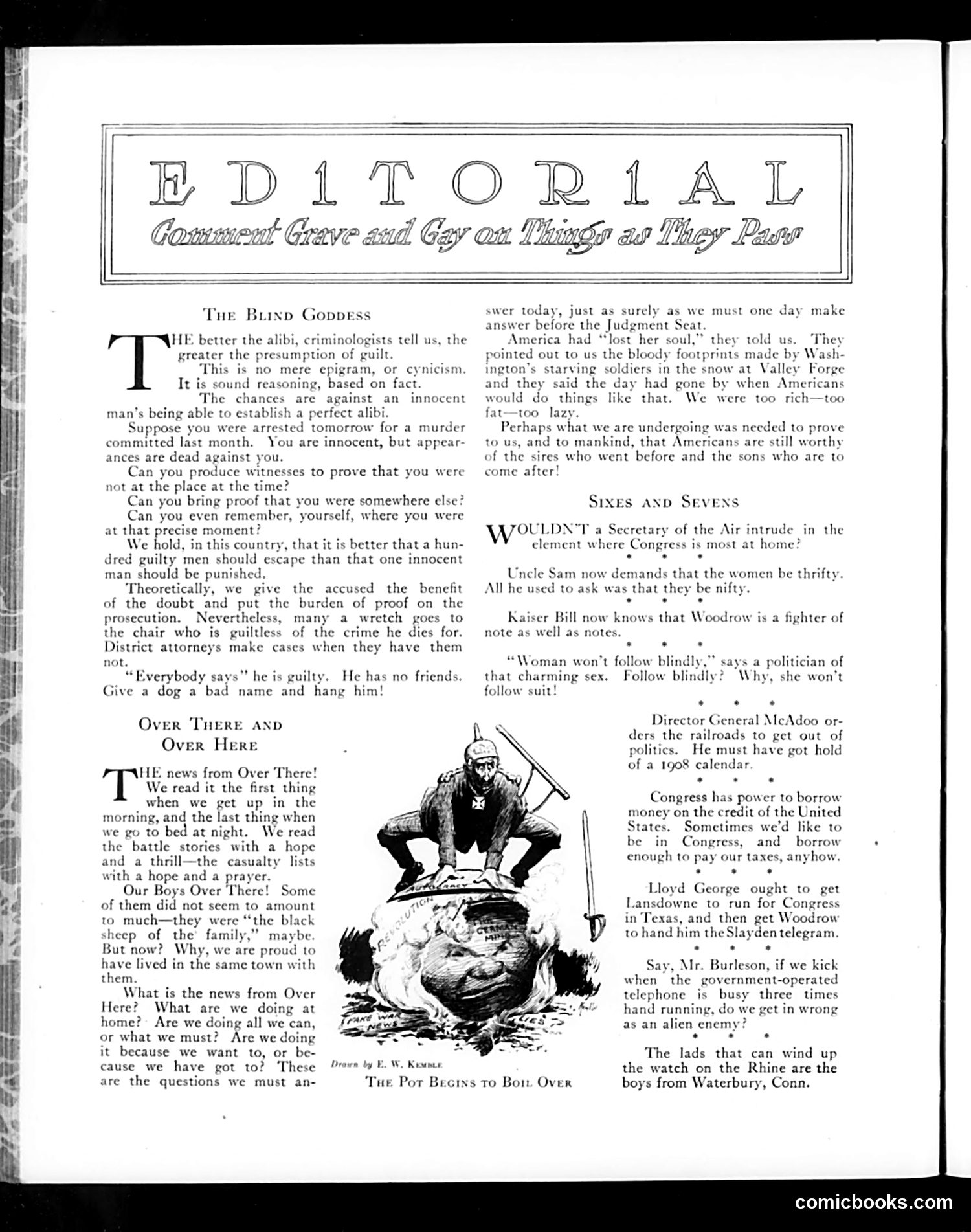
This page contains satirical commentary on American justice and WWI-era politics, not comic strips. **"The Blind Goddess"** argues that the legal system favors the guilty: perfect alibis are suspiciously easy to fabricate, while innocent people struggle to prove their whereabouts. The piece critiques how "everybody says he's guilty" can condemn someone without real evidence—a commentary on mob justice and flawed prosecution. **"Over There and Over Here"** contrasts American soldiers' sacrifice abroad with domestic complacency. It challenges whether Americans at home are genuinely committed to the war effort or merely going through motions. References to Valley Forge invoke patriotic comparison: past generations sacrificed; are current Americans worthy successors? **The brief jokes** mock wartime policies (women's thrift campaigns, Director General McAdoo's railroad orders, government phone monopolies) and British politics (Lloyd George, Lansdowne). The central message: America must prove itself worthy of its founding generation through genuine sacrifice, not just rhetoric.
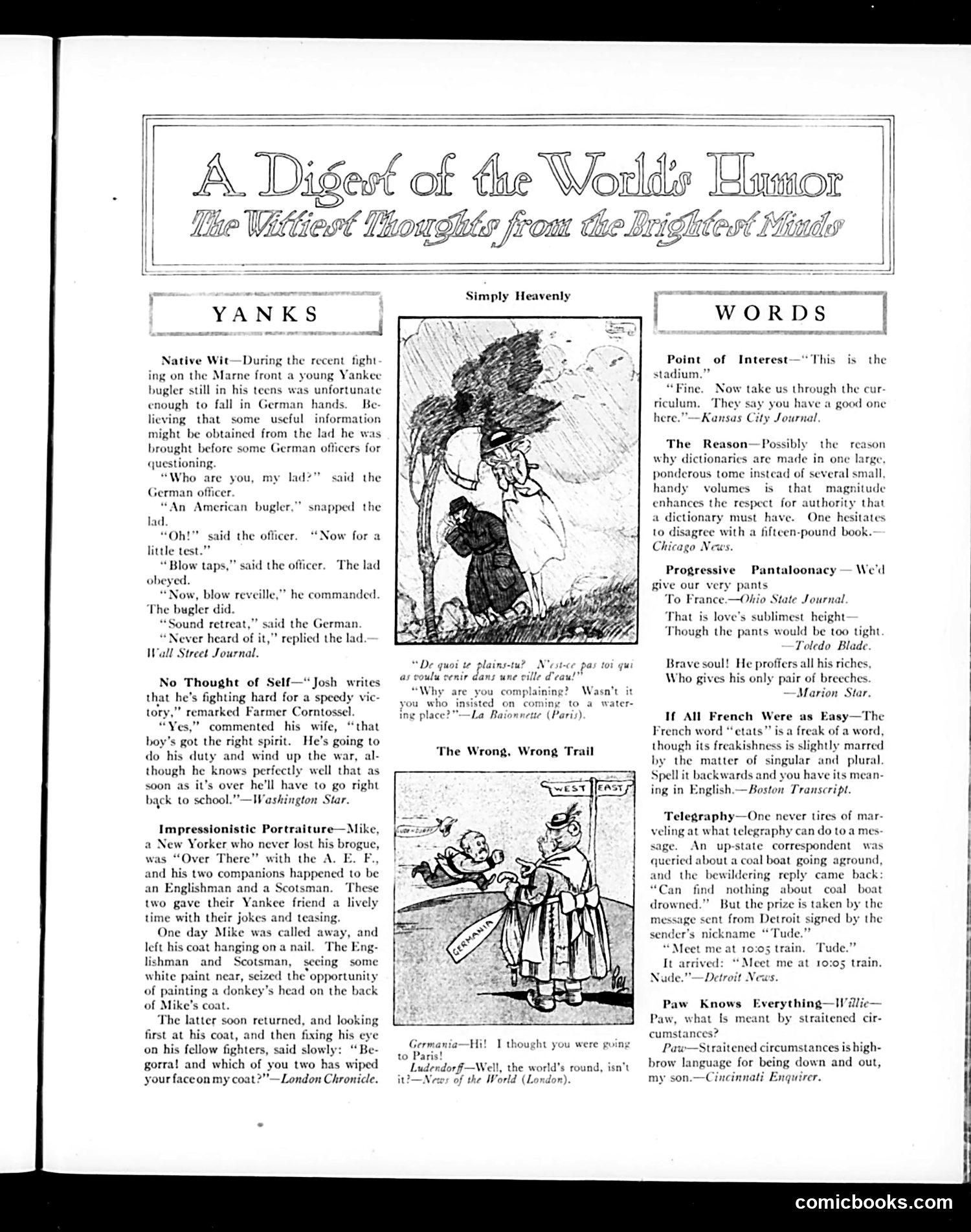
This page from Judge presents WWI-era American humor, primarily poking fun at American soldiers ("Yanks") and their experiences in France. The main cartoons satirize: 1. **"Native Wit"**: A young American bugler captured by Germans outwits his interrogators by claiming ignorance of "Retreat"—implying Americans don't know defeat, a boastful jab at American confidence. 2. **"The Wrong, Wrong Trail"**: A cartoon showing Germans heading toward Paris, with Ludendorff claiming "the world's round" as justification—mocking German strategic blunders on the Western Front. The surrounding "WORDS" section contains light social commentary: jokes about dictionaries, French grammar, telegraph mishaps, and domestic life. The humor is gentle, patriotic, and aimed at civilian readers. "Impressionistic Portraiture" mocks an Irish-American soldier's accent and working-class speech patterns. Overall, this reflects 1917-1918 American popular sentiment: optimistic about the war effort while gently ribbing soldiers' inexperience and ethnic stereotypes common to the era.
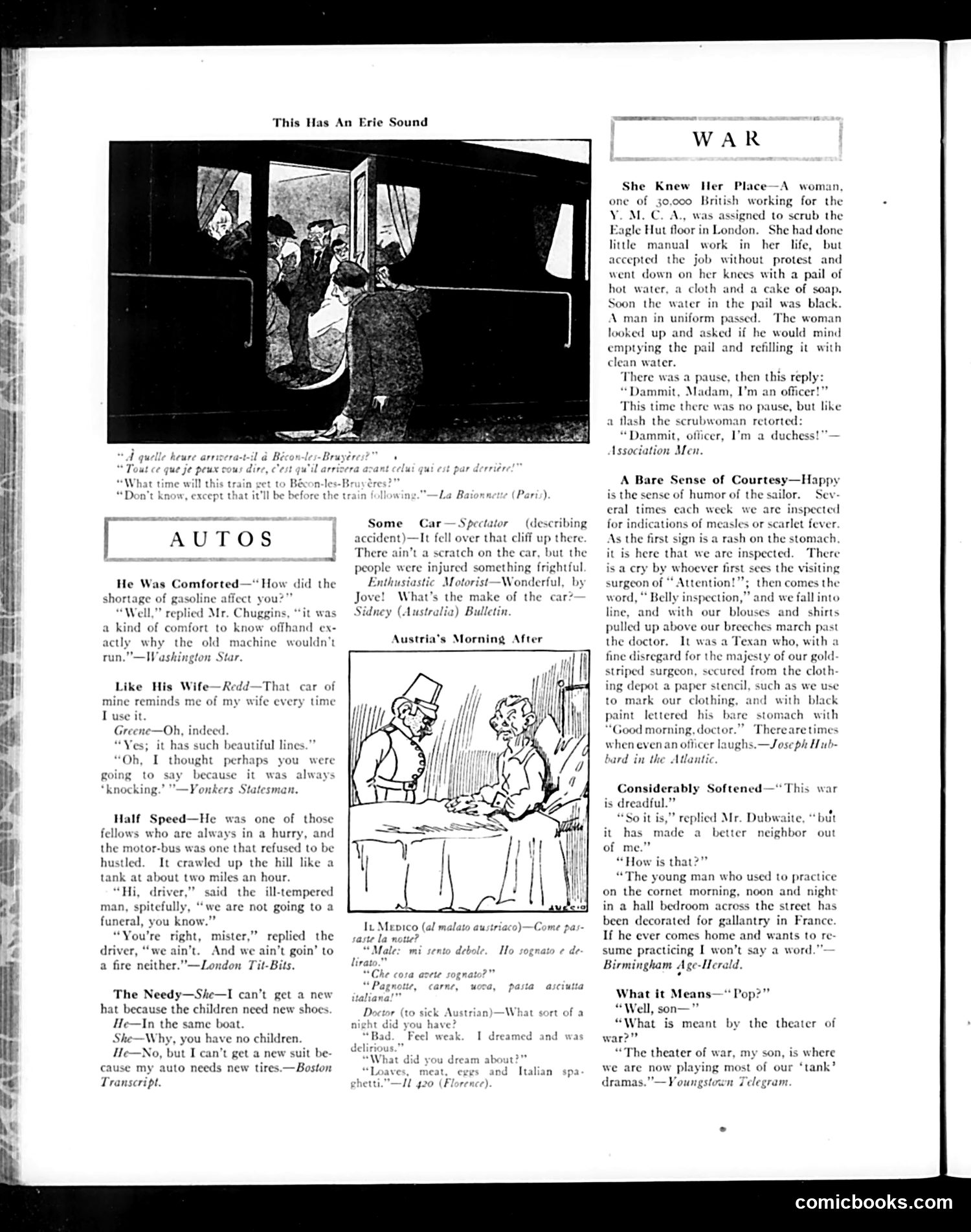
This page collects wartime humor during WWI, organized into three sections: "AUTOS," "WAR," and related jokes. The **AUTOS section** contains pre-war automobile humor about gasoline shortages, car reliability, and motorists—establishing contrast with the serious wartime content. The **WAR section** features satirical anecdotes about British home-front experiences: - "She Knew Her Place" mocks class hierarchy: a working-class scrubwoman responds to an officer's refusal to help her by claiming she's a duchess—the joke being her witty insubordination exposes his pretension. - "A Bare Sense of Courtesy" describes military medical inspections and a Texan soldier who stencils "Good morning, doctor" on his stomach—humor about crude American informality contrasting with military formality. - "Considerably Softened" jokes that war has improved neighborly relations by sending an annoying cornet player away (decorated for service). - "What it Means" contains a father-son exchange where "theater of war" becomes commentary on tank warfare replacing traditional drama. The overall tone satirizes wartime inconveniences, class tensions, and military absurdities.
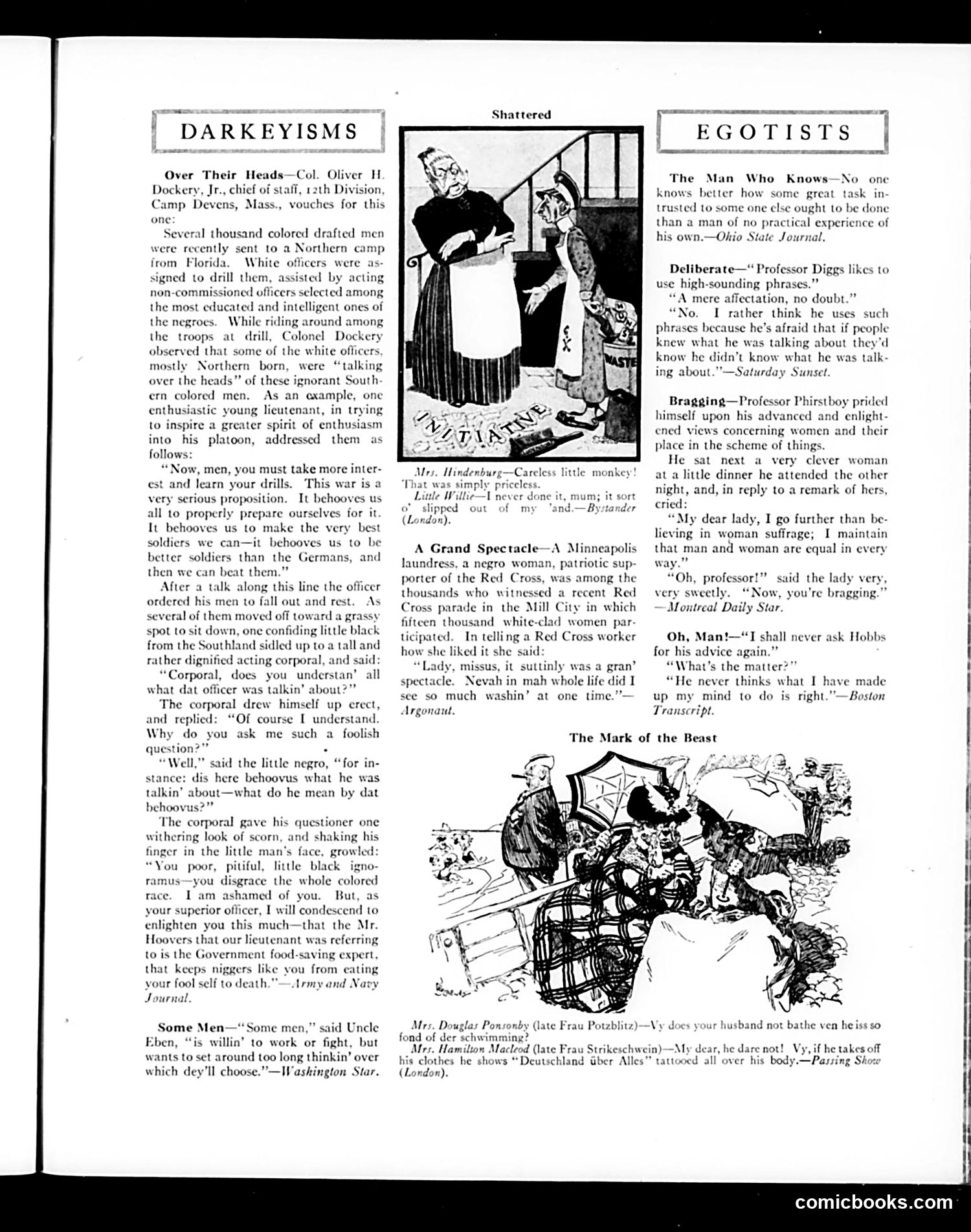
This page contains racist caricatures presented as humor, typical of early 20th-century American periodicals. The "Darkeyisms" section mocks African American soldiers during World War I through dialect humor and stereotypes. The main cartoon depicts a white officer using sophisticated language ("behooves") that confuses Black soldiers. The joke relies on the racist premise that Black men are intellectually inferior and cannot understand standard English. A Black corporal, trying to maintain dignity, pretends to understand while actually misinterpreting the officer's words—conflating "behooves" with "Mr. Hoovers," the food-rationing administrator. Additional anecdotes mock Black vernacular speech and stereotype Black women as simple-minded about laundry. The "Egotists" section appears unrelated racial commentary about pompous professors. **Context:** This reflects widespread 1910s-20s attitudes that portrayed Black Americans—especially soldiers—as comic subjects for ridicule based on perceived intellectual and linguistic inferiority. Such material normalized racial prejudice in mainstream publications.
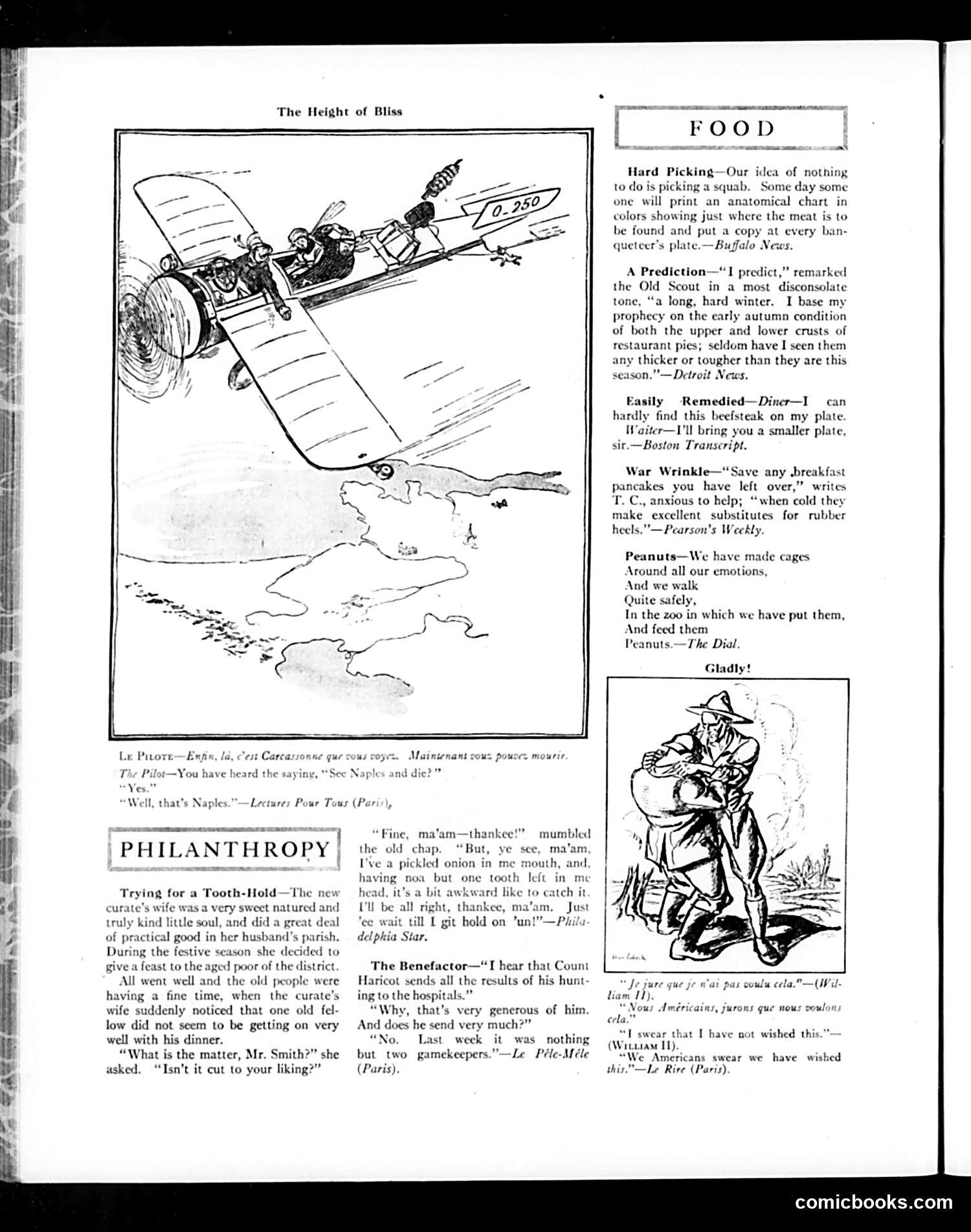
The main cartoon depicts an airplane crashing into a map, illustrating a French phrase about Naples being the height of bliss before death. It's a dark joke about aviation disasters being common enough that they've become a darkly humorous reference point. The **Philanthropy** section mocks upper-class charity work through anecdotes: a well-meaning curate's wife serves poor elderly men difficult food (a pickled onion he can barely chew with one tooth), exposing the gap between charitable intention and practical kindness. The **Benefactor** story similarly satirizes performative generosity—a count supposedly donates hunting results to hospitals, but it's just dead gamekeepers, suggesting his "charity" is merely disposing of inconveniences. The **Food** section collects humorous food observations and complaints from various newspapers, mixing genuine criticism (thin restaurant pie crusts, invisible beefsteaks) with wartime absurdities (pancakes as rubber heel substitutes). These pieces collectively mock class pretension, shallow charity, and wartime food shortages through gentle ridicule rather than sharp political critique.
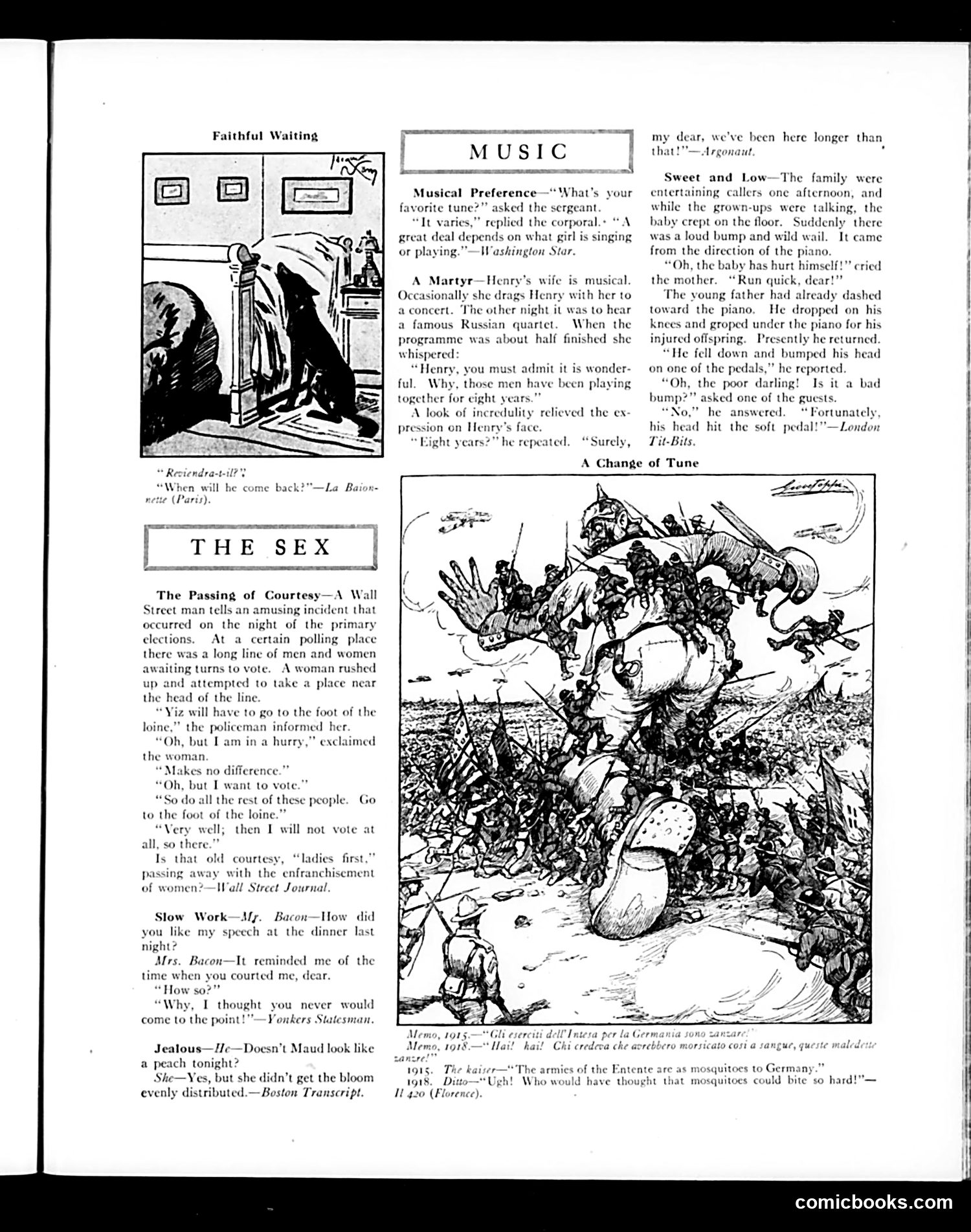
This Judge magazine page contains several brief humorous anecdotes and one major political cartoon, all reflecting early 20th-century social attitudes. **"The Passing of Courtesy"** satirizes women's newly-won voting rights. A woman attempting to vote is told to wait her turn like everyone else—no special treatment. The joke critiques that women's suffrage has eliminated traditional "ladies first" courtesy. The underlying tension reflects period anxieties about women's equality. **The other items** are light domestic humor: a wife criticizing her husband's long courtship, a woman's uneven complexion, and a baby bumping the piano's soft pedal. **"A Change of Tune"** (the large cartoon) appears to depict World War I combat—soldiers, explosions, and military equipment. The Italian caption and references to "Entente" and "Germany" suggest it comments on the war's chaotic violence, possibly mocking military strategy or the brutality of trench warfare. Without visible dates or bylines, precise attribution is unclear, but the content reflects American satirical commentary on contemporary political/social issues circa 1910s-1920s.
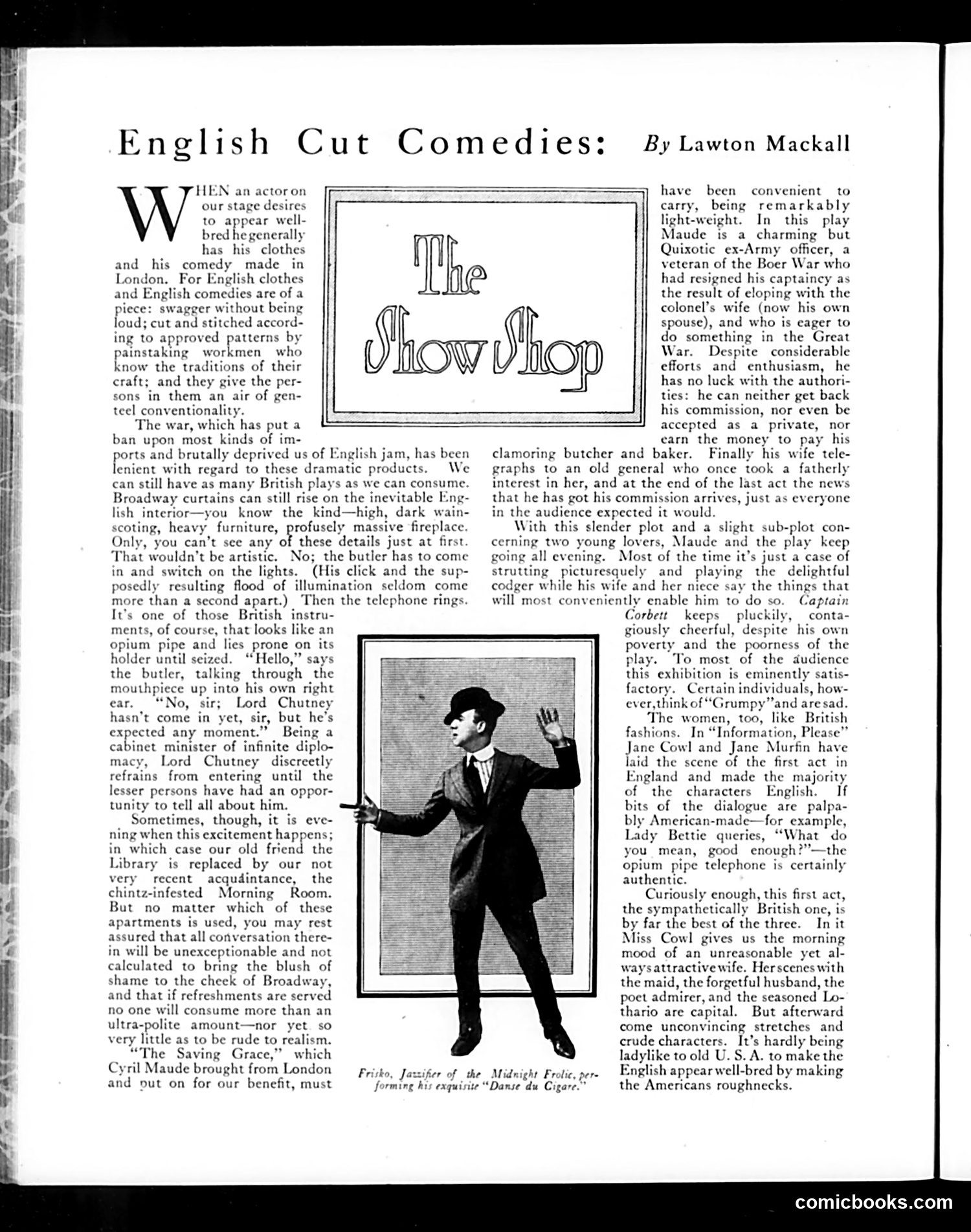
This article by Lawton Mackall reviews English comedies playing on Broadway. The central image shows an actor in the featured play "The Show Shop," performing in the mannered, physically expressive style typical of these productions. Mackall argues that English plays and clothes share a refined quality—"swagger without being loud"—and notes that wartime import restrictions haven't stopped British theatrical imports from flooding American stages. He describes their formulaic nature: drawing rooms with electric lights, telephone interruptions, and conveniently resolved plots. The review discusses specific plays: "The Saving Grace" (starring Cyril Maude as a bumbling ex-officer) and "Information, Please" (featuring Jane Cowl and Jane Murfin), which deliberately set scenes in England to enhance their "English appeal." Mackall gently mocks how American audiences find these plays satisfactory, though some viewers recognize their shallow characterization and borrowed dialogue as distinctly "American-made" beneath the English veneer—a critique of theatrical artifice and transatlantic cultural borrowing.
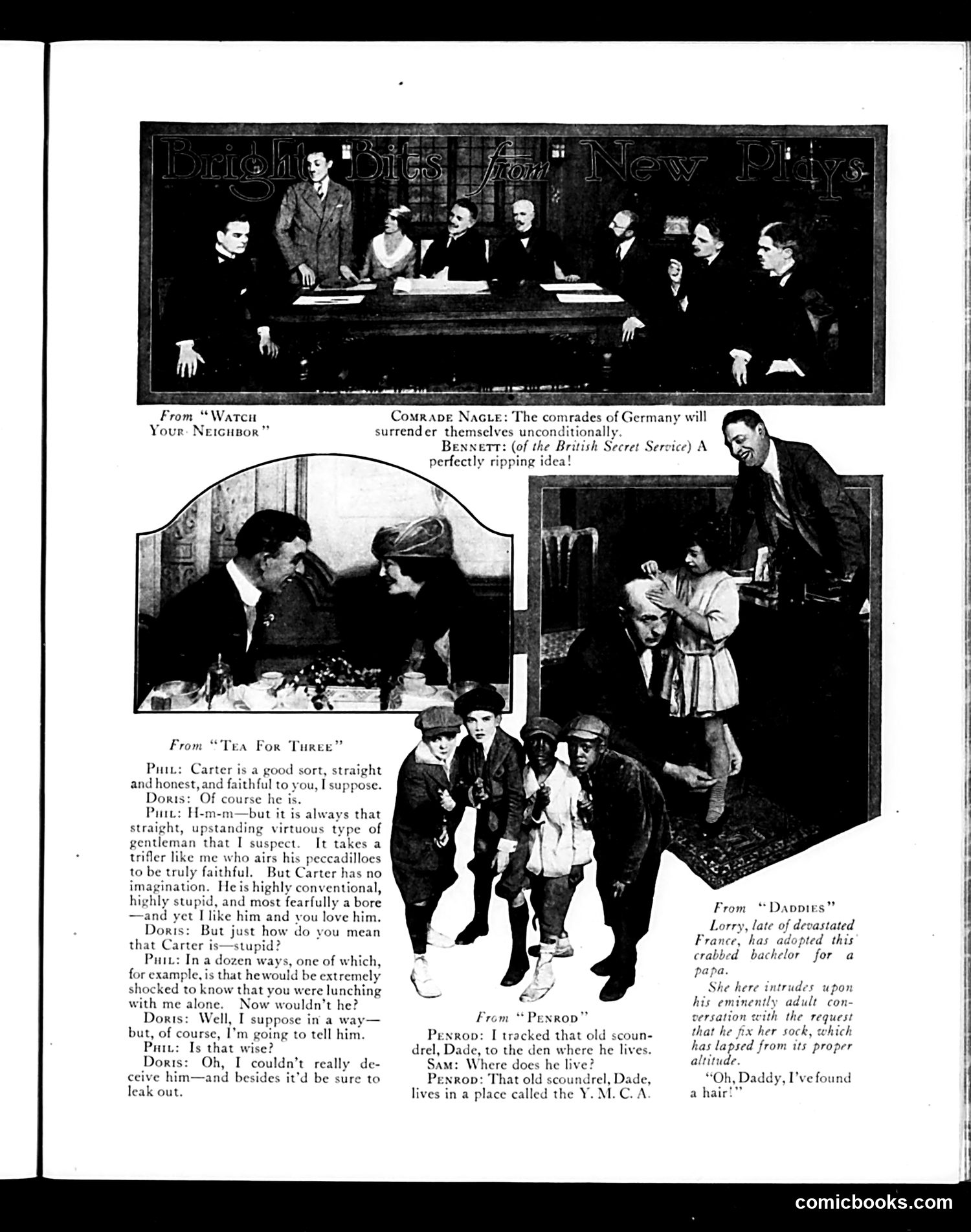
This page presents comedic excerpts from contemporary theatrical productions, illustrating dialogue-driven humor typical of early 20th-century Broadway comedies. **"Tea for Three"** satirizes bourgeois morality: a seductive man named Phil attempts to manipulate "Doris" by praising her fiancé Carter as boringly virtuous while flattering his own rakish nature as secretly faithful. The joke reveals Phil's transparent manipulation—he assumes respectable men are jealous prudes, unaware Doris will simply tell Carter the truth, undermining Phil's scheming. **"Penrod"** and **"Daddies"** offer gentler domestic humor: Penrod tracking a vagrant to a YMCA (unexpected shelter for the poor), and a child interrupting adult conversation with trivial requests ("fix her sock"). The top image, captioned "Comrade Nagle," appears to reference German surrender negotiations (likely post-WWI), though context is unclear without dating. The satire targets masculine pretension and social hypocrisy rather than specific political targets.
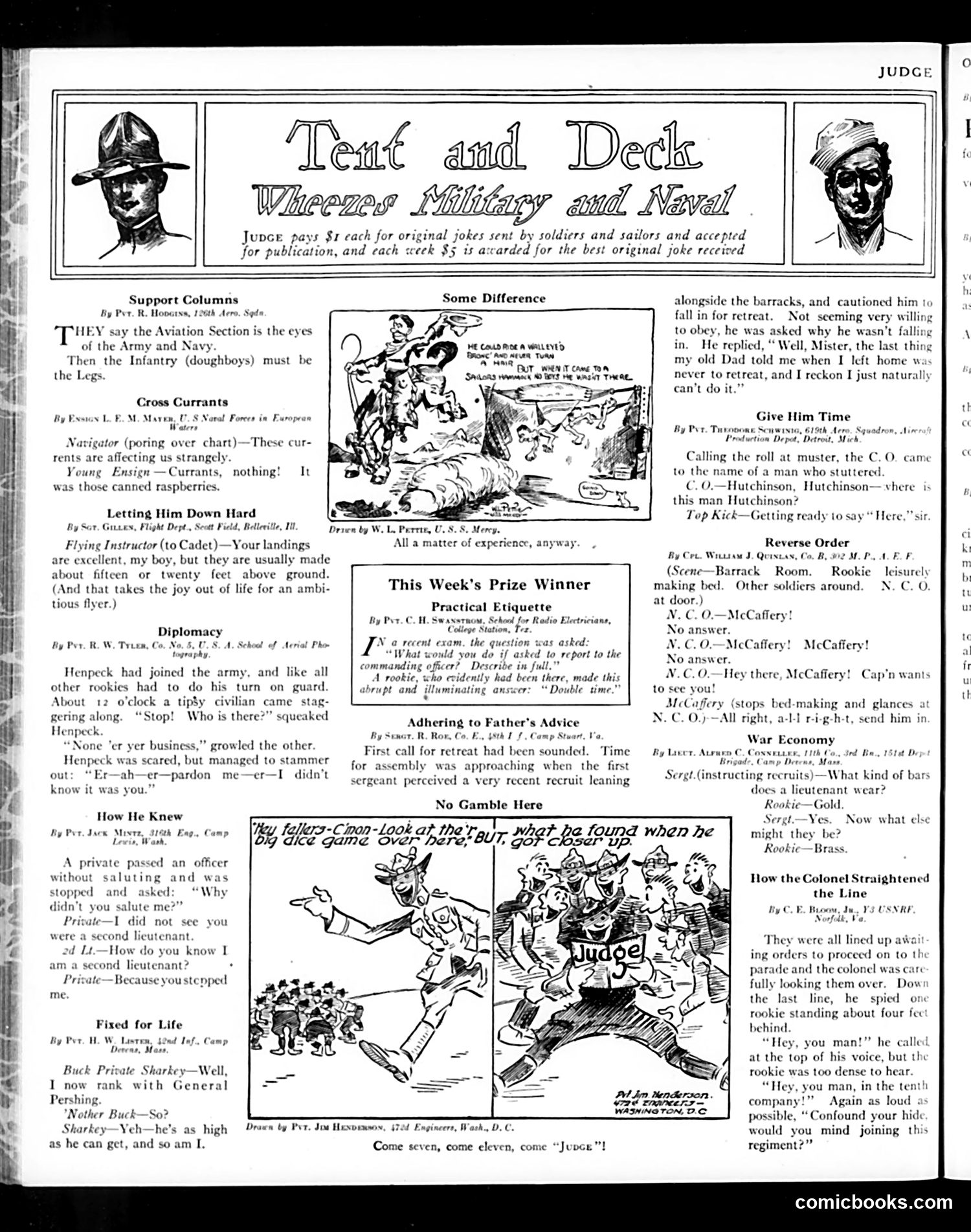
This page from *Judge* magazine is a collection of military-themed jokes and cartoons contributed by soldiers and sailors during World War I. The content consists of brief humorous anecdotes about Army and Navy life, aimed at poking fun at military absurdities. Key jokes include: - A recruit overzealous about obeying his father's advice never to retreat - A soldier misunderstanding orders to report to a commanding officer as an instruction to run - A shy soldier struggling to answer roll call - Flying instructor jokes about landings The cartoons mock the inefficiency and bureaucratic confusion of military life. One prominent cartoon shows troops in confused circumstances, with the caption suggesting soldiers often misunderstand basic military protocol. The satire targets incompetent officers, confused recruits, and the general chaos of wartime military organization. The humor is gentle, aimed at morale-boosting entertainment for servicemen rather than cutting political criticism.
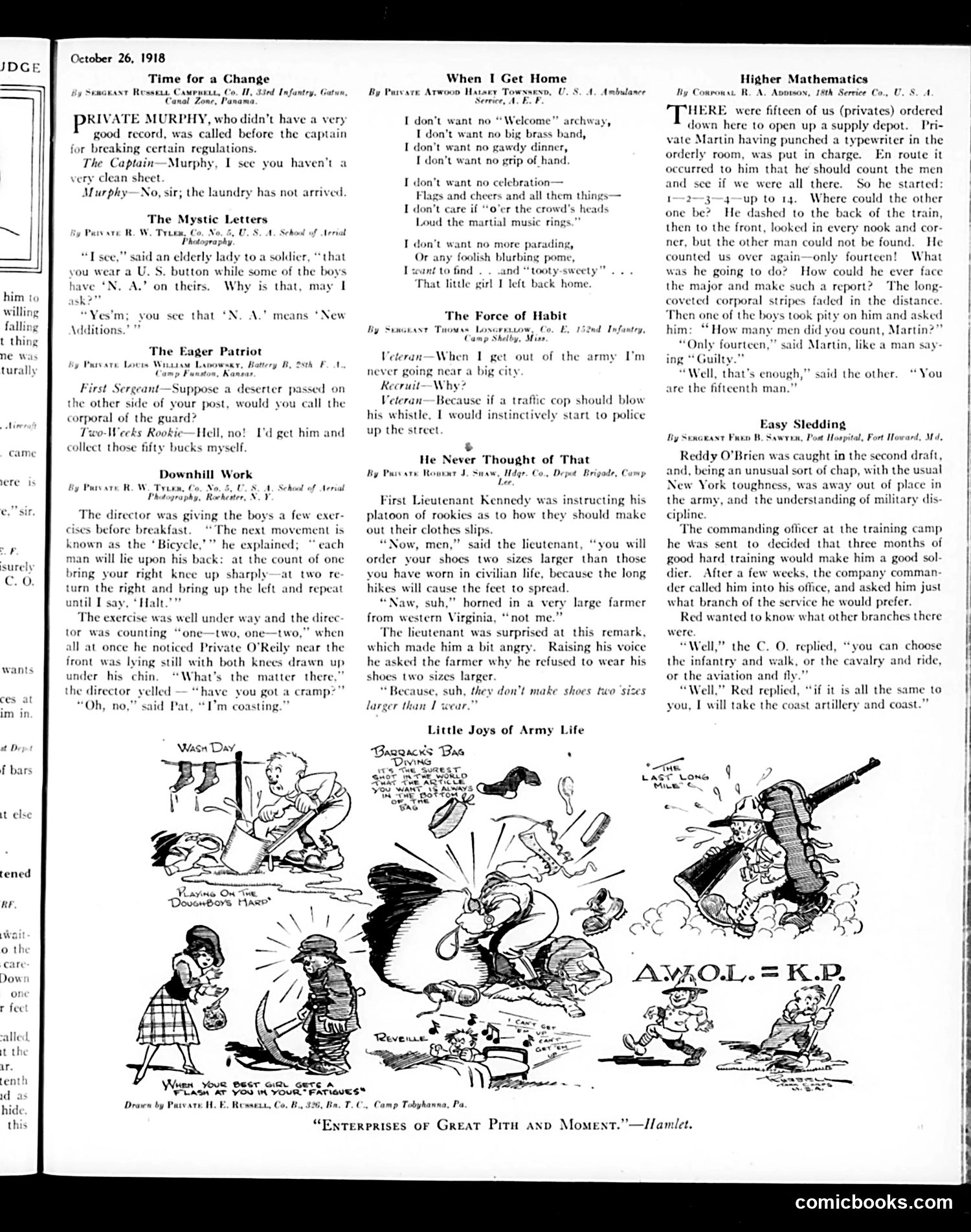
This page features **WWI-era soldier humor** from American troops. The cartoons and stories mock military life and regulations: **Key items:** - **"Private Murphy"**: A joke about military record-keeping—Murphy's poor service record is called a "dirty sheet," but he claims the laundry hasn't arrived. Satire of bureaucratic absurdity. - **"The Eager Patriot"**: A rookie threatens to capture a deserter for the financial bounty rather than report it properly—mocking mercenary motivation over duty. - **"Downhill Work"**: Private O'Reily lies on his back during exercises, claiming he's "coasting"—lazy soldier humor. - **"Little Joys of Army Life"**: Illustrated vignettes depicting army mishaps and absurdities. - **WWI Context**: Soldiers submitted humorous writings from various camps (Gatun, Camp Funston, Camp Shelby). The recurring theme is soldier complaints about military discipline, food, and regulations—gentle griping by enlisted men about service life during the final months of WWI (October 1918, shortly before Armistice).
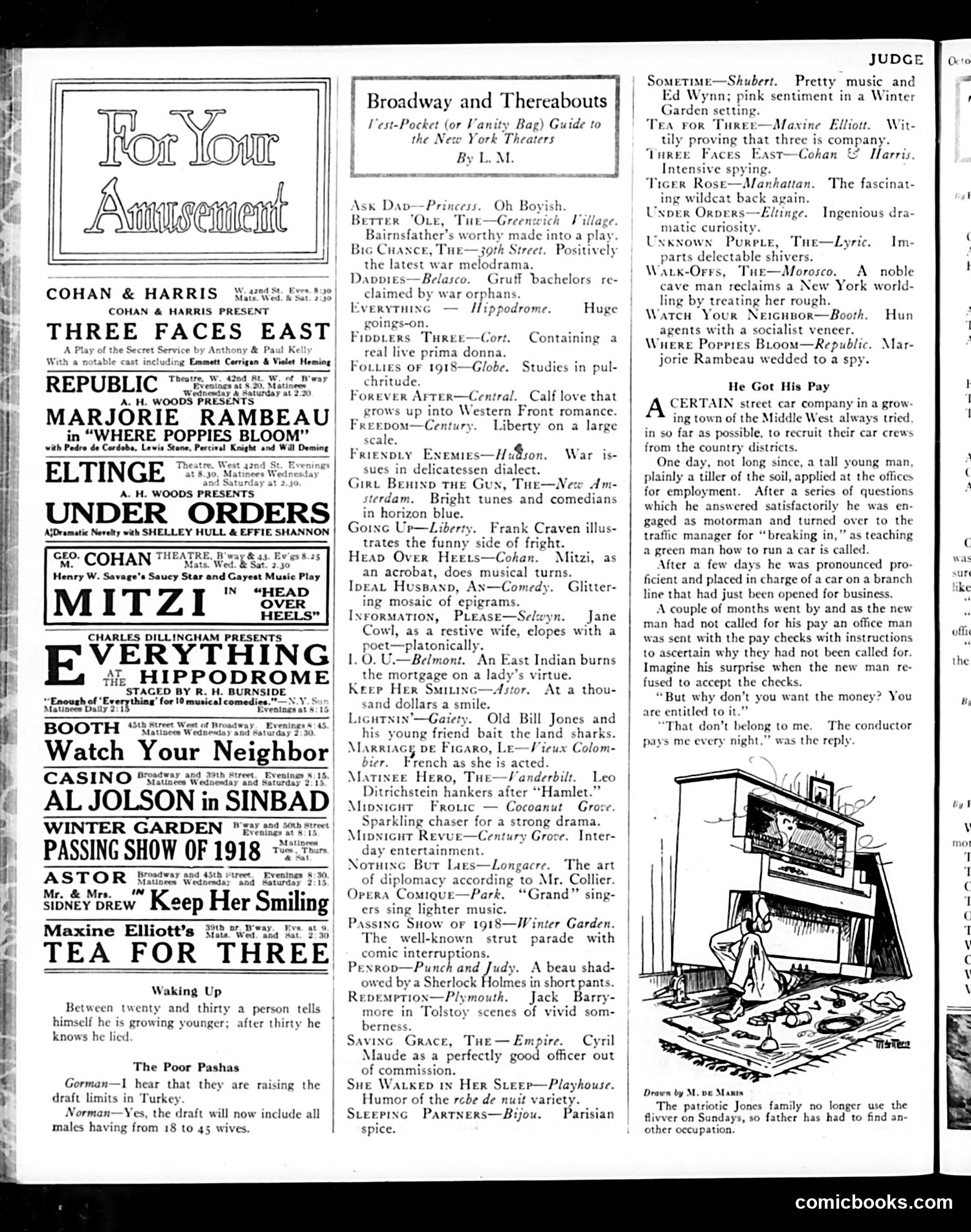
This is primarily a **theater advertising and review page** from Judge magazine, featuring Broadway show listings and brief critical commentary rather than political cartoons. The page includes: 1. **Theater advertisements** for productions like "Three Faces East," "Marjorie Rambeau," and "Al Jolson in Sinbad" 2. **A small cartoon** (lower right) showing a woman with her feet up on furniture, captioned about a family no longer using the river on Sundays due to changed occupation—likely satirizing wartime labor shifts or women's changing domestic roles 3. **Two brief humor pieces**: "Waking Up" (about aging self-deception) and "The Poor Pashas" (a joke about Turkey expanding draft eligibility to include men with 18-45 wives—satirizing Ottoman polygamy and wartime conscription demands) The content reflects **1918 wartime concerns**: multiple theater descriptions mention war themes, and the "Poor Pashas" joke targets Allied enemy Turkey. This is primarily **entertainment journalism** rather than political satire.
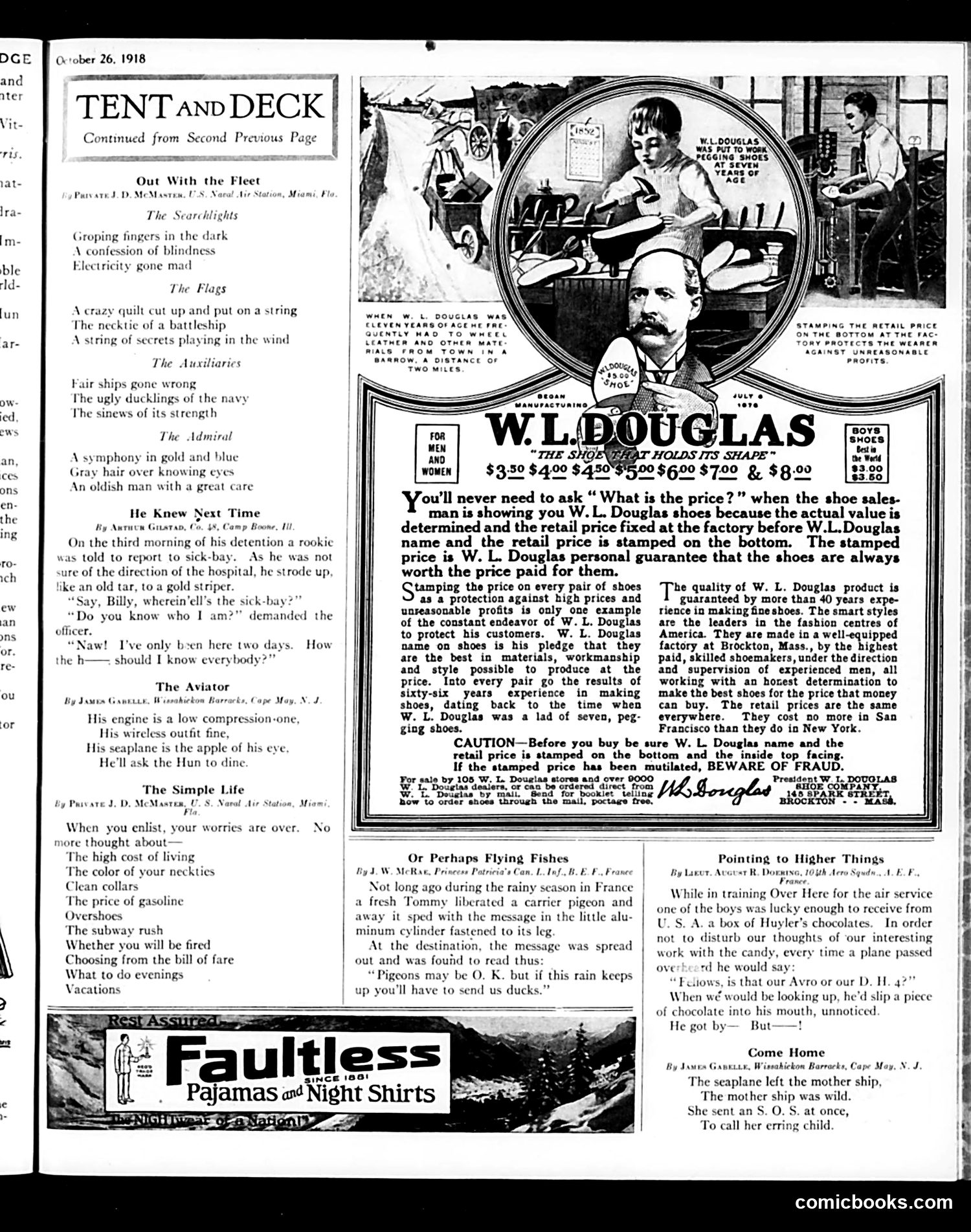
This October 1918 Judge magazine page contains **poetry about World War I** (published near the war's end) alongside a **major W.L. Douglas shoe advertisement**. The left column features patriotic verse about the Navy and military life—"Out With the Fleet," "The Admiral," "The Aviator"—reflecting the wartime context. The humorous section "He Knew Next Time" depicts a recruit's confusion navigating military protocol, satirizing the absurdities of military hierarchy. The dominant right-side advertisement uses a circular portrait format to showcase W.L. Douglas shoes, emphasizing that the stamped retail price on shoes protects consumers from price gouging—a concern during wartime inflation. The ad stresses American manufacturing ("Brockton, Mass.") and guarantees of quality/fair pricing. The bottom advertises "Faultless Pajamas and Night Shirts." This page reflects 1918 concerns: patriotic mobilization, military culture, and consumer protection against wartime profiteering.
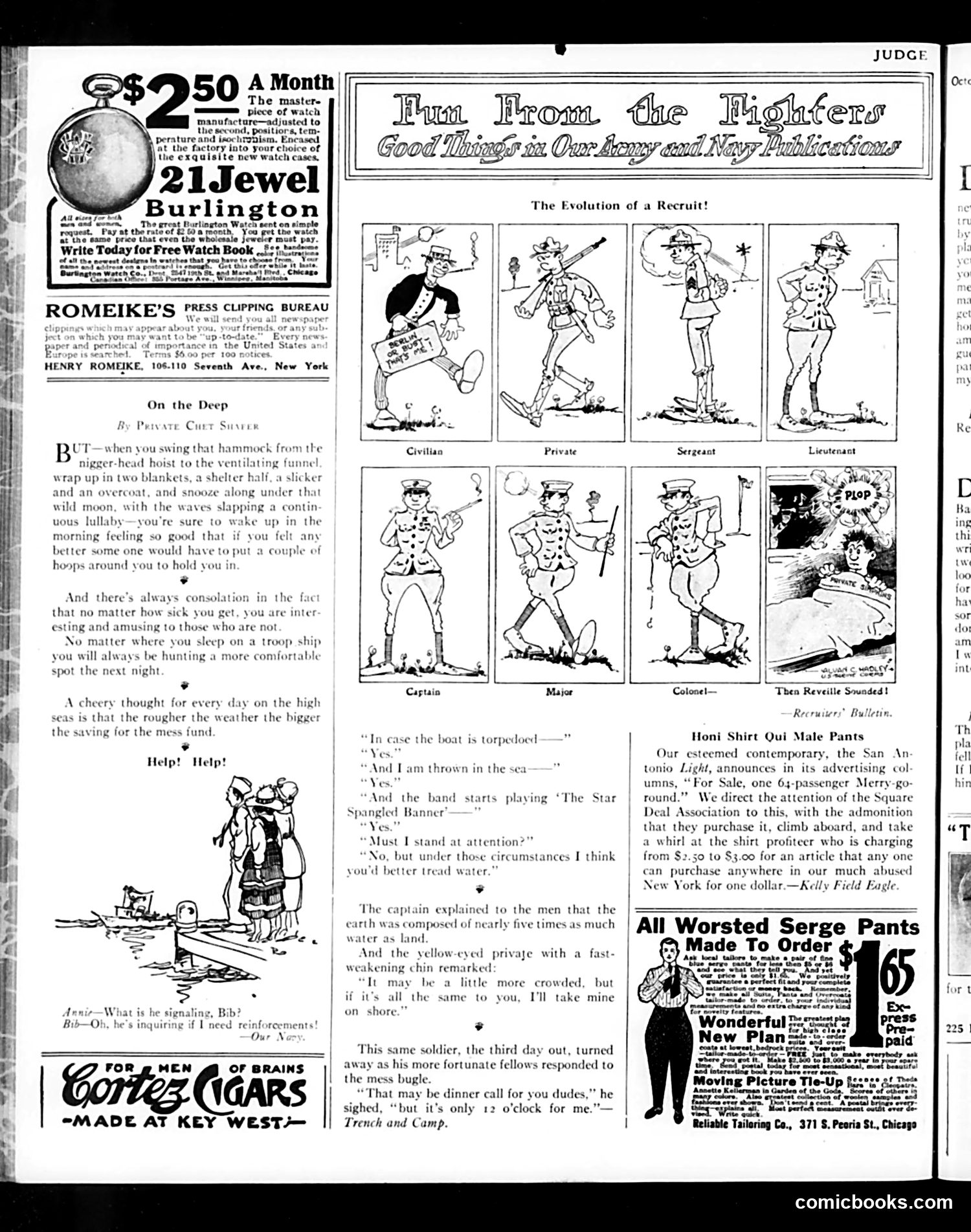
This page satirizes military training and soldier experiences during WWI. The central cartoon strip titled "The Evolution of a Recruit" depicts the progression from inexperienced civilian to seasoned lieutenant through four panels, showing how military discipline transforms recruits. The accompanying text "From the Fighters" contains humorous anecdotes about shipboard life and soldier hardships—sleeping in cramped conditions, rough seas, and sparse meals. The satire centers on soldiers' stoic acceptance of discomfort: when asked if he'll stand at attention during a torpedo attack, a private is told to "tread water instead." A final joke mocks wartime profiteering: a San Antonio newspaper advertises a merry-go-round for sale, and Judge sarcastically suggests taking it "for a whirl" at shirt manufacturers charging $2.50-$3.00 for items costing one dollar elsewhere—criticizing wartime inflation and exploitation. The page blends military humor with social criticism of home-front price gouging.
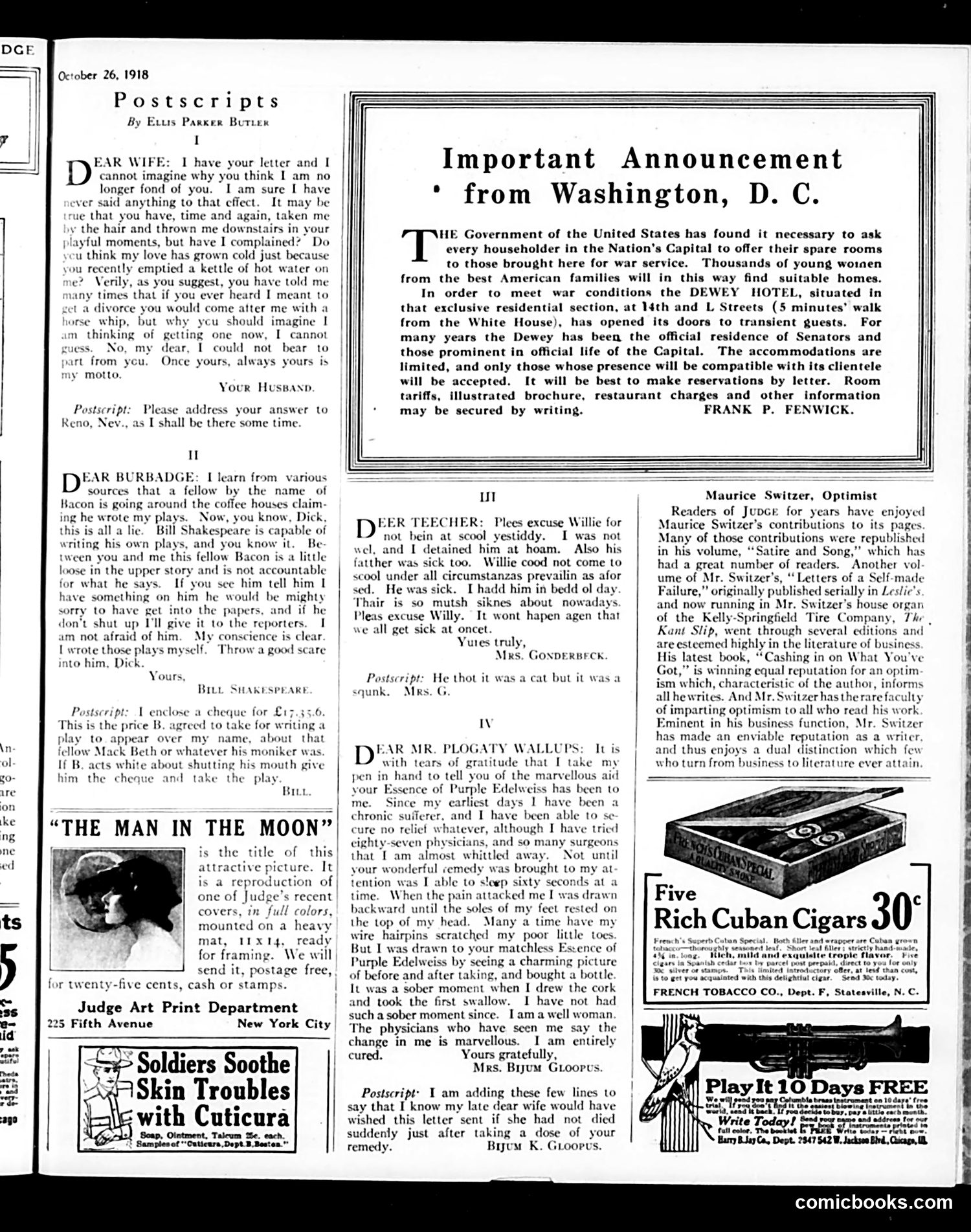
This page from Judge (October 26, 1918) consists primarily of **humorous letter parodies** rather than political cartoons. The "Postscripts" column features fake letters written in exaggerated dialect or character voices: 1. **Letter I**: A husband sarcastically denies his wife's concerns about their marriage, casually mentioning she's thrown him downstairs and poured hot water on him—suggesting marital abuse was treated as comedic fodder. 2. **Letter II**: "Shakespeare" claims he wrote his own plays, dismissing the "Bacon Theory" (a real historical debate about Francis Bacon's authorship) as ridiculous gossip, offering a bribe to silence the claim. 3. **Letter III**: A mother writes a teacher with phonetically-misspelled excuses for her son's absences, satirizing poorly-educated parents. The satire targets human vanity, marital dysfunction, literary pretension, and working-class illiteracy. The surrounding advertisements (cigars, skin remedies, travel) and an announcement about Washington, D.C. housing requests suggest this is wartime America (WWI ending).
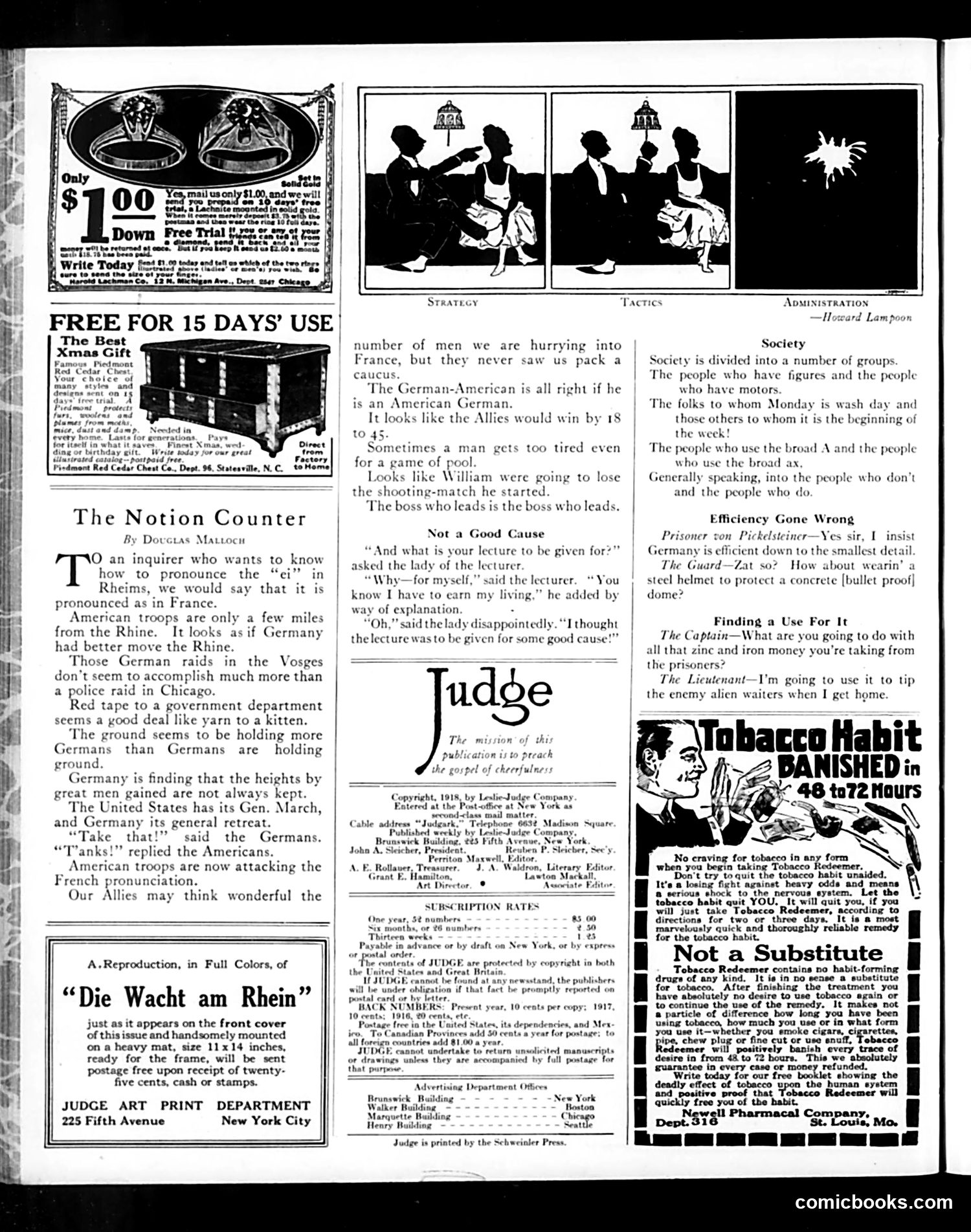
This page from Judge contains satirical commentary on World War I, primarily through Douglas Malloch's "Notion Counter" column—a series of brief, punchy jokes about the war. **Key References:** The humor targets German military failures and American intervention. Jokes mock German strategic incompetence ("Germany is finding that the heights by great men gained are not always kept"), play on military terminology ("'Take that!' said the Germans. 'T'anks!' replied the Americans"—a pun on tank warfare), and joke about America's entry disrupting French-German dynamics. **Context:** Published during active U.S. involvement in WWI (likely 1918), the column reflects American confidence in Allied victory and contempt for German military strategy. References to "General March" (likely General Peyton March, U.S. Army Chief of Staff) and jokes about "general retreat" mock German command. The column assumes readers understand current war terminology and positions—it's propagandistic humor reinforcing American patriotism and Allied superiority. **Advertising note:** The page also contains vintage product ads, including a tobacco-cessation product, typical of the era.
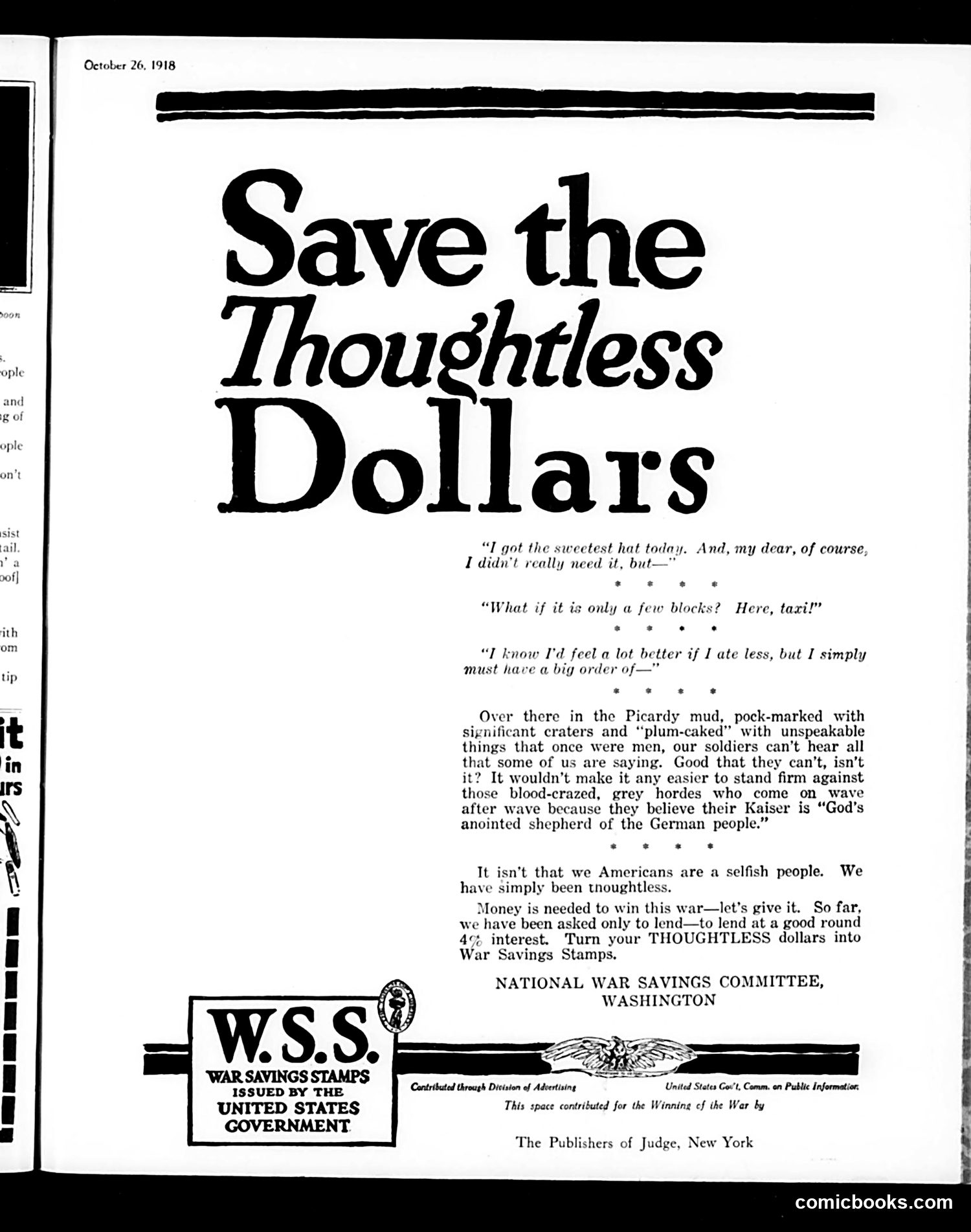
This is a wartime propaganda advertisement, not a satirical cartoon. Published just weeks before WWI's end, it targets American civilian frivolity during the conflict. The piece contrasts trivial consumer spending ("sweetest hat," unnecessary taxi rides, excessive dining) with soldiers suffering in the "Picardy mud"—referencing the real Picardy region in France where brutal fighting occurred. The "grey hordes" and "Kaiser" reference German enemies. The satire is gentle: Americans aren't *selfish*, merely *thoughtless*—they simply don't realize their wasteful purchases undermine the war effort. The solution: convert discretionary spending into War Savings Stamps (4.5% interest bonds that funded the war). This represents the U.S. government's advertising campaign to encourage voluntary financial sacrifice and patriotic consciousness among civilians, framing thrift as a moral duty equal to soldiers' sacrifice.
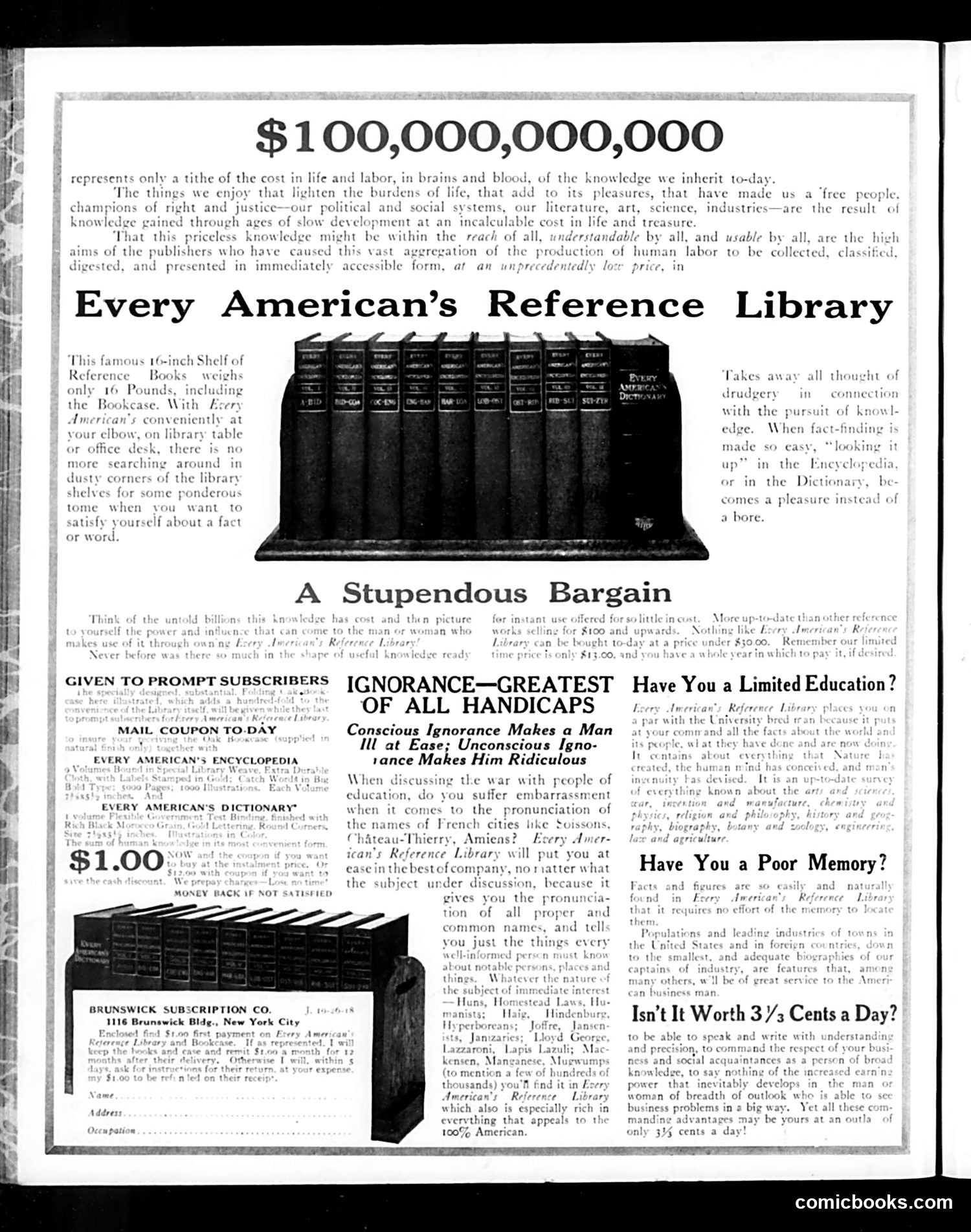
This page is primarily **advertising**, not satire or editorial cartooning. It promotes "Every American's Reference Library"—an encyclopedia/dictionary set marketed as an affordable home reference collection. The rhetorical strategy uses moral and patriotic appeals rather than humor: the opening claims the $100 billion figure represents the "cost in life and labor" of accumulated human knowledge, positioning the library as making this heritage accessible to all Americans as "a free people." The advertisements emphasize **self-improvement through knowledge**, addressing common insecurities: "Ignorance—Greatest of All Handicaps," "Have You a Poor Memory?", "Have You a Limited Education?" The copy suggests that owning this reference set eliminates embarrassment about pronunciation, geography, or lacking knowledge that "every well-informed person must know." The pricing—$1 for the encyclopedia, framed as "3⅓ cents a day"—positions the product as an affordable path to respectability and social competence for middle-class Americans concerned about appearing ignorant. This reflects early 20th-century American anxieties about education and social standing rather than political satire.