
Judge, 1918-10-26 · page 5 of 32
Judge — October 26, 1918 — page 5: what you’re looking at
What you’re looking at
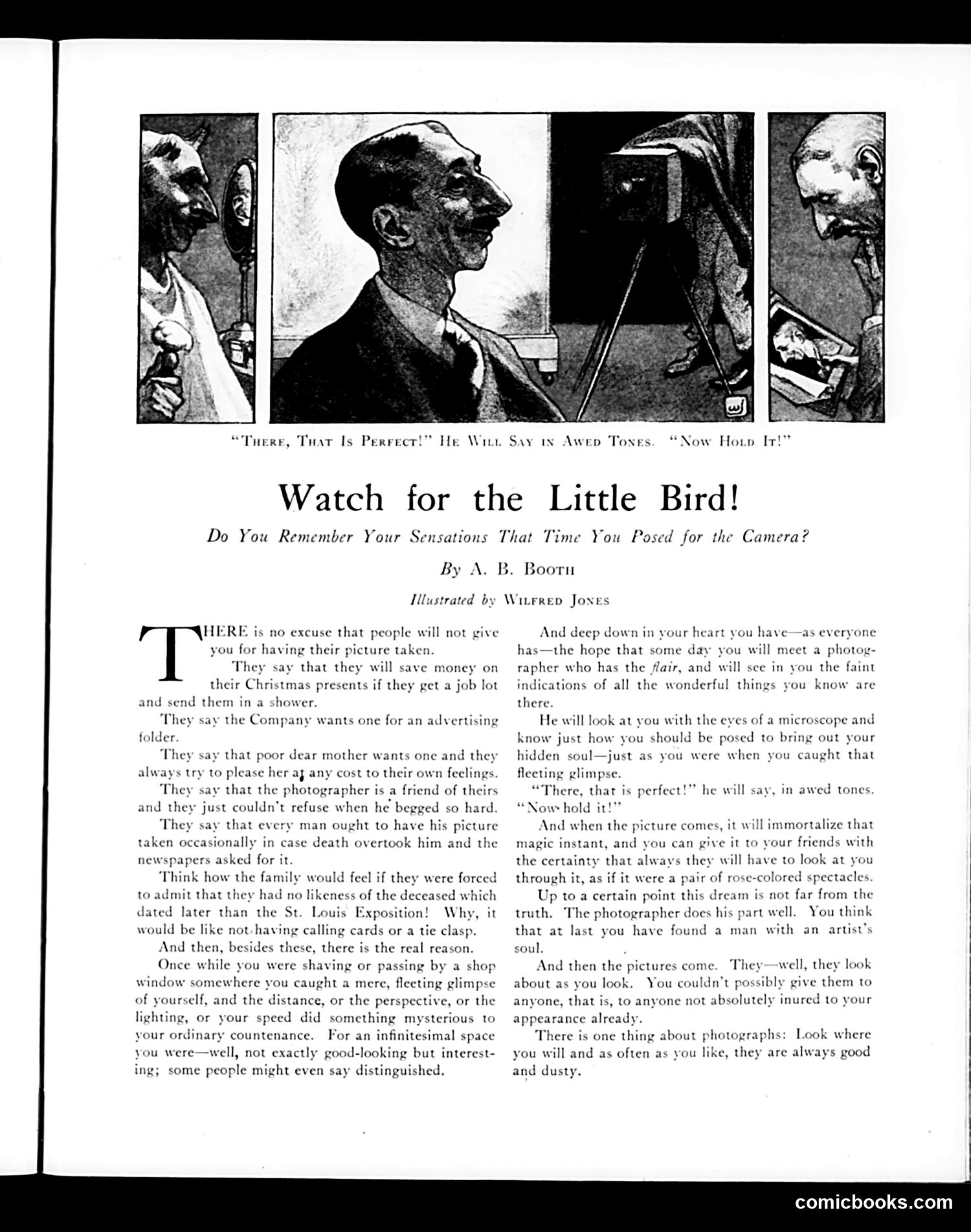
This is not a political cartoon but a humorous essay by A. B. Booth about photography, illustrated by Wilfred Jones. The "little bird" references the photographer's traditional instruction to say "cheese" or watch for a signal (bird) during portrait sessions. The essay satirizes the romanticized expectations people have about professional photography—hoping the photographer will magically capture their "hidden soul" and best self. Booth humorously deflates this dream, noting that photographs actually reveal people as they are: the poses feel awkward, and the results often disappoint. The illustrations show a photographer directing subjects through various poses and expressions, capturing the theatrical, often uncomfortable nature of early 20th-century portrait photography. The satire gently mocks both photographers' grandiose claims and subjects' naive hopes.
📄 Transcribed text from this page (OCR, searchable)
Machine-transcribed from the original scan — historical spelling and the odd misread are preserved.
He Wu “Tuere, Tat Is Perrect!” . SAY “Now Houp bh tx Awep Tones Watch for the Little Bird! Do You Remember Your Sensations That Time You Posed for the Camera? By A. B . Booru Illustrated by Witered Jones HERE is no excuse that people will not give you for having their picture taken. They say that they will save money on their Christmas presents if they get a job lot and send them in a shower. They say the Company wants one for an advertising folder. They say that poor dear mother wants one and they s try to please her aj any cost to their own feelings. ay that the photographer is a friend of theirs » just couldn’t refuse when he begged so hard. y man ought to have his picture ¢ death overtook him and the They say that eve taken occasionally in ca newspapers asked for it. ‘Think how the family would feel if they were forced to admit that they had no likeness of the deceased which dated later than the St. Louis Exposition! Why, it would be like not-having calling cards or a tie clasp. And then, besides these, there is the real reason. Once while you were shaving or passing by a shop window somewhere you caught a mere, fleeting glimpse of yourself, and the distance, or the perspective, or the lighting, or your speed did something mysterious to For an infinitesimal space good-looking but interest- your ordinary countenance. you were—well, not exact] ing; some people might even say distinguished. And deep down in your heart you have—as everyone has—the hope that some day you will meet a photc rapher who has the flair, and will sce in you the faint indications of all the wonderful things you know are there. He will look at you with the eves of a microscope and know just how you should be posed to bring out your hidden soul—just as you were when you caught that fleeting glimpse. “There, that is perfect!” he will say, } in awed tones. ow hold it And when the picture comes, it will immortalize that magic instant, and you can give it to your friends with the certainty that always they will have to look at you through it, as if it were a pair of rose-colored spectacles. Up to a certain point this dream is not far from the truth. The photographer does his part well. You think that at last you have found a man with an artist’s soul. And then the pictures come. hey—well, they look about as you look. You couldn't possibly give them to anyone, that is, to anyone not absolutely inured to your appearance already. There is one thing about photographs: you will and as often as you like, the ¢ always good and dusty. Look where comicbooks.com