
Judge, 1918-10-26 · page 22 of 32
Judge — October 26, 1918 — page 22: what you’re looking at
What you’re looking at
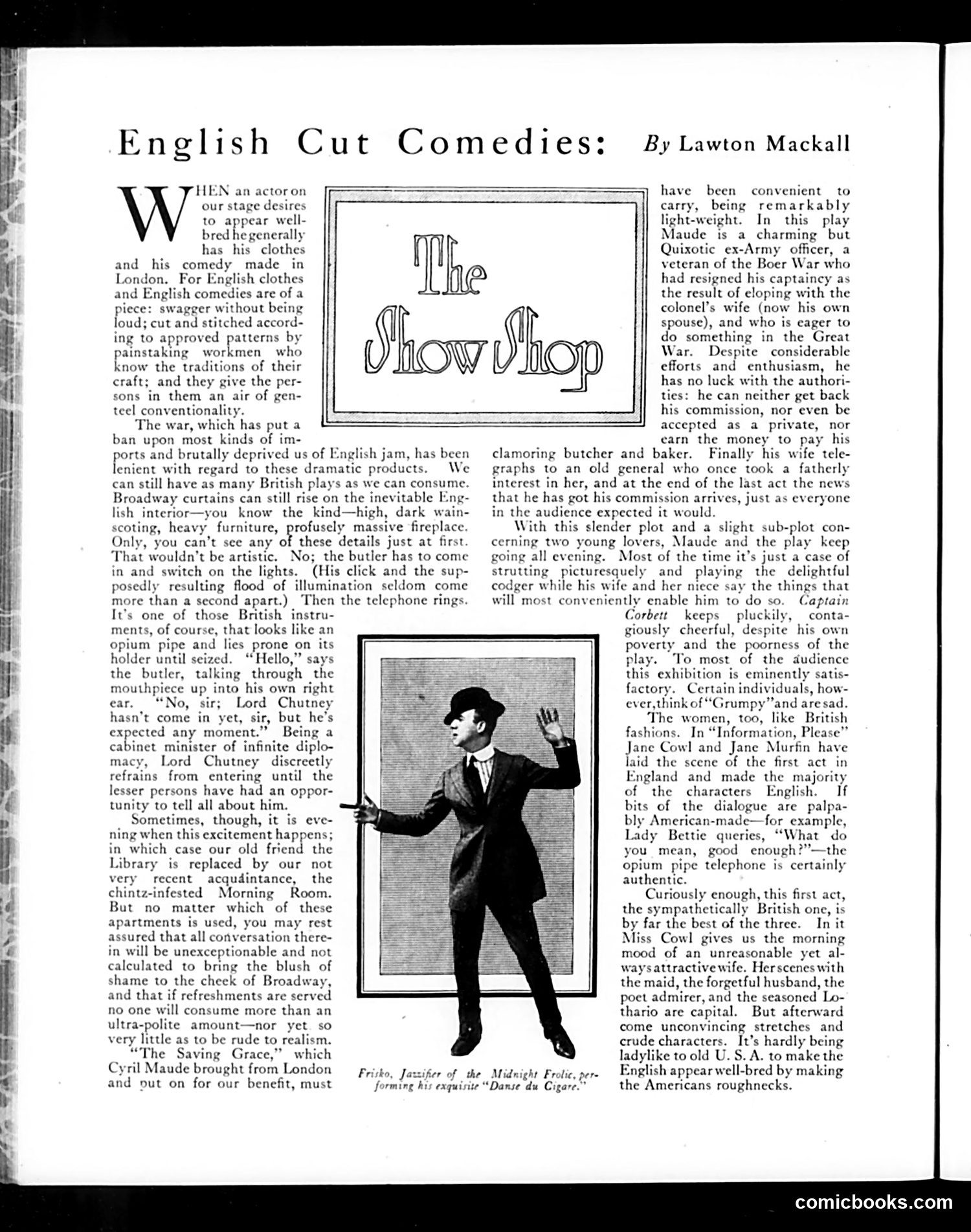
This article by Lawton Mackall reviews English comedies playing on Broadway. The central image shows an actor in the featured play "The Show Shop," performing in the mannered, physically expressive style typical of these productions. Mackall argues that English plays and clothes share a refined quality—"swagger without being loud"—and notes that wartime import restrictions haven't stopped British theatrical imports from flooding American stages. He describes their formulaic nature: drawing rooms with electric lights, telephone interruptions, and conveniently resolved plots. The review discusses specific plays: "The Saving Grace" (starring Cyril Maude as a bumbling ex-officer) and "Information, Please" (featuring Jane Cowl and Jane Murfin), which deliberately set scenes in England to enhance their "English appeal." Mackall gently mocks how American audiences find these plays satisfactory, though some viewers recognize their shallow characterization and borrowed dialogue as distinctly "American-made" beneath the English veneer—a critique of theatrical artifice and transatlantic cultural borrowing.
📄 Transcribed text from this page (OCR, searchable)
Machine-transcribed from the original scan — historical spelling and the odd misread are preserved.
Engli h Cut Comedies: By Lawton Mackall HEN an actoron convenient to been have our stage desires to appear well- bred he generally has his clothe and his comedy made in London. For English clothes and English comedies are of a piece: swagger without being loud; cut and stitched accord- ing to approved patterns by painstaking workmen who know the traditions of their craft; and they give the per- sons in them an air of gen- teel conventionality. remarkably y, being light-weight. In this play Maude is a charming but carr Quixotic ex-Army officer, a veteran of the Boer War who had resigned his captaincy as the result of eloping with the colonel’s wife (now his own spouse), and who is eager to do something in the Great War. Despite considerable efforts and enthusiasm, he has no luck with the authori- ties: he can neither get back his commission, nor even be The war, which has put a ban upon most kinds of im- ports and brutally deprived us of English jam, has been lenient with regard to these dramatic products. We can still have as many British plays as we can consume. Broadway curtains can still rise on the inevitable I lish interior—you know the kind—high, dark wain- scoting, heavy furniture, profusely massive fireplace. Only, you can’t see any of these details just at first. That wouldn’t be artistic. No; the butler has to come in and switch on the lights. (His click and the sup- posedly resulting flood of illumination seldom come more than a second apart.) Then the telephone rings. It’s one of those British instru- ments, of course, that looks like an accepted as a private, nor earn the money to pay his clamoring butcher and baker. Finally his wife tele- graphs to an old general who once took a fatherly interest in her, and at the end of the last act the news that he has got his commission arrives, just as everyone in the audience expected it would. With this slender plot and a slight sub-plot con- cerning two young lovers, Maude and the play keep going all evening. Most of the time it’s just a case of strutting picturesquely and playing the delightful codger while his wife and her niece say the things that will most conveniently enable him to do so. Captain ‘orbett keeps pluckily, conta- giously cheerful, despite his own opium pipe and lies prone on its holder until seized. “Hello,” says the butler, talking through the mouthpiece up into his own right ear. “No, sir; Lord Chutney hasn't come in yet, sir, but he’s expected any moment.” Being a cabinet minister of infinite diplo- macy, Lord Chutney discreetly refrains from entering until the lesser persons have had an oppor- tunity to tell all about him. Sometimes, though, it is eve- ning when this excitement happens; in which case our old friend the Library is replaced by our not very recent acqudintance, the chintz-infested Morning Room. But no matter which of these apartments is used, you may rest assured that all conversation there- in will be unexceptionable and not calculated to bring the blush of shame to the cheek of Broadway, poverty and the poorness of the play. To most of the audience this exhibition is eminently satis- factory. Certain individuals, how- ever,think of “Grumpy”’and are sad. The women, too, like British fashions. In “Information, Please” Jane Cowl and Jane Murfin have laid the scene of the first act in England and made the majority of the characters English. If bits of the dialogue are palpa- bly American-made—for example, Lady Bettie queries, “What do you mean, good enough?”—the opium pipe telephone is certainly authentic. Curiously enough, this first act, the sympathetically British one, is by far the best of the three. In it Miss Cowl gives us the morning mood of an unreasonable yet al- waysattractivewife. Herscenes with the maid, the forgetful husband, the and that if refreshments are served no one will consume more than an ultra-polite amount—nor yet so very little as to be rude to realism. “The Saving Grace,” which Cyril Maude brought from London : Frisko, Jaz and out on for our benefit, must 1 of the Midnight Frolic, pere forming his exquisite “Danse du Cigar poct admirer, and the seasoned Lo- thario are capital. But afterward come unconvincing stretches and crude characters. It’s hardly being ladylike to old U.S. A. to make the English appear well-bred by making the Americans roughnecks. comicbooks.com