
Judge, 1918-10-26 · page 16 of 32
Judge — October 26, 1918 — page 16: what you’re looking at
What you’re looking at
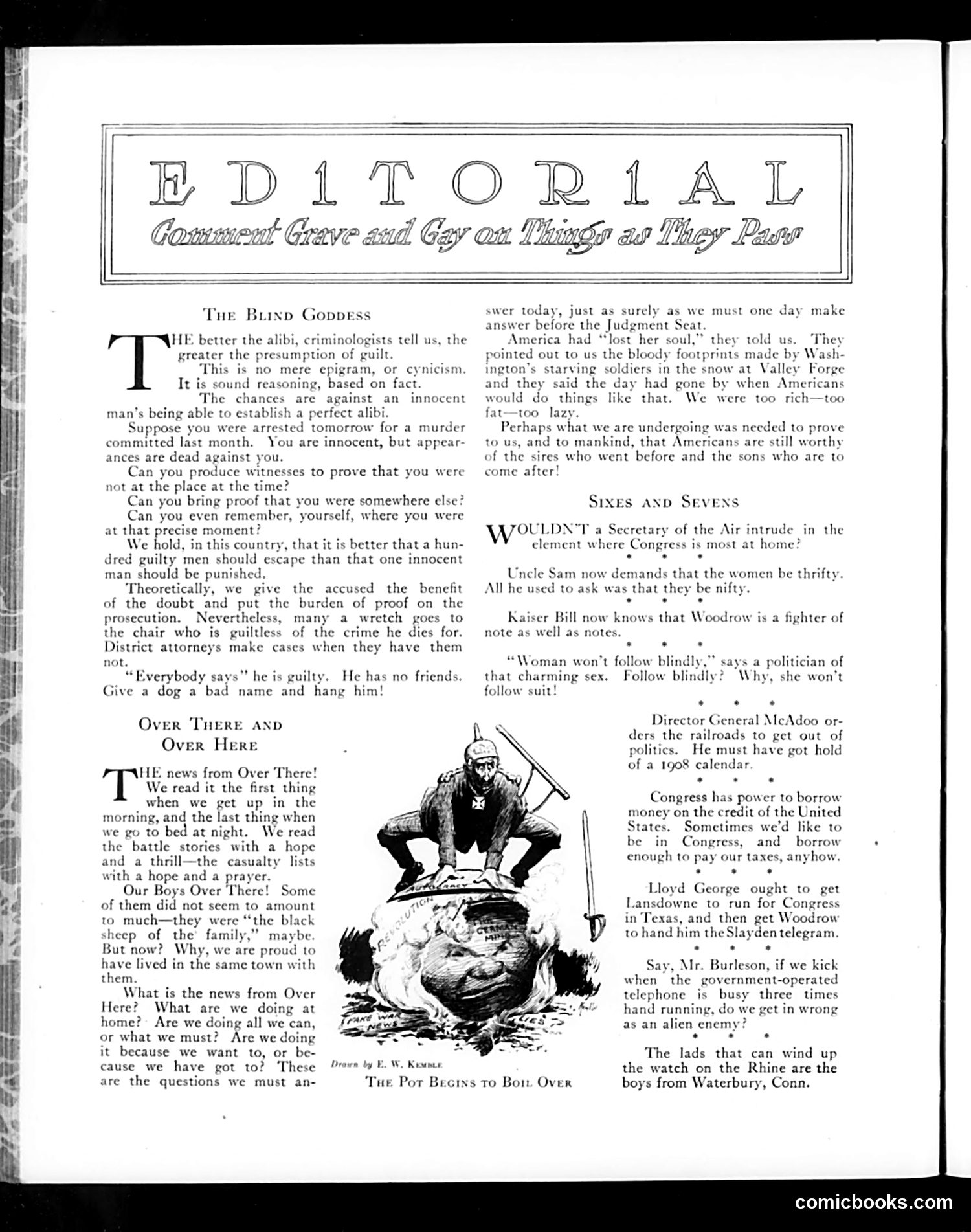
This page contains satirical commentary on American justice and WWI-era politics, not comic strips. **"The Blind Goddess"** argues that the legal system favors the guilty: perfect alibis are suspiciously easy to fabricate, while innocent people struggle to prove their whereabouts. The piece critiques how "everybody says he's guilty" can condemn someone without real evidence—a commentary on mob justice and flawed prosecution. **"Over There and Over Here"** contrasts American soldiers' sacrifice abroad with domestic complacency. It challenges whether Americans at home are genuinely committed to the war effort or merely going through motions. References to Valley Forge invoke patriotic comparison: past generations sacrificed; are current Americans worthy successors? **The brief jokes** mock wartime policies (women's thrift campaigns, Director General McAdoo's railroad orders, government phone monopolies) and British politics (Lloyd George, Lansdowne). The central message: America must prove itself worthy of its founding generation through genuine sacrifice, not just rhetoric.
📄 Transcribed text from this page (OCR, searchable)
Machine-transcribed from the original scan — historical spelling and the odd misread are preserved.
d Gay on Things as They Pare Tue Buixp Goppess HE better the alibi, cri greater the presumption of guilt. This is no mere epigram, or cynicism It is sound reasoning, based on fact. The chances are against an innocent man’s being able to establish a perfect alib Suppose you were arrested tomorrow for a murder committed last month. You are innocent, but appear- ances are dead against you. Can you produce witnesses to prove that you were not at the place at the time? Can you bring proof that you were somewhere els Can you even remember, yourself, where you were at that precise moment? We hold, in this country, that it is better that a hun- dred guilty men should escape than that one innocent man should be punished. Theoretically, we give the accused the benefit of the doubt and put the burden of proof on the prosecution. Nevertheless, many a wretch goes to the chair who is guiltless of the crime he dies for. District attorneys make cases when they have them not. “Everybody says” he is guilty. He has no friends. Give a dog a bad name and hang him! Over ‘There AND Over Here HE news from Over There! We read it the first thing when we get up in the morning, and the last thing when we go to bed at night. We read the battle stories with a hope and a thrill—the casualty lists with a hope and a prayer. Our Boys Over There! Some of them did not seem to amount to much—they were “the black sheep of the fami 3 But now? Why, we are proud to have lived in the same town with them. What is the news from Over Here? What are we doing at home?» Are we doing all we can, or what we must? Are we doing it because we want to, or be- cause we have got to? These are the questions we must an- Drown by BW. Kestnur inologists tell us, the Tue Por Becins to Bou. Over just as surely as we must one day make answer before the Judgment Seat America had “lost her soul,” they told us. } pointed out to us the bloody footprints made by Wash- ington’s starving soldiers in the snow at Valley Forge and they said the day had gone by when Americans would do things like that. We were too rich—too fat—too lazy. Perhaps what we are undergoing was needed to prove to us, and to mankind, that Americans are still worthy of the sires who went before and the sons who are to come after! AND SEVENS Secretary of the Air intrude in the element where Congress is most at hom . * * Uncle Sam now demands that the women be thrifty. Ml he used to ask was that they be nifty. . . * iser Bill now knows that Woodrow is a fighter of note as well as notes. . . says a politician of Why, she won't “Woman won't follow blindly,” that charming sex. Follow blindly? follow suit! * 8 6 Director General McAdoo or- ders the railroads to get out of politics. He must have got hold of a 1908 calendar . . * Congress has power to borrow money on the credit of the United States. Sometimes we'd like to be in Congress, and borrow enough to pay our taxes, anyhow. . . . Lloyd George ought to get Lansdowne to run for Congress in Texas, and then get Woodrow to hand him the Slayden telegram. * . * y, Mr. Burleson, if we kick when the government-operated telephone is busy three times hand running, do we get in wrong as an alien enemy? . * . The lads that can wind up the watch on the Rhine are the boys from Waterbury, Conn. comicbooks.com