
A complete issue · 28 pages · 1918
Judge — January 12, 1918
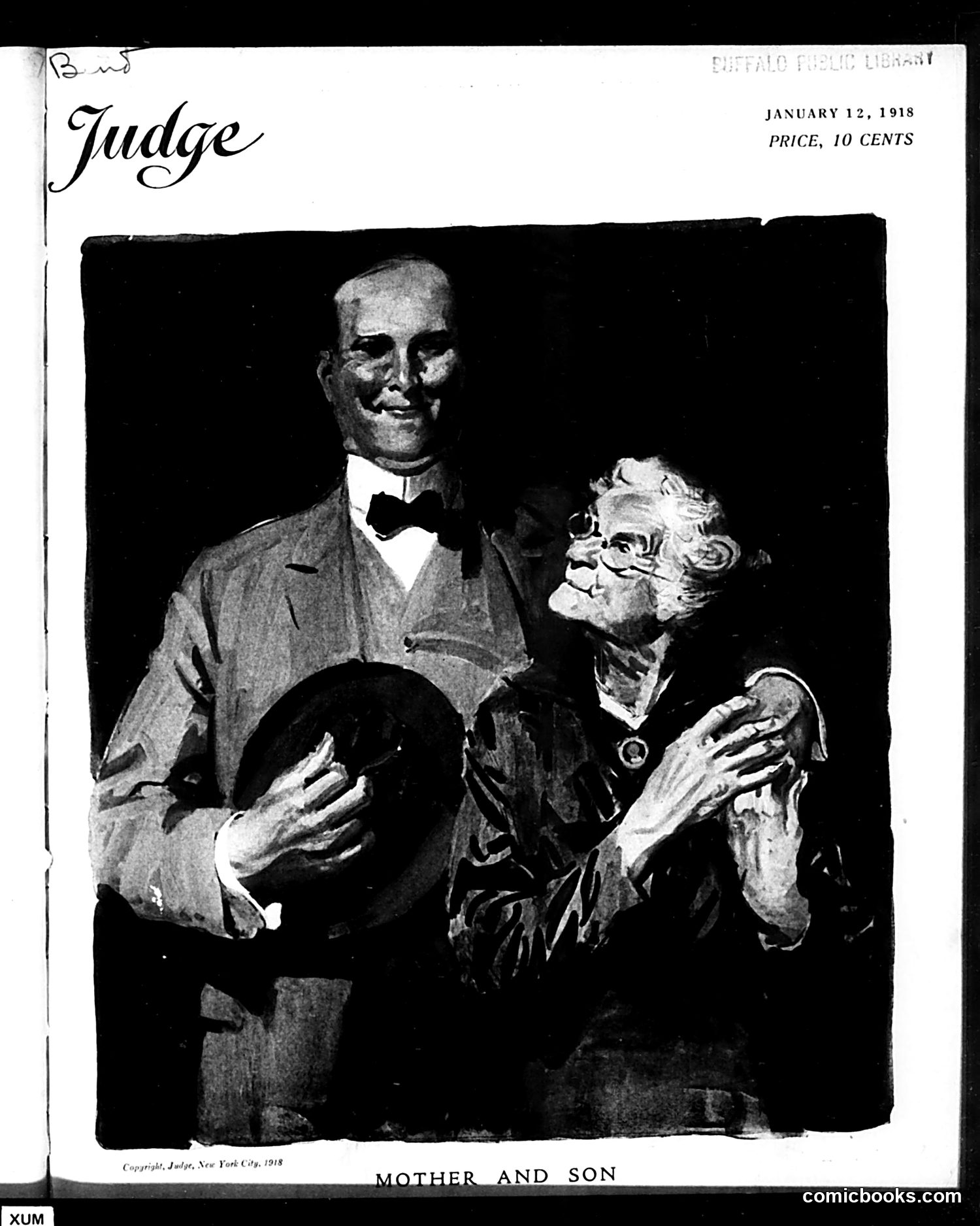
This cartoon depicts an elegantly dressed man in formal attire (tuxedo and bow tie) standing beside an elderly woman wearing glasses. The caption reads "Mother and Son." Given the 1918 date during World War I, this likely satirizes American attitudes toward the war or military service. The formal presentation and the pairing of generations suggests commentary on familial pressure or generational dynamics regarding war participation. However, without additional context identifying the specific individuals caricatured or the particular event referenced, I cannot definitively explain the satire's precise target. The image quality and stylistic conventions typical of Judge's political cartoons suggest social commentary, but the exact point remains unclear from the visual and textual information alone.
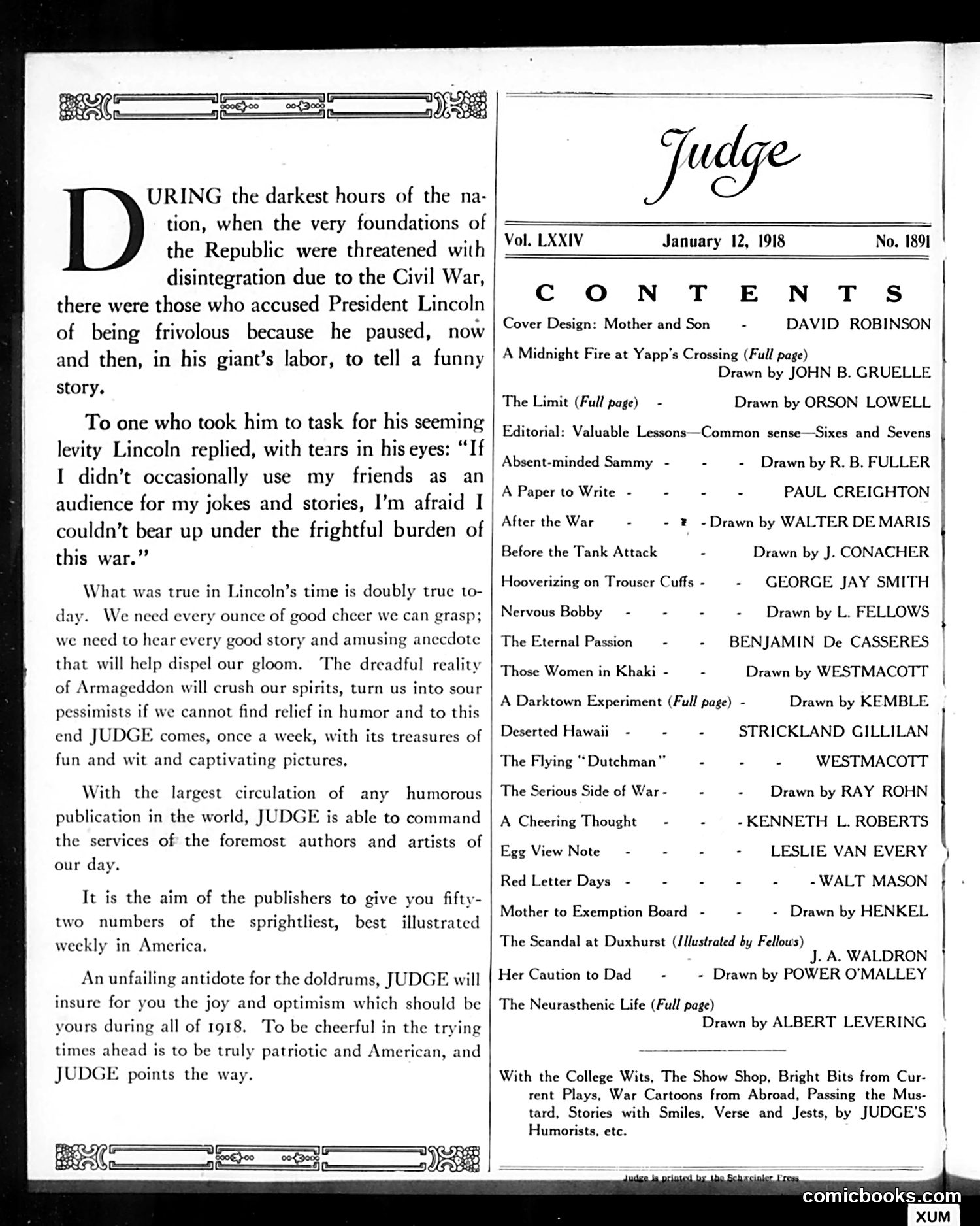
This is primarily a **contents page** for Judge magazine (Vol. LXXIV, January 12, 1918), not a political cartoon. The page lists articles and illustrations in that issue. The **editorial text** on the left references President Lincoln's use of humor during the Civil War to cope with wartime stress, arguing that humor remains essential during WWI (America was fighting in 1918). Judge positions itself as providing necessary comic relief during a national crisis. The masthead and contents listing show Judge was a prestigious humor magazine featuring prominent artists and writers of the era. The actual cartoons and illustrations referenced—such as "A Midnight Fire at Yapp's Crossing" and "Before the Tank Attack"—appear on other pages not visible here.
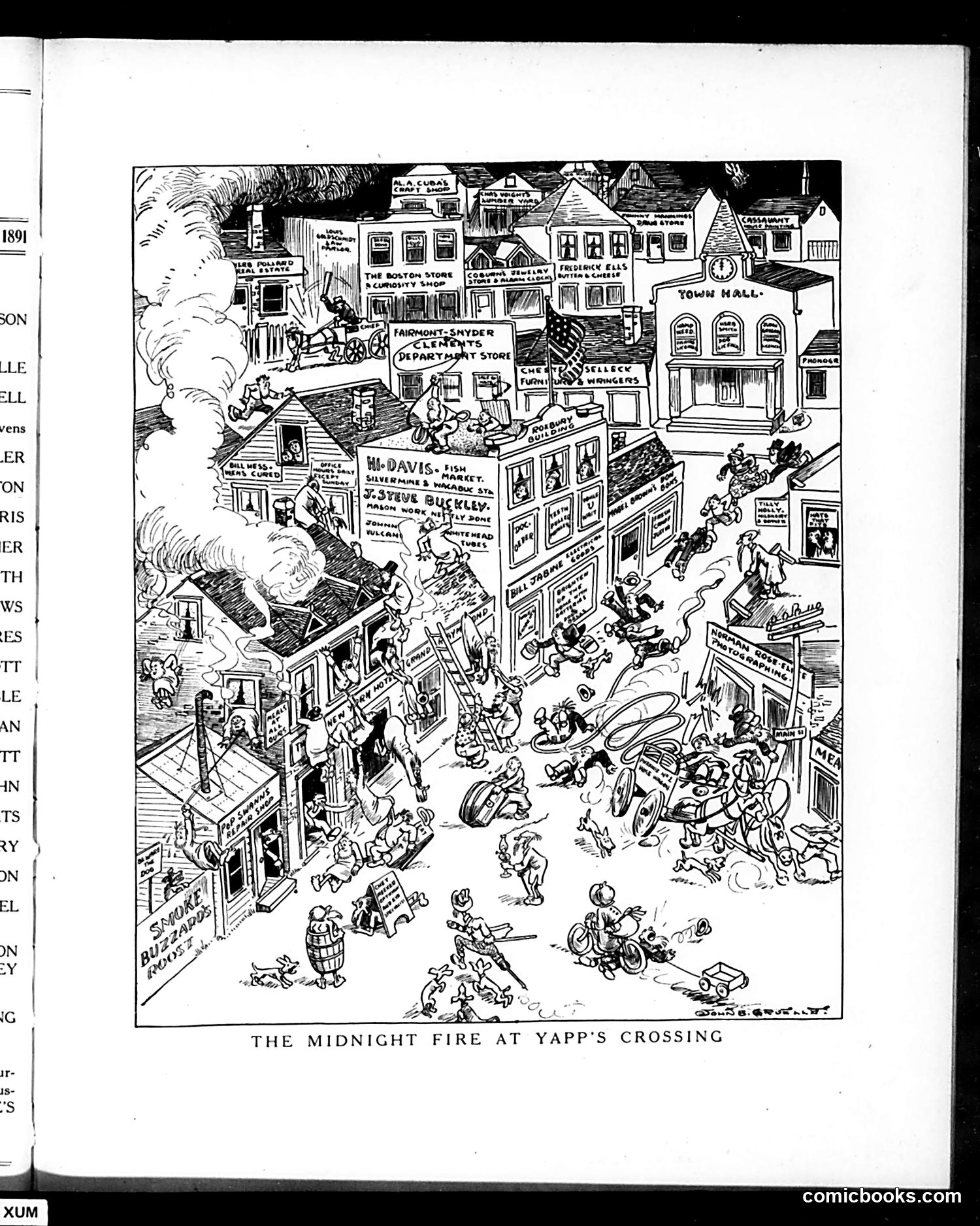
This is a humorous illustrated scene depicting chaos at a town center during a nighttime fire. The cartoon shows a busy street with various storefronts (Town Hall, Davis Fish Market, Clement's Department Store, and others) engulfed in smoke and flames on the left side. The satire appears to target small-town emergency response and public panic. Civilians scatter chaotically—some on bicycles and motorcycles, others running or standing confused. The scene mocks both the disorder of firefighting efforts and community reactions to disaster. Without additional context, the specific "Yapp's Crossing" location and whether particular figures represent actual people or events remains unclear. The cartoon likely comments on general small-town inefficiency and hysteria rather than a specific incident.
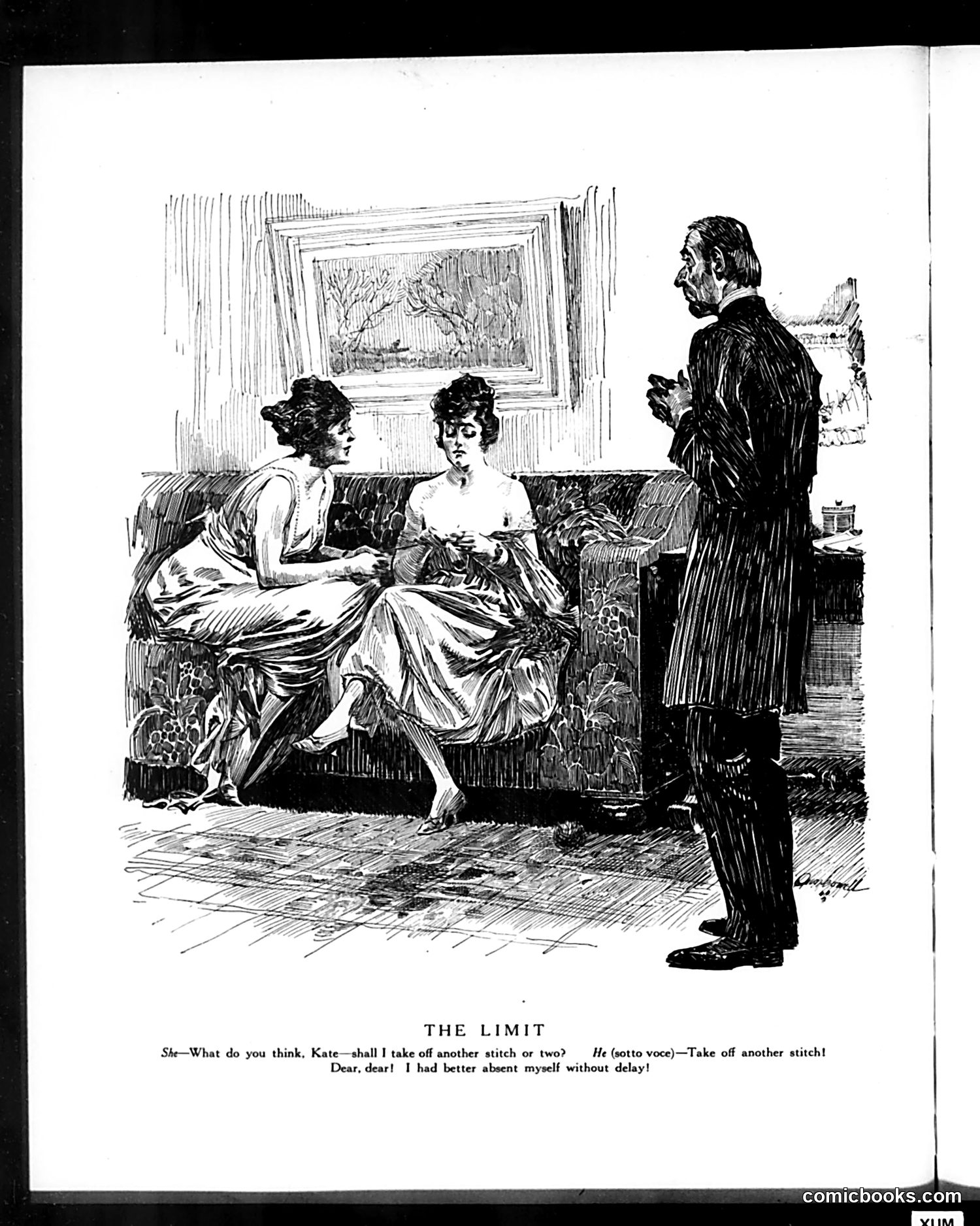
This cartoon satirizes marital dynamics and social expectations around needlework. A woman sits with her companion, both engaged in sewing, while a man (apparently the husband) stands observing. The woman asks her friend whether she should add more stitches to her work. The husband interjects loudly, insisting she take another stitch before leaving—claiming he'd "better absent myself without delay." The satire targets the husband's impatience with his wife's domestic pursuits and his urgent need to escape. The joke hinges on the phrase "the limit"—suggesting the wife's sewing represents the absolute maximum of tedious activity he can tolerate before departing. It's social commentary on Victorian-era domestic life and marital frustration with women's handicraft obligations.
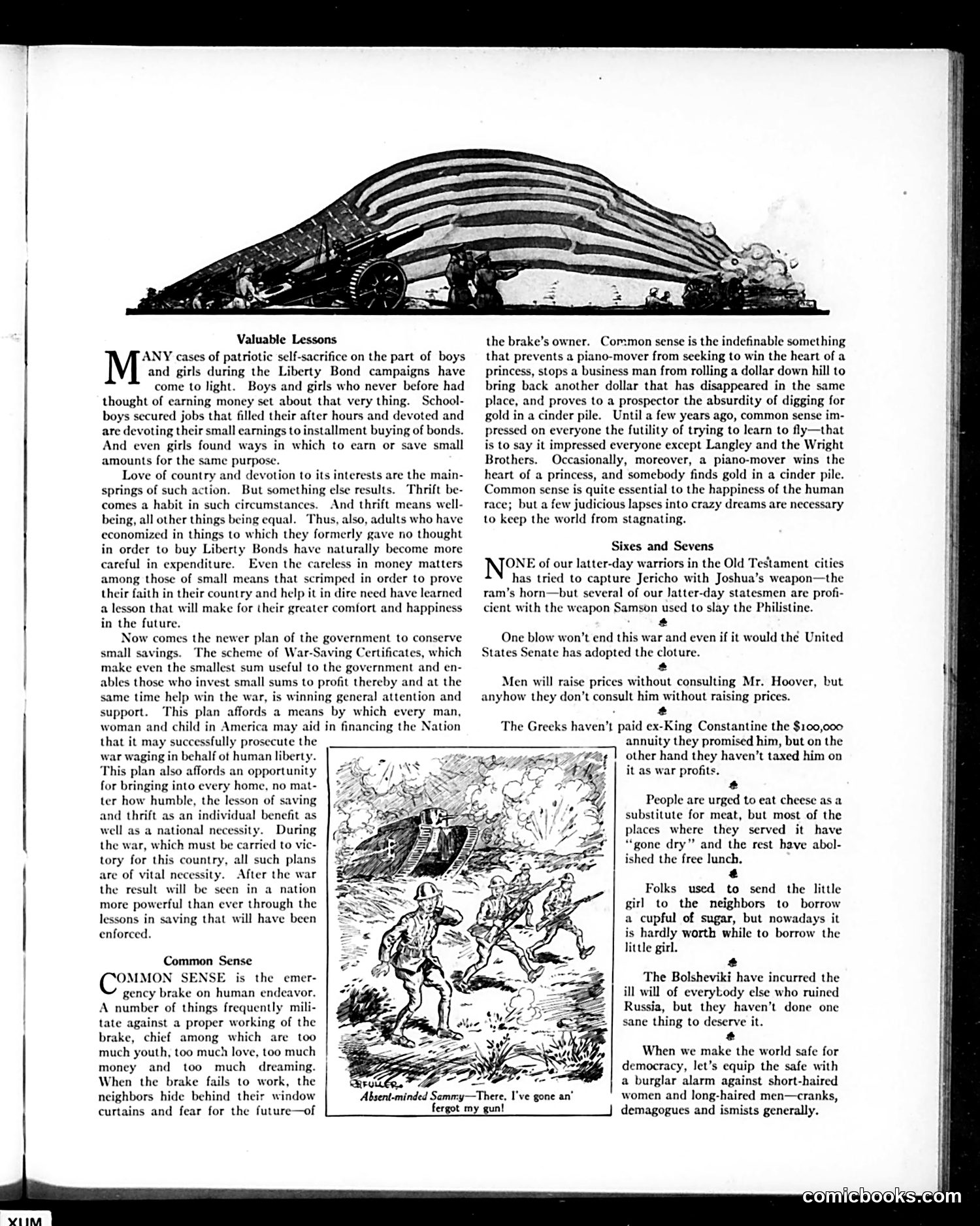
The page contains three distinct sections of satirical commentary rather than a single unified cartoon. **"Valuable Lessons"** discusses young people earning money through Liberty Bond campaigns during WWI, advocating thrift and financial responsibility. **"Common Sense"** mocks excessive sentimentality about money and dreaming, using a piano-moving anecdote to critique impractical idealism. **"Sixes and Sevens"** presents brief satirical quips on contemporary issues: criticism of Senate isolationism, price controls under Hoover, Greek finances, cheese rationing, sugar borrowing customs, and Russian Bolshevism. The central illustration shows a soldier in a trench—likely depicting WWI combat conditions. Overall, the page combines wartime patriotic messaging with domestic social commentary typical of Judge's satirical approach during the early 1920s.
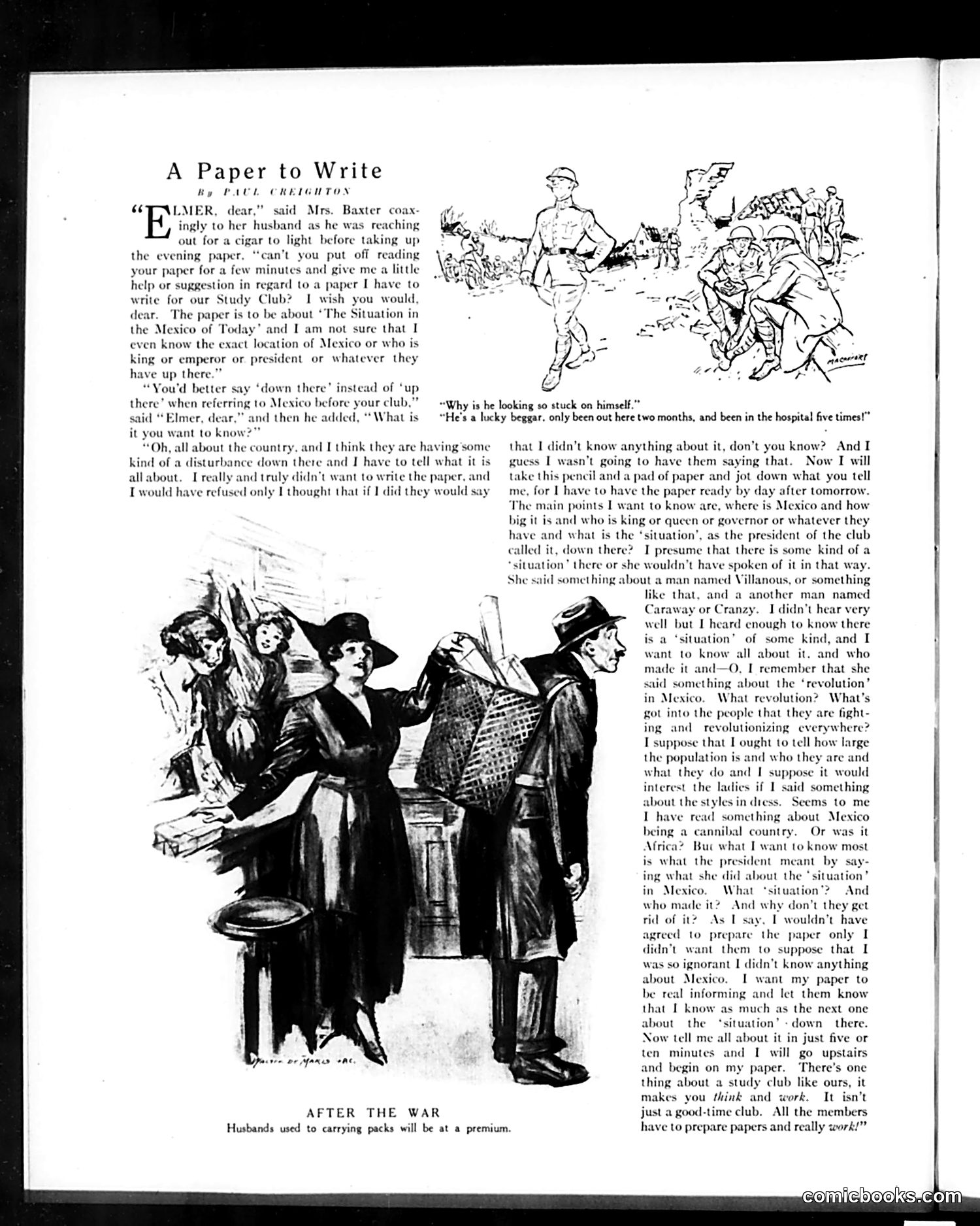
The page satirizes early-20th-century domestic life and gender roles. The main story depicts a husband pressuring his wife to write a paper about Mexico for a study club, despite her admitted ignorance. She complains he wants her to research Mexico's political situation, revolution, and leadership—topics she finds overwhelming—just to prepare remarks for their club meeting. The lower cartoon, captioned "After the War / Husbands used to carrying packs will be at a premium," jokes that wives will value husbands trained by military service to carry heavy loads, likely referring to post-WWI domestic labor expectations. The satire targets both male obliviousness to women's burdens and the era's assumptions about wives' intellectual obligations to their husbands' social standing.
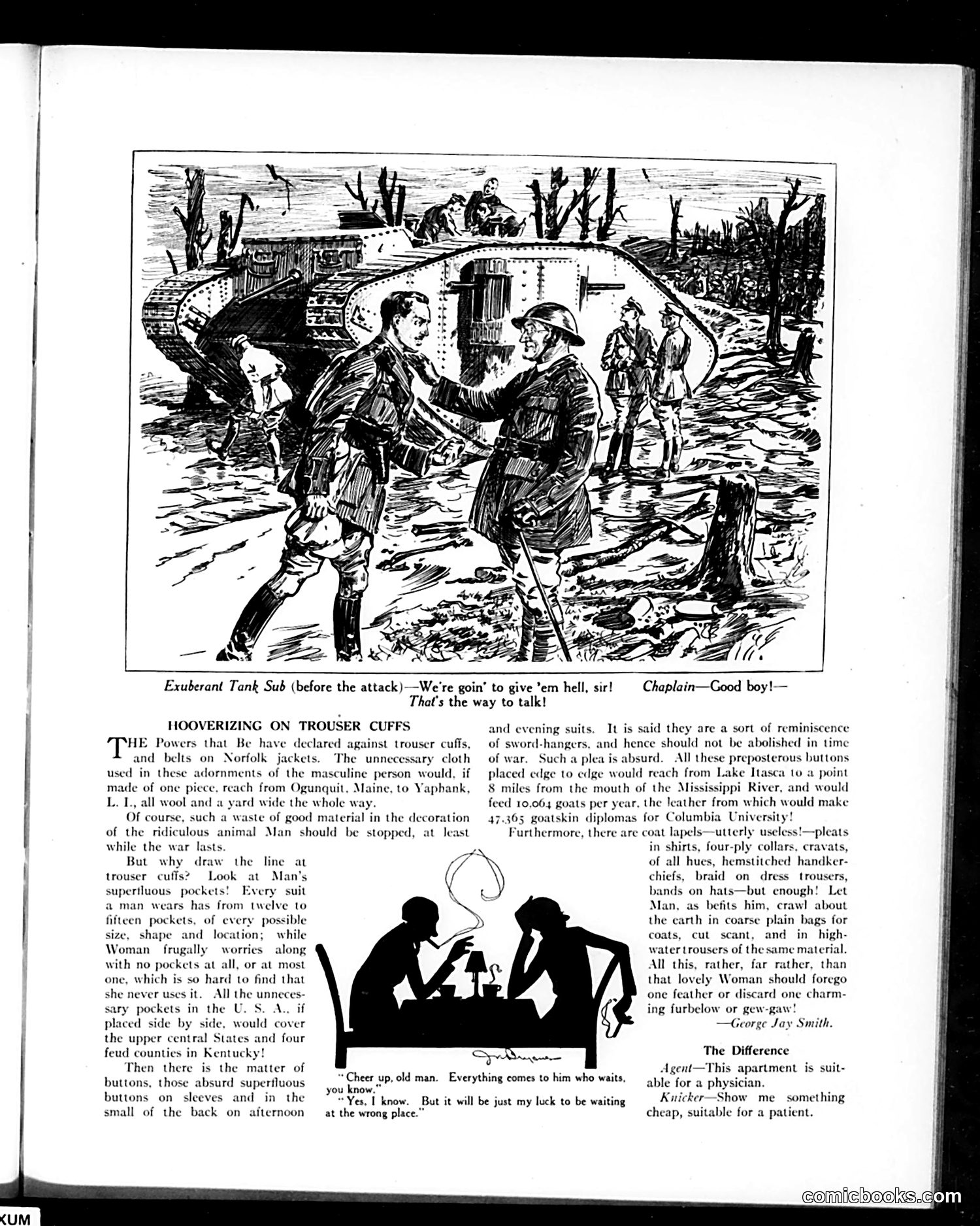
This page satirizes wartime material conservation efforts, likely from WWI. "Hooverizing" refers to Herbert Hoover's voluntary rationing campaigns urging Americans to conserve resources for the war effort. The top cartoon shows a tank commander and chaplain before battle—establishing a patriotic, serious tone that contrasts with the article below. The main piece mockingly attacks government calls to eliminate men's trouser cuffs and other "unnecessary" garments to save fabric. The satire's point: the author lists absurdly inflated calculations (buttons allegedly stretching from Lake Itasca to the Mississippi River mouth; cuffs reaching Maine to Long Island) to expose how ridiculous these conservation mandates are. Crucially, the piece argues these restrictions should apply equally to women's clothing—yet notes women's garments (feathers, "furbelows," decorative elements) are exempted. The author sarcastically suggests women should sacrifice their fashion instead of men. The bottom cartoon about a cheap apartment is unrelated filler humor. Overall: biting criticism of selective, gender-biased wartime sacrifice demands.
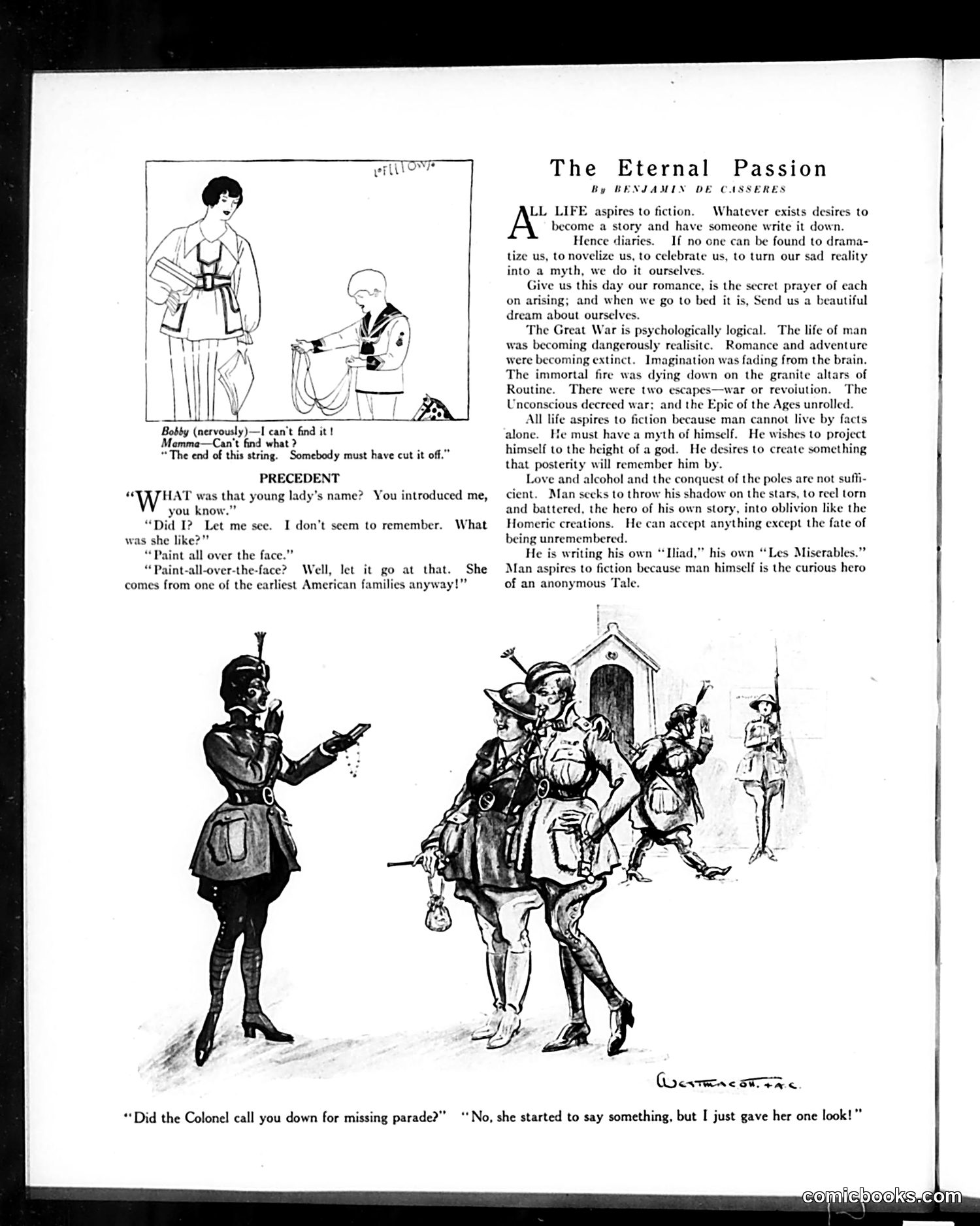
This page combines three distinct elements: two cartoon vignettes and a philosophical essay by Benjamin de Casseres. **The cartoons** depict domestic military-life humor from the WWI era. The top comic shows a child unable to find "the end of this string"—likely satirizing wartime rationing or material shortages. The "Precedent" dialogue jokes about upper-class social amnesia: a man forgets a woman's name but remembers she wore heavy makeup and came from an "earliest American family" (old money), suggesting superficial social judgment. The bottom cartoon mocks military discipline: a soldier avoids punishment for missing parade by intimidating his superior with "one look." **The essay** is a meditation on why humans crave narrative and myth-making, explicitly connecting this impulse to WWI. De Casseres argues that peacetime reality had become unbearably dull, driving men toward war as an escape into epic storytelling. He suggests humanity needs to mythologize itself—to become heroes of our own tales rather than face anonymous, forgotten lives. The juxtaposition suggests satirical commentary on wartime sentimentality and romanticization.
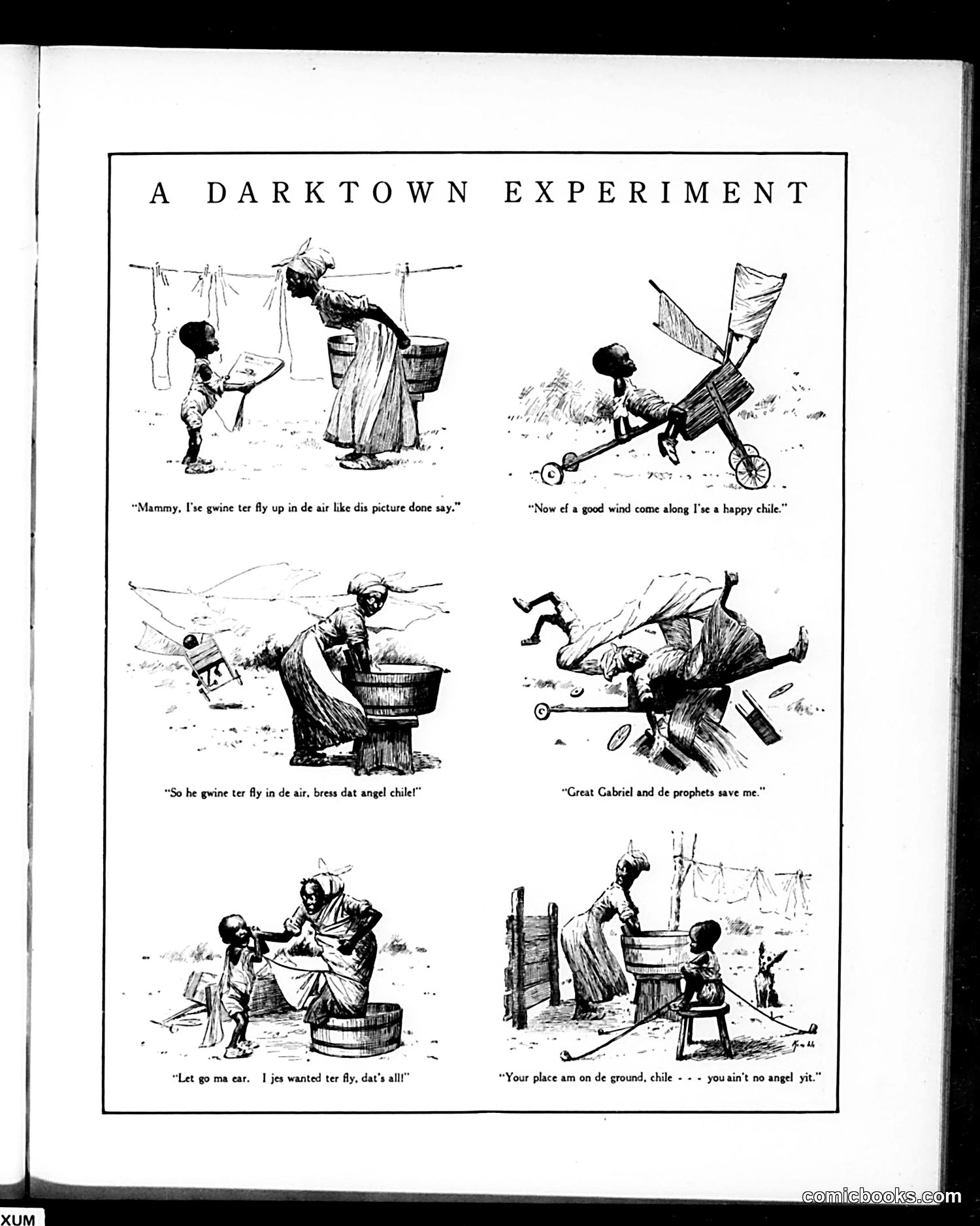
This is a racist cartoon series depicting Black children attempting to fly by imitating the Wright brothers' early aviation experiments. Each panel shows a child attempting flight with makeshift contraptions—clothesline wings, wooden aircraft, baskets—resulting in crashes and failure. The satire works on two levels: it mocks both the aviation pioneers' early struggles AND uses racist caricature and dialect to ridicule Black people as foolishly imitating white technological achievement without understanding it. The title "Darktown Experiment" references a long-running stereotypical comic trope depicting African American characters in absurd situations. This reflects early 20th-century attitudes portraying Black people as comic subjects unfit for serious endeavors, while the aviation context dates the piece to the Wright brothers era (1903 onward).
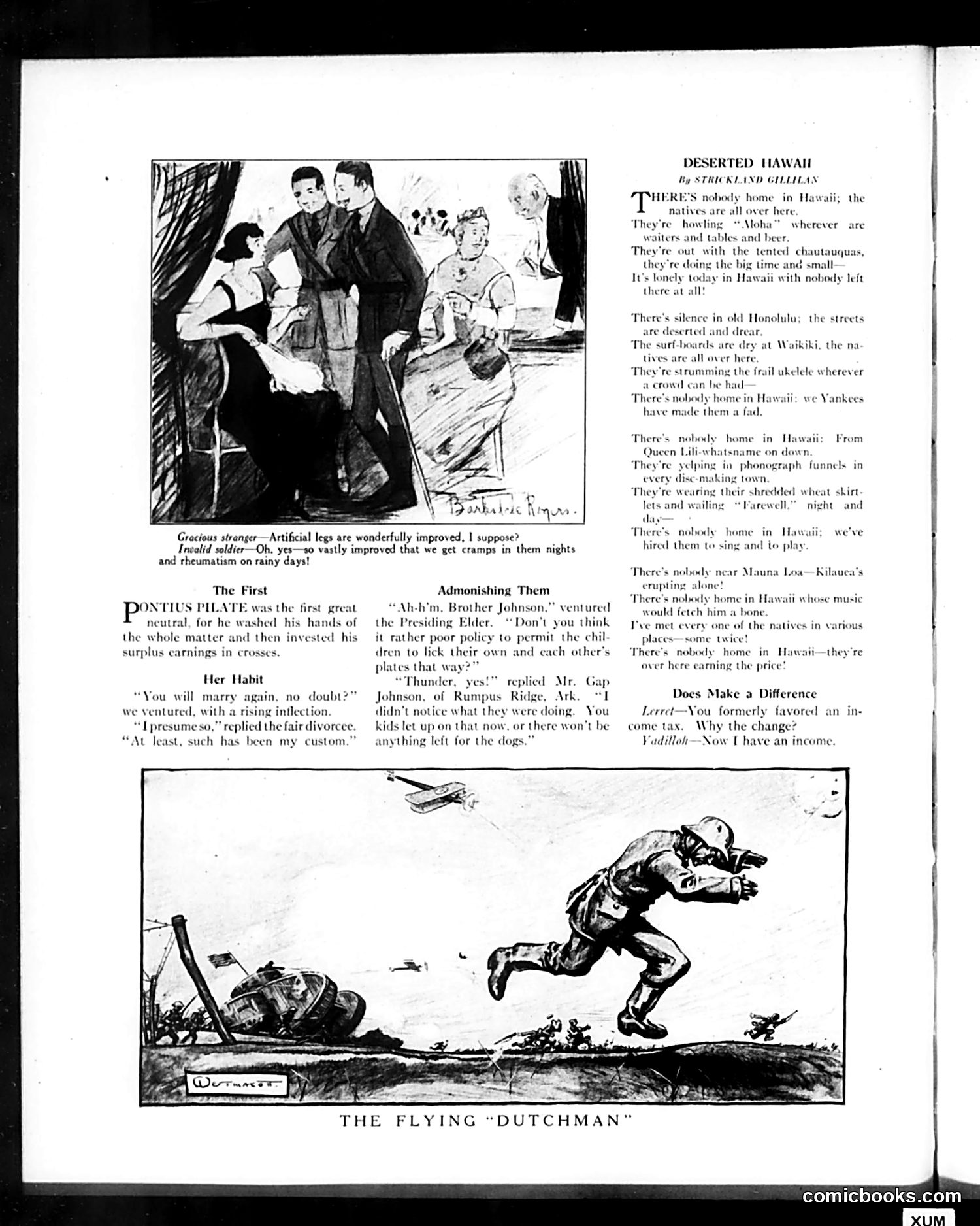
This page contains satirical commentary on Hawaiian tourism and labor during the early 20th century. The main piece, "Deserted Hawaii" by Strickland Gilliland, laments that native Hawaiians have left the islands to work on the American mainland—performing in vaudeville shows, chautauqua tents, and photograph phonograph recordings. The poem treats this as a tragedy: Hawaii is now empty of natives, reduced to tourist attractions while the indigenous people labor elsewhere for American entertainment industries. The cartoon "The Flying Dutchman" (bottom) appears unrelated, depicting a soldier or worker in action, possibly referencing wartime or industrial labor. The page's other jokes mock marriage, divorce, artificial limbs for war veterans, and tax policy—typical Judge magazine fare combining social commentary with dark humor about contemporary American life.
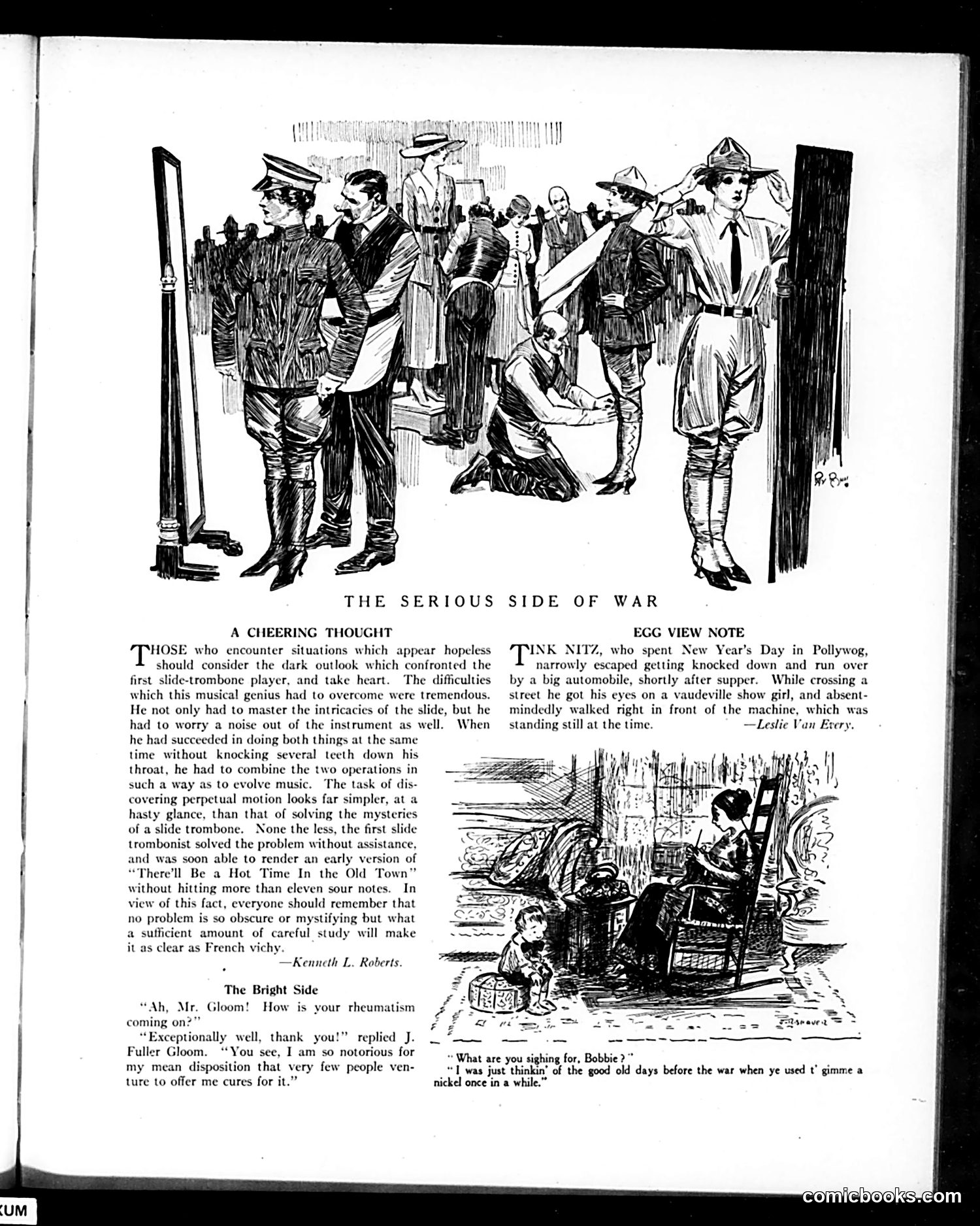
This page satirizes WWI-era American attitudes through three humor pieces: **"A Cheering Thought"** (by Kenneth L. Roberts): An absurdist essay comparing the first slide-trombone player's struggles to modern problems. The joke suggests that if someone could master the impossibly difficult trombone, any problem becomes solvable through persistence—a morale-boosting message for wartime readers facing difficulties. **"The Bright Side"**: A brief joke about J. Fuller Gloom, whose notorious meanness paradoxically *helps* his rheumatism—no one bothers offering him remedies because they dislike him. Dark humor about finding silver linings. **"Egg View Note"** (by Leslie Van Every): An anecdote about "Tink Nitz" nearly hit by a car while distracted by a vaudeville performer on New Year's Day in Pollywog. Below, a child sighs for pre-war days when he'd receive nickels—nostalgia for simpler, more prosperous times before WWI's economic disruptions. Overall, the page uses humor to address wartime hardship and economic strain while maintaining morale through jokes about persistence and finding unexpected benefits in misfortune.
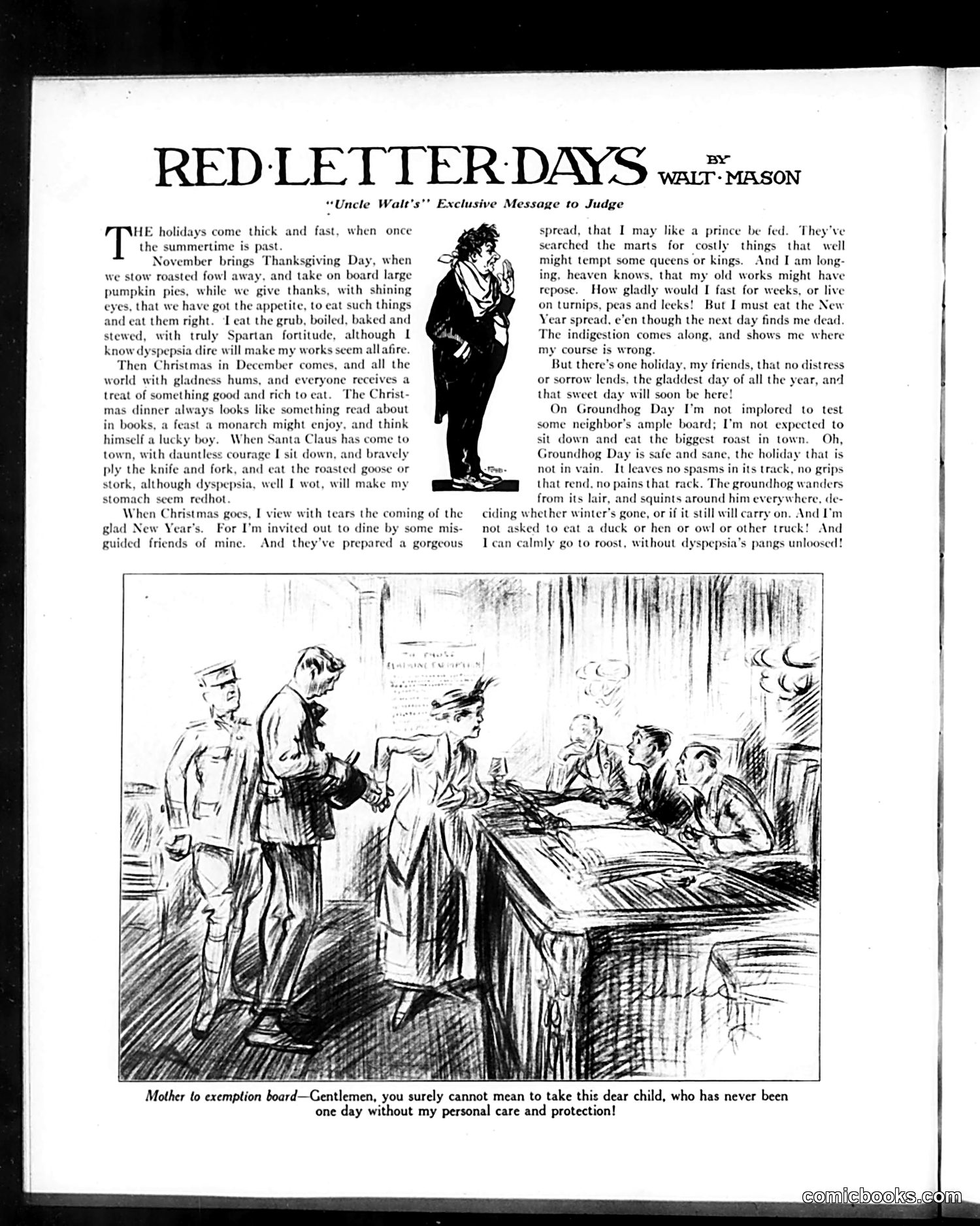
This is a humorous essay by Walt Mason about the burden of holiday feasting. The narrator comically complains about the social obligation to overeat during Thanksgiving, Christmas, and New Year's celebrations—each demanding rich, elaborate meals that trigger his dyspepsia (indigestion). The satire mocks upper-class dining customs and the physical toll of conspicuous consumption. The narrator ironically celebrates Groundhog Day as the only holiday offering relief, since no one expects him to attend banquets or demonstrate his wealth through lavish eating. The accompanying illustration depicts a separate scene: a mother before an "exemption board" (likely a WWI draft board) pleading that her son cannot be conscripted because he requires her constant care and protection. This reflects contemporary anxiety about military service during wartime, showing how mothers claimed their sons were indispensable to family welfare.
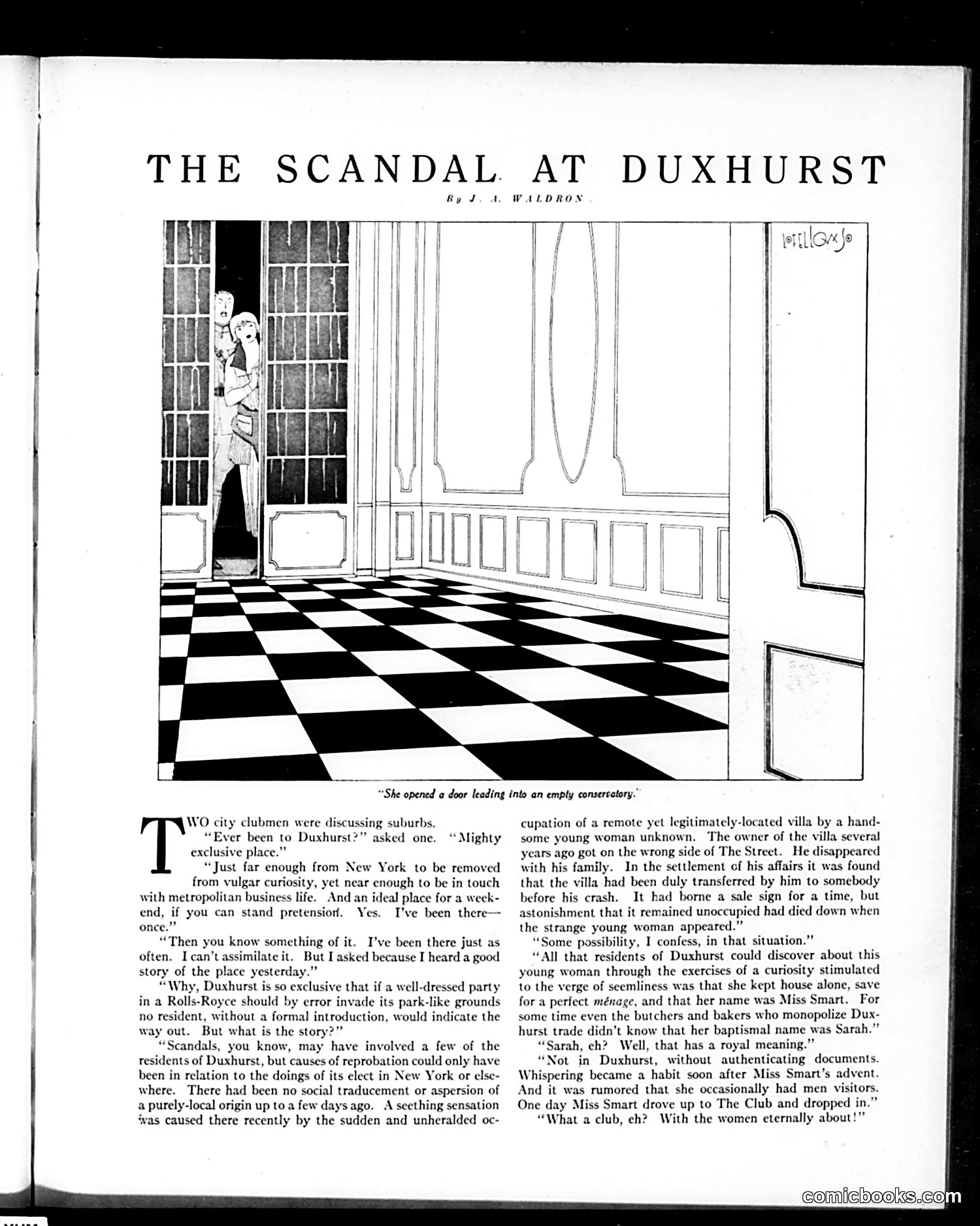
This is a satirical short story illustrated in *Judge* magazine. The narrative mocks the exclusivity and gossip culture of wealthy suburban enclaves near New York City. The plot concerns "Duxhurst," a fictional ultra-exclusive suburb so snobbish that residents won't even give directions to outsiders. A mysterious, well-dressed young woman named Miss Smart mysteriously moves into a vacant villa. Her unexplained presence and occasional male visitors spark intense speculation among the bored, scandal-hungry community. The satire targets two groups: the absurd pretension of exclusive suburbs that isolate themselves from "vulgar curiosity," and the hypocritical moralism of wealthy residents who eagerly generate rumors while maintaining a facade of respectability. The illustration shows Miss Smart entering what appears to be the conservatory—the setup for the scandal the story hints at but doesn't fully reveal.
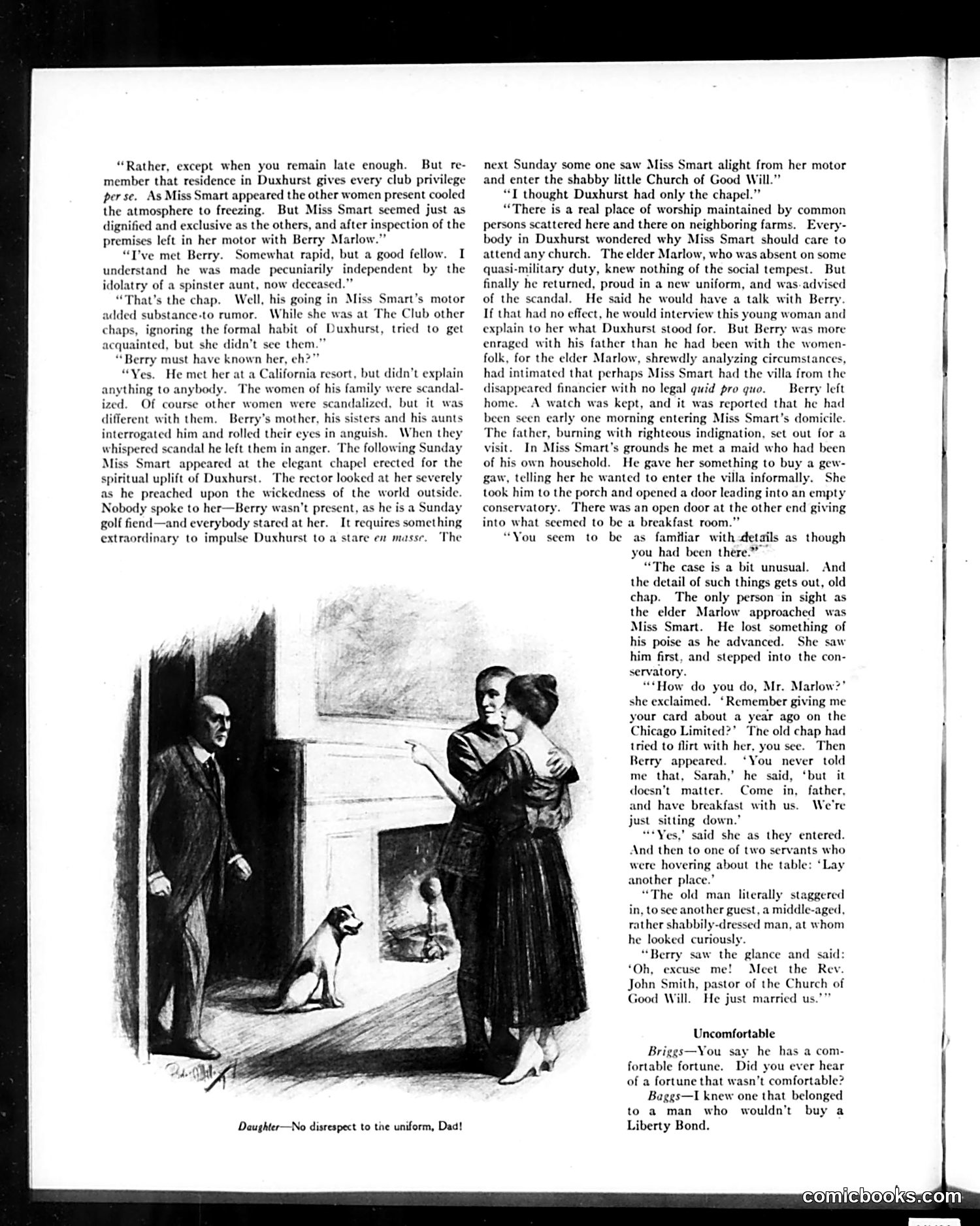
This page satirizes small-town social hypocrisy and class consciousness in "Duxhurst," an affluent suburban community. The narrative concerns Miss Smart, a woman of unclear social standing who arrives in a motor car with Berry Marlow, a wealthy but somewhat dissolute young man. When she attends the exclusive "chapel" (implying the town's fashionable church), society coldly ostracizes her. However, when she later attends the humble "Church of Good Will"—a modest congregation for working-class farmers—the community becomes scandalized, fearing she's an improper woman. The accompanying illustration shows an awkward domestic scene. The satire's point: Duxhurst's moral judgment is entirely superficial and inverted. They condemn her for attending the *less* prestigious church, revealing that their Christianity is purely performative—status-obsessed rather than genuinely spiritual. The "uncomfortable" exchanges between Marlow, his father, and Miss Smart expose how social conventions mask hypocrisy and class snobbery.
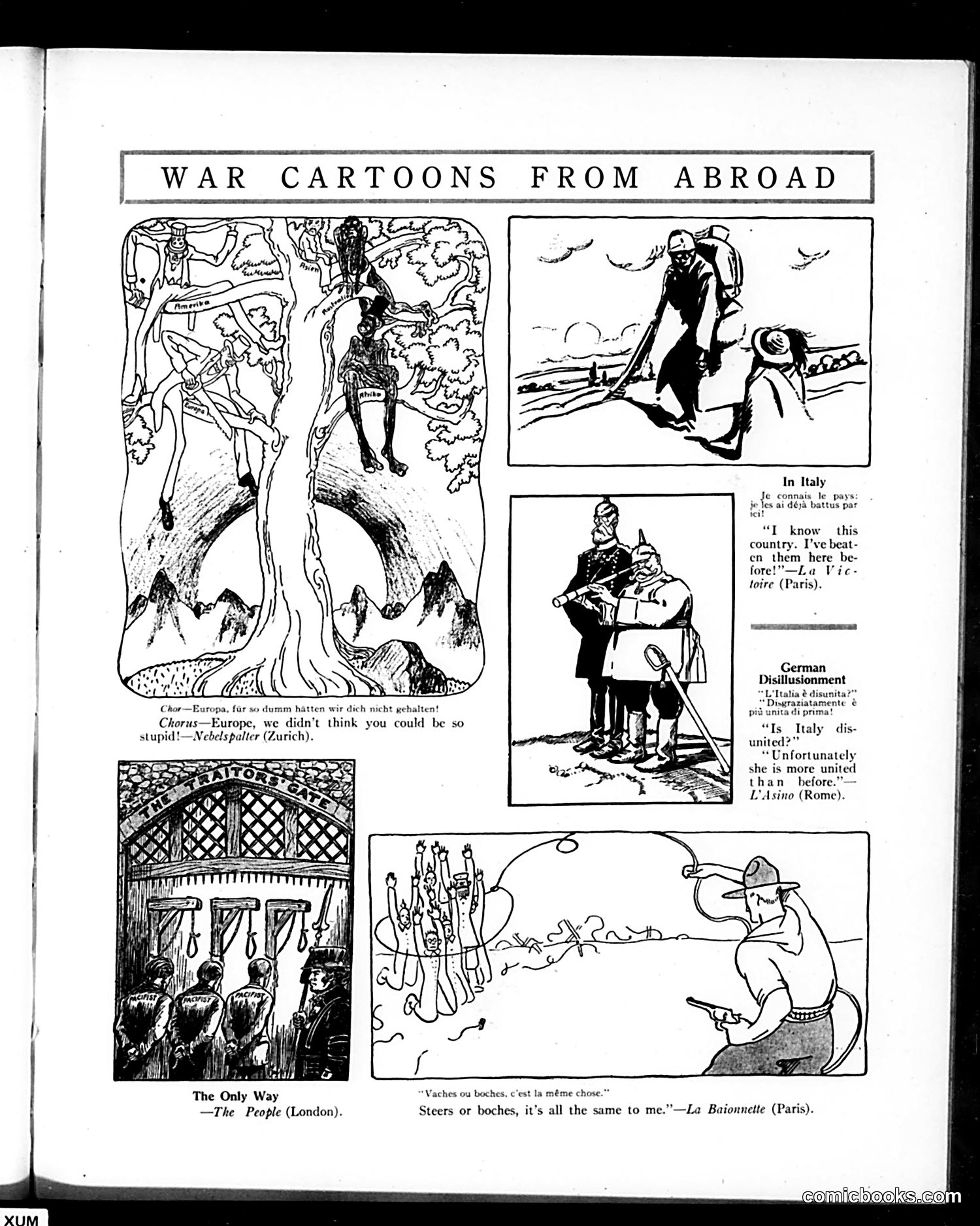
This page collects European editorial cartoons about Italy during World War I, satirizing Italian political divisions and military performance. **Key themes:** The cartoons mock Italy's internal disunity despite military involvement. One depicts a German soldier expressing disillusionment that Europe (Italy) could be "so stupid"—suggesting Italy's unreliability as an ally or inability to present unified strength. French cartoons ("La Victoire," "La Baionnette") show confidence in defeating Italy, treating Italian soldiers ("boches") as indistinguishable from German enemies. The Italian cartoon ("L'Asino") presents ironic optimism: despite appearing disunited, Italy claims greater unity than before—likely sarcastic commentary on actual factional tensions. A London cartoon ("The Only Way") depicts execution by hanging, though the specific referent is unclear from the image alone. **Overall:** These are Allied/neutral nations satirizing Italy's questionable military effectiveness and political cohesion during WWI.
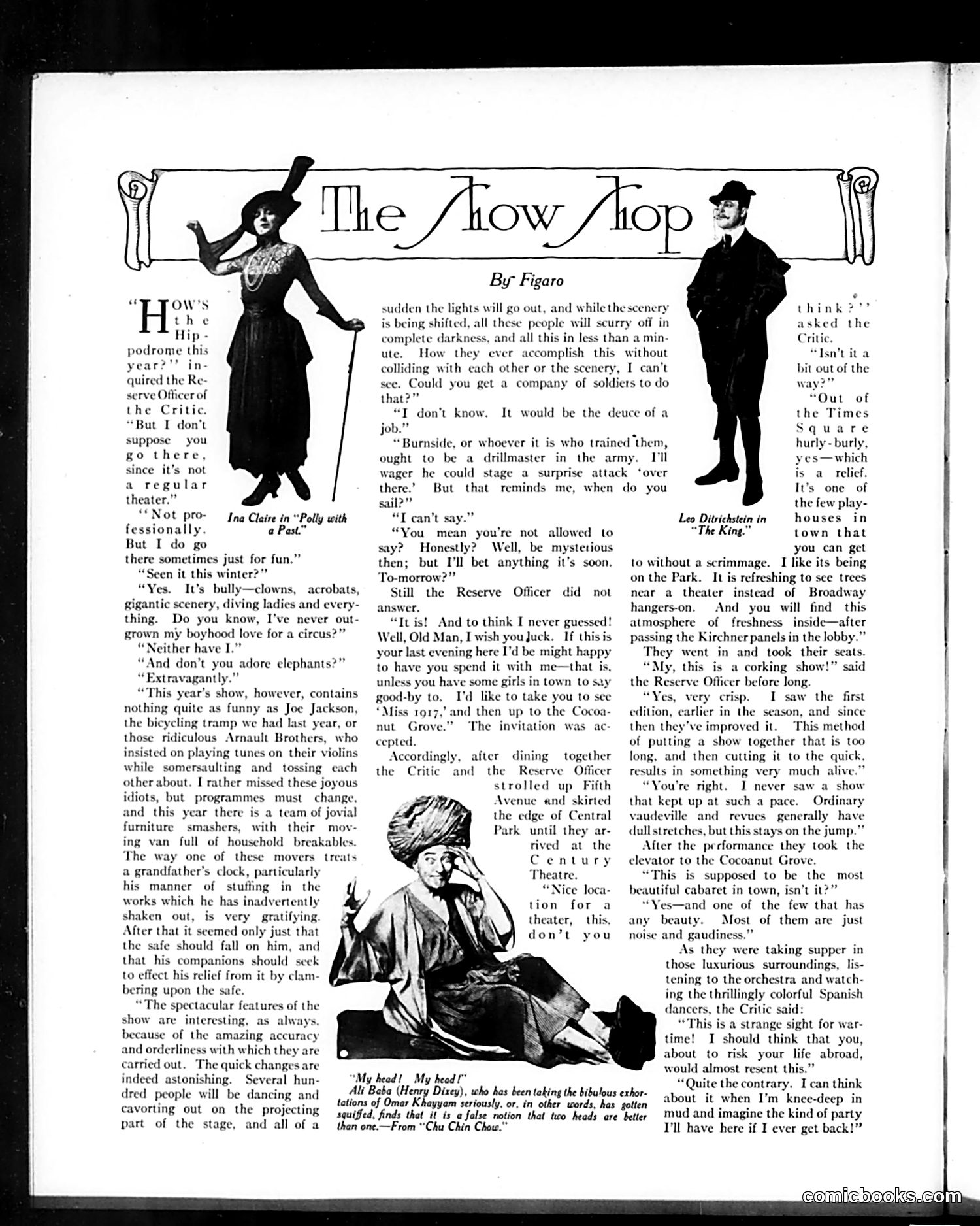
This piece by Figaro satirizes theater-going culture and the Hippodrome theatre's spectacle-driven entertainment. Two characters—a Reserve Officer and a Critic—discuss the Hippodrome's elaborate productions, which featured massive ensemble numbers, quick scene changes, and acrobatic acts (clowns, elephants, "ridiculous Arnault Brothers" performing destructive furniture stunts). The satire mocks how audiences, including supposedly sophisticated critics, enjoy circus-like entertainment despite its lack of artistic substance. The dialogue suggests tension between "serious" theater and popular spectacle. References to actors like Ina Claire and Henry Dixey ground this in contemporary Broadway. The side caption about Ali Baba in "Chu Chin Chow" continues the vein of absurdist comedy. Figaro's point: even cultivated theater-goers secretly love the lowbrow entertainment the Hippodrome offers—contradicting their pretensions to refined taste.
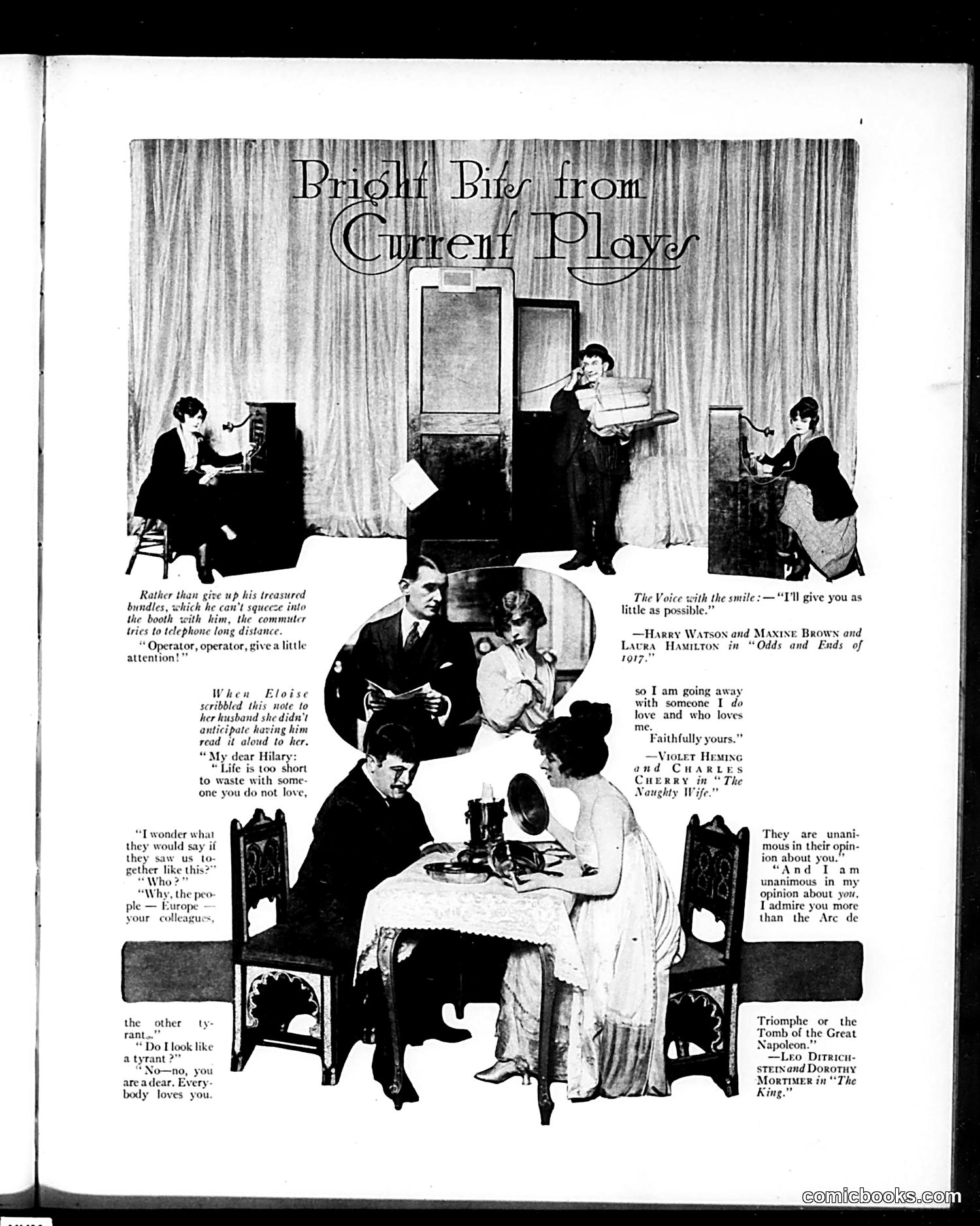
This is a theatrical column presenting humorous dialogue excerpts from Broadway productions of 1917. The page features five separate scene vignettes with quoted zingers from contemporary plays, attributed to their casts. The jokes target familiar situations: a commuter hoarding luggage and avoiding phone booths, a husband publicly reading his wife's love-note confession to a stranger, a telephone operator's curt efficiency, a husband unwittingly reading aloud a wife's note announcing she's leaving him for someone else, and soldiers/lovers making romantic declarations to each other. The satire mocks everyday frustrations (telephone operators, commuter chaos), marital discord, and wartime romance. The "Naughty Wife" and infidelity references suggest contemporary anxieties about wartime relationships. These aren't political cartoons but rather light entertainment—theatrical gossip presented as humor for Judge magazine's sophisticated urban readership.
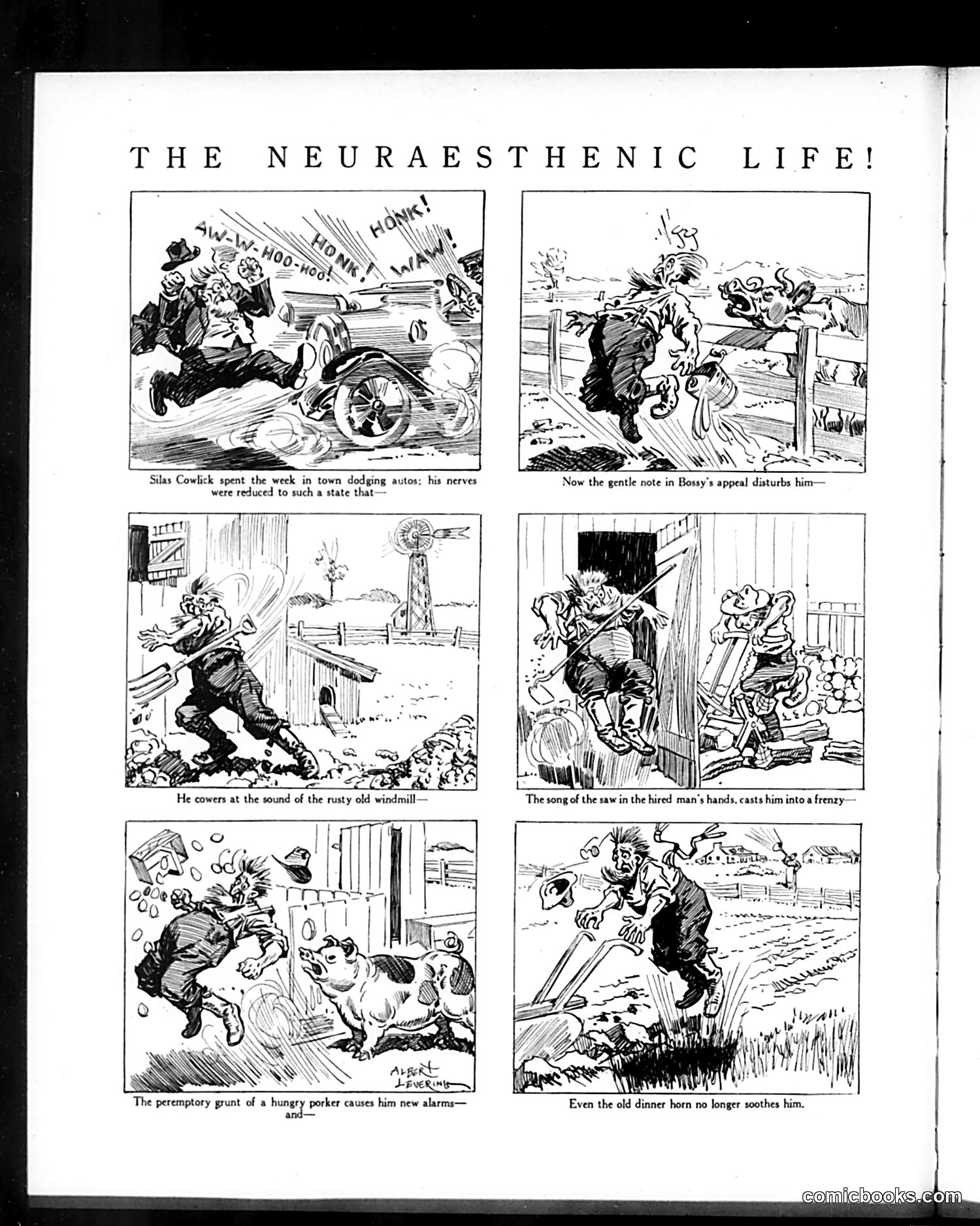
This satirical comic strip mocks "neurasthenia," a fashionable diagnosis of nervous exhaustion afflicting wealthy urbanites. The protagonist, Silas Cowlick, represents a nervous hypochondriac whose condition worsens after city exposure to automobiles and their horns. The humor escalates as trivial rural sounds—a windmill, a saw, a pig's grunt, even a dinner horn—trigger increasingly hysterical reactions in this supposedly refined gentleman. Each panel shows him in exaggerated panic from everyday farm noises. The satire targets both the pretentiousness of urban "neuraesthetic" sufferers and the comedy of a man so psychologically fragile that countryside life—traditionally considered restorative—becomes unbearable. The strip mocks the era's tendency to treat minor anxieties as serious medical conditions worthy of elaborate avoidance and concern.
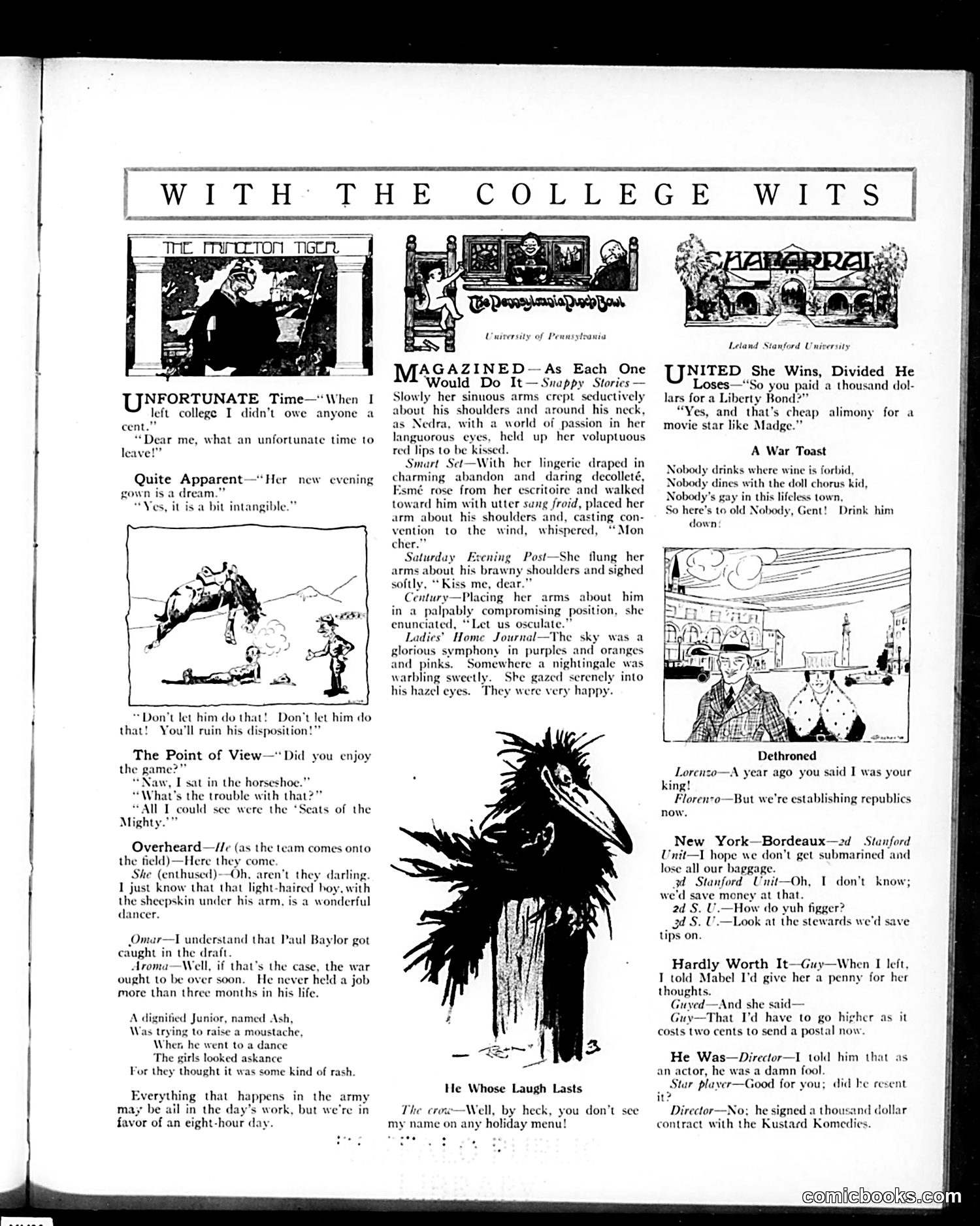
This page collects brief satirical jokes and observations targeting college students and wartime social issues. Key themes: **College humor** mocks student pretensions and romantic clichés—notably "Magazined," which parodies how different magazines would describe the same romantic scene, from *Ladies' Home Journal's* flowery sentimentality to *Century's* affected language ("Let us osculate"). **WWI references** include jokes about the draft (a young man named Ash growing a mustache to seem older), Liberty Bonds (war savings), and submarines threatening troop transport. **Social commentary** targets Prohibition ("Nobody drinks where wine is forbid") and changing gender dynamics ("Dethroned," where a man is no longer called "king" as republics replace monarchies). The humor is light and topical—aimed at educated readers familiar with current magazines, military conscription, and post-war social upheaval. The cartoons appear to be simple illustrations accompanying these jokes rather than complex political commentary.
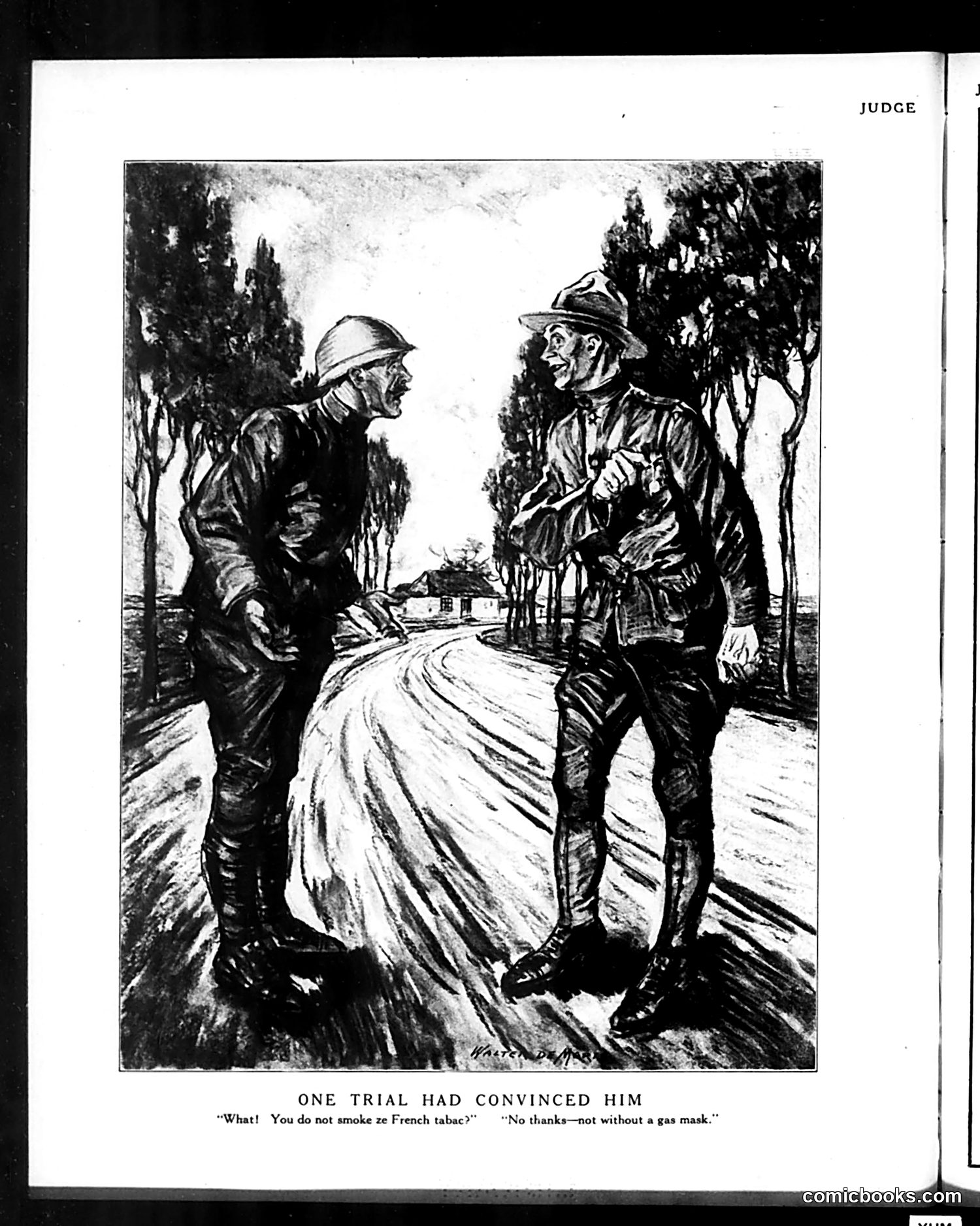
This WWI-era cartoon satirizes the dangers of poison gas warfare. Two soldiers—one appearing to be French (indicated by "ze French tabac" dialect) and one Allied soldier wearing a military helmet—are depicted on a tree-lined road. The joke hinges on a dark pun: the Allied soldier refuses French tobacco, demanding a gas mask for protection. This refers to both chemical weapons used in trench warfare and the poor quality of French cigarettes. The cartoon mocks the horrific conditions soldiers faced, where even accepting a simple cigarette required protection against gas attacks. The title "One Trial Had Convinced Him" suggests the soldier learned this dangerous lesson firsthand. It's gallows humor typical of WWI-era satirical magazines addressing the brutal realities of mechanized warfare.
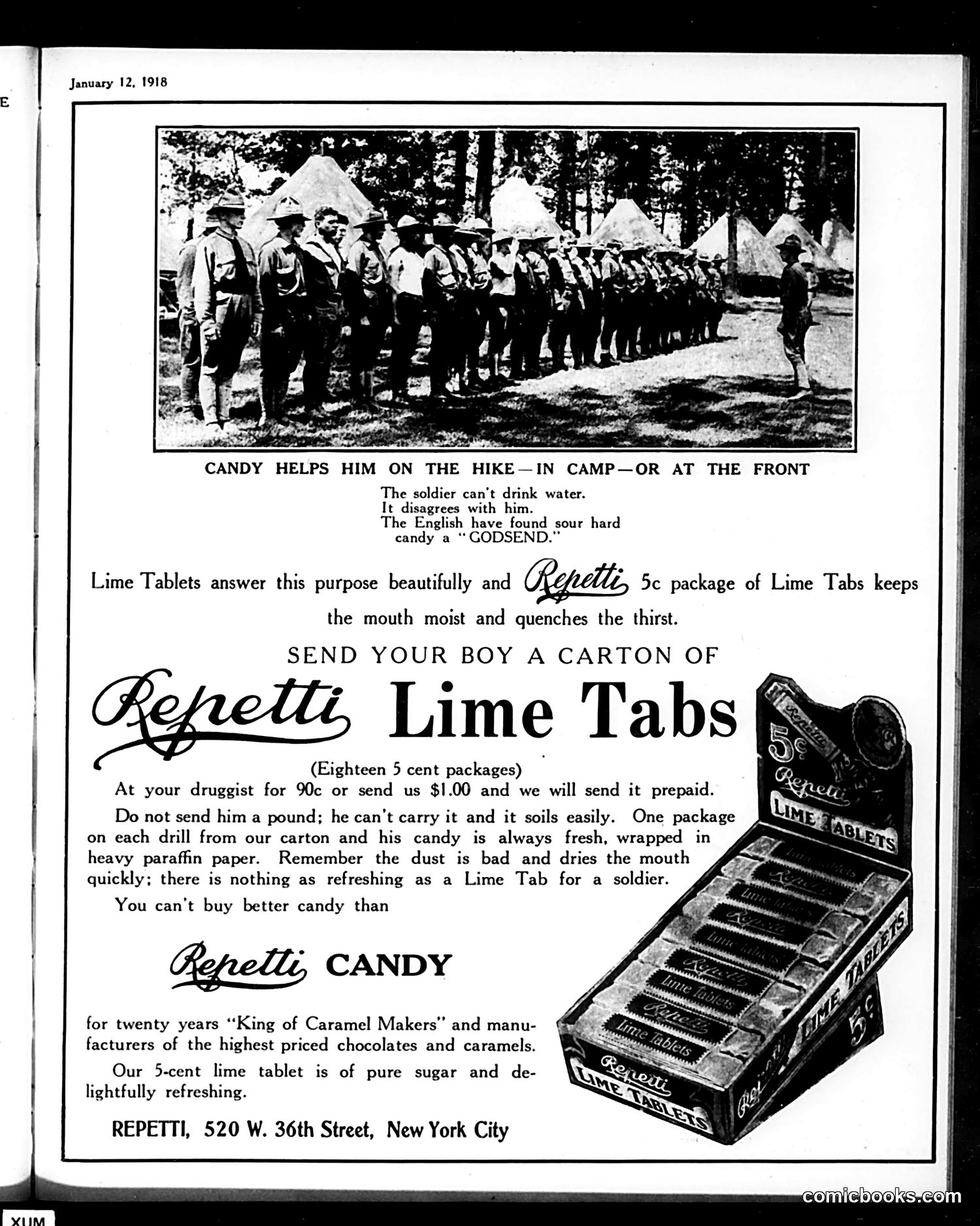
This is a **World War I-era advertisement**, not satire. Published January 12, 1918 (near war's end), it's a patriotic marketing pitch targeting American families with soldiers overseas. The image shows soldiers in military camp lined up for inspection or drill. The ad claims British troops discovered that sour hard candy (called "Godsend") helps soldiers on marches and at the front because soldiers "can't drink water"—it supposedly causes digestive problems. The product pitched is Repetti Lime Tablets: small, portable candies meant as care packages. The marketing emphasizes practicality: lightweight, wrapped in paraffin to stay fresh despite dust, and affordable enough to send regularly (90¢ for eighteen 5-cent packages). This reflects genuine WWI concerns about soldier welfare and morale. The ad exploits patriotic sentiment, positioning candy consumption as supporting troops while promoting a commercial product. Repetti's claim to be a twenty-year "King of Caramel Makers" adds credibility.
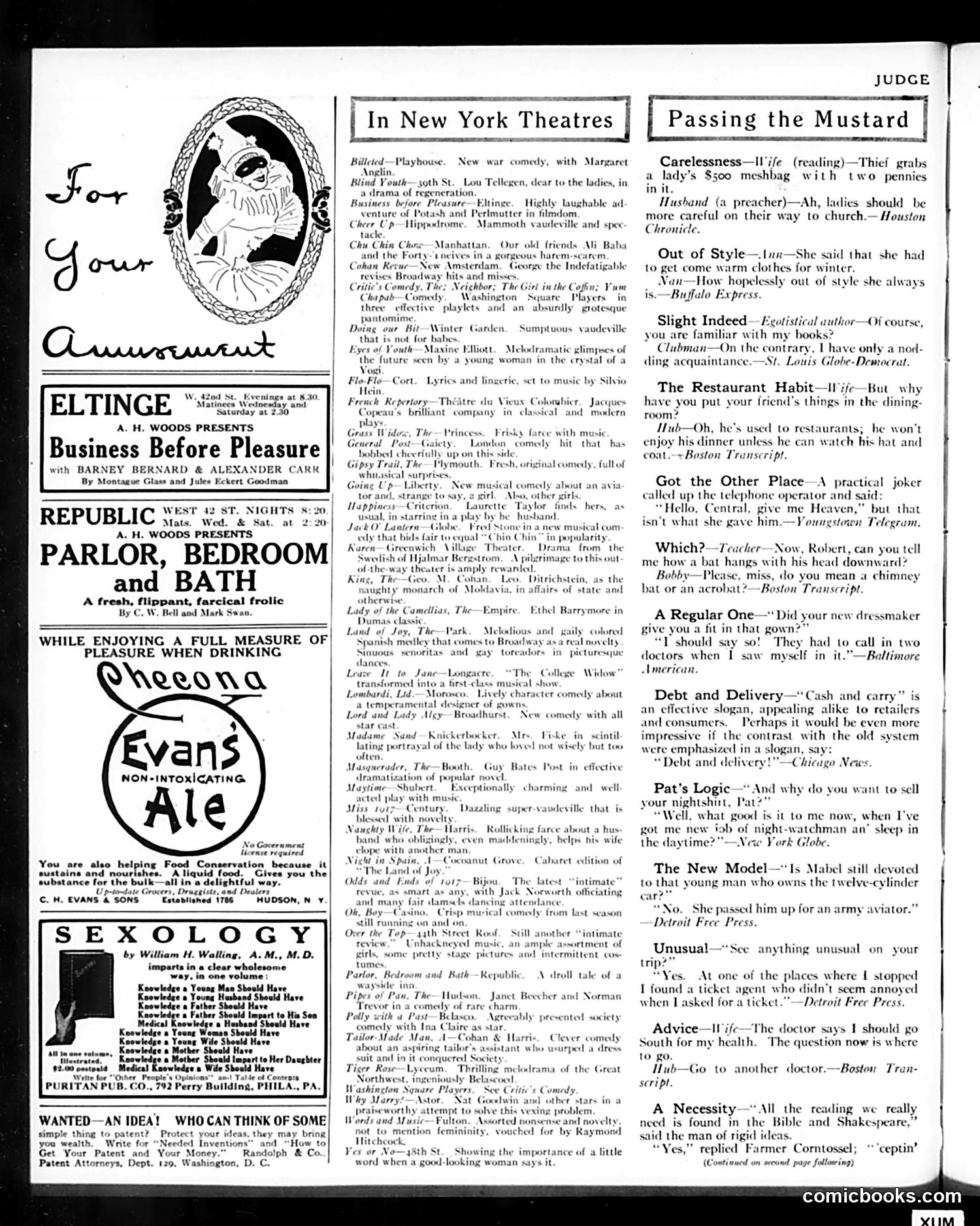
This page is primarily **advertisements and theater listings** with minimal editorial cartoon content visible in the image. The main visual element is an **ornamental oval portrait** in the upper left, appearing decorative rather than political satire. Below it are advertisements for theatrical productions and consumer goods typical of the era. The theater section lists Broadway shows from what appears to be **early 20th century** (references to specific productions and venues like the Hippodrome and Cohan). The ads promote products like Evans Non-Intoxicating Ale and a book titled "Sexology," reflecting contemporary commercial interests. The "Passing the Mustard" section contains brief humorous anecdotes—short joke items about social behavior rather than political commentary. **This is not primarily a satirical/political page.** It functions as a standard magazine layout combining theatrical reviews, product advertising, and light humor—typical of Judge's mixed editorial-commercial format rather than showcasing the publication's characteristic political cartooning.
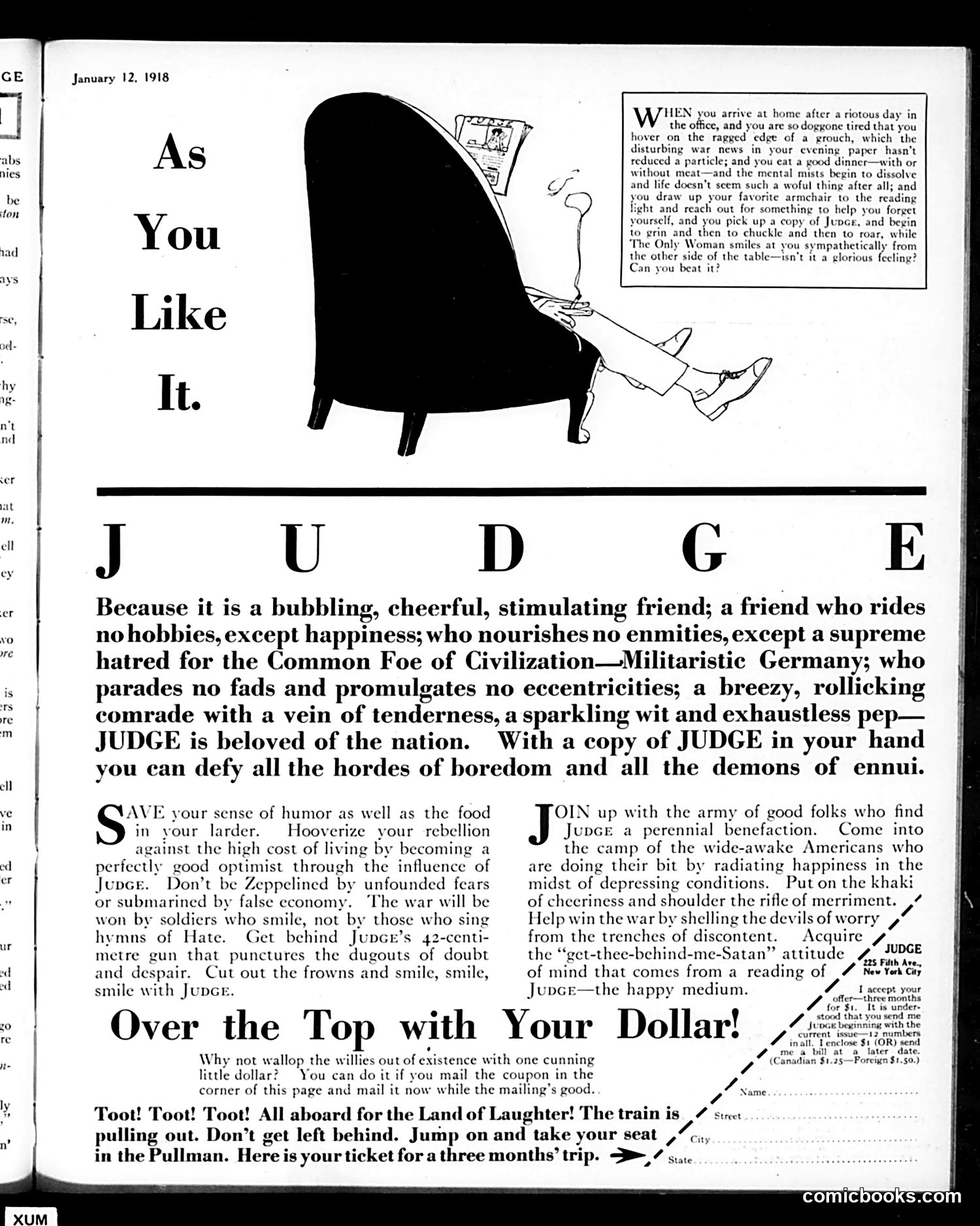
This is primarily a **subscription advertisement** for *Judge* magazine, disguised as editorial content. The page uses wartime patriotism to pitch the magazine as essential reading during WWI. The cartoon shows a man relaxed in an armchair—the implicit message being that reading *Judge* transforms exhaustion and war anxiety into contentment. The text frames the magazine as a morale-boosting weapon against despair, using military metaphors: readers should "defy boredom," acquire an attitude of cheerfulness like a "rifle of merriment," and help "win the war" through optimism rather than worry. References include "Hooverize" (rationing under President Hoover's food program), "Zeppelined" and "submarined" (German aerial and naval threats), and "Militaristic Germany" as the enemy. The advertisement exploits homefront anxiety while positioning humor and optimism as patriotic duty—typical American propaganda strategy of 1918.
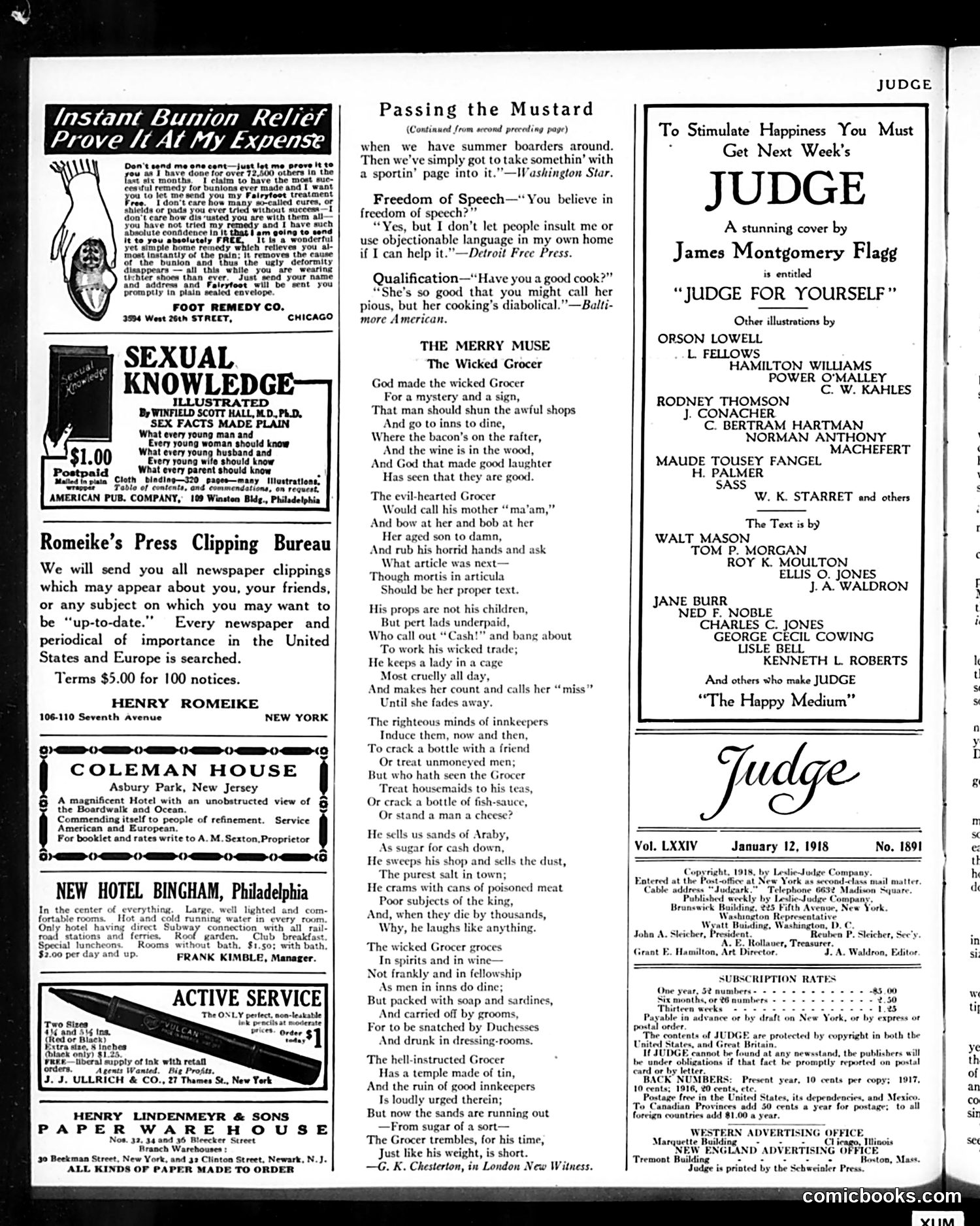
This page is primarily **advertisements and filler content** rather than political cartoons. The main items are: **Advertisements:** Bunion relief, sexual education books, press clipping services, and hotels—typical early 20th-century periodical ads. **Substantive content:** "The Merry Muse" features "The Wicked Grocer," a poem satirizing dishonest grocery merchants. The verse—written in the style of G.K. Chesterton (credited at bottom)—contrasts the grocer's hypocrisy and exploitation with the honesty of tavern-keepers. It criticizes underpaid workers, overpriced goods, and sale of adulterated products (sand sold as sugar, poisoned meat). The satire reflects **working-class concerns about food safety and merchant fraud**—genuine issues in early 20th-century retail before modern food regulation. The comparison to innkeepers suggests nostalgia for older, more "honest" commerce. The lighter "Passing the Mustard" section contains brief humor about summer boarders and freedom of speech.
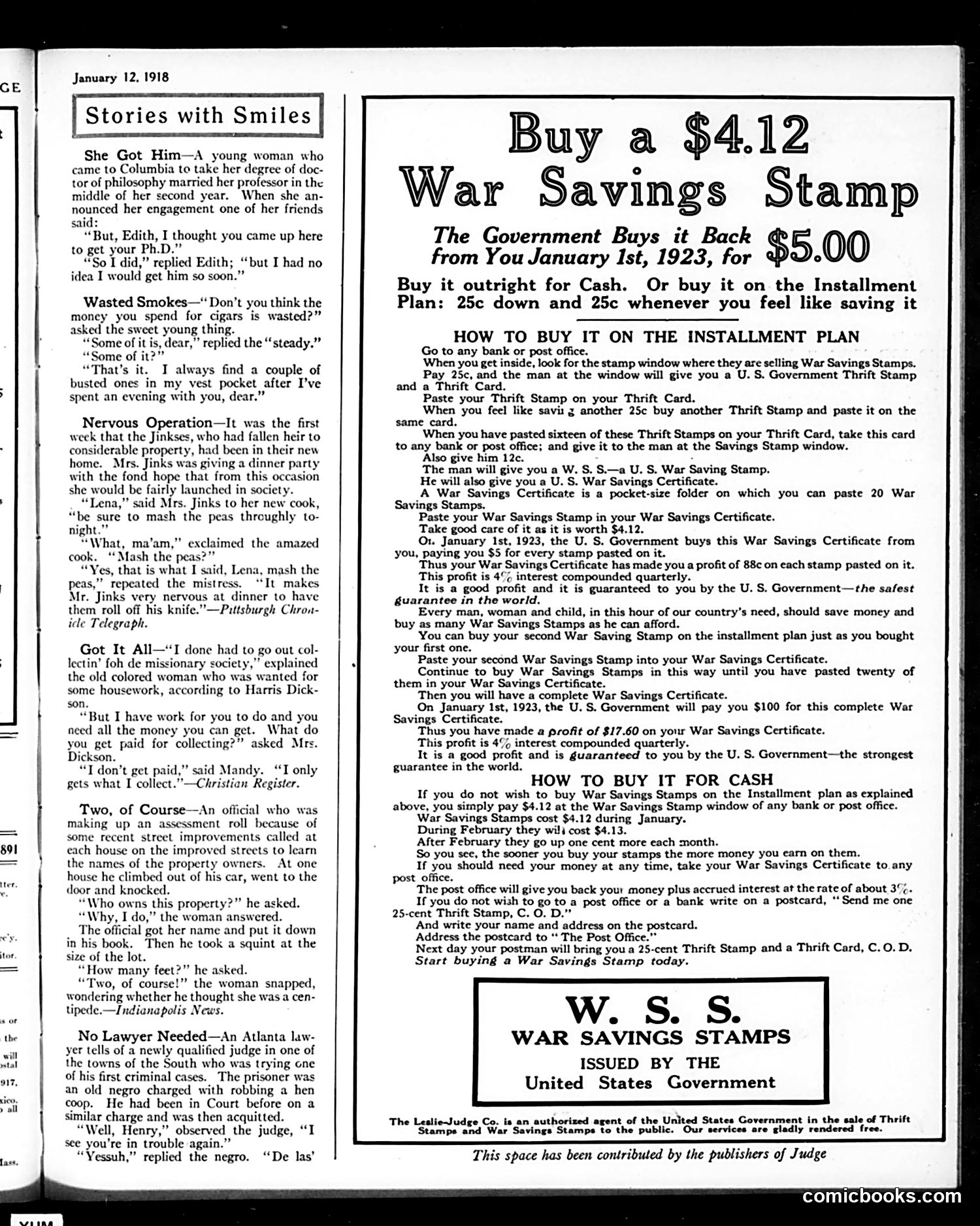
This page from *Judge* (January 12, 1918) is primarily an advertisement promoting U.S. War Savings Stamps during World War I, not political satire. The left column contains lighthearted humor pieces unrelated to the ad. The advertisement explains the government's installment plan for purchasing War Savings Stamps—$4.12 invested now would be redeemed for $5.00 in January 1923, guaranteeing 4% interest. Citizens could buy stamps incrementally (25 cents at a time) through banks and post offices, accumulating sixteen stamps on a Thrift Card to exchange for a War Savings Certificate. This was a patriotic financial instrument encouraging Americans to fund the war effort while earning modest returns. The detailed instructions reflect the government's systematic approach to civilian war financing during America's involvement in WWI (1917-1918). The humor pieces are simply filler content typical of magazine layouts from this era.
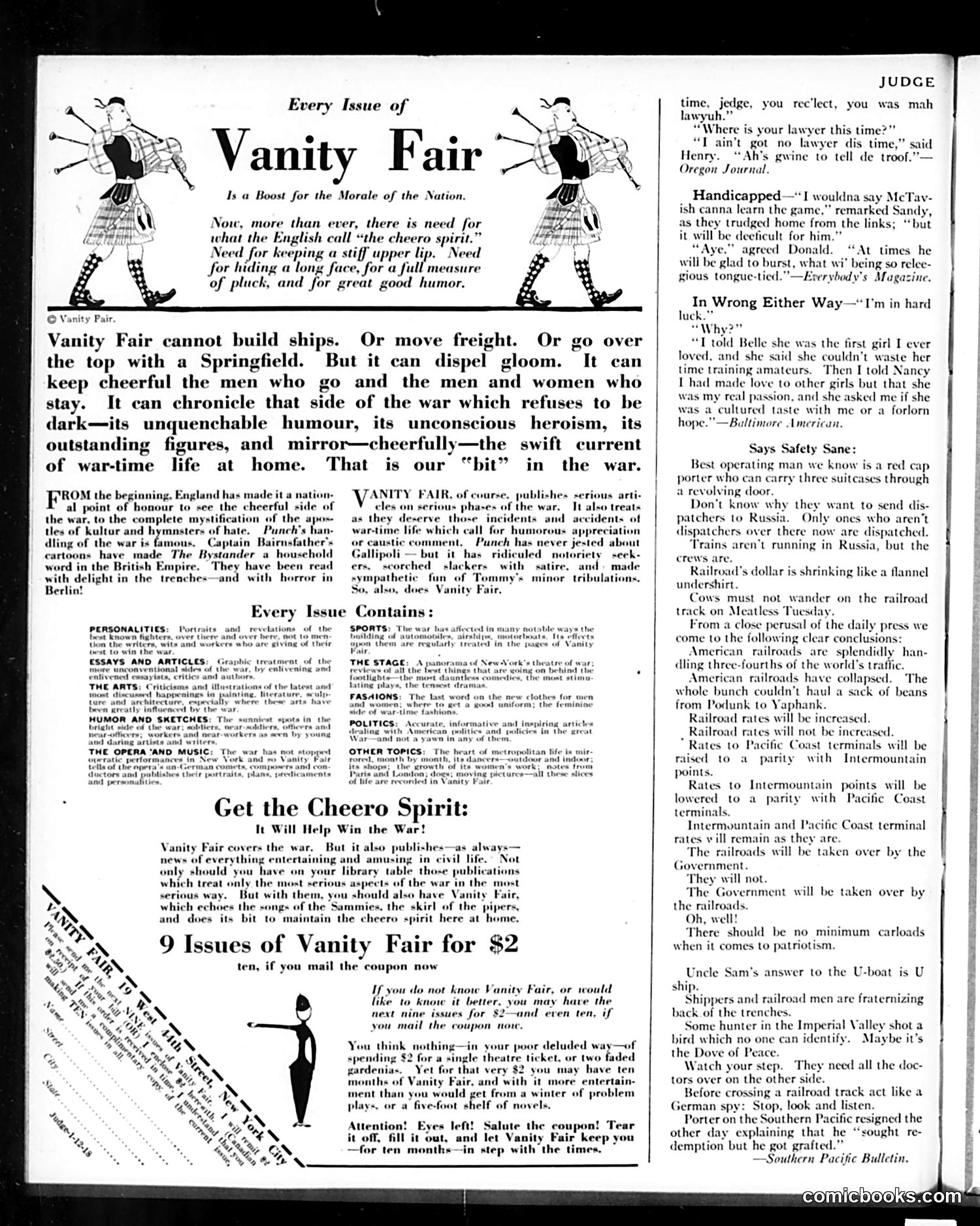
This page promotes **Vanity Fair magazine** as a patriotic wartime publication that boosts national morale. The main text argues that while Vanity Fair cannot literally contribute to the war effort (building ships, moving freight), it serves the crucial purpose of maintaining British and American "cheerio spirit"—maintaining humor and morale on the home front during World War I. The page references **Captain Bruce Bairnsfather**, a famous WWI cartoonist whose humorous depictions of trench life in *The Bystander* were widely popular. The satire suggests that humor itself is patriotic work. The lower section contains typical **Judge magazine humor**: brief jokes about lawyers, golf handicaps, courtship mishaps, and railroad operations. These appear unrelated to the Vanity Fair promotion—they're standard satirical content showing Judge's own comedic voice alongside the advertisement. The coupon offers nine issues of Vanity Fair for $2, positioning the magazine as affordable wartime entertainment serving the national interest.
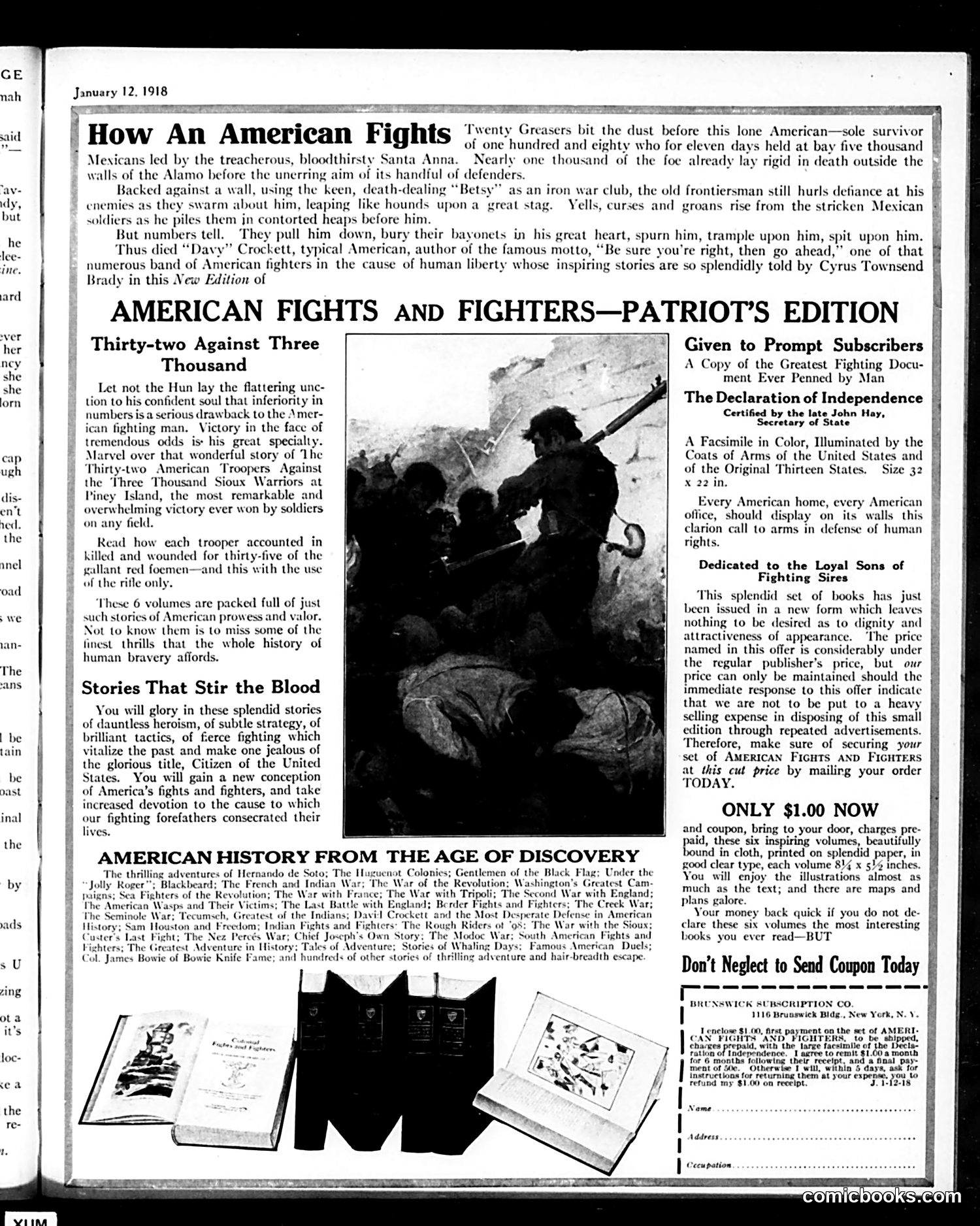
This is primarily **advertising copy**, not satire. It promotes a six-volume book series titled "American Fights and Fighters—Patriot's Edition" published by Breadswick Subscription Co. The page uses historical American military narratives—particularly the Alamo (evoking Davy Crockett) and a battle between 32 American troops and 3,000 Sioux warriors at Piney Island—to establish a propaganda theme: Americans triumph through superior valor despite overwhelming odds. The timing and language are significant: published during World War I (note the reference to "the Hun"), the advertisement frames American military superiority as innate national character. By invoking frontier combat against "treacherous" Santa Anna and "red foemen," it constructs a genealogy of American martial prowess designed to bolster public support for the current war effort. The promise of a facsimile Declaration of Independence as a premium incentivizes purchase while reinforcing patriotic messaging. This is wartime propaganda dressed as historical commemoration.
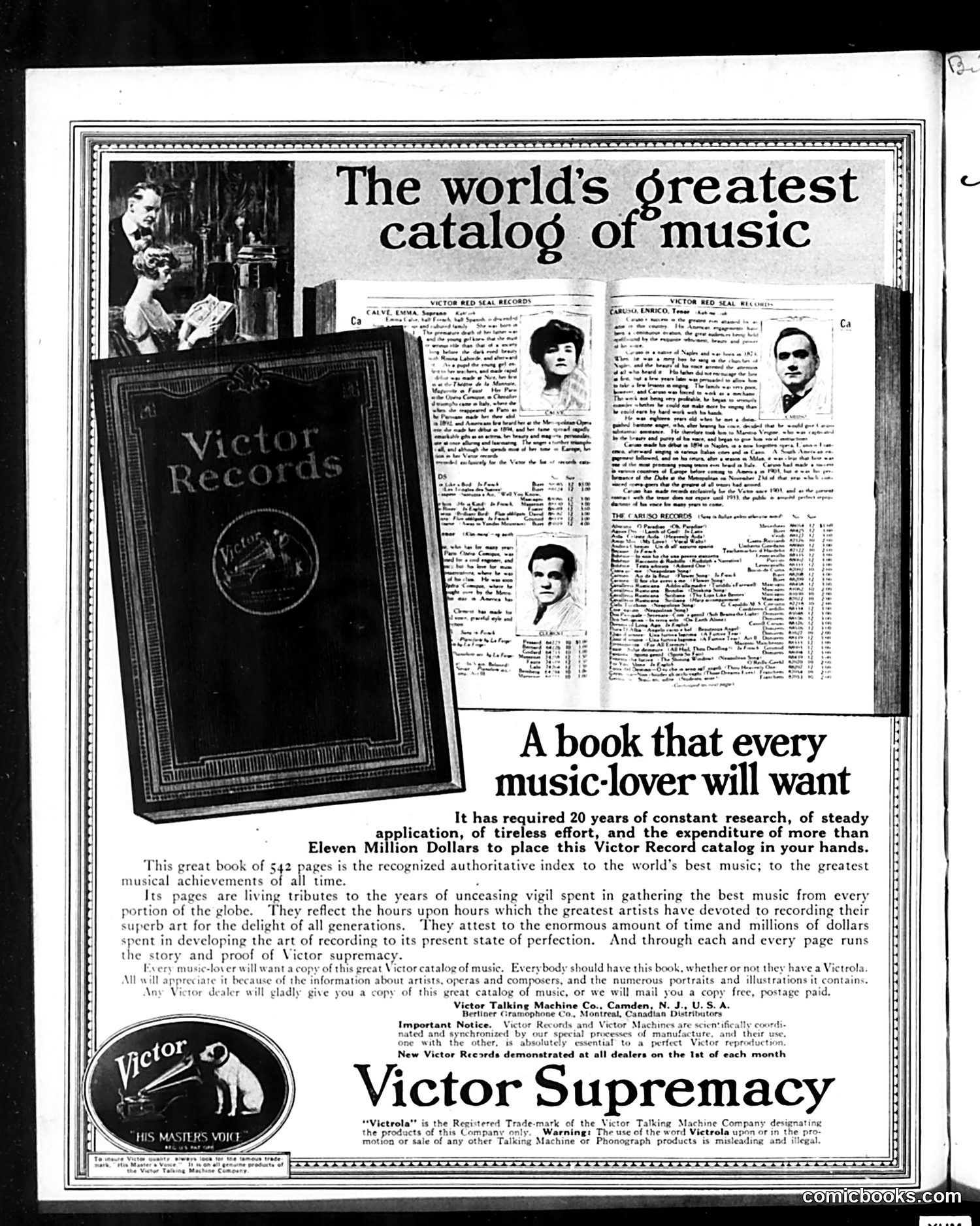
This is a **full-page advertisement**, not a political cartoon. It promotes Victor's new 542-page music catalog—described as "the world's greatest catalog of music"—claiming 20 years of research and $11 million in development costs. The ad features photographs of what appear to be **famous opera singers and classical musicians** (though specific identities aren't clearly captioned), legitimizing Victor's claims to authoritative taste in music. The Victor Records branded book and the company's dog-and-phonograph logo ("His Master's Voice") reinforce brand authority. The pitch targets **middle-class music lovers**, positioning the catalog as an essential reference book anyone should own. A legal notice warns competitors not to misuse the "Victrola" trademark—suggesting market competition was fierce. This reflects the **pre-radio era** when recorded music catalogs and phonographs were luxury consumer products, and Victor was a dominant brand positioning itself as curator of serious, respectable music.