
Judge, 1918-01-12 · page 8 of 28
Judge — January 12, 1918 — page 8: what you’re looking at
What you’re looking at
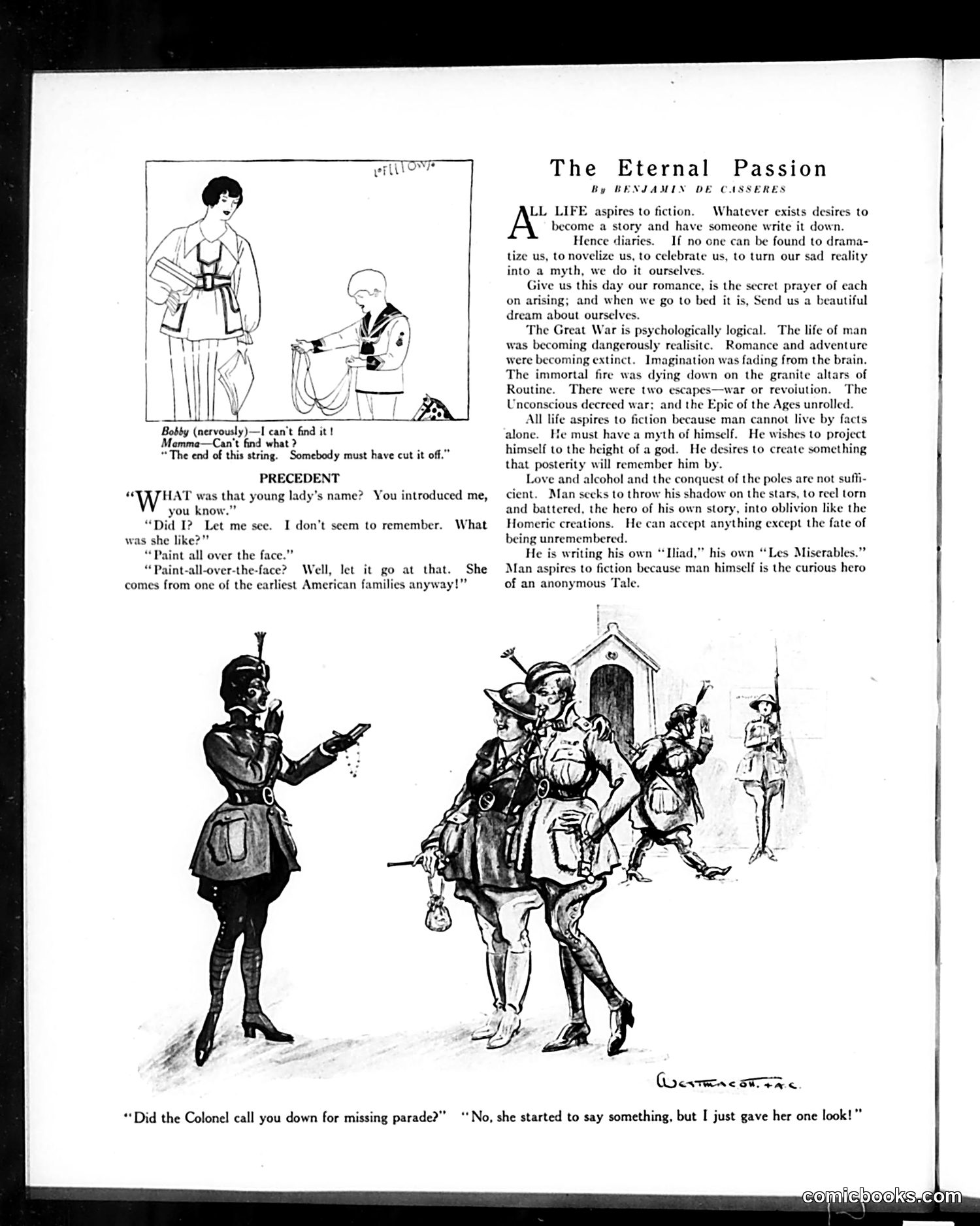
This page combines three distinct elements: two cartoon vignettes and a philosophical essay by Benjamin de Casseres. **The cartoons** depict domestic military-life humor from the WWI era. The top comic shows a child unable to find "the end of this string"—likely satirizing wartime rationing or material shortages. The "Precedent" dialogue jokes about upper-class social amnesia: a man forgets a woman's name but remembers she wore heavy makeup and came from an "earliest American family" (old money), suggesting superficial social judgment. The bottom cartoon mocks military discipline: a soldier avoids punishment for missing parade by intimidating his superior with "one look." **The essay** is a meditation on why humans crave narrative and myth-making, explicitly connecting this impulse to WWI. De Casseres argues that peacetime reality had become unbearably dull, driving men toward war as an escape into epic storytelling. He suggests humanity needs to mythologize itself—to become heroes of our own tales rather than face anonymous, forgotten lives. The juxtaposition suggests satirical commentary on wartime sentimentality and romanticization.
📄 Transcribed text from this page (OCR, searchable)
Machine-transcribed from the original scan — historical spelling and the odd misread are preserved.
Bobby (nervously) —I can’t find it ! Mamma—Can't find what ? “The end of this string. Somebody must have cut it off.” PRECEDENT “ HAT was that young lady’s name? You introduced me, you know.” “Did 1? Let me see. was she like?” “Paint all over the face.” “Paint-all-over-the-face? Well, let it go at that. She comes from one of the earliest American families anyway!” I don’t seem to remember. What ‘Did the Colonel call you down for missing parade?” “No, she started to say something, but I just gave her one look!" The Eternal Passion By BENJAMIN DE CASSERES LL LIFE aspires to fiction. Whatever exists desires to A become a story and have someone write it down. Hence diaries. If no one can be found to drama- tize us, to novelize us, to celebrate us, to turn our sad reality into a myth, we do it ourselves Give us this day our roman on arising; and when we go to bed it is, dream about ourselves. The Great War is psychologically logical. The life of man was becoming dangerously tc. Romance and adventure were becoming extinct. Imagination was fading from the brain. The immortal fire was dying down on the granite altars of Routine. There were two escapes—war or revolution. ‘The Unconscious decreed war; and the Epic of the Ages unrolled All life aspires to fiction because man cannot live by facts alone. He must have a myth of himself. He wishes to project himself to the height of a god. He desires to create something that posterity will remember him by. Love and alcohol and the conquest of the poles are not suffi- cient. Man secks to throw his shadow on the stars, to reel torn and battered, the hero of his own story, into oblivion like the Ho creations. He can accept anything except the fate of being unremembered. He is writing his own “Iliad,” his own “Les Miserables.” Man aspires to fiction because man himself is the curious hero of an anonymous Tale. is the secret prayer of each nd us a beautiful Qocatene TA