
Judge, 1918-01-12 · page 7 of 28
Judge — January 12, 1918 — page 7: what you’re looking at
What you’re looking at
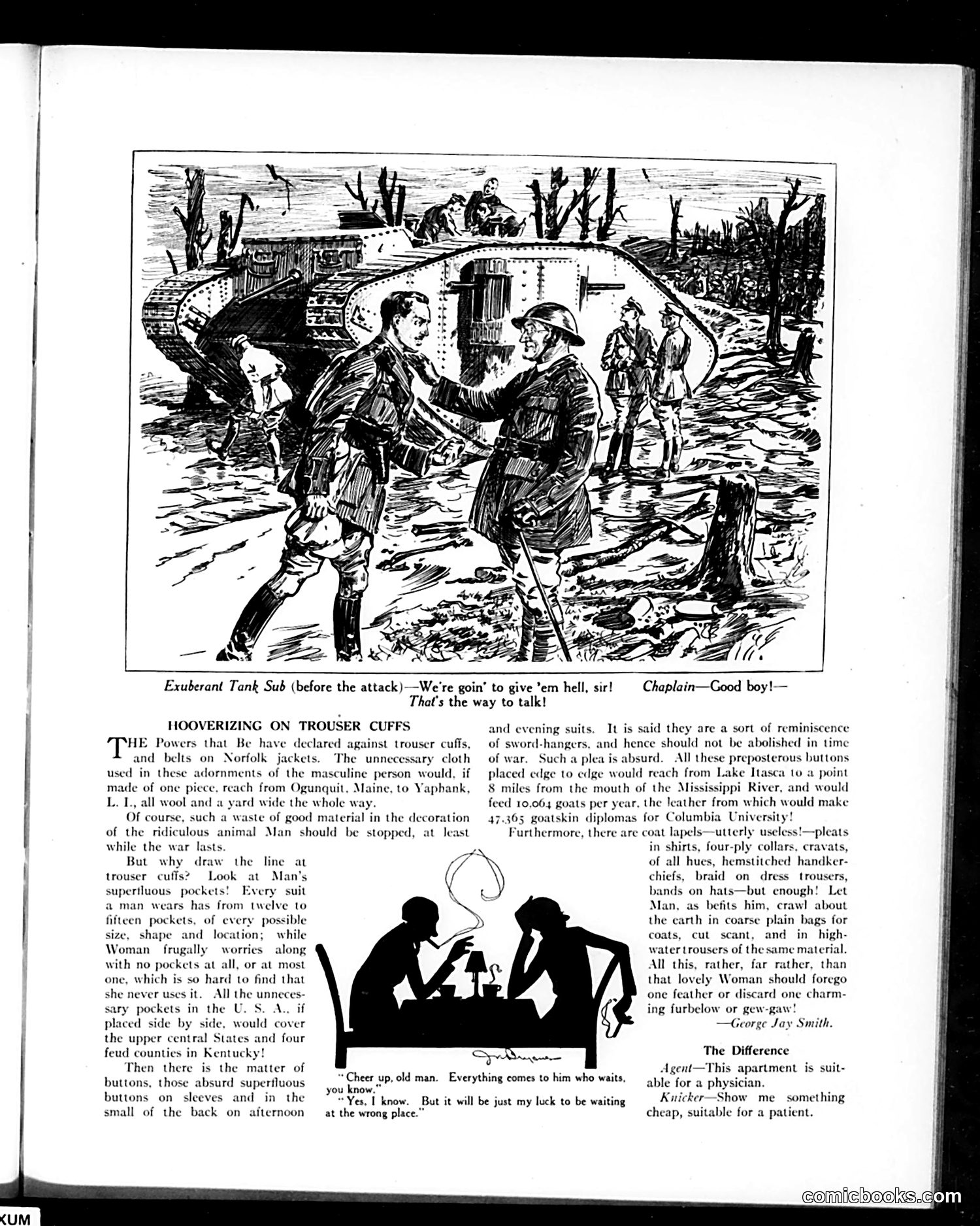
This page satirizes wartime material conservation efforts, likely from WWI. "Hooverizing" refers to Herbert Hoover's voluntary rationing campaigns urging Americans to conserve resources for the war effort. The top cartoon shows a tank commander and chaplain before battle—establishing a patriotic, serious tone that contrasts with the article below. The main piece mockingly attacks government calls to eliminate men's trouser cuffs and other "unnecessary" garments to save fabric. The satire's point: the author lists absurdly inflated calculations (buttons allegedly stretching from Lake Itasca to the Mississippi River mouth; cuffs reaching Maine to Long Island) to expose how ridiculous these conservation mandates are. Crucially, the piece argues these restrictions should apply equally to women's clothing—yet notes women's garments (feathers, "furbelows," decorative elements) are exempted. The author sarcastically suggests women should sacrifice their fashion instead of men. The bottom cartoon about a cheap apartment is unrelated filler humor. Overall: biting criticism of selective, gender-biased wartime sacrifice demands.
📄 Transcribed text from this page (OCR, searchable)
Machine-transcribed from the original scan — historical spelling and the odd misread are preserved.
KUM Exuberant Tank Sub (before the attack)—We're goin’ to give ’em hell, sir! Chaplain—Good boy!— That's the way to talk! HOOVERIZING ON TROUSER CUFFS HE Powers that Be have declared against trouser cuffs, and belts on Norfolk jackets. The unnecessary cloth used in these adornments of the masculine person would, if made of one piece, reach from Ogunquit, Maine, to Yapbank, L. L., all wool and a yard wide the whole way. Of course, such a waste of good material in the decoration of the ridiculous animal Man should be stopped, at least while the war lasts. But why draw the line at trouser cufis? Look at Man's supertluous pockets! Every suit a man wears from twelve to fifteen pockets, of every possible size, shape and location; while Woman frugally worries along with no pockets at all, or at most one, which is so hard to find that she never uses it. All the unn sary pockets in the U.S. A. placed side by side, would cover the upper al States and four feud count n Kentucky! Then there is the matter of buttons, those absurd superfluous buttons on sleeves and in the small of the back on afternoon at the wrong place.” “Cheer up, old man. you know.” Everything comes to him who waits, “Yes, | know. But it will be just my luck to be waiting and evening suits, It is said they are a sort of reminiscence of sword-hangers, and hence should not be abolished in time of war. Such a plea is absurd. All these preposterous buttons placed edge to edge would reach from Lake Itasca to a point 8 miles from the mouth of the Mississippi River, and would feed 10,064 goats per year, the leather from which would make s for Columbia University! 47.363 goatskin diplon Furthermore, there are coat lapels—utterly useless!—plea in shirts, four-ply collars, cravats, of all hues, hemstitched handker- chiefs, braid on dress trousers, bands on hats—but enough! Let Man. befits him, crawl about the carth in coarse plain bags for coats, cut ant, din’ high- water trousers of thesame material, All this, rather, far rather, than that lovely Woman should forego one feather or discard one charm- ing furbelow or gew —George Jay Smith. The Difference Agent—This apartment is suit- able for a ph Kuicker—Show me something cheap, suitable for a patient. comichooks.celu)