
Judge, 1918-01-12 · page 14 of 28
Judge — January 12, 1918 — page 14: what you’re looking at
What you’re looking at
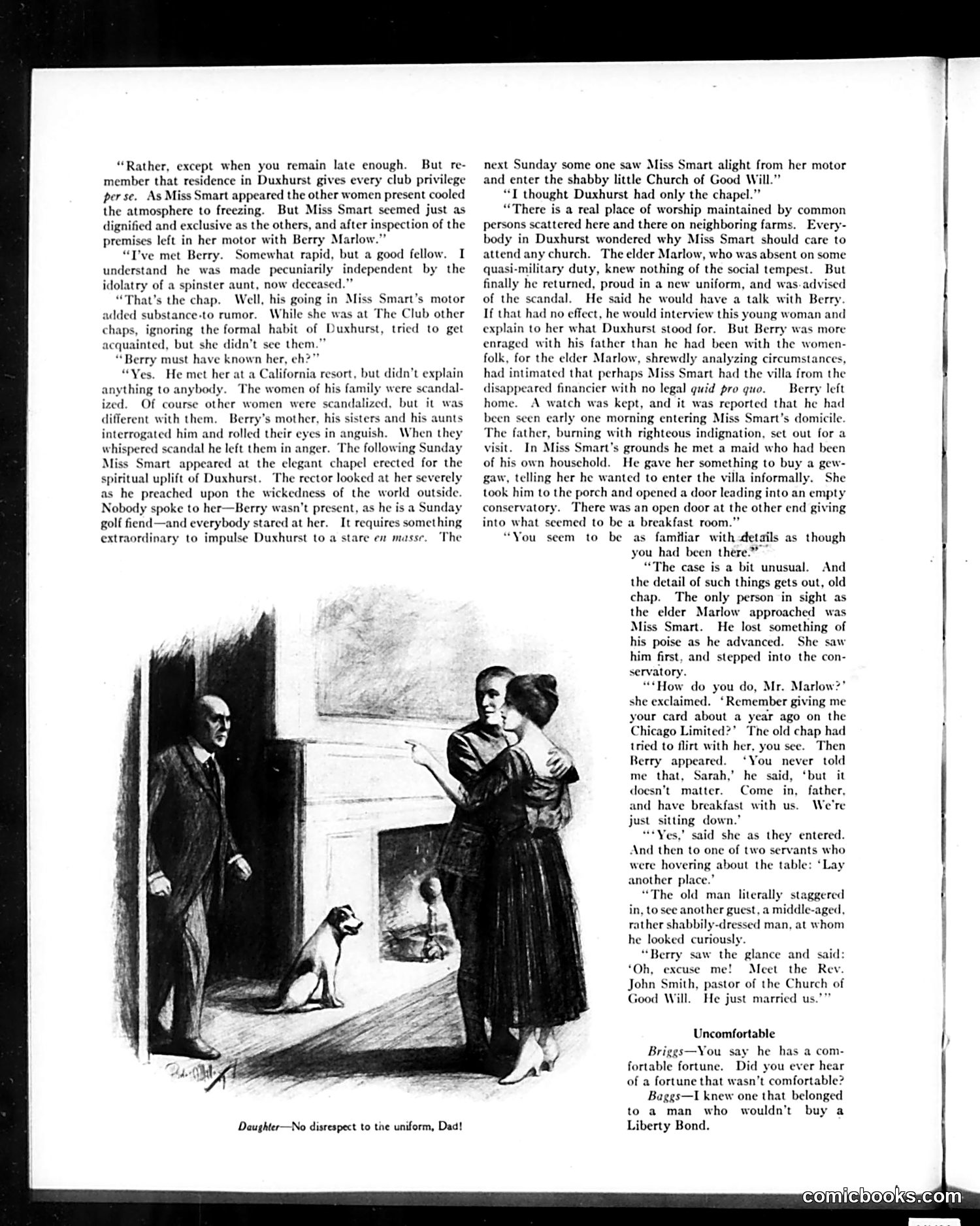
This page satirizes small-town social hypocrisy and class consciousness in "Duxhurst," an affluent suburban community. The narrative concerns Miss Smart, a woman of unclear social standing who arrives in a motor car with Berry Marlow, a wealthy but somewhat dissolute young man. When she attends the exclusive "chapel" (implying the town's fashionable church), society coldly ostracizes her. However, when she later attends the humble "Church of Good Will"—a modest congregation for working-class farmers—the community becomes scandalized, fearing she's an improper woman. The accompanying illustration shows an awkward domestic scene. The satire's point: Duxhurst's moral judgment is entirely superficial and inverted. They condemn her for attending the *less* prestigious church, revealing that their Christianity is purely performative—status-obsessed rather than genuinely spiritual. The "uncomfortable" exchanges between Marlow, his father, and Miss Smart expose how social conventions mask hypocrisy and class snobbery.
📄 Transcribed text from this page (OCR, searchable)
Machine-transcribed from the original scan — historical spelling and the odd misread are preserved.
“Rather, except when you remain late enough. But re- member that residence in Duxhurst gives every club privilege per se. As Miss Smart appeared the other women present cooled the atmosphere to freezing. But Miss Smart seemed just as dignified and exclusive as the others, and after inspection of the premises left in her motor with Berry Marlow.” “T’ve met Berry. Somewhat rapid, but a good fellow. I understand he was made pecuniarily independent by the idolatry of a spinster aunt, now deceased.” “That's the chap. Well, his going in Miss Smart's motor added substance-to rumor. While she was at The Club other ignoring the formal habit of Duxhurst, tried to get acquainted, but she didn’t see them. must have known her, eh?” He met her at a California resort, but didn’t explain anything to anybody. The women of his family were scandal- ized. Of course other women were scandalized, but it was erent with them. Berry’s mother, his sisters and his aunts interrogated him and rolled their eyes in anguish. When th whispered scandal he left them in an; The following Sunday Mi appeared at the elegant chapel erected for the spiritual uplift of Duxhurst. The rector looked at her severely as he preached upon the wickedness of the world outside. Nobody spoke to her—Berry wasn't present, as he is a Sunday golf fiend—and everybody stared at her. It requires something extraordinary to impulse Duxhurst to a stare en masse, The Daughter—No disrespect to tive uniform, Dad! next Sunday some one saw Miss Smart alight from her motor and enter the shabby little Church of Good Will.” “TI thought Duxhurst had only the chapel.” “There is a real place of worship maintained by common persons scattered here and there on neighboring farms. Every- body in Duxhurst wondered why Miss Smart should care to attend any church. The elder Marlow, who was absent on some quasi-military duty, knew nothing of the social tempest. But finally he returned, proud in a new uniform, and was-advised of the scandal. He said he would have a talk with Berry. Ift had no effect, he would interview this young woman and explain to her what Duxhurst stood for. But Berry was more enraged with his father than he had been with the women- folk, for the elder Marlow, shrewdly analyzing circumstances, had intimated that perhaps Miss Smart had the villa from the disappeared financier with no legal quid pro quo. Berry left home. A watch was kept, and it was reported that he had been seen early one morning entering Miss Smart’s domicile. The father, burning with righteous indignation, set out for a visit. In Miss Smart's grounds he met a maid who had been of his own houschold. He gave her something to buy a gew- gaw, telling her he wanted to enter the villa informally. She took him to the porch and opened a door leading into an empty conservatory. There was an open door at the other end giving into what seemed to be a breakfast room.” “You seem to be as familiar with details as though you had been there.” “The case is a bit unusual. And the detail of such things gets out, old chap. The only person in sight as the elder Marlow approached was Miss Smart. He lost something of his poise as he advanced. She saw him first, and stepped into the con- servatory “*How do you do, Mr. Marlow?’ she exclaimed. ‘Remember giving me ‘our card about a year ago on the hicago Limited?’ The old chap had tried to flirt with her, you see. Then Rerry appeared. ‘You never told me that, Sarah,’ he said, ‘but it doesn’t matte: Come in, father, and have breakfast with us. We're just sitting down.” “*Yes,’ said she as they entered. And then to one of two servants who were hovering about the table: ‘Lay another place. “The old man literally staggered in, to see another guest, a middle-aged, rather shabbily-dressed man, at whom he looked curiously. “Berry saw the glance and said: ‘Oh, excuse me! Meet the Rev. John Smith, pastor of the Church of Good Will. He just married us.’” Uncomfortable Briggs—You say he has a com- fortable fortune. Did you ever hear of a fortune that wasn’t comfortable? Baggs—I knew one that belonged to a man who wouldn’t buy a Liberty Bond.