
Judge, 1918-01-12 · page 25 of 28
Judge — January 12, 1918 — page 25: what you’re looking at
What you’re looking at
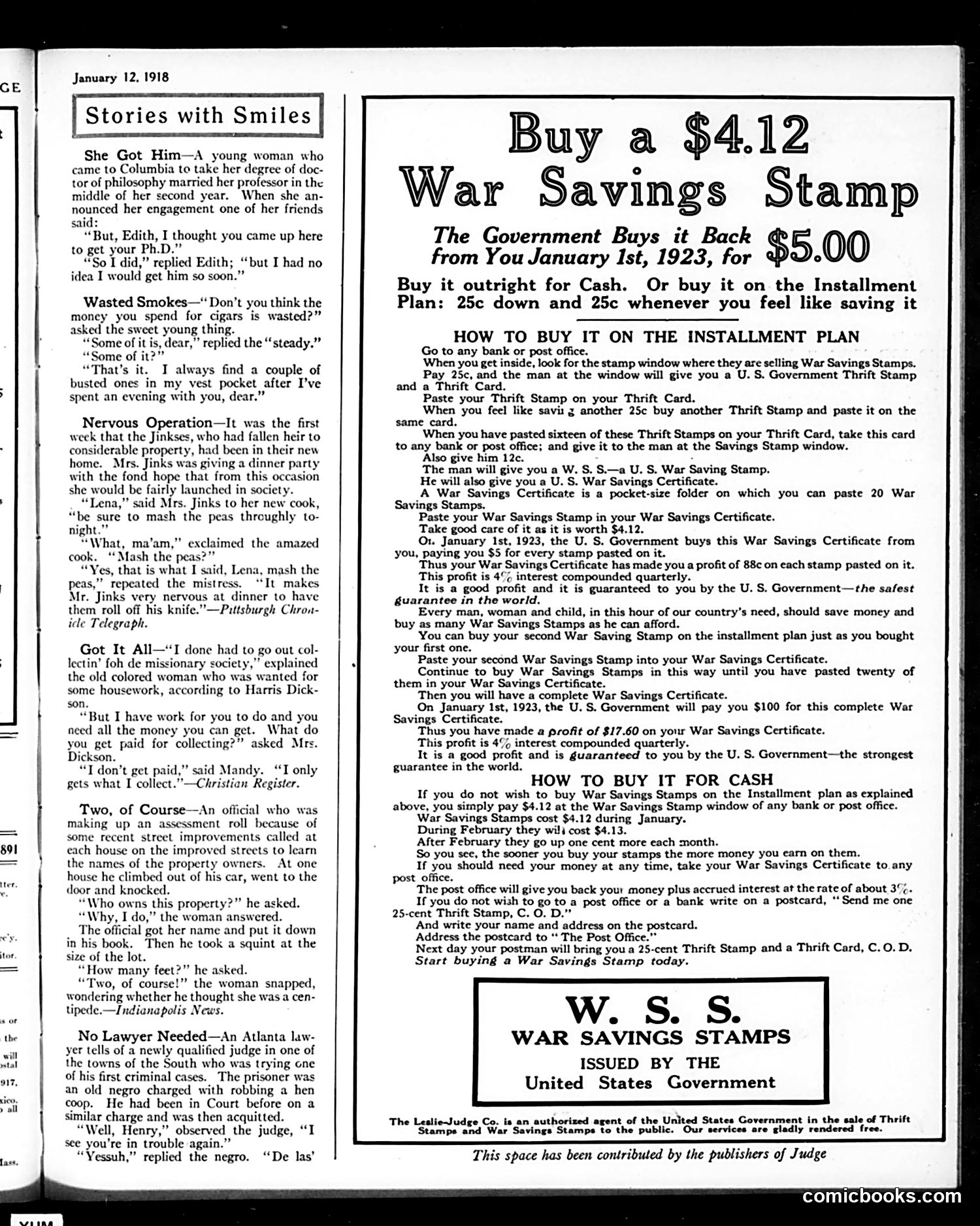
This page from *Judge* (January 12, 1918) is primarily an advertisement promoting U.S. War Savings Stamps during World War I, not political satire. The left column contains lighthearted humor pieces unrelated to the ad. The advertisement explains the government's installment plan for purchasing War Savings Stamps—$4.12 invested now would be redeemed for $5.00 in January 1923, guaranteeing 4% interest. Citizens could buy stamps incrementally (25 cents at a time) through banks and post offices, accumulating sixteen stamps on a Thrift Card to exchange for a War Savings Certificate. This was a patriotic financial instrument encouraging Americans to fund the war effort while earning modest returns. The detailed instructions reflect the government's systematic approach to civilian war financing during America's involvement in WWI (1917-1918). The humor pieces are simply filler content typical of magazine layouts from this era.
📄 Transcribed text from this page (OCR, searchable)
Machine-transcribed from the original scan — historical spelling and the odd misread are preserved.
January 12, 1918 Stories with Smiles She Got Him—A young woman who came to Columbia to take her degree of doc- tor of philosophy married her professor in the middle of her second year. When she an- nounced her engagement one of her friends said: “But, Edith, I thought you came up here to get your Ph.D.” “So I did,” replied Edith; “but I had no idea I would get him so soon.” Wasted Smokes—* Don’t you think the money you spend for cigars is wasted?” asked the sweet young thing. Some of it is, dear,” replied the “steady.” Some of it?” “That’s it. I always find a couple of busted ones in my vest pocket after I’ve spent an evening with you, dear.” Nervous Operation—It was the first week that the Jinkses, who had fallen heir to considerable property, had been in their new home. Mrs. Jinks was giving a dinner party with the fond hope that from this occasion she would be fairly launched in society. “Lena,” said Mrs. Jinks to her new cook, “be sure to mash the peas throughly to- night.”” “What, ma’am,” exclaimed the amazed cook. ‘Mash the peas?” “Yes, that is what I said, Lena, mash the peas,” repeated the mistress. “It makes Mr. Jinks very nervous at dinner to have them roll off his knife.”"—Pittsburgh Chron- ide Telegraph. “T done had to go out col- onary society,” explained the old colored woman who was wanted for some housework, according to Harris Dick- son. “But I have work for you to do and you need all the money you can get. What do you get paid for collecting?” asked Mrs. Dickson. “T don’t get paid,” said Mandy. “TI only gets what I collect.” —Christian Register. Two, of Course—An official who was making up an assessment roll because of some recent street improvements called at cach house on the improved streets to learn the names of the property owners. At one house he climbed out of his car, went to the door and knocked. “Who owns this property?” he asked. “Why, I do,” the woman answered. The official got her name and put it down in his book. Then he took a squint at the size of the lot. “How many feet?” he asked. “Two, of course!” the woman snapped, wondering whether he thought she was a cen- tipede.—Indiana polis News. No Lawyer Needed—An Atlanta law- yer tells of a newly qualified judge in one of the towns of the South who was trying one of his first criminal cases. The prisoner was an old negro charged with robbing a hen coop. He had been in Court before on a similar charge and was then acquitted. “Well, Henry,” observed the judge, “I see you're in trouble again.” “Yessuh,” replied the negro. “De las’ Buy a $4.12 War Savings Stamp The Government Buys it Back from You January Ist, 1923, for $5.00 Buy it outright for Cash. Or buy it on the Installment Plan: 25c down and 25c whenever you feel like saving it HOW TO BUY IT ON THE INSTALLMENT PLAN Go to any bank or post office. When you get inside, look for the stamp window where they are selling War Savings Stamps. Pay 25c, and the man at the window will give you a U. S. Government Thrift Stamp and a Thrift Card. Paste your Thrift Stamp on your Thrift Card. When you feel like savi: g another 25c buy another Thrift Stamp and paste it on the same card. When you have pasted sixteen of these Thrift Stamps on your Thrift Card, take this card to any bank or post office; and give it to the man at the Savings Stamp window. Also give him 12c. : The man will give you a W. S. S.—a U. S. War Saving Stamp. He will also give you a U. S. War Savings Certificate. A War Savings Certificate is a pocket-size folder on which you can paste 20 War Savings Stamps. Paste your War Savings Stamp in your War Savings Certificate. Take good care of it as it is worth $4.12. O1. January Ist, 1923, the U. S. Government buys this War Savings Certificate from you, paying you $5 for every stamp pasted on it. ‘Thus your War Savings Certificate has made you a profit of 88c on each stamp pasted on it. This profit is 4% interest compounded quarterly. It is a good profit and it is guaranteed to you by the U. S. Government—the safest Guarantee in the world. Every man, woman and child, in this hour of our country’s need, should save money and buy as many War Savings Stamps as he can afford. You can buy your second War Saving Stamp on the installment plan just as you bought your first one. Paste your second War Savings Stamp into your War Savings Certificate. Continue to buy War Savings Stamps in this way until you have pasted twenty of them in your War Savings Certificate. Then you will have a complete War Savings Certificate. On January Ist, 1923, the U. S. Government will pay you $100 for this complete War Savings Certificate. Thus you have made a profit of $17.60 on your War Savings Certificate. This profit is 4% interest compounded quarterly. It is a good profit and is guaranteed to you by the U. S. Government—the strongest guarantee in the world. HOW TO BUY IT FOR CASH If you do not wish to buy War Savings Stamps on the Installment plan as explained above, you simply pay $4.12 at the War Savings Stamp window of any bank or post office. War Savings Stamps cost $4.12 during January. During February they wili cost $4.13. After February they go up one cent more each month. So you see, the sooner you buy your stamps the more money you earn on them. If you should need your money at any time, take your War Savings Certificate to any post office. The post office will give you back your money plus accrued interest at the rate of about 3%. If you do not wish to go to a post office or a bank write on a postcard, ‘‘ Send me one 25-cent Thrift Stamp, C. O. D.” And write your name and address on the postcard. Address the postcard to ‘ The Post Office.” t Next day your postman will bring you a 25-cent Thrift Stamp and a Thrift Card, C.O. D. Start buying a War Savings Stamp today. W. S. S. WAR SAVINGS STAMPS ISSUED BY THE United States Government ‘The Lealie-Judge Co. | thorized agent of the United States Government in the sale of Thrift * "Stamps and War Savings Stamps to the public. Our services are gladly rendered free. This space has been contributed by the publishers of Judge comicbooks.com